Revelation 17:7

Greek (Tischendorf 8th ed.) Revelation 17:7 appears in the Greek New Testament. The text above is from the Tischendorf 8th edition. Each word links to its Strong’s number and a concise gloss. Click any word for its full Thayer’s Greek Lexicon entry.
Download image
Cite this verse

Revelation 17:7 (World English Bible). Public Domain. Lemma interlinear Bible study tool, https://lemma.gebible.app/v/revelation/17/7.

Show BibTeX & RIS
BibTeX
RIS
English Translation
The angel said to me, "Why do you wonder? I will tell you the mystery of the woman, and of the beast that carries her, which has the seven heads and the ten horns.
World English Bible · Public Domain
Download a study sheet

One document with this verse’s original text, its word-by-word gloss line, the meaning frame, cross-references with their text, attributed commentary, and full source and license credits — printable, and it pastes into notes with its structure intact.

This verse Autodidact and up

Study sheet (.html) Plain text (.txt)

A passage Seminary Student

Up to 50 verses in one chapter. A passage sheet keeps up to 6 commentary sources and 12 cross-references per verse, in the order this page ranks them, and says so on the sheet whenever that leaves anything out. Ask for a single verse and you get the Autodidact verse sheet above.

Everything on this page stays free to read, with no account — the sheet is a download of what is already on screen, not access to it.

Want to remove ads? Support Godless Engineer
Compare translations 3

The same verse in 3 English versions, stacked beneath the original-language interlinear above. Click any original word for its lexicon entry.

Each is an independent rendering of the whole verse — the interlinear is not word-aligned to these translations.

Highlighted words mark where these versions differ — a whole-verse word diff, not a word-by-word alignment.

  • World English Bible Public Domain
    The angel said to me, "Why do you wonder? I will tell you the mystery of the woman, and of the beast that carries her, which has the seven heads and the ten horns.
  • King James Version Public Domain
    And the angel said unto me, Wherefore didst thou marvel? I will tell thee the mystery of the woman, and of the beast that carrieth her, which hath the seven heads and ten horns.
  • unfoldingWord Literal Text CC BY-SA 4.0
    But the angel said to me, “Why are you wondering? I will tell to you the mystery of the woman and of the beast carrying her having the seven heads and the ten horns.

unfoldingWord Literal Text — © unfoldingWord, licensed CC BY-SA 4.0. Word-aligned USFM3 via Door43 (git.door43.org/unfoldingWord/en_ult).

Versions to compare (up to 4)

3 of 4 selected

Show all 19 translations

Every available English version of this verse, each an independent rendering of the whole verse.

  • World English Bible Public Domain
    The angel said to me, "Why do you wonder? I will tell you the mystery of the woman, and of the beast that carries her, which has the seven heads and the ten horns.
  • Berean Standard Bible Public Domain
    “Why are you so amazed?” said the angel. “I will tell you the mystery of the woman and of the beast that carries her, which has the seven heads and ten horns.
  • Majority Standard Bible Public Domain
    “Why are you so amazed?” said the angel. “I will tell you the mystery of the woman and of the beast that carries her, which has the seven heads and ten horns.
  • King James Version Public Domain
    And the angel said unto me, Wherefore didst thou marvel? I will tell thee the mystery of the woman, and of the beast that carrieth her, which hath the seven heads and ten horns.
  • American Standard Version (1901) Public Domain
    And the angel said unto me, Wherefore didst thou wonder? I will tell thee the mystery of the woman, and of the beast that carrieth her, which hath the seven heads and the ten horns.
  • Revised Version (1885) Public Domain
    And the angel said unto me, Wherefore didst thou wonder? I will tell thee the mystery of the woman, and of the beast that carrieth her, which hath the seven heads and the ten horns.
  • Geneva Bible (1599) Public Domain
    Then the Angel saide vnto me, Wherefore marueilest thou? I will shewe thee the misterie of that woman, and of that beast, that beareth her, which hath seuen heads, and tenne hornes.
  • Douay-Rheims (1899) Public Domain
    And the angel said to me: Why dost thou wonder? I will tell thee the mystery of the woman, and of the beast which carrieth her, which hath the seven heads and ten horns.
  • Young's Literal Translation Public Domain
    and the messenger said to me, `Wherefore didst thou wonder? I -- I will tell thee the secret of the woman and of the beast that `is' carrying her, which hath the seven heads and the ten horns.
  • Literal Standard Version CC BY-SA 4.0
    and the messenger said to me, “For this reason did you wonder? I will tell you the secret of the woman and of the beast that [is] carrying her, which has the seven heads and the ten horns.
  • Unlocked Literal Bible CC BY-SA 4.0
    But the angel said to me, “Why are you astonished? I will explain to you the meaning of the woman and of the beast that is carrying her, the beast that has the seven heads and the ten horns.
  • unfoldingWord Literal Text CC BY-SA 4.0
    But the angel said to me, “Why are you wondering? I will tell to you the mystery of the woman and of the beast carrying her having the seven heads and the ten horns.
  • Darby Bible Public Domain
    And the angel said to me, Why hast thou wondered? *I* will tell thee the mystery of the woman, and of the beast which carries her, which has the seven heads and the ten horns.
  • World Messianic Bible Public Domain
    The angel said to me, “Why do you wonder? I will tell you the mystery of the woman and of the beast that carries her, which has the seven heads and the ten horns.
  • Webster's Bible Public Domain
    And the angel said to me, Why didst thou wonder? I will tell thee the mystery of the woman, and of the beast that carrieth her, which hath the seven heads and ten horns.
  • Free Bible Version CC BY-SA 4.0
    The angel asked me, “Why were you amazed? I will explain to you the mystery of the woman and the beast she rode which has seven heads and ten horns.
  • Bible in Basic English Public Domain
    And the angel said to me, Why were you surprised? I will make clear to you the secret of the woman, and of the beast on which she is seated, which has the seven heads and the ten horns.
  • Text-Critical English NT CC BY 4.0
    But the angel said to me, “Why are yoʋ so amazed? I will tell yoʋ the mystery of the woman and of the beast with seven heads and ten horns that carries her.
  • Tyndale New Testament (1534) Public Domain
    And the angell sayde vnto me: wherfore mervayllyst thou? I wyll shewe the the mistery of the woman and of the best that berith her which hath seven heddes and ten hornes.

Literal Standard Version (2020), Covenant Press — licensed CC BY-SA 4.0. Text via the HelloAO Bible API (eBible.org). Unlocked Literal Bible (unfoldingWord) — licensed CC BY-SA 4.0. Text via the HelloAO Bible API (eBible.org). unfoldingWord Literal Text — © unfoldingWord, licensed CC BY-SA 4.0. Word-aligned USFM3 via Door43 (git.door43.org/unfoldingWord/en_ult). Free Bible Version, Dr. Jonathan Gallagher — licensed CC BY-SA 4.0. Text via the HelloAO Bible API (eBible.org).

Word by word

More ways to search: Search by grammar → Find every occurrence → Compare this word →

Practice this passage: Drill this verse → Learn its vocabulary →

κέρατα
kéras
G2768
“horn”
Noun, Accusative, Plural, Neuter
Part of Speech
Noun
Case
Accusative
Number
Plural
Gender
Neuter
Full Thayer's Definition

Origin: from a primary kar (the hair of the head)

TDNT: 14:09,4

1. a horn a. of animals b. since animals (esp. bulls) defend themselves with their horns, the horn with the Hebrews (and other nations) is a symbol of strength and courage, and used as such in a variety of phrases 1. a mighty and valiant helper, the author of deliverance, of the Messiah c. a projecting extremity in a shape like a horn, a point, apex: as of an altar
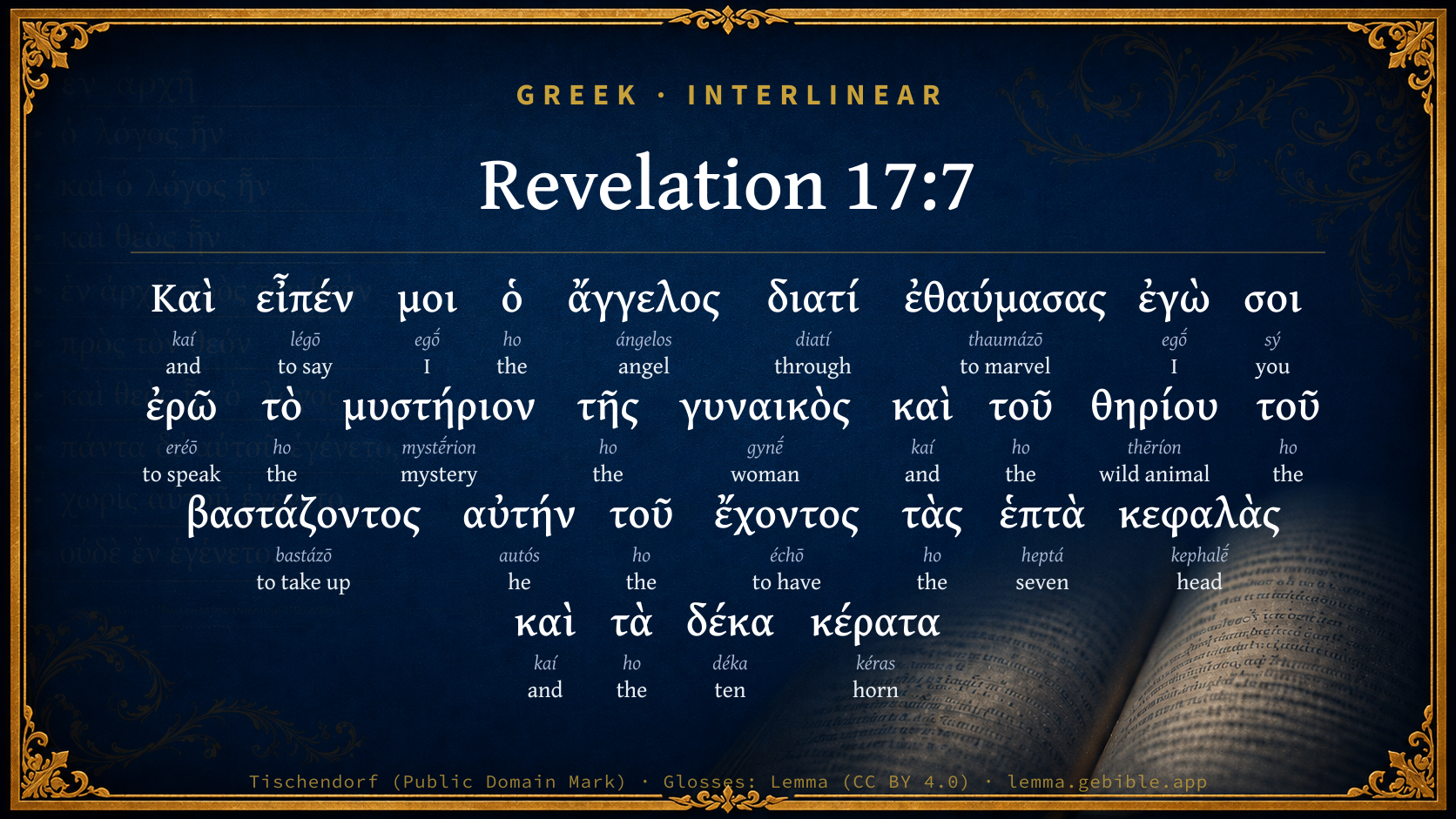
  1. Καὶ kaí G2532 “and” Conjunction
  2. εἶπέν légō G3004 “to say” Verb, Aorist, Active, Indicative, 3rd person, Singular
  3. μοι egṓ G1473 “I” Personal pronoun, 1st person, Dative, Singular
  4. ὁ ho G3588 “the” Article, Nominative, Singular, Masculine
  5. ἄγγελος ángelos G32 “angel” Noun, Nominative, Singular, Masculine
  6. διατί diatí G1302 “through” Particle, Interrogative
  7. ἐθαύμασας thaumázō G2296 “to marvel” Verb, Aorist, Active, Indicative, 2nd person, Singular
  8. ἐγὼ egṓ G1473 “I” Personal pronoun, 1st person, Nominative, Singular
  9. σοι sý G4771 “you” Personal pronoun, 2nd person, Dative, Singular
  10. ἐρῶ eréō G2046 “to speak” Verb, Future, Active, Indicative, 1st person, Singular
  11. τὸ ho G3588 “the” Article, Accusative, Singular, Neuter
  12. μυστήριον mystḗrion G3466 “mystery” Noun, Accusative, Singular, Neuter
  13. τῆς ho G3588 “the” Article, Genitive, Singular, Feminine
  14. γυναικὸς gynḗ G1135 “woman” Noun, Genitive, Singular, Feminine
  15. καὶ kaí G2532 “and” Conjunction
  16. τοῦ ho G3588 “the” Article, Genitive, Singular, Neuter
  17. θηρίου thēríon G2342 “wild animal” Noun, Genitive, Singular, Neuter
  18. τοῦ ho G3588 “the” Article, Genitive, Singular, Neuter
  19. βαστάζοντος bastázō G941 “to take up” Verb, Present, Active, Participle, Genitive, Singular, Neuter
  20. αὐτήν autós G846 “he” Personal pronoun, Accusative, Singular, Feminine
  21. τοῦ ho G3588 “the” Article, Genitive, Singular, Neuter
  22. ἔχοντος échō G2192 “to have” Verb, Present, Active, Participle, Genitive, Singular, Neuter
  23. τὰς ho G3588 “the” Article, Accusative, Plural, Feminine
  24. ἑπτὰ heptá G2033 “seven” Adjective, Numeral (indeclinable)
  25. κεφαλὰς kephalḗ G2776 “head” Noun, Accusative, Plural, Feminine
  26. καὶ kaí G2532 “and” Conjunction
  27. τὰ ho G3588 “the” Article, Accusative, Plural, Neuter
  28. δέκα déka G1176 “ten” Adjective, Numeral (indeclinable)

About this verse

These counts appear in no published source. They are computed here, from the morphology-tagged text and Lemma’s own curated glosses. What Lemma adds →

29
words
19
distinct lemmas
Revelation
section

Notable vocabulary

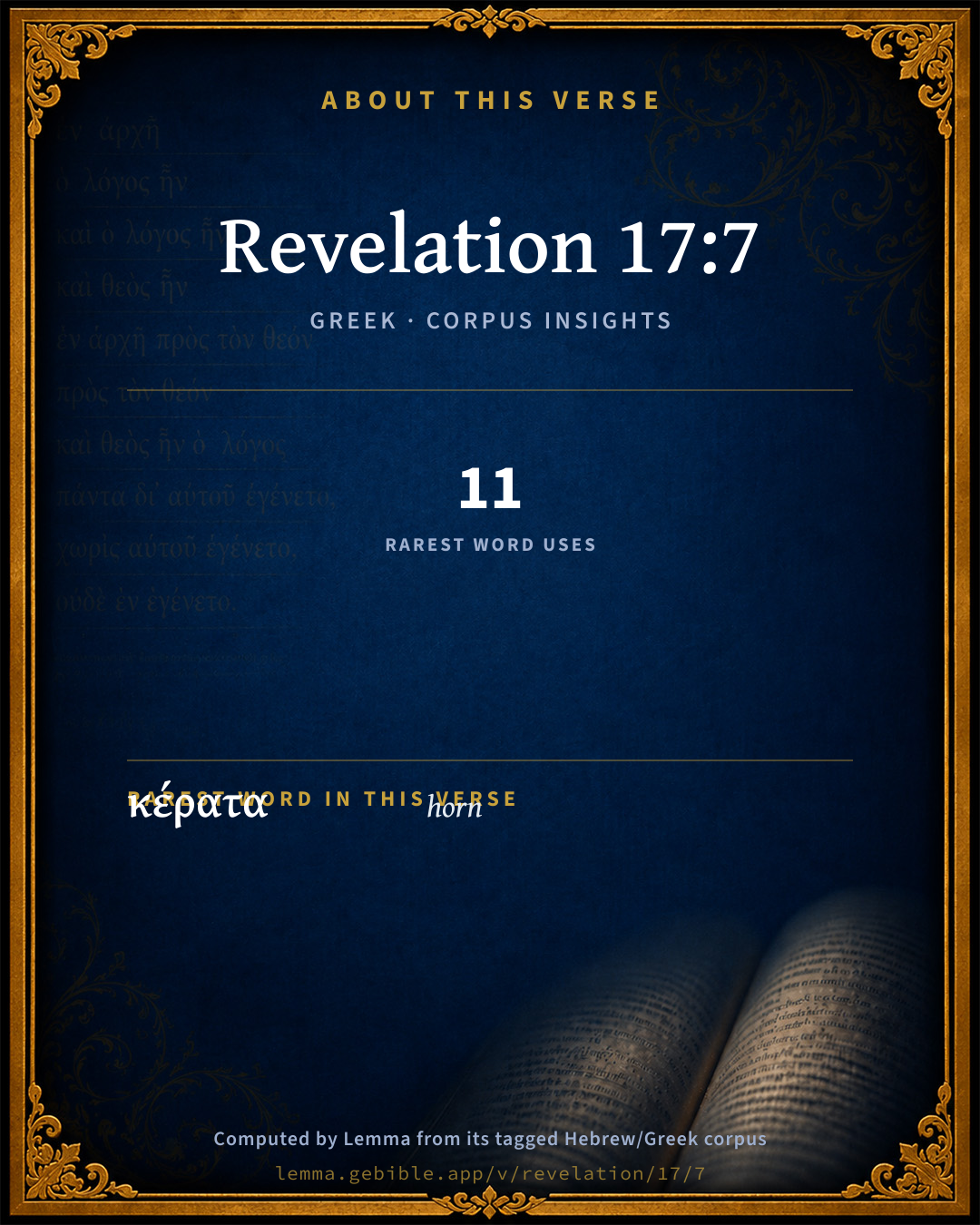
The rarest word here is κέρατα horn G2768 — appearing just 11 times in the whole Greek New Testament.

Shared distinctive vocabulary

κέρατα horn G2768 occurs in 10 verses of the Greek New Testament. Also found in:

Repetition

Words recur within this verse:

Cross-references

2

Topical passages linked to Revelation 17:7 in the Treasury of Scripture Knowledge — connected by theme and wording, ordered by reader-vote popularity; previews shown in the World English Bible.

  • Revelation 17:1–6 One of the seven angels who had the seven bowls came and spoke with me, saying, "Come here. I will show you the judgment of the great prostitute who sits on many waters,
  • Revelation 17:8 The beast that you saw was, and is not; and is about to come up out of the abyss and to go into destruction. Those who dwell on the earth and whose names have not been written in the book of life from the foundation of the world will marvel when they see that the beast was, and is not, and shall be present.

Cross-references courtesy of OpenBible.info (CC BY 4.0).

Commentary

Notes on Revelation 17:7 from classic Christian and Jewish commentators (each source and its license shown beneath its notes). The classic Christian expositions comment on the surrounding passage and are grouped to its opening verse, so a note may address several verses; the Jewish commentaries on the Tanakh (Rashi and others) are per-verse, so they appear only where the commentator wrote on this verse.

Lemma curates 59 commentaries, every one of them public domain or Creative Commons licensed, each selected and text-cleaned for this edition rather than reprinted as found. About our sources →

The Cambridge Bible for Schools and Colleges

gen. ed. J. J. S. Perowne

The Interpretation of the Mystery, Rev_17:7-18

7. Wherefore didst thou marvel?] Again the word should be wonder. For the angel’s surprise at the seer not comprehending at once, see on Rev_7:14.

I will tell thee] The “I” is emphatic: “I will tell thee, since thou findest it so strange.”

the mystery] i.e. the mystical meaning: see on Rev_17:5.

of the woman, and of the beast] The latter is explained first, Rev_17:8-14 : the Woman is not clearly defined till Rev_17:18.

The Cambridge Bible for Schools and Colleges (gen. ed. J. J. S. Perowne; Cambridge University Press, 1878–1918) — public domain. Text from a community e-Sword module.

The Biblical Illustrator

Joseph S. Exell

Rev_17:7-14

I will tell thee the mystery of the woman, and of the beast that carrieth her.

A picture of moral error

I. Its history is marvellous.

1. On account of the darkness that enfolds its introduction.

2. On account of the mask under which it works.

3. On account of the wonderful issues that will result from it.

II. Its course is lamentable.

1. It rises from the bottomless pit--the fathomless abysses of impure lusts, ravenous greed, burning ambition, sensual yearnings, impious irreverences, blasphemous assumptions, etc.

2. It leads to perdition--ruin.

III. Its supports are unstable. Many of the arguments that have sustained it from time to time have appeared as settled and imposing as mountains, as gorgeous and majestic as kings; but mountains have fallen and come to nought, and even imperial bulwarks have disappeared as visions of the night. So it has been, so it is, and so it must be to the end. (D. Thomas, D. D.)

These shall make war with the Lamb, and the Lamb shall overcome them.

War and conquest

I. The opposing forces. Look abroad upon the earth. What a pandemonium of vice and crime, injustice and cruelty, heathenism and superstition it is. Oh, how mighty and multiplied the antagonist hosts! They are mustered and marshalled; they are eager for the strife of the battle, they confront us at every step; and the great question is this, Can they be overcome? Must we lay down our arms in despair! Is the world to become no better?

II. The opposing forces vanquished. The Lamb will overcome them.

1. By the interpositions and changes of Providence. God has a purpose, the world is to be converted, and all things are working to accomplish that end; but Gods way is in the sea, and His path in the mighty waters; He is the real, though invisible, ruler, both of matter and of mind. The laws of providence are just as Divine in their appointments and results as the laws of nature. All things work to usher in the day predicted by the angels song, Glory to God in the highest, and on earth peace, goodwill toward men.

2. By the preaching of His own truth and the outpouring of His Holy Spirit. Preaching is the appointment of heaven.

3. By the indomitable zeal and energy of His own followers. As the conflict advances, one shall chase a thousand and two shall put ten thousand to flight. In all ages God has carried on His work by the zeal, energy, and courage of His faithful servants. He did it even in the ages of miracles, He will do it till the world is saved; and why shrink from the task His benevolence appoints? Have we had no success? Did not Wesley and Whitfield arouse all England and North America to the worth of the gospel and the importance of eternal things? Are we faithful to the cause of the Lamb? Might He not reproach us for our doubts and fears? Where is the faith which wrought those moral wonders in the apostolic age? (W. S. Edwards.)

The Royal Christ

A Lamb, and yet Lord of lords, and King of kings. The ideas seem incongruous. How, then, is the Lamb this?

1. By rightful authority. Though Son of Man, He is also Son of God (cf. Psa_2:1-12.)

2. By virtue of His sacrifice (chap. 4.; cf. Php_3:1-21.), Therefore hath God highly exalted Him, and, etc.

3. By the might of meekness. See how at His nativity the shepherds were told they should see the Saviour, Christ the Lord. Meekness is might, sacrifice is sovereignty, losing life is gaining it; the cross creates the crown.

4. By the consent of conscience.

5. By the grace he imparted to His people. Their patient continuance in well-doing put to silence all their foes.

6. In His people. They that are with Him. The Revised Version rightly renders St. Johns words, They also shall overcome that are with Him, called, chosen, faithful. St. John does not teach that the Lamb was indebted to them for this victory as a general is indebted to his army. They are--

(1) Called.

(2) Chosen. But thus we may know if we be chosen:

(3) If we be of those who are faithful. Called we are; chosen we may be.

II. faithful, then we are of the chosen too; and this, and this only, is the proof. (C. Conway, B. A.)

The great moral campaign

I. The contending forces.

1. The one is represented as a beast. Emblem of the mighty aggregate of wrong in all its elements and operations: wrong in theories and in institutions, wrong in sentiments and habits, wrong as imposing as seven mountains and as majestic as kings or empires, wrong sitting as empress over all nations and peoples and tongues.

2. The other is represented as a Lamb--emblem of innocence, mildness, and purity.

II. The marvellous conquest.

1. The conqueror. The Lamb, though not a bellicose existence, is

(1) Invested with the highest authority.

(2) Followed by a noble army.

2. The conquered. (D. Thomas, D. D.)

The overcoming Lamb

I. The person mentioned. He is not a lamb, but the Lamb. He is the great universal Lamb, causing the blood which He shed to spread itself, as it were, all over the world, so that every sinner might touch it and be saved from his sins.

II. What He shall overcome. All opposers, both nations and individuals.

III. How He shall overcome His opposers. There are two general methods--

1. That of using certain means to persuade rebellious hearts to become reconciled to God. His greatest effort has always been to overcome by the passion of His love.

2. That of final banishment from His presence. Oh, what can feeble man do against such an all-powerful being as Christ is? How utterly vain have been the threats of infidels, that they would banish Him from the world. (C. H. Wetherbe.)

And they that are with Him are called, and chosen, and faithful.--

The army of the Lamb

This is a description of the best appointed army that was ever brought into the field--the army of Christ Jesus. It has been the presumptuous boast of many earthly generals that their soldiers were invincible--such as no enemy could overthrow. This may, however, be with truth affirmed of this army. They carry, as it were, this inscription on their banners, Conquering and to conquer!

I. The Captain of this host of the Lord. The success of every ordinary army depends mainly, under God, upon the skill and valour of its general. But of this spiritual army it may with truth be said that every hope of victory they have arises altogether from Him who leads them to the battle. They have an Almighty leader at their head, One whose presence insures victory to all His followers. In the former part of the verse this Captain of the Lords host is called by two different titles, which seem, at first sight, scarcely reconcilable.

1. One of these titles is, the Lamb--a name which might seem, at first, little suited to the leader of an army. But what does the term signify in the case of Him to whom it is applied? Not that He is weak and feeble as the tender animal which bears this name. But He is a Lamb in reference to the death He died for His people, when He was led as a Lamb to the slaughter, and as a sheep is dumb before its shearers so He opened not His mouth. It is a title, too, of endearment. The Lamb is not more meek and gentle than He is to His faithful followers.

2. But if the epithet Lamb represents His gentleness and tenderness towards His people and the death which He has died for them, He has another name which describes, as strikingly, His majesty and power--Lord of lords and King of kings.

II. His soldiers. They that are with Him are called, and chosen, and faithful.

1. They are called--just as the soldiers of an earthly army are enlisted for the service. The soldiers of an earthly warfare were called into the ranks they fill from very different occupations: some from the shop, some from the plough. Christs soldiers, too, were very differently occupied when the call of grace was given them. They were then mere children of the world, fulfilling the desires of the flesh and of the mind--each busily occupied in his own favourite and cherished sins. Various, too, were the circumstances under which the call was given to them, and various the means employed by the great Captain of salvation to make them hear that call. But in every case it was the Saviours Follow Me! which brought His soldiers to His side.

2. They are not called only, but chosen. There is a difference, even in earthly armies, between being called and being chosen, between being merely enlisted and being what is called picked men, men in whom the general can place his confidence. Look at Gideons army (Jdg_7:1-7). Two-and-thirty thousand then were called; three hundred only chosen. It is just thus in the camp of Jesus. What multitudes flock into it! But how many of all these become in after life true soldiers of the Cross? Alas! but a small remnant; for many are called, but few are chosen. But they that are really with the Saviour, and who constitute His Church militant here on earth, are, all of them, picked men. Whatever exploits Christs soldiers may perform when they have entered on the fight of faith, by the grace of God they are what they are.

3. They are faithful. The word may be taken in two senses, in each of which it is equally applicable to the armies of the Living God.

(1) They are faithful inasmuch as they are full of faith and confidence in the Captain of their salvation. The soldiers of the Lamb of God place their entire confidence in the Commander whom they follow.

(2) A man is said to be faithful who lives up to his engagements, and who adheres with constancy and perseverance to the person whose service he has undertaken. Faithfulness, in this understanding of the word, is most essential to the character of a good soldier. One part of his faithfulness consists in his remaining true to his commander until he be disbanded or dismissed. To run from his colours, or desert the service of his king and country, is amongst the soldiers greatest crimes. In this point, too, the soldiers of the Lord are faithful. They follow the Lamb whithersoever He goeth, and nothing shall ever separate them from His love and from His service. (A. Roberts, M. A.)

.

The Biblical Illustrator, edited by Joseph S. Exell (c. 1880s–1900s) — public domain. Text from a community e-Sword module.

Tyndale Open Study Notes

Tyndale Open Resources

17:7 In response to John’s amazement, the angel prepares him to understand the mystery (17:8-14).

Tyndale Open Study Notes — © Tyndale Open Resources, licensed CC BY-SA 4.0. Text via the HelloAO Bible API.

Bengel's Gnomon

Johann Albrecht Bengel

Rev 17:7. Τῆς γυναικὸς—τοῦ θηρίου, of the woman—of the beast) There follows, by Chiasmus, a discussion concerning the beast, Rev 17:8-14; and, with a repetition of the short preface, and he saith to me, a discussion concerning the woman, Rev 17:15-18.

Bengel's Gnomon of the New Testament — English translation (T&T Clark, Edinburgh, 1860) — public domain. Text from a community e-Sword module.

Meyer's Critical & Exegetical Commentary

Heinrich August Wilhelm Meyer

Rev_17:7-14. The question of the angel, διὰ τί ἐθαύμασας, introduces the intended interpretation just as the question of the elders (Rev_7:13), only that here the angel expects no answer whatever of John, but immediately himself promises: ἐγὼ ἐρῶ σοι τὸ μυστήριον, κ.τ.λ. This announcement marks that the two chief forms, the woman and the beast, which of course are explained each by themselves,as they symbolize subjects that are actually different, the world-city and the world-kingdom,nevertheless belong together essentially; there is but one mystery, the mystery of the woman and of the beast. Although the woman and the beast are distinguished, the present description remains, therefore, in essential agreement with that of ch 13. Nevertheless, the inner connection between the woman and the beast is expressed by the fact that the woman is seated upon the beast, (τ. βασταζ αὐτ., cf. Rev_17:3.) In perfect harmony with this is the circumstance that the beast is first (Rev_17:8) explained, and only then, that which is more special, which is first received from that further conception, the form of the woman.

Of the beast which John saw (Rev_17:3 sqq.), it is said: ἡν καὶ οὐκ ἔστιν καὶ μέλλει ἀναβαίνειν ἐκ τῆς ἀβύσσου, κ.τ.λ., and this is again expressed as a foundation for the astonishment of the inhabitants of the earth:[3848] ἡν καὶ οὐκ ἔστιν καὶ πάρεσται. This summary πάρεσταιwhich simply means shall be, but in which an intimation of a parousia of the beast, to be opposed to the parousia of the Lord,[3849] dare be sought the less as the expression παρουσία is lacking in the Apoc.briefly comprehends what was previously described in such a way that also the last end of the beast again coming forth might be designated therewith (καὶ μέλλει ἀναβ.

ὑπαγει). Finally, the important point of the interpretationwhich, of course, is not itself without mystery, but is given after the manner of Rev_13:18, because of which, also, just as there, the allusion (Rev_17:9) is justified, in that it here pertains to an understanding endowed with wisdomrecurs for the third time in Rev_17:11, where, notwithstanding the more minute determination that the beast is to return in the person of a true king, yet the identity of the subject is unmistakably designated by the formulas ὃ ἡν καὶ οὐκ ἔστιν and καὶ εἰς ἀπώλειαν ὑπάγει. That explanation, therefore, is utterly mistaken, which understands the beast (Rev_17:11) differently from in Rev_17:8 (and Rev_17:3); in no way is the distinction possible that τὸ θηρίον is at one time Satan himself, and directly afterwards antichrist.[3850] For the more accurate explanation of the subject; see on Rev_17:10; Rev_17:18. In phraseology, the genitive βλεπόντων in Rev_17:8 is remarkable. Entirely similar is the construction neither of Luk_8:20,where the absolute gen. λεγόντων is in meaning construed with the impersonal ἀπηγγέλη,nor of Mat_1:18,[3851] where the absolute genitive construction μνηστευθείσης τῆς μητρός precedes, and then, by a variation of construction, the subject is derived entirely from the first member (εὑρέθη ἐν γαστρὶ ἕχουσα), which is not modified by the parenthetical limitation πρὶν ἤ συνελθεἰν αὐτους. In this passage, however, the definite subject οί κατοικοῦντες precedes, and the clause βλεπ. τ. θηρ. explains what is predicated of those κατοικοῦντες (θαυμασθήσονται), so that, according to the symmetry of the construction, only the nom. βλἑποντες can be expected; but the gen. is occasioned by the gen. parenthetical clause ὡν, κ.τ.λ., even though it dare not also be said that the βλεπόντων, κ.τ.λ., is expressly construed into the relative clause.[3852] The nearest indication given within ch. 17,which is also in harmony with ch. 13,for the understanding of what is said concerning the beast in Rev_17:8 (and Rev_17:11), lies in Rev_17:9 sq., where the seven heads of the beast are interpreted: The seven heads are seven mountains on which the woman sitteth, and there are seven kings.[3853] The seven heads, therefore, which in Rev_12:3, Rev_13:1 sqq.,where they appeared adorned with crowns,indicated royal sovereigns, receive here a twofold reference:[3854] thereby both seven mountains and seven kings are to be understood. In connection with the heads appearing here without crowns, the first reference is without difficulty; while the other to the seven kings, which indeed is not indicated here by crowns, nevertheless finds an essentially identical foundation with Rev_13:1 sqq. in the description of the regal magnificence of the woman who sits upon the beast with seven heads. But at the same time, the reference to the seven mountains on which the woman sits serves to interpret the mystery of the woman and of the beast; for if, by the woman, the city mistress of the world (Rev_17:8), of the Gentile empire forcing all inhabitants of the earth beneath her, be meant, and this city is designated as lying on seven hills, this significant point of the interpretation can be referred only to the seven-hilled city, to Rome, just as what is said (Rev_17:8; Rev_17:10-11) concerning the relations of the βασιλεῖς, in complete harmony with Rev_12:3, Rev_13:1 sqq., applies only to the Roman rulers of the world. Mysteriously, therefore, as this interpretation sounds, yet the first reference of the seven heads to the seven well-known mountains has been made prominent with the manifest intent to actually attest the interpretation promised in Rev_17:7.

Accordingly the seven hills are not themselves taken into further consideration; the interpretation stops (Rev_17:10 sq.) with the seven kings. The transferal, already mentioned on Rev_12:3 and Rev_13:1 sqq., of the textual idea of seven ΒΑΣΙΛΕῖς, i.e., of seven persons who possess a kingdom, and that, too, the dominion of the world, to that of seven kingdoms or phases of the dominion of the world, depends, in Andr. and Beda, as well as in Hofmann, Ebrard, Hengstenb., and Auberlen,[3855] upon the presumption that the temporal-historical explanation of Hammond, Grot., Wetstein, Eichhorn, Ewald, Lücke, De Wette, Bleek, etc., removes the biblical conception of Apocalyptic prophecy.[3856] That this opposition is justified in one chief point, has been already referred to on Rev_13:3; but exegetically incorrect, and without foundation in a further theological respect to the idea of prophetical inspiration, is the opposition to the acknowledgment of the fact that the entire force of the context allows the βασιλείς to be regarded only as concrete personalities, and then, that the form in general of the antichristian world-power hovering before the prophetic gaze is that of the heathen-Roman Empire. The first has been correctly understood, e.g., by Coccejus, whom Auberlen certainly will not accuse of the temporal-historical exposition of the Apoc., and has turned it to the advantage of his ecclesiastical-historical exposition: The seven kings, says Coccejus, are the primates of the churches of Alexandria, Jerusalem, Antioch, Constantinople, Rome, France, and Spain. On the other hand, however, many temporal-historical expositors cross over into the sphere of the ecclesiastical-historical, by finding, especially in Rev_17:12; Rev_17:16, predictions concerning the incursions of the Goths, etc.[3857] That the ΒΑΣΙΛΕῖς ἙΠΤΆ are actually, as the expression declares,[3858] seven persons invested with the βασιλεία, results especially from the description, Rev_17:10 (οἱ πέντε

ὁ εἶς

ὁ ἄλλος), and most of all from Rev_17:11, since here the entire sense depends upon the fact that the still future eight kings are contemplated as the human-personal manifestation of the whole beast.

Five of the seven kings are fallen, i.e., dead; the one, therefore the sixth in the series, is, i.e., he at present possesses the βασιλεία, the other, therefore the last of the seven, is not yet come, he is not yet in possession of the βασιλεία, he has not yet made his appearance as βασιλεύς: but he shall come as the seventh, and when he cometh,[3859] he must continue a short space; i.e., his dominion shall soon come to an end.[3860] But the seventh is followed by yet another, the eighth (Rev_17:11), who cannot be symbolized by a particular head on the beast,[3861] because, although connected with the seven (ἐκ τῶν ἑπτά ὲστιν), yet he has a different position from all those; he is not as one in their series, but in his person is the embodiment of the beast himself; he himself is the one in whom the beast rising out of the abyss,[3862] which now is not, shall again appear, of which also it shall then be said, just as Rev_17:8 of the beast as such: εἰς ἀπώλειαν ὑπάγει, i.e., by the judgment at the Lords coming, he shall be delivered to everlasting destruction, and thus with him, then, the beast himself shall perish.

Before the expressions made in Rev_17:8-11 concerning the beast and the seven (eight) kings are explained by their combination with one another, and with what is contained in Rev_13:1 sqq., the meaning of the phrase καὶ ἐκ τῶν ἑπτά ἐστιν must be established. Hengstenb.s explanation is incorrect: His fate is that of the seven, viz., he must fall, he goes to ruin. Too general is the explanation that the eighththe eighth kingdom, as it is saidis to be of the same nature as the seven.[3863] But, on the other hand, the explanation which forms a decisive point in Ewald, De Wette, Volkm., Hilgenf., and the other expositors, who in the eighth king recognize the returned Nero,[3864] is not compatible with the words of the text. The formula ἐκ τῶν ἑπτά ἐστιν is supposed to declare: He is one of the seven. He has thus, and that, too, as one of the five fallen, already once existed, and shall return as a true king.[3865] But the more peculiar the idea, the more necessary would its unambiguous expression have been; and this would have been very easy to John; he would have written, according to the linguistic usage altogether customary with him,[3866] καὶ εἶς ἐκ τῶν ἑπτά ἐστιν. The fable of the return of Nero, which, in its actual foundations, must be regarded as far removed from Rev_13:3, is also here unjustified in a simply exegetical respect. Grot., has shown the correct way,[3867] by explaining the ἐκ τῶν ἑπτά ἐστιν with a comparison of Rom_9:10; Mat_1:3; Mat_1:5-6; Luk_1:27 : The son of one of them. It is noticeable also that Andr. was led by his cultivated Greek taste to what is at least in a formal respect a similar explanation: ὡς ἐκ μιᾶς αὐτῶν βλαστάνων. Yet both explanations attempt too much by presupposing a text which must read: ἐξ ἑνὸς τῶν ἑπτά ἐστιν. All that is correct is the acknowledgment that the formula ἐκ τῶν ἑπτά ἐστιν expresses descent from the seven. John does not lay emphasis upon the circumstance that the eighth arose from one of the seven,although this is in fact correct,but that he who to a certain extent, as the personification of the entire beast, corresponds to all seven, has himself his human-personal origin from these seven. The seven in their entirety are therefore contrasted with the eighth, which is the embodiment of the entire beast.[3868]

[3848] Cf. Rev_13:3; Rev_13:8; Rev_13:12.

[3849] Beng.

[3850] Against Beda, Andr., etc.

[3851] Cf. Winer, p. 195.

[3852] Cf. De Wette.

[3853] On the Hebraistic combination of the relative ὅπου with the demonstrative ἐπʼ αὐτῶν, cf. Rev_12:6; Rev_12:14.

[3854] Incorrectly, Hengstenb.: The mountains are here, as everywhere in the Apoc., meant symbolically, as a designation of kingdoms or reigns; so that consequently, by the one symbol, that of the heads, only another symbol, that of the mountains, is symbolized, and so that what is properly meant, viz., βασιλεῖς ἑπτά, should be designated.

[3855] Hofm. and Ebrard enumerate Assyria, Babylon, Persia, Macedonia, Antiochus Epiph., as the five fallen, the Roman as the present sixth kingdom. Hengstenb. and Auberlen enumerate as fallen, Egypt, Assyria, Babylon, Persia, Greece; they also regard the present sixth kingdom as the Roman. At all events, in order to correspond somewhat better with the text (Luthardt), besides the first five kingdoms, their representative sovereigns may also be named (Sennacherib, Nebuchadnezzar, Cyrus, Alexander the Great, Antiochus Epiphanes). But already in the sixth place, Luth. does not mention a definite person, but only the Roman emperor, and then in the seventh period necessarily finds prefigured the present period of the European system of governments.Klief. explains upon the basis of Auberlen and Hengstenb., interpreting according to Daniel, the seven reigns as the kingdom of ten, with antichrist arising therefrom. This is the Germano-Christian kingdom of ten, by which the Roman Empire, wounded to death, is dissolved, from whose dismemberment then antichrist develops.

[3856] Cf. Introduction, p. 32 sqq.

[3857] Cf. Grot., etc.

[3858] Cf. also Rev_17:12 sqq.: δέκα βασιλεῖς.

[3859] ὅταν; cf. Rev_12:4.

[3860] On the δεῖ, cf. Rev_1:1.

[3861] Against Vitr., who maintains that there is a true head of a beast, and against Hengstenb., who (as also Klief., p. 218) in the seventh head finds at the same time the eighth.

[3862] Cf. Rev_11:7.

[3863] Primas: Lest you regard him of another class, it has been added, He is of the seven. Beng. Cf. also Vitr., etc.

[3864] Cf. Hofm., who refers it to the return of Antiochus Epiphanes; also Luthardt and Ebrard, who, abandoning the idea of any express personality, substitute the restoration of the dynasty of the Seleucidae.

[3865] Cf. Rev_13:3.

[3866] Cf. Rev_5:5, Rev_6:1, Rev_7:13, Rev_13:3, Rev_17:1, Rev_21:9. Cf. also Joh_11:49; Joh_13:21.

[3867] Cf. also Hammond.

[3868] Also against Hilgenf.

The historical illustration of Rev_17:8-11 depends upon the presumption undoubtedly given by the context from ch. 13, ay, already from ch. 12, that the beast is a symbol of the heathen-Roman secular power, and that the βασιλεῖς symbolized by the heads of the beast are not kingdoms, but royal persons, viz., Roman emperors. How these are to be reckoned, is shown from Rev_17:8 and Rev_17:10, with a comparison of Rev_13:3. Ch. 17 (Rev_17:3; Rev_17:7) also recalls the significant distinction between the numbers seven of the heads and ten of the horns, even though a new application be made here of the ten horns. Ch. 17, however, perfectly harmonizes with ch. 13 in the description of the seven heads in themselves, and their relation to the beast. That the beast that was, at present is not,[3869] and yet is, in so far as at present one of his heads, i.e., the sixth βασιλεύς, is, after the five βασιλεῖς are fallen, harmonizes with what is said in Rev_13:3, that one of the heads was wounded to death, but was again healed. But hereby we reach the standpoint from which, looking backward, we enumerate the five fallen rulers with certainty, and at the same time, looking forward, can recognize the seventh and eighth rulers. The enumerations of Hammond and Grotius,[3870] of Wetst.,[3871] and of Rinck,[3872] are, apart from other reasons, incorrect, partly because the subject considered is, in no way, under what individual emperor the Roman secular power shall for the first time be hostilely opposed to the Christians,[3873] and partly because among the seven heads, the three usurpers, Galba, Otho, and Vitellius, indicated by horns,[3874] dare not be reckoned

The enumeration of Roman secular rulers, intended by the writer of the Apocalypse, is not to be determined from the first,so that it could be doubtful whether the series is to be begun with Caesar[3875] or with Augustus,[3876]but from the fifth and sixth, i.e., from the point of time designated as present, in which the mortal wound of one head (viz., the fifth) appears healed, or in which, after five sovereigns have fallen, the sixth is now there. But this description[3877] corresponds with the situation in which the Roman Empire was when Vespasian undertook its control, although he was not yet in indisputable possession of it. Vespasian is therefore the sixth sovereign; before him five have fallen,

Augustus, Tiberius, Caligula, Claudius, and Nero; Titus follows as the seventh; the eighth, in whom the beast himself is embodied, is Domitian.

[3869] Incorrect are all interpretations whereby the concrete historical references to the relations of the Roman Empire are avoided; as, e.g., Andr., who by the θηρίον (Rev_17:8) understands Satan, and explains: by the manifestation, especially by the death, of Christ, the beast is annihilaied. Cf. Beda, C. a Lap., Zeger, etc.Marlorat. and other Protestants interpret: Heathen Rome is gone; Papal Rome is here, but its secular dominion is in itself nothing (οὐκ ἔστιν). Cf. Luthers gloss: The Roman Empire is, and yet is not; for it is not the whole, but, since its fall, has been reproduced by the Pope. He interprets the one (Rev_17:10) as referring to Germany; the short space, to Spain; the beast (Rev_17:11), to Rome; and the ten kings (Rev_17:12), to Hungary, etc. In violation of the context, Weiss, p. 44, explains the idea of the being, with respect to the not being, by the designation of the antichristian nature and power, whence then what is erroneous is inferred.

[3870] 1. Claudius. 2. Nero. 3. Galba. 4. Otho. 5. Vitellius. 6. Vespasian. 7. Titus. 8. Domitian.

[3871] 1. Caesar. 2. Augustus. 3. Tiberius. 4. Caligula. 5. Claudius. 6. Nero. 7. Galba. 8. Otho.

[3872] 1. Caligula. 2. Claudius. 3. Nero. 4. Vespasian. 5. Titus. 6. Domitian. 7. Nero. And this applies likewise as a prophetic indefinite one to the succeeding emperors until the downfall of the Roman Empire.

[3873] Against Hamm., Grot., Rinck.

[3874] Cf. Rev_12:3, Rev_13:1.

[3875] Cf. Sueton., Vitae XII. Caesarum.

[3876] Cf. Tacit., Ann., I. i.; Hist., I. i. Lücke, p. 839.

[3877] Cf. on Rev_13:3.

There is presented, therefore, in Rev_17:10 sqq. a prediction, which definitely announces beforehand certain historical circumstances. For its understanding,[3878] it is to be remarked: 1. The chief points of the predictionviz., that Vespasian should be succeeded by his two sons, Titus as the seventh, Domitian as the eighth ruler; that Titus will remain for a short time; and that Domitian will come forth as a personification of the entire beasthave developed upon the basis of temporal relations present in the prophet in such a way that the prophecy directed to special facts has yet nothing magical or mantic, but remains of an ethical nature. The natural presupposition and accommodation for the ethical genesis of the prophecy was in John the same as in Josephus, as the latter promised the government to Vespasian and his son Tiberius, even before Vespasian had decided to assume the empire.[3879] How extraordinarily Vespasian, and the sons of such men like Otho and Vitellius, were esteemed in every respect, was manifest already ever since the expedition to Britain:[3880] the Syrian expedition had still further increased the reputation and authority of the Flavians. But for the points of the prophecy that Titus, as successor of his father, would reign but for a short time, and that Domitian, proceeding from the seven,a son of Vespasian,would come forth from the abyss as an incarnation of the beast, the natural foundation was already present. Domitians insolent, barbarous, and imperious disposition manifested itself already during the Vitellian war:[3881] it was naturally to be expected that he would be just such a sovereign as he actually afterwards showed himself to be.[3882] John, in prophesying a short reign for Titus, possibly expected what was always impending during his reign;[3883] viz., that Domitian would soon dethrone his brother Titus, and assume the government himself.2. John erred in the expectation, that, with Domitian, the Roman Empire would perish. The singular error proves, of course, a certain imperfection of prophetic character in the writer of the Apocalypse, yet by no means entirely annihilates it. [See Note LXX., p. 386, on ch. Rev_13:2.]

[3878] Cf. Introduction, p. 33 sqq., 39 sqq.

[3879] Josephus, Jewish War, iii. 8.

[3880] Cf. Dio Cassius, Hist. Rom., ed. Jo. Leunclav., p. 736.

[3881] Cf. Sueton., Domit., I.: But he exercised the entire power of his dominion so licentiously, as then already to show what he was to be.

[3882] A pernicions tyrant, Eutrop., II. Rom., VIII. 1; A portion of Nero as to cruelty, Tertullian, Apolog., 5.

[3883] Sueton., Tit., 9: His brother, i.e., Domitian, not ceasing to lay plots for him, but almost avowedly inciting the army, he did venture meditating flight, either to slay or to banish, or to have even in less honor, but, as from the first day of his reign, continued to attest that he was his associate and successor, sometimes beseeching him secretly with tears and prayers, that he at length wished to live in mutual affection with him.

Rev_17:7-18. The interpretation of the angel (Rev_17:1) as to how the vision (Rev_17:1; Rev_17:6) has manifested two chief figures, follows in two paragraphs (Rev_17:7-14 and Rev_17:15-18), which are separated by the formula καὶ λέγει μοι,[3847] repeated in Rev_17:15.

[3847] Cf. the καὶ εἶπεν μοι ὁ ἄγγ., Rev_17:7.

Meyer — Critical and Exegetical Commentary on the New Testament — English translation by Peter Christie, edited by Frederick Crombie (T&T Clark, 1880) — public domain. Text from a community e-Sword module.

Expositor's Greek Testament

ed. W. Robertson Nicoll

Rev 17:7-18 . An explanation of the vision, cautiously but clearly outlining the Nero-saga.

The Expositor's Greek Testament, edited by W. Robertson Nicoll (1897–1910) — public domain. Text from a community e-Sword module.

Geneva Bible (1599)

Geneva Bible translators

The second part or place, as I said, verse 1. The narration of the vision, promised in this verse, and delivered in the verse following. Now there is delivered first a narration of the beast and his story, unto verse 14. After, of the harlot, unto the end of the chap.

Geneva Bible (1599) marginal notes — public domain. Text via Bolls.life.

Matthew Henry's Commentary

Here we have the mystery of this vision explained. The apostle wonders at the sight of this woman: the angel undertakes to open this vision to him, it being the key of the former visions; and he tells the apostle what was meant by the beast on which the woman sat; but it is so explained as still to need further explanation. 1. This beast was, and is not, and yet is; that is, it was a seat of idolatry and persecution; and is not, that is, not in the ancient form, which was pagan; and yet it is, it is truly the seat of idolatry and tyranny, though of another sort and form. It ascends out of the bottomless pit (idolatry and cruelty are the issue and product of hell), and it shall return thither and go into perdition. 2. This beast has seven heads, which have a double signification. (1.) Seven mountains - the seven hills on which Rome stands; and (2.) Seven kings - seven sorts of government. Rome was governed by kings, consuls, tribunes, decemviri, dictators, emperors who were pagan, and emperors who were Christian. Five of these were extinct when this prophecy was written; one was then in being, that is, the pagan emperor; and the other, that is, the Christian emperor, was yet to come, Rev 17:10. This beast, the papacy, makes an eighth governor, and sets up idolatry again. 3. This beast had ten horns; which are said to be ten kings which have as yet received no kingdoms; as yet, that is, as some, shall not rise up till the Roman empire be broken in pieces; or, as others, shall not rise up till near the end of antichrist's reign, and so shall reign but as it were one hour with her, but shall for that time be very unanimous and very zealous in that interest, and entirely devoted to it, divesting themselves of their prerogatives and revenues (things so dear to princes), out of an unaccountable fondness for the papacy.

Matthew Henry's Commentary on the Whole Bible (1708–1710) — public domain (CC PDM 1.0). Text via the HelloAO Bible API.

Adam Clarke's Commentary

Verse 7. And the angel said unto me, Wherefore didst thou marvel! I will tell thee the mystery of the woman, and of the beast that carried her, which hath the seven heads and ten horns.] The apostle was greatly astonished, as well he might be, at the woman's being drunk with the blood of the saints, when the beast which carried her abounded with sacred appellations, such as holy, most holy, most Christian, sacred, most sacred. The angel undertakes to explain to St. John the vision which had excited in him so great astonishment; and the explication is of such great importance, that, had it not been given, the mystery of the dragon and the beast could never have been satisfactorily explained in all its particulars. The angel begins with saying:-

Adam Clarke's Commentary on the Bible (1810–1826) — public domain. Text from a community e-Sword/MySword module.

John Gill's Exposition

And the angel said unto me,.... The same as in Rev 17:1

wherefore didst thou marvel? which is not said by way of reproof, as questions of this kind sometimes are, Act 3:12 for John did not wonder at her with a sinful admiration, so as to have her in great veneration, and to do homage and worship to her, as the inhabitants of the world wondered after the beast, Rev 13:3 but his admiration was an amazement, or stupefaction of mind, joined with indignation at her; and this is said by the angel to lead on to what he had to declare unto him.

I will tell thee the mystery of the woman; that is, what is mysteriously or mystically designed by her; for till it was made known to John by the angel, it was a mystery to him; and when it was revealed, the interpretation is given in such an obscure manner, that it is only understood by the mind that has spiritual wisdom; and still remains a mystery to carnal men, just as the Gospel itself does. The hidden meaning of this woman, or the mystery of her, is told by the angel in Rev 17:18.

And of the beast that carried her, which hath the seven heads, and ten horns; the mystical sense of the beast, its heads and horns, and which is also delivered in a mysterious manner, is given in Rev 17:8.

John Gill's Exposition of the Whole Bible (1746–1763) — public domain (CC PDM 1.0). Text via the HelloAO Bible API.

Trapp's Complete Commentary

John Trapp

7 And the angel said unto me, Wherefore didst thou marvel? I will tell thee the mystery of the woman, and of the beast that carrieth her, which hath the seven heads and ten horns.

Ver. 7. Wherefore didst thou marvel?] Nil admirari prope res est una, Numici. We wonder at things out of ignorance of the causes of them. Hinc admiratio peperit philosophiam.

John Trapp, A Commentary or Exposition upon All the Books of the Old and New Testament (1647–1656) — public domain. Text from a community e-Sword module.

Albert Barnes' Notes on the Bible

And the angel said unto me, Wherefore didst thou marvel? - He was doubtless struck with the appearance of John as he stood fixed in astonishment. The question asked him, “why” he wondered, was designed to show him that the cause of his surprise would be removed or lessened, for that he would proceed so to explain this that he might have a correct view of its design.

I will tell thee the mystery of the woman - On the word “mystery,” see the notes on Rev 17:5. The sense is, “I will explain what is meant by the symbol - the hidden meaning that is couched under it.” That is, he would so far explain it that a just view might be obtained of its signification. The explanation follows, Rev 17:8-18.

And of the beast that carrieth her, ... - Rev 17:3.

Albert Barnes' Notes on the Bible (1834–1885) — public domain. Text from a community e-Sword/MySword module.

Matthew Poole's English Annotations

The angel promiseth to open this vision, it being the key of the former vision, and is the only vision expounded throughout this whole book.

Matthew Poole's English Annotations on the Holy Bible (1683–1685) — public domain. Text from a community e-Sword/MySword module.

The Pulpit Commentary

And the angel said unto me, Wherefore didst thou marvel? did thou wonder? the same word as in ver. 6. Though the seer cannot fully comprehend the terrible significance of the sign he sees, viz. that a portion of the Church is one with the hostile world (see on ver. 6), yet there are sufficient marks wherewith to identify it. The woman, the wilderness, the reliance upon the world power, the inscription, the similar description of Judah in Jeremiah 2 and 3. (see on ver. 6), might have made the interpretation plain. I will tell thee the mystery of the woman, and of the beast that carrieth her, which hath the seven heads and ten horns; the ten horns (cf. ver. 5, which declares that this essential unity is a mystery). Observe, too, that the "mystery of the woman and of the beast" is all one. (On the "beast," "the seven heads," and "the ten horns." see on previous verses, especially Rev_13:1) In ver. 1 the harlot is said to sit on the waters; here the beast carries her. The two statements are really identical; both the beast and the waters represent the worldly power found among "peoples, multitudes, nations, and tongues" (ver. 14).

Vers. 7-13. A picture of moral error.

"And the angel said unto me, Wherefore didst thou marvel? I will tell thee the mystery of the woman, and of the beast that carrieth her, which hath the seven heads and ten horns," etc. Whilst to the eye of the Infinite the greatest cities of the world, the mightiest empires, the most stupendous productions of human art are as nothing, and less than nothing, "vanity," those great moral principles which are the expressions of his own nature, the laws that control the destinies of moral mind, are of transcendent import. What are Egypt, Babylon, Rome, Paris, St. Petersburg, New York, London, etc., to him? Shifting clouds, melting into infinite space; little bubbles, rising from and breaking into the ever changing, ever rolling stream of time. But justice, truth, love, what are these? As real, as changeless, as lasting, as God himself. Hence it is that in going through this Apocalypse I all but ignore the fanciful and conflicting interpretations presented by what are called Evangelical expositors, and concern myself with those two principles, good and evil, that touch the spring of all human activities. Looking at these verses as an illustration of moral error, three things are observable.

I ITS HISTORY IS MARVELLOUS. John, in his vision, seems to have wondered at this vision of the "mother of harlots," riding on the beast with "seven heads and ten horns." "The angel said unto me, Wherefore didst thou marvel wonder?" (ver. 7). Evil is indeed a "marvel," a wonder. It is mysterious on several accounts.

1. On account of the darkness that enfolds its introduction. When thinking of the introduction of moral evil, there are tour questions which we ask with intense anxiety, but to which we seek a satisfactory solution in vain.

(1) When did it arise? A commencement it must have had. Evil is not eternal; there is but one Eternal Being in the universe, and he is "glorious in holiness." Evil, then, had a beginning; but when? Who shall tell the morning when the first dark cloud rose upon the bright firmament of moral mind? Who shall tell when the first breath of sin ruffled the peaceful atmosphere of God"s creation? The events of that morning are not chronicled in the annals of our world.

(2) How did it rise? There are two principles on which we can account for the prevalence of sin amongst men nowinternal tendencies and external circumstances. Man now has a strong disposition to sin, so that as soon as he begins to act he begins to sin, and then the outward circumstances under which he is brought up tempt him to wrong. To the latter we refer the introduction of sin into our world. Adam had no unholy tendencies, but an external force was brought to bear upon his holy nature, which turned him from rectitude. But the first sinner, whoever he might be, had neither this internal tendency nor the external circumstances. All within and without, above, beneath, and around, was in favour of holiness. The whole current of inner feeling and the mighty tide of outward events were all flowing in favour of perfect purity. How could a being sin in such circumstances? How could he strike a discordant note amongst such harmonies? How could he rise up against and conquer all the mighty influences which were in favour of holiness? How could he lift his nature against the Eternal and "defy the Omnipotent to arms"? All is mystery.

(3) Where did it arise? In what province of the universe? Amidst what order of intelligences?

(4) And then, why did it arise? Omniscience must have foreseen it, and all the evil consequences that must start out from it. Almightiness could have prevented it. Why did he allow it to enter? Oh, why?

2. On account of the mask under which it works. Evil never appears in its own true character. Dishonesty wears the aspect of rectitude; falsehood speaks the language of truth; selfishness has the voice of benevolence; profanity robes itself in the garb of sanctity; the "prince of darkness" appears like an angel of light. The most monstrous deeds that have been perpetrated under these heavens have been done in the name of religion. The Alexanders and the Caesars of this world have fought their sanguinary battles, and reared their empires upon slaughtered nations in the name of religion. The popes of the world have erected their iron throne upon the soul of Christendom in the name of religion. The persecutors of the world have invented their Inquisitions, built their dungeons, and kindled their fires in the name of religion. Ah me! the Son of God himself was put to death in the name of religion. Wrong is necessarily hypocritical.

3. On account of the wonderful issues that will result from it. Results will spring from evil which the originators and agents never designed, nay, which they would dread. The introduction of sin became the occasion of a new and brighter manifestation of God. All the glorious developments of Divine justice and love and power which we have in Christ owe their existence to evil. Evil has done an immense injury to the universe, but I believe that in the long run of ages it will be found to have been overruled for a greater good.

II ITS COURSE IS LAMENTABLE. "The beast that thou sawest was, and is not; and shall ascend out of the bottomless pit is about to come out of the abyss, and go into perdition" (ver. 8). What meaneth this? The Roman emperors, especially Nero, is the answer of some. My answer is deeper, broader, more practical. It is moral error; that which originated all that was bad in Rome, in Babylon, ay, and in the world and ages throughout. Moral error is the beastifying force in human nature; it makes men beasts everywhere. Its beginning and end are lamentable; it rises from the "bottomless pit," from the fathomless abysses of impure lusts, ravenous greed, burning ambition, sensual yearnings, impious irreverences, and blasphemous assumptions, etc. Its end is lamentable. It leads to "perdition," to ruin. The course of moral error is like the course of the meteor, which, rising from the abysses of the sulphurous cloud, flashes across the concave heavens, and then falls into darkness and forgetfulness. "Lust, when it conceiveth, bringeth forth sin; sin, when it is finished, bringeth forth death." "The wages of sin is death the death of everything that gives value to life; the death of an approving conscience, pure friendships, bright hopes, etc. What a glorious contrast is the course of moral truth to this! "The path of the just is as the shining light, that shineth more and more unto the perfect day." Light is the emblem of intelligence, purity, and blessedness. The march of the good is like the march of the sun.

1. Glorious. How glorious is the sun as it rises in the morning, tinging the distant hills with beauty, at noon flooding the earth with splendour, in evening fringing the clouds with rich purple, crimson, and gold!

2. Commanding. The sun is the ruler of the day; at his appearance the world wakens from its slumbers; the winds and waves obey him; as he moves, all nature moves.

3. Useful. The sun enlightens the system and maintains harmony throughout every part. It renews the earth, quickens the seeds into life, covers the landscape with beauty, ripens the harvest for man and beast.

4. Independent. Troops of black clouds may roll over the earth, but they touch not the sun; furious storms may shake the globe, but the sun is beyond their reach. It is always behind the darkest clouds, and looks calmly down upon the ocean in fury and the earth in a tempest.

5. Certain. The sun is never out of time; it is ever in its place at the right hour. In all this it is the emblem of the good.

III ITS SUPPORTS ARE UNSTABLE. "And the beast that was, and is not, even he is the is himself also an eighth, and is of the seven, and goeth into perdition" (ver. 11). This "mother of harlots" (the emblem of corrupt Christianity) is here represented as sitting "on the beast with seven heads and ten horns." The seven heads are "seven mountains" (vers. 9, 10). What mountains? The seven hills on which Rome was built, is the answer of popular expositors. There are "seven kings." Who are these kings, five of whom are gone, one remaining and waiting for another who are they? One expositor suggests that "the reference is rather to seven great monarchies, five of which, viz. Assyria, Egypt, Babylon, Persia, and Macedon, had fallen before the time of St. John. The pagan empire of the Roman Caesars then existing would be the sixth, the papal power might be the seventh, and the last form of antichrist the eighth." I confess my utter inability to give any verbal interpretation agreeable to the dictates of common sense or the conditions of spiritual culture. The one idea which it suggests to me and serves to illustrate is that the supports of moral evil are unstable. Moral evil in our world has its supports. Many seem strong as "seven mountains," mighty as "seven kings," and more, but all are shifting and transitory. Many have been and are not, some have risen and have passed away, others in their course have come and will disappear. This has been the history of moral evil in our world. Many of the arguments that have sustained it from time to time have appeared as settled and imposing as mountains, as gorgeous and majestic as kings; but "mountains have fallen and come to nought," and even imperial bulwarks have disappeared as visions of the night. So it has been, so it is, and so it must be to the end. Moral error has no lasting foundation. Its superstructures are not houses on the rocks, but on shifting sands. Whether it appears in the form of thrones, governments, churches, colleges, markets, it stands nowhere but on volcanic hills. They may be clad in loveliest verdure and enriched with the choicest fruit, but fires lie beneath them which will rive them to pieces and engulf in ruin all that have stood and flourished above. D.T.

The Pulpit Commentary (1880–1919), ed. H.D.M. Spence-Jones & Joseph S. Exell — public domain. Text from a community e-Sword module.

John Wesley's Explanatory Notes

I will tell thee the mystery - The hidden meaning of this.

John Wesley, Explanatory Notes Upon the Whole Bible (1754–1765) — public domain. Text via the GEBible commentary corpus.

Scofield Reference Notes

C. I. Scofield

angel (See Scofield "Heb 1:4")

mystery (See Scofield "Mat 13:11")

The Scofield Reference Bible (1917 edition), notes by C. I. Scofield — public domain. Text from a community e-Sword module.

Kretzmann's Popular Commentary

Paul E. Kretzmann

The mystery of the woman:

v. 7. And the angel said unto me, Wherefore didst thou marvel? I will tell thee the mystery of the woman and of the beast that carrieth her, which hath the seven heads and ten horns.

v. 8. The beast that thou sawest was and is not; and shall ascend out of the bottomless pit and go into perdition; and they that dwell on the earth shall wonder, whose names were not written in the Book of Life from the foundation of the world, when they behold the beast that was and is not and yet is.

The angel noticed the look of horrified wonder on the face of John, and hastened to enlighten him: And the angel said unto me, For what reason didst thou wonder? I shall tell thee the mystery of the woman and of the beast that carries her that has the seven heads and the ten horns. The angel himself undertakes to explain to the seer what he could not have guessed or explained, to reveal the mystery of the great harlot and of the beast that served as beast of burden for her shameless self and the abominations of her filth.

The angel now first explains the meaning of the beast: The beast that thou sawest was and is not, and will ascend out of the abyss and go into perdition; and they that live on the earth will marvel, whose name is not written in the Book of Life from the foundation of the world, when they see the beast that it was and is not, and yet is present. Here is the first step in the solution of the mystery which causes the harlot, the kingdom of Anti-Christ, to be connected with the beast, the Roman Empire. For it is the Roman Empire upon which the Church of Anti-Christ is sitting, in itself a continuation of the ancient Roman world empire. For the latter was before the kingdom of Anti-Christ; then it came to an end in 476, when the Germanic hordes conquered Rome; then, to the great surprise of all those that have its mark on their foreheads, it arose out of the abyss once more; it was revealed in all its hideousness by the Reformation and has lost its unlimited influence; and yet it is present to this day, being destined to eternal perdition on the last day.

Paul E. Kretzmann, Popular Commentary of the Bible (1921–1924) — public domain. Text from a community e-Sword module.

The People's New Testament

B. W. Johnson

7–11. I will tell thee the mystery of the woman. This is told in the latter portion of this chapter and in the next. And of the beast that carrieth her. For a full discussion of this seven-headed beast, see notes on chap. 13:1–10.

B. W. Johnson's The People's New Testament with Notes (1889–1891) — public domain. Electronic text from the Christian Classics Ethereal Library (CCEL) ThML edition.

Cambridge Greek Testament for Schools and Colleges

7–18. THE INTERPRETATION OF THE MYSTERY

7. σοι ἐρῶ. So Text. Rec[596] and Tisch[597] W. H[598] marg. with אP 1 am[599] fu[600]; Lach[601] Treg[602] W. H[603], Weiss read ἐρῶ σοι with AB2.

[596] Rec. Textus Receptus as printed by Scrivener.

[597] Tischendorf: eighth edition; where the text aud notes differ the latter are cited.

[598] H. Westcott aud Hort.

[599] Codex Amiatinus 6th century in Laurentian Library at Florence.

[600] Codex Fuldensis 6th century at Fulda.

[601] Lachmann’s larger edition.

[602] Tregelles.

[603] H. Westcott aud Hort.

7. Διατί ἐθαύμασας; Here again A. V[621] varies the expression “wherefore didst thou marvel?” For the angel’s surprise at the seer’s not comprehending at once, see on Rev 7:14.

[621] Authorised Version.

ἐγώ σοι ἐρῶ. Cf. ἐγὼ δὲ δώσω σοι τὸν ἀμπελῶνα, 1Ki 21:7, which also comes after a question; Dan 10:12, ἠκούσθησαν οἱ λόγοι σου, καὶ ἐγὼ ἧλθον ἐν τοῖς λόγοις σου, Rev 11:1 καὶ ἐγὼ ἐν ἔτει πρώτῳ Κύρου ἔστην εἰς κράτος καὶ ἰσχύν. It is not quite certain that the emphasis of ἐγὼ depends on a contrast between the angel and the seer.

τὸ μυστήριον, i.e. the mystical meaning: see on Rev 17:5.

τῆς γυναικός, καὶ τοῦ θηρίου. The latter is explained first, Rev 17:8-14: the Woman is not clearly defined till Rev 17:18. The delay is intentional, but the exposition passes to and fro between the Horns and the Beast, and the Woman, who is approached again and again in a way that recalls the Prologue of the Fourth Gospel, which also passes to and fro between the Word and the Man sent from God whose name was John.

Cambridge Greek Testament for Schools and Colleges (Cambridge University Press, 1896; 21 vols, various authors incl. Carr, Maclear, Plummer, Farrar, Lumby, Moule, M. R. James, Simcox) — public domain. Text from a community e-Sword module.

Alford’s Greek Testament

Henry Alford

7-18.] Explanation by the angel of the mystery of the woman and of the beast. And first,

7-14.] of the beast. And the angel said to me, Wherefore didst thou wonder? I will tell to thee the mystery (which, be it noted, is but one) of the woman and of the wild-beast that carrieth her, which hath the seven heads and the ten horns. The beast which thou sawest, was, and is not, and shall come up out of the abyss and goeth to perdition (these words have been a very battle-field for apocalyptic expositors, whose principal differing interpretations are far too long to be given at all intelligibly here, but will be seen best in their own works, and compendiously but fairly stated in the notices in Mr. Elliott’s fourth volume. What is here required, is that I should give a consistent account of that solution which I have been myself led to adopt. 1) It will not be supposed, with the general view which I have taken of the beast as the secular persecuting power, that I am prepared to accede to that line of interpretation which makes the whole vision merely descriptive of the Seer’s own time, and of the Roman emperors then past, present, and expected. Against such a view it seems to me the whole imagery and diction of the vision protest: and this it will be my endeavour to shew as each of their details comes under my notice. If, as universally acknowledged, our prophecy be a taking up and continuation of that of Daniel, then we are dealing with larger matters and on a wider scale than such a limited interpretation would imply. 2) Nor again, after the meaning assigned above to the harlot and her title, will it be expected that I should agree with those who take her as, according to the letter of our ver. 18, strictly confined in meaning to the material city of Rome. She is that city: but she is also μυστήριον. She is herself a harlot, an apostate and faithless church; but she is also a mother: from her spring, of her nature partake, with her shall be destroyed, all the fornications and abominations of the earth, though they be not in Rome, though they be not called by her name, though in outward semblance they quarrel with and oppose her. 3) The above remarks will lead their intelligent reader to expect, that the present words of our text, which are in the main reproductive of the imagery of ch. 13:1-4, will be interpreted as those were interpreted, not of mere passing events and persons, but of world-wide and world-long empires and changes. 4) Having thus indicated the line of interpretation which I shall follow, I reserve the details for ver. 10, where they necessarily come before us): and they shall wonder who dwell upon the earth, of whom the name is not written upon (the accus. as so often in this book) the book of life from the foundation of the world (these latter words, even in ordinary N. T. Greek, would belong to γέγραπται, and the art. τό would be wanted to connect them with τὸ βιβλίον τῆς ζωῆς. But it is by no means certain, in the loose Greek of the Apocalypse, whether these accuracies must be insisted on. Judging by the analogy of ch. 13:8 (see note there), ἀπὸ κατ. κόσμου belongs to that which immediately precedes it: as indeed it does in every place where it occurs in which its connexion might be ambiguous. I prefer therefore to follow analogy, rather than to insist on philological accuracy in a book where its rules are manifestly not observed), seeing (the reader expects βλέποντες, to agree with οἱ κατοικοῦντες: but instead, we have βλεπόντων, agreeing with ὧν by attraction) the beast that he was and is not and shall come again (see for full explanation, below on vv. 9, 10). Here (is) the mind that hath wisdom (by these words, as in ch. 13:18, attention is bespoken, and spiritual discernment challenged, for that which follows). The seven heads are seven mountains, where (= ἐφʼ ὧν, on which) the woman sitteth (upon them) (ἐπʼ αὐτῶν, the well-known Hebraistic redundancy of construction after ἐφʼ ὧν, here expressed by ὅπου.

By these words, no less plainly than by ver. 18, Rome is pointed out. Propertius, iii. 11. 57, by a remarkable coincidence, unites both descriptions in one line: “Septem urbs alta jugis, toto quæ præsidet orbi.” The more remarkable out of the very many testimonies to Rome being thus known, are those of Horace, Carmen Seculare, 7, “Di quibus septem placuere colles:” Virg. Æn. vi. 782, “Illa inclyta Roma Imperium terris, animos æquabit Olympo, Septemque una sibi muro circumdabit arces:” where Servius annotates, “alii dicunt breves septem colliculos a Romulo inclusos, qui tamen aliis nominibus appellabantur: alii volunt hos ipsos qui nunc sunt a Romulo inclusos, hoc est Palatinum, Quirinalem, Aventinum, Cœlium, Viminalem, Æsquilinum, et Janicularem.” See also Georg. ii. 534: Cicero, ad Att. vi. 5, ἐξ ἄστεος ἑπταλόφου: Martial iv. 64, speaking of Julius Martial’s gardens on the Janiculum, “Hinc septem dominos videre montes, Et totam licet æstimare Romam:” Varro de L. L. iv., “Dies Septimontium nominatus ab his septem montibus in queis sita Roma est:”—and so Plutarch, Probl. Rom. p. 280 d, τὸ Σεπτιμούντιον ἄγουσιν ἐπὶ τῷ τὸν ἕβδομον λόφον τῇ πόλει προσκατανεμηθῆναι, καὶ τὴν Ῥώμην ἑπτάλοφον γενέσθαι. See very many more in Wetst., and a copious catena of citations in Bp. Wordsworth’s Letters to M. Gondon on the Church of Rome, Let. xi. Also the coin of Vespasian figured in Elliott, vol. iv. p. 30): and they are seven kings (let us weigh well the significance of this indication furnished by the angel. The seven heads have a reference to the woman, who sits upon the beast to whom they belong: and, as far as this reference is concerned, they are hills, on which she sits. But they have also another reference—to the beast, of which they are the heads: and as far as this other reference is concerned, they are kings. Not, be it noticed, kings over the woman, nor kings of the city symbolized by her: but kings in a totally different relation, viz. that to the beast, of which they are heads. So that to interpret these kings as emperors of Rome, or as successive forms of government over Rome, is to miss the propriety of the symbolism and to introduce utter confusion. They belong to the beast, which is not Rome, nor the Roman Empire, but a general symbol of secular antichristian power. They are in substance the same seven crowned heads which we saw on the dragon in ch. 12:3: the same which we saw, with names of blasphemy on them, on the beast of ch. 13:1, to whom the dragon gave his power and his throne). The five (i. e. the first five out of the seven) fell (Angl., “are fallen.” Of whom is this word used? Is it one likely to be chosen to describe the mere passing away of king after king in an empire more or less settled? One appropriate to Augustus and Tiberius, who died in their beds? Or again is it one which could well be predicated of the government by consuls, which had been absorbed into the imperial power, or of that by dictators, which had merely ceased ad tempus sumi, because it had become perpetual in the person of one man? Had Roman emperors been meant by the seven kings, or successive stages of government over Rome (even supposing these last made out, which they never have been), we should in vain have sought any precedent, or any appropriate meaning, for this ἔπεσαν: “have passed away” would be its constrained and unexampled sense. But let the analogy of Scripture and of this book itself guide us, and our way will be clear enough. ἔπεσεν is the cry over Babylon herself. πίπτω is used in the LXX constantly, and by Theod. in ref. Dan., of the violent fall, the overthrow, either of kings or of kingdoms: it is a word belonging to domination overthrown, to glory ruined, to empire superseded. If I understand these five of individual successive kings, if I understand them of forms of government adopted and laid down on occasion, I can give no account of this verb: but if I understand them of forms of empire, one after another heading the antichristian secular power, one after another violently overthrown and done away, I have this verb in its right place and appropriate sense. Egypt is fallen, the first head of the beast that persecuted God’s people, Ezek. 29, 30: Nineveh is fallen, the bloody city, Nah 3:1-19: Babylon is fallen, the great enemy of Israel, Isa 21:9; Jer. 50, 51, al.: Persia is fallen, Dan 10:13, Dan 11:2: Græcia is fallen, Dan 11:3, Dan 11:4. Thus, and as it seems to me thus only, can we do justice to the expression. Nor is any force done thus to βασιλεῖς, but on the contrary it is kept to its strict prophetic import, and to the analogy of that portion of prophecy which is here especially in view. For in Dan 7:17 we read these great beasts which are four are four kings, מַלְכין; not βασιλεῖαι, as LXX and Theodotion), the one is (the Roman), the other (required to complete the seven) is not yet come (I agree with Auberlen, der Prophet Daniel, pp. 304 ff., in regarding this seventh as the Christian empire beginning with Constantine: during whose time the beast in his proper essence, in his fulness of opposition to God and His saints, ceases to be), and when he shall come he must remain a little time (certainly the impression we derive from these words is not as Düsterd., al., that his empire is to be of very short continuance, but the ὀλίγον, as in ref. 1 Pet., gives the idea of some space not assigned, but vaguely thus stated as “some little time.” The idea given is rather that of duration than of non-duration. Herodotus, iv. 81, says of the river Exampæus, τοῦ καὶ ὀλίγον τι πρότερον τούτων μνήμην εἶχον, but it was twenty-nine chapters back. See for the usage of this book itself, ch. 2:14, 3:4; not 12:12, where the context decides ὀλίγον to be emphatic. Here, the stress is on δεῖ μεῖναι, and not on ὀλίγον: on the fact of some endurance, not on its being but short). And the beast, which was and is not (as in ver. 8, whose peculiar power and essence seem suspended while the empire is Christian by profession. But observe, the seventh is for all that a veritable head, and like the others carries names of blasphemy. The beast is not actually put out of existence, but has only received a deadly wound which is again healed, see ch. 13:3, notes), he himself (or, this) also is the eighth, and is of the seven, and goeth unto perdition (this eighth, the last and worst phase of the beast, is not represented as any one of his heads, but as being the beast himself in actual embodiment. He is ἐκ τῶν ἑπτά,—not, “one of the seven,” but, the successor and result of the seven, following and springing out of them. And he εἰς ἀπώλειαν ὑπάγει—does not fall like the others, but goes on and meets his own destruction at the hand of the Lord Himself. There can be little doubt in the mind of the student of prophecy, who is thus described: that it is the ultimate antichristian power, prefigured by the little horn in Daniel, and expressly announced by St. Paul, 2Th 2:3 ff., as ὁ υἱὸς τῆς ἀπωλείας,—as ὁ ἄνομος, ὃν ὁ κύριος Ἰησοῦς ἀνελεῖ τῷ πνεύματι τοῦ στόματος αὐτοῦ, καὶ καταργήσει τῇ ἐπιφανείᾳ τῆς παρουσίας αὐτοῦ). And the ten horns which thou sawest, are ten kings (not necessarily personal kings: see on ver. 10 above: but kingdoms, regarded as summed up in their kings) which (οἵτινες, kings of that kind who) have not yet received a kingdom, but receive power as kings (the ὡς βασιλεῖς is somewhat enigmatical. Auberlen suggests, whether the kingly power itself may not have passed away from these realms in the days of antichristian misrule, and thus their power be only ὡς βασιλεῖς. But this seems inconsistent with their being called βασιλεῖς. Rather I would say the ὡς represents the reservation of their kingly rights in their alliance with the beast) one hour (i. e. during the space of one hour: just as ἡμίωρον in ch. 8:1 is during the space of half an hour. Some, e. g. Vitringa and Elliott, have upheld the meaning, for μίαν ὤραν μετά, of “at one and the same time with.” From the use of ποίαν ὥραν in ch. 3:3, we might concede such usage to be within the bare limits of possibility; though even thus the μίαν μετά, for “one and the same with,” is a hard saying. But we are not to enquire in our exegesis, what may possibly be, but what probably is. And I venture to say that but for a preconceived opinion, no one would ever have thought of any other meaning for these words than the ordinary one, “for the space of one hour.” And thus accordingly we will take them, as signifying some definite space, unknown to us, thus designated: analogous in position to the ὀλίγον above) together with (i. e. in conjunction with, allied with: their power will be associated with his power) the beast (who are these? The answer seems to be furnished us in Dan 7:23 ff. They are ten kingdoms which shall arise out of the fourth great kingdom there: ten European powers, which in the last time, in concert with and subjection to the antichristian power, shall make war against Christ. In the precise number and form here indicated, they have not yet arisen. It would not be difficult to point out the elements and already consolidating shapes of most of them: but in precise number we have them not as yet. What changes in Europe may bring them into the required tale and form, it is not for us to say). These have (the present is used in describing them, though they have not yet arisen) one mind (one and the same view and intent and consent), and give their might and their power to the beast (becoming his allies and moving at his beck). These shall war with the Lamb (in concert with the beast, ch. 19:19), and the Lamb shall conquer them, because He is Lord of lords and King of kings, and they who are with Him (νικήσουσιν αὐτούς also: the verb is implied in νικήσει above) called and chosen (all the called are not chosen, Matt. (20:16,) 22:14: but all that are chosen are first called, 2Pe 1:10) and faithful (this way of taking this clause is far better than with Bengel to make κλ. κ. ἐκλ. κ. πιστοί into predicate, “and they that are with him are called and chosen and faithful.” For 1) it can clearly be no co-ordinate reason with the other assigned for the Lamb’s victory, that His followers are, &c., and 2) the arrangement of the sentence seems against this view, seeing that in the former case the predicate is put forward, and in this we should have expected it also: καὶ κλ. κ. ἐκλεκτ. κ. πιστοὶ οἱ μετʼ αὐτοῦ).

Henry Alford, The Greek Testament (1849–1861) — public domain. Text from a community e-Sword module.

Lesson kit

Teaching starters — assembled from the data on this page, not authored interpretation. Every prompt links to the verse data it draws on. Edit before teaching.

Revelation, in the Revelation, opens this verse with 29 words (19 distinct Greek lemmas). Its most distinctive word is kéras (“horn”). A historical commentator’s framing appears above. Read the whole chapter for the surrounding context.

Discussion questions

  1. How does “horn” (kéras) shape what this verse is saying?
  2. Luke 1:69 shares the word «horn» with this verse. How do the two illuminate each other?
  3. “the” occurs 8× in this one verse. What is the effect of the repetition?
  4. The translations on this page render this verse differently — a whole-verse word diff, not a word-by-word alignment. What might account for the different wordings?
  5. Reading how The Cambridge Bible for Schools and Colleges and The Biblical Illustrator read this verse, where do the two commentators agree and where do they part?

Things to notice

Reading settings

Reading text

Shown beneath each verse's original-language words.

Old Testament
Old Testament edition

Read the OT as the Masoretic Hebrew (MT) or the Greek Septuagint (LXX).

English shown for the Greek Septuagint (in the Hebrew ↔ Greek comparison).

Comparing translations? Open the Compare panel on any verse page to stack up to four side by side.