
Genesis 12:17

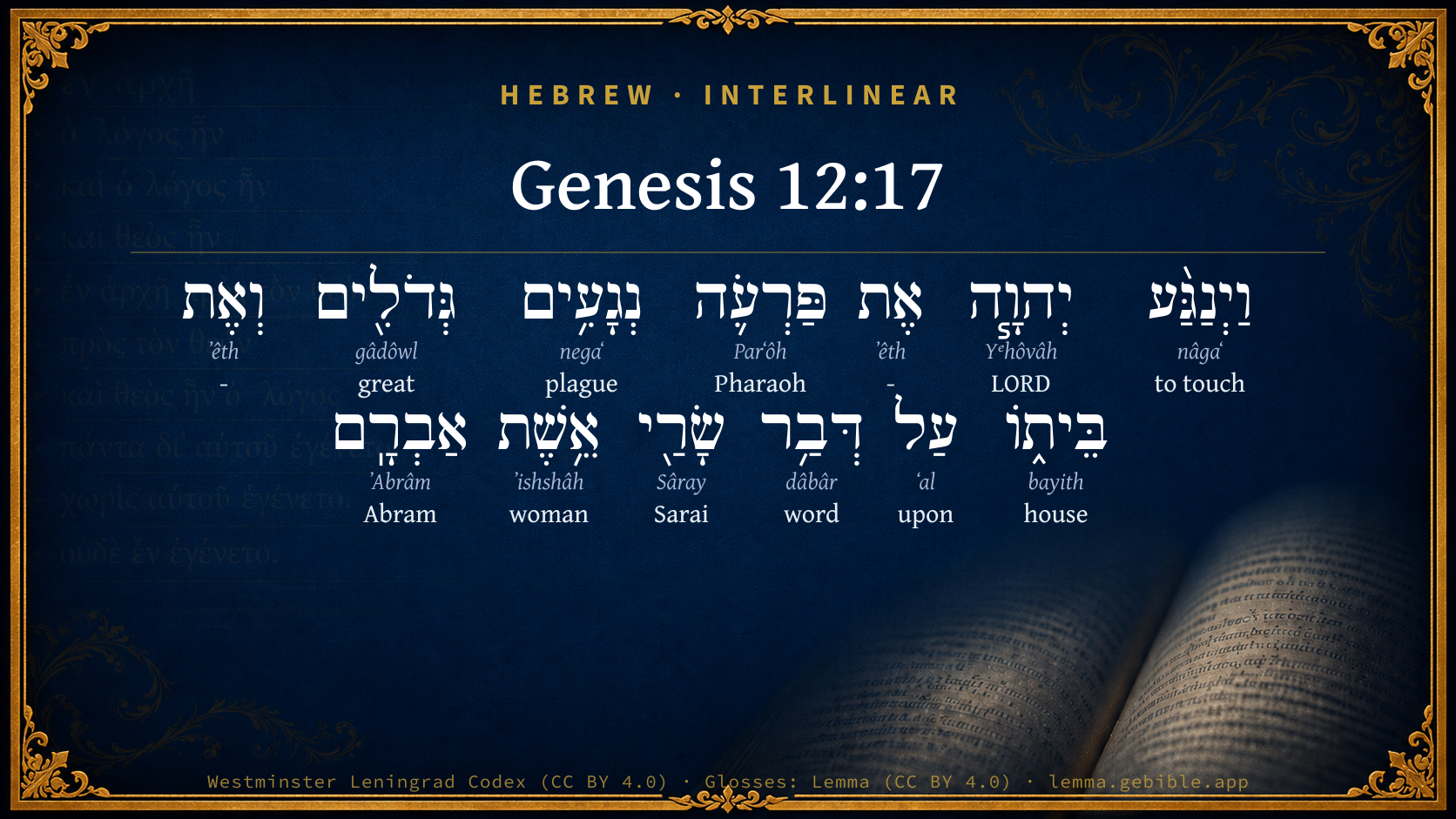
Hebrew (Westminster Leningrad Codex) Genesis 12:17 appears in the Hebrew Old Testament. The text above is from the Westminster Leningrad Codex. Each word links to its Strong’s number, a concise gloss, and parsing drawn from the Open Scriptures Hebrew Bible morphology. Click any word for its full Brown-Driver-Briggs (BDB) entry.
Download image
Cite this verse

Genesis 12:17 (World English Bible). Public Domain. Lemma interlinear Bible study tool, https://lemma.gebible.app/v/genesis/12/17.

Show BibTeX & RIS
BibTeX
RIS
English Translation
Yahweh plagued Pharaoh and his house with great plagues because of Sarai, Abram's wife.
World English Bible · Public Domain
Highlights
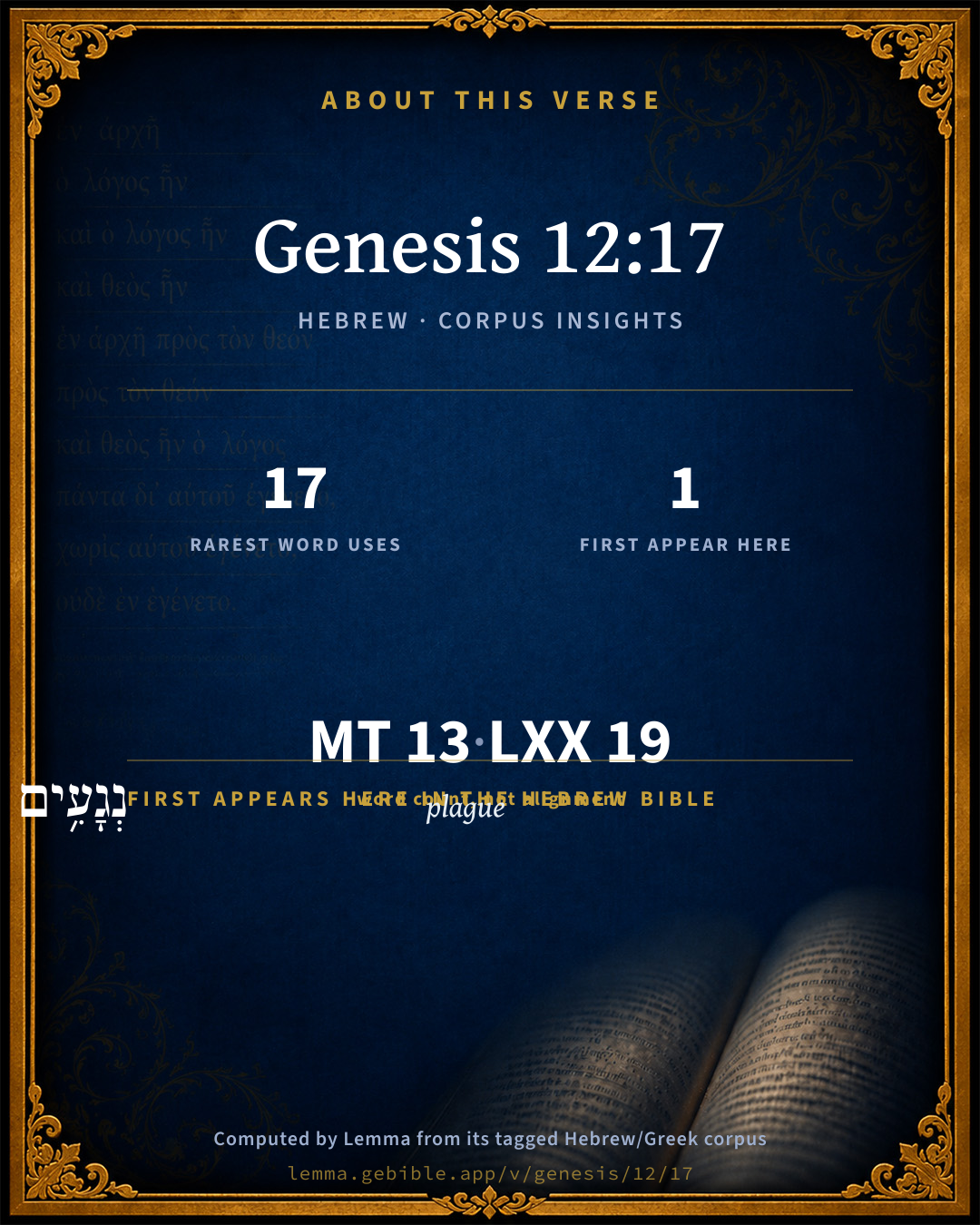
  • 1 first appearance in the Hebrew Bible
Full analysis ↓
Download a study sheet

One document with this verse’s original text, its word-by-word gloss line, the meaning frame, cross-references with their text, attributed commentary, and full source and license credits — printable, and it pastes into notes with its structure intact.

This verse Autodidact and up

Study sheet (.html) Plain text (.txt)

A passage Seminary Student

Up to 50 verses in one chapter. A passage sheet keeps up to 6 commentary sources and 12 cross-references per verse, in the order this page ranks them, and says so on the sheet whenever that leaves anything out. Ask for a single verse and you get the Autodidact verse sheet above.

Everything on this page stays free to read, with no account — the sheet is a download of what is already on screen, not access to it.

Want to remove ads? Support Godless Engineer
Compare translations 3

The same verse in 3 English versions, stacked beneath the original-language interlinear above. Click any original word for its lexicon entry.

Each is an independent rendering of the whole verse — the interlinear is not word-aligned to these translations.

Highlighted words mark where these versions differ — a whole-verse word diff, not a word-by-word alignment.

  • World English Bible Public Domain
    Yahweh plagued Pharaoh and his house with great plagues because of Sarai, Abram's wife.
  • King James Version Public Domain
    And the LORD plagued Pharaoh and his house with great plagues because of Sarai Abram's wife.
  • unfoldingWord Literal Text CC BY-SA 4.0
    But Yahweh struck Pharaoh and his house great plagues on account of Sarai the wife of Abram.

unfoldingWord Literal Text — © unfoldingWord, licensed CC BY-SA 4.0. Word-aligned USFM3 via Door43 (git.door43.org/unfoldingWord/en_ult).

Versions to compare (up to 4)

3 of 4 selected

Show all 18 translations

Every available English version of this verse, each an independent rendering of the whole verse.

  • World English Bible Public Domain
    Yahweh plagued Pharaoh and his house with great plagues because of Sarai, Abram's wife.
  • Berean Standard Bible Public Domain
    The LORD, however, afflicted Pharaoh and his household with severe plagues because of Abram’s wife Sarai.
  • Majority Standard Bible Public Domain
    The LORD, however, afflicted Pharaoh and his household with severe plagues because of Abram’s wife Sarai.
  • King James Version Public Domain
    And the LORD plagued Pharaoh and his house with great plagues because of Sarai Abram's wife.
  • American Standard Version (1901) Public Domain
    And Jehovah plagued Pharaoh and his house with great plagues because of Sarai, Abram's wife.
  • Revised Version (1885) Public Domain
    And the LORD plagued Pharaoh and his house with great plagues because of Sarai Abram’s wife.
  • Geneva Bible (1599) Public Domain
    But the Lord plagued Pharaoh and his house with great plagues, because of Sarai Abrams wife.
  • Douay-Rheims (1899) Public Domain
    But the Lord scourged Pharao and his house with most grievous stripes for Sarai, Abram's wife.
  • Young's Literal Translation Public Domain
    And Jehovah plagueth Pharaoh and his house -- great plagues -- for the matter of Sarai, Abram's wife.
  • Literal Standard Version CC BY-SA 4.0
    And YHWH plagues Pharaoh and his house—great plagues—for the matter of Sarai, Abram’s wife.
  • Unlocked Literal Bible CC BY-SA 4.0
    Then Yahweh afflicted Pharaoh and his house with great plagues because of Sarai, Abram's wife.
  • unfoldingWord Literal Text CC BY-SA 4.0
    But Yahweh struck Pharaoh and his house great plagues on account of Sarai the wife of Abram.
  • Darby Bible Public Domain
    And Jehovah plagued Pharaoh and his house with great plagues because of Sarai Abram's wife.
  • World Messianic Bible Public Domain
    The LORD afflicted Pharaoh and his house with great plagues because of Sarai, Abram’s wife.
  • Webster's Bible Public Domain
    And the LORD afflicted Pharaoh and his house with great plagues, because of Sarai, Abram's wife.
  • Free Bible Version CC BY-SA 4.0
    But the Lord caused Pharaoh and the people in his palace to suffer from terrible diseases because of Sarai, Abram's wife.
  • Bible in Basic English Public Domain
    And the Lord sent great troubles on Pharaoh's house because of Sarai, Abram's wife.
  • JPS Tanakh (1917) Public Domain
    And the LORD plagued Pharaoh and his house with great plagues because of Sarai Abram's wife.

Literal Standard Version (2020), Covenant Press — licensed CC BY-SA 4.0. Text via the HelloAO Bible API (eBible.org). Unlocked Literal Bible (unfoldingWord) — licensed CC BY-SA 4.0. Text via the HelloAO Bible API (eBible.org). unfoldingWord Literal Text — © unfoldingWord, licensed CC BY-SA 4.0. Word-aligned USFM3 via Door43 (git.door43.org/unfoldingWord/en_ult). Free Bible Version, Dr. Jonathan Gallagher — licensed CC BY-SA 4.0. Text via the HelloAO Bible API (eBible.org).

Word by word

More ways to search: Search by grammar → Find every occurrence → Compare this word →

Practice this passage: Drill this verse → Learn its vocabulary →

About this verse

These counts appear in no published source. They are computed here, from the morphology-tagged text and Lemma’s own curated glosses. What Lemma adds →

13
words
12
distinct lemmas
Pentateuch
section

Notable vocabulary

The rarest word here is שָׂרַ֖י Sarai H8297 — appearing just 17 times in the whole Hebrew Bible.

First appearance in Scripture

This word makes its first canonical appearance in the Hebrew Bible here:

  • נְגָעִ֥ים plague H5061

Shared distinctive vocabulary

שָׂרַ֖י Sarai H8297 occurs in 13 verses of the Hebrew Bible. Also found in:

Grammatical profile

  • 1 verb
  • 8 nouns
  • 1 adjective
  • 1 preposition
  • 2 particles

Verb forms

  • וַיְנַגַּ֨ע Piel · Sequential Imperfect

Hebrew & Septuagint length

In English translation the verse runs 14 words from the Hebrew and 17 from the Septuagint (LXX English) — closely comparable.

A rough comparison of the two English renderings, which tokenize alike — not a word-level alignment.

Word counts can differ between the Hebrew and the Greek without any difference in meaning — e.g. the Hebrew direct-object marker אֵת has no separate Greek word, and Greek often adds the article ὁ.

In the original languages it is 13 Hebrew tokens and 19 Greek tokens — but the two are counted differently (Hebrew bundles its prefixes and suffixes into one token; the Greek is in lemma form), so that isn’t a like-for-like length.

Cross-references

6

Topical passages linked to Genesis 12:17 in the Treasury of Scripture Knowledge — connected by theme and wording, ordered by reader-vote popularity; previews shown in the World English Bible.

  • 1 Chronicles 16:21 He allowed no man to do them wrong; Yes, he reproved kings for their sakes,
  • Genesis 20:18 For Yahweh had closed up tight all the wombs of the house of Abimelech, because of Sarah, Abraham's wife.
  • Psalms 105:14–15 He allowed no one to do them wrong. Yes, he reproved kings for their sakes,
  • 1 Chronicles 21:22 Then David said to Ornan, Give me the place of this threshing floor, that I may build thereon an altar to Yahweh: for the full price shall you give it me, that the plague may be stayed from the people.
  • Job 34:19 Who doesn't respect the persons of princes, Nor regards the rich more than the poor; For they all are the work of his hands.
  • Hebrews 13:4 Let marriage be held in honor among all, and let the bed be undefiled: but God will judge the sexually immoral and adulterers.

Cross-references courtesy of OpenBible.info (CC BY 4.0).

Hebrew and Greek witnesses Masoretic Hebrew ↔ Greek Septuagint

The same verse in the two great witnesses to the Old Testament, shown verse-for-verse.

These are two independent witnesses, not word-aligned to each other, and the Septuagint is shown in lemma (dictionary) form.

Hebrew Genesis 12:17 Masoretic · Westminster Leningrad Codex

וַיְנַגַּ֨ע יְהוָ֧ה אֶת פַּרְעֹ֛ה נְגָעִ֥ים גְּדֹלִ֖ים וְאֶת בֵּית֑וֹ עַל דְּבַ֥ר שָׂרַ֖י אֵ֥שֶׁת אַבְרָֽם

Yahweh plagued Pharaoh and his house with great plagues because of Sarai, Abram's wife.

World English Bible · Public Domain

Greek LXX Genesis 12:17 Septuagint · lemma form

καί ἐτάζω ὁ θεός ὁ φαραώ ἐτασμός μέγας καί πονηρός καί ὁ οἶκος αὐτός περί σαρα ὁ γυνή αβραμ

And God afflicted Pharao with great and severe afflictions, and his house, because of Sara, Abram's wife.

LXX2012 (modern English Septuagint) · Public Domain

Hebrew: Westminster Leningrad Codex (CC BY 4.0). Greek: Septuagint (public domain); English from LXX2012 (modern English Septuagint) (Public Domain). How the Septuagint differs from the Hebrew →

Targum (Aramaic paraphrase)

2

The Targum is the ancient Jewish Aramaic paraphrase of the Hebrew Scriptures — an interpretive translation, not the Hebrew text itself. Onkelos (literal) and Pseudo-Jonathan (expansive) render the Torah, and Jonathan the Prophets. Coverage is partial: where no permissively-licensed English translation exists for a verse, only the Aramaic is shown. This is verse-level text, not a word-by-word alignment to the Hebrew.

  1. Targum Onkelos Torah (Genesis–Deuteronomy)
    וְאַיְתִי יְיָ עַל פַּרְעֹה מַכְתָּשִׁין רַבְרְבִין וְעַל אֱנַשׁ בֵּיתֵהּ עַל עֵיסַק שָׂרַי אִתַּת אַבְרָם

    And the Lord brought upon Pharaoh great plagues, and upon the men of his house, for the affair of Sara the wife of Abram.

    Targum Onkelos — Aramaic: “Onkelos Genesis” (public domain); “Onkelos Exodus” (public domain); “Onkelos Leviticus” (public domain); “Onkelos Numbers” (public domain); “Onkelos Deuteronomy” (public domain). English: “Sefaria Community Translation” (CC0 1.0 (public-domain dedication)); “J.W. Etheridge. The Targums of Onkelos and Jonathan Ben Uzziel on the Pentateuch. London: Longmans, Green, 1862” (public domain). Text via Sefaria.

  2. Targum Pseudo-Jonathan Torah (Genesis–Deuteronomy)
    וְגָרֵי מֵימְרָא דַיְיָ בְּפַרְעה מַכְתְּשִׁין רַבְרְבִין וְיַת אֵינַשׁ בֵּיתֵיהּ עַל עֵיסַק שָרַי אִתַּת אַבְרָם

    And the Word of the Lord sent great plagues against Pharoh and the men of his house, on account of Sara, Abram's wife.

    Targum Pseudo-Jonathan — Aramaic: “Targum Jonathan on Genesis” (public domain); “Targum Jonathan on Exodus” (public domain); “Targum Jonathan on Leviticus” (public domain); “Targum Jonathan on Numbers” (public domain); “Targum Jonathan on Deuteronomy” (public domain). English: “The Targum of Jonathan ben Uzziel, trans. J. W. Etheridge, London, 1862” (public domain). Text via Sefaria.

Commentary

Notes on Genesis 12:17 from classic Christian and Jewish commentators (each source and its license shown beneath its notes). The classic Christian expositions comment on the surrounding passage and are grouped to its opening verse, so a note may address several verses; the Jewish commentaries on the Tanakh (Rashi and others) are per-verse, so they appear only where the commentator wrote on this verse.

Lemma curates 59 commentaries, every one of them public domain or Creative Commons licensed, each selected and text-cleaned for this edition rather than reprinted as found. About our sources →

Trapp's Complete Commentary

John Trapp

Gen 12:17 And the LORD plagued Pharaoh and his house with great plagues because of Sarai Abram’s wife.

Ver. 17. And the Lord plagued Pharaoh.] Plagued him with plagues, saith the Hebrew: tormented him with torments, or set him on the rack, saith the Greek. And for this he might thank his court parasites, who put him upon this rape. Chrysostom thinketh that Sarai was in bed with the king, and that in the bed God by his plague so restrained him that she remained untouched. But we cannot gather by the text that he intended to commit adultery, sed quod levitate et vaga libidine peccavit , but offended only in going after the sight of his eyes and lust of his heart, as Solomon hath it.

John Trapp, A Commentary or Exposition upon All the Books of the Old and New Testament (1647–1656) — public domain. Text from a community e-Sword module.

Joseph Benson's Commentary

Gen 12:17. And the Lord plagued Pharaoh and his house — We are not told particularly, in what way they were plagued; but, doubtless, there was something in the plagues themselves, or some explication added to them, sufficient to convince Pharaoh and his house that it was for Sarai’s sake they were thus plagued.

Joseph Benson's Commentary on the Old and New Testaments (1811–1818) — public domain. Text from a community e-Sword module.

Tyndale Open Study Notes

Tyndale Open Resources

12:17-19 God’s intervention rescued Sarai and preserved the marriage to fulfill the covenant promise. Sarai’s restoration to Abram came with a rebuke from Pharaoh on God’s behalf (12:18-19).

Tyndale Open Study Notes — © Tyndale Open Resources, licensed CC BY-SA 4.0. Text via the HelloAO Bible API.

Geneva Bible (1599)

Geneva Bible translators

The Lord took the defense of this poor stranger against a mighty king: and as he is ever careful over his, so did he preserve Sarai.

Geneva Bible (1599) marginal notes — public domain. Text via Bolls.life.

Adam Clarke's Commentary

Verse 17. The Lord plagued Pharaoh] What these plagues were we know not. In the parallel case, Ge 20:18, all the females in the family of Abimelech, who had taken Sarah in nearly the same way, were made barren; possibly this might have been the case here; yet much more seems to be signified by the expression great plagues. Whatever these plagues were, it is evident they were understood by Pharaoh as proofs of the disapprobation of God; and, consequently, even at this time in Egypt there was some knowledge of the primitive and true religion.

Adam Clarke's Commentary on the Bible (1810–1826) — public domain. Text from a community e-Sword/MySword module.

John Calvin's Commentaries

17. And the Lord plagued Pharaoh. If Moses had simply related, that God had punished the king for having committed adultery, it would not so obviously appear that he had taken care of Sarai’s chastity; but when he plainly declares that the house of the king was plagued because of Sarai, Abram’s wife, all doubt is, in my judgment, removed; because God, on behalf of his servant, interposed his mighty hand in time, lest Sarai should be violated. And here we have a remarkable instance of the solicitude with which God protects his servants, by undertaking their cause against the most powerful monarchs; as this and similar histories show, which are referred to in Psalm 105:12-15: —

When they were but a few men in number; yea, very few, and strangers in it. When they went from one nation to another, from one kingdom to another people; he suffered no man to do them wrong; yea, he reproved kings for their sakes; saying, Touch not mine anointed, and do my prophets no harm.’

From which passage also a confirmation of the opinion just given may be derived. For if God reproved Pharaoh, that he should do Abram no harm; it follows, that he preserved Sarai’s honor uninjured. Instructed by such examples, we may also learn, that however the world may hold us in contempt, on account of the smallness of our number, and our weakness; we are yet so precious in the sight of God, that he will, for our sake, declare himself an enemy to kings, and even to the whole world. Let us know, that we are covered by his protection, in order that the lust and violence of those who are more powerful, may not oppress us. But it is asked, whether Pharaoh was justly punished, seeing that he neither intended, by guile nor by force, to gain possession of another man’s wife? I answer, that the actions of men are not always to be estimated according to our judgment, but are rather to be weighed in the balances of God; for it often happens, that the Lord will find in us what he may justly punish, while we seem to ourselves to be free from fault, and while we absolve ourselves from all guilt. Let kings rather learn, from this history, to bridle their own power, and moderately to use their authority; and, lastly, to impose a voluntary law of moderation upon themselves. For, although no fault openly appears in Pharaoh; yet, since he has no faithful monitor among men, who dares to repress his licentiousness, the Lord chastises him from heaven. As to his family, it was indeed innocent; but the Lord has always just causes, though hidden from us, why he should smite with his rod those who seem to merit no such rebuke. That he spared his servant Abram, ought to be ascribed to his paternal indulgence.

John Calvin's Commentaries (1540-1563) — public domain. Text from the Calvin Translation Society English edition (1840s-50s) via the Christian Classics Ethereal Library (ccel.org). Calvin's coverage is partial (roughly two-thirds of the Bible); uncommented books and verses are honest gaps, never fabricated. The 19th-century editor's footnotes and remarks are omitted so the notes are faithfully Calvin's own voice.

The Cambridge Bible for Schools and Colleges

gen. ed. J. J. S. Perowne

17. plagued … with great plagues] The words in the original run: “and Jehovah struck Pharaoh with great strokes, and his house.” The words “and his house” have all the appearance of being a later explanatory addition. The “great strokes” or “plagues” must have been some kind of epidemic (cf. Gen_20:17; 1Ch_16:21; Psa_105:14), the cause of which could not be understood. Pharaoh and his house are guiltless; Abram and Sarai are deceitful and cowardly; Jehovah smites the Egyptian, in order to protect the patriarch and his wife. This representation of the Deity illustrates the immature stage of religious development presented by some of the early Israelite traditions.

The Cambridge Bible for Schools and Colleges (gen. ed. J. J. S. Perowne; Cambridge University Press, 1878–1918) — public domain. Text from a community e-Sword module.

John Gill's Exposition

And the Lord plagued Pharaoh and his house with great plagues,.... Perhaps with the same sort that Abimelech and his servants were smote with on a like account, Gen 20:17. The Jews (h) say they were smitten with ulcers; not only Pharaoh was plagued, but those of his household also, his courtiers and servants, who were accessary to the bringing of Sarai into his house; for all this was

because of Sarai, Abram's wife; or "upon the word of Sarai" (i), as it may be literally rendered: hence the Jews have a notion, that an angel stood by Sarai with a scourge in his hand, and when Sarai bid him smite Pharaoh, he smote him (k); but signifies not a word only, but thing, matter and business: and so Onkelos renders it here: and the sense is, that Pharaoh and his courtiers were smitten, because of the affair and business of Sarai; because she was taken by them, and detained in Pharaoh's house, and designed to be made his wife or concubine; and thus for evil intentions was this punishment inflicted; so that evil designs, not brought into execution, are punishable; though the word of Sarai may mean what she was bid to say, and did.

(h) Jarchi in loc. Bereshit Rabba, sect. 41. fol. 35. 4. (i) "propter verbum Sarai", Montanus; "super verbo", Munster, Piscator. (k) Jarchi in loc. Bereshit Rabba, ut supra. (sect. 41. fol. 35. 4.)

John Gill's Exposition of the Whole Bible (1746–1763) — public domain (CC PDM 1.0). Text via the HelloAO Bible API.

Haydock's Catholic Bible Commentary

Scourged Pharao with unusual pains, sterility, &c. that he might easily perceive that his taking Sarai was displeasing to God. (Haydock) --- He did not intend to commit adultery indeed, but his conduct was tyrannical and oppressive to the stranger, whom God protects, Psalm 44. (Menochius)

George Leo Haydock (1774–1849), Haydock's Catholic Family Bible and Commentary, 1859 edition — public domain. Excludes Psalms (Douay-Rheims chapter numbering differs from Protestant) and Deuterocanonical books (Catholic canon only).

Matthew Poole's English Annotations

Most probably with some notable distemper of his body, which did both chastise him for and hinder him in the execution of his lust.

His house, i.e, his servants, who being some one way, some another, partners of his sin, are justly made partners in his plagues. And if any were innocent in this matter, they were obnoxious to God for other sins. Besides, as they were punished upon the occasion of Pharaoh's sin, so Pharaoh was punished in their punishments.

Because of Sarai, i.e.

1. For the act of violence towards her; for the word taken, Gen 12:15, implies that it was by constraint, and not with Abram's and with her consent, which it is not probable that either of them would give in that case.

2. For an intention of uncleanness. For God, who is the Searcher and Judge of men's hearts, may justly, and doth often, punish men for their evil purposes. Compare Gen 20:3-4.

Matthew Poole's English Annotations on the Holy Bible (1683–1685) — public domain. Text from a community e-Sword/MySword module.

Whedon's Commentary on the Bible

Daniel D. Whedon

17. The Lord plagued Pharaoh — As another Pharaoh and his people were afterwards smitten for their cruel oppression of Abram’s seed. What these plagues were we are not told, but they seem to have fallen upon all who were engaged in this despotic proceeding, and probably were of such a nature as to prevent Pharaoh from consummating his marriage with Sarai, and led him to see that his design ran counter to the purposes of Abram’s God. According to Josephus, the priests told Pharaoh the cause of the plagues; but Patrick suggests, that Sarai confessed the truth to Pharaoh.

Daniel D. Whedon (gen. ed.), Commentary on the Old and New Testaments (1874–1909) — public domain. Text from a community e-Sword module.

The Pulpit Commentary

And the Lord plagued (literally, struck) Pharaoh and his house with great plagues (or strokes, either of disease or death, or some other calamity an indication that Pharaoh was not entirely innocent) because of Sarai Abram"s wife. The effect of this was to lead to the discovery, not through the aid of the Egyptian priests (Josephus), but either through a special revelation granted to him, as afterwards (Gen_20:6) to Abimelech in a dream (Chrysostom), or through the confession of Sarai herself (A Lapide), or through the servants of Abraham (Kurtz).

The Pulpit Commentary (1880–1919), ed. H.D.M. Spence-Jones & Joseph S. Exell — public domain. Text from a community e-Sword module.

John Wesley's Explanatory Notes

And the Lord plagued Pharaoh and his house - Probably, those princes especially that had commended Sarai to Pharaoh. We are not told, particularly, what these plagues were; but, doubtless, there was something in the plagues themselves, or some explication added to them, sufficient to convince them that it was for Sarai's sake they were thus plagued.

John Wesley, Explanatory Notes Upon the Whole Bible (1754–1765) — public domain. Text via the GEBible commentary corpus.

unfoldingWord translationNotes

Door43 World Missions Community

because of Sarai, Abram's wife

This can be made more explicit. AT: "because Pharaoh intended to take Sarai, Abram's wife, to be his own wife" (See: Assumed Knowledge and Implicit Information)

Pharaoh summoned Abram

"Pharaoh called Abram" or "Pharaoh ordered Abram to come to him"

What is this that you have done to me?

Pharaoh used this rhetorical question to show how angry he was about what Abram had done to him. It can also be stated as an exclamation. AT: "You have done a terrible thing to me!" (See: Rhetorical Question)

Then Pharaoh gave orders to his men concerning him

"Then Pharaoh directed his officials concerning Abram"

they sent him away, along with his wife and all that he had

"the officials sent Abram away from Pharoah, with his wife and all his possessions"

translationWords

Yahweh

afflicted

Pharaoh

household

plague

Sarah

unfoldingWord translationNotes — © Distant Shores Media and the Door43 World Missions Community, licensed CC BY-SA 4.0. Source: git.door43.org/Door43/en_tn.

Rashi

Rabbi Shlomo Yitzchaki (Rashi)

'וינגע ה' וגו AND THE LORD PLAGUED PHARAOH etc. — He was smitten with the disease of Raathon which demands close continence (Genesis Rabbah 41:2).

ואת ביתו AND HIS HOUSE — Take it as the Targum has it: “and the people of his house”. A Midrashic explanation is: the word את is used here to imply that included in the curse were also its walls, pillars and its utensils (Midrash Tanchuma, Lech Lecha 5). The whole of this explanation of ואת ביתו is given in an old text of Rashi.

על דבר שרי BECAUSE OF SARAI (literally, by the word of Sarai) — at her orders: she said to the angel “Smite” and he smote (Midrash Tanchuma, Lech Lecha 5).

Rashi on the Tanakh — English translations: “The Judaica Press complete Tanach with Rashi, translated by A. J. Rosenberg” (CC BY 4.0); “Pentateuch with Rashi's commentary by M. Rosenbaum and A.M. Silbermann, 1929-1934” (public domain); “The Metsudah Tanach series, Lakewood, N.J” (CC BY 4.0); and “The Book of Joshua, Metsudah Publications, 1997” (CC BY 4.0). Text via Sefaria.

Ramban (Nachmanides)

Rabbi Moshe ben Nachman (Ramban / Nachmanides)

BECAUSE OF SARAI ABRAM’s WIFE. This means that because of the wrong done to Sarah, as well as to Abraham, and the merit of both of them, these great plagues came upon Pharaoh and his house.

Ramban (Nachmanides) on the Tanakh — English translation: “Commentary on the Torah by Ramban (Nachmanides). Translated and annotated by Charles B. Chavel. New York, Shilo Pub. House, 1971-1976” (CC BY 4.0). Text via Sefaria.

Radak

Rabbi David Kimhi (Radak)

'וינגע ה, immediately, in the night following Sarai’s abduction. G’d’s objective was to prevent Pharaoh from defiling Sarai through sexual contact with her.

ואת ביתו, the men of his household, the very men who had praised Sarai’s beauty to their king and had abducted her. Alternatively, the meaning of these words could be that all members of the palace household, whether male or female, were afflicted with this plague in order for them to recognise the finger of G’d’s retribution for violating Sarai’s rights as an individual.

על דבר שרי, so that they could not claim that the plague was a coincidence, not related to Sarai’s abduction. An allegorical approach (related to a Midrash quoted by Rashi) the words על דבר שרי אשת אברם were spoken by the angel who inflicted this plague on Pharaoh and his household. The plain meaning is that after suffering this affliction, Pharaoh searched in his mind why this should have happened to him, and it eventually occurred to him that Sarai might have been a married woman. He then asked Sarai to tell her the truth. She replied that she was indeed Avram’s wife, and that seeing they had been afraid for Avram’s life, she had agreed to this semi-deception. As a result of this revelation, Pharaoh called Avram and confronted him personally.

Radak on the Tanakh — English translations: “Sefaria Community Translation” (CC0 1.0 (public-domain dedication)); “Eliyahu Munk, HaChut Hameshulash” (CC BY 4.0); “Rabbi Mike Feuer, Jerusalem Anthology” (CC BY 4.0); and “R. David Kimhi on the first book of Psalms, Translated by R.G. Finch, London, 1919” (public domain). Text via Sefaria.

Lesson kit

Teaching starters — assembled from the data on this page, not authored interpretation. Every prompt links to the verse data it draws on. Edit before teaching.

Genesis, in the Pentateuch, opens this verse with 13 words (12 distinct Hebrew lemmas). Its most distinctive word is Sâray (“Sarai”). A historical commentator’s framing appears above. Read the whole chapter for the surrounding context.

Discussion questions

  1. What does “Sarai” (Sâray) contribute to the verse as a whole?
  2. This is the first place “plague” appears in Scripture (first appears here). What does its debut here establish?
  3. How does Genesis 11:29, which shares the word «Sarai», read alongside this verse?
  4. These translations render this verse differently; the difference is in the English rendering, not the original. What questions does that raise?
  5. «וַיְנַגַּ֨ע» is a Piel Sequential Imperfect verb. How does that grammatical form shape the action described?
  6. Compare how Trapp's Complete Commentary and Joseph Benson's Commentary read this verse. Where do they agree or differ?

Things to notice

Reading settings

Reading text

Shown beneath each verse's original-language words.

Old Testament
Old Testament edition

Read the OT as the Masoretic Hebrew (MT) or the Greek Septuagint (LXX).

English shown for the Greek Septuagint (in the Hebrew ↔ Greek comparison).

Comparing translations? Open the Compare panel on any verse page to stack up to four side by side.