
Acts 13:50

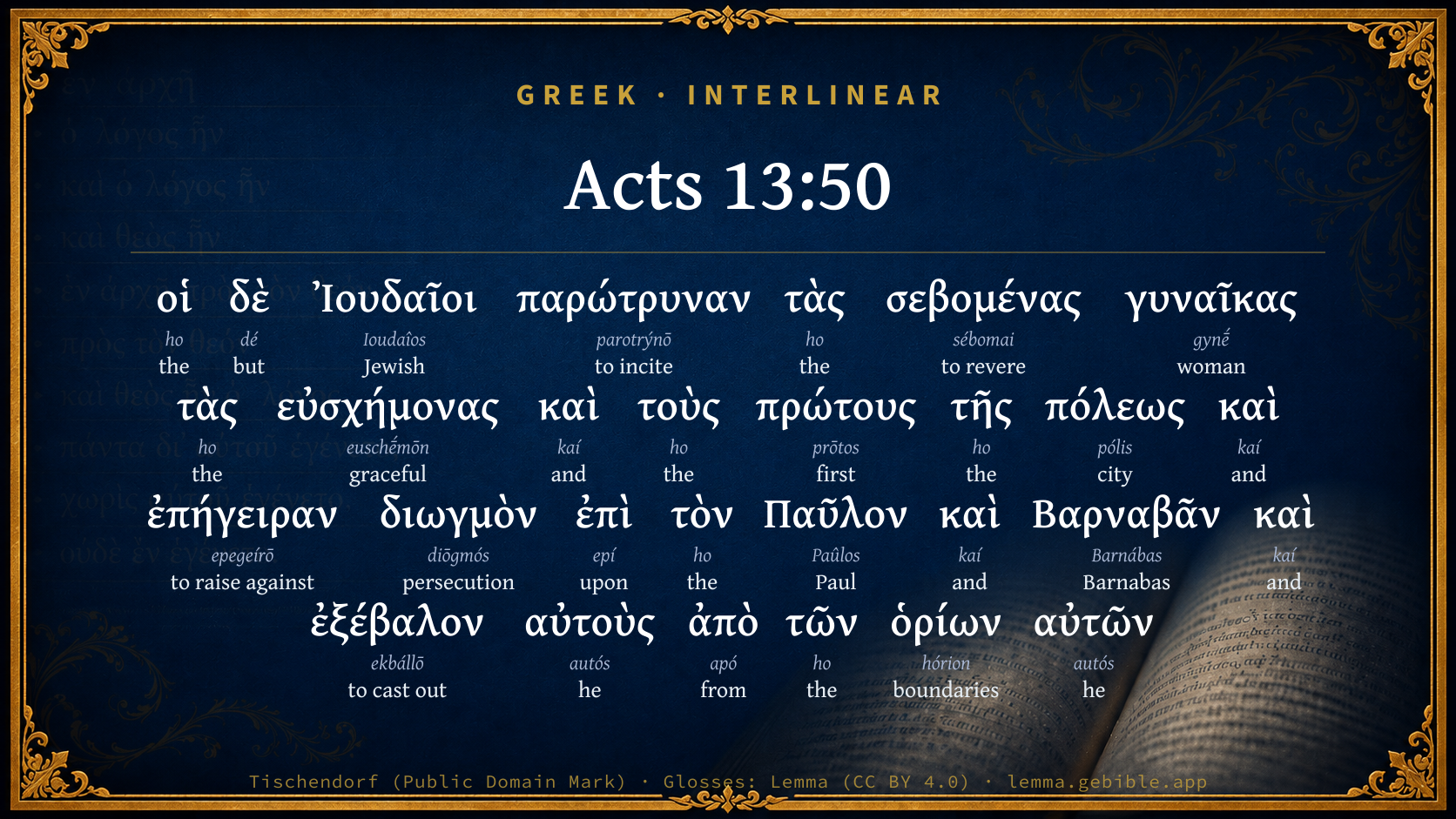
Greek (Tischendorf 8th ed.) Acts 13:50 appears in the Greek New Testament. The text above is from the Tischendorf 8th edition. Each word links to its Strong’s number and a concise gloss. Click any word for its full Thayer’s Greek Lexicon entry.
Download image
Cite this verse

Acts 13:50 (World English Bible). Public Domain. Lemma interlinear Bible study tool, https://lemma.gebible.app/v/acts/13/50.

Show BibTeX & RIS
BibTeX
RIS
English Translation
But the Jews stirred up the devout and prominent women and the chief men of the city, and stirred up a persecution against Paul and Barnabas, and threw them out of their borders.
World English Bible · Public Domain
Highlights
  • 1 hapax legomenon — only here in the Greek New Testament
  • 2 first appearances in the Greek New Testament
Full analysis ↓
Download a study sheet

One document with this verse’s original text, its word-by-word gloss line, the meaning frame, cross-references with their text, attributed commentary, and full source and license credits — printable, and it pastes into notes with its structure intact.

This verse Autodidact and up

Study sheet (.html) Plain text (.txt)

A passage Seminary Student

Up to 50 verses in one chapter. A passage sheet keeps up to 6 commentary sources and 12 cross-references per verse, in the order this page ranks them, and says so on the sheet whenever that leaves anything out. Ask for a single verse and you get the Autodidact verse sheet above.

Everything on this page stays free to read, with no account — the sheet is a download of what is already on screen, not access to it.

Want to remove ads? Support Godless Engineer
Compare translations 3

The same verse in 3 English versions, stacked beneath the original-language interlinear above. Click any original word for its lexicon entry.

Each is an independent rendering of the whole verse — the interlinear is not word-aligned to these translations.

Highlighted words mark where these versions differ — a whole-verse word diff, not a word-by-word alignment.

  • World English Bible Public Domain
    But the Jews stirred up the devout and prominent women and the chief men of the city, and stirred up a persecution against Paul and Barnabas, and threw them out of their borders.
  • King James Version Public Domain
    But the Jews stirred up the devout and honourable women, and the chief men of the city, and raised persecution against Paul and Barnabas, and expelled them out of their coasts.
  • unfoldingWord Literal Text CC BY-SA 4.0
    But the Jews stirred up the influential worshiping women and the principal ones of the city and aroused a persecution against Paul and Barnabas, and they threw them out from their boundaries.

unfoldingWord Literal Text — © unfoldingWord, licensed CC BY-SA 4.0. Word-aligned USFM3 via Door43 (git.door43.org/unfoldingWord/en_ult).

Versions to compare (up to 4)

3 of 4 selected

Show all 19 translations

Every available English version of this verse, each an independent rendering of the whole verse.

  • World English Bible Public Domain
    But the Jews stirred up the devout and prominent women and the chief men of the city, and stirred up a persecution against Paul and Barnabas, and threw them out of their borders.
  • Berean Standard Bible Public Domain
    The Jews, however, incited the religious women of prominence and the leading men of the city. They stirred up persecution against Paul and Barnabas and drove them out of their district.
  • Majority Standard Bible Public Domain
    The Jews, however, incited the religious women of prominence and the leading men of the city. They stirred up persecution against Paul and Barnabas and drove them out of their district.
  • King James Version Public Domain
    But the Jews stirred up the devout and honourable women, and the chief men of the city, and raised persecution against Paul and Barnabas, and expelled them out of their coasts.
  • American Standard Version (1901) Public Domain
    But the Jews urged on the devout women of honorable estate, and the chief men of the city, and stirred up a persecution against Paul and Barnabas, and cast them out of their borders.
  • Revised Version (1885) Public Domain
    But the Jews urged on the devout women of honourable estate, and the chief men of the city, and stirred up a persecution against Paul and Barnabas, and cast them out of their borders.
  • Geneva Bible (1599) Public Domain
    But the Iewes stirred certaine deuoute and honourable women, and the chiefe men of the citie, and raised persecution against Paul and Barnabas, and expelled them out of their coastes.
  • Douay-Rheims (1899) Public Domain
    But the Jews stirred up religious and honourable women, and the chief men of the city, and raised persecution against Paul and Barnabas: and cast them out of their coasts.
  • Young's Literal Translation Public Domain
    And the Jews stirred up the devout and honourable women, and the first men of the city, and did raise persecution against Paul and Barnabas, and did put them out from their borders;
  • Literal Standard Version CC BY-SA 4.0
    And the Jews stirred up the devout and honorable women, and the first men of the city, and raised persecution against Paul and Barnabas, and put them out from their borders;
  • Unlocked Literal Bible CC BY-SA 4.0
    But the Jews urged on the devout and important women, as well as the leading men of the city. These stirred up a persecution against Paul and Barnabas and threw them out beyond the border of their city.
  • unfoldingWord Literal Text CC BY-SA 4.0
    But the Jews stirred up the influential worshiping women and the principal ones of the city and aroused a persecution against Paul and Barnabas, and they threw them out from their boundaries.
  • Darby Bible Public Domain
    But the Jews excited the women of the upper classes who were worshippers, and the first people of the city, and raised a persecution against Paul and Barnabas, and cast them out of their coasts.
  • World Messianic Bible Public Domain
    But the Jews stirred up the devout and prominent women and the chief men of the city, and stirred up a persecution against Paul and Barnabas, and threw them out of their borders.
  • Webster's Bible Public Domain
    But the Jews stirred up the devout and honorable women, and the chief men of the city, and raised persecution against Paul and Barnabas, and expelled them from their borders.
  • Free Bible Version CC BY-SA 4.0
    But the Jews incited the prominent religious women and leaders of the city to persecute Paul and Barnabas, and had them expelled from their territory.
  • Bible in Basic English Public Domain
    But the Jews, working up the feelings of the God-fearing women of high position and of the chief men of the town, got an attack started against Paul and Barnabas, driving them out of those parts.
  • Text-Critical English NT CC BY 4.0
    But the Jews incited the devout women of high standing and the prominent men of the city. They stirred up persecution against Paul and Barnabas, and drove them out of their region.
  • Tyndale New Testament (1534) Public Domain
    But the Iewes moved the worshypfull and honorable wemen and the chefe men of the cyte and reysed persecucion agaynst Paul and Barnabas and expelled them oute of their costes.

Literal Standard Version (2020), Covenant Press — licensed CC BY-SA 4.0. Text via the HelloAO Bible API (eBible.org). Unlocked Literal Bible (unfoldingWord) — licensed CC BY-SA 4.0. Text via the HelloAO Bible API (eBible.org). unfoldingWord Literal Text — © unfoldingWord, licensed CC BY-SA 4.0. Word-aligned USFM3 via Door43 (git.door43.org/unfoldingWord/en_ult). Free Bible Version, Dr. Jonathan Gallagher — licensed CC BY-SA 4.0. Text via the HelloAO Bible API (eBible.org).

Word by word

More ways to search: Search by grammar → Find every occurrence → Compare this word →

Practice this passage: Drill this verse → Learn its vocabulary →

παρώτρυναν
parotrýnō
G3951
“to incite”
Verb, Aorist, Active, Indicative, 3rd person, Plural
Part of Speech
Verb
Tense
Aorist
Voice
Active
Mood
Indicative
Person
3rd person
Number
Plural
Full Thayer's Definition

Origin: from G3844 and otruno (to spur)

TDNT: None

1. to incite, stir up
  1. οἱ ho G3588 “the” Article, Nominative, Plural, Masculine
  2. δὲ dé G1161 “but” Conjunction
  3. Ἰουδαῖοι Ioudaîos G2453 “Jewish” Adjective, Nominative, Plural, Masculine
  4. τὰς ho G3588 “the” Article, Accusative, Plural, Feminine
  5. σεβομένας sébomai G4576 “to revere” Verb, Present, Middle or Passive deponent, Participle, Accusative, Plural, Feminine
  6. γυναῖκας gynḗ G1135 “woman” Noun, Accusative, Plural, Feminine
  7. τὰς ho G3588 “the” Article, Accusative, Plural, Feminine
  8. εὐσχήμονας euschḗmōn G2158 “graceful” Adjective, Accusative, Plural, Masculine
  9. καὶ kaí G2532 “and” Conjunction
  10. τοὺς ho G3588 “the” Article, Accusative, Plural, Masculine
  11. πρώτους prōtos G4413 “first” Adjective, Accusative, Plural, Masculine, Superlative
  12. τῆς ho G3588 “the” Article, Genitive, Singular, Feminine
  13. πόλεως pólis G4172 “city” Noun, Genitive, Singular, Feminine
  14. καὶ kaí G2532 “and” Conjunction
  15. ἐπήγειραν epegeírō G1892 “to raise against” Verb, Aorist, Active, Indicative, 3rd person, Plural
  16. διωγμὸν diōgmós G1375 “persecution” Noun, Accusative, Singular, Masculine
  17. ἐπὶ epí G1909 “upon” Preposition
  18. τὸν ho G3588 “the” Article, Accusative, Singular, Masculine
  19. Παῦλον Paûlos G3972 “Paul” Noun, Accusative, Singular, Masculine
  20. καὶ kaí G2532 “and” Conjunction
  21. Βαρναβᾶν Barnábas G921 “Barnabas” Noun, Accusative, Singular, Masculine
  22. καὶ kaí G2532 “and” Conjunction
  23. ἐξέβαλον ekbállō G1544 “to cast out” Verb, Aorist, Active, Indicative, 3rd person, Plural
  24. αὐτοὺς autós G846 “he” Personal pronoun, Accusative, Plural, Masculine
  25. ἀπὸ apó G575 “from” Preposition
  26. τῶν ho G3588 “the” Article, Genitive, Plural, Neuter
  27. ὁρίων hórion G3725 “boundaries” Noun, Genitive, Plural, Neuter
  28. αὐτῶν autós G846 “he” Personal pronoun, Genitive, Plural, Masculine

About this verse

These counts appear in no published source. They are computed here, from the morphology-tagged text and Lemma’s own curated glosses. What Lemma adds →

29
words
19
distinct lemmas
Acts
section

Notable vocabulary

1 hapax legomenon — a word that appears only here in the entire Greek New Testament:

  • παρώτρυναν to incite G3951

First appearance in Scripture

These words make their first canonical appearance in the Greek New Testament here:

  • παρώτρυναν to incite G3951
  • ἐπήγειραν to raise against G1892

Shared distinctive vocabulary

ἐπήγειραν to raise against G1892 occurs in 2 verses of the Greek New Testament. Also found in:
Repetition

Words recur within this verse:

  • οἱ the G3588 ×7
  • καὶ and G2532 ×4
  • αὐτοὺς he G846 ×2

Cross-references

20

Topical passages linked to Acts 13:50 in the Treasury of Scripture Knowledge — connected by theme and wording, ordered by reader-vote popularity; previews shown in the World English Bible.

  • Acts 13:45 But when the Jews saw the multitudes, they were filled with jealousy, and contradicted the things which were spoken by Paul, and blasphemed.
  • Acts 14:2 But the disbelieving Jews stirred up and embittered the souls of the Gentiles against the brothers.
  • Acts 14:19 But some Jews from Antioch and Iconium came there, and having persuaded the multitudes, they stoned Paul, and dragged him out of the city, supposing that he was dead.
  • Acts 17:13 But when the Jews of Thessalonica had knowledge that the word of God was proclaimed by Paul at Beroea also, they came there likewise, agitating the multitudes.
  • Acts 21:27 When the seven days were almost completed, the Jews from Asia, when they saw him in the temple, stirred up all the multitude and laid hands on him,
  • 2 Timothy 3:11 persecutions, and sufferings: those things that happened to me at Antioch, Iconium, and Lystra. I endured those persecutions. Out of them all the Lord delivered me.
  • Acts 16:37–39 But Paul said to them, "They have beaten us publicly, without a trial, men who are Romans, and have cast us into prison! Do they now release us secretly? No, most assuredly, but let them come themselves and bring us out!"
  • Acts 13:43 Now when the synagogue broke up, many of the Jews and of the devout proselytes followed Paul and Barnabas; who, speaking to them, urged them to continue in the grace of God.
  • Romans 10:2 For I testify about them that they have a zeal for God, but not according to knowledge.
  • 1 Thessalonians 2:15–16 who killed both the Lord Jesus and their own prophets, and drove us out, and didn't please God, and are contrary to all men;
  • 1 Kings 21:25 (But there was none like Ahab, who did sell himself to do that which was evil in the sight of Yahweh, whom Jezebel his wife stirred up.
  • Isaiah 66:5 Hear the word of Yahweh, you who tremble at his word: Your brothers who hate you, who cast you out for my name's sake, have said, Let Yahweh be glorified, that we may see your joy; but it is those who shall be disappointed.
  • Amos 7:12 Amaziah also said to Amos, "You seer, go, flee away into the land of Judah, and there eat bread, and prophesy there:
  • Matthew 10:23 But when they persecute you in this city, flee into the next, for most assuredly I tell you, you will not have gone through the cities of Israel, until the Son of Man has come.
  • Mark 5:17 They began to beg him to depart from their region.
  • Acts 2:5 Now there were dwelling in Jerusalem Jews, devout men, from every nation under the sky.
  • Acts 6:12 They stirred up the people, the elders, and the scribes, and came against him and seized him, and brought him in to the council,
  • Acts 8:1 Saul was consenting to his death. A great persecution arose against the assembly which was in Jerusalem in that day. They were all scattered abroad throughout the regions of Judea and Samaria, except for the apostles.
  • 1 Corinthians 1:26–29 For you see your calling, brothers, that not many are wise according to the flesh, not many mighty, and not many noble;
  • James 2:5–6 Listen, my beloved brothers. Didn't God choose those who are poor in this world to be rich in faith, and heirs of the Kingdom which he promised to those who love him?

Cross-references courtesy of OpenBible.info (CC BY 4.0).

Commentary

Notes on Acts 13:50 from classic Christian and Jewish commentators (each source and its license shown beneath its notes). The classic Christian expositions comment on the surrounding passage and are grouped to its opening verse, so a note may address several verses; the Jewish commentaries on the Tanakh (Rashi and others) are per-verse, so they appear only where the commentator wrote on this verse.

Lemma curates 59 commentaries, every one of them public domain or Creative Commons licensed, each selected and text-cleaned for this edition rather than reprinted as found. About our sources →

The Biblical Illustrator

Joseph S. Exell

Act_13:50-52

But the Jews stirred up the devout and honourable women.

Jewish tactics

The fact brings before us another feature of the relations between Jews and Gentiles at this period. They compassed sea and land to make one proselyte. They found it easiest to make proselytes of women. Such conversions had their good and their bad sides. In many cases there was a real longing for a higher and purer life than was found in the infinite debasement of Greek and Roman society, which found its satisfaction in the life and faith of Israel. But with many, such as Juvenal speaks of when he describes (Sat. 6:542) the Jewish teacher who gains influence over women, The trembling Jewess whispers in her ear, And tells her of the laws of Solymae (i.e., Jerusalem)

. The change brought with it new elements of superstition and weakness, and absolute submission of conscience to its new directors, and thus the Rabbis were often to the wealthier women of Greek and Roman cities what Jesuit confessors were in France and Italy in the seventeenth and eighteenth centuries. Here we get the darker side of the picture. The Jews stir up the women of the upper class, and they stir up their husbands. The latter were content apparently to acquiesce in their wives accepting the Judaism with which they had become familiar, but resented the intrusion of a new and, in one sense, more exacting doctrine. (Dean Plumptre.)

But they shook off the dust of their feet against them.--

When should a servant of God shake off the dust of his feet?

1. When he has not only knocked in a friendly manner, but also boldly kept is ground.

2. When he has been called on to proceed, not only by men, but by God.

3. When not only the door here is closed, but when he also sees it opened elsewhere for successful work. (K. Gerok.)

Israels temporary rejection

1. Wickedly caused by themselves, through pride and ingratitude.

2. Righteously ordained by the Lord in virtue of holiness and truth.

3. An admonitory example to Christianity, and also an impressive call to go after the lost sheep of Israel. (K. Gerok.)

And the disciples were filled with Joy and with the Holy Ghost.--

Holy joy

I. The prosperity of the Word of God is a special source of rejoicing to Christians. It was not an ordinary gladness, but the special and overflowing joy which can only be stirred up by extraordinary manifestations of the grace of God. We are full of joy--

1. Because we are saved. Deliverance from danger and death is ever a source of gratitude. A soul rescued from the power of sin and the consequences thereof, is a theme of the highest inspiration, whether we think of the value of the soul, or the price of deliverance. The brave rescuer risks his life to save others. Jesus died to save mankind.

2. Because Jesus sees of the travail of His soul.

3. At the prospect of seeing the glory of the Lord filling the earth. Every step onward which the Word of God takes, revives the hope of universal restoration.

II. The presence of the Holy Ghost in the heart is a special source of support to Christians. The Comforter sustained them in their trial.

1. They were full of holy courage. The circumstances of the disciples at Antioch were depressing. Devout and honourable women, with the chief men of the city, had raised the storm of persecution. The apostles were driven out of the city. The number of believers was small, and probably they were poor; but the source of their strength was the power of the Spirit in their heart. They could not be cast down while they were under such influence. There could be no darkness while the glory of the Lord shone within them.

2. They were full of consecration to their work. They were resolved to labour on until the name of Jesus would become universal. The light which shone on their path revealed the triumph of faith.

3. They were full of assurance that Jesus name would become glorious in the earth. (Weekly Pulpit.)

Joy in the Holy Ghost

When I was a country minister in Scotland, some time ago, the most joyous person in my parish was a poor old woman whose every joint was knotted with rheumatism; her husband was a poor labouring old man, her home a crowded hut, yet her life was bright and cheerful. When I was dejected I used to visit her, and after ten minutes conversation my load would be tightened. She diffused gladness wherever she was, because the Holy Spirit dwelt in her as a temple. (Dr. Boyd.)

Spiritual experience

The description is brief but noteworthy.

I. It records an experience--spiritual, real, and exemplary. There was emotionalism, high and holy; and it was visible. The elements were simple, but grand.

1. Joy.

2. The Holy Ghost. Each is suggestive, and both were prominent features of those early times. They are, too, co-related. Instead of spirituality and gladness being antagonistic, the soul is joyous just because it has the Holy Ghost; and the fruit of the Spirits influence is a more perfect, joy, so that the more largely we possess the Spirit, the greater becomes our joy.

II. The degree and measure of this experience deserves consideration. It was not the possession of a favoured few, but of the disciples. By them it was possessed, not scantily, or partially, they were filled with it. These emotions did not spring from external circumstances, but were independent of them and superior to them: they were, despite outward adversity (see Act_13:50-51, and Act_14:22).

III. The attainment of like experience can never be deemed impossible when we remember the exhortations of Scripture, and the testimony of disciples--learners in the school of Christ. If ye being evil know how, etc. If possible, how advantageous to us would such an experience prove! joyous in itself; an evidence; an energy; a foretaste. (J. P. Allen, M. A.)

Full of joy and of the Holy Ghost

(Act_8:39):--There is a striking resemblance between the condition of the eunuch deprived of his teacher and of these raw disciples, in Pisidian Antioch, bereft of theirs. Both were very recent converts; both had the scantiest knowledge; both were left utterly alone. Now this phrase, full of the Holy Ghost, is not an uncommon one in the Acts of the Apostles; and the Writer is fond of connecting with it other graces, of which it is declared to be the cause. So they were to be men full of the Holy Ghost and of wisdom; and of Stephen we read that he was full of the Holy Ghost and of faith. The text traces the joy of these solitary Christians to the complete possession of that Divine Spirit. So filled, we shall have an all-sufficient Teacher for all our ignorance; a Companion for all our solitude; a fountain of joy in all our sorrow. And the stories before us may help to illustrate these three things.

I. First, then, note here, the all-sufficient Teacher for our ignorance. Think, for instance, of that Ethiopian statesman. An hour or two before he had said, How can I understand except some man guide me? And now he is going away into the darkness, without a single external help, knowing only the little that he had gathered from Philip. He had not a line of the New Testament. He had nothing but a scroll of the prophet Isaiah, but he went away with a glad heart, quite sure that he would be taught all he needed to know. And these other people at Antioch, just dragged out of the darkness of heathenism, with no teaching beyond the rudimentary instruction of the two apostles for a few days--they, too, were left by their teachers without a fear. We trust far too little to the educating and enlightening power of Gods grace in the hearts of men who have no other teacher. And if Christian people more really believed the promise of their Master, He will guide you into all truth, they would be more likely to realise the promise, and be all taught of God. Only remember the instrument of that Divine Teacher is the Word of God. And if we, as Christians, neglect our Bibles, we shall not get the teaching of the Spirit of God. And remember, too, that that teaching is granted to us on plainly defined conditions. There must be a desire for it. And there must be patient waiting and solitary meditation. Let us take the lesson, and whosesoever scholars we may be, let us enroll ourselves in the school of the Master, and learn from that Spirit who will guide us into all truth.

II. Now, note, secondly, the Companion in all our solitude. Think of the loneliness of this man on the Gaza road, or of that handful of sheep in the midst of wolves at Antioch. And yet they were not alone. Full of the Holy Ghost, they were conscious of a Divine presence. And so it may be with us all. We are all condemned to live alone, however many may be the troops of friends round us. Every human soul, after all love and companionship, lives isolated. There is only One who can pass the awful boundary of personality which hedges off every man from every other. Besides the natural, necessary solitude in which every human soul lives there are some of us, no doubt, on whom God, by His providence, has laid the burden of a very lonely life. Gods purpose in making us solitary is to join Himself to us. Left alone, nestle close to Him. Beside the natural and the providential solitudes there is yet another. We must make a solitude for ourselves if we would have God speaking to us and keeping us company. Solitude is the mother country of the strong. To be much alone is the condition of sanity and nobleness of life. No mans religion will be deep and strong unless he has learned to go into the secret place of the Most High, and shut his doors about him, and there receive the fulness of that Spirit.

III. Lastly, notice the joy in all the sorrow. Full of joy and of the Holy Ghost, says the latter of the two texts. That collocation is familiar to the student of the New Testament. You will remember the apostles great enumeration of the fruits of the Spirit, Love, joy, peace. And in another place he speaks to the members of one of his Churches, and tells them that they had received the Word in much affliction with joy of the Holy Ghost. So then, whoever has this Divine Guest dwelling in his heart may possess a joy as complete as is its possession of him. I need not remind you how that Divine Spirit, that enters into our souls by faith, brings to us the consciousness of forgiveness and of sonship, nor how it fits the needs of every part of our nature, and brings all our being into harmony with itself, with circumstances, and with God. But I may remind you that not only does this Divine Spirit in us make provision for joy, but that, with such an indwelling Guest, there is the possibility of the co-existence of joy and sorrow. It is no paradox that the apostle gave forth when he said, Sorrowful, yet always rejoicing. Even in the midst of the snow and cold and darkness of Arctic regions the explorers build houses for themselves of the very blocks of ice, and within are warmth and light end comfort and vitality, while around is a dreary waste. But remember that this joy from the Spirit is a commandment. I am sure that Christians do not sufficiently lay to heart that gladness is their duty, and that sorrow unrelieved by it is cowardice and sin. We have no business to be thus sorrowful. But remember the conditions. If you and I have that Divine Spirit within us we shall be enlightened, however ignorant; companioned, however solitary; joyful, however ringed about with sorrow. If we have not, the converse will be true. (A. Maclaren, D. D.)

Persecution not inconsistent with joy

As if a man should throw precious stones and jewels at another, with intent to kill him, and the other should gather them up and enrich himself with them; even so do persecutors enrich the children of God, that they may rejoice being worthy to suffer for Christs sake. (Cawdray.)

Joy a Christian evidence

The ordinary idea is that a Christian is sombre, but that is a perversion of the gospel. The fruit of the Spirit is love and joy in the Holy Ghost, and if God comes into the soul, we may expect that the result will be the imparting of the element of joy which is so eminent in him. Sometimes through secular instruments God makes us joyful, for He employs the whole world to work out His purposes; but sometimes, by seemingly breaking upon the spirit of His people, He makes them joyful. You cannot tell why you are so musical at times. On some days you are full of music. There are some hours that are radiant above all other hours. And when these transpire among Gods people, it is not an unfair thing to infer that they are signs of Christs presence with them. (H. W. Beecher.)

.

The Biblical Illustrator, edited by Joseph S. Exell (c. 1880s–1900s) — public domain. Text from a community e-Sword module.

Tyndale Open Study Notes

Tyndale Open Resources

13:50-51 Jewish opposition once again forced Paul and Barnabas . . . out of town. They shook the dust from their feet as a sign of rejection, as Jesus had taught his disciples (see Matt 10:14-15; Mark 6:11-12; Luke 9:5-6; 10:10-11). That place was then treated as pagan territory, and other people were given access to the message of new life in Christ.

Tyndale Open Study Notes — © Tyndale Open Resources, licensed CC BY-SA 4.0. Text via the HelloAO Bible API.

Bengel's Gnomon

Johann Albrecht Bengel

Act 13:50. Γυναῖκας) Through women many obstructions, or else furtherances, are often caused to the kingdom of GOD.

Bengel's Gnomon of the New Testament — English translation (T&T Clark, Edinburgh, 1860) — public domain. Text from a community e-Sword module.

Meyer's Critical & Exegetical Commentary

Heinrich August Wilhelm Meyer

Act_13:50. Παρώτρυναν τ. σεβ. γυν. τ. εὐσχ.] they stirred up (Pind. Ol. iii. 38; Lucian, Tox. 35) the female proselytes, of genteel rank (see Act_17:12, and on Mar_15:43). Heinrichs interprets σεβ. otherwise: religiosas zeloque servandorum rituum ethnicorum ferventes. Against this may be urged the stated use of σεβ. in this narrative (Act_13:16; Act_13:43), as well as the greater suitableness of the thing itself, that the crafty Jews should choose as the instruments of their hatred the female proselytes, who were sufficiently zealous for the honour of their adopted religion to bring about, by influencing their Gentile husbands, the intended expulsion of the apostles.

Meyer — Critical and Exegetical Commentary on the New Testament — English translation by Peter Christie, edited by Frederick Crombie (T&T Clark, 1880) — public domain. Text from a community e-Sword module.

Expositor's Greek Testament

ed. W. Robertson Nicoll

Act 13:50 . παρώτρυναν : “urged on,” R.V.; only here in N.T., not in LXX or Apocrypha; so in Pind., Lucian, and so too in Josephus, Ant. , vii., 6, 1, and also in Hippocrates and Aretaeus. ἐπήγειραν , cf. Act 14:2 ; nowhere else in N.T., several times in LXX, and also frequently in Hippocrates and Galen, Hobart, pp. 225, 226. On the addition in Codex [266] see critical notes, and Ramsay, St. Paul , pp. 105, 106. τὰς εὐσχ .: “of honourable estate,” R.V.; not of character, but of position, cf. Mar 15:43 . This influence assigned to women at Antioch, and exerted by them, is quite in accordance with the manners of the country, and we find evidence of it in all periods and under most varying conditions. Thus women were appointed under the empire as magistrates, as presidents of the games, and even the Jews elected a woman as an Archisynagogos, at least in one instance, at Smyrna, Ramsay, St. Paul , p. 102; Church in the Roman Empire , p. 67; C. and H., p. 144; “Antioch,” Hastings’ B.D.; Loening, Die Gemeindeverfassung des Urchristenthums , p. 15. τοὺς πρώτους : perhaps approaching them through their wives. On the addiction of women to the Jewish religion cf. Jos., B. J. , ii., 20, 2; Strabo, vii., 2; Juvenal, vi., 542; see Blass, Felten, Plumptre, in loco , and instances in Wetstein. ἐξέβαλον αὐτοὺς , see Act 14:21 .

[266] Codex Claromontanus (sæc. vi.), a Græco-Latin MS. at Paris, edited by Tischendorf in 1852.

The Expositor's Greek Testament, edited by W. Robertson Nicoll (1897–1910) — public domain. Text from a community e-Sword module.

Geneva Bible (1599)

Geneva Bible translators

Such as embraced Moses’ Law.

Such is the craft and subtlety of the enemies of the Gospel, that they abuse the simplicity of some which are not altogether evil men, to execute their cruelty.

Geneva Bible (1599) marginal notes — public domain. Text via Bolls.life.

Jamieson, Fausset & Brown

Robert Jamieson, A. R. Fausset & David Brown

the devout and honourable women--female proselytes of distinction, jaundiced against the new preachers by those Jewish ecclesiastics to whom they had learned to look up. The potent influence of the female character both for and against the truth is seen in every age of the Church's history.

expelled them--an easier thing than to refute them.

Jamieson, Fausset & Brown — Commentary Critical and Explanatory on the Whole Bible (1871) — public domain (CC PDM 1.0). Text via the HelloAO Bible API.

Adam Clarke's Commentary

Verse 50. Devout and honourable women] It is likely that these were heathen matrons, who had become proselytes to the Jewish religion; and, as they were persons of affluence and respectability, they had considerable influence with the civil magistracy of the place, and probably their husbands were of this order; and it is likely that they used that influence, at the instigation of the Jews, to get the apostles expelled from the place.

Adam Clarke's Commentary on the Bible (1810–1826) — public domain. Text from a community e-Sword/MySword module.

John Calvin's Commentaries

50. Nevertheless, he declareth that that was done not without great pains and trouble. Therefore, the beginning of the calling of the Gentiles was joyful and prosperous, neither could Satan hinder the course of the grace of God; but in the mean season, it stood Paul and Barnabas upon (whom God had brought forth into the field ) to strive. And we must mark what Luke saith, that the religious and honest women, together with the chief men of the city, were enforced to persecute the servants of Christ. For this was no small offense to the rude, and those who were as yet scarce begotten in Christ, when they saw all those men and women which were of any account or estimation set against Christ, and also whatsoever was praise-worthy according to men. A great multitude of men received Christ, but it was but the multitude and the offscourings of men. Against them were set the chief men of the city, who with their pomp did easily oppress the base and obscure multitude. That might also cause doctrine to be suspected, yea, to be hated, in that godly and honest matrons to look to were enemies to it. If wicked, ungodly, and mischievous men should have issued out of their taverns and dens; if companies of whores should break out of their brothel-house, it should be no reproach to the gospel; yea, rather the dignity thereof should thereby appear more plainly; but now, what may the weak think with themselves, but that the doctrine which hath such adversaries is not of God? Therefore it was expedient that not only the faithful, who were as yet weak, should be confirmed by the Lord, lest their faith should fall, but also that the hand should be reached out to Paul and Barnabas, lest, being discouraged, they should leave off.

And by this example the Lord meant to teach us that we must valiantly resist such lets; and that we must beware lest the vain visors of virtue do blind our eyes, so that we cannot see the glory of Christ which shineth in the gospel. For it is certain that all that virtue and honesty which is in men is mere hypocrisy where they set themselves against. Christ; though it may be that those who are rashly carried against Christ for a time may afterwards repent. Notwithstanding, we must thus think with ourselves, that whatsoever fair show of holiness those bear who resist the gospel, they are neither endued with the perfect fear of God, neither are they any thing else but a vain shadow, how greatly soever they boast of their virtue. Neither is it without cause that Christ hath this title given him, that he revealeth the cogitations of many hearts, (Luke 2:35.)

Religious. And what manner [of] religion could that be where there was no reverence of the Word of God? We must note that there be four kinds of men: as there be few which worship God sincerely and from the heart, so there be few who openly profess the manifest and gross contempt of him. These be two sorts. And the more part is neither quite without religion, neither is it altogether void of the common worship of God; but yet, notwithstanding, whilst they do coldly, and, as it were, overfields play with God, if they be thoroughly examined they be but profane; like as, at this day, the ungodliness of many is after a sort shrouded under ceremonies, and the reigned profession of the worship of God. So that in all ages there have been certain worshippers of God who have worshipped him like stage-players, whose holiness did wholly consist in gestures and vain pomps. In Paul’s time, even as at this day, a peculiar study of godliness was to be found in a few, whose religion, though it were impure, and their heart reigned, deceitful, and double, yet are they counted after a sort religious, in respect of their zeal. But hereby appeareth what account we may make of bare religion, which driveth headlong, through unadvised heat, the professors thereof, to resist the kingdom of God, and to oppress his glory. Furthermore, it is to be thought that though these matrons had not altogether given their name to Judaism, neither had they been nousled in the doctrine of the law, yet were they half Jewesses, and that was the cause that they did so willingly take upon them the defense of the nation. For thus are women led about captive, being laden with sins, as Paul witnesseth.

John Calvin's Commentaries (1540-1563) — public domain. Text from the Calvin Translation Society English edition (1840s-50s) via the Christian Classics Ethereal Library (ccel.org). Calvin's coverage is partial (roughly two-thirds of the Bible); uncommented books and verses are honest gaps, never fabricated. The 19th-century editor's footnotes and remarks are omitted so the notes are faithfully Calvin's own voice.

Ellicott's Commentary for English Readers

(50) The Jews stirred up the devout and honourable women.—The fact stated brings before us another feature of the relations between Jews and Gentiles at this period. They “compassed sea and land to make one proselyte” (Mat_23:15). They found it easier to make proselytes of women. Such conversions had their good and their bad sides. In many cases there was a real longing for a higher and purer life than was found in the infinite debasement of Greek and Roman society, which found its satisfaction in the life and faith of Israel. (See Notes on Act_17:4; Act_17:12.) But with many, such as Juvenal speaks of when he describes (Sat. vi. 542) the Jewish teacher who gains influence over women—

“Arcanam Judæa tremens mendicat in aurem

Interpres legum Solymarum”—

[“The trembling Jewess whispers in her ear,

And tells her of the laws of Solymse,”][3][3] Solymæ, of course, stands for Jerusalem.

the change brought with it new elements of superstition and weakness, and absolute submission of conscience to its new directors, and thus the Rabbis were often to the wealthier women of Greek and Roman cities what Jesuit confessors were in France and Italy in the seventeenth and eighteenth centuries. Here we get the darker side of the picture. The Jews stir up the women of the upper class, and they stir up their husbands. The latter were content apparently to acquiesce in their wives accepting the Judaism with which they had become familiar, but resented the intrusion of a new and, in one sense, more exacting doctrine.

Raised persecution against Paul and Barnabas.—It lies in the nature of the case that they were not the only sufferers. From the first the Christians of Antioch in Pisidia had to learn the lesson that they must “through much tribulation enter into the kingdom of God” (Act_14:22). The memory of these sufferings came back upon St. Paul’s mind, even in the last months of his life, as something never to be forgotten (2Ti_3:11).

A Bible Commentary for English Readers, edited by Charles John Ellicott (1878–1897) — public domain. Text from a community e-Sword module.

The Cambridge Bible for Schools and Colleges

gen. ed. J. J. S. Perowne

50. the devout and honourable women] The conjunction is omitted in the best texts. Read, “the devout women of honourable estate.” We read that in Damascus, and we may suppose that it was likely to be the case in other large towns and cities in which Jews abounded, the wives of the men in high position among the heathen were much inclined to the Jewish religion (Josephus, B.J. ii. 20. 2). These would be easily moved by the Jews to take action against the Apostles.

and the chief men of the city] As the Jews in Jerusalem had appealed to Pilate and the Roman power to carry out their wishes at the Crucifixion, so the Jews in Antioch excite their heathen magistrates against Paul and Barnabas.

out of their coasts] i.e. “from their borders.” Antioch and all Pisidia was inland. But the old English “coast” was used for any borderland, and not as now for the “sea-board.”

The Cambridge Bible for Schools and Colleges (gen. ed. J. J. S. Perowne; Cambridge University Press, 1878–1918) — public domain. Text from a community e-Sword module.

Trapp's Complete Commentary

John Trapp

50 But the Jews stirred up the devout and honourable women, and the chief men of the city, and raised persecution against Paul and Barnabas, and expelled them out of their coasts.

Ver. 50. The devout and honourable women] Satan per costam tanquam per scalam ad cor ascendit. (Gregory.) The devil breaketh many a man’s head with his own rib. When the hen is suffered to crow, much evil ensueth. Satan makes use of women still to hinder men from heaven.

But the Jews] Stirred up by Satan, who cannot brook the dilatation of Christ’s curtains.

John Trapp, A Commentary or Exposition upon All the Books of the Old and New Testament (1647–1656) — public domain. Text from a community e-Sword module.

Albert Barnes' Notes on the Bible

But the Jews stirred up - Excited opposition.

Honourable women - See the notes on Mar 15:43. Women of influence, and connected with families of rank. Perhaps they were proselytes, and were connected with the magistrates of the city.

And raised persecution - Probably on the ground that they produced disorder. The aid of “chief men” has often been called into oppose revivals of religion, and to put a period, if possible, to the spread of the gospel.

Out of their coasts - Out of the regions of their country; out of their province.

Albert Barnes' Notes on the Bible (1834–1885) — public domain. Text from a community e-Sword/MySword module.

Matthew Poole's English Annotations

The devout; sebomenoi, as was said of the men, such as had relinquished the idolatry of their country and ancestors, and acknowledged the true God, the Maker of heaven and earth.

Honourable women; of great repute and esteem; women being accounted more earnest in what way soever they take; and to be sure Eve was first seduced, and in the transgression.

The chief men of the city; in some cities there were but five, in some ten, in others twenty, in whose hands the government of the city was ordinarily put; and these the persecutors (knowing what an influence their authority must needs have) by all means labour to seduce.

Matthew Poole's English Annotations on the Holy Bible (1683–1685) — public domain. Text from a community e-Sword/MySword module.

Whedon's Commentary on the Bible

Daniel D. Whedon

50. Devout and honourable women—It is noted in the history of these times that many pagan women of the higher ranks were predisposed to Judaism. These honourable women were probably wives of the chief men of the city, and used their influence with their husbands against the preachers of the new doctrine. It is a curious corroboration of this narrative that Strabo, the Greek geographer, speaking of this district, says: “All agree that the women are prime leaders in superstition, and these appeal to the men in favour of large reverence of the gods, and feasts, and worships.”

Daniel D. Whedon (gen. ed.), Commentary on the Old and New Testaments (1874–1909) — public domain. Text from a community e-Sword module.

The Pulpit Commentary

Urged on for stirred up, A.V.; the devout women of honorable estate for the devout and honorable women, A.V. and T.R.; stirred up a for raised, A.V.; cast them out of their borders for expelled them out of their coasts, A.V. Urged on (parwtrunan). The word only occurs here in the New Testament, and is not common elsewhere. The devout women of honorable estate: eujschmwn is, literally, well-formed; then decent, becoming; and then honorable, well-to-do (comp. twn). Act_17:4, gunaikwn twn prw Seemwn Mar_15:43, where Joseph of Arimathaea is described as eujsch bouleuthv, "an honorable counselor." The devout women (ai sebomenai) were the Gentile proselytes who worshipped God, as in ver. 43. So of Lydia, (Act_16:14) and of "the devout Greeks". (Act_17:4, 17 18:7) The chief men (toutouv), as in Act_17:4.

The Pulpit Commentary (1880–1919), ed. H.D.M. Spence-Jones & Joseph S. Exell — public domain. Text from a community e-Sword module.

McGarvey & Pendleton's Commentaries

J. W. McGarvey

See notes one verse 49

J. W. McGarvey (with Philip Y. Pendleton), Commentaries on the New Testament (The Fourfold Gospel, 1914; Acts; and the epistles) — public domain. Text from a community e-Sword/MySword module.

The People's New Testament

B. W. Johnson

50. The Jews stirred up the devout and honourable women. Gentile women who had learned to revere the One God, women of high rank (see Revision). A Roman writer (Strabo) declares that the women in this part of Asia exerted a powerful influence. And the chief men. Probably the husbands of these women. Raised persecution. There was probably no appeal to the magistrates, who were Romans (Antioch of Pisidia was a Roman colony), but they excited tumultuous opposition. The missionaries retired for the time, because their work was interrupted. They were not exiled, for they returned afterward (14:21).

B. W. Johnson's The People's New Testament with Notes (1889–1891) — public domain. Electronic text from the Christian Classics Ethereal Library (CCEL) ThML edition.

unfoldingWord translationNotes

Door43 World Missions Community

Connecting Statement:

This ends Paul and Barnabas' time in Antioch of Pisidia and they go to Iconium.

General Information:

Here the word "they" refers to Paul and Barnabas.

the Jews

This probably refers to the leaders of the Jews. AT: "the Jewish leaders" (See: Synecdoche)

urged on

"convinced" or "stirred up"

the leading men

"the most important men"

These stirred up a persecution against Paul and Barnabas

"They convinced the important men and women to persecute Paul and Barnabas"

threw them out beyond the border of their city

"removed Paul and Barnabas from their city"

shook off the dust from their feet against them

This was a symbolic act to indicate to the unbelieving people that God had rejected them and would punish them. (See: Symbolic Language)

the disciples

This probably refers to the new believers in the Antioch of Pisidia that Paul and Silas just left.

translationWords

Jew

persecute

Paul

Barnabas

joy

filled with the Holy Spirit

Holy Spirit

unfoldingWord translationNotes — © Distant Shores Media and the Door43 World Missions Community, licensed CC BY-SA 4.0. Source: git.door43.org/Door43/en_tn.

Cambridge Greek Testament for Schools and Colleges

50. καὶ before τὰς εὐσχήμονας omitted with אABCD. Vulg. ‘et.’

50. τὰς σεβομένας γυναῖκας τὰς εὐσχήμονας, the devout women of honourable estate. We read that in Damascus, and we may suppose that it was likely to be the case in other large towns and cities in which Jews abounded, the wives of the men in high position among the heathen were much inclined to the Jewish religion (Josephus, B. J. II. 20. 2). These would be easily moved by the Jews to take action against the Apostles.

τοὺς πρώτους τῆς πόλεως, the chief men of the city, i.e. the heathen magistrates. As the Jews in Jerusalem had appealed to Pilate and the Roman power to carry out their wishes at the Crucifixion, so the Jews in Antioch excite the heathen authorities against Paul and Barnabas.

ἀπὸ τῶν ὁρίων, from their borders. The old English word ‘coasts’ (A.V.) did not mean only land bordering on the sea as now, but any borderland.

Cambridge Greek Testament for Schools and Colleges (Cambridge University Press, 1896; 21 vols, various authors incl. Carr, Maclear, Plummer, Farrar, Lumby, Moule, M. R. James, Simcox) — public domain. Text from a community e-Sword module.

Alford’s Greek Testament

Henry Alford

50. τὰς σεβ. γυν.] Women had a strong religious influence both for and against Christianity: see for the former ch. 16:14; 17:4; Php 4:3; 1Co 7:16: for the latter, compare Josephus’s statement (B. J. ii. 20.2), that the majority of the wives of the Damascenes were proselytes, with ch. 9:22-25. Strabo (vii. 3: C. and H. i. p. 219) says, ἅπαντες τῆς δεισιδαιμονίας ἀρχηγοὺς οἴονται τὰς γυναῖκας αὗται δὲ καὶ τοὺς ἄνδρας προκαλοῦνται πρὸς τὰς ἐπὶ πλέον θεραπείας τῶν θεῶν καὶ ἑορτὰς καὶ ποτνιασμούς.

These were proselytes of the gate, or at least inclined to Judaism.

ἐξέβαλον] Though the πρῶτοι τῆς πόλεως, at the instigation, probably, of their wives, were concerned, this seems to have been no legal expulsion: for we find them revisiting Antioch on their return, ch. 14:21;—but only a compulsory retirement for peace, and their own safety’s sake.

Henry Alford, The Greek Testament (1849–1861) — public domain. Text from a community e-Sword module.

Vincent's Word Studies in the New Testament

Marvin R. Vincent

Honorable [ευσχημονας] . See on Mr 14:43. Women of rank, or, as Rev., of honorable state.

Coasts [οριων] . Not a good rendering, because it implies merely a sea - coast; whereas the word is a general one for boundaries.

Marvin R. Vincent, Word Studies in the New Testament (1887–1900) — public domain. Text from a community e-Sword/MySword module.

Lesson kit

Teaching starters — assembled from the data on this page, not authored interpretation. Every prompt links to the verse data it draws on. Edit before teaching.

Acts, in the Acts, opens this verse with 29 words (19 distinct Greek lemmas). Its most distinctive word is parotrýnō (“to incite”). A historical commentator’s framing appears above. Read the whole chapter for the surrounding context.

Discussion questions

  1. The word parotrýnō carries the sense “to incite.” How does it shape the verse?
  2. This verse holds 1 word here found nowhere else in the Greek New Testament. What might the rare word draw attention to?
  3. 2 words here appear for the first time in Scripture. What is being introduced at this debut?
  4. Acts 14:2 shares the word «to raise against» with this verse. How do the two illuminate each other?
  5. “the” occurs 7× in this one verse. What is the effect of the repetition?
  6. The translations on this page render this verse differently — a whole-verse word diff, not a word-by-word alignment. What might account for the different wordings?
  7. Reading how The Biblical Illustrator and Tyndale Open Study Notes read this verse, where do the two commentators agree and where do they part?

Things to notice

  • 1 word in this verse appears nowhere else in the Greek New Testament.
  • 2 words make their first canonical appearance in Scripture here.
  • These translations choose different wording for 16 words in this verse.
  • “the” occurs 7× in this single verse.
  • 19 distinct Greek lemmas span 29 words in this verse.

Reading settings

Reading text

Shown beneath each verse's original-language words.

Old Testament
Old Testament edition

Read the OT as the Masoretic Hebrew (MT) or the Greek Septuagint (LXX).

English shown for the Greek Septuagint (in the Hebrew ↔ Greek comparison).

Comparing translations? Open the Compare panel on any verse page to stack up to four side by side.