1 Kings 2:17

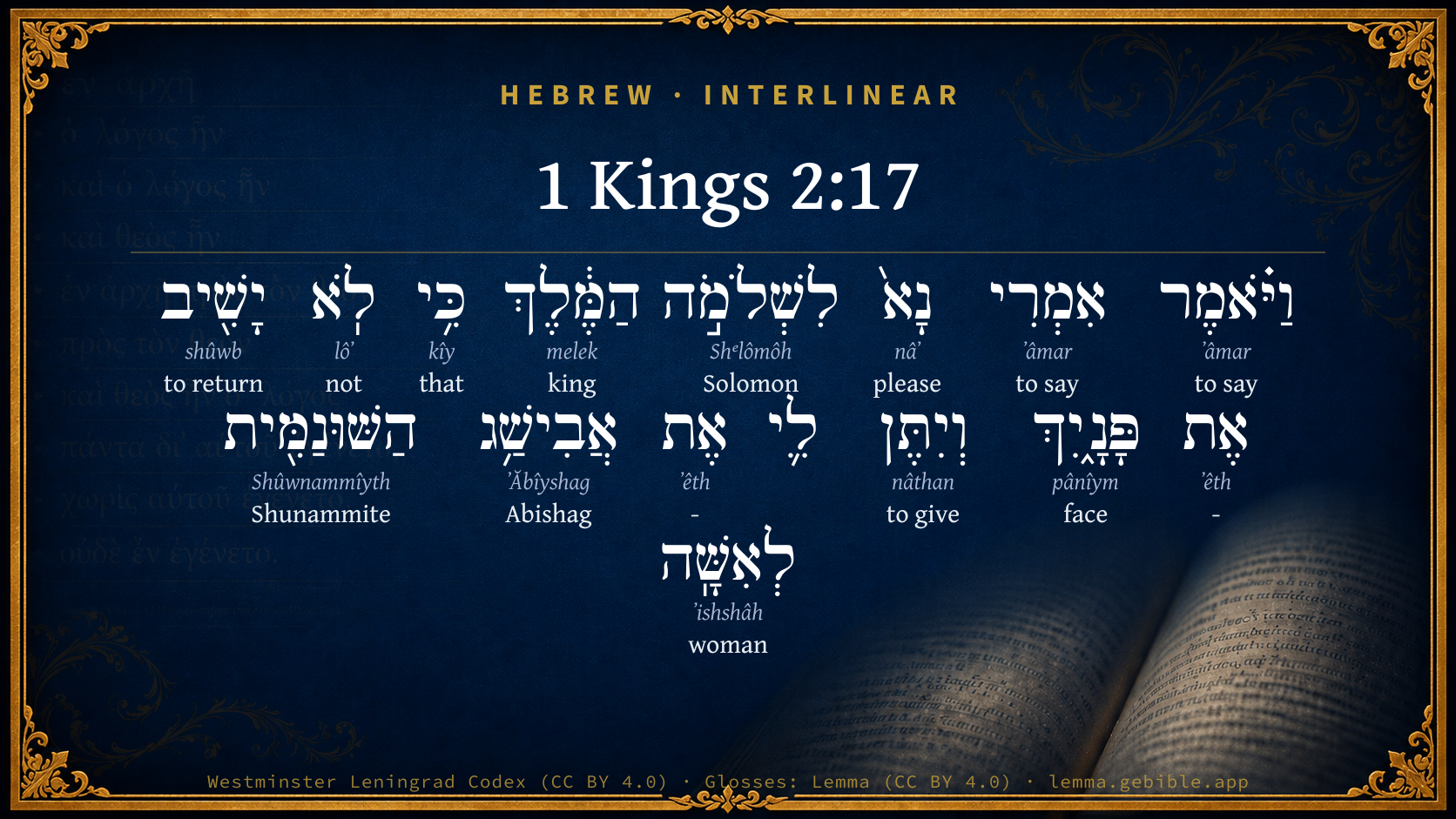
Hebrew (Westminster Leningrad Codex) 1 Kings 2:17 appears in the Hebrew Old Testament. The text above is from the Westminster Leningrad Codex. Each word links to its Strong’s number, a concise gloss, and parsing drawn from the Open Scriptures Hebrew Bible morphology. Click any word for its full Brown-Driver-Briggs (BDB) entry.
Download image
Cite this verse

1 Kings 2:17 (World English Bible). Public Domain. Lemma interlinear Bible study tool, https://lemma.gebible.app/v/1-kings/2/17.

Show BibTeX & RIS
BibTeX
RIS
English Translation
He said, Please speak to Solomon the king (for he will not tell you 'no'), that he give me Abishag the Shunammite as wife.
World English Bible · Public Domain
Download a study sheet

One document with this verse’s original text, its word-by-word gloss line, the meaning frame, cross-references with their text, attributed commentary, and full source and license credits — printable, and it pastes into notes with its structure intact.

This verse Autodidact and up

Study sheet (.html) Plain text (.txt)

A passage Seminary Student

Up to 50 verses in one chapter. A passage sheet keeps up to 6 commentary sources and 12 cross-references per verse, in the order this page ranks them, and says so on the sheet whenever that leaves anything out. Ask for a single verse and you get the Autodidact verse sheet above.

Everything on this page stays free to read, with no account — the sheet is a download of what is already on screen, not access to it.

Want to remove ads? Support Godless Engineer
Compare translations 3

The same verse in 3 English versions, stacked beneath the original-language interlinear above. Click any original word for its lexicon entry.

Each is an independent rendering of the whole verse — the interlinear is not word-aligned to these translations.

Highlighted words mark where these versions differ — a whole-verse word diff, not a word-by-word alignment.

  • World English Bible Public Domain
    He said, Please speak to Solomon the king (for he will not tell you 'no'), that he give me Abishag the Shunammite as wife.
  • King James Version Public Domain
    And he said, Speak, I pray thee, unto Solomon the king, (for he will not say thee nay,) that he give me Abishag the Shunammite to wife.
  • unfoldingWord Literal Text CC BY-SA 4.0
    And he said, “Please speak to King Solomon, for he will not turn away your face, that he may give to me Abishag the Shunammitess for a wife.”

unfoldingWord Literal Text — © unfoldingWord, licensed CC BY-SA 4.0. Word-aligned USFM3 via Door43 (git.door43.org/unfoldingWord/en_ult).

Versions to compare (up to 4)

3 of 4 selected

Show all 18 translations

Every available English version of this verse, each an independent rendering of the whole verse.

  • World English Bible Public Domain
    He said, Please speak to Solomon the king (for he will not tell you 'no'), that he give me Abishag the Shunammite as wife.
  • Berean Standard Bible Public Domain
    Adonijah replied, “Please speak to King Solomon, since he will not turn you down. Let him give me Abishag the Shunammite as my wife.”
  • Majority Standard Bible Public Domain
    Adonijah replied, “Please speak to King Solomon, since he will not turn you down. Let him give me Abishag the Shunammite as my wife.”
  • King James Version Public Domain
    And he said, Speak, I pray thee, unto Solomon the king, (for he will not say thee nay,) that he give me Abishag the Shunammite to wife.
  • American Standard Version (1901) Public Domain
    And he said, Speak, I pray thee, unto Solomon the king (for he will not say thee nay), that he give me Abishag the Shunammite to wife.
  • Revised Version (1885) Public Domain
    And he said, Speak, I pray thee, unto Solomon the king, (for he will not say thee nay,) that he give me Abishag the Shunammite to wife.
  • Geneva Bible (1599) Public Domain
    And he sayd, Speake, I pray thee, vnto Salomon ye King, (for he will not say thee nay) that he giue me Abishag the Shunammite to wife.
  • Douay-Rheims (1899) Public Domain
    And he said: I pray thee speak to king Solomon (for he cannot deny thee any thing) to give me Abisag the Sunamitess to wife.
  • Young's Literal Translation Public Domain
    And he saith, `Speak, I pray thee, to Solomon the king, for he doth not turn back thy face, and he doth give to me Abishag the Shunammite for a wife.'
  • Literal Standard Version CC BY-SA 4.0
    And he says, “Please speak to Solomon the king, for he does not turn back your face, and he gives Abishag the Shunammite to me for a wife.”
  • Unlocked Literal Bible CC BY-SA 4.0
    He said, “Please speak to Solomon the king, for he will not turn away from your face, so that he may give me Abishag the Shunammite as my wife.”
  • unfoldingWord Literal Text CC BY-SA 4.0
    And he said, “Please speak to King Solomon, for he will not turn away your face, that he may give to me Abishag the Shunammitess for a wife.”
  • Darby Bible Public Domain
    And he said, Speak, I pray thee, to Solomon the king -- for he will not refuse thee -- that he give me Abishag the Shunammite as wife.
  • World Messianic Bible Public Domain
    He said, “Please speak to Solomon the king (for he will not tell you ‘no’), that he give me Abishag the Shunammite as wife.”
  • Webster's Bible Public Domain
    And he said, Speak, I pray thee, to Solomon the king, (for he will not say to thee no,) that he give me Abishag the Shunamite for a wife.
  • Free Bible Version CC BY-SA 4.0
    He went on, “Please talk to King Solomon for me because he won't turn you down. Ask him to give me Abishag from Shunem as my wife.”
  • Bible in Basic English Public Domain
    Then he said, Will you go to Solomon the king (for he will not say, No, to you) and put before him my request that he will give me Abishag the Shunammite for a wife?
  • JPS Tanakh (1917) Public Domain
    And he said: 'Speak, I pray thee, unto Solomon the king — for he will not say thee nay — that he give me Abishag the Shunammite to wife.'

Literal Standard Version (2020), Covenant Press — licensed CC BY-SA 4.0. Text via the HelloAO Bible API (eBible.org). Unlocked Literal Bible (unfoldingWord) — licensed CC BY-SA 4.0. Text via the HelloAO Bible API (eBible.org). unfoldingWord Literal Text — © unfoldingWord, licensed CC BY-SA 4.0. Word-aligned USFM3 via Door43 (git.door43.org/unfoldingWord/en_ult). Free Bible Version, Dr. Jonathan Gallagher — licensed CC BY-SA 4.0. Text via the HelloAO Bible API (eBible.org).

Word by word

More ways to search: Search by grammar → Find every occurrence → Compare this word →

Practice this passage: Drill this verse → Learn its vocabulary →

אֲבִישַׁ֥ג
ʼĂbîyshag
H49
“Abishag”
Noun, Proper
Part of Speech
Noun
Type
Proper
Full BDB Definition

Origin: from H1 and H7686

TWOT: None

Abishag = "my father is a wanderer" - David's beautiful young nurse
  1. וַיֹּ֗אמֶר ʼâmar H559 “and · to say” Conjunction + Verb, Qal, Sequential Imperfect, 3rd Person, Masculine, Singular
  2. אִמְרִי ʼâmar H559 “say” Verb, Qal, Imperative, 2nd Person, Feminine, Singular
  3. נָא֙ nâʼ H4994 “please” Particle, Exhortation
  4. לִשְׁלֹמֹ֣ה Shᵉlômôh H8010 “to/for · Solomon” Preposition + Noun, Proper
  5. הַמֶּ֔לֶךְ melek H4428 “the · king” Particle, Definite Article + Noun, Common, Masculine, Singular, Absolute
  6. כִּ֥י kîy H3588 “that” Conjunction
  7. לֹֽא lôʼ H3808 “not” Particle, Negative
  8. יָשִׁ֖יב shûwb H7725 “to return” Verb, Hiphil, Imperfect, 3rd Person, Masculine, Singular
  9. אֶת ʼêth H853 “-” Particle, Direct Object
  10. פָּנָ֑יִךְ pânîym H6440 “face(s) · your” Noun, Common, Both, Plural, Construct + Suffix, Personal, 2nd Person, Feminine, Singular
  11. וְיִתֶּן nâthan H5414 “and · to give” Conjunction + Verb, Qal, Imperfect, 3rd Person, Masculine, Singular
  12. אֶת ʼêth H853 “-” Particle, Direct Object
  13. הַשּׁוּנַמִּ֖ית Shûwnammîyth H7767 “the · Shunammite” Particle, Definite Article + Noun, Gentilic, Feminine, Singular, Absolute
  14. לְאִשָּֽׁה ʼishshâh H802 “to/for · woman” Preposition + Noun, Common, Feminine, Singular, Absolute

About this verse

These counts appear in no published source. They are computed here, from the morphology-tagged text and Lemma’s own curated glosses. What Lemma adds →

16
words
13
distinct lemmas
Historical
section

Notable vocabulary

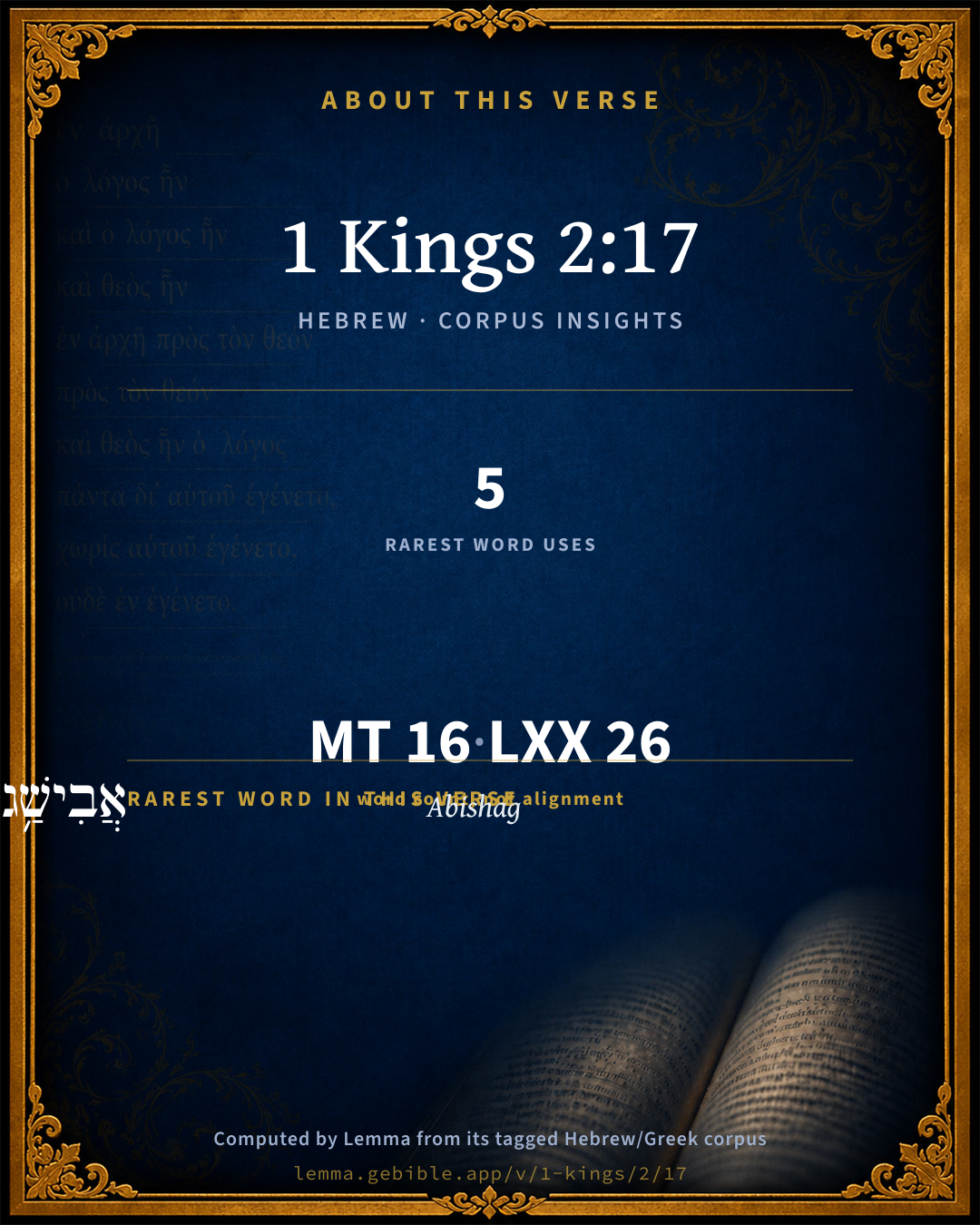
The rarest word here is אֲבִישַׁ֥ג Abishag H49 — appearing just 5 times in the whole Hebrew Bible.

Shared distinctive vocabulary

אֲבִישַׁ֥ג Abishag H49 occurs in 5 verses of the Hebrew Bible. Also found in:

Grammatical profile

  • 4 verbs
  • 6 nouns
  • 1 preposition
  • 1 conjunction
  • 4 particles

Verb forms

  • וַיֹּ֗אמֶר Qal · Sequential Imperfect
  • אִמְרִי Qal · Imperative
  • יָשִׁ֖יב Hiphil · Imperfect
  • וְיִתֶּן Qal · Imperfect

Repetition

A word recurs within this verse — often emphatic in Hebrew:

  • וַיֹּ֗אמֶר to say H559 ×2

Hebrew & Septuagint length

In English translation the verse runs 24 words from the Hebrew and 33 from the Septuagint (LXX English) — closely comparable.

A rough comparison of the two English renderings, which tokenize alike — not a word-level alignment.

Word counts can differ between the Hebrew and the Greek without any difference in meaning — e.g. the Hebrew direct-object marker אֵת has no separate Greek word, and Greek often adds the article ὁ.

In the original languages it is 16 Hebrew tokens and 26 Greek tokens — but the two are counted differently (Hebrew bundles its prefixes and suffixes into one token; the Greek is in lemma form), so that isn’t a like-for-like length.

Cross-references

3

Topical passages linked to 1 Kings 2:17 in the Treasury of Scripture Knowledge — connected by theme and wording, ordered by reader-vote popularity; previews shown in the World English Bible.

  • 2 Samuel 3:7 Now Saul had a concubine, whose name was Rizpah, the daughter of Aiah: and [Ish-bosheth] said to Abner, Why have you gone in to my father's concubine?
  • 2 Samuel 12:8 I gave you your master's house, and your master's wives into your bosom, and gave you the house of Israel and of Judah; and if that would have been too little, I would have added to you many more such things.
  • 1 Kings 1:2–4 Therefore his servants said to him, Let there be sought for my lord the king a young virgin: and let her stand before the king, and cherish him; and let her lie in your bosom, that my lord the king may keep warm.

Cross-references courtesy of OpenBible.info (CC BY 4.0).

Hebrew and Greek witnesses Masoretic Hebrew ↔ Greek Septuagint

The same verse in the two great witnesses to the Old Testament, shown verse-for-verse.

These are two independent witnesses, not word-aligned to each other, and the Septuagint is shown in lemma (dictionary) form.

Hebrew 1 Kings 2:17 Masoretic · Westminster Leningrad Codex

וַיֹּ֗אמֶר אִמְרִי נָא֙ לִשְׁלֹמֹ֣ה הַמֶּ֔לֶךְ כִּ֥י לֹֽא יָשִׁ֖יב אֶת פָּנָ֑יִךְ וְיִתֶּן לִ֛י אֶת אֲבִישַׁ֥ג הַשּׁוּנַמִּ֖ית לְאִשָּֽׁה

He said, Please speak to Solomon the king (for he will not tell you 'no'), that he give me Abishag the Shunammite as wife.

World English Bible · Public Domain

Greek LXX 1 Kings 2:17 Septuagint · lemma form

καί εἶπον αὐτός εἶπον δή πρός σαλωμών ὁ βασιλεύς ὅτι οὐ ἀποστρέφω ὁ πρόσωπον αὐτός ἀπό σύ καί δίδωμι ἐγώ ὁ αβισακ ὁ σωμανῖτις εἰς γυνή

And he said to her, Speak, I pray you, to king Solomon, for he will not turn away his face from you, and let him give me Abisag the Somanite for a wife.

LXX2012 (modern English Septuagint) · Public Domain

Hebrew: Westminster Leningrad Codex (CC BY 4.0). Greek: Septuagint (public domain); English from LXX2012 (modern English Septuagint) (Public Domain). How the Septuagint differs from the Hebrew →

Targum (Aramaic paraphrase)

1

The Targum is the ancient Jewish Aramaic paraphrase of the Hebrew Scriptures — an interpretive translation, not the Hebrew text itself. Onkelos (literal) and Pseudo-Jonathan (expansive) render the Torah, and Jonathan the Prophets. Coverage is partial: where no permissively-licensed English translation exists for a verse, only the Aramaic is shown. This is verse-level text, not a word-by-word alignment to the Hebrew.

  1. Targum Jonathan Prophets (Joshua–Malachi)
    וַאֲמַר אִמְרִי כְעַן לִשְׁלֹמֹה מַלְכָּא אֲרֵי לָא יְתִיב יַת אַפָּיִךְ וִיהַב לִי יַת אֲבִישַׁג דְמִן שׁוּנֵם לְאִתּוּ:

    (no public-domain English translation for this verse)

    Targum Jonathan — Aramaic: “Mikraot Gedolot” (public domain). English: “Sefaria Community Translation” (CC0 1.0 (public-domain dedication)); “London "Chaldee Paraphrase," 1871” (public domain). Text via Sefaria.

Commentary

Notes on 1 Kings 2:17 from classic Christian and Jewish commentators (each source and its license shown beneath its notes). The classic Christian expositions comment on the surrounding passage and are grouped to its opening verse, so a note may address several verses; the Jewish commentaries on the Tanakh (Rashi and others) are per-verse, so they appear only where the commentator wrote on this verse.

Lemma curates 59 commentaries, every one of them public domain or Creative Commons licensed, each selected and text-cleaned for this edition rather than reprinted as found. About our sources →

Trapp's Complete Commentary

John Trapp

1Ki 2:17 And he said, Speak, I pray thee, unto Solomon the king, (for he will not say thee nay,) that he give me Abishag the Shunammite to wife.

Ver. 17. For he will not say thee nay.] He knew that a mother might do much, as Olympias with Alexander, Agrippina with Nero, &c. The Romanists blasphemously pray to the mother of Christ, to command her Son to do this or that for them.

John Trapp, A Commentary or Exposition upon All the Books of the Old and New Testament (1647–1656) — public domain. Text from a community e-Sword module.

Joseph Benson's Commentary

1Ki 2:17. That he give me Abishag to wife — It is not likely that either Adonijah or Bath-sheba was ignorant that it was unlawful for any man to marry his father’s wife: but they perhaps thought that as David knew her not, the marriage had not been completed.

Joseph Benson's Commentary on the Old and New Testaments (1811–1818) — public domain. Text from a community e-Sword module.

Adam Clarke's Commentary

Verse 17. That he give me Abishag - to wife.] He cheerfully gives up all right to the kingdom, and only desires to have this young woman, who, though she had been his father's wife or concubine, was still in a state of virginity. Some think that Joab and Abiathar had advised Adonijah to make this application, not doubting, if he got Abishag, that the popular tide would again turn in his favour, and that Solomon, whom they did not like, might soon be deposed; and that it was on this account that Solomon was so severe. But there is little evidence to support these conjectures. It does not appear that Adonijah by desiring to have Abishag had any thought of the kingdom, or of maintaining any right to it, though Solomon appears to have understood him in this sense. But without farther evidence, this was a flimsy pretext to imbrue his hands in a brother's blood. The fable of the wolf and lamb is here very applicable, and the old English proverb not less so: It is an easy thing to find a staff to beat a dog with. We readily find an excuse for whatever we are determined to do. He who attempts to varnish over this conduct of Solomon by either state necessity or a Divine command, is an enemy, in my mind, to the cause of God and truth. See on 1Kg 2:25.

Adam Clarke's Commentary on the Bible (1810–1826) — public domain. Text from a community e-Sword/MySword module.

The Cambridge Bible for Schools and Colleges

gen. ed. J. J. S. Perowne

17. that he give me Abishag] It is highly probable that the construction which Solomon put upon Adonijah’s request was the true one, for in the East the widows of the late king become the wives of his successor, and to marry, or seek to marry, such a widow is equivalent to putting forward a claim to the throne. Cf. God’s message to David (2Sa_12:8) ‘I gave thee … thy master’s wives into thy bosom,’ and also the threatening in the verses which follow that passage. See too 1Ki_20:7; 2Ki_24:15. Peter Martyr in his comment on this verse gives, as an illustration of the proud aspirations which are sometimes fostered by marriage with a royal widow, the case of Admiral Seymour, who married Catharine Parr, the widow of Henry 8, and straightway after his marriage began to plot rebellion.

The Cambridge Bible for Schools and Colleges (gen. ed. J. J. S. Perowne; Cambridge University Press, 1878–1918) — public domain. Text from a community e-Sword module.

John Gill's Exposition

And he said, speak, I pray thee, unto Solomon the king,.... He owns him to be king, and which he the rather did to engage her to take his suit in hand, and to cover his design:

for he will not say thee nay; or turn away thy face, or deny thy request; she being his mother, for whom he had a great affection, and to whom he was under obligation on all accounts:

that he give me Abishag the Shunammite to wife; which was contrary to the law of God, Lev 18:8; which surely Adonijah must have been ignorant of, and Bathsheba likewise; or the one would never have made such a request, nor the other have undertaken to try to obtain it; but perhaps they did not take her to be David's wife, or the marriage to be consummated, because he knew her not: but yet not being returned to her father's house, and being at the dispose of Solomon, prove that she must be a concubine wife, and which became the property of the next heir and successor; see Sa2 12:8; nor did Adonijah apply to her or her friends; which, if he was really in love with her, he would have done, if at her own or their disposal; but this he knew, that she was solely at the disposal of Solomon, to whom he did not care to apply himself, but makes use of his mother.

John Gill's Exposition of the Whole Bible (1746–1763) — public domain (CC PDM 1.0). Text via the HelloAO Bible API.

Haydock's Catholic Bible Commentary

Wife. Some think that Joab had instigated Adonias to make this petition, that his party might be strengthened. (Theodoret, q. 7.) But love might be his prompter. (Calmet) --- Bethsabee consented to further his petition, (Menochius) without suspecting any bad consequences. (Haydock)

George Leo Haydock (1774–1849), Haydock's Catholic Family Bible and Commentary, 1859 edition — public domain. Excludes Psalms (Douay-Rheims chapter numbering differs from Protestant) and Deuterocanonical books (Catholic canon only).

Matthew Poole's English Annotations

Which though it was against a positive law of God, Lev 18:7, yet either Adonijah might be ignorant of it, being a man more studied in the affairs of the court than in the book of God; or might think her not concerned in it, because David knew her not, 1Ki 1:4.

Matthew Poole's English Annotations on the Holy Bible (1683–1685) — public domain. Text from a community e-Sword/MySword module.

The Pulpit Commentary

And he said, Speak, I pray thee, unto Solomon the ring; for he will not say thee nay, will not repulse thee. Same words as ver. 16. There is a spice of flattery in these words. He now exaggerates herinfluence with the king that he may give me Abishag the Shunammite to wife. We are hardly justified in concluding, as some commentators have done, that love had nothing to do with this request. It is not improbable, on the contrary, that a passion for the beautiful Shunamnite, perhaps the fairest woman of her time, may have first given a powerful impulse to Adonijah"s ambition. (see on 1Ki_1:5) At the same time, he must have had ulterior motives (see on ver. 22).

The Pulpit Commentary (1880–1919), ed. H.D.M. Spence-Jones & Joseph S. Exell — public domain. Text from a community e-Sword module.

Lesson kit

Teaching starters — assembled from the data on this page, not authored interpretation. Every prompt links to the verse data it draws on. Edit before teaching.

1 Kings, in the Historical, opens this verse with 16 words (13 distinct Hebrew lemmas). Its most distinctive word is ʼĂbîyshag (“Abishag”). A historical commentator’s framing appears above. Read the whole chapter for the surrounding context.

Discussion questions

  1. What does “Abishag” (ʼĂbîyshag) contribute to the verse as a whole?
  2. How does 1 Kings 1:3, which shares the word «Abishag», read alongside this verse?
  3. What does the repetition of “to say” (2× in this one verse) do in this verse?
  4. These translations render this verse differently. What is at stake in choosing one wording over another?
  5. «וַיֹּ֗אמֶר» is a Qal Sequential Imperfect verb. How does that grammatical form shape the action described?
  6. Compare how Trapp's Complete Commentary and Joseph Benson's Commentary read this verse. Where do they agree or differ?

Things to notice

Reading settings

Reading text

Shown beneath each verse's original-language words.

Old Testament
Old Testament edition

Read the OT as the Masoretic Hebrew (MT) or the Greek Septuagint (LXX).

English shown for the Greek Septuagint (in the Hebrew ↔ Greek comparison).

Comparing translations? Open the Compare panel on any verse page to stack up to four side by side.