

1 Timothy 2:9
Greek (Tischendorf 8th ed.) 1 Timothy 2:9 appears in the Greek New Testament. The text above is from the Tischendorf 8th edition. Each word links to its Strong’s number and a concise gloss. Click any word for its full Thayer’s Greek Lexicon entry.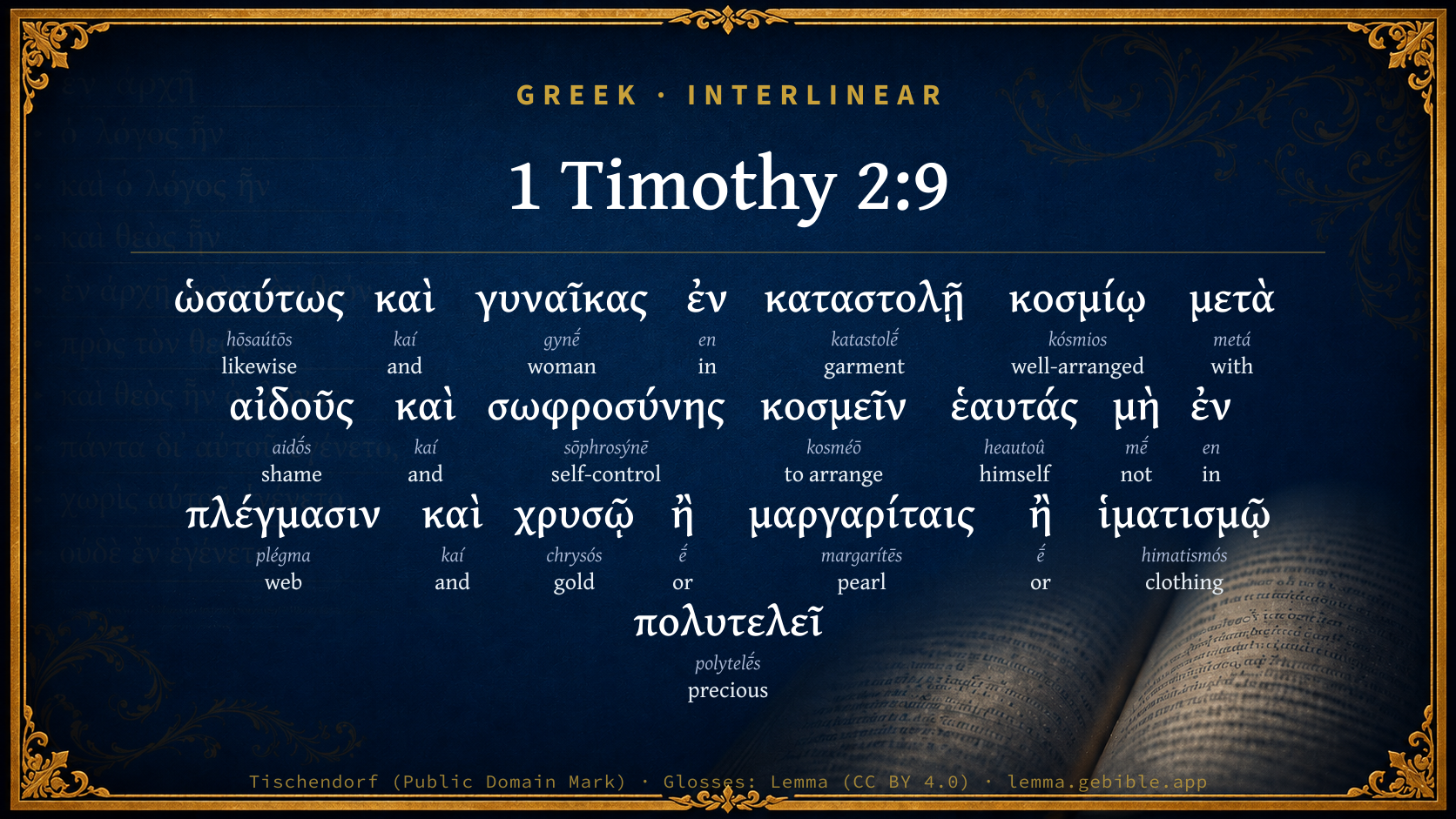
In the same way, that women also adorn themselves in decent clothing, with modesty and propriety; not just with braided hair, gold, pearls, or expensive clothing;
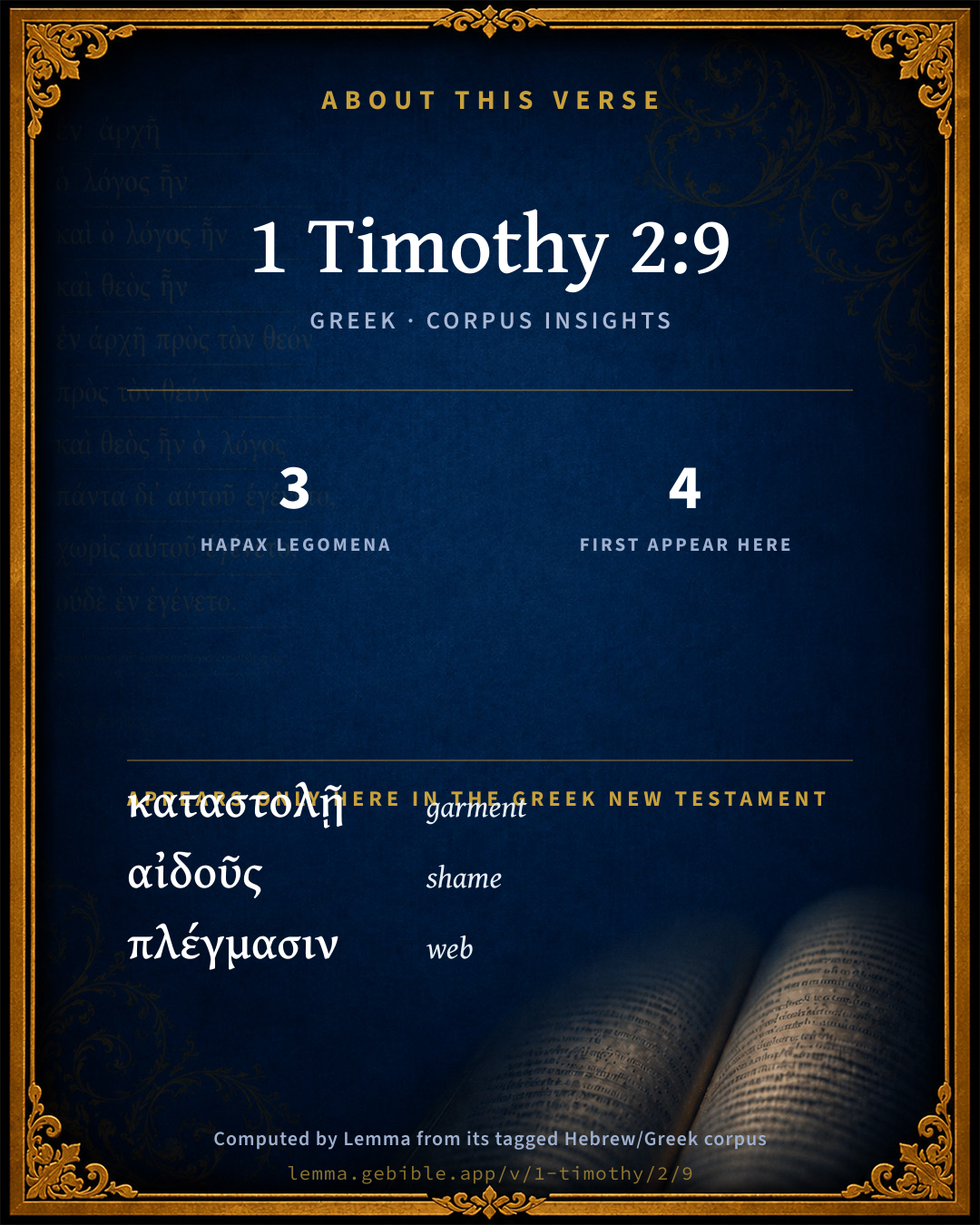
- 3 hapax legomena — only here in the Greek New Testament
- 4 first appearances in the Greek New Testament
Download a study sheet
One document with this verse’s original text, its word-by-word gloss line, the meaning frame, cross-references with their text, attributed commentary, and full source and license credits — printable, and it pastes into notes with its structure intact.
This verse Autodidact and up
A passage Seminary Student
Up to 50 verses in one chapter. A passage sheet keeps up to 6 commentary sources and 12 cross-references per verse, in the order this page ranks them, and says so on the sheet whenever that leaves anything out. Ask for a single verse and you get the Autodidact verse sheet above.
Everything on this page stays free to read, with no account — the sheet is a download of what is already on screen, not access to it.
Compare translations 3
The same verse in 3 English versions, stacked beneath the original-language interlinear above. Click any original word for its lexicon entry.
Each is an independent rendering of the whole verse — the interlinear is not word-aligned to these translations.
Highlighted words mark where these versions differ — a whole-verse word diff, not a word-by-word alignment.
-
World English Bible Public Domain
In the same way, that women also adorn themselves in decent clothing, with modesty and propriety; not just with braided hair, gold, pearls, or expensive clothing;
-
King James Version Public Domain
In like manner also, that women adorn themselves in modest apparel, with shamefacedness and sobriety; not with broided hair, or gold, or pearls, or costly array;
-
unfoldingWord Literal Text CC BY-SA 4.0
likewise women to adorn themselves in proper attire, with modesty and self-control, not in braids and gold, or pearls, or very expensive clothing,
unfoldingWord Literal Text — © unfoldingWord, licensed CC BY-SA 4.0. Word-aligned USFM3 via Door43 (git.door43.org/unfoldingWord/en_ult).
Show all 19 translations
Every available English version of this verse, each an independent rendering of the whole verse.
-
World English Bible Public Domain
In the same way, that women also adorn themselves in decent clothing, with modesty and propriety; not just with braided hair, gold, pearls, or expensive clothing;
-
Berean Standard Bible Public Domain
Likewise, I want the women to adorn themselves with respectable apparel, with modesty, and with self-control, not with braided hair or gold or pearls or expensive clothes,
-
Majority Standard Bible Public Domain
Likewise, I want the women to adorn themselves with respectable apparel, with modesty, and with self-control, not with braided hair or gold or pearls or expensive clothes,
-
King James Version Public Domain
In like manner also, that women adorn themselves in modest apparel, with shamefacedness and sobriety; not with broided hair, or gold, or pearls, or costly array;
-
American Standard Version (1901) Public Domain
In like manner, that women adorn themselves in modest apparel, with shamefastness and sobriety; not with braided hair, and gold or pearls or costly raiment;
-
Revised Version (1885) Public Domain
In like manner, that women adorn themselves in modest apparel, with shamefastness and sobriety; not with braided hair, and gold or pearls or costly raiment;
-
Geneva Bible (1599) Public Domain
Likewise also the women, that they aray themselues in comely apparell, with shamefastnes and modestie, not with broyded heare, or gold, or pearles, or costly apparell,
-
Douay-Rheims (1899) Public Domain
In like manner women also in decent apparel: adorning themselves with modesty and sobriety, not with plaited hair, or gold, or pearls, or costly attire,
-
Young's Literal Translation Public Domain
in like manner also the women, in becoming apparel, with modesty and sobriety to adorn themselves, not in braided hair, or gold, or pearls, or garments of great price,
-
Literal Standard Version CC BY-SA 4.0
also the women in like manner, in orderly apparel, to adorn themselves with modesty and sobriety, not in braided hair, or gold, or pearls, or clothing of great price,
-
Unlocked Literal Bible CC BY-SA 4.0
Likewise, I want the women to dress themselves in proper clothing, with modesty and self-control. They should not have braided hair, or gold, or pearls, or expensive clothing.
-
unfoldingWord Literal Text CC BY-SA 4.0
likewise women to adorn themselves in proper attire, with modesty and self-control, not in braids and gold, or pearls, or very expensive clothing,
-
Darby Bible Public Domain
In like manner also that the women in decent deportment and dress adorn themselves with modesty and discretion, not with plaited [hair] and gold, or pearls, or costly clothing,
-
World Messianic Bible Public Domain
In the same way, that women also adorn themselves in decent clothing, with modesty and propriety, not with braided hair, gold, pearls, or expensive clothing,
-
Webster's Bible Public Domain
In like manner also, that women adorn themselves in decent apparel, with modesty and sobriety; not with broidered hair, or gold, or pearls, or costly array,
-
Free Bible Version CC BY-SA 4.0
In the same way, women should dress sensibly, modestly, and appropriately. They should be attractive not in their hairstyle or by wearing gold or pearls or expensive clothes,
-
Bible in Basic English Public Domain
And that women may be dressed in simple clothing, with a quiet and serious air; not with twisted hair and gold or jewels or robes of great price;
-
Text-Critical English NT CC BY 4.0
Likewise, I want the women to adorn themselves in respectable apparel, with modesty and discretion, not with elaborately braided hair, gold, pearls, or expensive clothing,
-
Tyndale New Testament (1534) Public Domain
Lykwyse also the wemen that they araye them selves in comlye aparell with shamfastnes and discrete behaveour not with broyded heare other golde or pearles or costly araye:
Literal Standard Version (2020), Covenant Press — licensed CC BY-SA 4.0. Text via the HelloAO Bible API (eBible.org). Unlocked Literal Bible (unfoldingWord) — licensed CC BY-SA 4.0. Text via the HelloAO Bible API (eBible.org). unfoldingWord Literal Text — © unfoldingWord, licensed CC BY-SA 4.0. Word-aligned USFM3 via Door43 (git.door43.org/unfoldingWord/en_ult). Free Bible Version, Dr. Jonathan Gallagher — licensed CC BY-SA 4.0. Text via the HelloAO Bible API (eBible.org).
Word by word
More ways to search: Search by grammar → Find every occurrence → Compare this word →
Practice this passage: Drill this verse → Learn its vocabulary →
- Appears 1× in the Greek New Testament
- First appears here
- Part of Speech
- Noun
- Case
- Dative
- Number
- Singular
- Gender
- Feminine
Full Thayer's Definition
- ὡσαύτως hōsaútōs G5615 “likewise” Adverb
- καὶ kaí G2532 “and” Conjunction
- γυναῖκας gynḗ G1135 “woman” Noun, Accusative, Plural, Feminine
- ἐν en G1722 “in” Preposition
- καταστολῇ katastolḗ G2689 “garment” Noun, Dative, Singular, Feminine
- κοσμίῳ kósmios G2887 “well-arranged” Adjective, Dative, Singular, Feminine
- μετὰ metá G3326 “with” Preposition
- αἰδοῦς aidṓs G127 “shame” Noun, Genitive, Singular, Feminine
- καὶ kaí G2532 “and” Conjunction
- σωφροσύνης sōphrosýnē G4997 “self-control” Noun, Genitive, Singular, Feminine
- κοσμεῖν kosméō G2885 “to arrange” Verb, Present, Active, Infinitive
- ἑαυτάς heautoû G1438 “himself” Reflexive pronoun, 3rd person, Accusative, Plural, Feminine
- μὴ mḗ G3361 “not” Particle, Negative
- ἐν en G1722 “in” Preposition
- πλέγμασιν plégma G4117 “web” Noun, Dative, Plural, Neuter
- καὶ kaí G2532 “and” Conjunction
- χρυσῷ chrysós G5557 “gold” Noun, Dative, Singular, Masculine
- ἢ ḗ G2228 “or” Particle
- μαργαρίταις margarítēs G3135 “pearl” Noun, Dative, Plural, Masculine
- ἢ ḗ G2228 “or” Particle
- ἱματισμῷ himatismós G2441 “clothing” Noun, Dative, Singular, Masculine
- πολυτελεῖ polytelḗs G4185 “precious” Adjective, Dative, Singular, Masculine
About this verse
These counts appear in no published source. They are computed here, from the morphology-tagged text and Lemma’s own curated glosses. What Lemma adds →
- 22
- words
- 18
- distinct lemmas
- Pauline Epistles
- section
Notable vocabulary
3 hapax legomena — words that appear only here in the entire Greek New Testament:
First appearance in Scripture
These words make their first canonical appearance in the Greek New Testament here:
Shared distinctive vocabulary
κοσμίῳ well-arranged G2887 occurs in 2 verses of the Greek New Testament. Also found in:
Cross-references
18Topical passages linked to 1 Timothy 2:9 in the Treasury of Scripture Knowledge — connected by theme and wording, ordered by reader-vote popularity; previews shown in the World English Bible.
- 1 Peter 3:3–5 Let your beauty be not just the outward adorning of braiding the hair, and of wearing jewels of gold, or of putting on fine clothing;
- Titus 2:3–5 and that older women likewise be reverent in behavior, not slanderers nor enslaved to much wine, teachers of that which is good;
- Psalms 149:4 For Yahweh takes pleasure in his people. He crowns the humble with salvation.
- Jeremiah 4:30 You, when you are made desolate, what will you do? Though you clothe yourself with scarlet, though you deck you with ornaments of gold, though you enlarge your eyes with paint, in vain do you make yourself beautiful; [your] lovers despise you, they seek your life.
- Isaiah 3:16 Moreover Yahweh said, "Because the daughters of Zion are haughty, And walk with outstretched necks and flirting eyes, Walking to trip as they go, Jingling ornaments on their feet;
- 2 Kings 9:30 When Jehu was come to Jezreel, Jezebel heard of it; and she painted her eyes, and attired her head, and looked out at the window.
- Isaiah 3:18–24 In that day the Lord will take away the beauty of their anklets, the headbands, the crescent necklaces,
- Jeremiah 2:32 Can a virgin forget her ornaments, or a bride her attire? yet my people have forgotten me days without number.
- Genesis 24:53 The servant brought forth jewels of silver, and jewels of gold, and clothing, and gave them to Rebekah. He gave also to her brother and to her mother precious things.
- Proverbs 7:10 Behold, there a woman met him with the attire of a prostitute, And with crafty intent.
- Matthew 6:28–29 Why are you anxious about clothing? Consider the lilies of the field, how they grow. They don't toil, neither do they spin,
- Esther 5:1 Now it happened on the third day, that Esther put on her royal clothing, and stood in the inner court of the king's house, over against the king's house: and the king sat on his royal throne in the royal house, over against the entrance of the house.
- Isaiah 61:4 They shall build the old wastes, they shall raise up the former desolations, and they shall repair the waste cities, the desolations of many generations.
- Proverbs 31:22 She makes for herself carpets of tapestry. Her clothing is fine linen and purple.
- Psalms 45:13–14 The princess inside is all glorious. Her clothing is interwoven with gold.
- Matthew 11:8 But what did you go out to see? A man in soft clothing? Behold, those who wear soft clothing are in king's houses.
- Exodus 35:22–23 They came, both men and women, as many as were willing-hearted, and brought brooches, ear-rings, signet-rings, and armlets, all jewels of gold; even every man who offered an offering of gold to Yahweh.
- Ezekiel 16:9–16 Then washed I you with water; yes, I thoroughly washed away your blood from you, and I anointed you with oil.
Cross-references courtesy of OpenBible.info (CC BY 4.0).
Lesson kit
Teaching starters — assembled from the data on this page, not authored interpretation. Every prompt links to the verse data it draws on. Edit before teaching.
1 Timothy, in the Pauline Epistles, opens this verse with 22 words (18 distinct Greek lemmas). Its most distinctive word is katastolḗ (“garment”). A historical commentator’s framing appears above. Read the whole chapter for the surrounding context.
Discussion questions
- How does “garment” (katastolḗ) shape what this verse is saying?
- This verse holds 3 words here found nowhere else in the Greek New Testament. What might the rare words draw attention to?
- 4 words here appear for the first time in Scripture. What is being introduced at this debut?
- 1 Timothy 3:2 shares the word «well-arranged» with this verse. How do the two illuminate each other?
- “and” occurs 3× in this one verse. What is the effect of the repetition?
- These translations render this verse differently; the difference is in the English rendering, not the original. What questions does that raise?
- Reading how Albert Barnes' Notes on the Bible and The Biblical Illustrator read this verse, where do the two commentators agree and where do they part?
Things to notice
- 3 words in this verse appear nowhere else in the Greek New Testament.
- 4 words make their first canonical appearance in Scripture here.
- These translations choose different wording for 26 words in this verse.
- “and” occurs 3× in this single verse.
- 18 distinct Greek lemmas span 22 words in this verse.
Commentary
Notes on 1 Timothy 2:9 from classic Christian and Jewish commentators (each source and its license shown beneath its notes). The classic Christian expositions comment on the surrounding passage and are grouped to its opening verse, so a note may address several verses; the Jewish commentaries on the Tanakh (Rashi and others) are per-verse, so they appear only where the commentator wrote on this verse.
Lemma curates 59 commentaries, every one of them public domain or Creative Commons licensed, each selected and text-cleaned for this edition rather than reprinted as found. About our sources →
Albert Barnes' Notes on the Bible
Albert Barnes' Notes on the Bible (1834–1885) — public domain. Text from a community e-Sword/MySword module.
The Biblical Illustrator
Joseph S. Exell
The Biblical Illustrator, edited by Joseph S. Exell (c. 1880s–1900s) — public domain. Text from a community e-Sword module.
Joseph Benson's Commentary
Joseph Benson's Commentary on the Old and New Testaments (1811–1818) — public domain. Text from a community e-Sword module.
Whedon's Commentary on the Bible
Daniel D. Whedon
Daniel D. Whedon (gen. ed.), Commentary on the Old and New Testaments (1874–1909) — public domain. Text from a community e-Sword module.
The Preacher's Complete Homiletical Commentary
Joseph S. Exell (gen. ed.)
The Preacher's Complete Homiletical Commentary (gen. ed. Joseph S. Exell; Funk & Wagnalls, c. 1892) — public domain (pre-1929). A full-Bible homiletical/sermon-outline anthology covering 65 of 66 books (2 John is absent from the source module). Text from a community e-Sword module.
Tyndale Open Study Notes
Tyndale Open Resources
Tyndale Open Study Notes — © Tyndale Open Resources, licensed CC BY-SA 4.0. Text via the HelloAO Bible API.
Bengel's Gnomon
Johann Albrecht Bengel
Bengel's Gnomon of the New Testament — English translation (T&T Clark, Edinburgh, 1860) — public domain. Text from a community e-Sword module.
Meyer's Critical & Exegetical Commentary
Heinrich August Wilhelm Meyer
Meyer — Critical and Exegetical Commentary on the New Testament — English translation by Peter Christie, edited by Frederick Crombie (T&T Clark, 1880) — public domain. Text from a community e-Sword module.
Expositor's Greek Testament
ed. W. Robertson Nicoll
The Expositor's Greek Testament, edited by W. Robertson Nicoll (1897–1910) — public domain. Text from a community e-Sword module.
Geneva Bible (1599)
Geneva Bible translators
Geneva Bible (1599) marginal notes — public domain. Text via Bolls.life.
Matthew Henry's Commentary
Matthew Henry's Commentary on the Whole Bible (1708–1710) — public domain (CC PDM 1.0). Text via the HelloAO Bible API.
Jamieson, Fausset & Brown
Robert Jamieson, A. R. Fausset & David Brown
Jamieson, Fausset & Brown — Commentary Critical and Explanatory on the Whole Bible (1871) — public domain (CC PDM 1.0). Text via the HelloAO Bible API.
Adam Clarke's Commentary
Adam Clarke's Commentary on the Bible (1810–1826) — public domain. Text from a community e-Sword/MySword module.
John Calvin's Commentaries
John Calvin's Commentaries (1540-1563) — public domain. Text from the Calvin Translation Society English edition (1840s-50s) via the Christian Classics Ethereal Library (ccel.org). Calvin's coverage is partial (roughly two-thirds of the Bible); uncommented books and verses are honest gaps, never fabricated. The 19th-century editor's footnotes and remarks are omitted so the notes are faithfully Calvin's own voice.
Ellicott's Commentary for English Readers
A Bible Commentary for English Readers, edited by Charles John Ellicott (1878–1897) — public domain. Text from a community e-Sword module.
The Cambridge Bible for Schools and Colleges
gen. ed. J. J. S. Perowne
The Cambridge Bible for Schools and Colleges (gen. ed. J. J. S. Perowne; Cambridge University Press, 1878–1918) — public domain. Text from a community e-Sword module.
John Gill's Exposition
John Gill's Exposition of the Whole Bible (1746–1763) — public domain (CC PDM 1.0). Text via the HelloAO Bible API.
Trapp's Complete Commentary
John Trapp
John Trapp, A Commentary or Exposition upon All the Books of the Old and New Testament (1647–1656) — public domain. Text from a community e-Sword module.
Matthew Poole's English Annotations
Matthew Poole's English Annotations on the Holy Bible (1683–1685) — public domain. Text from a community e-Sword/MySword module.
The Pulpit Commentary
The Pulpit Commentary (1880–1919), ed. H.D.M. Spence-Jones & Joseph S. Exell — public domain. Text from a community e-Sword module.
John Wesley's Explanatory Notes
John Wesley, Explanatory Notes Upon the Whole Bible (1754–1765) — public domain. Text via the GEBible commentary corpus.
Kretzmann's Popular Commentary
Paul E. Kretzmann
Paul E. Kretzmann, Popular Commentary of the Bible (1921–1924) — public domain. Text from a community e-Sword module.
Burkitt's Expository Notes on the New Testament
William Burkitt
William Burkitt's Expository Notes on the New Testament (1700–1703) — public domain. Text from a community e-Sword module.
The People's New Testament
B. W. Johnson
B. W. Johnson's The People's New Testament with Notes (1889–1891) — public domain. Electronic text from the Christian Classics Ethereal Library (CCEL) ThML edition.
Cambridge Greek Testament for Schools and Colleges
Cambridge Greek Testament for Schools and Colleges (Cambridge University Press, 1896; 21 vols, various authors incl. Carr, Maclear, Plummer, Farrar, Lumby, Moule, M. R. James, Simcox) — public domain. Text from a community e-Sword module.
Alford’s Greek Testament
Henry Alford
Henry Alford, The Greek Testament (1849–1861) — public domain. Text from a community e-Sword module.
Vincent's Word Studies in the New Testament
Marvin R. Vincent
Marvin R. Vincent, Word Studies in the New Testament (1887–1900) — public domain. Text from a community e-Sword/MySword module.