Revelation 12:17

Greek (Tischendorf 8th ed.) Revelation 12:17 appears in the Greek New Testament. The text above is from the Tischendorf 8th edition. Each word links to its Strong’s number and a concise gloss. Click any word for its full Thayer’s Greek Lexicon entry.
Download image
Cite this verse

Revelation 12:17 (World English Bible). Public Domain. Lemma interlinear Bible study tool, https://lemma.gebible.app/v/revelation/12/17.

Show BibTeX & RIS
BibTeX
RIS
English Translation
The dragon grew angry with the woman, and went away to make war with the rest of her seed, who keep God's commandments and hold Jesus' testimony.
World English Bible · Public Domain
Download a study sheet

One document with this verse’s original text, its word-by-word gloss line, the meaning frame, cross-references with their text, attributed commentary, and full source and license credits — printable, and it pastes into notes with its structure intact.

This verse Autodidact and up

Study sheet (.html) Plain text (.txt)

A passage Seminary Student

Up to 50 verses in one chapter. A passage sheet keeps up to 6 commentary sources and 12 cross-references per verse, in the order this page ranks them, and says so on the sheet whenever that leaves anything out. Ask for a single verse and you get the Autodidact verse sheet above.

Everything on this page stays free to read, with no account — the sheet is a download of what is already on screen, not access to it.

Want to remove ads? Support Godless Engineer
Compare translations 3

The same verse in 3 English versions, stacked beneath the original-language interlinear above. Click any original word for its lexicon entry.

Each is an independent rendering of the whole verse — the interlinear is not word-aligned to these translations.

Highlighted words mark where these versions differ — a whole-verse word diff, not a word-by-word alignment.

  • World English Bible Public Domain
    The dragon grew angry with the woman, and went away to make war with the rest of her seed, who keep God's commandments and hold Jesus' testimony.
  • King James Version Public Domain
    And the dragon was wroth with the woman, and went to make war with the remnant of her seed, which keep the commandments of God, and have the testimony of Jesus Christ.
  • unfoldingWord Literal Text CC BY-SA 4.0
    And the dragon was enraged at the woman and went off to make war with the rest of her seed, the ones keeping the commandments of God and having the testimony of Jesus.

unfoldingWord Literal Text — © unfoldingWord, licensed CC BY-SA 4.0. Word-aligned USFM3 via Door43 (git.door43.org/unfoldingWord/en_ult).

Versions to compare (up to 4)

3 of 4 selected

Show all 19 translations

Every available English version of this verse, each an independent rendering of the whole verse.

  • World English Bible Public Domain
    The dragon grew angry with the woman, and went away to make war with the rest of her seed, who keep God's commandments and hold Jesus' testimony.
  • Berean Standard Bible Public Domain
    And the dragon was enraged at the woman, and went to make war with the rest of her children, who keep the commandments of God and hold to the testimony of Jesus. And the dragon stood on the shore of the sea.
  • Majority Standard Bible Public Domain
    And the dragon was enraged at the woman and went to make war with the rest of her children, who keep the commandments of God and hold to the testimony of Jesus. And I stood on the shore of the sea.
  • King James Version Public Domain
    And the dragon was wroth with the woman, and went to make war with the remnant of her seed, which keep the commandments of God, and have the testimony of Jesus Christ.
  • American Standard Version (1901) Public Domain
    And the dragon waxed wroth with the woman, and went away to make war with the rest of her seed, that keep the commandments of God, and hold the testimony of Jesus:
  • Revised Version (1885) Public Domain
    And the dragon waxed wroth with the woman, and went away to make war with the rest of her seed, which keep the commandments of God, and hold the testimony of Jesus:
  • Geneva Bible (1599) Public Domain
    Then the dragon was wroth with the woman, and went and made warre with the remnant of her seede, which keepe the comaundements of God, and haue the testimonie of Iesus Christ.
  • Douay-Rheims (1899) Public Domain
    And the dragon was angry against the woman: and went to make war with the rest of her seed, who keep the commandments of God, and have the testimony of Jesus Christ.
  • Young's Literal Translation Public Domain
    and the dragon was angry against the woman, and went away to make war with the rest of her seed, those keeping the commands of God, and having the testimony of Jesus Christ.
  • Literal Standard Version CC BY-SA 4.0
    and the dragon was angry against the woman, and went away to make war with the rest of her seed, those keeping the commands of God, and having the testimony of Jesus.
  • Unlocked Literal Bible CC BY-SA 4.0
    Then the dragon was enraged at the woman and went off to wage war with the rest of her descendants, those who obey God's commandments and hold to the testimony about Jesus.
  • unfoldingWord Literal Text CC BY-SA 4.0
    And the dragon was enraged at the woman and went off to make war with the rest of her seed, the ones keeping the commandments of God and having the testimony of Jesus.
  • Darby Bible Public Domain
    And the dragon was angry with the woman, and went to make war with the remnant of her seed, who keep the commandments of God, and have the testimony of Jesus.
  • World Messianic Bible Public Domain
    The dragon grew angry with the woman, and went away to make war with the rest of her offspring, who keep God’s commandments and hold Yeshua’s testimony.
  • Webster's Bible Public Domain
    And the dragon was wroth with the woman, and went to make war with the remnant of her seed, who keep the commandments of God, and have the testimony of Jesus Christ.
  • Free Bible Version CC BY-SA 4.0
    The dragon was furious with the woman, and went off to attack the rest of her offspring, those who keep God's commandments and have the testimony of Jesus.
  • Bible in Basic English Public Domain
    And the dragon was angry with the woman and went away to make war on the rest of her seed, who keep the orders of God, and the witness of Jesus:
  • Text-Critical English NT CC BY 4.0
    So the dragon was angry with the woman and went off to wage war against the rest of her offspring, those who keep the commandments of God and hold to the testimony of Jesus.
  • Tyndale New Testament (1534) Public Domain
    And the dragon was wroth with the woman: and went and made warre with the remnaunt of hyr sede which kepe the commaundmentes of god and have the testimony of Iesus Christe. And I stode on the see sonde.

Literal Standard Version (2020), Covenant Press — licensed CC BY-SA 4.0. Text via the HelloAO Bible API (eBible.org). Unlocked Literal Bible (unfoldingWord) — licensed CC BY-SA 4.0. Text via the HelloAO Bible API (eBible.org). unfoldingWord Literal Text — © unfoldingWord, licensed CC BY-SA 4.0. Word-aligned USFM3 via Door43 (git.door43.org/unfoldingWord/en_ult). Free Bible Version, Dr. Jonathan Gallagher — licensed CC BY-SA 4.0. Text via the HelloAO Bible API (eBible.org).

Word by word

More ways to search: Search by grammar → Find every occurrence → Compare this word →

Practice this passage: Drill this verse → Learn its vocabulary →

ὠργίσθη
orgízō
G3710
“to anger”
Verb, Aorist, Passive, Indicative, 3rd person, Singular
Part of Speech
Verb
Tense
Aorist
Voice
Passive
Mood
Indicative
Person
3rd person
Number
Singular
Full Thayer's Definition

Origin: from G3709

TDNT: 5:382,*

1. to provoke, to arouse to anger 2. to be provoked to anger, be angry, be wroth
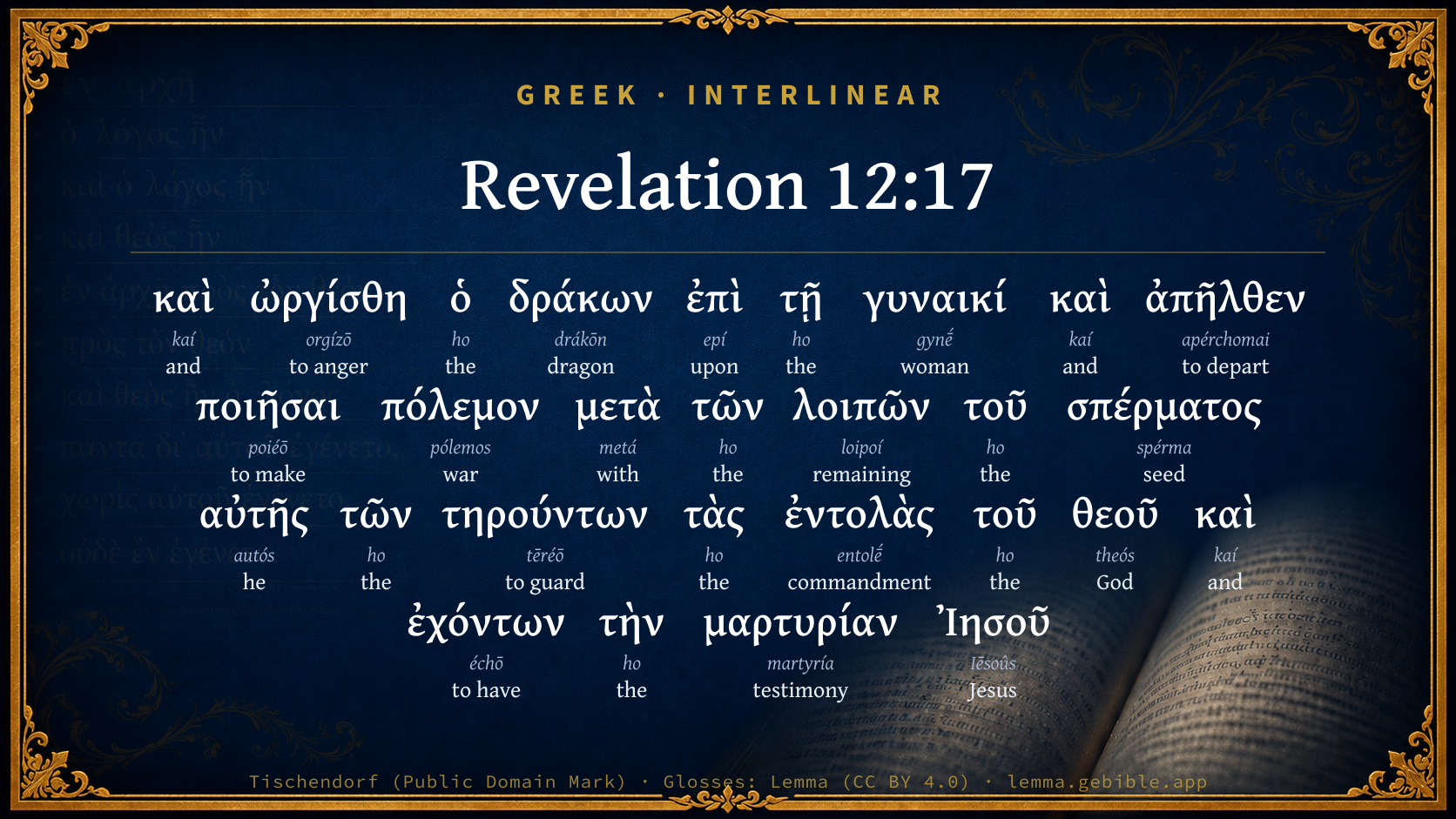
  1. καὶ kaí G2532 “and” Conjunction
  2. ὁ ho G3588 “the” Article, Nominative, Singular, Masculine
  3. δράκων drákōn G1404 “dragon” Noun, Nominative, Singular, Masculine
  4. ἐπὶ epí G1909 “upon” Preposition
  5. τῇ ho G3588 “the” Article, Dative, Singular, Feminine
  6. γυναικί gynḗ G1135 “woman” Noun, Dative, Singular, Feminine
  7. καὶ kaí G2532 “and” Conjunction
  8. ἀπῆλθεν apérchomai G565 “to depart” Verb, Aorist, Active, Indicative, 3rd person, Singular
  9. ποιῆσαι poiéō G4160 “to make” Verb, Aorist, Active, Infinitive
  10. πόλεμον pólemos G4171 “war” Noun, Accusative, Singular, Masculine
  11. μετὰ metá G3326 “with” Preposition
  12. τῶν ho G3588 “the” Article, Genitive, Plural, Masculine
  13. λοιπῶν loipoí G3062 “remaining” Adjective, Genitive, Plural, Masculine
  14. τοῦ ho G3588 “the” Article, Genitive, Singular, Neuter
  15. σπέρματος spérma G4690 “seed” Noun, Genitive, Singular, Neuter
  16. αὐτῆς autós G846 “he” Personal pronoun, Genitive, Singular, Feminine
  17. τῶν ho G3588 “the” Article, Genitive, Plural, Masculine
  18. τηρούντων tēréō G5083 “to guard” Verb, Present, Active, Participle, Genitive, Plural, Masculine
  19. τὰς ho G3588 “the” Article, Accusative, Plural, Feminine
  20. ἐντολὰς entolḗ G1785 “commandment” Noun, Accusative, Plural, Feminine
  21. τοῦ ho G3588 “the” Article, Genitive, Singular, Masculine
  22. θεοῦ theós G2316 “God” Noun, Genitive, Singular, Masculine
  23. καὶ kaí G2532 “and” Conjunction
  24. ἐχόντων échō G2192 “to have” Verb, Present, Active, Participle, Genitive, Plural, Masculine
  25. τὴν ho G3588 “the” Article, Accusative, Singular, Feminine
  26. μαρτυρίαν martyría G3141 “testimony” Noun, Accusative, Singular, Feminine
  27. Ἰησοῦ Iēsoûs G2424 “Jesus” Noun, Genitive, Singular, Masculine

About this verse

These counts appear in no published source. They are computed here, from the morphology-tagged text and Lemma’s own curated glosses. What Lemma adds →

28
words
19
distinct lemmas
Revelation
section

Notable vocabulary

The rarest word here is ὠργίσθη to anger G3710 — appearing just 8 times in the whole Greek New Testament.

Shared distinctive vocabulary

ὠργίσθη to anger G3710 occurs in 8 verses of the Greek New Testament. Also found in:

Repetition

Words recur within this verse:

Cross-references

25

Topical passages linked to Revelation 12:17 in the Treasury of Scripture Knowledge — connected by theme and wording, ordered by reader-vote popularity; previews shown in the World English Bible.

  • Revelation 14:12 Here is the patience of the saints, those who keep the commandments of God, and the faith of Jesus."
  • Genesis 3:15 I will put enmity between you and the woman, and between your offspring and her offspring. He will bruise your head, and you will bruise his heel."
  • Revelation 19:10 I fell down before his feet to worship him. He said to me, "Look! Don't do it! I am a fellow bondservant with you and with your brothers who hold the testimony of Jesus. Worship God, for the testimony of Jesus is the Spirit of Prophecy."
  • Revelation 1:2 who testified to God's word, and of the testimony of Jesus Christ, about everything that he saw.
  • Revelation 6:9 When he opened the fifth seal, I saw underneath the altar the souls of those who had been killed for the Word of God, and for the testimony of the Lamb which they had.
  • Revelation 11:7 When they have finished their testimony, the beast that comes up out of the abyss will make war with them, and overcome them, and kill them.
  • Revelation 13:7 It was given to him to make war with the saints, and to overcome them. Authority over every tribe, people, language, and nation was given to him.
  • Daniel 7:23–26 Thus he said, The fourth animal shall be a fourth kingdom on earth, which shall be diverse from all the kingdoms, and shall devour the whole earth, and shall tread it down, and break it in pieces.
  • John 8:44 You are of your Father, the devil, and you want to do the desires of your father. He was a murderer from the beginning, and doesn't stand in the truth, because there is no truth in him. When he speaks a lie, he speaks on his own; for he is a liar, and the father of it.
  • 1 John 2:3 This is how we know that we know him: if we keep his commandments.
  • 1 John 5:2 By this we know that we love the children of God, when we love God and keep his commandments.
  • 1 John 5:10 He who believes in the Son of God has the testimony in himself. He who doesn't believe God has made him a liar, because he has not believed in the testimony that God has given concerning his Son.
  • Revelation 1:9 I John, your brother and partner with you in oppression, Kingdom, and perseverance in Christ Jesus, was on the isle that is called Patmos because of God's Word and the testimony of Jesus Christ.
  • Revelation 12:11–12 They overcame him because of the Lamb's blood, and because of the word of their testimony. They didn't love their life, even to death.
  • Revelation 17:14 These will war against the Lamb, and the Lamb will overcome them, for he is Lord of lords, and King of kings. They also will overcome who are with him, called and chosen and faithful."
  • Daniel 11:36 The king shall do according to his will; and he shall exalt himself, and magnify himself above every god, and shall speak marvelous things against the God of gods; and he shall prosper until the indignation be accomplished; for that which is determined shall be done.
  • 1 Corinthians 2:1 When I came to you, brothers, I didn't come with excellence of speech or of wisdom, proclaiming to you the testimony of God.
  • Revelation 17:6 I saw the woman drunken with the blood of the saints, and with the blood of the martyrs of Jesus. When I saw her, I wondered with great amazement.
  • Revelation 18:20 Rejoice over her, O heaven, you saints, apostles, and prophets; for God has judged your judgment on her."
  • Revelation 19:19 I saw the beast, and the kings of the earth, and their armies, gathered together to make war against him who sat on the horse, and against his army.
  • Revelation 20:4 I saw thrones, and they sat on them, and judgment was given to them. I saw the souls of those who had been beheaded for the testimony of Jesus, and for the word of God, and such as didn't worship the beast nor his image, and didn't receive the mark on their forehead and on their hand. They lived, and reigned with Christ for the thousand years.
  • Revelation 22:14 Blessed are those who do his commandments, that they may have the right to the tree of life, and may enter in by the gates into the city.
  • Matthew 28:20 teaching them to observe all things that I commanded you. Behold, I am with you always, even to the end of the age." Amen.
  • 1 Peter 5:8 Be sober and self-controlled. Be watchful. Your adversary the devil, walks around like a roaring lion, seeking whom he may devour.
  • Revelation 20:8–9 and he will come out to deceive the nations which are in the four corners of the earth, Gog and Magog, to gather them together to the war; the number of whom is as the sand of the sea.

Cross-references courtesy of OpenBible.info (CC BY 4.0).

Where the printed editions differ

1 variant

Places in this verse where the major printed Greek editions disagree on the wording in a way that affects the translation — a comparison of editions, not a manuscript-by-manuscript collation. The editions are the modern critical texts (Nestlé-Aland 28/27, SBL, Westcott-Hort, Tregelles, Tyndale House) and the traditional texts behind the KJV (the Textus Receptus and the Byzantine/Majority text). It is not a claim about which reading is original.

  1. Extra text
    Χριστοῦ.

    “Christ.”

    In TR Not in NA28NA27TynSBLWHTregByz

    Χριστοῦ. (Christou) 'Christ.' is only in traditional manuscripts (TR)

Textual data: Translators Amalgamated Greek New Testament (STEPBible TAGNT) · CC BY 4.0.

Commentary

Notes on Revelation 12:17 from classic Christian and Jewish commentators (each source and its license shown beneath its notes). The classic Christian expositions comment on the surrounding passage and are grouped to its opening verse, so a note may address several verses; the Jewish commentaries on the Tanakh (Rashi and others) are per-verse, so they appear only where the commentator wrote on this verse.

Lemma curates 59 commentaries, every one of them public domain or Creative Commons licensed, each selected and text-cleaned for this edition rather than reprinted as found. About our sources →

Tyndale Open Study Notes

Tyndale Open Resources

12:17 The dragon turns his hostility against the woman’s children (believers) who keep God’s commandments and continue in their testimony for Jesus.

Tyndale Open Study Notes — © Tyndale Open Resources, licensed CC BY-SA 4.0. Text via the HelloAO Bible API.

Bengel's Gnomon

Johann Albrecht Bengel

Rev 12:17. Μετὰ τῶν λοιπῶν, with the remnant) These are the faithful scattered in the lands of the unfaithful.

Bengel's Gnomon of the New Testament — English translation (T&T Clark, Edinburgh, 1860) — public domain. Text from a community e-Sword module.

Meyer's Critical & Exegetical Commentary

Heinrich August Wilhelm Meyer

Rev_12:17. The dragon, inflamed only to greater rage (καὶ ὠργίσθη τῇ γυναικὶ) against the fleeing woman (Rev_12:16), because of the frustration of his last attack, applies himself to a conflict with the rest of her seed which keep the commandments of God, and hold the testimony of Jesus.

For the correct explanation of the expression τ. λοιπῶν τοῦ σπέρματος αὐτης, κ.τ.λ.,and also for the determination thence, according to the context, of the idea of the γυνή,we must first of all maintain, against Ebrard, that the σπέρμα αὐτῆς is not a seed from which also the woman springs, but only the seed springing from the woman, i.e., born of her, can be designated; so that the λοιποὶ τοῦ σπερμ. αὐτης could in no way be those who belong to the same seed with the woman. In violation of the context, Auberlen[3187] further judges the λοιπ. τ. σπ. αὐτ. to be the disciples of the Lord who have survived the earlier persecutions (Rev_12:13-16); for if the hostility described in Rev_12:13-16 is directed against the woman herself, not her seed, that hostility remains entirely unsuccessful,[3188] so that the subject here cannot be survivors in general. This also against Hengstenb., who concedes two different references: The rest are they who survive the hostile inundation in Rev_12:15, or are not touched by it.

A guide to the more specific determination of the λοιποὶ τ. σπέρμ. αὐτ. is contained in the words τῶν τηροῦντων

Ἰησοῦ, if the sense be correctly stated by Ewald, whom Züll. follows: Of those uniting with the more eager and wholesome study of Mosaic laws firm faith in Jesus the Messiah; but the expression is entirely too general,[3189] than that thereby merely Jewish Christians be designated.

The relation, especially presented by the context, of the statement Τ. ΛΟΙΠῶΝ ΤΟὐ ΣΠΈΡΜΑΤΟς ΑὐΤ., viz., to the man-child which, according to Rev_12:5, belongs to the seed of the woman as the firstborn, has been acknowledged with complete definiteness only by Zull.;[3190] yet while he has correctly explained only the form, but not, at the same time, the subject, he enables us to recognize the occasion because of which this most simple contrast of the rest of the seed of the woman, and that firstborn brother, the Messiah himself,[3191] has not been obvious to expositors, viz., the difficulty of correctly conceiving of the woman in the relation as well to the man-child (Rev_12:5) as also to the rest of her seed. The ΓΥΝΉ herself, her ΥἹΌς, and the ΛΟΙΠΟῚ ΤΟῦ ΣΠΈΡΜΑΤΟς ΑὐΤῆς, are three ideas so essentially connected that the misunderstanding of one necessarily hinders the correct explanation of the rest. In general, there is no doubt possible as to the fact that the son of the woman is the Messiah; but, nevertheless, that the Virgin Mary is not on this account to be understood by the woman,even though the ideal contemplation of the writer of the Apoc. always gives the historical person of the Virgin a certain support,

Andr., in agreement with Methodius, has already noted. Any such reference to the person of Mary is rendered impossible, on the one hand, by the ideal description of the γυνή herself, and the events pertaining to her; on the other, by her relation to the rest of her seed. By the latter statementas the ΛΟΙΠΟῚ Τ. ΣΠ. ΑὐΤ. is designated not only by the final clause of Rev_12:17, but also by what succeeds in ch. 13, as, at all events, believers in Christthe expositors are led with essential unanimity to recognition of the fact that the ΓΥΝΉ designates the Church, in analogy with the mode of contemplation, according to which, in the O. T., the congregation of Gods people appears as the wife of Jehovah, and in the Apoc. itself[3192] as the bride of the Lord. If now the question be as to the more specific comprehension of this, in general, obvious idea of the ΓΥΝΉ, as well according to the measure of significant features in the description of the ΓΥΝΉ herself,[3193] as also in relation to her man-child, and the rest of her seed; in the first place, all the expositors err who, in the ΓΥΝΉ, wish to recognize the Christian Church, whether they expressly distinguish it from the Jewish or O. T. Church,[3194] and limit the description to the antichristic period at the end of the world,[3195] or regard the N. T. Church in essential connection with that of the O. T., the latter not without its N. T. continuation, and both as one inseparable comprehensive Church.[3196] A characteristic sign that these two modifications of the exposition essentially cohere, lies in the fact that men like Vitringa and Auberlen share the error that the twelve stars (Rev_12:1) refer to the twelve apostles.[3197] But the view that the woman is the N. T. Church, inevitably miscarries in Rev_12:5; for it is impossible[3198] to refer the birth of the Messiah to Christs attaining life and form in believers.[3199] For this reason,[3200] the reference to the O. T. Church has been received; but, on the one hand, the difficulty concerning the original exposition arising from Rev_12:5[3201] is not properly removed, and, on the other, a new difficulty is developed. For, if the γυνή be the O. and N. T. Church universal, who are then the λοιπ. τ. σπ. αὐτ., Rev_12:17? The opinion of Bleek, De Wette, and Hengstenb., also of Klief.,according to which an actual distinction could not be made between the woman and the rest of her seed, since the woman herself is nothing but the sum of her children, and by ἡ γυνή the whole, while by οἱ λοιπ. τ. σπ. αὐτ. the particular members of the whole, are designated,[3202]

Auberlen[3203] defends upon the ground that only in this way can it be explained why the dragon who was enraged with the woman turns against her seed. But the text does directly the opposite in offering a distinction between the woman and her seed. The woman (Rev_12:16) is hidden from injury on the part of the dragon; just because he sees that he cannot reach the woman herself, he inflicts his wrath, which undoubtedly is directed against the woman, upon another subject still within reach, viz., the rest of the womans children. Is it not very readily to be understood, if the dragon wishes now to distress the mother by injuring her children?

The γυνὴ who bore the Messiah (Rev_12:5), and has still other seed (Rev_12:17), can be only the O. T. Church of God, the true Israel.[3204] John was taught already by the ancient prophetic representation, to ascribe seed to this Church, and to regard her as mother of her children, the believing and godly;[3205] the description, also, in Rev_12:2; Rev_12:5, has originated not without an allusion to Mic_5:1 sqq. But nevertheless, in the writer of the Apocalypse, the view, with all its analogy to the ancient prophetic types, appears peculiarly defined, viz., because he represents heathen Christians (the λοιπ. τ. σπ. αὐτ., Hofm., Ebrard), as belonging to the seed of the woman, and in so far the brethren of the Messiah.[3206] Here John would have a very suitable model in Mic_5:3, as the יֶחֶר אֶחָיך[3207] designates the growth of the Church from the heathen, who are added to the mother Church as though born of her seed. For the evangelical-prophetical fundamental view, cf. Isa_2:2 sqq.; Zec_8:20 sqq.; Joh_4:22, etc. Against this conception, it dare not be said, that nevertheless not only believers from the heathen are brethren of the Messiah, that consequentlybeneath the acknowledgment of the reference of ΟἹ ΛΟΙΠΟῚ Τ. ΣΠΈΡΜ. ΑὐΤ., to the child of the woman mentioned in Rev_12:5the ΛΟΙΠΟΊ are, in any case, to be regarded Jewish and heathen Christians; for the ordinary view, according to which all believers are brethren of the Lord, is not presented here as certainly as is the ideal person of the γυνή, the mother of the Messiah, the O. T. Church of God, in whose complete unity Jewish Christians are regarded as the genuine Israelites. [See Note LXIX., p. 359.]

[3187] p. 298.

[3188] Cf. Rev_12:17.

[3189] Cf. Rev_14:12, Rev_22:14. Concerning the correct meaning of ἕχ. τ. μαρτ. Ἰησ., cf., against Ewald especially, Rev_6:9, Rev_19:10.

[3190] The rest of her seed, the Zionites on earth, in contrast with the child above removed.

[3191] Cf. Mat_28:10; Heb_2:11-12.

[3192] Rev_22:17.

[3193] Cf. Rev_12:1.

[3194] Beda, N. de Lyra, Aret., Hammond, Calov., Vitr., Beng., etc.

[3195] C. a Lap., Stern.

[3196] Victorin., Andr., De Wette, Hengstenb., Auberien, Christiani: The Church of the last time. Cf. also the inconsistencies of Coccejus, who, in Rev_12:14, suddenly speaks of the N. T. Church, although he had referred what preceded to the O. T.; of Eichh., who already, in Rev_12:5, inserts the Christian Church which proceeded from Judaism, etc.

[3197] The apostolic Church (Vitr., p. 566).

[3198] To say nothing as to the proposition that the birth of Christ may be his return to judgment, as the result of the course of the Christian Church through time, as Klief. (Zeitschr., a. a. O. S., 547) indicates by understanding by the γυνή the people of God in Christendom. Cf. on Rev_12:11.

[3199] Against Beda, Stern, etc.

[3200] Cf., e.g., Auberlen, p. 277: By the woman who bore Jesus, we are naturally to understand the Church of God in its O. T. form; on the other hand, p. 280: The Church also in its N. T. form.

[3201] For, the more earnestly the essential unity of the O. and N. T. Church of God is asserted, the less proper is it to ascribe that exclusively to the first part of this Church which cannot be ascribed to the second part.

[3202] Cf., on the other hand, Ewald.

[3203] p. 289.

[3204] Cf. Herder, Heinr., Ewald, Züll., Hofm., Ebrard; also Bleek, Vorles., Volkm., Hilgenf.: The original Church in Palestine.

[3205] Cf. Isa_54:1; Isa_54:13; Isa_66:8.

[3206] Volkm., who indorses this explanation, attempts, however, to harmonize this passage with the assumed Judaism of the Apoc. by requiring us to regard heathen Christians as metics subordinate to the citizens of the kingdom of God. Hilgenf. prefers to keep clear of this distinction here, and to think only of the daughter-congregation in general contrast with that of the Palestinian mother-church.Both are unsuitable to this passage, since here the opposition to the received anti-Pauline Judaism of the Apoc. is presented.

[3207] The rest of his [the Messiahs] brethren. LXX., incorrectly: οἱ ἐπίλοιποι τῶν ἀδελφῶν αὐτων.

Only now[3208] is the purpose of what is described in Rev_12:1-17, with respect to what follows, to be clearly recognized. In Rev_12:17 (ἈΠῆΛΘΕ, Κ.Τ.Λ.), this distinctly comes to light. By the vision of ch. 12, Satan himself is designated as the proper exciter of the ΠΌΛΕΜΟς (Rev_12:17) of the ΘΛῚΨΙς, which believers have yet to expect before the coming of their Lord. And, besides, a specific determination of the ΠΌΛΕΜΟς, whose description is here introduced, lies in the fact, that, on the one hand, Satan appears in the form which he had attained in the Roman Empire (Rev_12:3), as, then, on the other hand, those Christians are designated as the goal of the dragons rage who came from the Gentiles to the sonship of Israel (Rev_12:17), and are to be found within the bounds of that empire. But how Satan now excites war, and what instruments he puts in motion, is made manifest directly afterwards, viz., in ch. 13, which begins with the words that in the later editions form the close of ch. 12 (Rev 12:18).

[3208] Cf. on Rev_12:5-6.

NOTES BY THE AMERICAN EDITOR

LXIX. Rev_12:17. μετὰ τῶν λοιπῶν

Alford: Note, as important elements for the interpretation: 1. That the woman has seed besides the man-child who was caught up to Gods throne, those who are not only distinct from herself, but who do not accompany her in her flight into the wilderness. 2. That those persons are described as being they who keep the commandments of God, and have the testimony of Jesus. 3. That during the womans time of her being fed in the wilderness, the dragon is making war, not against her, but against this remnant of her seed. 4. That by the form of expression here,these present participles, descriptive of habit, and occurring at the breaking-off of the vision, as regards the general description of the dragons agency,it is almost necessarily implied that the woman, while hidden in the wilderness from the dragons wrath, goes on bringing forth sons and daughters thus described. These facts he regards fatal to the view of the flight as the withdrawal of Gods true servants from open recognition. So Beck, who also finds its solution in the doctrine of the invisible Church, and refers to the parallel in Gal_4:27. In fact, the entire passage (Gal_4:22 sqq.) affords an answer to an objection which Düsterdieck derives from the οἱ λοιποὶ; for here, as there, the Church, as an institution regenerating and perpetuating through the word and sacraments a spiritual seed, is a mother; while the individuals belonging to the Church, as the congregation of believers, are the children. Our author ignores the well-known principle, Omne simile claudicat.

Meyer — Critical and Exegetical Commentary on the New Testament — English translation by Peter Christie, edited by Frederick Crombie (T&T Clark, 1880) — public domain. Text from a community e-Sword module.

Expositor's Greek Testament

ed. W. Robertson Nicoll

Rev 12:17 . The baffled adversary now widens his sphere of operations. τ . λ . an apocalyptic term = the derelicti or relicti of 4 Esdras ( cf. Volz, 319). These represent to the Christian editor the scattered Christians in the Empire; by adding this verse (or at least καὶ ἐχ .… Ἰησοῦ ) to the source, he paves the way for the following saga of 13. which depicts the trying situation of Christians exposed to the attack of the devil’s deputies. The devil keeps himself in the background. He works subtly through the Roman power. This onset on the faith and faithfulness of Christians by the enforcement of the Imperial cultus is vividly delineated in Ep. Lugd. which incidentally mentions the experience of Biblias who, like Cranmer, repented of a recantation. “The devil, thinking he had already swallowed up [918] ., one of those who had denied Christ, desired to condemn her further by means of blasphemy, and brought her to the torture [ i.e. , in order to force false accusations from her lips].… But she, reminded by her present anguish of the eternal punishment in Gehenna [ cf. Rev 14:9 f.], contradicted the blasphemous slanderers, confessed herself a Christian, and was added to the order of the martyrs.” Blandina, the heroic slave-girl, survived several conflicts ἵνα νικήσασα τῷ μὲν σκολιῷ ὄφει ἀπαραίτητον ποιήσῃ τὴν καταδίκην .

[918] Codex Vaticanus (sæc. iv.), published in photographic facsimile in 1889 under the care of the Abbate Cozza-Luzi.

The keynote of the situation hinted in Rev 12:17 f. is struck in Rev 13:2 . The dragon has given his authority to the beast ; what God’s people have now to contend with is no longer the O.T. Satan merely (Rev 12:9-10 ) but his powerful and seductive delegate on earth. In the Imperial cultus the Christian prophet could see nothing except a supreme and diabolically subtle manœuvre of Satan himself ( cf. on Rev 13:1 ; Rev 13:5 ). The Danielic prophecy was at last on he verge of fulfilment! Mythological and cosmological elements ( S. C. 360 f.) were already present in the Danielic tradition, but the prophet (or the source which he edits) readapted them to the historical situation created by the expectation of Nero’s return from the under world and the enforcement of the Imperial cultus. For the hypothesis of a Caligula-source in this chapter, cf. Introd § 6.

Rev 12:17 to Rev 13:18 : the saga of the woman and the red dragon (a war in heaven) is followed by the saga of the two monsters from sea and land (a war on earth), who, with the dragon, form a triumvirate of evil. First (Rev 12:17 to Rev 13:10 ) the monster from the sea, i.e. , the Roman Empire.

Rev 12:18. The scene is the sea-shore, ex hypothesi , of the Mediterranean ( Phœdo , 109 b , 111 a , etc.), i.e. , the West, the whole passage being modelled on Dan 7:2-3 ; Dan 7:7-8 ; Dan 7:19-27 , where the stormy sea from which the monsters emerge is the world of nations ( cf. 4 Esd. 11:1: ecce ascendebat de mari aquila, also 4 Esd. 13:1)

The Expositor's Greek Testament, edited by W. Robertson Nicoll (1897–1910) — public domain. Text from a community e-Sword module.

Cambridge Greek Testament for Schools and Colleges

17. ἐπὶ τῇ γυναικί … μετὰ τῶν λοιπῶν τοῦ σπέρματος αὐτῆς. We have not means for interpreting this description in detail. All we can say certainly is, that it describes the providential foiling of Satanic attempts at the destruction of Israel. Perhaps the most plausible suggestion of a definite meaning of the “flood” [better translated “river”] is that the Christians of Jerusalem, in their flight to “the mountains” (St Mat 24:16 &c.) of Pella, were delivered by a miracle or special providence from the dangers of the passage of Jordan: if they fled immediately before the siege was formed by Titus, this was just before the Passover, when the river was in flood (Jos 3:15). But of such an event we have no historical notice: and it is likely that the Christians fled when they had first “seen Jerusalem compassed with armies” (St Luk 21:20), in the unsuccessful assault of Cestius Gallus, three years before the fall of the city.

τῶν τηρούντων τὰς ἐντολάς. Rev 14:12.

ἐχόντων τὴν μαρτυρίαν Ἰησοῦ. Rev 6:9, Rev 19:10.

Rev 12:17 to Rev 13:10. THE BEAST FROM THE SEA

Cambridge Greek Testament for Schools and Colleges (Cambridge University Press, 1896; 21 vols, various authors incl. Carr, Maclear, Plummer, Farrar, Lumby, Moule, M. R. James, Simcox) — public domain. Text from a community e-Sword module.

Geneva Bible (1599)

Geneva Bible translators

Being set on fire by this means, he began to be more mad, and because he perceived that his purpose against the Christian Church of the Jewish remnant was come to nought, he resolved to fall upon her seed, that is, the Church gathered also by God of the Gentiles, and the holy members of the same. And this is that other branch, as I said upon verse 13, in which the purpose of Satan is showed, verse 17, and his attempt, verse 18.

Geneva Bible (1599) marginal notes — public domain. Text via Bolls.life.

Jamieson, Fausset & Brown

Robert Jamieson, A. R. Fausset & David Brown

wroth with--Greek, "at."

went--Greek, "went away."

the remnant of her seed--distinct in some sense from the woman herself. Satan's first effort was to root out the Christian Church, so that there should be no visible profession of Christianity. Foiled in this, he wars (Rev 11:7; Rev 13:7) against the invisible Church, namely, "those who keep the commandments of God, and have the testimony of Jesus" (A, B, and C omit "Christ"). These are "the remnant," or rest of her seed, as distinguished from her seed, "the man-child" (Rev 12:5), on one hand, and from mere professors on the other. The Church, in her beauty and unity (Israel at the head of Christendom, the whole forming one perfect Church), is now not manifested, but awaiting the manifestations of the sons of God at Christ's coming. Unable to destroy Christianity and the Church as a whole, Satan directs his enmity against true Christians, the elect remnant: the others he leaves unmolested.

Next: Revelation Chapter 13

Jamieson, Fausset & Brown — Commentary Critical and Explanatory on the Whole Bible (1871) — public domain (CC PDM 1.0). Text via the HelloAO Bible API.

Adam Clarke's Commentary

NOTES ON CHAP. XII., BY J. E. C.

Verse 17. And the dragon was wroth with the woman] The heathen party, foiled in their subtle attempt to destroy Christianity, were greatly enraged, and endeavoured to excite the hatred of the multitude against the religion of Jesus. "They alleged that before the coming of Christ the world was blessed with peace and prosperity; but that since the progress of their religion everywhere, the gods, filled with indignation to see their worship neglected and their altars abandoned, had visited the earth with those plagues and desolations which increased every day." See Mosheim's Ecclesiastical History, cent. V., part 1, and other works on this subject.

Went to make war with the remnant of her seed] The dragon απηλθε, departed, i.e., into the wilderness, whither the woman had fled; and in another form commenced a new species of persecution, directed only against the remnant of her seed, who keep the commandments of God, and have the testimony of Jesus Christ. See on verse 13 of the following chapter for an illustration of this remarkable passage. "Re 13:13"

Adam Clarke's Commentary on the Bible (1810–1826) — public domain. Text from a community e-Sword/MySword module.

Ellicott's Commentary for English Readers

(17) And the dragon . . .—Translate, And the dragon was wroth with the woman, and departed (not merely “went,” but departed, as one baffled in his attempt to carry the woman away by the river) to make war with the rest of her seed, who Keep the commandments of God, and have the testimony of Jesus. Omit the word Christ. The attempt to sweep away the Christian Church is vain. The wrath of man has always been found to turn to God’s praise; the earth has always helped the woman; out of a thousand seeming defeats the Church of Christ has arisen; the banner of the Lord has been lifted up over every flood. But the foe will not give up his attacks. He can make war upon individual Christians; he may cease to assail the collective Church of Christ, but he can assail Christians by a thousand discomforts, by petty opposition, by undermining their morals, by making them unpopular, not as Christians, but as “very particular” Christians: for those thus assailed are they who “keep the commandments of God and the testimony of Jesus.” It is the old combination of a holy life and a fidelity to their Master which is the test of true loyalty. They take heed to themselves; they abide in Christ; they take heed to the teaching, that Christ’s word may abide in them. They keep His word, and they witness to Him in lip and life.

A Bible Commentary for English Readers, edited by Charles John Ellicott (1878–1897) — public domain. Text from a community e-Sword module.

The Cambridge Bible for Schools and Colleges

gen. ed. J. J. S. Perowne

17. the woman … the remnant of her seed] Gen_3:15. The sense must be, that the Devil attempts to frustrate God’s counsels, not now by attacking the old Israel, but the new “Israel of God.” Titus, we are told, resolved to destroy the Temple, “in order that the religion of the Jews and Christians might be more completely abolished” (Sulp. Sev. ii. 30, supposed to embody a quotation from Tacitus). Hadrian, on the contrary, seeing that the Christians had separated their cause from that of the rebel Jews, extended to them a tolerance not merely contemptuous. But thenceforward the best and ablest emperors, from M. Aurelius to Diocletian, recognising the independent power of the Church, thought it necessary to persecute it. At last, Julian completely reversed the policy of Titus, seeking to discredit the Gospel by patronage to the Jews. This policy, apparently, will be carried out by Antichrist: but will be baffled when the Jews, whom he has restored to their land as unbelievers, are converted by the martyrdom and resurrection of the two prophets (see notes on the preceding chapter).

which keep the commandments] Rev_14:12.

have the testimony] Rev_6:9. The word “Christ” should be omitted.

The Cambridge Bible for Schools and Colleges (gen. ed. J. J. S. Perowne; Cambridge University Press, 1878–1918) — public domain. Text from a community e-Sword module.

John Gill's Exposition

And the dragon was wroth with the woman,.... The devil was very angry with the church, because he could not destroy her by the Arian persecution he had raised; and because he could not carry her away with the flood, either of errors and heresies, or of the barbarous nations; and because he could not, by any means, come at her, and indeed did not well know where she was, a place being prepared for her of God in the wilderness, where she was taken care of: wherefore he took another method as follows,

and went to make war with the remnant of her seed; which refers to the war the beast, to whom he gave his power, seat, and authority, is said to make with the saints; and which was entered into and carried on by his instigation, of which there is an account in the following chapter: the persons with whom he went to make war are described as "her seed"; the seed of the church, her spiritual offspring, the sons and daughters she brought forth to Christ; between which seed, and Satan and his seed, there always was an enmity: and these are "the remnant" of her seed, a few persons scattered up and down, a remnant according to the election of grace; who were not in bodies, or in church states, regularly formed, as heretofore, but in private families, and some here, and some there; and who were called out to bear a testimony for Christ in corrupt times: and these are further described as such

who keep the commandments of God: and not the traditions of men: nor are the commands of the moral law of God so much designed, though it is true that these were kept by the seed of the church; but rather the ordinances of the Gospel, the commands of God our Saviour, such as baptism and the Lord's supper; which were kept by these faithful ones, as they had been delivered, when they began now to be sadly corrupted by the antichristian party:

and have the testimony of Jesus Christ; the Gospel, which is a testimony concerning him; See Gill on Rev 1:2. This they had in their hearts, a spiritual knowledge and saving experience of it; and this they had in their hands, they made a profession of it, they held it forth, and held it fast; all which was the reason of Satan's enmity against them, and war with them.

Next: Revelation Chapter 13

John Gill's Exposition of the Whole Bible (1746–1763) — public domain (CC PDM 1.0). Text via the HelloAO Bible API.

Trapp's Complete Commentary

John Trapp

17 And the dragon was wroth with the woman, and went to make war with the remnant of her seed, which keep the commandments of God, and have the testimony of Jesus Christ.

Ver. 17. Was wroth with the woman] Who yet had done him no wrong; but he and his are mad with malice (when their designs miscarry especially), and are ready to sue the Church, as he in Cicero did another, quod totum telum corpore non recepieset, because he had not taken into his body the whole dagger wherewith he had stabbed him. (Orat. pro C. Rab. Posth.)

To make war] That war which is mentioned Rev 13:7.

With the remnant of her seed] As a little seed grain is reserved out of a great heap for store, which is nothing to the whole crop; so is the small number of true believers reserved by grace, nothing to the whole field and crop of the world.

Which keep the commandments] A just description of a godly Christian. Boni catholici sunt qui et fidem integram sequuntur et bonos mores. To be sound in faith and holy in life, this is the kernel of Christianity. (Aug.)

John Trapp, A Commentary or Exposition upon All the Books of the Old and New Testament (1647–1656) — public domain. Text from a community e-Sword module.

Albert Barnes' Notes on the Bible

And the dragon was wroth with the woman - This wrath had been vented by his persecuting her Rev 12:13; by his pursuing her; and by his pouring out the flood of water to sweep her away Rev 12:15; and the same wrath was now vented against her children. As he could not reach and destroy the woman herself, he turned his indignation against all who were allied to her. Stripped of the imagery, the meaning is, that as he could not destroy the church as such, he vented his malice against all who were the friends of the church, and endeavored to destroy them. “The church, as such, he could not destroy; therefore he turned his wrath against individual Christians, to bring as many of them as possible to death” (DeWette).

And went to make war with the remnant of her seed - No mention is made before of his persecuting the children of the woman, except his opposition to the “man child” which she bore, Rev 12:1-4. The “woman” represents the church, and the phrase “the remnant of her seed” must refer to her scattered children, that is, to the scattered members of the church, wherever they could be found. The reference here is to persecutions against individuals, rather than a general persecution against the church itself, and all that is here said would find an ample fulfillment in the vexations and troubles of individuals in the Roman communion in the dark ages, when they evinced the spirit of pure evangelical piety; in the cruelties practiced in the Inquisition on individual Christians under the plea that they were heretics; and in the persecutions of such men as Wycliffe, John Huss, and Jerome of Prague. This warfare against individual Christians was continued long in the papal church, and tens of thousands of true friends of the Saviour suffered every form of cruelty and wrong as the result.

Which keep the commandments of God - Who were true Christians. This phrase characterizes correctly those who, in the dark ages, were the friends of God, in the midst of abounding corruption.

And have the testimony of Jesus Christ - That is, they bore a faithful testimony to his truth, or were real martyrs. See Rev 2:13.

The scene, then, in this chapter is this: John saw a most beautiful woman, suitably adorned, representing the church as about to he enlarged, and to become triumphant in the earth. Then he saw a great red monster, representing Satan, about to destroy the church: the pagan power, infuriated, and putting forth its utmost energy for its destruction. He then saw the child caught up into heaven, denoting that the church would be ultimately safe, and would reign over all the world. Another vision appears, It is that of a contest between Michael, the protecting angel of the people of God, and the great foe, in which victory declares in favor of the former, and Satan suffers a discomfiture, as if he were cast from heaven to earth. Still, however, he is permitted for a time to carry on a warfare against the church, though certain that he would be ultimately defeated. He puts forth his power, and manifests his hostility, in another form - that of the papacy - and commences a new opposition against the spiritual church of Christ. The church is, however, safe from that attempt to destroy it, for the woman is represented as fleeing to the wilderness beyond the power of the enemy, and is there kept alive. Still filled with rage, though incapable of destroying the true church itself, he turns his wrath, under the form of papal persecutions, against individual Christians, and endeavors to cut them off in detail.

This is the general representation in this chapter, and on the supposition that it was designed to represent the various forms of opposition which Satan would make to the church of Christ, under paganism and the papacy, it must be admitted, I think, that no more expressive or appropriate symbols could have been chosen. This fact should be allowed to have due influence in confirming the interpretation suggested above; and if it be admitted to be a correct interpretation, it is conclusive evidence of the inspiration of the book. Further details of this opposition of Satan to the church under the papal form of persecution are made in the subsequent chapters.

Albert Barnes' Notes on the Bible (1834–1885) — public domain. Text from a community e-Sword/MySword module.

Matthew Poole's English Annotations

And the dragon was wroth with the woman: the devil hath been defeated in two designs against the whole church; he could not wholly root it out by the ten persecutions under the Roman emperors, nor by the water thrown out of his mouth, pestilent doctrines which he influenced some to broach; but he was angry still, his rage was not extinguished.

And went to make war with the remnant of her seed; he gives over his design to ruin the whole church, as not practicable, but resolves to do all the mischief he could to the remnant of her seed, to particular Christians; those especially, which kept closest to the doctrine of faith, called here

the testimony of Jesus Christ, and to the rule of a holy life, which is meant by keeping

the commandments of God. Hence antichrist’s rage hath not been against Christians in general, as was the pagans’, but only against such Christians as he hath not been able to bring over to him, in a compliance with his corruptions in doctrine, worship, and discipline.

Matthew Poole's English Annotations on the Holy Bible (1683–1685) — public domain. Text from a community e-Sword/MySword module.

Whedon's Commentary on the Bible

Daniel D. Whedon

17. Dragon was wroth—Paganism long maintained an angry and desperate struggle for supremacy.

War with… seed—Who maintained the testimony of Jesus himself over wafer-worship and Mariolatry during the beast-period.

Dusterdieck denies that the woman is symbol of the Church; maintaining that this whole scene of chapter 12 is a picture showing who are the true adversaries of Christ, namely, Satan and his hosts. The woman, he argues, cannot be the Jewish Church, for, besides her apostolic twelve stars she laps over into the Christian ages even to the time of Constantine. Nor can she be the Christian Church; for who then are the remnant of her seed? To this argument Alford seems to succumb, and accept Dusterdieck’s view, and thereby enfeebles and disconcerts his whole scheme of interpretation.

Our answer to Dusterdieck’s dilemma is, that the woman is the anti-dragon or anti-pagan Church; the remnant of her seed is the anti-bestial or anti-papal Church. The woman, therefore, inclusively represents the ancient Jewish Church, from which Christ sprung, continued into the Christian Church in all its anti-pagan history and character. While the pagan dragon hoped, in his own undisguised person, to conquer her, he fought; but when he saw defeat before him he evoked the sea-beast (chap. 13) to be his substitute, and through him to war with the remnant of her seed—the opponents of the pseudo-Christian beast—until he reappears in his own person, Rev_20:1. The Church, the woman, is, in successive generations, truly her own seed. The Church of to-day is the Church’s seed, and the Church of a later day is the remnant or rest of her seed. The seed against which paganism warred through the beast were the anti-papal successors to the anti-pagan Church.

We have a striking proof that the dragon was paganism in the opinion of Constantine himself. Eusebius gives us Constantine’s words: “That dragon has been expelled from the government of the world by the good providence of the supreme God and my instrumentality.” And before the vestibule of his own palace the emperor placed a cross over his own head, and the dragon beneath, thrust down into the abyss.

Daniel D. Whedon (gen. ed.), Commentary on the Old and New Testaments (1874–1909) — public domain. Text from a community e-Sword module.

The Pulpit Commentary

And the dragon was wroth with the woman, and went to make war with the remnant of her seed; waxed wroth... went away to make, etc. (Revised Version). Having failed to prevent the mission of" the man child Christ Jesus and having been foiled in his attempts to overwhelm the Church of God, Satan proceeds to attack the individual members of the Church the seed of the woman. The method by which he endeavours to do this is related in the following chapters. Wordsworth points out an analogy between the means which Satan employs to destroy the Church as described here, and those described in the seals. The "rest of her seed" (Revised Version) signifies all the children of the woman, excluding the man child of ver. 5. All members of the Church of God are thus referred to, those who are brethren of Christ. (cf. Heb_2:11, "For which cause he is not ashamed to call them brethren Which keep the commandments of God, and have the testimony of Jesus Christ (nearly all manuscripts omit "Christ"); hold the testimony (Revised Version). This plainly points out who are the "rest of the seed they are those who are God"s faithful servants. We may see in the description a reference to the Church of God, both Jewish and Christian. The members of the Jewish Church were they to whom "the commandments of God" were specially revealed, and Christians are they who specially "hold the testimony of Jesus." (For an explanation of the latter phrase, see on Rev_1:2)

We have now reached another stage in the history of the warfare carried on by the devil against God. Vers. 7-12 of this chapter describe the origin of the hostility of Satan towards God; vers. 4 and 5 relate the attempts of the devil to destroy Christ and to thwart his mission; vers. 13-16 refer to the attacks of Satan upon the Church of God, by which he hoped to destroy it as a whole, before there was time for the "seed" to spring up. Having failed in every attempt, the dragon now sends other agents by whom he hopes to destroy the individual members of the Church the other seed of the woman the brethren of Christ.

The Pulpit Commentary (1880–1919), ed. H.D.M. Spence-Jones & Joseph S. Exell — public domain. Text from a community e-Sword module.

John Wesley's Explanatory Notes

And the dragon was wroth - Anew, because he could not cause her to be carried away by the stream. And he went forth - Into other lands. To make war with the rest of her seed - Real Christians, living under heathen or Turkish governors.

John Wesley, Explanatory Notes Upon the Whole Bible (1754–1765) — public domain. Text via the GEBible commentary corpus.

The People's New Testament

B. W. Johnson

17. And the dragon waxed wroth. Was angry at his defeat. He continued the warfare by asking to destroy the woman's seed. I believe that this vision reveals the persecution of the true Church, first by Pagan, and then by Papal Rome, a persecution that results in the apparent disappearance of the true Church from the earth. Though not visible to the eye of the historian during this period, yet the true Church, fed of God, survives in the hearts of the hidden and persecuted saints. The period of her exile began about 533, in the reign of Justinian, and ends about the beginning of the nineteenth century. Before the end of the period, the Divine measure, the reed of the apostles, was used to measure the temple, altar and worshipers, and, as the result, over three-fourths of a century ago, the true Church began to appear as a visible body, once more in the world.

B. W. Johnson's The People's New Testament with Notes (1889–1891) — public domain. Electronic text from the Christian Classics Ethereal Library (CCEL) ThML edition.

Vincent's Word Studies in the New Testament

Marvin R. Vincent

Jesus Christ. Omit Christ.

The best texts add to this chapter the opening words of ch. 13 (A. V.), "And I stood upon the sand of the sea." Some, however, change ejstaqhn I stood, to ejstaqh he stood, referring to the dragon. So Rev.

Marvin R. Vincent, Word Studies in the New Testament (1887–1900) — public domain. Text from a community e-Sword/MySword module.

Lesson kit

Teaching starters — assembled from the data on this page, not authored interpretation. Every prompt links to the verse data it draws on. Edit before teaching.

Revelation, in the Revelation, opens this verse with 28 words (19 distinct Greek lemmas). Its most distinctive word is orgízō (“to anger”). A historical commentator’s framing appears above. Read the whole chapter for the surrounding context.

Discussion questions

  1. What does “to anger” (orgízō) contribute to the verse as a whole?
  2. Matthew 5:22 shares the word «to anger» with this verse. How do the two illuminate each other?
  3. “the” occurs 8× in this one verse. What is the effect of the repetition?
  4. These translations render this verse differently; the difference is in the English rendering, not the original. What questions does that raise?
  5. Reading how Tyndale Open Study Notes and Bengel's Gnomon read this verse, where do the two commentators agree and where do they part?

Things to notice

Reading settings

Reading text

Shown beneath each verse's original-language words.

Old Testament
Old Testament edition

Read the OT as the Masoretic Hebrew (MT) or the Greek Septuagint (LXX).

English shown for the Greek Septuagint (in the Hebrew ↔ Greek comparison).

Comparing translations? Open the Compare panel on any verse page to stack up to four side by side.