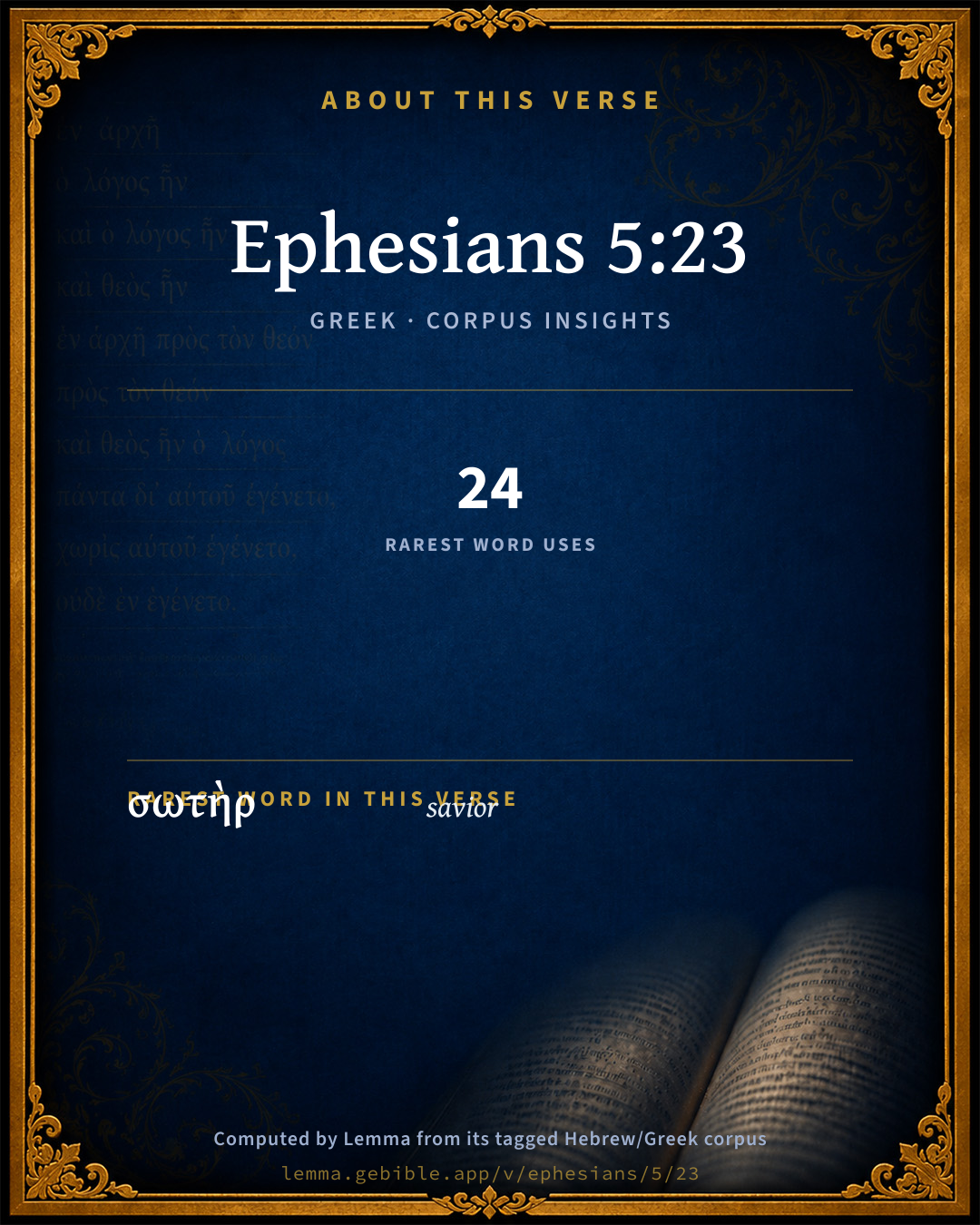
Ephesians 5:23

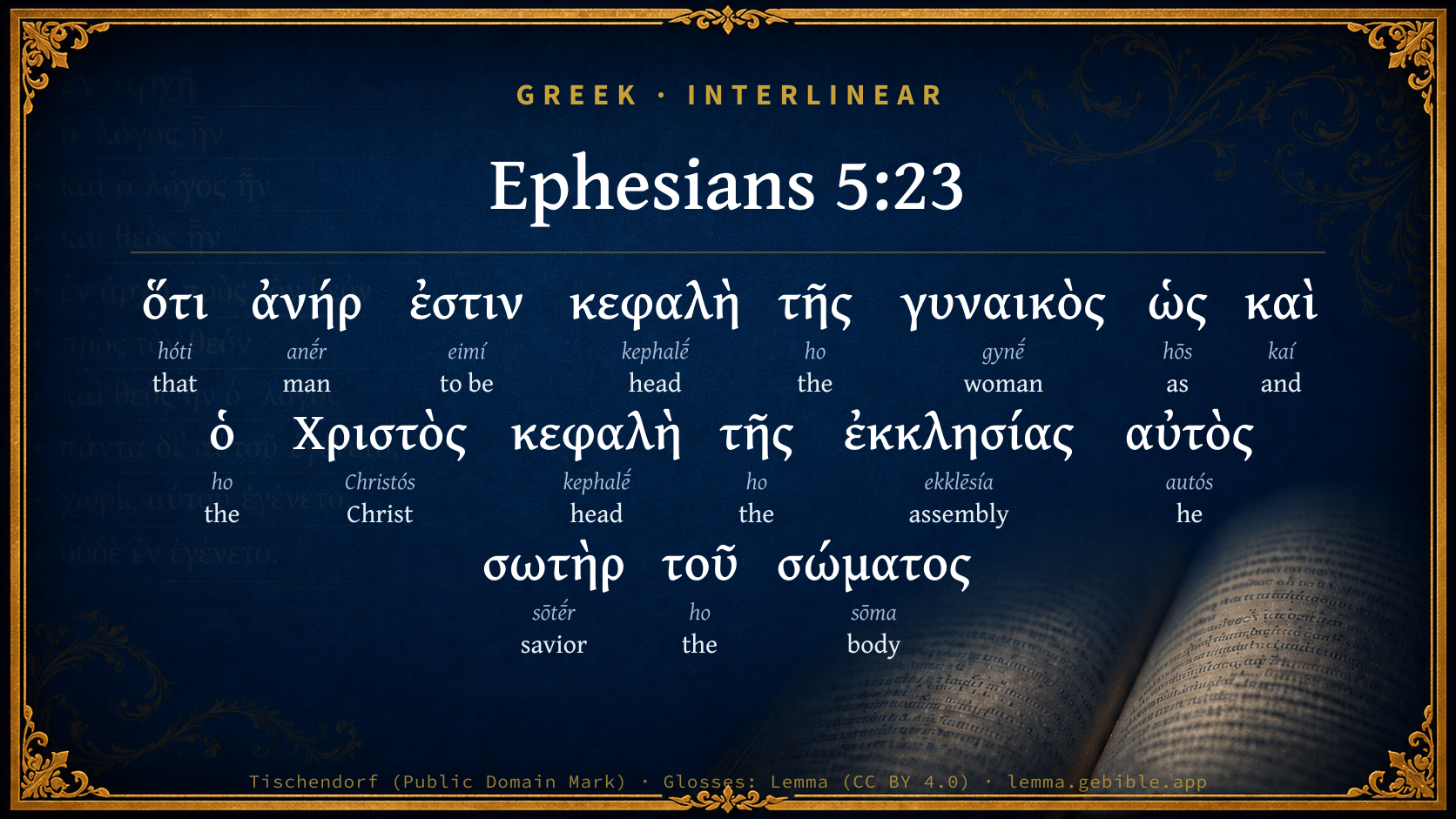
Greek (Tischendorf 8th ed.) Ephesians 5:23 appears in the Greek New Testament. The text above is from the Tischendorf 8th edition. Each word links to its Strong’s number and a concise gloss. Click any word for its full Thayer’s Greek Lexicon entry.
Download image
Cite this verse

Ephesians 5:23 (World English Bible). Public Domain. Lemma interlinear Bible study tool, https://lemma.gebible.app/v/ephesians/5/23.

Show BibTeX & RIS
BibTeX
RIS
English Translation
For the husband is the head of the wife, and Christ also is the head of the assembly, being himself the savior of the body.
World English Bible · Public Domain
Download a study sheet

One document with this verse’s original text, its word-by-word gloss line, the meaning frame, cross-references with their text, attributed commentary, and full source and license credits — printable, and it pastes into notes with its structure intact.

This verse Autodidact and up

Study sheet (.html) Plain text (.txt)

A passage Seminary Student

Up to 50 verses in one chapter. A passage sheet keeps up to 6 commentary sources and 12 cross-references per verse, in the order this page ranks them, and says so on the sheet whenever that leaves anything out. Ask for a single verse and you get the Autodidact verse sheet above.

Everything on this page stays free to read, with no account — the sheet is a download of what is already on screen, not access to it.

Want to remove ads? Support Godless Engineer
Compare translations 3

The same verse in 3 English versions, stacked beneath the original-language interlinear above. Click any original word for its lexicon entry.

Each is an independent rendering of the whole verse — the interlinear is not word-aligned to these translations.

Highlighted words mark where these versions differ — a whole-verse word diff, not a word-by-word alignment.

  • World English Bible Public Domain
    For the husband is the head of the wife, and Christ also is the head of the assembly, being himself the savior of the body.
  • King James Version Public Domain
    For the husband is the head of the wife, even as Christ is the head of the church: and he is the saviour of the body.
  • unfoldingWord Literal Text CC BY-SA 4.0
    For a husband is the head of the wife as Christ also the head of the church—he himself the savior of the body.

unfoldingWord Literal Text — © unfoldingWord, licensed CC BY-SA 4.0. Word-aligned USFM3 via Door43 (git.door43.org/unfoldingWord/en_ult).

Versions to compare (up to 4)

3 of 4 selected

Show all 19 translations

Every available English version of this verse, each an independent rendering of the whole verse.

  • World English Bible Public Domain
    For the husband is the head of the wife, and Christ also is the head of the assembly, being himself the savior of the body.
  • Berean Standard Bible Public Domain
    For the husband is the head of the wife as Christ is the head of the church, His body, of which He is the Savior.
  • Majority Standard Bible Public Domain
    For the husband is the head of the wife as Christ is the head of the church, and He is the Savior of the body.
  • King James Version Public Domain
    For the husband is the head of the wife, even as Christ is the head of the church: and he is the saviour of the body.
  • American Standard Version (1901) Public Domain
    For the husband is the head of the wife, and Christ also is the head of the church, `being' himself the saviour of the body.
  • Revised Version (1885) Public Domain
    For the husband is the head of the wife, as Christ also is the head of the church, being himself the saviour of the body.
  • Geneva Bible (1599) Public Domain
    For the husband is the wiues head, euen as Christ is the head of the Church, and the same is the sauiour of his body.
  • Douay-Rheims (1899) Public Domain
    Because the husband is the head of the wife, as Christ is the head of the church. He is the saviour of his body.
  • Young's Literal Translation Public Domain
    because the husband is head of the wife, as also the Christ `is' head of the assembly, and he is saviour of the body,
  • Literal Standard Version CC BY-SA 4.0
    because the husband is head of the wife, as also the Christ [is] head of the Assembly, and He is Savior of the body,
  • Unlocked Literal Bible CC BY-SA 4.0
    For the husband is the head of the wife as Christ also is the head of the church, and Christ himself is its savior.
  • unfoldingWord Literal Text CC BY-SA 4.0
    For a husband is the head of the wife as Christ also the head of the church—he himself the savior of the body.
  • Darby Bible Public Domain
    for a husband is head of the wife, as also the Christ [is] head of the assembly. *He* [is] Saviour of the body.
  • World Messianic Bible Public Domain
    For the husband is the head of the wife, as Messiah also is the head of the assembly, being himself the savior of the body.
  • Webster's Bible Public Domain
    For the husband is the head of the wife, even as Christ is the head of the church: and he is the Savior of the body.
  • Free Bible Version CC BY-SA 4.0
    The husband is head of the wife in the same way as Christ is head of the church—his body and its savior.
  • Bible in Basic English Public Domain
    For the husband is the head of the wife, as Christ is the head of the church, being himself the saviour of the body.
  • Text-Critical English NT CC BY 4.0
    For the husband is the head of the wife, just as Christ is the head and Savior of the church, which is his body.
  • Tyndale New Testament (1534) Public Domain
    For the husbande is the wyves heed even as Christ is the heed of the congregacion and the same is the saveoure of the body.

Literal Standard Version (2020), Covenant Press — licensed CC BY-SA 4.0. Text via the HelloAO Bible API (eBible.org). Unlocked Literal Bible (unfoldingWord) — licensed CC BY-SA 4.0. Text via the HelloAO Bible API (eBible.org). unfoldingWord Literal Text — © unfoldingWord, licensed CC BY-SA 4.0. Word-aligned USFM3 via Door43 (git.door43.org/unfoldingWord/en_ult). Free Bible Version, Dr. Jonathan Gallagher — licensed CC BY-SA 4.0. Text via the HelloAO Bible API (eBible.org).

Word by word

More ways to search: Search by grammar → Find every occurrence → Compare this word →

Practice this passage: Drill this verse → Learn its vocabulary →

σωτὴρ
sōtḗr
G4990
“savior”
Noun, Nominative, Singular, Masculine
Part of Speech
Noun
Case
Nominative
Number
Singular
Gender
Masculine
Full Thayer's Definition

Origin: from G4982

TDNT: 23:43,1

1. saviour, deliverer, preserver
  1. ὅτι hóti G3754 “that” Conjunction
  2. ἀνήρ anḗr G435 “man” Noun, Nominative, Singular, Masculine
  3. ἐστιν eimí G1510 “to be” Verb, Present, Active, Indicative, 3rd person, Singular
  4. κεφαλὴ kephalḗ G2776 “head” Noun, Nominative, Singular, Feminine
  5. τῆς ho G3588 “the” Article, Genitive, Singular, Feminine
  6. γυναικὸς gynḗ G1135 “woman” Noun, Genitive, Singular, Feminine
  7. ὡς hōs G5613 “as” Adverb
  8. καὶ kaí G2532 “and” Conjunction
  9. ὁ ho G3588 “the” Article, Nominative, Singular, Masculine
  10. Χριστὸς Christós G5547 “Christ” Noun, Nominative, Singular, Masculine
  11. κεφαλὴ kephalḗ G2776 “head” Noun, Nominative, Singular, Feminine
  12. τῆς ho G3588 “the” Article, Genitive, Singular, Feminine
  13. ἐκκλησίας ekklēsía G1577 “assembly” Noun, Genitive, Singular, Feminine
  14. αὐτὸς autós G846 “he” Personal pronoun, Nominative, Singular, Masculine
  15. τοῦ ho G3588 “the” Article, Genitive, Singular, Neuter
  16. σώματος sōma G4983 “body” Noun, Genitive, Singular, Neuter

About this verse

These counts appear in no published source. They are computed here, from the morphology-tagged text and Lemma’s own curated glosses. What Lemma adds →

17
words
13
distinct lemmas
Pauline Epistles
section

Notable vocabulary

The rarest word here is σωτὴρ savior G4990 — appearing just 24 times in the whole Greek New Testament.

Shared distinctive vocabulary

σωτὴρ savior G4990 occurs in 24 verses of the Greek New Testament. Also found in:

Repetition

Words recur within this verse:

  • κεφαλὴ head G2776 ×2
  • τῆς the G3588 ×4

Cross-references

5

Topical passages linked to Ephesians 5:23 in the Treasury of Scripture Knowledge — connected by theme and wording, ordered by reader-vote popularity; previews shown in the World English Bible.

  • 1 Corinthians 11:3–10 But I would have you know that the head of every man is Christ, and the head of the woman is the man, and the head of Christ is God.
  • Colossians 1:18 He is the head of the body, the assembly, who is the beginning, the firstborn from the dead; that in all things he might have the preeminence.
  • Ephesians 1:22–23 He put all things in subjection under his feet, and gave him to be head over all things for the assembly,
  • Ephesians 5:25–26 Husbands, love your wives, even as Christ also loved the assembly, and gave himself up for it;
  • Ephesians 4:15 but speaking truth in love, we may grow up in all things into him, who is the head, Christ;

Cross-references courtesy of OpenBible.info (CC BY 4.0).

Commentary

Notes on Ephesians 5:23 from classic Christian and Jewish commentators (each source and its license shown beneath its notes). The classic Christian expositions comment on the surrounding passage and are grouped to its opening verse, so a note may address several verses; the Jewish commentaries on the Tanakh (Rashi and others) are per-verse, so they appear only where the commentator wrote on this verse.

Lemma curates 59 commentaries, every one of them public domain or Creative Commons licensed, each selected and text-cleaned for this edition rather than reprinted as found. About our sources →

The Expositor's Bible

Chapter 26

CHRIST AND HIS BRIDE

Eph_5:23-32

WE have extracted from the apostles homily upon marriage the sentences referring to Christ and His Church, in order to gather up their collective import. The main topic of the epistle here again asserts itself; and under the figure of marriage St. Paul brings to its conclusion his doctrine on the subject of the Church. This passage answers, theologically, a purpose similar to that of the allegory of Hagar and Sarah in the epistle to the Galatians: it lights up for the imagination the teaching and argument of the former part of the epistle; it shows how the doctrine of Christ and the Church has its counterpart in nature, as the struggle between the legal and evangelical spirit had its counterpart in the patriarchal history.

The three detached paragraphs present us three considerations, of which we shall treat the second first in order of exposition: Christs love to the Church; His authority over the Church; and the mystery of the Churchs origin in Him.

I. "Husbands, love your wives, even as the Christ also loved the Church, and gave up Himself for her." This is parallel to the declaration of Gal_2:20 : "He loved me; He gave up Himself for me." The sacrifice of the cross has at once its personal and its collective purpose. Both are to be kept in mind.

On the one hand, we must value infinitely and joyfully assert our individual part in the redeeming love of the Son of God; but we must equally admit the sovereign rights of the Church in the Redeemers passion. Our souls bow down before the glory of the love with which He has from eternity sought her for His own. There is in some Christians an absorption in the work of grace within their own hearts, an individualistic salvation-seeking that, like all selfishness, defeats its end; for it narrows and impoverishes the inner life thus sedulously cherished. The Church does not exist simply for the benefit of individual souls; it is an eternal institution, with an affiance to Christ, a calling and destiny of its own; within that universal sphere our personal destiny holds its particular place.

It is "the Christ" who stands, throughout this context (Eph_5:23-29), over against "the Church" as her Lover and Husband; whereas in the context of Gal_2:20 we read "Christ"-the bare personal name-repeated again and again without the distinguishing article. Christ is the Person whom the soul knows and loves, with whom it holds communion in the Spirit. The Christ is the same regarded in the wide scope of His nature and office, -the Christ of humanity and of the ages. "The Christ" of this epistle expands the Saviours title to its boundless significance, and gives breadth and length to that which in "Christ" is gathered up into a single point.

This Christ "gave Himself up for the Church,"-yielded Himself to the death which the sins of His people merited and brought upon Him. Under the same verb, the apostle says in Rom_4:25 : He "was delivered because of our trespasses, and raised up because of our justification"-the sacrifice being there regarded on its passive side. Here, as in Gal_2:20, the act is made His own, -a voluntary Surrender. "No man taketh, my life from me," He said. {Joh_10:18} In His case alone amongst the sons of men, death was neither natural nor inevitable. His surrender of life was an absolute sacrifice. He "laid down His life for His friends," as no other friend of man could do- the One who died for all. The love measured by this sacrifice is proportionately great. The sayings of Eph_5:25-27 set the glory of the vicarious death in a vivid light. Of such worth was the person of the Christ, of such significance and moral value His sacrificial death, that it weighed against the trespass, not of a man-Paul or any other-but of a world of men. He "purchased through His own blood," said Paul to the Ephesian elders, "the Church of" Act_20:28 - the whole flock that feeds in the pastures of the Great Shepherd, that has passed or will pass through the gates of His fold. Great were the honour and glory with which He was crowned, when led as a victim to the altar of the worlds atonement. {Heb_2:9} Who will not say, as the meek Son of man treads so willingly His mournful path to Calvary, "Worthy is the Lamb!" Is not the heavenly Bridegroom worthy of the bride, that He consents to win by the sacrifice of Himself! He is worthy; and she must be made worthy. "He gave up Himself that-He might sanctify her, - that He might Himself present to Himself a glorious Church, not having spot or wrinkle or anything of the kind, -that she may be holy and without blemish." The sanctification of the Church is the grand purpose of redeeming grace. This was the design of God for His sons in Christ before the worlds foundation, "that we should be holy and unblemished before Him". {Eph_1:4} This, therefore, was the end of Christs mission upon earth; this was the intention of His sacrificial death. "For their sakes," said Jesus, concerning His disciples, "I sanctify myself, that they also may be sanctified in truth". {Joh_17:19} His purchase of the Church is no selfish act. To God His Father Christ devotes every spirit of man that is yielded to Him. As the Priest of mankind it was His. office thus to consecrate humanity, which is already in purpose and in essence "sanctified through the offering of the body of Jesus Christ once for all". {Heb_10:10} Only in this passage, where the apostle is. thinking of the preparation of the Church for its perfect union with its Head, does he name Christ as our Sanctifier; in 1Co_1:2 he comes near this expression, addressing his readers as. men "sanctified in Christ Jesus." In the epistle to the Hebrews this character is largely ascribed to Him, being the function of His priesthood. One in nature with the sanctified, Jesus our Great Priest "sanctifies us through His own blood," so that with cleansed consciences we may draw near to the living God. As Christ the Priest stands towards His people, so Christ the Husband towards His Church. He devotes her with Himself to God. He cleanses her that she may dwell with Him forever, a spotless bride, dead unto sin and living unto God through Him.

"That He might sanctify her, having cleansed her in the laver of water by the word." The Church s purification is antecedent in thought to her sanctification through the sacrifice of Christ; and it is a means thereto. "Ye were washed, ye were sanctified," writes the apostle in 1Co_6:19, putting the two things in the same order. It is the order of doctrine which he has laid down in the epistle to the Romans, where sanctification is built on the foundation laid in justification through the blood of Christ. Through the virtue of the sacrificial death the Church in all her members was washed from the defilements of sin, that she might enter upon Gods service. Of the same initial purification of the heart St. John writes in his first epistle: {1Jn_1:7-9} "The blood of Jesus, Gods Son, cleanses us from all sin He is faithful and just, that He should forgive us our sins and cleanse us from all unrighteousness." This is "the redemption through Christs blood," for which St. Paul in his first words of praise called upon us to bless God. {Eph_1:7} It is the special distinction of the New Covenant, which renders possible its other gifts of grace, that "the worshippers once cleansed" need have "no further consciousness of sins." {Heb_10:2; Heb_10:14-18} In the theological use here made of the idea of cleansing, St. Paul comes into line with St. John: and the epistle to the Hebrews. The purification is nothing else than that which he has elsewhere styled justification. He employs the terms synonymously in the later epistle to Titus. {Tit_2:143:7}

"Having cleansed" is a phrase congruous with the figure of the laver, or bath, {comp. again Tit_3:5-7} -an image suggested, as one would think, by the bride-bath of the wedding-day in the ancient marriage customs. To this St. Paul sees a counterpart in baptism, "the laver of water in the word." The cleansing and withal refreshing virtues of water made it an obvious symbol of regeneration. The emblem is twofold; it pictures at once the removal of guilt, and the imparting of new strength. One goes into the bath exhausted, and covered with dust; one comes out clean and fresh. Hence the baptism of the new believer in Christ had, in St. Pauls view, a double aspect. It looked backward to the old life of sin abandoned, and forward to the new life of holiness commenced. Thus it corresponded to the burial of Jesus, {Rom_6:4} the point of juncture between death and resurrection. Baptism served as the visible and formal expression of the souls passage through the gate of forgiveness into the sanctified life.

Along with this older teaching, a further and kindred significance is now given to the baptismal rite. It denotes the souls affiance to its Lord. As the maidens bath on the morning of her marriage betokened the purity in which she united herself to her betrothed, so the baptismal laver summons the Church to present herself "a chaste virgin unto Christ". {2Co_11:2} It signifies and seals her forgiveness, and pledges her in all her members to await the Bridegroom in garments unspotted from the world, with the pure and faithful love which will not be ashamed before Him at His coming. For this end Christ set up the baptismal laver. Upon our construction of the text, the words "that He might sanctify her" express a purpose complete in itself-viz., that of the Churchs consecration to God. Then follow the means to this sanctification.: "Having cleansed her in the water-bath through the word,"-which washing, at the same time, has its purpose on the part of the Lord who appointed it-viz., "that He might present her to Himself" a glorious and spotless Church.

At the end of Eph_5:27 the sentence doubles back upon itself, in Pauls characteristic fashion. The twofold aim of Christs sacrifice of love on the Churchs behalf-viz., her consecration to God, and her spotless purity fitting her for perfect union with her Lord-is restated in the final clause, by way of contrast with the "spots and wrinkles and such like things" that are washed out: "but that she may be holy and without blemish."

We passed by, for the moment, the concluding phrase of Eph_5:26, with which the apostle qualifies his reference to the baptismal cleansing; we are by no means forgetting it. "Having cleansed her," he writes, "by the laver of water in [the] word." This adjunct is deeply significant. It impresses on baptism a spiritual character, and excludes every theurgic conception of the rite, every doctrine that gives to it in the least degree a mechanical efficacy. "Without the word the sacrament could only influence man by magic, outward or inward" (Dorner). The "word" of which the apostle speaks, is that of Eph_6:17, "Gods word-the Spirits sword"; of Rom_10:8, "the word of faith which we proclaim"; of Luk_1:37, "the word from God which shall not be powerless"; of Joh_17:8, etc., "the words" that the Father had given to the Son, and the Son in turn to men. It is the Divine utterance, spoken and believed. In this accompaniment lies the power of the laver. The baptismal affusion is the outward seal of an inward transaction, that takes place in the spirit of believing utterers and hearers of the gospel word. This saving word receives in baptism its concrete expression; it becomes the verbum visibile.

The "word" in question is defined in Rom_10:8-9 : "If thou shalt confess with thy mouth the Lord Jesus, and believe in thy heart that God raised Him from the dead, thou shalt be saved!" Let the hearer respond, "I do so confess and believe," on the strength of this confession he is baptised, and in the conjoint act of faith and baptism - in the obedience of faith signified by his baptism-he is saved from his past sins and made an heir of life eternal. The rite is the simplest and most universal in application one can conceive. In heathen countries baptism recovers its primitive significance, as the decisive act of rupture with idolatry and acceptance of Christ as Lord, which in our usage is often overlaid and forgotten.

This interpretation gives a key to the obscure text of St. Peter upon the same subject: {1Pe_3:21} Baptism saves you-"not the putting away of the filth of the flesh, but the questioning with regard to God of a good conscience, through the resurrection of Jesus Christ." The vital constituent of the rite is not the application of water to the body, but the challenge which the word makes therein to the conscience respecting the things of God, -the inquiry thus conveyed, to which a sincere believer in the resurrection of Christ makes joyful and ready answer. It is, in fine, the appeal to faith contained in baptism that gives to the latter its saving worth. The "word" that makes Christian ordinances valid is not the past utterance of God alone, which may remain a dead letter, preserved in the oracles of Scripture or the official forms of the Church, but that word alive and active, re-spoken and transmitted from soul to soul by the breath of the Holy Spirit. Without this animating word of faith, baptism is but the pouring or sprinkling of so much water on the body; the Lord s supper is only the consumption of so much bread and wine. All the nations will at last, in obedience to Christs command, be baptised into the thrice-holy Name; and the work of baptism will be complete. Then the Church will issue from her bath, cleansed more effectually than the old world that emerged with Noah from the deluge. Every "spot and wrinkle" will pass from her face; the worldly passions that stained her features, the fears and anxieties that knit her brow or furrowed her cheek, will vanish away. In her radiant beauty, in her chaste and spotless love, Christ will lead forth His Church before His Father and the holy angels, "as a bride adorned before her husband." From eternity He set His love upon her; upon the cross. He won her back from her infidelity at the price of His blood. Through the ages He has been wooing her to Himself, and schooling her in wise and manifold ways that she might be fit for her heavenly calling. Now the end of this long task of redemption has arrived. The message goes forth to Christs friends in all the worlds: "Come, gather yourselves to the great supper of God! The marriage of the Lamb is come, and His wife hath made herself ready! He hath given her fine linen bright and pure, that she may array herself. Let us rejoice and exult, and give to Him the glory!" Through what cleansing fires, through what baptisms even of blood she has still to pass ere the consummation is reached, He only knows who loved her and gave Himself for her. He will spare to His Church nothing, either of bounty or of trial, that her perfection needs.

II. Concerning Christs lordly authority over His Church we have had occasion to speak already in other places. A word or two may be added here.

We acknowledge the Church to be "subject to Christ in everything." We proclaim ourselves, like the apostle, "slaves of Christ Jesus." But this subjection is too often a form rather than a fact. In protesting our independence of Popish and priestly lords of Gods heritage, we are sometimes in danger of ignoring our dependence upon Him, and of dethroning, in effect, the one Lord Jesus Christ. Christian communities act and speak too much in the style of political republics. They assume the attitude of self-directing and self-responsible bodies.

The Church is no democracy, any more than it is an aristocracy or a sacerdotal absolutism: it is a Christocracy. The people are not rulers in the house of God; they are the ruled, laity and ministers alike. "One is your Master, even the Christ; and all ye are brethren." We acknowledge this in theory; but our language and spirit would oftentimes be other than they are, if we were penetrated by the sense of the continual presence and majesty of the Lord Christ in our assemblies. Royalties and nobilities, and the holders of popular power-all whose "names are named in this world," along with the principalities in heavenly places, when they come into the precincts of the Church must lay aside their robes and forget their titles, and speak humbly as in the Masters presence. What is it to the glorious Church of Jesus Christ that Lord So-and-so wears a coronet and owns half a county? or that Midas can fill her coffers, if he is pleased and humoured? or that this or that orator guides at his will the fierce democracy? "He is no more than a man who will die and appear before the judgment seat of Christ?" The Churchs protection from human tyranny, from schemes of ambition, from the intrusion of political methods and designs, lies in her sense of the splendour and reality of Christs dominion, and of her own eternal life in Him.

III. We come now to the profound mystery disclosed, or half-disclosed at the end of this section, that of the origination of the Church from Christ, which accounts for His love to the Church and His authority over her. He nourishes and cherishes the Church, we are told in Eph_5:29-30, "because we are members of His body."

Now this membership is, in its origin, as old as creation. God "chose us in Christ before the worlds foundation". {Eph_1:4} We were created in the Son of Gods love, antecedently to our redemption by Him. Such is the teaching of this and the companion epistle. {Col_1:14-18} Christ recovers through the cross that which pertains inherently to Him, which belonged to Him by nature and is as a part of Himself. From this standpoint the connection of Eph_5:30-31 becomes intelligible. It is not, strictly speaking, "on account of this"; but "in correspondence with this" says the apostle, suiting the original phrase to his purpose. The derivation of Eve from the body of Adam, as that is affirmed in the mysterious words of Genesis, is analogous to the derivation of the Church from Christ. The latter relationship existed in its ideal, and as conceived in the purpose of God, prior to the appearance of the human race. In St. Pauls theory, the origin of woman in man which forms the basis of marriage in Scripture, looked further back to the origin of humanity in Christ Himself.

The train of thought that the apostle resumes here he followed in 1Co_11:3-12 : "I would have you know that the head of every man is the Christ, and the head of the woman is the man, and the head of Christ is God Man is the image and glory of God: but the woman is the glory of the man. For the man is not of the woman; but the woman of the man." So it is with Christ and His bride the Church.

"The Lord God caused a deep sleep to fall upon the man, and he slept; and He took one of his ribs, and closed up the flesh instead thereof: and the rib which the Lord God had taken from the man, made He a woman, and brought her to the man. And the man said,"

"This is now bone of my bones, and flesh of my flesh: She shall be called Woman [Isshah], because she was taken out of Man [Ish]. Therefore shall a man leave his father and his mother, and shall cleave unto his wife: And they shall be one flesh". {Gen_2:21-24}

Thus the first father of our race prophesied, and sang his wedding song. In some mystical, but real sense, marriage is a reunion, the reincorporation of what had been sundered. Seeking his other self, the complement of his nature, the man breaks the ties of birth and founds a new home. So the inspired author of the passage in Genesis explains the origin of marriage, and the instinct which draws the bridegroom to his bride.

But our apostle sees within this declaration a deeper truth, kept secret from the foundation of the world. When he speaks of "this great mystery," he means thereby not marriage itself, but the saying of Adam about it. This text was a standing problem to the Jewish interpreters. "But for my part," says the apostle, "I refer it to Christ and to the Church." St. Paul, who has so often before drawn the parallel between Adam and Christ, by the light of this analogy perceives a new and rich meaning in the old. dark sentence. It helps him to see how believers in Christ, forming collectively His body, are not only grafted into Him (as he puts it in the epistle to the Romans), but were derived from Him and formed in the very mould of His nature.

What is affirmed in Col_1:16-17, concerning the universe in general, is true in its perfect degree of redeemed humanity: "In Him were created all things," as well as "through Him and for Him." Eve was created in Adam; and Adam in Christ. We are "partakers of a Divine nature," by our spiritual origin in Him who is the image of God and the root of humanity. The union of the first human pair and every true marriage since, being in effect, as Adam puts it, a restoration and redintegration, symbolises the fellowship of Christ with mankind. This intention Was in the mind of God at the institution of human life; it took expression in the prophetic words of the Book of Genesis, whose deeper sense St. Paul is now able for the first time to unfold.

In our union through grace and faith with Christ crucified, we realise again the original design of our being. Christ has purchased by His blood no new or foreign bride, but her who was His from eternity, -the child who had wandered from the Fathers house, the betrothed who had left her Lord and Spouse. In regard to this "mystery of our coherence in Christ," Richard Hooker says, in words that suggest many aspects of this doctrine: "The Church is in Christ, as Eve was in Adam. Yea, by grace we are every one of us in Christ and in His Church, as by nature we are in our first parents. God made Eve of the rib of Adam. And His Church He frameth out of the very flesh, the very wounded and bleeding side of the Son of man. His body crucified and His blood shed for the life of the world are the true elements of that heavenly being which maketh us such as Himself is of whom we come. For which cause the words of Adam may be fitly the words of Christ concerning His Church, flesh of my flesh and bone of my bones-a true native extract out of mine own body. So that in Him, even according to His manhood, we according to our heavenly being are as branches in that root out of which they grow."

William Robertson Nicoll, ed., The Expositor's Bible (London: Hodder & Stoughton, 1887–1910) — public domain. 65 of 66 books (1 Corinthians is not separately keyed, as that volume carries no machine-parseable verse references); section-level commentary keyed to the opening verse. Introductory and overview sections not keyed to a specific passage are excluded.

Tyndale Open Study Notes

Tyndale Open Resources

5:23-24 a husband is the head of his wife: To be the head is to have authority (see 1 Cor 11:3). • Christ is the head of the church: See Eph 1:22; 4:15; Col 1:18; 2:10, 19.

Tyndale Open Study Notes — © Tyndale Open Resources, licensed CC BY-SA 4.0. Text via the HelloAO Bible API.

Bengel's Gnomon

Johann Albrecht Bengel

Eph 5:23. Καὶ αὐτὸς, and He Himself) But the husband is not the saviour of the wife; in that Christ excels. Hence but follows.

Bengel's Gnomon of the New Testament — English translation (T&T Clark, Edinburgh, 1860) — public domain. Text from a community e-Sword module.

Meyer's Critical & Exegetical Commentary

Heinrich August Wilhelm Meyer

Eph_5:23-24. Ὅτι ἀνὴρ … ἐκκλησίας] Reason assigned for the ὡς τῷ κυρίῳ just demanded. For the husband is in the marriage relation the same as Christ is in relation to the church; the former, like the latter, is the head.

ἀνήρ] a husband is head of his wife; hence ἀνήρ is without, and γυναικός with the article.

ὡς καί] as also with Christ the relation of being Head exists, namely, in regard to the church.

αὐτὸς ὁ σωτὴρ τοῦ σώματος] is usually taken as apposition to ὁ Χριστός,[271] according to which ΑὐΤΌς would take up the subject again with special emphasis (Schaefer, Melet. p. 84; Bernhardy, p. 283): He, the Saviour of the body, He who makes His body, i.e. the church, of which He is the Head, partaker of the Messianic σωτηρία (merito et efficacia, Calovius). But while there is not here apparent from the connection any purpose, bearing on the matter in hand, for such an emphatic description,[272] there may be urged against it the following ἀλλά, which, if it is not placed in combination with ΑὐΤῸς Ὁ ΣΩΤ. Τ. ΣΏΜ., admits of no logical explanation. Usually, it is true, this ἀλλά is taken syllogistically (so Beza, Grotius, and others, including Matthies, Olshausen, de Wette). But the syllogistic ἀλλά, and that in the Greek writers combined with ΜΉΝ, is employed for the introduction of the propositio minor (Apollon. Alex. in Beck, Anecd. II. p. 518, 839; Hartung, Partikell. II. p. 384; Fritzsche, ad Rom. v. 14; Klotz, ad Devar. p. 63); whereas here we should have the conclusio, and we should thus have to take ἀλλά, in accordance with its usage as breaking off (argumentorum enarrationem aut aliam cogitationem abrumpit et ad rem ipsam, quae sit agenda, vocat, Klotz, l.c. p. 5; comp. Hermann, ad Viger. p. 812; Ellendt, Lex. Soph. I. p. 78), for ὥστε, against which, however, militates the fact that the sentence assigning a reason, ὍΤΙ ἈΝΉΡ Κ.Τ.Λ., has already fulfilled its destined object (Eph_5:22), so that it could not occur to any reader to seek in the adversative ἈΛΛΆ an inference from this reason-assigning clause. If Paul had wished again to infer, from Eph_5:23, that which is proved by this verse, he would have written οὖν or the metabatic ΔΈ. Besides this, however, Eph_5:24, as an inference from Eph_5:23, would contain a very superfluous prolixity of the discourse, inasmuch as the contents of Eph_5:24 was already so fully given by the thought of Eph_5:23 attached to what precedes by means of ὍΤΙ, that we could not but see here a real logical pleonasm, such as we are not accustomed to meet with in the writings of the concise and sententious Paul. According to Winer, p. 400 [E. T. 565], Eph_5:24 is meant to continue and conclude the argument, so that Eph_5:23 proves the Ὡς Τῷ ΚΥΡΊῼ from the position of Christ and the husband, while Eph_5:24 proves it from the demand implied in this position, and hence ἀλλά amounts ultimately to the sense: but then, which is the main thing. But even in this way only a continuing δέ, autem, and not the adversative ἀλλά, at, would be quite in accordance with the thought. When, moreover, it is assumed, with Rückert, Harless, Bleek, that ἀλλά, after the intermediate thought ΑὐΤῸς Ὁ ΣΩΤ. Τ. Σ., is used as breaking off and leading back to the theme (see Hartung, l.c. II. p. 37), it is self-evident that the brief clause αὐτὸς ὁ σωτ. τ. σ.introduced, moreover, only as appositionhas not at all interrupted the development, and consequently has not given occasion for such a leading back to the theme.[273] Hofmann finally takes ἀλλά as repelling a possible objection, and to this effect: But even where the husband is not this (namely, one who makes happy, as like Christ he ought to be) to his wife, that subordination nevertheless remains, etc. But in this way the very thought, upon which everything is held to turn, is purely read into the passage. In view of all that has been said, I (and Schenkel agrees with me in this) cannot take αὐτὸς ὁ σωτ. τ. σ. as apposition, but only as an independent proposition, and I understand ἀλλά in its ordinary adversative sense, namely, thus: He for His person, He and no other, is the Saviour of the body; but this relation, which belongs exclusively to Himself, does not take away the obligation of obedience on the part of the wives towards their husbands, nay, rather, as the church obeys Christ, so must also the wives obey their husbands in every respect. The right view was already perceived by Calvin, when on account of the adversative ἀλλά he proposed the explanation:[274] Habet quidem id peculiare Christus, quod est servator ecclesiae, nihilominus sciant mulieres, sibi maritos praeesse, Christi exemplo, utcunque pari gratia non polleant. Comp. also Bengel, who aptly remarks: Vir autem non est servator uxoris; in eo Christus excellit; hinc sed sequitur. … What Hofmann objects is quite irrelevant; for the thought, that Christ is Saviour of the body, is not superfluous, but has its significant bearing in the contrast which follows; and Paul had not to write ἡμῶν instead of τοῦ σώματος with a view to clearness, since Christ was, in fact, just designated as κεφαλή; consequently nothing was now more natural and clear than the designation of believers by τοῦ σώματος, the correlative of κεφαλή. The objection of Reiche, that αὐτός comes in asyndetically, can have no weight in the case of Paul especially, and of his brief and terse moral precepts (see immediately Eph_5:28, and comp. in particular Rom_12:9 ff.).

αἱ γυναῖκες] sc. ὑποτασσέσθωσαν. See Eph_5:22.

ἐν παντί] in which case it is presupposed that the commanding on the part of the husbands is in keeping with their position as representing Christ towards the wife. Ὡς εὐσεβέσι νομοθετῶν προστέθεικε τὸ ἐν παντί, Theodoret.

[271] Holzhausen (comp. already Chrysostom) has again referred αὐτός to the husband, who is called σωτὴρ τοῦ σώματος in comparison with Christ, inasmuch as the being of the wife is conditioned by the husband. Incorrectly, since no reader could refer αὐτός to any other subject than to the one immediately preceding, ὁ Χριστός, and since it was intelligible to describe the church doubtless, but not the wife, as τὸ σῶμα (without further addition). Nor is σωτήρ ever employed in the N.T. otherwise than of Christ or God.

[272] For the view, that hereby a reminder is given to husbands of the fact, which is often forgotten by them, that they (see ver. 29) ought to make their wives truly happy (Erasm., Beza, Grotius, Estius, and others, including Rückert, Meier, Matthies, Baumgarten-Crusius; comp. also Hofmann, Schriftbew. II. 2, p. 134 f.), is inadmissible, since the instructions for husbands begin only with ver. 25. Harless remarks: Inasmuch as the apostle finds the obedience of marriage, realized in it by the wife, also in the relation of the church to Christ, he shows immediately the ground of this peculiar relation in the manifestation of the gracious power of the Lord by redemption. But in this way the question as to the reason determining this addition is not answered, and the gracious power of the Lord is, in fact, not denoted by the simple σωτήρ. Olshausen (so already Piscator) thought that αὐτὸς ὁ σωτὴρ τοῦ σώμ. had merely the design of setting forth Christ more distinctly in the character of κεφαλή, inasmuch as it designates the church as the σῶμα which He rules. But it is not τοῦ σώματος that has the emphasis; and κεφαλὴ τῆς ἐκκλ., spoken of Christ, needed no elucidation, least of all in this Epistle.

[273] And how would Paul have returned to his theme? He would have said again, in another form, in ver. 24, that which he had just said in ver. 23! After so short a clause as αὐτὸς ὁ σωτ. τ. σ., what an un-Pauline diffuseness!

[274] He did not, however, himself give it the preference, but erroneously took ἀλλά as ceterum, and in αὐτὸς ὁ σωτ. τ. σ. found the thought: ita nihil esse mulieri utilius nee magis salubre, quam ut marito subsit.

Meyer — Critical and Exegetical Commentary on the New Testament — English translation by Peter Christie, edited by Frederick Crombie (T&T Clark, 1880) — public domain. Text from a community e-Sword module.

Expositor's Greek Testament

ed. W. Robertson Nicoll

Eph 5:23 . ὅτι ὁ ἀνήρ ἐστι κεφαλὴ τῆς γυναικός , ὡς καὶ ὁ Χριστὸς κεφαλὴ τῆς ἐκκλησίας : because the husband is the head of the wife, as also Christ is the head of the Church . Reason for a wifely subjection of the kind indicated. It is found in the relation of headship. In the marriage union the husband holds the same relation, viz. , that of headship, as Christ holds to the Church, and the headship of the one represents the headship of the other. For ἐστι κεφαλὴ , [605] , Vulg., etc., give κεφαλὴ ἐστιν , which WH place in the margin. The ὁ before ἀνήρ rests on the slenderest authority, and is omitted by LTTrWHRV on the testimony of [606] [607] [608] [609] [610] [611] [612] , etc. The anarthrous ἀνήρ means “a husband” in the sense of any man belonging to the class of husbands. The article, again, is appropriate in τῆς γυναικός , as a definite relation is expressed there = “a husband is head of his wife”. The ὡς καί indicates the point common to the two subjects each is head , though in relation to different objects. [ καί ] αὐτός [ ἐστι ] σωτὴρ τοῦ σώματος : and He is Himself the Saviour of the body . The καί and the ἐστι of the TR have considerable authority ( [613] 3 [614] 2, 3 [615] [616] [617] , most cursives, Syr., Arm., etc.); but they are not found in [618] [619] [620] [621] [622] [623] , Vulg., etc., and are to be omitted (with LTTrWHRV). The clause then might be construed as in apposition to the previous ὁ Χριστός , = “as Christ is the Head of the Church He, the Saviour of the body”. But it is best taken as an independent clause, stating in a definite and emphatic way an important point in which Christ, who resembles the husband in respect of headship , at the same time differs from the husband. It is best rendered, therefore, “He, He Himself ( i.e. , = He alone) is the Saviour of the body”. The RV less happily makes it “being Himself the Saviour of the body”. The αὐτός can only be Christ , and the σῶμα is the Church the body to which He brings salvation. The husband is head of the wife, and in that he is like Christ; but Christ is also that which the husband is not, viz., Saviour of that whereof He is Head.

[605] Codex Vaticanus (sæc. iv.), published in photographic facsimile in 1889 under the care of the Abbate Cozza-Luzi.

[606] Codex Vaticanus (sæc. iv.), published in photographic facsimile in 1889 under the care of the Abbate Cozza-Luzi.

[607] Codex Sinaiticus (sæc. iv.), now at St. Petersburg, published in facsimile type by its discoverer, Tischendorf, in 1862.

[608] Codex Alexandrinus (sæc. v.), at the British Museum, published in photographic facsimile by Sir E. M. Thompson (1879).

[609] Codex Claromontanus (sæc. vi.), a Græco-Latin MS. at Paris, edited by Tischendorf in 1852.

[610] Codex Augiensis (sæc. ix.), a Græco-Latin MS., at Trinity College, Cambridge, edited by Scrivener in 1859. Its Greek text is almost identical with that of G, and it is therefore not cited save where it differs from that MS. Its Latin version, f, presents the Vulgate text with some modifications.

[611] Codex Mosquensis (sæc. ix.), edited by Matthæi in 1782.

[612] Codex Angelicus (sæc. ix.), at Rome, collated by Tischendorf and others.

[613] Codex Sinaiticus (sæc. iv.), now at St. Petersburg, published in facsimile type by its discoverer, Tischendorf, in 1862.

[614] Codex Claromontanus (sæc. vi.), a Græco-Latin MS. at Paris, edited by Tischendorf in 1852.

[615] Codex Mosquensis (sæc. ix.), edited by Matthæi in 1782.

[616] Codex Angelicus (sæc. ix.), at Rome, collated by Tischendorf and others.

[617] Codex Porphyrianus (sæc. ix.), at St. Petersburg, collated by Tischendorf. Its text is deficient for chap. Eph 2:13-16 .

[618] Codex Vaticanus (sæc. iv.), published in photographic facsimile in 1889 under the care of the Abbate Cozza-Luzi.

[619] Autograph of the original scribe of א .

[620] Autograph of the original scribe of א .

[621] Codex Alexandrinus (sæc. v.), at the British Museum, published in photographic facsimile by Sir E. M. Thompson (1879).

[622] Codex Claromontanus (sæc. vi.), a Græco-Latin MS. at Paris, edited by Tischendorf in 1852.

[623] Codex Boernerianus (sæc. ix.), a Græco-Latin MS., at Dresden, edited by Matthæi in 1791. Written by an Irish scribe, it once formed part of the same volume as Codex Sangallensis ( δ ) of the Gospels. The Latin text, g, is based on the O.L. translation.

The Expositor's Greek Testament, edited by W. Robertson Nicoll (1897–1910) — public domain. Text from a community e-Sword module.

Cambridge Greek Testament for Schools and Colleges

23. ὅτι ἀνήρ ἐστιν κεφαλὴ τῆς γυναικὸς ὡς καὶ ὁ χριστὸς κεφαλὴ τῆς ἐκκλησίας. On the figure of ‘the Head,’ cf. on Eph 1:22. It is applied as here to the relation of husband to wife in 1Co 11:3. Only there Christ is spoken of as Head of every man individually and not as here as Head of the Church. The position in regard to the race is a development of the thought of Christ as the Second Adam. See Hort Chr. Eccl. p. 151.

αὐτὸς. Himself—by His own act—or in His own person; cf. Eph 2:14.

σωτὴρ τοῦ σώματος. Christ is called Saviour in St Paul outside the Pastoral Epistles (4) only in Php 3:20. In the rest of the N.T. only in Luk 2:11; Act 5:31; Act 13:23; Joh 4:42; 1Jn 4:14; 2 Pet. (5). For its use as an Imperial Title see Deissmann, Light from Ancient East, pp. 368 ff. The nature of the salvation is defined in Act 5:31, ἀρχηγὸν καὶ σωτῆρα … τοῦ δοῦναι μετάνοιαν τῷ Ἰσραὴλ καὶ ἄφεσιν ἁματριῶν. In Act 13:23 there is no definition. It may, however, be implied in the closing words of the speech Act 13:39, ἐν τούτῳ πᾶς ὁ πιστεύων δικαιοῦται. In Php 3:20, the salvation lies in the future and is closely connected with the transformation of ‘the body of our humiliation.’ It might be possible therefore to take the salvation of the body here as referring to the consecration of sexual relations of which St Paul speaks in 1Co 6:13-15. But τὸ σῶμα can hardly be anything else than the Church esp. as Christ has just been described as κεφαλή, cf. Eph 1:23, Eph 4:16. The salvation therefore is no doubt to be understood in the light of Eph 5:23-25. The thought is introduced here because the Headship had been displayed most clearly in the sacrifice by which the salvation had been wrought out (cf. Act 5:31, ἀρχηγὸν καὶ σωτῆρα) and because the same sacrifice constitutes His final claim on our allegiance, cf. 1Co 6:20.

Cambridge Greek Testament for Schools and Colleges (Cambridge University Press, 1896; 21 vols, various authors incl. Carr, Maclear, Plummer, Farrar, Lumby, Moule, M. R. James, Simcox) — public domain. Text from a community e-Sword module.

Hodge's Commentary on Romans, Ephesians & First Corinthians

Charles Hodge

Eph_5:23

But although the obedience of the wife to the husband is of the nature of a religious duty because determined by religious motives, it has in common with all other commands of God, a foundation in nature. The apostle, therefore, says, wives are to be obedient to their husbands, because the husband is the head of the wife, even as Christ is the head of the church. The ground of the obligation, therefore, as it exists in nature, is the eminency of the husband; his superiority in those attributes which enable and entitle him to command. He is larger, stronger, bolder; has more of those mental and moral qualities which are required in a leader. This is just as plain from history as that iron is heavier than water. The man, therefore, in this aspect, as qualified and entitled to command, is said to be the image and glory of God, 1Co_11:7; for, as the apostle adds in that connection, the man was not made out of the woman, but the woman out of the man; neither was the man created for the woman, but the woman for the man. This superiority of the man, in the respects mentioned, thus taught in Scripture, founded in nature, and proved by all experience, cannot be denied or disregarded without destroying society and degrading both men and women; making the one effeminate and the other masculine. The superiority of the man, however, is not only consistent with the mutual dependence of the sexes, and their essential equality of nature, and in the kingdom of God, but also with the inferiority of men to women in other qualities than those which entitle to authority. The scriptural doctrine, while it lays the foundation for order in requiring wives to obey their husbands, at the same time exalts the wife to be the companion and ministering angel to the husband. The man, therefore, so far as this particular point is concerned, stands in the same relation to his wife, that Christ does to the church. There is however a relation which Christ bears to his church, which finds no analogy in that of the husband to the wife. Christ is not only the head of the church, but he is its Savior, καὶ αὐτὸς ἐστι σωτὴρ τοῦ σώματος. Why the apostle added these words is not easy to determine. Perhaps it was to mark the distinction between the cases otherwise so analogous,. Perhaps it was, as many suppose, to suggest to husbands their obligation to provide for the safety and happiness of their wives. Because Christ is the head of the church, he is its Savior; therefore as the husband is the head of the wife, he should not only rule, but protect and bless.‹19› The most probable explanation is, that as the apostles design is not merely to teach the nature of the relation between husband and wife, but also that between Christ and the church, the clause in question is added for that purpose, without any bearing on the conjugal relation. This clause is not in apposition with the preceding, but is an independent proposition. Christ is the head of the church; and he is the Savior of his body.

Charles Hodge — Commentary on Romans (1835), First Corinthians (1857), and Ephesians (1856) — public domain. Text from a community e-Sword module.

Geneva Bible (1599)

Geneva Bible translators

Another argument: Because the good estate of the wife dependeth of the man, so that this submission is not only just, but also very profitable: as also the salvation of the Church is of Christ, although far otherwise.

A declaration of the former saying: Because God hath made the man head of the woman in matrimony, as Christ is the head of the Church.

Geneva Bible (1599) marginal notes — public domain. Text via Bolls.life.

Jamieson, Fausset & Brown

Robert Jamieson, A. R. Fausset & David Brown

(Co1 11:3.)

even as--Greek, "as also."

and he is--The oldest manuscripts read, "Himself (being) Saviour," omitting "and," and "is." In Christ's case, the Headship is united with, nay gained by, His having SAVED the body in the process of redemption; so that (Paul implies) I am not alleging Christ's Headship as one entirely identical with that other, for He has a claim to it, and office in it, peculiar to Himself [ALFORD]. The husband is not saviour of the wife, in which particular Christ excels; hence, "But" (Eph 5:24) follows [BENGEL].

Jamieson, Fausset & Brown — Commentary Critical and Explanatory on the Whole Bible (1871) — public domain (CC PDM 1.0). Text via the HelloAO Bible API.

Adam Clarke's Commentary

Verse 23. For the husband is the head of the wife] This is the reason which the apostle gives for his injunctions. See above.

He is the Saviour of the body.] As Christ exercises authority over the Church so as to save and protect it, so let the husband exercise authority over his wife by protecting, comforting, and providing her with every necessary and comfort of life, according to his power.

Adam Clarke's Commentary on the Bible (1810–1826) — public domain. Text from a community e-Sword/MySword module.

John Calvin's Commentaries

23. For the husband is the head of the wife. This is the reason assigned why wives should be obedient. Christ has appointed the same relation to exist between a husband and a wife, as between himself and his church. This comparison ought to produce a stronger impression on their minds, than the mere declaration that such is the appointment of God. Two things are here stated. God has given to the husband authority over the wife; and a resemblance of this authority is found in Christ, who is the head of the church, as the husband is of the wife.

And he is the savior of the body. The pronoun HE (αὐτός) is supposed by some to refer to Christ; and, by others, to the husband. It applies more naturally, in my opinion, to Christ, but still with a view to the present subject. In this point, as well as in others, the resemblance ought to hold. As Christ rules over his church for her salvation, so nothing yields more advantage or comfort to the wife than to be subject to her husband. To refuse that subjection, by means of which they might be saved, is to choose destruction.

John Calvin's Commentaries (1540-1563) — public domain. Text from the Calvin Translation Society English edition (1840s-50s) via the Christian Classics Ethereal Library (ccel.org). Calvin's coverage is partial (roughly two-thirds of the Bible); uncommented books and verses are honest gaps, never fabricated. The 19th-century editor's footnotes and remarks are omitted so the notes are faithfully Calvin's own voice.

Ellicott's Commentary for English Readers

(23) For the husband is the head of the wife, even as Christ is the head of the church.—It is instructive to compare this with the partly similar passage in 1Co_11:3. There “the head of the woman is the man,” as here; but “the head of every man (individually) is Christ,” considered in His human nature; and finally, “the Head of Christ,” as the Son of Man, “is God.” There, accordingly, “headship” is simple lordship; the woman is subject to the man, the man is subject to Christ alone; Christ as the Son is subject to the Father. Here, on the other hand, we note, first, that in accordance with the general idea of the Epistle, the headship of Christ over the Church at large takes the place of His headship over the individual; next, that from the idea of His headship so conceived is derived the further idea of a spiritual unity, involving self-sacrifice in the head, as well as obedience to the head; and, lastly, that since the very idea of unity in Christ is unity with God, there is nothing to correspond to the third clause in the former Epistle.

(23, 24) And he is the saviour of the body. Therefore . . .—The words “and” and “is” are wrongly inserted, and the word “therefore” is absolutely an error, evading the difficulty of the passage. It should be, He Himself being the Saviour of the Body. But . . . This clause, in which the words “He Himself” are emphatic, notes (as if in order to guard against too literal acceptation of the comparison) that “Christ” (and He alone) is not only Head, but “Saviour of the Body,” i.e., “of His body the Church,” not only teaching and ruling it, but by His unity infusing into it the new life of justification and sanctification. Here no husband can be like Him, and therefore none can claim the absolute dependence of faith which is His of right. Accordingly St. Paul adds the word “But.” Though “this is so,” yet “still let the wives,” &c.

As the church is subject unto Christ, so let the wives be to their own husbands in every thing.—The subjection of the Church of Christ is a free subjection, arising out of faith in His absolute wisdom and goodness, and of love for His unspeakable love. Hence we gather (1) that the subordination of the wife is not that of the slave, by. compulsion and fear, but one which arises from and preserves freedom; next (2), that it can exist, or at any rate can endure, only on condition of superior wisdom and goodness and love in the husband; thirdly (3), that while it is like the higher subordination in kind, it cannot be equally perfect in degree—while it is real “in everything,” it can be absolute in nothing. The antitype is, as usual, greater than the type.

A Bible Commentary for English Readers, edited by Charles John Ellicott (1878–1897) — public domain. Text from a community e-Sword module.

The Cambridge Bible for Schools and Colleges

gen. ed. J. J. S. Perowne

23. the head] See 1Co_11:3. The husband and the wife are “one flesh” (Eph_5:31), and the husband, in that sacred union, is the leader. So Christ and the Church are one, and Christ is the Leader.

even as] Not, of course, that the headship of the husband embraces all ideas conveyed by the Lord’s Headship, but it truly answers to it in some essential respects; see last note, and its reference.

Christ is the head] See on Eph_1:22, and last note but one here.

the church] The highest reference of the word “Church” (see Hooker, quoted on Eph_1:22, where see the whole note) is the reference proper to this passage. The out-called Congregation, truly living by the heavenly Bridegroom, in union with Him, and subject to Him, is in view here.—The sacred truth of the Marriage-union of the Lord and the Church, brought in here incidentally yet prominently, pervades (in different phases) the Scriptures. See not only the Canticles, but e.g. Psalms 45; Isa_54:5; Isa_61:10; Isa_62:4-5; Jer_3:14; Jer_31:32; Hos_2:2-20; Mat_9:15; Mat_25:1-10; Joh_3:29; Gal_4:21-31; Rev_21:2; Rev_21:9; Rev_22:17.—It is observable that in the Revelation as in this Epistle the metaphors of building and of bridal appear in harmony; the Mystic Bride is the Holy City and the Spiritual Sanctuary. Cp. Psa_87:3, where a possible rendering is, “With glorious offers art thou bespoken [for marriage], O City of God.”

and he is, &c.] Read, with R.V., [being] himself the Saviour of the Body. The reference to the Lord, not to the earthly husband, is certain. And the emphasis (see on next ver.) is that Christ’s unique position, in this passage of comparison, must be remembered; as if to say, “He, emphatically, is to the Church what no earthly relationship can represent, its Saviour.” Some expositors see in this clause, on the other hand, an indirect precept to the husband to be the “preserver,” the loyal protector, of the wife. But the “but” which opens the next verse decides against this.

saviour] So the Lord is called elsewhere, Luk_2:11; Joh_4:42; Act_5:31; Act_13:23; Php_3:20; 2Ti_1:10; Tit_1:4; Tit_2:13; Tit_3:6; 2Pe_1:1; 2Pe_1:11; 2Pe_2:20; 2Pe_3:2; 2Pe_3:18; 1Jn_4:14. Cp. for the word “save” in connexion with Him (in spiritual reference), Mat_1:21; Mat_18:11; Luk_19:10; Joh_3:17; Joh_5:34; Joh_10:9; Joh_12:47; Act_4:12; Act_16:31; Rom_5:9-10; Rom_10:9; 1Ti_1:15; Heb_7:25. Deliverance and Preservation are both elements in the idea of Salvation. See further, above, on Eph_2:5.

the body] See on Eph_1:23, Eph_4:16. The Body is the Church, viewed as a complex living organism. The Gr. words Sôtêr (Saviour) and sôma (body) have a likeness of sound, and perhaps a community of origin, which makes it possible that we have here an intentional “play upon words.”

The Cambridge Bible for Schools and Colleges (gen. ed. J. J. S. Perowne; Cambridge University Press, 1878–1918) — public domain. Text from a community e-Sword module.

John Gill's Exposition

Husbands, love your wives,.... Which consists in a strong and cordial affection for them; in a real delight and pleasure in them; in showing respect, and doing honour to them; in seeking their contentment, satisfaction, and pleasure; in a quiet, constant, and comfortable dwelling with them; in providing all things necessary for them; in protecting them from all injuries and abuses; in concealing their faults, and covering their infirmities; in entertaining the best opinion of their persons and actions; and in endeavouring to promote their spiritual good and welfare: this love ought to be hearty and sincere, and not feigned and selfish; it should be shown in private, as well as in public: it should be chaste and single, constant and perpetual; it should exceed that which is bore to neighbours, or even to parents, and should be equal to that a man bears to himself; though not so as to hinder, and break in upon love to God and Christ: many are the reasons why husbands should love their wives; they are given to be helps unto them; they are companions of them; they are wives of covenant; they are their own wives, yea, their own bodies, their own flesh, nay, as themselves; they are their image and their glory; and especially the example of Christ, in his love to his church and people, should engage to it:

even as Christ also loved the church, and gave himself for it: See Gill on Eph 5:2; the Syriac and Ethiopic versions read, "his own church"; his bride and spouse, whom he betrothed to himself from all eternity, the Father having given her to him; and is no other than the church of the firstborn, whose names are written in heaven, even all the elect of God.

John Gill's Exposition of the Whole Bible (1746–1763) — public domain (CC PDM 1.0). Text via the HelloAO Bible API.

Trapp's Complete Commentary

John Trapp

23 For the husband is the head of the wife, even as Christ is the head of the church: and he is the saviour of the body.

Ver. 23. For the husband is the head] And would it not be ill-favoured to see the shoulders above the head?

John Trapp, A Commentary or Exposition upon All the Books of the Old and New Testament (1647–1656) — public domain. Text from a community e-Sword module.

Albert Barnes' Notes on the Bible

For the husband is the head of the wife - see the notes on 1Co 11:3.

As Christ is the head of the church - As Christ rules over the church, and has a right to direct and control it.

And he is the Saviour of the body - That is, of the church, represented as “his body;” see notes, Eph 1:23. The idea here seems to be, that as Christ gave himself to save his body, the church; as he practiced self-denial and made it an object of intense solicitude to preserve that church, so ought the husband to manifest a similar solicitude to make his wife happy, and to save her from want, affliction, and pain. He ought to regard himself as her natural protector; as bound to anticipate and provide for her needs; as under obligation to comfort her in trial, even as Christ does the church. What a beautiful illustration of the spirit which a husband should manifest is the care which Christ has shown for his “bride,” the church! See the notes on Eph 5:25-29.

Albert Barnes' Notes on the Bible (1834–1885) — public domain. Text from a community e-Sword/MySword module.

Haydock's Catholic Bible Commentary

For the husband is the head of the wife. Though St. Paul here speaks of a man, who is a husband, we may rather translate man than husband, being the same sentence and the same words as 1 Corinthians xi. 3. where even the Protestant translation has, that the man is head of the woman. --- He (Christ) is the saviour of his mystical body, the Church: though some expound it, that the husband is to save and take care of his wife, who is as it were his body. (Witham)

George Leo Haydock (1774–1849), Haydock's Catholic Family Bible and Commentary, 1859 edition — public domain. Excludes Psalms (Douay-Rheims chapter numbering differs from Protestant) and Deuterocanonical books (Catholic canon only).

Matthew Poole's English Annotations

For the husband is the head of the wife; superior to her by God’s ordination in authority and dignity, as the head in the natural body, being the seat of reason, and the fountain of sense and motion, is more excellent than the rest of the body.

Even as Christ is the head of the church: see Eph 1:22; Col 1:18. The particle as notes not equality, but likeness, Christ being the Head of the church in a more excellent way than the husband is of the wife.

And he is the saviour of the body; i.e. Christ is the Saviour of his church, implying that so likewise the husband is given to the wife to be a saviour to her, in maintaining, protecting, and defending her; and therefore the wife, if she regard her own good, should not grudge to be subject to him.

Matthew Poole's English Annotations on the Holy Bible (1683–1685) — public domain. Text from a community e-Sword/MySword module.

Whedon's Commentary on the Bible

Daniel D. Whedon

23. Head—He does not say Lord, as expressing Christ in his absolute capacity, but as head, representing his relative office. As the first planner and organizer, and perpetual representative of the family to the world, the husband is its naturally and divinely constituted head. By his name is the whole family rightly called. Outside the home, in which the wife is empress of a little kingdom of her own, he is held primarily responsible for the family support, reputation, and advancement. His position is justly held to be dishonoured, guiltily or unfortunately, if that responsibility be not sustained, or the wife be called to supply his place. It is equally unbecoming for her to endeavour, without necessity, either to substitute or overrule him.

Of the wife—Including her offspring, who are at once produced by herself, and herself; just as the Church’s offspring are truly herself.

Christ… Church—So that the family is a picture outlining the sacred original, and, therefore, itself sacred. Human laws may hold marriage a merely civil contract; but divine law holds it to be a divine institution. Hence, it is not the magistrate, but the minister, by whom the marriage rite should be performed, and the church should be its place; since, though not a sacrament, it is a most highly religious act. The marriage itself, however surrounded with jovial circumstances, should be performed by the minister as a most solemn religious ceremonial. He, emphatic and distinctive. Christ is not only head, but he is Saviour of the churchly body.

Daniel D. Whedon (gen. ed.), Commentary on the Old and New Testaments (1874–1909) — public domain. Text from a community e-Sword module.

The Pulpit Commentary

For the husband is the head of the wife, as Christ also is the Head of the Church. The woman was made for the man, (1Ti_2:13) showing the Divine purpose that the man should be the head and center of the household, and that the position of the wife, as wife, should be one of subordination. Parallel to this arrangement is the relation of Christ to the Church. In words, at least, all admit the headship of Christ, and the subordination of the Church to him. The Christian household, on a much lower level, should exemplify the same relation. Being himself savior of the body. This is not said by way of contrast, but still by way of parallel. The very saviorship of Christ should find an analogy in the Christian husband. The husband should be the ever-vigilant and self-denying protector, guardian, deliverer, of his family, though his saving power can never come near the high level of Christ"s A husband reckless of these obligations virtually ceases to have any claim on the subjection of the wife and the family. The very comparison of the husband to the Savior implies that, while there is a certain analogy, there is a still greater contrast. This is implied in the first word of the following verse. Between the lines we read this thought: "Not that the parallel between Christ"s saving function and the husband"s extends to the highest things."

The Pulpit Commentary (1880–1919), ed. H.D.M. Spence-Jones & Joseph S. Exell — public domain. Text from a community e-Sword module.

John Wesley's Explanatory Notes

The head - The governor, guide, and guardian of the wife. And he is the saviour of the body - The church, from all sin and misery.

John Wesley, Explanatory Notes Upon the Whole Bible (1754–1765) — public domain. Text via the GEBible commentary corpus.

Scofield Reference Notes

C. I. Scofield

saviour

(See Scofield "Rom 1:16").

The Scofield Reference Bible (1917 edition), notes by C. I. Scofield — public domain. Text from a community e-Sword module.

The People's New Testament

B. W. Johnson

23. The husband is the head of the wife. Every organization must have a head. The head of the family can only rule the wife in the most devoted love (verses 25 and 33).

B. W. Johnson's The People's New Testament with Notes (1889–1891) — public domain. Electronic text from the Christian Classics Ethereal Library (CCEL) ThML edition.

International Critical Commentary

23. ὅτι ἀνήρ ἐστι κεφαλὴ τῆς γυναικός. Assigns the reason of ὡς τῷ Κυρίῳ. The article before ἀνήρ in Rec. has no uncial authority in its favour. “A husband is head of his wife.”

ὡς καί, “as also.” Compare 1Co 11:3, παντὸς ἀνδρὸς ἡ κεφαλὴ ὁ Χριστός ἐστι, κεφαλὴ δὲ γυναικὸς ὁ ἀνήρ, κεφαλὴ δὲ τοῦ Χριστοῦ ὁ Θεός.

ὁ Χριστὸς κεφαλὴ τῆς ἐκκλησίας αὐτὸς σωτὴρ τοῦ σώματος.

Rec. has καὶ αὐτός ἐστι ς., with אcDbc K L P most MSS., Syr. (both), Arm. But the shorter reading is that of א * A B D* G, Vulg. The added words are an obvious gloss. Boh. has ἐστι without καί, and Aeth. καί without ἐστι.

The apostle having compared the headship of the husband to that of Christ, could not fail to think how imperfect the analogy was; he therefore emphatically calls attention to the point of difference; as if he would say: “A man is the head of his wife, even as Christ also is head of the Church, although there is a vast difference, since He is Himself the Saviour of the body, of which He is the head; but notwithstanding this difference,” etc. Calvin already proposed this view: “Habet quidem id peculiare Christus, quod est servator ecclesiae; nihilominus sciant mulieres, sibi maritos praeesse, Christi exemplo, utcunque pari gratia non polleant.” So Bengel concisely: “Vir autem non est servator uxoris; in eo Christus excellit; hint sed sequitur.” Chrys., Theoph. and Oecum., however, interpret this clause as equally applicable to the husband. καὶ γὰρ ἡ κεφαλὴ τοῦ σώματος σωτηρία ἐστίν, Chrys. and more fully Theoph.: ὥσπερ καὶ ὁ Χριστὸς τῆς ἐκκλησίας ὢν κεφαλή, προνοεῖται αὐτῆς καὶ σώζει· οὕτω τοίνυν καὶ ὁἀνήρ, σωτὴρ τοῦ σώματος αὐτοῦ, τουτέστι τῆς γυναικός. πῶς οὖν οὐκ ὀφείλει ὑποτάσσεσθαι τῇ κεφαλῇ τὸ σῶμα, τῇ προνοουμένῃ καὶ σωζούσῃ. So Hammond and many others. But αὐτός cannot refer to any subject but that which immediately precedes, viz. ὁ Χριστίς. Moreover, to use σῶμα without some qualification for the wife would be unintelligible; nor is σωτήρ ever used in the N.T. except of Christ or God.

International Critical Commentary — older volumes (1896–1929), various authors — public domain. Text from a community e-Sword module.

Vincent's Word Studies in the New Testament

Marvin R. Vincent

He is the savior of the body. In this particular the comparison between the husband as the head of the wife, and Christ as the head of the Church, does not hold. Hence Rev., properly, renders for and He is, being Himself; Himself separating the clause from what was previously said. The comparison lies in the fact of headship alone. The husband 's love and protection cannot be called salvation, in which respect Christ 's headship is peculiar to Himself.

Marvin R. Vincent, Word Studies in the New Testament (1887–1900) — public domain. Text from a community e-Sword/MySword module.

Lesson kit

Teaching starters — assembled from the data on this page, not authored interpretation. Every prompt links to the verse data it draws on. Edit before teaching.

Ephesians, in the Pauline Epistles, opens this verse with 17 words (13 distinct Greek lemmas). Its most distinctive word is sōtḗr (“savior”). A historical commentator’s framing appears above. Read the whole chapter for the surrounding context.

Discussion questions

  1. What does “savior” (sōtḗr) contribute to the verse as a whole?
  2. Luke 1:47 shares the word «savior» with this verse. How do the two illuminate each other?
  3. “head” occurs 2× in this one verse. What is the effect of the repetition?
  4. These translations render this verse differently. What is at stake in choosing one wording over another?
  5. Reading how The Expositor's Bible and Tyndale Open Study Notes read this verse, where do the two commentators agree and where do they part?

Things to notice

  • These translations choose different wording for 9 words in this verse.
  • “head” occurs 2× in this single verse.
  • 13 distinct Greek lemmas span 17 words in this verse.

Reading settings

Reading text

Shown beneath each verse's original-language words.

Old Testament
Old Testament edition

Read the OT as the Masoretic Hebrew (MT) or the Greek Septuagint (LXX).

English shown for the Greek Septuagint (in the Hebrew ↔ Greek comparison).

Comparing translations? Open the Compare panel on any verse page to stack up to four side by side.