Revelation 14:4

Greek (Tischendorf 8th ed.) Revelation 14:4 appears in the Greek New Testament. The text above is from the Tischendorf 8th edition. Each word links to its Strong’s number and a concise gloss. Click any word for its full Thayer’s Greek Lexicon entry.
Download image
Cite this verse

Revelation 14:4 (World English Bible). Public Domain. Lemma interlinear Bible study tool, https://lemma.gebible.app/v/revelation/14/4.

Show BibTeX & RIS
BibTeX
RIS
English Translation
These are those who were not defiled with women, for they are virgins. These are those who follow the Lamb wherever he goes. These were redeemed by Jesus from among men, the first fruits to God and to the Lamb.
World English Bible · Public Domain
Download a study sheet

One document with this verse’s original text, its word-by-word gloss line, the meaning frame, cross-references with their text, attributed commentary, and full source and license credits — printable, and it pastes into notes with its structure intact.

This verse Autodidact and up

Study sheet (.html) Plain text (.txt)

A passage Seminary Student

Up to 50 verses in one chapter. A passage sheet keeps up to 6 commentary sources and 12 cross-references per verse, in the order this page ranks them, and says so on the sheet whenever that leaves anything out. Ask for a single verse and you get the Autodidact verse sheet above.

Everything on this page stays free to read, with no account — the sheet is a download of what is already on screen, not access to it.

Want to remove ads? Support Godless Engineer
Compare translations 3

The same verse in 3 English versions, stacked beneath the original-language interlinear above. Click any original word for its lexicon entry.

Each is an independent rendering of the whole verse — the interlinear is not word-aligned to these translations.

Highlighted words mark where these versions differ — a whole-verse word diff, not a word-by-word alignment.

  • World English Bible Public Domain
    These are those who were not defiled with women, for they are virgins. These are those who follow the Lamb wherever he goes. These were redeemed by Jesus from among men, the first fruits to God and to the Lamb.
  • King James Version Public Domain
    These are they which were not defiled with women; for they are virgins. These are they which follow the Lamb whithersoever he goeth. These were redeemed from among men, being the firstfruits unto God and to the Lamb.
  • unfoldingWord Literal Text CC BY-SA 4.0
    These are they who have not been defiled with women, for they are virgins. These are the ones following the Lamb wherever he goes. These have been bought from among men as first fruits for God and for the Lamb,

unfoldingWord Literal Text — © unfoldingWord, licensed CC BY-SA 4.0. Word-aligned USFM3 via Door43 (git.door43.org/unfoldingWord/en_ult).

Versions to compare (up to 4)

3 of 4 selected

Show all 19 translations

Every available English version of this verse, each an independent rendering of the whole verse.

  • World English Bible Public Domain
    These are those who were not defiled with women, for they are virgins. These are those who follow the Lamb wherever he goes. These were redeemed by Jesus from among men, the first fruits to God and to the Lamb.
  • Berean Standard Bible Public Domain
    These are the ones who have not been defiled with women, for they are virgins. They follow the Lamb wherever He goes. They have been redeemed from among men as firstfruits to God and to the Lamb.
  • Majority Standard Bible Public Domain
    These are the ones who have not been defiled with women, for they are virgins. They follow the Lamb wherever He goes. They have been redeemed by Jesus from among men as firstfruits to God and to the Lamb.
  • King James Version Public Domain
    These are they which were not defiled with women; for they are virgins. These are they which follow the Lamb whithersoever he goeth. These were redeemed from among men, being the firstfruits unto God and to the Lamb.
  • American Standard Version (1901) Public Domain
    These are they that were not defiled with women; for they are virgins. These `are' they that follow the Lamb whithersoever he goeth. These were purchased from among men, `to be' the firstfruits unto God and unto the Lamb.
  • Revised Version (1885) Public Domain
    These are they which were not defiled with women; for they are virgins. These are they which follow the Lamb whithersoever he goeth. These were purchased from among men, to be the firstfruits unto God and unto the Lamb.
  • Geneva Bible (1599) Public Domain
    These are they, which are not defiled with women: for they are virgins: these follow the Lambe whithersoeuer he goeth: these are bought from men, being the first fruites vnto God, and to the Lambe.
  • Douay-Rheims (1899) Public Domain
    These are they who were not defiled with women: for they are virgins. These follow the Lamb whithersoever he goeth. These were purchased from among men, the firstfruits to God and to the Lamb:
  • Young's Literal Translation Public Domain
    these are they who with women were not defiled, for they are virgin; these are they who are following the Lamb whithersoever he may go; these were bought from among men -- a first-fruit to God and to the Lamb --
  • Literal Standard Version CC BY-SA 4.0
    these are they who were not defiled with women, for they are virgin; these are they who are following the Lamb wherever He may go; these were bought from among men—a first-fruit to God and to the Lamb—
  • Unlocked Literal Bible CC BY-SA 4.0
    These are the ones that have not defiled themselves with women, for they have kept themselves sexually pure. It is these who follow the Lamb wherever he goes. These were bought out of mankind as firstfruits for God and for the Lamb.
  • unfoldingWord Literal Text CC BY-SA 4.0
    These are they who have not been defiled with women, for they are virgins. These are the ones following the Lamb wherever he goes. These have been bought from among men as first fruits for God and for the Lamb,
  • Darby Bible Public Domain
    These are they who have not been defiled with women, for they are virgins: these are they who follow the Lamb wheresoever it goes. These have been bought from men [as] first-fruits to God and to the Lamb:
  • World Messianic Bible Public Domain
    These are those who were not defiled with women, for they are virgins. These are those who follow the Lamb wherever he goes. These were redeemed by Yeshua from among men, the first fruits to God and to the Lamb.
  • Webster's Bible Public Domain
    These are they who were not defiled with women; for they are virgins. These are they who follow the Lamb whithersoever he goeth. These were redeemed from among men, being the first-fruits to God and to the Lamb.
  • Free Bible Version CC BY-SA 4.0
    They have not become morally impure by sinning with women; spiritually they are virgins. They follow the Lamb wherever he goes. They were redeemed from humankind as the firstfruits to God and the Lamb.
  • Bible in Basic English Public Domain
    These are they who have not made themselves unclean with women; for they are virgins. These are they who go after the Lamb wherever he goes. These were taken from among men to be the first fruits to God and to the Lamb.
  • Text-Critical English NT CC BY 4.0
    These are the ones who have not defiled themselves with women, for they are virgins. These are the ones who follow the Lamb wherever he goes. They have been redeemed by Jesus from among men as firstfruits to God and to the Lamb.
  • Tyndale New Testament (1534) Public Domain
    These are they which were not defyled with wemen for they are virgyns. These folowe the lambe whither soever he goeth. These were redemed from men beynge the fyrste frutes vnto God and to the lambe

Literal Standard Version (2020), Covenant Press — licensed CC BY-SA 4.0. Text via the HelloAO Bible API (eBible.org). Unlocked Literal Bible (unfoldingWord) — licensed CC BY-SA 4.0. Text via the HelloAO Bible API (eBible.org). unfoldingWord Literal Text — © unfoldingWord, licensed CC BY-SA 4.0. Word-aligned USFM3 via Door43 (git.door43.org/unfoldingWord/en_ult). Free Bible Version, Dr. Jonathan Gallagher — licensed CC BY-SA 4.0. Text via the HelloAO Bible API (eBible.org).

Word by word

More ways to search: Search by grammar → Find every occurrence → Compare this word →

Practice this passage: Drill this verse → Learn its vocabulary →

ἐμολύνθησαν
molýnō
G3435
“to defile”
Verb, Aorist, Passive, Indicative, 3rd person, Plural
Part of Speech
Verb
Tense
Aorist
Voice
Passive
Mood
Indicative
Person
3rd person
Number
Plural
Full Thayer's Definition

Origin: probably from G3189

TDNT: 16:16,6

1. to pollute, stain, contaminate, defile a. used in NT of those who have not kept themselves pure from the defilements of sin, who have soiled themselves by fornication and adultery
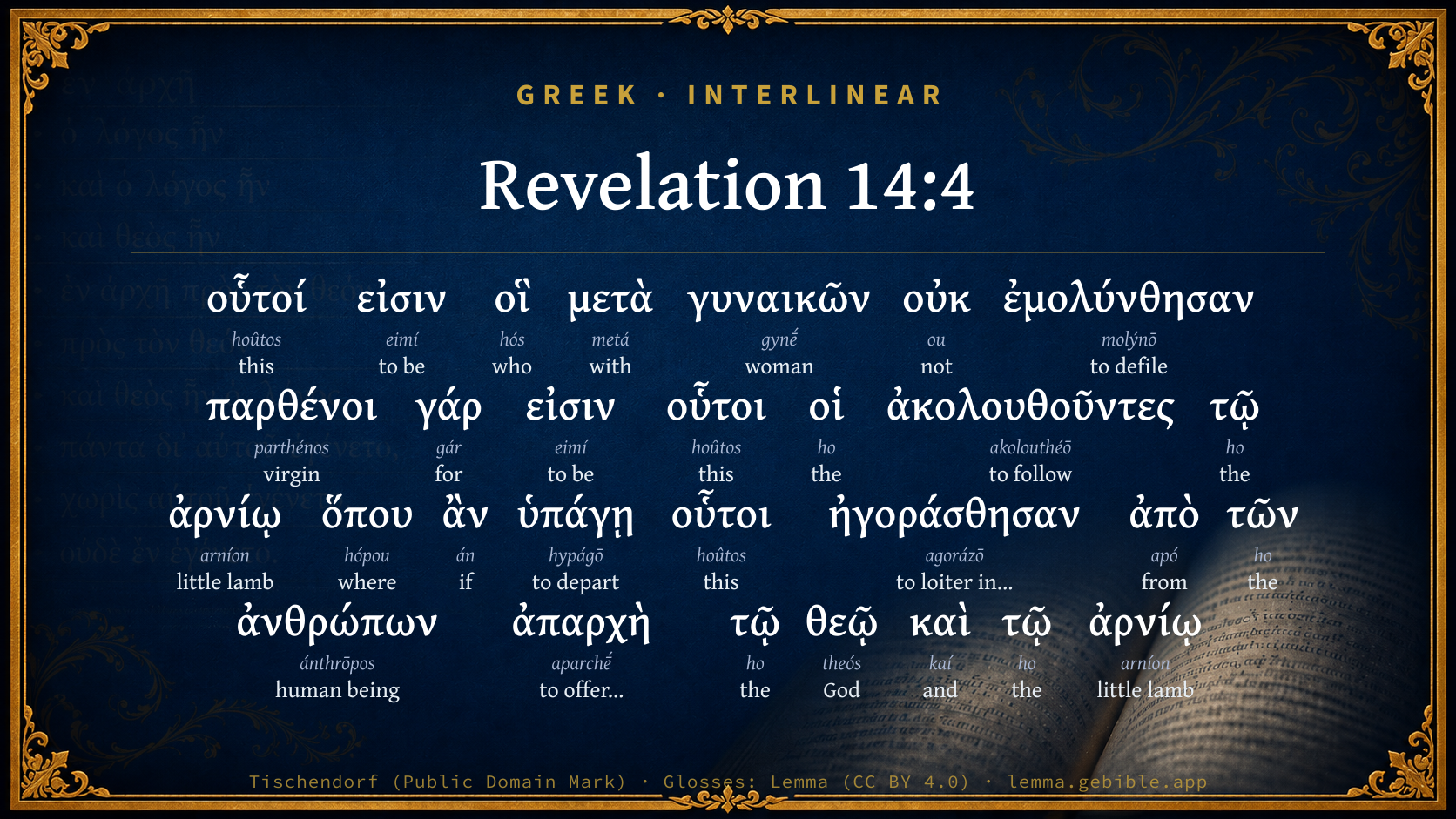
  1. οὗτοί hoûtos G3778 “this” Demonstrative pronoun, Nominative, Plural, Masculine
  2. εἰσιν eimí G1510 “to be” Verb, Present, Active, Indicative, 3rd person, Plural
  3. οἳ hós G3739 “who” Relative pronoun, Nominative, Plural, Masculine
  4. μετὰ metá G3326 “with” Preposition
  5. γυναικῶν gynḗ G1135 “woman” Noun, Genitive, Plural, Feminine
  6. οὐκ ou G3756 “not” Particle, Negative
  7. παρθένοι parthénos G3933 “virgin” Noun, Nominative, Plural, Feminine
  8. γάρ gár G1063 “for” Conjunction
  9. εἰσιν eimí G1510 “to be” Verb, Present, Active, Indicative, 3rd person, Plural
  10. οὗτοι hoûtos G3778 “this” Demonstrative pronoun, Nominative, Plural, Masculine
  11. οἱ ho G3588 “the” Article, Nominative, Plural, Masculine
  12. ἀκολουθοῦντες akolouthéō G190 “to follow” Verb, Present, Active, Participle, Nominative, Plural, Masculine
  13. τῷ ho G3588 “the” Article, Dative, Singular, Neuter
  14. ἀρνίῳ arníon G721 “little lamb” Noun, Dative, Singular, Neuter
  15. ὅπου hópou G3699 “where” Adverb
  16. ἂν án G302 “if” Particle
  17. ὑπάγῃ hypágō G5217 “to depart” Verb, Present, Active, Subjunctive, 3rd person, Singular
  18. οὗτοι hoûtos G3778 “this” Demonstrative pronoun, Nominative, Plural, Masculine
  19. ἠγοράσθησαν agorázō G59 “to loiter in marketplace” Verb, Aorist, Passive, Indicative, 3rd person, Plural
  20. ἀπὸ apó G575 “from” Preposition
  21. τῶν ho G3588 “the” Article, Genitive, Plural, Masculine
  22. ἀνθρώπων ánthrōpos G444 “human being” Noun, Genitive, Plural, Masculine
  23. ἀπαρχὴ aparchḗ G536 “to offer firstfruits” Noun, Nominative, Singular, Feminine
  24. τῷ ho G3588 “the” Article, Dative, Singular, Masculine
  25. θεῷ theós G2316 “God” Noun, Dative, Singular, Masculine
  26. καὶ kaí G2532 “and” Conjunction
  27. τῷ ho G3588 “the” Article, Dative, Singular, Neuter
  28. ἀρνίῳ arníon G721 “little lamb” Noun, Dative, Singular, Neuter

About this verse

These counts appear in no published source. They are computed here, from the morphology-tagged text and Lemma’s own curated glosses. What Lemma adds →

29
words
21
distinct lemmas
Revelation
section

Notable vocabulary

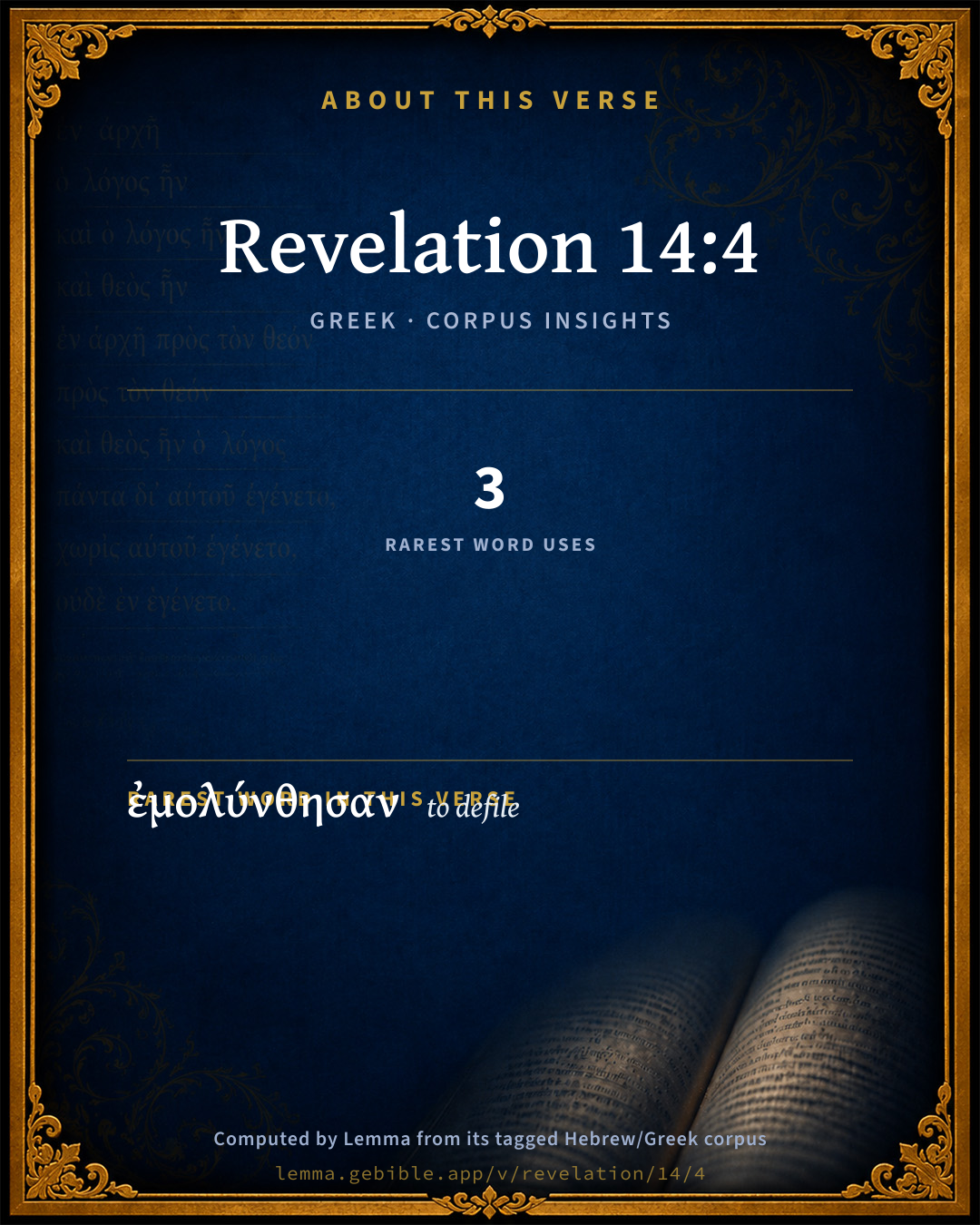
The rarest word here is ἐμολύνθησαν to defile G3435 — appearing just 3 times in the whole Greek New Testament.

Shared distinctive vocabulary

ἐμολύνθησαν to defile G3435 occurs in 3 verses of the Greek New Testament. Also found in:

Repetition

Words recur within this verse:

  • εἰσιν to be G1510 ×2
  • ἀρνίῳ little lamb G721 ×2
  • οἱ the G3588 ×5
  • οὗτοί this G3778 ×3

Cross-references

27

Topical passages linked to Revelation 14:4 in the Treasury of Scripture Knowledge — connected by theme and wording, ordered by reader-vote popularity; previews shown in the World English Bible.

  • 2 Corinthians 11:2 For I am jealous over you with a godly jealousy. For I married you to one husband, that I might present you as a pure virgin to Christ.
  • Revelation 3:4 Nevertheless you have a few names in Sardis that did not defile their garments. They will walk with me in white, for they are worthy.
  • James 1:18 Of his own will he brought us forth by the word of truth, that we should be a kind of first fruits of his creatures.
  • John 10:27 My sheep hear my voice, and I know them, and they follow me.
  • John 12:26 If anyone serves me, let him follow me. Where I am, there will my servant also be. If anyone serves me, the Father will honor him.
  • Revelation 5:9 They sang a new song, saying, "You are worthy to take the book, And to open its seals: For you were killed, And bought us for God with your blood, Out of every tribe, language, people, and nation,
  • 1 Corinthians 6:20 for you were bought with a price. Therefore glorify God in your body and in your spirit, which are God's.
  • Revelation 7:15–17 Therefore they are before the throne of God, they serve him day and night in his temple. He who sits on the throne will spread his tent over them.
  • Psalms 74:2 Remember your congregation, which you purchased of old, Which you have redeemed to be the tribe of your inheritance; Mount Zion, in which you have lived.
  • Revelation 17:14 These will war against the Lamb, and the Lamb will overcome them, for he is Lord of lords, and King of kings. They also will overcome who are with him, called and chosen and faithful."
  • Jeremiah 2:3 Israel [was] holiness to Yahweh, the first fruits of his increase: all who devour him shall be held guilty; evil shall come on them, says Yahweh.
  • John 8:12 Again, therefore, Jesus spoke to them, saying, "I am the light of the world. He who follows me will not walk in the darkness, but will have the light of life."
  • Song of Solomon 1:3 Your oils have a pleasing fragrance. Your name is oil poured forth, Therefore the virgins love you.
  • Matthew 8:19 A scribe came, and said to him, "Teacher, I will follow you wherever you go."
  • Matthew 25:1 "Then the Kingdom of Heaven will be like ten virgins, who took their lamps, and went out to meet the bridegroom.
  • Luke 9:57–62 As they went on the way, a certain man said to him, "I want to follow you wherever you go, Lord."
  • John 13:37 Peter said to him, "Lord, why can't I follow you now? I will lay down my life for you."
  • Acts 20:28 Take heed, therefore, to yourselves, and to all the flock, in which the Holy Spirit has made you overseers, to shepherd the assembly of the Lord and God which he purchased with his own blood.
  • 1 Corinthians 7:25–26 Now concerning virgins, I have no commandment from the Lord, but I give my judgment as one who has obtained mercy from the Lord to be trustworthy.
  • 1 Corinthians 16:15 Now I beg you, brothers (you know the house of Stephanas, that it is the first fruits of Achaia, and that they have set themselves to minister to the saints),
  • Ephesians 1:14 who is a pledge of our inheritance, to the redemption of God's own possession, to the praise of his glory.
  • 1 Peter 2:9 But you are a chosen race, a royal priesthood, a holy nation, a people for God's own possession, that you may show forth the excellencies of him who called you out of darkness into his marvelous light:
  • Psalms 45:14 She shall be led to the king in embroidered work. The virgins, her companions who follow her, shall be brought to you.
  • Song of Solomon 6:8 There are sixty queens, eighty concubines, And virgins without number.
  • Amos 6:1 Woe to those who are at ease in Zion, And to those who are secure on the mountain of Samaria, The notable men of the chief of the nations, To whom the house of Israel come!
  • 1 Corinthians 7:28 But if you marry, you have not sinned. If a virgin marries, she has not sinned. Yet such will have oppression in the flesh, and I want to spare you.
  • 1 Timothy 4:3 forbidding marriage and commanding to abstain from foods which God created to be received with thanksgiving by those who believe and know the truth.

Cross-references courtesy of OpenBible.info (CC BY 4.0).

Where the printed editions differ

1 variant

Places in this verse where the major printed Greek editions disagree on the wording in a way that affects the translation — a comparison of editions, not a manuscript-by-manuscript collation. The editions are the modern critical texts (Nestlé-Aland 28/27, SBL, Westcott-Hort, Tregelles, Tyndale House) and the traditional texts behind the KJV (the Textus Receptus and the Byzantine/Majority text). It is not a claim about which reading is original.

  1. Extra text
    ὑπὸ Ἰησοῦ

    “by Jesus”

    In Byz Not in NA28NA27TynSBLWHTregTR

    ὑπὸ Ἰησοῦ (hupo Iēsou) 'by Jesus' is only in a few manuscripts (Byz)

Textual data: Translators Amalgamated Greek New Testament (STEPBible TAGNT) · CC BY 4.0.

Commentary

Notes on Revelation 14:4 from classic Christian and Jewish commentators (each source and its license shown beneath its notes). The classic Christian expositions comment on the surrounding passage and are grouped to its opening verse, so a note may address several verses; the Jewish commentaries on the Tanakh (Rashi and others) are per-verse, so they appear only where the commentator wrote on this verse.

Lemma curates 59 commentaries, every one of them public domain or Creative Commons licensed, each selected and text-cleaned for this edition rather than reprinted as found. About our sources →

Whedon's Commentary on the Bible

Daniel D. Whedon

4. These are they—Rev_14:4-5 are strikingly parallel with Rev_7:14-15. This fact indicates that Dusterdieck is mistaken in supposing that this company is a select class of eminent saints. The simple truth is, that the virtues specially ascribed to them are selected as contrast to the vices ascribed to their Babylonian persecutors. These are not defiled with women, in contrast with the whore and her partisans that did corrupt the earth with her fornication. Compare Rev_18:3; Rev_18:7; Rev_18:9.

They are virgins—The Greek term is applicable to either sex, and in its full literal sense implies not only purity from fornication, but abstinence from all sexual indulgence. But it cannot be supposed to be affirmed that all the early Church were chaste celibates. Rather, are they all virgins in the sense in which the whole Church is the purely chaste bride of Christ, which takes sexual purity as the ideal type of all purity from sin. Such a view honours matrimony, and yet allows that there may be a chaste celibacy, not forced nor bound by changeless vows, which may enjoy the royal prerogative of pre-eminent consecration of itself to God. Note 1Co_7:1-9.

Follow… whithersoever he goeth—They are the special retinue and obedient body-guard of their Lord. The oath of the ancient soldiers bound them, in similar words, “to follow their generals wherever they may lead.”

Redeemed… men—Not redeemed as Dusterdieck, “in an eminent sense,” but in the same sense as the whole true Church.

First fruits—Early in time in comparison with the Christian and millennial ages that will follow; choice in character, as having fought the battles of persecution against the beast.

Daniel D. Whedon (gen. ed.), Commentary on the Old and New Testaments (1874–1909) — public domain. Text from a community e-Sword module.

Tyndale Open Study Notes

Tyndale Open Resources

14:4-5 These warriors were ritually pure (unpolluted) and morally without blame. • They have kept themselves as pure as virgins: Referring to men as virgins is a metaphor for the faithfulness of God’s people. The image might refer to the church as the virgin bride of Christ (see 2 Cor 11:2; Eph 5:25-27); it also suggests that the church constitutes soldiers in a holy war that are required to keep themselves chaste (see Deut 23:9-10; 1 Sam 21:5). • These faithful people are a special offering (literally firstfruits; see Exod 13:14-16; 23:19; Lev 23:9-14; Num 3:40-51; 18:15-20; Luke 2:22-24) who have been purchased for God. • They have told no lies: John teaches that liars will never enter heaven (Rev 21:8, 27; 22:15; see also John 8:44). The followers of Jesus speak and live the truth (see also John 8:32; 14:6).

Tyndale Open Study Notes — © Tyndale Open Resources, licensed CC BY-SA 4.0. Text via the HelloAO Bible API.

Meyer's Critical & Exegetical Commentary

Heinrich August Wilhelm Meyer

Rev_14:4-5. John describes the one hundred and forty-four thousand as a select number surpassing all other believers in moral perfection. The understanding of this description depends principally upon the proper arrangement and framing of the individual expressions. At the beginning and at the close two special points stand (Rev_14:4 : οὑτοι εἰσιν οῖ μετὰ γυναικῶν οὐκ ἐμολύνθησαν; Rev_14:5 : καὶ ἐν τῷ στόματι αὐτῶν οὐχ εὑρέθη ψεῦδος); here, where the subject pertains to the past earthly life of those who have died, the aor. necessarily stands. In both cases the conclusion is by formulæ framed precisely in like manner (Rev_14:4 : παρθένοι γάρ εἰσιν; Rev_14:5 : ἄμωμοι γάρ εἰσιν); but here, where an advance is made from the definite actual preservation of the deceased, to their proper nature and permanent condition, the present necessarily occurs. Between the two double-membered sentences, in the beginning and at the close, there are besides two sentences, which are thereby exhibited as independent of one another and the beginning and closing sentences, in that they both commence with the special designation of the subject (οὖτοι), and that the first expresses something present (οὖτ. εἰσιν οἱ ἀκολ.), but the second something past, completed in the earthly life (οὖτ. ἠγοράσθησαν, cf. Rev_14:3). Hofmann[3445] is the first expositor who keeps in view the disposition of Rev_14:4-5; but he misjudges it by regarding the παρθένοι γάρ εἰσιν as immediately attracted to the succeeding words. The disposition attempted now also by Ew. ii., whereby three members appear (1. οὐτοί εἰσ., κ.τ.λ.; 2. οὖτ. εἰσ., κ.τ.λ.; 3. καὶ ἐν τ. στόμ., κ.τ.λ.), is in violation of the context.

οἱ μετὰ γυναικῶν οὑκ ἐμολύνθησαν. According to Lev_15:18, the sexual union in itself, even that in wedlock, was regarded as defiling.[3446]

ΠΑΡΘΈΝΟΙ. This predicate was not seldom ascribed also to men.[3447] In order to avoid the thoughts forced from the word, and not seldom made the best of by Catholic interpreters in the sense of monastic asceticism,[3448] it is regarded either directly as figurative,[3449] and referring to spiritual purity, especially to abstaining from the worship of idols,[3450] or, if we abide by the proper sense of the words, to sexual purity, as an example of all virtues.[3451] Hofm. attempts to remove the difficulty by saying that the declaration is concerning believers of the last time,[3452] to whom celibacy will become a moral necessity, because of the special circumstances of those times. But nothing is said here concerning Christians of that time. The expedient of Bleek[3453] and De Wette, who regard it as referring to abstinence from all lewdness, as it was ordinarily combined with the worship of idols, is forbidden by the expression μετὰ τ. γυναικῶν, which is altogether general.

Nothing else seems to remain than with Augustine,[3454] Jerome,[3455] Beda, Andr., to explain it in the proper sense, and to acknowledge the idea, to which also other points in the text lead,[3456] that entire abstinence from all sexual intercourse belongs to the distinguished holiness of that one hundred and forty-four thousand,[3457] because of which they enjoy also distinguished blessedness. [See Note LXXV., p. 404.] This is declared by the words immediately following: οὖτοι εἰσιν οἱ ἀκολουθοῦντες τῷ ἀρνίῳ ὅπου ἂν ὑπάγει. There is generally found here a description of the obedience of believers who follow the Lamb even to the cross and to death;[3458] but because of the present tense, which here expresses the present condition,while the holy manifestation in the earthly life is designated by the aor.,there can be meant only a description of the blessed reward which those who have died are enjoying[3459] with the Lamb.[3460] It is meant that everywhere whither the Lamb goes, there that chosen one hundred and forty-four thousand accompany him; whether it be that a certain space in heaven remain inaccessible to other saints, or that the latter do not form the constant retinue of the Lamb, at least not in the same way as the former.

ΟὙΤΟΙ ἨΓΟΡΆΣΘΗΣΑΝ Ἀ̓ΠῸ ΤῶΝ ἈΝΘΡΏΠΩΝ ἈΠΑΡΧῊ Τῷ Θ., Κ.Τ.Λ. What applies to all the redeemed, viz., that they have been bought unto God by the blood of the Lamb, from among men, of the earth (Rev_14:3), or from all nations and kindreds (Rev_5:9), applies in an eminent sense to the one hundred and forty-four thousand: they are bought as an ἈΠΑΡΧΉ. They appear, therefore, not as the select first fruits from the entire world,[3461] but from believers, or, at any rate, from the blessed. The correlate to the ἀπαρχή is afforded by the context: τῶν ἠγορασμένων. As such select first fruits the one hundred and forty-four thousand appear, with respect both to their peculiar holiness (παρθένοι), and also their peculiar blessedness (ἀκολ. τ. ἀρν., κ.τ.λ.).

Besides distinguished virginity, in Rev_14:5 another peculiar perfection is mentioned, which that multitude had manifested in their earthly life (εὑρέθη, aor.); viz., perfect truthfulness never clouded by a lie. The expression ψεῦδος[3462] is to be taken in its general sense, and not to be limited to the lies of idolatry,[3463] heresy, or denial of Christ.[3464] A contrast is easily conceivable to the sphere of falsehood in which the seducing false prophet[3465] moves, with the worshippers of the beast accepting his lies.[3466] Cf. also, in Rev_9:21, in an enumeration of the characteristic sins of the inhabitants of the earth, the juxtaposition of πορνεία and κλέμματα.[3467]

ἄμωμοι γάρ εἰσιν. The conclusion which stands especially in analogous relation to the immediately preceding special point, as the παρθ. γ. εἰσ., Rev_14:4, to the immediately preceding clause,[3468] is, nevertheless, because of the comprehensive meaning of the predicate ἄμωμοι,[3469] especially suitable for rounding the entire description (Rev_14:4-5).

[3445] Schriftbew, II. 2, p. 392.

[3446] On the expression ἐμολυνθ., cf. Isa_59:3; 1Co_8:7; 2Co_7:1.

[3447] Cf. Fabricius, Cod. apocr. Vet. Test., II., pp. 92, 98 (where Joseph is called an ἀνήρ παρθένος); Kypke, Observ. sacr. ad h. l. (παρθένοννἰα from Nonnus, on Joh_19:26); Suidas, see on Αβελ.

[3448] N. de Lyra, Stern.

[3449] Cf. 2Co_11:2.

[3450] Victorin., Zeger, Coccejus, Grot., Vitr., Wolf; cf. also Züll.

[3451] Eichh., Beng., Hengstenb., who says that sexual intercourse, as legally defiling, is a figurative designation of sinful defilement in general.

[3452] Cf. also C. a Lap.

[3453] Beitr., p. 185.

[3454] De s. virg., c. 27. Opp. Antw., 1701, T. VI., p. 258.

[3455] Adv. Jovin., I. c. 40. Opp. Franeof, 1684, T. II., p. 34.

[3456] See above.

[3457] So also Neander, p. 543, who, from this mode of contemplation, properly recognizes a mark that the writer of the Apoc. is not identical with the Evangelist John.If the exposition above given be acknowledged, it must also be maintained (against Ew. ii.) that the view, which, to the writer of the Apoc., is fundamental, of the impurity of all sexual intercourse, is significantly distinguished from what is said in Mat_19:11 sqq., 1Co_7:32; 1Co_7:34, since here, under the express presumption that sexual intercourse in marriage is an ordinance which is divine, and by no means in itself impure, it is asserted that certain circumstances can make a complete abstinence from marriage possible and necessary. Possibly the too far-reaching statement of the writer of the Apocalypse is occasioned by the fact that he wishes to emphasize in the highest degree the contrast with the worshippers of the beast, i.e., the Gentiles, with their sexual abominations.

[3458] Cf. Mat_10:38. Coccej., Grot., Vitr., Wolf, who recall the fact that the soldiers were accustomed to swear: ἀκολουθεῖν τοῖς στρατηγοῖς ὅποι ποτʼ ἅν ἅγωσιν [to follow the generals whithersoever they would go]. Beng., De Wette, Hengstenb., Ebrard, Ew. ii.

[3459] Cf. Rev_7:17.

[3460] Augustine, l. c., but he is not consistent; Andr., Züll., Stern.

[3461] Against De Wette, Hengstenb., who improperly appeal to Jam_1:18, where the express designation ἀπαρχ. τῶν αὐτοῦ κτισμάτων is given; cf. also Jer_2:3.

[3462] Cf. Rev_21:27.

[3463] Grot.: They did not invoke the gods, which are not gods; Beng.

[3464] Cf. Hengstenb.

[3465] Rev_13:14.

[3466] Cf. Ewald, Ebrard.

[3467] Cf., besides, 1Th_4:4 sq., and Rev_14:6.

[3468] See above.

[3469] Cf. Eph_1:4; Eph_5:27; Col_1:22.

The purpose of the entire vision (Rev_14:1-5), in connection with ch. 13, i.e., in contrast with what is there reported, is, as the exposition of the details proves, not that of showing how the Church abides in invincible glory opposed to the dragon,[3470] or how in the midst of the corrupt Church (ch. 13) the true Church still continues,[3471] or how the Lamb with his hosts stands ready to help by the side of the oppressed Church;[3472] but[3473] the manifestation of the blessed with the Lamb in eternal glory is intended to give believers who are on earth, and exposed to persecution on the part of the dragon, a pledge inspiring courage and patience (cf. Rev_14:11), that if they remain faithful they shall also attain to that glory.

[3470] Primas, Beda The Church, rejoicing in her usual glory and number, encouraged for the conquest of the burdens of her oppression, with sublime joy of contemplation, celebrates at once, both with joy and invitation the conflicts of her King. Cf. Calov., C. a Lap., etc.

[3471] Vitr.

[3472] Ewald: The Messiah with his select saints prepared for war.

[3473] Rev_7:9 sqq.

In every respect preposterous are the historical explanations in Coccejus,[3474] Vitr.,[3475] etc., according to which, especially, the one hundred and forty-four thousand are regarded as the Waldenses.

Christiani has interpreted the one hundred and forty-four thousand even as the woman preserved in the wilderness,[3476] and thus as the Church of the last times. The final Israelitic church is also understood[3477] by Luthardt.

[3474] Rev_14:4 : Voices against the worship of images, as the Council of Frankfort in the year 800, and other protests against papal errors.

[3475] The players on the harp are Wiclif, Hus, etc. The ῷδ. καιν., Rev_14:3, is a confession of seemingly new contents, viz., the evangelical confession of the Bohemian brethren.

[3476] Rev_12:14.

[3477] Cf. Rev_7:4 sqq.

NOTES BY THE AMERICAN EDITOR

LXXV. Rev_14:4. οἱ μετὰ γυναικῶν, κ.τ.λ.

Any interpretation of this passage that teaches a superior holiness and blessedness as belonging to the unmarried estate, or attaches any defilement to marriage, is inconsistent with Heb_13:4. See this passage defended from such view at some length by Chemnitz already (Examen Concilii Tridentini, Schlawitz ed., 1861, p. 535). Hence all such attempts at mediation between maintaining the sanctity of marriage and the peculiar sanctity of celibacy, like those of Alford and Luthardt, are ineffectual. The former says: In them that fountain of carnal desire has never been opened, which is so apt to be a channel for unholy thoughts, and an access for the tempter. [Cf., however, 1Co_7:2.] The virgins may thus have missed the victory over the lusts of the flesh; but they have also, in great part, escaped the conflict. We are, perhaps, more like that which the Lord intended us to be; but they are more like the Lord himself. Luthardt proposes another mode of mediation, by affirming that no special holiness of celibacy is taught, but that under the peculiar circumstances of the last times it would be the duty of Christians to remain unmarried, and marriage intercourse would then be only a yielding to sinful lusts. Gebhardt, on the contrary: They have, in the most marked contrast to the world, with its fornications, or idolatrous worship and service of sin, not defiled themselves with women; that is, in the strongest and fullest sense, they have not committed fornication, have not been unfaithful to God; they have not allowed themselves to be tempted by the world, and have not sinned, for they are virgins; that is, what they are according to their nature as Christians, pure, holy, chaste, has, in their lives, simply perfected itself in gradual development, or, in the particular case, maintained itself. Certainly many expositors take the words just explained in a peculiar sense, and determine the representation of the seer to be that perfect abstinence from sexual intercourse belongs to the distinguished sanctity of the one hundred and forty-four thousand, and that, on this account, they enjoy peculiar blessedness; which, as Köstlin observes, is not merely in the spirit of the O. T., but is Esseno-Ebionitish. The one hundred and forty-four thousand are neither distinguished Christians, nor do they enjoy peculiar happiness; even on this supposition, it would be wholly inconceivable that the seer should have imagined one hundred and forty-four thousand unmarried Christians, and, according to the literal sense, Christians of the male sex; still less would he have regarded as Christians only those who had not been married.… I find that John has spoken of the idolatry and the sin of the world as fornication with sufficient frequency, and strength, and clearness, to enable us to see in it the true interpretation of this imagery. The true sense more decidedly presents itself if we begin, not with the first, but with the second member of the sentence,they are virgins,which is evidently symbolical.

Meyer — Critical and Exegetical Commentary on the New Testament — English translation by Peter Christie, edited by Frederick Crombie (T&T Clark, 1880) — public domain. Text from a community e-Sword module.

Jamieson, Fausset & Brown

Robert Jamieson, A. R. Fausset & David Brown

virgins--spiritually (Mat 25:1); in contrast to the apostate Church, Babylon (Rev 14:8), spiritually "a harlot" (Rev 17:1-5; Isa 1:21; contrast Co2 11:2; Eph 5:25-27). Their not being defiled with women means they were not led astray from Christian faithfulness by the tempters who jointly constitute the spiritual "harlot."

follow the Lamb whithersoever he goeth--in glory, being especially near His person; the fitting reward of their following Him so fully on earth.

redeemed--"purchased."

being the--rather, "as a first-fruit." Not merely a "first-fruit" in the sense in which all believers are so, but Israel's 144,000 elect are the first-fruit, the Jewish and Gentile elect Church is the harvest; in a further sense, the whole of the transfigured and translated Church which reigns with Christ at His coming, is the first-fruit, and the consequent general ingathering of Israel and the nations, ending in the last judgment, is the full and final harvest.

Jamieson, Fausset & Brown — Commentary Critical and Explanatory on the Whole Bible (1871) — public domain (CC PDM 1.0). Text via the HelloAO Bible API.

Adam Clarke's Commentary

Verse 4. These are they which were not defiled with women] They are pure from idolatry, and are presented as unspotted virgins to their Lord and Saviour Christ. See 2Co 11:2. There may be an allusion here to the Israelites committing idolatry, through the means of their criminal connection with the Midianitish women. See Nu 25:1-4; Nu 31:16.

Follow the Lamb whithersoever he goeth] They go through good and through evil report, bear his reproach, and love not their lives even to the death.

The first fruits unto God] The reference appears to be to those Jews who were the first converts to Christianity.

Adam Clarke's Commentary on the Bible (1810–1826) — public domain. Text from a community e-Sword/MySword module.

Ellicott's Commentary for English Readers

(4, 5) These are they . . .—The characteristics of the servants of the Lamb are given in this verse and the following. The first is purity: they are virgins. The expression can hardly be limited to the unmarried, as the 144,000 represent the wide society of the choice ones of God. They are those whose hearts have been made as the hearts of little children (Mat_18:1-4), who have that purity of heart which Christ declared to be blessed, and which St. James declared to be the first mark of heavenly wisdom (Mat_5:8, and Jas_3:17). The next is implicit obedience: they follow the Lamb whithersoever He goeth. Some, indeed, take this to be a kind of heavenly reward: they shall be the nearer companions of the Lamb. But it is better to take it as describing their complete consecration to Christ. They are those who are with Christ, who have tasted the cup that their Lord tasted, and have taken up their cross and followed Him (Mat_20:22; Luk_14:27; Joh_12:24-26). It is well to weigh these words; it is in the “wheresoever” that we may test the reality of our Christian life. Here lies the cross that Christ bids us take up. Here is the echo of Christ’s words, “Whosoever forsaketh not all he hath cannot be My disciple.” The third mark is separation, or unworldliness: they were purchased from among men, as a firstfruit to God and to the Lamb. They were a chosen generation, a peculiar people (Tit_2:14; 1Pe_2:9), as the Israel of God (Deu_7:6). The fourth feature is utter truthfulness: in their mouth no guile or no falsehood. (Comp. Psalms 14 and Deu_32:1-2.) The verse emphatically ends with “They are blameless.” The words “before the throne of God” must be omitted. (Comp. Rev_7:14-15; Eph_5:27; and Col_1:22.)

We have seen the servants of God; we have marked their character; we are now to see the weapon which is to be employed in the conflict against the enemies of Christ.

A Bible Commentary for English Readers, edited by Charles John Ellicott (1878–1897) — public domain. Text from a community e-Sword module.

The Cambridge Bible for Schools and Colleges

gen. ed. J. J. S. Perowne

4. for they are virgins] The first instance of the use of the word as a masculine. It was adopted in ecclesiastical language, and applied e.g. to St John himself. It is best to understand the word literally. St Mat_19:12; 1 Corinthians 7 prove, on any fair interpretation, that a devout and unselfish celibacy gives special means for serving God, and so we need not be surprised to learn here that it has a special reward from Him. No disparagement of holy matrimony is implied. Marriage is lowered by the Fall from what God meant it to be (Gen_3:16), and so, like other things which God made very good, has its own evils and dangers; but it does not follow that it is here conceived as in any sense defilement—they who are virgins à fortiori are “not defiled with women.” It is noticeable that we owe to the two celibate apostles the highest consecration of marriage, see Eph_5:23-33, and the last two chapters of this Book.

being the firstfruits] This seems to imply, as is required by the view that “virgins” strictly speaking are meant, that the 144,000 do not represent the whole number of the Elect, but a specially sanctified number from among them. See on Rev_7:4.

The Cambridge Bible for Schools and Colleges (gen. ed. J. J. S. Perowne; Cambridge University Press, 1878–1918) — public domain. Text from a community e-Sword module.

John Gill's Exposition

These are they which were not defiled with women,.... With the whore of Rome, and her harlots, she is the mother of; while the kings and inhabitants of the earth were drunk with the wine of their fornication, or committed idolatry with them, which is spiritual fornication, and is here meant by being defiled with them, these were free from such pollutions, or idolatrous practices:

for they are virgins; for their beauty and comeliness in Christ, chastity, sincerity of their love, uncorruptness in doctrine and worship, and for the uprightness of conversation; See Gill on Mat 25:1;

these are they which follow the Lamb whithersoever he goeth; as the sheep follow the shepherd of the flock, and which is a character of Christ's sheep, Joh 10:4. These follow Christ in the exercise of the graces of humility, patience, and love; and in the performance of the several duties of religion, and subjection to ordinances, and in the path of sufferings; and in every way in which Christ the Lamb has gone before them, or in his word and providence leads and directs them to, whether it be grateful to the flesh or not; particularly they follow where he is preached, and his Word and ordinances are faithfully administered; and they follow him to heaven, where he is: it was part of the oath taken by the Roman soldiers, ' , "to follow the generals wherever they should lead" (n), to which it is thought there is an allusion here; see Sa2 15:21;

these were redeemed from among men; "by Jesus", as the Syriac and Arabic versions add, and so the Complutensian edition; by the blood of Christ, for all men are not redeemed by it; and in consequence of this they were called, and delivered from this present evil world, and the men of it, and from a vain, wicked, and idolatrous conversation with it:

being the firstfruits unto God, and to the Lamb; in allusion to the firstfruits under the law, which represented and sanctified the lump, and showed that harvest was coming; so these persons are called the firstfruits to God, and to the Lamb, being called by grace, and consecrated to their worship and service, with reference to the harvest of souls, or that large number of them which will be gathered in during the spiritual reign of Christ, which these persons will be at the beginning of; and as those who are first called and converted in a country or nation are said to be the firstfruits of it, Rom 16:5; so these being the first, in the period of time to which respect is had, bear this name; and as the converted Jews received the firstfruits of the Spirit, on the day of Pentecost, and at other times, so these will receive the firstfruits of the far greater pouring forth of the Spirit in the latter day, which will begin, and usher in the kingdom of Christ; see Rom 8:23.

(n) Vid. Lydii Dissert. de Jurament. c. 2. p. 258.

John Gill's Exposition of the Whole Bible (1746–1763) — public domain (CC PDM 1.0). Text via the HelloAO Bible API.

Trapp's Complete Commentary

John Trapp

4 These are they which were not defiled with women; for they are virgins. These are they which follow the Lamb whithersoever he goeth. These were redeemed from among men, being the firstfruits unto God and to the Lamb.

Ver. 4. Which were not defiled with women] Which have not moiled themselves with fornication corporal or spiritual, as those Israelites, Num 25:1-9, by Balaam’s counsel, and as Papists at this day, seduced by those effeminate locusts, Rev 9:8. As for their shavelings that plead this text to prove marriage defilement, let them hear the apostle, Heb 13:4, and another almost as ancient: Si quis coinquinationem vocet commixtionem legitimam, habet inhabitatorem dracohere apostatam; If any call lawful marriage a defilement, that man hath a devil dwelling in him. (Ignatius.)

These are they which follow the Lamb] As the seaman’s needle doth the north pole; or as the hop, in its growing, winding about the pole, follows the course of the sun from east to west, and can by no means be drawn to the contrary, choosing rather to break than yield.

These were redeemed] For royal use. See Rev 14:3.

Being the firstfruits] Separated and sanctified unto him from the rest of the world.

John Trapp, A Commentary or Exposition upon All the Books of the Old and New Testament (1647–1656) — public domain. Text from a community e-Sword module.

Albert Barnes' Notes on the Bible

These are they - In this verse, and in the following verse, the writer states the leading characteristics of those who are saved. The general idea is, that they are chaste; that they are the followers of the Lamb; that they are redeemed from among people; and that they are without guile.

Which were not defiled with women - Who were chaste. The word “defiled” here determines the meaning of the passage, as denoting that they were not guilty of illicit sexual intercourse with women. It is unnecessary to show that this is a virtue everywhere required in the Bible, and everywhere stated as among the characteristics of the redeemed. On no point are there more frequent exhortations in the Scriptures than on this; on no point is there more solicitude manifested that the professed friends of the Saviour should be without blame. Compare the Act 15:20 note; Rom 1:24-32 notes; 1Co 6:18 note; Heb 13:4 note. See also 1Co 5:1; 1Co 6:13; Gal 5:19; Eph 5:3; Col 3:5; 1Th 4:3. This passage cannot be adduced in favor of celibacy, whether among the clergy or laity, or in favor of monastic principles in any form; for the thing that is specified is, that they were not “defiled with women,” and a lawful connection of the sexes, such as marriage, is not defilement. See the notes on Heb 13:4. The word rendered here “defiled” - ἐμολύνθησαν emolunthēsan, from μολύνω molunō - is a word that cannot be applied to the marriage relation. It means properly to “soil, to stain, to defile.” 1Co 8:7; “their conscience being weak, is defiled.” Rev 3:4; “which have not defiled their garments.” The word does not elsewhere occur in the New Testament, except in the passage before us, and it will be seen at once that it cannot be applied to that which is lawful and proper, and consequently that it cannot be construed as an expression against marriage and in favor of celibacy. It is a word that is properly expressive of illicit sexual intercourse - of impurity and unchastity of life - and the statement is, that they who are saved are not impure and unchaste.

For they are virgins - παρθένοι parthenoi. This is the masculine form, but this form is found in the later Greek and in the Christian fathers. See Suidas and Suicer, Thes. The meaning of the word, when found in the feminine form, is well understood. It denotes a virgin, a maiden, and thence it is used to denote what is chaste and pure: virgin modesty; virgin gold; virgin soil; virgin blush; virgin shame. The word in the masculine form must have a similar meaning as applied to men, and may denote:

(a)Those who are unmarried;

(b)Those who are chaste and pure in general.

The word is applied by Suidas to Abel and Melchizedek. “The sense,” says DeWette, in loco, “cannot be that all these 144,000 had lived an unmarried life; for how could the apostle Peter, and others who were married, have been excluded? But the reference must be to those who held themselves from all impurity - “unkeuschheit und hurerei” - which, in the view of the apostles, was closely connected with idolatry.” Compare Bleek, Beitr. i. 185. Prof. Stuart supposes that the main reference here is to those who had kept themselves from idolatry, and who were thus pure. It seems to me, however, that the most obvious meaning is the correct one, that it refers to the redeemed as chaste, and thus brings into view one of the prominent things in which Christians are distinguished from the devotees of nearly every other form of religion, and, indeed, exclusively from the world at large. This passage, also, cannot be adduced in favor of the monastic system, because:

(a)Whatever may be said anywhere of the purity of virgins, there is no such commendation of it as to imply that the married life is impure;

(b)It cannot be supposed that God meant in any way to reflect on the married life as in itself impure or dishonorable;

(c)The language does not demand such an interpretation; and,

(d)The facts in regard to the monastic life have shown that it has had very little pretensions to a claim of virgin purity.

These are they which follow the Lamb - This is another characteristic of those who are redeemed - that they are followers of the Lamb of God. That is, they are his disciples; they imitate his example; they obey his instructions; they yield to his laws; they receive him as their counselor and their guide. See the notes on Joh 10:3, Joh 10:27.

Whithersoever he goeth - As sheep follow the shepherd. Compare Psa 23:1-2. It is one characteristic of true Christians that they follow the Saviour wherever he leads them. Be it into trouble, into danger, into difficult duty; be it in Christian or pagan lands; be it in pleasant paths, or in roads rough and difficult, they commit themselves wholly to his guidance, and submit themselves wholly to his will.

These were redeemed from among men - This is another characteristic of those who are seen on Mount Zion. They are there because they are redeemed, and they have the character of the redeemed. They are not there in virtue of rank or blood Joh 1:13; not on the ground of their own works Tit 3:5; but because they are redeemed unto God by the blood of his Son. See the notes on Rev 5:9-10. None will be there of whom it cannot be said that they are “redeemed”; none will be absent who have been truly redeemed from sin.

Being the first-fruits unto God - On the meaning of the word “first-fruits,” see the notes on 1Co 15:20. The meaning here would seem to be, that the hundred and forty-four thousand were not to be regarded as the whole of the number that was saved, but that they were representatives of the redeemed. They had the same characteristics which all the redeemed must have; they were a pledge that all the redeemed would be there. Prof. Stuart supposes that the sense is, that they were, as it were, “an offering especially acceptable to God.” The former explanation, however, meets all the circumstances of the case, and is more in accordance with the usual meaning of the word.

And to the Lamb - They stood there as redeemed by him, thus honoring him as their Redeemer, and showing forth his glory.

Albert Barnes' Notes on the Bible (1834–1885) — public domain. Text from a community e-Sword/MySword module.

Haydock's Catholic Bible Commentary

These are they, &c. In the style of the prophets, by fornication is meant idolatry, and virginity signifies cleanness from all sacrilegious worship. These, therefore, are virgins in this sense, who have not fallen into the impurities of creature worship. But others, as St. Augustine, understand it of persons who have lived in continency. The first, however, is the more literal sense. (Calmet)

George Leo Haydock (1774–1849), Haydock's Catholic Family Bible and Commentary, 1859 edition — public domain. Excludes Psalms (Douay-Rheims chapter numbering differs from Protestant) and Deuterocanonical books (Catholic canon only).

Matthew Poole's English Annotations

These are they which were not defiled with women; for they are virgins; that is, that would not comply with antichristian idolatry and superstition; for idolatry is all along in holy writ compared to whoredom and fornication.

Which follow the Lamb whithersoever he goeth; that follow the Lord Christ fully, in all things keeping close to the rules of worship and life which he hath given.

These were redeemed from among men; these show themselves to be redeemed by the blood of Christ from the vain conversation of men, whether towards God, in matters of worship, or towards men.

Being the first-fruits unto God and to the Lamb; that are consecrated to, and accepted of God, as the first-fruits were, being the only part of the world that are not profane.

Matthew Poole's English Annotations on the Holy Bible (1683–1685) — public domain. Text from a community e-Sword/MySword module.

The Pulpit Commentary

These are they which were not defiled with women; for they are virgins. There is little doubt that these words are intended in a spiritual sense. In the Old Testament the employment of the figure of adultery and fornication to denote spiritual unfaithfulness is common. (cf. 2Ch_21:11 Jer_3:9, etc.) St. John elsewhere in the Apocalypse makes use of the same symbolism. (cf. Rev_2:20," That woman Jezebel, which calleth herself a prophetess, to teach and to seduce my servants to commit fornication, and to eat things sacrificed unto idols;" also Rev_17:5, Rev_17:6) Similarly, also, St. John pictures the faithful Church as the bride adorned for her Husband the Lamb. (Rev_19:7, Rev_19:8) So also St. Paul, (2Co_11:2) "I espoused you as a chaste virgin to one Husband, Christ." Paryenoi , "virgins," is a word equally applicable to men or women. This verse, therefore, seems to describe those who are free from spiritual impurity and unfaithfulness; those who have not worshipped the beast and his image. Alford, however, thinks the words should be understood literally. These are they which follow the Lamb whithersoever he goeth. These words describe the great source of the bliss of the redeemed, viz. that they are continually in the presence of Christ. This is their reward for following him on earth; but the words must not be taken as referring to the earthly course of the saints (as Bengel, De Wette, Hengstenberg, and others). These were redeemed from among men, being the firstfruits unto God and to the Lamb; these were purchased.from among men, the firstfruits unto God and unto the Lamb. Some have erroneously concluded that a reference is made to a portion of the redeemed to whom special honour is conceded; or to some who attain to glory before the rest. The firstfruits were the best of their kind, (Num_18:12) selected from the rest, and consecrated to the service of God. So the redeemed are the best of their kind; they who have proved themselves faithful to God, who voluntarily separated themselves from the world, and consecrated themselves to the service of God while in the world, and who are thus afterwards separated by him and consecrated to his service forever.

The greater salvation.

Firstfruits unto God and to the Lamb." From this and the many like expressions which are scattered over the New Testament, we gather that there is a salvation greater and less. For here it is said that these hundred and forty-four thousand are "firstfruits." Therefore we learn

I WHAT THESE ARE NOT.

1. They are not all the saved. The very word indicates that there is much more to follow. They are but the beginning. Nor:

2. Are these firstfruits the mass of the saved. True, a large number is named, but what is that compared with the "great multitude that no man can number, out of every," etc.?

II WHAT THEY ARE. The word "firstfruits" teaches us that these thus named are:

1. The pledge of all the rest. Thus Christ has "become the Firstfruits of them that slept". (1Co_15:20) He is the pledge and guarantee that in him "all shall be made alive." And so the natural firstfruits of corn guaranteed the rest of the harvest. For the same sun, and all other nurturing forces which had ripened the firstfruits, were there ready to do the same kindly office for all the rest. And so we are told, "The Spirit of him that raised up Jesus from the dead shall also quicken your mortal bodies." The same power is present for both the first and after fruits.

2. The pattern and representative of all the rest. Compare the first and after fruits. In the main they were alike; and so in the spiritual world also. But:

3. The firstfruits were pre-eminent over the rest. They were specially presented to God, and held in honour; so was it with the natural grain. But, without question, there is pre-eminence implied in being the firstfruits of the heavenly harvest.

(1) In time. Theirs is "the first resurrection," of which we read in Re 20 that resurrection of the dead which St. Paul calls "the resurrection," and "the mark" towards which he pressed, if by any means he might attain unto it. (Php 3) "The rest of the dead lived not again until the thousand years," etc.. (cf. Re 20)

(2) In honour. St. Paul called it "the prize of our high calling of God in Christ Jesus." Now, a prize implies special honour. And our Lord tells us that there is a "first" and "last" in the kingdom of heaven; "a least" and "a greatest." "One star differeth from another star in glory." There is "an entrance administered abundantly," and there is a "being saved so as by fire." As here there is no dead level of reward, so we might believe, and we are taught, that there is none such in heaven. Infinite mischief is done by the belief that all will be equally blessed, equally honoured, equally like God. It is as if we had adopted the creed of Ecclesiastes, where we are told, "One end cometh alike to all," instead of St. Paul"s, who tells us, "What a man soweth that not something else he also reap," in quantity and quality too.

(3) In service. That they were pre-eminent here, who that knows their history on earth, or reads even this book, will question?

(4) In character. See how they are described as to their spiritual purity, their unreserved consecration, their separateness from the world, their guilelessness and freedom from all deceit.

(5) In the approval of God. Of them it is written, "Blessed and holy is he that hath part in the first resurrection". (Re 20) How could it be otherwise than that such as they should stand highest upon the steps of the everlasting throne, and nearest God and the Lamb?

4. They are the elect of God. In another part of this book they are spoken of as "the called, and chosen, and faithful." They answer to the description of God"s chosen, and so we learn that "whilst all the elect are saved, all the saved are not. elect" (Alford). All are not firstfruits, greatest, first, in the kingdom of heaven. The very words imply order, gradation, rank. But it is for us to take heed as to

III WHAT WE SHOULD STRIVE TO BE. There are some who say that they will be content if they can only "get just inside the door of heaven such is the phrase. This sounds very humble minded, and if it be so, then those who thus speak are just those who would not be content with any such place. For, and to their credit be it said, they are such as desire to be like their Lord to resemble him, to possess his Spirit, and to please him in all things. But if they desire, or will be content with, the lowest place in heaven, they must get rid of all these beautiful and blessed qualities. But rather than this they would die. Too often, however, the phrase is but a substitute for diligence and faithful following of Christ. They are content to be but little like their Lord; they do not follow after holiness in the fear of God; they are the worldly hearted, those the least worthy of the Christian name. But who would be content to be as these? Who would not be in full sympathy with St. Paul, who said, "I labour... to be accepted of him"? (2Co_5:9) Ours, then, is to be not contented with any lowest place if we be, there is grave doubt whether we ever attain to that but to "press toward the mark for the prize of our high calling of God in Christ Jesus. S.C.

The Pulpit Commentary (1880–1919), ed. H.D.M. Spence-Jones & Joseph S. Exell — public domain. Text from a community e-Sword module.

John Wesley's Explanatory Notes

These are they who had not been defiled with women - It seems that the deepest defilement, and the most alluring temptation, is put for every other. They are virgins - Unspotted souls; such as have preserved universal purity. These are they who follow the Lamb - Who are nearest to him. This is not their character, but their reward Firstfruits - Of the glorified spirits. Who is ambitious to be of this number?

John Wesley, Explanatory Notes Upon the Whole Bible (1754–1765) — public domain. Text via the GEBible commentary corpus.

Scofield Reference Notes

C. I. Scofield

redeemed

(See Scofield "Rom 3:24").

The Scofield Reference Bible (1917 edition), notes by C. I. Scofield — public domain. Text from a community e-Sword module.

Burkitt's Expository Notes on the New Testament

William Burkitt

St. John proceeds here in describing the true worshippers of God, which would not comply with antichristian idolatry:

1. He styles them virgins, thereby intimating that they are the chaste spouse of Christ, and the true church, who worship God alone with religious worship; and they have not defiled themselves with women, that is, spiritually committed whoredom, they have not been inveigled with the whore to commit spiritual fornication.

Where note, That idolatry is a filthy sin, it is as odious to God as whoredom and uncleanness, and an idolatrous church is a filthy shore, unworthy to claim the title of a mother, unless it be the mother of fornications.

2. They are said to follow the Lamb whithersoever he goes; this is spoken in opposition to those who followed the beast, and denotes their imitation of Christ’s example, and their firm adherence to the purity of his doctrine and worship, although it expose them to hazard and danger.

3. They are called the first-fruits unto God, and the Lamb, which denotes their paucity, like a few sheaves in comparison of the whole harvest; their sanctity, the first-fruits were holy to the Lord, and were his peculiar portion; also their safety and security, as the first-fruits were God’s portion, so it was both sacrilegious and unsafe to rob God of his portion. By calling them the first-fruits which were holy to the Lord, we see the special interest and propriety that God has in his faithful servants and true worshippers beyond all others; they are his peculiar portion, his inheritance, his treasure, which he will ever take care of, and be concerned for.

William Burkitt's Expository Notes on the New Testament (1700–1703) — public domain. Text from a community e-Sword module.

The People's New Testament

B. W. Johnson

4. These are they which were not defiled with women. This thought is always a symbol of purity of life; of refusing sinful intercourse with the world. Spiritual adultery or fornication is being wedded to the world and partaking of its sins. They are virgins. This term is a symbol, and means that their lives are not defiled by the world. See 2 Cor. 11:2. First fruits. First fruits were always dedicated to God. See Num. 18:12. These holy ones are set apart and dedicated to God and the Lamb.

B. W. Johnson's The People's New Testament with Notes (1889–1891) — public domain. Electronic text from the Christian Classics Ethereal Library (CCEL) ThML edition.

Cambridge Greek Testament for Schools and Colleges

4. οὐκ ἐμολυνθησαν. One MS of Primas[470] reads non inquinaverunt vestimenta sua, which is supported by Tert[471] Hieron[472]

[470] Primasius, edited by Haussleiter.

[471] Tertullian as quoted by Haussleiter.

[472] St Jerome.

ἀπαρχή. א and Primas[473] read ἀπʼ ἀρχῆς.

[473] Primasius, edited by Haussleiter.

καὶ τῷ ἀρνίῳ. א* has καὶ ἐν τῷ ἀ.

4. παρθένοι. The first instance of the use of the word as a masculine substantive. It was adopted in ecclesiastical language, and applied e.g. to St John himself. It is best to understand the word literally. St Mat 19:12; 1 Corinthians 7 prove, on any fair interpretation, that a devout and unselfish celibacy gives special means for serving God, and so we need not be surprised to learn here that it has a special reward from Him. No disparagement of holy matrimony is implied. Marriage is lowered by the Fall from what God meant it to be (Gen 3:16), and so, like other things which God made very good, has its own evils and dangers; but it does not follow that it is here conceived as in any sense defilement—they who are virgins à fortiori are “not defiled with women.” It is noticeable that we owe to the two celibate Apostles the highest consecration of marriage, see Eph 5:23-33, and the last two chapters of this book.

ἀπαρχή. This seems to imply, as is required by the view that “virgins” strictly speaking are meant, that the 144,000 do not represent the whole number of the Elect, but a specially sanctified number from among them. See on Rev 7:4.

Cambridge Greek Testament for Schools and Colleges (Cambridge University Press, 1896; 21 vols, various authors incl. Carr, Maclear, Plummer, Farrar, Lumby, Moule, M. R. James, Simcox) — public domain. Text from a community e-Sword module.

Vincent's Word Studies in the New Testament

Marvin R. Vincent

Were not defiled [ουκ εμολυνθησαν] . The verb means properly to besmear or besmirch, and is never used in a good sense, as miainein (Joh 18:28; Jude 1:8), which in classical Greek is sometimes applied to staining with color. See on 1Pe 1:4.

Virgins [παρθενοι] . Either celibate or living in chastity whether in married or single life. See 1Co 7:1 - 7, 29; 2Co 11:2.

First - fruits [απαρχη] . See on Jas 1:18.

Marvin R. Vincent, Word Studies in the New Testament (1887–1900) — public domain. Text from a community e-Sword/MySword module.

Lesson kit

Teaching starters — assembled from the data on this page, not authored interpretation. Every prompt links to the verse data it draws on. Edit before teaching.

Revelation, in the Revelation, opens this verse with 29 words (21 distinct Greek lemmas). Its most distinctive word is molýnō (“to defile”). A historical commentator’s framing appears above. Read the whole chapter for the surrounding context.

Discussion questions

  1. What does “to defile” (molýnō) contribute to the verse as a whole?
  2. 1 Corinthians 8:7 shares the word «to defile» with this verse. How do the two illuminate each other?
  3. “to be” occurs 2× in this one verse. What is the effect of the repetition?
  4. These translations render this verse differently. What is at stake in choosing one wording over another?
  5. Reading how Whedon's Commentary on the Bible and Tyndale Open Study Notes read this verse, where do the two commentators agree and where do they part?

Things to notice

Reading settings

Reading text

Shown beneath each verse's original-language words.

Old Testament
Old Testament edition

Read the OT as the Masoretic Hebrew (MT) or the Greek Septuagint (LXX).

English shown for the Greek Septuagint (in the Hebrew ↔ Greek comparison).

Comparing translations? Open the Compare panel on any verse page to stack up to four side by side.