
Revelation 12:15

Greek (Tischendorf 8th ed.) Revelation 12:15 appears in the Greek New Testament. The text above is from the Tischendorf 8th edition. Each word links to its Strong’s number and a concise gloss. Click any word for its full Thayer’s Greek Lexicon entry.
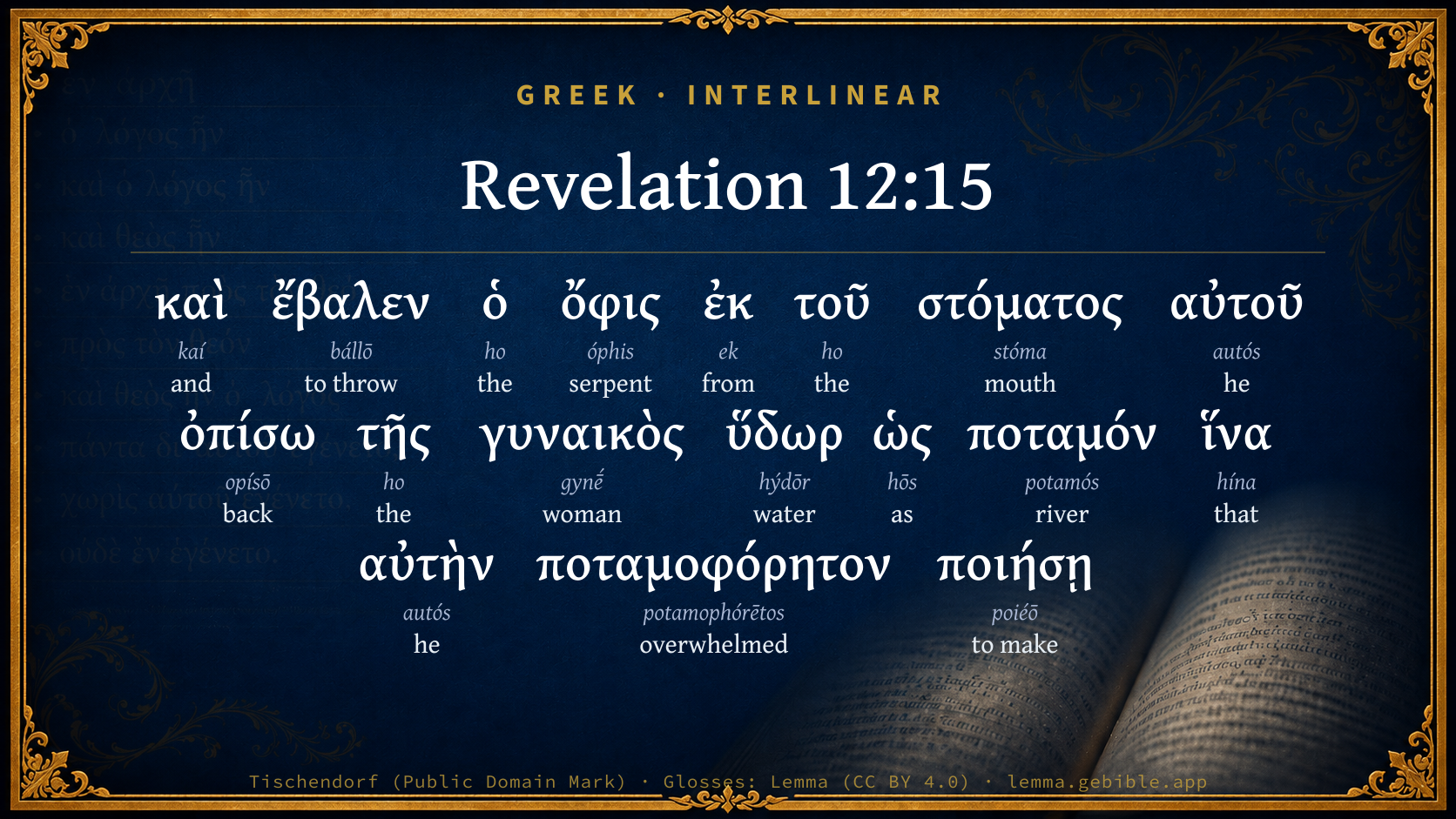
Download image
Cite this verse

Revelation 12:15 (World English Bible). Public Domain. Lemma interlinear Bible study tool, https://lemma.gebible.app/v/revelation/12/15.

Show BibTeX & RIS
BibTeX
RIS
English Translation
The serpent spewed water out of his mouth after the woman like a river, that he might cause her to be carried away by the stream.
World English Bible · Public Domain
Highlights
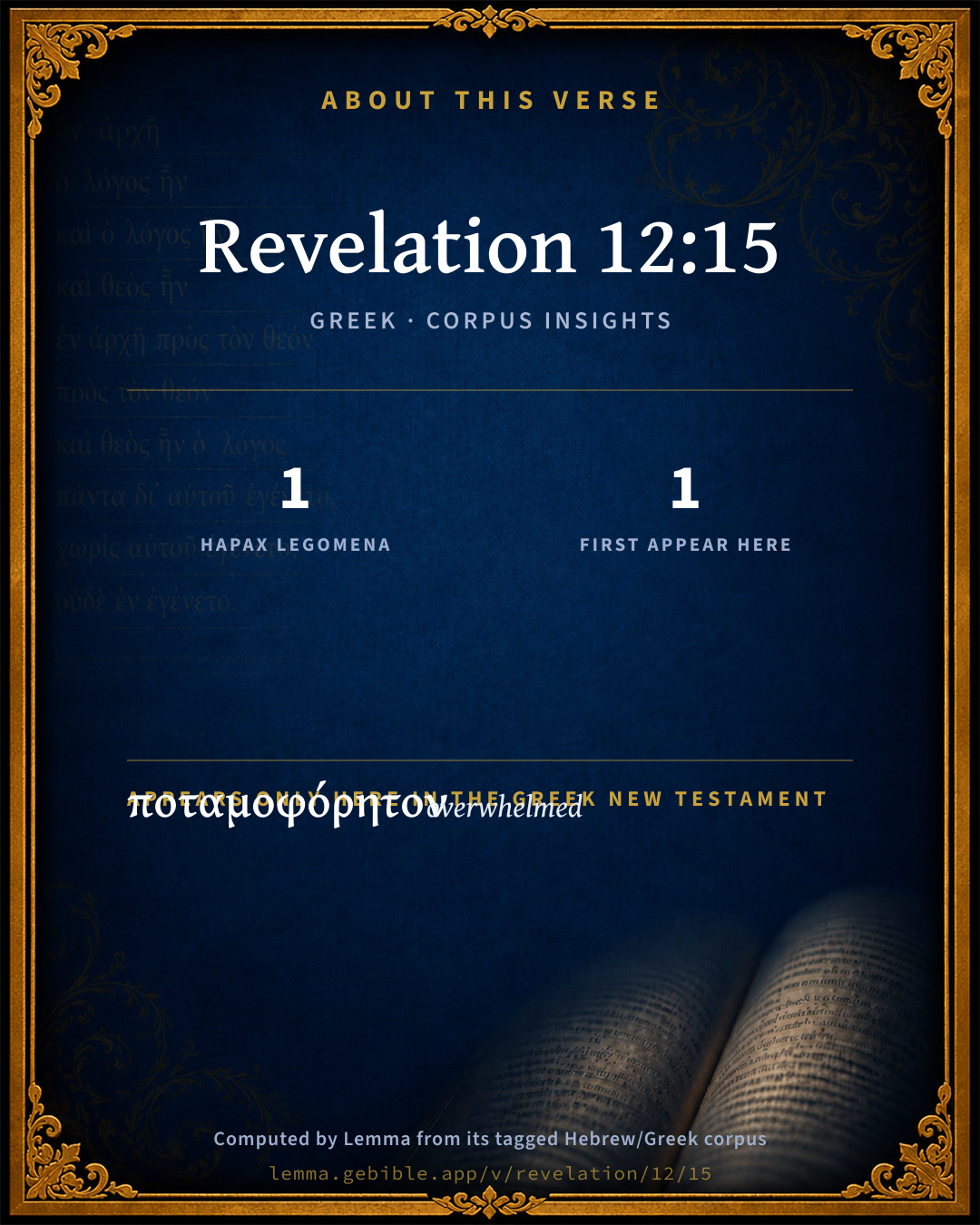
  • 1 hapax legomenon — only here in the Greek New Testament
  • 1 first appearance in the Greek New Testament
Full analysis ↓
Download a study sheet

One document with this verse’s original text, its word-by-word gloss line, the meaning frame, cross-references with their text, attributed commentary, and full source and license credits — printable, and it pastes into notes with its structure intact.

This verse Autodidact and up

Study sheet (.html) Plain text (.txt)

A passage Seminary Student

Up to 50 verses in one chapter. A passage sheet keeps up to 6 commentary sources and 12 cross-references per verse, in the order this page ranks them, and says so on the sheet whenever that leaves anything out. Ask for a single verse and you get the Autodidact verse sheet above.

Everything on this page stays free to read, with no account — the sheet is a download of what is already on screen, not access to it.

Want to remove ads? Support Godless Engineer
Compare translations 3

The same verse in 3 English versions, stacked beneath the original-language interlinear above. Click any original word for its lexicon entry.

Each is an independent rendering of the whole verse — the interlinear is not word-aligned to these translations.

Highlighted words mark where these versions differ — a whole-verse word diff, not a word-by-word alignment.

  • World English Bible Public Domain
    The serpent spewed water out of his mouth after the woman like a river, that he might cause her to be carried away by the stream.
  • King James Version Public Domain
    And the serpent cast out of his mouth water as a flood after the woman, that he might cause her to be carried away of the flood.
  • unfoldingWord Literal Text CC BY-SA 4.0
    And the serpent poured water like a river out from his mouth after the woman so that he might make her stream-borne.

unfoldingWord Literal Text — © unfoldingWord, licensed CC BY-SA 4.0. Word-aligned USFM3 via Door43 (git.door43.org/unfoldingWord/en_ult).

Versions to compare (up to 4)

3 of 4 selected

Show all 19 translations

Every available English version of this verse, each an independent rendering of the whole verse.

  • World English Bible Public Domain
    The serpent spewed water out of his mouth after the woman like a river, that he might cause her to be carried away by the stream.
  • Berean Standard Bible Public Domain
    Then from the mouth of the serpent spewed water like a river to overtake the woman and sweep her away in the torrent.
  • Majority Standard Bible Public Domain
    Then from his mouth the serpent spewed water like a river to overtake the woman and sweep her away in the torrent.
  • King James Version Public Domain
    And the serpent cast out of his mouth water as a flood after the woman, that he might cause her to be carried away of the flood.
  • American Standard Version (1901) Public Domain
    And the serpent cast out of his mouth after the woman water as a river, that he might cause her to be carried away by the stream.
  • Revised Version (1885) Public Domain
    And the serpent cast out of his mouth after the woman water as a river, that he might cause her to be carried away by the stream.
  • Geneva Bible (1599) Public Domain
    And the serpent cast out of his mouth water after the woman, like a flood, that he might cause her to be caried away of the flood.
  • Douay-Rheims (1899) Public Domain
    And the serpent cast out of his mouth after the woman, water as it were a river; that he might cause her to be carried away by the river.
  • Young's Literal Translation Public Domain
    and the serpent did cast forth after the woman, out of his mouth, water as a river, that he may cause her to be carried away by the river,
  • Literal Standard Version CC BY-SA 4.0
    and the serpent cast forth out of his mouth water as a river after the woman, that he may cause her to be carried away by the river,
  • Unlocked Literal Bible CC BY-SA 4.0
    The serpent poured water out of his mouth like a river, that he would make a flood to sweep her away.
  • unfoldingWord Literal Text CC BY-SA 4.0
    And the serpent poured water like a river out from his mouth after the woman so that he might make her stream-borne.
  • Darby Bible Public Domain
    And the serpent cast out of his mouth behind the woman water as a river, that he might make her be [as] one carried away by a river.
  • World Messianic Bible Public Domain
    The serpent spewed water out of his mouth after the woman like a river, that he might cause her to be carried away by the stream.
  • Webster's Bible Public Domain
    And the serpent cast out of his mouth water as a flood after the woman, that he might cause her to be carried away by the flood.
  • Free Bible Version CC BY-SA 4.0
    The serpent spewed water like a river out of his mouth, trying to sweep her away in the flood.
  • Bible in Basic English Public Domain
    And the snake sent out of his mouth after the woman a river of water, so that she might be taken away by the stream.
  • Text-Critical English NT CC BY 4.0
    Then out of his mouth the serpent spewed water like a river after the woman, to sweep her away with a flood.
  • Tyndale New Testament (1534) Public Domain
    And the dragon cast out of his mouth water after the woman as it had bene a ryver because she hulde have bene caught of the floud.

Literal Standard Version (2020), Covenant Press — licensed CC BY-SA 4.0. Text via the HelloAO Bible API (eBible.org). Unlocked Literal Bible (unfoldingWord) — licensed CC BY-SA 4.0. Text via the HelloAO Bible API (eBible.org). unfoldingWord Literal Text — © unfoldingWord, licensed CC BY-SA 4.0. Word-aligned USFM3 via Door43 (git.door43.org/unfoldingWord/en_ult). Free Bible Version, Dr. Jonathan Gallagher — licensed CC BY-SA 4.0. Text via the HelloAO Bible API (eBible.org).

Word by word

More ways to search: Search by grammar → Find every occurrence → Compare this word →

Practice this passage: Drill this verse → Learn its vocabulary →

ποταμοφόρητον
potamophórētos
G4216
“overwhelmed”
Adjective, Accusative, Singular, Feminine
Part of Speech
Adjective
Case
Accusative
Number
Singular
Gender
Feminine
Full Thayer's Definition

Origin: from G4215 and a derivative of G5409

TDNT: 16:07,9

1. carried away by a stream (i.e. overwhelmed, drowned in the waters)
  1. καὶ kaí G2532 “and” Conjunction
  2. ἔβαλεν bállō G906 “to throw” Verb, Aorist, Active, Indicative, 3rd person, Singular
  3. ὁ ho G3588 “the” Article, Nominative, Singular, Masculine
  4. ὄφις óphis G3789 “serpent” Noun, Nominative, Singular, Masculine
  5. ἐκ ek G1537 “from” Preposition
  6. τοῦ ho G3588 “the” Article, Genitive, Singular, Neuter
  7. στόματος stóma G4750 “mouth” Noun, Genitive, Singular, Neuter
  8. αὐτοῦ autós G846 “he” Personal pronoun, Genitive, Singular, Masculine
  9. ὀπίσω opísō G3694 “back” Adverb
  10. τῆς ho G3588 “the” Article, Genitive, Singular, Feminine
  11. γυναικὸς gynḗ G1135 “woman” Noun, Genitive, Singular, Feminine
  12. ὕδωρ hýdōr G5204 “water” Noun, Accusative, Singular, Neuter
  13. ὡς hōs G5613 “as” Adverb
  14. ποταμόν potamós G4215 “river” Noun, Accusative, Singular, Masculine
  15. ἵνα hína G2443 “that” Conjunction
  16. αὐτὴν autós G846 “he” Personal pronoun, Accusative, Singular, Feminine
  17. ποιήσῃ poiéō G4160 “to make” Verb, Aorist, Active, Subjunctive, 3rd person, Singular

About this verse

These counts appear in no published source. They are computed here, from the morphology-tagged text and Lemma’s own curated glosses. What Lemma adds →

18
words
15
distinct lemmas
Revelation
section

Notable vocabulary

1 hapax legomenon — a word that appears only here in the entire Greek New Testament:

  • ποταμοφόρητον overwhelmed G4216

First appearance in Scripture

This word makes its first canonical appearance in the Greek New Testament here:

  • ποταμοφόρητον overwhelmed G4216

Shared distinctive vocabulary

ὄφις serpent G3789 occurs in 14 verses of the Greek New Testament. Also found in:
Repetition

Words recur within this verse:

Cross-references

7

Topical passages linked to Revelation 12:15 in the Treasury of Scripture Knowledge — connected by theme and wording, ordered by reader-vote popularity; previews shown in the World English Bible.

  • Isaiah 8:7 now therefore, behold, the Lord brings up on them the waters of the River, strong and many, [even] the king of Assyria and all his glory: and it shall come up over all its channels, and go over all its banks;
  • Psalms 18:4 The cords of death surrounded me. The floods of ungodliness made me afraid.
  • Isaiah 59:19 So shall they fear the name of Yahweh from the west, and his glory from the rising of the sun; for he will come as a rushing stream, which the breath of Yahweh drives.
  • Psalms 65:7 Who stills the roaring of the seas, The roaring of their waves, And the turmoil of the nations.
  • Psalms 93:3–4 The floods have lifted up, Yahweh, The floods have lifted up their voice. The floods lift up their waves.
  • Isaiah 28:2 Behold, the Lord has a mighty and strong one; as a tempest of hail, a destroying storm, as a tempest of mighty waters overflowing, will he cast down to the earth with the hand.
  • Revelation 17:15 He said to me, "The waters which you saw, where the prostitute sits, are peoples, multitudes, nations, and languages.

Cross-references courtesy of OpenBible.info (CC BY 4.0).

Commentary

Notes on Revelation 12:15 from classic Christian and Jewish commentators (each source and its license shown beneath its notes). The classic Christian expositions comment on the surrounding passage and are grouped to its opening verse, so a note may address several verses; the Jewish commentaries on the Tanakh (Rashi and others) are per-verse, so they appear only where the commentator wrote on this verse.

Lemma curates 59 commentaries, every one of them public domain or Creative Commons licensed, each selected and text-cleaned for this edition rather than reprinted as found. About our sources →

Burkitt's Expository Notes on the New Testament

William Burkitt

Two things are here observable: a new danger, Rev 12:15 a renewed succour, Rev 12:16.

Observe, 1. A new danger; this is set forth, 1. By the author of it, the serpent; the former attempt against the church was managed by the wrathful dragon, this is contrived by the subtle serpent: open cruelty is more dreadful, but subtle policy is more dangerous: the cunning devil is a more dangerous: the cunning devil is a more mischievous enemy to the church of Christ than the raging devil; subtle Julian did the church more mischief than bloody Nero or Dioclesian.

Learn hence, That what mischief Satan cannot effect by open curelty, he will attempt against the church by subtle policy; when he fails as a dragon, he will try what he can do as a serpent.

2. Observe the matter as well as the author of this danger: The serpent cast out of his mouth water as a flood, that is, a flood of errors, heresies, false doctrines, and corrupt opinions, cast out of the mouth of the corrupting seducers, endangering the very essence and being of the church of Christ, particularly the Arian heresy, which prodigiously overspread the world in its time. Heresy may fitly be compared to a flood; it is a corrupting and defiling flood, it is a swelling and increasing flood, it is a drowning and overwhelming flood.

Learn hence, That the serpent’s flood of errors and false doctrines, is the worst and chiefest of the church’s dangers. The serpent cast out a flood to carry away the woman.

Observe, 3. The church’s seasonable relief and succour: The earth helped the woman by opening her mouth, and swallowing up the flood, which the dragon cast out of his mouth; by the earth some understand earthly ones, wicked men, who are said to help the woman, not intentionally, but eventually, by their greedy swallowing down those errors which come out of the dragon’s mouth, hearkening to his lies, and believing his errors for truth’s; others by the earth understand the kings and rulers of the earth understand the kings and rulers of the earth, helping the woman, by calling synods and councils to stem the tide, to dam this flood, and to condemn these errors and heresies, which by their overflowing endangered the church’s ruin: the devil raised four abominable errors presently after the church had obtained peace, and there was a great concurrence of magistrates and ministers in confuting, censuring, and condemning the same, in and by their councils and synods.

1. The heresy of Arius, who denied the divinity of Christ, this was condemned by the council of Nice, called by Constantine.

2. The heresy of Macedonius, who denied the personality of the Holy Ghost, condemned by a council at Constantinople, called by Theodosius the First.

3. The heresy of Nestorius, who asserted that Christ had two persons, as well as two natures, condemned by a council at Ephesus, called by Theodosius the Second.

4. The heresy of Eutyches, who confounded Christ’s natures, making him to have but one nature, as well as to be but one person; this was condemned by the council of Chalcedon: thus the earth helped the woman; these four councils tended very much to the maintaining of the truth, and preserving the church from that flood of error and heresy which the dragon cast out of his mouth.

Observe lastly, The dragon’s rage, Rev 12:17. He was wroth with the woman, and made war with the remnant of her seed, that is, he was greatly enraged because the woman was extraordinarily helped, and his designs wonderfully disappointed: and when he saw he could not ruin the whole church, he resolves to attack some particular members of it, even such as keep the commandments of God, and had the testimony of Christ; that is, those who kept close to the scriptures, which contain the doctrine of faith, and testify that Christ is the only Saviour of the world.

Now from the dragon’s making war with the remnant of the woman’s seed, we learn how insatiable the blood-thirstiness of Satan and his instruments is, who when they had killed the witnesses before, and many others, yet can they not rest until they have killed this little remnant, and made themselves drunk with the blood of the saints; and never let Protestants expect any other or any better usage at the hands of Romanists, with whom this is a certain principle, that heretics in a nation are to be extirpated, root and branch, where it may safely be done; that is, when they are not too numerous, and the loss of one of our lives may not cost two of their own.

If any say that Papists are now become better natured, by being under the restraint of our laws, I wish them that they may never be tempted out of their humanity by advantages of power; and as Almighty God has once more delivered the neck of this nation from the pinchings of the Anti-christian yoke, may our sins never provoke him more to deliver us into the hands of those men, whose tender mercies are cruel. Amen.

William Burkitt's Expository Notes on the New Testament (1700–1703) — public domain. Text from a community e-Sword module.

Tyndale Open Study Notes

Tyndale Open Resources

12:15-16 John pictures Satan as Leviathan (cp. Job 41:1) trying to destroy God’s people (the woman; see study note on Rev 12:1). The protective earth responds and the waters of chaos are contained, as at creation (cp. Gen 1:2, 6-7, 9-10).

Tyndale Open Study Notes — © Tyndale Open Resources, licensed CC BY-SA 4.0. Text via the HelloAO Bible API.

Meyer's Critical & Exegetical Commentary

Heinrich August Wilhelm Meyer

Rev_12:15-16. The dragon cannot reach the woman flying on eagles wings; and, therefore, casts a stream of water out of his mouth after her, in order to destroy her. But also by this danger the woman remains unharmed, because the earth absorbs the stream.

ὡς ποταμόν. This description of the great amount of water cast forth by the serpent serves to explain and illustrate the purpose: ἵνα ταύτην ποταμοφόρητον ποιήσῃ, to sink her carried away by the waters of the river, as Vitr. appropriately explains the word,[3178] not occurring elsewhere in biblical Greek, but otherwise regularly formed. Hesych.[3179] explains the Homeric ἀπόερσεν[3180] by ποταμορφόρητον ἐποίησεν.

The help afforded the woman imperilled on the part of the earth is described in a way, Rev_12:16, which is conformable with the nature of the danger, as well also with the nature of the earth; the earth opens its mouth, and drinks up the stream of water. The idea recalls not so much Gen_4:11,[3181] as rather Num_16:30; Num_16:32,[3182] since it is thought the mighty flood of water vanishes suddenly and inefficaciously in the widely gaping earth.

The question concerning the genesis of this entire description, Rev_12:15-16, is essentially a preliminary question, if it be as to whether a prophecy actually to be fulfilled be found here. The allegorists make the matter too easy by comparing the water cast forth from the mouth of the serpent directly with the many waters, Rev_17:1, on which the great harlot sits, and which are there (Rev_12:15) expressly explained as a figure of many nations, and who thus reach the opinion that in this passage also the stream of water signifies a stream of people which will roll against the Church, whether they be satisfied with this general sense,[3183] or more definite references be introduced.[3184]

By any allegorical interpretation whatever, we are of course prevented from making of the description in Rev_12:15 sqq. a prophecy actually to be fulfilled, because of the similar descriptions which precede in Rev_12:1-6, Rev_12:7-12, Rev_12:13-14, not allowing such interpretation. The stream of water from the mouth of the serpent designates as little something actually occurring in the present or in the future of John as the two wings of the eagle which, in Rev_12:14, were given the woman; but, as there the escape of the woman is represented with a plastic art, which is developed from the allusion to the O. T. testimony concerning Gods preservation of his people, so John here describes the danger which Satan, in his rage, prepares for the woman still fleeing, in such a way as to form living images from the symbolical mode of speech of the O. T. Entirely remote is any allusion to the passage of the Israelites through the Red Sea;[3185] but in passages like Psa_18:5-17; Psa_32:6; Psa_42:8; Psa_124:4, where pressing dangers are illustrated under the figure of great floods of water, lies the origin of the peculiar conception of the Apoc. idea; even its concrete form has a certain analogy in Psa_18:5, where what is said of the cords of death and the floods of ungodliness is in the same figurative sense as the cords of hell, and the snares of death. In such views we may recognize the foundation given the fantasy of the prophet, upon which his actual vision is ordinarily based.[3186]

[3178] Cf. the analogous ἀνεμοφόρητος.

[3179] Ed. Alberti, i. 461.

[3180] Il., iv. 348.

[3181] Züll.

[3182] ἀνοίξασα ἡ γῆ τὸ στόμα αὐτῆς καταπίεται αὑτούς, κ.τ.λ.

ἡνοίχθη ἡ γῆ καὶ κατἑπιεν αὐτ.

[3183] Hengstenb., Ebrard. Cf. Beda: The force of persecutions. Andreas: ἀθέων ἀνδρῶν ἣ πονηρῶν δαιμονων ἣ ποικίλων πειρασμῶν πλῆθος [the abundance of godless men, or wicked demons, or various trials] coming out of the mouth of the serpent, i.e., ἐκ προστάγματος αὐτου [by its command], as Vict. already indicates. C. a Lap.: The army of Antichrist. Stern: The flood of godless nations and infernal spirits.

[3184] Calov.: The Arian heretics. Vitr.: The Saracens, who (Rev_12:16) were defeated by Charles Martel. Coccejus: The armies of Maxentius and Licinius, which were defeated by Constantine the Great, and, indeed (Rev_12:16 : ἡ γῆ), with the forces of the lands in which (Rev_12:14) the Church had already found a refuge, viz., Gaul and Spain. Bengel: The Turks from the year 1058 on. Wetst.: The armies of Cestius and Vespasian. Hammond: Recent persecutions after the Neronian (Rev_12:3) on the part of the Romans, who, however (Rev_12:16), were withdrawn from the Christians by the Jewish war. Ew. ii.: The flight of the mother congregation from Jerusalem to Pella. Cf. Euseb., H. E., iii. 5. In connection with this, Rev_12:15 is referred to some great danger on the Jordan, possibly an attack by a faction of desperate Jews. Ew. interprets the delivering earth, but not more definitely. Auberlen: The migration of nations, whose flood, however, is not destructive to the Church, because the earth, i.e., the cultured Roman world, received those wild Germanic masses within itself, subdued their hostility, mellowed them, and won them to Christianity. But even granting that the allegorical mode of exposition is justified, and that in Rev_12:15-16 definite events of secular history are foretold, is it possible that the writer of the Apoc. could have conceived of the thought that the masses of nations which Satan casts forth against the Church are won to Christianity? This glaring contradiction is not removed by the fact that Christianity is to come into consideration chiefly, not on its heavenly, but on its earthly side, as a force of civilization (Auberlen, p. 297). And with respect to actual history dare it be said that the Germanic nations were cast forth like a stream of water out of the jaws of Satan, and were swallowed up by the earth? Does it agree with this, that from this Satanic stream of water the German Reformation emerged? It is a supposition more worthy of being entertained, when Aub., p. 300, recurs to the Turks.

[3185] Against Ew., De Wette, etc.

[3186] Cf. Introduction, p. 47 sq.

Meyer — Critical and Exegetical Commentary on the New Testament — English translation by Peter Christie, edited by Frederick Crombie (T&T Clark, 1880) — public domain. Text from a community e-Sword module.

Expositor's Greek Testament

ed. W. Robertson Nicoll

Rev 12:15 . Another mythological metaphor for persecution or persecutors, like “torrents of Belial” (Psa 18:4 ). As the primaeval dragon was frequently a sea-monster, from Tiâmat onwards, his connexion with water ( cf. on Rev 8:10 ) was a natural development in ancient ( cf. Pausan. ver 43 f.) and even Semitic ( e.g. , Psa 74:4 ; Ezekiel 29, 32.) literature. The serpent in the river was, for Zoroastrians, a creation of the evil spirit (Vend. i. 3).

The Expositor's Greek Testament, edited by W. Robertson Nicoll (1897–1910) — public domain. Text from a community e-Sword module.

Geneva Bible (1599)

Geneva Bible translators

That is, he inflamed the Romans and the nations, that they persecuting the Jewish people with cruel arms might by the same occasion invade the Church of Christ, now departed from Jerusalem and out of Judea. For it is an usual thing in Scripture that the raging tumults of the nations, should be compared unto waters.

Geneva Bible (1599) marginal notes — public domain. Text via Bolls.life.

Jamieson, Fausset & Brown

Robert Jamieson, A. R. Fausset & David Brown

flood--Greek, "river" (compare Exo 2:3; Mat 2:20; and especially Exo. 14:1-31). The flood, or river, is the stream of Germanic tribes which, pouring on Rome, threatened to destroy Christianity. But the earth helped the woman, by swallowing up the flood. The earth, as contradistinguished from water, is the world consolidated and civilized. The German masses were brought under the influence of Roman civilization and Christianity [AUBERLEN]. Perhaps it includes also, generally, the help given by earthly powers (those least likely, yet led by God's overruling providence to give help) to the Church against persecutions and also heresies, by which she has been at various times assailed.

Jamieson, Fausset & Brown — Commentary Critical and Explanatory on the Whole Bible (1871) — public domain (CC PDM 1.0). Text via the HelloAO Bible API.

Adam Clarke's Commentary

NOTES ON CHAP. XII., BY J. E. C.

Verse 15. And the serpent cast out of his mouth water as a flood] The water here evidently means great multitudes of nations and peoples; for in Re 17:15, the interpreting angel says, The waters which thou sawest-are peoples, and multitudes, and nations, and tongues. This water, then, which the dragon cast out of his mouth, must be an inundation of heathen barbarous nations upon the Roman empire; and the purpose which the dragon has in view by this inundation is, that he might cause the woman, or Christian Church:-

To be carried away of the flood.] Entirely swept away from the face of the earth. Dr. Mosheim, in the commencement of his second chapter upon the fifth century, observes "that the Goths, the Heruli, the Franks, the Huns, and the Vandals, with other fierce and warlike nations, for the most part strangers to Christianity, had invaded the Roman empire, and rent it asunder in the most deplorable manner. Amidst these calamities the Christians were grievous, nay, we may venture to say the principal, sufferers. It is true these savage nations were much more intent upon the acquisition of wealth and dominion than upon the propagation or support of the pagan superstitions, nor did their cruelty and opposition to the Christians arise from any religious principle, or from an enthusiastic desire to ruin the cause of Christianity; it was merely by the INSTIGATION of the pagans who remained yet in the empire, that they were excited to treat with such severity and violence the followers of Christ." Thus the wo which was denounced, Re 12:12, against the inhabiters of the earth and of the sea, came upon the whole Roman world; for, in consequence of the excitement and malicious misrepresentations of the pagans of the empire, "a transmigration of a great swarm of nations" came upon the Romans, and ceased not their ravages till they had desolated the eastern empire, even as far as the gates of Byzantium, and finally possessed themselves of the western empire. "If," says Dr. Robertson, in the introduction to his History of Charles V., vol. i., pp. 11, 12, edit. Lond. 1809, "a man was called to fix upon the period in the history of the world, during which the condition of the human race was most calamitous and afflicted, he would, without hesitation, name that which elapsed from the death of Theodosius the Great to the establishment of the Lombards in Italy, a period of one hundred and seventy-six years. The contemporary authors who beheld that scene of desolation, labour and are at a loss for expressions to describe the horror of it. The scourge of God, the destroyer of nations, are the dreadful epithets by which they distinguish the most noted of the barbarous leaders; and they compare the ruin which they had brought on the world to the havoc occasioned by earthquakes, conflagrations, or deluges, the most formidable and fatal calamities which the imagination of man can conceive." But the subtle design which the serpent or dragon had in view, when he vomited out of his mouth a flood of waters, was most providentially frustrated; for:-

Adam Clarke's Commentary on the Bible (1810–1826) — public domain. Text from a community e-Sword/MySword module.

Ellicott's Commentary for English Readers

(15) And the serpent . . .—Translate, And the serpent cast out of his mouth after the woman water as a river, that he might make her to be carried away by the river. The foe of the woman was described as a dragon for his cruelty and fierceness—as a serpent for his subtlety. The first attack on the woman is pictured as persecution by the dragon: from this she escapes by flight; but the subtlety of the enemy finds another device: the foe (now described as a serpent) pours forth water as a river to sweep away the woman. The emblem is nut uncommon in the Bible. Invasion is described as “an overflowing flood” (Jer_46:7-8; Jer_47:2; comp. Isa_8:7-8) The same emblem is used in Psa_74:2-6 to describe the uprising of a people’s ill-will. The floods, the rivers, the waves of the sea, are employed to express popular movements. The woman that cannot be destroyed by positive persecution may be swept away by a hostile public opinion. It is not the rulers alone who stand up against the Lord and His Church: an infuriated populace may be stirred up against them. The temper of the mob occasioned as much suffering and as many deaths in early Christian days as did the political authorities. Ill-regulated popular impulses, leading to violence and unwise action, whether nominally for Christianity or against it, have done enough of the devil’s work in the world.

A Bible Commentary for English Readers, edited by Charles John Ellicott (1878–1897) — public domain. Text from a community e-Sword module.

The Cambridge Bible for Schools and Colleges

gen. ed. J. J. S. Perowne

15, 16. We have not means for interpreting this description in detail. All we can say certainly is, that it describes the providential foiling of Satanic attempts at the destruction of Israel. Perhaps the most plausible suggestion of a definite meaning of the “flood” [better translated river] is that the Christians of Jerusalem, in their flight to “the mountains” (St Mat_24:16 &c.) of Pella, were delivered by a miracle or special providence from the dangers of the passage of Jordan: if they fled immediately before the siege was formed by Titus, this was just before the Passover, when the river was in flood (Jos_3:15). But of such an event we have no historical notice: and it is likely that the Christians fled when they had first “seen Jerusalem compassed with armies” (St Luk_21:20), in the unsuccessful assault of Cestius Gallus, three years before the fall of the city.

The Cambridge Bible for Schools and Colleges (gen. ed. J. J. S. Perowne; Cambridge University Press, 1878–1918) — public domain. Text from a community e-Sword module.

John Gill's Exposition

And the serpent cast out of his mouth water as a flood,.... Which cannot design any persecution before the fall of Paganism, either of the Jews, or of the Romans; nor indeed the Arian persecution, since the casting out of this flood is distinguished from the above persecution, and was after the church began to flee upon that persecution; though it is not unusual for wicked persecutors, and violent persecutions, to be expressed by waters, and they are called proud waters, Psa 124:1; and these may be said to be cast out of the mouth of the serpent, the devil, who was a persecutor and a murderer from the beginning, and by whom all persecutors and persecutions are instigated, moved, and carried on; but rather, as the words of a man's mouth are as deep waters, Pro 18:4; and doctrines, good or bad, may be so called; that flood of errors and heresies, which were poured in between the times of Constantine and the rise of antichrist may be here intended; such as the Arian heresy, which denied the divinity of Christ; the Nestorian heresy, which divided his person; and the Eutychian heresy, which confounded the two natures in him; and the Macedonian heresy, which took away the deity of the Holy Ghost; and the Pelagian heresy, which destroyed the grace of God, and set up the power of man's free will: and this flood of errors and heresies may be truly said to be cast out of the serpent's mouth; since the old serpent, the devil, is the father of all lies, and errors: and the above heresies are the doctrines of devils, and damnable ones; and were designed by Satan to destroy the souls of men, and ruin the church: though since this flood followed upon the Arian persecution, and was after the church began to flee, being supported and secured by the two divisions of the empire, eastern and western, the wings of the Roman eagle, it seems best by this flood to understand the irruption of the barbarous nations, which quickly followed that division; the Goths, Huns, Vandals, Heruli, Alans, and Lombards, who were poured into the western empire, and overran, and at last destroyed it; so that this flood is contemporary with the first four trumpets; after which followed the swarms of locusts, the Saracens, which infested, teased, and tormented the "eastern" empire; and after them the Turks, the four angels bound at the great river Euphrates, were let loose, and like a mighty torrent overflowed, and utterly destroyed it; and all this was done at the instigation of Satan, he being filled with wrath, because the empire was become Christian, and his view was to destroy the church in it: for this flood was cast

after the woman, that he might cause her to be carried away of the flood; along with the empire, and be no more; but his designs were frustrated, and he disappointed; so people, nations, and tongues, are compared to waters in Rev 17:15; see Isa 8:7, which the Targum interprets of the armies of much people.

John Gill's Exposition of the Whole Bible (1746–1763) — public domain (CC PDM 1.0). Text via the HelloAO Bible API.

Trapp's Complete Commentary

John Trapp

15 And the serpent cast out of his mouth water as a flood after the woman, that he might cause her to be carried away of the flood.

Ver. 15. Cast out of his, mouth water] Those barbarous nations, Goths, Huns, Vandals, Lombards, others, stirred up by the devil to overrun the empire, and afflict the Church. Or else it may mean those pestilent and poisonous heresies, Arianism, and the rest, wherewith the Church was infested, according to that of Solomon, "The mouth of the wicked belcheth out evil things," Pro 15:2.

John Trapp, A Commentary or Exposition upon All the Books of the Old and New Testament (1647–1656) — public domain. Text from a community e-Sword module.

Albert Barnes' Notes on the Bible

And the serpent cast out of his mouth water as a flood - This is special and uncommon imagery, and it is not necessary to suppose that anything like this literally occurs in nature. Some serpents are indeed said to eject from their mouths poisonous bile when they are enraged, in order to annoy their pursuers; and some sea monsters, it is known, spout forth large quantities of water; but the representation here does not seem to be taken from either of those cases. It is the mere product of the imagination, but the sense is clear. The woman is represented as having wings, and as being able thus to escape from the serpent. But, as an expression of his wrath, and as if with the hope of destroying her in her flight by a deluge of water, he is represented as pouring a flood from his mouth, that he might, if possible, sweep her away. The figure here would well represent the continued malice of the papal body against the true church, in those dark ages when it was sunk in obscurity, and, as it were, driven out into the desert. That malice never slumbered, but was continually manifesting itself in some new form, as if it were the purpose of papal Rome to sweep it entirely away.

That he might cause her to be carried away of the flood - Might cause the church wholly to be destroyed. The truth taught is, that Satan leaves no effort untried to destroy the church.

Albert Barnes' Notes on the Bible (1834–1885) — public domain. Text from a community e-Sword/MySword module.

Haydock's Catholic Bible Commentary

The serpent (the dragon, the devil) came out of his mouth, &c. He endeavoured to destroy Christian religion; but the earth, that is, the princes of the earth, as God was pleased to turn their hearts, helped to turn away the persecutions. (Witham) --- As a last effort, the devil raises a more bloody persecution than was ever known before. See Eusebius, History of the Church.

George Leo Haydock (1774–1849), Haydock's Catholic Family Bible and Commentary, 1859 edition — public domain. Excludes Psalms (Douay-Rheims chapter numbering differs from Protestant) and Deuterocanonical books (Catholic canon only).

Matthew Poole's English Annotations

And the serpent; the devil, the old serpent, mentioned Rev 12:9, being able no longer to execute his malice as a dragon, by the civil power of the heathen emperors, tearing Christians in pieces, but discerning the church secured by the special providence of God, went to work another way.

Cast out of his mouth water as a flood; corrupting the judgments of several persons, who, out of the abundance of error in their hearts, preached corrupt doctrine. Such were the followers of Arius, Nestorius, Eutyches, Pelagius, &c. The words of a man’s mouth are as deep waters, Pro 18:4. The mouth of the wicked poureth out evil things, Pro 15:28.

That he might cause her to be carried away of the flood; on purpose to ruin the church: and, indeed, such were the ill effects of these heresies, that he who is but meanly versed in the history of the fifth age, will see reason to adore the providence of God, that the Roman emperors, upon the sight of them, did not again turn pagans, and add their force to the malice of these pretended Christians against the sincerer part of the church.

Matthew Poole's English Annotations on the Holy Bible (1683–1685) — public domain. Text from a community e-Sword/MySword module.

Whedon's Commentary on the Bible

Daniel D. Whedon

15. Water as a flood—It cannot reasonably be denied that the antithetic terms water and earth are here figurative, as is the dragon. Water, as a figure, symbolizes the moving and unstable human populations; and earth, the steady and solid human state. The dragon, therefore, pouring from his mouth the water upon the woman, must signify paganism pouring a hostile horde upon the Christian communion; and the aid derived from the earth must designate the support of Christianity by the settled and civilized people. And so did pagan Europe pour her hosts of barbarians down upon Christianized Italy. And the Christianized earth so aided the Church as to secure her triumph over paganism.

Daniel D. Whedon (gen. ed.), Commentary on the Old and New Testaments (1874–1909) — public domain. Text from a community e-Sword module.

The Pulpit Commentary

And the serpent cast out of his month water as a flood after the woman, that he might cause her to be carried away of the flood; cast out of his mouth after the woman water as a river... carried away by the river . A flood, in the Old Testament, has several significations. It frequently expresses overwhelming misfortune. Thus Psa_69:15, "Let not the water flood overflow me;" Psa_90:5, "Thou carriest them away as with a flood". (cf. also Dan_9:26 Dan_11:22 Isa_59:19 Jer_46:7 Amo_9:5, etc.) The flood is typical of every form of destruction with which the devil seeks to overwhelm the Church of God. At the period of the writing of the Apocalypse, it plainly symbolized the bitter persecutions to which Christians were subjected; but its meaning need not be limited to this one form of destruction. Thus all those writers are correct, so far as they go, who interpret the flood of the Mohammedan power, of heresy, of the Gothic invasion, etc.

The Pulpit Commentary (1880–1919), ed. H.D.M. Spence-Jones & Joseph S. Exell — public domain. Text from a community e-Sword module.

John Wesley's Explanatory Notes

Water is an emblem of a great people; this water, of the Turks in particular. About the year 1060 they overran the Christian part of Asia. Afterward, they poured into Europe, and spread farther and farther, till they had overflowed many nations.

John Wesley, Explanatory Notes Upon the Whole Bible (1754–1765) — public domain. Text via the GEBible commentary corpus.

The People's New Testament

B. W. Johnson

15–17. And the serpent cast out … a flood. He resorted to persecutions in order to drive the true Church off of the face of the earth.

B. W. Johnson's The People's New Testament with Notes (1889–1891) — public domain. Electronic text from the Christian Classics Ethereal Library (CCEL) ThML edition.

unfoldingWord translationNotes

Door43 World Missions Community

serpent

This is the same being as the dragon mentioned earlier in Revelation 12:9.

like a river

The water flowed from his mouth like a river flows. AT: "in large volume" (See: Simile)

to sweep her away

"to wash her away"

The earth opened its mouth and swallowed the river that the dragon was pouring out of his mouth

The earth is spoken of as if it were a living thing, and a hole in the earth is spoken of as if it were a mouth that could drink up the water. AT: "A hole in the ground opened up and the water went down into the hole" (See: Personification)

dragon

This was a large, fierce reptile, like a lizard. For Jewish people, it was a symbol of evil and chaos. The dragon is also identified in verse 9 as "the devil or Satan." See how you translated this in Revelation 12:3. (See: Symbolic Language)

hold to the testimony about Jesus

The word "testimony" can be translated as a verb. AT: "continue to testify about Jesus"

translationWords

serpent

water

flood

earth

descend

obey

God

command

testimony

Jesus

unfoldingWord translationNotes — © Distant Shores Media and the Door43 World Missions Community, licensed CC BY-SA 4.0. Source: git.door43.org/Door43/en_tn.

Cambridge Greek Testament for Schools and Colleges

15, 16. Gen 3:15. The sense must be, that the Devil attempts to frustrate God’s counsels, not now by attacking the old Israel, but the new “Israel of God.” Titus, we are told, resolved to destroy the Temple, “in order that the religion of the Jews and Christians might be more completely abolished” (Sulp. Sev. II. 30, supposed to embody a quotation from Tacitus). Hadrian, on the contrary, seeing that the Christians had separated their cause from that of the rebel Jews, extended to them a tolerance not merely contemptuous. But thenceforward the best and ablest emperors, from M. Aurelius to Diocletian, recognising the independent power of the Church, thought it necessary to persecute it. At last, Julian completely reversed the policy of Titus, seeking to discredit the Gospel by patronage to the Jews. This policy, apparently, will be carried out by Antichrist: but will be baffled when the Jews, whom he has restored to their land as unbelievers, are converted by the martyrdom and resurrection of the two prophets (see notes on the preceding chapter).

15. ἵνα … ποιήσῃ. Cop[424] omits, Primas[425] ut eam perderet.

[424] Coptic.

[425] Primasius, edited by Haussleiter.

18. καὶ ἐστάθην. So Text. Rec[426] and Tisch[427] with B2P cop[428] And[429] Are.; Lach[430] Treg[431] W. H[432] and Weiss read ἐστάθη with אAC vg[433] arm[434] syr[435]; Primas[436] seems to omit the verse.

[426] Rec. Textus Receptus as printed by Scrivener.

[427] Tischendorf: eighth edition; where the text aud notes differ the latter are cited.

[428] Coptic.

[429] Andreas Archbishop of Caesarea.

[430] Lachmann’s larger edition.

[431] Tregelles.

[432] H. Westcott aud Hort.

[433] Vulgate.

[434] Armenian.

[435] Syriac.

[436] Primasius, edited by Haussleiter.

Cambridge Greek Testament for Schools and Colleges (Cambridge University Press, 1896; 21 vols, various authors incl. Carr, Maclear, Plummer, Farrar, Lumby, Moule, M. R. James, Simcox) — public domain. Text from a community e-Sword module.

Vincent's Word Studies in the New Testament

Marvin R. Vincent

Cause her to be carried away of the flood [παυτην ποταμοφορητον ποιηση] . Lit., might make her one carried away by the stream : a river - born one. The word occurs only here in the New Testament.

Marvin R. Vincent, Word Studies in the New Testament (1887–1900) — public domain. Text from a community e-Sword/MySword module.

Lesson kit

Teaching starters — assembled from the data on this page, not authored interpretation. Every prompt links to the verse data it draws on. Edit before teaching.

Revelation, in the Revelation, opens this verse with 18 words (15 distinct Greek lemmas). Its most distinctive word is potamophórētos (“overwhelmed”). A historical commentator’s framing appears above. Read the whole chapter for the surrounding context.

Discussion questions

  1. How does “overwhelmed” (potamophórētos) shape what this verse is saying?
  2. This verse holds 1 word here found nowhere else in the Greek New Testament. What might the rare word draw attention to?
  3. The word “overwhelmed” first appears here in Scripture. What is being introduced at this debut?
  4. Matthew 7:10 shares the word «serpent» with this verse. How do the two illuminate each other?
  5. “the” occurs 3× in this one verse. What is the effect of the repetition?
  6. The translations on this page render this verse differently — a whole-verse word diff, not a word-by-word alignment. What might account for the different wordings?
  7. Reading how Burkitt's Expository Notes on the New Testament and Tyndale Open Study Notes read this verse, where do the two commentators agree and where do they part?

Things to notice

  • 1 word in this verse appears nowhere else in the Greek New Testament.
  • 1 word makes its first canonical appearance in Scripture here.
  • These translations choose different wording for 12 words in this verse.
  • “the” occurs 3× in this single verse.
  • 15 distinct Greek lemmas span 18 words in this verse.

Reading settings

Reading text

Shown beneath each verse's original-language words.

Old Testament
Old Testament edition

Read the OT as the Masoretic Hebrew (MT) or the Greek Septuagint (LXX).

English shown for the Greek Septuagint (in the Hebrew ↔ Greek comparison).

Comparing translations? Open the Compare panel on any verse page to stack up to four side by side.