Luke 7:37

Greek (Tischendorf 8th ed.) Luke 7:37 appears in the Greek New Testament. The text above is from the Tischendorf 8th edition. Each word links to its Strong’s number and a concise gloss. Click any word for its full Thayer’s Greek Lexicon entry.

Download image
Cite this verse

Luke 7:37 (World English Bible). Public Domain. Lemma interlinear Bible study tool, https://lemma.gebible.app/v/luke/7/37.

Show BibTeX & RIS
BibTeX
RIS
English Translation
Behold, a woman in the city who was a sinner, when she knew that he was reclining in the Pharisee's house, she brought an alabaster jar of ointment.
World English Bible · Public Domain
Download a study sheet

One document with this verse’s original text, its word-by-word gloss line, the meaning frame, cross-references with their text, attributed commentary, and full source and license credits — printable, and it pastes into notes with its structure intact.

This verse Autodidact and up

Study sheet (.html) Plain text (.txt)

A passage Seminary Student

Up to 50 verses in one chapter. A passage sheet keeps up to 6 commentary sources and 12 cross-references per verse, in the order this page ranks them, and says so on the sheet whenever that leaves anything out. Ask for a single verse and you get the Autodidact verse sheet above.

Everything on this page stays free to read, with no account — the sheet is a download of what is already on screen, not access to it.

Want to remove ads? Support Godless Engineer
Compare translations 3

The same verse in 3 English versions, stacked beneath the original-language interlinear above. Click any original word for its lexicon entry.

Each is an independent rendering of the whole verse — the interlinear is not word-aligned to these translations.

Highlighted words mark where these versions differ — a whole-verse word diff, not a word-by-word alignment.

  • World English Bible Public Domain
    Behold, a woman in the city who was a sinner, when she knew that he was reclining in the Pharisee's house, she brought an alabaster jar of ointment.
  • King James Version Public Domain
    And, behold, a woman in the city, which was a sinner, when she knew that Jesus sat at meat in the Pharisee's house, brought an alabaster box of ointment,
  • unfoldingWord Literal Text CC BY-SA 4.0
    And behold, a woman who was in the city a sinner. And having found out that he was reclining to eat in the house of the Pharisee, she brought an alabaster jar of perfumed oil

unfoldingWord Literal Text — © unfoldingWord, licensed CC BY-SA 4.0. Word-aligned USFM3 via Door43 (git.door43.org/unfoldingWord/en_ult).

Versions to compare (up to 4)

3 of 4 selected

Show all 19 translations

Every available English version of this verse, each an independent rendering of the whole verse.

  • World English Bible Public Domain
    Behold, a woman in the city who was a sinner, when she knew that he was reclining in the Pharisee's house, she brought an alabaster jar of ointment.
  • Berean Standard Bible Public Domain
    When a sinful woman from that town learned that Jesus was dining there, she brought an alabaster jar of perfume.
  • Majority Standard Bible Public Domain
    When a sinful woman from that town learned that Jesus was dining there, she brought an alabaster jar of perfume.
  • King James Version Public Domain
    And, behold, a woman in the city, which was a sinner, when she knew that Jesus sat at meat in the Pharisee's house, brought an alabaster box of ointment,
  • American Standard Version (1901) Public Domain
    And behold, a woman who was in the city, a sinner; and when she knew that he was sitting at meat in the Pharisee's house, she brought an alabaster cruse of ointment,
  • Revised Version (1885) Public Domain
    And behold, a woman which was in the city, a sinner; and when she knew that he was sitting at meat in the Pharisee’s house, she brought an alabaster cruse of ointment,
  • Geneva Bible (1599) Public Domain
    And beholde, a woman in the citie, which was a sinner, when she knewe that Iesus sate at table in the Pharises house, shee brought a boxe of oyntment.
  • Douay-Rheims (1899) Public Domain
    And behold a woman that was in the city, a sinner, when she knew that he sat at meat in the Pharisee's house, brought an alabaster box of ointment;
  • Young's Literal Translation Public Domain
    and lo, a woman in the city, who was a sinner, having known that he reclineth (at meat) in the house of the Pharisee, having provided an alabaster box of ointment,
  • Literal Standard Version CC BY-SA 4.0
    and behold, a woman in the city, who was a sinner, having known that He reclines in the house of the Pharisee, having provided an alabaster box of ointment,
  • Unlocked Literal Bible CC BY-SA 4.0
    Behold, there was a woman in the city who was a sinner. When she found out that he was reclining at the table in the Pharisee's house, she brought an alabaster jar of perfumed oil.
  • unfoldingWord Literal Text CC BY-SA 4.0
    And behold, a woman who was in the city a sinner. And having found out that he was reclining to eat in the house of the Pharisee, she brought an alabaster jar of perfumed oil
  • Darby Bible Public Domain
    and behold, a woman in the city, who was a sinner, and knew that he was sitting at meat in the house of the Pharisee, having taken an alabaster box of myrrh,
  • World Messianic Bible Public Domain
    Behold, a woman in the city who was a sinner, when she knew that he was reclining in the Pharisee’s house, brought an alabaster jar of ointment.
  • Webster's Bible Public Domain
    And behold, a woman in the city, who was a sinner, when she knew that Jesus sat at table in the Pharisee's house, brought an alabaster-box of ointment,
  • Free Bible Version CC BY-SA 4.0
    A woman who was a sinner in that town found out that Jesus was eating in the Pharisee's house. She went there, carrying an alabaster jar of perfume.
  • Bible in Basic English Public Domain
    And there was a woman in the town who was a sinner; and when she had news that he was a guest in the Pharisee's house, she took a bottle of perfume,
  • Text-Critical English NT CC BY 4.0
    And behold, when a woman in that city who was a sinner found out that Jesus was reclining at the table in the Pharisee's house, she brought an alabaster jar of ointment.
  • Tyndale New Testament (1534) Public Domain
    And beholde a woman in that cite which was a synner assone as she knewe that. Iesus sate at meate in the pharises housse she brought an alablaster boxe of oyntment

Literal Standard Version (2020), Covenant Press — licensed CC BY-SA 4.0. Text via the HelloAO Bible API (eBible.org). Unlocked Literal Bible (unfoldingWord) — licensed CC BY-SA 4.0. Text via the HelloAO Bible API (eBible.org). unfoldingWord Literal Text — © unfoldingWord, licensed CC BY-SA 4.0. Word-aligned USFM3 via Door43 (git.door43.org/unfoldingWord/en_ult). Free Bible Version, Dr. Jonathan Gallagher — licensed CC BY-SA 4.0. Text via the HelloAO Bible API (eBible.org).

Word by word

More ways to search: Search by grammar → Find every occurrence → Compare this word →

Practice this passage: Drill this verse → Learn its vocabulary →

ἀλάβαστρον
alábastron
G211
“alabaster jar”
Noun, Accusative, Singular, Neuter
Part of Speech
Noun
Case
Accusative
Number
Singular
Gender
Neuter
Full Thayer's Definition

Origin: from alabastros (of uncertain derivation), the name of a stone

TDNT: None

1. a box made of alabaster in which unguents are preserved The ancients considered alabaster to be the best material inwhich to preserve their ointments. Breaking the box, probablymeans breaking the seal of the box.
  1. καὶ kaí G2532 “and” Conjunction
  2. ἰδοὺ horáō G3708 “to see” Verb, Aorist, Middle, Imperative, 2nd person, Singular
  3. γυνὴ gynḗ G1135 “woman” Noun, Nominative, Singular, Feminine
  4. ἥτις hóstis G3748 “whoever” Relative pronoun, Nominative, Singular, Feminine
  5. ἦν eimí G1510 “to be” Verb, Imperfect, Active, Indicative, 3rd person, Singular
  6. ἐν en G1722 “in” Preposition
  7. τῇ ho G3588 “the” Article, Dative, Singular, Feminine
  8. πόλει pólis G4172 “city” Noun, Dative, Singular, Feminine
  9. ἁμαρτωλός hamartōlós G268 “sinner” Adjective, Nominative, Singular, Feminine
  10. καὶ kaí G2532 “and” Conjunction
  11. ἐπιγνοῦσα epiginṓskō G1921 “to know thoroughly” Verb, Aorist, Active, Participle, Nominative, Singular, Feminine
  12. ὅτι hóti G3754 “that” Conjunction
  13. κατάκειται katákeimai G2621 “to lie down” Verb, Present, Middle or Passive deponent, Indicative, 3rd person, Singular
  14. ἐν en G1722 “in” Preposition
  15. τῇ ho G3588 “the” Article, Dative, Singular, Feminine
  16. οἰκίᾳ oikía G3614 “house” Noun, Dative, Singular, Feminine
  17. τοῦ ho G3588 “the” Article, Genitive, Singular, Masculine
  18. Φαρισαίου Pharisaîos G5330 “Pharisee” Noun, Genitive, Singular, Masculine
  19. κομίσασα komízō G2865 “to care for” Verb, Aorist, Active, Participle, Nominative, Singular, Feminine
  20. μύρου mýron G3464 “ointment” Noun, Genitive, Singular, Neuter

About this verse

These counts appear in no published source. They are computed here, from the morphology-tagged text and Lemma’s own curated glosses. What Lemma adds →

21
words
17
distinct lemmas
Gospels
section

Notable vocabulary

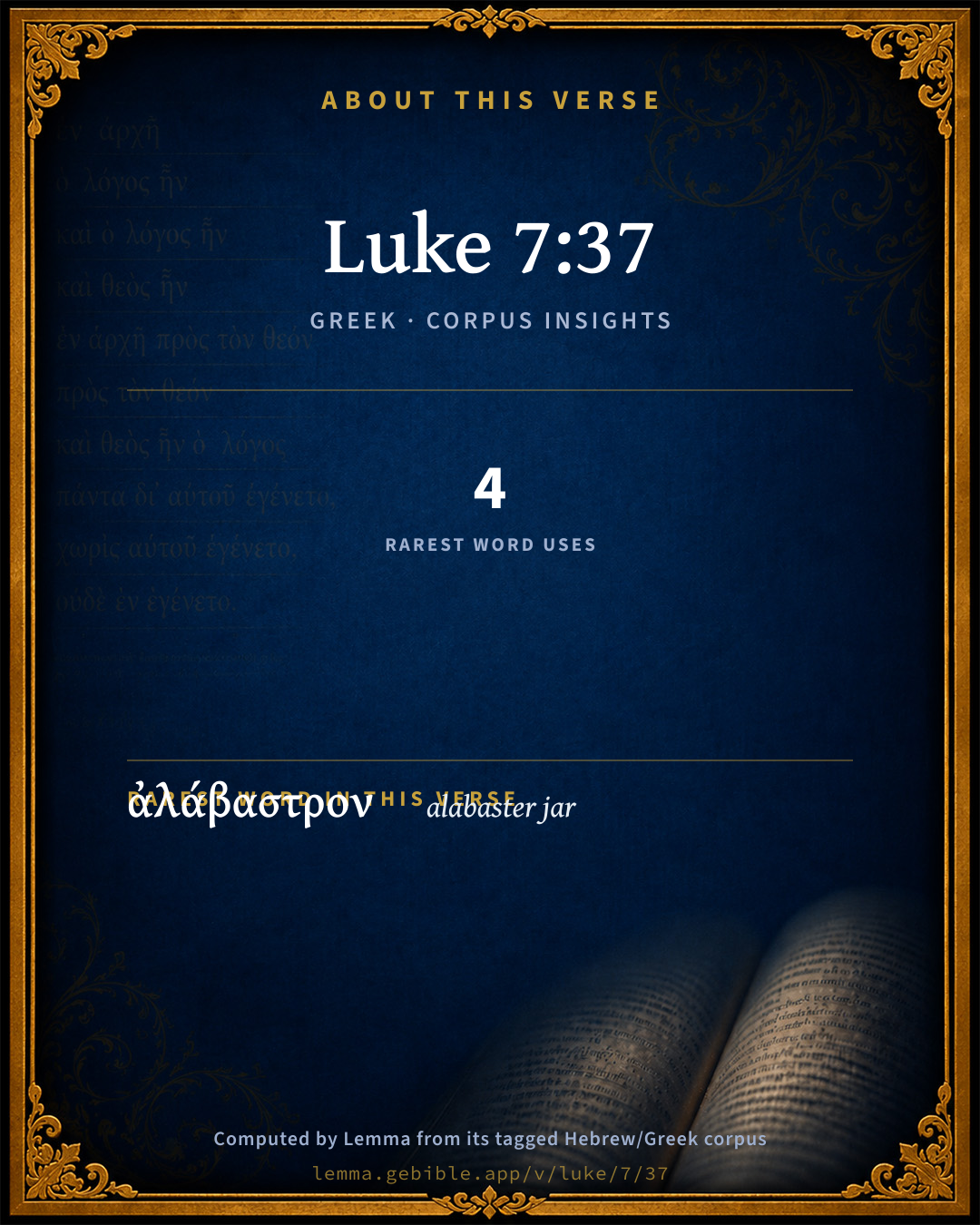
The rarest word here is ἀλάβαστρον alabaster jar G211 — appearing just 4 times in the whole Greek New Testament.

Shared distinctive vocabulary

ἀλάβαστρον alabaster jar G211 occurs in 3 verses of the Greek New Testament. Also found in:

Repetition

Words recur within this verse:

Cross-references

17

Topical passages linked to Luke 7:37 in the Treasury of Scripture Knowledge — connected by theme and wording, ordered by reader-vote popularity; previews shown in the World English Bible.

  • Mark 14:3–9 While he was at Bethany, in the house of Simon the leper, as he sat at the table, a woman came having an alabaster jar of ointment of pure nard-- very costly. She broke the jar, and poured it over his head.
  • Matthew 26:6–13 Now when Jesus was in Bethany, in the house of Simon the leper,
  • Matthew 21:31 Which of the two did the will of his father?" They said to him, "The first." Jesus said to them, "Most assuredly I tell you that the tax collectors and the prostitutes are entering into the Kingdom of God before you.
  • Luke 5:30 Their scribes and the Pharisees murmured against his disciples, saying, "Why do you eat and drink with the tax collectors and sinners?"
  • Luke 7:37–39 Behold, a woman in the city who was a sinner, when she knew that he was reclining in the Pharisee's house, she brought an alabaster jar of ointment.
  • Luke 5:32 I have not come to call the righteous, but sinners to repentance."
  • Luke 18:13 But the tax collector, standing far away, wouldn't even lift up his eyes to heaven, but beat his breast, saying, 'God, be merciful to me, a sinner!'
  • John 12:1–8 Then six days before the Passover, Jesus came to Bethany, where Lazarus was, who had been dead, whom he raised from the dead.
  • 1 Timothy 1:9 as knowing this, that law is not made for a righteous man, but for the lawless and insubordinate, for the ungodly and sinners, for the unholy and profane, for murderers of fathers and murderers of mothers, for manslayers,
  • 1 Peter 4:18 "If it is hard for the righteous to be saved, what will happen to the ungodly and the sinner?"
  • John 11:2 It was that Mary who had anointed the Lord with ointment, and wiped his feet with her hair, whose brother, Lazarus, was sick.
  • Romans 5:8 But God commends his own love toward us, in that while we were yet sinners, Christ died for us.
  • Luke 7:34 The Son of Man has come eating and drinking, and you say, 'Behold, a gluttonous man, and a drunkard; a friend of tax collectors and sinners!'
  • Luke 19:7 When they saw it, they all murmured, saying, "He has gone in to lodge with a man who is a sinner."
  • John 9:24 So they called the man who was blind a second time, and said to him, "Give glory to God. We know that this man is a sinner."
  • John 9:31 We know that God doesn't listen to sinners, but if anyone is a worshipper of God, and does his will, he listens to him.
  • 1 Timothy 1:15 The saying is faithful and worthy of all acceptance, that Christ Jesus came into the world to save sinners; of whom I am chief.

Cross-references courtesy of OpenBible.info (CC BY 4.0).

Commentary

Notes on Luke 7:37 from classic Christian and Jewish commentators (each source and its license shown beneath its notes). The classic Christian expositions comment on the surrounding passage and are grouped to its opening verse, so a note may address several verses; the Jewish commentaries on the Tanakh (Rashi and others) are per-verse, so they appear only where the commentator wrote on this verse.

Lemma curates 59 commentaries, every one of them public domain or Creative Commons licensed, each selected and text-cleaned for this edition rather than reprinted as found. About our sources →

Tyndale Open Study Notes

Tyndale Open Resources

7:37 a certain immoral woman: The implication is that she was a prostitute. • Alabaster is a soft marble—white, yellow, or red—that was often used to make expensive containers like this beautiful . . . jar.

Tyndale Open Study Notes — © Tyndale Open Resources, licensed CC BY-SA 4.0. Text via the HelloAO Bible API.

Bengel's Gnomon

Johann Albrecht Bengel

Luk 7:37. Γυνὴ, a woman) whose name is unknown. [There is certainly a great correspondence between this history and that which Joh 12:3, etc.; Mat 26:6, etc.; and Mar 14:3, etc., record: especially in this respect, that both events happened in the house of a certain Simon. But indeed the anointing described by Luke took place in a city of Galilee, before the transfiguration, nay, even before the second Passover: the other anointing took place at Bethany, six days before the third Passover. The woman in Luke had been heretofore a sinner; Mary had been a different kind of character, Joh 11:1-2 (comp. Luk 7:5). In fine, Simon the Pharisee doubted whether Jesus was a prophet: whereas Simon the leper had no longer any grounds left for doubting, inasmuch as Lazarus, who had been raised to life, was present.—Harm., p. 302.]—ἀμαρτωλὸς, a sinner) Referring to the chief sin which women can commit, unchastity.—καὶ ἐπιγνοῦσα, and having come to know [having learnt]) Καὶ, and, omitted by many, is here a redundant particle;[77] but yet it adds grace to the sentence, as å in ויבחר, 1Ch 28:5. The particle may also seem to have been repeated after a parenthesis [καὶ ἰδοὺ γυνὴ (—) καὶ ἐπιγν.], for the purpose of separating the mention of her sins and of her conversion.—ἐν τῇ οἰκίᾳ, in the house) Love impelled her so, as that she did not expect to find a more convenient place or opportunity for effecting her purpose elsewhere.

[77] ABPΔ Memph. Syr. support it. Rec. Text and Vulg. omit it.—ED. and TRANSL.

Bengel's Gnomon of the New Testament — English translation (T&T Clark, Edinburgh, 1860) — public domain. Text from a community e-Sword module.

Meyer's Critical & Exegetical Commentary

Heinrich August Wilhelm Meyer

Luk_7:37-38. Ἥτις ἦν ἐν τ. πόλει ἁμαρτ.] According to this arrangement (see the critical remarks): who in the city was a sinner: she was in the city a person practising prostitution.[110] See on ἁμαρτωλός in this sense, Wetstein in loc.; Dorvill, ad Char. p. 220. Comp. on Joh_8:7. The woman through the influence of Jesus (it is unknown how; perhaps only by hearing His preaching and by observation of His entire ministry) had attained to repentance and faith, and thereby to moral renewal. Now the most fervent love and reverence of gratitude to her deliverer urge her to show Him outward tokens of these sentiments. She does not speak, but her tears, etc., are more eloquent than speech, and they are understood by Jesus. The imperfect ἦν does not stand for the pluperfect (Kuinoel and others), but Luke narrates from the standpoint of the public opinion, according to which the woman still was (Luk_7:39) what she, and that probably not long before, had been. The view, handed down from ancient times in the Latin Church (see Sepp, L. J. II. p. 281 ff.; Schegg in loc.), and still defended by Lange,[111] to whom therefore the πόλις is Magdala, which identifies the woman with Mary Magdalene (for whose festival the narrative before us is the lesson), and further identifies the latter with the sister of Lazarus, is, though adopted even by Hengstenberg, just as groundless (according to Luk_8:2, moreover, morally inadmissible) as the supposition that the πόλις in the passage before us is Jerusalem (Paulus in his Comment. u. Exeg. Handb.; in his Leben Jesu: Bethany). Nain may be meant, Luk_7:11 (Kuinoel). It is safer to leave it indefinite as the city in which dwelt the Pharisee in question.

ὀπίσω παρὰ τ. πόδ. αὐτ.] According to the well-known, custom at meals, Jesus reclined, with naked feet, and these extended behind Him, at table.

ἤρξατο] vividness of description attained by making conspicuous the first thing done.

τῆς κεφαλῆς] superfluous in itself, but contributing to the vivid picture of the proof of affection.

κατεφίλει] as Mat_26:49. Comp. Polyb. xv. 1. 7 : ἀγεννῶς τοὺς πόδας καταφιλοῖεν τῶν ἐν τῷ συνεδρίῳ. Among the ancients the kissing of the feet was a proof of deep veneration (Kypke, I. p. 242; Dorvill, ad Charit. p. 203), which was manifested especially to Rabbins (Othonius, Lex. p. 233; Wetstein in loc.).

The tears of the woman were those of painful remembrance and of thankful emotion.

[110] Grotius says pertinently: Quid mirum, tales ad Christum confugisse, cum et ad Johannis baptismum venerint? Mat_21:32. Schleiermacher ought not to have explained it away as the sinful woman in the general sense. She had been a πόρνη (Mat_21:31).

[111] Heller follows him in Herzogs Encykl. IX. p. 104.

Meyer — Critical and Exegetical Commentary on the New Testament — English translation by Peter Christie, edited by Frederick Crombie (T&T Clark, 1880) — public domain. Text from a community e-Sword module.

Expositor's Greek Testament

ed. W. Robertson Nicoll

Luk 7:37 . γυνὴ , etc., a woman who was in the city, a sinner. This arrangement of the words ( ἥτις ἦν ἐν τῇ πόλει , W.H [78] ) represents her as a notorious character; how sinning indicated by expressive silence: a harlot. In what city? Various conjectures. Why not Capernaum? She a guest and hearer on occasion of the feast in Levi’s house, and this what came of it! Place the two dinners side by side for an effective contrast. ἐπιγνοῦσα , having learned, either by accident, or by inquiry, or by both combined. ἐν τῇ οἰκίᾳ τ . φ .: the Pharisee again, nota bene! A formidable place for one like her to go to, but what will love not dare?

[78] Westcott and Hort.

The Expositor's Greek Testament, edited by W. Robertson Nicoll (1897–1910) — public domain. Text from a community e-Sword module.

Jamieson, Fausset & Brown

Robert Jamieson, A. R. Fausset & David Brown

CHRIST'S FEET WASHED WITH TEARS. (Luk 7:36-50)

a sinner--one who had led a profligate life. Note.--There is no ground whatever for the popular notion that this woman was Mary Magdalene, nor do we know what her name was. (See on Luk 8:2.)

an alabaster box of ointment--a perfume vessel, in some cases very costly (Joh 12:5). "The ointment has here a peculiar interest, as the offering by a penitent of what had been an accessory in her unhallowed work of sin" [ALFORD].

Jamieson, Fausset & Brown — Commentary Critical and Explanatory on the Whole Bible (1871) — public domain (CC PDM 1.0). Text via the HelloAO Bible API.

Adam Clarke's Commentary

Verse 37. A woman - which was a sinner] Many suppose that this woman had been a notorious public prostitute; but this is taking the subject by the very worst handle. My own opinion is, that she had been a mere heathen who dwelt in this city, (probably Capernaum,) who, through the ministry of Christ, had been before this converted to God, and came now to give this public testimony of her gratitude to her gracious deliverer from the darkness and guilt of sin. I am inclined to think that the original word, αμαρτωλος, is used for heathen or Gentile in several places of the sacred writings. I am fully persuaded that this is its meaning in Mt 9:10-11; Mt 9:13; Mt 11:19; and Mt 26:45. The Son of man is betrayed into the hands of sinners, i.e. is delivered into the hands of the heathens, viz. the Romans, who alone could put him to death. See Mr 2:15-17; Mr 14:41. I think also it has this meaning in Lu 6:32-34; Lu 15:1-2; Lu 15:7; Lu 15:10; Lu 19:7; Joh 9:31. I think no other sense can be justly assigned to it in Ga 2:15: We who are Jews by nature, and not sinners of the Gentiles. We Jews, who have had the benefit of a Divine revelation, know that a man is not justified by the works of the law, but by the faith of Christ, (Ga 2:16), which other nations, who were heathens, not having a Divine revelation, could not know. It is, I think, likely that the grand subject of the self-righteous Pharisee's complaint was her being a heathen. As those who were touched by such contracted a legal defilement, he could not believe that Christ was a conscientious observer of the law, seeing he permitted her to touch him, knowing who she was; or, if he did not know that she was a heathen, it was a proof that he was no prophet, Lu 7:39, and consequently had not the discernment of spirits which prophets were supposed to possess. As the Jews had a law which forbade all iniquity, and they who embraced it being according to its requisitions and their profession saints; and as the Gentiles had no law to restrain evil, nor made any profession of holiness, the term αμαρτωλοι, or sinners, was first with peculiar propriety applied to them, and afterwards to all others, who, though they professed to be under the law, yet lived as Gentiles without the law. Many suppose this person to be the same as Mary Magdalene, but of this there is no solid proof.

Brought an alabaster box] See Clarke on Mr 14:3.

Adam Clarke's Commentary on the Bible (1810–1826) — public domain. Text from a community e-Sword/MySword module.

Ellicott's Commentary for English Readers

(37) A woman in the city, which was a sinner.—The word is clearly used as pointing to the special sin of unchastity. The woman was known in the city as plying there her sinful and hateful calling. The question who she was must be left unanswered. Two answers have, however, been given. (1) The widespread belief that she was Mary Magdalene—shown in the popular application of the term “Magdalen” to a penitent of this class—has absolutely not a single jot or tittle of evidence in Scripture. Nor can there be said to be anything like even a tradition in its favour. The earliest Fathers of the Church are silent. Origen discusses and rejects it. Ambrose, Jerome, and Augustine are doubtful. It first gained general acceptance through the authority of Gregory the Great. The choice of this narrative in the Gospel for the Feast of St. Mary Magdalene stamped it as with the sanction of the Western Church. The omission of that feast from the calendar of the Prayer Book of 1552 shows that the English Reformers at least hesitated, if they did not decide against it. We may note further (a) that if the popular belief were true we should have expected some hint of it on the occurrence of the name of Mary Magdalene in Luk_8:3; (b) that the description given of that Mary, as one out of whom had been cast “seven devils,” though not incompatible with a life of impurity, does not naturally suggest it; (c) that, on the assumption of identity, it is difficult to say when the “devils” had been cast out. Was it before she came with the ointment, or when our Lord spake the words, “Thy sins are forgiven thee?” It is obvious that the conduct of the woman in the Pharisee’s house was very different from the wild frenzy of a demoniac. (2) The belief adopted by some interpreters, and more or less generally received in the Church of Rome, that the woman was none other than Mary the sister of Lazarus, who, on this hypothesis, is identified also with Mary Magdalene, is even more baseless. The inference that when St. John speaks of Mary of Bethany as “that Mary which anointed the Lord with ointment,” must refer to the previous anointing which St. Luke narrates, and not to that which St. John himself records (Joh_12:3), is almost fantastic in its arbitrariness; and it will seem to most minds inconceivable that such a one as the sister of Lazarus, who appears in Luk_10:42 as “having chosen the good part,” could so shortly before have been leading the life of a harlot of the streets. Occurring as the narrative does in St. Luke only, it is probable enough that the “woman which was a sinner” became known to the company of devout women named in Luk_8:1-3, and that the Evangelist derived his knowledge of the facts from them. His reticence—possibly their reticence—as to the name was, under the circumstances, at once natural and considerate.

When she knew that Jesus . . .—The words imply that she had heard of Him—perhaps had listened to Him. She may have heard of His compassion for the widow of Nain in her sorrow. She might have been drawn by the ineffable pity and tenderness of His words and looks. She would show her reverence as she could.

Brought an alabaster box of ointment.—See Note on Mat_26:7. There is not the same stress laid here, as in the anointing by Mary of Bethany, on the preciousness of the ointment; but we may believe that it was relatively as costly. Passages like Pro_7:17, Isa_3:24, suggest the thought that then, as perhaps in all ages, the lavish and luxurious use of perfumes characterised the unhappy class to which the woman belonged. The ointment may have been purchased for far other uses than that to which it was now applied.

A Bible Commentary for English Readers, edited by Charles John Ellicott (1878–1897) — public domain. Text from a community e-Sword module.

The Cambridge Bible for Schools and Colleges

gen. ed. J. J. S. Perowne

37. a woman in the city] The harsher reading of A, B, L, is “who was a sinner in the city.” No city is named, but if the Christian church is right in identifying this woman with Mary Magdalene, we may assume that the city implied is Magdala, which appears at that time to have been a flourishing place, though now it is only a mud village—El Mejdel. It cannot of course be regarded as indisputable that this woman was the Magdaleire, but it is, to say the least, possible; and there is no sufficient reason to disturb the current Christian belief which has been consecrated in so many glorious works of art. See further on Luk_8:2.

which was a sinner] It was the Jewish term for a harlot, and such had come even to John’s baptism, Mat_21:32.

when she knew that Jesus sat at meat] Literally, getting to know. She had not of course received permission to enter, but the prominence of hospitality as the chief of Eastern virtues led to all houses being left open, so that during a meal any one who wished could enter and look on. “To sit down to eat with common people” was one of the six things which no Rabbi or Pupil of the Wise might do; another was “to speak with a woman.” Our Lord freely did both.

an alabaster box] The word alabastron meant originally a vase or phial of alabaster, such as were used for perfumes and unguents (unguenta optime servantur in alabastris, Plin. XIII. 3), but afterwards came to mean any phial used for a similar purpose (just as our box originally meant a receptacle made of box-wood).

of ointment] This was doubtless one of the implements of her guilty condition (Pro_7:17, Isa_3:24), and her willingness to sacrifice it was a sign of her sincere repentance (comp. Son_4:10).

The Cambridge Bible for Schools and Colleges (gen. ed. J. J. S. Perowne; Cambridge University Press, 1878–1918) — public domain. Text from a community e-Sword module.

John Gill's Exposition

There was a certain creditor,.... All the Oriental versions premise something to this. The Syriac version reads, "Jesus said unto him". The Arabic version, "then he said". The Persic version, "Jesus said"; and the Ethiopic version, "and he said to him"; and something of this kind is understood, and to be supplied in the text:

which had two debtors, the one owed five hundred pence, and the other fifty; these were, as the word shows, Roman "denarii" or "pence"; the former of these sums, reckoning a Roman penny at seven pence halfpenny of our money, amounted to fifteen pounds and twelve shillings and six pence; and the latter, to one pound eleven shillings and three pence; the one of these sums was ten times larger, than the other. This is a parable: by "the creditor", God is meant, to whom men owe their beings, and the preservation of them, and all the mercies of life; and are under obligation to obedience and thankfulness: hence: no man can merit any thing of God, or pay off any old debt, by a new act of obedience, since all is due to him: by the "two debtors" are meant, greater and lesser sinners: all sins are debts, and all sinners are debtors; not debtors to sin, for then it would not be criminal, but lawful to commit sin, and God must be pleased with it, which he is not, and men might promise themselves impunity, which they cannot; but they are debtors to fulfil the law, and in case of failure, are bound to the debt of punishment: and of these debtors and debts, some are greater, and others less; not but that they, are all equally sinners in Adam, and equally guilty and corrupted by his transgression; and the same seeds of sin are in the hearts of all men, and all sin is committed against God, and is a breach of his law, and is mortal, or deserving of death, even death eternal; but then as some commands are greater, and others less, so must their transgressions be: sin more immediately committed against God, is greater than that which is committed against our neighbour; and besides, the circumstances of persons and things differ, which more or less aggravate the offence.

John Gill's Exposition of the Whole Bible (1746–1763) — public domain (CC PDM 1.0). Text via the HelloAO Bible API.

Trapp's Complete Commentary

John Trapp

37 And, behold, a woman in the city, which was a sinner, when she knew that Jesus sat at meat in the Pharisee’s house, brought an alabaster box of ointment,

Ver. 37. A woman] Not that woman, say some, mentioned Mat 26:6; Joh 11:2, but some other.

A sinner] A strumpet, a she-sinner, as their mates call such.

John Trapp, A Commentary or Exposition upon All the Books of the Old and New Testament (1647–1656) — public domain. Text from a community e-Sword module.

Albert Barnes' Notes on the Bible

In the city - What city is meant is unknown. Some have supposed it was Nain; some Capernaum; some Magdala; and some Jerusalem.

Which was a sinner - Who was depraved or wicked. This woman, it seems, was known to be a sinner - perhaps an abandoned woman or a prostitute. It is certain that she had much to be forgiven, and she had probably passed her life in crime. There is no evidence that this was the woman commonly called Mary Magdalene.

An alabaster-box ... - See the notes at Mar 14:3.

Albert Barnes' Notes on the Bible (1834–1885) — public domain. Text from a community e-Sword/MySword module.

Matthew Poole's English Annotations

What hath made any interpreters imagine this was the some story which is mentioned Mat 26:6-13; Mar 14:3-9; Joh 12:1-3, I cannot tell. The histories agree scarcely in any thing, unless in the bringing the alabaster box of ointment, and the anointing our Saviour’s feet, whereas there was nothing in those countries more ordinary. That anointing was done in Bethany, within two miles of Jerusalem, this in Galilee. That in the house of one Simon the leper this in the house of one Simon a Pharisee. That a little, this a great while, before our Saviour’s passion. At that Judas was offended, at this Simon the Pharisee was offended. There Christ vindicates the woman from one head of argument, here from another. Questionless this is another quite different piece of history.

And, behold, a woman in the city, which was a sinner; that is, a remarkable sinner; it is a word generally so used, and, applied to women, signifies a prostitute, or at least one of an ill report as to chastity.

Was, refers here to the time past, though lately past; she had lately been infamous and notorious, but it appeareth by what followeth that she was not so now, otherwise than in the opinion and vogue of the people; according to whose opinion, though uncharitable enough, Quae semel fuit mala, semper praesumitur esse mala in eodem genere mali, A person who hath once been bad is always presumed so to be, through their ignorance of the power of Divine grace in changing the heart, or their malice against and envy towards those whose hearts they see so changed. But whatever this woman had been, it seems God had affected her heart with the word which Christ had preached, and filled it with the pure love of God and Christ, instead of its former fullness of impure love, and made her sins as bitter as they had been formerly pleasant to her.

She hearing Christ was eating meat at the house of Simon the Pharisee, makes no noise, but cometh behind him, bringing an alabaster box of ointment, and stood at his feet behind him weeping, and began to wash his feet with her tears, and did wipe them with the hairs of her head, and kissed his feet, and anointed them with the ointment. Weeping in the sense of her sins, and so plentifully as she washed the feet of Christ with her tears, spoke a broken and a contrite heart. Wiping them with her hair; her hair, with which she had offended through wantonness, plaiting it, and adorning herself by the dress of it to allure her lovers, she now useth to testify her abhorrence of her former courses.

And kissed his feet, and anointed them with the ointment. The kiss is a symbol of love, and not of love only, but of subjection and worship; by this she both showed her love to Christ, and also her subjection to him, she kissed Christ in the psalmist’s sense, Psa 2:12. It was not a kiss of love only, but of reverence and subjection, like Joseph’s kiss to Jacob, Gen 50:1, Moses’s kiss to Jethro, Exo 18:7; nay, of the highest reverence, for such was the kiss of the feet. And to testify her adoration of him: thus the idolaters kissed the calves, Hos 13:2, and Baal. 1Ki 19:18. Washing and anointing with oil, was a common compliment they used in those countries for cleansing and cooling the feet. She had been a great sinner, she now shows the profoundest sorrow, greatest love, humility, subjection, &c. But some may say, How could she come behind him, sitting at meat, and do this? While we sit at meat our feet are before us. This confirmeth the notion I mentioned before, in my notes on Mat 26:20, concerning the Jewish manner of sitting at meat, which was kneeling and resting their bodies upon their legs leaning backwards: admitting that, all that we here read of this woman was very easy; for his legs being thrust out backward, the soles of his feet were turned up, and she might with convenience enough come at them behind him to wash, and to wipe, and to anoint them, which it is hard to conceive how she could do, admitting him to have sat as we do, putting our feet forward under the table.

Matthew Poole's English Annotations on the Holy Bible (1683–1685) — public domain. Text from a community e-Sword/MySword module.

Whedon's Commentary on the Bible

Daniel D. Whedon

37. A woman in the city… a sinner—It is not said that her character was notorious through town, or that she was “a woman of the town;” but that, being in town, she heard of the Lord’s also being there, and where he was. Dr. Clarke holds, correctly we think, that the word sinner, here and often elsewhere, signifies heathen or Gentile. The decisive proof-text for this then customary meaning of the word is Gal_2:15, where it was held ritually unclean to eat with sinners, namely, of the Gentiles. The phrase publicans and sinners requires this meaning; otherwise the phrase is a solecism; for the publicans themselves were a class of sinners in the common sense of that term. See Mar_2:15-17; Mar_14:41; Luk_15:1-2; Luk_15:7; Luk_15:10; Luk_19:7; Joh_9:31.

To this woman there evidently belongs a previous history, which Luke presupposes, but does not give. It is plain that the entire argument of Jesus assumes that her love to him was preceded by forgiveness and was caused by it. She must, therefore, at some previous time, have heard with faith the Gospel from his lips; must have felt her condition of sin and ruin; must have repented and experienced the joy and gratitude of conversion. That justification, however, she had felt only by his spirit in her heart; never by announcement from his lips. Hence, when she learns the place of his stay, she hastens, provided with the fragrant token of gratitude, the ointment, to pour forth upon him.

Brought—In the East, the warm climate produces tents and open doors, destroying much of that exclusiveness which reigns in the close houses of more northern latitudes. The meals are often taken in the court, with one side perfectly open. And even in the house, while the company are at table, persons will come in, and, uninvited and unchallenged, take their seat upon the divan or long sofa that lines the walls, and enter freely into conversation with the host and guests at table.

Alabaster box—See note on Mat_26:7.

Daniel D. Whedon (gen. ed.), Commentary on the Old and New Testaments (1874–1909) — public domain. Text from a community e-Sword module.

The Pulpit Commentary

And, behold, a woman in the city, which was a sinner, when she knew that Jesus sat at meat in the Pharisee"s house. The text in the older authorities is more forcible: "a woman which was a sinner in that city." Her miserable way of life would thus be well known to Simon and other of the guests. This sad detail would serve to bring out the contrast in more vivid colours. In these Oriental feasts the houses were often left open, and uninvited strangers frequently passed in through the open courtyard into the guest-chamber, and looked on. She had heard Jesus already, perhaps often, and had drunk in his pleading words, begging sinners to turn and to come to him for peace. Perhaps what had decided her to take this step of boldly seeking out the Master were words apparently spoken about this time (in St. Matthew"s Gospel they follow directly after the discourse respecting the Baptist just related), "Come unto me, all ye that labour and are heavy laden, and I will give you rest," etc. (Mat_11:28-30) It was a bold step for one like her to press uninvited, in broad daylight, into the house of a rigid purist like Simon; but the knowledge that Jesus (though personally, as she thought, she was unknown to him) was there, gave her courage; she felt no one would dare to thrust her out of the presence of the strange loving Master, who so earnestly had bidden the sin-weary come to him, and he would give them rest! Brought an alabaster box of ointment. Pliny mentions alabaster as the best material for pots or vessels intended for these precious ointments. It was softer than marble, and easily scooped into pots or bottles. These costly unguents and cosmetics were much used by the wealthy Roman ladies. The precious ointment poured over the Redeemer"s feet had probably been originally procured for a very different purpose. The word muron , translated "ointment," was used for any kind of sweet-smelling vegetable essence, especially that of the myrtle.

The Pulpit Commentary (1880–1919), ed. H.D.M. Spence-Jones & Joseph S. Exell — public domain. Text from a community e-Sword module.

John Wesley's Explanatory Notes

A woman - Not the same with Mary of Bethany, who anointed him six days before his last passover.

John Wesley, Explanatory Notes Upon the Whole Bible (1754–1765) — public domain. Text via the GEBible commentary corpus.

Scofield Reference Notes

C. I. Scofield

sinner

i.e. in the sense of unchaste.

The Scofield Reference Bible (1917 edition), notes by C. I. Scofield — public domain. Text from a community e-Sword module.

The People's New Testament

B. W. Johnson

37. A woman … a sinner. Evidently an outcast woman. When she knew. She had them heard before of his compassion and tender mercy. She had learned to believe that there was mercy even for her, for whom earth had no mercy. Brought. How could she enter into the banquet chamber? Kitto says: “There were always many people hanging about the court and the outer parts of the guest chamber, which was wholly open in front. A door is a great hindrance to admission into a room, and where that does not exist people easily slip in.”

B. W. Johnson's The People's New Testament with Notes (1889–1891) — public domain. Electronic text from the Christian Classics Ethereal Library (CCEL) ThML edition.

Cambridge Greek Testament for Schools and Colleges

37. ἥτις ἦν ἐν τῇ πόλει ἁμαρτωλός. ‘Who was a sinner in the city.’ No city is named, but if the Christian church is right in identifying this woman with Mary Magdalene, we may assume that the city implied is Magdala, which appears at that time to have been a flourishing place, though now it is only a mud village—El Mejdel. It cannot of course be regarded as indisputable that this woman was the Magdalene, but it is, to say the least, possible; and there is no sufficient reason to disturb the current Christian belief which has been consecrated in so many glorious works of art. See further on Luk 8:2.

ἁμαρτωλός. It was the Jewish term for a harlot, and such had come even to John’s baptism, Mat 21:32. “Accessit ad Dominum immunda ut redeat munda.” St Aug.

ἐπιγνοῦσα. ‘Getting to know.’ She had not of course received permission to enter, but the prominence of hospitality as the chief of Eastern virtues led to all houses being left open, so that during a meal any one who wished could enter and look on. “To sit down to eat with common people” was one of the six things which no Rabbi or Pupil of the Wise might do; another was “to speak with a woman.” Our Lord freely did both.

ἀλάβαστρον. A vase or phial of alabaster, such as were used for perfumes and unguents (unguenta optime servantur in alabastris, Plin. XIII. 3); but afterwards the word came to mean any phial used for a similar purpose (just as our box originally meant a receptacle made of box-wood). The classical form is ἀλάβαστρος, but its heteroclite plural ἀλάβαστρα led to a change in the nom. sing.

μύρου. This was doubtless one of the implements of her guilty condition (Pro 7:17; Isa 3:24), and her willingness to sacrifice it was a sign of her sincere repentance (comp. Son 4:10).

Cambridge Greek Testament for Schools and Colleges (Cambridge University Press, 1896; 21 vols, various authors incl. Carr, Maclear, Plummer, Farrar, Lumby, Moule, M. R. James, Simcox) — public domain. Text from a community e-Sword module.

International Critical Commentary

37. καὶ ἰδοὺ γυνἠ ἥτις ἥν. The opening words imply that her presence created surprise. The ἥτις is stronger than ἥ and has point here: “who was of such a character as to be”: comp. 8:3. This is the right order, and ἐν τῇπόλει follows, not precedes, ητισἧν (א B L Ξ and most Versions). The exact meaning is not quite clear: either, “which was a sinner in the city,” i.e. was known as such in the place itself; or possibly, “which was in the city, a sinner.” The city is probably Capernaum.

ἁμαρτωλός. A person of notoriously bad character, and probably a prostitute: comp. Mat 21:32. For instances of this use of ἁμαρτωλός see Wetst. To the Jews all Gentiles were in a special sense ἁμαρτωλό (6:32, 33, 24:7 ; Gal 2:15; Gal_1 Mac. 2:44 );but something more than this is evidently meant here. The ἦν need not be pressed to mean, “She was even up to this time” (Alf.); nor does accessit ad Dominum immunda, ut rediret munda (Aug.) imply this. The ἦν expresses her public character: ἦν ἐν τῇπόλει. She had repented (perhaps quite recently, and in consequence of Christ’s teaching); but the general opinion of her remained unchanged. Her venturing to enter a Pharisee’s house in spite of this shows great courage. In the East at the present day the intrusion of uninvited persons is not uncommon (Trench, Parables, p. 302 n.; Tristram, Eastern Customs in Bible Lands, p. 36). Mary of Bethany was not an intruder. Note the idiomatic pres. κατακεῖται: just equivalent to our “He is dining with me to-day,” meaning that he will do so.

ἀλάβαστρου. Unguent-boxes or phials were called ἀλάβαστρα even when not made of alabaster. But unguenta optime servantur in alabastris (Plin. N. H. xiii. 3, xxxvi. 12; comp. Hdt. iii. 20, 1). See Wetst. on Mat 26:6.

The word is of all three genders in different writers; but in class Grk the sing. is ἀλάβαστρος, either masc. or fem. The origin of μύρον is unknown, μύρω, μύρρα σμύρνα, μύρτος being conjectures. In N.T. certainly, and probably in LXX also, μύρον, “ointment,” is distinguished from ἔλαιον, “oil.” Trench, Syn. xxxviii.

International Critical Commentary — older volumes (1896–1929), various authors — public domain. Text from a community e-Sword module.

Vincent's Word Studies in the New Testament

Marvin R. Vincent

A woman who [ητις] . Of that class which was, etc.

A sinner. Wyc., a sinneress. Her presence there is explained by the Oriental custom of strangers passing in and out of a house during a meal to see and converse with the guests. Trench cites a description of a dinner at a consul's house in Damietta. "Many came in and took their places on the side - seats, uninvited and yet unchallenged. They spoke to those at table on business or the news of the day, and our host spoke freely to them" (" Parables "). Bernard beautifully says : "Thanks to thee, most blessed sinner : thou hast shown the world a safe enough place for sinners - the feet of Jesus, which spurn none, reject none, repel none, and receive and admit all. Where alone the Pharisee vents not his haughtiness, there surely the Ethiopian changes his skin, and the leopard his spots" (cit. by Trench, " Parables ").

Sat [κατακειται] . Lit., is reclining at meat : a lively change to the present tense.

Alabaster. See on Mt 26:7.

Marvin R. Vincent, Word Studies in the New Testament (1887–1900) — public domain. Text from a community e-Sword/MySword module.

Lesson kit

Teaching starters — assembled from the data on this page, not authored interpretation. Every prompt links to the verse data it draws on. Edit before teaching.

Luke, in the Gospels, opens this verse with 21 words (17 distinct Greek lemmas). Its most distinctive word is alábastron (“alabaster jar”). A historical commentator’s framing appears above. Read the whole chapter for the surrounding context.

Discussion questions

  1. What does “alabaster jar” (alábastron) contribute to the verse as a whole?
  2. Matthew 26:7 shares the word «alabaster jar» with this verse. How do the two illuminate each other?
  3. “the” occurs 3× in this one verse. What is the effect of the repetition?
  4. These translations render this verse differently. What is at stake in choosing one wording over another?
  5. Reading how Tyndale Open Study Notes and Bengel's Gnomon read this verse, where do the two commentators agree and where do they part?

Things to notice

Reading settings

Reading text

Shown beneath each verse's original-language words.

Old Testament
Old Testament edition

Read the OT as the Masoretic Hebrew (MT) or the Greek Septuagint (LXX).

English shown for the Greek Septuagint (in the Hebrew ↔ Greek comparison).

Comparing translations? Open the Compare panel on any verse page to stack up to four side by side.