Titus 1:6

Greek (Tischendorf 8th ed.) Titus 1:6 appears in the Greek New Testament. The text above is from the Tischendorf 8th edition. Each word links to its Strong’s number and a concise gloss. Click any word for its full Thayer’s Greek Lexicon entry.
Download image
Cite this verse

Titus 1:6 (World English Bible). Public Domain. Lemma interlinear Bible study tool, https://lemma.gebible.app/v/titus/1/6.

Show BibTeX & RIS
BibTeX
RIS
English Translation
if anyone is blameless, the husband of one wife, having children who believe, who are not accused of loose or unruly behavior.
World English Bible · Public Domain
Download a study sheet

One document with this verse’s original text, its word-by-word gloss line, the meaning frame, cross-references with their text, attributed commentary, and full source and license credits — printable, and it pastes into notes with its structure intact.

This verse Autodidact and up

Study sheet (.html) Plain text (.txt)

A passage Seminary Student

Up to 50 verses in one chapter. A passage sheet keeps up to 6 commentary sources and 12 cross-references per verse, in the order this page ranks them, and says so on the sheet whenever that leaves anything out. Ask for a single verse and you get the Autodidact verse sheet above.

Everything on this page stays free to read, with no account — the sheet is a download of what is already on screen, not access to it.

Want to remove ads? Support Godless Engineer
Compare translations 3

The same verse in 3 English versions, stacked beneath the original-language interlinear above. Click any original word for its lexicon entry.

Each is an independent rendering of the whole verse — the interlinear is not word-aligned to these translations.

Highlighted words mark where these versions differ — a whole-verse word diff, not a word-by-word alignment.

  • World English Bible Public Domain
    if anyone is blameless, the husband of one wife, having children who believe, who are not accused of loose or unruly behavior.
  • King James Version Public Domain
    If any be blameless, the husband of one wife, having faithful children not accused of riot or unruly.
  • unfoldingWord Literal Text CC BY-SA 4.0
    if anyone is blameless, a husband of one wife, having faithful children not accused of reckless behavior or rebellion.

unfoldingWord Literal Text — © unfoldingWord, licensed CC BY-SA 4.0. Word-aligned USFM3 via Door43 (git.door43.org/unfoldingWord/en_ult).

Versions to compare (up to 4)

3 of 4 selected

Show all 19 translations

Every available English version of this verse, each an independent rendering of the whole verse.

  • World English Bible Public Domain
    if anyone is blameless, the husband of one wife, having children who believe, who are not accused of loose or unruly behavior.
  • Berean Standard Bible Public Domain
    An elder must be blameless, the husband of but one wife, having children who are believers and who are not open to accusation of indiscretion or insubordination.
  • Majority Standard Bible Public Domain
    An elder must be blameless, the husband of but one wife, having children who are believers and who are not open to accusation of indiscretion or insubordination.
  • King James Version Public Domain
    If any be blameless, the husband of one wife, having faithful children not accused of riot or unruly.
  • American Standard Version (1901) Public Domain
    if any man is blameless, the husband of one wife, having children that believe, who are not accused of riot or unruly.
  • Revised Version (1885) Public Domain
    if any man is blameless, the husband of one wife, having children that believe, who are not accused of riot or unruly.
  • Geneva Bible (1599) Public Domain
    If any be vnreproueable, the husband of one wife, hauing faithfull children, which are not slandered of riot, neither are disobedient.
  • Douay-Rheims (1899) Public Domain
    If any be without crime, the husband of one wife, having faithful children, not accused of riot, or unruly.
  • Young's Literal Translation Public Domain
    if any one is blameless, of one wife a husband, having children stedfast, not under accusation of riotous living or insubordinate --
  • Literal Standard Version CC BY-SA 4.0
    if anyone is blameless, a husband of one wife, having believing children, not under accusation of riotous living or insubordinate—
  • Unlocked Literal Bible CC BY-SA 4.0
    An elder must be without blame, the husband of one wife, with faithful children who do not have the reputation of being reckless or undisciplined.
  • unfoldingWord Literal Text CC BY-SA 4.0
    if anyone is blameless, a husband of one wife, having faithful children not accused of reckless behavior or rebellion.
  • Darby Bible Public Domain
    if any one be free from all charge [against him], husband of one wife, having believing children not accused of excess or unruly.
  • World Messianic Bible Public Domain
    if anyone is blameless, the husband of one wife, having children who believe, who are not accused of loose or unruly behavior.
  • Webster's Bible Public Domain
    If any is blameless, the husband of one wife, having faithful children, not accused of riot, or disorderly.
  • Free Bible Version CC BY-SA 4.0
    An elder must have a good reputation, the husband of one wife, and have children who believe and who are not accused of being wild or disobedient.
  • Bible in Basic English Public Domain
    Men having a good record, husbands of one wife, whose children are of the faith, children of whom it may not be said that they are given to loose living or are uncontrolled.
  • Text-Critical English NT CC BY 4.0
    An elder must be above reproach, the husband of one wife, with faithful children who are not rebellious and cannot be accused of debauchery.
  • Tyndale New Testament (1534) Public Domain
    Yf eny be fautelesse the husbande of one wyfe havynge faythfull childre which are not selandred of royote nether are disobedient.

Literal Standard Version (2020), Covenant Press — licensed CC BY-SA 4.0. Text via the HelloAO Bible API (eBible.org). Unlocked Literal Bible (unfoldingWord) — licensed CC BY-SA 4.0. Text via the HelloAO Bible API (eBible.org). unfoldingWord Literal Text — © unfoldingWord, licensed CC BY-SA 4.0. Word-aligned USFM3 via Door43 (git.door43.org/unfoldingWord/en_ult). Free Bible Version, Dr. Jonathan Gallagher — licensed CC BY-SA 4.0. Text via the HelloAO Bible API (eBible.org).

Word by word

More ways to search: Search by grammar → Find every occurrence → Compare this word →

Practice this passage: Drill this verse → Learn its vocabulary →

κατηγορίᾳ
katēgoría
G2724
“accusation”
Noun, Dative, Singular, Feminine
Part of Speech
Noun
Case
Dative
Number
Singular
Gender
Feminine
Full Thayer's Definition

Origin: from G2725

TDNT: 13:37,4

1. accusation, charge
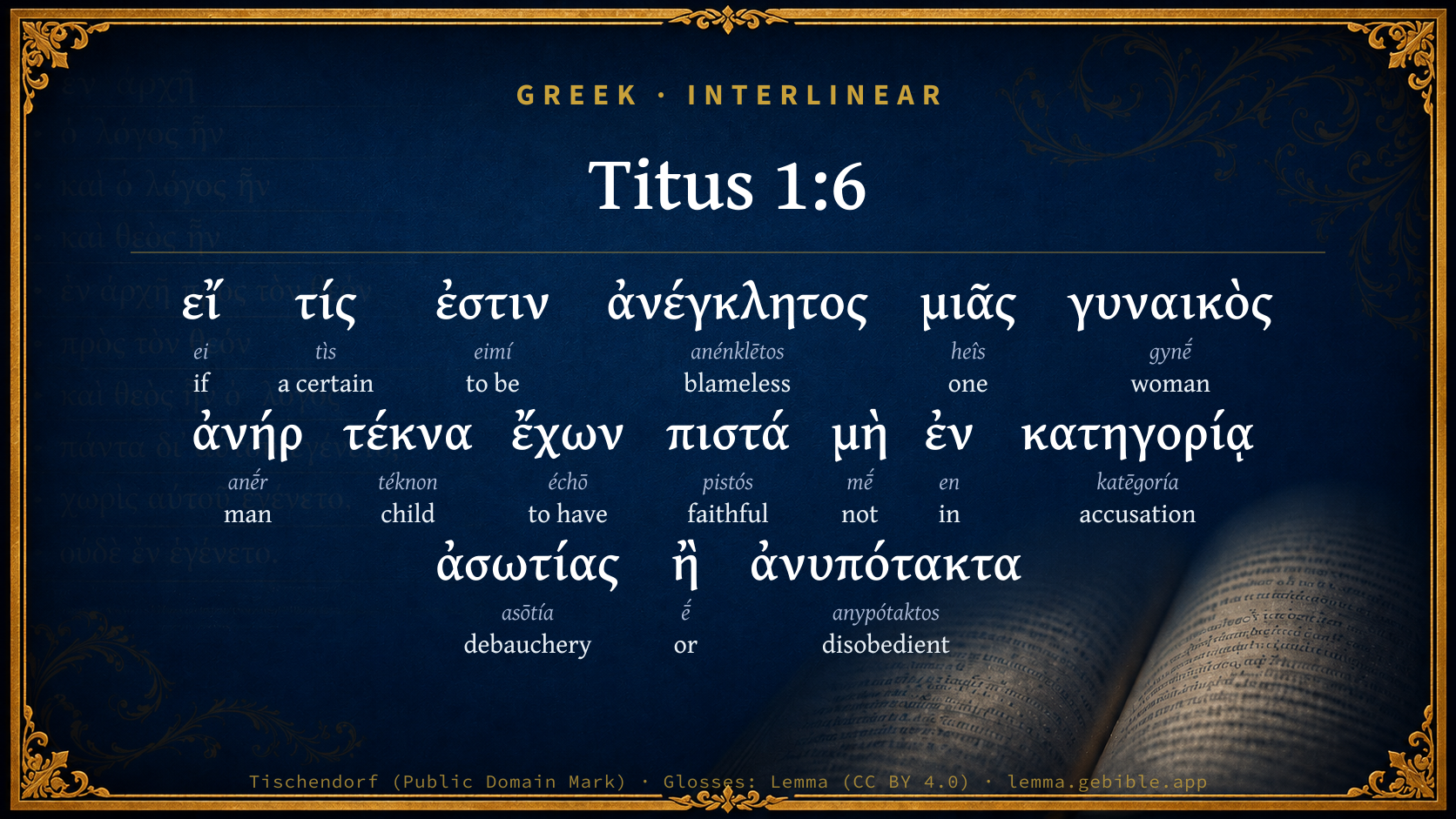
  1. εἴ ei G1487 “if” Conditional
  2. τίς tìs G5100 “a certain” Indefinite pronoun, Nominative, Singular, Masculine
  3. ἐστιν eimí G1510 “to be” Verb, Present, Active, Indicative, 3rd person, Singular
  4. ἀνέγκλητος anénklētos G410 “blameless” Adjective, Nominative, Singular, Masculine
  5. μιᾶς heîs G1520 “one” Adjective, Genitive, Singular, Feminine
  6. γυναικὸς gynḗ G1135 “woman” Noun, Genitive, Singular, Feminine
  7. ἀνήρ anḗr G435 “man” Noun, Nominative, Singular, Masculine
  8. τέκνα téknon G5043 “child” Noun, Accusative, Plural, Neuter
  9. ἔχων échō G2192 “to have” Verb, Present, Active, Participle, Nominative, Singular, Masculine
  10. πιστά pistós G4103 “faithful” Adjective, Accusative, Plural, Neuter
  11. μὴ mḗ G3361 “not” Particle, Negative
  12. ἐν en G1722 “in” Preposition
  13. ἀσωτίας asōtía G810 “debauchery” Noun, Genitive, Singular, Feminine
  14. ἢ ḗ G2228 “or” Particle
  15. ἀνυπότακτα anypótaktos G506 “disobedient” Adjective, Accusative, Plural, Neuter

About this verse

These counts appear in no published source. They are computed here, from the morphology-tagged text and Lemma’s own curated glosses. What Lemma adds →

16
words
16
distinct lemmas
Pauline Epistles
section

Notable vocabulary

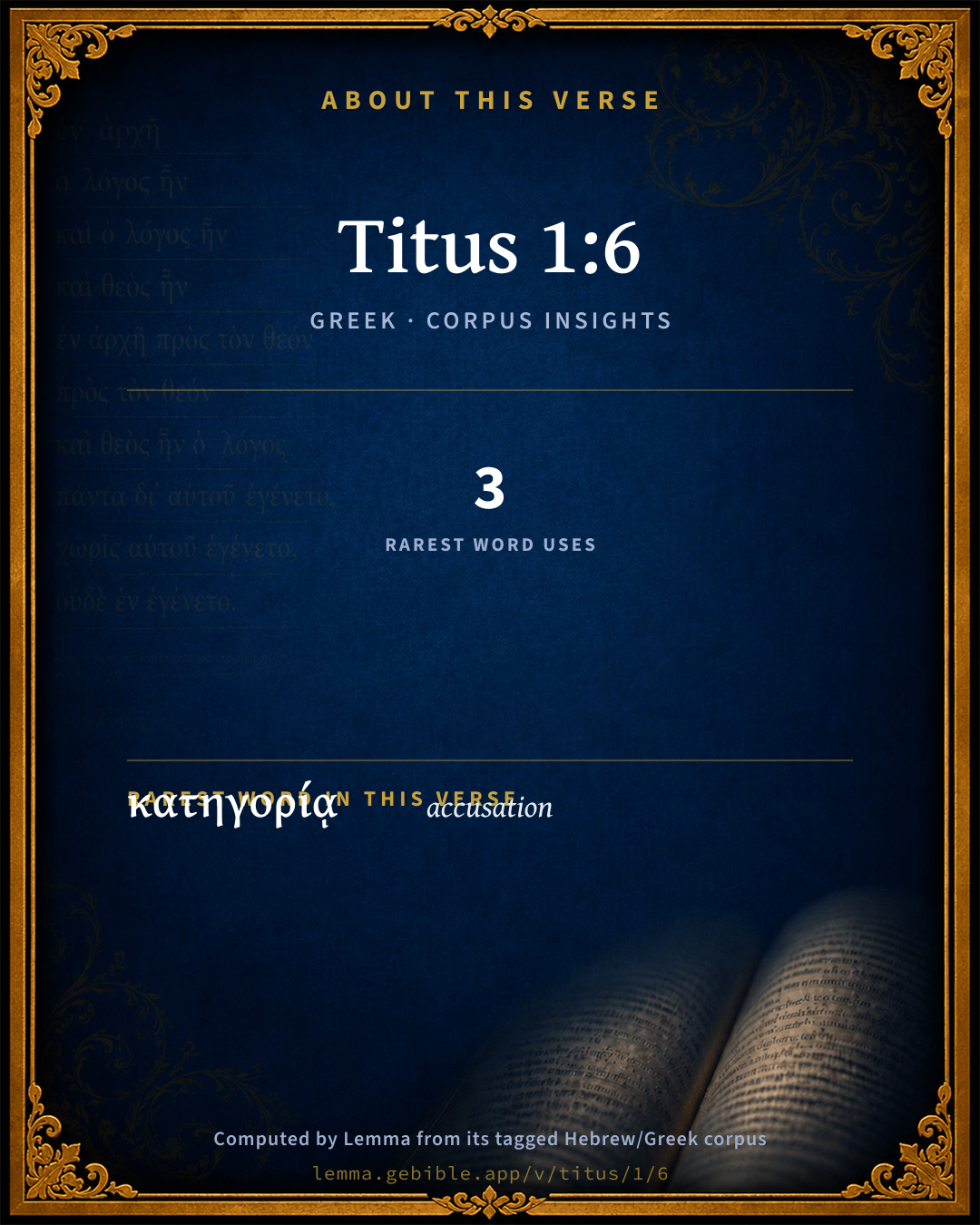
The rarest word here is κατηγορίᾳ accusation G2724 — appearing just 3 times in the whole Greek New Testament.

Shared distinctive vocabulary

κατηγορίᾳ accusation G2724 occurs in 3 verses of the Greek New Testament. Also found in:

Cross-references

17

Topical passages linked to Titus 1:6 in the Treasury of Scripture Knowledge — connected by theme and wording, ordered by reader-vote popularity; previews shown in the World English Bible.

  • 1 Timothy 3:2–7 The overseer therefore must be without reproach, the husband of one wife, temperate, sensible, modest, hospitable, good at teaching;
  • 1 Timothy 3:12 Let deacons be husbands of one wife, ruling their children and their own houses well.
  • Proverbs 28:7 Whoever keeps the law is a wise son; But he who is a companion of gluttons shames his father.
  • Titus 1:6–8 if anyone is blameless, the husband of one wife, having children who believe, who are not accused of loose or unruly behavior.
  • Genesis 18:19 For I have known him, to the end that he may command his children and his household after him, that they may keep the way of Yahweh, to do righteousness and justice; to the end that Yahweh may bring on Abraham that which he has spoken of him."
  • Ephesians 5:18 Don't be drunken with wine, in which is dissipation, but be filled with the Spirit,
  • Leviticus 21:7 "'They shall not marry a woman who is a prostitute, or profane; neither shall they marry a woman divorced from her husband: for he is holy to his God.
  • Leviticus 21:14 A widow, or one divorced, or a woman who has been defiled, or a prostitute, these he shall not marry: but a virgin of his own people shall he take as a wife.
  • 1 Samuel 2:11 Elkanah went to Ramah to his house. The child did minister to Yahweh before Eli the priest.
  • 1 Samuel 2:22 Now Eli was very old; and he heard all that his sons did to all Israel, and how that they lay with the women who served at the door of the tent of meeting.
  • 1 Samuel 2:29–30 Why kick you at my sacrifice and at my offering, which I have commanded in [my] habitation, and honor your sons above me, to make yourselves fat with the best of all the offerings of Israel my people?
  • 1 Samuel 3:12–13 In that day I will perform against Eli all that I have spoken concerning his house, from the beginning even to the end.
  • Ezekiel 44:22 Neither shall they take for their wives a widow, nor her who is put away; but they shall take virgins of the seed of the house of Israel, or a widow who is the widow of a priest.
  • Malachi 2:15 Did he not make one, although he had the residue of the Spirit? Why one? He sought a godly seed. Therefore take heed to your spirit, and let none deal treacherously against the wife of his youth.
  • 1 Thessalonians 5:14 We exhort you, brothers, admonish the disorderly, encourage the fainthearted, support the weak, be patient toward all.
  • Titus 1:10 For there are also many unruly men, vain talkers and deceivers, especially those of the circumcision,
  • Luke 1:5 There was in the days of Herod, the king of Judea, a certain priest named Zacharias, of the priestly division of Abijah. He had a wife of the daughters of Aaron, and her name was Elizabeth.

Cross-references courtesy of OpenBible.info (CC BY 4.0).

Commentary

Notes on Titus 1:6 from classic Christian and Jewish commentators (each source and its license shown beneath its notes). The classic Christian expositions comment on the surrounding passage and are grouped to its opening verse, so a note may address several verses; the Jewish commentaries on the Tanakh (Rashi and others) are per-verse, so they appear only where the commentator wrote on this verse.

Lemma curates 59 commentaries, every one of them public domain or Creative Commons licensed, each selected and text-cleaned for this edition rather than reprinted as found. About our sources →

Albert Barnes' Notes on the Bible

If any be blameless, the husband of one wife - See the notes at 1Ti 3:2.

Having faithful children - See the notes at 1Ti 3:4-5. That is, having a family well-governed, and well-trained in religion. The word here - πιστὰ pista - applied to the children, and rendered faithful, does not necessarily mean that they should be truly pious, but it is descriptive of those who had been well-trained, and were in due subordination. If a man’s family were not of his character - if his children were insubordinate, and opposed to religion - if they were decided infidels or scoffers, it would show that there was such a deficiency in the head of the family that he could not be safely entrusted with the government of the church; compare the notes at 1Ti 3:5. It is probably true, also, that the preachers at that time would be selected, as far as practicable, from those whose families were all Christians. There might be great impropriety in placing a man over a church, a part of whose family were Jews or heathens.

Not accused of riot - That is, whose children were not accused of riot. This explains what is meant by faithful. The word rendered “riot” - ἀσωτία asōtia - is translated excess in Eph 5:18, and riot in Tit 1:6; 1Pe 4:4. It does not elsewhere occur in the New Testament, though the word riotous is found in Luk 15:13; see it explained in the notes at Eph 5:18. The meaning here is, that they should not be justly accused of this; this should not be their character. It would, doubtless, be a good reason now why a man should not be ordained to the ministry that he had a dissipated and disorderly family.

Or unruly - Insubordinate; ungoverned; see the notes, 1Ti 1:9; Luk 3:4.

Albert Barnes' Notes on the Bible (1834–1885) — public domain. Text from a community e-Sword/MySword module.

The Biblical Illustrator

Joseph S. Exell

Tit_1:6

If any be blameless

Lessons

I.

Character, the primary qualification for office is the church.

II. Domestic and social relationships, conducive, rather than hindrances, to christian service.

III. Good family government, a guarantee for church government. (F. Wagstaff.)

A man of scandalous life is unfit to be a minister

1. Our apostle here first insisteth upon the life of him that is to be chosen, and afterwards requireth his fitness for doctrine: and so in his charge to Timothy that he should lay hand on no man rashly, addeth, that some mens sins go beforehand, and some mens sins follow after judgment: as though he had said more largely, Use all the circumspection thou canst, yet some hypocrites will creep into the ministry. Some are inwardly profane, and such close sinners thou canst not discern, till afterward they manifest themselves. Others are open sinners, of which thou mayest judge aright; these latter thou art to hinder, the former reclaim, or seasonably remove, and so salve up the sore again: for how requisite is it that such a sweet and favourite doctrine should be matched with a sweet and savoury Christian conversation!

2. That such an high calling is to be graced with an unreprovable life was typified in the law sundry ways, as after we shall more clearly see in the positive virtues required, especially in that prohibition that none of Aarons sons, or seed, that had any blemish in him, might once press to offer before the Lord, neither come near the vail, nor stand by the altar.

3. A scandalous and obnoxious person shall never do good in his calling. For although the things of Christ, as the Word, sacraments, and doctrine, depend not upon the person of the minister, but on the ordinance of Christ, neither in themselves are the worse in bad mens hands, no more than a true mans piece of gold in the hands of a thief; yet by our weakness, in such a mans hand, they are weaker to us: and although no man can answer or warrant the refusing of pure doctrine (which is not to be had in respect of persons) for the spotted life of the minister, who, while he sitteth in Mosess chair (be he Pharisee, be he hypocrite) must be heard, yet can it not be but that the wickedness of Elis sons will make the people abhor the offerings of the Lord, which what a grievous sin it was before the Lord (see 1Sa_2:17). Again, how can he benefit his people whose hands are bound, whose mouth is shut, and cannot utter the truth without continual galling and sentencing of himself? and when every scoffer shall be ready to say to him, Art thou become weak like one of us? and the word shall be still returned upon himself, how can it be expected that he should do good amongst them?

4. It is a most dangerous condition to himself to be a good teacher of a bad life, for such a one is in the snare of the devil, that is, when he seeth his life still more and more exprobrated, and himself more despised every day than other (for it is just with God that with the wicked should be reproach), then he begins to grow so bold and impudent, as that he casts off all shame and care, and as one desperate and hardened in sin, prostituteth himself remorselessly unto all lewdness and ungodly conversation. (T. Taylor, D. D.)

Rules to keep a man unreprovable

1. Labour with thy heart to see itself still in the presence of God, and this wilt be a means to keep it in order; whores otherwise an unruly heart will break out one time or other.

2. Have a care of a good name, as well as a good conscience; not so much for thy own as for Gods glory: neither because thyself, but ethers stand much upon it.

3. Avoid occasions of sins, appearances of evil, seeing thy motes become beams.

4. Study to do thy own duty diligently, meddle not with other mens matters.

5. Curb and cover thine own infirmities, buffet thy body, and bring it in subjection (1Co_9:1-27).

6. Daily pray for thyself, with a desire of the prayer and admonition of others. (T. Taylor, D. D.)

Importance of good ministerial character

Personal character is of the utmost moment in the work of admonition. We must not try to remove motes from the eyes of others while we have beams in our own. Quarles reminds us that He who cleanses a blot with blurred fingers, makes a greater blot. Even the candle snuffers of the sanctuary were of pure gold (Exo_37:23). We may not urge others to activity, and lie still like logs ourselves. A quaint old preacher of the sixteenth century has put this truth into homely, pungent words: Beloved in our Lord and Saviour Jesus Christ, it is a very monstrous thing that any man should have more tongues than hands. For God hath given us two hands and but one tongue, that we might do much and say but little. Yet many say so much and do so little, as though they had two tongues and but one hand; nay, three tongues and never a hand. Such as these (which do either worse than they teach, or else less than they teach, teaching others to do well and to do much, but doing no whir themselves) may be resembled to divers things. To a whetstone, which being blunt itself, makes a knife sharp. To a painter, which being deformed himself, makes a fair picture. To a sign, which being weather beaten, and hanging without itself, directs passengers into the inn. To a bell, which being deaf and hearing not itself, calls the people into the church to hear. To a goldsmith, which being beggarly, and having not one piece of plate to use himself, hath stores for others which he shows and sells in his shop. Lastly, to a ridiculous actor in the city of Smyrna, who pronouncing O coelum, O heaven, pointed with his finger toward the ground. Such are all they which talk one thing and do another; which teach well and do ill. (C.H. Spurgeon.)

The secret of a blameless life

Archbishop Beusou, speaking after Earl Granville had unveiled the memorial to his predecessor, adorned the occasion by a reference to the secret of the beautiful life of the late Archbishop Tate. I have heard, he said, and I believe it is true, that on the first day of his wedded life he and his bride pledged themselves to each other that they would never quarrel with any one, and I believe that, with Gods blessing and help, that pledge was kept to the end. Husband of one wife:--In the corrupt facility of divorce allowed both by Greek and Roman law, it was very common for man and wife to separate, and marry other parties during the life of each other. Thus, a man might have three or four living wives, or women who had successively been his wives. An example of this may be found in the English colony of Mauritius, where the French revolutionary law of divorce had been left unrepealed by the English Government; and it is not uncommon to meet in society three or four women who have all been wives of one man, and three or four men who have all been husbands of one woman. Thus, successive rather than simultaneous polygamy is perhaps forbidden here, (Conybeare and Howson.)

The husband of one wife

The family arrangements in the Isle of Crete were the result of heathenism, and, of course, polygamy had prevailed. Many believers had several wives, as is often the case in heathenism at the present time, and one of the most difficult questions of modern missions is how to treat such cases. When a man and his two wives, for example, all at the same time become Christians, and demand baptism and the Lords supper, what am I to do? There is no passage that I know of in the Word of God to guide me in the matter; and I am left to the general rules of Scripture, to the dictates of wisdom and prudence, and to the leadings of Divine Providence. If, however, such a man wished to become an elder, I would say, No, for a bishop must be blameless, the husband of one wife, and not of two wives, according to the decision of the apostle Paul (W. Graham, D. D.)

The Biblical Illustrator, edited by Joseph S. Exell (c. 1880s–1900s) — public domain. Text from a community e-Sword module.

Joseph Benson's Commentary

Tit 1:6-9. If any be blameless — As to his conduct, shunning the appearance of evil, and walking in all the ordinances and commandments of God; the husband of one wife — See on 1Ti 3:2; having faithful, or believing children — As τεκνα πιστα may be properly rendered; that is, not infidels, but such as embrace the Christian faith; not accused of riot — Ασωτιαστυ of luxury, or intemperance; or unruly — Ανυποτακτα, refractory or disobedient. The apostle required that the children of the person who was to be ordained an elder should be believers in Christ, and of a sober, exemplary behaviour, because the infidelity and vices of children never fail to reflect some blame on their parents. And the children of ministers ought certainly, from that consideration, as well as in order to the salvation of their own souls, carefully to avoid every irregularity, and even impropriety of conduct. For a bishop — Or elder, as he is called, Tit 1:5; must be blameless — In order to his being useful; as the steward of God — One intrusted by God with the care of immortal souls, and with the dispensation of the mysteries of the gospel; not self- willed — Αυθαδη, literally, pleasing himself; but all men for their good to edification; not soon angry — Or easily provoked: as οργιλον means; not given to wine, &c. — See on 1Ti 3:2-7; sober — Or prudent: as σωφρονα may be properly rendered. It implies, especially, the proper government of our angry passions; so that on all occasions we behave with prudence; temperate — In the use of every sensual pleasure; one who has so the command of himself that he keeps all his appetites under due restraint. Holding fast the faithful word — That is, the word of the truth of the gospel. There is a great beauty, says Macknight, in the word αντεχομενον, as here used. It signifies the holding fast the true doctrine, in opposition to those who would wrest it from us; as he hath been taught — Κατα την διδαχην, according to the teaching, namely, of the apostles; that by sound, or salutary doctrine, he may be able both to exhort — Believers to zeal and diligence in the performance of their duty; and to convince gainsayers — Those that oppose the truth, of their errors and sins.

Joseph Benson's Commentary on the Old and New Testaments (1811–1818) — public domain. Text from a community e-Sword module.

Fairbairn on Ezekiel, Jonah & the Pastoral Epistles

Patrick Fairbairn

Ver. 6. If any one is blameless—that is, such an one only as is blameless—husband of one wife, having faithful children, not accused of profligacy (lit. not in accusation of it, in a position that such accusation could be brought), or unruly. The qualifications have already been considered at 1Ti 3:2 sq.

Appendix B—Page 139. On the Meaning of the Expression “Husband of One Wife,” in 1Ti 3:2; 1Ti 3:12, Tit 1:6

The explanation given of this expression, under the first of the passages referred to, restricts the qualification indicated by it to an existing relationship, irrespective of the question whether a previous relationship mayor may not have existed, which had been dissolved by death. It simply required that when one was called to office in the Christian church, there should be but one living woman to whom he stood related as husband. And as the expression of itself does not import more there are various considerations which appear to shut us up to this meaning as the only one that is properly tenable.

1. First of all, let the place be noted which the qualification holds in the apostle’s delineation of fitness for office in the Christian church. In both the epistles (1 Timothy and Titus) it stands second in the list of qualifications for the pastorate,—in each also occurring immediately after the epithet blameless or irreproachable,—as if, among the characteristics of a life free from any palpable stain, the first thing that might be expected to start into notice was, whether the individual stood related in marriage to one person only, or to more than one. Now, supposing this latter alternative had respect merely to the contracting of a second marriage after the death of a first wife, is the qualification one that, in the circumstances, we could imagine to have been so prominently exhibited, and so stringently imposed? Or is it what we have reason to think would have been borne up by the moral sense of the community? Quite the reverse in both respects. The legislation and the practice of Old Testament times were notoriously of a different kind. They went to an extreme, indeed, in the opposite direction; and even our Lord, when correcting that extreme, gave no indication of His purpose to introduce a restriction of the nature in question, or to make monogamy, in this sense, a condition either of office or of sanctity. St. Paul himself had explicitly declared, in his earlier writings, that death dissolved the marriage tie, so as to leave the survivor free to enter into another union, if such might be deemed advisable or expedient (Rom 7:1-3; 1Co 7:8-9). And in the laws and usages of the Greeks and Romans no hindrance was ever known to be put upon men in respect to their use of this freedom; no stigma attached to their doing so, unless it might be in connection with the time and mode of their going about it. Such being the case, is it in the least degree probable, or does it seem to accord with the wisdom we are wont to associate with the apostle (apart altogether from his inspiration), that he should now, for the first time, and in so brief and peremptory a manner, without even a note of explanation, have pronounced more than a single marriage-union absolutely incompatible with the ministerial function?—nay, should have set it in the very front of admitted disqualifications?—and should even have extended the rule to deacons, whose employment was rather about, than in, spiritual things, serving tables, not ministering in word and doctrine? Unquestionably, if such were the import of the apostle’s instruction, a new thing was now introduced into the discipline of God’s house, and introduced in a very extraordinary way. A principle of sanctity was enunciated which was without warrant in any prior legislation or recognised usage; a principle, moreover, which, in contrariety to the whole spirit of the apostle’s writings, must have given to caste distinctions and ascetic notions of excellence a legitimate footing in the church of Christ. In point of fact, when the sense we contend against began to be put upon his words, it did work powerfully both in the ritualistic and the ascetic direction. And if that sense could be established as the natural and proper one, a difficulty of a very formidable kind would be raised against the Pauline authorship of the Pastoral epistles.

2. A second ground of confirmation to the view we advocate is the general concurrence in its favour on the part of the earlier interpreters; and this in spite of a prevalent feeling and usage tending to produce a bias in the contrary direction. Thus Chrysostom: “He (St. Paul) speaks thus, not imposing a law, as if it were not allowed one to become [an episcopos] without this condition [viz. unless he had one wife], but to restrain undue licence (τὴν ἀμετρίαν κωλύων); since among the Jews it was lawful to enter into double marriages, and have two wives at the same time.” (His comment on Tit 1:6, though less explicit, is to the same effect when rightly interpreted. It speaks merely of a double marriage relationship as incompatible with the pastoral office: “chastising the wanton, and not permitting them with a second (or twofold) marriage to assume the governing power,”—οὐκ ἀφεὶς ματὰ δευτέρου γάμου τὴν ἀρχὴν ἐγχειρίζεσθαι,—not after the marriage in question, but with it—standing in the twofold relationship at the same time—guilty of a moral wrong, though practised under the forms of law. See Suicer, under Διγαμία, vol. i. p. 897.) So, too, Theodoret: “Concerning that saying, the husband of one wife, I think certain men have said well. For of old both Greeks and Jews were wont to be married to two, three, and more wives at once. And even now, although the Imperial laws forbid men to marry two wives at one time, they have commerce with concubines and harlots. They have said, therefore, that the holy apostle declared that he who dwells in a becoming manner with a single wife is worthy of being ordained to the episcopate. For, they say, he (that is, Paul) does not reject a second marriage, who has often commanded it to be used.” Then, on the other side: “If he have put away his former wife, and married another, he is worthy of blame and deserving of reprehension; but if force of death has deprived him of his former wife, and nature has prompted him to become united to another, the second marriage is to be attributed, not to choice, but to casualty. Having respect to these and such like things, I accept the interpretation of those who so view the passage.” Theophylact is briefer, but to the same effect: “If he be a husband of one wife; this he said because of the Jews, for to them polygamy was permitted.” Even Jerome, with all his ascetic rigour, speaks favourably of this interpretation (in his notes on the passage in Titus); states that, according to the view of many and worthy divines, it was intended merely to condemn polygamy, and not to exclude from the ministry men who have been twice married. Now, considering the general prevalence of ascetic feeling at the time, and the virtue commonly attached to celibacy as a qualification for the proper discharge of priestly functions, the interpretation thus either expressly put upon the expression under consideration by those fathers, or held at least to be allowable, cannot but seem entitled to the greatest weight. It presents a series of testimonies to what may be fairly called the natural sense of the expression, and to what appeared the just and reasonable nature of the qualification demanded by the apostle, in spite of a strong current of feeling, and a very prevalent usage, tending to incline them in the opposite direction.

3. The commencement and growth of the other view—the view which understands the expression to exclude from the offices of pastor and deacon in the church any one who might have re-married after having lost a wife by death—furnishes an additional argument in favour of our interpretation. For the history of church opinion and practice on the subject puts it beyond a doubt, that the more natural view was abandoned only when a false asceticism began to flow in upon the church, and an ideal of piety unwarranted in Scripture, and at variance with the flesh and blood relations which God has established for men in this life. It is hot till near the end of the second century that the ascetic spirit makes its appearance as a disturbing element in this particular line; and when it does so, the perverting influence discovers itself in respect to the members generally of the Christian church, not specifically to those who were called to discharge any spiritual function. It may be questioned whether the Plea of Athenagoras or The Shepherd of Hermas had, in point of time, precedence of the other. Probably they were nearly contemporaneous; and they are the earliest extant of the Patristic writings which can be referred to on the present subject. Athenagoras is often erroneously adduced as a witness for the other view; for when the passage in his Plea is correctly explained, it has respect to bigamy in the proper sense. “A person (he says) should either remain as he was born, or be content with one marriage; for the second marriage (ὁ δεύτερος γάμος) is only a specious adultery. ‘For whosoever puts away his wife (says He), and marries another, commits adultery,’—neither permitting a man to put her away whose virginity he has made to cease, nor to marry another (οὐδε ἐπιγαμεῖν). For he who deprives himself of his first wife, even though she be dead, is a veiled adulterer, resisting the hand of God” (c. 33). The thought is somewhat loosely expressed, but the reason assigned for the judgment given clearly shows that the second marriage contemplated by the writer is one contracted under the forms of law, after an improper divorce had been effected against a first wife. In such a case a second marriage was justly held to be from the first vitiated—essentially adulterous; and this for all Christians alike, without respect to official distinctions. The passage in The Shepherd is more to the point: “If a wife or husband die, and the widower or widow marry, does he or she commit sin? There is no sin in marrying again, said he; but if they remain unmarried, they gain greater honour and glory from the Lord; yet if they marry, they do not commit sin” (Com. iv. c. 3). This also has respect to the Christian life generally, and makes but a slight advance upon the teaching of Scripture; for there both our Lord and St. Paul speak of the resolution to abstain from marriage as, in certain circumstances, and with a view to more entire devotedness to the service of God, an indication of spiritual excellence beyond what would be exhibited by a different course. Only here the married state is apparently contemplated more apart, as in itself, especially when entered into a second time, incompatible with the higher degrees of honour in the divine kingdom. It was still but an incipient indication of the leaven which had begun to work. A stage further on, and we meet with greatly more marked symptoms of its operation.

This stage had its commencement with the rise of that pretentious Gnosticism which, especially from about the middle of the second century, in the hands of the Encratites (Tatian and Marcion), sought to elevate the tone of Christianity, and raise the ideal of Christian perfection higher than was done by the acknowledged teachers of Christianity. According to this school, true perfection consisted in working one’s self free from the ordinary relations and enjoyments of life: marriage, which formed the common basis of these, was esteemed a kind of service of the devil, utterly at variance with the higher aims of the spiritual life; the “elect “spirits must have nothing to do with it, and must also abstain from the use of flesh and wine, and give themselves to fastings and other kinds of bodily mortification. The real tendency of this Gnostic spiritualism did not quite immediately discover itself; it pressed at various points as a reforming influence into the church; and in some of its more characteristic features it ere long burst forth with great power among the excitable and enthusiastic Christians of Phrygia in the guise of Montanism. Montanus and his followers did not profess, indeed, to stand in any proper affinity to Christians of the Gnostic type; but they so far coincided with them as to aim at introducing a new and higher style of Christianity, and one that partook largely of Gnostic elements. Having received (as they imagined) the fuller afflatus of the Spirit promised by Christ, they had attained to the position of right truly spiritual Christians; were the pneumatics (πνευματικοί), while others, if Christians at all, were but psychical or carnal (ψυχικοί); and, in proof of their nobler elevation, they renounced not only the pleasures and luxuries, but also most of the comforts of life—fasted oft, and rigidly; courted indignities, self-denials, persecutions; disparaged marriage, and stigmatized second marriages as fornication. Though the movement was opposed by all the leading authorities in the church, and the claim to supernatural guidance was on every hand rejected, yet many were impressed by the apparent elevation and moral strength of the party; and the opinion grew, that the more select class of Christians should cultivate the ascetic virtues, and should either remain in cœlibacy, or at most be but once married. The tendency of Christian thought and practice in this direction received a great impulse from Tertullian, who not only imbibed the distinctive principles of Montanism, but threw himself into the advocacy of them with zeal and energy. On the subject of marriage he occupied what he called middle ground—between those (the Encratites) who repudiated marriage altogether, as a thing inherently evil, and the Psychical party, who maintained the lawfulness of the married state, even when entered into anew after the death of a previous wife. He contended for the absolute singleness of the marriage union, pressing all sorts of considerations into his argument; such as that the first Adam had but one spouse (Eve), the second also but one (the church); that death does not entirely destroy the union of married parties, since the soul still lives, in which the more vital seat of the union resides; that at the resurrection, though there shall be no more marrying, but an angelic state of being, yet those who have been married on earth shall recognise each other as such, etc. (De Monog., and Ad Uxorem, L. i.). By considerations like these, Tertullian reaches the conclusion that in no case is more than a single marriage allowable for a Christian, while the state of cœlibacy is to be preferred as one of higher sanctity. He admits that in 1Co 7:39 the apostle grants liberty of re-marrying to those who had been deprived of a spouse by death, if only they married in the Lord; but he thinks this had respect to such merely as had been first married in heathenism, so that their union was no marriage in the Christian sense. He also admits that the principle laid down at the beginning of Romans 7 as to death severing the marriage tie, and leaving the survivor free to marry again without being guilty of adultery, is at variance with the view maintained and advocated by him; but finds his escape in the new revelation of Montanism, that as Christ had taken away the liberty which Moses allowed to the Israelites because of the hardness of their hearts, so the Paraclete now takes away what Christ and Paul allowed on account of the infirmity of the flesh, in order that the original ideal of marriage might be restored. So that he concludes second marriages are contrary to the will of Christ—not lawful—next thing to adultery (juxia adulterium; De Monog. c. xi.-xv.).

In the course of this strange piece of argumentation, the passages 1Ti 3:2, Tit 1:6, are naturally brought into consideration, and the expression husband of one wife is held, without question, to denote a person only once married: those who married a second time are termed digami, bigamists—the first time that such an explanation, followed by such an application of the term, occurs in any Christian writing. (The word is found in Justin’s Apology, c. i. 15, but in the usual sense of separating from one wife and marrying another.) Tertullian’s argument from the passages is this: The apostle requires of those who hold clerical functions in the church, that they be no more than once married; but this cannot be confined to them, no more than any of the other moral qualifications mentioned in the same connection: if the rest are common to them with believers generally, why should not this also? Or if the clergy alone have to do with this, then they, too, alone must be subject to the discipline of the rest. And is it not the doctrine of Scripture, that all genuine believers are of priestly rank, having one and the same spiritual standing, the same high and holy calling, with official distinctions only for orderly administrations? Here, undoubtedly, Tertullian got hold of a right principle, though he utterly misapplied it; for it is against the fundamental principles of the gospel (as already indicated) to have class distinctions as to moral attainments—to set up one type of purity or holiness for the pastor, and another for the flock. And it betrayed a departure from the simple faith and true spirit of Christianity when the authorities in the church began, as they did about or shortly after Tertullian’s time, to hold that it was allowable for common believers, but not for Christian ministers, to enter a second time into a marriage relationship. This was really to change the constitution of Christ’s spiritual kingdom.

The influence of Tertullian’s writings on this subject, as on many others, operated far and wide throughout the church, though he failed to carry the formal sanction of his views. In various quarters, second marriages, even among the laity, came to be viewed with disfavour, and were occasionally subjected to a measure of disciplinary treatment. Thus, in one of the canons of the provincial synod of Neo-Caesarea (A.D. 314), priests are forbidden to countenance the festivities of second marriages by their presence, “since the bigamus needed penitence.” (Thus early did the ecclesiastical use of the word bigamus become distinguished from the civil, in which it always denotes one married to two spouses still living.) The Council of Nicæa sought to interpose a check on this foolish restriction, and required (in its 8th canon) that the cathari, or purists, on being received into the church, should formally consent to communicate with such as had been married a second time. Yet a provincial council at Laodicea, held about a quarter of a century later (A.D. 352), ordained, in its very first canon, that persons legally marrying a second time should be received into communion only after fasting and prayer, and juxta indidgentiam. The general sense of the church, however, successfully withstood the ascetic tendency in this form of its manifestation; but only that it might be made to concentrate itself upon the select class of the priesthood, in respect to whom the feeling continued to grow that the normal condition was one of entire separation from married life, and that disqualification for clerical ministrations was consequent on a second marriage, especially if the second had been entered into after baptism. A rule to this effect is laid down in the so-called Apostolical Canons, which, though bearing a false title, undoubtedly expressed the general mind of the church about the close of the fourth century. They ordained, among other grounds of exception, that no one who had become involved in second marriages after baptism, or who had married a widow (this being also on one side a second marriage), could be admitted to any grade of priestly standing (Can. 17, 18). In like manner Ambrose, while distinctly asserting that the -apostolic precepts do not condemn second marriages (De Vid. c. 2, § 10), yet maintains that they were rightly held to be inconsistent with priestly functions (according to the prescription in 1Ti 3:2), and for this among other reasons, that there should not be one rule for the clergy and the people; that the former, as they stood on a higher spiritual eminence, should be held bound to a more perfect mode of life (Ep. ad Vercell. Ecclesiam, § 62-64. To the same effect also Innocent of Rome, De Cr. 13; and Epiphanius, Haer. 48).

Yet, with all this countenance from some of the more prominent authorities of the church, and the steady growth of public sentiment in the same direction, the practice in many places but slowly conformed to what the ascetic spirit, in this alliance with caste distinctions and ritualistic services, demanded as right and proper. Theodoret (whose comment on St. Paul’s expression was formerly given) mentions, in a letter to Domnus of Antioch (Ep. 110), that he had ordained one Irenaeus, though he had entered into marriage a second time; and that in doing so he had but “followed the footsteps of those who had gone before him.” He refers also to various examples of the same kind. And the frequency of the practice, coupled with the impropriety, or rather the palpable indecency, of the church’s commonly recognised procedure in excluding from sacred ministrations those who had lawfully entered into wedlock a second time, while persons guilty of concubinage and the grossest immoralities were freely admitted, is denounced by Jerome, in his own peculiar style, when commenting on a case of the former description in his letter to Oceanus. “I wonder,” says Jerome to his correspondent, “that you should think of dragging forth one bishop as having transgressed the apostolic rule, since the whole world is full of these ordinations: I don’t mean of presbyters, or those of inferior grade, but I come to bishops, of whom I could unroll such a list as would exceed in number the members of the synod of Ariminum.” He then refers to a disputation he had with an eloquent man at Rome on the subject, whose syllogistic reasoning he met by a counter reasoning of the same kind; and then he adds: “It is a new thing I hear, that what was not sin shall be reckoned for sin. All sorts of prostitutions, and the filth of public abominations, impiety towards God, acts of parricide, of incest, etc., are purged away in the font of Christ. Shall the stains of a wife still inhere, and brothels be preferred to the marriage-bed? I do not cast up to you troops of harlots, lots of catamites, shedding of blood, and swinish indulgences at every feast; and you bring up to me from the sepulchre a wife long since dead, whom I received lest I should do what you have done! Let the Gentiles hear it; let the catechumens, who are candidates for the faith, lest they marry wives before baptism, lest they enter into honourable matrimony, but may have wives and children in common—nay, may shun the term wife in every form, lest, after they have believed in Christ, it shall prove to their detriment that they had wives, and not concubines or harlots.”

Such were the factitious distinctions and the mischievous results which grew out of this unscriptural mode of teaching which the church received mainly at the hands of Tertullian, after he had assumed the heretical position of a Montanist. The view ultimately became associated nearly as much with false notions of the ministry and of the sacraments, as with unwarranted restrictions regarding marriage. And as the development in that direction could not be deemed otherwise than natural, if the principle had been sound on which it proceeded,—that a species of sanctity incompatible with second marriages was required of pastors and deacons which is not required of believers generally,—the development itself may fairly be regarded as a proof of the unsoundness of the principle. Doctrinally, it was wrong; but in a practical respect also, the view could not fail to be accompanied with serious embarrassment or trouble of a domestic kind. Pastors bereaved by death of their wives, and without any female relative to supply the blank, would often find it impossible to have their children properly cared for, and their households ruled well (according to apostolic precept), except by entering anew into married life. And to interdict this would necessarily have forced on them the painful alternative of either perilling the moral well-being of their family, or, to avoid that, renouncing their position as ministers of God’s word.

4. There remains still another line of reflection to strengthen the interpretation given—this, namely, that in addition to the objections which have been urged against understanding the expression of absolute monogamy, the other view affords a perfectly good and appropriate meaning. Recent interpreters have sometimes denied this, and laid considerable stress on the opposite allegation. Thus Alford: “The apostle would hardly have specified that as a requisite for the episcopate or presbyterate which we know to have been fulfilled by all Christians whatever; no instance being adduced of polygamy being practised in the Christian church, and no exhortation to abstain from it.” If this were anything like a fair and full representation of the matter, it would be hard to account for so many of the early interpreters (conversant, as they were, with the circumstances of the time) taking the other view of the passage, and thinking that, as matters then stood alike among the Jews and Gentiles, ample grounds existed for insisting on monogamy in the ordinary sense—monogamy in contradistinction simply to polygamy and divorce—as a qualification for office in the church. A certain proportion of its membership consisted of converts from Judaism; and though divorce, perhaps, on insufficient grounds, and subsequent marriage, or the undisguised practice of polygamy, might not be very common in the gospel age among the Jews, yet there is not wanting evidence to show that usages of that description did exist, and continued for ages after the Christian era, Justin Martyr charges it as matter of just reproach against the teachers of the Jewish people, that even till now they permitted each man to have four or five wives (Tryphio, c. 134). And in the year A.D. 393 a law was passed by Theodosius, enjoining that “none of the Jews should retain their own custom in marriage, nor enter into diverse marriage relationships at one time” (nec in diversa sub uno tempore conjugia conveniat),—a law which is not likely to have been enacted without adequate reasons for it, and still less to have been re-enacted, as it was by Justinian a century and a half later. It will readily be understood, that if persons, who in their unchristian state had become entangled in such double or treble marriage relationships, might be admitted, on their conversion, to the communion of the church, they should still not be entrusted with the spiritual administration of its affairs: there was a flaw in their condition which unfitted them for being unexceptionable guides and overseers of the flock. It is notorious, also, that among the Greeks and Romans, although polygamy was not formally sanctioned, yet it virtually prevailed—prevailed under the connivance or sanction of law; and that the most deplorable and wide-spread laxity in this respect existed, both previous to the apostolic age and for long after it. In the later stages of the Republic, with the influx of wealth and luxury, a fearful degeneracy of manners made way among the higher classes of society; many shunned the restraints of marriage, and with those who entered into the bond it was often little more than a temporary contract. Divorce was so common, that “public opinion ceased to frown on it; it could be initiated by husband or wife with almost equal freedom: there was a ready consent of both parties to the separation, in the prospect of marrying again; and this facility was open to all classes who could contract marriage.” (Dr. Thos. D. Woolsey On Divorce and Divorce Legislation, p. 41.) It was even open to them to do it without any legal process; for, as another authority on the subject tells us, “among the Romans divorce did not require the sentence of a judge; no judicial proceedings were necessary. It was considered a private act, though some distinct notice or declaration of intention was usual.” (Lord Mackenzie On Roman Law, part i. c. 6.)

This great social evil, instead of abating, grew with the introduction of the Empire, and received a powerful stimulus from the scandalous excesses of persons in high places. The two first Cæsars set here an example which was only too closely followed by many of their successors and underlings. Female manners became so loose, that no woman (Seneca could say) “was now ashamed of divorce; and illustrious and noble ladies counted their years, not by the number of consuls, but by the number of their husbands.” Hence also the bitter sarcasm of Juvenal:

Sic fiunt octo mariti

Quinque per autumnos.—vi. 229.

The influence of such a state of things at headquarters must have told disastrously throughout the empire. The States of Greece are known to have been lax enough even before such an influence began to work upon them; there was little of a high moral tone in the relations of domestic life. Along with marriage, the practice of concubinage was everywhere tolerated, and actions of divorce were effected by common consent, and on the weakest grounds. Even in Sparta, which was probably the least licentious State of Greece, what a light is thrown on the prevailing sentiments and habits of the people by such a fact as this: “To bring together the finest couples was regarded by the citizens as desirable, and by the lawgiver as a duty. There were even some married women who were recognised mistresses of two houses, and mothers of two distinct families,—a sort of bigamy strictly forbidden to the men, and never permitted except in the remarkable case of King Anaxandrides, when the royal Herakleidan line of Eurystheus was in danger of becoming extinct.” (Grote’s History, vol. ii. p. 520.) But without going further into detail, there can be no doubt that corruption in this particular line held its course generally throughout the Roman Empire for centuries after the Christian era, only partially checked by the introduction of the Christian element; so partially, indeed, that “divorce ex communi consensu kept its ground all the way down to Justinian” (Woolsey, p. 101). The legislative attempt of Constantine to grant liberty of divorce only on the proof of such heinous crimes as poisoning and adultery, failed from the impossibility of carrying it into effect. It had to be first relaxed, and by Honorius was almost abrogated. “A Christian writer, at the beginning of the fifth century, complains that men changed their wives as quickly as their clothes, and that marriage chambers were set up as easily as booths in a market. At a later period still, when Justinian attempted to prohibit all divorces except those on account of chastity, he was obliged to relax the law on account of the fearful crimes, the plots and poisonings, and other evils, which it introduced into domestic life.” (Milman’s History of Christianity, vol. iii. p. 290.)

Taking, then, all the known circumstances of the time into account, we see only too ample reason for such a qualification as that specified by the apostle for pastors and deacons—if by that qualification is understood simply fidelity to the marriage vow, or relationship to no more than one living woman as a spouse. The question was not (as put by Alford) whether, after being received into the Christian church, a looser practice might be held compatible with Christian obligations,—a wife and a concubine, or two wives at a time,—but whether those who had in these respects followed the too common practice of the world, should, on becoming Christians, be admitted to office in the church. Had they been so, the church might have seemed to take too light a view of the prevailing immorality; embarrassing complications also might have arisen for the parties themselves in the discharge of duty; so that the part of Christian wisdom with the church evidently was to stand entirely clear, in her administrative capacity, from having any participation in the abounding corruption. It is the very course which missionaries of the gospel are obliged in heathen lands to pursue still. They can often receive parties into church fellowship, because apparently sincere in the profession of the faith, whom yet, on account of essentially adulterous connections contracted in their heathenish state, they have felt it necessary to exclude from positions of honour, especially from functions of government in the church. (The comment of Conybeare and Howson on the passage under consideration, though brief, is in perfect accordance with the view we have given. “The true interpretation seems to be as follows: In the corrupt facility of divorce allowed both by Greek and Roman law, it was very common for man and wife to separate, and marry other parties during the life of one another. Thus, a man might have three or four living wives. An example of the operation of a similar code is unhappily to be found in our own colony of Mauritius. There the French revolutionary law of divorce has been suffered by the English Government to remain unrepealed; and it is not uncommon to meet in society three or four women who have all been the wives of the same man, and three or four men who have all been the husbands of the same woman. We believe it is this kind of successive polygamy, rather than simultaneous polygamy, which is here spoken of as disqualifying for the presbyterate.”)

It has been thought by some Protestant writers (by Vitringa, for example, Synag. Vet. P. i. c. 4; also by Ellicott, Alford, and some others), that the corrupt state of matters prevailing at the time may have induced the apostle to lay down the rule of absolute monogamy for rulers in the church—to provide a more efficient check against the evil —but that, as the same motive no longer operates now, the rule is fitly regarded as having had only a temporary significance, and as no longer in force. This, however, is a quite arbitrary supposition. The qualification, as given by the apostle, is coupled with no temporal limitation. It stands, in that respect, on the same footing as the other prescriptions—alike valid, apparently, for all times. Besides, the extremely lax state of morals then prevalent, while it undoubtedly called the church, especially in its official representatives, to be examples of a truly chaste and becoming behaviour, could never have justified the application of tests which went beyond the requirements of God’s law and the dictates of sound reason; for this would have been to make one evil the occasion of opening the door to another. It would have been an attempt, as the ascetic discipline in every form is, to improve upon God’s institutions by setting up a higher ideal of purity than is proper to them, and which always ends in bringing on worse evils than those it seeks to correct. In the form now under consideration, it would have given apostolic sanction to false views of marriage, and, against the whole spirit of the gospel, would have formally authorized gradations of sanctity in the membership of the church—a lower that might have sufficed for common believers; and another and higher, as not only proper, but indispensable, for those who should be called to bear rule in the congregation. A distinction certainly not of apostolic origin, and the fruitful parent, when originated, of grievous errors and perversions!

Special stress is laid, in this connection, by the writers in question on the corresponding qualification prescribed for widows, who were to be admitted to the kindly oversight and benefactions of the church: these were, among other moral characteristics, to be known as having each been the wife of one man, 1Ti 5:9, How, it is asked, could this be understood otherwise than as descriptive of a woman who had been only once married? And if such is the kind of oneness indicated in this case, how can it justly be regarded as different in the other? The facts already stated, however, show that the necessity supposed for so understanding the expression in the woman’s case by no means existed; and the very circumstance of a qualification of this sort being necessary to entitle a poor widow to become merely the recipient of the church’s charity, may surely be regarded as no mean evidence that the qualification in both cases could have involved nothing of an ascetic nature—could .have required only what is due to the claims of decency, and is in accordance with the essential nature and design of marriage. But this is shown more fully in the annotations on 1Ti 5:9.

Patrick Fairbairn — An Exposition of Ezekiel (1851), Jonah (1849), and The Pastoral Epistles (1874) — public domain. Text from a community e-Sword module.

Tyndale Open Study Notes

Tyndale Open Resources

1:6 must be faithful to his wife: See study note on 1 Tim 3:2. • wild or rebellious: This probably reflects Cretan culture with its low moral standards (Titus 1:12).

Tyndale Open Study Notes — © Tyndale Open Resources, licensed CC BY-SA 4.0. Text via the HelloAO Bible API.

unfoldingWord translationNotes

Door43 World Missions Community

Connecting Statement:

Having told Titus to ordain elders in every city on the island of Crete, Paul gives the requirements for elders.

An elder must be without blame, the husband

To be "without blame" is to be known as a person who does not do bad things. AT: "An elder must not have a bad reputation and must be the husband"

the husband of one wife

This means that he has only one wife, that is, he does not have any other wives or concubines. It may also imply that he does not commit adultery and that he has not divorced a previous wife. AT: "a man who has only one woman" or "a man who is faithful to his wife" (See: Assumed Knowledge and Implicit Information)

faithful children

Possible meanings are 1) children who believe in Jesus or 2) children who are trustworthy.

undisciplined

having no self-control, unable to control themselves

overseer

This is another name for the same position of spiritual leadership that Paul referred to as "elder" in Tit 1:6.

God's household manager

Paul speaks of the church as if it were God's household and the overseer as if he were a servant in charge of managing the household. (See: Metaphor)

not addicted to wine

"not an alcoholic" or "not one who drinks much wine"

not a brawler

"not one who is violent" or "not one who likes to fight"

translationWords

elder

faithful

oversee

house of God

manager

unfoldingWord translationNotes — © Distant Shores Media and the Door43 World Missions Community, licensed CC BY-SA 4.0. Source: git.door43.org/Door43/en_tn.

Bengel's Gnomon

Johann Albrecht Bengel

Tit 1:6. Πιστὰ, faithful) For he who could not bring his children to the faith, how shall he bring others?—ἀσωτίας, of luxury, of riot) which would be wrongfully supported at the expense of the church.

Bengel's Gnomon of the New Testament — English translation (T&T Clark, Edinburgh, 1860) — public domain. Text from a community e-Sword module.

Meyer's Critical & Exegetical Commentary

Heinrich August Wilhelm Meyer

Tit_1:6. Εἴ τις ἐστίν] This form is not, as Heinrichs and Heydenreich think, selected to express a doubt whether such men could be found among the corrupt Cretans. The meaning is rather: only such an one as.

ἀνέγκλητος] see 1Ti_3:10; ἀνεπίληπτος is used in 1Ti_3:2. The objection which de Wette raises on the ground that Titus is in the first place to have regard to external blamelessness, has been proved by Wiesinger to have no foundation whatever.

μιᾶς γυν. ἀνήρ] see 1Ti_3:2.

τέκνα ἔχων πιστά] comp. 1Ti_3:4-5; πιστά, in contrast to those that were not Christian, or were Christian only in name.

μὴ ἐν κατηγορίᾳ ἀσωτίας] qui non sunt obnoxii crimini luxus (Wolf); ἀσωτία is a debauched, sensual mode of life (1Pe_4:4; Eph_5:18). Chrysostom: οὐκ εἶπε μὴ ἁπλῶς ἄσωτος, ἀλλὰ μηδὲ διαβολὴν ἔχειν τοιαύτην, μηδὲ πονηρᾶς εἶναι δόξης.

ἢ ἀνυπότακτα] see 1Ti_3:5. Comp. the picture of the sons of Eli in 1Sa_2:12 ff. As the bishop is to be an example to the church, his own house must be well conducted.

Meyer — Critical and Exegetical Commentary on the New Testament — English translation by Peter Christie, edited by Frederick Crombie (T&T Clark, 1880) — public domain. Text from a community e-Sword module.

Expositor's Greek Testament

ed. W. Robertson Nicoll

Tit 1:6 . ἀνέγκλητος : See notes on 1Ti 3:2 ; 1Ti 3:10 .

μιᾶς γυναικὸς ἀνήρ : See on 1Ti 3:2 .

τέκνα πιστά : It must be supposed that a Christian father who has unbelieving children is himself a recent convert, or a very careless Christian. The fact that St. Paul did not think it necessary to warn Timothy that such men were not eligible for the presbyterate is a proof that Christianity was at this time more firmly established in Ephesus than in Crete.

μὴ ἐν κατηγορίᾳ ἀσωτίας ἤ ἀνυπότακτα : It is significant that the moral requirements of the pastor’s children are more mildly expressed in 1Ti 3:4-5 ; 1Ti 3:12 . There it is the father’s power to keep order in his own house that is emphasised; here the submission of the children to discipline and restraint.

The Expositor's Greek Testament, edited by W. Robertson Nicoll (1897–1910) — public domain. Text from a community e-Sword module.

Geneva Bible (1599)

Geneva Bible translators

This word is proper to horses and oxen, which will not abide the yoke.

Geneva Bible (1599) marginal notes — public domain. Text via Bolls.life.

Matthew Henry's Commentary

The apostle here gives Titus directions about ordination, showing whom he should ordain, and whom not.

I. Of those whom he should ordain. He points out their qualifications and virtues; such as respect their life and manners, and such as relate to their doctrine: the former in the sixth, seventh, and eighth verses, and the latter in the ninth.

1. Their qualifications respecting their life and manners are,

(1.) More general: If any be blameless; not absolutely without fault, so none are, for there is none that liveth and sinneth not; nor altogether unblamed, this is rare and difficult. Christ himself and his apostles were blamed, though not worthy of it. In Christ thee was certainly nothing blamable; and his apostles were not such as their enemies charged them to be. But the meaning is, He must be one who lies not under an ill character; but rather must have good report, even from those that are without; not grossly or scandalously guilty, so as would bring reproach upon the holy function; he must not be such a one.

(2.) More particularly.

[1.] There is his relative character. In his own person, he must be of conjugal chastity: The husband of one wife. The church of Rome says the husband of no wife, but from the beginning it was not so; marriage is an ordinance from which no profession nor calling is a bar. Co1 9:5, Have I not power, says Paul, to lead about a sister, a wife, as well as other apostles? Forbidding to marry is one of the erroneous doctrines of the antichristian church, Ti1 4:3. Not that ministers must be married; this is not meant; but the husband of one wife may be either not having divorced his wife and married another (as was too common among those of the circumcision, even for slight causes), or the husband of one wife, that is, at one and the same time, no bigamist; not that he might not be married to more than one wife successively, but, being married, he must have but one wife at once, not two or more, according to the too common sinful practice of those times, by a perverse imitation of the patriarchs, from which evil custom our Lord taught a reformation. Polygamy is scandalous in any, as also having a harlot or concubine with his lawful wife; such sin, or any wanton libidinous demeanour, must be very remote from such as would enter into so sacred a function. And, as to his children, having faithful children, obedient and good, brought up in the true Christian faith, and living according to it, at least as far as the endeavours of the parents can avail. It is for the honour of ministers that their children be faithful and pious, and such as become their religion. Not accused of riot, nor unruly, not justly so accused, as having given ground and occasion for it, for otherwise the most innocent may be falsely so charged; they must look to it therefore that there be no colour for such censure. Children so faithful, and obedient, and temperate, will be a good sign of faithfulness and diligence in the parent who has so educated and instructed them; and, from his faithfulness in the less, there may be encouragement to commit to him the greater, the rule and government of the church of God. The ground of this qualification is shown from the nature of his office (Tit 1:7): For a bishop must be blameless, as the steward of God. Those before termed presbyters, or elders, are in this verse styled bishops; and such they were, having no ordinary fixed and standing officers above them. Titus's business here, it is plain, was but occasional, and his stay short, as was before noted. Having ordained elders, and settled in their due form, he went and left all (for aught that appears in scripture) in the hands of those elders whom the apostle here calls bishops and stewards of God. We read not in the sacred writings of any successor he had in Crete; but to those elders or bishops was committed the full charge of feeding, ruling, and watching over their flock; they wanted not any powers necessary for carrying on religion and the ministry of it among them, and committing it down to succeeding ages. Now, being such bishops and overseers of the flock, who were to be examples to them, and God's stewards to take care of the affairs of his house, to provide for and dispense to them things needful, there is great reason that their character should be clear and good, that they should be blameless. How else could it be but that religion must suffer, their work be hindered, and souls prejudiced and endangered, whom they were set to save? These are the relative qualifications with the ground of them.

[2.] The more absolute ones are expressed, First, Negatively, showing what an elder or bishop must not be: Not self-willed. The prohibition is of large extent, excluding self-opinion, or overweening conceit of parts and abilities, and abounding in one's own sense, - self-love, and self-seeking, making self the centre of all, - also self-confidence and trust, and self-pleasing, little regarding or setting by others, - being proud, stubborn, froward, inflexible, set on one's own will and way, or churlish as Nabal: such is the sense expositors have affixed to the term. A great honour it is to a minister not to be thus affected, to be ready to ask and to take advice, to be ready to defer as much as reasonably may be to the mind and will of others, becoming all things to all men, that they may gain some. Not soon angry, mē orgilon, not one of a hasty angry temper, soon and easily provoked and inflamed. How unfit are those to govern a church who cannot govern themselves, or their own turbulent and unruly passions! The minister must be meek and gentle, and patient towards all men. Not given to wine; thee is no greater reproach on a minister than to be a wine-bibber, one who loves it, and gives himself undue liberty this way who continues at the wine or strong drink till it inflames him. Seasonable and moderate use of this, as of the other good creatures of God, is not unlawful. Use a little wine for thy stomach's sake, and thine often infirmities, said Paul to Timothy, Ti1 5:23. But excess therein is shameful in all, especially in a minister. Wine takes away the heart, turns the man into a brute: here most proper is that exhortation of the apostle (Eph 5:18), Be not drunk with wine, wherein is excess; but be filled with the Spirit. Here is no exceeding, but in the former too easily there may: take heed therefore of going too near the brink. No striker, in any quarrelsome or contentious manner, not injuriously nor out of revenge, with cruelty or unnecessary roughness. Not given to filthy lucre; not greedy of it (as Ti1 3:3), whereby is not meant refusing a just return for their labours, in order to their necessary support and comfort; but not making gain their first or chief end, not entering into the ministry nor managing it with base worldly views. Nothing is more unbecoming a minister, who is to direct his own and others' eyes to another world, than to be too intent upon this. It is called filthy lucre, from its defiling the soul that inordinately affects or greedily looks after it, as if it were any otherwise desirable than for the good and lawful uses of it. Thus of the negative part of the bishop's character. But, Secondly, Positively: he must be (Tit 1:8) a lover of hospitality, as an evidence that he is not given to filthy lucre, but is willing to use what he has to the best purposes, not laying up for himself, so as to hinder charitable laying out for the good of others; receiving and entertaining strangers (as the word imports), a great and necessary office of love, especially in those times of affliction and distress, when Christians were made to fly and wander for safety from persecution and enemies, or in travelling to and fro where there were not such public houses for reception as in our days, nor, it may be, had many poor saints sufficiency of their own for such uses - then to receive and entertain them was good and pleasing to God. And such a spirit and practice, according to ability and occasion, are very becoming such as should be examples of good works. A lover of good men, or of good things; ministers should be exemplary in both; this will evince their open piety, and likeness to God and their Master Jesus Christ: Do good to all, but especially to those of the household of faith, those who are the excellent of the earth, in whom should be all our delight. Sober, or prudent, as the word signifies; a needful grace in a minister both for his ministerial and personal carriage and management. He should be a wise steward, and one who is not rash, or foolish, or heady; but who can govern well his passions and affections. Just in things belonging to civil life, and moral righteousness, and equity in dealings, giving to all their due. Holy, in what concerns religion; one who reverences and worships God, and is of a spiritual and heavenly conversation. Temperate; it comes from a word that signifies strength, and denotes one who has power over his appetite and affections, or, in things lawful, can, for good ends, restrain and hold them in. Nothing is more becoming a minister than such things as these, sobriety, temperance, justice, and holiness - sober in respect of himself, just and righteous towards all men, and holy towards God. And thus of the qualifications respecting the minister's life and manners, relative and absolute, negative and positive, what he must not, and what he must, be and do.

2. As to doctrine,

(1.) Here is his duty: Holding fast the faithful word, as he has been taught, keeping close to the doctrine of Christ, the word of his grace, adhering thereto according to the instructions he has received - holding it fast in his own belief and profession, and in teaching others. Observe, [1.] The word of God, revealed in the scripture, is a true and infallible word; the word of him that is the amen, the true and faithful witness, and whose Spirit guided the penmen of it. Holy men of God spoke as they were moved by the Holy Ghost. [2.] Ministers must hold fast, and hold forth, the faithful word in their teaching and life. I have kept the faith, was Paul's comfort (Ti2 4:7), and not shunned to declare the whole counsel of God; there was his faithfulness, Act 20:27.

(2.) Here is the end: That he may be able, by sound doctrine, both to exhort, and to convince the gainsayers, to persuade and draw others to the true faith, and to convince the contrary-minded. How should he do this if he himself were uncertain or unsteady, not holding fast that faithful word and sound doctrine which should be the matter of this teaching, and the means and ground of convincing those that oppose the truth? We see here summarily the great work of the ministry - to exhort those who are willing to know and do their duty, and to convince those that contradict, both which are to be done by sound doctrine, that is, in a rational instructive way, by scripture-arguments and testimonies, which are the infallible words of truth, what all may and should rest and be satisfied in and determined by. And thus of the qualifications of the elders whom Titus was to ordain.

II. The apostle's directory shows whom he should reject or avoid - men of another character, the mention of whom is brought in as a reason of the care he had recommended about the qualifications of ministers, why they should be such, and only such, as he had described. The reasons he takes both from bad teachers and hearers among them, Tit 1:10, to the end.

1. From bad teachers. (1.) Those false teachers are described. They were unruly, headstrong and ambitious of power, refractory and untractable (as some render it), and such as would not bear nor submit themselves to the discipline and necessary order in the church, impatient of good government and of sound doctrine. And vain talkers and deceivers, conceiting themselves to be wise, but really foolish, and thence great talkers, falling into errors and mistakes, and fond of them, and studious and industrious to draw others into the same. Many such there were, especially those of the circumcision, converts as they pretended, at least, from the Jews, who yet were for mingling Judaism and Christianity together, and so making a corrupt medley. These were the false teachers. (2.) Here is the apostle's direction how to deal with them (Tit 1:11): Their mouths must be stopped; not by outward force (Titus had no such power, nor was this the gospel method), but by confutation and conviction, showing them their error, not giving place to them even for an hour. In case of obstinacy indeed, breaking the peace of the church, and corrupting other churches, censures are to have place, the last means for recovering the faulty and preventing the hurt of many. Observe, Faithful ministers must oppose seducers in good time, that, their folly being made manifest, they may proceed no further. (3.) The reasons are given for this. [1.] From the pernicious effects of their errors: They subvert whole houses, teaching things which they ought not (namely, the necessity of circumcision, and of keeping the law of Moses, etc.), so subverting the gospel and the souls of men; not some few only, but whole families. It was unjustly charged on the apostles that they turned the world upside down; but justly on these false teachers that they drew many from the true faith to their ruin: the mouths of such should be stopped, especially considering, [2.] Their base end in what they do: For filthy lucre's sake, serving a worldly interest under pretence of religion. Love of money is the root of all evil. Most fit it is that such should be resisted, confuted, and put to shame, by sound doctrine, and reasons from the scriptures. Thus of the grounds respecting the bad teachers.

II. In reference to their people or hearers, who are described from ancient testimony given of them.

1. Here is the witness (Tit 1:12): One of themselves, even a prophet of their own, that is, one of the Cretans, not of the Jews, Epimenides a Greek poet, likely to know and unlikely to slander them. A prophet of their own; so their poets were accounted, writers of divine oracles; these often witnessed against the vices of the people: Aratus, Epimenides, and others among the Greeks; Horace, Juvenal, and Persius, among the Latins: much smartness did they use against divers vices.

2. Here is the matter of his testimony: Krētes aei pseustaî kaka thēriâ gasteres argai - The Cretans are always liars, evil beasts, slow bellies. Even to a proverb, they were infamous for falsehood and lying; kretizein, to play the Cretan, or to lie, is the same; and they were compared to evil beasts for their sly hurtfulness and savage nature, and called slow bellies for their laziness and sensuality, more inclined to eat than to work and live by some honest employment. Observe, Such scandalous vices as were the reproach of heathens should be far from Christians: falsehood and lying, invidious craft and cruelty, all beastly and sensual practices, with idleness and sloth, are sins condemned by the light of nature. For these were the Cretans taxed by their own poets.

3. Here is the verification of this by the apostle himself: Tit 1:13. This witness is true, The apostle saw too much ground for that character. The temper of some nations is more inclined to some vices than others. The Cretans were too generally such as here described, slothful and ill-natured, false and perfidious, as the apostle himself vouches. And thence,

4. He instructs Titus how to deal with them: Wherefore rebuke them sharply. When Paul wrote to Timothy he bade him instruct with meekness; but now, when he writes to Titus, he bids him rebuke them sharply. The reason of the difference may be taken from the different temper of Timothy and Titus; the former might have more keenness in his disposition, and be apt to be warm in reproving, whom therefore he bids to rebuke with meekness; and the latter might be one of more mildness, therefore he quickens him, and bids him rebuke sharply. Or rather it was from the difference of the case and people: Timothy had a more polite people to deal with, and therefore he must rebuke them with meekness; and Titus had to do with those who were more rough and uncultivated, and therefore he must rebuke them sharply; their corruptions were many and gross, and committed without shame or modesty, and therefore should be dealt with accordingly. There must in reproving be a distinguishing between sins and sins; some are more gross and heinous in their nature, or in the manner of their commission, with openness and boldness, to the greater dishonour of God and danger and hurt to men: and between sinners and sinners; some are of a more tender and tractable temper, apter to be wrought on by gentleness, and to be sunk and discouraged by too much roughness and severity; others are more hardy and stubborn, and need more cutting language to beget in them remorse and shame. Wisdom therefore is requisite to temper and manage reproofs aright, as may be most likely to do good. Jde 1:22, Jde 1:23, Of some have compassion, making a difference; and others save with fear, pulling them out of the fire. The Cretans' sins and corruptions were many, great, and habitual; therefore they must be rebuked sharply. But that such direction might not be misconstrued,

5. Here is the end of it noted: That they may be sound in the faith (Tit 1:14), not giving heed to Jewish fables, and commandments of men, that turn from the truth; that is, that they may be and show themselves truly and effectually changed from such evil tempers and manners as those Cretans in their natural state lived in, and may not adhere to nor regard (as some who were converted might be too ready to do) the Jewish traditions and the superstitions of the Pharisees, which would be apt to make them disrelish the gospel, and the sound and wholesome truths of it. Observe, (1.) The sharpest reproofs must aim at the good of the reproved: they must not be of malice, nor hatred, nor ill-will, but of love; not to gratify pride, passion, nor any evil affection in the reprover, but to reclaim and reform the erroneous and the guilty. (2.) Soundness in the faith is most desirable and necessary. This is the soul's health and vigour, pleasing to God, comfortable to the Christian, and what makes ready to be cheerful and constant in duty. (3.) A special means to soundness in the faith is to turn away the ear from fables and the fancies of men (Ti1 1:4): Neither give heed to fables and endless genealogies, that minister questions rather than godly edifying, which is in faith. So Ti1 4:7, Refuse profane and old wives' fables, and exercise thyself rather to godliness. Fancies and devices of men in the worship of God are contrary to truth and piety. Jewish ceremonies and rites, that were at first divine appointments, the substance having come and their season and use being over, are now but unwarranted commands of men, which not only stand not with, but turn fRom. the truth, the pure gospel truth and spiritual worship, set up by Christ instead of that bodily service under the law. (4.) A fearful judgment it is to be turned away from the truth, to leave Christ for Moses, the spiritual worship of the gospel for the carnal ordinances of the law, or the true divine institutions and precepts for human inventions and appointments. Who hath bewitched you (said Paul to the Galatians, Gal 3:1, Gal 3:3) that you should not obey the truth? Having begun in the Spirit, are you made perfect by the flesh? Thus having shown the end of sharply reproving the corrupt and vicious Cretans, that they might be sound in the faith, and not heed Jewish fables and commands of men,

6. He gives the reasons of this, from the liberty we have by the gospel from legal observances, and the evil and mischief of a Jewish spirit under the Christian dispensation in the last two verses. To good Christians that are sound in the faith and thereby purified all things are pure. Meats and drinks, and such things as were forbidden under the law (the observances of which some still maintain), in these there is now no such distinction, all are pure (lawful and free in their use), but to those that are defiled and unbelieving nothing is pure; things lawful and good they abuse and turn to sin; they suck poison out of that from which others draw sweetness; their mind and conscience, those leading faculties, being defiled, a taint is communicated to all they do. The sacrifice of the wicked is an abomination to the Lord, Pro 15:8. And Pro 21:4, The ploughing of the wicked is sin, not in itself, but as done by him; the carnality of the mind and heart mars all the labour of the hand.

Objection. But are not these judaizers (as you call them) men who profess religion, and speak well of God, and Christ, and righteousness of life, and should they be so severely taxed? Answer, They profess that they know God; but in works they deny him, being abominable, and disobedient, and to every good work reprobate, Tit 1:16. There are many who in word and tongue profess to know God, and yet in their lives and conversations deny and reject him; their practice is a contradiction to their profession. They come unto thee as the people cometh, and they sit before thee as my people, and they hear thy words, but they will not do them: with their mouth they show much love, but their heart goeth after their covetousness, Eze 33:31. Being abominable, and disobedient, and to every good work reprobate. The apostle, instructing Titus to rebuke sharply, does himself rebuke sharply; he gives them very hard words, yet doubtless no harder than their case warranted and their need required. Being abominable - bdeluktoi, deserving that God and good men should turn away their eyes from them as nauseous and offensive. And disobedient - apeitheis, unpersuadable and unbelieving. They might do divers things; but it was not the obedience of faith, nor what was commanded, or short of the command. To every good work reprobate, without skill or judgment to do any thing aright. See the miserable condition of hypocrites, such as have a form of godliness, but without the power; yet let us not be so ready to fix this charge on others as careful that it agree not to ourselves, that there be not in us an evil heart of unbelief, in departing from the living God; but that we be sincere and without offence till the day of Christ, being filled with the fruits of righteousness, which are by Jesus Christ unto the glory and praise of God, Phi 1:10, Phi 1:11.

Matthew Henry's Commentary on the Whole Bible (1708–1710) — public domain (CC PDM 1.0). Text via the HelloAO Bible API.

Jamieson, Fausset & Brown

Robert Jamieson, A. R. Fausset & David Brown

(Compare Notes, see on Ti1 3:2-4.) The thing dwelt on here as the requisite in a bishop, is a good reputation among those over whom he is to be set. The immorality of the Cretan professors rendered this a necessary requisite in one who was to be a reprover: and their unsoundness in doctrine also made needful great steadfastness in the faith (Tit 1:9, Tit 1:13).

having faithful children--that is, believing children. He who could not bring his children to faith, how shall he bring others? [BENGEL]. ALFORD explains, "established in the faith."

not accused--not merely not riotous, but "not (even) accused of riot" ("profligacy" [ALFORD]; "dissolute life" [WAHL]).

unruly--insubordinate; opposed to "in subjection" (Ti1 3:4).

Jamieson, Fausset & Brown — Commentary Critical and Explanatory on the Whole Bible (1871) — public domain (CC PDM 1.0). Text via the HelloAO Bible API.

Adam Clarke's Commentary

Verse 6. If any be blameless] 1Ti 3:2, c.

Having faithful children] Whose family is converted to God. It would have been absurd to employ a man to govern the Church whose children were not in subjection to himself for it is an apostolic maxim, that he who cannot rule his own house, cannot rule the Church of God; 1Ti 3:5.

Adam Clarke's Commentary on the Bible (1810–1826) — public domain. Text from a community e-Sword/MySword module.

John Calvin's Commentaries

6. If any one is blameless In order that no one may be angry with Titus, as if he were too rigorous or severe in rejecting any, Paul takes the whole blame to himself; for he declares that he has expressly commanded, that no one may be admitted, unless he be such a person as is here described. Accordingly, as he testified, a little before, that he had invested Titus with authority to preside in the appointment of pastors, that others might allow to him that right; so he now relates the injunction which he had given, lest the severity of Titus should be exposed to the illwill of the ignorant, or the slanders of wicked men.

As this passage presents to us a lively portrait of a lawful bishop, we ought to observe it carefully; but, on the other hand, as almost everything that is here contained has been explained by me in the Commentary on the First Epistle to Timothy, it will be enough at present to touch on it slightly. When he says, that a bishop must be ἀνέγκληος, blameless, he does not mean one who is exempt from every vice, (for no such person could at any time be found,) but one who is marked by no disgrace that would lessen his authority. He means, therefore, that he shall be a man of unblemished reputation.

The husband of one wife The reason why this rule is laid down — has been explained by us in the Commentary on the First Epistle to Timothy. Polygamy was so common among the Jews, that the wicked custom had nearly passed into a law. If any man had married two wives before he made a profession of Christianity, it would have been cruel to compel him to divorce one of them; and therefore the apostles endured what was in itself faulty, because they could not correct it. Besides, they who had involved themselves by marrying more than one wife at a time, even though they had been prepared to testify their repentance by retaining but one wife, had, nevertheless, given a sign of their incontinence, which might have been a brand on their good name. The meaning is the same as if Paul had enjoined them to elect those who had lived chastely in marriage — had been satisfied with having a single wife, and had forbidden those who had manifested the power of lust by marrying many wives. At the same time, he who, having become an unmarried man by the death of his wife, marries another, ought, nevertheless, to be accounted “the husband of one wife;” for the apostle does not say, that they shall choose him who has been, but him who is, “the husband of one wife.”

Having believing children Seeing that it is required that a pastor shall have prudence and gravity, it is proper that those qualities should be exhibited in his family; for how shall that man who cannot rule his own house — be able to govern the church! Besides, not only must the bishop himself be free from reproach, but his whole family ought to be a sort of mirror of chaste and honorable discipline; and, therefore, in the First Epistle to Timothy, he not less strictly enjoins their wives what they ought to be.

First, he demands that the children shall be “believers;” whence it is obvious that they have been educated in the sound doctrine of godliness, and in the fear of the Lord. Secondly, that they shall not be devoted to luxury, that they may be known to have been educated to temperance and frugality. Thirdly, that they shall not be disobedient; for he who cannot obtain from his children any reverence or subjection — will hardly be able to restrain the people by the bridle of discipline.

John Calvin's Commentaries (1540-1563) — public domain. Text from the Calvin Translation Society English edition (1840s-50s) via the Christian Classics Ethereal Library (ccel.org). Calvin's coverage is partial (roughly two-thirds of the Bible); uncommented books and verses are honest gaps, never fabricated. The 19th-century editor's footnotes and remarks are omitted so the notes are faithfully Calvin's own voice.

Ellicott's Commentary for English Readers

(6) If any be blameless.—The candidate for the holy office must have naught laid to his charge; he must be of such a character that no one could bring a reasonable accusation against him. Blameless must be his life, spotless his name. As it has been well said, “the office of presbyter must never be allowed to cover or condone damaged reputations.”

The husband of one wife.—See Notes on 1Ti_3:2.

Having faithful children.—Better, believing children. In searching out these presbyters, whose charge would involve so many and such responsible duties, Titus must look for men of ripe age. There were even grave objections to the appointment of the comparatively young to this office. We have seen how anxious St. Paul was for Timothy, his well-known and trusted friend, on account of his want of years. Timothy must have been at least approaching forty years of age when St. Paul warned him so earnestly of his behaviour and his life, “Let no man despise thy youth.” These presiding Cretan elders should be married men, with children already, so to speak, grown up.

These requirements evidently show that Christianity had been established in Crete for a very considerable period. We must remember some thirty-three years had passed since that memorable Pentecost feast of Jerusalem, when “Cretes” were among the hearers of those marvellous utterances of the Spirit. Besides the children of the candidates for the presbyter’s office being professing Christians, they must also be free from all suspicion of profligacy.

Not accused of riot.—More accurately rendered, dissoluteness. The Greek word here rendered “riot” implies a self-indulgent or even a reckless expenditure. Such careless selfishness well-nigh always ends in profligacy. In the case of men whose duties included the superintendence of the Church’s funds, it was imperatively necessary that their homes and families should be free from all suspicion of anything like that reckless waste or extravagance which in so many cases imperceptibly passes into dissoluteness and profligacy.

Or unruly.—That is, disobedient to their parents. If the presbyter was incapable of teaching his own children obedience and order, what hope was there that his influence would be of any value with his flock? All these early instructions to the master-builders whose task it was to lay the early storeys of the Christian Temple are very decisive as to the state of St. Paul’s mind; and we must not forget whence St. Paul directly drew his wisdom. The Apostles of the Lord never seem to have thought of the Christian priesthood of the future developing into a caste or order. Anything more diametrically opposed to the mediæval notion of church government than the Pastoral Epistles can hardly be imagined. The writer of the Epistles to Timothy and to Titus never dreamed of building up a priestly order with views, thoughts, hopes, and joys differing from those of the ordinary worker of the world. St. Paul’s presbyters were to be chosen, among other qualities, for the white and blameless lives of their families. The presbyter’s home in Crete and Ephesus must supply a fair pattern for the many other Christian homes in that luxurious, dissolute age in which Titus lived.

A Bible Commentary for English Readers, edited by Charles John Ellicott (1878–1897) — public domain. Text from a community e-Sword module.

The Cambridge Bible for Schools and Colleges

gen. ed. J. J. S. Perowne

6. if any be blameless, the husband of one wife] ‘Blameless’; the word has occurred 1Ti_3:10, to the same effect as ‘without reproach’ in 1Ti_3:2, that word describing a character ‘such as cannot be laid hold of,’ this denoting a life ‘such as cannot be called in question,’ Vulg. ‘sine crimine.’ For the importance of this primary qualification see note on 1Ti_5:7. It fits exactly with the next, ‘husband of one wife.’ This also was what the ordinands were to be before they were appointed presbyters; hence ‘husband of one wife’ refers to the prevalent polygamy, and has nothing to do with prohibition of a second marriage after ordination. We see in this here as elsewhere in the Pastoral Epistles (see note on 1Ti_3:2) ‘a solemn demand for purity and blamelessness in the marriage relation amid widespread concubinage and licence.’ Dr Reynolds, Expositor, Vol. viii. p. 74. Technically, ‘not a bigamist.’

having faithful children] ‘Faithful’ is ambiguous, implying either ‘trustworthy’ or ‘believing’; no doubt the latter is intended; the presbyter’s household must not be one where the influence and teaching have been such that the children have still remained heathen; nor yet one where ‘faith’ and ‘duty’ have been severed; for they must also be neither chargeable with riotous living nor unruly, but living ‘in temperance, soberness and chastity,’ and submitting themselves ‘to all that are put in authority.’ ‘Riotous living’ is perhaps better than R.V. ‘riot’ (which is also substituted for the A.V. rendering of the same word ‘excess’ in Eph_5:18), as recalling the typical instance of the character in the ‘Prodigal Son,’ Luk_15:13. ‘The prodigal is one who cannot save or spare, to use Spenser’s word, ‘scatterling.’ The word forms part of Aristotle’s ethical terminology, the truly liberal man being one who keeps the golden mean between the two extremes, prodigality on one side and stinginess on the other.’ Trench, N.T. Syn. § 16.

The Cambridge Bible for Schools and Colleges (gen. ed. J. J. S. Perowne; Cambridge University Press, 1878–1918) — public domain. Text from a community e-Sword module.

John Gill's Exposition

If any be blameless,.... In his outward life and conversation, not chargeable with any notorious crime; See Gill on Ti1 3:2,

the husband of one wife; See Gill on Ti1 3:2,

having faithful children; legitimate ones, born in lawful wedlock, in the same sense as such are called godly and holy, in Mal 2:15 Co1 7:14 for by faithful children cannot be meant converted ones, or true believers in Christ; for it is not in the power of men to make their children such; and their not being so can never be an objection to their being elders, if otherwise qualified; at most the phrase can only intend, that they should be brought up in the faith, in the principles, doctrines, and ways of Christianity, or in the nurture and admonition of the Lord.

Not accused of riot; or chargeable with sins of uncleanness and intemperance, with rioting and drunkenness, chambering and wantonness; or with such crimes as Eli's sons were guilty of, from which they were not restrained by their father, and therefore the priesthood was removed from the family: "or unruly" not subject, but disobedient to their parents; See Gill on Ti1 3:4. See Gill on Ti1 3:5.

John Gill's Exposition of the Whole Bible (1746–1763) — public domain (CC PDM 1.0). Text via the HelloAO Bible API.

Trapp's Complete Commentary

John Trapp

6 If any be blameless, the husband of one wife, having faithful children not accused of riot or unruly.

Ver. 6. The husband of one wife] Here the apostle canonizeth, saith Scultetus, the marriage of ministers.

John Trapp, A Commentary or Exposition upon All the Books of the Old and New Testament (1647–1656) — public domain. Text from a community e-Sword module.

Haydock's Catholic Bible Commentary

Without crime. See the like qualifications, 1 Timothy iii. (Witham) --- These words if taken in their strictest meaning, do not seem to have all the force St. Paul meant them to have. For it is not sufficient that a bishop be free from great crimes; he ought, moreover to lead such a life as to draw others by his example to the practice of virtue. (Calmet) --- If we consult all antiquity we shall find, that if in the early infancy of the Church some who had been once married were ordained to the ministry, we shall find that after their ordination they abstained from the use of marriage. See St. Epiphanius, lib. iii. cont. hær. and lib. iii. hæres. 59.

George Leo Haydock (1774–1849), Haydock's Catholic Family Bible and Commentary, 1859 edition — public domain. Excludes Psalms (Douay-Rheims chapter numbering differs from Protestant) and Deuterocanonical books (Catholic canon only).

Matthew Poole's English Annotations

If any be blameless: the apostle now directs what kind of persons should be made elders or officers in the church. It is an elliptic speech, where must be something understood to perfect the sense. Do not make every one an elder, but if any be ανεγκλητος, see the notes on 1Ti 3:10, such a one, as though possibly he may be clamoured on by ill men, yet cannot be justly charged with or accused of any notorious crime.

The husband of one wife; one that doth not take the sinful liberty, taken by the Jews and heathens, (but contrary to the rule of Christ), to have at the same time more than one wife: see the notes on 1Ti 3:2.

Having faithful children; having also a religious family, children that are believers, or at least honest in a moral sense (so then ministers in those days might marry).

Not accused of riot; the Greek is, under an accusation of ασωτιας, we translate it by a general word, riot, and undoubtedly our English words, sots and sottishness, comes from this word. The word signifieth any kind of luxury, drunkenness, whoredom, prodigality.

Unruly; sons of Belial, ungoverned, disorderly persons, like soldiers that will not keep their ranks, or rather, like cattle untamed, that will not endure any yoke.

Objection. But why must none be put into the ministry that have such children? The fathers may be good men, though the children be bad.

Solution.

1. Because the honour and repute of the church is more to be regarded than the interest of any private person.

2. Because it is an ill sign that the parents of such children have not ruled their own houses well, keeping their children in all subjection and gravity under authority, and are therefore very unfit to rule the greater society of a church.

Matthew Poole's English Annotations on the Holy Bible (1683–1685) — public domain. Text from a community e-Sword/MySword module.

Whedon's Commentary on the Bible

Daniel D. Whedon

6. If—Perhaps it was a contingency whether many such men could be found in Crete, but the words do not necessarily so imply.

Blameless— Possessed of such known innocence of character as makes imputation of wrong at the start improbable.

One wife—Note on 1Ti_3:2; 1Ti_4:9.

Children—Notes 1Ti_3:4-5.

Accused—Refers to children. There is a common but fallacious notion prevalent that ministers’ children, instead of being after Paul’s model, are worse than other people’s children. A modern Greek proverb is, that “the parson’s son is the devil’s grandson.” Impartial statistics, however, show that in this country, at any rate, the reverse is the truth. The fallacy arises from the fact that people demand a ministerial rectitude of ministers’ children. When a minister’s son, therefore, commits a gross fault, it is usually told with the awful addendum, “and a minister’s son, too!” No one thinks of exclaiming, “and a lawyer’s,” or, “a mechanic’s, son, too!” The transgressing minister’s son will be remembered for a quarter of a century as standing proof that ministers’ sons are the worst of young men.

Daniel D. Whedon (gen. ed.), Commentary on the Old and New Testaments (1874–1909) — public domain. Text from a community e-Sword module.

The Pulpit Commentary

Any man is for any be, A.V; children that believe for faithful children, A.V; who are not for not, A.V Blameless (anegklhtov); see 1Ti_3:10, note. The husband of one wife. (see 1Ti_3:2, note) Having children that believe. (see 1Ti_3:4) Mark the importance given to the "elder"s" family as well as to his personal character. Not accused (mh en kathgoria k.t.l..); literally, not under an accusation. (see 1Ti_5:19) Riot (aswtiav); see Eph_5:18 1Pe_4:4 Luk_15:13. Used in Plato and Aristotle for "debauchery" or "profligacy," with the kindred words aswtov aswteuomai , etc. Unruly (anupotakta); ver. 10 and 1Ti_1:9, note. (comp. 1Ti_3:4, where the children are required to be an upotagh , "under rule," in subjection)

Vers. 6, 7. The character of bishops their negative qualifications.

The apostle first mentions their qualifications in a moral point of view before he speaks of their duties as teachers.

I BLAMELESSNESS. The minister must be one against whom no charge can be brought. His name must be spotless. (1Co_1:8 Col_1:22) The Church must be able to respect him.

1. Because he must be an example to the believers.

2. Because he could not otherwise consistently check or reprove the blameworthy ways of others. (Tit_1:13) Christian life in Crete was unsound both as to morals and doctrine.

3. Because as a steward of God" he has grave responsibilities, both to God and to the flock. He must be both wise and faithful in relation to the "house of God... the Church of the living God", (1Ti_3:15) which is entrusted to his keeping.

II THE HUSBAND OF ONE WIFE. His family relationships are of much moment, for polygamy was the established rule of heathenism.

1. This passage does not make the marriage of ministers compulsory, as it is in the case of priests in the Greek Church.

2. It is totally inconsistent with the principle of the celibacy of ministers in the Church of Rome.

3. It does not prevent the second marriage of a minister, which is sanctioned by Scripture. (Rom_7:1 1Co_7:8, 1Co_7:9, 1Co_7:39)

4. It simply condemns polygamy.

III THE CONDUCT OF HIS CHILDREN. "Having believing children, who are not accused of riot or unruly.

1. The bishop will be judged by his family life. The family is the nursery of the Church, and these two societies act and react upon each other reciprocally, so that a bad or weak or injudicious father can never be an efficient or respected minister. If he cannot rule his children, how can he rule the Church of God? (1Ti_3:5)

2. His children ought to be:

(1) Believers, adorning the doctrine of the gospel by purity and obedience. There must be evidence that they have been brought up in the nurture and admonition of the Lord.

(2) They ought to be free from the imputation of dissoluteness. There must be no ill reports concerning profligacy.

(3) They must not be unruly, that is, disobedient to parents. Those ministers would be unfit to govern the Church whose authority was disregarded by their own children. The minister"s home in Crete was, therefore, to be a pattern of order, purity, and piety.

IV NOT SELF-WILLED. The elder ought not to cherish:

1. A self-loving spirit, which leads to the disregard of the rights, or claims, or feelings of others.

2. A haughty and imperious temper. One who is both obstinate and proud can have no influence over his flock, tie ought to be humble, easy to be entreated, able to rule his own spirit, and considerate to others.

V NOT SOON ANGRY.

1. He ought to have a temper not quickly provoked by contradiction or evil-speaking. Many tongues will be busy with him, as many eyes will be watchfully turned upon his walk.

2. He ought to remember the temper of his Master, "who, when he was reviled, reviled not again." He ought to be "slow to wrath," and imitate the Divine long-suffering and patience.

VI NO BRAWLER. The word suggests the conduct of one insolent through wine, quarrelsome and furious. The minister must not only abstain from drunkenness, but avoid the passionate folly of men carried away by this sin.

VII NO STRIKER. He must never lift his hand against his fellows.

1. He is the peacemaker of his parish.

2. How can he restrain the violence of others if he cannot hold his own hands?

VIII NOT GIVEN TO FILTHY LUCRE.

1. Covetousness is idolatry in a minister as well as in the members of his flock. It implies the existence of a divided heart.

2. An avaricious temper is condemned by the example of Christ, who, "though he was rich, became poor" to make many rich.

3. It is a peculiarly heinous sin to make a gain of godliness.

4. A covetous minister will seek his own things, not the things of Jesus Christ. T.C.

The Pulpit Commentary (1880–1919), ed. H.D.M. Spence-Jones & Joseph S. Exell — public domain. Text from a community e-Sword module.

John Wesley's Explanatory Notes

The husband of one wife - Surely the Holy Ghost, by repeating this so often, designed to leave the Romanists without excuse.

John Wesley, Explanatory Notes Upon the Whole Bible (1754–1765) — public domain. Text via the GEBible commentary corpus.

Burkitt's Expository Notes on the New Testament

William Burkitt

Here St. Paul gave Titus, as he had before done Timothy, the character of such persons as were to be admitted into the sacred function. The character is twofold, positive and negative; he shows them both what they should be, and what they should not be.

The positive characters of a bishop, yea, of every one that administers to God in holy things, are these: he must be

blameless, free from scandal, not blameworthy; a minister’s life should be so bright and shining, that all persons who behold it may admire it, and guide their lives by the direction and example of it.

The husband of one wife, that is at once, the apostle’s command doth not forbid successive marriages: for this he elsewhere allows: see the note on 1Ti 3:2. Nor does the command oblige him to marry at all, but it establishes the lawfulness of a bishop’s marriage, if he sees reason for it, no doubt, by these words, the husband of one wife, St. Paul proposes a greater degree of chastity to church governors than to other persons.

Having faithful children, not accused of riot, or unruly; Titus must not only look at the person he is to ordain, but to the family and household of the person ordained, that they be well governed; because the honour of religion, and the reputation of the church suffers exceedingly, when any of the bishop’s family, his children especially, are riotous and unruly; besides, the world will pronounce them unfit to govern the church of God, that cannot command their own families.

As the steward of God; the steward is an appointed and deputed officer, he acts by commission, and distributes his Lord’s allowance according to his Lord’s command, and is accountable for all he does; and as he is over the inferior servants, so must he be a pattern and precedent for them; a steward must be both wise and faithful.

A lover of hospitality, sober, temperate. Mark, Of hospitality, not of luxury and sensuality; as he commends hospitality, so he regulates it too, a lover of hospitality, yet sober and temperate; riotous housekeeping is not hospitality in St. Paul’s account, but the liberal and free relieving of such as are in necessities and straits.

Holding fast the faithful word, as he hath been taught; he must be a person well instructed, well settled and confirmed in the faith, of ability to defend the faith, and to stop the mouth of gainsayers;--

just, holy, and a lover of good men, a person of strict holiness and piety towards God, of exact righteousness and justice towards men, and a sincere lover of all good men. These are positive characters required in a bishop.

The negatives follow, and they are five:

not self-willed, not so adhering to his own resolutions, that nothing can force him from them; he that is of an inflexible will, had need be of an infallible judgment;

not soon angry, and subject to passion; for he stands in God’s place, and ought to resemble God in long-suffering and patience:

not given to wine, that is, too much wine, no inordinate lover of it; no sitter at wine, either in his own house or elsewhere:

no striker, either with the hand or with the tongue:

not given to filthy lucre, seeking to get wealth by sordid ways and means; the sin of covetousness is not so base in any man as in a minister; many are unjustly charged with it, but where it is really found it is a sordid sin.

How unfit is he to administer in holy things to God, who prefers the world before God! By making a god of the world, we make an idol of God.

William Burkitt's Expository Notes on the New Testament (1700–1703) — public domain. Text from a community e-Sword module.

The People's New Testament

B. W. Johnson

6. If any be blameless. The appointment is conditioned on finding the right kind of men. For a discussion of the qualifications, see notes on 1 Tim. 3:1–6.

B. W. Johnson's The People's New Testament with Notes (1889–1891) — public domain. Electronic text from the Christian Classics Ethereal Library (CCEL) ThML edition.

Cambridge Greek Testament for Schools and Colleges

6–9. THE QUALIFICATIONS OF AN ἐπίσκοπος

6. εἴ τις ἐστὶν ἀνέγκλητος. If any man has nought laid to his charge. No suggestion as to the scarcity of such persons can be founded on the form of the sentence εἴ τις κ.τ.λ.; cp. e.g. 2Co 11:20. The list of qualifications, negative and positive, which follows, should be compared with the list in 1 Timothy; see on 1Ti 3:2 ff.

μιᾶς γυναικὸς ἀνήρ. As at 1Ti 3:2, this is desirable because the ἐπίσκοπος is to be ἀνέγκλητος; see the note on that passage.

τέκνα ἔχων πιστά, having believing children; the emphasis is on πιστά. It is not the fact that the ἐπίσκοπος has children that is important, but that if he has children they should be professing Christians and of good behaviour. See 1Ti 3:4-5 and the notes thereon.

It has been suggested that this qualification marks the fact that Christianity had been established for some time in Crete, as Christians of the second generation are contemplated, and that thus it corresponds (in a measure) to μὴ νεόφυτον of 1Ti 3:6. But this is to miss the point, which is merely a further provision that the ἐπίσκοπος shall be ἀνέγκλητος. We have no knowledge as to when the Gospel reached Crete; quite possibly it was carried there by some of those Cretans who heard it preached on the Day of Pentecost (Act 2:11).

μὴ ἐν κατηγορίᾳ ἀσωτίας, who are not accused of dissoluteness. For ἀσωτία cp. Eph 5:18 and 1Pe 4:4; the Prodigal Son lived ἀσώτως (Luk 15:13). The word signifies every kind of riotous and profligate living. ἄσωτος γὰρ, says Aristotle, ὁ διʼ αὑτὸν ἀπολλύμενος (Nic. Eth. IV. 1. 5).

ἢ ἀνυπότακτα, or insubordinate. See, for the reason of this, 1Ti 3:5 and the note thereon. For the word ἀνυπότακτος see on 1Ti 1:9.

Cambridge Greek Testament for Schools and Colleges (Cambridge University Press, 1896; 21 vols, various authors incl. Carr, Maclear, Plummer, Farrar, Lumby, Moule, M. R. James, Simcox) — public domain. Text from a community e-Sword module.

Alford’s Greek Testament

Henry Alford

6.] if any man is blameless (see 1Ti 3:10. No intimation is conveyed by the εἴ τις, as Heinr. and Heydenr. suppose, that such persons would be rare in Crete: see besides reff. Mat 18:28; 2Co 11:20), husband of one wife (see note on 1Ti 3:2), having believing children (‘nam qui liberos non potuit ad fidem perducere, quomodo alios perducet?’ Beng.: and similarly Chrys., Thl. πιστοί implies that they were not only ‘ad fidem perducti,’ but ‘in fide stabiliti’), who are not under (involved in) accusation of profligacy (see Eph 5:18, note) or insubordinate (respecting the reason of these conditions affecting his household, see 1Ti 3:4. I have treated in the Prolegg. ch. vii. § 1., the argument which Baur and De W. have drawn from these descriptions for dating our Epistles in the second century).

7 ff.] For it behoves an (τόν, as so often (reff.), generic, the, i.e. every: our English idiom requires the indefinite article) overseer (see note, 1Ti 3:2; here most plainly identified with the presbyter spoken of before. So Thdrt.: ἐντεῦθεν δῆλον, ὡς τοὺς πρεσβυτέρους ἐπισκόπους ὠνόμαζον) to be blameless, as God’s steward (see 1Ti 3:15, to which image, that of a responsible servant and dispensator (1Pe 4:10) in the house of God, the allusion perhaps is, rather than to that of 1Co 4:1. There is clearly no allusion to the ἐπίσκ.’s own household, as Heydenr. supposes. Mack well remarks, meaning perhaps however more than the words convey, “God’s steward;—consequently spiritual superiors are not merely servants and commissioned agents of the Church. According to the Apostle’s teaching, church government does not grow up out of the ground”), not self-willed (ἐπίσκοπος ἑκόντων ἄρχων, οὐκ ὀφείλει αὐθάδης εἶναι ὥστε αὐτογνώμως καὶ αὐτοβούλως καὶ ἄνευ γνώμης τῶν ἀρχομένων πράττειν. τυραννικὸν γὰρ τοῦτο, Thl. σεμνότης δʼ ἐστὶν αὐθαδείας ἀνὰ μέσον τε καὶ ἀρεσκείας, ἐστὶ δὲ περὶ τὰς ἐντεύξεις. ὅ τε γὰρ αὐθάδης τοιοῦτός ἐστιν οἷος μηθενὶ ἐντυχεῖν μηδὲ διαλεγῆναι, ἀλλὰ τοὔνομα ἔοικεν ἀπὸ τοῦ τρόπου κεῖσθαι· ὁ γὰρ αὐθάδης αὐτοάδης τίς ἐστιν, ἀπὸ τοῦ αὐτὸς αὐτῷ ἀρέσκειν, Aristot. Magn. Moral. i. 29: see also Theophr. Char. c. xvi. (αὐθάδειά ἐστιν ἀπήνεια ὁμιλίας ἐν λόγοις): Suicer, i. p. 572: and Ellic.’s note here), not soon provoked (οἱ μὲν οὖν ὀργίλοι ταχέως μὲν ὀργίζονται, καὶ οἷς οὐ δεῖ, καὶ ἐφʼ οἷς οὐ δεῖ, καὶ μᾶλλον ἢ δεῖ· παύονται δὲ ταχέως ὃ καὶ βέλτιστον ἔχουσι, Aristot. Eth. Nic. iv. 5: this meaning, and not Thdrt.’s, ὀργίλον δέ, τὸν μνησίκακον,—must be taken), not a brawler, not a striker (for both these, see 1Ti 3:3, notes), not greedy of gain (1Ti 3:8, note), but hospitable (1Ti 3:2, note, and 3Jn 1:5), a lover of good (cf. the opposite ἀφιλάγαθος, 2Ti 3:3. It is hardly likely to mean a lover of good men, coming so immediately after φιλόξενον. Thl. explains it, τὸν ἐπιεικῆ, τὸν μέτριον, τὸν μὴ φθονοῦντα. Dionys. Areop., Ep. viii. 1, p. 597, calls God τὸν ὑπεράγαθον καὶ φιλάγαθον—and Clem. Alex., Pæd. iii. 11, p. 291 P., classes together ἀνδρία, σωφροσύνη, φιλαγαθία), self-restrained (see 1Ti 2:9, note. I am not satisfied with this rendering, but adopt it for want of a better: “discreet is perhaps preferable.” See Ellic. on 1 Tim. as above), just, holy (see on these, and their distinction, in notes on Eph 4:24: 1Th 2:10), continent (τὸν πάθους κρατοῦντα, τὸν καὶ γλώττης καὶ χειρὸς καὶ ὀφθαλμῶν ἀκολάστων· τοῦτο γὰρ ἐστὶν ἐγκράτεια, τὸ μηδενὶ ὑποσύρεσθαι πάθει, Chrys., and id. Epist. ii. ad Olympiad., vol. iii. p. 560 (Migne), ἐγκρατεύεσθαι ἐκεῖνόν φαμεν … τὸν ὑπό τινος ἐπιθυμίας ἐνοχλούμενον, καὶ κρατοῦντα ταύτης. See Suicer i. p. 998 ff., for a full explanation of the subsequent technical usages of the word. Here, the sense need not be limited to sexual continence, but may be spread over the whole range of the indulgences), holding fast (see reff.: constantly keeping to, and not letting go,—φροντίζοντα, ἔργον τοῦτο ποιούμενον, Chrys.

Then how are we to take the following words? Is τοῦ κατὰ τὴν διδαχὴν πιστοῦ λόγου equivalent to (1) τοῦ λόγου τοῦ κατὰ τὴν διδαχὴν πιστοῦ, or (2) τοῦ πιστοῦ λόγου τοῦ κατὰ τὴν διδαχήν? (1) is taken by Wiesinger and Conyb. (the words which are faithful to (?) our teaching): (2) by Chrys., Thl., and almost all Commentators, and I believe rightly. For (α) it is hard to believe that even in these Epistles, such a sentence could occur as ἀντεχόμενον (τοῦ-κατὰ-τὴν-διδαχὴν-πιστοῦ) λόγου: had this been intended, it would certainly have stood τοῦ λ. τοῦ κατὰ τὴν διδ. πιστοῦ: (β) the epithet πιστός, absolute, is so commonly attached to λόγος in these Epistles (1Ti 1:15; 1Ti 3:1; 1Ti 4:9: 2Ti 2:11: ch. 3:8) as to incline us, especially with the above reason, to take it absolutely here also. I therefore render accordingly) the faithful (true, trustworthy, see note on 1Ti 1:15) word (which is) according to (measured by, or in accordance with) the instruction (which he has received) διδαχή may be active, as Calv., ‘qui in ecclesiæ ædificationem sit utilis:’ Luth., ‘dass lehren kann.’ But thus we should have a tautological sentence, in which the practice, and the result of the practice (ἵνα κ.τ.λ.) would have the same power to instruct predicated of them: besides that ἀντεχόμενον would require some forcing to make it apply in this sense of ‘constantly using.’ The passive acceptation of διδαχή is therefore preferable: and the meaning will be much the same as in 2Ti 3:14, μένε ἐν οἷς ἔμαθες,—cf. 1Ti 4:6, οἱ λόγοι τῆς πίστεως καὶ τῆς καλῆς διδασκαλίας ᾗ παρηκολούθηκας. So Ellic. also), that he may be able both to exhort (believers) in (the element of his παράκλησις) healthy teaching (the teaching which is healthy), and to reprove (see ver. 13 below) the gainsayers.

Henry Alford, The Greek Testament (1849–1861) — public domain. Text from a community e-Sword module.

International Critical Commentary

6. μιᾶς γυναικὸς ἀνήρ] cf. 1Ti 3:2 note.

πιστά] perhaps “believing,” “Christian,” “non ad idolorum culturam proruentes,” Thd.; cf. 1Ti 4:12, 1Ti 5:16, 1Ti 6:2, Concil. Carthag. 3. Canon 18. “ut episcopi et presbyteri et diaconinon ordi nentur priusquam omnes qui sunt in domo eorum Christianos catholicos fecerint.” More Probably, as suiting the following qualifications better, “trustworthy,” “loyal”; cf. 1Co 4:17 τέκνον ἀγαπητὸν καὶ πιστόν, and 1Ti 3:5.

ἀσωτίας] “luxuriæ,” Vulg.; “lasciviæ,” Thd.-Mops. The conduct of the ἄσωτος, one who cannot save, who wastes his money, often with the implication of wasting it on his Pleasures, and so ruining himself, cf. Luk 15:13 ζῶν ἀσώτως, Eph 5:18 οἴνῳ ἐν ᾧ ἐστὶν ἀσωτία, 1 P 4:4, 2 Mac 6:4 ἀσωτίας καί κώμων—“extravagance,” “Prodigality,” almost “profligacy.” Aristotle (Nic. Eth. iv. 1) defines it as ὑπερβολὴ περὶ χρήματα: ἐλευθεριότης being the true mean, ἀνελευθερία the failure to use money rightly. The characteristic of the ἄσωτος is τὸ φθείρειν τὴν οὐσίαν: so he comes to ruin himself ὁ διʼ αὑτὸν ἀπολλύμενος, δοκεῖ δʼ ἀπώλειά τις αὑτοῦ εἶναι καὶ ἡ τῆς οὐσίας φθορά. Pro 28:6 Provides an apposite comment on this verse, φυλάσσει νόμον υἱὸς συνετός, ὃς δὲ ποιμαίνει ἀσωτίαν ἀτιμάζει πατέρα: cf. Trench, Syn. N.T. s.v.

ἀνυπότακτα] primarily—to himself, 1Ti 3:4 τέκνα ἔχοντα ἐν ὑποταγῇ, but including disorder out of doors, insubordinate to the officers of the city; cf. κατηγορία and inf. 3:1.

International Critical Commentary — older volumes (1896–1929), various authors — public domain. Text from a community e-Sword module.

Vincent's Word Studies in the New Testament

Marvin R. Vincent

Faithful children [τεκνα πιστα] . Better, believing children; or, as Rev., children that believe. Comp. 1Ti 3:4.

Not accused of riot [μη εν κατηγορια ασωτιας] . Lit. not in accusation of profigacy. For kathgoria see on 1Ti 5:19. Aswtia, lit. unsavingness; hence, dissoluteness, profigacy. Comp. Luk 14:13, of the prodigal son, who lived unsavingly [ασωτως] . Only here, Eph 5:18, and 1Pe 4:4 (note).

Marvin R. Vincent, Word Studies in the New Testament (1887–1900) — public domain. Text from a community e-Sword/MySword module.

Lesson kit

Teaching starters — assembled from the data on this page, not authored interpretation. Every prompt links to the verse data it draws on. Edit before teaching.

Titus, in the Pauline Epistles, opens this verse with 16 words (16 distinct Greek lemmas). Its most distinctive word is katēgoría (“accusation”). A historical commentator’s framing appears above. Read the whole chapter for the surrounding context.

Discussion questions

  1. How does “accusation” (katēgoría) shape what this verse is saying?
  2. John 18:29 shares the word «accusation» with this verse. How do the two illuminate each other?
  3. The translations on this page render this verse differently — a whole-verse word diff, not a word-by-word alignment. What might account for the different wordings?
  4. Reading how Albert Barnes' Notes on the Bible and The Biblical Illustrator read this verse, where do the two commentators agree and where do they part?

Things to notice

Reading settings

Reading text

Shown beneath each verse's original-language words.

Old Testament
Old Testament edition

Read the OT as the Masoretic Hebrew (MT) or the Greek Septuagint (LXX).

English shown for the Greek Septuagint (in the Hebrew ↔ Greek comparison).

Comparing translations? Open the Compare panel on any verse page to stack up to four side by side.