

Revelation 2:20
Greek (Tischendorf 8th ed.) Revelation 2:20 appears in the Greek New Testament. The text above is from the Tischendorf 8th edition. Each word links to its Strong’s number and a concise gloss. Click any word for its full Thayer’s Greek Lexicon entry.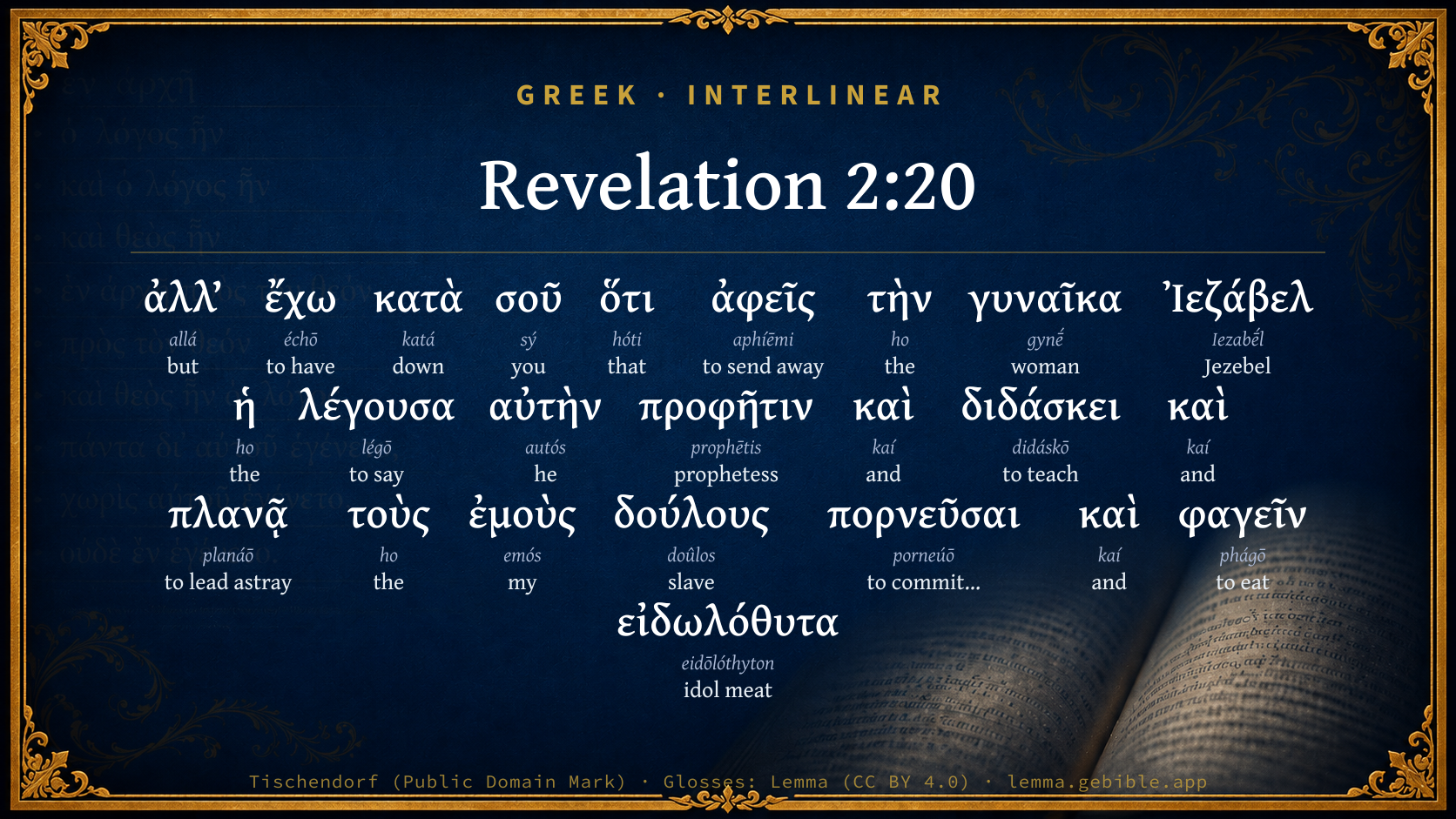
But I have this against you, that you tolerate your woman, Jezebel, who calls herself a prophetess. She teaches and seduces my servants to commit sexual immorality, and to eat things sacrificed to idols.
- 1 hapax legomenon — only here in the Greek New Testament
- 1 first appearance in the Greek New Testament
Download a study sheet
One document with this verse’s original text, its word-by-word gloss line, the meaning frame, cross-references with their text, attributed commentary, and full source and license credits — printable, and it pastes into notes with its structure intact.
This verse Autodidact and up
A passage Seminary Student
Up to 50 verses in one chapter. A passage sheet keeps up to 6 commentary sources and 12 cross-references per verse, in the order this page ranks them, and says so on the sheet whenever that leaves anything out. Ask for a single verse and you get the Autodidact verse sheet above.
Everything on this page stays free to read, with no account — the sheet is a download of what is already on screen, not access to it.
Compare translations 3
The same verse in 3 English versions, stacked beneath the original-language interlinear above. Click any original word for its lexicon entry.
Each is an independent rendering of the whole verse — the interlinear is not word-aligned to these translations.
Highlighted words mark where these versions differ — a whole-verse word diff, not a word-by-word alignment.
-
World English Bible Public Domain
But I have this against you, that you tolerate your woman, Jezebel, who calls herself a prophetess. She teaches and seduces my servants to commit sexual immorality, and to eat things sacrificed to idols.
-
King James Version Public Domain
Notwithstanding I have a few things against thee, because thou sufferest that woman Jezebel, which calleth herself a prophetess, to teach and to seduce my servants to commit fornication, and to eat things sacrificed unto idols.
-
unfoldingWord Literal Text CC BY-SA 4.0
But I have against you that you tolerate the woman Jezebel, the one calling herself a prophetess, and she teaches and deceives my servants to be sexually immoral and to eat idol-offerings.
unfoldingWord Literal Text — © unfoldingWord, licensed CC BY-SA 4.0. Word-aligned USFM3 via Door43 (git.door43.org/unfoldingWord/en_ult).
Show all 19 translations
Every available English version of this verse, each an independent rendering of the whole verse.
-
World English Bible Public Domain
But I have this against you, that you tolerate your woman, Jezebel, who calls herself a prophetess. She teaches and seduces my servants to commit sexual immorality, and to eat things sacrificed to idols.
-
Berean Standard Bible Public Domain
But I have this against you: You tolerate that woman Jezebel, who calls herself a prophetess. By her teaching she misleads My servants to be sexually immoral and to eat food sacrificed to idols.
-
Majority Standard Bible Public Domain
But I have this against you: You tolerate that woman Jezebel, who calls herself a prophetess. By her teaching she misleads My servants to be sexually immoral and to eat food sacrificed to idols.
-
King James Version Public Domain
Notwithstanding I have a few things against thee, because thou sufferest that woman Jezebel, which calleth herself a prophetess, to teach and to seduce my servants to commit fornication, and to eat things sacrificed unto idols.
-
American Standard Version (1901) Public Domain
But I have `this' against thee, that thou sufferest the woman Jezebel, who calleth herself a prophetess; and she teacheth and seduceth my servants to commit fornication, and to eat things sacrificed to idols.
-
Revised Version (1885) Public Domain
But I have this against thee, that thou sufferest the woman Jezebel, which calleth herself a prophetess; and she teacheth and seduceth my servants to commit fornication, and to eat things sacrificed to idols.
-
Geneva Bible (1599) Public Domain
Notwithstanding, I haue a few things against thee, that thou sufferest the woman Iezabel, which calleth her selfe a prophetesse, to teache and to deceiue my seruants to make them commit fornication, and to eate meates sacrificed vnto idoles.
-
Douay-Rheims (1899) Public Domain
But I have against thee a few things: because thou sufferest the woman Jezabel, who calleth herself a prophetess, to teach, and to seduce my servants, to commit fornication, and to eat of things sacrificed to idols.
-
Young's Literal Translation Public Domain
`But I have against thee a few things: That thou dost suffer the woman Jezebel, who is calling herself a prophetess, to teach, and to lead astray, my servants to commit whoredom, and idol-sacrifices to eat;
-
Literal Standard Version CC BY-SA 4.0
But I have a few things against you: that you allow the woman Jezebel, who is calling herself a prophetess, to teach, and to lead astray, My servants to commit whoredom, and to eat idol-sacrifices;
-
Unlocked Literal Bible CC BY-SA 4.0
But I have this against you: You tolerate the woman Jezebel, who calls herself a prophetess. By her teaching she deceives my servants to commit sexual immorality and to eat food sacrificed to idols.
-
unfoldingWord Literal Text CC BY-SA 4.0
But I have against you that you tolerate the woman Jezebel, the one calling herself a prophetess, and she teaches and deceives my servants to be sexually immoral and to eat idol-offerings.
-
Darby Bible Public Domain
But I have against thee that thou permittest the woman Jezebel, she who calls herself prophetess, and she teaches and leads astray my servants to commit fornication and eat of idol sacrifices.
-
World Messianic Bible Public Domain
But I have this against you, that you tolerate your woman Jezebel, who calls herself a prophetess. She teaches and seduces my servants to commit sexual immorality and to eat things sacrificed to idols.
-
Webster's Bible Public Domain
Notwithstanding, I have a few things against thee, because thou sufferest that woman Jezebel, who calleth herself a prophetess, to teach and to seduce my servants to commit lewdness, and to eat things sacrificed to idols.
-
Free Bible Version CC BY-SA 4.0
But I have something against you: you are allowing the woman called Jezebel who calls herself a prophetess to teach my followers, leading them astray into sexual sins, and to eat food sacrificed to idols.
-
Bible in Basic English Public Domain
But I have this against you, that you let the woman Jezebel say she is a prophet and give false teaching, making my servants go after the desires of the flesh and take food offered to false gods.
-
Text-Critical English NT CC BY 4.0
But I have this against yoʋ: Yoʋ tolerate yoʋr wife Jezebel, who calls herself a prophetess while teaching and seducing my servants to commit fornication and to eat food sacrificed to idols.
-
Tyndale New Testament (1534) Public Domain
Notwitstondinge I have a feawe thynges agaynst the that thou sofferest that woman Iesabell which called her sylfe a prophetes to teache and to deceave my servauntes to make them commyt fornicacion and to eate meates offered vppe vnto ydoles.
Literal Standard Version (2020), Covenant Press — licensed CC BY-SA 4.0. Text via the HelloAO Bible API (eBible.org). Unlocked Literal Bible (unfoldingWord) — licensed CC BY-SA 4.0. Text via the HelloAO Bible API (eBible.org). unfoldingWord Literal Text — © unfoldingWord, licensed CC BY-SA 4.0. Word-aligned USFM3 via Door43 (git.door43.org/unfoldingWord/en_ult). Free Bible Version, Dr. Jonathan Gallagher — licensed CC BY-SA 4.0. Text via the HelloAO Bible API (eBible.org).
Word by word
More ways to search: Search by grammar → Find every occurrence → Compare this word →
Practice this passage: Drill this verse → Learn its vocabulary →
- Appears 1× in the Greek New Testament
- First appears here
- Part of Speech
- Noun · Proper, indeclinable
Full Thayer's Definition
- ἀλλ’ allá G235 “but” Conjunction
- ἔχω échō G2192 “to have” Verb, Present, Active, Indicative, 1st person, Singular
- κατὰ katá G2596 “down” Preposition
- σοῦ sý G4771 “you” Personal pronoun, 2nd person, Genitive, Singular
- ὅτι hóti G3754 “that” Conjunction
- ἀφεῖς aphíēmi G863 “to send away” Verb, Present, Active, Indicative, 2nd person, Singular
- τὴν ho G3588 “the” Article, Accusative, Singular, Feminine
- γυναῖκα gynḗ G1135 “woman” Noun, Accusative, Singular, Feminine
- Ἰεζάβελ Iezabḗl G2403 “Jezebel” Noun, Proper, indeclinable
- ἡ ho G3588 “the” Article, Nominative, Singular, Feminine
- λέγουσα légō G3004 “to say” Verb, Present, Active, Participle, Nominative, Singular, Feminine
- αὐτὴν autós G846 “he” Personal pronoun, Accusative, Singular, Feminine
- προφῆτιν prophētis G4398 “prophetess” Noun, Accusative, Singular, Feminine
- καὶ kaí G2532 “and” Conjunction
- διδάσκει didáskō G1321 “to teach” Verb, Present, Active, Indicative, 3rd person, Singular
- καὶ kaí G2532 “and” Conjunction
- πλανᾷ planáō G4105 “to lead astray” Verb, Present, Active, Indicative, 3rd person, Singular
- τοὺς ho G3588 “the” Article, Accusative, Plural, Masculine
- ἐμοὺς emós G1699 “my” Possessive pronoun, 1st person, Accusative, Plural, Masculine
- δούλους doûlos G1401 “slave” Noun, Accusative, Plural, Masculine
- πορνεῦσαι porneúō G4203 “to commit immorality” Verb, Aorist, Active, Infinitive
- καὶ kaí G2532 “and” Conjunction
- φαγεῖν phágō G5315 “to eat” Verb, Aorist, Active, Infinitive
- εἰδωλόθυτα eidōlóthyton G1494 “idol meat” Adjective, Accusative, Plural, Neuter
About this verse
These counts appear in no published source. They are computed here, from the morphology-tagged text and Lemma’s own curated glosses. What Lemma adds →
- 24
- words
- 20
- distinct lemmas
- Revelation
- section
Notable vocabulary
1 hapax legomenon — a word that appears only here in the entire Greek New Testament:
- Ἰεζάβελ Jezebel G2403
First appearance in Scripture
This word makes its first canonical appearance in the Greek New Testament here:
- Ἰεζάβελ Jezebel G2403
Shared distinctive vocabulary
προφῆτιν prophetess G4398 occurs in 2 verses of the Greek New Testament. Also found in:
Cross-references
15Topical passages linked to Revelation 2:20 in the Treasury of Scripture Knowledge — connected by theme and wording, ordered by reader-vote popularity; previews shown in the World English Bible.
- 1 Kings 16:31 It happened, as if it had been a light thing for him to walk in the sins of Jeroboam the son of Nebat, that he took as wife Jezebel the daughter of Ethbaal king of the Sidonians, and went and served Baal, and worshiped him.
- Revelation 2:14 But I have a few things against you, because you have there some who hold the teaching of Balaam, who taught Balak to throw a stumbling block before the children of Israel, to eat things sacrificed to idols, and to commit sexual immorality.
- 1 Corinthians 10:18–21 Consider Israel after the flesh. Don't those who eat the sacrifices have communion with the altar?
- 2 Kings 9:7 You shall strike the house of Ahab your master, that I may avenge the blood of my servants the prophets, and the blood of all the servants of Yahweh, at the hand of Jezebel.
- Acts 15:20 but that we write to them that they abstain from the pollution of idols, from sexual immorality, from what is strangled, and from blood.
- Acts 15:29 that you abstain from things sacrificed to idols, from blood, from things strangled, and from sexual immorality, from which if you keep yourselves, it will be well with you. Farewell."
- 1 Kings 21:23–25 Of Jezebel also spoke Yahweh, saying, The dogs shall eat Jezebel by the rampart of Jezreel.
- 2 Kings 9:30–37 When Jehu was come to Jezreel, Jezebel heard of it; and she painted her eyes, and attired her head, and looked out at the window.
- Revelation 2:4 But I have this against you, that you left your first love.
- Exodus 34:15 Don't make a covenant with the inhabitants of the land, lest they play the prostitute after their gods, and sacrifice to their gods, and one call you and you eat of his sacrifice;
- 1 Kings 19:1–2 Ahab told Jezebel all that Elijah had done, and withal how he had slain all the prophets with the sword.
- 1 Corinthians 8:10–12 For if a man sees you who have knowledge sitting in an idol's temple, won't his conscience, if he is weak, be emboldened to eat things sacrificed to idols?
- 1 Kings 21:7–15 Jezebel his wife said to him, Do you now govern the kingdom of Israel? arise, and eat bread, and let your heart be merry: I will give you the vineyard of Naboth the Jezreelite.
- 1 Corinthians 10:28 But if anyone says to you, "This was offered to idols," don't eat it for the sake of the one who told you, and for the sake of conscience. For "the earth is the Lord's, and all its fullness."
- Numbers 25:1–2 Israel abode in Shittim; and the people began to play the prostitute with the daughters of Moab:
Cross-references courtesy of OpenBible.info (CC BY 4.0).
Where the printed editions differ
2 variantsPlaces in this verse where the major printed Greek editions disagree on the wording in a way that affects the translation — a comparison of editions, not a manuscript-by-manuscript collation. The editions are the modern critical texts (Nestlé-Aland 28/27, SBL, Westcott-Hort, Tregelles, Tyndale House) and the traditional texts behind the KJV (the Textus Receptus and the Byzantine/Majority text). It is not a claim about which reading is original.
-
Extra text
ὀλίγα
“few things”
In TR Not in NA28NA27TynSBLWHTregByzὀλίγα (oliga) 'few things' is only in traditional manuscripts (TR)
-
Extra text
σοῦ
“of you”
In Byz Not in NA28NA27TynSBLWHTregTRσοῦ (sou) 'of you' is only in a few manuscripts (Byz)
Textual data: Translators Amalgamated Greek New Testament (STEPBible TAGNT) · CC BY 4.0.
Lesson kit
Teaching starters — assembled from the data on this page, not authored interpretation. Every prompt links to the verse data it draws on. Edit before teaching.
Revelation, in the Revelation, opens this verse with 24 words (20 distinct Greek lemmas). Its most distinctive word is Iezabḗl (“Jezebel”). A historical commentator’s framing appears above. Read the whole chapter for the surrounding context.
Discussion questions
- How does “Jezebel” (Iezabḗl) shape what this verse is saying?
- 1 word here appears nowhere else in the Greek New Testament. Why might the author reach for such rare wording?
- This is the first place “Jezebel” appears in Scripture (first appears here). What does its debut here establish?
- How does Luke 2:36, which shares the word «prophetess», read alongside this verse?
- What does the repetition of “the” (3× in this one verse) do in this verse?
- These translations render this verse differently. What is at stake in choosing one wording over another?
- Compare how Joseph Benson's Commentary and Tyndale Open Study Notes read this verse. Where do they agree or differ?
Things to notice
- 1 word in this verse appears nowhere else in the Greek New Testament.
- 1 word makes its first canonical appearance in Scripture here.
- These translations choose different wording for 27 words in this verse.
- “the” occurs 3× in this single verse.
- 20 distinct Greek lemmas span 24 words in this verse.
Commentary
Notes on Revelation 2:20 from classic Christian and Jewish commentators (each source and its license shown beneath its notes). The classic Christian expositions comment on the surrounding passage and are grouped to its opening verse, so a note may address several verses; the Jewish commentaries on the Tanakh (Rashi and others) are per-verse, so they appear only where the commentator wrote on this verse.
Lemma curates 59 commentaries, every one of them public domain or Creative Commons licensed, each selected and text-cleaned for this edition rather than reprinted as found. About our sources →
Joseph Benson's Commentary
Joseph Benson's Commentary on the Old and New Testaments (1811–1818) — public domain. Text from a community e-Sword module.
Tyndale Open Study Notes
Tyndale Open Resources
Tyndale Open Study Notes — © Tyndale Open Resources, licensed CC BY-SA 4.0. Text via the HelloAO Bible API.
Bengel's Gnomon
Johann Albrecht Bengel
Bengel's Gnomon of the New Testament — English translation (T&T Clark, Edinburgh, 1860) — public domain. Text from a community e-Sword module.
Meyer's Critical & Exegetical Commentary
Heinrich August Wilhelm Meyer
Meyer — Critical and Exegetical Commentary on the New Testament — English translation by Peter Christie, edited by Frederick Crombie (T&T Clark, 1880) — public domain. Text from a community e-Sword module.
Expositor's Greek Testament
ed. W. Robertson Nicoll
The Expositor's Greek Testament, edited by W. Robertson Nicoll (1897–1910) — public domain. Text from a community e-Sword module.
Geneva Bible (1599)
Geneva Bible translators
Geneva Bible (1599) marginal notes — public domain. Text via Bolls.life.
Jamieson, Fausset & Brown
Robert Jamieson, A. R. Fausset & David Brown
Jamieson, Fausset & Brown — Commentary Critical and Explanatory on the Whole Bible (1871) — public domain (CC PDM 1.0). Text via the HelloAO Bible API.
Adam Clarke's Commentary
Adam Clarke's Commentary on the Bible (1810–1826) — public domain. Text from a community e-Sword/MySword module.
Ellicott's Commentary for English Readers
A Bible Commentary for English Readers, edited by Charles John Ellicott (1878–1897) — public domain. Text from a community e-Sword module.
The Cambridge Bible for Schools and Colleges
gen. ed. J. J. S. Perowne
The Cambridge Bible for Schools and Colleges (gen. ed. J. J. S. Perowne; Cambridge University Press, 1878–1918) — public domain. Text from a community e-Sword module.
John Gill's Exposition
John Gill's Exposition of the Whole Bible (1746–1763) — public domain (CC PDM 1.0). Text via the HelloAO Bible API.
Trapp's Complete Commentary
John Trapp
John Trapp, A Commentary or Exposition upon All the Books of the Old and New Testament (1647–1656) — public domain. Text from a community e-Sword module.
Albert Barnes' Notes on the Bible
Albert Barnes' Notes on the Bible (1834–1885) — public domain. Text from a community e-Sword/MySword module.
Haydock's Catholic Bible Commentary
George Leo Haydock (1774–1849), Haydock's Catholic Family Bible and Commentary, 1859 edition — public domain. Excludes Psalms (Douay-Rheims chapter numbering differs from Protestant) and Deuterocanonical books (Catholic canon only).
Matthew Poole's English Annotations
Matthew Poole's English Annotations on the Holy Bible (1683–1685) — public domain. Text from a community e-Sword/MySword module.
Whedon's Commentary on the Bible
Daniel D. Whedon
Daniel D. Whedon (gen. ed.), Commentary on the Old and New Testaments (1874–1909) — public domain. Text from a community e-Sword module.
The Pulpit Commentary
The Pulpit Commentary (1880–1919), ed. H.D.M. Spence-Jones & Joseph S. Exell — public domain. Text from a community e-Sword module.
John Wesley's Explanatory Notes
John Wesley, Explanatory Notes Upon the Whole Bible (1754–1765) — public domain. Text via the GEBible commentary corpus.
The People's New Testament
B. W. Johnson
B. W. Johnson's The People's New Testament with Notes (1889–1891) — public domain. Electronic text from the Christian Classics Ethereal Library (CCEL) ThML edition.
unfoldingWord translationNotes
Door43 World Missions Community
unfoldingWord translationNotes — © Distant Shores Media and the Door43 World Missions Community, licensed CC BY-SA 4.0. Source: git.door43.org/Door43/en_tn.
Cambridge Greek Testament for Schools and Colleges
Cambridge Greek Testament for Schools and Colleges (Cambridge University Press, 1896; 21 vols, various authors incl. Carr, Maclear, Plummer, Farrar, Lumby, Moule, M. R. James, Simcox) — public domain. Text from a community e-Sword module.
Alford’s Greek Testament
Henry Alford
Henry Alford, The Greek Testament (1849–1861) — public domain. Text from a community e-Sword module.