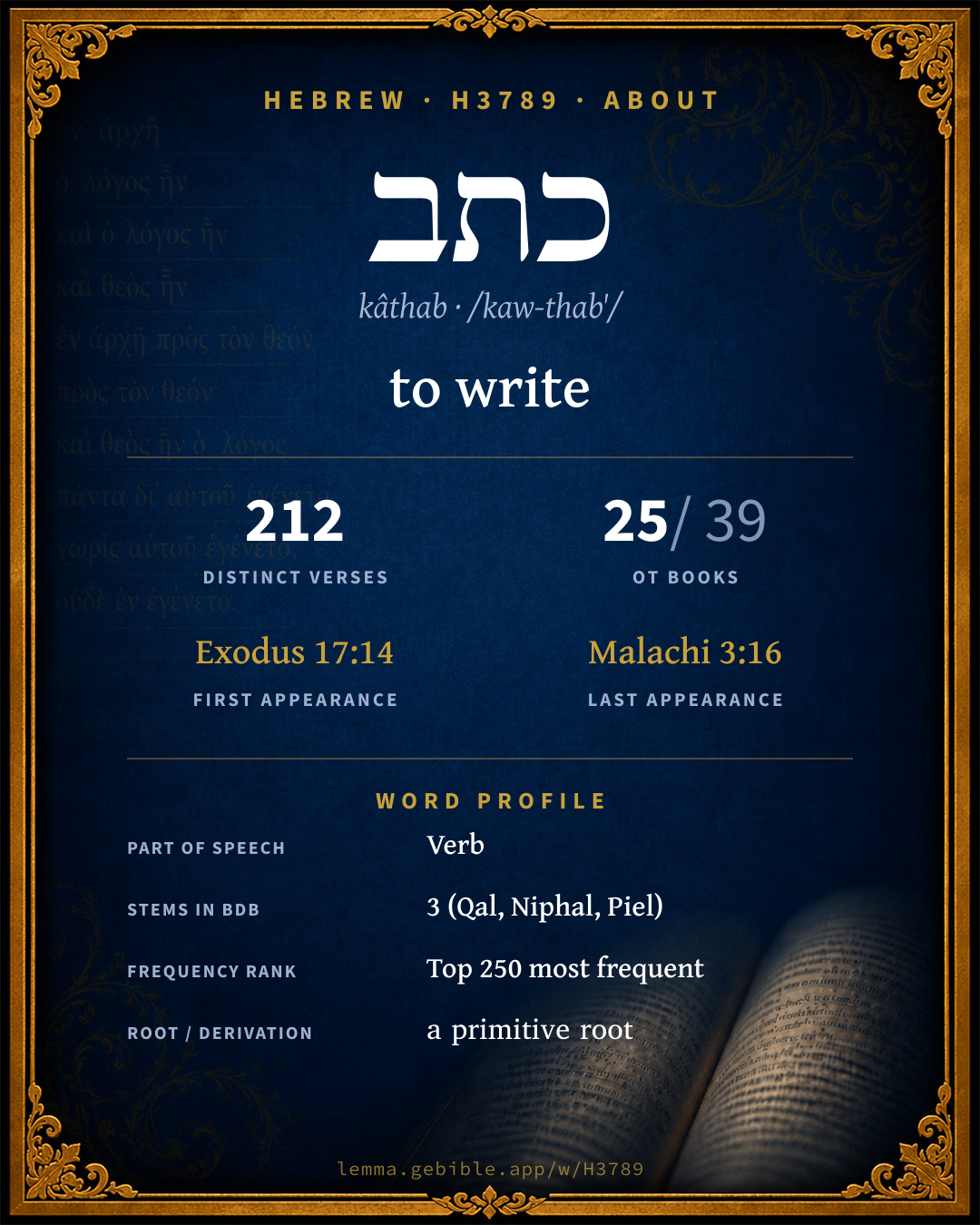
כָּתַב
to write
also: record, enroll fuller range ↓
Full lexicon entry — Brown-Driver-Briggs (BDB)
From Brown-Driver-Briggs (BDB)
Where this word appears
See every Qal verb in the Hebrew Bible →
Grammar key — what these labels mean
Part of speech
- Verb
- An action or state-of-being word.
- Preposition
- A relational word (e.g. “in,” “to,” “from”) governing a noun.
Noun type
- Common
- A common noun — a general class of person, place, or thing (“king,” “city,” “water”), not a specific name.
Stem
- Qal
- The basic, simple active stem — the plain form of the verb (“he wrote”). Here: ‘write’
- Niphal
- Usually the simple passive or reflexive of the Qal (“he was written”). Here: ‘be written’
- Piel
- An intensive or resultative active stem. Here: ‘frequent.’
Form
- Participle Passive
- A verbal adjective expressing action received (“written”).
- Sequential Imperfect
- An imperfect with prefixed waw — the standard past-narrative form (waw-consecutive imperfect).
- Perfect
- A completed action or state — Hebrew marks aspect (completeness) more than strict tense (“he wrote”).
- Imperative
- A direct command (“write!”).
- Sequential Perfect
- A perfect with prefixed waw continuing a preceding imperfect or command (waw-consecutive perfect).
- Imperfect
- An incomplete, ongoing, or future action (“he will / would write”).
- Infinitive Construct
- A bound verbal noun, frequently with prepositions (“to write / in writing”).
- Participle Active
- A verbal adjective expressing ongoing or characteristic action (“writing / one who writes”).
- Infinitive Absolute
- An unbound verbal noun, often intensifying or standing in for a finite verb.
- Jussive
- A third- or second-person volitional form expressing wish or command (“let him write”).
State
- Absolute
- The independent form of a noun, not bound to a following word.
- Construct
- A noun bound to a following noun in a possessive / “of” relationship (the construct chain).
Person
- 3rd Person
- The one spoken about (“he / she / it / they”).
- 2nd Person
- The one addressed (“you”).
- 1st Person
- The speaker (“I / we”).
Gender
- Masculine
- Grammatically masculine.
- Feminine
- Grammatically feminine.
- Common
- Either gender — not distinguished for this form.
Number
- Plural
- More than one (in Hebrew, generally three or more).
- Singular
- One.
Grammatical forms 37 distinct
- Verb, Qal, Participle Passive, Masculine, Plural, Absolute 64 times (28%)
- Verb, Qal, Participle Passive, Masculine, Singular, Absolute 38 times (17%)
- Verb, Qal, Sequential Imperfect, 3rd Person, Masculine, Singular 22 times (10%)
- Verb, Qal, Imperative, 2nd Person, Masculine, Singular 13 times (6%)
- Verb, Qal, Perfect, 3rd Person, Masculine, Singular 10 times (4%)
- Verb, Qal, Participle Passive, Feminine, Singular, Absolute 10 times (4%)
- Verb, Niphal, Sequential Imperfect, 3rd Person, Masculine, Singular 5 times (2%)
- Verb, Qal, Sequential Perfect, 2nd Person, Masculine, Singular 5 times (2%)
+29 more forms (60 occurrences)
Parsed forms decoded from the imported morphology (morphhb / Westminster Leningrad Codex — WLC text public domain, morphhb tagging CC BY 4.0), counted across 227 parsed occurrences — not distinct verses.
Page 1 of 2 — showing verses 1–200 of 212 distinct verses where H3789 appears, across 25 books. Click any verse to open its interlinear word-by-word view. Verse text shown in the World English Bible for context — . Each verse’s Hebrew form is shown with its reference; the English is not keyword-highlighted, since the data carries no word-level English alignment. Use “Compare translations” on any verse to read it across multiple English versions. This concordance covers the Hebrew Bible; Septuagint (Greek Old Testament) occurrences are not indexed here.
Exodus 10 verses
- Exodus 17:14 כְּתֹ֨ב Qal impv 2ms Yahweh said to Moses, "Write this for a memorial in a book, and rehearse it in the ears of Joshua: that I will utterly blot out the memory of Amalek from under the sky."
- Exodus 24:4 וַ/יִּכְתֹּ֣ב conj + Qal wimpf 3ms Moses wrote all the words of Yahweh, and rose up early in the morning, and built an altar under the mountain, and twelve pillars for the twelve tribes of Israel.
- Exodus 24:12 כָּתַ֖בְתִּי Qal pf 1cs Yahweh said to Moses, "Come up to me on the mountain, and stay here, and I will give you the tables of stone with the law and the commands that I have written, that you may teach them."
- Exodus 31:18 כְּתֻבִ֖ים Qal ptcp.pass mp He gave to Moses, when he finished speaking with him on Mount Sinai, the two tablets of the testimony, stone tablets, written with God's finger.
- Exodus 32:15 כְּתֻבִים֙ כְּתֻבִֽים Qal ptcp.pass mp Qal ptcp.pass mp Moses turned, and went down from the mountain, with the two tablets of the testimony in his hand; tablets that were written on both their sides; on the one side and on the other they were written.
- Exodus 32:32 כָּתָֽבְתָּ Qal pf 2ms Yet now, if you will, forgive their sin-- and if not, please blot me out of your book which you have written."
- Exodus 34:1 וְ/כָתַבְתִּי֙ conj + Qal wpf 1cs Yahweh said to Moses, "Chisel two stone tablets like the first: and I will write on the tablets the words that were on the first tablets, which you broke.
- Exodus 34:27 כְּתָב Qal impv 2ms Yahweh said to Moses, "Write you these words: for in accordance with these words I have made a covenant with you and with Israel."
- Exodus 34:28 וַ/יִּכְתֹּ֣ב conj + Qal wimpf 3ms He was there with Yahweh forty days and forty nights; he neither ate bread, nor drank water. He wrote on the tablets the words of the covenant, the ten commandments.
- Exodus 39:30 וַ/יִּכְתְּב֣וּ conj + Qal wimpf 3mp They made the plate of the holy crown of pure gold, and wrote on it a writing, like the engravings of a signet: "HOLY TO YAHWEH."
Numbers 5 verses
- Numbers 5:23 וְ֠/כָתַב conj + Qal wpf 3ms "The priest shall write these curses in a book, and he shall blot them out into the water of bitterness.
- Numbers 11:26 בַּ/כְּתֻבִ֔ים prep det + Qal ptcp.pass mp But there remained two men in the camp, the name of the one was Eldad, and the name of the other Medad: and the Spirit rested on them; and they were of those who were written, but had not gone out to the Tent; and they prophesied in the camp.
- Numbers 17:2 תִּכְתֹּ֖ב Qal impf 2ms Speak to the children of Israel, and take of them rods, one for each fathers' house, of all their princes according to their fathers' houses, twelve rods: write you every man's name on his rod.
- Numbers 17:3 תִּכְתֹּ֖ב Qal impf 2ms You shall write Aaron's name on the rod of Levi; for there shall be one rod for each head of their fathers' houses.
- Numbers 33:2 וַ/יִּכְתֹּ֨ב conj + Qal wimpf 3ms Moses wrote their goings out according to their journeys by the commandment of Yahweh: and these are their journeys according to their goings out.
Deuteronomy 22 verses
- Deuteronomy 4:13 וַֽ/יִּכְתְּבֵ֔/ם conj + Qal wimpf 3ms + sfx pers 3mp He declared to you his covenant, which he commanded you to perform, even the ten commandments; and he wrote them on two tables of stone.
- Deuteronomy 5:22 וַֽ/יִּכְתְּבֵ֗/ם conj + Qal wimpf 3ms + sfx pers 3mp These words Yahweh spoke to all your assembly on the mountain out of the midst of the fire, of the cloud, and of the thick darkness, with a great voice: and he added no more. He wrote them on two tables of stone, and gave them to me.
- Deuteronomy 6:9 וּ/כְתַבְתָּ֛/ם conj + Qal wpf 2ms + sfx pers 3mp You shall write them on the door-posts of your house, and on your gates.
- Deuteronomy 9:10 כְּתֻבִ֖ים Qal ptcp.pass mp Yahweh delivered to me the two tables of stone written with the finger of God; and on them [was written] according to all the words, which Yahweh spoke with you on the mountain out of the midst of the fire in the day of the assembly.
- Deuteronomy 10:2 וְ/אֶכְתֹּב֙ conj + Qal impf 1cs I will write on the tables the words that were on the first tables which you broke, and you shall put them in the ark.
- Deuteronomy 10:4 וַ/יִּכְתֹּ֨ב conj + Qal wimpf 3ms He wrote on the tables, according to the first writing, the ten commandments, which Yahweh spoke to you on the mountain out of the midst of the fire in the day of the assembly: and Yahweh gave them to me.
- Deuteronomy 11:20 וּ/כְתַבְתָּ֛/ם conj + Qal wpf 2ms + sfx pers 3mp You shall write them on the door-posts of your house, and on your gates;
- Deuteronomy 17:18 וְ/כָ֨תַב conj + Qal wpf 3ms It shall be, when he sits on the throne of his kingdom, that he shall write him a copy of this law in a book, out of [that which is] before the priests the Levites:
- Deuteronomy 24:1 וְ/כָ֨תַב conj + Qal wpf 3ms When a man takes a wife, and marries her, then it shall be, if she find no favor in his eyes, because he has found some unseemly thing in her, that he shall write her a bill of divorce, and give it in her hand, and send her out of his house.
- Deuteronomy 24:3 וְ/כָ֨תַב conj + Qal wpf 3ms If the latter husband hate her, and write her a bill of divorce, and give it in her hand, and send her out of his house; or if the latter husband die, who took her to be his wife;
- Deuteronomy 27:3 וְ/כָתַבְתָּ֣ conj + Qal wpf 2ms and you shall write on them all the words of this law, when you are passed over; that you may go in to the land which Yahweh your God gives you, a land flowing with milk and honey, as Yahweh, the God of your fathers, has promised you.
- Deuteronomy 27:8 וְ/כָתַבְתָּ֣ conj + Qal wpf 2ms You shall write on the stones all the words of this law very plainly.
- Deuteronomy 28:58 הַ/כְּתוּבִ֖ים ptcl def.art + Qal ptcp.pass mp If you will not observe to do all the words of this law that are written in this book, that you may fear this glorious and fearful name, YAHWEH YOUR GOD;
- Deuteronomy 28:61 כָת֔וּב Qal ptcp.pass ms Also every sickness, and every plague, which is not written in the book of this law, them will Yahweh bring on you, until you are destroyed.
- Deuteronomy 29:20 הַ/כְּתוּבָ֖ה ptcl def.art + Qal ptcp.pass fs Yahweh will not pardon him, but then the anger of Yahweh and his jealousy will smoke against that man, and all the curse that is written in this book shall lie on him, and Yahweh will blot out his name from under the sky.
- Deuteronomy 29:21 הַ/כְּתוּבָ֕ה ptcl def.art + Qal ptcp.pass fs Yahweh will set him apart to evil out of all the tribes of Israel, according to all the curses of the covenant that is written in this book of the law.
- Deuteronomy 29:27 הַ/כְּתוּבָ֖ה ptcl def.art + Qal ptcp.pass fs therefore the anger of Yahweh was kindled against this land, to bring on it all the curse that is written in this book;
- Deuteronomy 30:10 הַ/כְּתוּבָ֕ה ptcl def.art + Qal ptcp.pass fs if you shall obey the voice of Yahweh your God, to keep his commandments and his statutes which are written in this book of the law; if you turn to Yahweh your God with all your heart, and with all your soul.
- Deuteronomy 31:9 וַ/יִּכְתֹּ֣ב conj + Qal wimpf 3ms Moses wrote this law, and delivered it to the priests the sons of Levi, who bore the ark of the covenant of Yahweh, and to all the elders of Israel.
- Deuteronomy 31:19 כִּתְב֤וּ Qal impv 2mp Now therefore write you this song for you, and teach you it the children of Israel: put it in their mouths, that this song may be a witness for me against the children of Israel.
- Deuteronomy 31:22 וַ/יִּכְתֹּ֥ב conj + Qal wimpf 3ms So Moses wrote this song the same day, and taught it the children of Israel.
- Deuteronomy 31:24 לִ/כְתֹּ֛ב prep + Qal inf.cs It happened, when Moses had made an end of writing the words of this law in a book, until they were finished,
Joshua 11 verses
- Joshua 1:8 הַ/כָּת֖וּב ptcl def.art + Qal ptcp.pass ms This book of the law shall not depart out of your mouth, but you shall meditate thereon day and night, that you may observe to do according to all that is written therein: for then you shall make your way prosperous, and then you shall have good success.
- Joshua 8:31 כַּ/כָּתוּב֙ prep det + Qal ptcp.pass ms as Moses the servant of Yahweh commanded the children of Israel, as it is written in the book of the law of Moses, an altar of uncut stones, on which no man had lifted up any iron: and they offered thereon burnt offerings to Yahweh, and sacrificed peace-offerings.
- Joshua 8:32 וַ/יִּכְתָּב כָּתַ֔ב conj + Qal wimpf 3ms Qal pf 3ms He wrote there on the stones a copy of the law of Moses, which he wrote, in the presence of the children of Israel.
- Joshua 8:34 הַ/כָּת֖וּב ptcl def.art + Qal ptcp.pass ms Afterward he read all the words of the law, the blessing and the curse, according to all that is written in the book of the law.
- Joshua 10:13 כְתוּבָ֖ה Qal ptcp.pass fs The sun stood still, and the moon stayed, Until the nation had avenged themselves of their enemies. Isn't this written in the book of Jashar? The sun stayed in the midst of the sky, and didn't hurry to go down about a whole day.
- Joshua 18:4 וְ/יִכְתְּב֥וּ conj + Qal impf 3mp Appoint for you three men of each tribe: and I will send them, and they shall arise, and walk through the land, and describe it according to their inheritance; and they shall come to me.
- Joshua 18:6 תִּכְתְּב֤וּ Qal impf 2mp You shall describe the land into seven portions, and bring [the description] here to me; and I will cast lots for you here before Yahweh our God.
- Joshua 18:8 לִ/כְתֹּ֨ב וְ/כִתְב֤וּ prep + Qal inf.cs conj + Qal impv 2mp The men arose, and went: and Joshua charged those who went to describe the land, saying, Go and walk through the land, and describe it, and come again to me; and I will cast lots for you here before Yahweh in Shiloh.
- Joshua 18:9 וַ/יִּכְתְּב֧וּ/הָ conj + Qal wimpf 3mp + sfx pers 3fs The men went and passed through the land, and described it by cities into seven portions in a book; and they came to Joshua to the camp at Shiloh.
- Joshua 23:6 הַ/כָּת֔וּב ptcl def.art + Qal ptcp.pass ms Therefore be you very courageous to keep and to do all that is written in the book of the law of Moses, that you not turn aside from it to the right hand or to the left;
- Joshua 24:26 וַ/יִּכְתֹּ֤ב conj + Qal wimpf 3ms Joshua wrote these words in the book of the law of God; and he took a great stone, and set it up there under the oak that was by the sanctuary of Yahweh.
Judges 1 verse
1 Samuel 1 verse
2 Samuel 3 verses
- 2 Samuel 1:18 כְתוּבָ֖ה Qal ptcp.pass fs (and he bade them teach the children of Judah [the song of] the bow: behold, it is written in the book of Jashar):
- 2 Samuel 11:14 וַ/יִּכְתֹּ֥ב conj + Qal wimpf 3ms It happened in the morning, that David wrote a letter to Joab, and sent it by the hand of Uriah.
- 2 Samuel 11:15 וַ/יִּכְתֹּ֥ב conj + Qal wimpf 3ms He wrote in the letter, saying, Set Uriah in the forefront of the hottest battle, and retire you from him, that he may be struck, and die.
1 Kings 16 verses
- 1 Kings 2:3 כַּ/כָּת֖וּב prep det + Qal ptcp.pass ms and keep the charge of Yahweh your God, to walk in his ways, to keep his statutes, [and] his commandments, and his ordinances, and his testimonies, according to that which is written in the law of Moses, that you may prosper in all that you do, and wherever you turn yourself.
- 1 Kings 11:41 כְּתֻבִ֔ים Qal ptcp.pass mp Now the rest of the acts of Solomon, and all that he did, and his wisdom, aren't they written in the book of the acts of Solomon?
- 1 Kings 14:19 כְּתוּבִ֗ים Qal ptcp.pass mp The rest of the acts of Jeroboam, how he warred, and how he reigned, behold, they are written in the book of the chronicles of the kings of Israel.
- 1 Kings 14:29 כְתוּבִ֗ים Qal ptcp.pass mp Now the rest of the acts of Rehoboam, and all that he did, aren't they written in the book of the chronicles of the kings of Judah?
- 1 Kings 15:7 כְּתוּבִ֗ים Qal ptcp.pass mp The rest of the acts of Abijam, and all that he did, aren't they written in the book of the chronicles of the kings of Judah? There was war between Abijam and Jeroboam.
- 1 Kings 15:23 כְתוּבִ֗ים Qal ptcp.pass mp Now the rest of all the acts of Asa, and all his might, and all that he did, and the cities which he built, aren't they written in the book of the chronicles of the kings of Judah? But in the time of his old age he was diseased in his feet.
- 1 Kings 15:31 כְּתוּבִ֗ים Qal ptcp.pass mp Now the rest of the acts of Nadab, and all that he did, aren't they written in the book of the chronicles of the kings of Israel?
- 1 Kings 16:5 כְּתוּבִ֗ים Qal ptcp.pass mp Now the rest of the acts of Baasha, and what he did, and his might, aren't they written in the book of the chronicles of the kings of Israel?
- 1 Kings 16:14 כְּתוּבִ֗ים Qal ptcp.pass mp Now the rest of the acts of Elah, and all that he did, aren't they written in the book of the chronicles of the kings of Israel?
- 1 Kings 16:20 כְּתוּבִ֗ים Qal ptcp.pass mp Now the rest of the acts of Zimri, and his treason that he did, aren't they written in the book of the chronicles of the kings of Israel?
- 1 Kings 16:27 כְּתוּבִ֗ים Qal ptcp.pass mp Now the rest of the acts of Omri which he did, and his might that he shown, aren't they written in the book of the chronicles of the kings of Israel?
- 1 Kings 21:8 וַ/תִּכְתֹּ֤ב conj + Qal wimpf 3fs So she wrote letters in Ahab's name, and sealed them with his seal, and sent the letters to the elders and to the nobles who were in his city, [and] who lived with Naboth.
- 1 Kings 21:9 וַ/תִּכְתֹּ֥ב conj + Qal wimpf 3fs She wrote in the letters, saying, Proclaim a fast, and set Naboth on high among the people:
- 1 Kings 21:11 כָּתוּב֙ Qal ptcp.pass ms The men of his city, even the elders and the nobles who lived in his city, did as Jezebel had sent to them, according as it was written in the letters which she had sent to them.
- 1 Kings 22:39 כְּתוּבִ֗ים Qal ptcp.pass mp Now the rest of the acts of Ahab, and all that he did, and the ivory house which he built, and all the cities that he built, aren't they written in the book of the chronicles of the kings of Israel?
- 1 Kings 22:45 כְּתוּבִ֗ים Qal ptcp.pass mp Now the rest of the acts of Jehoshaphat, and his might that he shown, and how he warred, aren't they written in the book of the chronicles of the kings of Judah?
2 Kings 30 verses
- 2 Kings 1:18 כְתוּבִ֗ים Qal ptcp.pass mp Now the rest of the acts of Ahaziah which he did, aren't they written in the book of the chronicles of the kings of Israel?
- 2 Kings 8:23 כְּתוּבִ֗ים Qal ptcp.pass mp The rest of the acts of Joram, and all that he did, aren't they written in the book of the chronicles of the kings of Judah?
- 2 Kings 10:1 וַ/יִּכְתֹּב֩ conj + Qal wimpf 3ms Now Ahab had seventy sons in Samaria. Jehu wrote letters, and sent to Samaria, to the rulers of Jezreel, even the elders, and to those who brought up [the sons of] Ahab, saying,
- 2 Kings 10:6 וַ/יִּכְתֹּ֣ב conj + Qal wimpf 3ms Then he wrote a letter the second time to them, saying, If you be on my side, and if you will listen to my voice, take the heads of the men your master's sons, and come to me to Jezreel by tomorrow this time. Now the king's sons, being seventy persons, were with the great men of the city, who brought them up.
- 2 Kings 10:34 כְּתוּבִ֗ים Qal ptcp.pass mp Now the rest of the acts of Jehu, and all that he did, and all his might, aren't they written in the book of the chronicles of the kings of Israel?
- 2 Kings 12:19 כְּתוּבִ֗ים Qal ptcp.pass mp Now the rest of the acts of Joash, and all that he did, aren't they written in the book of the chronicles of the kings of Judah?
- 2 Kings 13:8 כְּתוּבִ֗ים Qal ptcp.pass mp Now the rest of the acts of Jehoahaz, and all that he did, and his might, aren't they written in the book of the chronicles of the kings of Israel?
- 2 Kings 13:12 כְּתוּבִ֗ים Qal ptcp.pass mp Now the rest of the acts of Joash, and all that he did, and his might with which he fought against Amaziah king of Judah, aren't they written in the book of the chronicles of the kings of Israel?
- 2 Kings 14:6 כַּ/כָּת֣וּב prep det + Qal ptcp.pass ms but the children of the murderers he didn't put to death; according to that which is written in the book of the law of Moses, as Yahweh commanded, saying, The fathers shall not be put to death for the children, nor the children be put to death for the fathers; but every man shall die for his own sin.
- 2 Kings 14:15 כְּתוּבִ֗ים Qal ptcp.pass mp Now the rest of the acts of Jehoash which he did, and his might, and how he fought with Amaziah king of Judah, aren't they written in the book of the chronicles of the kings of Israel?
- 2 Kings 14:18 כְּתוּבִ֗ים Qal ptcp.pass mp Now the rest of the acts of Amaziah, aren't they written in the book of the chronicles of the kings of Judah?
- 2 Kings 14:28 כְּתוּבִ֗ים Qal ptcp.pass mp Now the rest of the acts of Jeroboam, and all that he did, and his might, how he warred, and how he recovered Damascus, and Hamath, [which had belonged] to Judah, for Israel, aren't they written in the book of the chronicles of the kings of Israel?
- 2 Kings 15:6 כְּתוּבִ֗ים Qal ptcp.pass mp Now the rest of the acts of Azariah, and all that he did, aren't they written in the book of the chronicles of the kings of Judah?
- 2 Kings 15:11 כְּתוּבִ֗ים Qal ptcp.pass mp Now the rest of the acts of Zechariah, behold, they are written in the book of the chronicles of the kings of Israel.
- 2 Kings 15:15 כְּתֻבִ֗ים Qal ptcp.pass mp Now the rest of the acts of Shallum, and his conspiracy which he made, behold, they are written in the book of the chronicles of the kings of Israel.
- 2 Kings 15:21 כְּתוּבִ֗ים Qal ptcp.pass mp Now the rest of the acts of Menahem, and all that he did, aren't they written in the book of the chronicles of the kings of Israel?
- 2 Kings 15:26 כְּתוּבִ֗ים Qal ptcp.pass mp Now the rest of the acts of Pekahiah, and all that he did, behold, they are written in the book of the chronicles of the kings of Israel.
- 2 Kings 15:31 כְּתוּבִ֗ים Qal ptcp.pass mp Now the rest of the acts of Pekah, and all that he did, behold, they are written in the book of the chronicles of the kings of Israel.
- 2 Kings 15:36 כְּתוּבִ֗ים Qal ptcp.pass mp Now the rest of the acts of Jotham, and all that he did, aren't they written in the book of the chronicles of the kings of Judah?
- 2 Kings 16:19 כְּתוּבִ֗ים Qal ptcp.pass mp Now the rest of the acts of Ahaz which he did, aren't they written in the book of the chronicles of the kings of Judah?
- 2 Kings 17:37 כָּתַ֣ב Qal pf 3ms and the statutes and the ordinances, and the law and the commandment, which he wrote for you, you shall observe to do forevermore; and you shall not fear other gods:
- 2 Kings 20:20 כְּתוּבִ֗ים Qal ptcp.pass mp Now the rest of the acts of Hezekiah, and all his might, and how he made the pool, and the conduit, and brought water into the city, aren't they written in the book of the chronicles of the kings of Judah?
- 2 Kings 21:17 כְּתוּבִ֗ים Qal ptcp.pass mp Now the rest of the acts of Manasseh, and all that he did, and his sin that he sinned, aren't they written in the book of the chronicles of the kings of Judah?
- 2 Kings 21:25 כְּתוּבִ֗ים Qal ptcp.pass mp Now the rest of the acts of Amon which he did, aren't they written in the book of the chronicles of the kings of Judah?
- 2 Kings 22:13 הַ/כָּת֥וּב ptcl def.art + Qal ptcp.pass ms Go you, inquire of Yahweh for me, and for the people, and for all Judah, concerning the words of this book that is found; for great is the wrath of Yahweh that is kindled against us, because our fathers have not listened to the words of this book, to do according to all that which is written concerning us.
- 2 Kings 23:3 הַ/כְּתֻבִ֖ים ptcl def.art + Qal ptcp.pass mp The king stood by the pillar, and made a covenant before Yahweh, to walk after Yahweh, and to keep his commandments, and his testimonies, and his statutes, with all [his] heart, and all [his] soul, to confirm the words of this covenant that were written in this book: and all the people stood to the covenant.
- 2 Kings 23:21 כַּ/כָּת֕וּב prep det + Qal ptcp.pass ms The king commanded all the people, saying, Keep the Passover to Yahweh your God, as it is written in this book of the covenant.
- 2 Kings 23:24 הַ/כְּתֻבִ֣ים ptcl def.art + Qal ptcp.pass mp Moreover those who had familiar spirits, and the wizards, and the teraphim, and the idols, and all the abominations that were seen in the land of Judah and in Jerusalem, did Josiah put away, that he might confirm the words of the law which were written in the book that Hilkiah the priest found in the house of Yahweh.
- 2 Kings 23:28 כְּתוּבִ֗ים Qal ptcp.pass mp Now the rest of the acts of Josiah, and all that he did, aren't they written in the book of the chronicles of the kings of Judah?
- 2 Kings 24:5 כְּתוּבִ֗ים Qal ptcp.pass mp Now the rest of the acts of Jehoiakim, and all that he did, aren't they written in the book of the chronicles of the kings of Judah?
1 Chronicles 5 verses
- 1 Chronicles 4:41 הַ/כְּתוּבִ֨ים ptcl def.art + Qal ptcp.pass mp These written by name came in the days of Hezekiah king of Judah, and struck their tents, and the Meunim who were found there, and destroyed them utterly to this day, and lived in their place; because there was pasture there for their flocks.
- 1 Chronicles 9:1 כְּתוּבִ֔ים Qal ptcp.pass mp So all Israel were reckoned by genealogies; and, behold, they are written in the book of the kings of Israel: and Judah was carried away captive to Babylon for their disobedience.
- 1 Chronicles 16:40 הַ/כָּתוּב֙ ptcl def.art + Qal ptcp.pass ms to offer burnt offerings to Yahweh on the altar of burnt offering continually morning and evening, even according to all that is written in the law of Yahweh, which he commanded to Israel;
- 1 Chronicles 24:6 וַֽ/יִּכְתְּבֵ֡/ם conj + Qal wimpf 3ms + sfx pers 3mp Shemaiah the son of Nethanel the scribe, who was of the Levites, wrote them in the presence of the king, and the princes, and Zadok the priest, and Ahimelech the son of Abiathar, and the heads of the fathers' [houses] of the priests and of the Levites; one fathers' house being taken for Eleazar, and one taken for Ithamar.
- 1 Chronicles 29:29 כְּתוּבִ֗ים Qal ptcp.pass mp Now the acts of David the king, first and last, behold, they are written in the history of Samuel the seer, and in the history of Nathan the prophet, and in the history of Gad the seer,
2 Chronicles 27 verses
- 2 Chronicles 9:29 כְּתוּבִ֗ים Qal ptcp.pass mp Now the rest of the acts of Solomon, first and last, aren't they written in the history of Nathan the prophet, and in the prophecy of Ahijah the Shilonite, and in the visions of Iddo the seer concerning Jeroboam the son of Nebat?
- 2 Chronicles 12:15 כְּתוּבִ֜ים Qal ptcp.pass mp Now the acts of Rehoboam, first and last, aren't they written in the histories of Shemaiah the prophet and of Iddo the seer, after the manner of genealogies? There were wars between Rehoboam and Jeroboam continually.
- 2 Chronicles 13:22 כְּתוּבִ֕ים Qal ptcp.pass mp The rest of the acts of Abijah, and his ways, and his sayings, are written in the commentary of the prophet Iddo.
- 2 Chronicles 16:11 כְּתוּבִים֙ Qal ptcp.pass mp Behold, the acts of Asa, first and last, behold, they are written in the book of the kings of Judah and Israel.
- 2 Chronicles 20:34 כְּתוּבִ֗ים Qal ptcp.pass mp Now the rest of the acts of Jehoshaphat, first and last, behold, they are written in the history of Jehu the son of Hanani, which is inserted in the book of the kings of Israel.
- 2 Chronicles 23:18 כַּ/כָּת֛וּב prep det + Qal ptcp.pass ms Jehoiada appointed the officers of the house of Yahweh under the hand of the priests the Levites, whom David had distributed in the house of Yahweh, to offer the burnt offerings of Yahweh, as it is written in the law of Moses, with rejoicing and with singing, according to the order of David.
- 2 Chronicles 24:27 כְּתוּבִ֔ים Qal ptcp.pass mp Now concerning his sons, and the greatness of the burdens [laid] on him, and the rebuilding of the house of God, behold, they are written in the commentary of the book of the kings. Amaziah his son reigned in his place.
- 2 Chronicles 25:4 כַ/כָּת֣וּב prep det + Qal ptcp.pass ms But he didn't put their children to death, but did according to that which is written in the law in the book of Moses, as Yahweh commanded, saying, The fathers shall not die for the children, neither shall the children die for the fathers; but every man shall die for his own sin.
- 2 Chronicles 25:26 כְּתוּבִ֔ים Qal ptcp.pass mp Now the rest of the acts of Amaziah, first and last, behold, aren't they written in the book of the kings of Judah and Israel?
- 2 Chronicles 26:22 כָּתַ֛ב Qal pf 3ms Now the rest of the acts of Uzziah, first and last, did Isaiah the prophet, the son of Amoz, write.
- 2 Chronicles 27:7 כְּתוּבִ֔ים Qal ptcp.pass mp Now the rest of the acts of Jotham, and all his wars, and his ways, behold, they are written in the book of the kings of Israel and Judah.
- 2 Chronicles 28:26 כְּתוּבִ֔ים Qal ptcp.pass mp Now the rest of his acts, and all his ways, first and last, behold, they are written in the book of the kings of Judah and Israel.
- 2 Chronicles 30:1 כָּתַב֙ Qal pf 3ms Hezekiah sent to all Israel and Judah, and wrote letters also to Ephraim and Manasseh, that they should come to the house of Yahweh at Jerusalem, to keep the Passover to Yahweh, the God of Israel.
- 2 Chronicles 30:5 כַּ/כָּתֽוּב prep det + Qal ptcp.pass ms So they established a decree to make proclamation throughout all Israel, from Beersheba even to Dan, that they should come to keep the Passover to Yahweh, the God of Israel, at Jerusalem: for they had not kept it in great numbers in such sort as it is written.
- 2 Chronicles 30:18 כַ/כָּת֑וּב prep det + Qal ptcp.pass ms For a multitude of the people, even many of Ephraim and Manasseh, Issachar and Zebulun, had not cleansed themselves, yet did they eat the Passover otherwise than it is written. For Hezekiah had prayed for them, saying, The good Yahweh pardon everyone
- 2 Chronicles 31:3 כַּ/כָּת֖וּב prep det + Qal ptcp.pass ms [He appointed] also the king's portion of his substance for the burnt-offerings, [to wit], for the morning and evening burnt offerings, and the burnt offerings for the Sabbaths, and for the new moons, and for the set feasts, as it is written in the law of Yahweh.
- 2 Chronicles 32:17 כָּתַ֔ב Qal pf 3ms He wrote also letters, to rail on Yahweh, the God of Israel, and to speak against him, saying, As the gods of the nations of the lands, which have not delivered their people out of my hand, so shall the God of Hezekiah not deliver his people out of my hand.
- 2 Chronicles 32:32 כְּתוּבִ֗ים Qal ptcp.pass mp Now the rest of the acts of Hezekiah, and his good deeds, behold, they are written in the vision of Isaiah the prophet the son of Amoz, in the book of the kings of Judah and Israel.
- 2 Chronicles 33:19 כְּתוּבִ֔ים Qal ptcp.pass mp His prayer also, and how [God] was entreated of him, and all his sin and his trespass, and the places in which he built high places, and set up the Asherim and the engraved images, before he humbled himself: behold, they are written in the history of Hozai.
- 2 Chronicles 34:21 הַ/כָּת֖וּב ptcl def.art + Qal ptcp.pass ms Go you, inquire of Yahweh for me, and for those who are left in Israel and in Judah, concerning the words of the book that is found; for great is the wrath of Yahweh that is poured out on us, because our fathers have not kept the word of Yahweh, to do according to all that is written in this book.
- 2 Chronicles 34:24 הַ/כְּתוּב֣וֹת ptcl def.art + Qal ptcp.pass fp Thus says Yahweh, Behold, I will bring evil on this place, and on the inhabitants of it, even all the curses that are written in the book which they have read before the king of Judah.
- 2 Chronicles 34:31 הַ/כְּתוּבִ֖ים ptcl def.art + Qal ptcp.pass mp The king stood in his place, and made a covenant before Yahweh, to walk after Yahweh, and to keep his commandments, and his testimonies, and his statutes, with all his heart, and with all his soul, to perform the words of the covenant that were written in this book.
- 2 Chronicles 35:12 כַּ/כָּת֖וּב prep det + Qal ptcp.pass ms They removed the burnt offerings, that they might give them according to the divisions of the fathers' houses of the children of the people, to offer to Yahweh, as it is written in the book of Moses. So did they with the oxen.
- 2 Chronicles 35:25 כְּתוּבִ֖ים Qal ptcp.pass mp Jeremiah lamented for Josiah: and all the singing men and singing women spoke of Josiah in their lamentations to this day; and they made them an ordinance in Israel: and, behold, they are written in the lamentations.
- 2 Chronicles 35:26 כַּ/כָּת֖וּב prep det + Qal ptcp.pass ms Now the rest of the acts of Josiah, and his good deeds, according to that which is written in the law of Yahweh,
- 2 Chronicles 35:27 כְּתוּבִ֔ים Qal ptcp.pass mp and his acts, first and last, behold, they are written in the book of the kings of Israel and Judah.
- 2 Chronicles 36:8 כְּתוּבִ֗ים Qal ptcp.pass mp Now the rest of the acts of Jehoiakim, and his abominations which he did, and that which was found in him, behold, they are written in the book of the kings of Israel and Judah: and Jehoiachin his son reigned in his place.
Ezra 5 verses
- Ezra 3:2 כַּ/כָּת֕וּב prep det + Qal ptcp.pass ms Then stood up Jeshua the son of Jozadak, and his brothers the priests, and Zerubbabel the son of Shealtiel, and his brothers, and built the altar of the God of Israel, to offer burnt offerings thereon, as it is written in the law of Moses the man of God.
- Ezra 3:4 כַּ/כָּת֑וּב prep det + Qal ptcp.pass ms They kept the feast of tents, as it is written, and [offered] the daily burnt offerings by number, according to the ordinance, as the duty of every day required;
- Ezra 4:6 כָּתְב֣וּ Qal pf 3cp In the reign of Ahasuerus, in the beginning of his reign, wrote they an accusation against the inhabitants of Judah and Jerusalem.
- Ezra 4:7 כָּתַ֨ב כָּת֥וּב Qal pf 3ms Qal ptcp.pass ms In the days of Artaxerxes wrote Bishlam, Mithredath, Tabeel, and the rest of his companions, to Artaxerxes king of Persia; and the writing of the letter was written in the Syrian [character], and set forth in the Syrian [language].
- Ezra 8:34 וַ/יִּכָּתֵ֥ב conj + Niphal wimpf 3ms the whole by number and by weight: and all the weight was written at that time.
Nehemiah 10 verses
- Nehemiah 6:6 כָּת֣וּב Qal ptcp.pass ms in which was written, It is reported among the nations, and Gashmu says it, that you and the Jews think to rebel; for which cause you are building the wall: and you would be their king, according to these words.
- Nehemiah 7:5 כָּת֥וּב Qal ptcp.pass ms My God put into my heart to gather together the nobles, and the rulers, and the people, that they might be reckoned by genealogy. I found the book of the genealogy of those who came up at the first, and I found written therein:
- Nehemiah 8:14 כָּת֣וּב Qal ptcp.pass ms They found written in the law, how that Yahweh had commanded by Moses, that the children of Israel should dwell in booths in the feast of the seventh month;
- Nehemiah 8:15 כַּ/כָּתֽוּב prep det + Qal ptcp.pass ms and that they should publish and proclaim in all their cities, and in Jerusalem, saying, Go forth to the mountain, and get olive branches, and branches of wild olive, and myrtle branches, and palm branches, and branches of thick trees, to make booths, as it is written.
- Nehemiah 9:38 וְ/כֹתְבִ֑ים conj + Qal ptcp.act mp Yet for all this we make a sure covenant, and write it; and our princes, our Levites, [and] our priests, seal to it.
- Nehemiah 10:34 כַּ/כָּת֖וּב prep det + Qal ptcp.pass ms We cast lots, the priests, the Levites, and the people, for the wood-offering, to bring it into the house of our God, according to our fathers' houses, at times appointed, year by year, to burn on the altar of Yahweh our God, as it is written in the law;
- Nehemiah 10:36 כַּ/כָּת֖וּב prep det + Qal ptcp.pass ms also the firstborn of our sons, and of our cattle, as it is written in the law, and the firstborn of our herds and of our flocks, to bring to the house of our God, to the priests who minister in the house of our God;
- Nehemiah 12:22 כְּתוּבִ֖ים Qal ptcp.pass mp As for the Levites, in the days of Eliashib, Joiada, and Johanan, and Jaddua, there were recorded the heads of fathers' [houses]; also the priests, in the reign of Darius the Persian.
- Nehemiah 12:23 כְּתוּבִ֕ים Qal ptcp.pass mp The sons of Levi, heads of fathers' [houses], were written in the book of the chronicles, even until the days of Johanan the son of Eliashib.
- Nehemiah 13:1 כָּת֣וּב Qal ptcp.pass ms On that day they read in the book of Moses in the audience of the people; and therein was found written, that an Ammonite and a Moabite should not enter into the assembly of God forever,
Esther 14 verses
- Esther 1:19 וְ/יִכָּתֵ֛ב conj + Niphal impf 3ms If it please the king, let there go forth a royal commandment from him, and let it be written among the laws of the Persians and the Medes, that it not be altered, that Vashti come no more before king Ahasuerus; and let the king give her royal estate to another who is better than she.
- Esther 2:23 וַ/יִּכָּתֵ֗ב conj + Niphal wimpf 3ms When inquisition was made of the matter, and it was found to be so, they were both hanged on a tree: and it was written in the book of the chronicles before the king.
- Esther 3:9 יִכָּתֵ֖ב Niphal impf 3ms If it please the king, let it be written that they be destroyed: and I will pay ten thousand talents of silver into the hands of those who have the charge of the [king's] business, to bring it into the king's treasuries.
- Esther 3:12 וַ/יִּכָּתֵ֣ב נִכְתָּ֔ב conj + Niphal wimpf 3ms Niphal ptcp.pass ms Then were the king's scribes called in the first month, on the thirteenth day of it; and there was written according to all that Haman commanded to the king's satraps, and to the governors who were over every province, and to the princes of every people, to every province according to the writing of it, and to every people after their language; in the name of king Ahasuerus was it written, and it was sealed with the king's ring.
- Esther 6:2 כָת֗וּב Qal ptcp.pass ms It was found written that Mordecai had told of Bigthana and Teresh, two of the king's chamberlains, of those who kept the threshold, who had sought to lay hands on the king Ahasuerus.
- Esther 8:5 יִכָּתֵ֞ב כָּתַ֗ב Niphal juss 3ms Qal pf 3ms She said, If it please the king, and if I have found favor in his sight, and the thing seem right before the king, and I be pleasing in his eyes, let it be written to reverse the letters devised by Haman, the son of Hammedatha the Agagite, which he wrote to destroy the Jews who are in all the king's provinces:
- Esther 8:8 כִּתְב֨וּ נִכְתָּ֣ב Qal impv 2mp Niphal ptcp.pass ms Write you also to the Jews, as it pleases you, in the king's name, and seal it with the king's ring; for the writing which is written in the king's name, and sealed with the king's ring, may no man reverse.
- Esther 8:9 וַ/יִּכָּתֵ֣ב כִּ/כְתָבָ֖/ם conj + Niphal wimpf 3ms prep + n c ms cs + sfx pers 3mp Then were the king's scribes called at that time, in the third month Sivan, on the three and twentieth [day] of it; and it was written according to all that Mordecai commanded to the Jews, and to the satraps, and the governors and princes of the provinces which are from India to Ethiopia, one hundred twenty-seven provinces, to every province according to the writing of it, and to every people after their language, and to the Jews according to their writing, and according to their language.
- Esther 8:10 וַ/יִּכְתֹּ֗ב conj + Qal wimpf 3ms He wrote the name of king Ahasuerus, and sealed it with the king's ring, and sent letters by post on horseback, riding on swift steeds that were used in the king's service, bred of the stud:
- Esther 9:20 וַ/יִּכְתֹּ֣ב conj + Qal wimpf 3ms Mordecai wrote these things, and sent letters to all the Jews who were in all the provinces of the king Ahasuerus, both near and far,
- Esther 9:23 כָּתַ֥ב Qal pf 3ms The Jews undertook to do as they had begun, and as Mordecai had written to them;
- Esther 9:29 וַ֠/תִּכְתֹּב conj + Qal wimpf 3fs Then Esther the queen, the daughter of Abihail, and Mordecai the Jew, wrote with all authority to confirm this second letter of Purim.
- Esther 9:32 וְ/נִכְתָּ֖ב conj + Niphal ptcp.pass ms The commandment of Esther confirmed these matters of Purim; and it was written in the book.
- Esther 10:2 כְּתוּבִ֗ים Qal ptcp.pass mp All the acts of his power and of his might, and the full account of the greatness of Mordecai, whereunto the king advanced him, aren't they written in the book of the chronicles of the kings of Media and Persia?
Job 3 verses
- Job 13:26 תִכְתֹּ֣ב Qal impf 2ms For you write bitter things against me, And make me inherit the iniquities of my youth:
- Job 19:23 וְ/יִכָּתְב֣וּ/ן conj + Niphal impf 3mp + sfx n "Oh that my words were now written! Oh that they were inscribed in a book!
- Job 31:35 כָּ֝תַ֗ב Qal pf 3ms Oh that I had one to hear me! (Behold, here is my signature, let the Almighty answer me); Let the accuser write my indictment!
Psalms 6 verses
- Psalms 40:7 כָּת֥וּב Qal ptcp.pass ms Then I said, "Behold, I have come. It is written about me in the book in the scroll.
- Psalms 69:28 יִכָּתֵֽבוּ Niphal juss 3mp Let them be blotted out of the book of life, And not be written with the righteous.
- Psalms 87:6 בִּ/כְת֣וֹב prep + Qal inf.cs Yahweh will count, when he writes up the peoples, "This one was born there." Selah.
- Psalms 102:18 תִּכָּ֣תֶב Niphal impf 3fs This will be written for the generation to come. A people which will be created will praise Yah.
- Psalms 139:16 יִכָּ֫תֵ֥בוּ Niphal impf 3mp Your eyes saw my body. In your book they were all written, The days that were ordained for me, When as yet there were none of them.
- Psalms 149:9 כָּת֗וּב Qal ptcp.pass ms To execute on them the written judgment. All his saints have this honor. Praise Yah!
Proverbs 3 verses
- Proverbs 3:3 כָּ֝תְבֵ֗/ם Qal impv 2ms + sfx pers 3mp Don't let kindness and truth forsake you. Bind them around your neck. Write them on the tablet of your heart.
- Proverbs 7:3 כָּ֝תְבֵ֗/ם Qal impv 2ms + sfx pers 3mp Bind them on your fingers. Write them on the tablet of your heart.
- Proverbs 22:20 כָתַ֣בְתִּי Qal pf 1cs Haven't I written to you thirty excellent things Of counsel and knowledge,
Ecclesiastes 1 verse
Isaiah 7 verses
- Isaiah 4:3 הַ/כָּת֥וּב ptcl def.art + Qal ptcp.pass ms It will happen, that he who is left in Zion, and he who remains in Jerusalem, shall be called holy, even everyone who is written among the living in Jerusalem;
- Isaiah 8:1 וּ/כְתֹ֤ב conj + Qal impv 2ms Yahweh said to me, "Take a large tablet, and write on it with a man's pen, 'For Maher Shalal Hash Baz;'
- Isaiah 10:1 וּֽ/מְכַתְּבִ֥ים כִּתֵּֽבוּ conj + Piel ptcp.act mp Piel pf 3cp Woe to those who decree unrighteous decrees, and to the writers who write perverseness;
- Isaiah 10:19 יִכְתְּבֵֽ/ם Qal impf 3ms + sfx pers 3mp The remnant of the trees of his forest shall be few, so that a child may write them.
- Isaiah 30:8 כָתְבָ֥/הּ Qal impv 2ms + sfx pers 3fs Now go, write it before them on a tablet, and inscribe it in a book, that it may be for the time to come forever and ever.
- Isaiah 44:5 יִכְתֹּ֤ב Qal impf 3ms One shall say, I am Yahweh's; and another shall call [himself] by the name of Jacob; and another shall subscribe with his hand to Yahweh, and surname [himself] by the name of Israel.
- Isaiah 65:6 כְתוּבָ֖ה Qal ptcp.pass fs Behold, it is written before me: I will not keep silence, but will recompense, yes, I will recompense into their bosom,
Jeremiah 20 verses
- Jeremiah 17:1 כְּתוּבָ֛ה Qal ptcp.pass fs The sin of Judah is written with a pen of iron, [and] with the point of a diamond: it is engraved on the tablet of their heart, and on the horns of your altars;
- Jeremiah 17:13 יִכָּתֵ֔בוּ Niphal impf 3mp Yahweh, the hope of Israel, all who forsake you shall be disappointed. Those who depart from me shall be written in the earth, because they have forsaken Yahweh, the spring of living waters.
- Jeremiah 22:30 כִּתְב֞וּ Qal impv 2mp Thus says Yahweh, Write you this man childless, a man who shall not prosper in his days; for no more shall a man of his seed prosper, sitting on the throne of David, and ruling in Judah.
- Jeremiah 25:13 הַ/כָּתוּב֙ ptcl def.art + Qal ptcp.pass ms I will bring on that land all my words which I have pronounced against it, even all that is written in this book, which Jeremiah has prophesied against all the nations.
- Jeremiah 30:2 כְּתָב Qal impv 2ms Thus speaks Yahweh, the God of Israel, saying, Write you all the words that I have spoken to you in a book.
- Jeremiah 31:33 אֶכְתֲּבֶ֑/נָּה Qal impf 1cs + sfx pers 3fs But this is the covenant that I will make with the house of Israel after those days, says Yahweh: I will put my law in their inward parts, and in their heart will I write it; and I will be their God, and they shall be my people:
- Jeremiah 32:10 וָ/אֶכְתֹּ֤ב conj + Qal wimpf 1cs I subscribed the deed, and sealed it, and called witnesses, and weighed him the money in the balances.
- Jeremiah 32:12 הַ/כֹּתְבִ֖ים ptcl def.art + Qal ptcp.act mp and I delivered the deed of the purchase to Baruch the son of Neriah, the son of Mahseiah, in the presence of Hanamel my uncle's son, and in the presence of the witnesses who subscribed the deed of the purchase, before all the Jews who sat in the court of the guard.
- Jeremiah 32:44 וְ/כָת֨וֹב conj + Qal inf.abs Men shall buy fields for money, and subscribe the deeds, and seal them, and call witnesses, in the land of Benjamin, and in the places about Jerusalem, and in the cities of Judah, and in the cities of the hill-country, and in the cities of the lowland, and in the cities of the South: for I will cause their captivity to return, says Yahweh.
- Jeremiah 36:2 וְ/כָתַבְתָּ֣ conj + Qal wpf 2ms Take a scroll of a book, and write therein all the words that I have spoken to you against Israel, and against Judah, and against all the nations, from the day I spoke to you, from the days of Josiah, even to this day.
- Jeremiah 36:4 וַ/יִּכְתֹּ֨ב conj + Qal wimpf 3ms Then Jeremiah called Baruch the son of Neriah; and Baruch wrote from the mouth of Jeremiah all the words of Yahweh, which he had spoken to him, on a scroll of a book.
- Jeremiah 36:6 כָּתַֽבְתָּ Qal pf 2ms therefore go you, and read in the scroll, which you have written from my mouth, the words of Yahweh in the ears of the people in Yahweh's house on the fast-day; and also you shall read them in the ears of all Judah who come out of their cities.
- Jeremiah 36:17 כָּתַ֛בְתָּ Qal pf 2ms They asked Baruch, saying, Tell us now, How did you write all these words at his mouth?
- Jeremiah 36:18 כֹּתֵ֥ב Qal ptcp.act ms Then Baruch answered them, He pronounced all these words to me with his mouth, and I wrote them with ink in the book.
- Jeremiah 36:27 כָּתַ֥ב Qal pf 3ms Then the word of Yahweh came to Jeremiah, after that the king had burned the scroll, and the words which Baruch wrote at the mouth of Jeremiah, saying,
- Jeremiah 36:28 וּ/כְתֹ֣ב conj + Qal impv 2ms Take again another scroll, and write in it all the former words that were in the first scroll, which Jehoiakim the king of Judah has burned.
- Jeremiah 36:29 כָּתַ֨בְתָּ Qal pf 2ms Concerning Jehoiakim king of Judah you shall say, Thus says Yahweh: You have burned this scroll, saying, Why have you written therein, saying, The king of Babylon shall certainly come and destroy this land, and shall cause to cease from there man and animal?
- Jeremiah 36:32 וַ/יִּכְתֹּ֤ב conj + Qal wimpf 3ms Then took Jeremiah another scroll, and gave it to Baruch the scribe, the son of Neriah, who wrote therein from the mouth of Jeremiah all the words of the book which Jehoiakim king of Judah had burned in the fire; and there were added besides to them many like words.
- Jeremiah 45:1 בְּ/כָתְב/וֹ֩ prep + Qal inf.cs + sfx pers 3ms The word that Jeremiah the prophet spoke to Baruch the son of Neriah, when he wrote these word in a book at the mouth of Jeremiah, in the fourth year of Jehoiakim the son of Josiah, king of Judah, saying,
- Jeremiah 51:60 וַ/יִּכְתֹּ֣ב הַ/כְּתֻבִ֖ים conj + Qal wimpf 3ms ptcl def.art + Qal ptcp.pass mp Jeremiah wrote in a book all the evil that should come on Babylon, even all these words that are written concerning Babylon.
About this entry
At a glance — auto-summarized from this page’s data, not written by a person. Every figure links to its source below. This summary describes the numbers; it doesn’t interpret them.
The Hebrew verb כתב centers on the idea of “to write.” Older and newer Bibles part ways — “are they not written” in the King James Version, “written” (Berean Standard Bible) in modern versions. See the renderings breakdown. It appears 212 verses across 25 books of the Hebrew Bible, among its common vocabulary. Its earliest occurrence is Exodus 17:14. Read the stem: it spans 3 stems, including Qal and Niphal. For the data behind this summary, explore the sense tree and the renderings breakdown below.
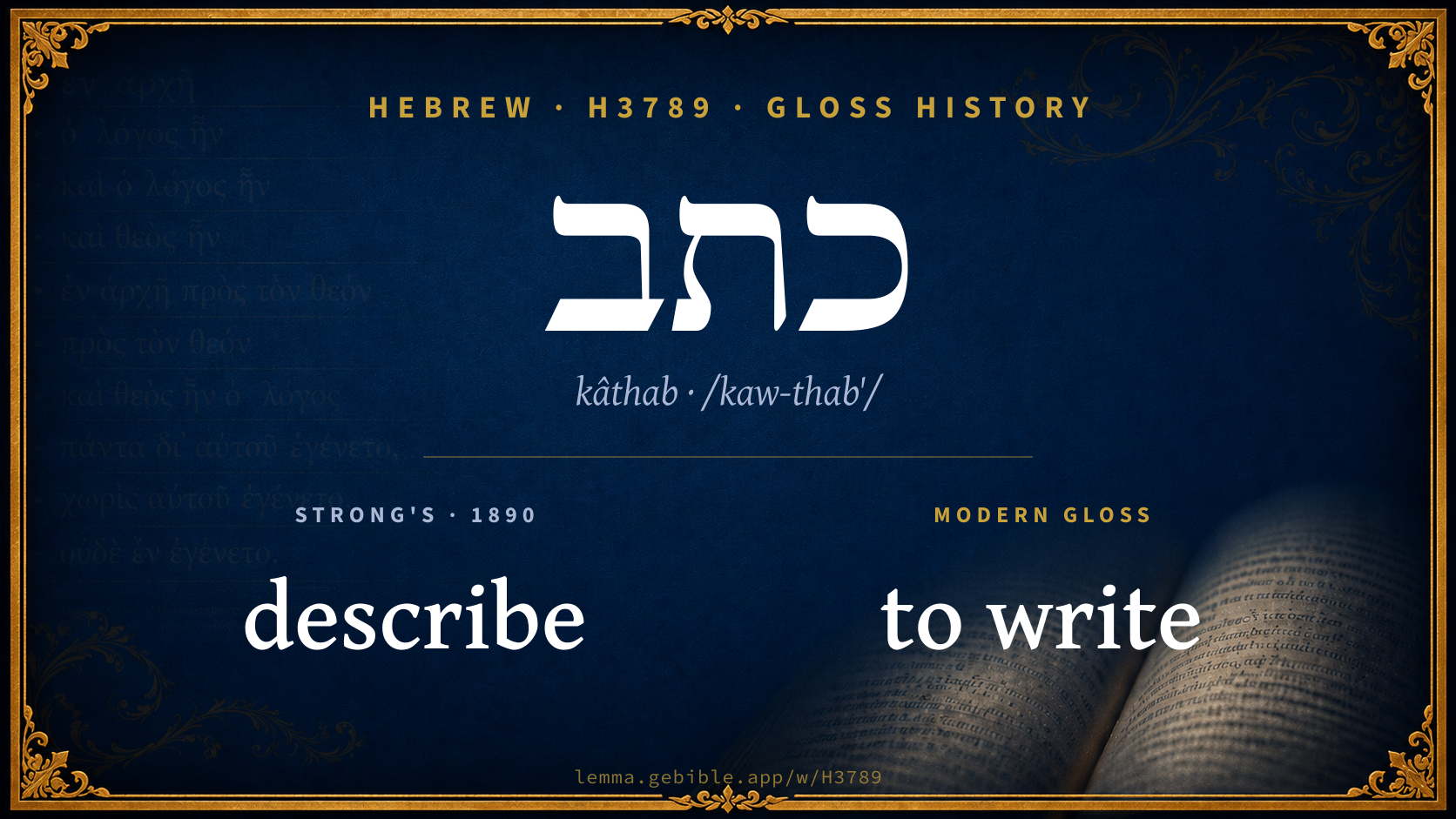
Gloss history
Strong's 1890 vs modern scholarship
About this word
Strong's H3789 catalogs a Hebrew word from the Hebrew Old Testament.
These counts are not copied from any lexicon or concordance. They are computed here, from the morphology-tagged Hebrew Old Testament. What Lemma adds →
- 212
- distinct verses
- The word appears in 212 distinct verses.
- 25 / 39
- OT books
- The word appears in 25 of 39 Old Testament books.
- #207
- by frequency
- Top 250 most frequent Hebrew words (rank 207 of 8,640 Hebrew words by occurrence).
View all 212 occurrences in the concordance →
Most concentrated in
- 2 Kings 30 verses 14%
- 2 Chronicles 27 verses 13%
- Deuteronomy 22 verses 10%
By section of the Old Testament
By traditional corpus
Conventional, traditional groupings — biblical authorship is debated, so this is a traditional corpus grouping, not an authorship claim. Each share is this word’s portion of its verses in that division of the Hebrew canon. Each figure is a share of the word’s 212 distinct verses.
- Prophets (Nevi'im) 98 verses · 46%
- Writings (Ketuvim) 77 verses · 36%
- Torah (Pentateuch) 37 verses · 17%
How translations render this word
Counts come from each version’s own published word-to-Strong’s tagging or interlinear alignment — an approximate guide to how each version renders this word, not a word-level alignment the data otherwise carries. Because each total is that version’s own tagged count, the per-version totals vary from one another and need not match the appearance or distinct-verse counts above. These counts may also differ from a printed concordance because Lemma counts each distinctly tagged rendering and does not collapse phrase taggings into a single head-word total. This is a fixed set of word-tagged versions (KJV, ASV, BSB, ULT) and does not change with the reading translation you choose elsewhere. Each version’s license is shown beside its name below (and on Sources).
- King James Version: Are they not written 32×, Write 20×, Wrote 18×
- American Standard Version: Are they not written 31×, Wrote 19×, Write 17×
- Berean Standard Bible: Written 60×, Is written 15×, Wrote 10×
- unfoldingWord Literal Text: Written 70×, Are 28×, And 15×
King James Version Public Domain
Renders H3789 across 223 tagged occurrences — most commonly:
Plus other, less common renderings. Plus 49 renderings that appear only once — usually multi-word phrases or single function words the recovered tagging swept in, not distinct renderings.
American Standard Version Public Domain
Renders H3789 across 223 tagged occurrences — most commonly:
Plus other, less common renderings. Plus 56 renderings that appear only once — usually multi-word phrases or single function words the recovered tagging swept in, not distinct renderings.
Berean Standard Bible Public Domain
Renders H3789 across 219 tagged occurrences — most commonly:
Plus other, less common renderings. Plus 64 renderings that appear only once — usually multi-word phrases or single function words the recovered tagging swept in, not distinct renderings. Not rendered by a distinct English word in 5 further occurrences.
unfoldingWord Literal Text CC BY-SA 4.0
Renders H3789 across 258 tagged occurrences — most commonly:
Plus other, less common renderings. Plus 40 renderings that appear only once — usually multi-word phrases or single function words the recovered tagging swept in, not distinct renderings.
12 senses and sub-senses in the full BDB
Hebrew verbs can shift meaning by stem (binyan): Qal is the basic action, Niphal is often passive or reflexive, Piel often intensifies or makes it factitive, and Hiphil is typically causative. The senses below are grouped under the stem BDB assigns to each.
What do BDB’s symbols mean?
BDB uses these scholarly abbreviations:
| Symbol | Meaning |
|---|---|
| 𝔊 | the Septuagint (the ancient Greek translation, LXX) |
| 𝔙 | the Vulgate (the Latin translation) |
| 𝔖 | the Syriac version (the Peshitta) |
| 𝔗 | the Targum (the Aramaic translation) |
| ψ | the Psalms |
| √ | root (the underlying root or stem) |
| ‖ | parallel passage (a synonymous or contrasted parallel) |
| † | the dagger: every passage where the word occurs is cited |
The 12 senses and sub-senses the full Brown-Driver-Briggs lexicon distinguishes for this word, in lexicon order (not ranked by frequency), with BDB’s own verbatim wording and sub-sense lettering. Shown in Hebrew script with BDB’s own scholarly abbreviations. The condensed entry is in the Lexicon Entry tab. See also the Forms in the corpus table below.
Qal
- Pf. כ׳ Jos 8:32 +, כָּתַבְתָּ Je 36:6 +, sf. וּכְתַבְתָּם consec. Dt 6:9; 11:20, etc. (Pf. 27 times); Impf. יִכְתֹּב Is 44:5, וַיִּכְתֹּב Ex 24:4 +, etc. (Impf. 39 times); Imv. כְּתֹב Is 8:1 + 5 times, כְּתָב־ Ex 34:27 + 2 times; sf. כָּתְבָהּ Is 30:8, כָּתְבֵם Pr 3:3; 7:3; pl. כִּתְבוּ Dt 31:9 + 3 times; Inf. abs. כָּתוֹב Je 32:44; cstr. כְּתוֹב ψ 87:6, לִכְתֹּב Dt 31:24 Jos 18:8; sf. כָּתְבוֹ Je 45:1; Pt. act. כֹּתֵב Je 36:18, pl. כֹּתְבִים Je 32:12 Ne 10:1; pass. (113 times), כָּתוּב Jos 1:8 +, f. כְּתוּבָה 2 S 1:18 +, pl. כְּתוּבִים 1 K 15:7 +, כְּתֻבִים 1 K 11:41 +; fpl. כְּתוּבוֹת 2 Ch 34:24;— e.g. Joshua 8:32
- 1. write:
- a. c. acc., words Ex 34:27, commandments 24:12, etc., acc. cogn. מכתב Ex 39:30, cf. כַּמִּכְתָּב Dt 10:4; with כְּ, giving purport of writing, also Est 8:8; but obj. also a book, סֵפֶר Ex 32:32 Dt 24:1; מְגִלָּה Je 38:6, cf. pt. pass., וְהִיא כְּתוּבָה פָּנִים וְאָחוֹר Ez 2:10 (of מגלה; i.e. written on both sides); a letter, סֵפֶר 2 S 11:14 2 K 10:1 + 4 times, אִגֶּרֶת 2 Ch 30:1; a divorce-certificate סֵפֶר כְּרִיתֻת Dt 24:1, etc.; even לֻחֹת כְּתֻבִים tablets inscribed by the finger of God Ex 31:18 cf. Dt 9:10; ל׳ כ׳ מִשְּׁנֵי עֶבְרֵיהֶם Ex 32:15 tables inscribed on both sides (cf. Ez 2:10 supr.) Here belongs (prob.) וְזֶה יִכְתֹּב יָדוֹ לי׳ Is 44:5 and this one shall inscribe his hand, ‘Yahweh’s,’ so 𝔊 Hi Kn Che Br Du Di, > Ges Ew De, shall sign (with) his hand unto י׳. e.g. Exodus 34:27
- b. more often write something on, or in (עַל־ 85 times, בְ 44 times, אֶל־ 3 times) a tablet, roll, book, etc. (obj. various, as above):—(1) כ׳ עַל־ sq. סֵפֶר = book Dt 17:18 + 55 times, especially in phr. כתובים על־ספר דברי וגו׳ 1 K 11:41 + often K Ch; כ׳ עַל־מְגִלָּה Je 36:2, 28, 32; 36:29; כ׳ עַל־לוּח(ות) Ex 34:1 + 7 times, עַל־אֶבֶן Dt 27:3 + 2 times, עַל־גִּלָּיוֹן Is 8:1; עַל־מְזֻזוֹת בַּיִת Dt 6:9; 11:20; עַל־מַטֶּה on a rod Nu 17:17, 18; עַל־עֵץ Ez 37:16(×2), עַל־צִיץ (high priest’s plate) Ex 39:30; even (only Ch) עַל־ sq. name of book or its contents:—כ׳ עַל־דִּבְרֵי נָתָן 2 Ch 9:29 cf. 33:19; עַל־מִדְרַשׁ וגו׳ 24:27; עַל־הַקִּינוֹת 35:25; fig., כ׳ עַל־לִבָּם Je 31:33 I will write them upon their heart; cf. כ׳ עַל־לוּחַ לִכֶּ֑ךָ Pr 3:3. (2) כ׳ אֶל־ appears for כ׳ עַל־ only Je 36:2 cf. Ez 2:10, Je 51:60. (3) כ׳ בְּ sq. ספר = book Jos 24:26 (E) + 35 times; = letter, bill, deed, 1 K 21:9 + 5 times; בִּמְגִלַּת סֵפֶר כָּתוּב עָלָ֑י ψ 40:8 it is prescribed to me, על as 2 K 22:13 (N. B. כ׳ על־ not used with סֵפֶר = letter, and כ׳ בְּ not used with לוּחַ, אבן or עֵץ). e.g. Deuteronomy 17:18
- c. other uses of prep. with כ׳ are:—בְּ instr., כ׳ בְּחֶרֶט אֱנוֹשׁ Is 8:1, כ׳ בְּעֵט בַּרְזֶל Je 17:1; כְּתֻבִים בְּאֶצְבַּע אֱלֹהִים Dt 9:10 Ex 31:18; כ׳ אֶל־ unto, of person to whom letter, etc., is addressed 2 S 11:14 2 K 10:6 Est 9:23; עַל־ subst. for אֶל־ (late) 2 Ch 30:1 Ezr 4:7 Est 8:8; the fuller construction is (אֶל־) כ׳ ספר וישׁלח 2 K 10:1 Est 8:10; 9:20 +; כ׳ אֶל־ write down for the benefit or use of some one, Ju 8:14; לְ to or for, Dt 17:18; 24:1 +; note especially אֶכְתָּו֯ב־לוֹ רֻבֵּו֯ תּוֹרָתִי Ho 8:12, i.e. either, I write (keep writing) for them ever so many (We, רֹב, cf. رُبّ; Ew and most רִבּוֹ(א) a myriad) of my directions, or ‘Though I write,’ ‘Were I to write,’ etc.; כ׳ sq. ל c. inf. of purpose 2 Ch 32:17 Est 8:5; c. מִן in phr. כ׳ מִפִּי פ׳ write from the mouth of any one, i.e. from dictation, †Je 36:2, 32; 38:6, 17, 27; 45:1. e.g. Isaiah 8:1
- 2. = write down, describe in writing, כ׳ אֶת־הָאָרֶץ Jos 18:4, 6, 8(×2), 9. e.g. Joshua 18:4
- 3. = register, enroll Is 10:19 (= record the number), 1 Ch 24:6; especially pass. הַכְּתוּבִים Nu 11:26 those enrolled cf. Ne 12:22; הַכּ׳ בְּשֵׁמוֹת 1 Ch 4:41 those recorded by name; in prediction, כ׳ אֶת־הָאִישׁ הַזֶּה עֲרִירִי Je 22:30 register this man as childless; with eschatol. reference, כַּל־הַכָּתוּב לַחַיִּים Is 4:3 all those enrolled (i.e. appointed) unto life; and, more explicitly, כָּל־הַנִּמְצָא כָּתוּב בַּסֵּפֶר Dn 12:1; י׳ יִסְפֹּר בִּכְתוֹב עַמִּים ψ 87:6 י׳ shall reckon, when he registers (note absence of suffix) the peoples, etc. e.g. Isaiah 10:19
- 4. = decree, תִּכְתֹּב עָלַי מְרֹרוֹת Jb 13:26 thou (י׳) decreest against me bitter things. e.g. Job 13:26
Niphal
- (chiefly late, especially Est.), Impf. יִכָּתֵב Est 1:19 +, 3 fs. תִּכָּ֫תֶב זֹאת ψ 102:19; 3 mpl. יִכָּתֵ֑בוּ Je 17:13 + 3 times, יִכָּֽתְבוּן Jb 19:23; Pt. נִכְתָּב Est 3:12 + 2 times;— e.g. Esther 1:19
- 1. be written, subj. words, Jb 19:23, book Mal 3:16; be written בְּסֵפֶר Est 2:23; 9:23, in, or among (ב) the laws Est 1:19; once, c. עַל־, עַל־סִפְרְךָ כֻּלָּם יִכָּתֵ֑בוּ ψ 139:16 in thy (י׳’s) book all of them (my members) are written, i.e. written down, recorded (v. infr.); abs. כְּתָב אֲשֶׁר נִכְתָּב בְּשֵׁם הַמֶּלֶךְ Est 8:8 a writing which is written in the king’s name, cf. (impers.) 3:12; impers. also וַיִּכָּתֵב כְּכָל־אֲשֶׁר צִוָּה Est 3:12; 8:9; יִכָּ׳ sq. לְ = for ψ 102:19; sq. לְ + inf. (really = a subject-cl.,—the contents of the letter) Est 3:9; 8:5. e.g. Job 19:23
- 2. be written down, recorded, Ezr 8:34; enrolled, בִּכְתָב בית ישׂראל לֹא יִכָּתֵ֑בוּ Ez 13:9 in the enrolment of the house of Israel they are not enrolled (eschatolog.); וְעִם־צַדִּיקִים אַל־יִכָּתֵ֑בוּ ψ 69:29 (‖ חַיִּים יִמָּחוּ מִסֵּפֶר).—בָּאָרֶץ יִכָּתֵ֑בוּ Je 17:13 is difficult; Gie reads, plausibly, מֵאֶרֶץ יִכָּרֵ֑תוּ (cf. ψ 34:17; 101:8, etc.) e.g. Ezra 8:34
Piel
- frequent., Pf. and Pt., only כִּתֵּ֑בוּ וּמְכַתְּבִים עָמָל Is 10:1 and busy writers that make a business of writing oppression (i.e. register unjust sentences, cf. Qal 4; ‖ הַחֹקֲקִים חִקֲקֵי־אָוֶן). e.g. Isaiah 10:1
Senses from the full Brown-Driver-Briggs lexicon (Brown, Driver, Briggs; Oxford 1906 — public domain), digitized via Sefaria, supplemented by the OpenScriptures HebrewLexicon (CC BY 4.0). Full attribution on Sources.
Word origin
vb. write (NH id.; Ph. כתב; Aramaic כְּתַב, ܟܬܰܒ; Nab. כתב, v. especially Nö in EutNab. p. 43; thence Arabic كَتَبَ, Ethiopic ክታብ: book, Di Lex. 852 (as loan-wds., Frä 249 DHM VOJ i (1887), 29); MV Buhl comp. Arabic كَتَبَ draw or sew together, conjoin (letters), etc., cf. Fl ZMG 1873, 427)—
— Brown-Driver-Briggs (Oxford 1906, public domain), digitized via Sefaria, supplemented by the OpenScriptures HebrewLexicon (CC BY 4.0). See Sources.
Origin: a primitive root
Jastrow Dictionary
A second Hebrew/Aramaic lexicon for comparison, covering Aramaic and post-biblical (Talmudic, Targumic, Midrashic) usage that the biblical-Hebrew BDB does not. Matched by lemma rather than by Strong’s number, so a lemma may carry more than one Jastrow headword (shown separately below), and the entries cover usage well beyond the Bible.
כָּתַב
- H. Dict. s. v.) [to join sign to sign,] to compose, write; to promise in writing, to will, assign, consign. Gitt. 20ᵃ וכ׳ ולא חקק it says (Deut. XXIV, 1) ‘and he shall write’ but not engrave; Y. ib. II, 44ᵇ top, v. כְּתִיבָה. Macc. III, 6 (ref. to Lev. XIX, 28) עד שׁיִכְתּוֹב וכ׳ unless he writes (designs) and etches with ink, stibium or anything that marks; Sifra K’doshim, Par. 3, ch. VI, v. כְּתוֹבֶת.—Meg. 9ᵃ כִּתְבוּ לי תורת וכ׳ write (translate) for me the Law &c. Ib. 7ᵃ כִּתְבוּנִי בספר Ms. M. (ed. לדורות) write me down (record my deeds) in a book (Book of Esther). Ex. R. s. 47, beg. כְּתוֹב אתה write thou thyself. Sabb. XII, 3 הכּוֹתֵב וכ׳ he who writes two letters (on the Sabbath). Ib. 5 נתכוין לִכְתּוֹב ח"ית if he intended to write a Ḥeth.—Keth. IX, 1 הכּוֹתֵב לאשתו וכ׳ he who declares to his wife &c.; ib. 83ᵃ תני ר׳ חייא האומר R. Ḥ. interpreted it, ‘he who says’ (verbally). Ib. 102ᵇ מאי כּוֹתְבִין אומרים ‘they write’ (in the Mishnah) means merely they declare. Ib. V, 1 והיא כוֹתֶבֶת וכ׳ and she may write (a receipt), I have received &c.—Pes. 50ᵇ כּוֹתְבֵי ספרים וכ׳ copyists of sacred books, or T’fillin &c. B. Bath. 14ᵇ משה כ׳ ספרו וכ׳ Moses is the author of his book, the chapter of Balaam, and the Book of Job; a. v. fr.—Part. pass. כָּתוּב, f. כְּתוּבָה; pl. כְּתוּבִים, כְּתוּבִין; כְּתוּבוֹת. Meg. 31ᵃ דבר זה כ׳ בתורה וכ׳ this is written in the Law, and repeated in the Prophets &c. Ib. 7ᵃ כבר כ׳ אני וכ׳ I am already recorded in the chronicles of &c. Y. Shek. VI, 49ᵈ bot. כיצד היו הלוחות כ׳ how was the writing on the tablets arranged?—Gitt. 54ᵇ כל ס"ת … כ׳ לשמן any scroll of the Law in which the Divine names are not written with full consciousness, v. שֵׁם; a. fr.—V. כָּתוּב. e.g. Deuteronomy 24:1
- to be written, be reduced to writing; to be written upon. Meg. I, 8 הספרים נִכְתָּבִים בכל לשון the Biblical books may be written in (translated into) any language (v. ib. 9ᵃ); ib. לא התירו שׁיִכָּתְבוּ וכ׳ they permitted them to be translated only into Greek. Ib. 7ᵃ נאמרה לִיכָּתֵב was indited (by the divine spirit) for the purpose of being written (as a book); Yoma 29ᵃ נתנה ליכתב (some ed. לִכְתּוֹב); a. v. fr.
- 1. to cause to be written or recorded, to dictate, indite. Gen. R. s. 22 כבר הִכְתַּבְתִּי לך וכ׳ I have already ordered to be written in the Law &c. Ruth R. to II, 14 אילו היה ראובן יודע שהק"בה מַכְתִּיב עליו וכ׳ if R. had known that the Lord would cause to be written about him (Gen. XXXVII, 21) &c.; a. fr.—Lev. R. s. 24 ג׳ פרשיות ה׳ לנו וכ׳ (Pesik. R. s. 15; Yalk. Ex. 307 כתכ) there are three sections that Moses indited for us in the Law. e.g. Genesis 37:21
- 2. to consign, enlist in the army, levy. Ex. R. s. 15 (מלך) ב"וד מַכְתִּיב לו וכ׳ a human king levies soldiers for himself, strong &c.; Tanḥ. Ḥayé 3 מסביב (corr. acc.). Cant. R. to II, 8, a. e. מַכְתֶּבֶת, v. טִירוֹנְיָא.—Part. pass. מוּכְתָּב recorded; levied. Kidd. IV, 5, v. אִסְטְרַטְיָא II.—Tosef. B. Bath. IV, 7; B. Bath. 92ᵇ; Keth. 58ᵃ מ׳ למלכות levied for royal service (comment.: sentenced to death); Kidd. 11ᵃ נִכְתָּב.—Gen. R. s. 89 (Yalk. ib. 147 כתיב), v. סַקְרָרִין.
כְּתַב I
- Targ. Deut. VI, 9 (v. Berl. Targ. O. II, p. 51). Ib. XXXI, 24. Targ. Josh. XVIII, 4; a. v. fr.—Part. pass. (כְּתוּב) כְּתִיב. Targ. Ex. XXXI, 18. Targ. O. Num. XI, 26 (Y. כתוביא); a. fr.—B. Kam. 88ᵃ bot. כְּתַבְתִּינְהוּ לניכסי וכ׳ she willed her property to &c. Gitt. 20ᵃ איהי קא כָתְבָה ליה she (the wife) had it written (at her expense). B. Bath. 168ᵇ ולִיכְתּוֹב לן מר וכ׳ write for us another document (copy) in addition to this; a. v. fr.—Sabb. 115ᵇ היכא דכְתִיבֵי תרגום וכ׳ when the books are written in Chaldaic or any other tongue (than Hebrew); a. fr.—Esp. (in arguments on Biblical texts) כ׳ or כ׳ רחמנא the Lord has written, the text reads. Pes. 21ᵇ טעמא דכ׳רחמנא וכ׳ this is so because the text reads לא יֵאָכֵל (passive voice), but if it did not read so &c. Ib. לִכְתּוֹב רחמנא וכ׳ it ought to read &c. Ber. 3ᵇ א"ה לכתוב מהנשף וכ׳ if this were so (that נשף invariably means evening), it ought to read (I Sam. XXX, 17) מהנשף ועד הנשף; a. v. fr.—כְּתִיב it is written, it reads (used also in Hebr. diction). Ib. 13ᵇ דִּכְ׳ לדבר בם for it says (Deut. XI, 19) ‘to speak thereof’; ה"נ הא כ׳ ודברת בם here, too, (in the first part of the Sh’ma) it says (VI, 7), ‘and thou shalt speak thereof’!—Meg. 10ᵇ כ׳ הכא ויהי … וכ׳ התם ויהי here (Lev. IX, 1) vayhi is used, and there (Gen. I, 5) vayhi is used. Ib. והָכְ׳, והא כ׳ but does it not also read &c.?—Gen. R. s. 1 ומאי כ׳ אחריו and what do we read after this?—הדא הוא דכ׳, v. דָּא I.—Snh. 71ᵃ, a. e. בעינן קרא כְּדִכְ׳ we must construe the Biblical text as it is written (literally, e.g. Mish. ib. VIII, 4 as an interpretation of Deut. XXI, 19); a. v. fr.—B. Kam. 66ᵃ שינוי קונה כְּתִיבָה ותנינא כ׳ that a change of form of a stolen object gives possession (compelling the thief to restore in value) is written (intimated in the Biblical text) and has been taught in the Mishnah.—V. כְּתִיב. e.g. 1 Samuel 30:17
- to be written, recorded &c. Targ. Esth. I, 19. Targ. Ps. XL, 8. Ib. LXXXVII, 6 דמִכָּתְבִין Ms. (ed. דמְכַתְּבִין Pa.); a. fr.—Meg. 7ᵃ דאיבעי איכתיב וכ׳ (Ms. M. מאי דבעי כתיב, v. Rabb. D. S. a. l. note; Rashi: דאי בעי כתב) that which was liked was written down &c.; a. fr.
כְּתָב
- preced.) writing, writ; character. Ab. V, 6; Pes. 54ᵃ; Sifré Deut. 355 (of things created in the last hour of the sixth day) הכתב והמִכְתָּב the art of writing and the writing on the tablets (Ex. XXXII, 16; Rashi to Pes. l. c. והמְכַתֵּב and the pencil); Mekh. B’shall., Vayassa, s. 5 only כתב. Ab. Zar. 10ᵃ אין להם לא כ׳ ולא לשון they (the Romans) have neither (original) types nor language; Gitt. 80ᵃ (of פרסיים!). Y. Meg. I, 71ᵇ bot., v. אַשּׁוּרִי. Snh. 21ᵇ; Meg. 8ᵇ כ׳ עברי(ת), v. לִיבּוֹנָאָה. [Ib. עד שיכתבנו בכתב אשורית, strike out בכתב, v. Rabb. D. S. a. l., a. Meg. 9ᵃ.]—תורה שֶׁבִּכְּ׳ written Law, opp. שבעל פה. Yoma 28ᵇ; a. fr.—Meg. 18ᵇ שלא מן הכ׳ without a written copy, from memory.—Pes. 21ᵇ, a. e. דברים כִּכְתָבָן וכ׳ וכ׳ construe the Biblical words as they are written (Deut. XIV, 21), to the resident stranger give it as a present, to the foreigner sell it.—כְּתַב יד signature. Keth. II, 3 sq.; a. fr.—Tosef. B. Kam. VII, 4 כ׳ היכר יד שלו.—Gen. R. s. 48 בכל מקום … הכ׳ רבה על הנקודה אתה דורש את הכ׳ וכ׳ wherever you find in the Biblical text the plain writing, i.e. the number of undotted letters in a word, prevailing over the number of the dotted, you must interpret the undotted (ignoring the dotted); where the dotted prevail, you must interpret the dotted, e.g. א̇לי̇ו̇ (Gen. XVIII, 9) read אַיּוֹ, where is he (Abraham)?; ib. s. 78; Cant. R. to VII, 5.—Tosef. Meg. IV (III), 41 (ref. to II Kings X, 27 מחראות) קורין אותו ככְתָבוֹ we read it as it is written (not as emended in the K’ri); a. fr.—Pl. כְּתָבִים, כְּתָבִין. Tanḥ. Masé 1; Num. R. s. 23, beg. כ׳ רעים מן המלכות government papers containing orders of hard measures against the Jews. Esth. R. introd. כְּתָבָיו של מלך royal decrees. Ex. R. s. 20 עד שילמוד בני כ׳ (some ed. כתובין) until my son shall have studied documents; a. e. e.g. Exodus 32:16
כְּתַב II
- Targ. Y. Lev. XIX, 28 (h. text כְּתֹבֶת).—Targ. Y. Gen. XLVIII, 9 (marriage contract, v. כְּתוּבָּה). Targ. Ex. XXXII, 16 (h. text מכתב); a. fr.—Lev. R. s. 28, end מה דאמר כְּתַבְכוֹן what your sacred writ says.—Pl. (כָּתְבִין) כְּתָבִין, כִּתְבִין, כִּתְבֵי. Targ. II Esth. IV, 12. Ib. VII, 10; a. e.—Gen. R. s. 10; Lev. R. s. 22 כ׳ בישין וכ׳ evil decrees against the Jews of Caesarea (v. preced.); Tanḥ. Ḥuck. 1.
תַּב
- to give, v. יְתֵב II.
A Dictionary of the Targumim, the Talmud Babli and Yerushalmi, and the Midrashic Literature (Marcus Jastrow; London, Luzac, 1903) — Public Domain. Digitized via Sefaria. Digitized via Sefaria. Full attribution on Sources.
Forms in the corpus
The 132 distinct written forms H3789 takes in the Hebrew Bible, most frequent first — each parse links to that stem’s occurrences in the concordance. Hebrew forms include their vowel points and cantillation, so a single lemma takes many written forms.
The 60 most common forms are shown; 72 rarer forms follow in the full concordance.
Same root — word family
Other BDB entries built from the same root as H3789, grouped by Strong’s listed origin. These share a root / origin per the lexicon — not necessarily a shared meaning. Each links to that word’s own entry.
Derived from this word
- כתב kᵉthab H3790 to write
- כתב kâthâb H3791 writing
- כתבת kᵉthôbeth H3793 mark
- מכתב miktâb H4385 writing
Compare all same-root words → Showing 4 of 5 — not the complete family. They share a root, not necessarily a meaning.
Septuagint verse parallels
This word appears in 188 verses that also exist in the Greek Old Testament (Septuagint), out of the 212 Hebrew verses it occurs in. You can read those verses in Greek by switching the Old Testament edition to the Septuagint.
Read these verses in the Septuagint
- Exodus 17:14
- Numbers 5:23
- Deuteronomy 4:13
- Joshua 1:8
- Judges 8:14
- 1 Samuel 10:25
- 2 Samuel 1:18
- 1 Kings 2:3
- 2 Kings 1:18
- 1 Chronicles 4:41
- 2 Chronicles 9:29
- Ezra 3:2
This is a verse-level parallel only — the same verses exist in both the Hebrew and Greek Old Testaments. No word-level Hebrew↔Greek correspondence is claimed: the data carries no such alignment, so no Greek word is shown as this Hebrew word’s translation. Coverage is not total — the Septuagint omits the deuterocanon and renumbers the Psalms, so some Hebrew verses have no direct Greek parallel.