
Psalms 87:6

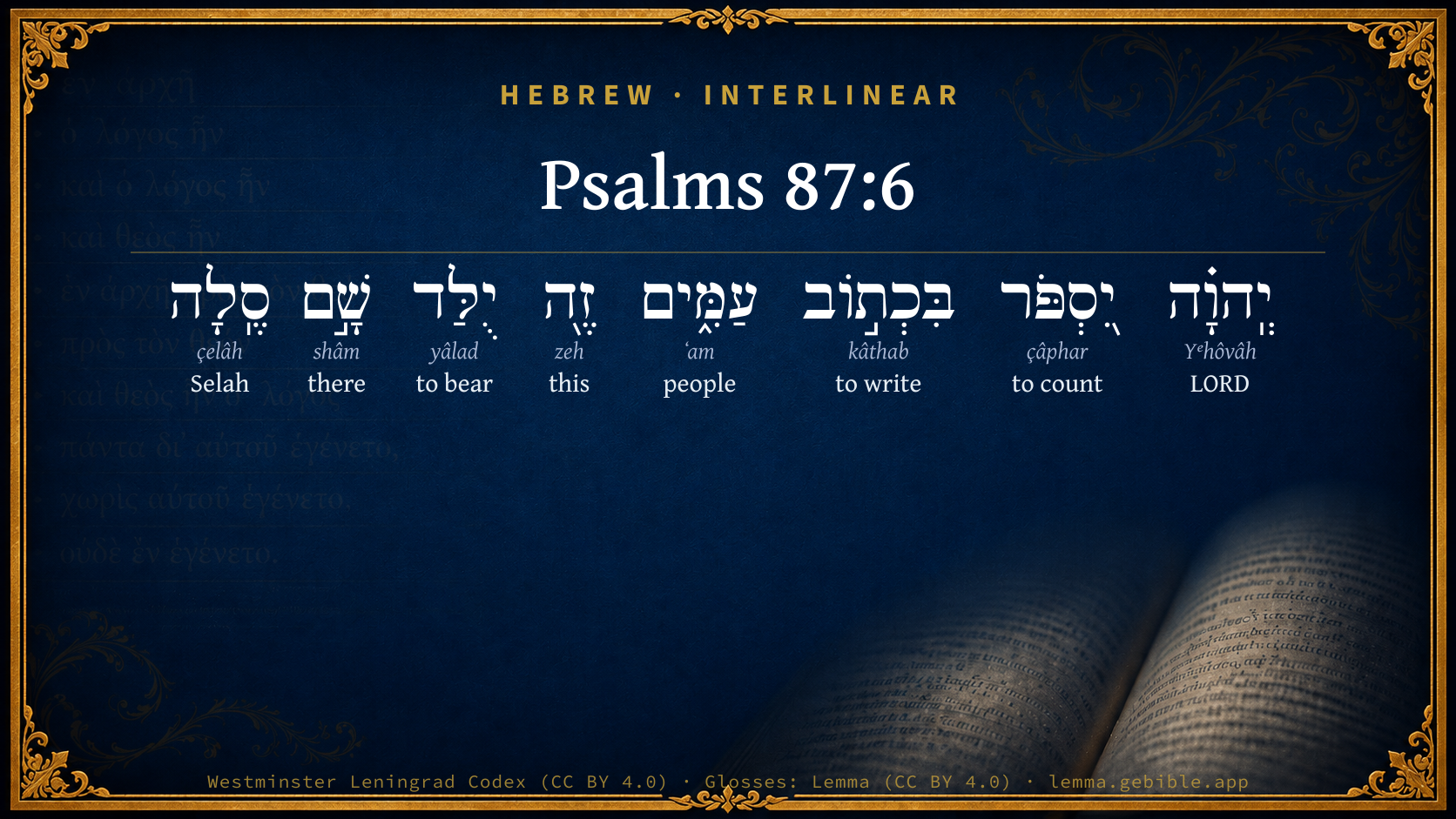
Hebrew (Westminster Leningrad Codex) Psalms 87:6 appears in the Hebrew Old Testament. The text above is from the Westminster Leningrad Codex. Each word links to its Strong’s number, a concise gloss, and parsing drawn from the Open Scriptures Hebrew Bible morphology. Click any word for its full Brown-Driver-Briggs (BDB) entry.
Download image
Cite this verse

Psalms 87:6 (World English Bible). Public Domain. Lemma interlinear Bible study tool, https://lemma.gebible.app/v/psalms/87/6.

Show BibTeX & RIS
BibTeX
RIS
English Translation
Yahweh will count, when he writes up the peoples, "This one was born there." Selah.
World English Bible · Public Domain
Download a study sheet

One document with this verse’s original text, its word-by-word gloss line, the meaning frame, cross-references with their text, attributed commentary, and full source and license credits — printable, and it pastes into notes with its structure intact.

This verse Autodidact and up

Study sheet (.html) Plain text (.txt)

A passage Seminary Student

Up to 50 verses in one chapter. A passage sheet keeps up to 6 commentary sources and 12 cross-references per verse, in the order this page ranks them, and says so on the sheet whenever that leaves anything out. Ask for a single verse and you get the Autodidact verse sheet above.

Everything on this page stays free to read, with no account — the sheet is a download of what is already on screen, not access to it.

Want to remove ads? Support Godless Engineer
Compare translations 3

The same verse in 3 English versions, stacked beneath the original-language interlinear above. Click any original word for its lexicon entry.

Each is an independent rendering of the whole verse — the interlinear is not word-aligned to these translations.

Highlighted words mark where these versions differ — a whole-verse word diff, not a word-by-word alignment.

  • World English Bible Public Domain
    Yahweh will count, when he writes up the peoples, "This one was born there." Selah.
  • King James Version Public Domain
    The LORD shall count, when he writeth up the people, that this man was born there. Selah.
  • unfoldingWord Literal Text CC BY-SA 4.0
    Yahweh will recount in the writing of the peoples, “This was born there.” Selah

unfoldingWord Literal Text — © unfoldingWord, licensed CC BY-SA 4.0. Word-aligned USFM3 via Door43 (git.door43.org/unfoldingWord/en_ult).

Versions to compare (up to 4)

3 of 4 selected

Show all 18 translations

Every available English version of this verse, each an independent rendering of the whole verse.

  • World English Bible Public Domain
    Yahweh will count, when he writes up the peoples, "This one was born there." Selah.
  • Berean Standard Bible Public Domain
    The LORD will record in the register of the peoples: “This one was born in Zion.” Selah
  • Majority Standard Bible Public Domain
    The LORD will record in the register of the peoples: “This one was born in Zion.” Selah
  • King James Version Public Domain
    The LORD shall count, when he writeth up the people, that this man was born there. Selah.
  • American Standard Version (1901) Public Domain
    Jehovah will count, when he writeth up the peoples, This one was born there. Selah
  • Revised Version (1885) Public Domain
    The LORD shall count, when he writeth up the peoples, this one was born there. Selah
  • Geneva Bible (1599) Public Domain
    The Lord shall count, when hee writeth the people, He was borne there. Selah.
  • Douay-Rheims (1899) Public Domain
    The Lord shall tell in his writings of peoples and of princes, of them that have been in her.
  • Young's Literal Translation Public Domain
    Jehovah doth recount in the describing of the peoples, `This `one' was born there.' Selah.
  • Literal Standard Version CC BY-SA 4.0
    YHWH recounts in the describing of the peoples, “This [one] was born there.” Selah.
  • Unlocked Literal Bible CC BY-SA 4.0
    Yahweh writes in the census book of the nations, “This one was born there.” Selah
  • unfoldingWord Literal Text CC BY-SA 4.0
    Yahweh will recount in the writing of the peoples, “This was born there.” Selah
  • Darby Bible Public Domain
    Jehovah will count, when he inscribeth the peoples, This [man] was born there. Selah.
  • World Messianic Bible Public Domain
    The LORD will count, when he writes up the peoples, “This one was born there.” Selah.
  • Webster's Bible Public Domain
    The LORD shall count, when he writeth up the people, that this man was born there. Selah.
  • Free Bible Version CC BY-SA 4.0
    When the Lord registers the nations, he will write, “They were born there.” Selah.
  • Bible in Basic English Public Domain
    The Lord will keep in mind, when he is writing the records of the people, that this man had his birth there. (Selah.)
  • JPS Tanakh (1917) Public Domain
    The LORD shall count in the register of the peoples: 'This one was born there.' Selah

Literal Standard Version (2020), Covenant Press — licensed CC BY-SA 4.0. Text via the HelloAO Bible API (eBible.org). Unlocked Literal Bible (unfoldingWord) — licensed CC BY-SA 4.0. Text via the HelloAO Bible API (eBible.org). unfoldingWord Literal Text — © unfoldingWord, licensed CC BY-SA 4.0. Word-aligned USFM3 via Door43 (git.door43.org/unfoldingWord/en_ult). Free Bible Version, Dr. Jonathan Gallagher — licensed CC BY-SA 4.0. Text via the HelloAO Bible API (eBible.org).

Word by word

More ways to search: Search by grammar → Find every occurrence → Compare this word →

Practice this passage: Drill this verse → Learn its vocabulary →

About this verse

These counts appear in no published source. They are computed here, from the morphology-tagged text and Lemma’s own curated glosses. What Lemma adds →

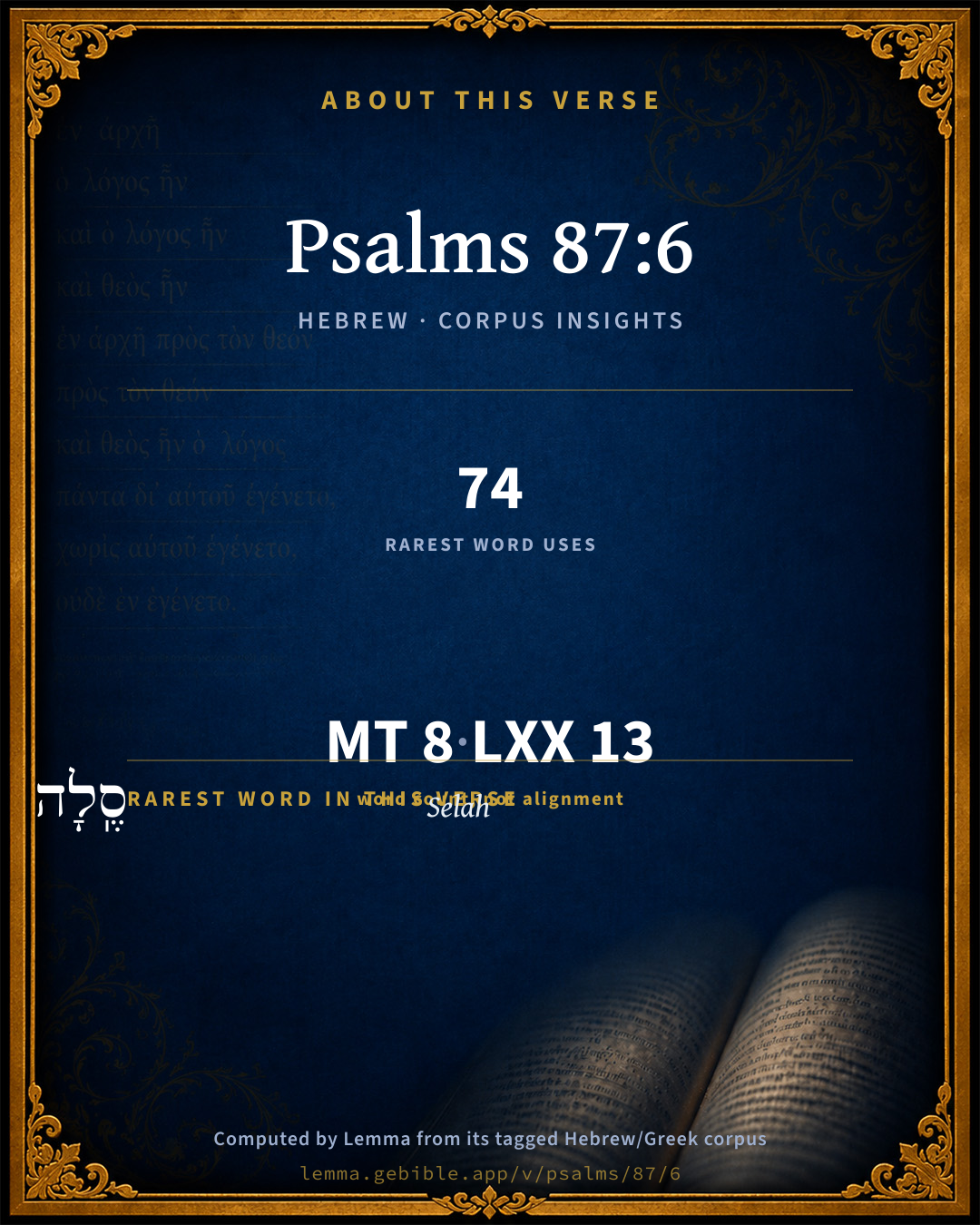
8
words
8
distinct lemmas
Wisdom
section

Grammatical profile

  • 3 verbs
  • 2 nouns
  • 1 pronoun
  • 1 adverb
  • 1 particle

Verb forms

  • יִ֭סְפֹּר Qal · Imperfect
  • בִּכְת֣וֹב Qal · Infinitive Construct
  • יֻלַּד Pual · Perfect

Hebrew & Septuagint length

In English translation the verse runs 15 words from the Hebrew and 20 from the Septuagint (LXX English) — closely comparable.

A rough comparison of the two English renderings, which tokenize alike — not a word-level alignment.

Word counts can differ between the Hebrew and the Greek without any difference in meaning — e.g. the Hebrew direct-object marker אֵת has no separate Greek word, and Greek often adds the article ὁ.

In the original languages it is 8 Hebrew tokens and 13 Greek tokens — but the two are counted differently (Hebrew bundles its prefixes and suffixes into one token; the Greek is in lemma form), so that isn’t a like-for-like length.

Cross-references

11

Topical passages linked to Psalms 87:6 in the Treasury of Scripture Knowledge — connected by theme and wording, ordered by reader-vote popularity; previews shown in the World English Bible.

  • Isaiah 4:3 It will happen, that he who is left in Zion, and he who remains in Jerusalem, shall be called holy, even everyone who is written among the living in Jerusalem;
  • Luke 10:20 Nevertheless, don't rejoice in this, that the spirits are subject to you, but rejoice that your names are written in heaven."
  • Ezekiel 13:9 My hand shall be against the prophets who see false visions, and who divine lies: they shall not be in the council of my people, neither shall they be written in the writing of the house of Israel, neither shall they enter into the land of Israel; and you shall know that I am the Lord Yahweh.
  • Revelation 20:15 If anyone was not found written in the book of life, he was cast into the lake of fire.
  • Psalms 69:28 Let them be blotted out of the book of life, And not be written with the righteous.
  • Philippians 4:3 Yes, I beg you also, true yoke-fellow, help these women, for they labored with me in the Gospel, with Clement also, and the rest of my fellow workers, whose names are in the book of life.
  • Psalms 22:30 Posterity shall serve him. Future generations shall be told about the Lord.
  • Jeremiah 3:19 But I said, How I will put you among the children, and give you a pleasant land, a goodly heritage of the hosts of the nations! and I said, You shall call me My Father, and shall not turn away from following me.
  • Revelation 13:8 All who dwell on the earth will worship him, everyone whose name has not been written from the foundation of the world in the book of life of the Lamb who has been killed.
  • Ezekiel 9:4 Yahweh said to him, Go through the midst of the city, through the midst of Jerusalem, and set a mark on the foreheads of the men that sigh and that cry over all the abominations that are done in the midst of it.
  • Galatians 4:26–31 But the Jerusalem that is above is free, which is the mother of us all.

Cross-references courtesy of OpenBible.info (CC BY 4.0).

Hebrew and Greek witnesses Masoretic Hebrew ↔ Greek Septuagint

The same verse in the two great witnesses to the Old Testament, shown verse-for-verse.

You’re reading Greek Psalm 86 (Hebrew Psalm 87). The Septuagint counts the superscription, so verse numbers can differ from the Hebrew — chapter-level alignment, not verse-by-verse. Numbering follows Rahlfs.

These are two independent witnesses, not word-aligned to each other, and the Septuagint is shown in lemma (dictionary) form.

Hebrew Psalms 87:6 Masoretic · Westminster Leningrad Codex

יְֽהוָ֗ה יִ֭סְפֹּר בִּכְת֣וֹב עַמִּ֑ים זֶ֖ה יֻלַּד שָׁ֣ם סֶֽלָה

Yahweh will count, when he writes up the peoples, "This one was born there." Selah.

World English Bible · Public Domain

Greek LXX Greek Psalm 86:6 Septuagint · lemma form

κύριος διαἡγέομαι ἐν γραφή λαός καί ἄρχων οὗτος ὁ γίγνομαι ἐν αὐτός διάψαλμα

The Lord shall recount it in the writing of the people, and of these princes that were born in her.

LXX2012 (modern English Septuagint) · Public Domain

Hebrew: Westminster Leningrad Codex (CC BY 4.0). Greek: Septuagint (public domain); English from LXX2012 (modern English Septuagint) (Public Domain). How the Septuagint differs from the Hebrew →

Commentary

Notes on Psalms 87:6 from classic Christian and Jewish commentators (each source and its license shown beneath its notes). The classic Christian expositions comment on the surrounding passage and are grouped to its opening verse, so a note may address several verses; the Jewish commentaries on the Tanakh (Rashi and others) are per-verse, so they appear only where the commentator wrote on this verse.

Lemma curates 59 commentaries, every one of them public domain or Creative Commons licensed, each selected and text-cleaned for this edition rather than reprinted as found. About our sources →

Trapp's Complete Commentary

John Trapp

Psa 87:6 The LORD shall count, when he writeth up the people, [that] this [man] was born there. Selah.

Ver. 6. The Lord shall count when he writeth up the people] When he maketh his cease book (called the writing of the house of Israel, Eze 13:9, the Lord’s book of remembrance, Mal 3:16, the register of the living in Jerusalem, Isa 4:3), he shall muster them in the roll of his soldiers, number them in the catalogue of his citizens, call them in the nomenclature of his disciples, &c. A glorious privilege surely.

John Trapp, A Commentary or Exposition upon All the Books of the Old and New Testament (1647–1656) — public domain. Text from a community e-Sword module.

The Biblical Illustrator

Joseph S. Exell

Psa_87:6

The Lord shall count, when He writeth up the people, that this man was born there.

The last census

I. When this dispensation shall come to its close, when the Lord Jesus Christ shall come in the clouds of heaven, then we believe the Lord shall write up His people. What will this writing be?

1. There will be written in this census nothing but personal matters. This man was born there. They are not taken in the plural--these men. They are not taken as a corporate body--this nation, this Church, this family--but one by one each mans name shall be found either written there or else left out. There is no truth which we need more frequently to hold up before the eyes of our people than the truth that nothing but personal godliness will ever avail.

2. Again, you will perceive that this great census deals not merely with personal matters, but with vital matters which concern a mans birth. Here you have it that this man was born there. Tis true the things we have thought and those we have done shall be mentioned at the last, but not for their own sakes. They shall be mentioned only as means of proving that we were born again, or else as evidence that regeneration had never taken place in us.

3. This census will be decisive--the last polling of the people, the last counting of the jewels and casting away of the counterfeits, the last bringing in of the sheep and banishment of the goats. Oh that we were wise to look into futurities!

II. Whose names will not be found written when the Lord counteth up His people.

1. The name of the hypocritical Church member will not be found there.

2. The man who is a mere hearer.

3. Those who are living in vice and open sin, and die as they live.

4. Moralists.

III. Whose name will be found there? We reply, there shall be the name of every soul that ever believed in the Lord Jesus Christ.

IV. Who is to make out the census paper? The Lord shall count when He writeth up the people. But why shall the Lord make out the census? Who else should do it? God is only wise. We will not question this man or that, this denomination or that. It is not for us to use our fingers to count the brands plucked from the burning, but to use our hands to pluck them from the fire, and we will pass the roll to the only wise God, and He shall at the last decide whether they be His or no.

V. Why will the census be taken at all? The Lord counts up His people--

1. To show His value of them.

2. To show to Satan his entire defeat.

3. To let all men see that the great riddle which has distracted human intellect was no riddle but a fact. God is glorified, and man free. (C. H. Spurgeon.)

The correct census

I. The counting. A census is no new thing. Refer to the history of Jacob, the time of Pharaoh, etc. Churches have their census. This describes the final census--

1. It will be an individual counting. This man was born there. The question not one of reformation, but of regeneration.

2. It will be unalterable. It will be final (Rev_22:11). It is of supreme importance to have our name written in the Lambs Book of Life. Seek to have it registered now.

II. The counter. The Lord shall count. What a mercy. Man might accidentally omit, or through partiality insert some name, but it is well that the Lord should be the Presiding Officer because of--

1. His intimate acquaintance with every one. The Lord knoweth them that are His. He cannot therefore be deceived. To Him all hearts are open. We may profess and call ourselves Christians, but our profession will be worthless unless our name be inserted in the heavenly register.

2. His unfailing accuracy. No name omitted or inserted in error. The totals will agree. Man may err, but His accuracy none can call in question.

III. The counted. Whose name will be found in the register? Only his who has been born again, i.e. born from above. I may be the weakest of them that love Him, but if I have been born there, I shall not be disowned. If we share in the bond of the covenant, we shall also share in the blessedness of the covenant. Will He count me? Except a man be born again, etc. (Samuel Oliver.)

God takes the census

Why should the Lord make out the census? The reason is--who else could do it? Imagine for a moment that the pen could be given to the Pope of Rome. I am sure he would omit yours and mine, because we are not obedient to the Pontifical See; and even if he were under authority and command, I am sure he would make a great splutter in trying to write the name Martin Luther, and he would throw down his pen and utterly refuse to obey if he had to write the glorious name of John Calvin. Suppose, now, we put the pen into the hand of Bigotry--Bigotry who lives not quite so far off as Italy, but takes up her residence in our own land, and hard by our abode. I think I see her, with her face bitter as wormwood, and with her eyes full of darkness, and she, having written all the names down, reads, There be few that shall be saved; they be so few that a child can count them.. . . God, and God only--God the only wise--shall have the writing up of the people, for there is no one to be found but God who could do it. (C. H. Spurgeon.)

The Biblical Illustrator, edited by Joseph S. Exell (c. 1880s–1900s) — public domain. Text from a community e-Sword module.

Joseph Benson's Commentary

Psa 87:6. The Lord, shall count, when he writeth up the people — In the book of life, that register of heaven, kept by God himself, in which men’s names are entered, not as born of flesh and blood, by the will of man, but as born of the Spirit, by the will of God; that this man was born there — By a spiritual birth, and therefore, that he is a genuine and free citizen of Zion, that is, God shall esteem such a one, though of Gentile race, a true member of his church, when he takes a particular account and survey of all his citizens and subjects. The psalmist alludes to the custom of princes or governors of cities, who used to write and preserve a register of all their people. Observe, reader, the birth here spoken of, the second birth, the birth from above, not of water merely, but of the Spirit, producing love to God, deadness to the world, and holiness of heart and life, (1Jn 4:7; 1Jn 5:4; 1Jn 3:9; 1Jn 5:18,) is the only birth we ought to value ourselves upon, because this alone gives us a title to “the inheritance of the saints in light.” Such, and only such, are written among the living in Jerusalem, Isa 4:3. Or, written in the writing of the house of Israel, Eze 13:9. Or, in the language of the New Testament, such only have their names in the Lamb’s book of life, Php 4:3. And we know the consequence of not being found written there: see Rev 20:15.

Joseph Benson's Commentary on the Old and New Testaments (1811–1818) — public domain. Text from a community e-Sword module.

J. A. Alexander on Psalms

Joseph Addison Alexander

6. (Psa 87:6) Jehovah shall count, in enrolling the nations: This (one) was born there. Selah. The theme or idea of the whole psalm, that Zion should yet be the birth-place of all nations, is again repeated, under a new figure, that of registration. Compare Eze 13:9. The meaning is that, as he counts the nations, he shall say of each, in turn or one by one, this one was also born there. In enrolling, literally writing, i.e. inscribing in a list or register. The common version (when he writeth up the people) not only fails to reproduce the plural form of the last word, or to shew in any way that more than a single nation is referred to, but ascribes the act of writing to the Lord himself, which, though not so inadmissible in a figurative passage as some writers think it, is not necessarily implied in the original, where the form of expression is in the writing, i.e. at the time or in the act of doing so, whether the act be that of God himself or merely done by his authority and under his direction.

Joseph Addison Alexander, The Psalms Translated and Explained (1850) — public domain. Text from a community e-Sword module.

Geneva Bible (1599)

Geneva Bible translators

When he calleth by his word them into the Church, whom he had elected and written in the book.

Geneva Bible (1599) marginal notes — public domain. Text via Bolls.life.

Adam Clarke's Commentary

Verse 6. The Lord shall count, when he writeth up the people] בכתוב עמים bichthob ammim, in the register of the people. When he takes account of those who dwell in Jerusalem, he will particularly note those who were born in Zion.

This has an easy spiritual meaning. When God takes an account of all professing Christians, he will set apart those for inhabitants of the New Jerusalem who were born in Zion, who were born again, received a new nature, and were fitted for heaven.

Adam Clarke's Commentary on the Bible (1810–1826) — public domain. Text from a community e-Sword/MySword module.

John Calvin's Commentaries

6 The Lord will recount, when he writeth the peoples. The meaning is, that Zion will acquire such renown as to excite all men with the greatest earnestness to desire to be admitted into the number and rank of her citizens. It is a highly honorable condition which is spoken of, the language implying, that when God shall take a census of the people on whom he will be graciously pleased to confer the highest honor, he will write them as belonging to Zion, rather than to Babylon or any other cities; for to be one of the common people among the citizens of Zion, will be a greater distinction than to be invested with the highest rank anywhere else. We are, at the same time, taught that the cause to which we are to trace the sudden elevation of these aliens to so great honor, is the favor of God. Those who are the bondslaves of Satan and of sin will assuredly never be able to obtain, by any efforts of their own, the right of citizenship in the heavenly Jerusalem. It is the Lord’s peculiar work to divide people into their respective ranks, distinguishing one from another, as seemeth good to him, all men being on a level by nature. This passage is to be understood as referring to effectual calling. God, it is true, wrote the names of his children in the Book of Life before the creation of the world; but he enrols them in the catalogue of his saints, only when, having regenerated them by the Spirit of adoption, he impresses his own mark upon them.

John Calvin's Commentaries (1540-1563) — public domain. Text from the Calvin Translation Society English edition (1840s-50s) via the Christian Classics Ethereal Library (ccel.org). Calvin's coverage is partial (roughly two-thirds of the Bible); uncommented books and verses are honest gaps, never fabricated. The 19th-century editor's footnotes and remarks are omitted so the notes are faithfully Calvin's own voice.

Ellicott's Commentary for English Readers

(6) The proud boast of the preceding verse is repeated here with allusion to the census or birth-register of citizens. (See Eze_13:9; Isa_4:3; Psa_69:28, Note.) No doubt these lists were often produced or appealed to in triumph to mark the superiority of a native of Jerusalem over those born at a distance.

A Bible Commentary for English Readers, edited by Charles John Ellicott (1878–1897) — public domain. Text from a community e-Sword module.

The Cambridge Bible for Schools and Colleges

gen. ed. J. J. S. Perowne

6. Jehovah shall reckon, when he registers the peoples,

‘This one was born there.’

Jehovah holds His census of the nations, and writes their names down in His book. One after another of them He registers as ‘born in Zion.’ It is the official confirmation of their rights of citizenship. Allusions to the registers of citizens are found in Psa_69:28; Isa_4:3; Eze_13:9; and the importance attached to genealogical registers appears in Ezr_2:62.

The Cambridge Bible for Schools and Colleges (gen. ed. J. J. S. Perowne; Cambridge University Press, 1878–1918) — public domain. Text from a community e-Sword module.

John Gill's Exposition

The Lord shall count when he writeth up the people, Not in the Lamb's book of life; for that was written from eternity, Rev 13:8 but in the writing of the house of Israel, among the living in Jerusalem, and with his righteous ones; which is done at effectual calling, and when admitted members of Gospel churches, whereby they openly appear to be the children of God, and are taken into the list and catalogue of saints; see Eze 13:9 or in the last day, when the Lord will take the number of his people,

and cause them again to pass under the rod of him that telleth them; and will make up his jewels, complete the number of them in conversion, and collect them all together; and his counting and writing them may denote his exact knowledge of them, and his care that he lose none; but this will only concern regenerate persons; the Lord will not count nor make any account of any others, as follows:

that this man was born there; and the man that is born in Zion, even every regenerate man, will be counted and numbered by him, and declared to be his, when he makes a general survey and muster of his saints another day.

Selah. See Gill on Psa 3:2.

John Gill's Exposition of the Whole Bible (1746–1763) — public domain (CC PDM 1.0). Text via the HelloAO Bible API.

Albert Barnes' Notes on the Bible

The Lord shall count - That is, God himself will honor those who are so born. In the previous verse, the effect of such a birth was described as securing honor from human beings. Here a higher honor is adverted to - that which will be derived from God himself.

When he writeth up the people ... - The word rendered “people” here is in the plural number. At the time of making an enrollment of the people, or taking an account or a census of the nations, he would mark, or cause to be marked, with special honor the man that had his birth in Zion. Out of such would his own people be taken, and those thus born would have an honor which no one else would receive from him. He would not mark with any special approbation those who had been born in Egypt, in Babylon, or in Tyre, but he would mark with special interest those who had been born in Zion. The practical truth suggested here is, that God will in the main take his people from among those who have been born in the church. As a matter of fact, while it is true that others are converted and added to the church, the great mass of church-members consist of those who have been born of Christian parents; who have been early dedicated to God; and who have been trained up for his service. See the notes at Isa 44:3-5.

Albert Barnes' Notes on the Bible (1834–1885) — public domain. Text from a community e-Sword/MySword module.

Matthew Poole's English Annotations

The people; or, his people. So it is only a defect of the pronoun his, which is very frequent, and easily understood out of the foregoing word,

the Lord. The sense is, when God, the Maker and Governor of this city, shall take a survey of all his citizens and subjects. It is an allusion to princes or governors of cities that use to write and keep a register of all their people. Hence holy then and true Israelites are said to be written among the living in Jerusalem, Isa 4:3; or, in the writing of the house of Israel, Eze 13:9.

Matthew Poole's English Annotations on the Holy Bible (1683–1685) — public domain. Text from a community e-Sword/MySword module.

The Treasury of David

Charles H. Spurgeon

Ver. 6. The Lord shall count, when he writeth up the people, that this man was born there. At the great census which the Lord himself shall take, he will number the nations without exception and make an exact registry of them, whether they were by their natural descent Babylonians or Tyrians, or other far off heathen. May it be our happy lot to be numbered with the Lord's chosen both in life and death, in the church roll below, and in the church roll above. Jehovah's census of his chosen will differ much from ours; he will count many whom we should have disowned, and he will leave out many whom we should have reckoned. His registration is infallible. Let us pray then for that adoption and regeneration which will secure us a place among the heaven born. It was thought to be a great honour to have one's name written in the golden book of the Republic of Venice, kings and princes paid dearly for the honour, but the book of life confers far rarer dignity upon all whose names are recorded therein.

Ver. 6. The Lord will count (rpoy) record it in a book, when he writes up the people (Myme bwtkb) registers the several nations of the earth; that "this man, was born in" Sion. The Psalmist here describes the peculiar regard of God to the inhabitants of Jerusalem, and figuratively represents him, as keeping a register of all the nations of the earth, and marking, as it were, in that register every one that was a citizen of Jerusalem, as thereby entitled to his distinguishing favour and protection. Samuel Chandler.

Ver. 6. This man was born there. When events shall be traced to their principles at the last day, many a scene will come forth into prominence, which now is of little regard. Humble churches will then prove to have been the birthplace, and stately palaces the graves of many an immortal soul, while every saved soul will ascribe its springs of glory to its Redeemer, through the instrumentality of that church, which he has ordained. Edward Garrard Marsh.

Ver. 6. Selah. The Hebrew text addeth "Selah", which St. Jerome translates semper (always). For the Church, as a bride glorious in her husband, shall evermore be preached of; glorious things shall be spoken of her, and in her shall be continually sung the ineffable glory of the everlasting grace of God in Christ our Lord. And so the Jews for the most part interpret the word "Selah" by "everlasting". This is evident in their epitaphs, even as the Jewish epitaph is in Hebrew at Basle"His soul continues in Paradise, Amen, Amen, Amen, forever and ever." Urbanus Regius (Le Roi) (1541) in "The Solace of Sion."

Ver. 6.

1. "The Lord" will make the Census.

2. He will "count" whether a man be rightly there or no.

3. Every man truly born in Zion shall be admitted on the register.

Ver. 6.

1. The time referred to. "When he writeth up", & c.; when all the true Israel is saved.

2. The account to be taken: "When he writeth up", & c., i.e. revises and reenters the names in the Lamb's Book of Life. Compares the called with the chosen.

3. The test to be applied.

(a) Their being in Zion, or having the means of grace.

(b) Their being born there.

4. The completion of their number: "The Lord shall count." An exact number of stones in a perfect building and of members in a perfect body. So in Christ's Church. All make one bride.

5. The notice taken of each one: "This man was born there." Men fell as a whole; they are saved individually.

G.R.

Psalms 87:7*

Charles H. Spurgeon's The Treasury of David (1869–1885) — public domain. Psalms only. Text from a community e-Sword/MySword module.

Whedon's Commentary on the Bible

Daniel D. Whedon

6. The Lord shall count, when he writeth up the people—The allusion is to the civic book, or census roll, in which the nationality or tribe of each person was entered, the children, or the childless family, recorded, (Jer_22:30,) and from which the dead and the excommunicated were erased. Exo_12:33. Jehovah himself should keep this book, and each entry should be made under his inspection. When he shall pass through the nations (as Jos_18:8) to take the account of their converts, in writing them down he will enter each as a Zion-born citizen. The worship of Zion’s God should be accounted as the privilege of birthright citizenship. The whole is to be construed of the spiritual Church and the conversion of the nations. Compare “book of life.” Rev_20:12-15; Luk_10:20

Daniel D. Whedon (gen. ed.), Commentary on the Old and New Testaments (1874–1909) — public domain. Text from a community e-Sword module.

The Pulpit Commentary

The Lord shall count, when he writeth up the people; rather, the peoples, (see ver. 4). That this man was born there. He shall enregister every individual among the converted nations as a true citizen of Zion, entitled to all covenant privileges.

"The Lord shall count.

There shall be a Divine census, a numbering of the people by God, such as never yet has taken place. Nothing in Hezekiah"s reign, the probable date of this psalm, ever fulfilled the glorious promises here given. But it shall be when Christ shall come again. Consider

I THE FACT OF SUCH "WRITING UP" OF THE PEOPLE.

1. It shall be national. (Ver. 4)

2. But individual also. The counting will be of this one, and that, and the other; there will be no passing in a crowd.

3. It is attested by many witnesses Scripture, reason, history, conscience.

II ITS PURPOSE. The gathering together of his own true people; the making up of his jewels; the manifestation of the sons of God. This is not done now, but shall be.

III THE WRITER. The Lord himself.

1. He only can really know where to find his people; they are often found in strange places (ver. 4).

2. He only can be trusted. Bigotry, superstition, dislike, would shut many out. Partiality, fondness, love of sin, would let many in. God alone can judge.

IV THE NAMES IN IT. Those only who have been "born" of God. Shall we be there? S.C.

Privileges of a birthplace.

Keeping the associations with the times of Hezekiah, we may see, in this verse, a poetical representation of the revival of the nations, when the dread of Assyria was lifted off them. It was like a new birth to them. They entered on a new experience, and on new relations. And as Zion was regarded as the centre and source of the deliverance Jehovah from Zion the nations are, in a poetical way, said to have their birth in Zion. It was thought of as the city of the new birth of the nations. This figure may be applied to the spiritual birth of individuals. Be they white or black, bond or free, from whatever clime they come, they may properly be thought of as horn in Zion, where "Our dear Lord was crucified, Who died to save us all.

The Zion birthright belongs to every redeemed soul. "Salvation is of the Jews.

I THE PRIVILEGES OF OUR NATURAL BIRTHPLACE. Curious is the admiration men have for the town and neighbourhood in which they saw the light. And the places of our birth have more to do with disposition, and with genius, than we are wont to think. Our early surroundings may waken poetic or artistic instincts. Our town and country may enjoy peculiar liberty, special advantages of education, etc. Illustrate by the claims of seven towns to be the birthplace of the poet Homer, partly because it honoured them to provide the first formative influences that reached the poet.

II THE PRIVILEGES OF OUR ADOPTED BIRTHPLACE. If actual life begins where we were born, our individuality, our life work, our success, often begins somewhere else. We begin again, in some place of our selection and adoption. And as we look back in life, we can see how our surroundings and associations, in that new birthplace, have been privileges, helping to make us what we have become. Many of us, giving our birthplace, feel that we want to say, "We began to breathe at A, but we began to live at B, and B we think of as our true birthplace." Like these nations which felt they began really to live from the time of the Zion deliverance.

III THE PRIVILEGES OF OUR SPIRITUAL BIRTHPLACE. The place where we began to live unto God began to live the soul life. Many keep in dearest memory the time, the place, the incidents, of their first realization of the redeeming love and sufficiency. For us that is Zion. The place where God met with us is our Zion. And, in one sense, it is always Zion, for it is always in the presence of the cross on which Jesus died. We feel we live by his "decease accomplished at Jerusalem. R.T.

The Pulpit Commentary (1880–1919), ed. H.D.M. Spence-Jones & Joseph S. Exell — public domain. Text from a community e-Sword module.

John Wesley's Explanatory Notes

When - When God, the maker and governor of this city shall take a survey of all his citizens. It is an allusion to princes or governors of cities that use to write and keep a register of all their people.

John Wesley, Explanatory Notes Upon the Whole Bible (1754–1765) — public domain. Text via the GEBible commentary corpus.

Rashi

Rabbi Shlomo Yitzchaki (Rashi)

The Lord counts in the script of the peoples, “This one, etc.” This is a transposed verse, and סלה, forever, which is said at the end, refers to the beginning: When the Lord counts in the script of the peoples forever. That means that in the future, when the Holy One, blessed be He, inscribes the nations for an abhorrence, He will count the Israelites who are assimilated among them and those who were coerced [to abandon Judaism] among them and extract them from their midst, and [He shall] say, “This one was born of those of Zion,” and He will choose them for Himself. This is what Isaiah says (66:21): “And from them, too, will I take for priests and for Levites.” From the nations bringing them for tribute, I shall take those assimilated among them. And there will be among them priests and Levites who are unrecognizable, but they are revealed to Me, says the Lord. Now where did He say it? (Deut. 29:28) “The secret things belong to the Lord, our God.”

Rashi on the Tanakh — English translations: “The Judaica Press complete Tanach with Rashi, translated by A. J. Rosenberg” (CC BY 4.0); “Pentateuch with Rashi's commentary by M. Rosenbaum and A.M. Silbermann, 1929-1934” (public domain); “The Metsudah Tanach series, Lakewood, N.J” (CC BY 4.0); and “The Book of Joshua, Metsudah Publications, 1997” (CC BY 4.0). Text via Sefaria.

Lesson kit

Teaching starters — assembled from the data on this page, not authored interpretation. Every prompt links to the verse data it draws on. Edit before teaching.

Psalms, in the Wisdom, opens this verse with 8 words (8 distinct Hebrew lemmas). Its most distinctive word is çelâh (“Selah”). A historical commentator’s framing appears above. Read the whole chapter for the surrounding context.

Discussion questions

  1. What does “Selah” (çelâh) contribute to the verse as a whole?
  2. How does Isaiah 4:3, which shares this passage’s theme, read alongside this verse?
  3. These translations render this verse differently; the difference is in the English rendering, not the original. What questions does that raise?
  4. «יִ֭סְפֹּר» is a Qal Imperfect verb. How does that grammatical form shape the action described?
  5. Compare how Trapp's Complete Commentary and The Biblical Illustrator read this verse. Where do they agree or differ?

Things to notice

Reading settings

Reading text

Shown beneath each verse's original-language words.

Old Testament
Old Testament edition

Read the OT as the Masoretic Hebrew (MT) or the Greek Septuagint (LXX).

English shown for the Greek Septuagint (in the Hebrew ↔ Greek comparison).

Comparing translations? Open the Compare panel on any verse page to stack up to four side by side.