
Jeremiah 25:13

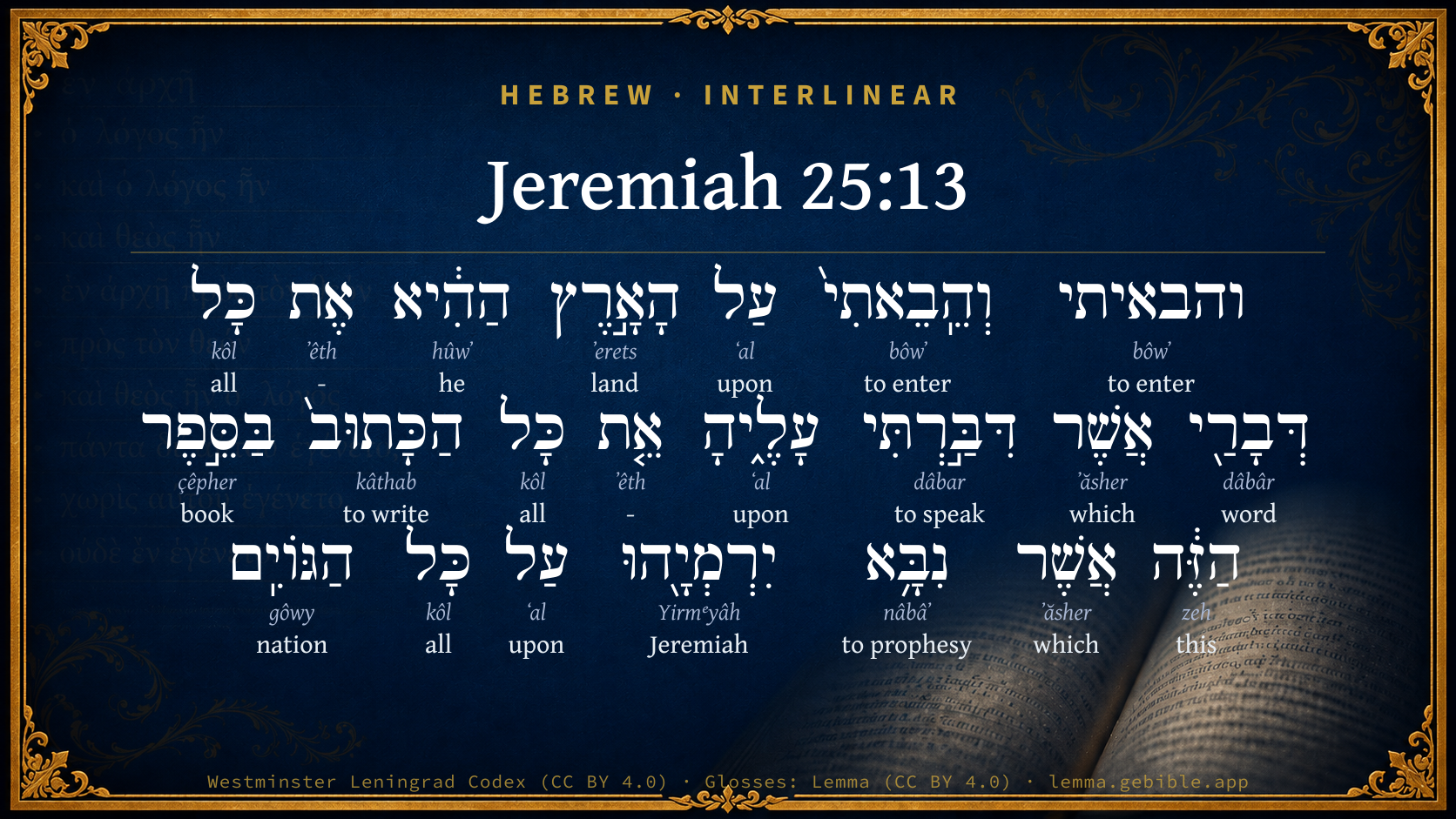
Hebrew (Westminster Leningrad Codex) Jeremiah 25:13 appears in the Hebrew Old Testament. The text above is from the Westminster Leningrad Codex. Each word links to its Strong’s number, a concise gloss, and parsing drawn from the Open Scriptures Hebrew Bible morphology. Click any word for its full Brown-Driver-Briggs (BDB) entry.
Download image
Cite this verse

Jeremiah 25:13 (World English Bible). Public Domain. Lemma interlinear Bible study tool, https://lemma.gebible.app/v/jeremiah/25/13.

Show BibTeX & RIS
BibTeX
RIS
English Translation
I will bring on that land all my words which I have pronounced against it, even all that is written in this book, which Jeremiah has prophesied against all the nations.
World English Bible · Public Domain
Download a study sheet

One document with this verse’s original text, its word-by-word gloss line, the meaning frame, cross-references with their text, attributed commentary, and full source and license credits — printable, and it pastes into notes with its structure intact.

This verse Autodidact and up

Study sheet (.html) Plain text (.txt)

A passage Seminary Student

Up to 50 verses in one chapter. A passage sheet keeps up to 6 commentary sources and 12 cross-references per verse, in the order this page ranks them, and says so on the sheet whenever that leaves anything out. Ask for a single verse and you get the Autodidact verse sheet above.

Everything on this page stays free to read, with no account — the sheet is a download of what is already on screen, not access to it.

Want to remove ads? Support Godless Engineer
Compare translations 3

The same verse in 3 English versions, stacked beneath the original-language interlinear above. Click any original word for its lexicon entry.

Each is an independent rendering of the whole verse — the interlinear is not word-aligned to these translations.

Highlighted words mark where these versions differ — a whole-verse word diff, not a word-by-word alignment.

  • World English Bible Public Domain
    I will bring on that land all my words which I have pronounced against it, even all that is written in this book, which Jeremiah has prophesied against all the nations.
  • King James Version Public Domain
    And I will bring upon that land all my words which I have pronounced against it, even all that is written in this book, which Jeremiah hath prophesied against all the nations.
  • unfoldingWord Literal Text CC BY-SA 4.0
    And I will bring upon that land all of my words that I have spoken against it, all of that which is written in this book, which Jeremiah has prophesied against all of the nations.

unfoldingWord Literal Text — © unfoldingWord, licensed CC BY-SA 4.0. Word-aligned USFM3 via Door43 (git.door43.org/unfoldingWord/en_ult).

Versions to compare (up to 4)

3 of 4 selected

Show all 18 translations

Every available English version of this verse, each an independent rendering of the whole verse.

  • World English Bible Public Domain
    I will bring on that land all my words which I have pronounced against it, even all that is written in this book, which Jeremiah has prophesied against all the nations.
  • Berean Standard Bible Public Domain
    I will bring upon that land all the words I have pronounced against it, all that is written in this book, which Jeremiah has prophesied against all the nations.
  • Majority Standard Bible Public Domain
    I will bring upon that land all the words I have pronounced against it, all that is written in this book, which Jeremiah has prophesied against all the nations.
  • King James Version Public Domain
    And I will bring upon that land all my words which I have pronounced against it, even all that is written in this book, which Jeremiah hath prophesied against all the nations.
  • American Standard Version (1901) Public Domain
    And I will bring upon that land all my words which I have pronounced against it, even all that is written in this book, which Jeremiah hath prophesied against all the nations.
  • Revised Version (1885) Public Domain
    And I will bring upon that land all my words which I have pronounced against it, even all that is written in this book, which Jeremiah hath prophesied against all the nations.
  • Geneva Bible (1599) Public Domain
    And I will bring vpon that lande all my wordes which I haue pronounced against it, euen all that is written in this booke, which Ieremiah hath prophecied against all nations.
  • Douay-Rheims (1899) Public Domain
    And I will bring upon the land all my words, that I have spoken against it, all that is written in this book, all that Jeremias hath prophesied against all nations:
  • Young's Literal Translation Public Domain
    And I have brought in on that land all My words that I have spoken against it, all that is written in this book, that Jeremiah hath prophesied concerning all the nations.
  • Literal Standard Version CC BY-SA 4.0
    And I have brought in on that land all My words that I have spoken against it, all that is written in this scroll, that Jeremiah has prophesied concerning all the nations.
  • Unlocked Literal Bible CC BY-SA 4.0
    Then I will carry out against that land all the words that I had spoken, and everything written in this book that Jeremiah has prophesied against all the nations.
  • unfoldingWord Literal Text CC BY-SA 4.0
    And I will bring upon that land all of my words that I have spoken against it, all of that which is written in this book, which Jeremiah has prophesied against all of the nations.
  • Darby Bible Public Domain
    And I will bring upon that land all my words which I have pronounced against it, all that is written in this book, which Jeremiah hath prophesied against all the nations.
  • World Messianic Bible Public Domain
    I will bring on that land all my words which I have pronounced against it, even all that is written in this book, which Jeremiah has prophesied against all the nations.
  • Webster's Bible Public Domain
    And I will bring upon that land all my words which I have pronounced against it, even all that is written in this book, which Jeremiah hath prophesied against all the nations.
  • Free Bible Version CC BY-SA 4.0
    I will bring down on that country everything I threatened to do, everything that's written in this book which Jeremiah prophesied against all the different nations.
  • Bible in Basic English Public Domain
    And I will make that land undergo everything I have said against it, even everything recorded in this book, which Jeremiah the prophet has said against all the nations.
  • JPS Tanakh (1917) Public Domain
    And I will bring upon that land all My words which I have pronounced against it, even all that is written in this book, which Jeremiah hath prophesied against all the nations.

Literal Standard Version (2020), Covenant Press — licensed CC BY-SA 4.0. Text via the HelloAO Bible API (eBible.org). Unlocked Literal Bible (unfoldingWord) — licensed CC BY-SA 4.0. Text via the HelloAO Bible API (eBible.org). unfoldingWord Literal Text — © unfoldingWord, licensed CC BY-SA 4.0. Word-aligned USFM3 via Door43 (git.door43.org/unfoldingWord/en_ult). Free Bible Version, Dr. Jonathan Gallagher — licensed CC BY-SA 4.0. Text via the HelloAO Bible API (eBible.org).

Word by word

More ways to search: Search by grammar → Find every occurrence → Compare this word →

Practice this passage: Drill this verse → Learn its vocabulary →

נִבָּ֥א
nâbâʼ
H5012
“to prophesy”
Verb, Niphal, Perfect, 3rd Person, Masculine, Singular
Part of Speech
Verb
Stem
Niphal
Form
Perfect
Person
3rd Person
Gender
Masculine
Number
Singular
Full BDB Definition

Origin: a primitive root

TWOT: 1277

to prophesy - (Niphal) - to prophesy - under influence of divine spirit - of false prophets - (Hithpael) - to prophesy - under influence of divine spirit - of false prophets
  1. והבאיתי bôwʼ H935 “and · to enter” Conjunction + Verb, Hiphil, Sequential Perfect, 1st Person, Common, Singular
  2. וְהֵֽבֵאתִי֙ bôwʼ H935 “and · to enter” Conjunction + Verb, Hiphil, Sequential Perfect, 1st Person, Common, Singular
  3. עַל ʻal H5921 “upon” Preposition
  4. הָאָ֣רֶץ ʼerets H776 “the · land” Particle, Definite Article + Noun, Common, Both, Singular, Absolute
  5. הַהִ֔יא hûwʼ H1931 “the · he” Particle, Definite Article + Pronoun, Personal, 3rd Person, Feminine, Singular
  6. אֶת ʼêth H853 “-” Particle, Direct Object
  7. כָּל kôl H3605 “all of” Noun, Common, Masculine, Singular, Construct
  8. דְּבָרַ֖י dâbâr H1697 “words · my” Noun, Common, Masculine, Plural, Construct + Suffix, Personal, 1st Person, Common, Singular
  9. אֲשֶׁר ʼăsher H834 “which” Particle, Relative
  10. דִּבַּ֣רְתִּי dâbar H1696 “to speak” Verb, Piel, Perfect, 1st Person, Common, Singular
  11. עָלֶ֑יהָ ʻal H5921 “upon · her” Preposition + Suffix, Personal, 3rd Person, Feminine, Singular
  12. אֵ֤ת ʼêth H853 “-” Particle, Direct Object
  13. כָּל kôl H3605 “all of” Noun, Common, Masculine, Singular, Construct
  14. הַכָּתוּב֙ kâthab H3789 “the · written” Particle, Definite Article + Verb, Qal, Participle Passive, Masculine, Singular, Absolute
  15. בַּסֵּ֣פֶר çêpher H5612 “in/at the · book” Preposition, Determined + Noun, Common, Masculine, Singular, Absolute
  16. הַזֶּ֔ה zeh H2088 “the · this” Particle, Definite Article + Pronoun, Demonstrative, Masculine, Singular
  17. אֲשֶׁר ʼăsher H834 “which” Particle, Relative
  18. יִרְמְיָ֖הוּ Yirmᵉyâh H3414 “Jeremiah” Noun, Proper
  19. עַל ʻal H5921 “upon” Preposition
  20. כָּל kôl H3605 “all of” Noun, Common, Masculine, Singular, Construct
  21. הַגּוֹיִֽם gôwy H1471 “the · nations” Particle, Definite Article + Noun, Common, Masculine, Plural, Absolute

About this verse

These counts appear in no published source. They are computed here, from the morphology-tagged text and Lemma’s own curated glosses. What Lemma adds →

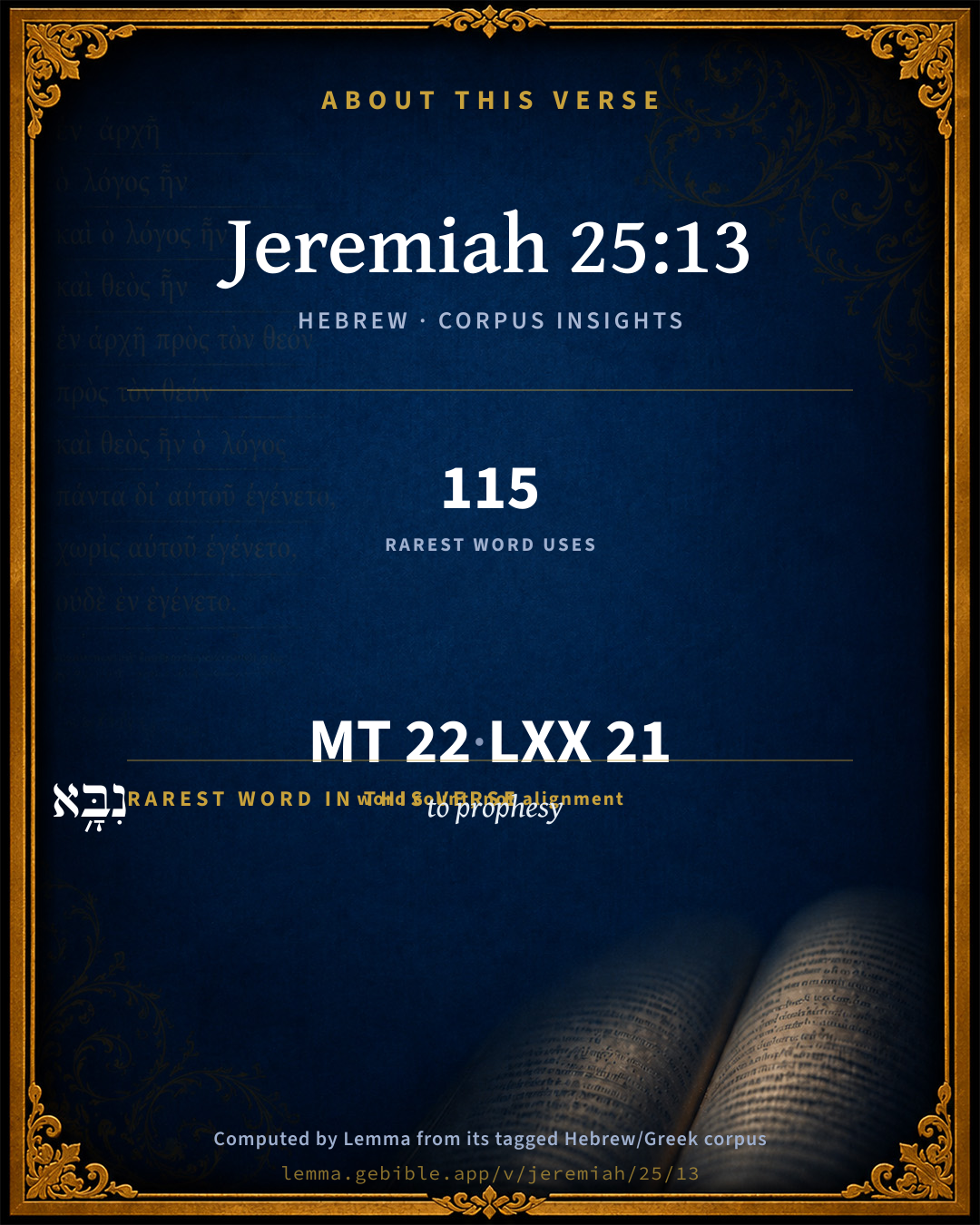
22
words
15
distinct lemmas
Prophets
section

Grammatical profile

  • 5 verbs
  • 8 nouns
  • 2 pronouns
  • 3 prepositions
  • 4 particles

Verb forms

  • והבאיתי Hiphil · Sequential Perfect
  • וְהֵֽבֵאתִי֙ Hiphil · Sequential Perfect
  • דִּבַּ֣רְתִּי Piel · Perfect
  • הַכָּתוּב֙ Qal · Participle Passive
  • נִבָּ֥א Niphal · Perfect

Repetition

Words recur within this verse — often emphatic in Hebrew:

  • עַל upon H5921 ×3
  • כָּל all H3605 ×3
  • והבאיתי to enter H935 ×2
  • אֲשֶׁר which H834 ×2

Hebrew & Septuagint length

In the original languages it is 22 Hebrew tokens and 21 Greek tokens — but the two are counted differently (Hebrew bundles its prefixes and suffixes into one token; the Greek is in lemma form), so that isn’t a like-for-like length.

Cross-references

5

Topical passages linked to Jeremiah 25:13 in the Treasury of Scripture Knowledge — connected by theme and wording, ordered by reader-vote popularity; previews shown in the World English Bible.

  • Jeremiah 1:5 Before I formed you in the belly I knew you, and before you came forth out of the womb I sanctified you; I have appointed you a prophet to the nations.
  • Jeremiah 1:10 behold, I have this day set you over the nations and over the kingdoms, to pluck up and to break down and to destroy and to overthrow, to build and to plant.
  • Daniel 5:28 PERES; your kingdom is divided, and given to the Medes and Persians.
  • Daniel 5:31 Darius the Mede received the kingdom, being about sixty-two years old.
  • Revelation 10:11 They told me, "You must prophesy again over many peoples, nations, languages, and kings."

Cross-references courtesy of OpenBible.info (CC BY 4.0).

Hebrew and Greek witnesses Masoretic Hebrew ↔ Greek Septuagint

The same verse in the two great witnesses to the Old Testament, shown verse-for-verse.

These are two independent witnesses, not word-aligned to each other, and the Septuagint is shown in lemma (dictionary) form.

Hebrew Jeremiah 25:13 Masoretic · Westminster Leningrad Codex

והבאיתי וְהֵֽבֵאתִי֙ עַל הָאָ֣רֶץ הַהִ֔יא אֶת כָּל דְּבָרַ֖י אֲשֶׁר דִּבַּ֣רְתִּי עָלֶ֑יהָ אֵ֤ת כָּל הַכָּתוּב֙ בַּסֵּ֣פֶר הַזֶּ֔ה אֲשֶׁר נִבָּ֥א יִרְמְיָ֖הוּ עַל כָּל הַגּוֹיִֽם

I will bring on that land all my words which I have pronounced against it, even all that is written in this book, which Jeremiah has prophesied against all the nations.

World English Bible · Public Domain

Greek LXX Structure differs

In the Septuagint, Jeremiah is about an eighth shorter than the Hebrew and arranges its material differently — the Oracles Against the Nations (Hebrew chapters 46–51) appear in the middle of the Greek book, after 25:13. Because the chapter and verse boundaries do not line up, a verse-for-verse comparison with the Hebrew is not shown.

A verse-for-verse comparison isn’t shown here because the chapters and verses don’t line up. Switch to the LXX edition with the MT / LXX toggle above to read the Greek directly.

On this verse, Jamieson, Fausset & Brown discusses the Septuagint’s reading. Read the note in Commentary ↓

Hebrew: Westminster Leningrad Codex (CC BY 4.0). Greek: Septuagint (public domain); English from a public-domain English Septuagint. How the Septuagint differs from the Hebrew →

Targum (Aramaic paraphrase)

1

The Targum is the ancient Jewish Aramaic paraphrase of the Hebrew Scriptures — an interpretive translation, not the Hebrew text itself. Onkelos (literal) and Pseudo-Jonathan (expansive) render the Torah, and Jonathan the Prophets. Coverage is partial: where no permissively-licensed English translation exists for a verse, only the Aramaic is shown. This is verse-level text, not a word-by-word alignment to the Hebrew.

  1. Targum Jonathan Prophets (Joshua–Malachi)
    וְאַיְתֵי עַל אַרְעָא הַהִיא יַת כָּל פִתְגָמַיָא דִגְזָרִית עֲלָהּ יַת כָּל דִכְתִיב בְּסִפְרָא הָדֵין דְאִתְנַבֵּי יִרְמְיָה עַל כָּל עַמְמַיָא:

    (no public-domain English translation for this verse)

    Targum Jonathan — Aramaic: “Mikraot Gedolot” (public domain). English: “Sefaria Community Translation” (CC0 1.0 (public-domain dedication)); “London "Chaldee Paraphrase," 1871” (public domain). Text via Sefaria.

Commentary

Notes on Jeremiah 25:13 from classic Christian and Jewish commentators (each source and its license shown beneath its notes). The classic Christian expositions comment on the surrounding passage and are grouped to its opening verse, so a note may address several verses; the Jewish commentaries on the Tanakh (Rashi and others) are per-verse, so they appear only where the commentator wrote on this verse.

Lemma curates 59 commentaries, every one of them public domain or Creative Commons licensed, each selected and text-cleaned for this edition rather than reprinted as found. About our sources →

Jamieson, Fausset & Brown

Robert Jamieson, A. R. Fausset & David Brown

all . . . written in this book, which Jeremiah . . . prophesied against all . . . nations--It follows from this, that the prophecies against foreign nations (forty-sixth through fifty-first chapters) must have been already written. Hence the Septuagint inserts here those prophecies. But if they had followed immediately (Jer 25:13), there would have been no propriety in the observation in the verse. The very wording of the reference shows that they existed in some other part of the book, and not in the immediate context. It was in this very year, the fourth of Jehoiakim (Jer 36:1-2), that Jeremiah was directed to write in a regular book for the first time all that he had prophesied against Judah and foreign "nations" from the beginning of his ministry. Probably, at a subsequent time, when he completed the whole work, including the forty-sixth through fifty-first chapters, Jeremiah himself inserted the clause, "all that is written in this book, which Jeremiah hath prophesied against all the nations." The prophecies in question may have been repeated, as others in Jeremiah, more than once; so in the original smaller collection they may have stood in an earlier position; and, in the fuller subsequent collection, in their later and present position.

Jamieson, Fausset & Brown — Commentary Critical and Explanatory on the Whole Bible (1871) — public domain (CC PDM 1.0). Text via the HelloAO Bible API.

The Cambridge Bible for Schools and Colleges

gen. ed. J. J. S. Perowne

13. even all that is written in this book, which Jeremiah hath prophesied against all the nations] At this point there presents itself one of the most marked discrepancies between the Septuagint Version of Jeremiah and the Hebrew. (See Introd. iv. §§ 10 ff.) The Greek Version as it stands now ends the sentence with “in this book,” and reads as a new sentence, and title of the section on the nations, “What Jeremiah prophesied against the nations,” although it is probable that originally these words were, as in E.VV., merely descriptive of “even all … book.” Upon this follows, with the heading “The things of (concerning) Elam,” what with us appears as ch. Jer_49:35-39, and then, although in a different order of grouping, the other prophecies against foreign nations including Babylon, which in the Hebrew text (and E.VV.) come at the end of the whole Book (chs. 46–51). Which arrangement (if either, which Co. doubts) is the original one? Against the LXX’s order it is urged that by the Greek arrangement the passing of sentence upon the nations (Jer_25:15-38 [Jer_32:1-24]) is made to follow, whereas it should naturally precede, the announcement of punishments as set forth in detail in the prophecies themselves. In favour of the order of the LXX as the original one are the following considerations: (a) It is unlikely that the words rendered “which Jeremiah hath prophesied, etc.” (Jer_25:13) should be from the prophet himself, while the clause would form a natural heading to the collection of prophecies against foreign nations, occurring thus in the course of the Book (as in Ezekiel chs. 25–32). When Hebrew editors of the text removed them to the end, the clause in question was left behind (cp. the converse proceeding pointed out in note on Jer_51:64) and considered to be the conclusion of the preceding sentence; (b) we should a priori expect these prophecies to appear here in company with the kindred matter (Jer_25:15-38). There is however a third hypothesis, which deserves serious consideration, viz. that in both Hebrew and LXX texts these prophecies stood at the end of ch. 25, and were removed to the respective positions which they now occupy in the two texts, because (a) the general overthrow anticipated at the time of the battle of Carchemish, and set forth in the vision of the wine-cup, did not in fact occur, and (b) the modifications of an apocalyptic character, apparently introduced into the latter part of this ch. in order to apply its threatening to a last judgement of the world, rendered it no longer a suitable introduction to them. This view is strongly supported by Peake who argues that the closing words of Jer_25:13 should be taken as indicating a stage at which the Hebrew, and not only the LXX, placed these prophecies at this point.

The Cambridge Bible for Schools and Colleges (gen. ed. J. J. S. Perowne; Cambridge University Press, 1878–1918) — public domain. Text from a community e-Sword module.

Trapp's Complete Commentary

John Trapp

Jer 25:13 And I will bring upon that land all my words which I have pronounced against it, [even] all that is written in this book, which Jeremiah hath prophesied against all the nations.

Ver. 13. And I will bring upon that land,] scil., By Cyrus and his successors, who out of the ruins of Babylon built two cities, Ctesiphon and Seleucia.

John Trapp, A Commentary or Exposition upon All the Books of the Old and New Testament (1647–1656) — public domain. Text from a community e-Sword module.

John Calvin's Commentaries

He confirms what he had said before when he says, that he would bring all his words on the Chaldeans; that is, that he would give effect to all the prophecies, so that it would be evident that Jeremiah had foretold nothing rashly, and that God had not in vain threatened them by the mouth of his servant. Such is the meaning, and hence we see what the Prophet intimates when he says, that God would bring all his words, for he had then spoken. But as the ungodly regard whatever is brought forward in God’s name as a matter of sport and mockery, and boldly deride all threatenings, to bring words means the same thing with proving by events that God does not terrify men without accomplishing his words; in short, to bring words is to prove their authority. And, as I have said, the expression has a reference to the insensibility of men who give no credit to God’s words until they are convinced by their accomplishment; for they think that the air only is beaten, and thus they are not touched by any fear. But God proves the power of his word when he executes what he has predicted.

We then see that the Prophet intends nothing else in this verse than to confirm what he had said before. And he speaks of Chaldea and says, upon that land

And we must at the same time notice another form of speaking; for God says, that he had pronounced these words; he afterwards says, that Jeremiah was his minister, and as it were his herald; and he calls him also a scribe or a writer. God then here declares that he was the author of all that Jeremiah had brought forward; and yet he leaves his own office to his minister, for it is necessary to secure authority to the prophets; otherwise, except God visibly descended from heaven, men would either indiscriminately admit what might be said, and without judgment receive falsehood and truth, or they would become wholly hardened, so as to give no credit to prophetic instruction. He says, whatsoever is written in this book The Prophet no doubt wrote down a summary of what he had delivered; for as we have said elsewhere, it was usual with the prophets, after they had spoken at large to the people and preached diffusely, to affix a short summary to the doors of the Temple. This volume then is what Jeremiah calls the book, which was composed from his public addresses. It might in common language be called a summary. Then he adds, in what, or, “what he prophesied,” in order to shew that he meant what he had before said; and so it might be rendered, that is, what he prophesied; but the other exposition is not unsuitable, in which Jeremiah hath prophesied against all the nations It follows, —

John Calvin's Commentaries (1540-1563) — public domain. Text from the Calvin Translation Society English edition (1840s-50s) via the Christian Classics Ethereal Library (ccel.org). Calvin's coverage is partial (roughly two-thirds of the Bible); uncommented books and verses are honest gaps, never fabricated. The 19th-century editor's footnotes and remarks are omitted so the notes are faithfully Calvin's own voice.

Ellicott's Commentary for English Readers

(13) Which Jeremiah hath prophesied . . .—Here again we have the trace of an interpolation. In the LXX. the words appear detached, as a title, and are followed by Jer_49:35-39, and the other prophecies against the nations which the Hebrew text places at the end of the book (Jeremiah 46-51). The words “all that is written in this book” are manifestly the addition of a scribe. (See Introduction,)

A Bible Commentary for English Readers, edited by Charles John Ellicott (1878–1897) — public domain. Text from a community e-Sword module.

John Gill's Exposition

And I will bring upon that land all my words which I have pronounced against it,.... By his prophets, and particularly by Jeremiah, as follows; for not one word that is spoken by the Lord, either in a way of promise or threatening, shall fail; his truth, power, and faithfulness, are engaged to accomplish all:

even all that is written in this book, which Jeremiah hath prophesied against all the nations; the Egyptians, Philistines, Moabites, Edomites, Arabians, Persians, and also the Babylonians, in Jer 46:1, which prophecies, in the Greek version, immediately follow here, though in a confused manner; where some have thought they might be more regularly placed than as they are in the Hebrew copies, at the end of the book; but of this there seems to be no absolute necessity.

John Gill's Exposition of the Whole Bible (1746–1763) — public domain (CC PDM 1.0). Text via the HelloAO Bible API.

Albert Barnes' Notes on the Bible

The Septuagint places a full stop after “book,” and take the rest as a title “what Jeremiah prophesied against the nations,” which series there immediately follows. In the Masoretic Text, this series is deferred to the end Jer. 46–49, and with Jer. 50–51, forms one entire series. Other reasons make it probable that the Septuagint has preserved for us an earlier text, in which all direct mention of the king of Babylon is omitted and the 70 years are given as the duration of Judah’s captivity, and not of the Babylonian empire. The fuller text of the Masorites is to be explained by the dislocation which Jehoiakim’s scroll evidently suffered.

Albert Barnes' Notes on the Bible (1834–1885) — public domain. Text from a community e-Sword/MySword module.

Matthew Poole's English Annotations

That land; the land of the Babylonians and Chaldeans.

Matthew Poole's English Annotations on the Holy Bible (1683–1685) — public domain. Text from a community e-Sword/MySword module.

Whedon's Commentary on the Bible

Daniel D. Whedon

13. Written in this book — The difficulties in this verse have been exaggerated. On the one hand, there can be no question that this language implies the existence of a written book of Jeremiah, and is not satisfied with a merely spoken discourse. But words at first spoken more fully are here reduced to a condensed written record, in which the identifying phrase “written in this book” occurs. That the passage directly mentions the prophecies which are to come has been too hastily assumed. Against all the nations is a phrase which is perfectly intelligible in its application to prophecies already recorded. But the Septuagint divides this thirteenth verse differently. Its arrangement is inconsistent with the Masoretic punctuation, but not with the original text, and strongly commends itself to favourable consideration. The preceding passage is made to terminate at book, and the sentence immediately following is the caption of the succeeding passage — What Jeremiah prophesied against the nations — a title which describes the subject-matter of the passage as far as the thirty-fourth verse. And yet, even with the Masoretic pointing, the difficulty is not serious.

Daniel D. Whedon (gen. ed.), Commentary on the Old and New Testaments (1874–1909) — public domain. Text from a community e-Sword module.

The Pulpit Commentary

And I will bring, etc. Clearly this verse cannot have formed part of the original prophecy, but must have been added whenever the collection of prophecies against foreign nations finally assumed its present form. (see introduction on Jer 50 Jer 51) It should be mentioned that the Septuagint separates the last clause of the verse, "that which Jeremiah prophesied," etc., and makes it the heading of the group of prophecies against the nations, which in the Hebrew Bible stand at the end of Jeremiah"s prophecies, but which, beginning with "Elam," the Alexandrian Version inserts at this point.

The Pulpit Commentary (1880–1919), ed. H.D.M. Spence-Jones & Joseph S. Exell — public domain. Text from a community e-Sword module.

Rashi

Rabbi Shlomo Yitzchaki (Rashi)

all that is written concerning Babylon.

in this Book at its end.

Rashi on the Tanakh — English translations: “The Judaica Press complete Tanach with Rashi, translated by A. J. Rosenberg” (CC BY 4.0); “Pentateuch with Rashi's commentary by M. Rosenbaum and A.M. Silbermann, 1929-1934” (public domain); “The Metsudah Tanach series, Lakewood, N.J” (CC BY 4.0); and “The Book of Joshua, Metsudah Publications, 1997” (CC BY 4.0). Text via Sefaria.

Lesson kit

Teaching starters — assembled from the data on this page, not authored interpretation. Every prompt links to the verse data it draws on. Edit before teaching.

Jeremiah, in the Prophets, opens this verse with 22 words (15 distinct Hebrew lemmas). Its most distinctive word is nâbâʼ (“to prophesy”). A historical commentator’s framing appears above. Read the whole chapter for the surrounding context.

Discussion questions

  1. The word nâbâʼ carries the sense “to prophesy.” How does it shape the verse?
  2. Jeremiah 1:5 shares this passage’s theme. How do the two illuminate each other?
  3. “upon” occurs 3× in this one verse. What is the effect of the repetition?
  4. These translations render this verse differently. What is at stake in choosing one wording over another?
  5. The verb «והבאיתי» is Hiphil Sequential Perfect. How does its form color the action?
  6. Reading how Jamieson, Fausset & Brown and The Cambridge Bible for Schools and Colleges read this verse, where do the two commentators agree and where do they part?

Things to notice

Reading settings

Reading text

Shown beneath each verse's original-language words.

Old Testament
Old Testament edition

Read the OT as the Masoretic Hebrew (MT) or the Greek Septuagint (LXX).

English shown for the Greek Septuagint (in the Hebrew ↔ Greek comparison).

Comparing translations? Open the Compare panel on any verse page to stack up to four side by side.