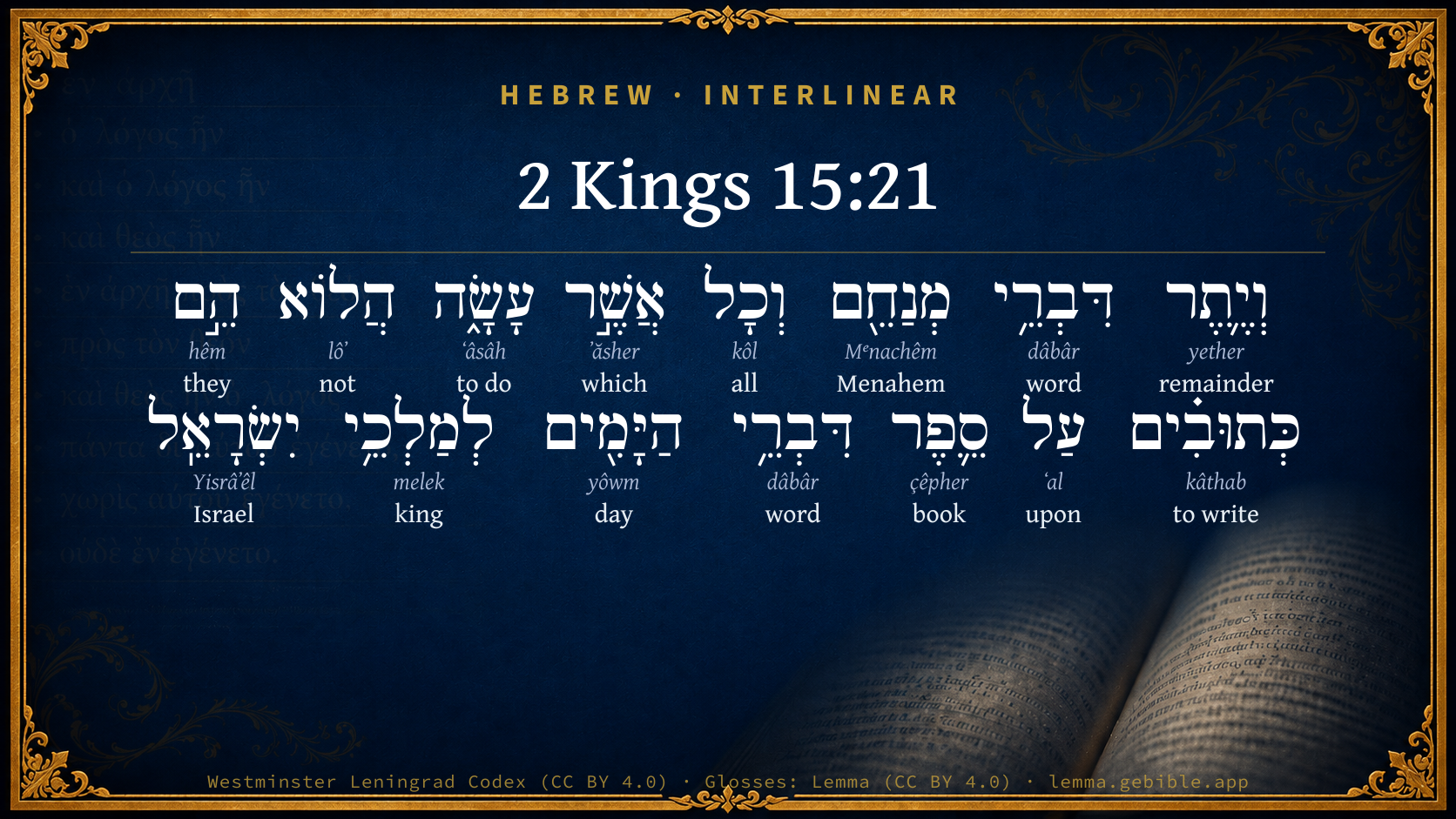
2 Kings 15:21

Hebrew (Westminster Leningrad Codex) 2 Kings 15:21 appears in the Hebrew Old Testament. The text above is from the Westminster Leningrad Codex. Each word links to its Strong’s number, a concise gloss, and parsing drawn from the Open Scriptures Hebrew Bible morphology. Click any word for its full Brown-Driver-Briggs (BDB) entry.
Download image
Cite this verse

2 Kings 15:21 (World English Bible). Public Domain. Lemma interlinear Bible study tool, https://lemma.gebible.app/v/2-kings/15/21.

Show BibTeX & RIS
BibTeX
RIS
English Translation
Now the rest of the acts of Menahem, and all that he did, aren't they written in the book of the chronicles of the kings of Israel?
World English Bible · Public Domain
Download a study sheet

One document with this verse’s original text, its word-by-word gloss line, the meaning frame, cross-references with their text, attributed commentary, and full source and license credits — printable, and it pastes into notes with its structure intact.

This verse Autodidact and up

Study sheet (.html) Plain text (.txt)

A passage Seminary Student

Up to 50 verses in one chapter. A passage sheet keeps up to 6 commentary sources and 12 cross-references per verse, in the order this page ranks them, and says so on the sheet whenever that leaves anything out. Ask for a single verse and you get the Autodidact verse sheet above.

Everything on this page stays free to read, with no account — the sheet is a download of what is already on screen, not access to it.

Want to remove ads? Support Godless Engineer
Compare translations 3

The same verse in 3 English versions, stacked beneath the original-language interlinear above. Click any original word for its lexicon entry.

Each is an independent rendering of the whole verse — the interlinear is not word-aligned to these translations.

Highlighted words mark where these versions differ — a whole-verse word diff, not a word-by-word alignment.

  • World English Bible Public Domain
    Now the rest of the acts of Menahem, and all that he did, aren't they written in the book of the chronicles of the kings of Israel?
  • King James Version Public Domain
    And the rest of the acts of Menahem, and all that he did, are they not written in the book of the chronicles of the kings of Israel?
  • unfoldingWord Literal Text CC BY-SA 4.0
    Now the rest of the matters of Menahem and all that he did, are they not written in the book of the matters of the days of the kings of Israel?

unfoldingWord Literal Text — © unfoldingWord, licensed CC BY-SA 4.0. Word-aligned USFM3 via Door43 (git.door43.org/unfoldingWord/en_ult).

Versions to compare (up to 4)

3 of 4 selected

Show all 18 translations

Every available English version of this verse, each an independent rendering of the whole verse.

  • World English Bible Public Domain
    Now the rest of the acts of Menahem, and all that he did, aren't they written in the book of the chronicles of the kings of Israel?
  • Berean Standard Bible Public Domain
    As for the rest of the acts of Menahem, along with all his accomplishments, are they not written in the Book of the Chronicles of the Kings of Israel?
  • Majority Standard Bible Public Domain
    As for the rest of the acts of Menahem, along with all his accomplishments, are they not written in the Book of the Chronicles of the Kings of Israel?
  • King James Version Public Domain
    And the rest of the acts of Menahem, and all that he did, are they not written in the book of the chronicles of the kings of Israel?
  • American Standard Version (1901) Public Domain
    Now the rest of the acts of Menahem, and all that he did, are they not written in the book of the chronicles of the kings of Israel?
  • Revised Version (1885) Public Domain
    Now the rest of the acts of Menahem, and all that he did, are they not written in the book of the chronicles of the kings of Israel?
  • Geneva Bible (1599) Public Domain
    Concerning the rest of the actes of Menahem, and all that he did, are they not written in the booke of the Chronicles of the kings of Israel?
  • Douay-Rheims (1899) Public Domain
    And the rest of the acts of Manahem, and all that he did, are they not written in the book of the words of the days of the kings of Israel?
  • Young's Literal Translation Public Domain
    And the rest of the matters of Menahem, and all that he did, are they not written on the book of the Chronicles of the kings of Israel?
  • Literal Standard Version CC BY-SA 4.0
    And the rest of the matters of Menahem and all that he did, are they not written on the scroll of the Chronicles of the Kings of Israel?
  • Unlocked Literal Bible CC BY-SA 4.0
    As for the other matters concerning Menahem, and all that he did, are they not written in the book of the events of the kings of Israel?
  • unfoldingWord Literal Text CC BY-SA 4.0
    Now the rest of the matters of Menahem and all that he did, are they not written in the book of the matters of the days of the kings of Israel?
  • Darby Bible Public Domain
    And the rest of the acts of Menahem, and all that he did, are they not written in the book of the chronicles of the kings of Israel?
  • World Messianic Bible Public Domain
    Now the rest of the acts of Menahem, and all that he did, aren’t they written in the book of the chronicles of the kings of Israel?
  • Webster's Bible Public Domain
    And the rest of the acts of Menahem, and all that he did, are they not written in the book of the chronicles of the kings of Israel?
  • Free Bible Version CC BY-SA 4.0
    The rest of what happened in Menahem's reign and all he did are recorded in the Book of Chronicles of the Kings of Israel.
  • Bible in Basic English Public Domain
    Now the rest of the acts of Menahem, and all he did, are they not recorded in the book of the history of the kings of Israel?
  • JPS Tanakh (1917) Public Domain
    Now the rest of the acts of Menahem, and all that he did, are they not written in the book of the chronicles of the kings of Israel?

Literal Standard Version (2020), Covenant Press — licensed CC BY-SA 4.0. Text via the HelloAO Bible API (eBible.org). Unlocked Literal Bible (unfoldingWord) — licensed CC BY-SA 4.0. Text via the HelloAO Bible API (eBible.org). unfoldingWord Literal Text — © unfoldingWord, licensed CC BY-SA 4.0. Word-aligned USFM3 via Door43 (git.door43.org/unfoldingWord/en_ult). Free Bible Version, Dr. Jonathan Gallagher — licensed CC BY-SA 4.0. Text via the HelloAO Bible API (eBible.org).

Word by word

More ways to search: Search by grammar → Find every occurrence → Compare this word →

Practice this passage: Drill this verse → Learn its vocabulary →

מְנַחֵ֖ם
Mᵉnachêm
H4505
“Menahem”
Noun, Proper
Part of Speech
Noun
Type
Proper
Full BDB Definition

Origin: from H5162

TWOT: None

Menahem = "comforter" - son of Gadi and king of the northern kingdom of Israel; slew the usurper Shallum to ascend the throne and reigned for ten years; contemporary with prophets Hosea and Amos
  1. וְיֶ֛תֶר yether H3499 “and · remainder of” Conjunction + Noun, Common, Masculine, Singular, Construct
  2. דִּבְרֵ֥י dâbâr H1697 “words of” Noun, Common, Masculine, Plural, Construct
  3. וְכָל kôl H3605 “and · all of” Conjunction + Noun, Common, Masculine, Singular, Construct
  4. אֲשֶׁ֣ר ʼăsher H834 “which” Particle, Relative
  5. עָשָׂ֑ה ʻâsâh H6213 “to do” Verb, Qal, Perfect, 3rd Person, Masculine, Singular
  6. הֲלוֹא lôʼ H3808 “not” Particle, Interrogative + Particle, Negative
  7. הֵ֣ם hêm H1992 “they” Pronoun, Personal, 3rd Person, Masculine, Plural
  8. כְּתוּבִ֗ים kâthab H3789 “written” Verb, Qal, Participle Passive, Masculine, Plural, Absolute
  9. עַל ʻal H5921 “upon” Preposition
  10. סֵ֛פֶר çêpher H5612 “book of” Noun, Common, Masculine, Singular, Construct
  11. דִּבְרֵ֥י dâbâr H1697 “words of” Noun, Common, Masculine, Plural, Construct
  12. הַיָּמִ֖ים yôwm H3117 “the · days” Particle, Definite Article + Noun, Common, Masculine, Plural, Absolute
  13. לְמַלְכֵ֥י melek H4428 “to/for · kings of” Preposition + Noun, Common, Masculine, Plural, Construct
  14. יִשְׂרָאֵֽל Yisrâʼêl H3478 “Israel” Noun, Proper

About this verse

These counts appear in no published source. They are computed here, from the morphology-tagged text and Lemma’s own curated glosses. What Lemma adds →

15
words
14
distinct lemmas
Historical
section

Notable vocabulary

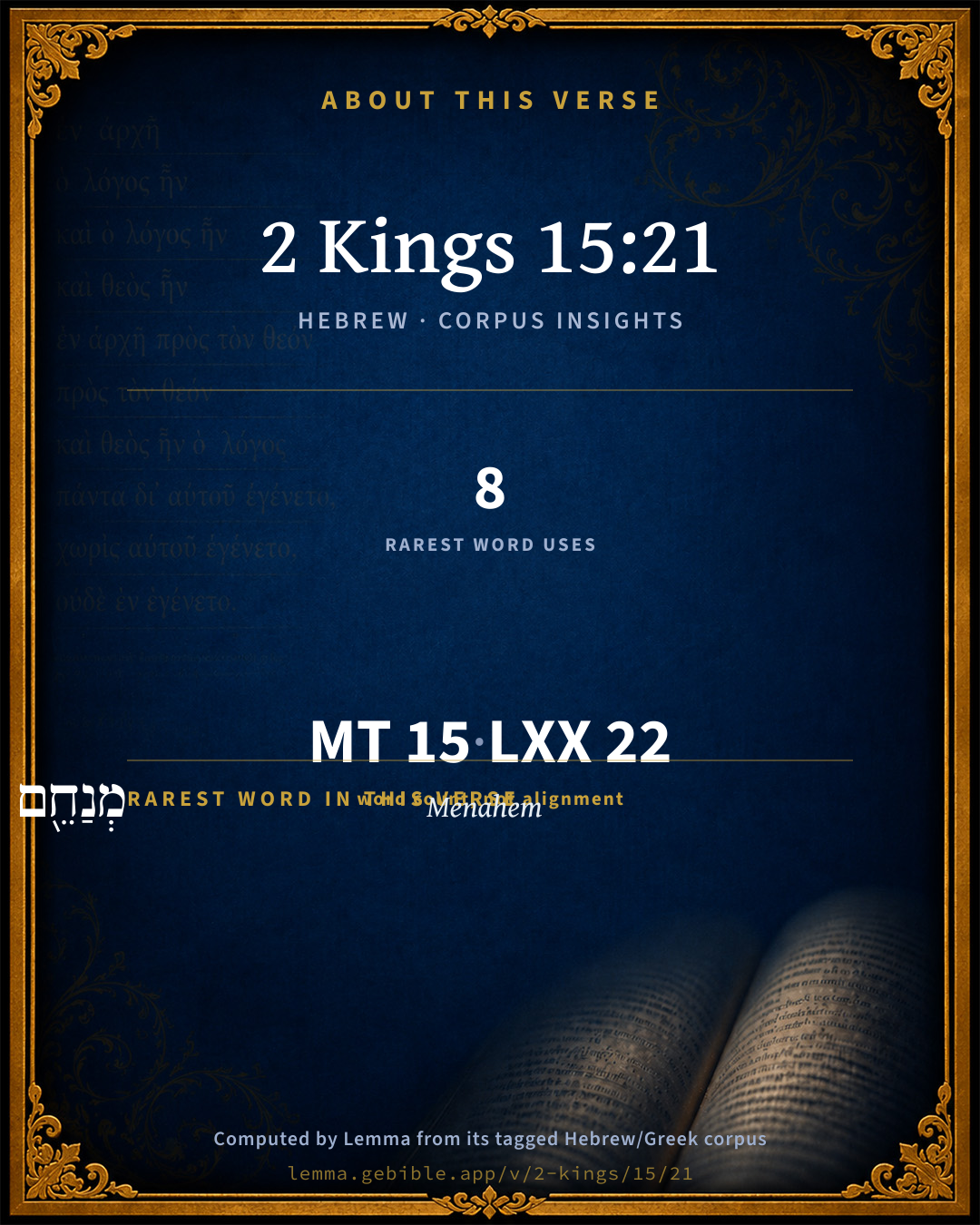
The rarest word here is מְנַחֵ֖ם Menahem H4505 — appearing just 8 times in the whole Hebrew Bible.

Shared distinctive vocabulary

מְנַחֵ֖ם Menahem H4505 occurs in 8 verses of the Hebrew Bible. Also found in:

Grammatical profile

  • 2 verbs
  • 9 nouns
  • 1 pronoun
  • 1 preposition
  • 2 particles

Verb forms

  • עָשָׂ֑ה Qal · Perfect
  • כְּתוּבִ֗ים Qal · Participle Passive

Repetition

A word recurs within this verse — often emphatic in Hebrew:

  • דִּבְרֵ֥י word H1697 ×2

Hebrew & Septuagint length

In English translation the verse runs 27 words from the Hebrew and 29 from the Septuagint (LXX English) — closely comparable.

A rough comparison of the two English renderings, which tokenize alike — not a word-level alignment.

Word counts can differ between the Hebrew and the Greek without any difference in meaning — e.g. the Hebrew direct-object marker אֵת has no separate Greek word, and Greek often adds the article ὁ.

In the original languages it is 15 Hebrew tokens and 22 Greek tokens — but the two are counted differently (Hebrew bundles its prefixes and suffixes into one token; the Greek is in lemma form), so that isn’t a like-for-like length.

Hebrew and Greek witnesses Masoretic Hebrew ↔ Greek Septuagint

The same verse in the two great witnesses to the Old Testament, shown verse-for-verse.

These are two independent witnesses, not word-aligned to each other, and the Septuagint is shown in lemma (dictionary) form.

Hebrew 2 Kings 15:21 Masoretic · Westminster Leningrad Codex

וְיֶ֛תֶר דִּבְרֵ֥י מְנַחֵ֖ם וְכָל אֲשֶׁ֣ר עָשָׂ֑ה הֲלוֹא הֵ֣ם כְּתוּבִ֗ים עַל סֵ֛פֶר דִּבְרֵ֥י הַיָּמִ֖ים לְמַלְכֵ֥י יִשְׂרָאֵֽל

Now the rest of the acts of Menahem, and all that he did, aren't they written in the book of the chronicles of the kings of Israel?

World English Bible · Public Domain

Greek LXX 2 Kings 15:21 Septuagint · lemma form

καί ὁ λοιπός ὁ λόγος μαναημ καί πᾶς ὅσος ποιέω οὐ ἰδού οὗτος γράφω ἐπί βιβλίον λόγος ὁ ἡμέρα ὁ βασιλεύς ἰσραήλ

And the rest of the acts of Manaem, and all that he did, behold, are not these written in the book of the chronicles of the kings of Israel?

LXX2012 (modern English Septuagint) · Public Domain

Hebrew: Westminster Leningrad Codex (CC BY 4.0). Greek: Septuagint (public domain); English from LXX2012 (modern English Septuagint) (Public Domain). How the Septuagint differs from the Hebrew →

Targum (Aramaic paraphrase)

1

The Targum is the ancient Jewish Aramaic paraphrase of the Hebrew Scriptures — an interpretive translation, not the Hebrew text itself. Onkelos (literal) and Pseudo-Jonathan (expansive) render the Torah, and Jonathan the Prophets. Coverage is partial: where no permissively-licensed English translation exists for a verse, only the Aramaic is shown. This is verse-level text, not a word-by-word alignment to the Hebrew.

  1. Targum Jonathan Prophets (Joshua–Malachi)
    וּשְׁאָר פִּתְגָמֵי מְנַחֵם וְכָל דִי עֲבַד הֲלָא אִינוּן כְּתִיבִין עַל סְפַר פִּתְגָמֵי יוֹמַיָא לְמַלְכֵי יִשְׂרָאֵל:

    (no public-domain English translation for this verse)

    Targum Jonathan — Aramaic: “Mikraot Gedolot” (public domain). English: “Sefaria Community Translation” (CC0 1.0 (public-domain dedication)); “London "Chaldee Paraphrase," 1871” (public domain). Text via Sefaria.

Commentary

Notes on 2 Kings 15:21 from classic Christian and Jewish commentators (each source and its license shown beneath its notes). The classic Christian expositions comment on the surrounding passage and are grouped to its opening verse, so a note may address several verses; the Jewish commentaries on the Tanakh (Rashi and others) are per-verse, so they appear only where the commentator wrote on this verse.

Lemma curates 59 commentaries, every one of them public domain or Creative Commons licensed, each selected and text-cleaned for this edition rather than reprinted as found. About our sources →

Trapp's Complete Commentary

John Trapp

2Ki 15:21 And the rest of the acts of Menahem, and all that he did, [are] they not written in the book of the chronicles of the kings of Israel?

Ver. 21. And the rest of the acts.] See 1Ki 14:19.

John Trapp, A Commentary or Exposition upon All the Books of the Old and New Testament (1647–1656) — public domain. Text from a community e-Sword module.

Adam Clarke's Commentary

Verse 21. Are they not written in - the chronicles] There are no chronicles extant, in which there is any thing farther relative to this king.

Adam Clarke's Commentary on the Bible (1810–1826) — public domain. Text from a community e-Sword/MySword module.

John Gill's Exposition

And Hoshea the son or Elab made a conspiracy against Pekah the son of Remaliah, and smote him, and slew him, and reigned in his stead,.... Did by him as he had done by Pekahiah, Kg2 15:28, this was measure for measure, as the Jews say: and this he did

in the twentieth year of Jotham the son of Uzziah; and yet Jotham is said to reign but sixteen years, Kg2 15:33, this must be reckoned therefore either from the time of his being viceroy, and judging Israel in his father's lifetime, Kg2 15:5 or this was the fourth year of Ahaz, and the twentieth year, reckoning from the time Jotham began to reign, who is the rather mentioned, because as yet the historian had taken no notice of Ahaz.

John Gill's Exposition of the Whole Bible (1746–1763) — public domain (CC PDM 1.0). Text via the HelloAO Bible API.

Albert Barnes' Notes on the Bible

Assyrian inscriptions show that Menahem was subsequently redfaced to subjection by Tiglath-Pileser 2Ki 15:29.

Albert Barnes' Notes on the Bible (1834–1885) — public domain. Text from a community e-Sword/MySword module.

The Pulpit Commentary

And the rest of the acts of Menahem, and all that he did, are they not written in the book of the chronicles of the kings of Israel? Nothing more is known of Menahem the son of Gadi, since he certainly cannot be identical with the prince of the same name who is mentioned as "Menahem of Samaria" in the inscriptions of Sennacherib ("Eponym Canon," p. 132, line 17). This second Menahem is probably a descendant of the first, who was allowed a sort of titular sovereignty ever the conquered town.

The Pulpit Commentary (1880–1919), ed. H.D.M. Spence-Jones & Joseph S. Exell — public domain. Text from a community e-Sword module.

unfoldingWord translationNotes

Door43 World Missions Community

are they not written ... Israel?

This question is used to either inform or remind the readers that the information about Menahem is in this other book. See how you translated this in 2 Kings 1:18. AT: "they are written in The Book of the Events of the Kings of Israel." (See: Rhetorical Question)

Menahem slept with his ancestors

Sleeping represents dying. See how you translated this in 2 Kings 10:35. AT: "Menahem died as his ancestors had" or "like his ancestors, Menahem died" (See: Metaphor and Euphemism)

Pekahiah

This a man's name. (See: How to Translate Names)

became king in his place

The phrase "in his place" is a metaphor meaning "instead of him." AT: "became king instead of Menahem" (See: Metaphor)

translationWords

asleep

unfoldingWord translationNotes — © Distant Shores Media and the Door43 World Missions Community, licensed CC BY-SA 4.0. Source: git.door43.org/Door43/en_tn.

Lesson kit

Teaching starters — assembled from the data on this page, not authored interpretation. Every prompt links to the verse data it draws on. Edit before teaching.

2 Kings, in the Historical, opens this verse with 15 words (14 distinct Hebrew lemmas). Its most distinctive word is Mᵉnachêm (“Menahem”). A historical commentator’s framing appears above. Read the whole chapter for the surrounding context.

Discussion questions

  1. The word Mᵉnachêm carries the sense “Menahem.” How does it shape the verse?
  2. How does 2 Kings 15:14, which shares the word «Menahem», read alongside this verse?
  3. What does the repetition of “word” (2× in this one verse) do in this verse?
  4. These translations render this verse differently; the difference is in the English rendering, not the original. What questions does that raise?
  5. «עָשָׂ֑ה» is a Qal Perfect verb. How does that grammatical form shape the action described?
  6. Compare how Trapp's Complete Commentary and Adam Clarke's Commentary read this verse. Where do they agree or differ?

Things to notice

Reading settings

Reading text

Shown beneath each verse's original-language words.

Old Testament
Old Testament edition

Read the OT as the Masoretic Hebrew (MT) or the Greek Septuagint (LXX).

English shown for the Greek Septuagint (in the Hebrew ↔ Greek comparison).

Comparing translations? Open the Compare panel on any verse page to stack up to four side by side.