
Jeremiah 36:32

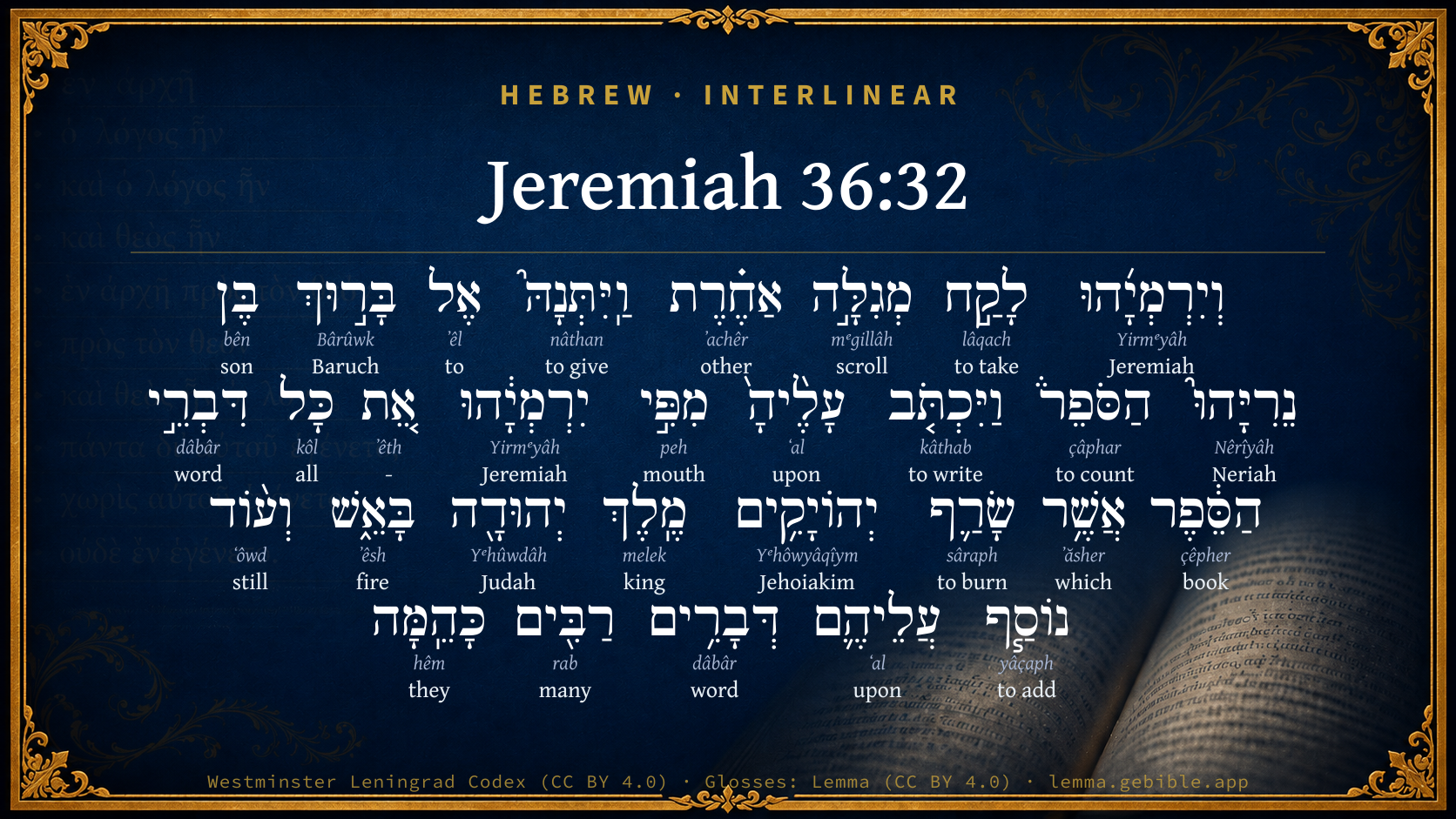
Hebrew (Westminster Leningrad Codex) Jeremiah 36:32 appears in the Hebrew Old Testament. The text above is from the Westminster Leningrad Codex. Each word links to its Strong’s number, a concise gloss, and parsing drawn from the Open Scriptures Hebrew Bible morphology. Click any word for its full Brown-Driver-Briggs (BDB) entry.
Download image
Cite this verse

Jeremiah 36:32 (World English Bible). Public Domain. Lemma interlinear Bible study tool, https://lemma.gebible.app/v/jeremiah/36/32.

Show BibTeX & RIS
BibTeX
RIS
English Translation
Then took Jeremiah another scroll, and gave it to Baruch the scribe, the son of Neriah, who wrote therein from the mouth of Jeremiah all the words of the book which Jehoiakim king of Judah had burned in the fire; and there were added besides to them many like words.
World English Bible · Public Domain
Download a study sheet

One document with this verse’s original text, its word-by-word gloss line, the meaning frame, cross-references with their text, attributed commentary, and full source and license credits — printable, and it pastes into notes with its structure intact.

This verse Autodidact and up

Study sheet (.html) Plain text (.txt)

A passage Seminary Student

Up to 50 verses in one chapter. A passage sheet keeps up to 6 commentary sources and 12 cross-references per verse, in the order this page ranks them, and says so on the sheet whenever that leaves anything out. Ask for a single verse and you get the Autodidact verse sheet above.

Everything on this page stays free to read, with no account — the sheet is a download of what is already on screen, not access to it.

Want to remove ads? Support Godless Engineer
Compare translations 3

The same verse in 3 English versions, stacked beneath the original-language interlinear above. Click any original word for its lexicon entry.

Each is an independent rendering of the whole verse — the interlinear is not word-aligned to these translations.

Highlighted words mark where these versions differ — a whole-verse word diff, not a word-by-word alignment.

  • World English Bible Public Domain
    Then took Jeremiah another scroll, and gave it to Baruch the scribe, the son of Neriah, who wrote therein from the mouth of Jeremiah all the words of the book which Jehoiakim king of Judah had burned in the fire; and there were added besides to them many like words.
  • King James Version Public Domain
    Then took Jeremiah another roll, and gave it to Baruch the scribe, the son of Neriah; who wrote therein from the mouth of Jeremiah all the words of the book which Jehoiakim king of Judah had burned in the fire: and there were added besides unto them many like words.
  • unfoldingWord Literal Text CC BY-SA 4.0
    So Jeremiah took another scroll and gave it to Baruch son of Neriah the scribe. Baruch wrote on it at Jeremiah’s dictation all the words that had been in the scroll burned by Jehoiakim king of Judah. Furthermore, many other similar words were added to this scroll.

unfoldingWord Literal Text — © unfoldingWord, licensed CC BY-SA 4.0. Word-aligned USFM3 via Door43 (git.door43.org/unfoldingWord/en_ult).

Versions to compare (up to 4)

3 of 4 selected

Show all 18 translations

Every available English version of this verse, each an independent rendering of the whole verse.

  • World English Bible Public Domain
    Then took Jeremiah another scroll, and gave it to Baruch the scribe, the son of Neriah, who wrote therein from the mouth of Jeremiah all the words of the book which Jehoiakim king of Judah had burned in the fire; and there were added besides to them many like words.
  • Berean Standard Bible Public Domain
    Then Jeremiah took another scroll and gave it to the scribe Baruch son of Neriah, and at Jeremiah’s dictation he wrote on it all the words of the scroll that Jehoiakim king of Judah had burned in the fire. And many similar words were added to them.
  • Majority Standard Bible Public Domain
    Then Jeremiah took another scroll and gave it to the scribe Baruch son of Neriah, and at Jeremiah’s dictation he wrote on it all the words of the scroll that Jehoiakim king of Judah had burned in the fire. And many similar words were added to them.
  • King James Version Public Domain
    Then took Jeremiah another roll, and gave it to Baruch the scribe, the son of Neriah; who wrote therein from the mouth of Jeremiah all the words of the book which Jehoiakim king of Judah had burned in the fire: and there were added besides unto them many like words.
  • American Standard Version (1901) Public Domain
    Then took Jeremiah another roll, and gave it to Baruch the scribe, the son of Neriah, who wrote therein from the mouth of Jeremiah all the words of the book which Jehoiakim king of Judah had burned in the fire; and there were added besides unto them many like words.
  • Revised Version (1885) Public Domain
    Then took Jeremiah another roll, and gave it to Baruch the scribe, the son of Neriah; who wrote therein from the mouth of Jeremiah all the words of the book which Jehoiakim king of Judah had burned in the fire: and there were added besides unto them many like words.
  • Geneva Bible (1599) Public Domain
    Then tooke Ieremiah another roule, and gaue it Baruch the scribe the sonne of Neriah, which wrote therein at the mouth of Ieremiah all the wordes of the booke which Iehoiakim King of Iudah had burnt in the fire, and there were added besides them many like wordes.
  • Douay-Rheims (1899) Public Domain
    And Jeremias took another volume, and gave it to Baruch the son of Nerias the scribe: who wrote in it from the mouth of Jeremias all the words of the book which Joakim the king of Juda had burnt with fire: and there were added besides many more words than had been before.
  • Young's Literal Translation Public Domain
    And Jeremiah hath taken another roll, and giveth it unto Baruch son of Neriah the scribe, and he writeth on it from the mouth of Jeremiah all the words of the book that Jehoiakim king of Judah hath burnt in the fire; and again there were added unto them many words like these.
  • Literal Standard Version CC BY-SA 4.0
    And Jeremiah has taken another scroll, and gives it to Baruch son of Neriah the scribe, and he writes on it from the mouth of Jeremiah all the words of the scroll that Jehoiakim king of Judah has burned in the fire; and again there were added to them many words like these.
  • Unlocked Literal Bible CC BY-SA 4.0
    So Jeremiah took another scroll and gave it to Baruch son of Neriah the scribe. Baruch wrote on it at Jeremiah's dictation all the words that had been in the scroll burned by Jehoiakim king of Judah. Furthermore, many other similar words were added to this scroll.
  • unfoldingWord Literal Text CC BY-SA 4.0
    So Jeremiah took another scroll and gave it to Baruch son of Neriah the scribe. Baruch wrote on it at Jeremiah’s dictation all the words that had been in the scroll burned by Jehoiakim king of Judah. Furthermore, many other similar words were added to this scroll.
  • Darby Bible Public Domain
    And Jeremiah took another roll, and gave it to Baruch the scribe, the son of Nerijah; and he wrote therein from the mouth of Jeremiah, all the words of the book that Jehoiakim king of Judah had burned in the fire; and there were added besides unto them many like words.
  • World Messianic Bible Public Domain
    Then Jeremiah took another scroll, and gave it to Baruch the scribe, the son of Neriah, who wrote therein from the mouth of Jeremiah all the words of the book which Jehoiakim king of Judah had burned in the fire; and many similar words were added to them.
  • Webster's Bible Public Domain
    Then Jeremiah took another roll, and gave it to Baruch the scribe, the son of Neriah; who wrote therein from the mouth of Jeremiah all the words of the book which Jehoiakim king of Judah had burned in the fire: and there were besides added to them many like words.
  • Free Bible Version CC BY-SA 4.0
    Jeremiah got another scroll and gave it to Baruch. Jeremiah dictated everything that was in the scroll that Jehoiakim had burned in the fire and Baruch wrote it down. Even more messages of a similar kind were added.
  • Bible in Basic English Public Domain
    Then Jeremiah took another book, and gave it to Baruch the scribe, the son of Neriah, who put down in it, from the mouth of Jeremiah, all the words of the book which had been burned in the fire by Jehoiakim, king of Judah: and in addition a number of other words of the same sort.
  • JPS Tanakh (1917) Public Domain
    Then took Jeremiah another roll, and gave it to Baruch the scribe, the son of Neriah; who wrote therein from the mouth of Jeremiah all the words of the book which Jehoiakim king of Judah had burned in the fire; and there were added besides unto them many like words.

Literal Standard Version (2020), Covenant Press — licensed CC BY-SA 4.0. Text via the HelloAO Bible API (eBible.org). Unlocked Literal Bible (unfoldingWord) — licensed CC BY-SA 4.0. Text via the HelloAO Bible API (eBible.org). unfoldingWord Literal Text — © unfoldingWord, licensed CC BY-SA 4.0. Word-aligned USFM3 via Door43 (git.door43.org/unfoldingWord/en_ult). Free Bible Version, Dr. Jonathan Gallagher — licensed CC BY-SA 4.0. Text via the HelloAO Bible API (eBible.org).

Word by word

More ways to search: Search by grammar → Find every occurrence → Compare this word →

Practice this passage: Drill this verse → Learn its vocabulary →

נֵרִיָּהוּ֮
Nêrîyâh
H5374
“Neriah”
Noun, Proper
Part of Speech
Noun
Type
Proper
Full BDB Definition

Origin: from H5216 and H3050

TWOT: None

Neriah = "lamp of Jehovah" - son of Maaseiah and father of Baruch and Seraiah
  1. וְיִרְמְיָ֜הוּ Yirmᵉyâh H3414 “and · Jeremiah” Conjunction + Noun, Proper
  2. לָקַ֣ח lâqach H3947 “to take” Verb, Qal, Perfect, 3rd Person, Masculine, Singular
  3. מְגִלָּ֣ה mᵉgillâh H4039 “scroll” Noun, Common, Feminine, Singular, Absolute
  4. אַחֶ֗רֶת ʼachêr H312 “other” Adjective, Adjective, Feminine, Singular, Absolute
  5. וַֽיִּתְּנָהּ֮ nâthan H5414 “and · to give · her” Conjunction + Verb, Qal, Sequential Imperfect, 3rd Person, Masculine, Singular + Suffix, Personal, 3rd Person, Feminine, Singular
  6. אֶל ʼêl H413 “to” Preposition
  7. בָּר֣וּךְ Bârûwk H1263 “Baruch” Noun, Proper
  8. בֶּן bên H1121 “son of” Noun, Common, Masculine, Singular, Construct
  9. הַסֹּפֵר֒ çâphar H5608 “the · scribe” Particle, Definite Article + Noun, Common, Masculine, Singular, Absolute
  10. וַיִּכְתֹּ֤ב kâthab H3789 “and · to write” Conjunction + Verb, Qal, Sequential Imperfect, 3rd Person, Masculine, Singular
  11. עָלֶ֨יהָ֙ ʻal H5921 “upon · her” Preposition + Suffix, Personal, 3rd Person, Feminine, Singular
  12. מִפִּ֣י peh H6310 “from · mouth of” Preposition + Noun, Common, Masculine, Singular, Construct
  13. יִרְמְיָ֔הוּ Yirmᵉyâh H3414 “Jeremiah” Noun, Proper
  14. אֵ֚ת ʼêth H853 “-” Particle, Direct Object
  15. כָּל kôl H3605 “all of” Noun, Common, Masculine, Singular, Construct
  16. דִּבְרֵ֣י dâbâr H1697 “words of” Noun, Common, Masculine, Plural, Construct
  17. הַסֵּ֔פֶר çêpher H5612 “the · book” Particle, Definite Article + Noun, Common, Masculine, Singular, Absolute
  18. אֲשֶׁ֥ר ʼăsher H834 “which” Particle, Relative
  19. שָׂרַ֛ף sâraph H8313 “to burn” Verb, Qal, Perfect, 3rd Person, Masculine, Singular
  20. יְהוֹיָקִ֥ים Yᵉhôwyâqîym H3079 “Jehoiakim” Noun, Proper
  21. מֶֽלֶךְ melek H4428 “king of” Noun, Common, Masculine, Singular, Construct
  22. יְהוּדָ֖ה Yᵉhûwdâh H3063 “Judah” Noun, Proper
  23. בָּאֵ֑שׁ ʼêsh H784 “in/at the · fire” Preposition, Determined + Noun, Common, Both, Singular, Absolute
  24. וְע֨וֹד ʻôwd H5750 “and · still” Conjunction + Adverb
  25. נוֹסַ֧ף yâçaph H3254 “to add” Verb, Niphal, Perfect, 3rd Person, Masculine, Singular
  26. עֲלֵיהֶ֛ם ʻal H5921 “upon · them” Preposition + Suffix, Personal, 3rd Person, Masculine, Plural
  27. דְּבָרִ֥ים dâbâr H1697 “words” Noun, Common, Masculine, Plural, Absolute
  28. רַבִּ֖ים rab H7227 “many” Adjective, Adjective, Masculine, Plural, Absolute
  29. כָּהֵֽמָּה hêm H1992 “like/as · them” Preposition + Suffix, Personal, 3rd Person, Masculine, Plural

About this verse

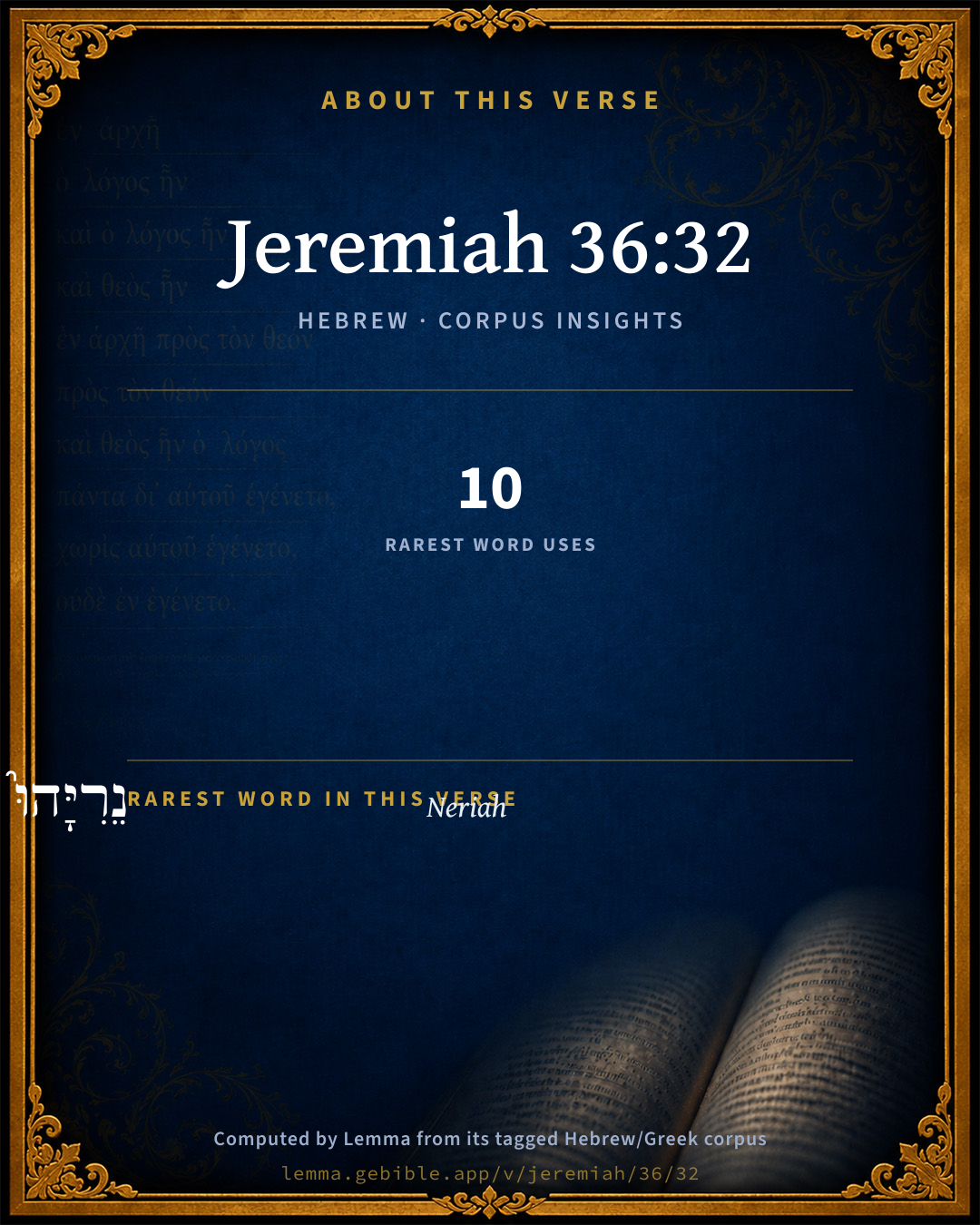
These counts appear in no published source. They are computed here, from the morphology-tagged text and Lemma’s own curated glosses. What Lemma adds →

30
words
27
distinct lemmas
Prophets
section

Notable vocabulary

The rarest word here is נֵרִיָּהוּ֮ Neriah H5374 — appearing just 10 times in the whole Hebrew Bible.

Shared distinctive vocabulary

נֵרִיָּהוּ֮ Neriah H5374 occurs in 10 verses of the Hebrew Bible. Also found in:

Grammatical profile

  • 5 verbs
  • 16 nouns
  • 2 adjectives
  • 4 prepositions
  • 1 adverb
  • 2 particles

Verb forms

  • לָקַ֣ח Qal · Perfect
  • וַֽיִּתְּנָהּ֮ Qal · Sequential Imperfect
  • וַיִּכְתֹּ֤ב Qal · Sequential Imperfect
  • שָׂרַ֛ף Qal · Perfect
  • נוֹסַ֧ף Niphal · Perfect

Repetition

Words recur within this verse — often emphatic in Hebrew:

  • וְיִרְמְיָ֜הוּ Jeremiah H3414 ×2
  • עָלֶ֨יהָ֙ upon H5921 ×2
  • דִּבְרֵ֣י word H1697 ×2

Cross-references

12

Topical passages linked to Jeremiah 36:32 in the Treasury of Scripture Knowledge — connected by theme and wording, ordered by reader-vote popularity; previews shown in the World English Bible.

  • Jeremiah 36:4 Then Jeremiah called Baruch the son of Neriah; and Baruch wrote from the mouth of Jeremiah all the words of Yahweh, which he had spoken to him, on a scroll of a book.
  • Jeremiah 36:18 Then Baruch answered them, He pronounced all these words to me with his mouth, and I wrote them with ink in the book.
  • Exodus 4:15–16 You shall speak to him, and put the words in his mouth. I will be with your mouth, and with his mouth, and will teach you what you shall do.
  • Exodus 34:1 Yahweh said to Moses, "Chisel two stone tablets like the first: and I will write on the tablets the words that were on the first tablets, which you broke.
  • Leviticus 26:18 "'If you in spite of these things will not listen to me, then I will chastise you seven times more for your sins.
  • Leviticus 26:21 "'If you walk contrary to me, and won't listen to me, then I will bring seven times more plagues on you according to your sins.
  • Leviticus 26:24 then I will also walk contrary to you; and I will strike you, even I, seven times for your sins.
  • Leviticus 26:28 then I will walk contrary to you in wrath; and I also will chastise you seven times for your sins.
  • Jeremiah 36:23 It happened, when Jehudi had read three or four leaves, that [the king] cut it with the penknife, and cast it into the fire that was in the brazier, until all the scroll was consumed in the fire that was in the brazier.
  • Daniel 3:19 Then was Nebuchadnezzar full of fury, and the form of his visage was changed against Shadrach, Meshach, and Abednego: [therefore] he spoke, and commanded that they should heat the furnace seven times more than it was wont to be heated.
  • Romans 16:22 I, Tertius, who write the letter, greet you in the Lord.
  • Revelation 22:18 I testify to everyone who hears the words of the prophecy of this book, if anyone adds to them, may God add to him the plagues which are written in this book.

Cross-references courtesy of OpenBible.info (CC BY 4.0).

Hebrew and Greek witnesses Masoretic Hebrew ↔ Greek Septuagint

The same verse in the two great witnesses to the Old Testament, shown verse-for-verse.

These are two independent witnesses, not word-aligned to each other, and the Septuagint is shown in lemma (dictionary) form.

Hebrew Jeremiah 36:32 Masoretic · Westminster Leningrad Codex

וְיִרְמְיָ֜הוּ לָקַ֣ח מְגִלָּ֣ה אַחֶ֗רֶת וַֽיִּתְּנָהּ֮ אֶל בָּר֣וּךְ בֶּן נֵרִיָּהוּ֮ הַסֹּפֵר֒ וַיִּכְתֹּ֤ב עָלֶ֨יהָ֙ מִפִּ֣י יִרְמְיָ֔הוּ אֵ֚ת כָּל דִּבְרֵ֣י הַסֵּ֔פֶר אֲשֶׁ֥ר שָׂרַ֛ף יְהוֹיָקִ֥ים מֶֽלֶךְ יְהוּדָ֖ה בָּאֵ֑שׁ וְע֨וֹד נוֹסַ֧ף עֲלֵיהֶ֛ם דְּבָרִ֥ים רַבִּ֖ים כָּהֵֽמָּה

Then took Jeremiah another scroll, and gave it to Baruch the scribe, the son of Neriah, who wrote therein from the mouth of Jeremiah all the words of the book which Jehoiakim king of Judah had burned in the fire; and there were added besides to them many like words.

World English Bible · Public Domain

Greek LXX Structure differs

In the Septuagint, Jeremiah is about an eighth shorter than the Hebrew and arranges its material differently — the Oracles Against the Nations (Hebrew chapters 46–51) appear in the middle of the Greek book, after 25:13. Because the chapter and verse boundaries do not line up, a verse-for-verse comparison with the Hebrew is not shown.

A verse-for-verse comparison isn’t shown here because the chapters and verses don’t line up. Switch to the LXX edition with the MT / LXX toggle above to read the Greek directly.

Hebrew: Westminster Leningrad Codex (CC BY 4.0). Greek: Septuagint (public domain); English from a public-domain English Septuagint. How the Septuagint differs from the Hebrew →

Targum (Aramaic paraphrase)

1

The Targum is the ancient Jewish Aramaic paraphrase of the Hebrew Scriptures — an interpretive translation, not the Hebrew text itself. Onkelos (literal) and Pseudo-Jonathan (expansive) render the Torah, and Jonathan the Prophets. Coverage is partial: where no permissively-licensed English translation exists for a verse, only the Aramaic is shown. This is verse-level text, not a word-by-word alignment to the Hebrew.

  1. Targum Jonathan Prophets (Joshua–Malachi)
    וְיִרְמְיָה נְסִיב מְגִלָה אוֹחֲרֵי וְיָהֲבָהּ לְבָרוּךְ בַּר נֵרִיָה סַפְרָא דְיִרְמְיָה וּכְתַב עֲלָהּ מִפּוּמָא יַת כָּל פִּתְגָמֵי סִפְרָא דְאוֹקֵיד יְהוֹיָקִים מְלַךְ שִׁבְטָא דְבֵית יְהוּדָה בְּנוּרָא וְעוֹד אִתּוֹסָפוּ עֲלֵיהוֹן פִּתְגָמִין סַגִיאִין כְּוַתְהוֹן:

    (no public-domain English translation for this verse)

    Targum Jonathan — Aramaic: “Mikraot Gedolot” (public domain). English: “Sefaria Community Translation” (CC0 1.0 (public-domain dedication)); “London "Chaldee Paraphrase," 1871” (public domain). Text via Sefaria.

Commentary

Notes on Jeremiah 36:32 from classic Christian and Jewish commentators (each source and its license shown beneath its notes). The classic Christian expositions comment on the surrounding passage and are grouped to its opening verse, so a note may address several verses; the Jewish commentaries on the Tanakh (Rashi and others) are per-verse, so they appear only where the commentator wrote on this verse.

Lemma curates 59 commentaries, every one of them public domain or Creative Commons licensed, each selected and text-cleaned for this edition rather than reprinted as found. About our sources →

Trapp's Complete Commentary

John Trapp

Jer 36:32 Then took Jeremiah another roll, and gave it to Baruch the scribe, the son of Neriah; who wrote therein from the mouth of Jeremiah all the words of the book which Jehoiakim king of Judah had burned in the fire: and there were added besides unto them many like words.

Ver. 32. Then took Jeremiah.] Who is therefore famous for his obedience; which is then only right, when it is prompt and present, ready and, speedy, without delays and consults, as here.

And there were added besides unto them many like words.] So little is gotten by relucting against the Word of God, and persecuting his messengers. What do wicked men hereby but entangle themselves more and more, as one that goeth among briers? {a} "Did not my word take hold of your fathers?" {Zec 1:6} {See Trapp on "Zec 1:6"} What do they else, but as she in the history, who, disliking her looking glass for showing her truly the wrinkles in her old withered face, broke it in displeasure; and then she had for one glass many, every piece thereof presenting to her the decay of her beauty, which she was so loath to take notice of. The best way is to pass into the likeness of the heavenly pattern. See Mic 2:7. {See Trapp on "Mic 2:7"}

{a} Oppressus Christi Spiritus robustior in se coactus exilit. - Oecolamp.

John Trapp, A Commentary or Exposition upon All the Books of the Old and New Testament (1647–1656) — public domain. Text from a community e-Sword module.

Joseph Benson's Commentary

Jer 36:32. Then took Jeremiah another roll — Here we are shown, that wicked men gain nothing by opposing themselves to the revealed will of God, how ungrateful soever it may be to them, but the addition of guilt to their souls, and the increase of divine wrath; God’s counsels shall stand, and what he speaks shall most certainly be accomplished. Here is another roll written, with additional threatenings, confirming what God had before said. There were added unto them, besides, many like words — Blaney translates the clause, And there was a further addition made unto them of many words of the same sort. “From hence we may infer,” says Lowth, “that God’s Spirit did not always endite the very form of words which the holy writers have set down, but, directing them in general to express his sense in proper words, left the manner of expression to themselves. From whence proceeds that variety of style which we may observe in the Scriptures, suitable to the different genius and education of the writers.”

Joseph Benson's Commentary on the Old and New Testaments (1811–1818) — public domain. Text from a community e-Sword module.

MacLaren's Expositions of Holy Scripture

Alexander MacLaren

Jeremiah

JEREMIAH’S ROLL BURNED AND REPRODUCED

Jer 36:32.

This story brings us into the presence of the long death agony of the Jewish monarchy. The wretched Jehoiakim, the last king but two who reigned in Jerusalem, was put on the throne by the King of Egypt, as his tributary, and used by him as a buffer to bear the brunt of the Babylonian invasion. He seems to have had all the vices of Eastern sovereigns. He was covetous, cruel, tyrannous, lawless, heartless, senseless. He was lavishing money on a grand palace, built with cedar and painted in vermilion, when the nation was in its death-throes. He had neither valour nor goodness, and so little did he understand the forces at work in his times that he held by the rotten support of Egypt against the grim power of Babylon, and of course, when the former was driven like chaff before the assault of the latter, he shared the fate of his principal, and Judaea was overrun by Babylon, Jerusalem captured, and the poor creature on the throne bound in chains to be carried to Babylon, but, as would appear, discovered by Nebuchadnezzar to be pliable enough to make it safe to leave him behind, as his vassal. His capture took place but a few months after the incident with which I am dealing now. It would appear probable that the confusion and alarm of the Babylonian assault on Egypt had led to a solemn fast in Jerusalem, at which the nation assembled. Jeremiah, who had been prophesying for some thirty years, and had already been in peril of his life from the godless tyrant on the throne, was led to collect, in one book, his scattered prophecies and read them in the ears of the people gathered for the fast. That reading had no effect at all on the people. The roll was then read to the princes, and in them roused fear and interested curiosity, and kindly desire for the safety of Jeremiah and Baruch, his amanuensis. It was next read to the king, and he cut the roll leaf by leaf and threw it on the brasier, not afraid, nor penitent, but enraged and eager to capture Jeremiah and Baruch. The burnt roll was reproduced by God’s command, ‘and there were added besides . . . many like words.’

I. The love of God necessarily prophesying evil.

As a matter of fact, the prophets of the Old Testament were all prophets of evil. They were watchmen seeing the sword and giving warning. No one ever spoke more plainly of the penalties of sin than did Christ. The authoritative revelation of the consequences of wrongdoing is an integral part of the gospel.

It is not the highest form of appeal. It would be higher to say, ‘Do right because it is right; love Christ because Christ is lovely.’ The purpose of such an appeal is to prepare us for the true gospel. But the appeal to a reasonable self-love, by warnings of the death which is the wages of sin, is perfectly legitimate. Dehortations from sin on the ground of its consequences is part of God’s message.

Further, the warning comes from love. Punishment must needs follow on sin. Even His love must compel God to punish, and to warn before He does. Surely that is kind. His punishments are made known beforehand that we may be sure that caprice and anger have no part in inflicting them, but that they are the settled order of an inviolable law, and constitutional procedure of a just kind. Whether is it better to live under a despot who smites as he will, or under a constitutional king whose code is made public.

Surely it is needful to have clearly set forth the consequences of sin, in view of the sophistries buzzing round us all and nestling in our own hearts, of the deceitfulness of sin, of siren voices whispering, ‘Ye shall not surely die.’

God’s prophecies of evil are all conditional. They are sent on purpose that they may not be fulfilled.

II. The loving warnings disregarded and disliked. Jehoiakim’s behaviour is very human and like what we all do. We see the same thing repeated in all similar crises. Cassandra. Jewish prophets. Christ. English Commonwealth. French Revolution. Blindness to all signs and hostility to the men that warn.

We see it in the attitude to the gospel revelation. The Scripture doctrine of punishment always rouses antagonism, and in this day revolts men. There is much in present tendencies to weaken the idea of future retribution. Modern philanthropy makes it hard sometimes to administer even human laws. The feeling is good, but this exaggeration of it bad. It is a reaction to some extent against an unchristian way of preaching Christian truth, but even admitting that, it still remains true that an integral part of the Christian revelation is the revelation of death as the wages of sin.

We see the same recoil of feeling operating in individual cases. How many of you are quite indifferent to the preaching of a judgment to come, or only conscious of a movement of dislike! But how foolish this is! If a man builds a house on a volcano, is it not kind to tell him that the lava is creeping over the side? Is it not kind to wake, even violently, a traveller who has fallen asleep on the snow, before drowsiness stiffens into death?

III. The impotent rejection and attempted destruction of the message.

The roll is destroyed, but it is renewed. You do not alter facts by neglecting them, nor abrogate a divine decree by disbelieving it. The awful law goes on its course. It is not pre-eminent seamanship to put the look-out man in irons because he sings out, ‘Breakers ahead.’ The crew do not abolish the reef so, but they end their last chance of avoiding it, and presently the shock comes, and the cruel coral tears through the hull.

IV. The neglected message made harder and heavier.

Every rejection makes a man more obdurate. Every rejection increases criminality, and therefore increases punishment. Every rejection brings the punishment nearer.

The increased severity of the message comes from love.

Oh, think of the infinite ‘treasures of darkness’ which God has in reserve, and let the words of warning lead you to Jesus, that you may only hear and never experience the judgments of which they warn. Give Christ the roll of judgment and He will destroy it, nailing it to His cross, and instead of it will give you a book full of blessing.

Alexander MacLaren, Expositions of Holy Scripture (1904–1910) — public domain. Text from a community e-Sword module.

Jamieson, Fausset & Brown

Robert Jamieson, A. R. Fausset & David Brown

added besides . . . many like words--Sinners gain nothing but additional punishment by setting aside the word of Jehovah. The law was similarly rewritten after the first tables had been broken owing to Israel's idolatry (Exo 32:19, Exo 34:1).

Next: Jeremiah Chapter 37

Jamieson, Fausset & Brown — Commentary Critical and Explanatory on the Whole Bible (1871) — public domain (CC PDM 1.0). Text via the HelloAO Bible API.

Adam Clarke's Commentary

Verse 32. There were added - many like words.] All the first roll, with many other threatenings, and perhaps more minute declarations which were merely of a temporary importance and local application; and the Holy Spirit did not think proper to record them here.

Adam Clarke's Commentary on the Bible (1810–1826) — public domain. Text from a community e-Sword/MySword module.

John Calvin's Commentaries

Here the Prophet tells us that he faithfully obeyed God in writing another volume; and his constancy in this affair deserves no common praise; for he had lately fled in fear, he knew that the king was his enemy, as he had already ordered him and Baruch to be slain. As then he knew that the king burned with so much rage and hatred, how came he to be so bold as to exasperate him still more? But we see that the Prophets were not exempt from the influence of fear, and were often anxious about their own safety; and yet they ever preferred the duty imposed on them by God to their own life. The Prophet, no doubt, trembled, but as he felt bound to obey God’s command, he disregarded his own life, when he had to make the choice, whether to refuse the burden laid on him, or to provide for his own safety. Thus then he offered his own life as a sacrifice, though he was not free from fear and other infirmities. This is one thing.

But Baruch, I doubt not, again proclaimed these words; how was it then that the king abstained from cruelty? Had his madness been by any means mitigated? It is certain that he did not become changed, and that he did not through kindness spare God’s servants; but God restrained his cruelty; for when it is not his will to soften the hearts of the ungodly, he yet bridles their violence, so that they either dare not, or cannot find the way, to execute with their hands what they have intended in their minds, however much they may strive to do so. I therefore consider that the King Jehoiakim was restrained by the hidden power of God, so that he could not do any harm to Jeremiah and his scribe Baruch; and that in the meantime the magnanimity of the Prophet and also of his scribe remained invincible; for it was God’s will to fight as it were hand to hand, with this impious king, until he was ignominiously cast from his throne, which happened, as we shall see, soon after.

John Calvin's Commentaries (1540-1563) — public domain. Text from the Calvin Translation Society English edition (1840s-50s) via the Christian Classics Ethereal Library (ccel.org). Calvin's coverage is partial (roughly two-thirds of the Bible); uncommented books and verses are honest gaps, never fabricated. The 19th-century editor's footnotes and remarks are omitted so the notes are faithfully Calvin's own voice.

Ellicott's Commentary for English Readers

(32) And there were added besides unto them many like words.—The passage is interesting as showing, as it were, the genesis of the present volume of the prophet’s writings. The discourse delivered in the Temple court was, in modern phrase, revised and enlarged, dictated to Baruch as before, and in this shape has probably come down to us in Jeremiah 25.

A Bible Commentary for English Readers, edited by Charles John Ellicott (1878–1897) — public domain. Text from a community e-Sword module.

The Cambridge Bible for Schools and Colleges

gen. ed. J. J. S. Perowne

32. and there were added … many like words] See Intr. ch. 4 § 5.

The Cambridge Bible for Schools and Colleges (gen. ed. J. J. S. Perowne; Cambridge University Press, 1878–1918) — public domain. Text from a community e-Sword module.

John Gill's Exposition

Then took Jeremiah another roll,.... Of parchment; several sheets joined together, which made up a roll or volume:

and gave it to Baruch the scribe, the son of Neriah; who was by office a public notary or scribe of the law, as well as the amanuensis of the prophet:

who wrote therein from the mouth of Jeremiah all the words of the book which Jehoiakim king of Judah had burnt in the fire; not one was lost; all were recovered again, through the fresh inspiration of the Holy Spirit, under which Jeremiah dictated the selfsame things in the same words to Baruch again; so that the king got nothing by burning it, but an addition of guilt, and a heavier denunciation of wrath and vengeance, as follows:

and there were added besides unto them many like words; of the same nature and argument, of the threatening kind more especially. The Rabbins (y), who take the roll to be the book of Lamentations, very triflingly observe, that the first roll had only the three alphabets, in the first, second, and fourth chapters that the addition is the treble alphabet, in the third chapter the whole of the fifth chapter. Here it may not be amiss to insert the testimony of Eupolemus (z), an Heathen historian, concerning Jeremiah and his prophecies in the times of Jehoiakim.

"Joachim, (for so he calls him,) in his times Jeremiah the prophet prophesied, being sent of God, to take the Jews sacrificing to a golden idol, called by them Baal, and to declare unto them the calamity that was coming upon them; but Joachim would have laid hold on him, and burnt him alive; then he (the prophet) said that with those sticks they should prepare food for the Babylonians, and that they should dig canals from the Tigris and Euphrates when carried captive; wherefore, when Nebuchadnezzar king of the Babylonians heard what was prophesied by Jeremiah, he besought Astibares, king of the Medes, to join his forces with him; and having gathered and joined together the Babylonians and Medes, a hundred and eighty thousand foot, and a hundred and twenty thousand horse, with ten thousand chariots, first destroyed Samaria, Galilee, Scythopolis, and the Jews that inhabited Gilead; and then marched to Jerusalem, and took alive Joachim king of the Jews; and having taken out the gold, silver, and brass in the temple, sent it to Babylon, excepting the ark and the tables in it, for this remained with Jeremiah;''

compare with this Jer 22:18.

(y) Vid. Yalkut & Kimchi in loc. (z) Apud Euseb. Prepar. Evangel. l. 9. c. 39. p. 454.

Next: Jeremiah Chapter 37

John Gill's Exposition of the Whole Bible (1746–1763) — public domain (CC PDM 1.0). Text via the HelloAO Bible API.

Albert Barnes' Notes on the Bible

Many like words - The second scroll was thus a more complete record of the main lessons taught by Jeremiah during the long course of his inspired ministry.

Albert Barnes' Notes on the Bible (1834–1885) — public domain. Text from a community e-Sword/MySword module.

Haydock's Catholic Bible Commentary

Before. We cannot tell what. (Calmet) --- Protestants, "many like words." (Haydock)

George Leo Haydock (1774–1849), Haydock's Catholic Family Bible and Commentary, 1859 edition — public domain. Excludes Psalms (Douay-Rheims chapter numbering differs from Protestant) and Deuterocanonical books (Catholic canon only).

Matthew Poole's English Annotations

Wicked men get nothing by opposing themselves to the revealed will of God, how ungrateful soever it be to them, but the addition of guilt of their souls, and the increase of Divine wrath; God’s counsels shall stand, and what he speaks shall most certainly be accomplished. Here is another roll, written with additional threatenings, confirmative of what God had before-said.

Matthew Poole's English Annotations on the Holy Bible (1683–1685) — public domain. Text from a community e-Sword/MySword module.

Whedon's Commentary on the Bible

Daniel D. Whedon

32. Were added… like words — Implying that the first record by no means contained every thing which Jeremiah had said as a prophet, but only such things as were especially suited to the uses of this time. The second record received additions, but we are not warranted in concluding that even this was complete.

Daniel D. Whedon (gen. ed.), Commentary on the Old and New Testaments (1874–1909) — public domain. Text from a community e-Sword module.

The Pulpit Commentary

Many like words. Thus Jehoiakim gained nothing by his sin (comp. Introduction). Ver. 32 (last clause). The development of revelation. "And there were added besides unto them many like words." The second roll was a transcript of the first, but with numerous additions, though these were all similar in character to the original prophecies. We have here, on a small scale, an instance of that development of revelation which is evolved on similar principles through the whole realm of knowledge.

I REVELATION FOLLOWS A PROCESS OF GRADUAL DEVELOPMENT. There are those to whom the word "development" has an evil sound, because of the excuse Roman Catholics have found in it for perversions of New Testament doctrines; while others object to it on account of its use in the scientific world, where they think it is meant to take the place of the will and wisdom of God. But the abuse of a word should not hide us from the important idea that it naturally denotes. Nothing is more true and grand and wonderful in all God"s works than the principle of development which his great power and wisdom has made to run through them. The dawn advances through twilight to full day; the seed grows slowly the blade, then the ear, then the full corn in the ear;" man begins life as an infant, and toils up to his full stature through years of childhood and youth; the kingdom of heaven began as a grain of mustard seed, and is slowly spreading till, from the work of that little company in the upper room at Jerusalem, "the earth shall be full of the knowledge of the Lord as the waters cover the sea." Revelation is no exception to the same universal Divine process. God did not flash all his truth upon the world in one dazzling moment. The Bible is a slow growth of many centuries. Progress is observable in the Old Testament. Isaiah saw further than it was given to Abraham to see. Jeremiah"s vision of the new covenant (Jer_31:31-34) is in advance of the Levitical Law. The New Testament is a decided manifestation of broader knowledge and fuller light than the earlier revelation contained. Christ said to his disciples, "I have yet many things to say unto you, but ye cannot bear them now". (Joh_16:12) St. Paul"s teachings go beyond the doctrines held in his day by the Church at Jerusalem. We cannot say that God has nothing further to reveal. The Christian believes that "holy Scripture containeth all things necessary to salvation." But all the analogy of God"s past action would lead us to think that there may be much truth which men were not at first able to see in the Scripture, and yet which may be known in successive ages and found to be of great profit.

1. The human occasion of this development of revelation may be seen in the fact that the thoughts of men grow. God reveals his truth in human thinking. Men must seek him, and, feeling after the truth, are rewarded by God"s revelation. But the revelation is proportionate to the progress of the search.

2. The Divine purpose of this development may be noted in such facts as these: God reveals truth as man is able to receive it, as he is spiritually educated to understand it, as he is in a moral condition to profit by it, as changing circumstances may bring need for new stages in the development of it.

II THE DEVELOPMENT OF REVELATION IS CONSISTENT WITH ITSELF.

1. It does not set aside old truth. In the new roll all the contents of the old roll were rewritten, so that the fresh matter was not a substitute but an addition. Christ came to fulfill the Law and the prophets, not to destroy. (Mat_5:17) The gospel exceeds but does not supersede the spiritual truth of the Old Testament. No new discovery can ever destroy what is once known to be real and true.

2. This development maintains an essential likeness between its earliest and its latest stages. The added Words of Jeremiah"s roll were "like unto those which were first written. All truth must ultimately harmonize. One great test of a new doctrine is its agreement with previously established truth. All Christian truth must agree with the teachings of Christ and his apostles. That many so called developments of truth are really perversions of truth may be proved by the application of this test. Thus to us Protestants it seems clear that many Roman Catholic dogmas which profess to be developments of Christianity are so utterly contrary to its spirit that they must be regarded either as pagan additions or as relapses towards Judaism. So there are "liberal" notions that are really negations of essential elements of the gospel. It is monstrous to call these developments. The oak is a development of the acorn; but the hollow, blasted stump, which is the last stage in the history of the tree, is surely not a further result of the same process. Decay is not development.

The Pulpit Commentary (1880–1919), ed. H.D.M. Spence-Jones & Joseph S. Exell — public domain. Text from a community e-Sword module.

unfoldingWord translationNotes

Door43 World Missions Community

Jeremiah took ... Jeremiah's dictation

Jeremiah speaks of himself by name for reasons that are not clear. (See: First, Second, or Third Person)

Baruch wrote on it at Jeremiah's dictation

The abstract noun "dictation" can be translated as a verb. See how similar words are translated in Jeremiah 36:4. AT: "while Jeremiah was speaking, Baruch wrote on it" (See: Abstract Nouns)

burned by Jehoiakim king of Judah

"that Jehoiakim king of Judah had burned in the fire"

Furthermore, many other similar words were added to this scroll

This can be translated in active form. AT: "Furthermore, Jeremiah and Baruch added to this scroll many more words which were similar to the words that had been in the first scroll" (See: Active or Passive)

translationWords

Jeremiah

scroll

Baruch

scribe

word

Jehoiakim

king

kingdom of Judah

unfoldingWord translationNotes — © Distant Shores Media and the Door43 World Missions Community, licensed CC BY-SA 4.0. Source: git.door43.org/Door43/en_tn.

Rashi

Rabbi Shlomo Yitzchaki (Rashi)

many words like those At first, there were three alphabetical acrostics: (Lam. ch. 1) “O how... remained,” (2) “How...brought darkness,” (4) “How dim...has become.” And he added to it, (3) “I am the man,” in which every letter is tripled.

Rashi on the Tanakh — English translations: “The Judaica Press complete Tanach with Rashi, translated by A. J. Rosenberg” (CC BY 4.0); “Pentateuch with Rashi's commentary by M. Rosenbaum and A.M. Silbermann, 1929-1934” (public domain); “The Metsudah Tanach series, Lakewood, N.J” (CC BY 4.0); and “The Book of Joshua, Metsudah Publications, 1997” (CC BY 4.0). Text via Sefaria.

Lesson kit

Teaching starters — assembled from the data on this page, not authored interpretation. Every prompt links to the verse data it draws on. Edit before teaching.

Jeremiah, in the Prophets, opens this verse with 30 words (27 distinct Hebrew lemmas). Its most distinctive word is Nêrîyâh (“Neriah”). A historical commentator’s framing appears above. Read the whole chapter for the surrounding context.

Discussion questions

  1. What does “Neriah” (Nêrîyâh) contribute to the verse as a whole?
  2. How does Jeremiah 32:12, which shares the word «Neriah», read alongside this verse?
  3. What does the repetition of “Jeremiah” (2× in this one verse) do in this verse?
  4. The translations on this page render this verse differently — a whole-verse word diff, not a word-by-word alignment. What might account for the different wordings?
  5. «לָקַ֣ח» is a Qal Perfect verb. How does that grammatical form shape the action described?
  6. Compare how Trapp's Complete Commentary and Joseph Benson's Commentary read this verse. Where do they agree or differ?

Things to notice

Reading settings

Reading text

Shown beneath each verse's original-language words.

Old Testament
Old Testament edition

Read the OT as the Masoretic Hebrew (MT) or the Greek Septuagint (LXX).

English shown for the Greek Septuagint (in the Hebrew ↔ Greek comparison).

Comparing translations? Open the Compare panel on any verse page to stack up to four side by side.