
Jeremiah 36:6

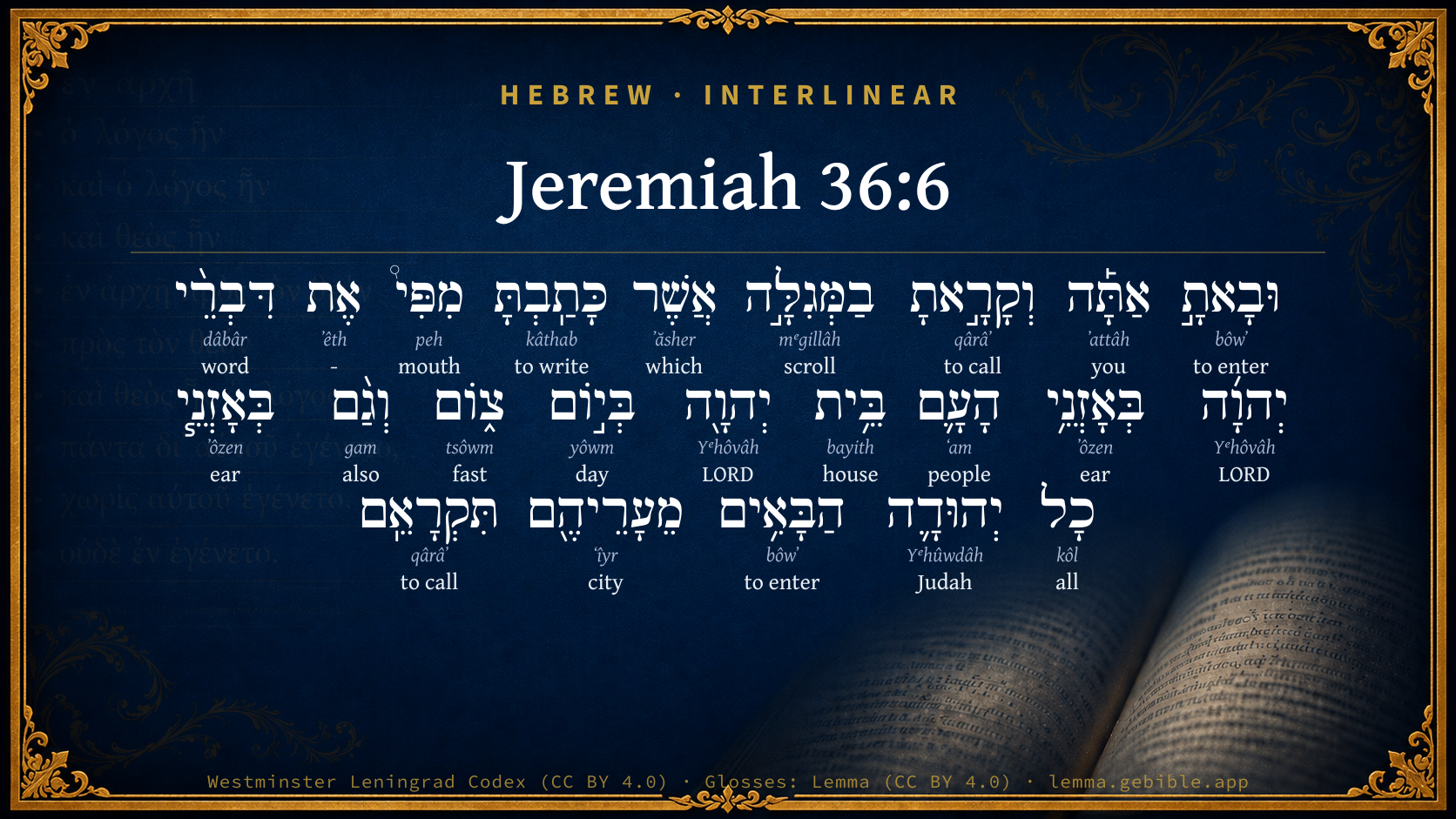
Hebrew (Westminster Leningrad Codex) Jeremiah 36:6 appears in the Hebrew Old Testament. The text above is from the Westminster Leningrad Codex. Each word links to its Strong’s number, a concise gloss, and parsing drawn from the Open Scriptures Hebrew Bible morphology. Click any word for its full Brown-Driver-Briggs (BDB) entry.
Download image
Cite this verse

Jeremiah 36:6 (World English Bible). Public Domain. Lemma interlinear Bible study tool, https://lemma.gebible.app/v/jeremiah/36/6.

Show BibTeX & RIS
BibTeX
RIS
English Translation
therefore go you, and read in the scroll, which you have written from my mouth, the words of Yahweh in the ears of the people in Yahweh's house on the fast-day; and also you shall read them in the ears of all Judah who come out of their cities.
World English Bible · Public Domain
Download a study sheet

One document with this verse’s original text, its word-by-word gloss line, the meaning frame, cross-references with their text, attributed commentary, and full source and license credits — printable, and it pastes into notes with its structure intact.

This verse Autodidact and up

Study sheet (.html) Plain text (.txt)

A passage Seminary Student

Up to 50 verses in one chapter. A passage sheet keeps up to 6 commentary sources and 12 cross-references per verse, in the order this page ranks them, and says so on the sheet whenever that leaves anything out. Ask for a single verse and you get the Autodidact verse sheet above.

Everything on this page stays free to read, with no account — the sheet is a download of what is already on screen, not access to it.

Want to remove ads? Support Godless Engineer
Compare translations 3

The same verse in 3 English versions, stacked beneath the original-language interlinear above. Click any original word for its lexicon entry.

Each is an independent rendering of the whole verse — the interlinear is not word-aligned to these translations.

Highlighted words mark where these versions differ — a whole-verse word diff, not a word-by-word alignment.

  • World English Bible Public Domain
    therefore go you, and read in the scroll, which you have written from my mouth, the words of Yahweh in the ears of the people in Yahweh's house on the fast-day; and also you shall read them in the ears of all Judah who come out of their cities.
  • King James Version Public Domain
    Therefore go thou, and read in the roll, which thou hast written from my mouth, the words of the LORD in the ears of the people in the LORD's house upon the fasting day: and also thou shalt read them in the ears of all Judah that come out of their cities.
  • unfoldingWord Literal Text CC BY-SA 4.0
    So you must go and read from the scroll that you wrote at my dictation. On the day of the fast, you must read Yahweh’s words in the hearing of the people in his house, and also in the hearing of all of Judah who have come from their cities. Proclaim these words to them.

unfoldingWord Literal Text — © unfoldingWord, licensed CC BY-SA 4.0. Word-aligned USFM3 via Door43 (git.door43.org/unfoldingWord/en_ult).

Versions to compare (up to 4)

3 of 4 selected

Show all 18 translations

Every available English version of this verse, each an independent rendering of the whole verse.

  • World English Bible Public Domain
    therefore go you, and read in the scroll, which you have written from my mouth, the words of Yahweh in the ears of the people in Yahweh's house on the fast-day; and also you shall read them in the ears of all Judah who come out of their cities.
  • Berean Standard Bible Public Domain
    so you are to go to the house of the LORD on a day of fasting, and in the hearing of the people you are to read the words of the LORD from the scroll you have written at my dictation. Read them in the hearing of all the people of Judah who are coming from their cities.
  • Majority Standard Bible Public Domain
    so you are to go to the house of the LORD on a day of fasting, and in the hearing of the people you are to read the words of the LORD from the scroll you have written at my dictation. Read them in the hearing of all the people of Judah who are coming from their cities.
  • King James Version Public Domain
    Therefore go thou, and read in the roll, which thou hast written from my mouth, the words of the LORD in the ears of the people in the LORD's house upon the fasting day: and also thou shalt read them in the ears of all Judah that come out of their cities.
  • American Standard Version (1901) Public Domain
    therefore go thou, and read in the roll, which thou hast written from my mouth, the words of Jehovah in the ears of the people in Jehovah's house upon the fast-day; and also thou shalt read them in the ears of all Judah that come out of their cities.
  • Revised Version (1885) Public Domain
    therefore go thou, and read in the roll, which thou hast written from my mouth, the words of the LORD in the ears of the people in the LORD’S house upon the fast day: and also thou shalt read them in the ears of all Judah that come out of their cities.
  • Geneva Bible (1599) Public Domain
    Therefore goe thou, and reade the roule wherein thou hast written at my mouth the words of the Lord in the audience of the people in the Lordes House vpon the fasting day: also thou shalt reade them in the hearing of all Iudah, that come out of their cities.
  • Douay-Rheims (1899) Public Domain
    Go thou in therefore, and read out of the volume, which thou hast written from my mouth, the words of the Lord, in the hearing of all the people in the house of the Lord on the fasting day: and also thou shalt read them in the hearing of all Juda that come out of their cities:
  • Young's Literal Translation Public Domain
    but thou hast entered -- and thou hast read in the roll that thou hast written from my mouth, the words of Jehovah, in the ears of the people, in the house of Jehovah, in the day of the fast, and also in the ears of all Judah who are coming in from their cities thou dost read them;
  • Literal Standard Version CC BY-SA 4.0
    but you have entered—and you have read in the scroll that you have written from my mouth, the words of YHWH, in the ears of the people, in the house of YHWH, in the day of the fast, and you also read them in the ears of all Judah who are coming in from their cities;
  • Unlocked Literal Bible CC BY-SA 4.0
    So you must go and read from the scroll that you wrote at my dictation. On the day of the fast, you must read Yahweh's words in the hearing of the people in his house, and also in the hearing of all of Judah who have come from their cities. Proclaim these words to them.
  • unfoldingWord Literal Text CC BY-SA 4.0
    So you must go and read from the scroll that you wrote at my dictation. On the day of the fast, you must read Yahweh’s words in the hearing of the people in his house, and also in the hearing of all of Judah who have come from their cities. Proclaim these words to them.
  • Darby Bible Public Domain
    and read in the roll, which thou hast written from my mouth, the words of Jehovah in the ears of the people in the house of Jehovah upon the fast day; and thou shalt also read them in the ears of all Judah that come from their cities.
  • World Messianic Bible Public Domain
    Therefore you go, and read from the scroll which you have written from my mouth, the LORD’s words, in the ears of the people in the LORD’s house on the fast day. Also you shall read them in the ears of all Judah who come out of their cities.
  • Webster's Bible Public Domain
    Therefore go thou and read in the roll, which thou hast written from my mouth, the words of the LORD in the ears of the people in the LORD'S house upon the day of fasting: and also thou shalt read them in the ears of all Judah that come out of their cities.
  • Free Bible Version CC BY-SA 4.0
    So you have to go to the Lord's Temple on a day when people are fasting, and read to them the Lord's messages from the scroll I dictated to you. Read them to all the people of Judah who come in from their towns.
  • Bible in Basic English Public Domain
    So you are to go, reading there from the book, which you have taken down from my mouth, the words of the Lord, in the hearing of the people in the Lord's house, on a day when they go without food, and in the hearing of all the men of Judah who have come out from their towns.
  • JPS Tanakh (1917) Public Domain
    therefore go thou, and read in the roll, which thou hast written from my mouth, the words of the LORD in the ears of the people in the LORD'S house upon a fast-day; and also thou shalt read them in the ears of all Judah that come out of their cities.

Literal Standard Version (2020), Covenant Press — licensed CC BY-SA 4.0. Text via the HelloAO Bible API (eBible.org). Unlocked Literal Bible (unfoldingWord) — licensed CC BY-SA 4.0. Text via the HelloAO Bible API (eBible.org). unfoldingWord Literal Text — © unfoldingWord, licensed CC BY-SA 4.0. Word-aligned USFM3 via Door43 (git.door43.org/unfoldingWord/en_ult). Free Bible Version, Dr. Jonathan Gallagher — licensed CC BY-SA 4.0. Text via the HelloAO Bible API (eBible.org).

Word by word

More ways to search: Search by grammar → Find every occurrence → Compare this word →

Practice this passage: Drill this verse → Learn its vocabulary →

בַמְּגִלָּ֣ה
mᵉgillâh
H4039
“in/at the · scroll”
Preposition, Determined + Noun, Common, Feminine, Singular, Absolute
Part of Speech
Preposition + Noun
Type
Common
Gender
Feminine
Number
Singular
State
Absolute
Full BDB Definition

Origin: from H1556

TWOT: 353m

roll, book, writing
  1. וּבָאתָ֣ bôwʼ H935 “and · to enter” Conjunction + Verb, Qal, Sequential Perfect, 2nd Person, Masculine, Singular
  2. אַתָּ֡ה ʼattâh H859 “you” Pronoun, Personal, 2nd Person, Masculine, Singular
  3. וְקָרָ֣אתָ qârâʼ H7121 “and · to call” Conjunction + Verb, Qal, Sequential Perfect, 2nd Person, Masculine, Singular
  4. אֲשֶׁר ʼăsher H834 “which” Particle, Relative
  5. כָּתַֽבְתָּ kâthab H3789 “to write” Verb, Qal, Perfect, 2nd Person, Masculine, Singular
  6. מִפִּי֩ peh H6310 “from · mouth · my” Preposition + Noun, Common, Masculine, Singular, Construct + Suffix, Personal, 1st Person, Common, Singular
  7. אֶת ʼêth H853 “-” Particle, Direct Object
  8. דִּבְרֵ֨י dâbâr H1697 “words of” Noun, Common, Masculine, Plural, Construct
  9. יְהוָ֜ה Yᵉhôvâh H3068 “LORD” Noun, Proper
  10. בְּאָזְנֵ֥י ʼôzen H241 “in/at · ears of” Preposition + Noun, Common, Feminine, Dual, Construct
  11. הָעָ֛ם ʻam H5971 “the · people” Particle, Definite Article + Noun, Common, Masculine, Singular, Absolute
  12. בֵּ֥ית bayith H1004 “house of” Noun, Common, Masculine, Singular, Construct
  13. יְהוָ֖ה Yᵉhôvâh H3068 “LORD” Noun, Proper
  14. בְּי֣וֹם yôwm H3117 “in/at · day of” Preposition + Noun, Common, Masculine, Singular, Construct
  15. צ֑וֹם tsôwm H6685 “fast” Noun, Common, Masculine, Singular, Absolute
  16. וְגַ֨ם gam H1571 “and · also” Conjunction + Particle, Accusative
  17. בְּאָזְנֵ֧י ʼôzen H241 “in/at · ears of” Preposition + Noun, Common, Feminine, Dual, Construct
  18. כָל kôl H3605 “all of” Noun, Common, Masculine, Singular, Construct
  19. יְהוּדָ֛ה Yᵉhûwdâh H3063 “Judah” Noun, Proper
  20. הַבָּאִ֥ים bôwʼ H935 “the · entering” Particle, Definite Article + Verb, Qal, Participle Active, Masculine, Plural, Absolute
  21. מֵעָרֵיהֶ֖ם ʻîyr H5892 “from · cities · their” Preposition + Noun, Common, Feminine, Plural, Construct + Suffix, Personal, 3rd Person, Masculine, Plural
  22. תִּקְרָאֵֽם qârâʼ H7121 “to call · them” Verb, Qal, Imperfect, 2nd Person, Masculine, Singular + Suffix, Personal, 3rd Person, Masculine, Plural

About this verse

These counts appear in no published source. They are computed here, from the morphology-tagged text and Lemma’s own curated glosses. What Lemma adds →

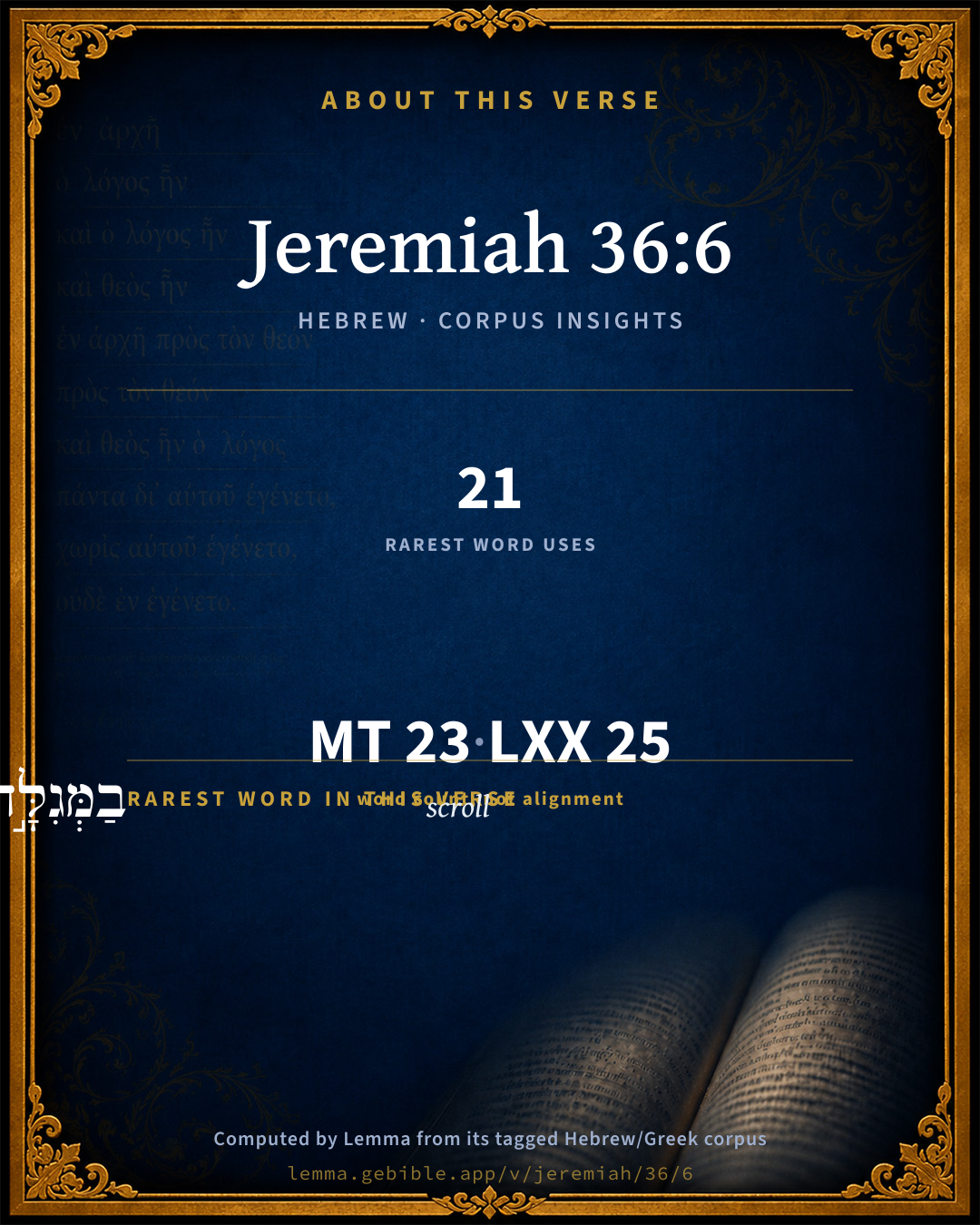
23
words
19
distinct lemmas
Prophets
section

Notable vocabulary

The rarest word here is בַמְּגִלָּ֣ה scroll H4039 — appearing just 21 times in the whole Hebrew Bible.

Shared distinctive vocabulary

בַמְּגִלָּ֣ה scroll H4039 occurs in 19 verses of the Hebrew Bible. Also found in:

Grammatical profile

  • 5 verbs
  • 14 nouns
  • 1 pronoun
  • 3 particles

Verb forms

  • וּבָאתָ֣ Qal · Sequential Perfect
  • וְקָרָ֣אתָ Qal · Sequential Perfect
  • כָּתַֽבְתָּ Qal · Perfect
  • הַבָּאִ֥ים Qal · Participle Active
  • תִּקְרָאֵֽם Qal · Imperfect

Repetition

Words recur within this verse — often emphatic in Hebrew:

  • וּבָאתָ֣ to enter H935 ×2
  • וְקָרָ֣אתָ to call H7121 ×2
  • יְהוָ֜ה LORD H3068 ×2
  • בְּאָזְנֵ֥י ear H241 ×2

Hebrew & Septuagint length

In the original languages it is 23 Hebrew tokens and 25 Greek tokens — but the two are counted differently (Hebrew bundles its prefixes and suffixes into one token; the Greek is in lemma form), so that isn’t a like-for-like length.

Cross-references

10

Topical passages linked to Jeremiah 36:6 in the Treasury of Scripture Knowledge — connected by theme and wording, ordered by reader-vote popularity; previews shown in the World English Bible.

  • Jeremiah 36:8–9 Baruch the son of Neriah did according to all that Jeremiah the prophet commanded him, reading in the book the words of Yahweh in Yahweh's house.
  • Leviticus 16:29–31 "It shall be a statute to you forever: in the seventh month, on the tenth day of the month, you shall afflict your souls, and shall do no manner of work, the native-born, or the stranger who lives as a foreigner among you:
  • Jeremiah 7:2 Stand in the gate of Yahweh's house, and proclaim there this word, and say, Hear the word of Yahweh, all you of Judah, who enter in at these gates to worship Yahweh.
  • Jeremiah 22:2 Say, Hear the word of Yahweh, king of Judah, who sits on the throne of David, you, and your servants, and your people who enter in by these gates.
  • Jeremiah 26:2 Thus says Yahweh: Stand in the court of Yahweh's house, and speak to all the cities of Judah, which come to worship in Yahweh's house, all the words that I command you to speak to them; don't diminish a word.
  • Leviticus 23:27–32 "However on the tenth day of this seventh month is the day of atonement: it shall be a holy convocation to you, and you shall afflict yourselves; and you shall offer an offering made by fire to Yahweh.
  • Ezekiel 2:3–7 He said to me, Son of man, I send you to the children of Israel, to nations that are rebellious, which have rebelled against me: they and their fathers have transgressed against me even to this very day.
  • Jeremiah 18:11 Now therefore, speak to the men of Judah, and to the inhabitants of Jerusalem, saying, Thus says Yahweh: Behold, I frame evil against you, and devise a device against you: return you now everyone from his evil way, and amend your ways and your doings.
  • Jeremiah 19:14 Then came Jeremiah from Topheth, where Yahweh had sent him to prophesy; and he stood in the court of Yahweh's house, and said to all the people:
  • Acts 27:9 When much time had passed and the voyage was now dangerous, because the Fast had now already gone by, Paul admonished them,

Cross-references courtesy of OpenBible.info (CC BY 4.0).

Hebrew and Greek witnesses Masoretic Hebrew ↔ Greek Septuagint

The same verse in the two great witnesses to the Old Testament, shown verse-for-verse.

These are two independent witnesses, not word-aligned to each other, and the Septuagint is shown in lemma (dictionary) form.

Hebrew Jeremiah 36:6 Masoretic · Westminster Leningrad Codex

וּבָאתָ֣ אַתָּ֡ה וְקָרָ֣אתָ בַמְּגִלָּ֣ה אֲשֶׁר כָּתַֽבְתָּ מִפִּי֩ אֶת דִּבְרֵ֨י יְהוָ֜ה בְּאָזְנֵ֥י הָעָ֛ם בֵּ֥ית יְהוָ֖ה בְּי֣וֹם צ֑וֹם וְגַ֨ם בְּאָזְנֵ֧י כָל יְהוּדָ֛ה הַבָּאִ֥ים מֵעָרֵיהֶ֖ם תִּקְרָאֵֽם

therefore go you, and read in the scroll, which you have written from my mouth, the words of Yahweh in the ears of the people in Yahweh's house on the fast-day; and also you shall read them in the ears of all Judah who come out of their cities.

World English Bible · Public Domain

Greek LXX Structure differs

In the Septuagint, Jeremiah is about an eighth shorter than the Hebrew and arranges its material differently — the Oracles Against the Nations (Hebrew chapters 46–51) appear in the middle of the Greek book, after 25:13. Because the chapter and verse boundaries do not line up, a verse-for-verse comparison with the Hebrew is not shown.

A verse-for-verse comparison isn’t shown here because the chapters and verses don’t line up. Switch to the LXX edition with the MT / LXX toggle above to read the Greek directly.

Hebrew: Westminster Leningrad Codex (CC BY 4.0). Greek: Septuagint (public domain); English from a public-domain English Septuagint. How the Septuagint differs from the Hebrew →

Targum (Aramaic paraphrase)

1

The Targum is the ancient Jewish Aramaic paraphrase of the Hebrew Scriptures — an interpretive translation, not the Hebrew text itself. Onkelos (literal) and Pseudo-Jonathan (expansive) render the Torah, and Jonathan the Prophets. Coverage is partial: where no permissively-licensed English translation exists for a verse, only the Aramaic is shown. This is verse-level text, not a word-by-word alignment to the Hebrew.

  1. Targum Jonathan Prophets (Joshua–Malachi)
    וְתֵיתֵי אַתְּ וְתִקְרֵי בִּמְגִלָתָא דִכְתַבְתָּא מִפּוּמִי יַת פִּתְגָמַיָא דַייָ קֳדָם עַמָא בְּבֵית מַקְדְשָׁא דַייָ בְּיוֹמָא דְצוֹמָא וְאַף קֳדָם כָּל בֵּית יְהוּדָה דְאָתָן מִקִרְוֵיהוֹן תִּקְרִינוּן:

    (no public-domain English translation for this verse)

    Targum Jonathan — Aramaic: “Mikraot Gedolot” (public domain). English: “Sefaria Community Translation” (CC0 1.0 (public-domain dedication)); “London "Chaldee Paraphrase," 1871” (public domain). Text via Sefaria.

Commentary

Notes on Jeremiah 36:6 from classic Christian and Jewish commentators (each source and its license shown beneath its notes). The classic Christian expositions comment on the surrounding passage and are grouped to its opening verse, so a note may address several verses; the Jewish commentaries on the Tanakh (Rashi and others) are per-verse, so they appear only where the commentator wrote on this verse.

Lemma curates 59 commentaries, every one of them public domain or Creative Commons licensed, each selected and text-cleaned for this edition rather than reprinted as found. About our sources →

Trapp's Complete Commentary

John Trapp

Jer 36:6 Therefore go thou, and read in the roll, which thou hast written from my mouth, the words of the LORD in the ears of the people in the LORD’S house upon the fasting day: and also thou shalt read them in the ears of all Judah that come out of their cities.

Ver. 6. Therefore go thou, and read in the roll.] A minister, when he cannot himself officiate, must provide another in his stead.

Which thou hast written from my mouth.] And which the Holy Ghost hath put into my mouth, both matter and words.

Upon the fasting day.] A very fit time for the reading of the Scriptures, that the people then convened might hear and fear, and supplicate, and convert, and God might heal them. The fast here mentioned was not the ordinary yearly fast, called the day of expiation or atonement, but another that was conceptivum et liberum, kept on some special occasion for the averting of God’s judgment, such as was that at Nineveh. There was afterwards, indeed, a yearly fast kept in November, to bewail this wicked practice of King Jehoiakim in cutting and casting into the fire this blessed book. {a}

{a} Genebrard., Ex Menologio Hebraeor.

John Trapp, A Commentary or Exposition upon All the Books of the Old and New Testament (1647–1656) — public domain. Text from a community e-Sword module.

The Biblical Illustrator

Joseph S. Exell

Jer_36:6

The fasting-day.

Symbolism of a fast

I. It exhibits the duty of a wise self-restraint or self-denial, in receiving the good gifts of heaven. What could more exactly typify this than the temporary withdrawing from innocent pleasure, and even from the proper nourishment of the frame? It is temporary, and not absolute; an occasion, and not a permanency; a suspension, and not a renunciation. It admonishes us by an example, and does not crush us by a law. It reminds us of the obligation of sobriety in the use of the world s offerings. It bids us reflect that it is good for us to break away at times from what is plentiful, contenting ourselves with what is scanty; and to interrupt the course of the enjoyments that only do not reproach us, in order to make room for higher satisfactions. It exhorts us to be frugal, to be watchful, to be provident. It enjoins to be temperate in all things, and to let our moderation be known to all men; to learn how to lack as well as how to abound; and to show to others and prove to ourselves how well we can resign what we would fain keep, and refrain from what we desire to do, controlling tongue and hand, wish and passion, at the call of any holy commandment.

2. It typifies our weak and subject condition. When we pause in the midst of our blessings, and put them at a distance for a while that we may see them the better, we remember how precarious is our hold upon them, and how easily what we dispense with for a day may be withdrawn from us for ever. Fulness may shrink. Strength and activity may be crippled. Resources heaped up ever so high may be scattered to the winds. Opportunity and desire may perish together. It is good to be impressed with this at intervals, though it would not be good to dwell upon it perpetually; for you make a man none the better by making him habitually sad.

3. It presents an image of the sorrows of the world. These are a part of our subjection, and a peculiar part. While it is foolish and ungrateful to anticipate trouble, every day having enough to do with its own; and it is one of the worst occupations we can engage in, to torment ourselves with unarrived calamities, and paint the white blank of the future with woe; yet it becomes thoughtful persons, and has no tendency to make them less thankful, to consider She evils of humanity. They may be thus preserved from presumption, thus guarded against surprises, thus furnished with a fellow-feeling for the sufferings of others, and thus better prepared for their own trial when God shall send it.

4. Fasting represents penitence. It does so on the principle already mentioned, since penitence is one kind of grief. It does so on another ground. When a man is thoroughly stricken with the sense of sin, and seeks to express that consciousness, he describes his unworthiness to receive the bounties of heaven by declining to partake of them. (N. L. Frothingham.)

The Biblical Illustrator, edited by Joseph S. Exell (c. 1880s–1900s) — public domain. Text from a community e-Sword module.

Tyndale Open Study Notes

Tyndale Open Resources

36:6 The next day of fasting was a national festival, but it is not clear which one (none of the annual festivals occurred in the ninth month; see study note on 36:8-9). Reading the written scroll to the multitude gathered in the Temple would have placed Baruch in danger of arrest or assault.

Tyndale Open Study Notes — © Tyndale Open Resources, licensed CC BY-SA 4.0. Text via the HelloAO Bible API.

Geneva Bible (1599)

Geneva Bible translators

Which was proclaimed for fear of the Babylonians, as their custom was when they feared war, or any great plague of God.

Geneva Bible (1599) marginal notes — public domain. Text via Bolls.life.

Jamieson, Fausset & Brown

Robert Jamieson, A. R. Fausset & David Brown

go--on the following year (Jer 36:9).

fasting day--(See Jer 36:9). An extraordinary fast, in the ninth month (whereas the fast on the great day of atonement was on the tenth day of the seventh month, Lev 16:29; Lev 23:27-32), appointed to avert the impending calamity, when it was feared Nebuchadnezzar, having in the year before (that is, the fourth of Jehoiakim), smitten Pharaoh-necho at Carchemish, would attack Judea, as the ally of Egypt (Kg2 23:34-35). The fast was likely to be an occasion on which Jeremiah would find the Jews more softened, as well as a larger number of them met together.

Jamieson, Fausset & Brown — Commentary Critical and Explanatory on the Whole Bible (1871) — public domain (CC PDM 1.0). Text via the HelloAO Bible API.

Adam Clarke's Commentary

Verse 6. Upon the fasting day] A day when multitudes of people would be gathered together from all parts to implore the mercy of God. This was a favourable time to read these tremendous prophecies.

Adam Clarke's Commentary on the Bible (1810–1826) — public domain. Text from a community e-Sword/MySword module.

John Calvin's Commentaries

Go thou, then, he says, and read in the volume The Prophet, in this case, was ready to incur any odium which might be, for he did not bid Baruch to relate by memory what he had heard from him, but ordered him to take the volume, and to read, as we shall hereafter see, what he had written. The Prophet then did not, in this instance, avoid danger, and put Baruch in his own place, but he expressly told him to read from the volume: What thou hast written, he says, from my mouth, and, what Jehovah has spoken, these things read thou to the people in the Temple, on a fasting day This day was chosen, first, because there was then a greater concourse of people, according to what immediately follows, for he was to read these things in the ears not only of the citizens, but also of the whole people; and on fast-days they were wont, as it is well known, to come in great numbers to the city for the purpose of sacrificing. It was then God’s purpose that these threatenings should be proclaimed, not only to the inhabitants of Jerusalem, but also to all other Jews, that the report of them might spread to every part of the land. In the second place, such a day was much more suitable to the message conveyed; for why was a fast enjoined, except humbly to supplicate God’s mercy, and to deprecate his wrath? As then this was the design of a fast, the Jews ought to have been then, as it were, in a submissive state of mind, prepared calmly to receive these threatenings, and to profit by them.

We then see that there were two reasons why the Prophet, by God’s command, fixed on this day, — first, because there was a larger number of people, — and, secondly, because a fast ought to have rendered them teachable, so that they might more readily submit to God, acknowledge their sins, and, being terrified, might also flee to God’s mercy, and thus loathe themselves on account of their sins. The rest tomorrow.

John Calvin's Commentaries (1540-1563) — public domain. Text from the Calvin Translation Society English edition (1840s-50s) via the Christian Classics Ethereal Library (ccel.org). Calvin's coverage is partial (roughly two-thirds of the Bible); uncommented books and verses are honest gaps, never fabricated. The 19th-century editor's footnotes and remarks are omitted so the notes are faithfully Calvin's own voice.

Ellicott's Commentary for English Readers

(6) In the Lord’s house upon the fasting day.—Literally, a fast day. We learn from Jer_36:9 that this was one of the special fasts “proclaimed” in times of national distress (comp. Joe_2:1; 2Ch_20:3-4; 1Ki_21:10), and it was accordingly a time when the courts of the Temple would be more than usually thronged, and when, it might be hoped, the people gathered in them would be more than usually disposed to listen to warnings and exhortations to repentance. Probably, however, the king had proclaimed the fast by the advice of the priests and false prophets, to rouse the people to the “holy war” of an enthusiastic religious resistance to the Chaldeans, and this may account for the eagerness of Jeremiah to counteract the scheme by the unlooked-for sermon. The addition, “and also thou shalt read them in the ears of all Judah,” implies that Baruch was, if opportunity offered, to read the words of the prophecy on other occasions and to other gatherings of the people. The ordinary fast of the Day of Atonement was, it will be remembered, in the seventh month—i.e., October; this accordingly was in November or December. This agrees, it may be noted, with the charcoal fire which was burning in the king’s chamber (Jer_36:22).

A Bible Commentary for English Readers, edited by Charles John Ellicott (1878–1897) — public domain. Text from a community e-Sword module.

The Cambridge Bible for Schools and Colleges

gen. ed. J. J. S. Perowne

6. the fast day] mg. a fast day, probably one specially appointed on account of the critical position of affairs (Jer_36:9).

The Cambridge Bible for Schools and Colleges (gen. ed. J. J. S. Perowne; Cambridge University Press, 1878–1918) — public domain. Text from a community e-Sword module.

John Gill's Exposition

Therefore go thou, and read in the roll, which thou hast written from my mouth,.... The roll being finished, Baruch is ordered to read it, which was the end of writing it: and since the prophet could not go himself, he sends another in his room, to read

the words of the Lord in the ears of the people, in the Lord's house,

upon the fasting day; the day of atonement; the great fast, which was on the tenth day of the seventh month, in the fourth year of Jehoiakim; and so a different time of reading from that in Jer 36:9. This was a very proper time to read it in, when the people were fasting and humbling themselves before the Lord; though some think this was a fast proclaimed by Jehoiakim, to avert the vengeance threatened by the Chaldean army:

and also thou shalt read them in the ears of all Judah that come out of their cities; to keep the feast of tabernacles; as they did five days after the fast, or day of atonement; and this seems to be the second reading of the roll enjoined.

John Gill's Exposition of the Whole Bible (1746–1763) — public domain (CC PDM 1.0). Text via the HelloAO Bible API.

Albert Barnes' Notes on the Bible

The fasting day - A fasting day. Baruch was to wait for a proper opportunity Jer 36:9.

Albert Barnes' Notes on the Bible (1834–1885) — public domain. Text from a community e-Sword/MySword module.

Haydock's Catholic Bible Commentary

Read. This may sometimes have as good an effect as preaching without a book. (Haydock) --- Fasting day of expiation, (Usher, the year of the world 3398) or rather on (Haydock) the day prescribed in the 9th month, ver. 9. (Lyranus) (Tirinus)

George Leo Haydock (1774–1849), Haydock's Catholic Family Bible and Commentary, 1859 edition — public domain. Excludes Psalms (Douay-Rheims chapter numbering differs from Protestant) and Deuterocanonical books (Catholic canon only).

Matthew Poole's English Annotations

We do not read that Jeremiah was a prisoner in the fourth year of Jehoiakim, and therefore it is very uncertainly guessed in what sense he here saith he was shut up. Some think Jehoiakim had imprisoned him, or at least restrained him to his house, though we do not read of it. Others think he restrained himself; but in what sense he was shut up is not certain; that he was so is certain. He knew that God had not commanded his prophecies to be written for any other end, but that the people might have them recalled to their memories: he being not in a capacity himself at present to speak any thing to the people in so public a place, sendeth Baruch to do it in his stead, choosing for it a day of public fast; not the day of the yearly fast mentioned Lev 23:27, but on a fast day (of which we shall read more Jer 36:9) proclaimed by Jehoiakim, probably to avert the vengeance hanging over them from the Chaldeans, or rather from the drought. It was, undoubtedly, because of the concourse of people which the prophet knew would that day be in the temple that he chose that day, when some would be present from all parts of Judah.

Matthew Poole's English Annotations on the Holy Bible (1683–1685) — public domain. Text from a community e-Sword/MySword module.

Whedon's Commentary on the Bible

Daniel D. Whedon

6. The fasting day — The fast day mentioned in Jer_36:9 is here intended. This was not a stated, but an extraordinary, fast. It would be a favourable time in which to read the book, because a day of holy convocation and because a day of solemnity and humiliation.

Daniel D. Whedon (gen. ed.), Commentary on the Old and New Testaments (1874–1909) — public domain. Text from a community e-Sword module.

The Pulpit Commentary

Upon the fasting day. The mention of the fast day suggests that ver. 9 is out of its place, which again confirms the view that the narrative before us has received its present form from an editor. In the ears of all Judah (see ver. 9).

"Things new and old.

I THE OLD. The message itself was old. It had been proclaimed before in parts and on different occasions. There was not, indeed, opportunity for anything new. The audience also was to some extent old. But then let it always be understood that God speaks according to the necessities of the case, not according to the itching ear of man ever clamouring for novelty and relief from ennui. "If they hear not Moses and the prophets, neither wilt they be persuaded though one rose from the dead." There may come a time in every man"s life, when it is not the new but the old and neglected or misunderstood that will prove the necessity of the soul.

II THE NEW.

1. The messenger. Not Jeremiah, but Baruch; not a prophet, but a prophet"s deputy; not a word spoken, but a word read; not a part of Jeremiah"s utterances, but the whole, so that people might have it brought home to them how much they had neglected. Old truth appears in new framework and new relations, so that it may arrest people who have become indifferent to the old associations. There was a time when Jeremiah"s face was fresh, and curiosity would make people stop to hear what this babbler might say. But after hearing him often, they ceased to heed him. Then Baruch comes forward, and words that were an exact repetition of words heard before got a flavour of novelty.

2. The occasion. The fasting day. Read Isaiah 58, carefully to discover the avowed purpose and yet utter uselessness of the fasting day in Israel. The people met together to acknowledge their sins, to punish their bodies, to please God, to avert his displeasure. It might, therefore, be assumed that then, if ever, they were in a state prepared to listen to the volume of one great prophet"s utterance. If anything was to be got out of seizing the best available occasion, then surely it was to be got here. Thus we learn how occasion adds responsibility to utterance; responsibility both for him who speaks and those who hear. These people were not stopped in the street or the market; their homes were not invaded by prophetic messages; they had no pretence for saying they were interfered with. They put themselves in Baruch"s way. His work, as reader of Jeremiah"s prophecies, was in exact harmony with what ought to have been the feelings and desires of his audience.

3. The audience. That audience, as we have said above, was to some extent old, but to some extent also it would be new. A new message to some people in Jerusalem, and quite new doubtless to the bulk of those who came from the cities of Judah to Jerusalem. The whole proceeding helps us to see how valuable the public reading of the Scriptures may be. For old as they are, with so much in them that savours of vanished ages and customs, their have, nevertheless, to do with perennial wants, miseries, and possibilities. Y.

The Pulpit Commentary (1880–1919), ed. H.D.M. Spence-Jones & Joseph S. Exell — public domain. Text from a community e-Sword module.

John Wesley's Explanatory Notes

Upon the fasting day - It was undoubtedly, because of the concourse of people which the prophet knew would that day be in the temple, that he chose that day, when some would be present from all parts of Judah.

John Wesley, Explanatory Notes Upon the Whole Bible (1754–1765) — public domain. Text via the GEBible commentary corpus.

Lesson kit

Teaching starters — assembled from the data on this page, not authored interpretation. Every prompt links to the verse data it draws on. Edit before teaching.

Jeremiah, in the Prophets, opens this verse with 23 words (19 distinct Hebrew lemmas). Its most distinctive word is mᵉgillâh (“scroll”). A historical commentator’s framing appears above. Read the whole chapter for the surrounding context.

Discussion questions

  1. How does “scroll” (mᵉgillâh) shape what this verse is saying?
  2. Psalms 40:7 shares the word «scroll» with this verse. How do the two illuminate each other?
  3. “to enter” occurs 2× in this one verse. What is the effect of the repetition?
  4. These translations render this verse differently; the difference is in the English rendering, not the original. What questions does that raise?
  5. The verb «וּבָאתָ֣» is Qal Sequential Perfect. How does its form color the action?
  6. Reading how Trapp's Complete Commentary and The Biblical Illustrator read this verse, where do the two commentators agree and where do they part?

Things to notice

Reading settings

Reading text

Shown beneath each verse's original-language words.

Old Testament
Old Testament edition

Read the OT as the Masoretic Hebrew (MT) or the Greek Septuagint (LXX).

English shown for the Greek Septuagint (in the Hebrew ↔ Greek comparison).

Comparing translations? Open the Compare panel on any verse page to stack up to four side by side.