
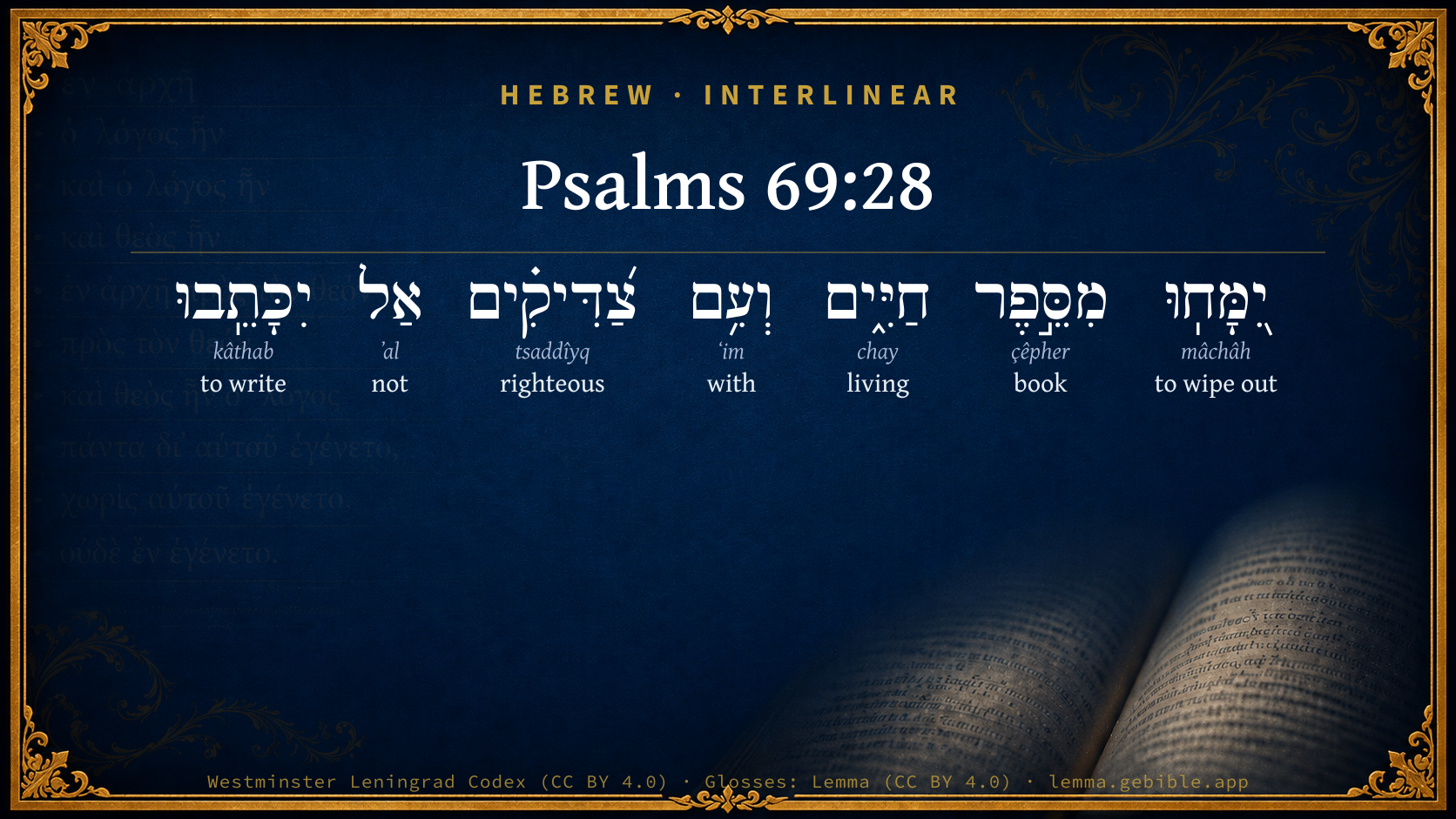
Psalms 69:28

Hebrew (Westminster Leningrad Codex) Psalms 69:28 appears in the Hebrew Old Testament. The text above is from the Westminster Leningrad Codex. Each word links to its Strong’s number, a concise gloss, and parsing drawn from the Open Scriptures Hebrew Bible morphology. Click any word for its full Brown-Driver-Briggs (BDB) entry.
Download image
Cite this verse

Psalms 69:28 (World English Bible). Public Domain. Lemma interlinear Bible study tool, https://lemma.gebible.app/v/psalms/69/28.

Show BibTeX & RIS
BibTeX
RIS
English Translation
Let them be blotted out of the book of life, And not be written with the righteous.
World English Bible · Public Domain
Download a study sheet

One document with this verse’s original text, its word-by-word gloss line, the meaning frame, cross-references with their text, attributed commentary, and full source and license credits — printable, and it pastes into notes with its structure intact.

This verse Autodidact and up

Study sheet (.html) Plain text (.txt)

A passage Seminary Student

Up to 50 verses in one chapter. A passage sheet keeps up to 6 commentary sources and 12 cross-references per verse, in the order this page ranks them, and says so on the sheet whenever that leaves anything out. Ask for a single verse and you get the Autodidact verse sheet above.

Everything on this page stays free to read, with no account — the sheet is a download of what is already on screen, not access to it.

Want to remove ads? Support Godless Engineer
Compare translations 3

The same verse in 3 English versions, stacked beneath the original-language interlinear above. Click any original word for its lexicon entry.

Each is an independent rendering of the whole verse — the interlinear is not word-aligned to these translations.

Highlighted words mark where these versions differ — a whole-verse word diff, not a word-by-word alignment.

  • World English Bible Public Domain
    Let them be blotted out of the book of life, And not be written with the righteous.
  • King James Version Public Domain
    Let them be blotted out of the book of the living, and not be written with the righteous.
  • unfoldingWord Literal Text CC BY-SA 4.0
    Let them be wiped from the book of the living, and let them not be written with the righteous.

unfoldingWord Literal Text — © unfoldingWord, licensed CC BY-SA 4.0. Word-aligned USFM3 via Door43 (git.door43.org/unfoldingWord/en_ult).

Versions to compare (up to 4)

3 of 4 selected

Show all 18 translations

Every available English version of this verse, each an independent rendering of the whole verse.

  • World English Bible Public Domain
    Let them be blotted out of the book of life, And not be written with the righteous.
  • Berean Standard Bible Public Domain
    May they be blotted out of the Book of Life and not listed with the righteous.
  • Majority Standard Bible Public Domain
    May they be blotted out of the Book of Life and not listed with the righteous.
  • King James Version Public Domain
    Let them be blotted out of the book of the living, and not be written with the righteous.
  • American Standard Version (1901) Public Domain
    Let them be blotted out of the book of life, And not be written with the righteous.
  • Revised Version (1885) Public Domain
    Let them be blotted out of the book of life, and not be written with the righteous.
  • Geneva Bible (1599) Public Domain
    Let them be put out of the booke of life, neither let them be written with the righteous.
  • Douay-Rheims (1899) Public Domain
    Add thou iniquity upon their iniquity: and let them not come into thy justice.
  • Young's Literal Translation Public Domain
    They are blotted out of the book of life, And with the righteous are not written.
  • Literal Standard Version CC BY-SA 4.0
    They are blotted out of the scroll of life, || And are not written with the righteous.
  • Unlocked Literal Bible CC BY-SA 4.0
    Let them be blotted out of the Book of Life and not be written down along with the righteous.
  • unfoldingWord Literal Text CC BY-SA 4.0
    Let them be wiped from the book of the living, and let them not be written with the righteous.
  • Darby Bible Public Domain
    Let them be blotted out of the book of life, and not be written with the righteous.
  • World Messianic Bible Public Domain
    Let them be blotted out of the book of life, and not be written with the righteous.
  • Webster's Bible Public Domain
    \\69:27\\Add iniquity to their iniquity: and let them not come into thy righteousness.
  • Free Bible Version CC BY-SA 4.0
    Blot out their names from the Book of Life. Don't let them be listed with those who do right.
  • Bible in Basic English Public Domain
    Let their names be taken from the book of the living, let them not be numbered with the upright.
  • JPS Tanakh (1917) Public Domain
    (69-29) Let them be blotted out of the book of the living, and not be written with the righteous.

Literal Standard Version (2020), Covenant Press — licensed CC BY-SA 4.0. Text via the HelloAO Bible API (eBible.org). Unlocked Literal Bible (unfoldingWord) — licensed CC BY-SA 4.0. Text via the HelloAO Bible API (eBible.org). unfoldingWord Literal Text — © unfoldingWord, licensed CC BY-SA 4.0. Word-aligned USFM3 via Door43 (git.door43.org/unfoldingWord/en_ult). Free Bible Version, Dr. Jonathan Gallagher — licensed CC BY-SA 4.0. Text via the HelloAO Bible API (eBible.org).

Word by word

More ways to search: Search by grammar → Find every occurrence → Compare this word →

Practice this passage: Drill this verse → Learn its vocabulary →

About this verse

These counts appear in no published source. They are computed here, from the morphology-tagged text and Lemma’s own curated glosses. What Lemma adds →

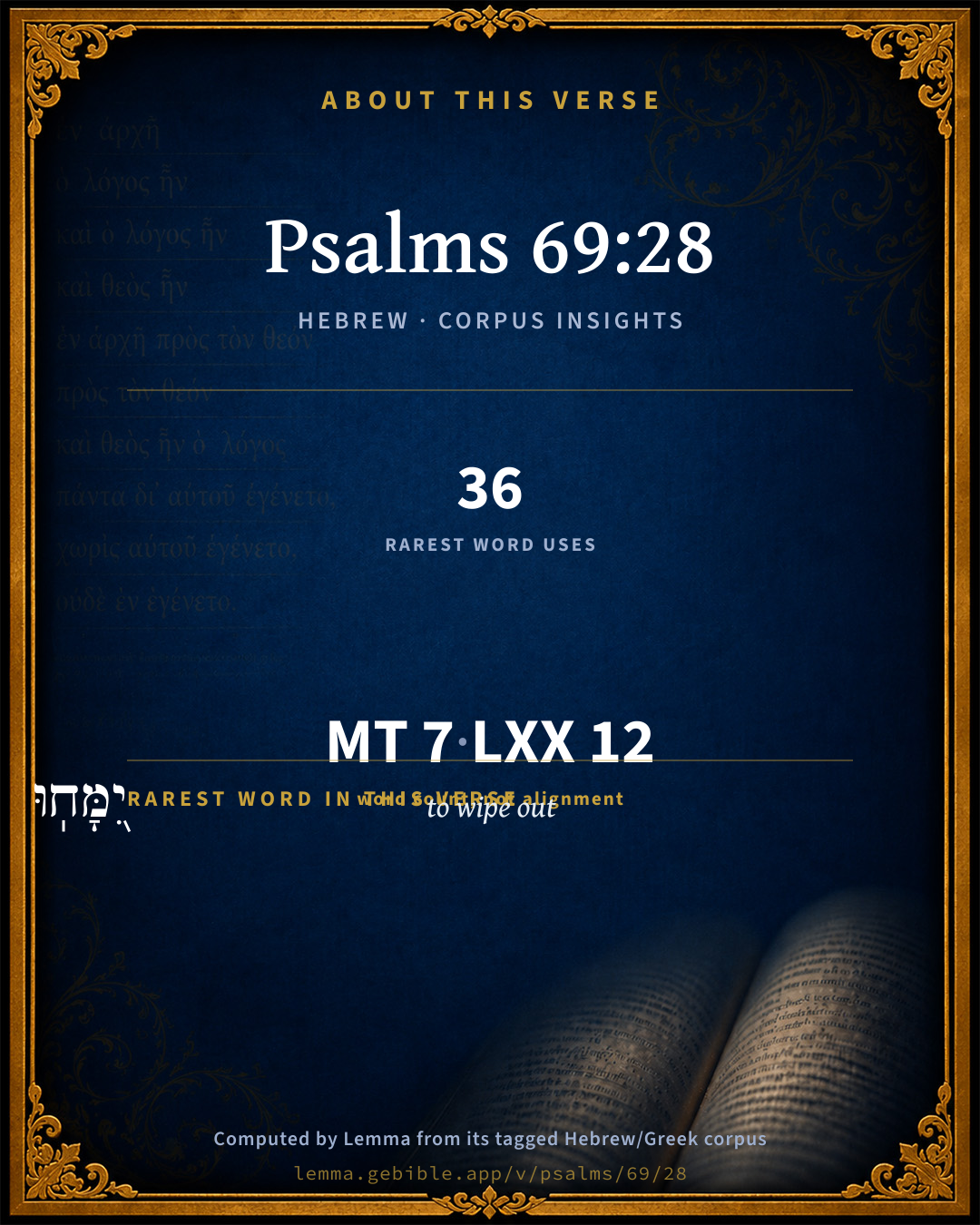
7
words
7
distinct lemmas
Wisdom
section

Shared distinctive vocabulary

יִ֭מָּחֽוּ to wipe out H4229 occurs in 32 verses of the Hebrew Bible. Also found in:

Grammatical profile

  • 2 verbs
  • 1 noun
  • 2 adjectives
  • 1 preposition
  • 1 particle

Verb forms

  • יִ֭מָּחֽוּ Niphal · Imperfect
  • יִכָּתֵֽבוּ Niphal · Jussive

Hebrew & Septuagint length

In English translation the verse runs 17 words from the Hebrew and 20 from the Septuagint (LXX English) — closely comparable.

A rough comparison of the two English renderings, which tokenize alike — not a word-level alignment.

Word counts can differ between the Hebrew and the Greek without any difference in meaning — e.g. the Hebrew direct-object marker אֵת has no separate Greek word, and Greek often adds the article ὁ.

In the original languages it is 7 Hebrew tokens and 12 Greek tokens — but the two are counted differently (Hebrew bundles its prefixes and suffixes into one token; the Greek is in lemma form), so that isn’t a like-for-like length.

Cross-references

12

Topical passages linked to Psalms 69:28 in the Treasury of Scripture Knowledge — connected by theme and wording, ordered by reader-vote popularity; previews shown in the World English Bible.

  • Exodus 32:32–33 Yet now, if you will, forgive their sin-- and if not, please blot me out of your book which you have written."
  • Luke 10:20 Nevertheless, don't rejoice in this, that the spirits are subject to you, but rejoice that your names are written in heaven."
  • Philippians 4:3 Yes, I beg you also, true yoke-fellow, help these women, for they labored with me in the Gospel, with Clement also, and the rest of my fellow workers, whose names are in the book of life.
  • Ezekiel 13:9 My hand shall be against the prophets who see false visions, and who divine lies: they shall not be in the council of my people, neither shall they be written in the writing of the house of Israel, neither shall they enter into the land of Israel; and you shall know that I am the Lord Yahweh.
  • Revelation 13:8 All who dwell on the earth will worship him, everyone whose name has not been written from the foundation of the world in the book of life of the Lamb who has been killed.
  • Revelation 20:12–15 I saw the dead, the great and the small, standing before the throne, and they opened books. Another book was opened, which is the book of life. The dead were judged out of the things which were written in the books, according to their works.
  • Hebrews 12:23 to the general assembly and assembly of the firstborn who are enrolled in heaven, to God the Judge of all, to the spirits of just men made perfect,
  • Revelation 3:5 He who overcomes will be arrayed in white garments, and I will in no way blot his name out of the book of life, and I will confess his name before my Father, and before his angels.
  • Revelation 22:19 If anyone takes away from the words of the book of this prophecy, may God take away his part from the tree of life, and out of the holy city, which are written in this book.
  • Isaiah 65:16 so that he who blesses himself in the earth shall bless himself in the God of truth; and he who swears in the earth shall swear by the God of truth; because the former troubles are forgotten, and because they are hid from my eyes.
  • Isaiah 4:3 It will happen, that he who is left in Zion, and he who remains in Jerusalem, shall be called holy, even everyone who is written among the living in Jerusalem;
  • Hosea 1:9 He said, "Call his name Lo-Ammi; for you are not my people, and I will not be yours.

Cross-references courtesy of OpenBible.info (CC BY 4.0).

Hebrew and Greek witnesses Masoretic Hebrew ↔ Greek Septuagint

The same verse in the two great witnesses to the Old Testament, shown verse-for-verse.

You’re reading Greek Psalm 68 (Hebrew Psalm 69). The Septuagint counts the superscription, so verse numbers can differ from the Hebrew — chapter-level alignment, not verse-by-verse. Numbering follows Rahlfs.

These are two independent witnesses, not word-aligned to each other, and the Septuagint is shown in lemma (dictionary) form.

Hebrew Psalms 69:28 Masoretic · Westminster Leningrad Codex

יִ֭מָּחֽוּ מִסֵּ֣פֶר חַיִּ֑ים וְעִ֥ם צַ֝דִּיקִ֗ים אַל יִכָּתֵֽבוּ

Let them be blotted out of the book of life, And not be written with the righteous.

World English Bible · Public Domain

Greek LXX Greek Psalm 68:28 Septuagint · lemma form

προςτίθημι ἀνομία ἐπί ὁ ἀνομία αὐτός καί μή εἰςἔρχομαι ἐν δικαιοσύνη σύ

Let them be blotted out of the book of the living, and let them not be written with the righteous.

LXX2012 (modern English Septuagint) · Public Domain

Hebrew: Westminster Leningrad Codex (CC BY 4.0). Greek: Septuagint (public domain); English from LXX2012 (modern English Septuagint) (Public Domain). How the Septuagint differs from the Hebrew →

Commentary

Notes on Psalms 69:28 from classic Christian and Jewish commentators (each source and its license shown beneath its notes). The classic Christian expositions comment on the surrounding passage and are grouped to its opening verse, so a note may address several verses; the Jewish commentaries on the Tanakh (Rashi and others) are per-verse, so they appear only where the commentator wrote on this verse.

Lemma curates 59 commentaries, every one of them public domain or Creative Commons licensed, each selected and text-cleaned for this edition rather than reprinted as found. About our sources →

Trapp's Complete Commentary

John Trapp

Psa 69:28 Let them be blotted out of the book of the living, and not be written with the righteous.

Ver. 28. Let them be blotted out, &c.] Wherein they were never indeed written among those living in Jerusalem, Isa 4:3, those firstborn whose names are written in heaven, Heb 12:23, but they accounted themselves of that number, and were so esteemed by others. This was a mistake, and the psalmist prayeth God to make it appear so, Ne videantur in albun tuorum relati quibus verae vitro donum destinasti.

John Trapp, A Commentary or Exposition upon All the Books of the Old and New Testament (1647–1656) — public domain. Text from a community e-Sword module.

Joseph Benson's Commentary

Psa 69:28. Let them be blotted out of the book of the living — “Let them be cut off before their time, and enjoy none of the blessings which thou hast promised to the righteous.” — Bishop Patrick. The psalmist is thought to allude to registers or catalogues, in which the names of living men used anciently to be recorded, and out of which the names of those who died were blotted. This was awfully fulfilled with respect to the unbelieving Jews, vast multitudes of whom fell by the sword and famine, while none of those who embraced the Christian faith perished among them. The nation, as a nation, was blotted out of the list of nations, and became not a people. The words may also be understood, as they are by many commentators, of their rejection from God’s covenant, and the privileges of it, which is the book of the truly living, or the book of life. “Let the commonwealth of Israel itself, Israel according to the flesh, now become alienated from that covenant of promise, of which it has hitherto had the monopoly.” —

Henry. This has long been the case with the degenerate and apostate Jews, who are no longer the peculiar people of God, nor have they any part or portion in the inheritance of his children. Thus Ezekiel, speaking of the false prophets, They shall not be in the assembly of my people, nor shall they be written in the writing of the house of Israel, Eze 13:9. This accords well with the next clause, Let them not be written with the righteous — Let them not have, or, they shall not have, a place in the congregation of the saints, when they shall all be gathered in the general assembly of those whose names are written in heaven.

Joseph Benson's Commentary on the Old and New Testaments (1811–1818) — public domain. Text from a community e-Sword module.

J. A. Alexander on Psalms

Joseph Addison Alexander

29. (Psa 69:28). Let them be blotted from the book of life (or of the living), and with the righteous let them not be written, registered, enrolled. The book is not here a figure for the memory, as in Psa 56:8, but for the divine decree. The primary idea is that of a register containing the names of those who are to live or be preserved alive. The figure is Mosaic, being evidently borrowed from Exo 32:32. The translation living, which is given in the ancient versions, is favoured by the parallel expression righteous (men), if not by the analogy of Psa 27:13; Psa 52:5. But the abstract version life is equally appropriate, and is recommended by the use of the phrase book of life in the New Testament with reference to the future state. See Php 4:3, Rev 20:15.

Joseph Addison Alexander, The Psalms Translated and Explained (1850) — public domain. Text from a community e-Sword module.

Tyndale Open Study Notes

Tyndale Open Resources

69:28 Erase their names from the Book of Life: Cp. 1:5-6; 9:5; Rev 3:5; 20:15; 21:22-27.

Tyndale Open Study Notes — © Tyndale Open Resources, licensed CC BY-SA 4.0. Text via the HelloAO Bible API.

Geneva Bible (1599)

Geneva Bible translators

They which seemed by their profession to have been written in thy book, yet by their fruits prove the contrary, let them be known as reprobate.

Geneva Bible (1599) marginal notes — public domain. Text via Bolls.life.

Jamieson, Fausset & Brown

Robert Jamieson, A. R. Fausset & David Brown

book of the living--or "life," with the next clause, a figurative mode of representing those saved, as having their names in a register (compare Exo 32:32; Isa 4:3).

Jamieson, Fausset & Brown — Commentary Critical and Explanatory on the Whole Bible (1871) — public domain (CC PDM 1.0). Text via the HelloAO Bible API.

Adam Clarke's Commentary

Verse 28. Let them be blotted out] They shall be blotted out from the land of the living. They shall be cut off from life, which they have forfeited by their cruelty and oppression. The psalmist is speaking of retributive justice; and in this sense all these passages are to be understood.

And not be written with the righteous.] They shall have no title to that long life which God has promised to his followers.

Adam Clarke's Commentary on the Bible (1810–1826) — public domain. Text from a community e-Sword/MySword module.

John Calvin's Commentaries

28. Let them be blotted out from the book of the living. This is the last imprecation, and it is the most dreadful of the whole; but it nevertheless uniformly follows the persevered in impenitence and incorrigible obduracy of which the Psalmist has spoken above. After having taken away from them all hope of repentance, he denounces against them eternal destruction, which is the obvious meaning of the prayer, that they might be blotted out of the book of the living; for all those must inevitably perish who are not found written or enrolled in the book of life. This is indeed an improper manner of speaking; but it is one well adapted to our limited capacity, the book of life being nothing else than the eternal purpose of God, by which he has predestinated his own people to salvation. God, it is certain, is absolutely immutable; and, further, we know that those who are adopted to the hope of salvation were written before the foundation of the world, (Ephesians 1:4;) but as God’s eternal purpose of election is incomprehensible, it is said, in accommodation to the imperfection of the human understanding, that those whom God openly, and by manifest signs, enrols among his people, are written. On the other hand, those whom God openly rejects and casts out of his Church are, for the same reason, said to be blotted out. As then David desires that the vengeance of God may be manifested, he very properly speaks of the reprobation of his enemies in language accommodated to our understanding; as if he had said, O God! reckon them not among the number or ranks of thy people, and let them not be gathered together with thy Church; but rather show by destroying them that thou hast rejected them; and although they occupy a place for a time among thy faithful ones, do thou at length cut them off, to make it manifest that they were aliens, though they were mingled with the members of thy family. Ezekiel uses language of similar import when he says,

“And mine hand shall be upon the prophets that see vanity, and that divine lies: they shall not be in the assembly of my people, neither shall they be written in the writing of the house of Israel.” (Ezekiel 13:9)

That, however, continues true which is spoken by the Apostle John, (1 John 2:19,) that none who have been once really the children of God will ever finally fall away or be wholly cut off. But as hypocrites presumptuously boast that they are the chief members of the Church, the Holy Spirit well expresses their rejection, by the figure of their being blotted out of the book of life. Moreover, it is to be observed that, in the second clause, all the elect of God are called the righteous; for, as Paul says in 1 Thessalonians 4:3, 4, 7,

“This is the will of God, even our sanctification, that every one of us should know how to possess his vessel in sanctification and honor: for God hath not called us unto uncleanness, but unto holiness.” (1 Thessalonians 4:3, 4, 7)

And the climax which the same Apostle uses in the 8th chapter of his Epistle to the Romans, at the 30th verse, is well known:

“Whom he did predestinate, them he also called; and whom he called, them he also justified; and whom he justified, them he also glorified.” (Romans 8:30)

John Calvin's Commentaries (1540-1563) — public domain. Text from the Calvin Translation Society English edition (1840s-50s) via the Christian Classics Ethereal Library (ccel.org). Calvin's coverage is partial (roughly two-thirds of the Bible); uncommented books and verses are honest gaps, never fabricated. The 19th-century editor's footnotes and remarks are omitted so the notes are faithfully Calvin's own voice.

Ellicott's Commentary for English Readers

(28) Book of the living—or life.—This image, which plays so great a part in Christian poetry (Rev_3:5; Rev_13:8; Rev_21:27. Comp. Php_4:3; Luk_10:20), is derived from the civil lists or registers of the Jews. (Exo_32:32; Jer_22:30; Eze_13:9.) At first erasure from this list only implied that a man was dead, or that a family was extinct (see references above); but as death was thought to deprive of all benefit of the covenant (see Note, Psa_6:5), such erasure came to imply exclusion from all the rights and privileges of the Theocracy, and therefore from the glory of participating in the promised deliverance and restoration of the race, and so gradually, as eschatological ideas developed, from the resurrection to eternal life. Dan_12:1 marks a stage in this development. In the psalmist’s mouth the words would correspond to the ideas current when he wrote. From the next clause, Let them not be written with the righteous, it might be argued that the idea had already appeared which limited the resurrection to the righteous—an idea current at the date of 2Ma_7:14, but probably familiar to some minds much sooner.

A Bible Commentary for English Readers, edited by Charles John Ellicott (1878–1897) — public domain. Text from a community e-Sword module.

The Cambridge Bible for Schools and Colleges

gen. ed. J. J. S. Perowne

28. the book of the living] Or, as R.V., the book of life. The figure is borrowed from the lists or registers of citizens (Jer_22:30; Eze_13:9). God has a book in which the names of those who are to be preserved alive are inscribed. The righteous have their names recorded in it (cp. Hab_2:4). May the names of these malefactors be struck out, or never inserted there! May they be deprived of their privileges as Israelites! May they perish and be utterly forgotten! Cp. Exo_32:32; Isa_4:3; Dan_12:1. But—and this mitigates what would otherwise be the awful character of the imprecation—‘the book of life’ is not here to be understood in the full N.T. sense as ‘the book of eternal life’ (Luk_10:20; Php_4:3; Rev_3:5; Rev_13:8; Rev_17:8; Rev_20:12).

The Cambridge Bible for Schools and Colleges (gen. ed. J. J. S. Perowne; Cambridge University Press, 1878–1918) — public domain. Text from a community e-Sword module.

John Gill's Exposition

Let them be blotted out of the book of life,.... Which some understand of this animal life, or of the catalogue of living saints; of their being not written among the living in Jerusalem, or in the writing of the house of Israel, Isa 4:3. The Targum is,

"let them he blotted out of the book of the memory of the living.''

Let their names rot and perish, being buried in everlasting oblivion. Aben Ezra interprets this book of the heavens; where, he says, all things that should come to pass were written, at the time they were created; see Luk 10:20. But this is the book of divine predestination or election, often in the New Testament called the book of life; in which the names of some persons are written, and others not, Phi 4:3; so called, not with respect to the present life, and the affairs of it, which belong to the book of Providence; but with respect to the life of the world to come, or eternal life, as Kimchi explains it. It is no other than God's ordination or foreappointment of men to eternal life; which being called a book, and names written in it, show that election is personal or particular; the exact knowledge God has of his chosen ones; his great care of them, and value for them; his constant remembrance of them, and the certainty of their salvation; for such whose names are written here in reality can never be blotted out: this would be contrary to the unchangeableness of God, the firmness of his purposes, and the safety of his people. Wherefore the design of this imprecation is, that those persons who had, in their own conceits, and in the apprehensions of others, a name in this book; that it might appear, both to themselves and others, they had none, by the awful ruin and destruction that should be brought upon them;

and not be written with the righteous; neither in the book of life with them; by which it appears, that to be blotted out, and not be written, are the same: nor in a Gospel church state; so they were the branches broken off: nor be among them at the resurrection of the just, and in the judgment day. Kimchi observes, that it is the same thing in different words; to be blotted out is the same as not to be written.

John Gill's Exposition of the Whole Bible (1746–1763) — public domain (CC PDM 1.0). Text via the HelloAO Bible API.

Albert Barnes' Notes on the Bible

Let them be blotted out of the book of the living - That is, Let them cease to live; let them not be numbered among living people; let them be cut off. This language is taken from the custom of registering the names of persons in a list, roll, or catalogue, Exo 32:32. See the notes at Phi 4:3. Compare Rev 3:5. The language has no reference to the future world; it is “not” a prayer that they should not be saved.

And not be written with the righteous - Let them not be registered or numbered with the righteous. As they “are” wicked, so let them be numbered; so regarded. Let them be reckoned and treated as they are. They deserve to be punished; so let them be. All that this “necessarily” means is, that they should not be treated as righteous, when they were in fact “not” righteous. It cannot be shown that the author of the psalm would not have desired that they should “become” righteous, and that they should “then” be regarded and treated as such. All that the language here implies is, a desire that they should be regarded and treated as they were; that is, as they deserved. The language is evidently derived from the idea so common in the Old Testament that length of days would be the reward of a righteous life (see Job 5:26; Pro 3:2; Pro 9:11; Pro 10:27), and that the wicked would be cut off in the midst of their days. See the notes at Psa 55:23.

Albert Barnes' Notes on the Bible (1834–1885) — public domain. Text from a community e-Sword/MySword module.

Matthew Poole's English Annotations

Of the living; or, of life: either,

1. Of this life. Out of the number of living men; which anciently used to be written in catalogues, out of which the names of those who died were blotted. Or rather,

2. Of eternal life, as both Jewish and Christian interpreters commonly understand it; which agrees best,

1. To the use of this phrase in Scripture; for in this sense men are said to be written in the book, Dan 12:1, or in God’s book, Exo 32:32, or in the book of life, Phi 4:3; Rev 3:5; 13:8; 17:8; 20:12; 21:27.

2. To the last clause of the verse, which explains it of that book, wherein none but

the righteous are written; whereas this life, and that attended with health and prosperity, is promiscuously given to and taken from good and bad men.

3. To the quality of the persons of whom this is said; which are the malicious enemies of God, and of his people, and the murderers of the Lord of glory, who shall be punished with eternal death. In this book men may be said to be written, either,

1. In reality, by God’s election or predestination. Or,

2. In appearance, when a man is called by God to the profession and practice of the true religion, and into covenant with himself, and professeth to comply with it; and so is written in the writing of the house of Israel, which is said of all that are in the assembly of God’s people, Eze 13:9, and so seems to others, and it may be to himself, to be really written in the book of life. And when a man renounceth this profession and religion, he may be said to be

blotted out of that book, because his apostacy makes it evident that he was not written in it, as he seemed to be. For this is a known and approved rule for the understanding of many texts of Scripture, that things are oft said to be done when they only seem to be done, and are not really done; as he is said to find his life, . Mat 10:39, who falsely imagined that he did find it, when in truth he lost it; and to have, Mat 13:12, who only seemed to have, as it is explained in the parallel place, Luk 8:18; and to live, Rom 7:9, when he vainly conceited himself to be alive. And in like manner men may be said to be written in or blotted out of this book, when they seem to be so by the course of their lives and actions. But that this blotting out is not meant properly and positively, is clear from the last branch of this verse; which, after the manner of these books, expounds the former, wherein this doubtful phrase is explained by one which is evident and unquestionable, even by his not being written in it; for it is impossible that a man’s name should be properly blotted out of that book in which it was never written. The sense of the verse seems to be this, Let their wickedness be so notorious, and the tokens of God’s wrath upon them so manifest, that all men may discern that they are blotted out; that is, that they never were written in the book of life, in which the righteous are written.

With the righteous, i.e. in the book of life, in which all righteous or holy persons, and only they, are written; whereby it may appear that whatsoever show or profession they once made, yet they neither are nor were truly righteous persons.

Matthew Poole's English Annotations on the Holy Bible (1683–1685) — public domain. Text from a community e-Sword/MySword module.

The Treasury of David

Charles H. Spurgeon

Ver. 28. Let them be blotted out of the book of the living. Though in their conceit they wrote themselves among the people of God, and induced others to regard them under that character, they shall be unmasked and their names removed from the register. Enrolled with honour, they shall be erased with shame. Death shall obliterate all recollection of them; they shall be held no longer in esteem, even by those who paid them homage. Judas first, and Pilate, and Herod, and Caiaphas, all in due time, were speedily wiped out of existence; their names only remain as bywords, but among the honoured men who live after their departure they are not recorded.

And not be written with the righteous. This clause is parallel with the former, and shows that the inner meaning of being blotted out from the book of life is to have it made evident that the name was never written there at all. Man in his imperfect copy of God's book of life will have to make many emendations, both of insertion and erasure; but, as before the Lord, the record is for ever fixed and unalterable. Beware, O man, of despising Christ and his people, lest thy soul should never partake in the righteousness of God, without which men are condemned already.

Ver. 28. Let them be blotted out of the book of the living. All the Israelites who came up out of Egypt were put down in a muster roll of the living, called "the writing of the house of Israel" (Eze 13:9), and "the book of life." Those who had died were excluded when the names were written out afresh each year. They were, thereby, consigned to oblivion (Pr 10:7). Hence, the book of life was used as an image for God's book of predestination to eternal life (Ps 139:16 Ex 32:32 Ps 87:6 Da 12:1 Php 4:3 Re 17:8 13:8 Re 21:27; Lu 10:20). The book of life, in the human point of view, has names written in it who have a name to live, but are dead, being in it only by external call, or in their own estimation, and in that of others. But, in the divine point of view, it contains only those who are elected finally to life. The former may be blotted out, as was Judas (Re 3:5 Mt 13:12 25:29 7:23 Ex 32:33); but the latter never (Re 20:12, 15 Joh 10:28-29 Ac 13:48). A. R. Fausset.

Ver. 28. Let them be wiped out, etc. This verse alludes to the ancient Jewish practice of recording the names of the inhabitants of every division, or tribe, of the people, in a volume somewhat similar to the Dom-boc of the Saxons. See Lu 2:1. The names of those who died were blotted out or wiped out, and appeared no longer on the list of the living. Such a book is attributed to God in Ps 139:16: and the blotting out of Moses from God's book, in Ex 32:32, is a figurative expression, for depriving him of life. Richard Warner.

Ver. 28. Let them be blotted out of the book of the living, etc. We come to the question, Whether to be written in heaven be an infallible assurance of salvation; or, whether any there registered may come to be blotted out? The truth is, that none written in heaven can ever be lost; yet they object against it this verse. Hence, they infer, that some names once there recorded are afterwards put out; but this opinion casteth a double aspersion on God himself. Either it makes him ignorant of future things, as if he foresaw not the end of elect and reprobate, and so were deceived in decreeing some to be saved that shall not be saved; or, that his decree is mutable, in excluding those upon their sins whom he hath formerly chosen. From both these weaknesses St. Paul vindicates him (2Ti 2:19): "The foundation of God standeth sure, having this seal, the Lord knoweth them that are his." First, "The Lord knows them that are his; "this were not true if God's prescience could be deluded. Then, his "foundation stands sure; "but that were no sure foundation, if those he hath decreed to be his should afterwards fall out not to be his. The very conclusion of truth is this impossibilis est deletio; they which are "written in heaven" can never come into hell. To clear this from the opposed doubt, among many, I will cull out three proper distinctions: --

1. One may be said to be written in heaven simpliciter, and secundum quid. He that is simply written there, in quantum praedestinatus ad vitam, because elected to life, can never be blotted out. He that is written after a sort may, for he is written non secundum Dei praescientiam, sed secundum praesentem justitiam --not according to God's former decree, but according to his present righteousness. So they are said to be blotted out, not in respect of God's knowledge, for he knows they never were written there; but according to their present condition, apostatising from grace to sin. (Lyra.)

2. Some are blotted out non secundum rei veritatem, sed hominum opinionem --not according to the truth of the thing but according to men's opinion. It is usual in the Scriptures to say a thing is done quando innotescat fieri, when it is declared to be done. Hypocrites have a simulation of outward sanctity, so that men in charity judge them to be written in heaven. But when those glistening stars appear to be only ignes fatui, foolish meteors, and fall from the firmament of the church, then we say they are blotted out. The written ex existentia, by a perfect being, are never lost; but ex apparentia, by a dissembled appearance, may. Some God so writes, in se ut simpliciter habituri vitam --that they have life simply in themselves, though not of themselves. Others he so writes, ut habeant non in se, sed in sua causa; from which falling they are said to be obliterated. (Aquinas.)

3. Augustine says, we must not so take it, that God first writes and then dasheth out. For if a Pilate could say, Quod scripsi, scripsi --"What I have written, I have written, "and it shall stand; shall God say, Quod scripsi expungam --What I have written, I will wipe out, and it shall not stand? They are written, then, secundum spem ipsorum, qui ibi se scriptos putabant --according to their own hope that presumed their names there; and are blotted out quando ipsis constet illos non ibi fuisse --when it is manifest to themselves that their names never had any such honour of inscription. This even that Psalm strengthens whence they fetch their opposition: Let them be blotted out of the book of the living, and not be written with the righteous. So that to be blotted out of that book, it is, indeed, never to be written there. To be wiped out in the end, is but a declaration that such were not written in the beginning. Thomas Adams.

None.

Psalms 69:29*

Imprecations, prophecies, and complaints are ended, and prayer of a milder sort begins, intermingled with bursts of thankful song, and encouraging foresight of coming good.

Charles H. Spurgeon's The Treasury of David (1869–1885) — public domain. Psalms only. Text from a community e-Sword/MySword module.

Whedon's Commentary on the Bible

Daniel D. Whedon

28. Blotted out of the book of the living—Or, the book of life. The allusion is to the public genealogies, where the names of all the living were recorded. These civil lists were the ultimate vouchers of pure Hebrew descent and citizenship, and of title, not only to lands, but also to Church privileges and covenant blessings. To erase the name was to extinguish these rights, but does not necessarily suppose natural death. See Exo_32:32-33; Isa_4:3; Dan_12:1. Only in the New Testament is the idea clearly developed of a “book of life” containing the names of such only as are entitled to the life of future and eternal blessedness. Php_4:3; Rev_20:12; Rev_20:15

Daniel D. Whedon (gen. ed.), Commentary on the Old and New Testaments (1874–1909) — public domain. Text from a community e-Sword module.

The Pulpit Commentary

Let them be blotted out of the Book of the living. God is supposed to have a "book of the living" in his possession, which contains the names of all those on whom he looks with favour, and whom he will bless both in this world and beyond the grave. (comp. Exo_32:32 Psa_86:6 Eze_13:9 Dan_12:1) From this list, as from any register of earthly citizenship, the names of the unworthy may be erased. David prays for the erasure of the names of those unworthy ones against whom his imprecations are uttered. And not be written with the righteous; i.e. not remain written in the book side by side with the names of the righteous. The New Testament, no less than the Old, tells of this book. (see Luk_10:20 Php_4:3 Rev_3:5 Rev_13:8 Rev_20:12 Rev_21:27)

The Pulpit Commentary (1880–1919), ed. H.D.M. Spence-Jones & Joseph S. Exell — public domain. Text from a community e-Sword module.

John Wesley's Explanatory Notes

Living - Of eternal life.

John Wesley, Explanatory Notes Upon the Whole Bible (1754–1765) — public domain. Text via the GEBible commentary corpus.

unfoldingWord translationNotes

Door43 World Missions Community

Let them be blotted out of

Here "them" refers to the names of the enemies. This can be stated in active form. AT: "Wipe out their names in" (See: Metonymy and Active or Passive)

not be written down

It is inferred that "let them" is understood. This can be stated in active form. AT: "do not write down their names" (See: Ellipsis and Active or Passive)

let your salvation, God, set me up on high

The abstract noun "salvation" can be stated with the verb "save." Here "on high" refers to a place of safety." AT: "God, save me and put me in a safe place" (See: Abstract Nouns and Metonymy)

translationWords

blot out

Book of Life

written

righteous

save

God

on high

unfoldingWord translationNotes — © Distant Shores Media and the Door43 World Missions Community, licensed CC BY-SA 4.0. Source: git.door43.org/Door43/en_tn.

Lesson kit

Teaching starters — assembled from the data on this page, not authored interpretation. Every prompt links to the verse data it draws on. Edit before teaching.

Psalms, in the Wisdom, opens this verse with 7 words (7 distinct Hebrew lemmas). Its most distinctive word is mâchâh (“to wipe out”). A historical commentator’s framing appears above. Read the whole chapter for the surrounding context.

Discussion questions

  1. How does “to wipe out” (mâchâh) shape what this verse is saying?
  2. How does Genesis 6:7, which shares the word «to wipe out», read alongside this verse?
  3. These translations render this verse differently; the difference is in the English rendering, not the original. What questions does that raise?
  4. «יִ֭מָּחֽוּ» is a Niphal Imperfect verb. How does that grammatical form shape the action described?
  5. Compare how Trapp's Complete Commentary and Joseph Benson's Commentary read this verse. Where do they agree or differ?

Things to notice

Reading settings

Reading text

Shown beneath each verse's original-language words.

Old Testament
Old Testament edition

Read the OT as the Masoretic Hebrew (MT) or the Greek Septuagint (LXX).

English shown for the Greek Septuagint (in the Hebrew ↔ Greek comparison).

Comparing translations? Open the Compare panel on any verse page to stack up to four side by side.