
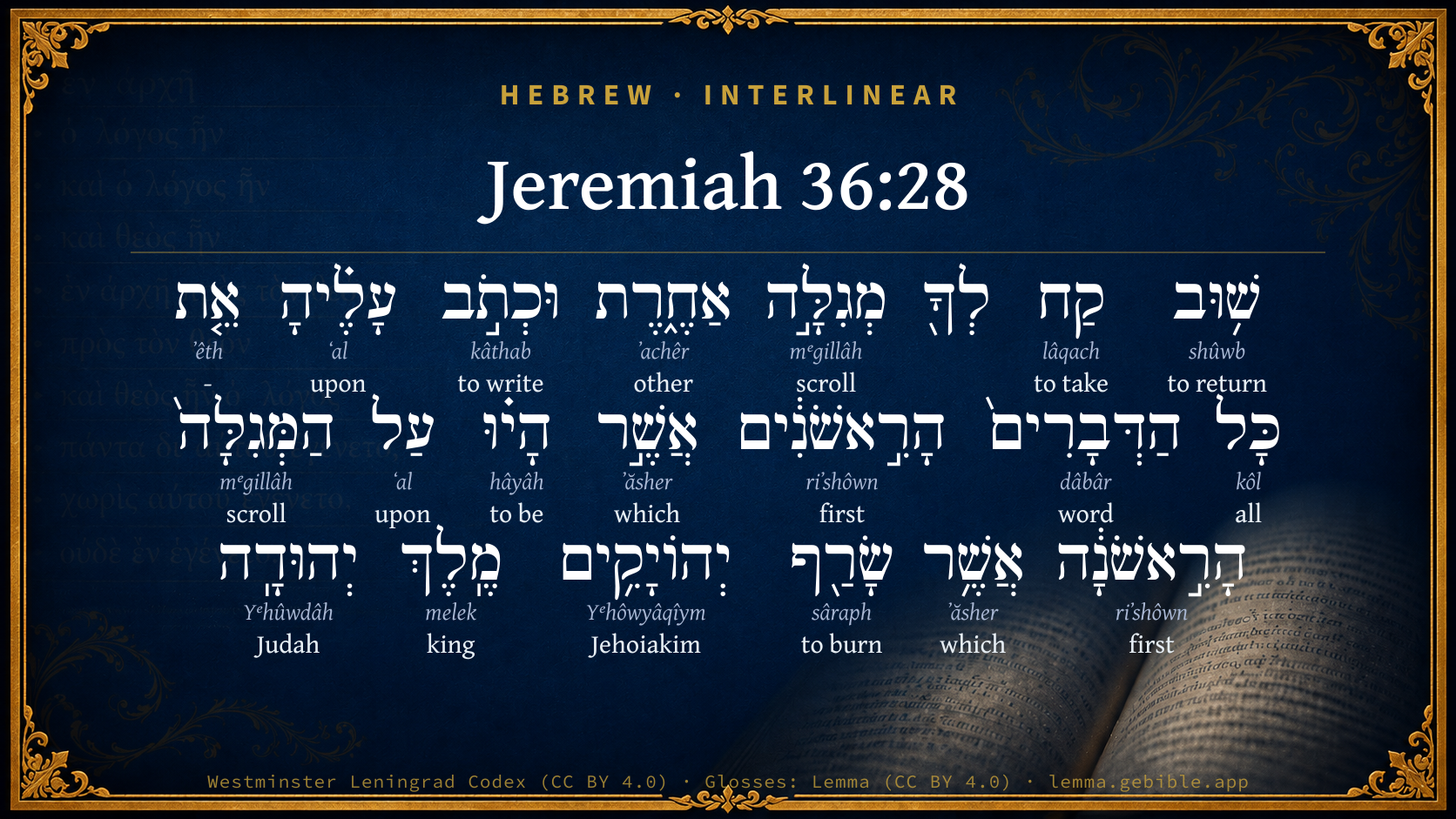
Jeremiah 36:28

Hebrew (Westminster Leningrad Codex) Jeremiah 36:28 appears in the Hebrew Old Testament. The text above is from the Westminster Leningrad Codex. Each word links to its Strong’s number, a concise gloss, and parsing drawn from the Open Scriptures Hebrew Bible morphology. Click any word for its full Brown-Driver-Briggs (BDB) entry.
Download image
Cite this verse

Jeremiah 36:28 (World English Bible). Public Domain. Lemma interlinear Bible study tool, https://lemma.gebible.app/v/jeremiah/36/28.

Show BibTeX & RIS
BibTeX
RIS
English Translation
Take again another scroll, and write in it all the former words that were in the first scroll, which Jehoiakim the king of Judah has burned.
World English Bible · Public Domain
Download a study sheet

One document with this verse’s original text, its word-by-word gloss line, the meaning frame, cross-references with their text, attributed commentary, and full source and license credits — printable, and it pastes into notes with its structure intact.

This verse Autodidact and up

Study sheet (.html) Plain text (.txt)

A passage Seminary Student

Up to 50 verses in one chapter. A passage sheet keeps up to 6 commentary sources and 12 cross-references per verse, in the order this page ranks them, and says so on the sheet whenever that leaves anything out. Ask for a single verse and you get the Autodidact verse sheet above.

Everything on this page stays free to read, with no account — the sheet is a download of what is already on screen, not access to it.

Want to remove ads? Support Godless Engineer
Compare translations 3

The same verse in 3 English versions, stacked beneath the original-language interlinear above. Click any original word for its lexicon entry.

Each is an independent rendering of the whole verse — the interlinear is not word-aligned to these translations.

Highlighted words mark where these versions differ — a whole-verse word diff, not a word-by-word alignment.

  • World English Bible Public Domain
    Take again another scroll, and write in it all the former words that were in the first scroll, which Jehoiakim the king of Judah has burned.
  • King James Version Public Domain
    Take thee again another roll, and write in it all the former words that were in the first roll, which Jehoiakim the king of Judah hath burned.
  • unfoldingWord Literal Text CC BY-SA 4.0
    “Go back, take another scroll for yourself, and write in it all the words that were on the original scroll, the one that Jehoiakim king of Judah burned.

unfoldingWord Literal Text — © unfoldingWord, licensed CC BY-SA 4.0. Word-aligned USFM3 via Door43 (git.door43.org/unfoldingWord/en_ult).

Versions to compare (up to 4)

3 of 4 selected

Show all 18 translations

Every available English version of this verse, each an independent rendering of the whole verse.

  • World English Bible Public Domain
    Take again another scroll, and write in it all the former words that were in the first scroll, which Jehoiakim the king of Judah has burned.
  • Berean Standard Bible Public Domain
    “Take another scroll and rewrite on it the very words that were on the original scroll, which Jehoiakim king of Judah has burned.
  • Majority Standard Bible Public Domain
    “Take another scroll and rewrite on it the very words that were on the original scroll, which Jehoiakim king of Judah has burned.
  • King James Version Public Domain
    Take thee again another roll, and write in it all the former words that were in the first roll, which Jehoiakim the king of Judah hath burned.
  • American Standard Version (1901) Public Domain
    Take thee again another roll, and write in it all the former words that were in the first roll, which Jehoiakim the king of Judah hath burned.
  • Revised Version (1885) Public Domain
    Take thee again another roll, and write in it all the former words that were in the first roll, which Jehoiakim the king of Judah hath burned.
  • Geneva Bible (1599) Public Domain
    Take thee againe another roule and write in it all ye former words that were in the first roule which Iehoiakim the King of Iudah hath burnt,
  • Douay-Rheims (1899) Public Domain
    Take thee again another volume: and write in it all the former words that were in the first volume which Joakim the king of Juda hath burnt.
  • Young's Literal Translation Public Domain
    `Turn, take to thee another roll, and write on it all the former words that were on the first roll, that Jehoiakim king of Judah burnt,
  • Literal Standard Version CC BY-SA 4.0
    “Turn, take another scroll to yourself, and write on it all the former words that were on the first scroll that Jehoiakim king of Judah burned,
  • Unlocked Literal Bible CC BY-SA 4.0
    “Go back, take another scroll for yourself, and write in it all the words that were on the original scroll, the one that Jehoiakim king of Judah burned.
  • unfoldingWord Literal Text CC BY-SA 4.0
    “Go back, take another scroll for yourself, and write in it all the words that were on the original scroll, the one that Jehoiakim king of Judah burned.
  • Darby Bible Public Domain
    Take thee again another roll, and write in it all the former words that were in the first roll which Jehoiakim the king of Judah hath burned.
  • World Messianic Bible Public Domain
    “Take again another scroll, and write in it all the former words that were in the first scroll, which Jehoiakim the king of Judah has burned.
  • Webster's Bible Public Domain
    Take thee again another roll, and write in it all the former words that were in the first roll, which Jehoiakim king of Judah hath burned.
  • Free Bible Version CC BY-SA 4.0
    Get another scroll and write everything out that was on the first scroll that Jehoiakim king of Judah burned.
  • Bible in Basic English Public Domain
    Take another book and put down in it all the words which were in the first book, which Jehoiakim, king of Judah, put into the fire.
  • JPS Tanakh (1917) Public Domain
    'Take thee again another roll, and write in it all the former words that were in the first roll, which Jehoiakim the king of Judah hath burned.

Literal Standard Version (2020), Covenant Press — licensed CC BY-SA 4.0. Text via the HelloAO Bible API (eBible.org). Unlocked Literal Bible (unfoldingWord) — licensed CC BY-SA 4.0. Text via the HelloAO Bible API (eBible.org). unfoldingWord Literal Text — © unfoldingWord, licensed CC BY-SA 4.0. Word-aligned USFM3 via Door43 (git.door43.org/unfoldingWord/en_ult). Free Bible Version, Dr. Jonathan Gallagher — licensed CC BY-SA 4.0. Text via the HelloAO Bible API (eBible.org).

Word by word

More ways to search: Search by grammar → Find every occurrence → Compare this word →

Practice this passage: Drill this verse → Learn its vocabulary →

מְגִלָּ֣ה
mᵉgillâh
H4039
“scroll”
Noun, Common, Feminine, Singular, Absolute
Part of Speech
Noun
Type
Common
Gender
Feminine
Number
Singular
State
Absolute
Full BDB Definition

Origin: from H1556

TWOT: 353m

roll, book, writing
  1. שׁ֥וּב shûwb H7725 “return” Verb, Qal, Imperative, 2nd Person, Masculine, Singular
  2. קַח lâqach H3947 “take” Verb, Qal, Imperative, 2nd Person, Masculine, Singular
  3. אַחֶ֑רֶת ʼachêr H312 “other” Adjective, Adjective, Feminine, Singular, Absolute
  4. וּכְתֹ֣ב kâthab H3789 “and · write” Conjunction + Verb, Qal, Imperative, 2nd Person, Masculine, Singular
  5. עָלֶ֗יהָ ʻal H5921 “upon · her” Preposition + Suffix, Personal, 3rd Person, Feminine, Singular
  6. אֵ֤ת ʼêth H853 “-” Particle, Direct Object
  7. כָּל kôl H3605 “all of” Noun, Common, Masculine, Singular, Construct
  8. הַדְּבָרִים֙ dâbâr H1697 “the · words” Particle, Definite Article + Noun, Common, Masculine, Plural, Absolute
  9. הָרִ֣אשֹׁנִ֔ים riʼshôwn H7223 “the · first” Particle, Definite Article + Adjective, Adjective, Masculine, Plural, Absolute
  10. אֲשֶׁ֣ר ʼăsher H834 “which” Particle, Relative
  11. הָי֗וּ hâyâh H1961 “to be” Verb, Qal, Perfect, 3rd Person, Common, Plural
  12. עַל ʻal H5921 “upon” Preposition
  13. הַמְּגִלָּה֙ mᵉgillâh H4039 “the · scroll” Particle, Definite Article + Noun, Common, Feminine, Singular, Absolute
  14. הָרִ֣אשֹׁנָ֔ה riʼshôwn H7223 “the · first” Particle, Definite Article + Adjective, Adjective, Feminine, Singular, Absolute
  15. אֲשֶׁ֥ר ʼăsher H834 “which” Particle, Relative
  16. שָׂרַ֖ף sâraph H8313 “to burn” Verb, Qal, Perfect, 3rd Person, Masculine, Singular
  17. יְהוֹיָקִ֥ים Yᵉhôwyâqîym H3079 “Jehoiakim” Noun, Proper
  18. מֶֽלֶךְ melek H4428 “king of” Noun, Common, Masculine, Singular, Construct
  19. יְהוּדָֽה Yᵉhûwdâh H3063 “Judah” Noun, Proper

About this verse

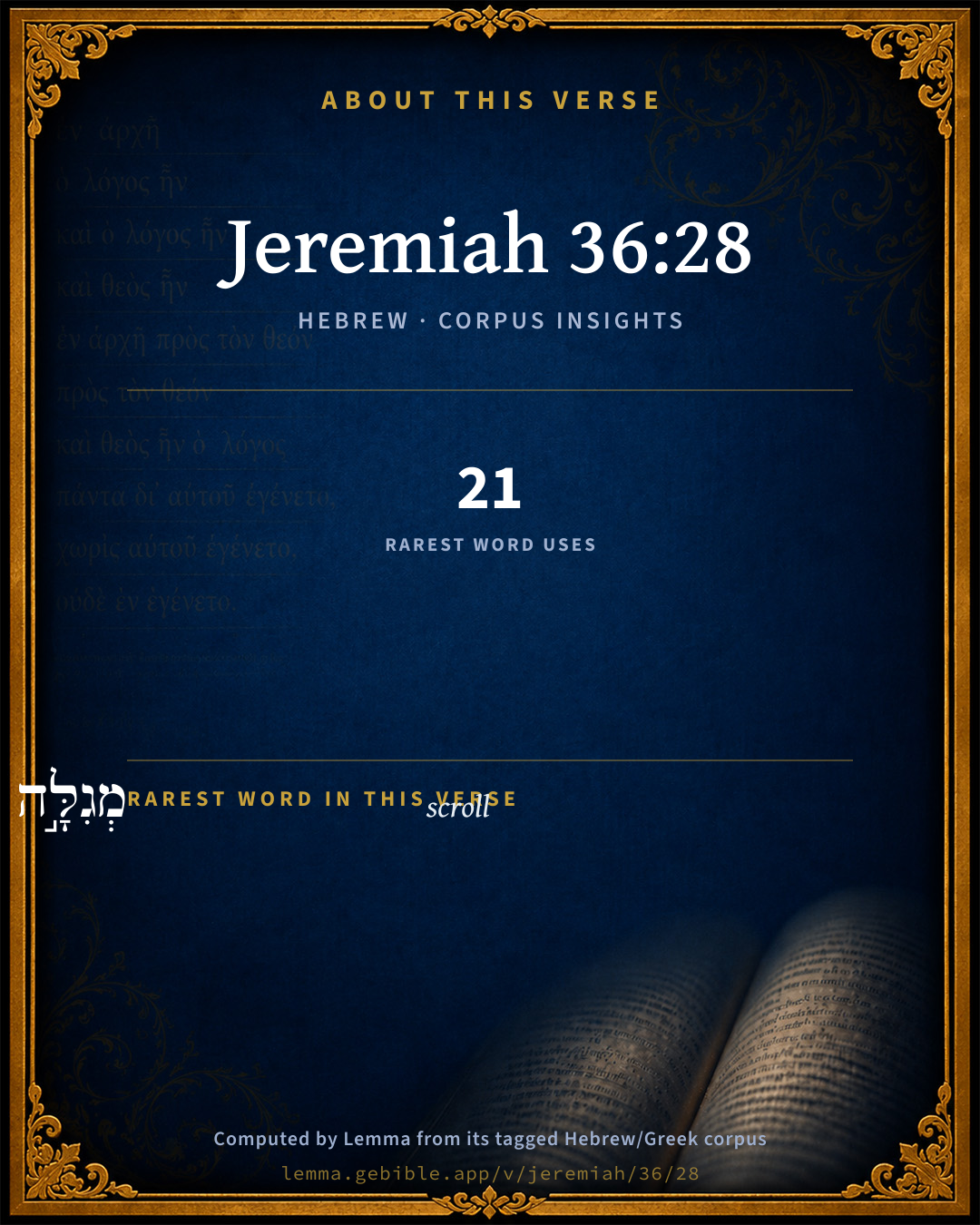
These counts appear in no published source. They are computed here, from the morphology-tagged text and Lemma’s own curated glosses. What Lemma adds →

21
words
16
distinct lemmas
Prophets
section

Notable vocabulary

The rarest word here is מְגִלָּ֣ה scroll H4039 — appearing just 21 times in the whole Hebrew Bible.

Shared distinctive vocabulary

מְגִלָּ֣ה scroll H4039 occurs in 19 verses of the Hebrew Bible. Also found in:

Grammatical profile

  • 5 verbs
  • 7 nouns
  • 3 adjectives
  • 3 prepositions
  • 3 particles

Verb forms

  • שׁ֥וּב Qal · Imperative
  • קַח Qal · Imperative
  • וּכְתֹ֣ב Qal · Imperative
  • הָי֗וּ Qal · Perfect
  • שָׂרַ֖ף Qal · Perfect

Repetition

Words recur within this verse — often emphatic in Hebrew:

  • מְגִלָּ֣ה scroll H4039 ×2
  • עָלֶ֗יהָ upon H5921 ×2
  • הָרִ֣אשֹׁנִ֔ים first H7223 ×2
  • אֲשֶׁ֣ר which H834 ×2

Cross-references

6

Topical passages linked to Jeremiah 36:28 in the Treasury of Scripture Knowledge — connected by theme and wording, ordered by reader-vote popularity; previews shown in the World English Bible.

  • Zechariah 1:5–6 Your fathers, where are they? And the prophets, do they live forever?
  • Job 23:13 But he stands alone, and who can oppose him? What his soul desires, even that he does.
  • Jeremiah 28:13–14 Go, and tell Hananiah, saying, Thus says Yahweh: You have broken the bars of wood; but you have made in their place bars of iron.
  • Jeremiah 44:28 Those who escape the sword shall return out of the land of Egypt into the land of Judah, few in number; and all the remnant of Judah, who have gone into the land of Egypt to sojourn there, shall know whose word shall stand, mine, or theirs.
  • Matthew 24:35 Heaven and earth will pass away, but my words will not pass away.
  • 2 Timothy 2:13 If we are faithless, He remains faithful. He can't deny himself.

Cross-references courtesy of OpenBible.info (CC BY 4.0).

Hebrew and Greek witnesses Masoretic Hebrew ↔ Greek Septuagint

The same verse in the two great witnesses to the Old Testament, shown verse-for-verse.

These are two independent witnesses, not word-aligned to each other, and the Septuagint is shown in lemma (dictionary) form.

Hebrew Jeremiah 36:28 Masoretic · Westminster Leningrad Codex

שׁ֥וּב קַח לְךָ֖ מְגִלָּ֣ה אַחֶ֑רֶת וּכְתֹ֣ב עָלֶ֗יהָ אֵ֤ת כָּל הַדְּבָרִים֙ הָרִ֣אשֹׁנִ֔ים אֲשֶׁ֣ר הָי֗וּ עַל הַמְּגִלָּה֙ הָרִ֣אשֹׁנָ֔ה אֲשֶׁ֥ר שָׂרַ֖ף יְהוֹיָקִ֥ים מֶֽלֶךְ יְהוּדָֽה

Take again another scroll, and write in it all the former words that were in the first scroll, which Jehoiakim the king of Judah has burned.

World English Bible · Public Domain

Greek LXX Structure differs

In the Septuagint, Jeremiah is about an eighth shorter than the Hebrew and arranges its material differently — the Oracles Against the Nations (Hebrew chapters 46–51) appear in the middle of the Greek book, after 25:13. Because the chapter and verse boundaries do not line up, a verse-for-verse comparison with the Hebrew is not shown.

A verse-for-verse comparison isn’t shown here because the chapters and verses don’t line up. Switch to the LXX edition with the MT / LXX toggle above to read the Greek directly.

Hebrew: Westminster Leningrad Codex (CC BY 4.0). Greek: Septuagint (public domain); English from a public-domain English Septuagint. How the Septuagint differs from the Hebrew →

Targum (Aramaic paraphrase)

1

The Targum is the ancient Jewish Aramaic paraphrase of the Hebrew Scriptures — an interpretive translation, not the Hebrew text itself. Onkelos (literal) and Pseudo-Jonathan (expansive) render the Torah, and Jonathan the Prophets. Coverage is partial: where no permissively-licensed English translation exists for a verse, only the Aramaic is shown. This is verse-level text, not a word-by-word alignment to the Hebrew.

  1. Targum Jonathan Prophets (Joshua–Malachi)
    תּוּב סַב לָךְ מְגִילָתָא אוֹחֲרֵי וּכְתוֹב עֲלָהּ יַת כָּל פִּתְגְמַיָא קֳדָמָאֵי דַהֲווֹ עַל מְגִלָתָא קַדְמַיְתָא דְאוֹקֵיד יְהוֹיָקִים מְלַךְ שִׁבְטָא דְבֵית יְהוּדָה:

    (no public-domain English translation for this verse)

    Targum Jonathan — Aramaic: “Mikraot Gedolot” (public domain). English: “Sefaria Community Translation” (CC0 1.0 (public-domain dedication)); “London "Chaldee Paraphrase," 1871” (public domain). Text via Sefaria.

Commentary

Notes on Jeremiah 36:28 from classic Christian and Jewish commentators (each source and its license shown beneath its notes). The classic Christian expositions comment on the surrounding passage and are grouped to its opening verse, so a note may address several verses; the Jewish commentaries on the Tanakh (Rashi and others) are per-verse, so they appear only where the commentator wrote on this verse.

Lemma curates 59 commentaries, every one of them public domain or Creative Commons licensed, each selected and text-cleaned for this edition rather than reprinted as found. About our sources →

Trapp's Complete Commentary

John Trapp

Jer 36:28 Take thee again another roll, and write in it all the former words that were in the first roll, which Jehoiakim the king of Judah hath burned.

Ver. 28. Take thee again another roll.] Revertere, accipe. God’s ministers must be steadfast and unweariable, always abounding in the work of the Lord, forasmuch as they know that their labour is not in vain in the Lord. {1Co 15:58}

And write in it all the former words.] If all the tyrants on earth should fight against the very paper of the Scriptures, striving to abolish it, yet they could not possibly do it. There will be Bibles when they shall be laid low enough in the slimy valley, where are many already like them, and more shall come after them. {Job 21:31-32}

John Trapp, A Commentary or Exposition upon All the Books of the Old and New Testament (1647–1656) — public domain. Text from a community e-Sword module.

Geneva Bible (1599)

Geneva Bible translators

Though the wicked think to have abolished the word of God, when they have burnt the book thereof: yet this declareth that God will not only raise it up again, but also increase it in greater abundance to their condemnation, as verse 32.

Geneva Bible (1599) marginal notes — public domain. Text via Bolls.life.

Jamieson, Fausset & Brown

Robert Jamieson, A. R. Fausset & David Brown

all the former words--It is in vain that the ungodly resist the power of Jehovah: not one of His words shall fall to the ground (Mat 5:18; Act 9:5; Act 5:39).

Jamieson, Fausset & Brown — Commentary Critical and Explanatory on the Whole Bible (1871) — public domain (CC PDM 1.0). Text via the HelloAO Bible API.

Adam Clarke's Commentary

Verse 28. Take thee again another roll] There was no duplicate of the former preserved; and now God inspired the prophet with the same matter that he had given him before; and there is to be added the heavy judgment that is to fall on Jehoiakim and his courtiers.

Adam Clarke's Commentary on the Bible (1810–1826) — public domain. Text from a community e-Sword/MySword module.

John Calvin's Commentaries

By these words the Prophet shews what the ungodly gain by contending against God; for however hard and refractory, they must necessarily be broken down by God’s power. This happened to King Jehoiakim. We saw in yesterday’s Lecture how furious he was when he cut and burned the volume, and also ordered the Prophet to be slain. But it now follows, that another volume was written.

Now God deals in different ways with the rebellious. For at one time he passes by or leaves timre, when he sees that he spends in vain his labor in admonishing them. He then sends no more his Prophets to reprove or threaten, but silently executes his judgments. And for this reason it is said,

“My Spirit shall no more contend with man, because he is flesh.” (Genesis 6:3)

And similar examples everywhere occur, that is, that when God saw that the prophetic doctrine was despised, he raised his hand against the ungodly, and at the same time ceased to speak to them. But here he purposed in a different way to break down the violence of Jehoiakim, for he caused another volume to be written He foolishly thought that God’s power was in a manner cut off, or extinguished by fire, because the book was reduced to ashes. But God shews that his word cannot be bound or restrained. Then he begins anew to threaten, not because he hoped for any benefit from this repetition, but because it was necessary to expose to ridicule the madness of the king, who had so presumptuously dared to despise both God and his holy Prophet.

The first thing then is, that the Prophet was bidden to write another roll, after the King Jehoiakim vented his rage against the roll read before him; and hence he carefully repeats the words, Take to thee another roll, and write in it the same words which were in the first book; as though he had said, “Let not a syllable be omitted, but let that which I once proclaimed by thy mouth, remain unchanged; and let thus all the ungodly know that thou hast faithfully delivered what thou didst receive from my mouth.” It follows —

John Calvin's Commentaries (1540-1563) — public domain. Text from the Calvin Translation Society English edition (1840s-50s) via the Christian Classics Ethereal Library (ccel.org). Calvin's coverage is partial (roughly two-thirds of the Bible); uncommented books and verses are honest gaps, never fabricated. The 19th-century editor's footnotes and remarks are omitted so the notes are faithfully Calvin's own voice.

John Gill's Exposition

Take thee again another roll,.... Or a piece of parchment; or rather several pieces of parchment glued or rolled up together:

and write in it all the former words that were in the first roll, which Jehoiakim the king of Judah hath burnt; just as when the two tables of the law were broken, two others were made, and the same laws written on them; and so here the same Spirit of God, which brought to the mind of the prophet all his former discourses and prophecies, so that he could readily dictate them to Baruch, could and did renew them again; wherefore Jehoiakim's burning of the roll signified nothing: all attempts to destroy the word of God are in vain; they always have been, and will be; for the word of the Lord endures for ever.

John Gill's Exposition of the Whole Bible (1746–1763) — public domain (CC PDM 1.0). Text via the HelloAO Bible API.

Lesson kit

Teaching starters — assembled from the data on this page, not authored interpretation. Every prompt links to the verse data it draws on. Edit before teaching.

Jeremiah, in the Prophets, opens this verse with 21 words (16 distinct Hebrew lemmas). Its most distinctive word is mᵉgillâh (“scroll”). A historical commentator’s framing appears above. Read the whole chapter for the surrounding context.

Discussion questions

  1. What does “scroll” (mᵉgillâh) contribute to the verse as a whole?
  2. Psalms 40:7 shares the word «scroll» with this verse. How do the two illuminate each other?
  3. “scroll” occurs 2× in this one verse. What is the effect of the repetition?
  4. The translations on this page render this verse differently — a whole-verse word diff, not a word-by-word alignment. What might account for the different wordings?
  5. The verb «שׁ֥וּב» is Qal Imperative. How does its form color the action?
  6. Reading how Trapp's Complete Commentary and Geneva Bible (1599) read this verse, where do the two commentators agree and where do they part?

Things to notice

Reading settings

Reading text

Shown beneath each verse's original-language words.

Old Testament
Old Testament edition

Read the OT as the Masoretic Hebrew (MT) or the Greek Septuagint (LXX).

English shown for the Greek Septuagint (in the Hebrew ↔ Greek comparison).

Comparing translations? Open the Compare panel on any verse page to stack up to four side by side.