
2 Chronicles 12:15

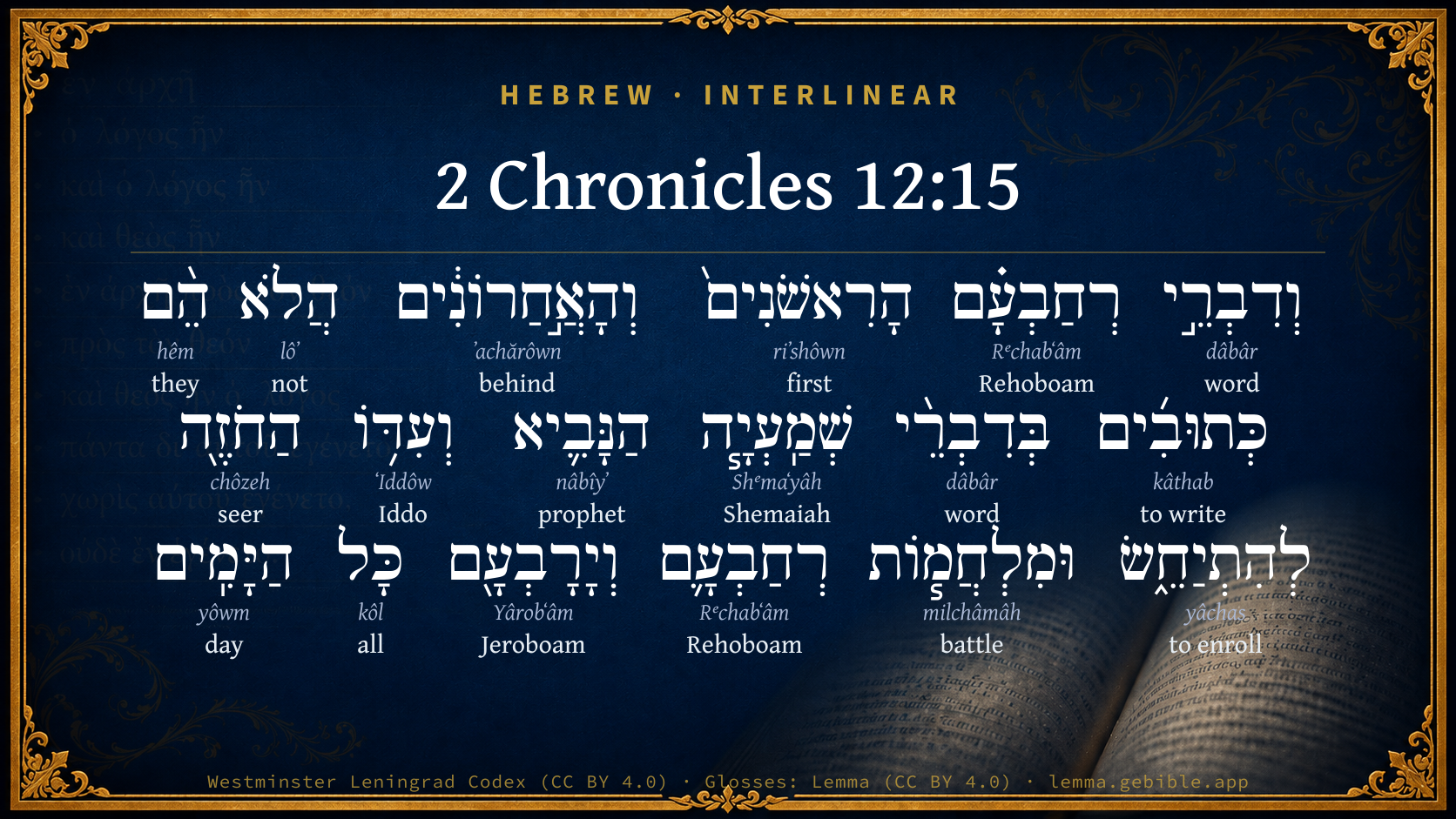
Hebrew (Westminster Leningrad Codex) 2 Chronicles 12:15 appears in the Hebrew Old Testament. The text above is from the Westminster Leningrad Codex. Each word links to its Strong’s number, a concise gloss, and parsing drawn from the Open Scriptures Hebrew Bible morphology. Click any word for its full Brown-Driver-Briggs (BDB) entry.
Download image
Cite this verse

2 Chronicles 12:15 (World English Bible). Public Domain. Lemma interlinear Bible study tool, https://lemma.gebible.app/v/2-chronicles/12/15.

Show BibTeX & RIS
BibTeX
RIS
English Translation
Now the acts of Rehoboam, first and last, aren't they written in the histories of Shemaiah the prophet and of Iddo the seer, after the manner of genealogies? There were wars between Rehoboam and Jeroboam continually.
World English Bible · Public Domain
Download a study sheet

One document with this verse’s original text, its word-by-word gloss line, the meaning frame, cross-references with their text, attributed commentary, and full source and license credits — printable, and it pastes into notes with its structure intact.

This verse Autodidact and up

Study sheet (.html) Plain text (.txt)

A passage Seminary Student

Up to 50 verses in one chapter. A passage sheet keeps up to 6 commentary sources and 12 cross-references per verse, in the order this page ranks them, and says so on the sheet whenever that leaves anything out. Ask for a single verse and you get the Autodidact verse sheet above.

Everything on this page stays free to read, with no account — the sheet is a download of what is already on screen, not access to it.

Want to remove ads? Support Godless Engineer
Compare translations 3

The same verse in 3 English versions, stacked beneath the original-language interlinear above. Click any original word for its lexicon entry.

Each is an independent rendering of the whole verse — the interlinear is not word-aligned to these translations.

Highlighted words mark where these versions differ — a whole-verse word diff, not a word-by-word alignment.

  • World English Bible Public Domain
    Now the acts of Rehoboam, first and last, aren't they written in the histories of Shemaiah the prophet and of Iddo the seer, after the manner of genealogies? There were wars between Rehoboam and Jeroboam continually.
  • King James Version Public Domain
    Now the acts of Rehoboam, first and last, are they not written in the book of Shemaiah the prophet, and of Iddo the seer concerning genealogies? And there were wars between Rehoboam and Jeroboam continually.
  • unfoldingWord Literal Text CC BY-SA 4.0
    And the matters of Rehoboam, the first things and the last things, are they not written in the words of Shemaiah the prophet and Iddo the seer, according to genealogy? And there were wars between Rehoboam and Jeroboam all the days.

unfoldingWord Literal Text — © unfoldingWord, licensed CC BY-SA 4.0. Word-aligned USFM3 via Door43 (git.door43.org/unfoldingWord/en_ult).

Versions to compare (up to 4)

3 of 4 selected

Show all 18 translations

Every available English version of this verse, each an independent rendering of the whole verse.

  • World English Bible Public Domain
    Now the acts of Rehoboam, first and last, aren't they written in the histories of Shemaiah the prophet and of Iddo the seer, after the manner of genealogies? There were wars between Rehoboam and Jeroboam continually.
  • Berean Standard Bible Public Domain
    Now the acts of Rehoboam, from first to last, are they not written in the records of Shemaiah the Prophet and of Iddo the Seer concerning the genealogies? There was war between Rehoboam and Jeroboam throughout their days.
  • Majority Standard Bible Public Domain
    Now the acts of Rehoboam, from first to last, are they not written in the records of Shemaiah the Prophet and of Iddo the Seer concerning the genealogies? There was war between Rehoboam and Jeroboam throughout their days.
  • King James Version Public Domain
    Now the acts of Rehoboam, first and last, are they not written in the book of Shemaiah the prophet, and of Iddo the seer concerning genealogies? And there were wars between Rehoboam and Jeroboam continually.
  • American Standard Version (1901) Public Domain
    Now the acts of Rehoboam, first and last, are they not written in the histories of Shemaiah the prophet and of Iddo the seer, after the manner of genealogies? And there were wars between Rehoboam and Jeroboam continually.
  • Revised Version (1885) Public Domain
    Now the acts of Rehoboam, first and last, are they not written in the histories of Shemaiah the prophet and of Iddo the seer, after the manner of genealogies? And there were wars between Rehoboam and Jeroboam continually.
  • Geneva Bible (1599) Public Domain
    The actes also of Rehoboam, first and last, are they not written in the booke of Shemaiah the Prophet, and Iddo the Seer, in rehearsing the genealogie? and there was warre alway betweene Rehoboam and Ieroboam.
  • Douay-Rheims (1899) Public Domain
    Now the acts of Roboam first and last are written in the books of Semeias the prophet, and of Addo the seer, and diligently recorded: and there was war between Roboam and Jeroboam all their days.
  • Young's Literal Translation Public Domain
    And the matters of Rehoboam, the first and the last, are they not written among the matters of Shemaiah the prophet, and of Iddo the seer, concerning genealogy? And the wars of Rehoboam and Jeroboam `are' all the days;
  • Literal Standard Version CC BY-SA 4.0
    And the matters of Rehoboam, the first and the last, are they not written among the matters of Shemaiah the prophet, and of Iddo the seer, concerning genealogy? And the wars of Rehoboam and Jeroboam [are for] all the days;
  • Unlocked Literal Bible CC BY-SA 4.0
    As for the other matters concerning Rehoboam, first and last, are they not written in the writings of Shemaiah the prophet and of Iddo the seer, which also have records of genealogies and the constant wars between Rehoboam and Jeroboam?
  • unfoldingWord Literal Text CC BY-SA 4.0
    And the matters of Rehoboam, the first things and the last things, are they not written in the words of Shemaiah the prophet and Iddo the seer, according to genealogy? And there were wars between Rehoboam and Jeroboam all the days.
  • Darby Bible Public Domain
    And the acts of Rehoboam, first and last, are they not written in the words of Shemaiah the prophet, and of Iddo the seer, in the genealogical registers? And there were wars between Rehoboam and Jeroboam continually.
  • World Messianic Bible Public Domain
    Now the acts of Rehoboam, first and last, aren’t they written in the histories of Shemaiah the prophet and of Iddo the seer, in the genealogies? There were wars between Rehoboam and Jeroboam continually.
  • Webster's Bible Public Domain
    Now the acts of Rehoboam, first and last, are they not written in the book of Shemaiah the prophet, and of Iddo the seer, concerning genealogies? And there were wars between Rehoboam and Jeroboam continually.
  • Free Bible Version CC BY-SA 4.0
    What Rehoboam did, from beginning to end, is written down in the records of Shemaiah the Prophet and of Iddo the Seer dealing with genealogies. However, Rehoboam and Jeroboam were always at war with each other.
  • Bible in Basic English Public Domain
    Now the acts of Rehoboam, first and last, are they not recorded in the words of Shemaiah the prophet and Iddo the seer? And there were wars between Rehoboam and Jeroboam all their days.
  • JPS Tanakh (1917) Public Domain
    Now the acts of Rehoboam, first and last, are they not written in the histories of Shemaiah the prophet and of Iddo the seer, after the manner of genealogies? And there were wars between Rehoboam and Jeroboam continually.

Literal Standard Version (2020), Covenant Press — licensed CC BY-SA 4.0. Text via the HelloAO Bible API (eBible.org). Unlocked Literal Bible (unfoldingWord) — licensed CC BY-SA 4.0. Text via the HelloAO Bible API (eBible.org). unfoldingWord Literal Text — © unfoldingWord, licensed CC BY-SA 4.0. Word-aligned USFM3 via Door43 (git.door43.org/unfoldingWord/en_ult). Free Bible Version, Dr. Jonathan Gallagher — licensed CC BY-SA 4.0. Text via the HelloAO Bible API (eBible.org).

Word by word

More ways to search: Search by grammar → Find every occurrence → Compare this word →

Practice this passage: Drill this verse → Learn its vocabulary →

וְעִדּ֥וֹ
ʻIddôw
H5714
“and · Iddo”
Conjunction + Noun, Proper
Part of Speech
Conjunction + Noun
Type
Proper
Full BDB Definition

Origin: from H5710

TWOT: None

Iddo = "His witness" - father of Abinadab, an officer of Solomon - grandfather of the prophet Zechariah - a Gershonite Levite, son of Joah - a priest in the time of Nehemiah - a seer in the time of king Jeroboam of the northern kingdom of Israel - son of Zechariah, ruler of the tribe of Manasseh in the time of David - a chief of the temple slaves who assembled at Casiphia at the time of the 2nd caravan from Babylon
  1. וְדִבְרֵ֣י dâbâr H1697 “and · words of” Conjunction + Noun, Common, Masculine, Plural, Construct
  2. רְחַבְעָ֗ם Rᵉchabʻâm H7346 “Rehoboam” Noun, Proper
  3. הָרִאשֹׁנִים֙ riʼshôwn H7223 “the · first” Particle, Definite Article + Adjective, Adjective, Masculine, Plural, Absolute
  4. וְהָאֲ֣חַרוֹנִ֔ים ʼachărôwn H314 “and · the · behind” Conjunction + Particle, Definite Article + Adjective, Adjective, Masculine, Plural, Absolute
  5. הֲלֹא lôʼ H3808 “not” Particle, Interrogative + Particle, Negative
  6. הֵ֨ם hêm H1992 “they” Pronoun, Personal, 3rd Person, Masculine, Plural
  7. כְּתוּבִ֜ים kâthab H3789 “written” Verb, Qal, Participle Passive, Masculine, Plural, Absolute
  8. בְּדִבְרֵ֨י dâbâr H1697 “in/at · words of” Preposition + Noun, Common, Masculine, Plural, Construct
  9. שְׁמַֽעְיָ֧ה Shᵉmaʻyâh H8098 “Shemaiah” Noun, Proper
  10. הַנָּבִ֛יא nâbîyʼ H5030 “the · prophet” Particle, Definite Article + Noun, Common, Masculine, Singular, Absolute
  11. הַחֹזֶ֖ה chôzeh H2374 “the · seer” Particle, Definite Article + Noun, Common, Masculine, Singular, Absolute
  12. לְהִתְיַחֵ֑שׂ yâchas H3187 “to enroll” Preposition + Verb, Hithpael, Infinitive Construct
  13. וּמִלְחֲמ֧וֹת milchâmâh H4421 “and · battles of” Conjunction + Noun, Common, Feminine, Plural, Construct
  14. רְחַבְעָ֛ם Rᵉchabʻâm H7346 “Rehoboam” Noun, Proper
  15. וְיָרָבְעָ֖ם Yârobʻâm H3379 “and · Jeroboam” Conjunction + Noun, Proper
  16. כָּל kôl H3605 “all of” Noun, Common, Masculine, Singular, Construct
  17. הַיָּמִֽים yôwm H3117 “the · days” Particle, Definite Article + Noun, Common, Masculine, Plural, Absolute

About this verse

These counts appear in no published source. They are computed here, from the morphology-tagged text and Lemma’s own curated glosses. What Lemma adds →

18
words
16
distinct lemmas
Historical
section

Notable vocabulary

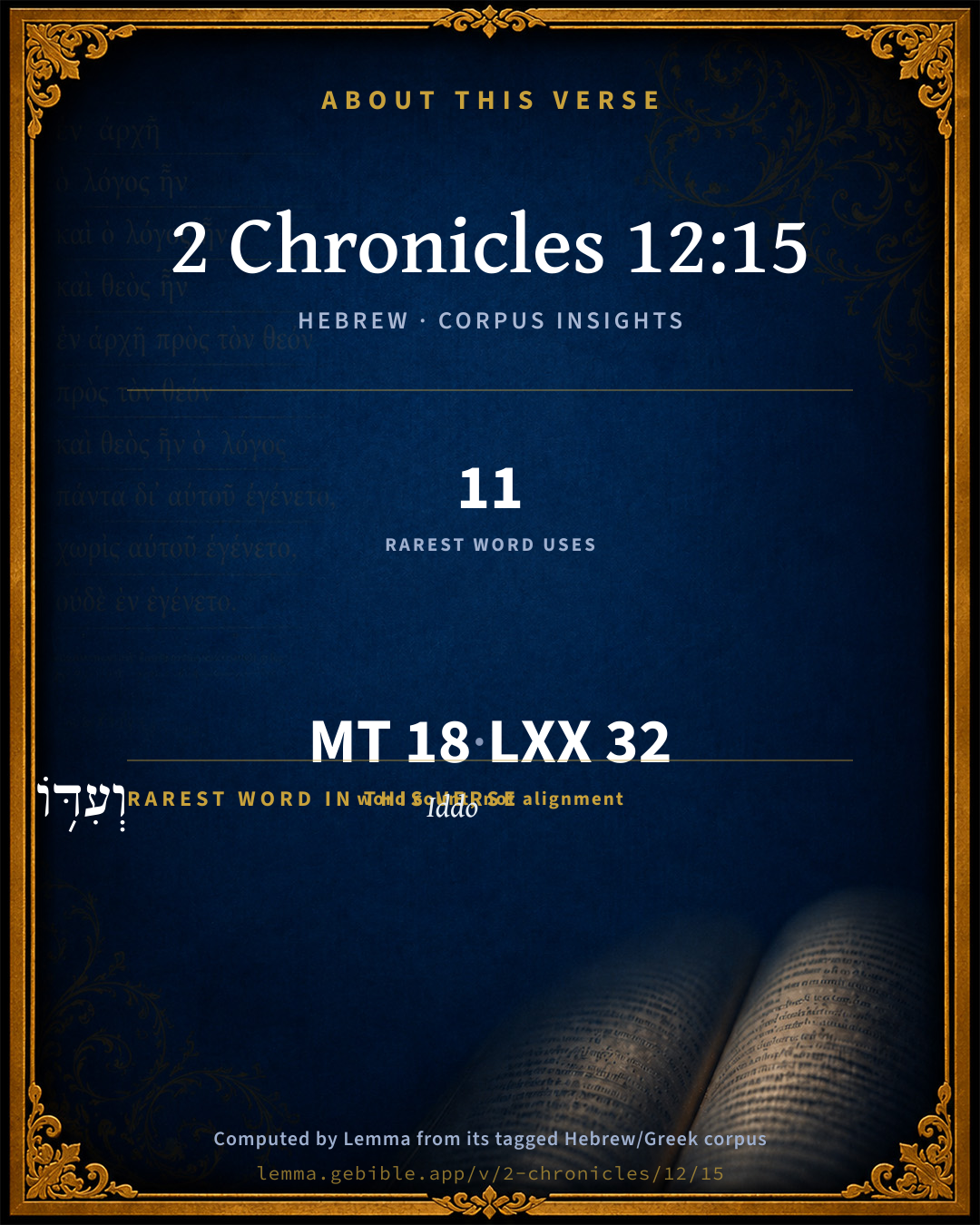
The rarest word here is וְעִדּ֥וֹ Iddo H5714 — appearing just 11 times in the whole Hebrew Bible.

Shared distinctive vocabulary

וְעִדּ֥וֹ Iddo H5714 occurs in 10 verses of the Hebrew Bible. Also found in:

Grammatical profile

  • 2 verbs
  • 12 nouns
  • 2 adjectives
  • 1 pronoun
  • 1 particle

Verb forms

  • כְּתוּבִ֜ים Qal · Participle Passive
  • לְהִתְיַחֵ֑שׂ Hithpael · Infinitive Construct

Repetition

Words recur within this verse — often emphatic in Hebrew:

  • וְדִבְרֵ֣י word H1697 ×2
  • רְחַבְעָ֗ם Rehoboam H7346 ×2

Hebrew & Septuagint length

In English translation the verse runs 36 words from the Hebrew and 29 from the Septuagint (LXX English) — closely comparable.

A rough comparison of the two English renderings, which tokenize alike — not a word-level alignment.

Word counts can differ between the Hebrew and the Greek without any difference in meaning — e.g. the Hebrew direct-object marker אֵת has no separate Greek word, and Greek often adds the article ὁ.

In the original languages it is 18 Hebrew tokens and 32 Greek tokens — but the two are counted differently (Hebrew bundles its prefixes and suffixes into one token; the Greek is in lemma form), so that isn’t a like-for-like length.

Cross-references

5

Topical passages linked to 2 Chronicles 12:15 in the Treasury of Scripture Knowledge — connected by theme and wording, ordered by reader-vote popularity; previews shown in the World English Bible.

  • 2 Chronicles 9:29 Now the rest of the acts of Solomon, first and last, aren't they written in the history of Nathan the prophet, and in the prophecy of Ahijah the Shilonite, and in the visions of Iddo the seer concerning Jeroboam the son of Nebat?
  • 2 Chronicles 12:5 Now Shemaiah the prophet came to Rehoboam, and to the princes of Judah, who were gathered together to Jerusalem because of Shishak, and said to them, Thus says Yahweh, You have forsaken me, therefore have I also left you in the hand of Shishak.
  • 1 Kings 12:22 But the word of God came to Shemaiah the man of God, saying,
  • 2 Chronicles 13:22 The rest of the acts of Abijah, and his ways, and his sayings, are written in the commentary of the prophet Iddo.
  • 1 Kings 14:29–30 Now the rest of the acts of Rehoboam, and all that he did, aren't they written in the book of the chronicles of the kings of Judah?

Cross-references courtesy of OpenBible.info (CC BY 4.0).

Hebrew and Greek witnesses Masoretic Hebrew ↔ Greek Septuagint

The same verse in the two great witnesses to the Old Testament, shown verse-for-verse.

These are two independent witnesses, not word-aligned to each other, and the Septuagint is shown in lemma (dictionary) form.

Hebrew 2 Chronicles 12:15 Masoretic · Westminster Leningrad Codex

וְדִבְרֵ֣י רְחַבְעָ֗ם הָרִאשֹׁנִים֙ וְהָאֲ֣חַרוֹנִ֔ים הֲלֹא הֵ֨ם כְּתוּבִ֜ים בְּדִבְרֵ֨י שְׁמַֽעְיָ֧ה הַנָּבִ֛יא וְעִדּ֥וֹ הַחֹזֶ֖ה לְהִתְיַחֵ֑שׂ וּמִלְחֲמ֧וֹת רְחַבְעָ֛ם וְיָרָבְעָ֖ם כָּל הַיָּמִֽים

Now the acts of Rehoboam, first and last, aren't they written in the histories of Shemaiah the prophet and of Iddo the seer, after the manner of genealogies? There were wars between Rehoboam and Jeroboam continually.

World English Bible · Public Domain

Greek LXX 2 Chronicles 12:15 Septuagint · lemma form

καί λόγος ροβοαμ ὁ πρῶτος καί ὁ ἔσχατος οὐ ἰδού γράφω ἐν ὁ λόγος σαμαιας ὁ προφήτης καί αδδω ὁ ὁράω καί πρᾶξις αὐτός καί πολεμέω ροβοαμ ὁ ιεροβοαμ πᾶς ὁ ἡμέρα

And the acts of Roboam, the first and the last, behold, are they not written in the book of Samaia the prophet, and Addo the seer, with his achievements.

LXX2012 (modern English Septuagint) · Public Domain

Hebrew: Westminster Leningrad Codex (CC BY 4.0). Greek: Septuagint (public domain); English from LXX2012 (modern English Septuagint) (Public Domain). How the Septuagint differs from the Hebrew →

Commentary

Notes on 2 Chronicles 12:15 from classic Christian and Jewish commentators (each source and its license shown beneath its notes). The classic Christian expositions comment on the surrounding passage and are grouped to its opening verse, so a note may address several verses; the Jewish commentaries on the Tanakh (Rashi and others) are per-verse, so they appear only where the commentator wrote on this verse.

Lemma curates 59 commentaries, every one of them public domain or Creative Commons licensed, each selected and text-cleaned for this edition rather than reprinted as found. About our sources →

Trapp's Complete Commentary

John Trapp

2Ch 12:15 Now the acts of Rehoboam, first and last, [are] they not written in the book of Shemaiah the prophet, and of Iddo the seer concerning genealogies? And [there were] wars between Rehoboam and Jeroboam continually.

Ver. 15. In the book of Shemaiah the prophet.] Not now extant; though God, if he had pleased, could as well have preserved those books, for the use of his Church, as he did the holy vessels of the temple from the spoil of Shishak.

And of Iddo the seer concerning genealogies.] Or, Pedigrees, or histories. This book is called Midrath, or a Commentary, {2Ch 13:22} Story, or Chronicle.

John Trapp, A Commentary or Exposition upon All the Books of the Old and New Testament (1647–1656) — public domain. Text from a community e-Sword module.

Joseph Benson's Commentary

2Ch 12:15. Of Iddo the seer concerning genealogies — In an historical account, written by him, of the genealogies and actions of the kings of Judah.

Joseph Benson's Commentary on the Old and New Testaments (1811–1818) — public domain. Text from a community e-Sword module.

Geneva Bible (1599)

Geneva Bible translators

Hebrew, sayings.

Geneva Bible (1599) marginal notes — public domain. Text via Bolls.life.

Adam Clarke's Commentary

Verse 15. Concerning genealogies] "In the book of the genealogy of the family of David." - Targum.

Adam Clarke's Commentary on the Bible (1810–1826) — public domain. Text from a community e-Sword/MySword module.

The Cambridge Bible for Schools and Colleges

gen. ed. J. J. S. Perowne

15. in the book] R.V. in the histories (mg. “words”). Probably one book is meant, begun by Shemaiah and continued by Iddo.

Iddo] See note on 2Ch_9:29.

concerning genealogies] Lit., “to enrol themselves” (the title of the book). Sometimes a book was named from the first striking word occurring in it; e.g. the Hebrew name of Numbers is B’midbar (“in the wilderness of”). Iddo had written another book called, The Visions of Iddo (2Ch_9:29).

The Cambridge Bible for Schools and Colleges (gen. ed. J. J. S. Perowne; Cambridge University Press, 1878–1918) — public domain. Text from a community e-Sword module.

Haydock's Catholic Bible Commentary

And diligently. Hebrew, "in their genealogical accounts." (Haydock) See chap. xiii. 22.

George Leo Haydock (1774–1849), Haydock's Catholic Family Bible and Commentary, 1859 edition — public domain. Excludes Psalms (Douay-Rheims chapter numbering differs from Protestant) and Deuterocanonical books (Catholic canon only).

Matthew Poole's English Annotations

Concerning genealogies; in an historical account written by him of the genealogies and actions of the kings of Judah.

Matthew Poole's English Annotations on the Holy Bible (1683–1685) — public domain. Text from a community e-Sword/MySword module.

Whedon's Commentary on the Bible

Daniel D. Whedon

15. Book of Shemaiah — Probably an account of his life and prophecies written by himself.

Iddo the seer concerning genealogies — Apparently a different work from that mentioned in 1Ch_9:29. Comp. 2Ch_13:22, and Introduction.

Daniel D. Whedon (gen. ed.), Commentary on the Old and New Testaments (1874–1909) — public domain. Text from a community e-Sword module.

The Pulpit Commentary

The authority quoted by the writer of Kings (14:29, 30) is "the book of the Chronicles literally, the book of the acts of the days, i.q. the title of our "Chronicles" of the kings of Judah," on which follows in the next verse the substantive statement, "And there was war between Rehoboam and Jeroboam all their days." The authorities quoted here are the works of Shemaiah and of Iddo, and it is possible that the following words touching the continual wars between Rehoboam and Jeroboam, which have not the substantive verb among them, may have been part of the title of Iddo"s work, although it is more probable that his work on "Genealogies" would retain the character of a specialty. We subjoin for English readers a literal translation of this verse: "And the words (acts) of Jeroboam first and last, are they not written in the words (acts) of Shemaiah the prophet, and of Iddo the seer touching genealogies" but Gesenius, sub voce," in the manner of a genealogical table" "and wars of Rehoboam and Jeroboam perpetual." We think that neither our Authorized Version nor Gesenius"s rendering probably convey the correct meaning. The hithp, of vjy" would be better satisfied by the rendering, "to make a register," i.e. "to preserve a continued register of David"s genealogy."

The Pulpit Commentary (1880–1919), ed. H.D.M. Spence-Jones & Joseph S. Exell — public domain. Text from a community e-Sword module.

Keil & Delitzsch

C. F. Keil & F. Delitzsch

Close of his reign. On the authorities, see the Introduction, and in reference to the other statements, the commentary on Kg1 14:29-31. מלחמות, wars, i.e., a state of hostility, was between Rehoboam and Jeroboam all days, can only be understood of the hostile attitude of the two rulers to each other, like מלחמה in Kings; for we have no narrative of wars between them after Rehoboam had abandoned, at the instance of the prophet, his proposed war with the Israelites at the commencement of his reign.

Keil & Delitzsch — Biblical Commentary on the Old Testament (1861–1891) — public domain (CC PDM 1.0). Text via the HelloAO Bible API. (Old Testament only.)

unfoldingWord translationNotes

Door43 World Missions Community

first and last

"from beginning to end." These two words form a merism and refer to everything that Rehoboam did from the beginning of his reign to the end of his reign. AT: "everything that he did" (See: Merism)

are they not written ... Jeroboam?

This can be expressed in active form and assumes that the answer is positive. The question is rhetorical and is used for emphasis. It can be translated as a statement. AT: "they are written ... Jeroboam." or "you can read about them ... Jeroboam." (See: Active or Passive and Rhetorical Question)

Shemaiah ... Iddo ... Abijah

These are the names of men. (See: How to Translate Names)

the constant wars between Rehoboam and Jeroboam

The names of the kings represent the armies that they led. AT: "the wars in which Rehoboam's army and Jeroboam's army constantly engaged" (See: Synecdoche)

Rehoboam slept with his ancestors

Rehoboam dying is spoken of as if he had fallen asleep. AT: "Rehoboam died" (See: Metaphor and Euphemism)

was buried in the city of David

This can be stated in active form. AT: "people buried him in the city of David" (See: Active or Passive)

became king in his place

The phrase "in his place" is a metaphor meaning "instead of him." AT: "became king instead of Rehoboam" (See: Metaphor)

translationWords

prophet

Rehoboam

Jeroboam

bury

city of David

king

unfoldingWord translationNotes — © Distant Shores Media and the Door43 World Missions Community, licensed CC BY-SA 4.0. Source: git.door43.org/Door43/en_tn.

Rashi

Rabbi Shlomo Yitzchaki (Rashi)

in the words of Shemaiah the prophet Every prophet would write his book, containing that which he prophesied, and this is the Shemaiah who was mentioned above (11:2, 12:5). And the verse written further (13:22), “And the rest of the deeds of Abijah and his ways and his words are written in the midrash of the prophet Iddo,” proves this, [that each prophet wrote a book of his prophecies, and] his [Iddo’s] book was called midrash.

Rashi on the Tanakh — English translations: “The Judaica Press complete Tanach with Rashi, translated by A. J. Rosenberg” (CC BY 4.0); “Pentateuch with Rashi's commentary by M. Rosenbaum and A.M. Silbermann, 1929-1934” (public domain); “The Metsudah Tanach series, Lakewood, N.J” (CC BY 4.0); and “The Book of Joshua, Metsudah Publications, 1997” (CC BY 4.0). Text via Sefaria.

Lesson kit

Teaching starters — assembled from the data on this page, not authored interpretation. Every prompt links to the verse data it draws on. Edit before teaching.

2 Chronicles, in the Historical, opens this verse with 18 words (16 distinct Hebrew lemmas). Its most distinctive word is ʻIddôw (“Iddo”). A historical commentator’s framing appears above. Read the whole chapter for the surrounding context.

Discussion questions

  1. How does “Iddo” (ʻIddôw) shape what this verse is saying?
  2. How does 1 Kings 4:14, which shares the word «Iddo», read alongside this verse?
  3. What does the repetition of “word” (2× in this one verse) do in this verse?
  4. The translations on this page render this verse differently — a whole-verse word diff, not a word-by-word alignment. What might account for the different wordings?
  5. «כְּתוּבִ֜ים» is a Qal Participle Passive verb. How does that grammatical form shape the action described?
  6. Compare how Trapp's Complete Commentary and Joseph Benson's Commentary read this verse. Where do they agree or differ?

Things to notice

Reading settings

Reading text

Shown beneath each verse's original-language words.

Old Testament
Old Testament edition

Read the OT as the Masoretic Hebrew (MT) or the Greek Septuagint (LXX).

English shown for the Greek Septuagint (in the Hebrew ↔ Greek comparison).

Comparing translations? Open the Compare panel on any verse page to stack up to four side by side.