
Proverbs 22:20

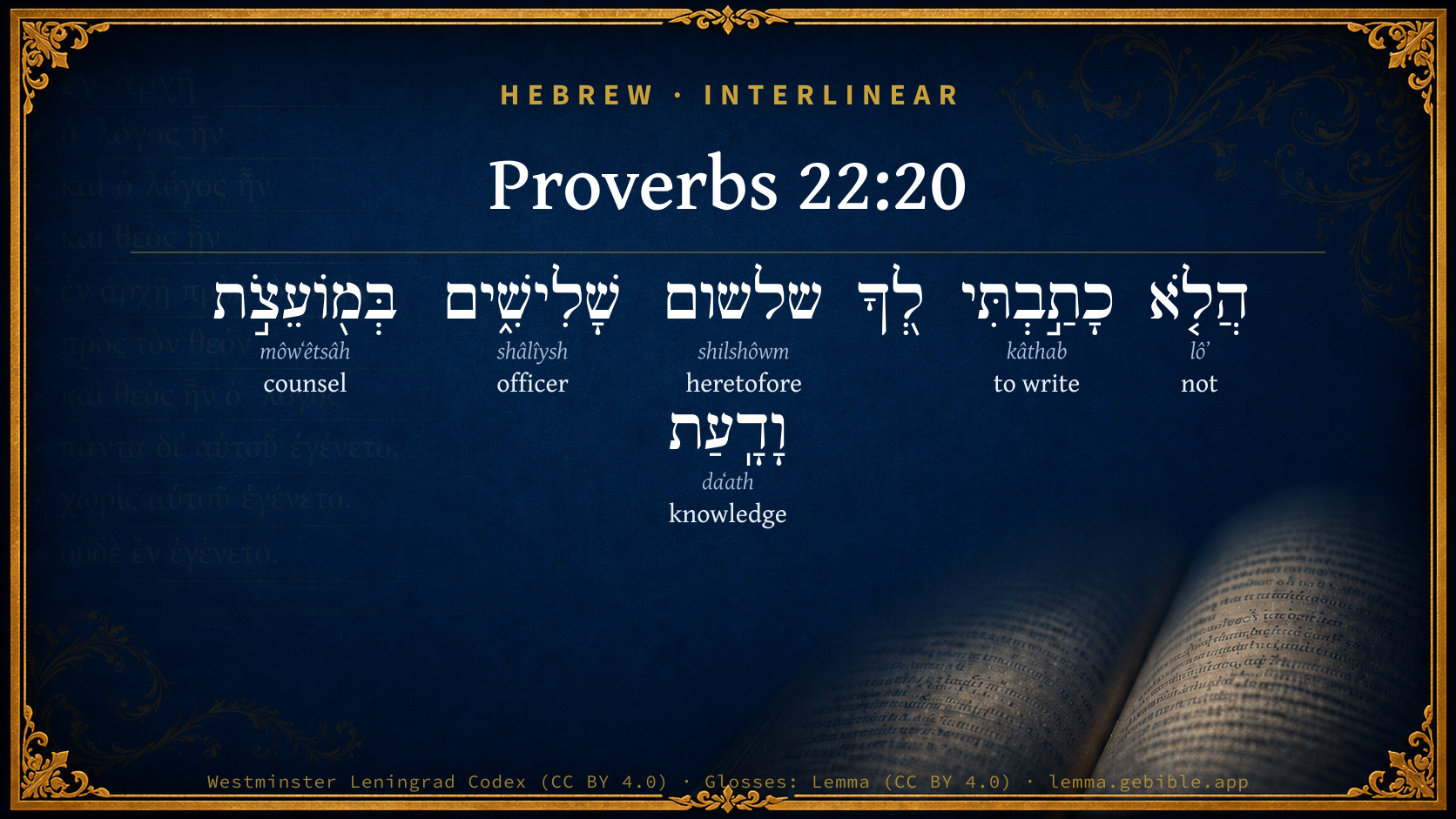
Hebrew (Westminster Leningrad Codex) Proverbs 22:20 appears in the Hebrew Old Testament. The text above is from the Westminster Leningrad Codex. Each word links to its Strong’s number, a concise gloss, and parsing drawn from the Open Scriptures Hebrew Bible morphology. Click any word for its full Brown-Driver-Briggs (BDB) entry.
Download image
Cite this verse

Proverbs 22:20 (World English Bible). Public Domain. Lemma interlinear Bible study tool, https://lemma.gebible.app/v/proverbs/22/20.

Show BibTeX & RIS
BibTeX
RIS
English Translation
Haven't I written to you thirty excellent things Of counsel and knowledge,
World English Bible · Public Domain
Download a study sheet

One document with this verse’s original text, its word-by-word gloss line, the meaning frame, cross-references with their text, attributed commentary, and full source and license credits — printable, and it pastes into notes with its structure intact.

This verse Autodidact and up

Study sheet (.html) Plain text (.txt)

A passage Seminary Student

Up to 50 verses in one chapter. A passage sheet keeps up to 6 commentary sources and 12 cross-references per verse, in the order this page ranks them, and says so on the sheet whenever that leaves anything out. Ask for a single verse and you get the Autodidact verse sheet above.

Everything on this page stays free to read, with no account — the sheet is a download of what is already on screen, not access to it.

Want to remove ads? Support Godless Engineer
Compare translations 3

The same verse in 3 English versions, stacked beneath the original-language interlinear above. Click any original word for its lexicon entry.

Each is an independent rendering of the whole verse — the interlinear is not word-aligned to these translations.

Highlighted words mark where these versions differ — a whole-verse word diff, not a word-by-word alignment.

  • World English Bible Public Domain
    Haven't I written to you thirty excellent things Of counsel and knowledge,
  • King James Version Public Domain
    Have not I written to thee excellent things in counsels and knowledge,
  • unfoldingWord Literal Text CC BY-SA 4.0
    Have I not written for you 30 things with counsels and knowledge,

unfoldingWord Literal Text — © unfoldingWord, licensed CC BY-SA 4.0. Word-aligned USFM3 via Door43 (git.door43.org/unfoldingWord/en_ult).

Versions to compare (up to 4)

3 of 4 selected

Show all 18 translations

Every available English version of this verse, each an independent rendering of the whole verse.

  • World English Bible Public Domain
    Haven't I written to you thirty excellent things Of counsel and knowledge,
  • Berean Standard Bible Public Domain
    Have I not written for you thirty sayings about counsel and knowledge,
  • Majority Standard Bible Public Domain
    Have I not written for you thirty sayings about counsel and knowledge,
  • King James Version Public Domain
    Have not I written to thee excellent things in counsels and knowledge,
  • American Standard Version (1901) Public Domain
    Have not I written unto thee excellent things Of counsels and knowledge,
  • Revised Version (1885) Public Domain
    Have not I written unto thee excellent things of counsels and knowledge;
  • Geneva Bible (1599) Public Domain
    Haue not I written vnto thee three times in counsels and knowledge,
  • Douay-Rheims (1899) Public Domain
    Behold I have described it to thee three manner of ways, in thoughts and knowledge:
  • Young's Literal Translation Public Domain
    Have I not written to thee three times With counsels and knowledge?
  • Literal Standard Version CC BY-SA 4.0
    Have I not written to you three times || With counsels and knowledge?
  • Unlocked Literal Bible CC BY-SA 4.0
    Have I not written for you thirty sayings of instruction and knowledge,
  • unfoldingWord Literal Text CC BY-SA 4.0
    Have I not written for you 30 things with counsels and knowledge,
  • Darby Bible Public Domain
    Have not I written to thee excellent things, in counsels and knowledge,
  • World Messianic Bible Public Domain
    Haven’t I written to you thirty excellent things of counsel and knowledge,
  • Webster's Bible Public Domain
    Have not I written to thee excellent things in counsels and knowledge,
  • Free Bible Version CC BY-SA 4.0
    Haven't I written down for you thirty sayings of advice and wisdom?
  • Bible in Basic English Public Domain
    Have I not put in writing for you thirty sayings, with wise suggestions and knowledge,
  • JPS Tanakh (1917) Public Domain
    Have not I written unto thee excellent things of counsels and knowledge;

Literal Standard Version (2020), Covenant Press — licensed CC BY-SA 4.0. Text via the HelloAO Bible API (eBible.org). Unlocked Literal Bible (unfoldingWord) — licensed CC BY-SA 4.0. Text via the HelloAO Bible API (eBible.org). unfoldingWord Literal Text — © unfoldingWord, licensed CC BY-SA 4.0. Word-aligned USFM3 via Door43 (git.door43.org/unfoldingWord/en_ult). Free Bible Version, Dr. Jonathan Gallagher — licensed CC BY-SA 4.0. Text via the HelloAO Bible API (eBible.org).

Word by word

More ways to search: Search by grammar → Find every occurrence → Compare this word →

Practice this passage: Drill this verse → Learn its vocabulary →

About this verse

These counts appear in no published source. They are computed here, from the morphology-tagged text and Lemma’s own curated glosses. What Lemma adds →

7
words
6
distinct lemmas
Wisdom
section

Notable vocabulary

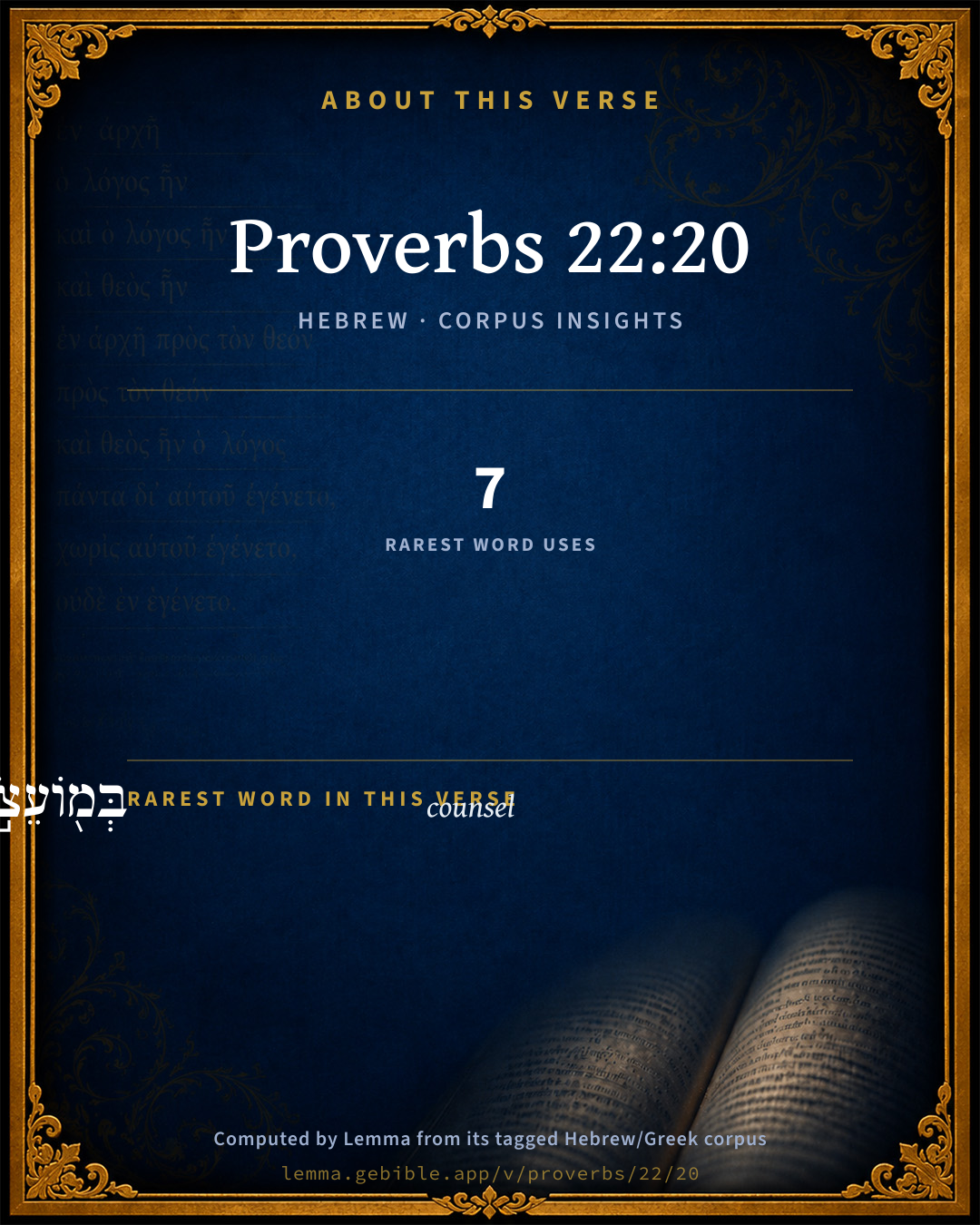
The rarest word here is בְּמ֖וֹעֵצֹ֣ת counsel H4156 — appearing just 7 times in the whole Hebrew Bible.

Shared distinctive vocabulary

בְּמ֖וֹעֵצֹ֣ת counsel H4156 occurs in 7 verses of the Hebrew Bible. Also found in:

Grammatical profile

  • 1 verb
  • 2 nouns
  • 1 adjective
  • 1 preposition
  • 1 adverb
  • 1 particle

Verb forms

  • כָתַ֣בְתִּי Qal · Perfect

Hebrew & Septuagint length

In English translation the verse runs 12 words from the Hebrew and 19 from the Septuagint (LXX English) — the Septuagint runs noticeably longer here. See the side-by-side →

A rough comparison of the two English renderings, which tokenize alike — not a word-level alignment.

Word counts can differ between the Hebrew and the Greek without any difference in meaning — e.g. the Hebrew direct-object marker אֵת has no separate Greek word, and Greek often adds the article ὁ.

Cross-references

5

Topical passages linked to Proverbs 22:20 in the Treasury of Scripture Knowledge — connected by theme and wording, ordered by reader-vote popularity; previews shown in the World English Bible.

  • Proverbs 8:6 Hear, for I will speak excellent things. The opening of my lips is for right things.
  • 2 Peter 1:19–21 We have the more sure word of prophecy; whereunto you do well that you take heed, as to a lamp shining in a dark place, until the day dawns, and the day star arises in your hearts:
  • Psalms 12:6 The words of Yahweh are flawless words, As silver refined in a clay furnace, purified seven times.
  • 2 Timothy 3:15–17 From infancy, you have known the sacred writings which are able to make you wise for salvation through faith, which is in Christ Jesus.
  • Hosea 8:12 I wrote for him the many things of my law; But they were regarded as a strange thing.

Cross-references courtesy of OpenBible.info (CC BY 4.0).

Hebrew and Greek witnesses Masoretic Hebrew ↔ Greek Septuagint

The same verse in the two great witnesses to the Old Testament, shown verse-for-verse.

Here the Septuagint runs noticeably longer than the Hebrew — LXX2012 (modern English Septuagint) 19 words vs World English Bible 12. A rough length comparison of the two English translations, not a word-level alignment — read both below.

These are two independent witnesses, not word-aligned to each other, and the Septuagint is shown in lemma (dictionary) form.

Hebrew Proverbs 22:20 Masoretic · Westminster Leningrad Codex

הֲלֹ֤א כָתַ֣בְתִּי לְ֭ךָ שלשום שָׁלִישִׁ֑ים בְּמ֖וֹעֵצֹ֣ת וָדָֽעַת

Haven't I written to you thirty excellent things Of counsel and knowledge,

World English Bible · Public Domain

Greek LXX Proverbs 22:20 Septuagint · lemma form

καί σύ δέ ἀπογράφω αὐτός σεαυτοῦ τρισσῶς εἰς βουλή καί γνῶσις ἐπί ὁ πλάτος ὁ καρδία σύ

And do you too repeatedly record them for yourself on the table of your heart, for counsel and knowledge.

LXX2012 (modern English Septuagint) · Public Domain

On this verse, Tyndale Open Study Notes discusses the Septuagint’s reading. Read the note in Commentary ↓

Hebrew: Westminster Leningrad Codex (CC BY 4.0). Greek: Septuagint (public domain); English from LXX2012 (modern English Septuagint) (Public Domain). How the Septuagint differs from the Hebrew →

Commentary

Notes on Proverbs 22:20 from classic Christian and Jewish commentators (each source and its license shown beneath its notes). The classic Christian expositions comment on the surrounding passage and are grouped to its opening verse, so a note may address several verses; the Jewish commentaries on the Tanakh (Rashi and others) are per-verse, so they appear only where the commentator wrote on this verse.

Lemma curates 59 commentaries, every one of them public domain or Creative Commons licensed, each selected and text-cleaned for this edition rather than reprinted as found. About our sources →

Trapp's Complete Commentary

John Trapp

Pro 22:20 Have not I written to thee excellent things in counsels and knowledge,

Ver. 20. Have not I written to thee excellent things?] Heb., Princely things; principles for princes, rare and royal sentences. The word signifies, say some, the third man in the kingdom for authority and dignity. Others read the words thus: Have not I three times written for thee concerning counsels and knowledge, - meaning his three books, proverbial, penitential, nuptial. The Canticles were penned perhaps in his younger years, saith one, {a} when his affections were more warm, active, and lively in spirituals; the Proverbs in his manly, ripe age, when his prudence and parts were at highest, most grave, solid, settled; Ecclesiastes in his old age, &c.

{a} Key of the Bible, by Mr Roberts.

John Trapp, A Commentary or Exposition upon All the Books of the Old and New Testament (1647–1656) — public domain. Text from a community e-Sword module.

Tyndale Open Study Notes

Tyndale Open Resources

22:20 thirty sayings: Early scribes noticed that the Hebrew word for thirty has been written in an unusual form (shlshwm) rather than the usual form (shlyshym). All the early translations of the Old Testament (e.g., Greek Septuagint, Latin Vulgate, Syriac Peshitta) read it as thirty. Nonetheless, some prefer to translate the word as excellent sayings.

Tyndale Open Study Notes — © Tyndale Open Resources, licensed CC BY-SA 4.0. Text via the HelloAO Bible API.

Geneva Bible (1599)

Geneva Bible translators

That is, sundry times.

Geneva Bible (1599) marginal notes — public domain. Text via Bolls.life.

Jamieson, Fausset & Brown

Robert Jamieson, A. R. Fausset & David Brown

excellent things--or probably of former times.

counsels and knowledge--both advice and instruction.

Jamieson, Fausset & Brown — Commentary Critical and Explanatory on the Whole Bible (1871) — public domain (CC PDM 1.0). Text via the HelloAO Bible API.

The Cambridge Bible for Schools and Colleges

gen. ed. J. J. S. Perowne

20. excellent things] The word has been thought to denote the chief of the three persons who formed the complement of an ancient war-chariot, and so to mean principal or excellent. In Pro_8:6 “excellent things” are literally princely things or words. The LXX. and Vulg., however, render the word literally, “thrice,” or “in threefold form,” τρισσῶς, tripliciter, possibly with the idea of reiteration to impress the lesson. Comp. Act_10:16.

Another reading is heretofore, or long ago. If this be adopted, the reference may be either to the earlier sections of this Book, or to the fact that what is now promulgated had been committed to writing long ago, and was therefore no hasty utterance.

This passage has borne a prominent part in the history of Biblical exegesis. By it, understood (with the LXX. and Vulg. quoted above) of “threefold” teaching, or teaching “in triple form,” Origen supported his doctrine of the threefold meaning of Holy Scripture. “By Solomon in the Proverbs,” he writes, “we find some such rule as this enjoined respecting the divine doctrines of Scripture: ‘And do thou portray them in a threefold manner, in counsel and knowledge, to answer words of truth to them who propose them to thee.’ ” And so, he adds, comparing the threefold sense of Scripture to the tripartite division of man into body, soul and spirit, the simple will be edified, “by the flesh,” or obvious sense of Scripture, and the more advanced by its “soul,” while the perfect (1Co_2:6-7) may attain to the spiritual law itself, De Princip. Bk. iv. ch. 1.

The Cambridge Bible for Schools and Colleges (gen. ed. J. J. S. Perowne; Cambridge University Press, 1878–1918) — public domain. Text from a community e-Sword module.

John Gill's Exposition

Have not I written to thee excellent things,.... In the Scriptures. Some render it, "three things" (c); and think that Solomon refers to the three divisions of the Scriptures among the Jews, the law, the prophets, and holy writings; so Jarchi; but some of those writings then were not: or to the three books wrote by him; the Proverbs, Ecclesiastes, and Song of Songs. Others render it, "in a threefold way" (d), as the Targum and several versions; that is, in various ways, in different forms and styles, in order the better to inform and instruct. But it is best, with Kimchi, Gersom, and Ben Melech, to render it, "excellent things", as we do; such are the truths of the Gospel; they are more excellent than those that are only known by the light of nature, or by the law of Moses: such as suspect the love and grace of God; the person and offices of Christ; peace, pardon, righteousness, atonement, life and salvation, by him. And these are said to lie

in counsels and knowledge; in disclosing the counsels of God, according to which they are; in giving the best of counsels to men; to perishing sinners, to look to Christ for salvation; to naked ones, to buy of him white raiment, or the robe of his righteousness; to guilty and filthy ones, to apply to his blood for pardon and cleansing; to hungry and thirsty ones, to come unto him for food, the bread of life, and water of life; and to weary ones, to him for rest; and all to do their duty both to God and men: and they also respect knowledge; the knowledge of divine and heavenly things; the knowledge of God in Christ, and of his perfections, as displayed in his salvation; the knowledge of Christ, what he is in himself, what he has done for his people, and is unto them; and especially the knowledge of salvation by him; all which the Gospel is a means of.

(c) "terna", Montanus, Vatablus, so Jarchi. (d) Sept. "tripticiter", V. L. and Arabic version; "tribus vicibus", Baynus, Targum and Syriac version; "triplici filo et nexa", Schultens; "triplicata", Cocceius.

John Gill's Exposition of the Whole Bible (1746–1763) — public domain (CC PDM 1.0). Text via the HelloAO Bible API.

Albert Barnes' Notes on the Bible

Excellent things - A meaning of the word derived from “the third,” i. e., “the chief of three warriors in a chariot” (compare Exo 14:7 note). Another reading of the Hebrew text gives “Have I not written to thee long ago?” and this would form a natural antithesis to “this day” of Pro 22:19. The rendering of the Septuagint is: “write them for thyself three times;” that of the Vulgate, “I have written it (i. e., my counsel) In threefold form;” the “three times” or “threefold form” being referred either to the Proverbs, Ecclesiastes, the Song of Solomon, or to the division of the Old Testament into the Law, the prophets, and the Hagiographa.

Albert Barnes' Notes on the Bible (1834–1885) — public domain. Text from a community e-Sword/MySword module.

Haydock's Catholic Bible Commentary

Ways. Repeatedly. (Bossuet; Tirinus) (2 Corinthians xii. 8., and Amos i. 11.) (Calmet) --- Protestants, "have not I written to thee excellent things in counsels and knowledge?" "Shalishim," perfect, (Pagnin) or "three things," (Montanus) means also (Haydock) such as might suit princes and great officers. (Calmet)

George Leo Haydock (1774–1849), Haydock's Catholic Family Bible and Commentary, 1859 edition — public domain. Excludes Psalms (Douay-Rheims chapter numbering differs from Protestant) and Deuterocanonical books (Catholic canon only).

Matthew Poole's English Annotations

Excellent things; or, princely things, as they are called, Pro 8:6, the great things of God’s law, as Hos 8:12.

In counsels and knowledge; consisting of counsels to direct thy practice, and knowledge to inform and enrich thy mind. Or by that known figure hendiadis, in counsels of knowledge, i.e. in good counsels, which proceed from sound knowledge, and make a man knowing and wise, which are opposed to the counsels of the wicked, Pro 12:5, which are without knowledge.

Matthew Poole's English Annotations on the Holy Bible (1683–1685) — public domain. Text from a community e-Sword/MySword module.

The Pulpit Commentary

Have not I written to thee excellent things in counsels and knowledge? There is a difficulty about the word tendered "excellent things." The Khetib has "the day before yesterday, formerly;" but the word occurs nowhere alone, and, as Nowack says, can hardly have been the original reading. However, Ewald, Bertheau, and others, adopting it, suppose that the author refers to some earlier work. Cheyne cites Bickell"s rendering, "Now, years before now, have I written unto thee long before with counsels and knowledge," and considers the words to mean either that the compiler took a long time over his work, or that this was not the first occasion of his writing. One does not see why stress should be here laid on former instruction, unless, perhaps, as Plumptre suggests, in contrast to "this day" of the previous verse. The LXX renders the word trisswv thus, "And do thou record them for thyself triply for counsel and knowledge upon the table of thine heart." St. Jerome has, Ecce descripsi eam tibi tripliciter, in cogitationibus et scientiis. Other versions have also given a numerical explanation to the term. In it is seen an allusion to the three supposed works of Solomon Proverbs, Ecclesiastes, Canticles which is absurd; others refer it to the threefold division of the Testament Law, Prophets, and Hagiographa; others, to three classes of youths for whom the admonitious were intended; others, again, think it equivalent to "oftentimes," or "in many forms." But the reading is as doubtful as the explanations of it are unsatisfactory. The genuine word is doubtless preserved in the Keri, which gives (shalishim), properly a military term, applied to chariot fighters and men of rank in the army. The LXX translates the word by trista e.g. , (Exo_14:7 Exo_15:4) which is equivalent to "chieftain." Hence the Hebrew term, understood in the neuter gender, is transferred to the chief among proverbs proverbs," as Delitzsch calls them. The Venetian, by a happy turn, gives trismegista . Thus we come back to the rendering of the Authorized Version as meet correct and intelligible.

Vers. 20, 21. Certainty.

I THE TRUTH SEEKER DESIRES CERTAINTY. With him "the certainty of the words of truth" is the great object sought after.

1. Certainty must be distinguished from positiveness. Doubt is often violent in assertion, as though to silence the opposition that cannot be answered. We may be very positive without being at all certain.

2. Certainty must be distinguished from certitude. Certitude is the feeling of certainty. Now, we may feel no doubt on a subject, and yet we may be in error. Real certainty is a well grounded assurance.

3. Certainty is desired because truth is precious. If a person is indifferent to truth, he may be satisfied with doubt, or acquiescent in error. This is the contemptuous condition of the cheerful Sadducee. His scepticism is no pain to him, because he does not feel the loss of truth. Not valuing truth, it is a light matter to him that he misses it. Such a condition of mind is an insult to truth itself. A man who recognizes the royal glory of truth will be in the greatest distress if he thinks it has eluded his grasp. To him the feeling of doubt will be an agony.

4. Certainty is sought because it is not always present. It may be very difficult to find. We grope in ignorance, error, and confusion of mind. Then the great want is some solid assurance of truth. Without this the world is dark, our voyage may end in shipwreck, and we cannot know God, ourselves, or our destiny.

II THE TRUTH SEEKER MAY SECURE CERTAINTY. The Bible denies agnosticism. It offers revelation.

1. Truth is revealed. The written Word contains the record of revelation. God has spoken to us through his prophets, but chiefly in his Son. (Heb_1:1, Heb_1:2) Everything that lifts the Bible above common books and impresses its message upon our hearts as from God, urges us to believe in the truth of what it teaches, for God is the Source of all truth. If the Bible does not teach truth, the Bible must be an earthly book, uninspired by God.

2. Truth must be practised and studied. "Excellent things in counsels and knowledge" are written in the Bible. but to find their truth we must do the commandment, follow the counsel, enter thoughtfully into the knowledge.

3. Truth should be taught. "That thou mightest answer the words of truth to them that send unto thee.

a. Inquirers need counsel and guidance.

b. Truth is no private possession, but a public trust.

c. They who teach others especially need to know the truth themselves.

The Pulpit Commentary (1880–1919), ed. H.D.M. Spence-Jones & Joseph S. Exell — public domain. Text from a community e-Sword module.

John Wesley's Explanatory Notes

In counsels and knowledge - In counsels which proceed from found knowledge.

John Wesley, Explanatory Notes Upon the Whole Bible (1754–1765) — public domain. Text via the GEBible commentary corpus.

Kretzmann's Popular Commentary

Paul E. Kretzmann

v. 20. Have not I written to thee excellent things in counsels and knowledge, most excellent maxims of proper behavior,

Paul E. Kretzmann, Popular Commentary of the Bible (1921–1924) — public domain. Text from a community e-Sword module.

unfoldingWord translationNotes

Door43 World Missions Community

General Information:

These verses continue and end the introduction that began in Proverbs 22:17.

Have I not written for you ... you?

This rhetorical question can be translated as a statement. AT: "You need to know that I have written for you ... you." (See: Rhetorical Question)

thirty sayings

Some translations read, "excellent sayings." (See: Textual Variants)

to those who sent you

This implies that the hearer is or will be one whom others send to gain and bring back information.

translationWords

instruct

know

true

trust

word

unfoldingWord translationNotes — © Distant Shores Media and the Door43 World Missions Community, licensed CC BY-SA 4.0. Source: git.door43.org/Door43/en_tn.

Rashi

Rabbi Shlomo Yitzchaki (Rashi)

Have I not written to you thirds The Torah, the Prophets, and the Hagiographa.

Rashi on the Tanakh — English translations: “The Judaica Press complete Tanach with Rashi, translated by A. J. Rosenberg” (CC BY 4.0); “Pentateuch with Rashi's commentary by M. Rosenbaum and A.M. Silbermann, 1929-1934” (public domain); “The Metsudah Tanach series, Lakewood, N.J” (CC BY 4.0); and “The Book of Joshua, Metsudah Publications, 1997” (CC BY 4.0). Text via Sefaria.

Lesson kit

Teaching starters — assembled from the data on this page, not authored interpretation. Every prompt links to the verse data it draws on. Edit before teaching.

Proverbs, in the Wisdom, opens this verse with 7 words (6 distinct Hebrew lemmas). Its most distinctive word is môwʻêtsâh (“counsel”). The Greek Septuagint runs longer here. A historical commentator’s framing appears above. Read the whole chapter for the surrounding context.

Discussion questions

  1. What does “counsel” (môwʻêtsâh) contribute to the verse as a whole?
  2. How does Psalms 5:10, which shares the word «counsel», read alongside this verse?
  3. The Septuagint runs longer here than the Hebrew. What might account for the difference?
  4. These translations render this verse differently; the difference is in the English rendering, not the original. What questions does that raise?
  5. «כָתַ֣בְתִּי» is a Qal Perfect verb. How does that grammatical form shape the action described?
  6. Compare how Trapp's Complete Commentary and Tyndale Open Study Notes read this verse. Where do they agree or differ?

Things to notice

Reading settings

Reading text

Shown beneath each verse's original-language words.

Old Testament
Old Testament edition

Read the OT as the Masoretic Hebrew (MT) or the Greek Septuagint (LXX).

English shown for the Greek Septuagint (in the Hebrew ↔ Greek comparison).

Comparing translations? Open the Compare panel on any verse page to stack up to four side by side.