
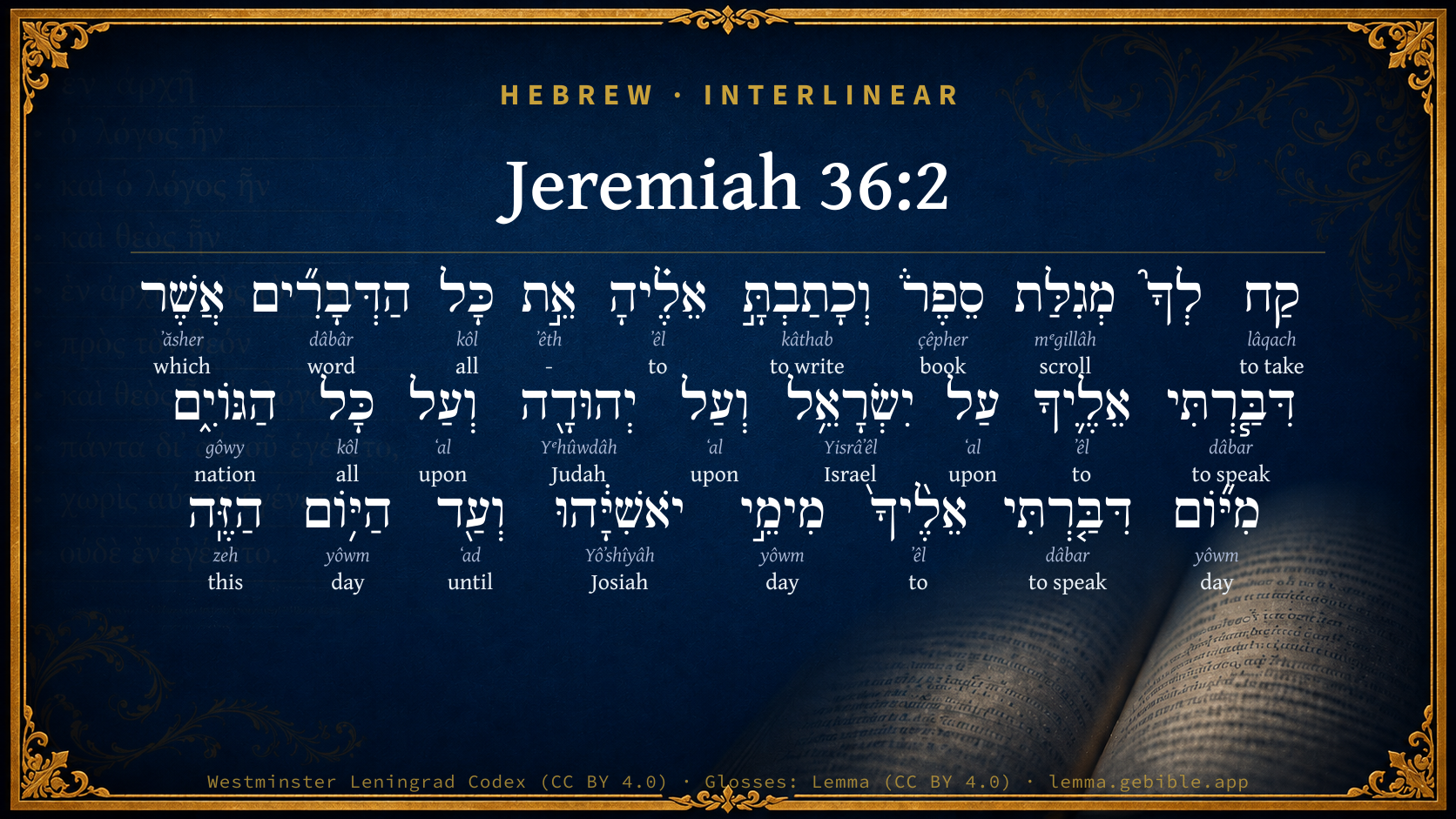
Jeremiah 36:2

Hebrew (Westminster Leningrad Codex) Jeremiah 36:2 appears in the Hebrew Old Testament. The text above is from the Westminster Leningrad Codex. Each word links to its Strong’s number, a concise gloss, and parsing drawn from the Open Scriptures Hebrew Bible morphology. Click any word for its full Brown-Driver-Briggs (BDB) entry.
Download image
Cite this verse

Jeremiah 36:2 (World English Bible). Public Domain. Lemma interlinear Bible study tool, https://lemma.gebible.app/v/jeremiah/36/2.

Show BibTeX & RIS
BibTeX
RIS
English Translation
Take a scroll of a book, and write therein all the words that I have spoken to you against Israel, and against Judah, and against all the nations, from the day I spoke to you, from the days of Josiah, even to this day.
World English Bible · Public Domain
Download a study sheet

One document with this verse’s original text, its word-by-word gloss line, the meaning frame, cross-references with their text, attributed commentary, and full source and license credits — printable, and it pastes into notes with its structure intact.

This verse Autodidact and up

Study sheet (.html) Plain text (.txt)

A passage Seminary Student

Up to 50 verses in one chapter. A passage sheet keeps up to 6 commentary sources and 12 cross-references per verse, in the order this page ranks them, and says so on the sheet whenever that leaves anything out. Ask for a single verse and you get the Autodidact verse sheet above.

Everything on this page stays free to read, with no account — the sheet is a download of what is already on screen, not access to it.

Want to remove ads? Support Godless Engineer
Compare translations 3

The same verse in 3 English versions, stacked beneath the original-language interlinear above. Click any original word for its lexicon entry.

Each is an independent rendering of the whole verse — the interlinear is not word-aligned to these translations.

Highlighted words mark where these versions differ — a whole-verse word diff, not a word-by-word alignment.

  • World English Bible Public Domain
    Take a scroll of a book, and write therein all the words that I have spoken to you against Israel, and against Judah, and against all the nations, from the day I spoke to you, from the days of Josiah, even to this day.
  • King James Version Public Domain
    Take thee a roll of a book, and write therein all the words that I have spoken unto thee against Israel, and against Judah, and against all the nations, from the day I spake unto thee, from the days of Josiah, even unto this day.
  • unfoldingWord Literal Text CC BY-SA 4.0
    “Take a scroll for yourself and write on it all the words that I have told you concerning Israel and Judah, and every nation. Do this for everything I have told from the days of Josiah until this very day.

unfoldingWord Literal Text — © unfoldingWord, licensed CC BY-SA 4.0. Word-aligned USFM3 via Door43 (git.door43.org/unfoldingWord/en_ult).

Versions to compare (up to 4)

3 of 4 selected

Show all 18 translations

Every available English version of this verse, each an independent rendering of the whole verse.

  • World English Bible Public Domain
    Take a scroll of a book, and write therein all the words that I have spoken to you against Israel, and against Judah, and against all the nations, from the day I spoke to you, from the days of Josiah, even to this day.
  • Berean Standard Bible Public Domain
    “Take a scroll and write on it all the words I have spoken to you concerning Israel, Judah, and all the nations, from the day I first spoke to you during the reign of Josiah until today.
  • Majority Standard Bible Public Domain
    “Take a scroll and write on it all the words I have spoken to you concerning Israel, Judah, and all the nations, from the day I first spoke to you during the reign of Josiah until today.
  • King James Version Public Domain
    Take thee a roll of a book, and write therein all the words that I have spoken unto thee against Israel, and against Judah, and against all the nations, from the day I spake unto thee, from the days of Josiah, even unto this day.
  • American Standard Version (1901) Public Domain
    Take thee a roll of a book, and write therein all the words that I have spoken unto thee against Israel, and against Judah, and against all the nations, from the day I spake unto thee, from the days of Josiah, even unto this day.
  • Revised Version (1885) Public Domain
    Take thee a roll of a book, and write thereon all the words that I have spoken unto thee against Israel, and against Judah, and against all the nations, from the day I spake unto thee, from the days of Josiah, even unto this day.
  • Geneva Bible (1599) Public Domain
    Take thee a roule or booke, and write therein all the wordes that I haue spoken to thee against Israel, and against Iudah, and against all the nations, from the day that I spake vnto thee, euen from the dayes of Iosiah vnto this day.
  • Douay-Rheims (1899) Public Domain
    Take thee a roll of a book, and thou shalt write in it all the words that I have spoken to thee against Israel and Juda, and against all the nations from the day that I spoke to thee, from the days of Josias even to this day.
  • Young's Literal Translation Public Domain
    `Take to thee a roll of a book, and thou hast written on it all the words that I have spoken unto thee concerning Israel, and concerning Judah, and concerning all the nations, from the day I spake unto thee, from the days of Josiah, even unto this day;
  • Literal Standard Version CC BY-SA 4.0
    “Take a roll of a scroll to yourself, and you have written on it all the words that I have spoken to you concerning Israel, and concerning Judah, and concerning all the nations, from the day I spoke to you, from the days of Josiah, even to this day;
  • Unlocked Literal Bible CC BY-SA 4.0
    “Take a scroll for yourself and write on it all the words that I have told you concerning Israel and Judah, and every nation. Do this for everything I have told from the days of Josiah until this very day.
  • unfoldingWord Literal Text CC BY-SA 4.0
    “Take a scroll for yourself and write on it all the words that I have told you concerning Israel and Judah, and every nation. Do this for everything I have told from the days of Josiah until this very day.
  • Darby Bible Public Domain
    Take thee a roll of a book, and write therein all the words that I have spoken unto thee against Israel, and against Judah, and against all the nations, from the day I spoke unto thee, from the days of Josiah, even unto this day.
  • World Messianic Bible Public Domain
    “Take a scroll of a book, and write in it all the words that I have spoken to you against Israel, against Judah, and against all the nations, from the day I spoke to you, from the days of Josiah even to this day.
  • Webster's Bible Public Domain
    Take thee a roll of a book, and write in it all the words that I have spoken to thee against Israel, and against Judah, and against all the nations, from the day I spoke to thee, from the days of Josiah, even to this day.
  • Free Bible Version CC BY-SA 4.0
    Get a scroll and write down everything I've told you condemning Israel, Judah, and all the other nations, from the time I first spoke to you during the reign of Josiah right up till now.
  • Bible in Basic English Public Domain
    Take a book and put down in it all the words I have said to you against Israel and against Judah and against all the nations, from the day when my word came to you in the days of Josiah till this day.
  • JPS Tanakh (1917) Public Domain
    'Take thee a roll of a book, and write therein all the words that I have spoken unto thee against Israel, and against Judah, and against all the nations, from the day I spoke unto thee, from the days of Josiah, even unto this day.

Literal Standard Version (2020), Covenant Press — licensed CC BY-SA 4.0. Text via the HelloAO Bible API (eBible.org). Unlocked Literal Bible (unfoldingWord) — licensed CC BY-SA 4.0. Text via the HelloAO Bible API (eBible.org). unfoldingWord Literal Text — © unfoldingWord, licensed CC BY-SA 4.0. Word-aligned USFM3 via Door43 (git.door43.org/unfoldingWord/en_ult). Free Bible Version, Dr. Jonathan Gallagher — licensed CC BY-SA 4.0. Text via the HelloAO Bible API (eBible.org).

Word by word

More ways to search: Search by grammar → Find every occurrence → Compare this word →

Practice this passage: Drill this verse → Learn its vocabulary →

מְגִלַּת
mᵉgillâh
H4039
“scroll of”
Noun, Common, Feminine, Singular, Construct
Part of Speech
Noun
Type
Common
Gender
Feminine
Number
Singular
State
Construct
Full BDB Definition

Origin: from H1556

TWOT: 353m

roll, book, writing
  1. קַח lâqach H3947 “take” Verb, Qal, Imperative, 2nd Person, Masculine, Singular
  2. סֵפֶר֒ çêpher H5612 “book” Noun, Common, Masculine, Singular, Absolute
  3. וְכָתַבְתָּ֣ kâthab H3789 “and · to write” Conjunction + Verb, Qal, Sequential Perfect, 2nd Person, Masculine, Singular
  4. אֵלֶ֗יהָ ʼêl H413 “to · her” Preposition + Suffix, Personal, 3rd Person, Feminine, Singular
  5. אֵ֣ת ʼêth H853 “-” Particle, Direct Object
  6. כָּל kôl H3605 “all of” Noun, Common, Masculine, Singular, Construct
  7. הַדְּבָרִ֞ים dâbâr H1697 “the · words” Particle, Definite Article + Noun, Common, Masculine, Plural, Absolute
  8. אֲשֶׁר ʼăsher H834 “which” Particle, Relative
  9. דִּבַּ֧רְתִּי dâbar H1696 “to speak” Verb, Piel, Perfect, 1st Person, Common, Singular
  10. אֵלֶ֛יךָ ʼêl H413 “to · you” Preposition + Suffix, Personal, 2nd Person, Masculine, Singular
  11. עַל ʻal H5921 “upon” Preposition
  12. יִשְׂרָאֵ֥ל Yisrâʼêl H3478 “Israel” Noun, Proper
  13. וְעַל ʻal H5921 “and · upon” Conjunction + Preposition
  14. יְהוּדָ֖ה Yᵉhûwdâh H3063 “Judah” Noun, Proper
  15. וְעַל ʻal H5921 “and · upon” Conjunction + Preposition
  16. כָּל kôl H3605 “all of” Noun, Common, Masculine, Singular, Construct
  17. הַגּוֹיִ֑ם gôwy H1471 “the · nations” Particle, Definite Article + Noun, Common, Masculine, Plural, Absolute
  18. מִיּ֞וֹם yôwm H3117 “from · day” Preposition + Noun, Common, Masculine, Singular, Absolute
  19. דִּבַּ֤רְתִּי dâbar H1696 “to speak” Verb, Piel, Perfect, 1st Person, Common, Singular
  20. אֵלֶ֨יךָ֙ ʼêl H413 “to · you” Preposition + Suffix, Personal, 2nd Person, Masculine, Singular
  21. מִימֵ֣י yôwm H3117 “from · days of” Preposition + Noun, Common, Masculine, Plural, Construct
  22. יֹאשִׁיָּ֔הוּ Yôʼshîyâh H2977 “Josiah” Noun, Proper
  23. וְעַ֖ד ʻad H5704 “and · until” Conjunction + Preposition
  24. הַיּ֥וֹם yôwm H3117 “the · day” Particle, Definite Article + Noun, Common, Masculine, Singular, Absolute
  25. הַזֶּֽה zeh H2088 “the · this” Particle, Definite Article + Pronoun, Demonstrative, Masculine, Singular

About this verse

These counts appear in no published source. They are computed here, from the morphology-tagged text and Lemma’s own curated glosses. What Lemma adds →

27
words
18
distinct lemmas
Prophets
section

Notable vocabulary

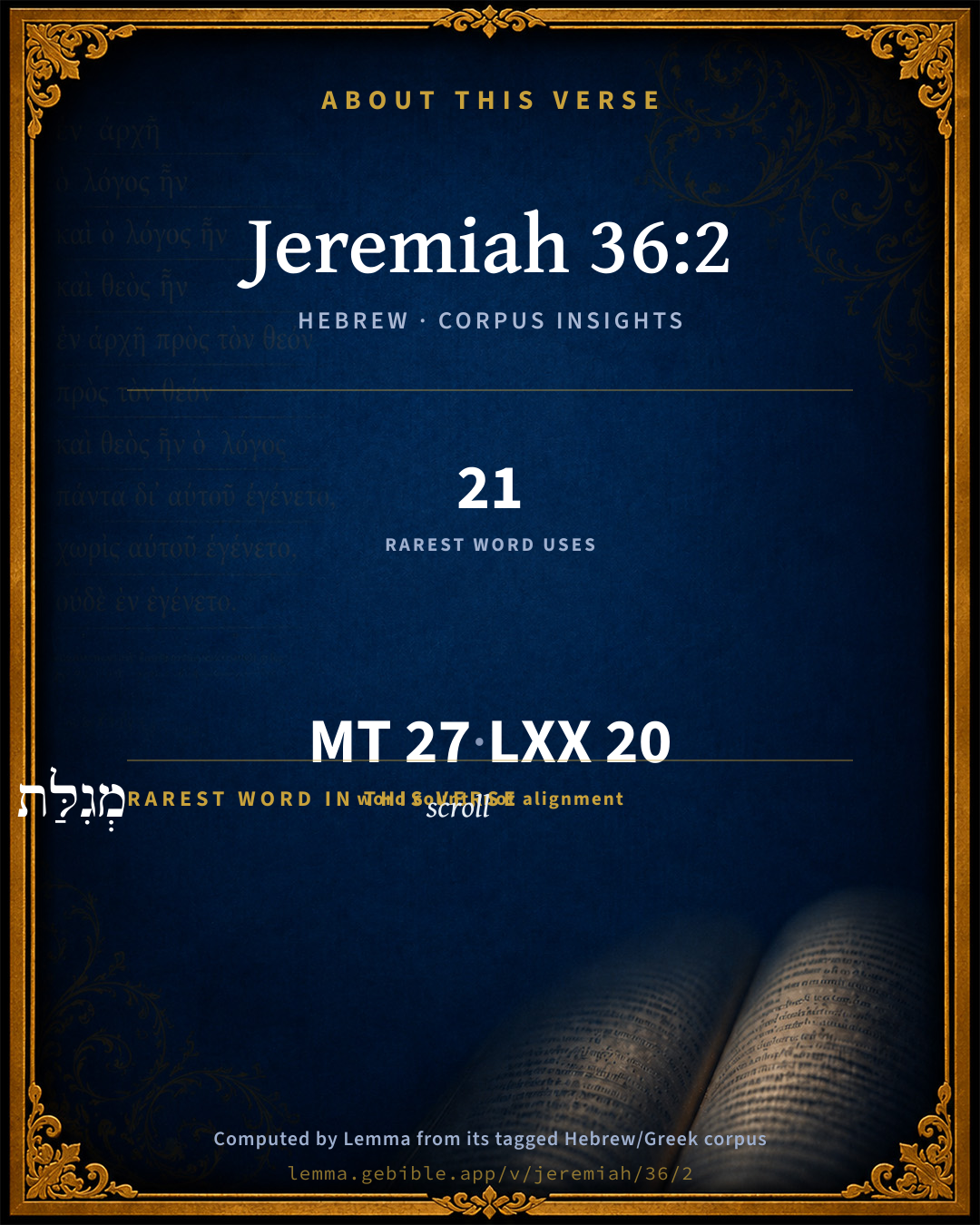
The rarest word here is מְגִלַּת scroll H4039 — appearing just 21 times in the whole Hebrew Bible.

Shared distinctive vocabulary

מְגִלַּת scroll H4039 occurs in 19 verses of the Hebrew Bible. Also found in:

Grammatical profile

  • 4 verbs
  • 12 nouns
  • 1 pronoun
  • 8 prepositions
  • 2 particles

Verb forms

  • קַח Qal · Imperative
  • וְכָתַבְתָּ֣ Qal · Sequential Perfect
  • דִּבַּ֧רְתִּי Piel · Perfect
  • דִּבַּ֤רְתִּי Piel · Perfect

Repetition

Words recur within this verse — often emphatic in Hebrew:

  • עַל upon H5921 ×3
  • מִיּ֞וֹם day H3117 ×3
  • כָּל all H3605 ×2
  • דִּבַּ֧רְתִּי to speak H1696 ×2
  • אֵלֶ֗יהָ to H413 ×3

Hebrew & Septuagint length

In the original languages it is 27 Hebrew tokens and 20 Greek tokens — but the two are counted differently (Hebrew bundles its prefixes and suffixes into one token; the Greek is in lemma form), so that isn’t a like-for-like length.

Cross-references

30

Topical passages linked to Jeremiah 36:2 in the Treasury of Scripture Knowledge — connected by theme and wording, ordered by reader-vote popularity; previews shown in the World English Bible.

  • Jeremiah 30:2 Thus speaks Yahweh, the God of Israel, saying, Write you all the words that I have spoken to you in a book.
  • Exodus 17:14 Yahweh said to Moses, "Write this for a memorial in a book, and rehearse it in the ears of Joshua: that I will utterly blot out the memory of Amalek from under the sky."
  • Jeremiah 1:10 behold, I have this day set you over the nations and over the kingdoms, to pluck up and to break down and to destroy and to overthrow, to build and to plant.
  • Jeremiah 25:3 From the thirteenth year of Josiah the son of Amon, king of Judah, even to this day, these twenty-three years, the word of Yahweh has come to me, and I have spoken to you, rising up early and speaking; but you have not listened.
  • Jeremiah 36:6 therefore go you, and read in the scroll, which you have written from my mouth, the words of Yahweh in the ears of the people in Yahweh's house on the fast-day; and also you shall read them in the ears of all Judah who come out of their cities.
  • Psalms 40:7 Then I said, "Behold, I have come. It is written about me in the book in the scroll.
  • Jeremiah 25:9–29 behold, I will send and take all the families of the north, says Yahweh, and [I will send] to Nebuchadrezzar the king of Babylon, my servant, and will bring them against this land, and against the inhabitants of it, and against all these nations round about; and I will utterly destroy them, and make them an astonishment, and a hissing, and perpetual desolations.
  • Jeremiah 36:23 It happened, when Jehudi had read three or four leaves, that [the king] cut it with the penknife, and cast it into the fire that was in the brazier, until all the scroll was consumed in the fire that was in the brazier.
  • Jeremiah 51:60 Jeremiah wrote in a book all the evil that should come on Babylon, even all these words that are written concerning Babylon.
  • Ezekiel 2:9 When I looked, behold, a hand was put forth to me; and, behold, a scroll of a book was therein;
  • Deuteronomy 31:24 It happened, when Moses had made an end of writing the words of this law in a book, until they were finished,
  • Ezra 6:2 There was found at Achmetha, in the palace that is in the province of Media, a scroll, and therein was thus written for a record:
  • Isaiah 8:1 Yahweh said to me, "Take a large tablet, and write on it with a man's pen, 'For Maher Shalal Hash Baz;'
  • Hosea 8:12 I wrote for him the many things of my law; But they were regarded as a strange thing.
  • Zechariah 5:1–4 Then again I lifted up my eyes, and saw, and, behold, a flying scroll.
  • Revelation 5:1–9 I saw, in the right hand of him who sat on the throne, a book written inside and outside, sealed shut with seven seals.
  • 2 Kings 17:18–20 Therefore Yahweh was very angry with Israel, and removed them out of his sight: there was none left but the tribe of Judah only.
  • Job 31:35 Oh that I had one to hear me! (Behold, here is my signature, let the Almighty answer me); Let the accuser write my indictment!
  • Isaiah 30:8–9 Now go, write it before them on a tablet, and inscribe it in a book, that it may be for the time to come forever and ever.
  • Jeremiah 1:2–3 to whom the word of Yahweh came in the days of Josiah the son of Amon, king of Judah, in the thirteenth year of his reign.
  • Jeremiah 1:5 Before I formed you in the belly I knew you, and before you came forth out of the womb I sanctified you; I have appointed you a prophet to the nations.
  • Jeremiah 2:4 Hear you the word of Yahweh, O house of Jacob, and all the families of the house of Israel:
  • Jeremiah 3:3–10 Therefore the showers have been withheld, and there has been no latter rain; yet you have a prostitute's forehead, you refused to be ashamed.
  • Jeremiah 23:13–14 I have seen folly in the prophets of Samaria; they prophesied by Baal, and caused my people Israel to err.
  • Jeremiah 32:30–35 For the children of Israel and the children of Judah have done only that which was evil in my sight from their youth; for the children of Israel have only provoked me to anger with the work of their hands, says Yahweh.
  • Jeremiah 36:29 Concerning Jehoiakim king of Judah you shall say, Thus says Yahweh: You have burned this scroll, saying, Why have you written therein, saying, The king of Babylon shall certainly come and destroy this land, and shall cause to cease from there man and animal?
  • Jeremiah 45:1 The word that Jeremiah the prophet spoke to Baruch the son of Neriah, when he wrote these word in a book at the mouth of Jeremiah, in the fourth year of Jehoiakim the son of Josiah, king of Judah, saying,
  • Jeremiah 47:1–7 The word of Yahweh that came to Jeremiah the prophet concerning the Philistines, before that Pharaoh struck Gaza.
  • Ezekiel 3:1–3 He said to me, Son of man, eat that which you find; eat this scroll, and go, speak to the house of Israel.
  • Habakkuk 2:2–3 Yahweh answered me, "Write the vision, and make it plain on tablets, that he may run who reads it.

Cross-references courtesy of OpenBible.info (CC BY 4.0).

Hebrew and Greek witnesses Masoretic Hebrew ↔ Greek Septuagint

The same verse in the two great witnesses to the Old Testament, shown verse-for-verse.

These are two independent witnesses, not word-aligned to each other, and the Septuagint is shown in lemma (dictionary) form.

Hebrew Jeremiah 36:2 Masoretic · Westminster Leningrad Codex

קַח לְךָ֮ מְגִלַּת סֵפֶר֒ וְכָתַבְתָּ֣ אֵלֶ֗יהָ אֵ֣ת כָּל הַדְּבָרִ֞ים אֲשֶׁר דִּבַּ֧רְתִּי אֵלֶ֛יךָ עַל יִשְׂרָאֵ֥ל וְעַל יְהוּדָ֖ה וְעַל כָּל הַגּוֹיִ֑ם מִיּ֞וֹם דִּבַּ֤רְתִּי אֵלֶ֨יךָ֙ מִימֵ֣י יֹאשִׁיָּ֔הוּ וְעַ֖ד הַיּ֥וֹם הַזֶּֽה

Take a scroll of a book, and write therein all the words that I have spoken to you against Israel, and against Judah, and against all the nations, from the day I spoke to you, from the days of Josiah, even to this day.

World English Bible · Public Domain

Greek LXX Structure differs

In the Septuagint, Jeremiah is about an eighth shorter than the Hebrew and arranges its material differently — the Oracles Against the Nations (Hebrew chapters 46–51) appear in the middle of the Greek book, after 25:13. Because the chapter and verse boundaries do not line up, a verse-for-verse comparison with the Hebrew is not shown.

A verse-for-verse comparison isn’t shown here because the chapters and verses don’t line up. Switch to the LXX edition with the MT / LXX toggle above to read the Greek directly.

On this verse, The Cambridge Bible for Schools and Colleges discusses the Septuagint’s reading. Read the note in Commentary ↓

Hebrew: Westminster Leningrad Codex (CC BY 4.0). Greek: Septuagint (public domain); English from a public-domain English Septuagint. How the Septuagint differs from the Hebrew →

Targum (Aramaic paraphrase)

1

The Targum is the ancient Jewish Aramaic paraphrase of the Hebrew Scriptures — an interpretive translation, not the Hebrew text itself. Onkelos (literal) and Pseudo-Jonathan (expansive) render the Torah, and Jonathan the Prophets. Coverage is partial: where no permissively-licensed English translation exists for a verse, only the Aramaic is shown. This is verse-level text, not a word-by-word alignment to the Hebrew.

  1. Targum Jonathan Prophets (Joshua–Malachi)
    סַב לָךְ מְגִלַת סַפְרָא וְתִכְתּוֹב עֲלָהּ יַת כָּל פִּתְגָמַיָא דְמַלְלֵית עִמָךְ עַל יִשְׂרָאֵל וְעַל יְהוּדָה וְעַל כָּל עַמְמַיָא מִיוֹמָא דְמַלְלֵית עִמָךְ מִימֵי יֹאשִׁיָה וְעַד יוֹמָא הָדֵין:

    (no public-domain English translation for this verse)

    Targum Jonathan — Aramaic: “Mikraot Gedolot” (public domain). English: “Sefaria Community Translation” (CC0 1.0 (public-domain dedication)); “London "Chaldee Paraphrase," 1871” (public domain). Text via Sefaria.

Commentary

Notes on Jeremiah 36:2 from classic Christian and Jewish commentators (each source and its license shown beneath its notes). The classic Christian expositions comment on the surrounding passage and are grouped to its opening verse, so a note may address several verses; the Jewish commentaries on the Tanakh (Rashi and others) are per-verse, so they appear only where the commentator wrote on this verse.

Lemma curates 59 commentaries, every one of them public domain or Creative Commons licensed, each selected and text-cleaned for this edition rather than reprinted as found. About our sources →

Trapp's Complete Commentary

John Trapp

Jer 36:2 Take thee a roll of a book, and write therein all the words that I have spoken unto thee against Israel, and against Judah, and against all the nations, from the day I spake unto thee, from the days of Josiah, even unto this day.

Ver. 2. Take thee a roll {a} of a book,] i.e., A volume. {as Isa 8:1} {See Trapp on "Isa 8:1"}

And write therein.] Jeremiah had a command to write; so have not our empty scripturients, whose rapes on the innocence of paper, as one phraseth it, make the press almost execrable. Ista prurientis calami scabies potius est, quam scriptio. {a}

All the words that I have spoken unto thee.] The sum and substance of all thy sermons for these twenty-three years past. See Jer 1:2; Jer 25:3.

{a} Olim liber erat instar mappae geographicae.

{b} Pineda.

John Trapp, A Commentary or Exposition upon All the Books of the Old and New Testament (1647–1656) — public domain. Text from a community e-Sword module.

Joseph Benson's Commentary

Jer 36:2. Take thee a roll of a book — Compare Isa 8:1; Eze 2:9; Zec 5:1. The ancient manner of writing was upon long scrolls of parchment, which they afterward rolled upon sticks. On these words it is remarked by Harmer, (vol. 4. chap. 7, obs. 122,) “Many things were rolled up, much in the shape of an ancient Jewish manuscript, which yet were not fit to write upon; the words then in this, and some other similar cases, may be understood to mean, Take thee a roll, or volume, fit to be made a book of, fit to be written on.” And write therein all the words that I have spoken against Israel and Judah — Jeremiah prophesied against Israel as well as against Judah, Jer 2:4; Jer 3:12; Jer 3:14; Jer 23:13; Jer 32:30. The kingdom of Israel was indeed destroyed by Shalmaneser, before the time of Jeremiah; but yet the prophet was ordered to reprove their sins, both to make the justice of God appear in punishing them so severely, and withal to warn the Jews by their example. Besides, there were some remains of these tribes still left, who joined themselves to the tribe of Judah. And against all the nations — See Jer 25:15-16. From the day I spake unto thee, from the days of Josiah — Namely, all the revelations which he had had from God for twenty-two years last past; for he began to prophesy in the thirteenth year of Josiah, who reigned thirty-one years, so that he prophesied eighteen years during Josiah’s life, and this was the fourth year of the reign of Jehoiakim, his successor. God would have his prophecies recorded, that there might be a memorial of them, that so the truth of them might appear when God should bring them to pass; the time of which now drew near.

Joseph Benson's Commentary on the Old and New Testaments (1811–1818) — public domain. Text from a community e-Sword module.

Geneva Bible (1599)

Geneva Bible translators

Which were twenty and three years, as Jer. 25:3, counting from the thirteenth year of Josiah’s reign.

Geneva Bible (1599) marginal notes — public domain. Text via Bolls.life.

Jamieson, Fausset & Brown

Robert Jamieson, A. R. Fausset & David Brown

roll of a book--a book formed of prepared skins made into a roll. Compare "volume of the book," that is, the Pentateuch (Psa 40:7). It does not follow that his prophecies were not before committed to writing; what is implied is, they were now written together in one volume, so as to be read continuously to the Jews in the temple.

against . . . nations-- (Jer 25:15, &c.).

from . . . days of Josiah-- (Jer 25:3). From Josiah's thirteenth year (Jer 1:2).

Jamieson, Fausset & Brown — Commentary Critical and Explanatory on the Whole Bible (1871) — public domain (CC PDM 1.0). Text via the HelloAO Bible API.

Adam Clarke's Commentary

Verse 2. Take thee a roll of a book] Take a sufficient quantity of parchment; cut and stitch it together, that it may make a roll on which to write the words that I have already spoken, that they may serve for a testimony to future generations. The Jewish rolls, several of which now lie before me, were made of vellum, or of sheep-skins dressed in the half-tanned or Basil manner. These were cut into certain lengths, and those parts were all stitched together, and rolled upon a roller. The matter was written on these skins in columns or pages. Sometimes two rollers are used, that as the matter is read from the roll in the left hand, the reader may coil it on the roller in his right. In this form the Pentateuch is written which is read in the synagogues.

Adam Clarke's Commentary on the Bible (1810–1826) — public domain. Text from a community e-Sword/MySword module.

John Calvin's Commentaries

The Prophet then says at the beginning, that the word of Jehovah came, by which he was ordered to write in a volume of a book whatever he had previously spoken By the volume of a book he means the volume in which he was to write; for ספר sepher, does not here mean a written book, for the volume was without any writing. Then the Prophet must have dictated to his servant Baruch. And this mode of speaking occurs also elsewhere, as in Psalm 40:7. But the Hebrews, according to an ancient custom, called a volume מגלה, megele; for they had no books in a compact form, such as we have in the present day, but had volumes or rolls; and the same word, volume, is also used in Latin. For as the Hebrews called what is folded up מגלה, megele, which comes from גלל, gelal, to fold up, or to roll; so the Latins also have derived it from a verb (volvo) which means to roll, and we call it rolle; and in Gaul they used the same form of writing; for all ancient documents and also judicial proceedings were wont formerly to be written on rolls, and in the old archieves there is nothing found but what is so written. God then ordered his Prophet to take a roll, and then he commanded him to write all the words which he had heard from the mouth of God, and which he had pronounced against Israel, and against Judah, and against all other nations.

We see here, in the first place, what is the benefit of having the Scripture, even that what would otherwise vanish away or escape the memory of man, may remain and be handed down from one to another, and also that it may be read; for what is written can be better weighed during leisure time. When one speaks only, every one takes in something according to his capacity and his attention; but as words from man’s mouth glide away, the utility of Scripture does hence appear more evident; for when what is not immediately understood is repeated, it brings more light, and then what one reads to-day he may read tomorrow, and next year, and many years after. As then God saw that he had been, as it were, beating the air when he had spoken by his Prophet, his purpose was that those things which Jeremiah had in vain spoken, should be written down. In this manner he, no doubt, intended to condemn both the king and his counsellors, and also the whole people, not only for their idleness, but also for their insensibility, even because all his teaching had been without fruit, though Jeremiah had labored much among them, and had been assiduous and faithful in the discharge of his office as a teacher.

We now perceive the design of God in saying, Take a volume and write in it; and he says, all the words which I have spoken to thee This was said in order that the Jews might understand that Jeremiah did not bring forward his own fictions, but faithfully delivered what he had heard from God’s mouth. He adds, against Israel and affainst Judah For Jeremiah at the beginning had prophesied against the ten tribes; but after the kingdom of Israel was cut off, he performed his office only towards the remaining people, so that his doctrine referred especially to the Jews. It is added, against all nations; and this we shall presently see; and it hence appears that his prophecies were not written according to the order of time, as I have before reminded you, but that the volume was written without regard to order. It was yet so far preserved that this book contains a summary of all the doctrine taught by Jeremiah during the whole course of his ministry. He says, from the day in which he began to speak, even from the days of Josiah, he says, to this day And the Prophet had been performing his duty as a teacher, not for ten, or twenty, or thirty, but for forty years. It follows, —

John Calvin's Commentaries (1540-1563) — public domain. Text from the Calvin Translation Society English edition (1840s-50s) via the Christian Classics Ethereal Library (ccel.org). Calvin's coverage is partial (roughly two-thirds of the Bible); uncommented books and verses are honest gaps, never fabricated. The 19th-century editor's footnotes and remarks are omitted so the notes are faithfully Calvin's own voice.

Ellicott's Commentary for English Readers

(2) Take thee a roll of a book.—The same phrase meets us in Psa_40:7 (ascribed by some critics to Jeremiah), but does not occur in any earlier prophet or historical book. It is found in later prophets (Eze_2:9; Eze_3:1; Zec_5:1-2). It probably followed on the introduction of parchment as a material for writing on, and the consequent substitution of the roll for the papyrus books, for which, from their fragile fabric, a different form was necessary. The command thus given to Baruch is interesting as letting us, so to speak, into the “workshop” of the prophet. He speaks probably without premeditation, as the word of the Lord comes to him (Mat_10:19). A disciple acts as reporter, and preserves the utterance in writing. It is interesting in this respect to note the parallelism between Jeremiah’s modus operandi and St. Paul’s (Rom_16:22; Gal_6:11; 2Th_3:17). From time to time the prophet collects, repeats, revises, and, in modern phrase, edits what he has uttered. We have here accordingly what may be described as the history of the first volume of his discourses—a volume which perished, as the chapter records, but of which the earlier chapters of the present book are substantially a reproduction.

A Bible Commentary for English Readers, edited by Charles John Ellicott (1878–1897) — public domain. Text from a community e-Sword module.

The Cambridge Bible for Schools and Colleges

gen. ed. J. J. S. Perowne

2. Take thee a roll of a book] Several skins were stitched together and attached to a roller of wood at one or both ends. The writing was arranged in columns parallel to the rollers, so that as the parchment was gradually unrolled from one end to the other, the successive columns could be read. Our word volume (that which is rolled up) points by its derivation to this older form of book.

write therein all the words] The prophet’s memory would supply him with the substance at any rate of the prophecies which he had uttered for the twenty-three years of his mission. But we may well believe, from the vivid style in which some of the earlier prophecies have come down to us, that he was able to draw upon some contemporary records of the exact language he had used, occasionally modifying it so as to adapt it to new circumstances.

Israel] Jeremiah addresses the Northern kingdom with promises only (Jer_3:6 ff., Jer_31:2 ff.). Accordingly it is better to read, with considerable support from MSS. of LXX, Jerusalem.

The Cambridge Bible for Schools and Colleges (gen. ed. J. J. S. Perowne; Cambridge University Press, 1878–1918) — public domain. Text from a community e-Sword module.

John Gill's Exposition

Take thee a roll of a book,.... A roll of parchment, which being wrote on, and rolled up, was called a book; but books, in those times, did not consist of leaves cut and stitched together, and bound up, as our books are, but sheets of parchments being written upon, were glued together, and then rolled up; hence such writings were called volumes; which name we still retain, and give to books, though the same practice is not used:

and write therein all the words that I have spoken unto thee against Israel, and against Judah; for though Israel was carried captive before the times of Jeremiah, and his prophecies were chiefly directed against Judah; yet as there were some of the ten tribes mixed with them, they were included in these prophecies, and therefore mentioned:

and against all the nations; such as Egypt, Edom, Ammon, and Moab, Jer 9:26;

from the day that I spake unto thee, from the days of Josiah, even unto this day; that is, from the time the Lord called him to prophesy in his name, which was in, the thirteenth year of Josiah, who reigned one and thirty years; and this being the fourth year of Jehoiakim, it must be the three and twentieth year of his prophesying, and the a course of full two and twenty years; see Jer 1:2; now all the sermons, discourses, and prophecies, he had delivered out against one and another, during this time, must all be written in one roll or book, that that they might be read. Kimchi says their Rabbins (n) would have it that this roll was the book of the Lamentations, called by them "Megallah", or roll.

(n) T. Bab. Moed Katon fol. 26. 1.

John Gill's Exposition of the Whole Bible (1746–1763) — public domain (CC PDM 1.0). Text via the HelloAO Bible API.

Albert Barnes' Notes on the Bible

A roll of a book - A parchment-scroll, consisting of several skins sewn together, and cut of an even breadth, with a piece of wood at one end (or, in case of larger volumes, at both ends) on which to roll them up.

Write therein all the words ... - The phrase means that the roll was to contain “all the counsel of God” Act 20:27 upon the special point mentioned in Jer 36:3; and that the prophet was not to keep anything back.

Albert Barnes' Notes on the Bible (1834–1885) — public domain. Text from a community e-Sword/MySword module.

Haydock's Catholic Bible Commentary

Write. He had already prophesied 22 years. Now he was more frequently ordered to write. (Calmet) --- He executed the order by the hand of Baruch, ver. 4.

George Leo Haydock (1774–1849), Haydock's Catholic Family Bible and Commentary, 1859 edition — public domain. Excludes Psalms (Douay-Rheims chapter numbering differs from Protestant) and Deuterocanonical books (Catholic canon only).

Matthew Poole's English Annotations

By

a roll of a book is to be understood parchments, which anciently were their books, the art of binding books being not then known. The precept is for recording all the revelations he had from God for twenty-two years last past; for he began to prophesy in the thirteenth year of Josiah, who reigned one and thirty years, so as he prophesied eighteen years during Josiah’s life, and this was the fourth year of the reign of Jehoiakim. God would have them recorded, that there might be a memorial of them, that so the truth of them might appear, when God should bring them to pass, the time of which now drew very near.

Matthew Poole's English Annotations on the Holy Bible (1683–1685) — public domain. Text from a community e-Sword/MySword module.

Whedon's Commentary on the Bible

Daniel D. Whedon

2. A roll of a book — A book-roll; that is, a roll properly prepared for writing.

And write — Not copy as if into one volume what already existed in a written form but detached, but reduce to writing the things which had, from time to time, been spoken. There is nothing in the form of language, either excluding or including written aids to the memory, in doing this work. The purpose of this writing, as shown in Jer_36:3, was to influence the people by means of it. A writing is something more staid and impressive than the fleeting utterances of oral discourse can be.

Daniel D. Whedon (gen. ed.), Commentary on the Old and New Testaments (1874–1909) — public domain. Text from a community e-Sword module.

The Pulpit Commentary

The written Word.

"Take thee a roll of a book, and write therein all the words that I have spoken unto thee" "This is the first recorded instance of the formation of a canonical book, and of the special purpose of its formation." No doubt other prophets had committed to writing more or less of their teachings the quotations of one prophet from another, the later from the earlier, prove this; but here is the first record of any such act, and hence it has especial interest. It is the forerunner of all those several Scriptures which together form now the depository of our religion, and justify the well known saying of Chillingworth, "The Bible and the Bible only is the religion of Protestants." For note

I OUR RELIGION DEPENDS ON THE WRITTEN WORD. Great contempt has been poured on the idea of a "book revelation." As if there were something even ridiculous in the idea of God revealing himself by means of a book. A recent missionary traveller (Gilmour) among the Mongols states that they feel the force of this objection very strongly, and that when the missionary holds up his little Bible as the revelation of God, it seems to them very absurd. But these people can claim distinguished companionship amongst our own countrymen. And in addition to the rejection of a book revelation at all, this particular book, the Bible, is objected to exceedingly. All manner of ridicule is poured on it, and there is scarce a single ground on which fault could be found with it which some one has not occupied. But in reply note

II THE WRITTEN WORD IS, HOWEVER, NOT THE REVELATION BUT ONLY THE RECORD OF IT. It is not claimed for it to be more than this. God did not give to mankind a book, but he revealed himself to "holy men of old," and especially through the Lord Jesus Christ. And this book is the record of that revelation. Hence the only question that concerns us is Is it a faithful record?

III BUT SUCH A RECORD WAS ABSOLUTELY NECESSARY. For if the existence of God be allowed, and that it is his desire to reclaim men from their sin and to bring them back to himself, it may be asked:

1. How could this be done except by his revealing himself to men? They must be enabled to know him, and to know him in such manner as would be likely to move them in the direction desired.

2. But if it be granted that a revelation was a necessity, how could that revelation be of use to mankind at large unless it were put on record? For all events are related to time and space; they must have happened God"s revelation of himself amongst others some when and some where. But how, except by a record, could those who dwelt in other generations and in other parts of the world know of this revelation? But for that it may as well not have been.

3. And so long as the Divine ideas are conveyed to our mind, what does it matter about the means employed? All the magnificence of nature the Alpine heights, the starry universe, etc. serve us only as they convey true and worthy ideas, as they wake up in us fit and appropriate thoughts. If they fail in this, they might as well not be so far as we are concerned. But there are many who never have opportunities of beholding the magnificence of nature their lives are one long round of sordid toil in scenes dark and squalid; and others who have such opportunities are too little educated to learn from them what they assuredly have to tell. The road that leads from nature up to nature"s God is a thinly traveled one; few go that way. But now, if by the written Word, which can be carried everywhere, perpetuated, multiplied, and is everywhere and at all times accessible if by this there can be conveyed to the mind fit, true, and heart moving ideas about God, what an advantage this is! Instead of being a cause of scorn, it should awaken our gratitude.

4. And those features in this record which seem to some unworthy of its great mission, these really are of great service. No doubt there is much of homeliness and of trivial and seemingly insignificant detail in this record. It is a very plain, prosaic book in many parts. But is not this a great boon? Had God"s revelation of himself to us been accompanied by a blaze of splendour, with such manifestations of Divine power to the senses or to the intellect as some seem to desire, the revelation would have been lost in the record; no one would look at the picture, their attention being so much occupied with the setting. Hence it is good for us that we live so long after the times of the Bible. It is expedient for us that Christ has gone away. For in proportion to men"s nearness to those times "events having God in them took a more forcible hold upon their mind than God in the events." The atmosphere of time is needed in order to our right viewing of the marvelous facts of the Bible.

IV OUR ONE QUESTION IS IS THE RECORD FAITHFUL?

1. As to the facts themselves in their main substance and meaning. This question is quite apart from inspiration. Nothing but honesty and intelligence are asked for here. Of course, if any start with the assumption that the supernatural is not, and hence miracles are by their very nature impossible, and the belief of them absurd, such a one will refuse all credence to this record. But first let his assumption be proved ere doubt be thrown on either the honesty or the intelligence of the writers of the Bible.

2. As to the interpretation and meaning of the facts they record. "Just as on gazing at a picture of Raphael"s we should rejoice to have at hand a companion who had familiarized himself with the spirit of the great artist and acquired an insight into his genius, to furnish us with such brief notices as might assist us to a comprehension of the profounder ideas expressed by the painting, for want of which it would lose very much of its intellectual meaning; so with the memoirs of Christ before us, as the spiritual revelation of God to our religious sense, we require, in order to adequate instruction and profit, the comments of... those who shall be qualified to point it out to our duller vision. What poets are to the natural exhibition of God in his works, these men will be to the moral exhibition of God in his Son." Now, that the sacred writers answer to this need is shown by the fact that they "commend the truth to every man"s conscience in the sight of God." In this commendation to our conscience is the evidence that they have read aright the facts they record. And to this we may fearlessly appeal. We do not assert this of men"s theologies and divinity schemes too many of them outrage the conscience and trouble the moral sense; but we do assert it of the great verities of the faith, as taught in the Scriptures, and of the doctrines which the Bible as a whole plainly teaches. Within this ample volume lies The mystery of mysteries. Happiest they of human race To whom their God has given grace. To read, to fear, to hope, to pray, To lift the latch and force the way; And better had they ne"er been born Than read to doubt or read to scorn. Cf. on this whole subject Miall"s "Bases of Belief. C.

The Pulpit Commentary (1880–1919), ed. H.D.M. Spence-Jones & Joseph S. Exell — public domain. Text from a community e-Sword module.

John Wesley's Explanatory Notes

A roll - Parchments, which anciently were their books. All the words - All the Revelations he had from God for twenty-two years last past. God would have them recorded, that there might be a memorial of them, that so the truth of them might appear, when God should bring them to pass; the time of which now drew near.

John Wesley, Explanatory Notes Upon the Whole Bible (1754–1765) — public domain. Text via the GEBible commentary corpus.

Keil & Delitzsch

C. F. Keil & F. Delitzsch

The word of the Lord to Jeremiah was to this effect: "Take thee a book-roll, and write on it (אליה for עליה) all the words that I have spoken unto thee concerning Israel and Judah, and concerning all the nations, from the day I spake unto thee, from the days of Josiah till this day. Jer 36:3. Perhaps the house of Judah will hear all the evil which I meditate doing to them, that they may return every one from his evil way, and that I may forgive their iniquity and their sin." ישׁמעוּ here means, to hear correctly and lay to heart; cf. Jer 26:3. Hitzig views the command as meaning, not that Jeremiah is now for the first time to write down his addresses (which would be an impossibility for the most faithful memory), but that he is merely to write them down together in one book, out of the several scattered leaves and scraps. Graf has already refuted this view, though more fully than was necessary. It is not a copying, word for word, of every separate address that is meant, but merely a writing down of the essential contents of all his oral discourses. This is quite clear, not merely from what is stated in Jer 36:3 as the object of this command, but also from the character of these collected addresses, as they are preserved to us. That the expression "all the words" is not to be understood in the most rigid sense, follows from the very fact that, when Jeremiah anew wrote down his prophecies, Jer 36:32, he further added "many similar words" to what had been contained in the first book-roll, which was burned by Jehoiakim. But Jeremiah might perhaps be able to retain in his memory the substance of all the addresses he had delivered during the twenty-three years, since all of them treated of the same subjects - reproof of prevailing sins, threat of punishment, and promises.

Keil & Delitzsch — Biblical Commentary on the Old Testament (1861–1891) — public domain (CC PDM 1.0). Text via the HelloAO Bible API. (Old Testament only.)

Lesson kit

Teaching starters — assembled from the data on this page, not authored interpretation. Every prompt links to the verse data it draws on. Edit before teaching.

Jeremiah, in the Prophets, opens this verse with 27 words (18 distinct Hebrew lemmas). Its most distinctive word is mᵉgillâh (“scroll”). A historical commentator’s framing appears above. Read the whole chapter for the surrounding context.

Discussion questions

  1. The word mᵉgillâh carries the sense “scroll.” How does it shape the verse?
  2. Psalms 40:7 shares the word «scroll» with this verse. How do the two illuminate each other?
  3. “upon” occurs 3× in this one verse. What is the effect of the repetition?
  4. These translations render this verse differently; the difference is in the English rendering, not the original. What questions does that raise?
  5. The verb «קַח» is Qal Imperative. How does its form color the action?
  6. Reading how Trapp's Complete Commentary and Joseph Benson's Commentary read this verse, where do the two commentators agree and where do they part?

Things to notice

Reading settings

Reading text

Shown beneath each verse's original-language words.

Old Testament
Old Testament edition

Read the OT as the Masoretic Hebrew (MT) or the Greek Septuagint (LXX).

English shown for the Greek Septuagint (in the Hebrew ↔ Greek comparison).

Comparing translations? Open the Compare panel on any verse page to stack up to four side by side.