2 Chronicles 13:22

Hebrew (Westminster Leningrad Codex) 2 Chronicles 13:22 appears in the Hebrew Old Testament. The text above is from the Westminster Leningrad Codex. Each word links to its Strong’s number, a concise gloss, and parsing drawn from the Open Scriptures Hebrew Bible morphology. Click any word for its full Brown-Driver-Briggs (BDB) entry.
Download image
Cite this verse

2 Chronicles 13:22 (World English Bible). Public Domain. Lemma interlinear Bible study tool, https://lemma.gebible.app/v/2-chronicles/13/22.

Show BibTeX & RIS
BibTeX
RIS
English Translation
The rest of the acts of Abijah, and his ways, and his sayings, are written in the commentary of the prophet Iddo.
World English Bible · Public Domain
Highlights
  • 1 first appearance in the Hebrew Bible
Full analysis ↓
Download a study sheet

One document with this verse’s original text, its word-by-word gloss line, the meaning frame, cross-references with their text, attributed commentary, and full source and license credits — printable, and it pastes into notes with its structure intact.

This verse Autodidact and up

Study sheet (.html) Plain text (.txt)

A passage Seminary Student

Up to 50 verses in one chapter. A passage sheet keeps up to 6 commentary sources and 12 cross-references per verse, in the order this page ranks them, and says so on the sheet whenever that leaves anything out. Ask for a single verse and you get the Autodidact verse sheet above.

Everything on this page stays free to read, with no account — the sheet is a download of what is already on screen, not access to it.

Want to remove ads? Support Godless Engineer
Compare translations 3

The same verse in 3 English versions, stacked beneath the original-language interlinear above. Click any original word for its lexicon entry.

Each is an independent rendering of the whole verse — the interlinear is not word-aligned to these translations.

Highlighted words mark where these versions differ — a whole-verse word diff, not a word-by-word alignment.

  • World English Bible Public Domain
    The rest of the acts of Abijah, and his ways, and his sayings, are written in the commentary of the prophet Iddo.
  • King James Version Public Domain
    And the rest of the acts of Abijah, and his ways, and his sayings, are written in the story of the prophet Iddo.
  • unfoldingWord Literal Text CC BY-SA 4.0
    And the remainder of the matters of Abijah, and his ways, and his words are written in the writing of the prophet Iddo.

unfoldingWord Literal Text — © unfoldingWord, licensed CC BY-SA 4.0. Word-aligned USFM3 via Door43 (git.door43.org/unfoldingWord/en_ult).

Versions to compare (up to 4)

3 of 4 selected

Show all 18 translations

Every available English version of this verse, each an independent rendering of the whole verse.

  • World English Bible Public Domain
    The rest of the acts of Abijah, and his ways, and his sayings, are written in the commentary of the prophet Iddo.
  • Berean Standard Bible Public Domain
    Now the rest of the acts of Abijah, along with his ways and his words, are written in the Treatise of the Prophet Iddo.
  • Majority Standard Bible Public Domain
    Now the rest of the acts of Abijah, along with his ways and his words, are written in the Treatise of the Prophet Iddo.
  • King James Version Public Domain
    And the rest of the acts of Abijah, and his ways, and his sayings, are written in the story of the prophet Iddo.
  • American Standard Version (1901) Public Domain
    And the rest of the acts of Abijah, and his ways, and his sayings, are written in the commentary of the prophet Iddo.
  • Revised Version (1885) Public Domain
    And the rest of the acts of Abijah, and his ways, and his sayings, are written in the commentary of the prophet Iddo.
  • Geneva Bible (1599) Public Domain
    The rest of the actes of Abiiah and his maners and his sayings are written in the storie of the Prophet Iddo.
  • Douay-Rheims (1899) Public Domain
    And the rest of the acts of Abia, and of his ways and works, are written diligently in the book of Addo the prophet.
  • Young's Literal Translation Public Domain
    and the rest of the matters of Abijah, and his ways, and his words, are written in the `Inquiry' of the prophet Iddo.
  • Literal Standard Version CC BY-SA 4.0
    and the rest of the matters of Abijah, and his ways, and his words, are written in the commentary of the prophet Iddo.
  • Unlocked Literal Bible CC BY-SA 4.0
    The rest of Abijah's deeds, his behavior, and words are written in the history of the prophet Iddo.
  • unfoldingWord Literal Text CC BY-SA 4.0
    And the remainder of the matters of Abijah, and his ways, and his words are written in the writing of the prophet Iddo.
  • Darby Bible Public Domain
    And the rest of the acts of Abijah, and his ways and his sayings, are written in the treatise of the prophet Iddo.
  • World Messianic Bible Public Domain
    The rest of the acts of Abijah, his ways, and his sayings are written in the commentary of the prophet Iddo.
  • Webster's Bible Public Domain
    And the rest of the acts of Abijah, and his ways, and his sayings, are written in the story of the prophet Iddo.
  • Free Bible Version CC BY-SA 4.0
    The rest of what Abijah did—what he said and what he accomplished—is recorded in the history written by Iddo the Prophet.
  • Bible in Basic English Public Domain
    And the rest of the acts of Abijah, and his ways and his sayings, are recorded in the account of the prophet Iddo.
  • JPS Tanakh (1917) Public Domain
    And the rest of the acts of Abijah, and his ways, and his sayings, are written in the commentary of the prophet Iddo.

Literal Standard Version (2020), Covenant Press — licensed CC BY-SA 4.0. Text via the HelloAO Bible API (eBible.org). Unlocked Literal Bible (unfoldingWord) — licensed CC BY-SA 4.0. Text via the HelloAO Bible API (eBible.org). unfoldingWord Literal Text — © unfoldingWord, licensed CC BY-SA 4.0. Word-aligned USFM3 via Door43 (git.door43.org/unfoldingWord/en_ult). Free Bible Version, Dr. Jonathan Gallagher — licensed CC BY-SA 4.0. Text via the HelloAO Bible API (eBible.org).

Word by word

More ways to search: Search by grammar → Find every occurrence → Compare this word →

Practice this passage: Drill this verse → Learn its vocabulary →

בְּמִדְרַ֖שׁ
midrâsh
H4097
“in/at · midrash of”
Preposition + Noun, Common, Masculine, Singular, Construct
Part of Speech
Preposition + Noun
Type
Common
Gender
Masculine
Number
Singular
State
Construct
Full BDB Definition

Origin: from H1875

TWOT: 455a

study, exposition, midrash, record, story - writings of a didactic nature - midrash - transliteration of the Hebrew word
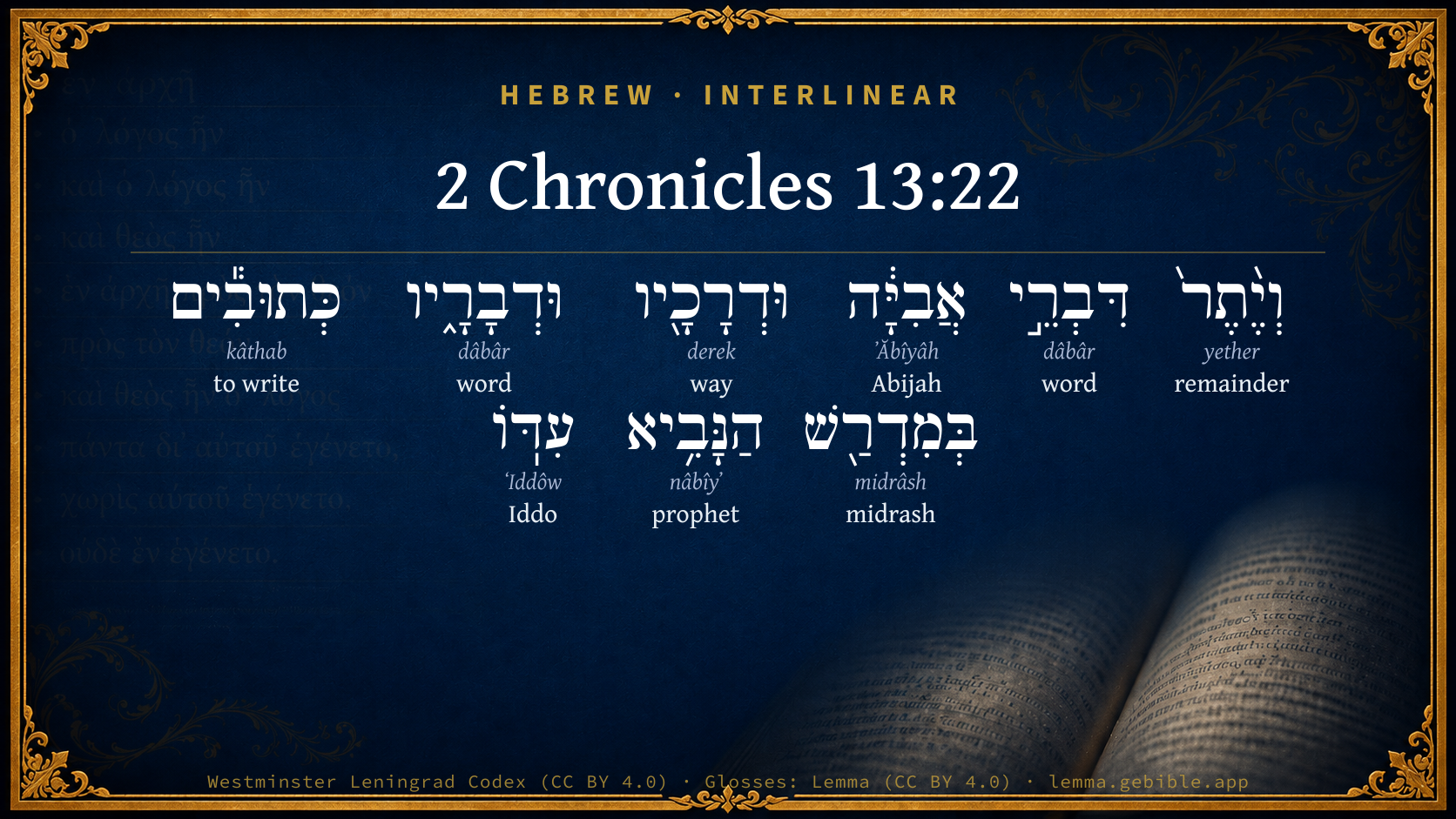
  1. וְיֶ֨תֶר֙ yether H3499 “and · remainder of” Conjunction + Noun, Common, Masculine, Singular, Construct
  2. דִּבְרֵ֣י dâbâr H1697 “words of” Noun, Common, Masculine, Plural, Construct
  3. אֲבִיָּ֔ה ʼĂbîyâh H29 “Abijah” Noun, Proper
  4. וּדְרָכָ֖יו derek H1870 “and · ways · his” Conjunction + Noun, Common, Both, Plural, Construct + Suffix, Personal, 3rd Person, Masculine, Singular
  5. וּדְבָרָ֑יו dâbâr H1697 “and · words · his” Conjunction + Noun, Common, Masculine, Plural, Construct + Suffix, Personal, 3rd Person, Masculine, Singular
  6. כְּתוּבִ֕ים kâthab H3789 “written” Verb, Qal, Participle Passive, Masculine, Plural, Absolute
  7. הַנָּבִ֥יא nâbîyʼ H5030 “the · prophet” Particle, Definite Article + Noun, Common, Masculine, Singular, Absolute
  8. עִדּֽוֹ ʻIddôw H5714 “Iddo” Noun, Proper

About this verse

These counts appear in no published source. They are computed here, from the morphology-tagged text and Lemma’s own curated glosses. What Lemma adds →

9
words
8
distinct lemmas
Historical
section

Notable vocabulary

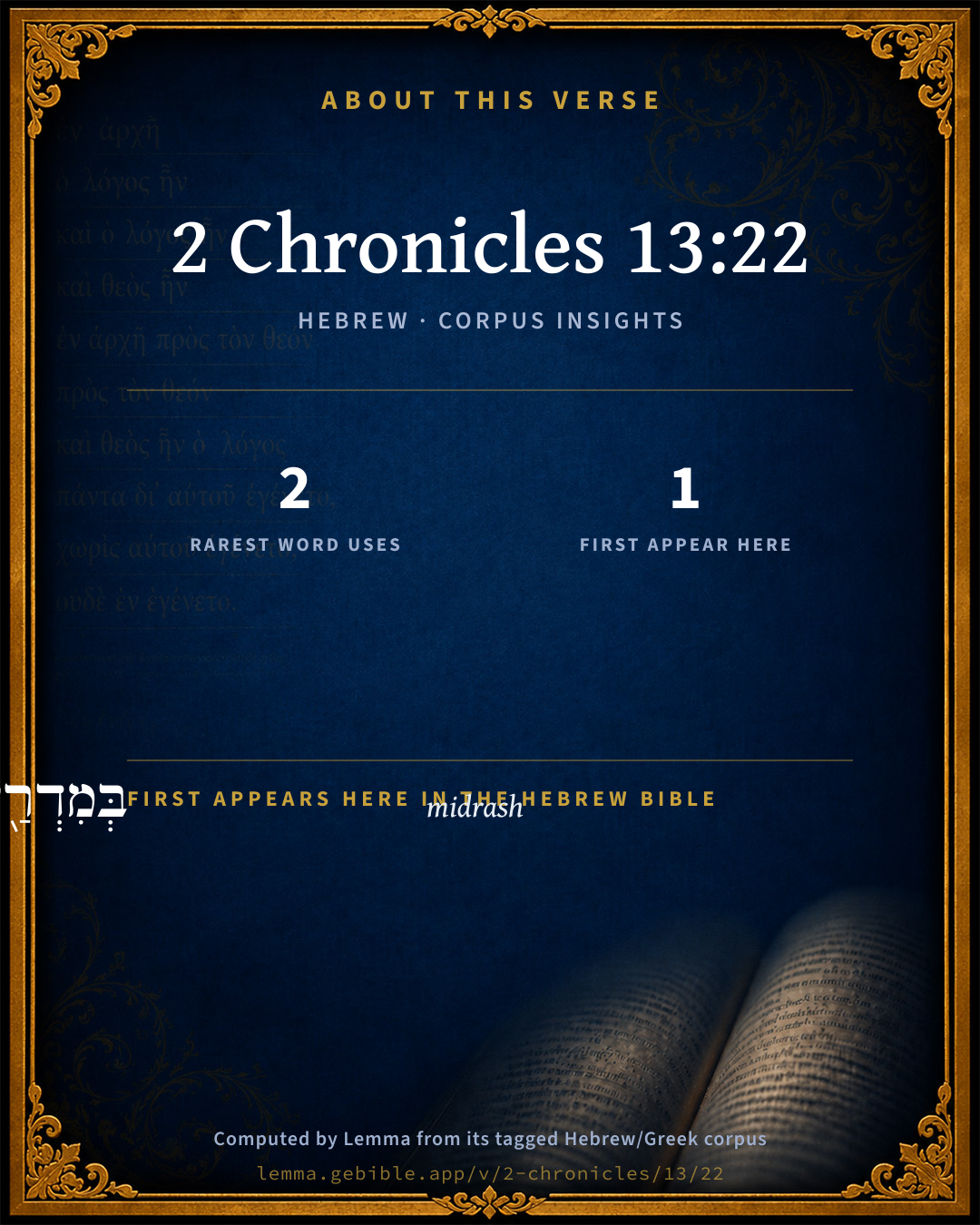
The rarest word here is בְּמִדְרַ֖שׁ midrash H4097 — appearing just 2 times in the whole Hebrew Bible.

First appearance in Scripture

This word makes its first canonical appearance in the Hebrew Bible here:

  • בְּמִדְרַ֖שׁ midrash H4097

Shared distinctive vocabulary

בְּמִדְרַ֖שׁ midrash H4097 occurs in 2 verses of the Hebrew Bible. Also found in:

Grammatical profile

  • 1 verb
  • 8 nouns

Verb forms

  • כְּתוּבִ֕ים Qal · Participle Passive

Repetition

A word recurs within this verse — often emphatic in Hebrew:

  • דִּבְרֵ֣י word H1697 ×2

Hebrew & Septuagint length

In English translation the verse runs 22 words from the Hebrew and 23 from the Septuagint (LXX English) — closely comparable.

A rough comparison of the two English renderings, which tokenize alike — not a word-level alignment.

Word counts can differ between the Hebrew and the Greek without any difference in meaning — e.g. the Hebrew direct-object marker אֵת has no separate Greek word, and Greek often adds the article ὁ.

Cross-references

3

Topical passages linked to 2 Chronicles 13:22 in the Treasury of Scripture Knowledge — connected by theme and wording, ordered by reader-vote popularity; previews shown in the World English Bible.

  • 2 Chronicles 9:29 Now the rest of the acts of Solomon, first and last, aren't they written in the history of Nathan the prophet, and in the prophecy of Ahijah the Shilonite, and in the visions of Iddo the seer concerning Jeroboam the son of Nebat?
  • 2 Chronicles 12:15 Now the acts of Rehoboam, first and last, aren't they written in the histories of Shemaiah the prophet and of Iddo the seer, after the manner of genealogies? There were wars between Rehoboam and Jeroboam continually.
  • 2 Chronicles 24:27 Now concerning his sons, and the greatness of the burdens [laid] on him, and the rebuilding of the house of God, behold, they are written in the commentary of the book of the kings. Amaziah his son reigned in his place.

Cross-references courtesy of OpenBible.info (CC BY 4.0).

Hebrew and Greek witnesses Masoretic Hebrew ↔ Greek Septuagint

The same verse in the two great witnesses to the Old Testament, shown verse-for-verse.

These are two independent witnesses, not word-aligned to each other, and the Septuagint is shown in lemma (dictionary) form.

Hebrew 2 Chronicles 13:22 Masoretic · Westminster Leningrad Codex

וְיֶ֨תֶר֙ דִּבְרֵ֣י אֲבִיָּ֔ה וּדְרָכָ֖יו וּדְבָרָ֑יו כְּתוּבִ֕ים בְּמִדְרַ֖שׁ הַנָּבִ֥יא עִדּֽוֹ

The rest of the acts of Abijah, and his ways, and his sayings, are written in the commentary of the prophet Iddo.

World English Bible · Public Domain

Greek LXX 2 Chronicles 13:22 Septuagint · lemma form

καί ὁ λοιπός λόγος αβια καί ὁ πρᾶξις αὐτός καί ὁ λόγος αὐτός γράφω ἐπί βιβλίον ὁ προφήτης αδδω

And the rest of the acts of Abia, and his deeds, and his sayings, are written in the book of the prophet Addo.

LXX2012 (modern English Septuagint) · Public Domain

Hebrew: Westminster Leningrad Codex (CC BY 4.0). Greek: Septuagint (public domain); English from LXX2012 (modern English Septuagint) (Public Domain). How the Septuagint differs from the Hebrew →

Commentary

Notes on 2 Chronicles 13:22 from classic Christian and Jewish commentators (each source and its license shown beneath its notes). The classic Christian expositions comment on the surrounding passage and are grouped to its opening verse, so a note may address several verses; the Jewish commentaries on the Tanakh (Rashi and others) are per-verse, so they appear only where the commentator wrote on this verse.

Lemma curates 59 commentaries, every one of them public domain or Creative Commons licensed, each selected and text-cleaned for this edition rather than reprinted as found. About our sources →

Trapp's Complete Commentary

John Trapp

2Ch 13:22 And the rest of the acts of Abijah, and his ways, and his sayings, [are] written in the story of the prophet Iddo.

Ver. 22. And his ways.] Which were not good. Prodit se libidinosum fuisse; by his many wives he appeareth to have been libidinous, as was also his father.

And his sayings.] His oration, {2Ch 13:5, &c.} which is very artificial, and other apophthegms, as being Solomon’s grandchild, &c.

John Trapp, A Commentary or Exposition upon All the Books of the Old and New Testament (1647–1656) — public domain. Text from a community e-Sword module.

Adam Clarke's Commentary

Verse 22. Written in the story] במדרש bemidrash, "in the commentary;" this, as far as I recollect, is the first place where a midrash or commentary is mentioned. The margin is right.

His ways, and his sayings] The commentary of the prophet Iddo is lost. What his sayings were we cannot tell; but from the specimen in this chapter, he appears to have been a very able speaker, and one who knew well how to make the best use of his argument.

Adam Clarke's Commentary on the Bible (1810–1826) — public domain. Text from a community e-Sword/MySword module.

Ellicott's Commentary for English Readers

(22) And his ways and his sayings.—Or works. The same word has just been rendered acts. There is an alliteration in the Hebrew, u-derâkhav u-debhârav.

Story.—Midrash. See margin. For the source here referred to, see Introduction, § 6.

A Bible Commentary for English Readers, edited by Charles John Ellicott (1878–1897) — public domain. Text from a community e-Sword module.

The Cambridge Bible for Schools and Colleges

gen. ed. J. J. S. Perowne

22. in the story] R.V. in the commentary, Heb. midrash. See Introduction, § 5.

Iddo] See note on 2Ch_9:29.

The Cambridge Bible for Schools and Colleges (gen. ed. J. J. S. Perowne; Cambridge University Press, 1878–1918) — public domain. Text from a community e-Sword module.

Haydock's Catholic Bible Commentary

Works. Protestants, "sayings are written in the story of the prophets Iddo." (Haydock) --- Modross properly means "researches," and was the title of the genealogical work of this prophet, from which this account is probably taken, chap. xii. 15. (Calmet) --- The entire work is not extant. (Menochius)

George Leo Haydock (1774–1849), Haydock's Catholic Family Bible and Commentary, 1859 edition — public domain. Excludes Psalms (Douay-Rheims chapter numbering differs from Protestant) and Deuterocanonical books (Catholic canon only).

Whedon's Commentary on the Bible

Daniel D. Whedon

22. The story of the prophet Iddo — Rather, the midrash, or commentary of the prophet Iddo. A work apparently different from that “against Jeroboam,” (2Ch_9:29,) and that “concerning genealogies,” (2Ch_14:15,) by the same prophet. The name would seem to show that it was a prophetical work consisting of comments and moral reflections on the ways and acts of the king. See Introduction.

Daniel D. Whedon (gen. ed.), Commentary on the Old and New Testaments (1874–1909) — public domain. Text from a community e-Sword module.

The Pulpit Commentary

The story of the Prophet Iddo, If this be the same work as that mentioned in it, 2Ch_12:15 (see our note there) is, at any rate, not called by the same title, but by the name well known for memoirs , of Midrash.

The Pulpit Commentary (1880–1919), ed. H.D.M. Spence-Jones & Joseph S. Exell — public domain. Text from a community e-Sword module.

Lesson kit

Teaching starters — assembled from the data on this page, not authored interpretation. Every prompt links to the verse data it draws on. Edit before teaching.

2 Chronicles, in the Historical, opens this verse with 9 words (8 distinct Hebrew lemmas). Its most distinctive word is midrâsh (“midrash”). A historical commentator’s framing appears above. Read the whole chapter for the surrounding context.

Discussion questions

  1. How does “midrash” (midrâsh) shape what this verse is saying?
  2. The word “midrash” first appears here in Scripture. What is being introduced at this debut?
  3. 2 Chronicles 24:27 shares the word «midrash» with this verse. How do the two illuminate each other?
  4. “word” occurs 2× in this one verse. What is the effect of the repetition?
  5. These translations render this verse differently; the difference is in the English rendering, not the original. What questions does that raise?
  6. The verb «כְּתוּבִ֕ים» is Qal Participle Passive. How does its form color the action?
  7. Reading how Trapp's Complete Commentary and Adam Clarke's Commentary read this verse, where do the two commentators agree and where do they part?

Things to notice

  • 1 word makes its first canonical appearance in Scripture here.
  • These translations choose different wording for 9 words in this verse.
  • “word” occurs 2× in this single verse.
  • 8 distinct Hebrew lemmas span 9 words in this verse.

Reading settings

Reading text

Shown beneath each verse's original-language words.

Old Testament
Old Testament edition

Read the OT as the Masoretic Hebrew (MT) or the Greek Septuagint (LXX).

English shown for the Greek Septuagint (in the Hebrew ↔ Greek comparison).

Comparing translations? Open the Compare panel on any verse page to stack up to four side by side.