1 Kings 14:19

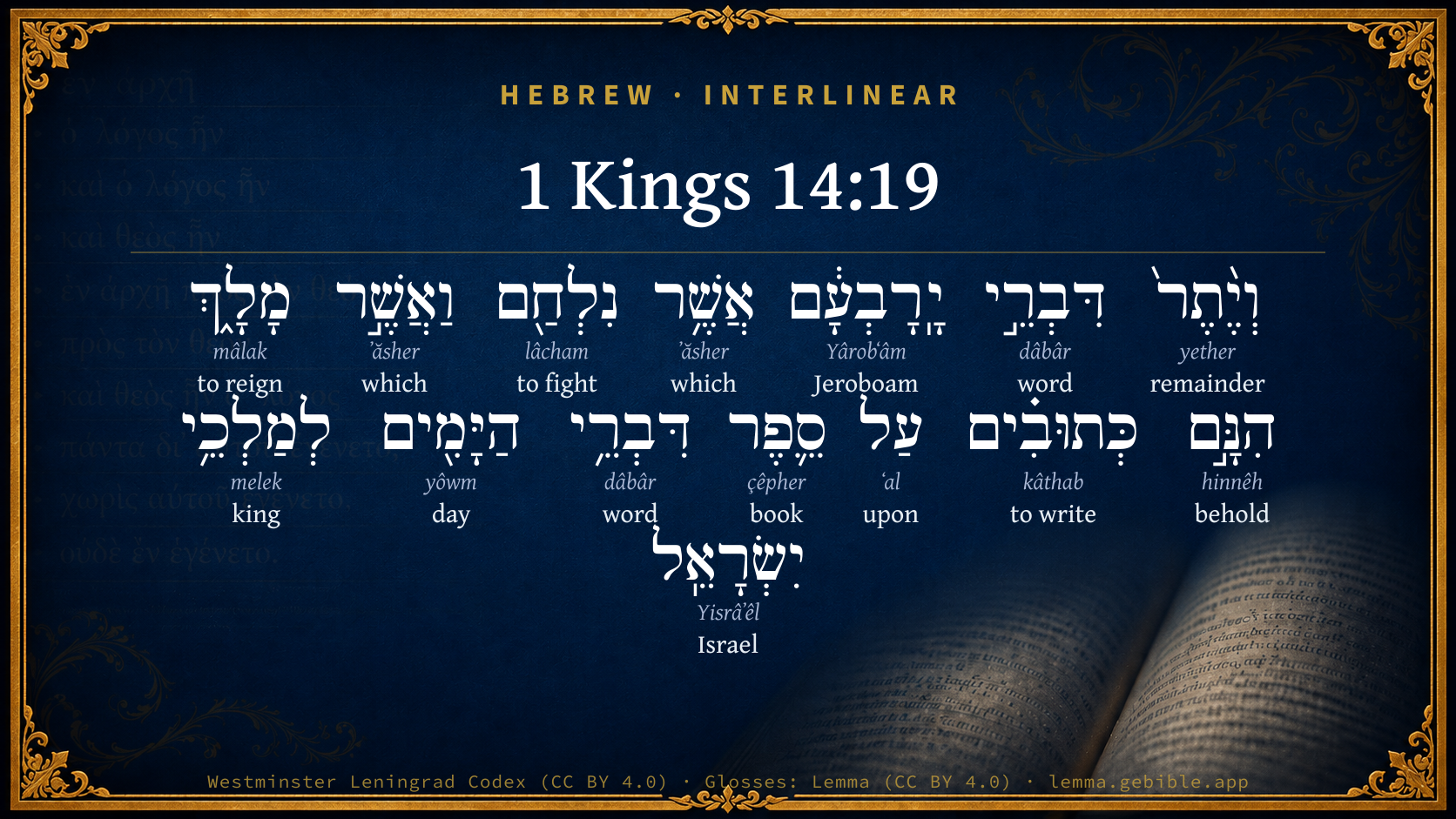
Hebrew (Westminster Leningrad Codex) 1 Kings 14:19 appears in the Hebrew Old Testament. The text above is from the Westminster Leningrad Codex. Each word links to its Strong’s number, a concise gloss, and parsing drawn from the Open Scriptures Hebrew Bible morphology. Click any word for its full Brown-Driver-Briggs (BDB) entry.
Download image
Cite this verse

1 Kings 14:19 (World English Bible). Public Domain. Lemma interlinear Bible study tool, https://lemma.gebible.app/v/1-kings/14/19.

Show BibTeX & RIS
BibTeX
RIS
English Translation
The rest of the acts of Jeroboam, how he warred, and how he reigned, behold, they are written in the book of the chronicles of the kings of Israel.
World English Bible · Public Domain
Download a study sheet

One document with this verse’s original text, its word-by-word gloss line, the meaning frame, cross-references with their text, attributed commentary, and full source and license credits — printable, and it pastes into notes with its structure intact.

This verse Autodidact and up

Study sheet (.html) Plain text (.txt)

A passage Seminary Student

Up to 50 verses in one chapter. A passage sheet keeps up to 6 commentary sources and 12 cross-references per verse, in the order this page ranks them, and says so on the sheet whenever that leaves anything out. Ask for a single verse and you get the Autodidact verse sheet above.

Everything on this page stays free to read, with no account — the sheet is a download of what is already on screen, not access to it.

Want to remove ads? Support Godless Engineer
Compare translations 3

The same verse in 3 English versions, stacked beneath the original-language interlinear above. Click any original word for its lexicon entry.

Each is an independent rendering of the whole verse — the interlinear is not word-aligned to these translations.

Highlighted words mark where these versions differ — a whole-verse word diff, not a word-by-word alignment.

  • World English Bible Public Domain
    The rest of the acts of Jeroboam, how he warred, and how he reigned, behold, they are written in the book of the chronicles of the kings of Israel.
  • King James Version Public Domain
    And the rest of the acts of Jeroboam, how he warred, and how he reigned, behold, they are written in the book of the chronicles of the kings of Israel.
  • unfoldingWord Literal Text CC BY-SA 4.0
    Now the rest of the matters of Jeroboam, how he fought and how he reigned, behold them, written in the book of the matters of the days of the kings of Israel.

unfoldingWord Literal Text — © unfoldingWord, licensed CC BY-SA 4.0. Word-aligned USFM3 via Door43 (git.door43.org/unfoldingWord/en_ult).

Versions to compare (up to 4)

3 of 4 selected

Show all 18 translations

Every available English version of this verse, each an independent rendering of the whole verse.

  • World English Bible Public Domain
    The rest of the acts of Jeroboam, how he warred, and how he reigned, behold, they are written in the book of the chronicles of the kings of Israel.
  • Berean Standard Bible Public Domain
    As for the rest of the acts of Jeroboam, how he waged war and how he reigned, they are indeed written in the Book of the Chronicles of the Kings of Israel.
  • Majority Standard Bible Public Domain
    As for the rest of the acts of Jeroboam, how he waged war and how he reigned, they are indeed written in the Book of the Chronicles of the Kings of Israel.
  • King James Version Public Domain
    And the rest of the acts of Jeroboam, how he warred, and how he reigned, behold, they are written in the book of the chronicles of the kings of Israel.
  • American Standard Version (1901) Public Domain
    And the rest of the acts of Jeroboam, how he warred, and how he reigned, behold, they are written in the book of the chronicles of the kings of Israel.
  • Revised Version (1885) Public Domain
    And the rest of the acts of Jeroboam, how he warred, and how he reigned, behold, they are written in the book of the chronicles of the kings of Israel.
  • Geneva Bible (1599) Public Domain
    And the rest of Ieroboams actes, how hee warred, and howe hee reigned, beholde, they are written in the booke of the Chronicles of the Kings of Israel.
  • Douay-Rheims (1899) Public Domain
    And the rest of the acts of Jeroboam, how he fought, and how he reigned, behold they are written in the book of the words of the days of the kings of Israel.
  • Young's Literal Translation Public Domain
    And the rest of the matters of Jeroboam, how he fought, and how he reigned, lo, they are written on the book of the Chronicles of the kings of Israel.
  • Literal Standard Version CC BY-SA 4.0
    And the rest of the matters of Jeroboam, how he fought, and how he reigned, behold, they are written on the scroll of the Chronicles of the Kings of Israel.
  • Unlocked Literal Bible CC BY-SA 4.0
    As for the other matters concerning Jeroboam, how he waged war and how he reigned, see, they are written in the book of the events of the kings of Israel.
  • unfoldingWord Literal Text CC BY-SA 4.0
    Now the rest of the matters of Jeroboam, how he fought and how he reigned, behold them, written in the book of the matters of the days of the kings of Israel.
  • Darby Bible Public Domain
    And the rest of the acts of Jeroboam, how he warred, and how he reigned, behold, they are written in the book of the chronicles of the kings of Israel.
  • World Messianic Bible Public Domain
    The rest of the acts of Jeroboam, how he fought and how he reigned, behold, they are written in the book of the chronicles of the kings of Israel.
  • Webster's Bible Public Domain
    And the rest of the acts of Jeroboam, how he warred, and how he reigned, behold, they are written in the book of the chronicles of the kings of Israel.
  • Free Bible Version CC BY-SA 4.0
    The rest of what Jeroboam did, how he engaged in warfare and how he reigned, they are recorded in the Book of Chronicles of the Kings of Israel.
  • Bible in Basic English Public Domain
    Now the rest of the acts of Jeroboam, how he made war and how he became king, are recorded in the book of the history of the kings of Israel.
  • JPS Tanakh (1917) Public Domain
    And the rest of the acts of Jeroboam, how he warred, and how he reigned, behold, they are written in the book of the chronicles of the kings of Israel.

Literal Standard Version (2020), Covenant Press — licensed CC BY-SA 4.0. Text via the HelloAO Bible API (eBible.org). Unlocked Literal Bible (unfoldingWord) — licensed CC BY-SA 4.0. Text via the HelloAO Bible API (eBible.org). unfoldingWord Literal Text — © unfoldingWord, licensed CC BY-SA 4.0. Word-aligned USFM3 via Door43 (git.door43.org/unfoldingWord/en_ult). Free Bible Version, Dr. Jonathan Gallagher — licensed CC BY-SA 4.0. Text via the HelloAO Bible API (eBible.org).

Word by word

More ways to search: Search by grammar → Find every occurrence → Compare this word →

Practice this passage: Drill this verse → Learn its vocabulary →

וְיֶ֨תֶר֙
yether
H3499
“and · remainder of”
Conjunction + Noun, Common, Masculine, Singular, Construct
Part of Speech
Conjunction + Noun
Type
Common
Gender
Masculine
Number
Singular
State
Construct
Full BDB Definition

Origin: from H3498

TWOT: 936a

remainder, excess, rest, remnant, excellence - remainder, remnant - remainder, rest, other part - excess - abundantly (adverb) - abundance, affluence - superiority, excellency
  1. דִּבְרֵ֣י dâbâr H1697 “words of” Noun, Common, Masculine, Plural, Construct
  2. יָֽרָבְעָ֔ם Yârobʻâm H3379 “Jeroboam” Noun, Proper
  3. אֲשֶׁ֥ר ʼăsher H834 “which” Particle, Relative
  4. נִלְחַ֖ם lâcham H3898 “to fight” Verb, Niphal, Perfect, 3rd Person, Masculine, Singular
  5. וַאֲשֶׁ֣ר ʼăsher H834 “and · which” Conjunction + Particle, Relative
  6. מָלָ֑ךְ mâlak H4427 “to reign” Verb, Qal, Perfect, 3rd Person, Masculine, Singular
  7. הִנָּ֣ם hinnêh H2009 “behold · them” Particle, Demonstrative + Suffix, Personal, 3rd Person, Masculine, Plural
  8. כְּתוּבִ֗ים kâthab H3789 “written” Verb, Qal, Participle Passive, Masculine, Plural, Absolute
  9. עַל ʻal H5921 “upon” Preposition
  10. סֵ֛פֶר çêpher H5612 “book of” Noun, Common, Masculine, Singular, Construct
  11. דִּבְרֵ֥י dâbâr H1697 “words of” Noun, Common, Masculine, Plural, Construct
  12. הַיָּמִ֖ים yôwm H3117 “the · days” Particle, Definite Article + Noun, Common, Masculine, Plural, Absolute
  13. לְמַלְכֵ֥י melek H4428 “to/for · kings of” Preposition + Noun, Common, Masculine, Plural, Construct
  14. יִשְׂרָאֵֽל Yisrâʼêl H3478 “Israel” Noun, Proper

About this verse

These counts appear in no published source. They are computed here, from the morphology-tagged text and Lemma’s own curated glosses. What Lemma adds →

15
words
13
distinct lemmas
Historical
section

Grammatical profile

  • 3 verbs
  • 8 nouns
  • 1 preposition
  • 3 particles

Verb forms

  • נִלְחַ֖ם Niphal · Perfect
  • מָלָ֑ךְ Qal · Perfect
  • כְּתוּבִ֗ים Qal · Participle Passive

Repetition

Words recur within this verse — often emphatic in Hebrew:

  • דִּבְרֵ֣י word H1697 ×2
  • אֲשֶׁ֥ר which H834 ×2

Cross-references

10

Topical passages linked to 1 Kings 14:19 in the Treasury of Scripture Knowledge — connected by theme and wording, ordered by reader-vote popularity; previews shown in the World English Bible.

  • 2 Chronicles 13:2–20 Three years reigned he in Jerusalem: and his mother's name was Micaiah the daughter of Uriel of Gibeah. There was war between Abijah and Jeroboam.
  • 1 Kings 14:29–30 Now the rest of the acts of Rehoboam, and all that he did, aren't they written in the book of the chronicles of the kings of Judah?
  • 1 Kings 15:31 Now the rest of the acts of Nadab, and all that he did, aren't they written in the book of the chronicles of the kings of Israel?
  • 1 Kings 16:5 Now the rest of the acts of Baasha, and what he did, and his might, aren't they written in the book of the chronicles of the kings of Israel?
  • 1 Kings 16:14 Now the rest of the acts of Elah, and all that he did, aren't they written in the book of the chronicles of the kings of Israel?
  • 1 Kings 16:20 Now the rest of the acts of Zimri, and his treason that he did, aren't they written in the book of the chronicles of the kings of Israel?
  • 1 Kings 16:27 Now the rest of the acts of Omri which he did, and his might that he shown, aren't they written in the book of the chronicles of the kings of Israel?
  • 1 Kings 22:39 Now the rest of the acts of Ahab, and all that he did, and the ivory house which he built, and all the cities that he built, aren't they written in the book of the chronicles of the kings of Israel?
  • 1 Chronicles 27:24 Joab the son of Zeruiah began to number, but didn't finish; and there came wrath for this on Israel; neither was the number put into the account in the chronicles of king David.
  • Esther 6:1 On that night the king couldn't sleep; and he commanded to bring the book of records of the chronicles, and they were read before the king.

Cross-references courtesy of OpenBible.info (CC BY 4.0).

Hebrew and Greek witnesses Masoretic Hebrew ↔ Greek Septuagint

The same verse in the two great witnesses to the Old Testament, shown verse-for-verse.

These are two independent witnesses, not word-aligned to each other, and the Septuagint is shown in lemma (dictionary) form.

Hebrew 1 Kings 14:19 Masoretic · Westminster Leningrad Codex

וְיֶ֨תֶר֙ דִּבְרֵ֣י יָֽרָבְעָ֔ם אֲשֶׁ֥ר נִלְחַ֖ם וַאֲשֶׁ֣ר מָלָ֑ךְ הִנָּ֣ם כְּתוּבִ֗ים עַל סֵ֛פֶר דִּבְרֵ֥י הַיָּמִ֖ים לְמַלְכֵ֥י יִשְׂרָאֵֽל

The rest of the acts of Jeroboam, how he warred, and how he reigned, behold, they are written in the book of the chronicles of the kings of Israel.

World English Bible · Public Domain

Hebrew: Westminster Leningrad Codex (CC BY 4.0). Greek: Septuagint (public domain); English from a public-domain English Septuagint. How the Septuagint differs from the Hebrew →

Targum (Aramaic paraphrase)

1

The Targum is the ancient Jewish Aramaic paraphrase of the Hebrew Scriptures — an interpretive translation, not the Hebrew text itself. Onkelos (literal) and Pseudo-Jonathan (expansive) render the Torah, and Jonathan the Prophets. Coverage is partial: where no permissively-licensed English translation exists for a verse, only the Aramaic is shown. This is verse-level text, not a word-by-word alignment to the Hebrew.

  1. Targum Jonathan Prophets (Joshua–Malachi)
    וּשְׁאָר פִּתְגָמֵי יָרָבְעָם דְאַגִיחַ קְרָבָא וְדִמְלָךְ הֲלָא אִינוּן כְּתִיבִין עַל סְפַר פִּתְגָמֵי יוֹמַיָא לְמַלְכַיָא דְיִשְׂרָאֵל:

    (no public-domain English translation for this verse)

    Targum Jonathan — Aramaic: “Mikraot Gedolot” (public domain). English: “Sefaria Community Translation” (CC0 1.0 (public-domain dedication)); “London "Chaldee Paraphrase," 1871” (public domain). Text via Sefaria.

Commentary

Notes on 1 Kings 14:19 from classic Christian and Jewish commentators (each source and its license shown beneath its notes). The classic Christian expositions comment on the surrounding passage and are grouped to its opening verse, so a note may address several verses; the Jewish commentaries on the Tanakh (Rashi and others) are per-verse, so they appear only where the commentator wrote on this verse.

Lemma curates 59 commentaries, every one of them public domain or Creative Commons licensed, each selected and text-cleaned for this edition rather than reprinted as found. About our sources →

Trapp's Complete Commentary

John Trapp

1Ki 14:19 And the rest of the acts of Jeroboam, how he warred, and how he reigned, behold, they [are] written in the book of the chronicles of the kings of Israel.

Ver. 19. Written in the book of the chronicles.] These were annals or public records, out of which, likely, were composed the Books of Chronicles, now part of the holy Scriptures.

John Trapp, A Commentary or Exposition upon All the Books of the Old and New Testament (1647–1656) — public domain. Text from a community e-Sword module.

Joseph Benson's Commentary

1Ki 14:19. Behold, they are written in the book of the Chronicles — Not that canonical book of Chronicles, for that was written long after this book; but a book of civil records, the annals, wherein all remarkable passages were recorded by the king’s command from day to day; out of which the sacred penman, by the direction of God’s spirit, took those passages which were most useful for God’s honour, and men’s edification.

Joseph Benson's Commentary on the Old and New Testaments (1811–1818) — public domain. Text from a community e-Sword module.

Whedon's Commentary on the Bible

Daniel D. Whedon

CLOSE OF JEROBOAM’S REIGN, 1Ki_14:19-20.

19. How he warred — With Rehoboam (1Ki_14:30, and 1Ki_15:6) and Abijam, (1Ki_15:7,) and perhaps with others.

Book of the Chronicles of the kings of Israel — Literally, book of the words of the kings of Israel. This book was doubtless the public official state papers containing all the annals of the kings as prepared and kept by the scribe and recorder. See notes on 2Sa_8:16-17, and Introduction. 20.

Nadab — See at 1Ki_15:25.

Daniel D. Whedon (gen. ed.), Commentary on the Old and New Testaments (1874–1909) — public domain. Text from a community e-Sword module.

Tyndale Open Study Notes

Tyndale Open Resources

14:19-20 all his wars: Jeroboam engaged in repeated border skirmishes with Rehoboam (14:30). • The Book of the History of the Kings of Israel is mentioned seventeen times in 1 Kgs 14:19—2 Kgs 15:31; it includes material that may have originated in official records kept by the court recorder (see 1 Kgs 4:3). It was known to the original readers of 1–2 Kings but is now lost.

Tyndale Open Study Notes — © Tyndale Open Resources, licensed CC BY-SA 4.0. Text via the HelloAO Bible API.

Jamieson, Fausset & Brown

Robert Jamieson, A. R. Fausset & David Brown

the rest of the acts of Jeroboam--None of the threatenings denounced against this family produced any change in his policy or government.

Jamieson, Fausset & Brown — Commentary Critical and Explanatory on the Whole Bible (1871) — public domain (CC PDM 1.0). Text via the HelloAO Bible API.

Adam Clarke's Commentary

Verse 19. The rest of the acts of Jeroboam - are written in the - chronicles] For some important particulars relative to this reign, see 2Ch 13:1-20.

Adam Clarke's Commentary on the Bible (1810–1826) — public domain. Text from a community e-Sword/MySword module.

Ellicott's Commentary for English Readers

(19) And the rest.—The preceding verse closes the detailed record of Jeroboam’s reign. His exaltation and the promise to him, his idolatry and its punishment, are all that the historian cares to narrate. All else is summed up in the words “how he warred” (see below, 1Ki_14:30, and 1Ki_15:6) and “how he reigned.” It is probable that his reign was prosperous enough in peace and war, though his attempt to subdue Judah failed. (See 2 Chronicles 13) But all this the Scriptural record passes over, and only commemorates him as “Jeroboam the son of Nebat, who made Israel to sin.”

A Bible Commentary for English Readers, edited by Charles John Ellicott (1878–1897) — public domain. Text from a community e-Sword module.

The Cambridge Bible for Schools and Colleges

gen. ed. J. J. S. Perowne

19. how he warred] His war with Abijah king of Judah is spoken of in 2Ch_13:3-20. The history in that place describes Jeroboam’s defeat, and the loss of five thousand of his men, and the capture of several Israelite cities by the king of Judah. The wars of Jeroboam with Rehoboam are alluded to below (1Ki_15:6).

The Cambridge Bible for Schools and Colleges (gen. ed. J. J. S. Perowne; Cambridge University Press, 1878–1918) — public domain. Text from a community e-Sword module.

John Gill's Exposition

And the days which Jeroboam reigned were twenty two years,.... So that he outlived Rehoboam five years, and lived to the second year of the reign of his grandson Asa:

and he slept with his fathers; or died as they did:

and Nadab his son reigned in his stead; who perhaps was younger than Abijah, whose sickness and death are before related.

John Gill's Exposition of the Whole Bible (1746–1763) — public domain (CC PDM 1.0). Text via the HelloAO Bible API.

Albert Barnes' Notes on the Bible

The wars of Jeroboam may be divided into:

(1) his wars with Rehoboam (see 1Ki 14:25, 1Ki 14:30); and

(2) his war with Abijam (see the marginal reference).

The book of the chronicles of the kings of Israel - (of Judah, 1Ki 14:29). See the Introduction.

Albert Barnes' Notes on the Bible (1834–1885) — public domain. Text from a community e-Sword/MySword module.

Haydock's Catholic Bible Commentary

The book of the words of the days of the kings of Israel. This book, which is often mentioned in the Book of Kings, is long since lost. For as to the books of Paralipomenon, or Chronicles, (which the Hebrews call the words of the days) they were certainly written after the Book of Kings, since they frequently refer to them; (Challoner) and they also remit us to these journals for farther information. (Haydock)

George Leo Haydock (1774–1849), Haydock's Catholic Family Bible and Commentary, 1859 edition — public domain. Excludes Psalms (Douay-Rheims chapter numbering differs from Protestant) and Deuterocanonical books (Catholic canon only).

Matthew Poole's English Annotations

Heb. in the book of the words or things of the days, & c. By which you are not to understand that canonical book of the Chronicles, for that was written long after this book; but a book of civil records, the annals, wherein all remarkable passages were recorded by the king’s command from day to day; out of which the sacred penman, by the direction of God’s Spirit, took those passages which were most considerable and useful for God’s honour, and men’s edification.

Matthew Poole's English Annotations on the Holy Bible (1683–1685) — public domain. Text from a community e-Sword/MySword module.

The Pulpit Commentary

And the rest of the acts of Jeroboam, how he warred (see ver. 30; 2Ch_13:2) and how he reigned, behold, they are written in the book of the chronicles of the kings of Israel. As to this work, see Introduction, Section VI The exact title is "the book of the words (or matters) of the days," i.e., the record of daily occurrences.

Vers. 19, 20.

The Review.

The text reminds us

I THAT THE SEASON OF DEATH IS A TIME FOR REFLECTION.

1. In presence of a corpse the giddiest pause.

(1) This is seen when an ordinary funeral passes along the streets, in the sombre countenances of the bystanders, if not in more special tokens of respect. It is more evident still when the deceased may have been an acquaintance or a relative. But most so in the very house of mourning, where the relies are seen shrouded in their pallor and immobility.

(2) What trains of thought are started!

(a) What a mystery is death!

(b) What a mystery is life!

(c) What a mystery is futurity! the spirit world the resurrection the judgment heaven hell.

(d) Are we prepared to encounter the inevitable? Who can forecast the moment?

(e) Why should we defer the needful preparation?

2. When a monarch dies a nation thinks.

(1) This is so under ordinary conditions. The social position occupied is so elevated that the event is conspicuous to all. What a leveller is death! In this article all claim kindred, the prince and the beggar. (Pro_22:2)

(2) But Jeroboam"s death was by the stroke of God. (2Ch_13:20) Such a conspicuous judgment was fitting to the man of sin (see Isa_11:4; 2Th_2:8; Rev_19:15) How alarmingly would such a death speak to workers of iniquity!

(3) The demise of Jeroboam opened the succession to Nadab, who, without the genius of his father, followed in his iniquities.

3. But the virtuous only are lamented.

(1) Jeroboam was buried. He did come to the sepulchre "with his fathers." And he may have had the formality of a family mourning. His household may have gone barefoot, wept, torn their clothes, smote on their breasts, lay on the ground and fasted, as the custom was.

(2) But there was no national mourning. The public mourning for Moses and Aaron lasted thirty days, that for Saul seven (Num_20:29; Deu_34:8; 1Sa_31:13) For Abijah, a pious prince of the house of Jeroboam, there was a national mourning, though he never came to the throne; but for Jeroboam, after a reign of twenty-two years, no mourning! (Ver. 13.)

(3) What a contrast the apathy of the nation, now at the close of their experiment at king making, to the enthusiasm at its commencement! (1Ki_12:20) How seldom do revolutionists adequately consider the end! They often anticipate a paradise and find a hell.

II THAT WE SHOULD, THEREFORE, SO LIVE THAT SUCH REFLECTIONS MAY PROVE GRATEFUL. To this end our policy should be

1. Pure.

(1) Such was not the policy of Jeroboam. When his people became restive under his rule, and he feared they would return to Rehoboam, instead of looking to God, he forsook Him and made Israel to sin.

(2) The policy of purity is the policy of faith. Faith in God in Christ in truth.

2. Peaceable.

(1) Peace is kin to purity. (Jam_3:17) God made peace for Jeroboambefore he had departed from Him. (see 1Ki_12:21-24) So does He still undertake for His people. (Pro_16:7)

(2) Wars are born of evil lusts. (Jam_4:1) When Jeroboam forsook the Lord, then commenced an embroilment in hostilities from which he was never free. First with Rehoboam (ver. 30), then with Abijah. (2Ch 13)

3. So shall we avoid disaster.

(1) By pursuing an opposite policy Jeroboam brought disaster upon himself. His body was smitten by God. There is no evidence of any repentance to the saving of his soul.

(2) He brought disaster upon his family. The best of his sons died prematurely for his sin. Two years later he perished himself. Still two years later and his race became exterminated with violence.

(3) He brought disaster upon his people. Impatient of taxation under Rehoboam, they made him king, but got no relief, having to build palaces and sustain wars. And by their complicity in his idolatry they filled up the measure of their iniquity and incurred the anger of God, which involved them in the miseries of foreign invasion and captivity. What profit is there in a crown that is retained by the policy of sin? The whole world is dearly purchased with the loss of the soul. J.A.M.

The Pulpit Commentary (1880–1919), ed. H.D.M. Spence-Jones & Joseph S. Exell — public domain. Text from a community e-Sword module.

John Wesley's Explanatory Notes

The chronicles - not that canonical book of chronicles; for that was written long after this book: but a book of civil records, the annals, wherein all remarkable passages were recorded by the king's command from day to day; out of which the sacred penman by the direction of God's spirit, took those passages which were most useful for God's honour, and mens edification.

John Wesley, Explanatory Notes Upon the Whole Bible (1754–1765) — public domain. Text via the GEBible commentary corpus.

unfoldingWord translationNotes

Door43 World Missions Community

see

"look" or "see for yourself"

they are written in

This can be stated in active form. AT: "you can find them written in" or "someone has written about them in" (See: Active or Passive)

the book of the events of the kings of Israel

This refers to a book that no longer exists.

twenty-two years

"22 years" (See: Numbers)

slept with his ancestors

Jeroboam dying is spoken of as if he had fallen asleep. See how you translated this in 1 Kings 2:10. AT: "died" (See: Metaphor and Euphemism)

translationWords

Jeroboam

reign

written

asleep

son

unfoldingWord translationNotes — © Distant Shores Media and the Door43 World Missions Community, licensed CC BY-SA 4.0. Source: git.door43.org/Door43/en_tn.

Lesson kit

Teaching starters — assembled from the data on this page, not authored interpretation. Every prompt links to the verse data it draws on. Edit before teaching.

1 Kings, in the Historical, opens this verse with 15 words (13 distinct Hebrew lemmas). Its most distinctive word is yether (“remainder”). A historical commentator’s framing appears above. Read the whole chapter for the surrounding context.

Discussion questions

  1. What does “remainder” (yether) contribute to the verse as a whole?
  2. 2 Chronicles 13:2–20 shares this passage’s theme. How do the two illuminate each other?
  3. “word” occurs 2× in this one verse. What is the effect of the repetition?
  4. The translations on this page render this verse differently — a whole-verse word diff, not a word-by-word alignment. What might account for the different wordings?
  5. The verb «נִלְחַ֖ם» is Niphal Perfect. How does its form color the action?
  6. Reading how Trapp's Complete Commentary and Joseph Benson's Commentary read this verse, where do the two commentators agree and where do they part?

Things to notice

Reading settings

Reading text

Shown beneath each verse's original-language words.

Old Testament
Old Testament edition

Read the OT as the Masoretic Hebrew (MT) or the Greek Septuagint (LXX).

English shown for the Greek Septuagint (in the Hebrew ↔ Greek comparison).

Comparing translations? Open the Compare panel on any verse page to stack up to four side by side.