
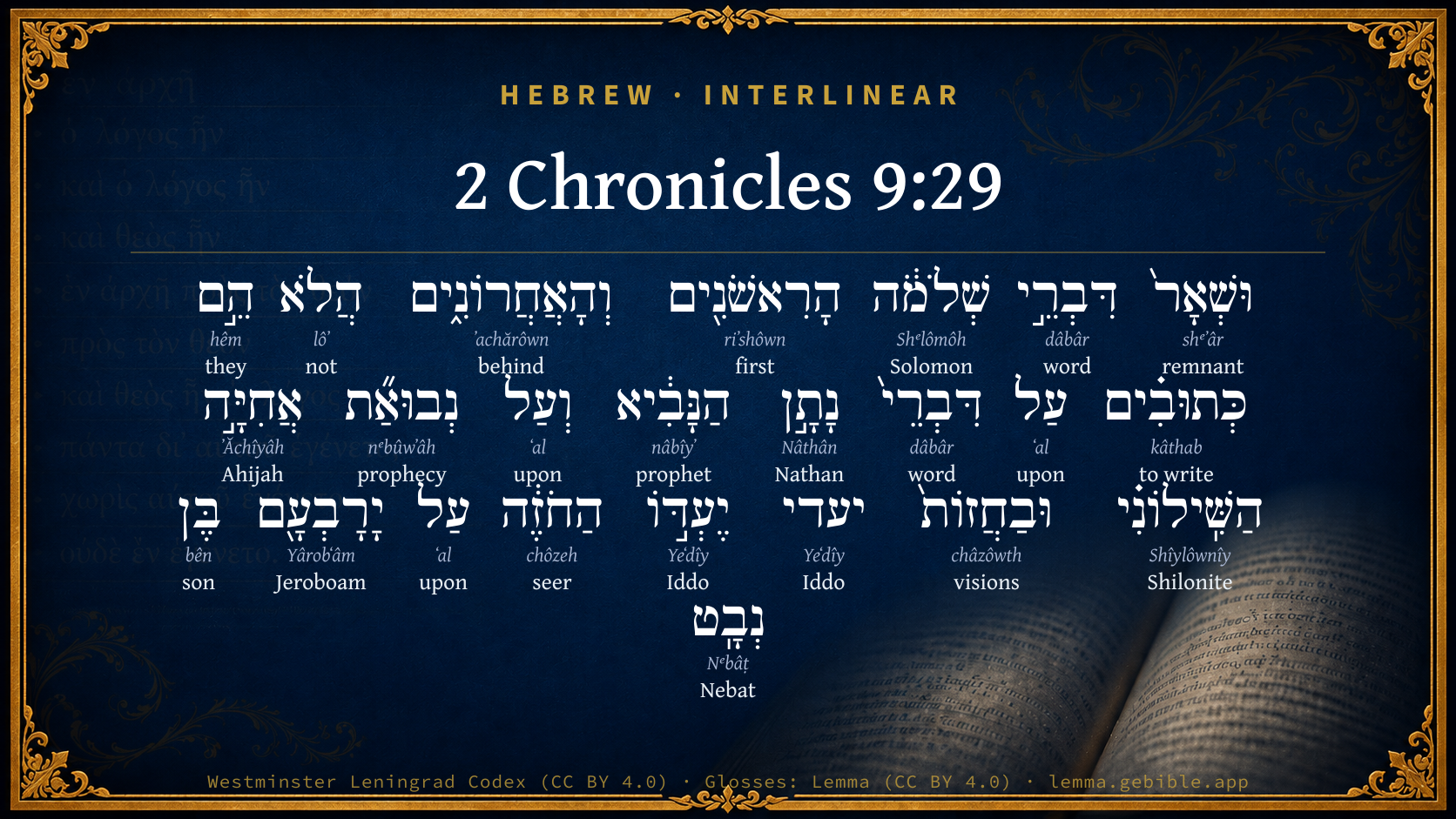
2 Chronicles 9:29

Hebrew (Westminster Leningrad Codex) 2 Chronicles 9:29 appears in the Hebrew Old Testament. The text above is from the Westminster Leningrad Codex. Each word links to its Strong’s number, a concise gloss, and parsing drawn from the Open Scriptures Hebrew Bible morphology. Click any word for its full Brown-Driver-Briggs (BDB) entry.
Download image
Cite this verse

2 Chronicles 9:29 (World English Bible). Public Domain. Lemma interlinear Bible study tool, https://lemma.gebible.app/v/2-chronicles/9/29.

Show BibTeX & RIS
BibTeX
RIS
English Translation
Now the rest of the acts of Solomon, first and last, aren't they written in the history of Nathan the prophet, and in the prophecy of Ahijah the Shilonite, and in the visions of Iddo the seer concerning Jeroboam the son of Nebat?
World English Bible · Public Domain
Highlights
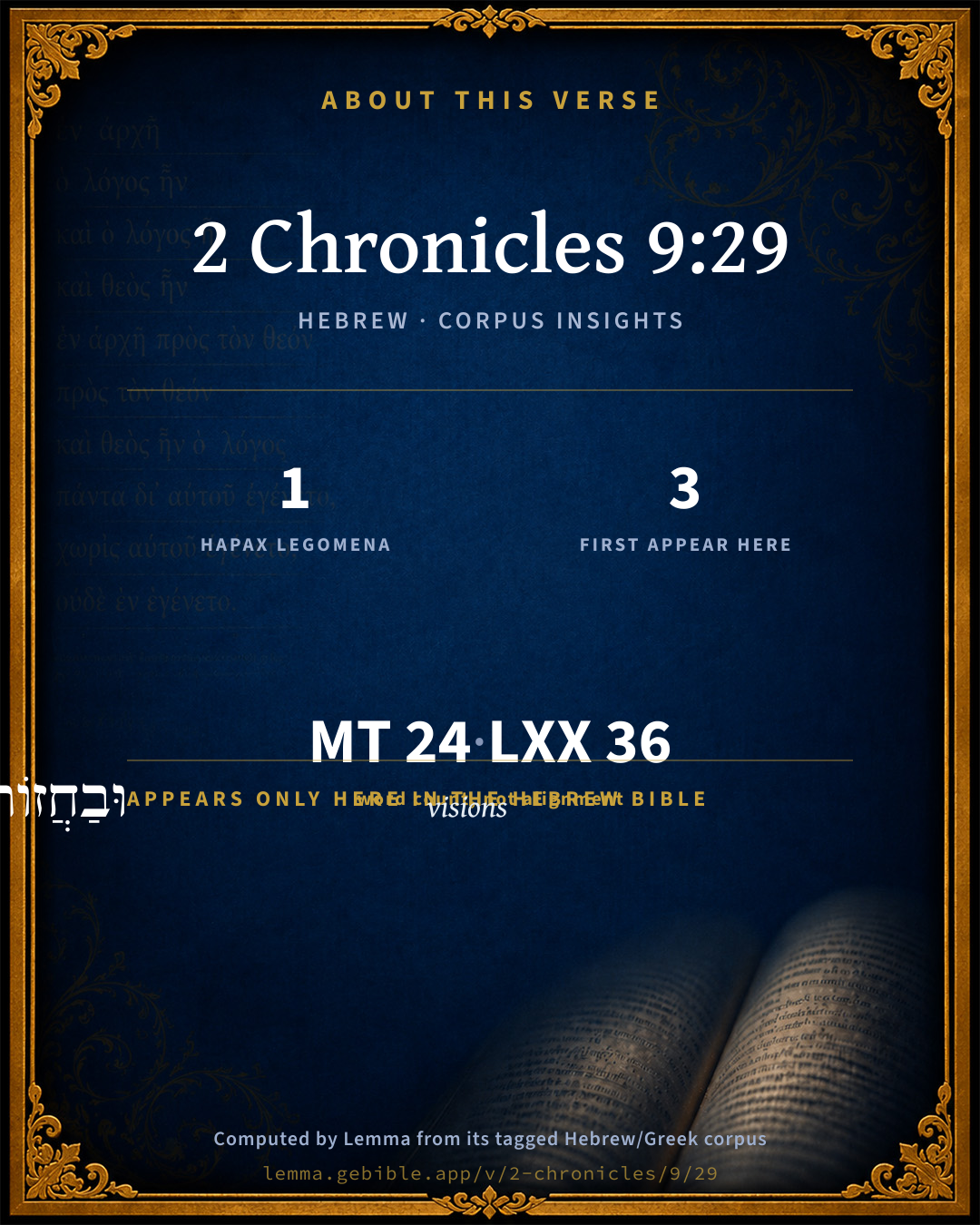
  • 1 hapax legomenon — only here in the Hebrew Bible
  • 3 first appearances in the Hebrew Bible
Full analysis ↓
Download a study sheet

One document with this verse’s original text, its word-by-word gloss line, the meaning frame, cross-references with their text, attributed commentary, and full source and license credits — printable, and it pastes into notes with its structure intact.

This verse Autodidact and up

Study sheet (.html) Plain text (.txt)

A passage Seminary Student

Up to 50 verses in one chapter. A passage sheet keeps up to 6 commentary sources and 12 cross-references per verse, in the order this page ranks them, and says so on the sheet whenever that leaves anything out. Ask for a single verse and you get the Autodidact verse sheet above.

Everything on this page stays free to read, with no account — the sheet is a download of what is already on screen, not access to it.

Want to remove ads? Support Godless Engineer
Compare translations 3

The same verse in 3 English versions, stacked beneath the original-language interlinear above. Click any original word for its lexicon entry.

Each is an independent rendering of the whole verse — the interlinear is not word-aligned to these translations.

Highlighted words mark where these versions differ — a whole-verse word diff, not a word-by-word alignment.

  • World English Bible Public Domain
    Now the rest of the acts of Solomon, first and last, aren't they written in the history of Nathan the prophet, and in the prophecy of Ahijah the Shilonite, and in the visions of Iddo the seer concerning Jeroboam the son of Nebat?
  • King James Version Public Domain
    Now the rest of the acts of Solomon, first and last, are they not written in the book of Nathan the prophet, and in the prophecy of Ahijah the Shilonite, and in the visions of Iddo the seer against Jeroboam the son of Nebat?
  • unfoldingWord Literal Text CC BY-SA 4.0
    And the remainder of the matters of Solomon, the first things and the last things, are they not written in the words of Nathan the Prophet, and in the prophecy of Ahijah the Shilonite, and in the visions of Iddo the Seer concerning Jeroboam the son of Nebat?

unfoldingWord Literal Text — © unfoldingWord, licensed CC BY-SA 4.0. Word-aligned USFM3 via Door43 (git.door43.org/unfoldingWord/en_ult).

Versions to compare (up to 4)

3 of 4 selected

Show all 18 translations

Every available English version of this verse, each an independent rendering of the whole verse.

  • World English Bible Public Domain
    Now the rest of the acts of Solomon, first and last, aren't they written in the history of Nathan the prophet, and in the prophecy of Ahijah the Shilonite, and in the visions of Iddo the seer concerning Jeroboam the son of Nebat?
  • Berean Standard Bible Public Domain
    As for the rest of the acts of Solomon, from beginning to end, are they not written in the Records of Nathan the Prophet, in the Prophecy of Ahijah the Shilonite, and in the Visions of Iddo the Seer concerning Jeroboam son of Nebat?
  • Majority Standard Bible Public Domain
    As for the rest of the acts of Solomon, from beginning to end, are they not written in the Records of Nathan the Prophet, in the Prophecy of Ahijah the Shilonite, and in the Visions of Iddo the Seer concerning Jeroboam son of Nebat?
  • King James Version Public Domain
    Now the rest of the acts of Solomon, first and last, are they not written in the book of Nathan the prophet, and in the prophecy of Ahijah the Shilonite, and in the visions of Iddo the seer against Jeroboam the son of Nebat?
  • American Standard Version (1901) Public Domain
    Now the rest of the acts of Solomon, first and last, are they not written in the history of Nathan the prophet, and in the prophecy of Ahijah the Shilonite, and in the visions of Iddo the seer concerning Jeroboam the son of Nebat?
  • Revised Version (1885) Public Domain
    Now the rest of the acts of Solomon, first and last, are they not written in the history of Nathan the prophet, and in the prophecy of Ahijah the Shilonite, and in the visions of Iddo the seer concerning Jeroboam the son of Nebat?
  • Geneva Bible (1599) Public Domain
    Concerning the rest of the actes of Salomon first and last, are they not written in the booke of Nathan the Prophet, and in the prophecie of Ahiiah the Shilonite, and in the visions of Ieedo the Seer against Ieroboam the sonne of Nebat?
  • Douay-Rheims (1899) Public Domain
    Now the rest of the acts of Solomon first and last are written in the words of Nathan the prophet, and in the boobs of Ahias the Silonite, and in the vision of Addo the seer, against Jeroboam the son of Nabat.
  • Young's Literal Translation Public Domain
    And the rest of the matters of Solomon, the first and the last, are they not written beside the matters of Nathan the prophet, and beside the prophecy of Ahijah the Shilonite, and with the visions of Iddo the seer concerning Jeroboam son of Nebat?
  • Literal Standard Version CC BY-SA 4.0
    And the rest of the matters of Solomon, the first and the last, are they not written beside the matters of Nathan the prophet, and beside the prophecy of Ahijah the Shilonite, and with the visions of Iddo the seer concerning Jeroboam son of Nebat?
  • Unlocked Literal Bible CC BY-SA 4.0
    As for the other matters concerning Solomon, first and last, are they not written in The History of Nathan the Prophet, in The Prophecy of Ahijah the Shilonite, and in The Visions of Iddo the Seer (which also had information about Jeroboam son of Nebat)?
  • unfoldingWord Literal Text CC BY-SA 4.0
    And the remainder of the matters of Solomon, the first things and the last things, are they not written in the words of Nathan the Prophet, and in the prophecy of Ahijah the Shilonite, and in the visions of Iddo the Seer concerning Jeroboam the son of Nebat?
  • Darby Bible Public Domain
    And the rest of the acts of Solomon first and last, are they not written in the words of Nathan the prophet, and in the prophecy of Ahijah the Shilonite, and in the visions of Iddo the seer concerning Jeroboam the son of Nebat?
  • World Messianic Bible Public Domain
    Now the rest of the acts of Solomon, first and last, aren’t they written in the history of Nathan the prophet, and in the prophecy of Ahijah the Shilonite, and in the visions of Iddo the seer concerning Jeroboam the son of Nebat?
  • Webster's Bible Public Domain
    Now the rest of the acts of Solomon, first and last, are they not written in the book of Nathan the prophet, and in the prophecy of Ahijah the Shilonite, and in the visions of Iddo the seer against Jeroboam the son of Nebat?
  • Free Bible Version CC BY-SA 4.0
    The rest of the acts of Solomon, from start to finish, are written in the Records of Nathan the Prophet, in the Prophecy of Ahijah the Shilonite, and in the Visions of Iddo the Seer about Jeroboam, son of Nebat.
  • Bible in Basic English Public Domain
    Now the rest of the acts of Solomon, first and last, are they not recorded in the history of Nathan the prophet, and in the words of Ahijah the prophet of Shiloh, and in the visions of Iddo the seer about Jeroboam, the son of Nebat?
  • JPS Tanakh (1917) Public Domain
    Now the rest of the acts of Solomon, first and last, are they not written in the words of Nathan the prophet, and in the prophecy of Ahijah the Shilonite, and in the visions of Jedo the seer concerning Jeroboam the son of Nebat?

Literal Standard Version (2020), Covenant Press — licensed CC BY-SA 4.0. Text via the HelloAO Bible API (eBible.org). Unlocked Literal Bible (unfoldingWord) — licensed CC BY-SA 4.0. Text via the HelloAO Bible API (eBible.org). unfoldingWord Literal Text — © unfoldingWord, licensed CC BY-SA 4.0. Word-aligned USFM3 via Door43 (git.door43.org/unfoldingWord/en_ult). Free Bible Version, Dr. Jonathan Gallagher — licensed CC BY-SA 4.0. Text via the HelloAO Bible API (eBible.org).

Word by word

More ways to search: Search by grammar → Find every occurrence → Compare this word →

Practice this passage: Drill this verse → Learn its vocabulary →

וּבַחֲזוֹת֙
châzôwth
H2378
“and · in/at · visions of”
Conjunction + Preposition + Noun, Common, Feminine, Singular, Construct
Part of Speech
Conjunction + Preposition + Noun
Type
Common
Gender
Feminine
Number
Singular
State
Construct
Full BDB Definition

Origin: from H2372

TWOT: 633c

visions
  1. וּשְׁאָר֙ shᵉʼâr H7605 “and · remnant of” Conjunction + Noun, Common, Masculine, Singular, Construct
  2. דִּבְרֵ֣י dâbâr H1697 “words of” Noun, Common, Masculine, Plural, Construct
  3. שְׁלֹמֹ֔ה Shᵉlômôh H8010 “Solomon” Noun, Proper
  4. הָרִאשֹׁנִ֖ים riʼshôwn H7223 “the · first” Particle, Definite Article + Adjective, Adjective, Masculine, Plural, Absolute
  5. וְהָאֲחֲרוֹנִ֑ים ʼachărôwn H314 “and · the · behind” Conjunction + Particle, Definite Article + Adjective, Adjective, Masculine, Plural, Absolute
  6. הֲלֹא lôʼ H3808 “not” Particle, Interrogative + Particle, Negative
  7. הֵ֣ם hêm H1992 “they” Pronoun, Personal, 3rd Person, Masculine, Plural
  8. כְּתוּבִ֗ים kâthab H3789 “written” Verb, Qal, Participle Passive, Masculine, Plural, Absolute
  9. עַל ʻal H5921 “upon” Preposition
  10. דִּבְרֵי֙ dâbâr H1697 “words of” Noun, Common, Masculine, Plural, Construct
  11. נָתָ֣ן Nâthân H5416 “Nathan” Noun, Proper
  12. הַנָּבִ֔יא nâbîyʼ H5030 “the · prophet” Particle, Definite Article + Noun, Common, Masculine, Singular, Absolute
  13. וְעַל ʻal H5921 “and · upon” Conjunction + Preposition
  14. נְבוּאַ֞ת nᵉbûwʼâh H5016 “prophecy of” Noun, Common, Feminine, Singular, Construct
  15. אֲחִיָּ֣ה ʼĂchîyâh H281 “Ahijah” Noun, Proper
  16. הַשִּֽׁילוֹנִ֗י Shîylôwnîy H7888 “the · Shilonite” Particle, Definite Article + Noun, Gentilic, Masculine, Singular, Absolute
  17. יעדי Yeʻdîy H3260 “Iddo” Noun, Proper
  18. יֶעְדּ֣וֹ Yeʻdîy H3260 “Iddo” Noun, Proper
  19. הַחֹזֶ֔ה chôzeh H2374 “the · seer” Particle, Definite Article + Noun, Common, Masculine, Singular, Absolute
  20. עַל ʻal H5921 “upon” Preposition
  21. יָרָבְעָ֖ם Yârobʻâm H3379 “Jeroboam” Noun, Proper
  22. בֶּן bên H1121 “son of” Noun, Common, Masculine, Singular, Construct
  23. נְבָֽט Nᵉbâṭ H5028 “Nebat” Noun, Proper

About this verse

These counts appear in no published source. They are computed here, from the morphology-tagged text and Lemma’s own curated glosses. What Lemma adds →

24
words
20
distinct lemmas
Historical
section

Notable vocabulary

1 hapax legomenon — a word that appears only here in the entire Hebrew Bible:

  • וּבַחֲזוֹת֙ visions H2378

First appearance in Scripture

These words make their first canonical appearance in the Hebrew Bible here:

  • נְבוּאַ֞ת prophecy H5016
  • וּבַחֲזוֹת֙ visions H2378
  • יעדי Iddo H3260

Grammatical profile

  • 1 verb
  • 16 nouns
  • 2 adjectives
  • 1 pronoun
  • 3 prepositions
  • 1 particle

Verb forms

  • כְּתוּבִ֗ים Qal · Participle Passive

Repetition

Words recur within this verse — often emphatic in Hebrew:

  • עַל upon H5921 ×3
  • דִּבְרֵ֣י word H1697 ×2
  • יעדי Iddo H3260 ×2

Hebrew & Septuagint length

In English translation the verse runs 43 words from the Hebrew and 46 from the Septuagint (LXX English) — closely comparable.

A rough comparison of the two English renderings, which tokenize alike — not a word-level alignment.

Word counts can differ between the Hebrew and the Greek without any difference in meaning — e.g. the Hebrew direct-object marker אֵת has no separate Greek word, and Greek often adds the article ὁ.

In the original languages it is 24 Hebrew tokens and 36 Greek tokens — but the two are counted differently (Hebrew bundles its prefixes and suffixes into one token; the Greek is in lemma form), so that isn’t a like-for-like length.

Cross-references

13

Topical passages linked to 2 Chronicles 9:29 in the Treasury of Scripture Knowledge — connected by theme and wording, ordered by reader-vote popularity; previews shown in the World English Bible.

  • 1 Chronicles 29:29 Now the acts of David the king, first and last, behold, they are written in the history of Samuel the seer, and in the history of Nathan the prophet, and in the history of Gad the seer,
  • 1 Kings 11:29 It happened at that time, when Jeroboam went out of Jerusalem, that the prophet Ahijah the Shilonite found him in the way; now [Ahijah] had clad himself with a new garment; and they two were alone in the field.
  • 1 Kings 11:41–43 Now the rest of the acts of Solomon, and all that he did, and his wisdom, aren't they written in the book of the acts of Solomon?
  • 2 Samuel 12:1 Yahweh sent Nathan to David. He came to him, and said to him, "There were two men in one city; the one rich, and the other poor.
  • 2 Chronicles 12:15 Now the acts of Rehoboam, first and last, aren't they written in the histories of Shemaiah the prophet and of Iddo the seer, after the manner of genealogies? There were wars between Rehoboam and Jeroboam continually.
  • 2 Chronicles 13:22 The rest of the acts of Abijah, and his ways, and his sayings, are written in the commentary of the prophet Iddo.
  • 2 Samuel 7:1–3 It happened, when the king lived in his house, and Yahweh had given him rest from all his enemies round about,
  • 2 Samuel 12:25 and he sent by the hand of Nathan the prophet; and he named him Jedidiah, for Yahweh's sake.
  • 1 Kings 1:8 But Zadok the priest, and Benaiah the son of Jehoiada, and Nathan the prophet, and Shimei, and Rei, and the mighty men who belonged to David, were not with Adonijah.
  • 1 Kings 1:10–11 but Nathan the prophet, and Benaiah, and the mighty men, and Solomon his brother, he didn't call.
  • 1 Kings 1:22–27 Behold, while she yet talked with the king, Nathan the prophet came in.
  • 1 Kings 1:32–38 King David said, Call to me Zadok the priest, and Nathan the prophet, and Benaiah the son of Jehoiada. They came before the king.
  • 1 Kings 14:2 Jeroboam said to his wife, Please get up and disguise yourself, that you not be known to be the wife of Jeroboam; and get you to Shiloh: behold, there is Ahijah the prophet, who spoke concerning me that I should be king over this people.

Cross-references courtesy of OpenBible.info (CC BY 4.0).

Hebrew and Greek witnesses Masoretic Hebrew ↔ Greek Septuagint

The same verse in the two great witnesses to the Old Testament, shown verse-for-verse.

These are two independent witnesses, not word-aligned to each other, and the Septuagint is shown in lemma (dictionary) form.

Hebrew 2 Chronicles 9:29 Masoretic · Westminster Leningrad Codex

וּשְׁאָר֙ דִּבְרֵ֣י שְׁלֹמֹ֔ה הָרִאשֹׁנִ֖ים וְהָאֲחֲרוֹנִ֑ים הֲלֹא הֵ֣ם כְּתוּבִ֗ים עַל דִּבְרֵי֙ נָתָ֣ן הַנָּבִ֔יא וְעַל נְבוּאַ֞ת אֲחִיָּ֣ה הַשִּֽׁילוֹנִ֗י וּבַחֲזוֹת֙ יעדי יֶעְדּ֣וֹ הַחֹזֶ֔ה עַל יָרָבְעָ֖ם בֶּן נְבָֽט

Now the rest of the acts of Solomon, first and last, aren't they written in the history of Nathan the prophet, and in the prophecy of Ahijah the Shilonite, and in the visions of Iddo the seer concerning Jeroboam the son of Nebat?

World English Bible · Public Domain

Greek LXX 2 Chronicles 9:29 Septuagint · lemma form

καί ὁ κατάλοιπος λόγος σαλωμών ὁ πρῶτος καί ὁ ἔσχατος ἰδού γράφω ἐπί ὁ λόγος ναθαν ὁ προφήτης καί ἐπί ὁ λόγος αχια ὁ σηλωνίτης καί ἐν ὁ ὅρασις ιωηλ ὁ ὁράω περί ιεροβοαμ υἱός ναβατ

And the rest of the acts of Solomon, the first and the last, behold, these are written in the words of Nathan the prophet, and in the words of Achia the Selonite, and in the visions of Joel the seer concerning Jeroboam the son of Nabat.

LXX2012 (modern English Septuagint) · Public Domain

Hebrew: Westminster Leningrad Codex (CC BY 4.0). Greek: Septuagint (public domain); English from LXX2012 (modern English Septuagint) (Public Domain). How the Septuagint differs from the Hebrew →

Commentary

Notes on 2 Chronicles 9:29 from classic Christian and Jewish commentators (each source and its license shown beneath its notes). The classic Christian expositions comment on the surrounding passage and are grouped to its opening verse, so a note may address several verses; the Jewish commentaries on the Tanakh (Rashi and others) are per-verse, so they appear only where the commentator wrote on this verse.

Lemma curates 59 commentaries, every one of them public domain or Creative Commons licensed, each selected and text-cleaned for this edition rather than reprinted as found. About our sources →

Ellicott's Commentary for English Readers

(c) REFERENCE TO DOCUMENTS.—CLOSE OF THE REIGN (2Ch_9:29-31). (Comp. 1Ki_11:41-43.)

(29) Now the rest of the acts of Solomon.—Or, story, history; literally, words. (Comp. 1Ch_29:29.)

First and last.—Or, the former and the latter. Instead of this, Kings has, “and all that he did, and his wisdom.”

In the book.—Or, history. For the sources named here, see the Introduction. Kings has simply, “are they not written in the book of the history of Solomon? “His name conveyed the idea of peace to the Hebrew ear. But there is no doubt that it was originally identical with Shalman (Assyrian Salmânu), the name of a god. Tiglath-pileser II. mentions a Salamânu king of Moab. This name exactly corresponds to Solomon.

Ahijah the Shilonite.—See 1Ki_11:29-39; 1Ki_14:2-18.

Iddo.—Hebrew, Ie‘dî or Ie‘dô. This seer is not mentioned in Kings. (See 2Ch_12:15; 2Ch_13:22 for further references to his works.)

A Bible Commentary for English Readers, edited by Charles John Ellicott (1878–1897) — public domain. Text from a community e-Sword module.

Trapp's Complete Commentary

John Trapp

2Ch 9:29 Now the rest of the acts of Solomon, first and last, [are] they not written in the book of Nathan the prophet, and in the prophecy of Ahijah the Shilonite, and in the visions of Iddo the seer against Jeroboam the son of Nebat?

Ver. 29. Now the rest, &c.] And worst. See 1Ki 11:41.

First and last.] His first were best: of his last this historian saith nothing, but layeth his finger on the scar.

In the book of Nathan.] In part of the First Book of Kings, written by these three prophets.

John Trapp, A Commentary or Exposition upon All the Books of the Old and New Testament (1647–1656) — public domain. Text from a community e-Sword module.

Joseph Benson's Commentary

2Ch 9:29. In the visions of Iddo the seer — Mentioned also 2Ch 12:15, and supposed by some to be the same person who is called Obed, 2Ch 15:1. This and the other prophets here mentioned were also historians, and wrote annals of their times, out of which these sacred books were taken, either by these or other prophets.

Joseph Benson's Commentary on the Old and New Testaments (1811–1818) — public domain. Text from a community e-Sword module.

Keil & Delitzsch

C. F. Keil & F. Delitzsch

Conclusion of Solomon's history. - Ch2 9:29. Sources; see the introduction.

Ch2 9:30-31

The length of his reign, his death and burial, and his successor, as in Kg1 11:42.

Keil & Delitzsch — Biblical Commentary on the Old Testament (1861–1891) — public domain (CC PDM 1.0). Text via the HelloAO Bible API. (Old Testament only.)

Tyndale Open Study Notes

Tyndale Open Resources

9:29 The Chronicler apparently used prophetic anthologies or annals as part of his source material; the works of individual prophets may have been incorporated into larger collections. These sources no longer exist. Nathan and Ahijah were active during the reigns of David and Solomon. Iddo is otherwise unknown.

Tyndale Open Study Notes — © Tyndale Open Resources, licensed CC BY-SA 4.0. Text via the HelloAO Bible API.

Geneva Bible (1599)

Geneva Bible translators

Or, Iddo.

That is, which prophesied against him.

Geneva Bible (1599) marginal notes — public domain. Text via Bolls.life.

Adam Clarke's Commentary

Verse 29. Nathan the prophet] These books are all lost. See the account of Solomon, his character, and a review of his works, at the end of 1Kg 11:43.

I. By the kindness of a learned friend, who has made this kind of subjects his particular study, I am able to give a more correct view of the value of the talent of gold and the talent of silver than that which I have quoted 1Kg 10:17, from Mr. Reynold's State of the Greatest King.

1. To find the equivalent in British standard to an ounce troy of pure gold, valued at eighty shillings, and to a talent of the same which weighs one thousand eight hundred ounces troy.

The ounce contains four hundred and eighty grains, and the guinea weighs one hundred and twenty-nine grains, or five pennyweights and nine grains.

(1) As 129 grains : 21 shillings :: 480, the number of grains in an ounce : 78.1395348s. or 3l. 18s. 1d. 2.69767q.; the equivalent in our silver coin to one ounce of standard gold.

(2) As 78.1395348 shillings, the value of an ounce of standard gold, : 80 shillings, the value of an ounce troy of pure gold, :: 80 shillings : 81.9047619 shillings, the equivalent in British standard to one ounce of pure gold.

Instead of the preceding, the following proportions may be used: -

(1) As 21.5 shillings : 21 shillings :: 80 shillings : 78.1395348 shillings. This multiplied by 1800, the number of troy ounces in a Hebrew talent, gives 140651.16264s. or 7032l. 11s. 1d. 3.8q., the equivalent to one talent of standard gold.

(2) As 21 standard : 21.5 pure :: 80 pure : 81.9047619 standard. This multiplied by 1800 gives 147428.67142s. or 7371l. 8s. 6d. 3.4q., the equivalent to one talent of pure gold.

2. To find the equivalent in British standard to a talent of pure silver, which is valued at four hundred and fifty pounds sterling, or five shillings the ounce troy.

The pound troy is 240 pennyweights; and our silver coin has 18 pennyweights of alloy in the pound. From 240 pennyweights take 18, and there will remain 222 pennyweights, the pure silver in the pound.

Now as 240 pennyweights : 222 pennyweights :: 20 pennyweights, the weight of a crown piece, : 18 1/2 pennyweights, the weight of the pure silver in the crown.

Then, as 18.5 pennyweights : 6 shillings :: 36000, the number of dwts. in a talent,: 9729.729729729729 shillings, or £486 9s. 8 3/4d., the equivalent in our coin to a talent of pure silver.

Example 1. To find the equivalent in British standard to the one hundred and twenty talents of gold which the queen of Sheba gave to King Solomon, 2Ch 9:9.

147428.57142s. equivalent to one talent of pure gold,

120 number of talents [as found above. _____________ 17691428.5704 = £884,571 8s. 6 3/4d., the equivalent to

120 talents. Example 2. To find the equivalent in British standard to Solomon's two hundred targets of beaten gold, each six hundred shekels; and to his three hundred shields, each three hundred shekels, 2Ch 9:15-16.

A talent is three thousand shekels; therefore six hundred shekels are one-fifth, and three hundred are one-tenth of a talent.

5)147428.57142s. equivalent to one talent.

____________

29485.71428 equivalent to one target.

200 the number of targets.

____________ 2|0)589714|2.856

____________

£294,857 2s. 10 1/4d. equivalent to 200 targets. One-tenth of a talent is 14742.857142 = one shield.

300 number of shields.

_____________

2|0)442285|7.1426

______________

£221,142 17s. 1 1/2d. = 300 shields. Example 3. To find the equivalent in British standard to the weight of gold which came to Solomon in one year, independently of what the chapmen and merchants brought him.

147428.57142s. = one talent.

666 number of talents.

____________

88457142852

88457142852

88457142852

________________

2|0)9818742|8.56572

________________

£4,909,371 8s. 6 3/4d. equivalent to 666 talents. Example 4. To find the equivalent in British standard to the hundred thousand talents of gold, and to the million of talents of silver, which were prepared by David for the temple, 1Ch 22:14.

THE GOLD

147428.57142s. = one talent.

100000 number of talents.

____________

2|0)1474285714|2

____________

£737,142,857 2s. the equivalent. Or, seven hundred and thirty-seven millions, one hundred and forty-two thousand, eight hundred and fifty-seven pounds, two shillings sterling, for the gold.

THE SILVER

9729.729729729s. = one talent.

1000000 number of talents.

_______________

2|0)97297297219.729

________________

£486,486,486 9s. 8 1/2d. the equivalent. Or, four hundred and eighty-six millions, four hundred and eighty-six thousand, four hundred and eighty-six pounds, nine shillings, and eightpence halfpenny sterling, for the silver.

II. I have referred, in the note on 2Ch 9:17, to a curious account of Solomon's throne, taken from a Persian MS. entitled [Persian] beet al mukuddus, the Holy House, or Jerusalem. It has already been remarked, in the account of Solomon at the end of 1Kg 11:43, article 12, that among the oriental writers Solomon is considered, not only as the wisest of all men, but as having supreme command over demons and genii of all kinds; and that he knew the language of beasts and birds, c. and therefore the reader need not be surprised if he find, in the following account, Solomon employing preternatural agency in the construction of this celebrated throne.

"This famous throne was the work of the Deev Sukhur; it was called Koukab al Jinna. The beauty of this throne has never been sufficiently described; the following are the particulars: -

"The sides of it were pure gold; the feet, of emeralds and pearls, intermixed with other pearls, each of which was as large as the egg of an ostrich.

"The throne had SEVEN steps; on each side were delineated orchards full of trees, the branches of which were composed of precious stones, representing ripe and unripe fruits.

"On the tops of the trees were to be seen fowls of the most beautiful plumage; particularly the peacock, the etaub, and the kurgus; all these birds were artificially hollowed within, so as occasionally to utter a thousand melodious notes, such as the ears of mortals had never before heard.

"On the FIRST step were delineated vine-branches, having bunches of grapes, composed of various sorts of precious stones; fashioned in such a manner as to represent the different colours of purple, violet, green, and red, so as to exhibit the appearance of real fruit.

"On the SECOND step, on each side of the throne, were two lions, of massive gold, of terrible aspect, and as large as life.

"The property of this throne was such, that when the prophet Solomon placed his foot upon the FIRST step, all the birds spread their wings, and made a fluttering noise in the air.

"On his touching the SECOND step, the two lions expanded their claws.

"On his reaching the THIRD step, the whole assembly of deevs, peris, and men, repeated the praises of the Deity.

"When he arrived at the FOURTH step, voices were heard addressing him in the following manner: Son of David be grateful for the blessings which the Almighty has bestowed upon thee.

"The same was repeated on his reaching the FIFTH step.

"On his touching the SIXTH step, all the children sang praises.

"On his arrival at the SEVENTH step, the whole throne, with all the birds and other animals, became in motion, and ceased not till he had placed himself in the royal seat; and then the birds, lions, and other animals, by secret springs, discharged a shower of the most precious musk upon the prophet; after which two of the kurguses, descending placed a golden crown upon his head.

"Before the throne was a column of burnished gold; on the top of which was placed a golden dove, which had in its beak a roll bound in silver. In this roll were written the Psalms of the prophet David, and the dove having presented the roll to King Solomon, he read a portion of it to the children of Israel.

"It is farther related that, on the approach of wicked persons to this throne for judgment, the lions were wont to set up a terrible roaring, and to lash their tails about with violence; the birds also began to erect their feathers; and the whole assembly of deeves and genii uttered such loud cries, that for fear of them no person would dare to be guilty of falsehood, but instantly confess his crimes.

"Such was the throne of Solomon, the son of David."

Supposing even this splendid description to be literally true, there is nothing here that could not have been performed by ingenuity and art; nothing that needed the aid of supernatural influence.

In another MS., on which I cannot now lay my hand, the whole value of this throne, and its ornaments, is computed in lacs of rupees! The above description is founded in the main on the account given here, 2Ch 9:17-19. The SIX steps, and the footstool of the sacred writer, make the SEVEN steps, in the above description. The twelve lions are not distinguished by the Mohammedan writer. Other matters are added from tradition.

This profusion of gold and precious stones was not beyond the reach of Solomon, when we consider the many millions left by his father; no less a sum than one thousand two hundred and twenty-three millions, six hundred and twenty-nine thousand, three hundred and forty-three pounds, eleven shillings, and eight pence halfpenny, besides what Solomon himself furnished.

Adam Clarke's Commentary on the Bible (1810–1826) — public domain. Text from a community e-Sword/MySword module.

The Cambridge Bible for Schools and Colleges

gen. ed. J. J. S. Perowne

29. the book of Nathan] Cp. 1Ch_29:29.

Ahijah the Shilonite] 1Ki_11:29; 1Ki_14:2 ff.

Iddo] Heb. Jedai or Jedo (probably a mis-spelling); cp. 2Ch_12:15; 2Ch_13:22.

29–31 (= 1Ki_11:41-43). The Epilogue

An important section of 1 Kin. (2Ch_11:1-23) giving an account of Solomon’s patronage of idolatry and of the troubles of his reign is unnoticed by the Chronicler.

The Cambridge Bible for Schools and Colleges (gen. ed. J. J. S. Perowne; Cambridge University Press, 1878–1918) — public domain. Text from a community e-Sword module.

Albert Barnes' Notes on the Bible

The book of Nathan ... - On the “books” here mentioned, see the introduction to Chronicles, the second note.

We hear nothing of Iddo in Kings: but he is mentioned below twice 2Ch 12:15; 2Ch 13:22. In the latter of these passages he is called not “the seer,” but “the prophet.” He seems to have been the author of three works:

(1) Visions against Jeroboam;

(2) A book of genealogies; and

(3) A commentary or history.

According to some, he was identical with Oded, the father of Azariah, who prophesied in the reign of Asa (see the 2Ch 15:1 note).

Albert Barnes' Notes on the Bible (1834–1885) — public domain. Text from a community e-Sword/MySword module.

Haydock's Catholic Bible Commentary

Seer. The works of these three are not extant. (Menochius) --- The fall of Solomon is recorded, 3 Kings xi. (Worthington)

George Leo Haydock (1774–1849), Haydock's Catholic Family Bible and Commentary, 1859 edition — public domain. Excludes Psalms (Douay-Rheims chapter numbering differs from Protestant) and Deuterocanonical books (Catholic canon only).

Matthew Poole's English Annotations

Iddo the seer, mentioned also 1Ch 12:15, supposed to be the same who is called Obed, 2Ch 15:1. This, and the other prophets mentioned, were also historians, and wrote some annals or histories of their times; out of which these sacred and canonical books were taken, either by these or other prophets.

Matthew Poole's English Annotations on the Holy Bible (1683–1685) — public domain. Text from a community e-Sword/MySword module.

The Pulpit Commentary

Nathan the prophet Ahijah the Shilonite Iddo the seer. For these original authorities of the history, see our Introduction (vol. 1. p. 8:2, and p. 9:3). The present quotation of the name of Ahijah in connection with his work, and the brief allusion to himself in our 2Ch_10:15, are the only appearances of Ahijah in Chronicles. He and the importance of his work are clear enough from 1Ki_11:28-40 1Ki_14:1-20. As the compiler of Chronicles evidently by a law omits any even reference to the defection of Solomon, it is natural that the name and special ministry of Ahijah should fall into the shade with him. Uniformly it is observable in Chronicles that the personal is not enlarged upon where it is not directly and indispensably ancillary to the ecclesiastical and national history. On the other hand, the writer of Kings does not once mention Iddo the seer, whereas we read of him again twice in Chronicles. (2Ch_12:15 2Ch_13:22)

The Pulpit Commentary (1880–1919), ed. H.D.M. Spence-Jones & Joseph S. Exell — public domain. Text from a community e-Sword module.

John Wesley's Explanatory Notes

Iddo - This, and the other prophets mentioned, were also historians, and wrote annals of their times; out of which these sacred books were taken, either by these, or other prophets.

John Wesley, Explanatory Notes Upon the Whole Bible (1754–1765) — public domain. Text via the GEBible commentary corpus.

Scofield Reference Notes

C. I. Scofield

rest of

These books have perished. 1Ki 11:29.

The Scofield Reference Bible (1917 edition), notes by C. I. Scofield — public domain. Text from a community e-Sword module.

unfoldingWord translationNotes

Door43 World Missions Community

first and last

The phrase "first and last" represents the whole time of Solomon's reign. AT: "from the beginning to the end of his reign" (See: Merism)

are they not written ... (which also had information about Jeroboam son of Nebat)?

The author uses the question to remind the readers that other people had written about Solomon. It can be expressed in active form AT: "they are written ... (which also had information about Jeroboam son of Nebat.)" or "people have written about them ... (which also had information about Jeroboam son of Nebat)." (See: Rhetorical Question)

The History of Nathan the Prophet ... The Prophecy of Ahijah the Shilonite ... The Visions of Iddo the Seer

These are the names of some writings that existed when 2 Chronicles was written, but they do not exist now.

Ahijah the Shilonite

This is a prophet from Shiloh who predicted that the nation of Israel would be divided into two kingdoms.

Shilonite

This is the name of a people group from the town of Shiloh. (See: How to Translate Names)

He slept with his ancestors

This was a polite way to tell about him dying. AT: "He died" (See: Euphemism)

translationWords

Solomon

written

Nathan

prophet

Ahijah

Shiloh

vision

Jeroboam

bury

city of David

Rehoboam

unfoldingWord translationNotes — © Distant Shores Media and the Door43 World Missions Community, licensed CC BY-SA 4.0. Source: git.door43.org/Door43/en_tn.

Rashi

Rabbi Shlomo Yitzchaki (Rashi)

in the words of Nathan the prophet (II Sam. 12:25): “And He sent by the hand of Nathan the prophet, and he called his name Jedidiah for the Lord’s sake.”

and in the prophecy of Ahijah the Shilonite (I Kings 11:31) who rent the kingdom from him and gave it to Jeroboam.

Rashi on the Tanakh — English translations: “The Judaica Press complete Tanach with Rashi, translated by A. J. Rosenberg” (CC BY 4.0); “Pentateuch with Rashi's commentary by M. Rosenbaum and A.M. Silbermann, 1929-1934” (public domain); “The Metsudah Tanach series, Lakewood, N.J” (CC BY 4.0); and “The Book of Joshua, Metsudah Publications, 1997” (CC BY 4.0). Text via Sefaria.

Lesson kit

Teaching starters — assembled from the data on this page, not authored interpretation. Every prompt links to the verse data it draws on. Edit before teaching.

2 Chronicles, in the Historical, opens this verse with 24 words (20 distinct Hebrew lemmas). Its most distinctive word is châzôwth (“visions”). A historical commentator’s framing appears above. Read the whole chapter for the surrounding context.

Discussion questions

  1. How does “visions” (châzôwth) shape what this verse is saying?
  2. This verse holds 1 word here found nowhere else in the Hebrew Bible. What might the rare word draw attention to?
  3. 3 words here appear for the first time in Scripture. What is being introduced at this debut?
  4. 1 Chronicles 29:29 shares this passage’s theme. How do the two illuminate each other?
  5. “upon” occurs 3× in this one verse. What is the effect of the repetition?
  6. These translations render this verse differently; the difference is in the English rendering, not the original. What questions does that raise?
  7. The verb «כְּתוּבִ֗ים» is Qal Participle Passive. How does its form color the action?
  8. Reading how Ellicott's Commentary for English Readers and Trapp's Complete Commentary read this verse, where do the two commentators agree and where do they part?

Things to notice

  • 1 word in this verse appears nowhere else in the Hebrew Bible.
  • 3 words make their first canonical appearance in Scripture here.
  • This verse counts 24 Hebrew ↔ 36 Greek words.
  • These translations choose different wording for 12 words in this verse.
  • “upon” occurs 3× in this single verse.

Reading settings

Reading text

Shown beneath each verse's original-language words.

Old Testament
Old Testament edition

Read the OT as the Masoretic Hebrew (MT) or the Greek Septuagint (LXX).

English shown for the Greek Septuagint (in the Hebrew ↔ Greek comparison).

Comparing translations? Open the Compare panel on any verse page to stack up to four side by side.