
Joshua 18:4

Hebrew (Westminster Leningrad Codex) Joshua 18:4 appears in the Hebrew Old Testament. The text above is from the Westminster Leningrad Codex. Each word links to its Strong’s number, a concise gloss, and parsing drawn from the Open Scriptures Hebrew Bible morphology. Click any word for its full Brown-Driver-Briggs (BDB) entry.
Download image
Cite this verse

Joshua 18:4 (World English Bible). Public Domain. Lemma interlinear Bible study tool, https://lemma.gebible.app/v/joshua/18/4.

Show BibTeX & RIS
BibTeX
RIS
English Translation
Appoint for you three men of each tribe: and I will send them, and they shall arise, and walk through the land, and describe it according to their inheritance; and they shall come to me.
World English Bible · Public Domain
Download a study sheet

One document with this verse’s original text, its word-by-word gloss line, the meaning frame, cross-references with their text, attributed commentary, and full source and license credits — printable, and it pastes into notes with its structure intact.

This verse Autodidact and up

Study sheet (.html) Plain text (.txt)

A passage Seminary Student

Up to 50 verses in one chapter. A passage sheet keeps up to 6 commentary sources and 12 cross-references per verse, in the order this page ranks them, and says so on the sheet whenever that leaves anything out. Ask for a single verse and you get the Autodidact verse sheet above.

Everything on this page stays free to read, with no account — the sheet is a download of what is already on screen, not access to it.

Want to remove ads? Support Godless Engineer
Compare translations 3

The same verse in 3 English versions, stacked beneath the original-language interlinear above. Click any original word for its lexicon entry.

Each is an independent rendering of the whole verse — the interlinear is not word-aligned to these translations.

Highlighted words mark where these versions differ — a whole-verse word diff, not a word-by-word alignment.

  • World English Bible Public Domain
    Appoint for you three men of each tribe: and I will send them, and they shall arise, and walk through the land, and describe it according to their inheritance; and they shall come to me.
  • King James Version Public Domain
    Give out from among you three men for each tribe: and I will send them, and they shall rise, and go through the land, and describe it according to the inheritance of them; and they shall come again to me.
  • unfoldingWord Literal Text CC BY-SA 4.0
    Provide for yourselves three men to a tribe. And I will send them, and they shall arise and walk about in the land and write it down according to the mouth of their inheritance, and they shall come to me.

unfoldingWord Literal Text — © unfoldingWord, licensed CC BY-SA 4.0. Word-aligned USFM3 via Door43 (git.door43.org/unfoldingWord/en_ult).

Versions to compare (up to 4)

3 of 4 selected

Show all 17 translations

Every available English version of this verse, each an independent rendering of the whole verse.

  • World English Bible Public Domain
    Appoint for you three men of each tribe: and I will send them, and they shall arise, and walk through the land, and describe it according to their inheritance; and they shall come to me.
  • Berean Standard Bible Public Domain
    Appoint three men from each tribe, and I will send them out to survey the land and map it out, according to the inheritance of each. Then they will return to me
  • Majority Standard Bible Public Domain
    Appoint three men from each tribe, and I will send them out to survey the land and map it out, according to the inheritance of each. Then they will return to me
  • King James Version Public Domain
    Give out from among you three men for each tribe: and I will send them, and they shall rise, and go through the land, and describe it according to the inheritance of them; and they shall come again to me.
  • American Standard Version (1901) Public Domain
    Appoint for you three men of each tribe: and I will send them, and they shall arise, and walk through the land, and describe it according to their inheritance; and they shall come unto me.
  • Revised Version (1885) Public Domain
    Appoint for you three men for each tribe: and I will send them, and they shall arise, and walk through the land, and describe it according to their inheritance; and they shall come unto me.
  • Geneva Bible (1599) Public Domain
    Giue from among you for euery tribe three men, that I may sende them, and that they may rise, and walke through the land, and distribute it according to their inheritance, and returne to me.
  • Young's Literal Translation Public Domain
    Give for you three men for a tribe, and I send them, and they rise and go up and down through the land, and describe it according to their inheritance, and come in unto me,
  • Literal Standard Version CC BY-SA 4.0
    Give three men from you for [each] tribe, and I send them, and they rise and go up and down through the land, and describe it according to their inheritance, and come to me,
  • Unlocked Literal Bible CC BY-SA 4.0
    Appoint for yourselves three men from each tribe, and I will send them out. They will set out and survey the land up and down. They will write out a description of it with a view to their inheritances, and then they will come back to me.
  • unfoldingWord Literal Text CC BY-SA 4.0
    Provide for yourselves three men to a tribe. And I will send them, and they shall arise and walk about in the land and write it down according to the mouth of their inheritance, and they shall come to me.
  • Darby Bible Public Domain
    Provide you three men for a tribe; that I may send them, and they shall rise and go through the land, and describe it according to the proportion of their inheritance, and they shall come to me.
  • World Messianic Bible Public Domain
    Appoint for yourselves three men from each tribe. I will send them, and they shall arise, walk through the land, and describe it according to their inheritance; then they shall come to me.
  • Webster's Bible Public Domain
    Select from among you three men for each tribe: and I will send them, and they shall rise, and go through the land, and describe it according to the inheritance of them, and they shall come again to me.
  • Free Bible Version CC BY-SA 4.0
    Choose three men from each tribe and I will send them out to explore the land. Then they can write a description regarding the land allocations and bring it to me.
  • Bible in Basic English Public Domain
    Take from among you three men from every tribe; and I will send them to go through the land and make a record of it for distribution as their heritage; then let them come back to me.
  • JPS Tanakh (1917) Public Domain
    Appoint for you three men for each tribe; and I will send them, and they shall arise, and walk through the land, and describe it according to their inheritance; and they shall come unto me.

Literal Standard Version (2020), Covenant Press — licensed CC BY-SA 4.0. Text via the HelloAO Bible API (eBible.org). Unlocked Literal Bible (unfoldingWord) — licensed CC BY-SA 4.0. Text via the HelloAO Bible API (eBible.org). unfoldingWord Literal Text — © unfoldingWord, licensed CC BY-SA 4.0. Word-aligned USFM3 via Door43 (git.door43.org/unfoldingWord/en_ult). Free Bible Version, Dr. Jonathan Gallagher — licensed CC BY-SA 4.0. Text via the HelloAO Bible API (eBible.org).

Word by word

More ways to search: Search by grammar → Find every occurrence → Compare this word →

Practice this passage: Drill this verse → Learn its vocabulary →

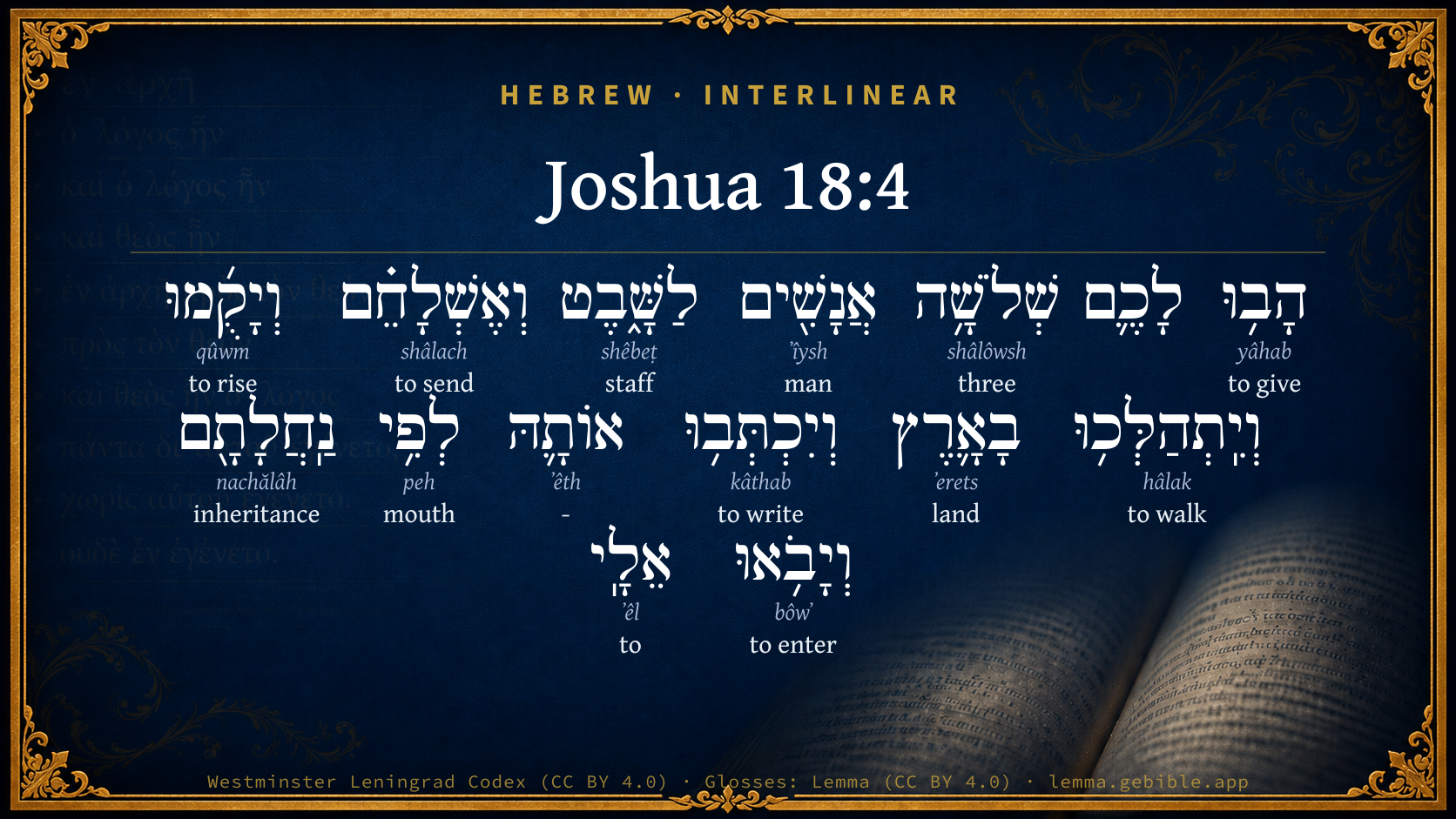
הָב֥וּ
yâhab
H3051
“give”
Verb, Qal, Imperative, 2nd Person, Masculine, Plural
Part of Speech
Verb
Stem
Qal
Form
Imperative
Person
2nd Person
Gender
Masculine
Number
Plural
Full BDB Definition

Origin: a primitive root

TWOT: 849

to give, provide, ascribe, come - (Qal) - to give - to set, place - to provide (with reflexive) - to ascribe (glory) - to grant, permit, come now
  1. שְׁלֹשָׁ֥ה shâlôwsh H7969 “three” Adjective, Cardinal number, Masculine, Singular, Absolute
  2. אֲנָשִׁ֖ים ʼîysh H376 “men” Noun, Common, Masculine, Plural, Absolute
  3. לַשָּׁ֑בֶט shêbeṭ H7626 “to/for the · staff” Preposition, Determined + Noun, Common, Masculine, Singular, Absolute
  4. וְאֶשְׁלָחֵ֗ם shâlach H7971 “and · to send · them” Conjunction + Verb, Qal, Imperfect, 1st Person, Common, Singular + Suffix, Personal, 3rd Person, Masculine, Plural
  5. וְיָקֻ֜מוּ qûwm H6965 “and · to rise” Conjunction + Verb, Qal, Imperfect, 3rd Person, Masculine, Plural
  6. וְיִֽתְהַלְּכ֥וּ hâlak H1980 “and · to walk” Conjunction + Verb, Hithpael, Imperfect, 3rd Person, Masculine, Plural
  7. בָאָ֛רֶץ ʼerets H776 “in/at the · land” Preposition, Determined + Noun, Common, Both, Singular, Absolute
  8. וְיִכְתְּב֥וּ kâthab H3789 “and · to write” Conjunction + Verb, Qal, Imperfect, 3rd Person, Masculine, Plural
  9. אוֹתָ֛הּ ʼêth H853 “- · her” Particle, Direct Object + Suffix, Personal, 3rd Person, Feminine, Singular
  10. לְפִ֥י peh H6310 “to/for · mouth of” Preposition + Noun, Common, Masculine, Singular, Construct
  11. נַֽחֲלָתָ֖ם nachălâh H5159 “inheritance · their” Noun, Common, Feminine, Singular, Construct + Suffix, Personal, 3rd Person, Masculine, Plural
  12. וְיָבֹ֥אוּ bôwʼ H935 “and · to enter” Conjunction + Verb, Qal, Imperfect, 3rd Person, Masculine, Plural
  13. אֵלָֽי ʼêl H413 “to · me” Preposition + Suffix, Personal, 1st Person, Common, Singular

About this verse

These counts appear in no published source. They are computed here, from the morphology-tagged text and Lemma’s own curated glosses. What Lemma adds →

15
words
14
distinct lemmas
Historical
section

Shared distinctive vocabulary

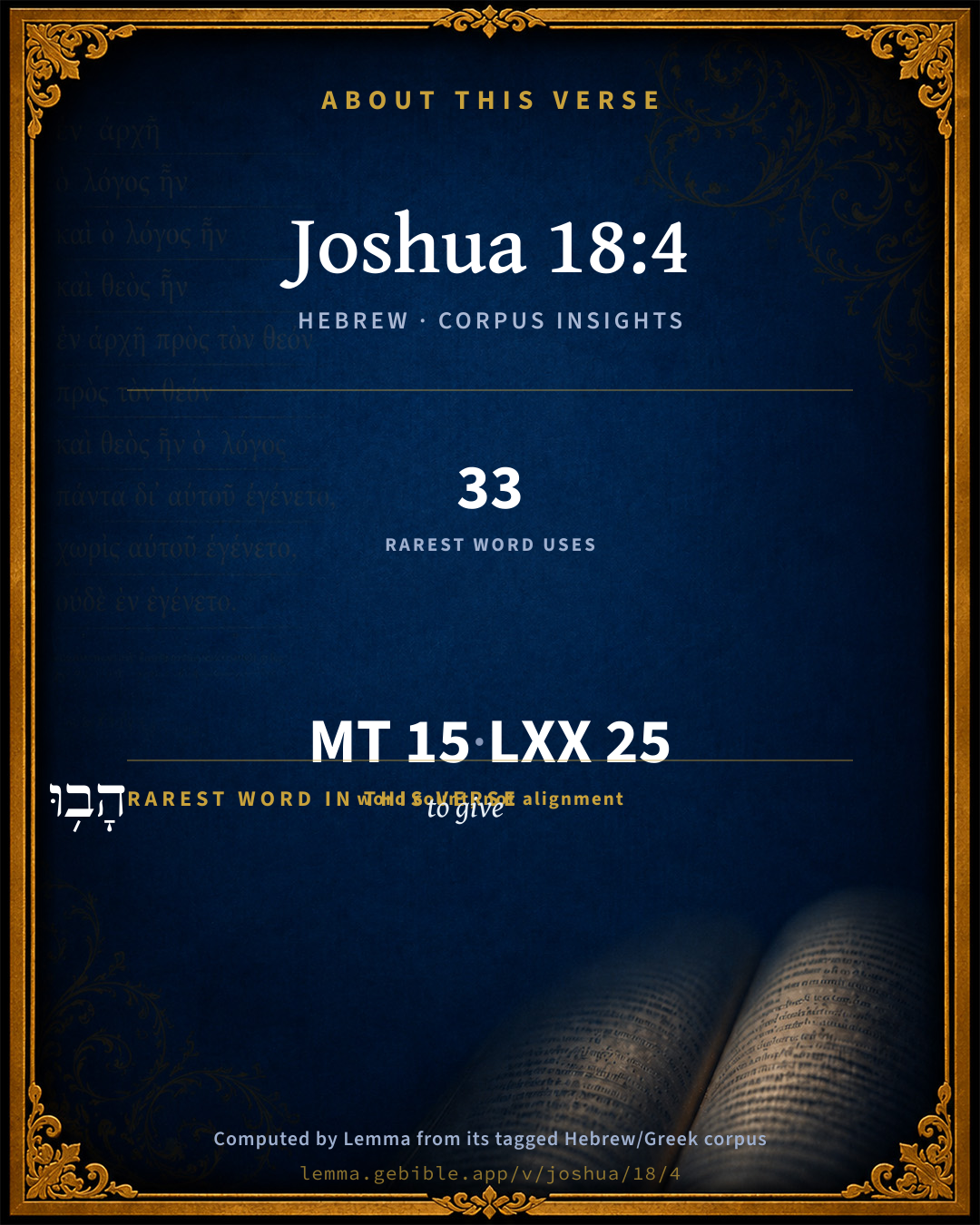
הָב֥וּ to give H3051 occurs in 29 verses of the Hebrew Bible. Also found in:

Grammatical profile

  • 6 verbs
  • 5 nouns
  • 1 adjective
  • 2 prepositions
  • 1 particle

Verb forms

  • הָב֥וּ Qal · Imperative
  • וְאֶשְׁלָחֵ֗ם Qal · Imperfect
  • וְיָקֻ֜מוּ Qal · Imperfect
  • וְיִֽתְהַלְּכ֥וּ Hithpael · Imperfect
  • וְיִכְתְּב֥וּ Qal · Imperfect
  • וְיָבֹ֥אוּ Qal · Imperfect

Hebrew & Septuagint length

In English translation the verse runs 35 words from the Hebrew and 33 from the Septuagint (LXX English) — closely comparable.

A rough comparison of the two English renderings, which tokenize alike — not a word-level alignment.

Word counts can differ between the Hebrew and the Greek without any difference in meaning — e.g. the Hebrew direct-object marker אֵת has no separate Greek word, and Greek often adds the article ὁ.

In the original languages it is 15 Hebrew tokens and 25 Greek tokens — but the two are counted differently (Hebrew bundles its prefixes and suffixes into one token; the Greek is in lemma form), so that isn’t a like-for-like length.

Cross-references

7

Topical passages linked to Joshua 18:4 in the Treasury of Scripture Knowledge — connected by theme and wording, ordered by reader-vote popularity; previews shown in the World English Bible.

  • Numbers 1:4 With you there shall be a man of every tribe; everyone head of his fathers' house.
  • Numbers 13:2 Send you men, that they may spy out the land of Canaan, which I give to the children of Israel: of every tribe of their fathers shall you send a man, everyone a prince among them.
  • Joshua 3:12 Now therefore take twelve men out of the tribes of Israel, for every tribe a man.
  • Joshua 4:2 Take twelve men out of the people, out of every tribe a man,
  • Joshua 18:3 Joshua said to the children of Israel, How long are you slack to go in to possess the land, which Yahweh, the God of your fathers, has given you?
  • Joshua 18:6 You shall describe the land into seven portions, and bring [the description] here to me; and I will cast lots for you here before Yahweh our God.
  • Joshua 18:9 The men went and passed through the land, and described it by cities into seven portions in a book; and they came to Joshua to the camp at Shiloh.

Cross-references courtesy of OpenBible.info (CC BY 4.0).

Hebrew and Greek witnesses Masoretic Hebrew ↔ Greek Septuagint

The same verse in the two great witnesses to the Old Testament, shown verse-for-verse.

These are two independent witnesses, not word-aligned to each other, and the Septuagint is shown in lemma (dictionary) form.

Hebrew Joshua 18:4 Masoretic · Westminster Leningrad Codex

הָב֥וּ לָכֶ֛ם שְׁלֹשָׁ֥ה אֲנָשִׁ֖ים לַשָּׁ֑בֶט וְאֶשְׁלָחֵ֗ם וְיָקֻ֜מוּ וְיִֽתְהַלְּכ֥וּ בָאָ֛רֶץ וְיִכְתְּב֥וּ אוֹתָ֛הּ לְפִ֥י נַֽחֲלָתָ֖ם וְיָבֹ֥אוּ אֵלָֽי

Appoint for you three men of each tribe: and I will send them, and they shall arise, and walk through the land, and describe it according to their inheritance; and they shall come to me.

World English Bible · Public Domain

Greek LXX Joshua 18:4 Septuagint · lemma form

δίδωμι ἐκ σύ τρεῖς ἀνήρ ἐκ φυλή καί ἀναἵστημι διαἔρχομαι ὁ γῆ καί διαγράφω αὐτός ἐναντίον ἐγώ καθά δέω διααἱρέω αὐτός καί ἔρχομαι πρός αὐτός

Appoint of yourselves three men of each tribe, and let them rise up and go through the land, and let them describe it before me, as it will be proper to divide it.

LXX2012 (modern English Septuagint) · Public Domain

Hebrew: Westminster Leningrad Codex (CC BY 4.0). Greek: Septuagint (public domain); English from LXX2012 (modern English Septuagint) (Public Domain). How the Septuagint differs from the Hebrew →

Targum (Aramaic paraphrase)

1

The Targum is the ancient Jewish Aramaic paraphrase of the Hebrew Scriptures — an interpretive translation, not the Hebrew text itself. Onkelos (literal) and Pseudo-Jonathan (expansive) render the Torah, and Jonathan the Prophets. Coverage is partial: where no permissively-licensed English translation exists for a verse, only the Aramaic is shown. This is verse-level text, not a word-by-word alignment to the Hebrew.

  1. Targum Jonathan Prophets (Joshua–Malachi)
    הָבוּ לְכוֹן תְּלָתָא גַבְרִין לְשִׁבְטָא וְאֶשְׁלָחִינוּן וִיקוּמוּן וִיהַלְכוּן בְּאַרְעָא וְיִכְתְּבוּן יָתָהּ לְפוּם אַחְסַנְתְּהוֹן וְיֵיתוּן לְוָתִי:

    (no public-domain English translation for this verse)

    Targum Jonathan — Aramaic: “Mikraot Gedolot” (public domain). English: “Sefaria Community Translation” (CC0 1.0 (public-domain dedication)); “London "Chaldee Paraphrase," 1871” (public domain). Text via Sefaria.

Commentary

Notes on Joshua 18:4 from classic Christian and Jewish commentators (each source and its license shown beneath its notes). The classic Christian expositions comment on the surrounding passage and are grouped to its opening verse, so a note may address several verses; the Jewish commentaries on the Tanakh (Rashi and others) are per-verse, so they appear only where the commentator wrote on this verse.

Lemma curates 59 commentaries, every one of them public domain or Creative Commons licensed, each selected and text-cleaned for this edition rather than reprinted as found. About our sources →

Trapp's Complete Commentary

John Trapp

Jos 18:4 Give out from among you three men for [each] tribe: and I will send them, and they shall rise, and go through the land, and describe it according to the inheritance of them; and they shall come [again] to me.

Ver. 4. Give out from amongst you three men.] Geodaetae, men skilful in surveying and map making; men of courage also and vigour, that dare undertake and can carry on such a dangerous enterprise.

John Trapp, A Commentary or Exposition upon All the Books of the Old and New Testament (1647–1656) — public domain. Text from a community e-Sword module.

Tyndale Open Study Notes

Tyndale Open Resources

18:4 The three selected representatives from each tribe came from the seven tribes that had not yet received their allotments. • a written report: Israel was not an entirely oral society. If an event or record was important enough to be remembered over time, leaders ordered that it be written down.

Tyndale Open Study Notes — © Tyndale Open Resources, licensed CC BY-SA 4.0. Text via the HelloAO Bible API.

Geneva Bible (1599)

Geneva Bible translators

That is, into seven portions, to every tribe one.

Geneva Bible (1599) marginal notes — public domain. Text via Bolls.life.

Jamieson, Fausset & Brown

Robert Jamieson, A. R. Fausset & David Brown

Give out from among you three men for each tribe--Though the lot determined the part of the country where each tribe was to be located, it could not determine the extent of territory which might be required; and the dissatisfaction of the children of Joseph with the alleged smallness of their possession gave reason to fear that complaints might arise from other quarters, unless precautions were taken to make a proper distribution of the land. For this purpose a commission was given to twenty-one persons--three chosen from each of the seven tribes which had not yet received their inheritance, to make an accurate survey of the country.

Jamieson, Fausset & Brown — Commentary Critical and Explanatory on the Whole Bible (1871) — public domain (CC PDM 1.0). Text via the HelloAO Bible API.

Adam Clarke's Commentary

Verse 4. Three men for each tribe] Probably meaning only three from each of the seven tribes who had not yet received their inheritance. It is likely that these twenty-one men were accompanied by a military guard, for without this they might have been easily cut off by straggling parties of the Canaanites.

They shall - describe it] It is likely they were persons well acquainted with geography and mensuration, without which it would have been impossible for them to have divided the land in the way necessary on this occasion.

Adam Clarke's Commentary on the Bible (1810–1826) — public domain. Text from a community e-Sword/MySword module.

John Calvin's Commentaries

4. Give out from among you three men, etc Caleb and Joshua had already surveyed those regions, and the people had learned much by inquiry: Joshua, however, wishes the land to be divided as if according to actual survey and orders three surveyors to be appointed for each of the seven tribes, in order that by the mouth of two or three persons every dispute may be settled. But nothing seems more incongruous than to send twenty-one men, who were not only to pass directly through a hostile country, but to trace it through all its various windings and turnings, so as not to leave a single corner unexamined, to calculate, its length and breadth, and even make due allowance for its inequalities. Every person whom they happened to meet must readily have suspected who they were, and for what reason they had been employed on this expedition. In short, no free return lay open for them except through a thousand deaths. Assuredly they would not have encountered so much danger from blind and irrational impulse, nor would Joshua have exposed them to such manifest danger had they not been aware that all those nations, struck with terror from heaven, desired nothing so much as peace. For although they hated the children of Israel, still, having been subdued by so many overthrows, they did not dare to move a finger against them, and thus the surveyors proceeded in safety as through a peaceful territory, under the pretext either of trading, or at least of making a harmless visit. It is also possible that they arranged themselves in different parties, and thus made the journey more secretly. It is certain, indeed, that there was only one source from which they could have derived all this courage and confidence, from trusting under the shadow of the wings of the Almighty, and thus having no fear of blind and stupid men. Hence the praise here bestowed on their ready will. For had they not been persuaded that the hands of those nations were tied up by supernal power, they would have had a just and honest cause for refusing.

John Calvin's Commentaries (1540-1563) — public domain. Text from the Calvin Translation Society English edition (1840s-50s) via the Christian Classics Ethereal Library (ccel.org). Calvin's coverage is partial (roughly two-thirds of the Bible); uncommented books and verses are honest gaps, never fabricated. The 19th-century editor's footnotes and remarks are omitted so the notes are faithfully Calvin's own voice.

The Cambridge Bible for Schools and Colleges

gen. ed. J. J. S. Perowne

4. Give out from among you] If the territory was to be distributed, it was necessary that the more distant portions of the country should be surveyed. Joshua therefore directs the tribes to appoint a commission of twenty-one members, three from each tribe, who should undertake the duty and report to him at Shiloh. Their duty apparently was not so much to carry out an actual measurement of the country, as the preparation of a list of the cities (see Jos_18:9), and the procuring information respecting the peculiar characteristics of different districts, such as, “what lands were barren and what fertile, whether a district was hilly or flat, whether well-watered or destitute of springs, and anything else which served to shew the goodness of the soil, and the comparative worth of different localities.” Rosenmüller.

The Cambridge Bible for Schools and Colleges (gen. ed. J. J. S. Perowne; Cambridge University Press, 1878–1918) — public domain. Text from a community e-Sword module.

John Gill's Exposition

Give out from among you three men for each tribe,.... That is, for each of the seven tribes, in all twenty one; though some think they were to be taken out of all the nine tribes and a half, and were thirty six; and so Josephus (a) seems to understand it; but then he makes but one out of each tribe to be sent, and but ten in all, which is a great oversight in that historian:

and I will send them; Joshua would not take upon him to name the persons, but left it to their own choice for their greater satisfaction; but when chosen and presented to him, he would give them a commission and directions what to do:

and they shall rise; gird themselves, and prepare for their journey, and set out:

and go through the land; of Canaan; not the whole of it, but that part which as yet was not disposed of; though some think they were to go through and describe the whole land; but I see no reason for that, for what was described was to be divided into seven parts only, and what belonged already to Judah and Joseph, seem plainly to be excepted in Jos 18:5,

and describe it according to the inheritance of them; take the dimensions of it, and divide it into seven parts, according to the number of the tribes that had not received their inheritance. Jarchi thinks this description and division were not to be made equally, but according to the largeness and smallness of the tribes; but this could not be done by the measurers, since the inheritance of each depended on the lot that was afterward to be cast, which by this means would have been rendered needless:

and they shall come again to me; which seems to be not only a precept or instruction to them, that when they had done their business, they should come to Joshua and give him an account of it; but an assurance also of their safety, that they should receive no disturbance nor hurt from the remaining Canaanites, but should return safe and well.

(a) Antiqu. l. 5. c. 1. sect. 21.

John Gill's Exposition of the Whole Bible (1746–1763) — public domain (CC PDM 1.0). Text via the HelloAO Bible API.

Albert Barnes' Notes on the Bible

Three men for each tribe - i. e. 21 in all. Their duty would be to describe the land, especially with reference to the cities it contained Jos 18:9, that Joshua might have the means of making a first apportionment among the tribes according to their varying numbers.

Albert Barnes' Notes on the Bible (1834–1885) — public domain. Text from a community e-Sword/MySword module.

Haydock's Catholic Bible Commentary

Tribe: it is not clear whether any but these seven were concerned. --- Out. Josephus says, that people well skilled in geometry accompanied them. (Calmet) --- They had to mark out seven portions of land, which might suffice for these remaining tribes, (Haydock) who would receive them by lot, to take away all cause of discontent. They still received according to their numbers, Numbers xxvi. 54. (Worthington)

George Leo Haydock (1774–1849), Haydock's Catholic Family Bible and Commentary, 1859 edition — public domain. Excludes Psalms (Douay-Rheims chapter numbering differs from Protestant) and Deuterocanonical books (Catholic canon only).

Matthew Poole's English Annotations

Three men; three, not one, for more exact observation both of the measure and quality of the several portions, and for greater assurance and evidence of their care and faithfulness in giving in their account.

Of each tribe; either one of each of these tribes, who were yet unprovided for; or rather, two of all the tribes, even of them who had already received their portions; which was highly expedient, that in case it should appear that there was not a sufficiency for each of these tribes who wanted their portions, their brethren might be more ready either to assist them in procuring more land, or to part with some of their own portion to them.

Go through the land; which they might now safely do, because the terror of the late war was yet upon the Canaanites, who were loth to rouse so near and potent an enemy.

Matthew Poole's English Annotations on the Holy Bible (1683–1685) — public domain. Text from a community e-Sword/MySword module.

Whedon's Commentary on the Bible

Daniel D. Whedon

4. Give out — Hebrews, appoint. The commission of twenty-one was fairly constituted; each tribe was equally represented.

[Describe it — Write down in a book (compare Jos_18:9) a list of the cities, and a description of the different localities, and, as Rosenmuller observes, “what lands were barren, and what were fertile; whether a district were hilly or flat, whether well watered or destitute of springs, and any thing else which served to show the goodness of the soil, and the comparative worth of different localities.”

According to the inheritance of them — That is, with reference to its being divided as an inheritance of the remaining seven tribes.] Josephus says, “Joshua thought the land should be divided by estimation of its goodness, rather than the largeness of its measure.” For the adjustment of the lots to the size of the tribes, see on Jos_13:6.

Daniel D. Whedon (gen. ed.), Commentary on the Old and New Testaments (1874–1909) — public domain. Text from a community e-Sword module.

The Pulpit Commentary

Give out from among you. Calvin enlarges much upon the boldness of these twenty-one men in venturing upon the task of the survey, rightly supposing that the difficulty of the task was enhanced by the number who undertook it. (see note on Jos_14:12) And here it is impossible to come to any other conclusion than that the twenty-one commissioners went together, for the object of their selection was to obviate complaints of a kind which, as we have already seen, the Israelites were not slow to make. (see Jos_17:14-18) But the Israelites had inspired quite sufficient awe into the inhabitants of the land to make such a general survey by no means a difficult task. Nor is it probable that the commissioners were unprovided with an escort. Three men for each tribe. Literally, for the tribe. This selection, which was intended to secure an impartial description of the country, would render impossible all future complaints, since the boundaries would be settled according to reports sent in by the representatives of each tribe.

The Pulpit Commentary (1880–1919), ed. H.D.M. Spence-Jones & Joseph S. Exell — public domain. Text from a community e-Sword module.

John Wesley's Explanatory Notes

Three men - Three, not one, for more exact observation both of the measure and quality of the several portions, and for greater assurance of their care and faithfulness in giving in their account. Of each tribe - One of each of these tribes, who were yet unprovided for.

John Wesley, Explanatory Notes Upon the Whole Bible (1754–1765) — public domain. Text via the GEBible commentary corpus.

Rashi

Rabbi Shlomo Yitzchaki (Rashi)

For each tribe. For each of the remaining seven tribes.

According to their inheritance. Into seven parts but not equal ones, but according to the tribes appropriate portions— to the large tribe according to its largeness, and to the small tribe according to its smallness, as it is said, ‘To the large [tribe], increase their inheritance.’

Rashi on the Tanakh — English translations: “The Judaica Press complete Tanach with Rashi, translated by A. J. Rosenberg” (CC BY 4.0); “Pentateuch with Rashi's commentary by M. Rosenbaum and A.M. Silbermann, 1929-1934” (public domain); “The Metsudah Tanach series, Lakewood, N.J” (CC BY 4.0); and “The Book of Joshua, Metsudah Publications, 1997” (CC BY 4.0). Text via Sefaria.

Lesson kit

Teaching starters — assembled from the data on this page, not authored interpretation. Every prompt links to the verse data it draws on. Edit before teaching.

Joshua, in the Historical, opens this verse with 15 words (14 distinct Hebrew lemmas). Its most distinctive word is yâhab (“to give”). A historical commentator’s framing appears above. Read the whole chapter for the surrounding context.

Discussion questions

  1. What does “to give” (yâhab) contribute to the verse as a whole?
  2. How does Genesis 11:3, which shares the word «to give», read alongside this verse?
  3. These translations render this verse differently. What is at stake in choosing one wording over another?
  4. «הָב֥וּ» is a Qal Imperative verb. How does that grammatical form shape the action described?
  5. Compare how Trapp's Complete Commentary and Tyndale Open Study Notes read this verse. Where do they agree or differ?

Things to notice

Reading settings

Reading text

Shown beneath each verse's original-language words.

Old Testament
Old Testament edition

Read the OT as the Masoretic Hebrew (MT) or the Greek Septuagint (LXX).

English shown for the Greek Septuagint (in the Hebrew ↔ Greek comparison).

Comparing translations? Open the Compare panel on any verse page to stack up to four side by side.