Isaiah 65:6

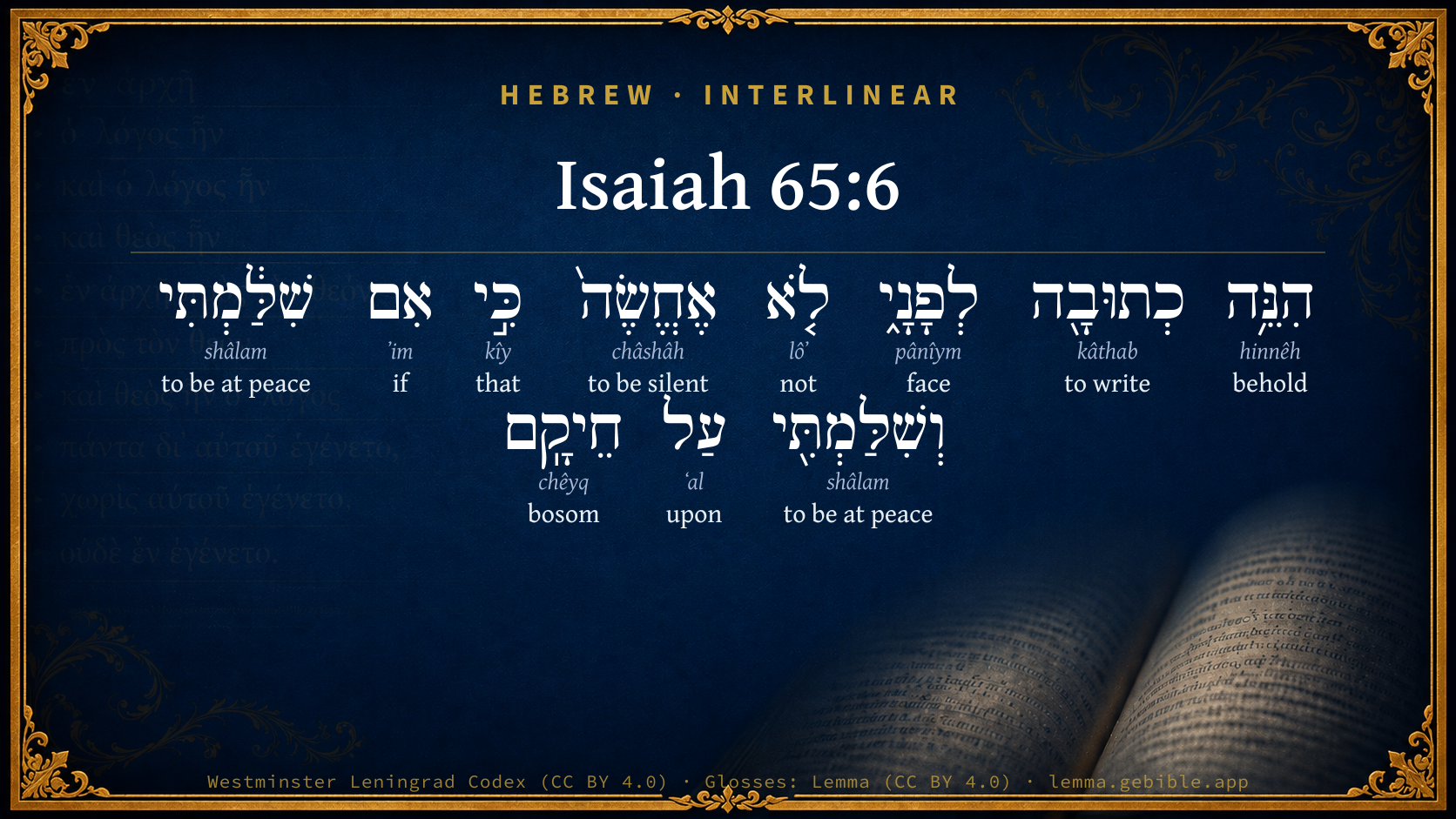
Hebrew (Westminster Leningrad Codex) Isaiah 65:6 appears in the Hebrew Old Testament. The text above is from the Westminster Leningrad Codex. Each word links to its Strong’s number, a concise gloss, and parsing drawn from the Open Scriptures Hebrew Bible morphology. Click any word for its full Brown-Driver-Briggs (BDB) entry.
Download image
Cite this verse

Isaiah 65:6 (World English Bible). Public Domain. Lemma interlinear Bible study tool, https://lemma.gebible.app/v/isaiah/65/6.

Show BibTeX & RIS
BibTeX
RIS
English Translation
Behold, it is written before me: I will not keep silence, but will recompense, yes, I will recompense into their bosom,
World English Bible · Public Domain
Download a study sheet

One document with this verse’s original text, its word-by-word gloss line, the meaning frame, cross-references with their text, attributed commentary, and full source and license credits — printable, and it pastes into notes with its structure intact.

This verse Autodidact and up

Study sheet (.html) Plain text (.txt)

A passage Seminary Student

Up to 50 verses in one chapter. A passage sheet keeps up to 6 commentary sources and 12 cross-references per verse, in the order this page ranks them, and says so on the sheet whenever that leaves anything out. Ask for a single verse and you get the Autodidact verse sheet above.

Everything on this page stays free to read, with no account — the sheet is a download of what is already on screen, not access to it.

Want to remove ads? Support Godless Engineer
Compare translations 3

The same verse in 3 English versions, stacked beneath the original-language interlinear above. Click any original word for its lexicon entry.

Each is an independent rendering of the whole verse — the interlinear is not word-aligned to these translations.

Highlighted words mark where these versions differ — a whole-verse word diff, not a word-by-word alignment.

  • World English Bible Public Domain
    Behold, it is written before me: I will not keep silence, but will recompense, yes, I will recompense into their bosom,
  • King James Version Public Domain
    Behold, it is written before me: I will not keep silence, but will recompense, even recompense into their bosom,
  • unfoldingWord Literal Text CC BY-SA 4.0
    Behold, it is written to my face, I will not be silent, but I will repay, and I will repay into their lap

unfoldingWord Literal Text — © unfoldingWord, licensed CC BY-SA 4.0. Word-aligned USFM3 via Door43 (git.door43.org/unfoldingWord/en_ult).

Versions to compare (up to 4)

3 of 4 selected

Show all 18 translations

Every available English version of this verse, each an independent rendering of the whole verse.

  • World English Bible Public Domain
    Behold, it is written before me: I will not keep silence, but will recompense, yes, I will recompense into their bosom,
  • Berean Standard Bible Public Domain
    Behold, it is written before Me: I will not keep silent, but I will repay; I will pay it back into their laps,
  • Majority Standard Bible Public Domain
    Behold, it is written before Me: I will not keep silent, but I will repay; I will pay it back into their laps,
  • King James Version Public Domain
    Behold, it is written before me: I will not keep silence, but will recompense, even recompense into their bosom,
  • American Standard Version (1901) Public Domain
    Behold, it is written before me: I will not keep silence, but will recompense, yea, I will recompense into their bosom,
  • Revised Version (1885) Public Domain
    Behold, it is written before me: I will not keep silence, but will recompense, yea, I will recompense into their bosom,
  • Geneva Bible (1599) Public Domain
    Beholde, it is written before me: I wil not keepe silence, but will render it and recompense it into their bosome.
  • Douay-Rheims (1899) Public Domain
    Behold it is written before me: I will not be silent, but I will render and repay into their bosom.
  • Young's Literal Translation Public Domain
    Lo, it is written before Me: `I am not silent, but have recompensed; And I have recompensed into their bosom,
  • Literal Standard Version CC BY-SA 4.0
    Behold, it is written before Me: I am not silent, but have repaid; And I have repaid into their bosom,
  • Unlocked Literal Bible CC BY-SA 4.0
    Look, it is written before me: I will not keep quiet, for I will pay them back; I will repay them into their laps,
  • unfoldingWord Literal Text CC BY-SA 4.0
    Behold, it is written to my face, I will not be silent, but I will repay, and I will repay into their lap
  • Darby Bible Public Domain
    Behold, it is written before me: I will not keep silence, but will recompense, even recompense into their bosom,
  • World Messianic Bible Public Domain
    “Behold, it is written before me: I will not keep silence, but will repay, yes, I will repay into their bosom
  • Webster's Bible Public Domain
    Behold, it is written before me: I will not keep silence, but will recompense, even recompense into their bosom,
  • Free Bible Version CC BY-SA 4.0
    Look—it's all written down right in front of me! I'm not going to keep quiet. I'm going to pay them back by throwing their punishment into their laps.
  • Bible in Basic English Public Domain
    See, it is recorded before me, says the Lord: I will not keep back my hand, till I have sent punishment,
  • JPS Tanakh (1917) Public Domain
    Behold, it is written before Me; I will not keep silence, except I have requited, yea, I will requite into their bosom,

Literal Standard Version (2020), Covenant Press — licensed CC BY-SA 4.0. Text via the HelloAO Bible API (eBible.org). Unlocked Literal Bible (unfoldingWord) — licensed CC BY-SA 4.0. Text via the HelloAO Bible API (eBible.org). unfoldingWord Literal Text — © unfoldingWord, licensed CC BY-SA 4.0. Word-aligned USFM3 via Door43 (git.door43.org/unfoldingWord/en_ult). Free Bible Version, Dr. Jonathan Gallagher — licensed CC BY-SA 4.0. Text via the HelloAO Bible API (eBible.org).

Word by word

More ways to search: Search by grammar → Find every occurrence → Compare this word →

Practice this passage: Drill this verse → Learn its vocabulary →

אֶחֱשֶׂה֙
châshâh
H2814
“to be silent”
Verb, Qal, Imperfect, 1st Person, Common, Singular
Part of Speech
Verb
Stem
Qal
Form
Imperfect
Person
1st Person
Gender
Common
Number
Singular
Full BDB Definition

Origin: a primitive root

TWOT: 768

to be silent, quiet, still, inactive - (Qal) to be silent, be still - (Hiphil) - to be silent, exhibit silence - to show inactivity, be inactive - to make silent, make quiet, cause to be still
  1. הִנֵּ֥ה hinnêh H2009 “behold” Particle, Demonstrative
  2. כְתוּבָ֖ה kâthab H3789 “written” Verb, Qal, Participle Passive, Feminine, Singular, Absolute
  3. לְפָנָ֑י pânîym H6440 “to/for · face(s) · my” Preposition + Noun, Common, Both, Plural, Construct + Suffix, Personal, 1st Person, Common, Singular
  4. לֹ֤א lôʼ H3808 “not” Particle, Negative
  5. כִּ֣י kîy H3588 “that” Conjunction
  6. אִם ʼim H518 “if” Conjunction
  7. שִׁלַּ֔מְתִּי shâlam H7999 “to be at peace” Verb, Piel, Perfect, 1st Person, Common, Singular
  8. וְשִׁלַּמְתִּ֖י shâlam H7999 “and · to be at peace” Conjunction + Verb, Piel, Sequential Perfect, 1st Person, Common, Singular
  9. עַל ʻal H5921 “upon” Preposition
  10. חֵיקָֽם chêyq H2436 “bosom · their” Noun, Common, Masculine, Singular, Construct + Suffix, Personal, 3rd Person, Masculine, Plural

About this verse

These counts appear in no published source. They are computed here, from the morphology-tagged text and Lemma’s own curated glosses. What Lemma adds →

11
words
10
distinct lemmas
Prophets
section

Notable vocabulary

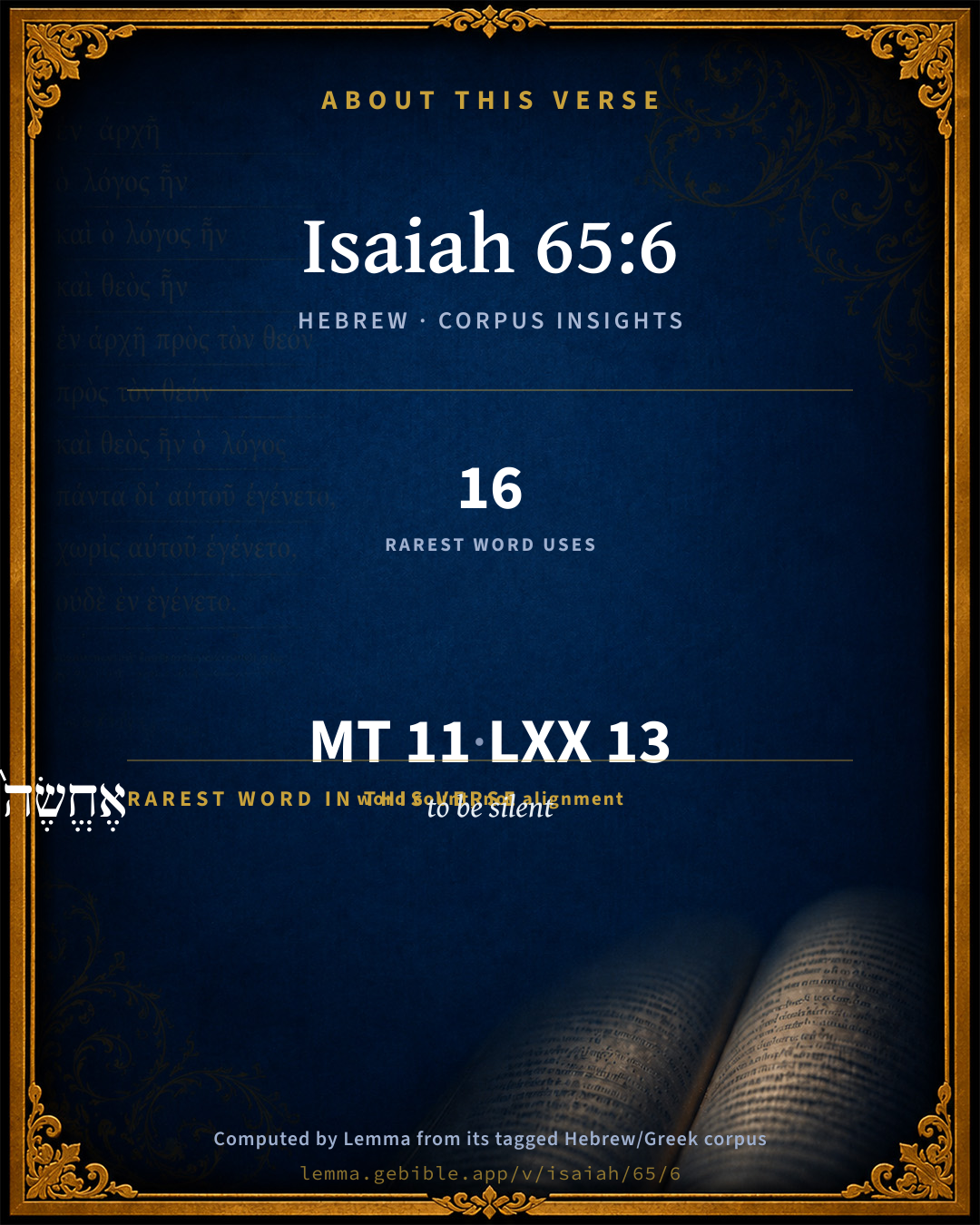
The rarest word here is אֶחֱשֶׂה֙ to be silent H2814 — appearing just 16 times in the whole Hebrew Bible.

Shared distinctive vocabulary

אֶחֱשֶׂה֙ to be silent H2814 occurs in 16 verses of the Hebrew Bible. Also found in:

Grammatical profile

  • 4 verbs
  • 2 nouns
  • 1 preposition
  • 2 conjunctions
  • 2 particles

Verb forms

  • כְתוּבָ֖ה Qal · Participle Passive
  • אֶחֱשֶׂה֙ Qal · Imperfect
  • שִׁלַּ֔מְתִּי Piel · Perfect
  • וְשִׁלַּמְתִּ֖י Piel · Sequential Perfect

Repetition

A word recurs within this verse — often emphatic in Hebrew:

  • שִׁלַּ֔מְתִּי to be at peace H7999 ×2

Hebrew & Septuagint length

In English translation the verse runs 21 words from the Hebrew and 18 from the Septuagint (LXX English) — closely comparable.

A rough comparison of the two English renderings, which tokenize alike — not a word-level alignment.

Word counts can differ between the Hebrew and the Greek without any difference in meaning — e.g. the Hebrew direct-object marker אֵת has no separate Greek word, and Greek often adds the article ὁ.

In the original languages it is 11 Hebrew tokens and 13 Greek tokens — but the two are counted differently (Hebrew bundles its prefixes and suffixes into one token; the Greek is in lemma form), so that isn’t a like-for-like length.

Cross-references

14

Topical passages linked to Isaiah 65:6 in the Treasury of Scripture Knowledge — connected by theme and wording, ordered by reader-vote popularity; previews shown in the World English Bible.

  • Psalms 50:3 Our God comes, and does not keep silent. A fire devours before him. It is very tempestuous around him.
  • Jeremiah 16:18 First I will recompense their iniquity and their sin double, because they have polluted my land with the carcasses of their detestable things, and have filled my inheritance with their abominations.
  • Psalms 50:21 You have done these things, and I kept silent. You thought that the "I AM" was just like you. I will rebuke you, and accuse you in front of your eyes.
  • Psalms 79:12 Pay back to our neighbors seven times into their bosom Their reproach with which they have reproached you, Lord.
  • Isaiah 42:14 I have long time held my peace; I have been still, and refrained myself: [now] will I cry out like a travailing woman; I will gasp and pant together.
  • Isaiah 64:12 Will you refrain yourself for these things, Yahweh? will you hold your peace, and afflict us very sore?
  • Ezekiel 22:31 Therefore have I poured out my indignation on them; I have consumed them with the fire of my wrath: their own way have I brought on their heads, says the Lord Yahweh.
  • Joel 3:4 "Yes, and what are you to me, Tyre, and Sidon, And all the regions of Philistia? Will you repay me? And if you repay me, I will swiftly and speedily return your repayment on your own head.
  • Malachi 3:16 Then those who feared Yahweh spoke one with another; and Yahweh listened, and heard, and a book of memory was written before him, for those who feared Yahweh, and who honored his name.
  • Revelation 20:12 I saw the dead, the great and the small, standing before the throne, and they opened books. Another book was opened, which is the book of life. The dead were judged out of the things which were written in the books, according to their works.
  • Exodus 17:14 Yahweh said to Moses, "Write this for a memorial in a book, and rehearse it in the ears of Joshua: that I will utterly blot out the memory of Amalek from under the sky."
  • Deuteronomy 32:34 Isn't this laid up in store with me, Sealed up among my treasures?
  • Psalms 56:8 You number my wanderings. You put my tears into your bottle. Aren't they in your book?
  • Ezekiel 11:21 But as for them whose heart walks after the heart of their detestable things and their abominations, I will bring their way on their own heads, says the Lord Yahweh.

Cross-references courtesy of OpenBible.info (CC BY 4.0).

Hebrew and Greek witnesses Masoretic Hebrew ↔ Greek Septuagint

The same verse in the two great witnesses to the Old Testament, shown verse-for-verse.

These are two independent witnesses, not word-aligned to each other, and the Septuagint is shown in lemma (dictionary) form.

Hebrew Isaiah 65:6 Masoretic · Westminster Leningrad Codex

הִנֵּ֥ה כְתוּבָ֖ה לְפָנָ֑י לֹ֤א אֶחֱשֶׂה֙ כִּ֣י אִם שִׁלַּ֔מְתִּי וְשִׁלַּמְתִּ֖י עַל חֵיקָֽם

Behold, it is written before me: I will not keep silence, but will recompense, yes, I will recompense into their bosom,

World English Bible · Public Domain

Greek LXX Isaiah 65:6 Septuagint · lemma form

ἰδού γράφω ἐνώπιόν ἐγώ οὐ σιωπάω ἕως ἄν ἀποδίδωμι εἰς ὁ κόλπος αὐτός

Behold, it is written before me: I will not be silent until I have recompensed into their bosom,

LXX2012 (modern English Septuagint) · Public Domain

Hebrew: Westminster Leningrad Codex (CC BY 4.0). Greek: Septuagint (public domain); English from LXX2012 (modern English Septuagint) (Public Domain). How the Septuagint differs from the Hebrew →

Targum (Aramaic paraphrase)

1

The Targum is the ancient Jewish Aramaic paraphrase of the Hebrew Scriptures — an interpretive translation, not the Hebrew text itself. Onkelos (literal) and Pseudo-Jonathan (expansive) render the Torah, and Jonathan the Prophets. Coverage is partial: where no permissively-licensed English translation exists for a verse, only the Aramaic is shown. This is verse-level text, not a word-by-word alignment to the Hebrew.

  1. Targum Jonathan Prophets (Joshua–Malachi)
    הָא כְתִיבָא קֳדָמַי לָא אֶתֵּן לְהוֹן אַרְכָּא בְּחַיַיָא אֱלָהֵן אֲשַׁלֵם לְהוֹן פּוּרְעֲנוּת חוֹבֵיהוֹן וְאֶמְסוֹר לְמוֹתָא תִּנְיָנָא יַת גְוִיַתְהוֹן:

    Behold, it is written before me: I will not give unto them prolongation in this life; but I will recompense unto them the wages for their sins, and deliver their bodies to the second death.

    Targum Jonathan — Aramaic: “Mikraot Gedolot” (public domain). English: “Sefaria Community Translation” (CC0 1.0 (public-domain dedication)); “London "Chaldee Paraphrase," 1871” (public domain). Text via Sefaria.

Commentary

Notes on Isaiah 65:6 from classic Christian and Jewish commentators (each source and its license shown beneath its notes). The classic Christian expositions comment on the surrounding passage and are grouped to its opening verse, so a note may address several verses; the Jewish commentaries on the Tanakh (Rashi and others) are per-verse, so they appear only where the commentator wrote on this verse.

Lemma curates 59 commentaries, every one of them public domain or Creative Commons licensed, each selected and text-cleaned for this edition rather than reprinted as found. About our sources →

Trapp's Complete Commentary

John Trapp

Isa 65:6 Behold, [it is] written before me: I will not keep silence, but will recompense, even recompense into their bosom,

Ver. 6. Behold, it is written before me.] Heb., Before my face, as your sins were committed to my face, {Isa 65:3} which, therefore, I shall surely remember and punish.

But will recompense, even recompense.] Certo, cite, penitus, - surely, severely, suddenly; you may write upon it.

John Trapp, A Commentary or Exposition upon All the Books of the Old and New Testament (1647–1656) — public domain. Text from a community e-Sword module.

Keil & Delitzsch

C. F. Keil & F. Delitzsch

The justice of God will not rest till it has procured for itself the fullest satisfaction. "Behold, it is written before me: I will not keep silence without having recompensed, and I will recompense into their bosom. Your offences, and the offences of your fathers together, saith Jehovah, that they have burned incense upon the mountains, and insulted me upon the hills, and I measure their reward first of all into their bosom." Vitringa has been misled by such passages as Isa 10:1; Job 13:26; Jer 22:30, in which kâthabh (kittēbh) is used to signify a written decree, and understands by khethūbhâh the sentence pronounced by God; but the reference really is to their idolatrous conduct and contemptuous defiance of the laws of God. This is ever before Him, written in indelible characters, waiting for the day of vengeance; for, according to the figurative language of Scripture, there are heavenly books, in which the good and evil works of men are entered. And this agrees with what follows: "I will not be silent, without having first repaid," etc. The accentuation very properly places the tone upon the penultimate of the first shillamtı̄ as being a pure perfect, and upon the last syllable of the second as a perf. consec. אם כּי preceded by a future and followed by a perfect signifies, "but if (without having) first," etc. (Isa 55:10; Gen 32:27; Lev 22:6; Rut 3:18; cf., Jdg 15:7). The original train of thought was, "I will not keep silence, for I shall first of all keep silence when," etc. Instead of ‛al chēqâm, "Upon their bosom," we might have 'el chēqâm, into their bosom, as in Jer 32:18; Psa 79:12. In Isa 65:7 the keri really has 'el instead of ‛al, whilst in Isa 65:9 the chethib is ‛al without any keri (for the figure itself, compare Luk 6:38, "into your bosom"). The thing to be repaid follows in Isa 65:7; it is not governed, however, by shillamtı̄, as the form of the address clearly shows, but by 'ăshallēm understood, which may easily be supplied. Whether 'ăsher is to be taken in the sense of qui or quod (that), it is hardly possible to decide; but the construction of the sentence favours the latter. Sacrificing "upon mountains and hills" (and, what is omitted, here, "under every green tree") is the well-known standing phrase used to describe the idolatry of the times preceding the captivity (cf., Isa 57:7; Hos 4:13; Eze 6:13). וּמדּתי points back to veshillamtı̄ in Isa 65:6, after the object has been more precisely defined. Most of the modern expositors take ראשׁנה פעלּתם together, in the sense of "their former wages," i.e., the recompense previously deserved by their fathers. But in this case the concluding clause would only affirm, by the side of Isa 65:7, that the sins of the fathers would be visited upon them. Moreover, this explanation has not only the accents against it, but also the parallel in Jer 16:18 (see Hitzig), which evidently stands in a reciprocal relation to the passage before us. Consequently ri'shōnâh must be an adverb, and the meaning evidently is, that the first thing which Jehovah had to do by virtue of His holiness was to punish the sins of the apostate Israelites; and He would so punish them that inasmuch as the sins of the children were merely the continuation of the fathers' sins, the punishment would be measured out according to the desert of both together.

Keil & Delitzsch — Biblical Commentary on the Old Testament (1861–1891) — public domain (CC PDM 1.0). Text via the HelloAO Bible API. (Old Testament only.)

Tyndale Open Study Notes

Tyndale Open Resources

65:6 my decree is written out: God is fully committed to carry out his plan. • The godly had asked whether the Lord would stand silent forever (64:12). God answered that he would not but would deal with the wicked before restoring the righteous remnant.

Tyndale Open Study Notes — © Tyndale Open Resources, licensed CC BY-SA 4.0. Text via the HelloAO Bible API.

Geneva Bible (1599)

Geneva Bible translators

So that the remembrance thereof cannot be forgotten.

Geneva Bible (1599) marginal notes — public domain. Text via Bolls.life.

Jamieson, Fausset & Brown

Robert Jamieson, A. R. Fausset & David Brown

written before me--"it is decreed by Me," namely, what follows (Job 13:26), [MAURER]; or, their guilt is recorded before Me (compare Dan 7:10; Rev 20:12; Mal 3:16).

into . . . bosom-- (Psa 79:12; Jer 32:18; Luk 6:38). The Orientals used the loose fold of the garment falling on "the bosom" or lap, as a receptacle for carrying things. The sense thus is: I will repay their sin so abundantly that the hand will not be able to receive it; it will need the spacious fold on the bosom to contain it [ROSENMULLER]. Rather it is, "I will repay it to the very person from whom it has emanated." Compare "God did render the evil of the men of Shechem upon their heads" (Jdg 9:57; Psa 7:16) [GESENIUS].

Jamieson, Fausset & Brown — Commentary Critical and Explanatory on the Whole Bible (1871) — public domain (CC PDM 1.0). Text via the HelloAO Bible API.

Adam Clarke's Commentary

Verse 6. Behold, it is written before me] Their sin is registered in heaven, calling aloud for the punishment due to it.

I will - recompense into their bosom] The bosom is the place where the Asiatics have their pockets, and not in their skirts like the inhabitants of the west. Their loose flowing garments have scarcely any thing analogous to skirts.

Into their bosom] For על al, ten MSS. and five editions have אל el. So again at the end of this verse, seventeen MSS. and four editions have אל al. - L.

Adam Clarke's Commentary on the Bible (1810–1826) — public domain. Text from a community e-Sword/MySword module.

Ellicott's Commentary for English Readers

(6) It is written before me . . .—The thought is that of the great register, the book of God’s remembrance, in which men’s deeds, good and evil, are ever being recorded. (Comp. Jer_17:1; Psa_56:8; Dan_12:1; Mal_3:16.)

But will recompense . . .—Literally, without recompensing, or, except I recompense. Men took the long-suffering of God as if it indicated forgetfulness (Rom_2:4; 2Pe_3:9). They are told that He will at last requite the impenitent “into their very bosom,” their inmost self, for all the evil they have done.

A Bible Commentary for English Readers, edited by Charles John Ellicott (1878–1897) — public domain. Text from a community e-Sword module.

The Cambridge Bible for Schools and Colleges

gen. ed. J. J. S. Perowne

6, 7. Sentence is now pronounced on the reprobates, who by their persistent idolatries have served themselves heirs to the guilt of their fathers.

it is written before me] The sins mentioned above stand recorded in the heavenly books, calling constantly for punishment (cf. Jer_17:1). Another interpretation, according to which the subject of the sentence is the Divine decree of judgement, is less acceptable, because the following words can hardly be taken as the contents of such a decree.

I will not keep silence until I have recompensed] For the construction cf. Gen_32:26; Lev_22:6, &c.

even recompense &c.] and I will recompense into their bosom,—a new sentence, as is shown by the Hebr. pointing of the verb as consec. perf. Cf. Jer_32:18; Psa_79:12.

The Cambridge Bible for Schools and Colleges (gen. ed. J. J. S. Perowne; Cambridge University Press, 1878–1918) — public domain. Text from a community e-Sword module.

John Gill's Exposition

Behold, it is written before me,.... This account of their sins; it was in his sight and constant remembrance, and punishment for them was determined by him, written in the book of his decrees:

I will not keep silence; but threaten with destruction, and not only threaten, but execute; plead against them really, as well as verbally, with sore judgments:

but will recompense, even recompense into their bosom; full and just recompence of punishment for all their transgressions, as it follows. The Targum is,

"I will recompense to them the vengeance of their sins, and deliver their bodies to the second death.''

John Gill's Exposition of the Whole Bible (1746–1763) — public domain (CC PDM 1.0). Text via the HelloAO Bible API.

Albert Barnes' Notes on the Bible

Behold, it is written before me - That is, the crimes of which they had been guilty, or the sentence which would be consequent thereon. The allusion is to the custom of having the decrees of kings recorded in a volume or on a table, and kept in their presence, so that they might be seen and not forgotten. An allusion to this custom of opening the books containing a record of this kind on trials, occurs in Dan 7:10, ‘The judgment was set, and the books were opened.’ So also Rev 20:12, ‘And I saw the dead, small and great, stand before God; and the books were opened; and another book was opened, which is the book of life, and the dead were judged out of those things which were written in the books, according to their works.’ So here. An impartial record had been made, and God would recompense them according to their deeds.

I will not keep silence - Nothing shall compel me to desist from declaring a sentence which shall be just and right.

But will recompense, even recompense - That is, I will certainly requite them. The word is repeated in accordance with the usual manner in Hebrew to denote emphasis.

Into their bosom - (See Psa 79:12; Jer 32:18; Luk 6:38). The word bosom, here refers to a custom among the Orientals of making the bosom or front of their garments large and loose, so that articles could be carried in them, answering the purpose of our pockets (compare Exo 4:6-7; Pro 6:27). The sense here is, that God would abundantly punish them for their sins.

Albert Barnes' Notes on the Bible (1834–1885) — public domain. Text from a community e-Sword/MySword module.

Haydock's Catholic Bible Commentary

Bosom: good measure, Luke vi. 38. Rewards and punishments will be eternal.

George Leo Haydock (1774–1849), Haydock's Catholic Family Bible and Commentary, 1859 edition — public domain. Excludes Psalms (Douay-Rheims chapter numbering differs from Protestant) and Deuterocanonical books (Catholic canon only).

Matthew Poole's English Annotations

They may think that I take no notice of these things, or if I take any notice, I will forget them, or at least not enter into judgment with them for them; but I as certainly know and will remember them, as princes or great men that record things in writing which they would not forget. And they shall know that I know and take notice of and will remember them; for

I will not keep silence; I will not long neglect the punishment of them, though for a while I have delayed it, like a man who bites in his wrath, for some wise reasons which are known unto himself best, Psa 50:21.

Will recompense into their bosom; my punishment of them shall be severe and certain, but yet it shall be just, but a giving them what is their own, as they are obnoxious to my justice, Deu 7:10; Jer 32:18; like the payment of an ox for an ox, Exo 21:36 (where the same word is used); they have been froward against me and I will show myself froward against them, Psa 18:26.

Matthew Poole's English Annotations on the Holy Bible (1683–1685) — public domain. Text from a community e-Sword/MySword module.

Whedon's Commentary on the Bible

Daniel D. Whedon

6, 7. Behold — Something very important.

It is written — Or, recorded. Probably for retribution soon to occur. For character as above portrayed shall be visited with deserved decree, or doom. It is poured into their bosom. “Their bosom” may refer to an oriental way of drawing up the loose garment, so as to make a capacious sack around the chest. See Rth_3:15.

Daniel D. Whedon (gen. ed.), Commentary on the Old and New Testaments (1874–1909) — public domain. Text from a community e-Sword module.

The Pulpit Commentary

It is written before me. The misconduct of his people is "written" in God"s book, which lies open "before him," so that their sin is ever in his sight. (comp. Psa_56:8 Mal_3:16 Rev_20:12) I will not keep silence. (comp. Psa_1:3) "Keeping silence" is a metaphor for complete inaction. But will recompense, etc.; rather, until I have recompensed, yea, recompensed them into their bosoms. (comp. Luk_6:38) Gifts were given and received into the fold of the beged, or cloak, which depended in front of the bosom.

Ver. 6. Men"s sins recorded in God"s book.

As far back as the time of Moses, God announced through him that men"s sins were "laid up in store with him, and sealed up among his treasures". (Deu_32:34) The later prophets, (Mal_3:16) with the Psalms, (Psa_56:8) and the Revelation of St. John, (Joh_20:12-15) speak of "a book," or "books, of remembrance," which contain the record of human frailty. Jeremiah says, "The sin of Judah is written with a pen of iron, and with the point of a diamond"; (Jer_17:1) and Daniel, like St. John, tells of a time when the judgment will be set, and "the books opened". (Joh_7:10) The heavenly registers record the acts of men, both good and bad; and in one register seem to be written the names of those whom God regards as "living ones". (Isa_4:3) This register is called "the book of life". (Rev_3:5 Rev_13:8 Rev_17:8 Rev_20:12, Rev_20:15) Such are the biblical statements on the subject. The expressions used are doubtless accommodations to human modes of thought, and are not to be taken literally. The great truth, however, which they convey is to be understood in the most absolute literalness. Men"s sins will not be forgotten, even when they are forgiven. They are all registered in God"s memory; and perhaps it may be found that each man"s sins are also registered in some secret place of his own memory, though at present he is unable to recall the greater part of them. All will be taken into consideration at the time of judgment, and all will be set forth in the sight of men and angels. There is nothing "secret" which shall not then be "revealed," or "hid" which shall not be "known." Men will be judged and sentenced "according to their works" (Rev_20:13) to that they have done, whether it be good or evil". (2Co_5:10)

The Pulpit Commentary (1880–1919), ed. H.D.M. Spence-Jones & Joseph S. Exell — public domain. Text from a community e-Sword module.

John Wesley's Explanatory Notes

Behold - They may think I take no notice of these things; but I will as certainly remember them, as princes or great men that record things in writing which they would not forget.

John Wesley, Explanatory Notes Upon the Whole Bible (1754–1765) — public domain. Text via the GEBible commentary corpus.

J. A. Alexander on Isaiah

Joseph Addison Alexander

“Lo, it is written before me. I will not rest except I repay, and I will repay into their bosom your iniquities and the iniquities of your fathers together, saith Jehovah, who burned incense on the mountains and on the hills blasphemed me, and I will measure their first work into their bosom.” The particle at the beginning calls attention both to the magnitude and certainty of the event about to be predicted. The figure of writing has been variously understood. Some think that what is said to be written is the eternal law of retribution. Others understand by it a book of remembrance (Mal 3:16), (i.e., a record of the sins referred to afterwards, by which they are kept perpetually present to the memory of Jehovah (Dan 7:10)). Most later writers understand by it a record, not of the crime, but of its punishment, or rather of the purpose or decree to punish it (Dan 5:5; Dan 5:24) in reference to the written judgments of the ancient courts (Isa 10:1). This last interpretation does not necessarily involve the supposition that the thing here said to be written is the threatening which immediately follows, although this is by no means an unnatural construction. ‘I will not rest or be silent,’ an expression used repeatedly before in reference to the seeming inaction or indifference of Jehovah. (See above, Isa 42:14; Isa 57:11, and compare Psa 50:21; Hab 1:13). For ‘repay into their bosom’, we have in the seventh verse ‘measure into their bosom’, which affords a clue to the origin and real meaning of the figure; as we read that ‘Boaz said to Ruth, Bring the veil (or cloak) that is upon thee and hold it, and she held it, and he measured six (measures of) barley and laid it on her’ (Rth 3:15). Hence the phrase ‘to measure into any one’s bosom,’ (i.e., into the lap or the fold of the garment covering the bosom. (See above, on Isa 49:22)). The same figure is employed by Jer 32:18 and in Psa 79:12, and has been explained as implying abundance, or a greater quantity than one could carry in the hand. {Compare Luk 6:38). But others understand the main idea to be not that of abundance, but of retribution, anything being said to return into one’s own bosom, just as it is elsewhere said to return upon his own head (Jdg 9:57; Psa 7:16). Both these accessory ideas are appropriate in the case before us. The sudden change from ‘their’ to ‘your’ at the beginning of v. 7, has been commonly explained as an example of the enallage personae so frequently occurring in Isaiah. This supposition is undoubtedly sufficient to remove all difficulty from the syntax. It is possible, however, that the change is not a mere grammatical anomaly or license of construction, but significant, and intended to distinguish between three generations. ‘I will repay into their bosom (that of your descendants) your iniquities and the iniquities of your fathers.’ If this be not a fanciful distinction, it gives color to the opinion that the previous description brings to view successively the gross idolatry of early times and the pharisaical hypocrisy prevailing at the time of Christ. Supposing his contemporaries to be the immediate objects of address, there would then be a distinct allusion to their idolatrous progenitors, the measure of whose guilt they filled up (Mat 23:32) and to their children, upon whom it was to be conspicuously visited (Luk 23:28). But whether this be so or not, the meaning of the text is obvious, as teaching that the guilt which had accumulated through successive generations should be visited, though not exclusively, upon the last. The whole of idolatry is here summed up in burning incense of the mountains, which are elsewhere mentioned as a favorite resort of those who worshipped idols (Isa 57:7; Jer 3:6; Eze 6:13; Eze 18:6; Hos 4:13) and blaspheming God upon the hills, which may either be regarded as a metaphorical description of idolatry itself, or strictly taken to denote the oral expression of contempt for Jehovah and His worship, which might naturally be expected to accompany such practices. ‘Their former work’, (i.e., its product or reward, as in Isa 40:10). The only sense in which it can be thus described is that of ancient, as distinguished not from the subsequent transgressions of the fathers, but from those of the children who came after them. According to the sense which the Apostle puts upon the two first verses of this chapter, we may understand those now before us as predicting the excision of the Jews from the communion of the church and from their covenant relation to Jehovah, as a testimony of His sore displeasure on account of the unfaithfulness and manifold transgressions of that chosen race throughout its former history, but also on account of the obstinate and spiteful unbelief with which so many later generations have rejected the Messiah, for whose sake alone they ever had a national existence and enjoyed so many national advantages.

Joseph Addison Alexander, The Prophecies of Isaiah (1846–1847; New York: Scribner, 1870–1878) — public domain. Text from a community e-Sword module.

unfoldingWord translationNotes

Door43 World Missions Community

General Information:

Yahweh continues speaking about the people of Israel.

Look, it is written

"Take notice and pay attention"

into their laps

This means God will punish them to the fullest extent. This expression compares Yahweh punishing the people to dumping on their legs as they are sitting. (See: Idiom and Metaphor)

translationWords

sin

ancestor

Yahweh

incense

works

unfoldingWord translationNotes — © Distant Shores Media and the Door43 World Missions Community, licensed CC BY-SA 4.0. Source: git.door43.org/Door43/en_tn.

Rashi

Rabbi Shlomo Yitzchaki (Rashi)

Behold it is inscribed Their sin is inscribed before Me, and their sentence has already been decreed and sealed.

Rashi on the Tanakh — English translations: “The Judaica Press complete Tanach with Rashi, translated by A. J. Rosenberg” (CC BY 4.0); “Pentateuch with Rashi's commentary by M. Rosenbaum and A.M. Silbermann, 1929-1934” (public domain); “The Metsudah Tanach series, Lakewood, N.J” (CC BY 4.0); and “The Book of Joshua, Metsudah Publications, 1997” (CC BY 4.0). Text via Sefaria.

Ibn Ezra

Rabbi Abraham ibn Ezra

Behold it is written before me. This evil which they have done, is, as it were, written before me; I have not forgotten it.

Ibn Ezra on the Tanakh — English translations: “Sefaria Community Translation” (CC0 1.0 (public-domain dedication)); “Yalkut, Sifsei Chachomim Chumash, Metsudah Publications, 2009” (CC BY 4.0); and “Commentary of Ibn Ezra on Isaiah - trans. by M. Friedlander, 1873” (public domain). Text via Sefaria.

Lesson kit

Teaching starters — assembled from the data on this page, not authored interpretation. Every prompt links to the verse data it draws on. Edit before teaching.

Isaiah, in the Prophets, opens this verse with 11 words (10 distinct Hebrew lemmas). Its most distinctive word is châshâh (“to be silent”). A historical commentator’s framing appears above. Read the whole chapter for the surrounding context.

Discussion questions

  1. What does “to be silent” (châshâh) contribute to the verse as a whole?
  2. Judges 18:9 shares the word «to be silent» with this verse. How do the two illuminate each other?
  3. “to be at peace” occurs 2× in this one verse. What is the effect of the repetition?
  4. The translations on this page render this verse differently — a whole-verse word diff, not a word-by-word alignment. What might account for the different wordings?
  5. The verb «כְתוּבָ֖ה» is Qal Participle Passive. How does its form color the action?
  6. Reading how Trapp's Complete Commentary and Keil & Delitzsch read this verse, where do the two commentators agree and where do they part?

Things to notice

Reading settings

Reading text

Shown beneath each verse's original-language words.

Old Testament
Old Testament edition

Read the OT as the Masoretic Hebrew (MT) or the Greek Septuagint (LXX).

English shown for the Greek Septuagint (in the Hebrew ↔ Greek comparison).

Comparing translations? Open the Compare panel on any verse page to stack up to four side by side.