
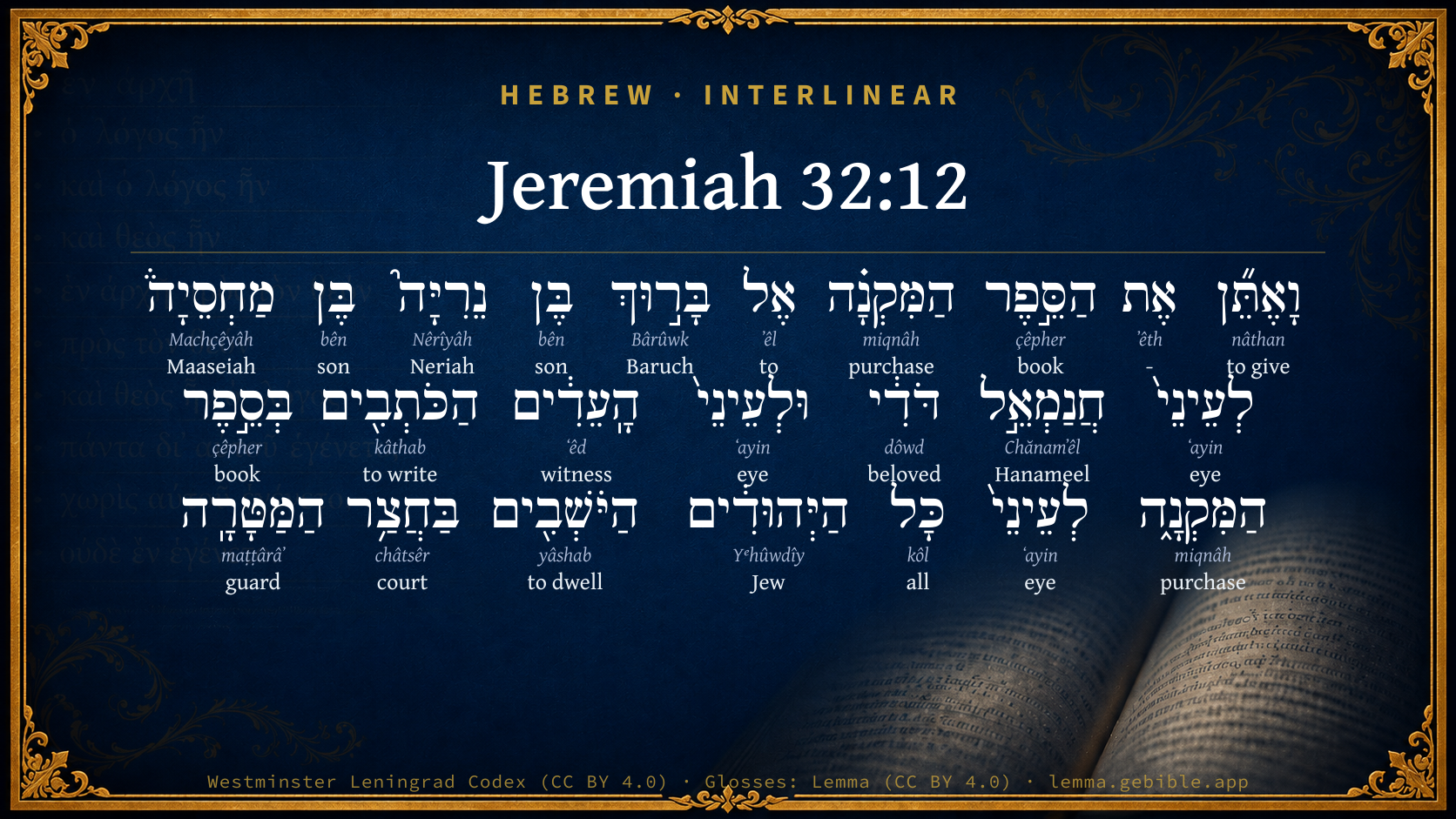
Jeremiah 32:12

Hebrew (Westminster Leningrad Codex) Jeremiah 32:12 appears in the Hebrew Old Testament. The text above is from the Westminster Leningrad Codex. Each word links to its Strong’s number, a concise gloss, and parsing drawn from the Open Scriptures Hebrew Bible morphology. Click any word for its full Brown-Driver-Briggs (BDB) entry.
Download image
Cite this verse

Jeremiah 32:12 (World English Bible). Public Domain. Lemma interlinear Bible study tool, https://lemma.gebible.app/v/jeremiah/32/12.

Show BibTeX & RIS
BibTeX
RIS
English Translation
and I delivered the deed of the purchase to Baruch the son of Neriah, the son of Mahseiah, in the presence of Hanamel my uncle's son, and in the presence of the witnesses who subscribed the deed of the purchase, before all the Jews who sat in the court of the guard.
World English Bible · Public Domain
Highlights
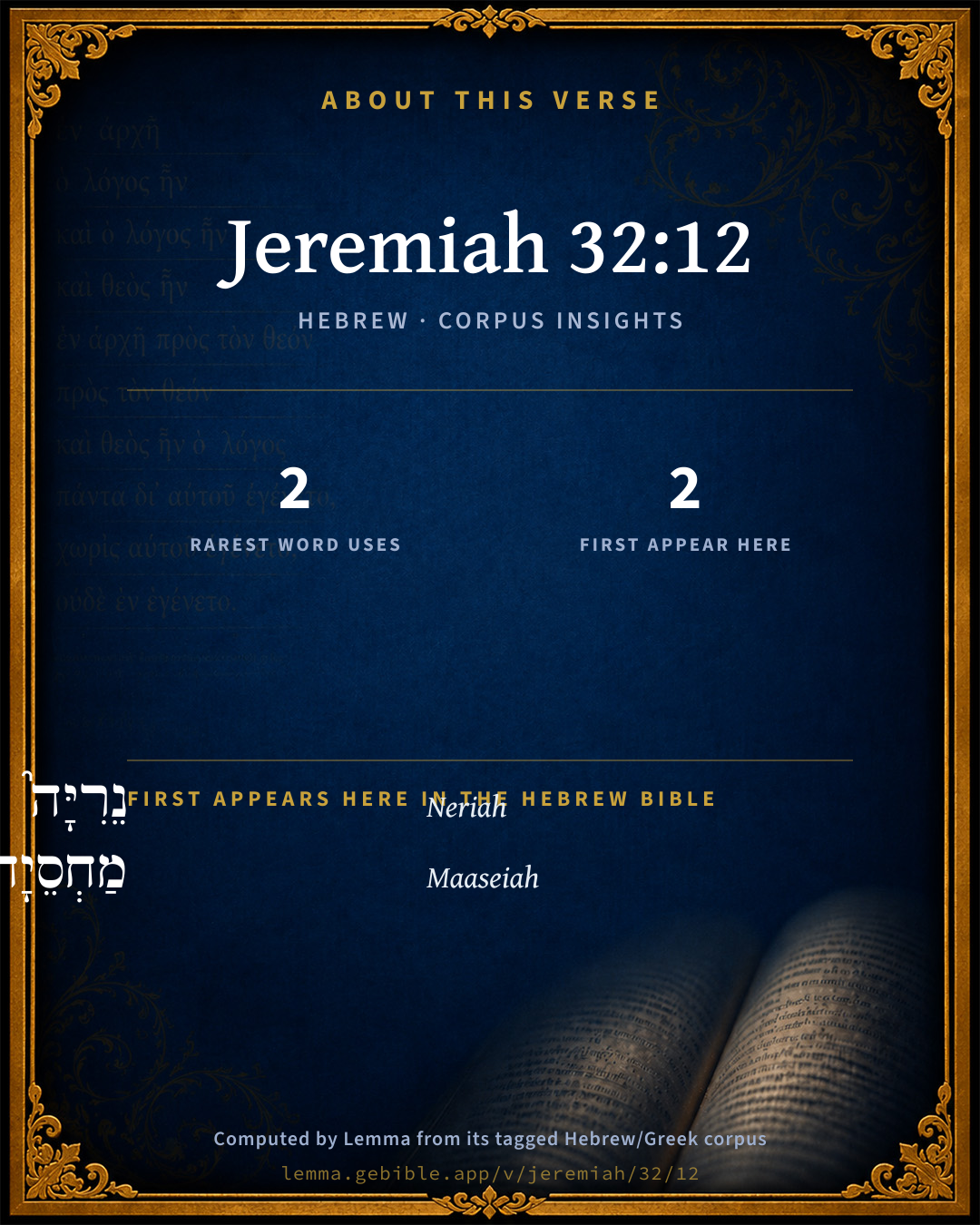
  • 2 first appearances in the Hebrew Bible
Full analysis ↓
Download a study sheet

One document with this verse’s original text, its word-by-word gloss line, the meaning frame, cross-references with their text, attributed commentary, and full source and license credits — printable, and it pastes into notes with its structure intact.

This verse Autodidact and up

Study sheet (.html) Plain text (.txt)

A passage Seminary Student

Up to 50 verses in one chapter. A passage sheet keeps up to 6 commentary sources and 12 cross-references per verse, in the order this page ranks them, and says so on the sheet whenever that leaves anything out. Ask for a single verse and you get the Autodidact verse sheet above.

Everything on this page stays free to read, with no account — the sheet is a download of what is already on screen, not access to it.

Want to remove ads? Support Godless Engineer
Compare translations 3

The same verse in 3 English versions, stacked beneath the original-language interlinear above. Click any original word for its lexicon entry.

Each is an independent rendering of the whole verse — the interlinear is not word-aligned to these translations.

Highlighted words mark where these versions differ — a whole-verse word diff, not a word-by-word alignment.

  • World English Bible Public Domain
    and I delivered the deed of the purchase to Baruch the son of Neriah, the son of Mahseiah, in the presence of Hanamel my uncle's son, and in the presence of the witnesses who subscribed the deed of the purchase, before all the Jews who sat in the court of the guard.
  • King James Version Public Domain
    And I gave the evidence of the purchase unto Baruch the son of Neriah, the son of Maaseiah, in the sight of Hanameel mine uncle's son, and in the presence of the witnesses that subscribed the book of the purchase, before all the Jews that sat in the court of the prison.
  • unfoldingWord Literal Text CC BY-SA 4.0
    I gave the sealed scroll to Baruch son of Neriah son of Mahseiah in front of Hanamel, the son of my uncle, and the witnesses who had written in the sealed scroll, and in front of all the Judeans who sat in the courtyard of the guard.

unfoldingWord Literal Text — © unfoldingWord, licensed CC BY-SA 4.0. Word-aligned USFM3 via Door43 (git.door43.org/unfoldingWord/en_ult).

Versions to compare (up to 4)

3 of 4 selected

Show all 18 translations

Every available English version of this verse, each an independent rendering of the whole verse.

  • World English Bible Public Domain
    and I delivered the deed of the purchase to Baruch the son of Neriah, the son of Mahseiah, in the presence of Hanamel my uncle's son, and in the presence of the witnesses who subscribed the deed of the purchase, before all the Jews who sat in the court of the guard.
  • Berean Standard Bible Public Domain
    and I gave this deed to Baruch son of Neriah, the son of Mahseiah, in the sight of my cousin Hanamel and the witnesses who were signing the purchase agreement and all the Jews sitting in the courtyard of the guard.
  • Majority Standard Bible Public Domain
    and I gave this deed to Baruch son of Neriah, the son of Mahseiah, in the sight of my cousin Hanamel and the witnesses who were signing the purchase agreement and all the Jews sitting in the courtyard of the guard.
  • King James Version Public Domain
    And I gave the evidence of the purchase unto Baruch the son of Neriah, the son of Maaseiah, in the sight of Hanameel mine uncle's son, and in the presence of the witnesses that subscribed the book of the purchase, before all the Jews that sat in the court of the prison.
  • American Standard Version (1901) Public Domain
    and I delivered the deed of the purchase unto Baruch the son of Neriah, the son of Mahseiah, in the presence of Hanamel mine uncle's `son', and in the presence of the witnesses that subscribed the deed of the purchase, before all the Jews that sat in the court of the guard.
  • Revised Version (1885) Public Domain
    and I delivered the deed of the purchase unto Baruch the son of Neriah, the son of Mahseiah, in the presence of Hanamel mine uncle’s son, and in the presence of the witnesses that subscribed the deed of the purchase, before all the Jews that sat in the court of the guard.
  • Geneva Bible (1599) Public Domain
    And I gaue the booke of the possession vnto Baruch the sonne of Neriah, the sonne of Maaseiah, in the sight of Hanameel mine vncles sonne, and in the presence of the witnesses, written in the booke of the possession, before al the Iewes that sate in the court of the prison.
  • Douay-Rheims (1899) Public Domain
    And I gave the deed of the purchase to Baruch the son of Neri the son of Maasias in the sight of Hanameel my uncle's son, in the presence of the witnesses that subscribed the book of the purchase, and before all the Jews that sat in the court of the prison.
  • Young's Literal Translation Public Domain
    And I give the purchase-book unto Baruch son of Neriah, son of Maaseiah, before the eyes of Hanameel, my uncle's son, and before the eyes of the witnesses, those writing in the purchase-book, before the eyes of all the Jews who are sitting in the court of the prison.
  • Literal Standard Version CC BY-SA 4.0
    and I give the purchase scroll to Baruch son of Neriah, son of Maaseiah, before the eyes of Hanameel, my uncle’s son, and before the eyes of the witnesses, those writing in the purchase scroll, before the eyes of all the Jews who are sitting in the court of the prison.
  • Unlocked Literal Bible CC BY-SA 4.0
    I gave the sealed scroll to Baruch son of Neriah son of Mahseiah in front of Hanamel, the son of my uncle, and the witnesses who had written in the sealed scroll, and in front of all the Judeans who sat in the courtyard of the guard.
  • unfoldingWord Literal Text CC BY-SA 4.0
    I gave the sealed scroll to Baruch son of Neriah son of Mahseiah in front of Hanamel, the son of my uncle, and the witnesses who had written in the sealed scroll, and in front of all the Judeans who sat in the courtyard of the guard.
  • Darby Bible Public Domain
    and I gave the writing of the purchase unto Baruch the son of Nerijah, the son of Maaseiah, in the sight of Hanameel mine uncle's [son], and in the presence of the witnesses that had subscribed the writing of purchase, before all the Jews that were sitting in the court of the guard.
  • World Messianic Bible Public Domain
    and I delivered the deed of the purchase to Baruch the son of Neriah, the son of Mahseiah, in the presence of Hanamel my uncle’s son, and in the presence of the witnesses who signed the deed of the purchase, before all the Jews who sat in the court of the guard.
  • Webster's Bible Public Domain
    And I gave the evidence of the purchase to Baruch the son of Neriah, the son of Maaseiah, in the sight of Hanameel my uncle's son, and in the presence of the witnesses that subscribed the book of the purchase, before all the Jews that sat in the court of the prison.
  • Free Bible Version CC BY-SA 4.0
    and handed them to Baruch son of Neriah, son of Mahseiah. I did this in the presence of my cousin Hanamel, the witnesses who had signed the deed of sale, and all the people of Judah who were sitting there in the guard's courtyard.
  • Bible in Basic English Public Domain
    And I gave the paper to Baruch, the son of Neriah, the son of Mahseiah, before the eyes of Hanamel, the son of my father's brother, and of the witnesses who had put their names to the paper, and before all the Jews who were seated in the place of the armed watchmen.
  • JPS Tanakh (1917) Public Domain
    and I delivered the deed of the purchase unto Baruch the son of Neriah, the son of Mahseiah, in the presence of Hanamel mine uncle 's son, and in the presence of the witnesses that subscribed the deed of the purchase, before all the Jews that sat in the court of the guard.

Literal Standard Version (2020), Covenant Press — licensed CC BY-SA 4.0. Text via the HelloAO Bible API (eBible.org). Unlocked Literal Bible (unfoldingWord) — licensed CC BY-SA 4.0. Text via the HelloAO Bible API (eBible.org). unfoldingWord Literal Text — © unfoldingWord, licensed CC BY-SA 4.0. Word-aligned USFM3 via Door43 (git.door43.org/unfoldingWord/en_ult). Free Bible Version, Dr. Jonathan Gallagher — licensed CC BY-SA 4.0. Text via the HelloAO Bible API (eBible.org).

Word by word

More ways to search: Search by grammar → Find every occurrence → Compare this word →

Practice this passage: Drill this verse → Learn its vocabulary →

מַחְסֵיָה֒
Machçêyâh
H4271
“Maaseiah”
Noun, Proper
Part of Speech
Noun
Type
Proper
Full BDB Definition

Origin: from H4268 and H3050

TWOT: None

Maaseiah = "Jehovah is a shelter" - a priest and ancestor of Baruch, the friend and scribe of Jeremiah - ancestor of Seraiah who carried Jeremiah's book to Babylon
  1. וָאֶתֵּ֞ן nâthan H5414 “and · to give” Conjunction + Verb, Qal, Sequential Imperfect, 1st Person, Common, Singular
  2. אֶת ʼêth H853 “-” Particle, Direct Object
  3. הַסֵּ֣פֶר çêpher H5612 “the · book” Particle, Definite Article + Noun, Common, Masculine, Singular, Absolute
  4. הַמִּקְנָ֗ה miqnâh H4736 “the · purchase” Particle, Definite Article + Noun, Common, Feminine, Singular, Absolute
  5. אֶל ʼêl H413 “to” Preposition
  6. בָּר֣וּךְ Bârûwk H1263 “Baruch” Noun, Proper
  7. בֶּן bên H1121 “son of” Noun, Common, Masculine, Singular, Construct
  8. נֵרִיָּה֮ Nêrîyâh H5374 “Neriah” Noun, Proper
  9. בֶּן bên H1121 “son of” Noun, Common, Masculine, Singular, Construct
  10. לְעֵינֵי֙ ʻayin H5869 “to/for · eyes of” Preposition + Noun, Common, Both, Dual, Construct
  11. חֲנַמְאֵ֣ל Chănamʼêl H2601 “Hanameel” Noun, Proper
  12. דֹּדִ֔י dôwd H1730 “beloved · my” Noun, Common, Masculine, Singular, Construct + Suffix, Personal, 1st Person, Common, Singular
  13. וּלְעֵינֵי֙ ʻayin H5869 “and · to/for · eyes of” Conjunction + Preposition + Noun, Common, Both, Dual, Construct
  14. הָֽעֵדִ֔ים ʻêd H5707 “the · witnesses” Particle, Definite Article + Noun, Common, Masculine, Plural, Absolute
  15. הַכֹּתְבִ֖ים kâthab H3789 “the · writing” Particle, Definite Article + Verb, Qal, Participle Active, Masculine, Plural, Absolute
  16. בְּסֵ֣פֶר çêpher H5612 “in/at · book of” Preposition + Noun, Common, Masculine, Singular, Construct
  17. הַמִּקְנָ֑ה miqnâh H4736 “the · purchase” Particle, Definite Article + Noun, Common, Feminine, Singular, Absolute
  18. לְעֵינֵי֙ ʻayin H5869 “to/for · eyes of” Preposition + Noun, Common, Both, Dual, Construct
  19. כָּל kôl H3605 “all of” Noun, Common, Masculine, Singular, Construct
  20. הַיְּהוּדִ֔ים Yᵉhûwdîy H3064 “the · Jews” Particle, Definite Article + Noun, Gentilic, Masculine, Plural, Absolute
  21. הַיֹּשְׁבִ֖ים yâshab H3427 “the · dwelling” Particle, Definite Article + Verb, Qal, Participle Active, Masculine, Plural, Absolute
  22. בַּחֲצַ֥ר châtsêr H2691 “in/at · court of” Preposition + Noun, Common, Both, Singular, Construct
  23. הַמַּטָּרָֽה maṭṭârâʼ H4307 “the · guard” Particle, Definite Article + Noun, Common, Feminine, Singular, Absolute

About this verse

These counts appear in no published source. They are computed here, from the morphology-tagged text and Lemma’s own curated glosses. What Lemma adds →

24
words
19
distinct lemmas
Prophets
section

Notable vocabulary

The rarest word here is מַחְסֵיָה֒ Maaseiah H4271 — appearing just 2 times in the whole Hebrew Bible.

First appearance in Scripture

These words make their first canonical appearance in the Hebrew Bible here:

  • נֵרִיָּה֮ Neriah H5374
  • מַחְסֵיָה֒ Maaseiah H4271

Shared distinctive vocabulary

מַחְסֵיָה֒ Maaseiah H4271 occurs in 2 verses of the Hebrew Bible. Also found in:

Grammatical profile

  • 3 verbs
  • 19 nouns
  • 1 preposition
  • 1 particle

Verb forms

  • וָאֶתֵּ֞ן Qal · Sequential Imperfect
  • הַכֹּתְבִ֖ים Qal · Participle Active
  • הַיֹּשְׁבִ֖ים Qal · Participle Active

Repetition

Words recur within this verse — often emphatic in Hebrew:

  • לְעֵינֵי֙ eye H5869 ×3
  • הַסֵּ֣פֶר book H5612 ×2
  • הַמִּקְנָ֗ה purchase H4736 ×2
  • בֶּן son H1121 ×2

Cross-references

9

Topical passages linked to Jeremiah 32:12 in the Treasury of Scripture Knowledge — connected by theme and wording, ordered by reader-vote popularity; previews shown in the World English Bible.

  • Jeremiah 32:16 Now after I had delivered the deed of the purchase to Baruch the son of Neriah, I prayed to Yahweh, saying,
  • Jeremiah 51:59 The word which Jeremiah the prophet commanded Seraiah the son of Neriah, the son of Mahseiah, when he went with Zedekiah the king of Judah to Babylon in the fourth year of his reign. Now Seraiah was chief chamberlain.
  • Jeremiah 36:4–5 Then Jeremiah called Baruch the son of Neriah; and Baruch wrote from the mouth of Jeremiah all the words of Yahweh, which he had spoken to him, on a scroll of a book.
  • Jeremiah 36:26 The king commanded Jerahmeel the king's son, and Seraiah the son of Azriel, and Shelemiah the son of Abdeel, to take Baruch the scribe and Jeremiah the prophet; but Yahweh hid them.
  • Jeremiah 36:16–19 Now it happened, when they had heard all the words, they turned in fear one toward another, and said to Baruch, We will surely tell the king of all these words.
  • Jeremiah 36:32 Then took Jeremiah another scroll, and gave it to Baruch the scribe, the son of Neriah, who wrote therein from the mouth of Jeremiah all the words of the book which Jehoiakim king of Judah had burned in the fire; and there were added besides to them many like words.
  • Jeremiah 43:3–6 but Baruch the son of Neriah sets you on against us, to deliver us into the hand of the Chaldeans, that they may put us to death, and carry us away captive to Babylon.
  • Jeremiah 45:1–5 The word that Jeremiah the prophet spoke to Baruch the son of Neriah, when he wrote these word in a book at the mouth of Jeremiah, in the fourth year of Jehoiakim the son of Josiah, king of Judah, saying,
  • 2 Corinthians 8:21 Having regard for honorable things, not only in the sight of the Lord, but also in the sight of men.

Cross-references courtesy of OpenBible.info (CC BY 4.0).

Hebrew and Greek witnesses Masoretic Hebrew ↔ Greek Septuagint

The same verse in the two great witnesses to the Old Testament, shown verse-for-verse.

These are two independent witnesses, not word-aligned to each other, and the Septuagint is shown in lemma (dictionary) form.

Hebrew Jeremiah 32:12 Masoretic · Westminster Leningrad Codex

וָאֶתֵּ֞ן אֶת הַסֵּ֣פֶר הַמִּקְנָ֗ה אֶל בָּר֣וּךְ בֶּן נֵרִיָּה֮ בֶּן מַחְסֵיָה֒ לְעֵינֵי֙ חֲנַמְאֵ֣ל דֹּדִ֔י וּלְעֵינֵי֙ הָֽעֵדִ֔ים הַכֹּתְבִ֖ים בְּסֵ֣פֶר הַמִּקְנָ֑ה לְעֵינֵי֙ כָּל הַיְּהוּדִ֔ים הַיֹּשְׁבִ֖ים בַּחֲצַ֥ר הַמַּטָּרָֽה

and I delivered the deed of the purchase to Baruch the son of Neriah, the son of Mahseiah, in the presence of Hanamel my uncle's son, and in the presence of the witnesses who subscribed the deed of the purchase, before all the Jews who sat in the court of the guard.

World English Bible · Public Domain

Greek LXX Structure differs

In the Septuagint, Jeremiah is about an eighth shorter than the Hebrew and arranges its material differently — the Oracles Against the Nations (Hebrew chapters 46–51) appear in the middle of the Greek book, after 25:13. Because the chapter and verse boundaries do not line up, a verse-for-verse comparison with the Hebrew is not shown.

A verse-for-verse comparison isn’t shown here because the chapters and verses don’t line up. Switch to the LXX edition with the MT / LXX toggle above to read the Greek directly.

Hebrew: Westminster Leningrad Codex (CC BY 4.0). Greek: Septuagint (public domain); English from a public-domain English Septuagint. How the Septuagint differs from the Hebrew →

Targum (Aramaic paraphrase)

1

The Targum is the ancient Jewish Aramaic paraphrase of the Hebrew Scriptures — an interpretive translation, not the Hebrew text itself. Onkelos (literal) and Pseudo-Jonathan (expansive) render the Torah, and Jonathan the Prophets. Coverage is partial: where no permissively-licensed English translation exists for a verse, only the Aramaic is shown. This is verse-level text, not a word-by-word alignment to the Hebrew.

  1. Targum Jonathan Prophets (Joshua–Malachi)
    וִיהָבֵית יַת שִׁטְרָא דִזְבִינֵי לְבָרוּךְ בַּר נֵרִיָה בַּר מַחְסֵיָה לְעֵינֵי חֲנַמְאֵל אַחֲבִי וּלְעֵינֵי סַהֲדַיָא דִכְתִיבִין בְּשִׁטְרָא דִזְבִינֵי לְעֵינֵי כָּל יְהוּדָאֵי דְיָתְבִין בְּדָרַת בֵּית אֲסִירַיָא:

    (no public-domain English translation for this verse)

    Targum Jonathan — Aramaic: “Mikraot Gedolot” (public domain). English: “Sefaria Community Translation” (CC0 1.0 (public-domain dedication)); “London "Chaldee Paraphrase," 1871” (public domain). Text via Sefaria.

Commentary

Notes on Jeremiah 32:12 from classic Christian and Jewish commentators (each source and its license shown beneath its notes). The classic Christian expositions comment on the surrounding passage and are grouped to its opening verse, so a note may address several verses; the Jewish commentaries on the Tanakh (Rashi and others) are per-verse, so they appear only where the commentator wrote on this verse.

Lemma curates 59 commentaries, every one of them public domain or Creative Commons licensed, each selected and text-cleaned for this edition rather than reprinted as found. About our sources →

Trapp's Complete Commentary

John Trapp

Jer 32:12 And I gave the evidence of the purchase unto Baruch the son of Neriah, the son of Maaseiah, in the sight of Hanameel mine uncle’s [son], and in the presence of the witnesses that subscribed the book of the purchase, before all the Jews that sat in the court of the prison.

Ver. 12. And I gave the evidences of the purchase unto Baruch.] Who was Jeremiah’s household servant, and his scribe or notary, such as was afterwards Paulus Coneordiensis to Cyprian.

In the sight of Hanameel, &c.] Here was good husbandry, which Bishop Andrews was wont to say was good divinity. {a}

Before all the Jews who sat in the court of the prison.] Whither they came likely to hear the prophet, as the well affected here did to hear and see the martyrs in Queen Mary’s days. To Mr Bradford (by his keeper’s courtesy) there was such resort at his lecture and ministration of the sacrament, that commonly his chamber was well nigh filled therewith. {b}

{a} Fuller’s Church Hist.

{b} Acts and Mon., 1457.

John Trapp, A Commentary or Exposition upon All the Books of the Old and New Testament (1647–1656) — public domain. Text from a community e-Sword module.

Jamieson, Fausset & Brown

Robert Jamieson, A. R. Fausset & David Brown

Baruch--Jeremiah's amanuensis and agent (Jer 36:4, &c.).

before all--In sales everything clandestine was avoided; publicity was required. So here, in the court of prison, where Jeremiah was confined, there were soldiers and others, who had free access to him, present (Jer 38:1).

Jamieson, Fausset & Brown — Commentary Critical and Explanatory on the Whole Bible (1871) — public domain (CC PDM 1.0). Text via the HelloAO Bible API.

John Calvin's Commentaries

He afterwards adds, that he gave both to his scribe Baruch, the son of Neriah, the son of Maaseiah, in the presence of Hanameel, and in the presence of the witnesses who had subscribed the writings, and in the presence of all who stood there, that is, in the court of the prison. Hence we may again plainly conclude, that he is narrating a real history, and not a vision exhibited to him: the seller, Hanameel, was present together with witnesses and other Jews; and he says that he gave up the writing with certain orders, for otherwise it would have been merely the delivering up of a book. If he had only deposited it with Baruch, the people would have learnt nothing; but the orders are added, I charged Baruch, saying, etc. We hence may also conclude, that this oracle was given to the Prophet, not only that it might continue for posterity, even after the time of exile was completed, but that it might also be then published and made known to all the Jews. He then says, Thus saith Jehovah He had not yet shewn the design of the prophecy; but when he said that the affair was carried on by the command of God, he rendered them all attentive. Take, he says, these writings, and put them in an earthen or a potter’s vessel It seems strange that he did not bid him to put them in another kind of vessel, for that vessel might become decayed, and so the writings might have perished. But we know that even the most precious treasures are deposited in earthen vessels. It is then no wonder that God commanded the prophecy to be put in an earthen vessel. Were any one disposed to understand something more refined, it might be said, that the promise, which apparently was not very firm, was an earthen vessel; for what is more frail than a voice which is dissipated into air? The Jews were driven into exile; they had heard from the mouth of Jeremiah, that the prefixed period was seventy years: but they might, in the meantime have despaired, since only the sound of the voice had reached their ears. However this may be, since the oracle, which was a pledge of deliverance, had been laid up in an earthen vessel, it remained safe and undecayed, because the treasure had been deposited there by God’s command.

John Calvin's Commentaries (1540-1563) — public domain. Text from the Calvin Translation Society English edition (1840s-50s) via the Christian Classics Ethereal Library (ccel.org). Calvin's coverage is partial (roughly two-thirds of the Bible); uncommented books and verses are honest gaps, never fabricated. The 19th-century editor's footnotes and remarks are omitted so the notes are faithfully Calvin's own voice.

Ellicott's Commentary for English Readers

(12) Baruch the son of Neriah, the son of Maaseiah.—This is the first mention of a man who played a more or less prominent part in connection with Jeremiah’s later work. Nothing is known of his father or grandfather, but the fact that both are named indicates that he belonged to the nobler families of Judah; and this is confirmed, partly by the fact that his brother Seraiah (Jer_51:59, where see Note) held a high position in the court of Zedekiah, partly by Josephus, who describes him as of “a very illustrious house,” and “highly educated” (Ant. x. 6, § 12). The mention of Chelcias (the Greek form for Hilkiah) among his ancestors, in the apocryphal book that bears his name (Bar_1:1), may indicate a connection with the family of the high-priest in the reign of Josiah (2Ki_22:4-14), and we may find in this fact an explanation of his regard tor Jeremiah. In relation to the prophet, he appears in Jer_36:4 as acting as his secretary, as accused of instigating Jeremiah to preach submission to the Chaldæans (Jer_43:3), as sharing his sufferings and dangers (Jer_36:26), and, according to Josephus (as above), as thrown into prison with him. He was probably an influential member of the Chaldæan party in the court of Judah, protesting against the policy which courted an alliance with Egypt and entered into intrigues and schemes of rebellion against the power of Babylon. The book that bears his name is probably pseudonymous, but it bears witness, in the very fact of its being ascribed to him, to the importance of the position which he occupied in the politics of the time. Here he is present as at least visiting the prophet in prison, even if he did not share his imprisonment, and Jeremiah hands over the deeds of conveyance to his custody.

Before all the Jews that sat in the court of the prison.—The incidental mention of these is interesting, as showing the freedom of access which was permitted to the prisoner. Looking to the freedom and fulness of the prayer that follows (Jer_32:17-25), it is a legitimate inference that they formed, as it were, a congregation of disciples, on whom the prophet sought to impress, by the transaction of the purchase, his own sure and certain hope of the restoration of his people.

A Bible Commentary for English Readers, edited by Charles John Ellicott (1878–1897) — public domain. Text from a community e-Sword module.

The Cambridge Bible for Schools and Colleges

gen. ed. J. J. S. Perowne

12. Baruch] the first mention of the prophet’s faithful amanuensis.

mine uncle’s son] See on Jer_32:7. From this v. together with ch. Jer_51:59 we gather that Seraiah, chief chamberlain to Zedekiah, was Baruch’s brother.

in the court of the guard] See on Jer_32:2.

The Cambridge Bible for Schools and Colleges (gen. ed. J. J. S. Perowne; Cambridge University Press, 1878–1918) — public domain. Text from a community e-Sword module.

John Gill's Exposition

And I charged Baruch before them,.... Before his kinsman, the witnesses of the deed, and the Jews that were in the court:

saying, as follows:

John Gill's Exposition of the Whole Bible (1746–1763) — public domain (CC PDM 1.0). Text via the HelloAO Bible API.

Matthew Poole's English Annotations

This

Baruch (as appeareth from Jer 36:4,26) was a scribe, and an attendant upon Jeremiah, and one who wrote things for him, and from his mouth. He made this purchase with all the usual formalities; to make it public, he signed and sealed it before witnesses, and delivered it to Baruch, to keep in the presence of them all, and in the presence of the Jews who casually were in the place when the thing was done.

Matthew Poole's English Annotations on the Holy Bible (1683–1685) — public domain. Text from a community e-Sword/MySword module.

John Wesley's Explanatory Notes

Baruch - This Baruch (chap. xlvi, 4, 26,) was a scribe, and an attendant upon Jeremiah. Witnesses - He made this purchase with all the usual formalities; he signed and sealed it before witnesses, and delivered it to Baruch to keep, in the presence of all the Jews.

John Wesley, Explanatory Notes Upon the Whole Bible (1754–1765) — public domain. Text via the GEBible commentary corpus.

Rashi

Rabbi Shlomo Yitzchaki (Rashi)

in the presence of Hanamel my uncle And until now, he calls him “my uncle’s son.” Perhaps there were two. Otherwise, I do not know what it means. Some are inclined to say that Hanamel was both Jeremiah’s uncle and his uncle’s son; e.g. Reuben married the daughter of his brother Simon, and she bore him Jemuel, and Simon had already begotten Jamin. Hence, Jamin is Jemuel’s uncle, since he is his mother’s brother, and also his uncle’s son, since he is the son of Simon, Jemuel’s father’s brother. This is, however, not the method of expression, for we do not find anywhere in the Bible, that the mother’s brother is called an uncle.

Rashi on the Tanakh — English translations: “The Judaica Press complete Tanach with Rashi, translated by A. J. Rosenberg” (CC BY 4.0); “Pentateuch with Rashi's commentary by M. Rosenbaum and A.M. Silbermann, 1929-1934” (public domain); “The Metsudah Tanach series, Lakewood, N.J” (CC BY 4.0); and “The Book of Joshua, Metsudah Publications, 1997” (CC BY 4.0). Text via Sefaria.

Lesson kit

Teaching starters — assembled from the data on this page, not authored interpretation. Every prompt links to the verse data it draws on. Edit before teaching.

Jeremiah, in the Prophets, opens this verse with 24 words (19 distinct Hebrew lemmas). Its most distinctive word is Machçêyâh (“Maaseiah”). A historical commentator’s framing appears above. Read the whole chapter for the surrounding context.

Discussion questions

  1. How does “Maaseiah” (Machçêyâh) shape what this verse is saying?
  2. 2 words make their first appearance in Scripture here. What does this debut establish?
  3. How does Jeremiah 51:59, which shares the word «Maaseiah», read alongside this verse?
  4. What does the repetition of “eye” (3× in this one verse) do in this verse?
  5. These translations render this verse differently. What is at stake in choosing one wording over another?
  6. «וָאֶתֵּ֞ן» is a Qal Sequential Imperfect verb. How does that grammatical form shape the action described?
  7. Compare how Trapp's Complete Commentary and Jamieson, Fausset & Brown read this verse. Where do they agree or differ?

Things to notice

  • 2 words make their first canonical appearance in Scripture here.
  • These translations choose different wording for 29 words in this verse.
  • “eye” occurs 3× in this single verse.
  • 19 distinct Hebrew lemmas span 24 words in this verse.

Reading settings

Reading text

Shown beneath each verse's original-language words.

Old Testament
Old Testament edition

Read the OT as the Masoretic Hebrew (MT) or the Greek Septuagint (LXX).

English shown for the Greek Septuagint (in the Hebrew ↔ Greek comparison).

Comparing translations? Open the Compare panel on any verse page to stack up to four side by side.