
2 Kings 13:8

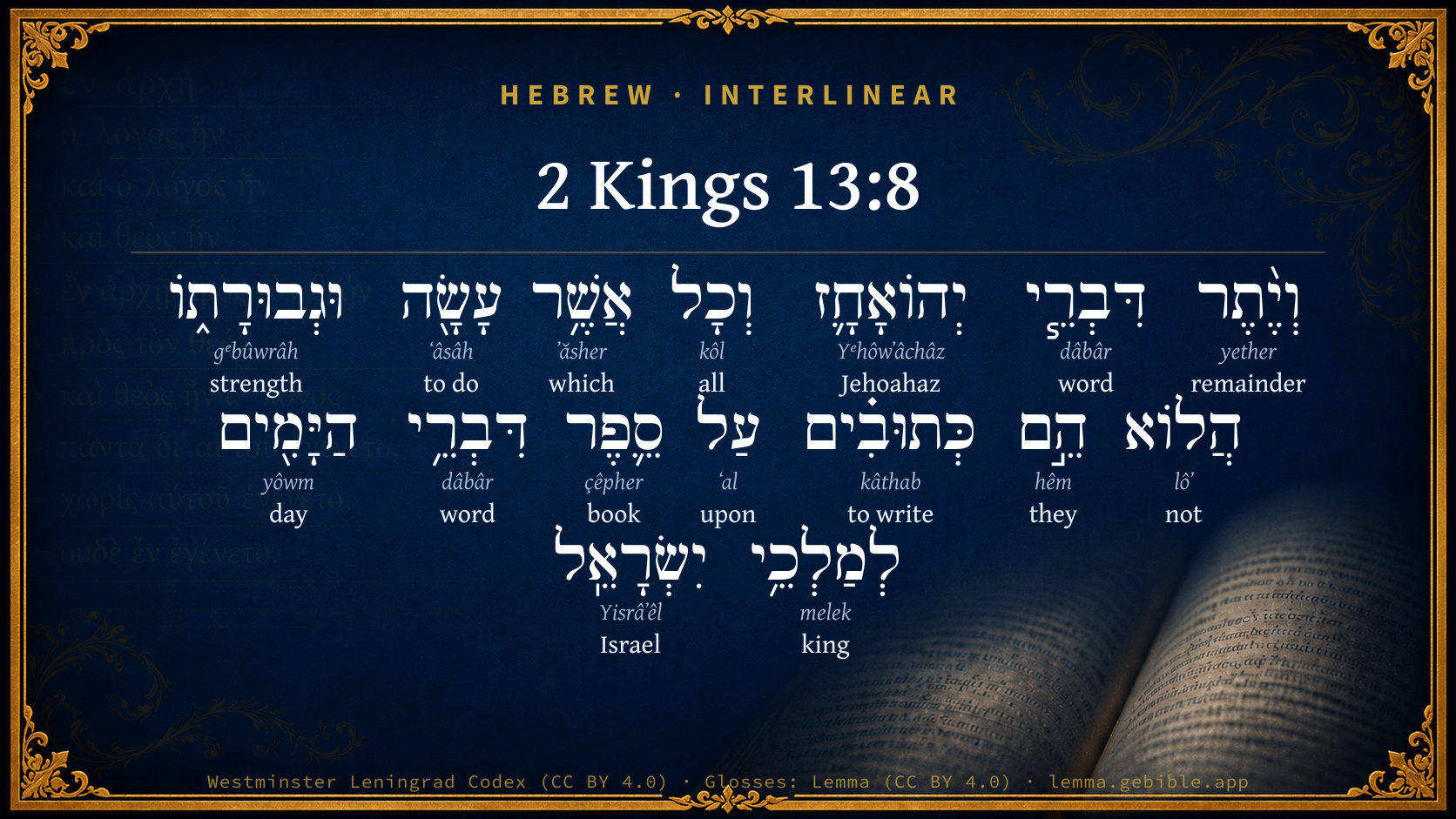
Hebrew (Westminster Leningrad Codex) 2 Kings 13:8 appears in the Hebrew Old Testament. The text above is from the Westminster Leningrad Codex. Each word links to its Strong’s number, a concise gloss, and parsing drawn from the Open Scriptures Hebrew Bible morphology. Click any word for its full Brown-Driver-Briggs (BDB) entry.
Download image
Cite this verse

2 Kings 13:8 (World English Bible). Public Domain. Lemma interlinear Bible study tool, https://lemma.gebible.app/v/2-kings/13/8.

Show BibTeX & RIS
BibTeX
RIS
English Translation
Now the rest of the acts of Jehoahaz, and all that he did, and his might, aren't they written in the book of the chronicles of the kings of Israel?
World English Bible · Public Domain
Download a study sheet

One document with this verse’s original text, its word-by-word gloss line, the meaning frame, cross-references with their text, attributed commentary, and full source and license credits — printable, and it pastes into notes with its structure intact.

This verse Autodidact and up

Study sheet (.html) Plain text (.txt)

A passage Seminary Student

Up to 50 verses in one chapter. A passage sheet keeps up to 6 commentary sources and 12 cross-references per verse, in the order this page ranks them, and says so on the sheet whenever that leaves anything out. Ask for a single verse and you get the Autodidact verse sheet above.

Everything on this page stays free to read, with no account — the sheet is a download of what is already on screen, not access to it.

Want to remove ads? Support Godless Engineer
Compare translations 3

The same verse in 3 English versions, stacked beneath the original-language interlinear above. Click any original word for its lexicon entry.

Each is an independent rendering of the whole verse — the interlinear is not word-aligned to these translations.

Highlighted words mark where these versions differ — a whole-verse word diff, not a word-by-word alignment.

  • World English Bible Public Domain
    Now the rest of the acts of Jehoahaz, and all that he did, and his might, aren't they written in the book of the chronicles of the kings of Israel?
  • King James Version Public Domain
    Now the rest of the acts of Jehoahaz, and all that he did, and his might, are they not written in the book of the chronicles of the kings of Israel?
  • unfoldingWord Literal Text CC BY-SA 4.0
    Now the rest of the matters of Jehoahaz and all that he did and his might, are they not written in the book of the matters of the days of the kings of Israel?

unfoldingWord Literal Text — © unfoldingWord, licensed CC BY-SA 4.0. Word-aligned USFM3 via Door43 (git.door43.org/unfoldingWord/en_ult).

Versions to compare (up to 4)

3 of 4 selected

Show all 18 translations

Every available English version of this verse, each an independent rendering of the whole verse.

  • World English Bible Public Domain
    Now the rest of the acts of Jehoahaz, and all that he did, and his might, aren't they written in the book of the chronicles of the kings of Israel?
  • Berean Standard Bible Public Domain
    As for the rest of the acts of Jehoahaz, along with all his accomplishments and his might, are they not written in the Book of the Chronicles of the Kings of Israel?
  • Majority Standard Bible Public Domain
    As for the rest of the acts of Jehoahaz, along with all his accomplishments and his might, are they not written in the Book of the Chronicles of the Kings of Israel?
  • King James Version Public Domain
    Now the rest of the acts of Jehoahaz, and all that he did, and his might, are they not written in the book of the chronicles of the kings of Israel?
  • American Standard Version (1901) Public Domain
    Now the rest of the acts of Jehoahaz, and all that he did, and his might, are they not written in the book of the chronicles of the kings of Israel?
  • Revised Version (1885) Public Domain
    Now the rest of the acts of Jehoahaz, and all that he did, and his might, are they not written in the book of the chronicles of the kings of Israel?
  • Geneva Bible (1599) Public Domain
    Concerning the rest of the actes of Iehoahaz and all that he did, and his valiant deedes, are they not written in the booke of the Chronicles of the Kings of Israel?
  • Douay-Rheims (1899) Public Domain
    Rut the rest of the acts of Joachaz, and all that he did, and his valour, are they not written in the book of the words of the days of the kings of Israel?
  • Young's Literal Translation Public Domain
    And the rest of the matters of Jehoahaz, and all that he did, and his might, are they not written on the book of the Chronicles of the kings of Israel?
  • Literal Standard Version CC BY-SA 4.0
    And the rest of the matters of Jehoahaz, and all that he did, and his might, are they not written on the scroll of the Chronicles of the Kings of Israel?
  • Unlocked Literal Bible CC BY-SA 4.0
    As for the other matters concerning Jehoahaz, and all that he did and his power, are they not written in the book of the events of the kings of Israel?
  • unfoldingWord Literal Text CC BY-SA 4.0
    Now the rest of the matters of Jehoahaz and all that he did and his might, are they not written in the book of the matters of the days of the kings of Israel?
  • Darby Bible Public Domain
    And the rest of the acts of Jehoahaz, and all that he did, and his might, are they not written in the book of the chronicles of the kings of Israel?
  • World Messianic Bible Public Domain
    Now the rest of the acts of Jehoahaz, and all that he did, and his might, aren’t they written in the book of the chronicles of the kings of Israel?
  • Webster's Bible Public Domain
    Now the rest of the acts of Jehoahaz, and all that he did, and his might, are they not written in the book of the chronicles of the kings of Israel?
  • Free Bible Version CC BY-SA 4.0
    The rest of what happened in Jehoahaz's reign, all he did, and his great achievements are recorded in the Book of Chronicles of the Kings of Israel.
  • Bible in Basic English Public Domain
    Now the rest of the acts of Jehoahaz, and all he did, and his great power, are they not recorded in the book of the history of the kings of Israel?
  • JPS Tanakh (1917) Public Domain
    Now the rest of the acts of Jehoahaz, and all that he did, and his might, are they not written in the book of the chronicles of the kings of Israel?

Literal Standard Version (2020), Covenant Press — licensed CC BY-SA 4.0. Text via the HelloAO Bible API (eBible.org). Unlocked Literal Bible (unfoldingWord) — licensed CC BY-SA 4.0. Text via the HelloAO Bible API (eBible.org). unfoldingWord Literal Text — © unfoldingWord, licensed CC BY-SA 4.0. Word-aligned USFM3 via Door43 (git.door43.org/unfoldingWord/en_ult). Free Bible Version, Dr. Jonathan Gallagher — licensed CC BY-SA 4.0. Text via the HelloAO Bible API (eBible.org).

Word by word

More ways to search: Search by grammar → Find every occurrence → Compare this word →

Practice this passage: Drill this verse → Learn its vocabulary →

יְהוֹאָחָ֛ז
Yᵉhôwʼâchâz
H3059
“Jehoahaz”
Noun, Proper
Part of Speech
Noun
Type
Proper
Full BDB Definition

Origin: from H3068 and H270

TWOT: None

Jehoahaz = "Jehovah has seized" - a king of Judah and son of Josiah - a king of the northern kingdom of Israel and son of Jehu - a king of Judah and son of Jehoram (Ahaziah)
  1. וְיֶ֨תֶר yether H3499 “and · remainder of” Conjunction + Noun, Common, Masculine, Singular, Construct
  2. דִּבְרֵ֧י dâbâr H1697 “words of” Noun, Common, Masculine, Plural, Construct
  3. וְכָל kôl H3605 “and · all of” Conjunction + Noun, Common, Masculine, Singular, Construct
  4. אֲשֶׁ֥ר ʼăsher H834 “which” Particle, Relative
  5. עָשָׂ֖ה ʻâsâh H6213 “to do” Verb, Qal, Perfect, 3rd Person, Masculine, Singular
  6. וּגְבוּרָת֑וֹ gᵉbûwrâh H1369 “and · strength · his” Conjunction + Noun, Common, Feminine, Singular, Construct + Suffix, Personal, 3rd Person, Masculine, Singular
  7. הֲלוֹא lôʼ H3808 “not” Particle, Interrogative + Particle, Negative
  8. הֵ֣ם hêm H1992 “they” Pronoun, Personal, 3rd Person, Masculine, Plural
  9. כְּתוּבִ֗ים kâthab H3789 “written” Verb, Qal, Participle Passive, Masculine, Plural, Absolute
  10. עַל ʻal H5921 “upon” Preposition
  11. סֵ֛פֶר çêpher H5612 “book of” Noun, Common, Masculine, Singular, Construct
  12. דִּבְרֵ֥י dâbâr H1697 “words of” Noun, Common, Masculine, Plural, Construct
  13. הַיָּמִ֖ים yôwm H3117 “the · days” Particle, Definite Article + Noun, Common, Masculine, Plural, Absolute
  14. לְמַלְכֵ֥י melek H4428 “to/for · kings of” Preposition + Noun, Common, Masculine, Plural, Construct
  15. יִשְׂרָאֵֽל Yisrâʼêl H3478 “Israel” Noun, Proper

About this verse

These counts appear in no published source. They are computed here, from the morphology-tagged text and Lemma’s own curated glosses. What Lemma adds →

16
words
15
distinct lemmas
Historical
section

Notable vocabulary

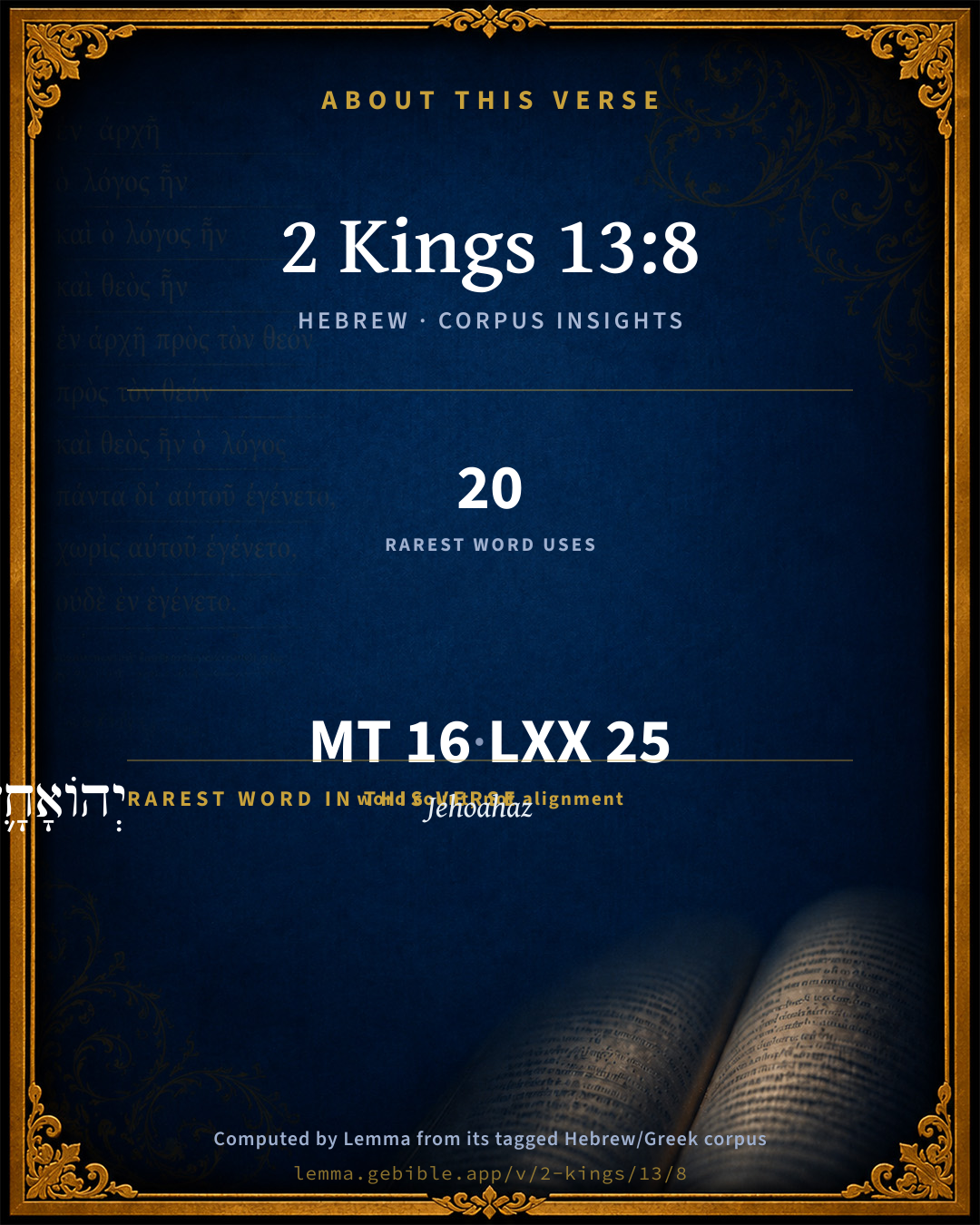
The rarest word here is יְהוֹאָחָ֛ז Jehoahaz H3059 — appearing just 20 times in the whole Hebrew Bible.

Shared distinctive vocabulary

יְהוֹאָחָ֛ז Jehoahaz H3059 occurs in 19 verses of the Hebrew Bible. Also found in:

Grammatical profile

  • 2 verbs
  • 10 nouns
  • 1 pronoun
  • 1 preposition
  • 2 particles

Verb forms

  • עָשָׂ֖ה Qal · Perfect
  • כְּתוּבִ֗ים Qal · Participle Passive

Repetition

A word recurs within this verse — often emphatic in Hebrew:

  • דִּבְרֵ֧י word H1697 ×2

Hebrew & Septuagint length

In English translation the verse runs 30 words from the Hebrew and 33 from the Septuagint (LXX English) — closely comparable.

A rough comparison of the two English renderings, which tokenize alike — not a word-level alignment.

Word counts can differ between the Hebrew and the Greek without any difference in meaning — e.g. the Hebrew direct-object marker אֵת has no separate Greek word, and Greek often adds the article ὁ.

In the original languages it is 16 Hebrew tokens and 25 Greek tokens — but the two are counted differently (Hebrew bundles its prefixes and suffixes into one token; the Greek is in lemma form), so that isn’t a like-for-like length.

Cross-references

5

Topical passages linked to 2 Kings 13:8 in the Treasury of Scripture Knowledge — connected by theme and wording, ordered by reader-vote popularity; previews shown in the World English Bible.

  • 1 Kings 11:4 For it happened, when Solomon was old, that his wives turned away his heart after other gods; and his heart was not perfect with Yahweh his God, as was the heart of David his father.
  • 1 Kings 14:19–20 The rest of the acts of Jeroboam, how he warred, and how he reigned, behold, they are written in the book of the chronicles of the kings of Israel.
  • 1 Kings 14:29 Now the rest of the acts of Rehoboam, and all that he did, aren't they written in the book of the chronicles of the kings of Judah?
  • 1 Kings 14:31 Rehoboam slept with his fathers, and was buried with his fathers in the city of David: and his mother's name was Naamah the Ammonitess. Abijam his son reigned in his place.
  • 2 Kings 10:34–35 Now the rest of the acts of Jehu, and all that he did, and all his might, aren't they written in the book of the chronicles of the kings of Israel?

Cross-references courtesy of OpenBible.info (CC BY 4.0).

Hebrew and Greek witnesses Masoretic Hebrew ↔ Greek Septuagint

The same verse in the two great witnesses to the Old Testament, shown verse-for-verse.

These are two independent witnesses, not word-aligned to each other, and the Septuagint is shown in lemma (dictionary) form.

Hebrew 2 Kings 13:8 Masoretic · Westminster Leningrad Codex

וְיֶ֨תֶר דִּבְרֵ֧י יְהוֹאָחָ֛ז וְכָל אֲשֶׁ֥ר עָשָׂ֖ה וּגְבוּרָת֑וֹ הֲלוֹא הֵ֣ם כְּתוּבִ֗ים עַל סֵ֛פֶר דִּבְרֵ֥י הַיָּמִ֖ים לְמַלְכֵ֥י יִשְׂרָאֵֽל

Now the rest of the acts of Jehoahaz, and all that he did, and his might, aren't they written in the book of the chronicles of the kings of Israel?

World English Bible · Public Domain

Greek LXX 2 Kings 13:8 Septuagint · lemma form

καί ὁ λοιπός ὁ λόγος ιωαχας καί πᾶς ὅσος ποιέω καί ὁ δυναστεία αὐτός οὐ οὗτος γράφω ἐπί βιβλίον λόγος ὁ ἡμέρα ὁ βασιλεύς ἰσραήλ

And the rest of the acts of Joachaz, and all that he did, and his mighty acts are not these things written in the book of the chronicles of the kings of Israel?

LXX2012 (modern English Septuagint) · Public Domain

Hebrew: Westminster Leningrad Codex (CC BY 4.0). Greek: Septuagint (public domain); English from LXX2012 (modern English Septuagint) (Public Domain). How the Septuagint differs from the Hebrew →

Targum (Aramaic paraphrase)

1

The Targum is the ancient Jewish Aramaic paraphrase of the Hebrew Scriptures — an interpretive translation, not the Hebrew text itself. Onkelos (literal) and Pseudo-Jonathan (expansive) render the Torah, and Jonathan the Prophets. Coverage is partial: where no permissively-licensed English translation exists for a verse, only the Aramaic is shown. This is verse-level text, not a word-by-word alignment to the Hebrew.

  1. Targum Jonathan Prophets (Joshua–Malachi)
    וּשְׁאָר פִּתְגָמֵי יְהוֹאָחָז וְכָל דַעֲבַד וּגְבוּרְתֵּיהּ הֲלָא אִינוּן כְּתִיבִין עַל סְפָר פִּתְגָמֵי יוֹמַיָא לְמַלְכֵי יִשְׂרָאֵל:

    (no public-domain English translation for this verse)

    Targum Jonathan — Aramaic: “Mikraot Gedolot” (public domain). English: “Sefaria Community Translation” (CC0 1.0 (public-domain dedication)); “London "Chaldee Paraphrase," 1871” (public domain). Text via Sefaria.

Commentary

Notes on 2 Kings 13:8 from classic Christian and Jewish commentators (each source and its license shown beneath its notes). The classic Christian expositions comment on the surrounding passage and are grouped to its opening verse, so a note may address several verses; the Jewish commentaries on the Tanakh (Rashi and others) are per-verse, so they appear only where the commentator wrote on this verse.

Lemma curates 59 commentaries, every one of them public domain or Creative Commons licensed, each selected and text-cleaned for this edition rather than reprinted as found. About our sources →

Jamieson, Fausset & Brown

Robert Jamieson, A. R. Fausset & David Brown

JOASH SUCCEEDS HIM. (2Ki. 13:8-25)

his might--This is particularly noticed in order to show that the grievous oppression from foreign enemies, by which the Israelites were ground down, was not owing to the cowardice or imbecility of their king, but solely to the righteous and terrible judgment of God for their foul apostasy.

Jamieson, Fausset & Brown — Commentary Critical and Explanatory on the Whole Bible (1871) — public domain (CC PDM 1.0). Text via the HelloAO Bible API.

Trapp's Complete Commentary

John Trapp

2Ki 13:8 Now the rest of the acts of Jehoahaz, and all that he did, and his might, [are] they not written in the book of the chronicles of the kings of Israel?

Ver. 8. And his might.] He did what he could, {a} but to no purpose, because God was against him.

{a} Defendit se quoad potuit. - A Lapide.

John Trapp, A Commentary or Exposition upon All the Books of the Old and New Testament (1647–1656) — public domain. Text from a community e-Sword module.

The Biblical Illustrator

Joseph S. Exell

2Ki_13:8

The rest of the acts of Jehoahaz.

Records of life

How very little we know even of the men whose lives are written: The rest of the acts of Jehoahaz and all that he did, and his might, are they not Written in the book of the chronicles of the kings of Israel No! Another hand there indeed endeavours to sketch the life, but how much is left out! No human chronicler can put down all things concerning the subject which he has undertaken to depict. But the rest of our lives is written. A diary is kept in heaven; the journal is not published for the perusal of others; but the whole life, day by day, is put down in the book of remembrance; and we shall be able to recognise the writing, and to confirm the accuracy of the minute. We cannot get away from it, there is the writing, and it abides--a perpetual witness for us or against us. What is the Divine scribe now writing? The pen is going. We are obliged to use such figures to represent the spiritual reality. The writing is now proceeding: every thought registered, every deed chronicled, every days work added up and carried over to the next page. It is a solemn thing to live! We are stewards, trustees, servants sent on messages, and entrusted with specified duties, and we are expected back with a definite answer and a complete report of our lives. (J. Parker.)

The Biblical Illustrator, edited by Joseph S. Exell (c. 1880s–1900s) — public domain. Text from a community e-Sword module.

Joseph Benson's Commentary

2Ki 13:8. And his might — For, though he had not success, he showed much personal valour and courage. Which is observed to intimate, that the Israelites were not conquered because of the baseness and cowardice of their king; but merely from the righteous and dreadful judgments of God, who was now resolved to reckon with them for their apostacy.

Joseph Benson's Commentary on the Old and New Testaments (1811–1818) — public domain. Text from a community e-Sword module.

Ellicott's Commentary for English Readers

(8) And his might.—Or, prowess. The reference is to his wars with the Syrians.

A Bible Commentary for English Readers, edited by Charles John Ellicott (1878–1897) — public domain. Text from a community e-Sword module.

John Gill's Exposition

Now the rest of the acts of Jehoahaz, and all that he did, and his might,.... Which he exerted against the Syrians, being a man of courage, though not successful, because the Lord was not with him, but against him:

are they not written in the book of the chronicles of the kings of Israel? where their acts, and the events of their reigns, were recorded.

John Gill's Exposition of the Whole Bible (1746–1763) — public domain (CC PDM 1.0). Text via the HelloAO Bible API.

Haydock's Catholic Bible Commentary

Valour, or personal courage, (Calmet) though he gained no complete victory. The most valiant are not always successful. (Tirinus) --- Fortiter ille facit qui miser esse potest. (Martial) (Haydock) --- Joachaz did not quite sink under his troubles. (Tirinus)

George Leo Haydock (1774–1849), Haydock's Catholic Family Bible and Commentary, 1859 edition — public domain. Excludes Psalms (Douay-Rheims chapter numbering differs from Protestant) and Deuterocanonical books (Catholic canon only).

Matthew Poole's English Annotations

His might; for though his success was not good, he showed much personal valour and courage; which is noted to intimate that the Israelites were not conquered, because of the baseness and cowardice of their king, but merely from the righteous and dreadful judgment of God, who was now resolved to reckon with them for their filthy apostacy.

Matthew Poole's English Annotations on the Holy Bible (1683–1685) — public domain. Text from a community e-Sword/MySword module.

The Pulpit Commentary

Now the rest of the acts of Jehoahaz, and all that he did, and his might; rather, his prowess, or his valor. Though defeated and reduced to subjection by the Syrians, yet Jehoahaz had distinguished himself, and shown his own personal courage, in the course of the war.

Are they not written in the book of the chronicles of the kings of Israel?. (comp. 2Ki_1:18) The regular use of the phrase is one of the indications that the two Books of the Kings are by one author, and form one book.

Vers. 8-19. Joash and Elisha.

Jehoahaz reigned for seventeen years, and was succeeded by his son Jehoash, or Joash. In this reign, after a long interval, Elisha again appears.

I ACCESSION OF JOASH. The change of rulers was in some respects a gain for Israel. Joash was a man of better disposition than his father, and under his reign the kingdom, which has been so sorely broken down, was again partially built up. But he still adhered to the cardinal sin of the nation the calf-worship-so that of him also the formula has to be Employed,"he did that which was evil in the sight of the Lord." That is, notwithstanding military successes, and some signs of respect for and attention to Elisha"s monitions, things still remained on a fundamentally false basis in the kingdom. So Herod feared John the Baptist, and observed him, and, when he heard him, did many things, and heard him gladly, yet remained a bad man. (Mar_6:20) God"s judgment on men is not according to superficial characteristics, but according to the fundamental bent of their minds.

II ELISHA ON HIS DEATHBED.

1. Elisha"s sickness. Elisha by this time was a very old man. He was Elijah"s attendant in the reign of Ahab; he was a prominent figure in the reigns of Ahaziah and Jehoram; he gave the commission to Jehu to overthrow the incurably corrupt dynasty of Ahab, and lived through the twenty-eight years of that king"s reign; he witnessed the troubles of the reign of Jehoahaz, and was perhaps the means of that monarch being led to humble himself before God; now, in Joash"s reign, he is still alive. From the time of Jehu"s accession he seems to have taken little part in the political life of the nation; at least, no accounts of his activity remain to us. When the curtain again lifts he is lying on his deathbed. It was not to be with him as with Elijah. He must pay the common debt to nature, experience the infirmities of age, be smitten with sickness, and succumb to death. The longest and most useful life thus comes to its close. It is well when, on a deathbed, one can look back on a life which has been spent in the service of God.

2. The visit of Joash. To the bedside of the dying Elisha came the King of Israel, apparently drawn thereto by sincere reverence and respect for the aged prophet. He came to him, it is said, and wept, saying, "O my father, my father, the chariot of Israel, and the horsemen thereof!" This language speaks to former relations of intimacy and friendship between the king and prophet. Probably Elisha had been the counselor of his youth, and had guided and encouraged him in his duties as king. It is to be remembered also that the promised deliverance from the Syrians was not yet begun. The kingdom was still in humiliation and distress, and Joash may have felt as if, with the death of Elisha, the last spark of hope for the nation would be extinguished. We see how, in the hour of extremity, good men are felt, even by the ungodly, to be a tower of strength to the state. Their presence and prayers are its truest bulwark. The full extent of the loss sustained by their removal is only realized when they are taken away. We see also how possible it is to have great respect for God"s servants, to appreciate their worth to the community, and to weep over and deeply regret their loss, and yet not do the things that they say. Joash shows fairly well in this narrative, but his conduct as a whole is stamped as "evil in the sight of the Lord.

III THE ARROW OF DELIVERANCE. Once and again had mighty deliverances for Israel been announced through Elisha. The last was to be the greatest of all.

1. The pledge of deliverance. Raising himself up on his bed, prophetic fire gleaming in his eye, Elisha bade the young and stalwart king take his bow and arrows. Joash did as the prophet required, not yet understanding his meaning, but no doubt forecasting some encouraging message. Elisha then bade him put his hand upon his bow, and placing his own hands on the king"s, told him further to open the window eastward, and shoot. This was done. Then the symbolic action was explained. That arrow he had shot into the air was the arrow of the Lord"s deliverance, an arrow pledging deliverance from the yoke of Syria. It was shot eastwards, because the Syrian ravages were com-inertly from that quarter. (2Ki_10:32, 2Ki_10:33) The action declares:

(1) That deliverance in trouble is from God only. As he alone can give it, so he is the true Source from which to seek it.

(2) God employs human agency in his deliverances. The bow and arrows were the symbols of the human instrumentality. Joash had to put his hands upon the bow. It was he who shot the arrow. It was he who was to smite the Syrians. Man has his part given him in all God"s works of deliverance on earth.

(3) The human agent could only succeed as God strengthened him. Elisha put his hands upon Joash"s, signifying that the power to gain the predicted victories came from God. His hands were to be "made strong by the hands of the mighty God of Jacob". (Gen_49:24) It is on God"s power we must always rely for victory. "Not unto us, O Lord, not unto us," etc. (Psa_115:1)

2. The victories in detail. The symbol was not yet complete. Joash"s quiver was yet full, minus that one arrow, and the prophet bade him shoot other arrows, this time to the ground, as if smiting something down to it. Joash took his arrows and began to smite. He shot once, and twice, and thrice, then stayed. The prophet was wroth at this, and told him he should have gone on smiting, then would the Syrians have been wholly consumed, whereas now he would only gain three victories over them. These successive smitings, therefore, represented the victories in detail which Joash would gain over the Syrians. One is at a loss at first to see why the prophet should have dealt so severely, with the king for what may have been a perfectly natural mistake. But the stopping with the third arrow no doubt brought to light a certain weak line in Joash"s character a want of perseverance, a tendency to be satisfied with partial results, to stop short of the ultimate goal of effort. And one can see how that may have hindered his complete success over the Syrians. We learn:

(1) Very trivial actions often reveal a great deal of character.

(2) We often have not from God because we ask not. These shootings of the arrows were at once prayers for victories from God, and pledges of victories. Joash, as it were, asked for only three victories, and he only got three. Had he asked for more, he would have got more. Had Abraham not ceased pleading for Sodom when he did, he might have got a yet further extension of grace for that doomed city. (Gen_18:32, Gen_18:33) It is never in God we are straitened in our prayers; it is only in ourselves.

(3) It displeases God that we do not ask more from him. His controversy with us is not that we ask too much, but that we do not ask enough. Joash missed the full blessing by stopping in his asking. J.O.

The Pulpit Commentary (1880–1919), ed. H.D.M. Spence-Jones & Joseph S. Exell — public domain. Text from a community e-Sword module.

John Wesley's Explanatory Notes

His might - For though his success was not good, he shewed much personal valour. Which is noted to intimate, that the Israelites were not conquered, because of the cowardice of their king, but merely from the righteous judgment of God, who was now resolved to reckon with them for their apostacy.

John Wesley, Explanatory Notes Upon the Whole Bible (1754–1765) — public domain. Text via the GEBible commentary corpus.

unfoldingWord translationNotes

Door43 World Missions Community

are they not written in the book of the events of the kings of Israel?

This question is used to remind the reader that the acts of Jehoahaz are recorded in another book. See how this phrase is translated in 2 Kings 1:18. AT: "they are written in the book of the events of the kings of Israel." (See: Rhetorical Question)

slept with his ancestors

This is a polite way of saying that he died. (See: Euphemism)

translationWords

asleep

bury

Joash

unfoldingWord translationNotes — © Distant Shores Media and the Door43 World Missions Community, licensed CC BY-SA 4.0. Source: git.door43.org/Door43/en_tn.

Lesson kit

Teaching starters — assembled from the data on this page, not authored interpretation. Every prompt links to the verse data it draws on. Edit before teaching.

2 Kings, in the Historical, opens this verse with 16 words (15 distinct Hebrew lemmas). Its most distinctive word is Yᵉhôwʼâchâz (“Jehoahaz”). A historical commentator’s framing appears above. Read the whole chapter for the surrounding context.

Discussion questions

  1. What does “Jehoahaz” (Yᵉhôwʼâchâz) contribute to the verse as a whole?
  2. 2 Kings 10:35 shares the word «Jehoahaz» with this verse. How do the two illuminate each other?
  3. “word” occurs 2× in this one verse. What is the effect of the repetition?
  4. These translations render this verse differently; the difference is in the English rendering, not the original. What questions does that raise?
  5. The verb «עָשָׂ֖ה» is Qal Perfect. How does its form color the action?
  6. Reading how Jamieson, Fausset & Brown and Trapp's Complete Commentary read this verse, where do the two commentators agree and where do they part?

Things to notice

Reading settings

Reading text

Shown beneath each verse's original-language words.

Old Testament
Old Testament edition

Read the OT as the Masoretic Hebrew (MT) or the Greek Septuagint (LXX).

English shown for the Greek Septuagint (in the Hebrew ↔ Greek comparison).

Comparing translations? Open the Compare panel on any verse page to stack up to four side by side.