
1 Chronicles 24:6

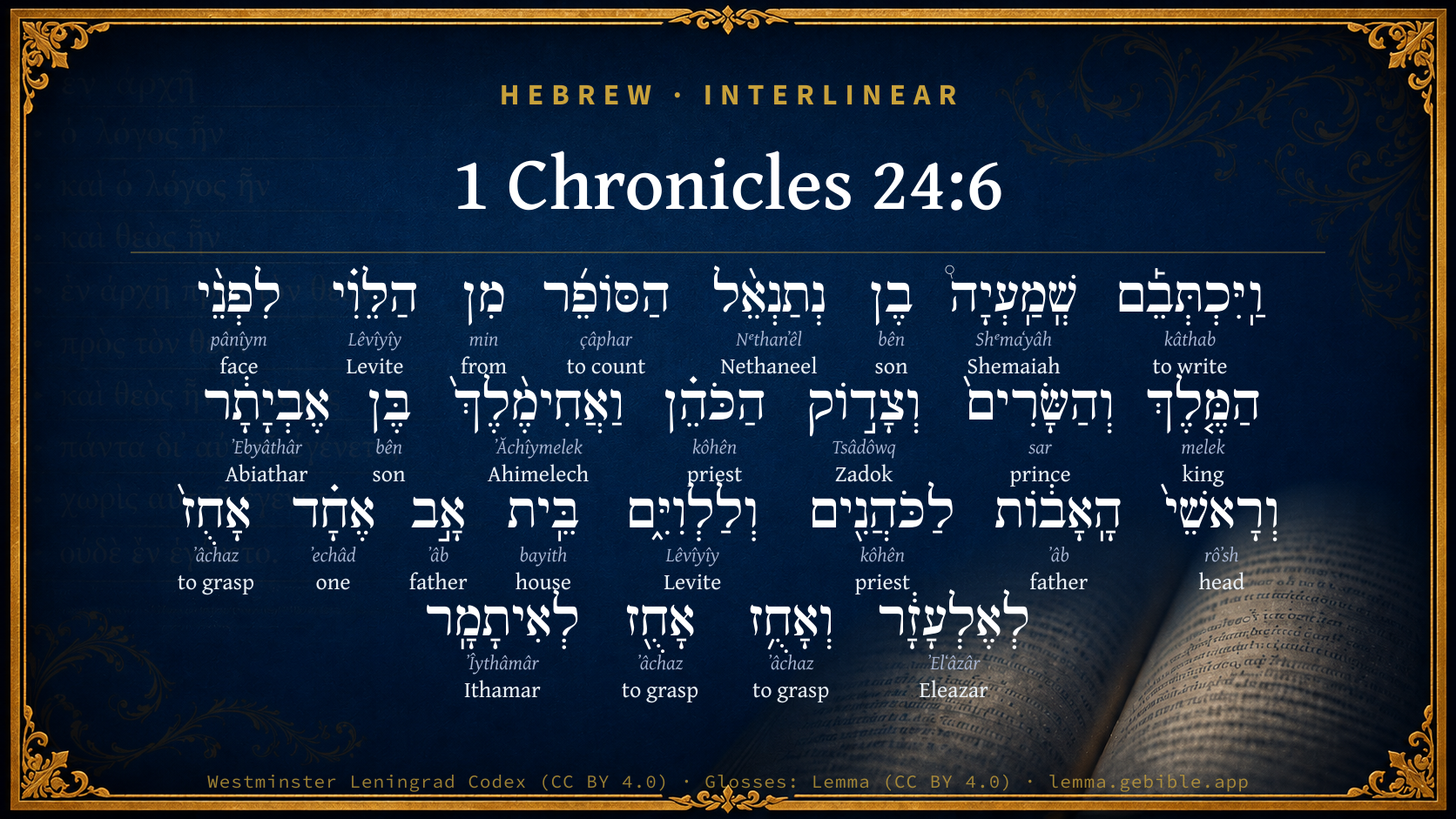
Hebrew (Westminster Leningrad Codex) 1 Chronicles 24:6 appears in the Hebrew Old Testament. The text above is from the Westminster Leningrad Codex. Each word links to its Strong’s number, a concise gloss, and parsing drawn from the Open Scriptures Hebrew Bible morphology. Click any word for its full Brown-Driver-Briggs (BDB) entry.
Download image
Cite this verse

1 Chronicles 24:6 (World English Bible). Public Domain. Lemma interlinear Bible study tool, https://lemma.gebible.app/v/1-chronicles/24/6.

Show BibTeX & RIS
BibTeX
RIS
English Translation
Shemaiah the son of Nethanel the scribe, who was of the Levites, wrote them in the presence of the king, and the princes, and Zadok the priest, and Ahimelech the son of Abiathar, and the heads of the fathers' [houses] of the priests and of the Levites; one fathers' house being taken for Eleazar, and one taken for Ithamar.
World English Bible · Public Domain
Download a study sheet

One document with this verse’s original text, its word-by-word gloss line, the meaning frame, cross-references with their text, attributed commentary, and full source and license credits — printable, and it pastes into notes with its structure intact.

This verse Autodidact and up

Study sheet (.html) Plain text (.txt)

A passage Seminary Student

Up to 50 verses in one chapter. A passage sheet keeps up to 6 commentary sources and 12 cross-references per verse, in the order this page ranks them, and says so on the sheet whenever that leaves anything out. Ask for a single verse and you get the Autodidact verse sheet above.

Everything on this page stays free to read, with no account — the sheet is a download of what is already on screen, not access to it.

Want to remove ads? Support Godless Engineer
Compare translations 3

The same verse in 3 English versions, stacked beneath the original-language interlinear above. Click any original word for its lexicon entry.

Each is an independent rendering of the whole verse — the interlinear is not word-aligned to these translations.

Highlighted words mark where these versions differ — a whole-verse word diff, not a word-by-word alignment.

  • World English Bible Public Domain
    Shemaiah the son of Nethanel the scribe, who was of the Levites, wrote them in the presence of the king, and the princes, and Zadok the priest, and Ahimelech the son of Abiathar, and the heads of the fathers' [houses] of the priests and of the Levites; one fathers' house being taken for Eleazar, and one taken for Ithamar.
  • King James Version Public Domain
    And Shemaiah the son of Nethaneel the scribe, one of the Levites, wrote them before the king, and the princes, and Zadok the priest, and Ahimelech the son of Abiathar, and before the chief of the fathers of the priests and Levites: one principal household being taken for Eleazar, and one taken for Ithamar.
  • unfoldingWord Literal Text CC BY-SA 4.0
    And Shemaiah, the son of Nethanel, the scribe from the Levites, wrote them to the face of the king and the officials and Zadok the priest, and Ahimelech, the son of Abiathar, and the heads of the fathers for the priests and for the Levites. One house of a father was taken for Eleazar, and was taken, was taken for Ithamar.

unfoldingWord Literal Text — © unfoldingWord, licensed CC BY-SA 4.0. Word-aligned USFM3 via Door43 (git.door43.org/unfoldingWord/en_ult).

Versions to compare (up to 4)

3 of 4 selected

Show all 18 translations

Every available English version of this verse, each an independent rendering of the whole verse.

  • World English Bible Public Domain
    Shemaiah the son of Nethanel the scribe, who was of the Levites, wrote them in the presence of the king, and the princes, and Zadok the priest, and Ahimelech the son of Abiathar, and the heads of the fathers' [houses] of the priests and of the Levites; one fathers' house being taken for Eleazar, and one taken for Ithamar.
  • Berean Standard Bible Public Domain
    The scribe, Shemaiah son of Nethanel, a Levite, recorded their names in the presence of the king and of the officers: Zadok the priest, Ahimelech son of Abiathar, and the heads of families of the priests and the Levites—one family being taken from Eleazar, and then one from Ithamar.
  • Majority Standard Bible Public Domain
    The scribe, Shemaiah son of Nethanel, a Levite, recorded their names in the presence of the king and of the officers: Zadok the priest, Ahimelech son of Abiathar, and the heads of families of the priests and the Levites—one family being taken from Eleazar, and then one from Ithamar.
  • King James Version Public Domain
    And Shemaiah the son of Nethaneel the scribe, one of the Levites, wrote them before the king, and the princes, and Zadok the priest, and Ahimelech the son of Abiathar, and before the chief of the fathers of the priests and Levites: one principal household being taken for Eleazar, and one taken for Ithamar.
  • American Standard Version (1901) Public Domain
    And Shemaiah the son of Nethanel the scribe, who was of the Levites, wrote them in the presence of the king, and the princes, and Zadok the priest, and Ahimelech the son of Abiathar, and the heads of the fathers' `houses' of the priests and of the Levites; one fathers' house being taken for Eleazar, and one taken for Ithamar.
  • Revised Version (1885) Public Domain
    And Shemaiah the son of Nethanel the scribe, who was of the Levites, wrote them in the presence of the king, and the princes, and Zadok the priest, and Ahimelech the son of Abiathar, and the heads of the fathers’ houses of the priests and of the Levites: one fathers’ house being taken for Eleazar, and one taken for Ithamar.
  • Geneva Bible (1599) Public Domain
    And Shemaiah the sonne of Nethaneel the scribe of the Leuites, wrote them before ye King and the princes, and Zadok the Priest, and Ahimelech the sonne of Abiathar, and before ye chiefe fathers of the Priests and of the Leuites, one familie being reserued for Eleazar, and another reserued for Ithamar.
  • Douay-Rheims (1899) Public Domain
    And Semeias the son of Nathanael the scribe a Levite, wrote them down before the king and the princes, and Sadoc the priest, and Ahimelech the son of Abiathar, and the princes also of the priestly and Levitical families: one house, which was over the rest, of Eleazar: and another house, which had the rest under it, of Ithamar.
  • Young's Literal Translation Public Domain
    And Shemaiah son of Nethaneel the scribe, of the Levites, writeth them before the king and the princes, and Zadok the priest, and Ahimelech son of Abiathar, and heads of the fathers, for priests and for Levites: one house of a father being taken possession of for Eleazar, and one being taken possession of for Ithamar.
  • Literal Standard Version CC BY-SA 4.0
    And Shemaiah son of Nethaneel the scribe, of the Levites, writes them before the king, and the princes, and Zadok the priest, and Ahimelech son of Abiathar, and heads of the fathers for priests and for Levites, one house of a father being taken possession of for Eleazar and one being taken possession of for Ithamar.
  • Unlocked Literal Bible CC BY-SA 4.0
    Shemaiah son of Nethanel the scribe, a Levite, wrote down their names in the presence of the king, the officials, Zadok the priest, Ahimelech son of Abiathar, and the leaders of the priestly and Levite families. One clan was drawn by lot from Eleazar's descendants, and then the next would be drawn from Ithamar's descendants.
  • unfoldingWord Literal Text CC BY-SA 4.0
    And Shemaiah, the son of Nethanel, the scribe from the Levites, wrote them to the face of the king and the officials and Zadok the priest, and Ahimelech, the son of Abiathar, and the heads of the fathers for the priests and for the Levites. One house of a father was taken for Eleazar, and was taken, was taken for Ithamar.
  • Darby Bible Public Domain
    And Shemaiah the son of Nethaneel the scribe, [one] of the Levites, inscribed them before the king, and the princes, and Zadok the priest, and Ahimelech the son of Abiathar, and the chief fathers of the priests and Levites: one father's house was drawn for Eleazar, and one drawn for Ithamar.
  • World Messianic Bible Public Domain
    Shemaiah the son of Nethanel the scribe, who was of the Levites, wrote them in the presence of the king, the princes, Zadok the priest, Ahimelech the son of Abiathar, and the heads of the fathers’ households of the priests and of the Levites; one fathers’ house being taken for Eleazar, and one taken for Ithamar.
  • Webster's Bible Public Domain
    And Shemaiah the son of Nethaneel the scribe, one of the Levites, wrote them before the king, and the princes, and Zadok the priest, and Ahimelech the son of Abiathar, and before the chief of the fathers of the priests and Levites: one principal household being taken for Eleazar, and one taken for Ithamar.
  • Free Bible Version CC BY-SA 4.0
    Shemaiah son of Nethanel, a Levite, was the secretary. He wrote down the names and assignments in the presence of the king, the officials, Zadok the priest, Ahimelech son of Abiathar, and the family leaders of the priests and Levites. One family from Eleazar and one from Ithamar were chosen in turn.
  • Bible in Basic English Public Domain
    And Shemaiah, the son of Nethanel the scribe, who was a Levite, put down their names in writing, the king being present with the rulers, and Zadok the priest, and Ahimelech, the son of Abiathar, and the heads of families of the priests and the Levites; one family being taken for Eleazar and then one for Ithamar, and so on.
  • JPS Tanakh (1917) Public Domain
    And Shemaiah the son of Nethanel the scribe, who was of the Levites, wrote them in the presence of the king, and the princes, and Zadok the priest, and Ahimelech the son of Abiathar, and the heads of the fathers' houses of the priests and of the Levites: one father's house being taken for Eleazar, and proportionately for Ithamar.

Literal Standard Version (2020), Covenant Press — licensed CC BY-SA 4.0. Text via the HelloAO Bible API (eBible.org). Unlocked Literal Bible (unfoldingWord) — licensed CC BY-SA 4.0. Text via the HelloAO Bible API (eBible.org). unfoldingWord Literal Text — © unfoldingWord, licensed CC BY-SA 4.0. Word-aligned USFM3 via Door43 (git.door43.org/unfoldingWord/en_ult). Free Bible Version, Dr. Jonathan Gallagher — licensed CC BY-SA 4.0. Text via the HelloAO Bible API (eBible.org).

Word by word

More ways to search: Search by grammar → Find every occurrence → Compare this word →

Practice this passage: Drill this verse → Learn its vocabulary →

נְתַנְאֵ֨ל
Nᵉthanʼêl
H5417
“Nethaneel”
Noun, Proper
Part of Speech
Noun
Type
Proper
Full BDB Definition

Origin: from H5414 and H410

TWOT: None

Nethaneel = "given of God" - son of Zuar and a chief of the tribe of Issachar at the exodus - the 4th son of Jesse and a brother of David - a priest in the reign of David who blew the trumpet before the ark when it was brought from the house of Obed-edom - a representative of the priestly family of Jedaiah in the time of Joiakim - a priest of the family of Pashur who had a foreign wife in the time of Ezra - a Levite, father of Shemaiah the scribe in the reign of David - a Levite, son of Obed-edom - a chief of the Levites in the reign of king Josiah of Judah - a prince of Judah in the reign of king Jehoshaphat of Judah who was sent by the king to teach in the cities of the kingdom - a Levite of the sons of Asaph who played a musical instrument at the dedication of the wall of Jerusalem - perhaps the same as 5
  1. וַֽיִּכְתְּבֵ֡ם kâthab H3789 “and · to write · them” Conjunction + Verb, Qal, Sequential Imperfect, 3rd Person, Masculine, Singular + Suffix, Personal, 3rd Person, Masculine, Plural
  2. שְֽׁמַֽעְיָה֩ Shᵉmaʻyâh H8098 “Shemaiah” Noun, Proper
  3. בֶן bên H1121 “son of” Noun, Common, Masculine, Singular, Construct
  4. הַסּוֹפֵ֜ר çâphar H5608 “the · scribe” Particle, Definite Article + Noun, Common, Masculine, Singular, Absolute
  5. מִן min H4480 “from” Preposition
  6. הַלֵּוִ֗י Lêvîyîy H3881 “the · Levite” Particle, Definite Article + Noun, Gentilic, Masculine, Singular, Absolute
  7. לִפְנֵ֨י pânîym H6440 “to/for · face(s) of” Preposition + Noun, Common, Both, Plural, Construct
  8. הַמֶּ֤לֶךְ melek H4428 “the · king” Particle, Definite Article + Noun, Common, Masculine, Singular, Absolute
  9. וְהַשָּׂרִים֙ sar H8269 “and · the · princes” Conjunction + Particle, Definite Article + Noun, Common, Masculine, Plural, Absolute
  10. וְצָד֣וֹק Tsâdôwq H6659 “and · Zadok” Conjunction + Noun, Proper
  11. הַכֹּהֵ֗ן kôhên H3548 “the · priest” Particle, Definite Article + Noun, Common, Masculine, Singular, Absolute
  12. וַאֲחִימֶ֨לֶךְ֙ ʼĂchîymelek H288 “and · Ahimelech” Conjunction + Noun, Proper
  13. בֶּן bên H1121 “son of” Noun, Common, Masculine, Singular, Construct
  14. אֶבְיָתָ֔ר ʼEbyâthâr H54 “Abiathar” Noun, Proper
  15. וְרָאשֵׁי֙ rôʼsh H7218 “and · heads of” Conjunction + Noun, Common, Masculine, Plural, Construct
  16. הָֽאָב֔וֹת ʼâb H1 “the · fathers” Particle, Definite Article + Noun, Common, Masculine, Plural, Absolute
  17. לַכֹּהֲנִ֖ים kôhên H3548 “to/for the · priests” Preposition, Determined + Noun, Common, Masculine, Plural, Absolute
  18. וְלַלְוִיִּ֑ם Lêvîyîy H3881 “and · to/for the · Levites” Conjunction + Preposition, Determined + Noun, Gentilic, Masculine, Plural, Absolute
  19. בֵּֽית bayith H1004 “house of” Noun, Common, Masculine, Singular, Construct
  20. אָ֣ב ʼâb H1 “father” Noun, Common, Masculine, Singular, Absolute
  21. אֶחָ֗ד ʼechâd H259 “one” Adjective, Cardinal number, Masculine, Singular, Absolute
  22. אָחֻז֙ ʼâchaz H270 “grasped” Verb, Qal, Participle Passive, Masculine, Singular, Absolute
  23. לְאֶלְעָזָ֔ר ʼElʻâzâr H499 “to/for · Eleazar” Preposition + Noun, Proper
  24. וְאָחֻ֥ז ʼâchaz H270 “and · grasped” Conjunction + Verb, Qal, Participle Passive, Masculine, Singular, Absolute
  25. אָחֻ֖ז ʼâchaz H270 “grasped” Verb, Qal, Participle Passive, Masculine, Singular, Absolute
  26. לְאִיתָמָֽר ʼÎythâmâr H385 “to/for · Ithamar” Preposition + Noun, Proper

About this verse

These counts appear in no published source. They are computed here, from the morphology-tagged text and Lemma’s own curated glosses. What Lemma adds →

27
words
21
distinct lemmas
Historical
section

Notable vocabulary

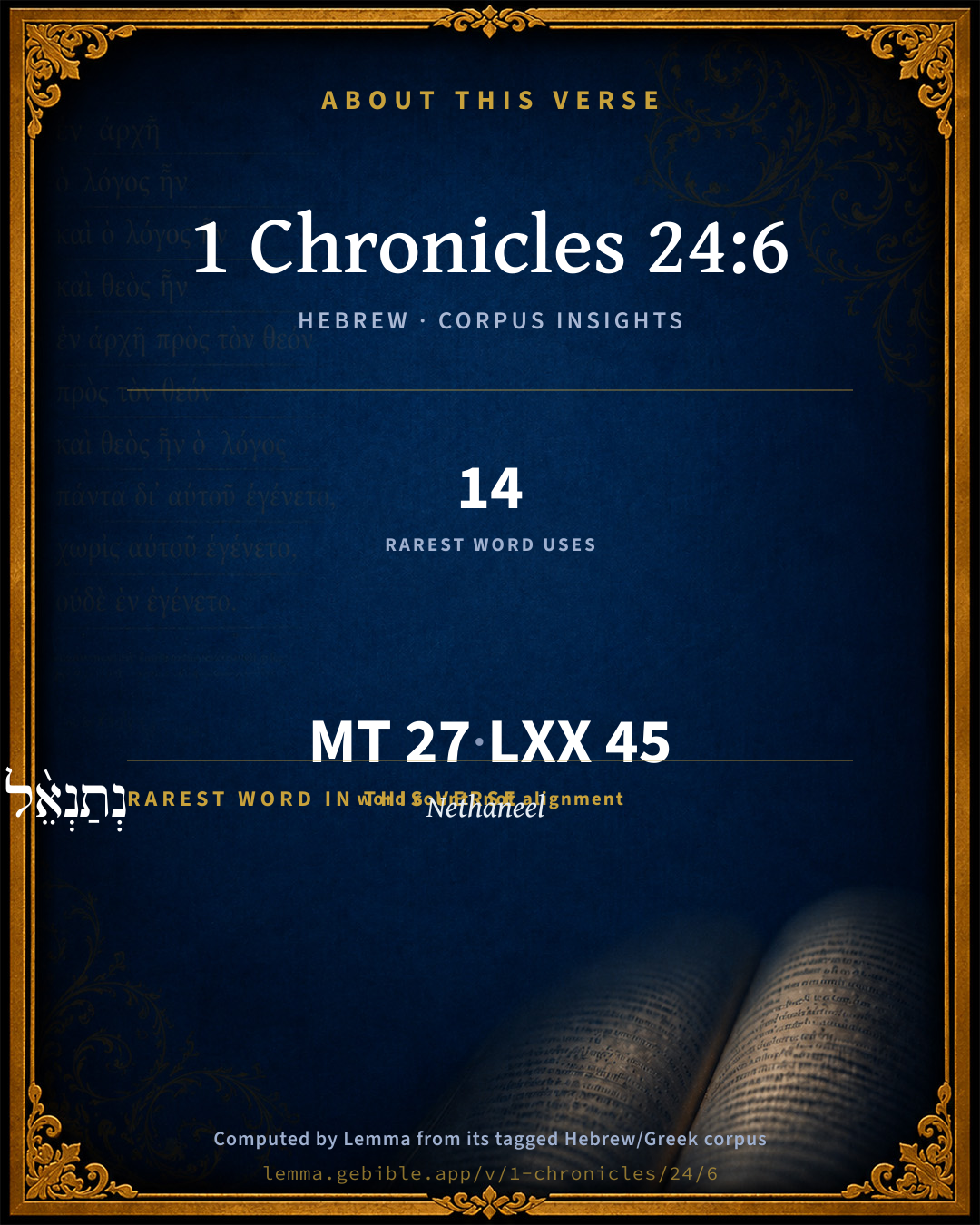
The rarest word here is נְתַנְאֵ֨ל Nethaneel H5417 — appearing just 14 times in the whole Hebrew Bible.

Shared distinctive vocabulary

נְתַנְאֵ֨ל Nethaneel H5417 occurs in 14 verses of the Hebrew Bible. Also found in:

Grammatical profile

  • 4 verbs
  • 21 nouns
  • 1 adjective
  • 1 preposition

Verb forms

  • וַֽיִּכְתְּבֵ֡ם Qal · Sequential Imperfect
  • אָחֻז֙ Qal · Participle Passive
  • וְאָחֻ֥ז Qal · Participle Passive
  • אָחֻ֖ז Qal · Participle Passive

Repetition

Words recur within this verse — often emphatic in Hebrew:

  • אָחֻז֙ to grasp H270 ×3
  • בֶן son H1121 ×2
  • הַלֵּוִ֗י Levite H3881 ×2
  • הַכֹּהֵ֗ן priest H3548 ×2
  • הָֽאָב֔וֹת father H1 ×2

Hebrew & Septuagint length

In English translation the verse runs 59 words from the Hebrew and 59 from the Septuagint (LXX English) — the same length.

A rough comparison of the two English renderings, which tokenize alike — not a word-level alignment.

Word counts can differ between the Hebrew and the Greek without any difference in meaning — e.g. the Hebrew direct-object marker אֵת has no separate Greek word, and Greek often adds the article ὁ.

In the original languages it is 27 Hebrew tokens and 45 Greek tokens — but the two are counted differently (Hebrew bundles its prefixes and suffixes into one token; the Greek is in lemma form), so that isn’t a like-for-like length.

Cross-references

9

Topical passages linked to 1 Chronicles 24:6 in the Treasury of Scripture Knowledge — connected by theme and wording, ordered by reader-vote popularity; previews shown in the World English Bible.

  • 1 Chronicles 18:16 and Zadok the son of Ahitub, and Abimelech the son of Abiathar, were priests; and Shavsha was scribe;
  • 1 Kings 4:3 Elihoreph and Ahijah, the sons of Shisha, scribes; Jehoshaphat the son of Ahilud, the recorder;
  • 1 Chronicles 23:24 These were the sons of Levi after their fathers' houses, even the heads of the fathers' [houses] of those of those who were counted, in the number of names by their polls, who did the work for the service of the house of Yahweh, from twenty years old and upward.
  • 2 Chronicles 34:13 Also they were over the bearers of burdens, and set forward all who did the work in every manner of service: and of the Levites there were scribes, and officers, and porters.
  • Ezra 7:6 this Ezra went up from Babylon: and he was a ready scribe in the law of Moses, which Yahweh, the God of Israel, had given; and the king granted him all his request, according to the hand of Yahweh his God on him.
  • Nehemiah 8:1 All the people gathered themselves together as one man into the broad place that was before the water gate; and they spoke to Ezra the scribe to bring the book of the law of Moses, which Yahweh had commanded to Israel.
  • Matthew 8:19 A scribe came, and said to him, "Teacher, I will follow you wherever you go."
  • Matthew 13:52 He said to them, "Therefore, every scribe who has been made a disciple in the Kingdom of Heaven is like a man who is a householder, who brings out of his treasure new and old things."

Cross-references courtesy of OpenBible.info (CC BY 4.0).

Hebrew and Greek witnesses Masoretic Hebrew ↔ Greek Septuagint

The same verse in the two great witnesses to the Old Testament, shown verse-for-verse.

These are two independent witnesses, not word-aligned to each other, and the Septuagint is shown in lemma (dictionary) form.

Hebrew 1 Chronicles 24:6 Masoretic · Westminster Leningrad Codex

וַֽיִּכְתְּבֵ֡ם שְֽׁמַֽעְיָה֩ בֶן נְתַנְאֵ֨ל הַסּוֹפֵ֜ר מִן הַלֵּוִ֗י לִפְנֵ֨י הַמֶּ֤לֶךְ וְהַשָּׂרִים֙ וְצָד֣וֹק הַכֹּהֵ֗ן וַאֲחִימֶ֨לֶךְ֙ בֶּן אֶבְיָתָ֔ר וְרָאשֵׁי֙ הָֽאָב֔וֹת לַכֹּהֲנִ֖ים וְלַלְוִיִּ֑ם בֵּֽית אָ֣ב אֶחָ֗ד אָחֻז֙ לְאֶלְעָזָ֔ר וְאָחֻ֥ז אָחֻ֖ז לְאִיתָמָֽר

Shemaiah the son of Nethanel the scribe, who was of the Levites, wrote them in the presence of the king, and the princes, and Zadok the priest, and Ahimelech the son of Abiathar, and the heads of the fathers' [houses] of the priests and of the Levites; one fathers' house being taken for Eleazar, and one taken for Ithamar.

World English Bible · Public Domain

Greek LXX 1 Chronicles 24:6 Septuagint · lemma form

καί γράφω αὐτός σαμαιας υἱός ναθαναηλ ὁ γραμματεύς ἐκ ὁ λευί κατέναντι ὁ βασιλεύς καί ὁ ἄρχων καί σαδωκ ὁ ἱερεύς καί αχιμελεχ υἱός αβιαθαρ καί ἄρχων ὁ πατριά ὁ ἱερεύς καί ὁ λευίτης οἶκος πατριά εἷς εἷς ὁ ελεαζαρ καί εἷς εἷς ὁ ιθαμαρ

And Samaias the son of Nathanael, the scribe, of the family of Levi, wrote them down before the king, and the princes, and Sadoc the priest, and Achimelech the son of Abiathar were present; and the heads of the families of the priests and the Levites, each of a household were assigned one to Eleazar, and one to Ithamar.

LXX2012 (modern English Septuagint) · Public Domain

On this verse, Ellicott's Commentary for English Readers discusses the Septuagint’s reading. Read the note in Commentary ↓

Hebrew: Westminster Leningrad Codex (CC BY 4.0). Greek: Septuagint (public domain); English from LXX2012 (modern English Septuagint) (Public Domain). How the Septuagint differs from the Hebrew →

Commentary

Notes on 1 Chronicles 24:6 from classic Christian and Jewish commentators (each source and its license shown beneath its notes). The classic Christian expositions comment on the surrounding passage and are grouped to its opening verse, so a note may address several verses; the Jewish commentaries on the Tanakh (Rashi and others) are per-verse, so they appear only where the commentator wrote on this verse.

Lemma curates 59 commentaries, every one of them public domain or Creative Commons licensed, each selected and text-cleaned for this edition rather than reprinted as found. About our sources →

Trapp's Complete Commentary

John Trapp

1Ch 24:6 And Shemaiah the son of Nethaneel the scribe, [one] of the Levites, wrote them before the king, and the princes, and Zadok the priest, and Ahimelech the son of Abiathar, and [before] the chief of the fathers of the priests and Levites: one principal household being taken for Eleazar, and [one] taken for Ithamar.

Ver. 6. The scribe, one of the Levites, wrote them.] This was the public notary, of great note amongst them; and highly honoured in such witnesses of that which he now recorded.

John Trapp, A Commentary or Exposition upon All the Books of the Old and New Testament (1647–1656) — public domain. Text from a community e-Sword module.

Joseph Benson's Commentary

1Ch 24:6. Shemaiah, the scribe, wrote them before the king — Their names were written and put into an urn, out of which the lots were to be drawn: which, that there might be no suspicion of fraud, were drawn before the king, the princes, the high-priest and his assistant, and before the several families of priests and Levites. One principal household being taken for Eleazar, &c. — That is, one of the principal families of Eleazar was first taken, and then one of Ithamar’s, and thus alternately, till all the families of Ithamar had received their lot. And afterward all the lots came forth to the rest of Eleazar’s families, which were double in number to those of Ithamar.

Joseph Benson's Commentary on the Old and New Testaments (1811–1818) — public domain. Text from a community e-Sword module.

Jamieson, Fausset & Brown

Robert Jamieson, A. R. Fausset & David Brown

one principal household--The marginal reading is preferable, "one house of the father." The lot was cast in a deliberate and solemn manner in presence of the king, the princes, the two high priests, and the chiefs of the priestly and Levitical families. The heads of families belonging to Eleazar and Ithamar were alternately brought forward to draw, and the name of each individual, as called, registered by an attendant secretary. To accommodate the casting of the lots to the inequality of the number, there being sixteen fathers' houses of Eleazar, and only eight of Ithamar, it was arranged that every house of Ithamar should be followed by two of Eleazar, or, what is the same thing, that every two houses of Eleazar should be followed by one of Ithamar. If, then, we suppose a commencement to have been made by Eleazar, the order would be as follows: one and two, Eleazar; three, Ithamar; four and five, Eleazar; six, Ithamar; seven and eight, Eleazar; nine, Ithamar; and so forth [BERTHEAU]. The lot determined also the order of the priests' service. That of the Levites was afterwards distributed by the same arrangement (Ch1 24:31).

Next: 1 Chronicles Chapter 25

Jamieson, Fausset & Brown — Commentary Critical and Explanatory on the Whole Bible (1871) — public domain (CC PDM 1.0). Text via the HelloAO Bible API.

Adam Clarke's Commentary

Verse 6. And Shemaiah] "Moses the great scribe, who is called Shemaiah, the son of Nethaneel, of the tribe of Levi, wrote them down." - T.

One principal household - for Eleazar] The family of Eleazar was the most illustrious of the sacerdotal families, because Eleazar was the first-born of Aaron, Ithamar's family was the second in order and dignity; therefore one of the principal families of Eleazar was first taken, and then one of Ithamar's, and thus alternately till the whole was finished.

Adam Clarke's Commentary on the Bible (1810–1826) — public domain. Text from a community e-Sword/MySword module.

Ellicott's Commentary for English Readers

(6) And Shemaiah . . . wrote them.—Made a list of the names in the order determined by lot, as given below (1Ch_24:7-18).

The chief of the fathers.—Better, the heads of the houses or clans.

One principal household being taken . . .—The Hebrew text is corrupt, but we may with great probability restore the original reading by the change of a single letter, and translate, one clan was drawn for Eleazar, and one drawn for Ithamar: i.e., alternately. So one Hebrew MS. The LXX. has, “one by one for Eleazar, and one by one for Ithamar.” (So some Hebrew MSS. The Syriac and Vulg. read, “one house for Eleazar, and another house for Ithamar.”) The chances would be that the Ithamarites would all be drawn before the Eleazarites. (Comp. 1Ch_25:22-31, where ten “sons of the Hemanite” are left over, and drawn last.)

A Bible Commentary for English Readers, edited by Charles John Ellicott (1878–1897) — public domain. Text from a community e-Sword module.

The Cambridge Bible for Schools and Colleges

gen. ed. J. J. S. Perowne

6. the scribe, one of the Levites] Particularly described in order to distinguish him from the king’s scribe (cp. 2Ch_24:11).

one principal household] R.V. one fathers’ house.

one taken] R.V. one taken (without italics) by an easy emendation of the Hebrew. The alternate drawing here described could have lasted only for the first sixteen lots; in the last eight drawings the descendants of Eleazar must have drawn against each other only; cp. 1Ch_24:4.

The Cambridge Bible for Schools and Colleges (gen. ed. J. J. S. Perowne; Cambridge University Press, 1878–1918) — public domain. Text from a community e-Sword module.

John Gill's Exposition

And Shemaiah the son of Nethaneel the scribe,.... The Targum is, Moses the chief scribe, so called: one

of the Levites wrote them: the lots, and the names upon them, put into the urn, and as they came out, which was first, second, &c. and this was done

before the king, and the princes, and Zadok the priest, and Ahimelech the son of Abiathar, and before the chief of the fathers of the priests and Levites; and in this public manner, before such great personages, and in the presence of those that were interested in the affair, that it might appear plainly no fraudulent methods were taken, and that there might be no suspicion of any:

one principal household being taken for Eleazar, and one for Ithamar; the sense of Jarchi as above, and other Jewish writers, is, that one was added to each family of Eleazar, and so made sixteen, and Ithamar's were retained, and left as at first, eight: but the sense is, that first one family of Eleazar was taken, and then one of Ithamar's family, and then one of Eleazar's again, and so on until sixteen were gone through; and then the other eight were divided under so many heads of the family of Eleazar.

John Gill's Exposition of the Whole Bible (1746–1763) — public domain (CC PDM 1.0). Text via the HelloAO Bible API.

Albert Barnes' Notes on the Bible

Wrote them before the king - i. e., “wrote down their names as the lots were drawn forth.”

Ahimelech the son of Abiathar - A wrong reading. It should be “Abiathar, the son of Ahimelech.” See the 2Sa 8:17 note.

Albert Barnes' Notes on the Bible (1834–1885) — public domain. Text from a community e-Sword/MySword module.

Haydock's Catholic Bible Commentary

Ithamar. All was done with the utmost order, and the priests took care to observe the regulation, till the end of the republic. (Josephus, [Antiquities?] vii. 2., and contra Apion i., and ii., and Luke i. 5.) --- The family of Eleazar had many prerogatives over the rest, as it was longer in possession of the high priesthood, and more numerous; but that of Ithamar, gave pontiffs to the nation at the time of this regulation. The Hebrew is very obscure, and is deemed incorrect. (Cap.) (Grotius) (Calmet) --- Protestants, "one principal household being taken for Eleazar, and one taken for Ithamar." --- The insertion of "one," which is in the Septuagint, removes the difficulty. (Haydock) --- The two families were enregistered alternately, (Menochius) till the eight families of Ithamar were done. (Haydock)

George Leo Haydock (1774–1849), Haydock's Catholic Family Bible and Commentary, 1859 edition — public domain. Excludes Psalms (Douay-Rheims chapter numbering differs from Protestant) and Deuterocanonical books (Catholic canon only).

Matthew Poole's English Annotations

Or, the chief (which word is easily supplied out of the context) of one house of the fathers was taken (to wit, by lot)

for Eleazar, ( i.e. out of his family,) and that which was taken after it was

taken for Ithamar, i.e. out of his family. The meaning is, that the first lot fell to Eleazar, and the second to Ithamar, and the third to Eleazar, and the fourth to Ithamar; and so successively, until all the families of Ithamar had received their lots; and afterwards all the lots came forth to the rest of Eleazar’s families, which were double in number to those of Ithamar, as was said, 1Ch 24:4.

Matthew Poole's English Annotations on the Holy Bible (1683–1685) — public domain. Text from a community e-Sword/MySword module.

The Pulpit Commentary

The person who acted as clerk or secretary on the occasion, and the whole number of the witnesses, and the lot-taking itself, are here given. The present Hebrew text repeats the word zjua; (taken) twice, before the name of Ithamar, at the end of the sentence. The evident and easy correction of the first occurrence of which into dj; a, (one) will make the clause and sense correspond with what goes before. Bertheau, however, and Keil, and some others do not accept this correction, and would keep the present Hebrew text, the first-named, moreover, contending that the repetition of the word for "taking" points to two lots being represented by each house of Ithamar, whose total number was only eight, for one of Eleazar, whose total was sixteen. Not only does the repetition of the present Hebrew text not avail to authorize such a supposition, but the supposition itself would be unsupported and gratuitous. What is really told us amounts to this only, that the drawing was first from the collection of families under the name of Eleazar, and then from that descended from Ithamar. For anything we are here told, the urn of Ithamar can have held out only half as long as that of Eleazar, and it can be only conjecture to suppose that two lots were drawn from the urn of Eleazar for every one from that of Ithamar, so as to make them run out together at the end. Could any one of the names from sixteen to twenty-four that are recorded in this chapter as "coming forth" in the shape of a "lot," be identified as belonging to families descended from Ithamar, the question might be solved. Ahimelech the son of Abiathar; read, as above, ver. 3, 1Ch_18:16, etc., Abiathar the son of Abimelech.

The Pulpit Commentary (1880–1919), ed. H.D.M. Spence-Jones & Joseph S. Exell — public domain. Text from a community e-Sword module.

John Wesley's Explanatory Notes

One, &c. - Or, the chief of one house of the fathers was taken (by lot) for Eleazar (out of his family) and that which was taken after it was taken for Ithamar, out of his family. So the first lot fell to Eleazar, and the second to Ithamar, the third to Eleazar, and the fourth to Ithamar, so successively, 'till all the families of Ithamar had received their lots. And afterwards all the lots came forth to the rest of Eleazar's families, which were double in number to those of Ithamar.

John Wesley, Explanatory Notes Upon the Whole Bible (1754–1765) — public domain. Text via the GEBible commentary corpus.

Keil & Delitzsch

C. F. Keil & F. Delitzsch

And Shemaiah the son of Nethaneel the scribe,.... The Targum is, Moses the chief scribe, so called: one

of the Levites wrote them: the lots, and the names upon them, put into the urn, and as they came out, which was first, second, &c. and this was done

before the king, and the princes, and Zadok the priest, and Ahimelech the son of Abiathar, and before the chief of the fathers of the priests and Levites; and in this public manner, before such great personages, and in the presence of those that were interested in the affair, that it might appear plainly no fraudulent methods were taken, and that there might be no suspicion of any:

one principal household being taken for Eleazar, and one for Ithamar; the sense of Jarchi as above, and other Jewish writers, is, that one was added to each family of Eleazar, and so made sixteen, and Ithamar's were retained, and left as at first, eight: but the sense is, that first one family of Eleazar was taken, and then one of Ithamar's family, and then one of Eleazar's again, and so on until sixteen were gone through; and then the other eight were divided under so many heads of the family of Eleazar.

Keil & Delitzsch — Biblical Commentary on the Old Testament (1861–1891) — public domain (CC PDM 1.0). Text via the HelloAO Bible API. (Old Testament only.)

unfoldingWord translationNotes

Door43 World Missions Community

Shemaiah

This is the name of a man. (See: How to Translate Names)

Nethanel

See how you translated this man's name in 1 Chronicles 15:24.

Ahimelech

See how you translated this man's name in 1 Chronicles 18:16.

One clan was drawn by lot from Eleazar's descendants, and then the next would be drawn from Ithamar's descendants

This can be stated in active form. AT: "They chose one by lot from Eleazar's descendants, then they would choose by lot one from Ithamar's descendants" (See: Active or Passive)

translationWords

scribe

Levi

king

Abiathar

family

unfoldingWord translationNotes — © Distant Shores Media and the Door43 World Missions Community, licensed CC BY-SA 4.0. Source: git.door43.org/Door43/en_tn.

Rashi

Rabbi Shlomo Yitzchaki (Rashi)

And Shemaiah... wrote them to be a reminder for them who was first, who second, and so all of them.

Rashi on the Tanakh — English translations: “The Judaica Press complete Tanach with Rashi, translated by A. J. Rosenberg” (CC BY 4.0); “Pentateuch with Rashi's commentary by M. Rosenbaum and A.M. Silbermann, 1929-1934” (public domain); “The Metsudah Tanach series, Lakewood, N.J” (CC BY 4.0); and “The Book of Joshua, Metsudah Publications, 1997” (CC BY 4.0). Text via Sefaria.

Lesson kit

Teaching starters — assembled from the data on this page, not authored interpretation. Every prompt links to the verse data it draws on. Edit before teaching.

1 Chronicles, in the Historical, opens this verse with 27 words (21 distinct Hebrew lemmas). Its most distinctive word is Nᵉthanʼêl (“Nethaneel”). A historical commentator’s framing appears above. Read the whole chapter for the surrounding context.

Discussion questions

  1. How does “Nethaneel” (Nᵉthanʼêl) shape what this verse is saying?
  2. How does Numbers 1:8, which shares the word «Nethaneel», read alongside this verse?
  3. What does the repetition of “to grasp” (3× in this one verse) do in this verse?
  4. These translations render this verse differently. What is at stake in choosing one wording over another?
  5. «וַֽיִּכְתְּבֵ֡ם» is a Qal Sequential Imperfect verb. How does that grammatical form shape the action described?
  6. Compare how Trapp's Complete Commentary and Joseph Benson's Commentary read this verse. Where do they agree or differ?

Things to notice

Reading settings

Reading text

Shown beneath each verse's original-language words.

Old Testament
Old Testament edition

Read the OT as the Masoretic Hebrew (MT) or the Greek Septuagint (LXX).

English shown for the Greek Septuagint (in the Hebrew ↔ Greek comparison).

Comparing translations? Open the Compare panel on any verse page to stack up to four side by side.