Deuteronomy 29:27

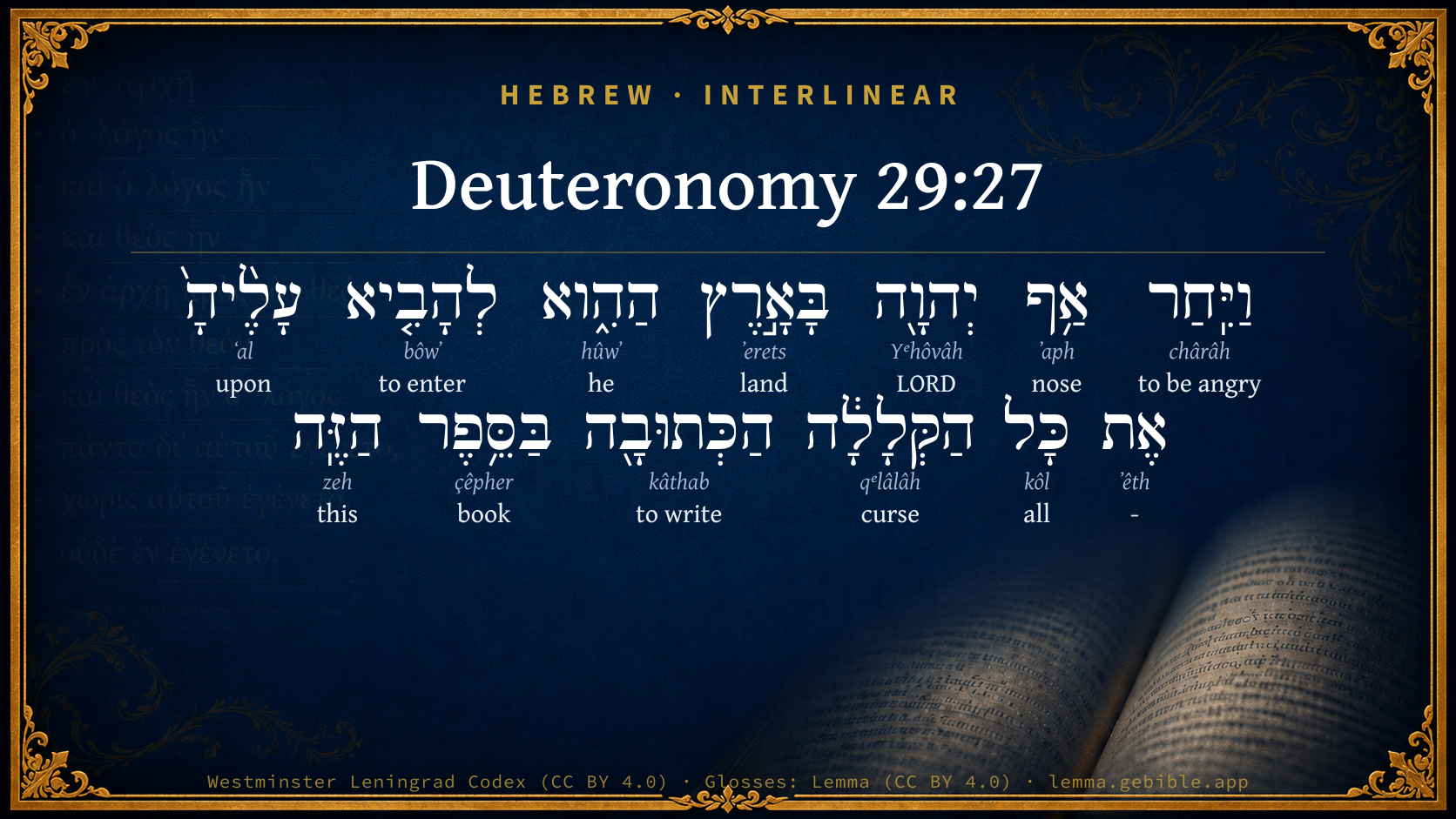
Hebrew (Westminster Leningrad Codex) Deuteronomy 29:27 appears in the Hebrew Old Testament. The text above is from the Westminster Leningrad Codex. Each word links to its Strong’s number, a concise gloss, and parsing drawn from the Open Scriptures Hebrew Bible morphology. Click any word for its full Brown-Driver-Briggs (BDB) entry.
Download image
Cite this verse

Deuteronomy 29:27 (World English Bible). Public Domain. Lemma interlinear Bible study tool, https://lemma.gebible.app/v/deuteronomy/29/27.

Show BibTeX & RIS
BibTeX
RIS
English Translation
therefore the anger of Yahweh was kindled against this land, to bring on it all the curse that is written in this book;
World English Bible · Public Domain
Download a study sheet

One document with this verse’s original text, its word-by-word gloss line, the meaning frame, cross-references with their text, attributed commentary, and full source and license credits — printable, and it pastes into notes with its structure intact.

This verse Autodidact and up

Study sheet (.html) Plain text (.txt)

A passage Seminary Student

Up to 50 verses in one chapter. A passage sheet keeps up to 6 commentary sources and 12 cross-references per verse, in the order this page ranks them, and says so on the sheet whenever that leaves anything out. Ask for a single verse and you get the Autodidact verse sheet above.

Everything on this page stays free to read, with no account — the sheet is a download of what is already on screen, not access to it.

Want to remove ads? Support Godless Engineer
Compare translations 3

The same verse in 3 English versions, stacked beneath the original-language interlinear above. Click any original word for its lexicon entry.

Each is an independent rendering of the whole verse — the interlinear is not word-aligned to these translations.

Highlighted words mark where these versions differ — a whole-verse word diff, not a word-by-word alignment.

  • World English Bible Public Domain
    therefore the anger of Yahweh was kindled against this land, to bring on it all the curse that is written in this book;
  • King James Version Public Domain
    And the anger of the LORD was kindled against this land, to bring upon it all the curses that are written in this book:
  • unfoldingWord Literal Text CC BY-SA 4.0
    So the nose of Yahweh burned against that land to bring on it all the curses written in this book,

unfoldingWord Literal Text — © unfoldingWord, licensed CC BY-SA 4.0. Word-aligned USFM3 via Door43 (git.door43.org/unfoldingWord/en_ult).

Versions to compare (up to 4)

3 of 4 selected

Show all 18 translations

Every available English version of this verse, each an independent rendering of the whole verse.

  • World English Bible Public Domain
    therefore the anger of Yahweh was kindled against this land, to bring on it all the curse that is written in this book;
  • Berean Standard Bible Public Domain
    Therefore the anger of the LORD burned against this land, and He brought upon it every curse written in this book.
  • Majority Standard Bible Public Domain
    Therefore the anger of the LORD burned against this land, and He brought upon it every curse written in this book.
  • King James Version Public Domain
    And the anger of the LORD was kindled against this land, to bring upon it all the curses that are written in this book:
  • American Standard Version (1901) Public Domain
    therefore the anger of Jehovah was kindled against this land, to bring upon it all the curse that is written in this book;
  • Revised Version (1885) Public Domain
    therefore the anger of the LORD was kindled against this land, to bring upon it all the curse that is written in this book:
  • Geneva Bible (1599) Public Domain
    Therefore the wrath of the Lord waxed hot against this land, to bring vpon it euery curse that is written in this booke.
  • Douay-Rheims (1899) Public Domain
    Therefore the wrath of the Lord was kindled against this land, to bring upon it all the curses that are written in this volume:
  • Young's Literal Translation Public Domain
    and the anger of Jehovah burneth against that land, to bring in on it all the reviling that is written in this book,
  • Literal Standard Version CC BY-SA 4.0
    and the anger of YHWH burns against that land, to bring in on it all the reviling that is written in this scroll,
  • Unlocked Literal Bible CC BY-SA 4.0
    Therefore the anger of Yahweh has been kindled against this land, so as to bring on it all the curses that are written in this book.
  • unfoldingWord Literal Text CC BY-SA 4.0
    So the nose of Yahweh burned against that land to bring on it all the curses written in this book,
  • Darby Bible Public Domain
    And the anger of Jehovah was kindled against this land, to bring upon it all the curse that is written in this book;
  • World Messianic Bible Public Domain
    Therefore the LORD’s anger burned against this land, to bring on it all the curses that are written in this book.
  • Webster's Bible Public Domain
    And the anger of the LORD was kindled against this land, to bring upon it all the curses that are written in this book:
  • Free Bible Version CC BY-SA 4.0
    That's why the Lord was so angry with this land, and he rained down on it every curse written in this book.
  • Bible in Basic English Public Domain
    And so the wrath of the Lord was moved against this land, to send on it all the curse recorded in this book:
  • JPS Tanakh (1917) Public Domain
    (29-26) therefore the anger of the LORD was kindled against this land, to bring upon it all the curse that is written in this book;

Literal Standard Version (2020), Covenant Press — licensed CC BY-SA 4.0. Text via the HelloAO Bible API (eBible.org). Unlocked Literal Bible (unfoldingWord) — licensed CC BY-SA 4.0. Text via the HelloAO Bible API (eBible.org). unfoldingWord Literal Text — © unfoldingWord, licensed CC BY-SA 4.0. Word-aligned USFM3 via Door43 (git.door43.org/unfoldingWord/en_ult). Free Bible Version, Dr. Jonathan Gallagher — licensed CC BY-SA 4.0. Text via the HelloAO Bible API (eBible.org).

Word by word

More ways to search: Search by grammar → Find every occurrence → Compare this word →

Practice this passage: Drill this verse → Learn its vocabulary →

הַקְּלָלָ֔ה
qᵉlâlâh
H7045
“the · curse”
Particle, Definite Article + Noun, Common, Feminine, Singular, Absolute
Part of Speech
Particle + Noun
Type
Common
Gender
Feminine
Number
Singular
State
Absolute
Full BDB Definition

Origin: from H7043

TWOT: 2028d

curse, vilification, execration
  1. וַיִּֽחַר chârâh H2734 “and · to be angry” Conjunction + Verb, Qal, Sequential Imperfect, 3rd Person, Masculine, Singular
  2. אַ֥ף ʼaph H639 “nose” Particle, Accusative
  3. יְהוָ֖ה Yᵉhôvâh H3068 “LORD” Noun, Proper
  4. בָּאָ֣רֶץ ʼerets H776 “in/at the · land” Preposition, Determined + Noun, Common, Both, Singular, Absolute
  5. הַהִ֑וא hûwʼ H1931 “the · he” Particle, Definite Article + Pronoun, Personal, 3rd Person, Feminine, Singular
  6. לְהָבִ֤יא bôwʼ H935 “to enter” Preposition + Verb, Hiphil, Infinitive Construct
  7. עָלֶ֨יהָ֙ ʻal H5921 “upon · her” Preposition + Suffix, Personal, 3rd Person, Feminine, Singular
  8. אֶת ʼêth H853 “-” Particle, Direct Object
  9. כָּל kôl H3605 “all of” Noun, Common, Masculine, Singular, Construct
  10. הַכְּתוּבָ֖ה kâthab H3789 “the · written” Particle, Definite Article + Verb, Qal, Participle Passive, Feminine, Singular, Absolute
  11. בַּסֵּ֥פֶר çêpher H5612 “in/at the · book” Preposition, Determined + Noun, Common, Masculine, Singular, Absolute
  12. הַזֶּֽה zeh H2088 “the · this” Particle, Definite Article + Pronoun, Demonstrative, Masculine, Singular

About this verse

These counts appear in no published source. They are computed here, from the morphology-tagged text and Lemma’s own curated glosses. What Lemma adds →

13
words
13
distinct lemmas
Pentateuch
section

Shared distinctive vocabulary

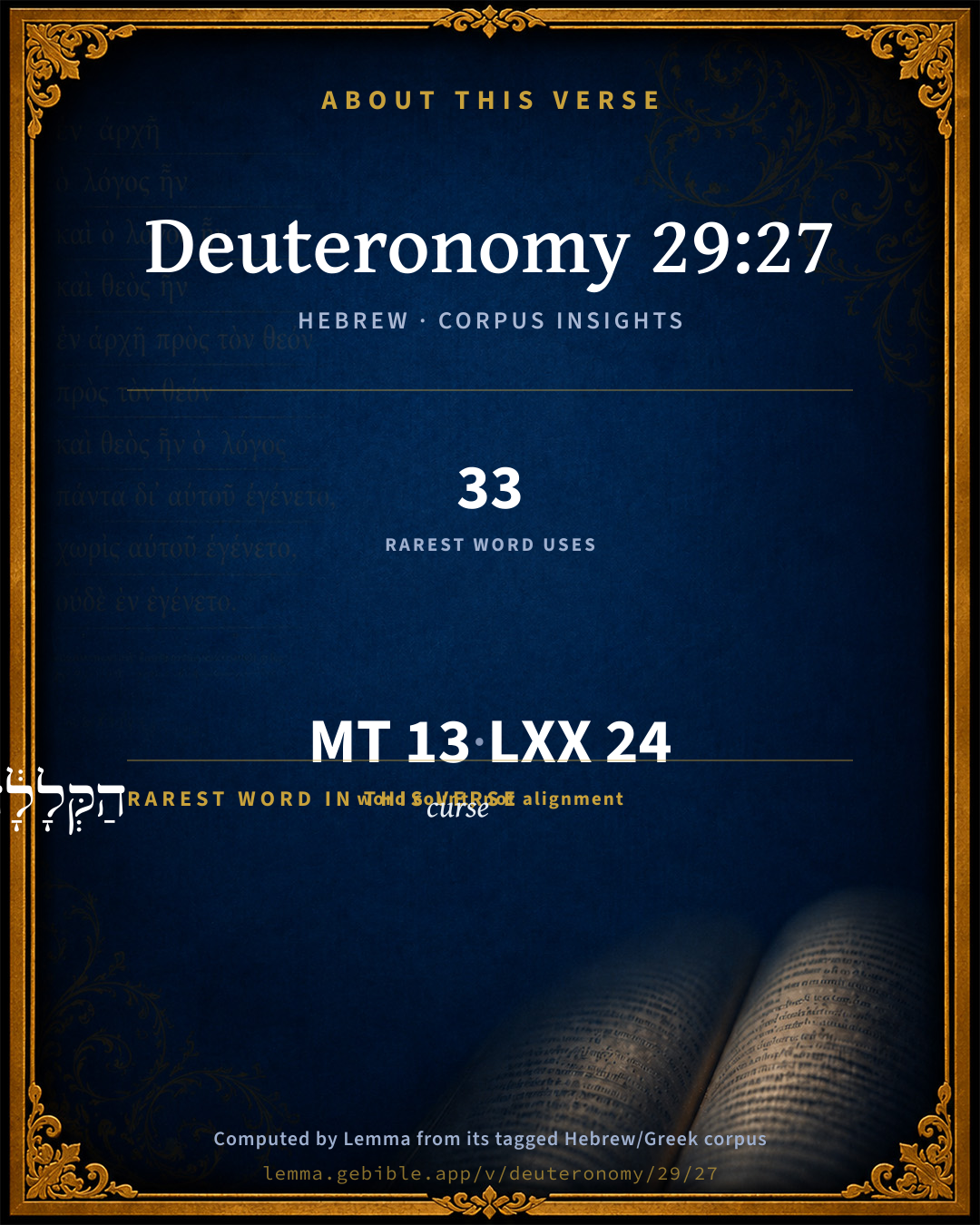
הַקְּלָלָ֔ה curse H7045 occurs in 33 verses of the Hebrew Bible. Also found in:

Grammatical profile

  • 3 verbs
  • 5 nouns
  • 2 pronouns
  • 1 preposition
  • 2 particles

Verb forms

  • וַיִּֽחַר Qal · Sequential Imperfect
  • לְהָבִ֤יא Hiphil · Infinitive Construct
  • הַכְּתוּבָ֖ה Qal · Participle Passive

Hebrew & Septuagint length

In English translation the verse runs 23 words from the Hebrew and 27 from the Septuagint (LXX English) — closely comparable.

A rough comparison of the two English renderings, which tokenize alike — not a word-level alignment.

Word counts can differ between the Hebrew and the Greek without any difference in meaning — e.g. the Hebrew direct-object marker אֵת has no separate Greek word, and Greek often adds the article ὁ.

In the original languages it is 13 Hebrew tokens and 24 Greek tokens — but the two are counted differently (Hebrew bundles its prefixes and suffixes into one token; the Greek is in lemma form), so that isn’t a like-for-like length.

Cross-references

5

Topical passages linked to Deuteronomy 29:27 in the Treasury of Scripture Knowledge — connected by theme and wording, ordered by reader-vote popularity; previews shown in the World English Bible.

  • Daniel 9:11–14 Yes, all Israel have transgressed your law, even turning aside, that they should not obey your voice: therefore has the curse been poured out on us, and the oath that is written in the law of Moses the servant of God; for we have sinned against him.
  • Deuteronomy 28:15–68 But it shall come to pass, if you will not listen to the voice of Yahweh your God, to observe to do all his commandments and his statutes which I command you this day, that all these curses shall come on you, and overtake you.
  • Leviticus 26:14–46 "'But if you will not listen to me, and will not do all these commandments;
  • Deuteronomy 27:15–26 Cursed be the man who makes an engraved or molten image, an abomination to Yahweh, the work of the hands of the craftsman, and sets it up in secret. All the people shall answer and say, Amen.
  • Deuteronomy 29:20–21 Yahweh will not pardon him, but then the anger of Yahweh and his jealousy will smoke against that man, and all the curse that is written in this book shall lie on him, and Yahweh will blot out his name from under the sky.

Cross-references courtesy of OpenBible.info (CC BY 4.0).

Hebrew and Greek witnesses Masoretic Hebrew ↔ Greek Septuagint

The same verse in the two great witnesses to the Old Testament, shown verse-for-verse.

These are two independent witnesses, not word-aligned to each other, and the Septuagint is shown in lemma (dictionary) form.

Hebrew Deuteronomy 29:27 Masoretic · Westminster Leningrad Codex

וַיִּֽחַר אַ֥ף יְהוָ֖ה בָּאָ֣רֶץ הַהִ֑וא לְהָבִ֤יא עָלֶ֨יהָ֙ אֶת כָּל הַקְּלָלָ֔ה הַכְּתוּבָ֖ה בַּסֵּ֥פֶר הַזֶּֽה

therefore the anger of Yahweh was kindled against this land, to bring on it all the curse that is written in this book;

World English Bible · Public Domain

Greek LXX Deuteronomy 29:27 Septuagint · lemma form

καί ἐκαἴρω αὐτός κύριος ἀπό ὁ γῆ αὐτός ἐν θυμός καί ὀργή καί παροξυσμός μέγας σφόδρα καί ἐκβάλλω αὐτός εἰς γῆ ἕτερος ὡσεί νῦν

And the Lord was exceedingly angry with that land to bring upon it according to all the curses which are written in the book of this law.

LXX2012 (modern English Septuagint) · Public Domain

Hebrew: Westminster Leningrad Codex (CC BY 4.0). Greek: Septuagint (public domain); English from LXX2012 (modern English Septuagint) (Public Domain). How the Septuagint differs from the Hebrew →

Targum (Aramaic paraphrase)

2

The Targum is the ancient Jewish Aramaic paraphrase of the Hebrew Scriptures — an interpretive translation, not the Hebrew text itself. Onkelos (literal) and Pseudo-Jonathan (expansive) render the Torah, and Jonathan the Prophets. Coverage is partial: where no permissively-licensed English translation exists for a verse, only the Aramaic is shown. This is verse-level text, not a word-by-word alignment to the Hebrew.

  1. Targum Onkelos Torah (Genesis–Deuteronomy)
    וְטַּלְטְּלִנוּן יְיָ מֵעַל אַרְעֲהוֹן בִּרְגַז וּבְחֵמְתָא וּבִתְקוֹף רְגַז וְאַגְלִנוּן לְאַרְעָא אָחֳרִי כְּיוֹמָא הָדֵין

    (no public-domain English translation for this verse)

    Targum Onkelos — Aramaic: “Onkelos Genesis” (public domain); “Onkelos Exodus” (public domain); “Onkelos Leviticus” (public domain); “Onkelos Numbers” (public domain); “Onkelos Deuteronomy” (public domain). English: “Sefaria Community Translation” (CC0 1.0 (public-domain dedication)); “J.W. Etheridge. The Targums of Onkelos and Jonathan Ben Uzziel on the Pentateuch. London: Longmans, Green, 1862” (public domain). Text via Sefaria.

  2. Targum Pseudo-Jonathan Torah (Genesis–Deuteronomy)
    וְטַלְטְלִינוּן יְיָ מֵעִלַוֵי אַרְעֲהוֹן בִּרְגוֹז וּבִכְלוּ וּבִתְקוֹף רַב וְטַלְקִינוּן בְּגָלוּתָא לְאַרַע חוֹרַן כִּזְמַן יוֹמָא הָדֵין

    And the Lord hath made them to wander forth from their country with anger, indignation, and wrath, and hath cast them into captivity in another land until this day.

    Targum Pseudo-Jonathan — Aramaic: “Targum Jonathan on Genesis” (public domain); “Targum Jonathan on Exodus” (public domain); “Targum Jonathan on Leviticus” (public domain); “Targum Jonathan on Numbers” (public domain); “Targum Jonathan on Deuteronomy” (public domain). English: “The Targum of Jonathan ben Uzziel, trans. J. W. Etheridge, London, 1862” (public domain). Text via Sefaria.

Commentary

Notes on Deuteronomy 29:27 from classic Christian and Jewish commentators (each source and its license shown beneath its notes). The classic Christian expositions comment on the surrounding passage and are grouped to its opening verse, so a note may address several verses; the Jewish commentaries on the Tanakh (Rashi and others) are per-verse, so they appear only where the commentator wrote on this verse.

Lemma curates 59 commentaries, every one of them public domain or Creative Commons licensed, each selected and text-cleaned for this edition rather than reprinted as found. About our sources →

Trapp's Complete Commentary

John Trapp

Deu 29:27 And the anger of the LORD was kindled against this land, to bring upon it all the curses that are written in this book:

Ver. 27. All the curses.] This was accomplished, as is by Daniel acknowledged. {Dan 9:11, &c.}

John Trapp, A Commentary or Exposition upon All the Books of the Old and New Testament (1647–1656) — public domain. Text from a community e-Sword module.

Tyndale Open Study Notes

Tyndale Open Resources

29:27 The phrase this book refers at least to Deuteronomy and perhaps to the first five books of the Old Testament (the Pentateuch).

Tyndale Open Study Notes — © Tyndale Open Resources, licensed CC BY-SA 4.0. Text via the HelloAO Bible API.

The Cambridge Bible for Schools and Colleges

gen. ed. J. J. S. Perowne

27. curse] As in Deu_28:15 ff.; and another word than in Deu_29:20 f.

The Cambridge Bible for Schools and Colleges (gen. ed. J. J. S. Perowne; Cambridge University Press, 1878–1918) — public domain. Text from a community e-Sword module.

John Gill's Exposition

And the Lord rooted them out of the land,.... Which was true both at the Babylonish captivity by Nebuchadnezzar, and at their present one by the Romans; and especially the latter, by whom they have been so rooted out, as that they have not been able to return to it these 1700 years, nor to have any inheritance or possession in it; whereas, at the end of seventy years, they returned from the Babylonish captivity to their land again: and which was done

in anger, and in wrath, and in great indignation; which were most abundantly shown in the utter destruction of their land, city, and temple, by the Romans:

and cast them another land, as it is this day; the ten tribes were cast into Assyria, and from thence into the cities of the Medes, the two tribes into the land of Chaldea, and now into all lands; and none their own, but another, a strange and foreign country. The word "cast" denotes the vehemence of the divine displeasure at them, expressed by the removal of them out of their own land into another. In the Hebrew word for "cast", a middle letter in it is greater than usual; the reason of which perhaps is, that this dealing of God with them might be observed and taken notice of as very remarkable; and Ainsworth thinks it is to observe the greatness of the punishment; and the Jews understand this of the casting away of the ten tribes: and they gather from hence that the ten tribes shall not return, though about it they are divided; for so they say in the Misnah (h),"the ten tribes shall not return, as it is said, and cast them into another land, as this day; as the day goes and does not return, so they go and return not; these are the words of R. Akiba. R. Eliezer says, as the day brings on darkness and light, so the ten tribes who are now dark shall be enlightened.''

(h) Sanhedrin, c. 11. sect. 3.

John Gill's Exposition of the Whole Bible (1746–1763) — public domain (CC PDM 1.0). Text via the HelloAO Bible API.

The Pulpit Commentary

All the curses; literally, every curse, or the whole curse. (cf. Dan_9:11, etc.)

The Pulpit Commentary (1880–1919), ed. H.D.M. Spence-Jones & Joseph S. Exell — public domain. Text from a community e-Sword module.

unfoldingWord translationNotes

Door43 World Missions Community

the anger of Yahweh has been kindled against this land

Moses compares Yahweh being angry to someone starting a fire. This emphasizes God's power to destroy whatever makes him angry, and it can be stated in active form. AT: "Yahweh has became very angry with this land" (See: Metaphor and Active or Passive)

this land, so as to bring on it

Here "land" is a metonym representing the people. AT: "the people of this land, so as to bring on them" (See: Metonymy)

that are written

This can be stated in active form. AT: "that I have written" (See: Active or Passive)

Yahweh has uprooted them from their land ... and has thrown them

Israel is compared to a bad plant that Yahweh has pulled up and thrown out of a garden. AT: "Yahweh has removed them from their land ... and has forced them to go" (See: Metaphor)

in anger, in wrath, and in great fury

The words "anger" and "wrath" and "fury" mean basically the same thing and emphasize the great intensity of Yahweh's anger. AT: "in extremely great anger" or "because he was extremely angry" (See: Doublet)

translationWords

anger

curse

written

wrath

unfoldingWord translationNotes — © Distant Shores Media and the Door43 World Missions Community, licensed CC BY-SA 4.0. Source: git.door43.org/Door43/en_tn.

Rashi

Rabbi Shlomo Yitzchaki (Rashi)

ויתשם ה׳ — Understand this as the Targum has it: וטלטלינון, “and He cast them out”. Similar is, (Jeremiah 12:14) “Behold, I cast them out (נתשם) from their land”.

Rashi on the Tanakh — English translations: “The Judaica Press complete Tanach with Rashi, translated by A. J. Rosenberg” (CC BY 4.0); “Pentateuch with Rashi's commentary by M. Rosenbaum and A.M. Silbermann, 1929-1934” (public domain); “The Metsudah Tanach series, Lakewood, N.J” (CC BY 4.0); and “The Book of Joshua, Metsudah Publications, 1997” (CC BY 4.0). Text via Sefaria.

Ramban (Nachmanides)

Rabbi Moshe ben Nachman (Ramban / Nachmanides)

AND THE ETERNAL ROOTED THEM OUT OF THEIR LAND, for He will exile the tribe that will do evil in the sight of the Eternal, as it is stated, and he [the king of Assyria] carried them away, even the Reubenites, and the Gadites, and the half-tribe of Menasheh. The correct interpretation is that he is now alluding to the exile of all Israel, all of them being evil, and they will be banished in a complete exile. Similarly, the following chapter, And it shall come to pass, when all these things are come upon thee is a reference to the exile of all Israel, as he said, among all the nations whither the Eternal thy G-d hath driven thee, and so he concludes the entire chapter.

Ramban (Nachmanides) on the Tanakh — English translation: “Commentary on the Torah by Ramban (Nachmanides). Translated and annotated by Charles B. Chavel. New York, Shilo Pub. House, 1971-1976” (CC BY 4.0). Text via Sefaria.

Lesson kit

Teaching starters — assembled from the data on this page, not authored interpretation. Every prompt links to the verse data it draws on. Edit before teaching.

Deuteronomy, in the Pentateuch, opens this verse with 13 words (13 distinct Hebrew lemmas). Its most distinctive word is qᵉlâlâh (“curse”). A historical commentator’s framing appears above. Read the whole chapter for the surrounding context.

Discussion questions

  1. What does “curse” (qᵉlâlâh) contribute to the verse as a whole?
  2. How does Genesis 27:12, which shares the word «curse», read alongside this verse?
  3. These translations render this verse differently. What is at stake in choosing one wording over another?
  4. «וַיִּֽחַר» is a Qal Sequential Imperfect verb. How does that grammatical form shape the action described?
  5. Compare how Trapp's Complete Commentary and Tyndale Open Study Notes read this verse. Where do they agree or differ?

Things to notice

Reading settings

Reading text

Shown beneath each verse's original-language words.

Old Testament
Old Testament edition

Read the OT as the Masoretic Hebrew (MT) or the Greek Septuagint (LXX).

English shown for the Greek Septuagint (in the Hebrew ↔ Greek comparison).

Comparing translations? Open the Compare panel on any verse page to stack up to four side by side.