Psalms 139:16

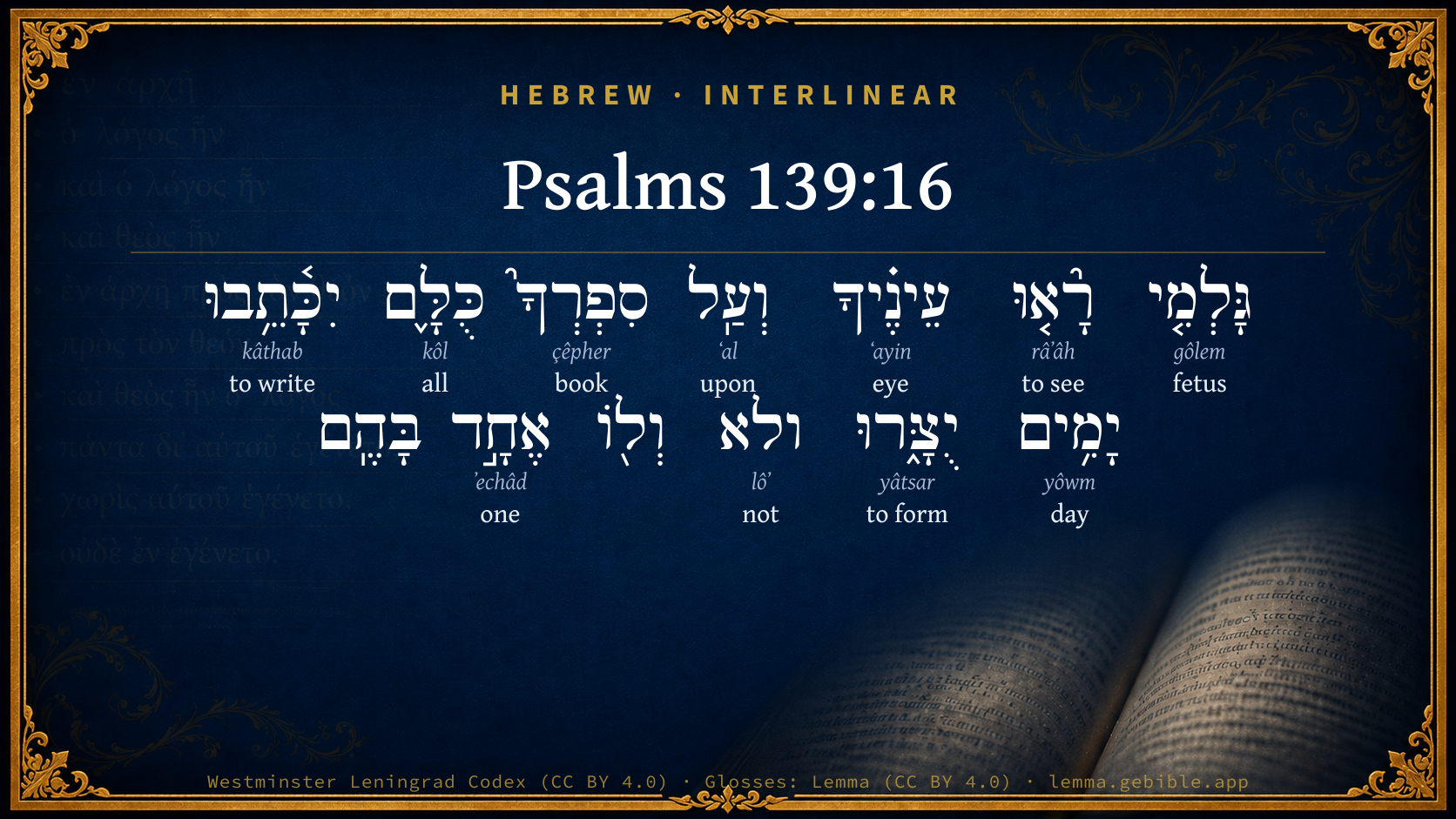
Hebrew (Westminster Leningrad Codex) Psalms 139:16 appears in the Hebrew Old Testament. The text above is from the Westminster Leningrad Codex. Each word links to its Strong’s number, a concise gloss, and parsing drawn from the Open Scriptures Hebrew Bible morphology. Click any word for its full Brown-Driver-Briggs (BDB) entry.
Download image
Cite this verse

Psalms 139:16 (World English Bible). Public Domain. Lemma interlinear Bible study tool, https://lemma.gebible.app/v/psalms/139/16.

Show BibTeX & RIS
BibTeX
RIS
English Translation
Your eyes saw my body. In your book they were all written, The days that were ordained for me, When as yet there were none of them.
World English Bible · Public Domain
Highlights
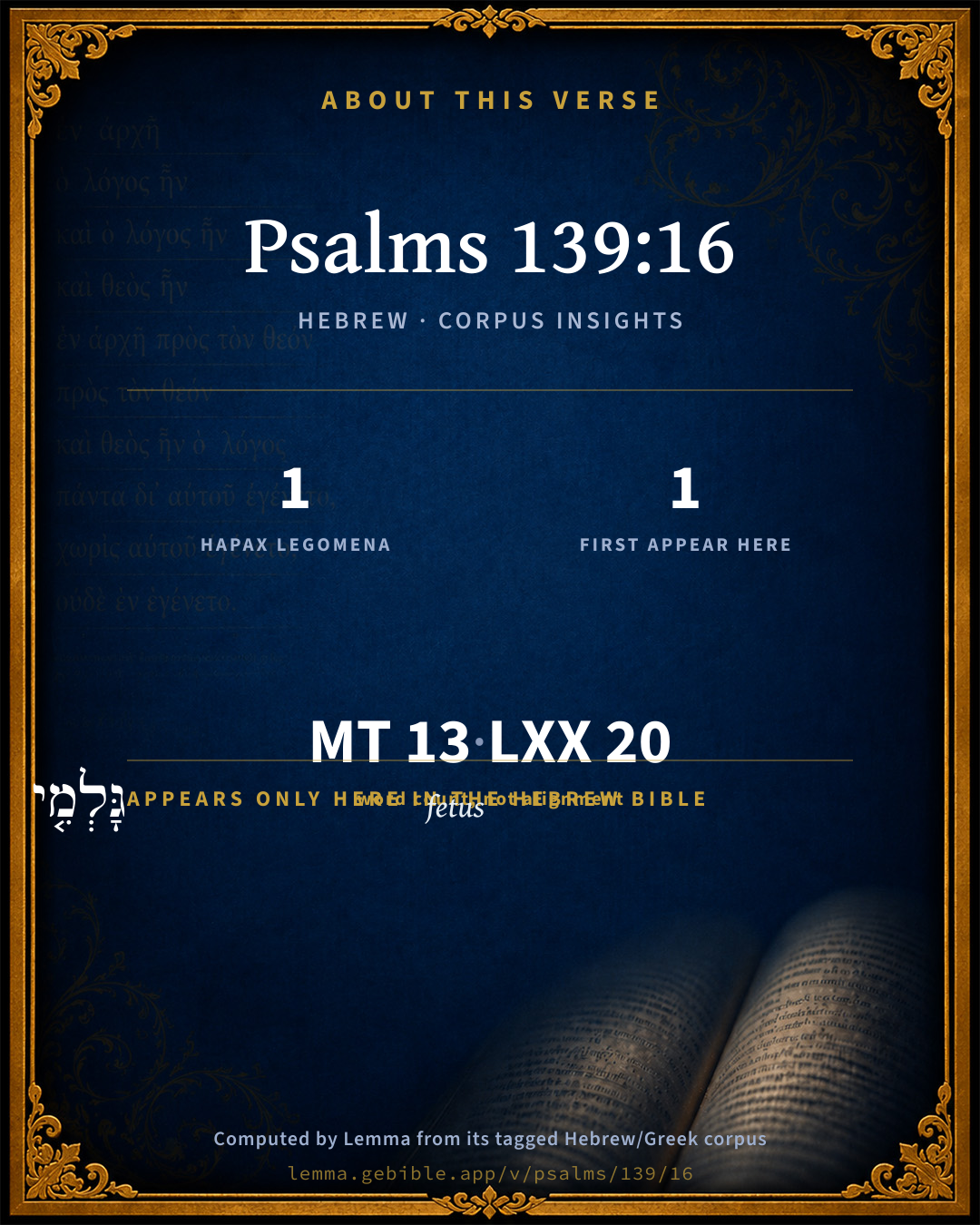
  • 1 hapax legomenon — only here in the Hebrew Bible
  • 1 first appearance in the Hebrew Bible
Full analysis ↓
Download a study sheet

One document with this verse’s original text, its word-by-word gloss line, the meaning frame, cross-references with their text, attributed commentary, and full source and license credits — printable, and it pastes into notes with its structure intact.

This verse Autodidact and up

Study sheet (.html) Plain text (.txt)

A passage Seminary Student

Up to 50 verses in one chapter. A passage sheet keeps up to 6 commentary sources and 12 cross-references per verse, in the order this page ranks them, and says so on the sheet whenever that leaves anything out. Ask for a single verse and you get the Autodidact verse sheet above.

Everything on this page stays free to read, with no account — the sheet is a download of what is already on screen, not access to it.

Want to remove ads? Support Godless Engineer
Compare translations 3

The same verse in 3 English versions, stacked beneath the original-language interlinear above. Click any original word for its lexicon entry.

Each is an independent rendering of the whole verse — the interlinear is not word-aligned to these translations.

Highlighted words mark where these versions differ — a whole-verse word diff, not a word-by-word alignment.

  • World English Bible Public Domain
    Your eyes saw my body. In your book they were all written, The days that were ordained for me, When as yet there were none of them.
  • King James Version Public Domain
    Thine eyes did see my substance, yet being unperfect; and in thy book all my members were written, which in continuance were fashioned, when as yet there was none of them.
  • unfoldingWord Literal Text CC BY-SA 4.0
    your eyes saw my unformed substance. And in your book all of them were written: the days were formed, and not one of them.

unfoldingWord Literal Text — © unfoldingWord, licensed CC BY-SA 4.0. Word-aligned USFM3 via Door43 (git.door43.org/unfoldingWord/en_ult).

Versions to compare (up to 4)

3 of 4 selected

Show all 17 translations

Every available English version of this verse, each an independent rendering of the whole verse.

  • World English Bible Public Domain
    Your eyes saw my body. In your book they were all written, The days that were ordained for me, When as yet there were none of them.
  • Berean Standard Bible Public Domain
    Your eyes saw my unformed body; all my days were written in Your book and ordained for me before one of them came to be.
  • Majority Standard Bible Public Domain
    Your eyes saw my unformed body; all my days were written in Your book and ordained for me before one of them came to be.
  • King James Version Public Domain
    Thine eyes did see my substance, yet being unperfect; and in thy book all my members were written, which in continuance were fashioned, when as yet there was none of them.
  • American Standard Version (1901) Public Domain
    Thine eyes did see mine unformed substance; And in thy book they were all written, `Even' the days that were ordained `for me', When as yet there was none of them.
  • Revised Version (1885) Public Domain
    Thine eyes did see mine unperfect substance, and in thy book were all my members written, which day by day were fashioned, when as yet there was none of them.
  • Geneva Bible (1599) Public Domain
    Thine eyes did see me, when I was without forme: for in thy booke were all things written, which in continuance were facioned, when there was none of them before.
  • Young's Literal Translation Public Domain
    Mine unformed substance Thine eyes saw, And on Thy book all of them are written, The days they were formed -- And not one among them.
  • Literal Standard Version CC BY-SA 4.0
    Your eyes saw my unformed substance, || And all of them are written on Your scroll, || The days they were formed—And not one among them.
  • Unlocked Literal Bible CC BY-SA 4.0
    You saw me inside the womb; all the days assigned to me were recorded in your book even before the first one happened.
  • unfoldingWord Literal Text CC BY-SA 4.0
    your eyes saw my unformed substance. And in your book all of them were written: the days were formed, and not one of them.
  • Darby Bible Public Domain
    Thine eyes did see my unformed substance, and in thy book all [my members] were written; [during many] days were they fashioned, when [as yet] there was none of them.
  • World Messianic Bible Public Domain
    Your eyes saw my body. In your book they were all written, the days that were ordained for me, when as yet there were none of them.
  • Webster's Bible Public Domain
    Thy eyes saw my substance, yet being imperfect; and in thy book all my members were written, which in continuance were fashioned, when as yet there was none of them.
  • Free Bible Version CC BY-SA 4.0
    You saw me as an embryo, and in your book all my days were written down—the days that were made for me before any of them existed.
  • Bible in Basic English Public Domain
    Your eyes saw my unformed substance; in your book all my days were recorded, even those which were purposed before they had come into being.
  • JPS Tanakh (1917) Public Domain
    Thine eyes did see mine unformed substance, and in Thy book they were all written — even the days that were fashioned, when as yet there was none of them.

Literal Standard Version (2020), Covenant Press — licensed CC BY-SA 4.0. Text via the HelloAO Bible API (eBible.org). Unlocked Literal Bible (unfoldingWord) — licensed CC BY-SA 4.0. Text via the HelloAO Bible API (eBible.org). unfoldingWord Literal Text — © unfoldingWord, licensed CC BY-SA 4.0. Word-aligned USFM3 via Door43 (git.door43.org/unfoldingWord/en_ult). Free Bible Version, Dr. Jonathan Gallagher — licensed CC BY-SA 4.0. Text via the HelloAO Bible API (eBible.org).

Word by word

More ways to search: Search by grammar → Find every occurrence → Compare this word →

Practice this passage: Drill this verse → Learn its vocabulary →

גָּלְמִ֤י
gôlem
H1564
“fetus · my”
Noun, Common, Masculine, Singular, Construct + Suffix, Personal, 1st Person, Common, Singular
Part of Speech
Noun
Type
Common
Gender
Masculine
Number
Singular
State
Construct
Full BDB Definition

Origin: from H1563

TWOT: 354b

embryo, fetus
  1. רָ֘א֤וּ râʼâh H7200 “to see” Verb, Qal, Perfect, 3rd Person, Common, Plural
  2. עֵינֶ֗יךָ ʻayin H5869 “eyes · your” Noun, Common, Both, Dual, Construct + Suffix, Personal, 2nd Person, Masculine, Singular
  3. וְעַֽל ʻal H5921 “and · upon” Conjunction + Preposition
  4. סִפְרְךָ֮ çêpher H5612 “book · your” Noun, Common, Masculine, Singular, Construct + Suffix, Personal, 2nd Person, Masculine, Singular
  5. כֻּלָּ֪ם kôl H3605 “all · their” Noun, Common, Masculine, Singular, Construct + Suffix, Personal, 3rd Person, Masculine, Plural
  6. יִכָּ֫תֵ֥בוּ kâthab H3789 “to write” Verb, Niphal, Imperfect, 3rd Person, Masculine, Plural
  7. יָמִ֥ים yôwm H3117 “days” Noun, Common, Masculine, Plural, Absolute
  8. יֻצָּ֑רוּ yâtsar H3335 “to form” Verb, Pual, Perfect, 3rd Person, Common, Plural
  9. ולא lôʼ H3808 “and · not” Conjunction + Particle, Negative
  10. אֶחָ֣ד ʼechâd H259 “one” Adjective, Cardinal number, Masculine, Singular, Absolute

About this verse

These counts appear in no published source. They are computed here, from the morphology-tagged text and Lemma’s own curated glosses. What Lemma adds →

13
words
11
distinct lemmas
Wisdom
section

Notable vocabulary

1 hapax legomenon — a word that appears only here in the entire Hebrew Bible:

  • גָּלְמִ֤י fetus H1564

First appearance in Scripture

This word makes its first canonical appearance in the Hebrew Bible here:

  • גָּלְמִ֤י fetus H1564

Grammatical profile

  • 3 verbs
  • 5 nouns
  • 1 adjective
  • 3 prepositions
  • 1 particle

Verb forms

  • רָ֘א֤וּ Qal · Perfect
  • יִכָּ֫תֵ֥בוּ Niphal · Imperfect
  • יֻצָּ֑רוּ Pual · Perfect

Hebrew & Septuagint length

In English translation the verse runs 27 words from the Hebrew and 32 from the Septuagint (LXX English) — closely comparable.

A rough comparison of the two English renderings, which tokenize alike — not a word-level alignment.

Word counts can differ between the Hebrew and the Greek without any difference in meaning — e.g. the Hebrew direct-object marker אֵת has no separate Greek word, and Greek often adds the article ὁ.

In the original languages it is 13 Hebrew tokens and 20 Greek tokens — but the two are counted differently (Hebrew bundles its prefixes and suffixes into one token; the Greek is in lemma form), so that isn’t a like-for-like length.

Cross-references

3

Topical passages linked to Psalms 139:16 in the Treasury of Scripture Knowledge — connected by theme and wording, ordered by reader-vote popularity; previews shown in the World English Bible.

  • Psalms 56:8 You number my wanderings. You put my tears into your bottle. Aren't they in your book?
  • Malachi 3:16 Then those who feared Yahweh spoke one with another; and Yahweh listened, and heard, and a book of memory was written before him, for those who feared Yahweh, and who honored his name.
  • Revelation 20:12 I saw the dead, the great and the small, standing before the throne, and they opened books. Another book was opened, which is the book of life. The dead were judged out of the things which were written in the books, according to their works.

Cross-references courtesy of OpenBible.info (CC BY 4.0).

Hebrew and Greek witnesses Masoretic Hebrew ↔ Greek Septuagint

The same verse in the two great witnesses to the Old Testament, shown verse-for-verse.

You’re reading Greek Psalm 138 (Hebrew Psalm 139). The Septuagint counts the superscription, so verse numbers can differ from the Hebrew — chapter-level alignment, not verse-by-verse. Numbering follows Rahlfs.

These are two independent witnesses, not word-aligned to each other, and the Septuagint is shown in lemma (dictionary) form.

Hebrew Psalms 139:16 Masoretic · Westminster Leningrad Codex

גָּלְמִ֤י רָ֘א֤וּ עֵינֶ֗יךָ וְעַֽל סִפְרְךָ֮ כֻּלָּ֪ם יִכָּ֫תֵ֥בוּ יָמִ֥ים יֻצָּ֑רוּ ולא וְל֖וֹ אֶחָ֣ד בָּהֶֽם

Your eyes saw my body. In your book they were all written, The days that were ordained for me, When as yet there were none of them.

World English Bible · Public Domain

Greek LXX Greek Psalm 138:16 Septuagint · lemma form

ὁ ἀκατέργαστος ἐγώ ὁράω ὁ ὀφθαλμός σύ καί ἐπί ὁ βιβλίον σύ πᾶς γράφω ἡμέρα πλάσσω καί οὐδείς ἐν αὐτός

Your eyes saw my unwrought substance, and all men shall be written in your book; they shall be formed by day, though there should for a time be no one among them.

LXX2012 (modern English Septuagint) · Public Domain

On this verse, Ellicott's Commentary for English Readers discusses the Septuagint’s reading. Read the note in Commentary ↓

Hebrew: Westminster Leningrad Codex (CC BY 4.0). Greek: Septuagint (public domain); English from LXX2012 (modern English Septuagint) (Public Domain). How the Septuagint differs from the Hebrew →

Commentary

Notes on Psalms 139:16 from classic Christian and Jewish commentators (each source and its license shown beneath its notes). The classic Christian expositions comment on the surrounding passage and are grouped to its opening verse, so a note may address several verses; the Jewish commentaries on the Tanakh (Rashi and others) are per-verse, so they appear only where the commentator wrote on this verse.

Lemma curates 59 commentaries, every one of them public domain or Creative Commons licensed, each selected and text-cleaned for this edition rather than reprinted as found. About our sources →

Trapp's Complete Commentary

John Trapp

Psa 139:16 Thine eyes did see my substance, yet being unperfect; and in thy book all [my members] were written, [which] in continuance were fashioned, when [as yet there was] none of them.

Ver. 16. Thine eyes did see my subtsance] Galmi; est semen coagulatum ante formationem membrorum, saith Kimchi; when I was but an embryo, or hardly so much. Disponit Deus membra culicis, et pulicis, saith Austin; how much more of man? The word signifieth my wound up, or unwrought up, mass.

And in thy book all my members were written] A metaphor from curious workmen, that do all by the book, or by a model sat before them, that nothing may be deficient or done amiss. Had God left out an eye in his common place book, saith one, thou hadst wanted it.

Which in continuance] In process of time, and by degrees.

When as yet there was none of them] But all was a rude lump. This is a great secret of nature, and to be modestly spoken of.

John Trapp, A Commentary or Exposition upon All the Books of the Old and New Testament (1647–1656) — public domain. Text from a community e-Sword module.

The Treasury of David

Charles H. Spurgeon

Ver. 16. Thine eyes did see my substance, yet being unperfect. While as yet the vessel was upon the wheel the Potter saw it all. The Lord knows not only our shape, but our substance: this is substantial knowledge indeed. The Lord's observation of us is intent and intentional, "Thine eyes did see." Moreover, the divine mind discerns all things as clearly and certainly as men perceive by actual eye sight. His is not hearsay acquaintance, but the knowledge which comes of sight.

And in thy book all my members were written, which in continuance were fashioned, when as yet there was none of them. An architect draws his plans, and makes out his specifications; even so did the great Maker of our frame write down all our members in the book of his purposes. That we have eyes, and ears, and hands, and feet, is all due to the wise and gracious purpose of heaven: it was so ordered in the secret decree by which all things are as they are. God's purposes concern our limbs and faculties. Their form, and shape, and everything about them were appointed of God long before they had any existence. God saw us when we could not be seen, and he wrote about us when there was nothing of us to write about. When as yet there were none of our members in existence, all those members were before the eye of God in the sketch book of his foreknowledge and predestination.

This verse is an exceedingly difficult one to translate, but we do not think that any of the proposed amendments are better than the rendering afforded us by the Authorized Version. The large number of words in italics will warn the English reader that the sense is hard to come at, and difficult to express, and that it would be unwise to found any doctrine upon the English words; happily there is no temptation to do so.

The great truth expressed in these lines has by many been referred to the formation of the mystical body of our Lord Jesus. Of course, what is true of man, as man, is emphatically true of Him who is the representative man. The great Lord knows who belong to Christ; his eye perceives the chosen members who shall yet be made one with the living person of the mystical Christ. Those of the elect who are as yet unborn, or unrenewed, are nevertheless written in the Lord's book. As the form of Eve grew up in silence and secrecy under the fashioning hand of the Maker, so at this hour is the Bride being fashioned for the Lord Jesus; or, to change the figure, a body is being prepared in which the life and glory of the indwelling Lord shall for ever be displayed. The Lord knoweth them that are his: he has a specially familiar acquaintance with the members of the body of Christ; he sees their substance, unperfect though they be.

Ver. 16. Thine eyes did see my substance, yet being unperfect, etc. From whence we may learn, first, not to be proud of what we are; all's the work of God. How beautiful or comely, how wise or holy soever you are, 'tis not of yourselves. What hath any man, either in naturals or supernaturals, which he hath not received? Secondly, despise not what others are or have, though they are not such exact pieces, though they have not such excellent endowments as yourselves; yet they are what God hath made them. Thirdly, despise not what yourselves are. Many are ashamed to be seen as God made them; few ale ashamed to be seen what the devil hath made them. Many are troubled at small defects in the outward man; few are troubled at the greatest deformities of the inward man: many buy artificial beauty to supply the natural; few spiritual, to supply the defects of the supernatural beauty of the soul. Abraham Wright.

Ver. 16. My substance yet being unperfect. One word in the original, which means strictly anything rolled together as a ball, and hence is generally supposed to mean here the foetus or embryo. Hupfeld, however, prefers to understand it of the ball of life, as consisting of a number of different threads ("the days" of Ps 139:16 see margin) which are first a compact mass as it were, and which are then unwound as life runs on. J.J. Stewart Perowne.

Ver. 16. A skilful architect before he builds draws a model, or gives a draught of the building in his book, or upon a table; there he will show you every room and contrivance: in his book are all the parts of the building written, while as yet there are none of them, or before any of them are framed and set up. In allusion to architects and other artisans, David speaks of God, In thy book all my members were written; that is, Thou hast made me as exactly as if thou hadst drawn my several members and my whole proportion with a pen or pencil in a book, before thou wouldst adventure to form me up. The Lord uses no book, no pen to decipher his work. He had the perfect idea of all things in himself from everlasting; but he may well be said to work as by pattern, whose work is the most perfect pattern. Joseph Caryl.

Psalms 139:17*

Charles H. Spurgeon's The Treasury of David (1869–1885) — public domain. Psalms only. Text from a community e-Sword/MySword module.

Joseph Benson's Commentary

Psa 139:16. Thine eyes did see my substance — Hebrews גלמי, my rude mass, as Dr. Waterland renders the word: massa rudis et intricata adhuc, says Buxtorf, neque in veram formam evoluta, a mass, yet rude and entangled, and not unfolded into proper form. When the matter, out of which I was made, was an unshapen embryo, without any form, it was visible to thee how every part, however minute, would be wrought; and in thy book all my members were written — Before any of them were in being they lay open before thy eyes, and were discerned by thee as clearly as if the plan of them had been drawn in a book. Thy eternal wisdom formed the plan, and according to that, thy almighty power raised the structure. The allusion to the needlework seems to be still carried on. “As the embroiderer hath his book or pattern before him, to which he always recurs; so by a method as exact were all my members in continuance fashioned; and as from the rude skeins of silk, under the artificer’s hands, there at length arises an unexpected beauty, and an accurate harmony of colours and proportions; so, by the skill of the divine workman, is a shapeless mass wrought into the most curious texture of parts, most skilfully interwoven and connected with each other, until it becomes a body harmoniously diversified with all the limbs and lineaments of a man, not one of which at first appeared, any more than the figures were to be seen in the ball of silk. But then, (which is the chief thing here insisted on by the psalmist,)

whereas the human artificer must have the clearest light, whereby to accomplish his task, the divine work-master seeth in secret, and effecteth all his wonders within the dark and narrow confines of the womb.” — Horne.

Joseph Benson's Commentary on the Old and New Testaments (1811–1818) — public domain. Text from a community e-Sword module.

J. A. Alexander on Psalms

Joseph Addison Alexander

16. (Psa 139:16) My unformed substance did thine eyes see, and in thy tools all of them are written, days are formed, and there is not one among them. This is one of the most obscure and doubtful verses in the book of Psalms. Its difficulty to our own translators may be gathered from the fact, that substance yet being unperfect answers to a single Hebrew word, and that my members is a gratuitous addition to the text. The first word in Hebrew occurs only here, but is clearly derived from a verb which means to roll or roll up (2Ki 2:8), and may therefore be supposed itself to signify something rolled up or rolled together, and from this may be deduced the sense of something shapeless or unformed, or more specifically that of an mbryo or foetus. The next difficulty lies in the expression all of them, evaded in the English Bible by changing it to all my members, and then making this the subject of the plurals following. The best interpreters are now disposed to construe all of them with days by a grammatical prolepsis. In thy book all of them are written, namely, all my days, as they were planned, projected, or decreed, before as yet one of them had really existed. Written and formed are then parallel expressions. All of them are written, days are delineated or depicted. By days (translated in our Bible in continuance) we are then to understand not merely the length but the events and vicissitudes of life. See Job 14:5, Psa 56:8. This is one of those cases in which the difficulty lies in the particular expressions, while the general import of the passage is clearly determined by the context. Instead of not, the keri or marginal reading in the Hebrew Bible has to him, a variation to which no one has succeeded in attaching a coherent sense. Precisely the same difference of text exists in Psa 100:3.

Joseph Addison Alexander, The Psalms Translated and Explained (1850) — public domain. Text from a community e-Sword module.

Geneva Bible (1599)

Geneva Bible translators

Seeing that thou didst know me before I was composed of either flesh or bone, much more now must thou know me when thou hast fashioned me.

Geneva Bible (1599) marginal notes — public domain. Text via Bolls.life.

Adam Clarke's Commentary

Verse 16. Thine eyes did see my substance] גלמי golmi, my embryo state-my yet indistinct mass, when all was wrapped up together, before it was gradually unfolded into the lineaments of man. "Some think," says Dr. Dodd, "that the allusion to embroidery is still carried on. As the embroiderer has still his work, pattern, or carton, before him, to which he always recurs; so, by a method as exact, revere all my members in continuance fashioned, i.e., from the rude embryo or mass they daily received some degree of figuration; as from the rude skeins of variously coloured silk or worsted, under the artificer's hands, there at length arises an unexpected beauty, and an accurate harmony of colours and proportions."

And in thy book all my members were written] "All those members lay open before God's eyes; they were discerned by him as clearly as if the plan of them had been drawn in a book, even to the least figuration of the body of the child in the womb."

Adam Clarke's Commentary on the Bible (1810–1826) — public domain. Text from a community e-Sword/MySword module.

John Calvin's Commentaries

16. Thine eyes beheld my shapelessness, etc. The embryo, when first conceived in the womb, has no form; and David speaks of God’s having known him when he was yet a shapeless mass, τὸ κύημα, as the Greeks term it; for τὸ εμβρυον is the name given to the foetus from the time of conception to birth inclusive. The argument is from the greater’ to the less. If he was known to God before he had grown to certain definite shape, much less could he now elude his observation. He adds, that all things were written in his book; that is, the whole method of his formation was well known to God. The term book is a figure taken from the practice common amongst men of helping their memory by means of books and commentaries. Whatever is an object of God’s knowledge he is said to have registered in writing, for he needs no helps to memory. Interpreters are not agreed as to the second clause. Some read ימים, yamim, in the nominative case, when days were made; the sense being, according to them — All my bones were written in thy book, O God! from the beginning of the world, when days were first formed by thee, and when as yet none of them actually existed. The other is the more natural meaning, That the different parts of the human body are formed in a succession of time; for in the first germ there is no arrangement of parts, or proportion of members, but it is developed, and takes its peculiar form progressively. “They (my members) have been daily formed, or forming. They were not formed at once, but gradually; each day increasing in strength and size. This expression is probably parenthetical, so that the last words of the verse will refer to the writing of those things previously mentioned in God’s register.” — Phillips.

“The meaning is,” says Warner, “there was a time when none of those curious parts, of which my form consists, existed. The germ of them all was planted by thee in the first instance; and gradually matured, by thy power, wisdom, and goodness, into that wonderful piece of mechanism which the human form exhibits.” Phillips gives a different turn to the clause: “And not one of them, or among them, was omitted. Not one of the particulars concerning my formation has been left out of thy record.”

John Calvin's Commentaries (1540-1563) — public domain. Text from the Calvin Translation Society English edition (1840s-50s) via the Christian Classics Ethereal Library (ccel.org). Calvin's coverage is partial (roughly two-thirds of the Bible); uncommented books and verses are honest gaps, never fabricated. The 19th-century editor's footnotes and remarks are omitted so the notes are faithfully Calvin's own voice.

Ellicott's Commentary for English Readers

(16) This difficult verse, rendered word for word, gives—

“My fœtus (literally, rolled) saw thine eyes,

And on thy book all of them were written;

Days were formed, and not (or, as the Hebrew margin, to him) one in them.”

The reading “substance yet being imperfect” of the Authorised Version follows the LXX. and Vulg., and (Symmachus, “shapeless thing”) periphrastically denotes the embryo, which the Hebrew word—literally, rolled, or wrapped, used in 2Ki_2:8, “of a mantle,” in Eze_27:24, “bales” (Authorised Version, “clothes;” margin, “foldings”)—almost scientifically describes. (Comp. Job_10:8-12; 2Ma_7:22.)

Others take it of the ball of the threads of destiny; but this is not a Hebrew conception. By inserting the word members, the Authorised Version suggests a possible, but not a probable, interpretation. The Hebrew language likes to use a pronoun before the word to which it refers has occurred (see Note, Psa_68:14); and, in spite of the accents, we must refer all of them to “days” (Authorised Version, “in continuance”).

“Thine eyes beheld my embryo,

And in thy book were written

All the days, the days

Which were being formed,

When as yet there were none of them.”

But a much more satisfactory sense is obtained by adopting one slight change and following Symmachus in the last line—

“The days which are all reckoned, and not one of them is wanting.”

All the ancient versions make that which is written in God’s book either the days of life, or men born in the course of these days, each coming into being according to the Divine will.

A Bible Commentary for English Readers, edited by Charles John Ellicott (1878–1897) — public domain. Text from a community e-Sword module.

The Cambridge Bible for Schools and Colleges

gen. ed. J. J. S. Perowne

16. my substance, yet being unperfect] R.V. mine unperfect substance. The word (gôlem) is a different one from that in Psa_139:15, and denotes the undeveloped embryo. Cp. Aram, gôlmâ, an unfinished vessel.

all my members] Lit. all of them, which A.V. and R.V. interpret to mean all the members into which the embryo was to develop. But it is better (cp. R.V. marg.) to regard the pronoun as anticipatory, and to render,

And in thy book were all of them written,

Even days which were formed,

When as yet there was none of them.

Each day of his life with all its history was pre-determined by the Creator and recorded in His book, before one of them actually was in existence:—a clear expression of the truth that there is an ideal plan of life providentially marked out for every individual. (Eph_2:10.)

The Q’rç or traditional reading of the Hebrew text, reads lô, ‘for it’ instead of lô’ ‘not’ (see note on Psa_100:3), giving the sense, and for it there was one among them: one of them was pre-ordained as ‘its day,’ the day of its birth. Cp. ‘his day,’ Job_3:1.

The Cambridge Bible for Schools and Colleges (gen. ed. J. J. S. Perowne; Cambridge University Press, 1878–1918) — public domain. Text from a community e-Sword module.

John Gill's Exposition

How precious also are thy thoughts unto me, O God!.... The word (r) signifies that which is scarce and rare, and not to be attained and enjoyed; see Sa1 3:1; the thoughts and counsels of God are impenetrable and unsearchable; he knows our thoughts, as Aben Ezra observes, but we do not know his, Psa 139:2; as well as it likewise signifies the worth and value of them; God's thoughts are infinitely beyond ours, and infinitely more valuable and more important, and are concerning our welfare and happiness: it is marvellous that God should think of us at all; it is more so that his thoughts should not be thoughts of evil, to bring that evil upon its we deserve, but thoughts of peace and reconciliation in and by his Son, in whom he was reconciling the world to himself; thoughts of salvation and eternal life, and of the way and means of bringing it about; thoughts to provide for our present supply in this world, and to lay up for us for the world to come; see Jer 29:11. It may be interpreted of the thoughts which David had of God in his meditations of him, which were sweet, precious, and comfortable to him; of his lovingkindness to him, covenant grace, precious promises, and gracious dealings with him; but the former sense seems best. The Targum is,

"to me how precious they that love thee, the righteous, O God!''

and so the Septuagint, Vulgate Latin, Ethiopic, Syriac, and Arabic versions render it, "thy friends";

how great is the sum of them! or "the heads of them"; that is, not the chief of thy friends, but the sum of thy thoughts, these in the bulk, in the general, are not to be counted; and much less the particulars of them, these are not to be entered into or described.

(r) "difficiles", Cocceius; "quam rarae"; so some in Vatablus.

John Gill's Exposition of the Whole Bible (1746–1763) — public domain (CC PDM 1.0). Text via the HelloAO Bible API.

Albert Barnes' Notes on the Bible

Thine eyes did see my substance, yet being unperfect - This whole verse is very obscure, but the “idea” in this expression clearly is, “Before I had shape or form thou didst see what I was to be.” The single word in the original translated “my substance, yet being unperfect,” is גלם gôlem. It occurs only in this place, though the verb - גלם gâlam - is found in 2Ki 2:8, where it is used in reference to the mantle of Elijah: And Elijah took his mantle, and “wrapped it together,” etc. That is, he rolled it up, or he folded it. The noun, then, means that which “is” rolled or wrapped together; that which is folded up, and hence, is applicable to anything folded up or undeveloped; and would thus most aptly denote the embryo, or the foetus, where all the members of the body are as yet folded up, or undeveloped; that is, before they have assumed their distinct form and proportions. This is undoubtedly the idea here. Before the embryo had any such form that its future size, shape, or proportions could be marked by the eye of man, it was clearly and distinctly known by God.

And in thy book - Where thou recordest all things. Perhaps the allusion here would be to the book of an architect or draftsman, who, before his work is begun, draws his plan, or sketches it for the direction of the workmen.

All my members were written - The words “my members” are not in the original. The Hebrew is, as in the margin, “all of them.” The reference may be, not to the members of his body, but to his “days” (see the margin on the succeeding phrase) - and then the sense would be, all my “days,” or all the periods of my life, were delineated in thy book. That is, When my substance - my form - was not yet developed, when yet an embryo, and when nothing could be determined from that by the eye of man as to what I was to be, all the future was known to God, and was written down - just what should be my form and vigor; how long I should live; what I should be; what would be the events of my life.

Which in continuance were fashioned - Margin, “What days they should be fashioned.” Literally, “Days should be formed.” DeWette renders this, “The days were determined before any one of them was.” There is nothing in the Hebrew to correspond with the phrase “in continuance.” The simple idea is, The days of my life were determined on, the whole matter was fixed and settled, not by anything seen in the embryo, but “before” there was any form - before there were any means of judging from what I then was to what I would be - all was seen and arranged in the divine mind.

When as yet there was none of them - literally, “And not one among them.” Before there was one of them in actual existence. Not one development had yet occurred from which it could be inferred what the rest would be. The entire knowledge on the subject must have been based on Omniscience.

Albert Barnes' Notes on the Bible (1834–1885) — public domain. Text from a community e-Sword/MySword module.

Matthew Poole's English Annotations

Yet being unperfect; when I was a mere embryo, a rude and shapeless lump, when I was first conceived.

In thy book; in thy counsel and providence, by which thou didst contrive and effect this great work, and all the parts of it, according to that model which thou hadst appointed. This is a metaphor taken from workmen, who when they are to make some curious structure, they first draw a rude draught or delineation of it, by which they govern themselves in the building of it.

All my members; all the several parts of my substance.

When in continuance were fashioned; which in due time and by degrees were formed into bones, fleshy sinews, &c. Or, as it is in the margin, what days (and the days in which) they were or should be fashioned; by what steps, in what order and time, each part of the body should receive its proper form. This also was written or appointed by God.

When as yet there was none of them, Heb. and not one of them; understand either yet was, as it is in our translation; or, was lacking, to wit, in thy book. All my parts without exception were written by thee. But then these words are not to bc joined with those immediately foregoing, but with the former, and the words are to be read thus, in thy book all my members were written, (which in continuance were fashioned,) when as yet, &c.

Matthew Poole's English Annotations on the Holy Bible (1683–1685) — public domain. Text from a community e-Sword/MySword module.

The Pulpit Commentary

Thine eyes did see my substance, yet being unperfect; or, "my embryo." The Hebrew text has but the single word ymlg, which probably means, "the still unformed embryonic mass" (Hengstenberg). And in thy book all my members were written; literally, all of them; but the pronoun has no antecedent. Professor Cheyne and others suspect the passage to have suffered corruption. But the general meaning can scarcely have been very different from that assigned to the passage in the Authorized Version. Which in continuance were fashioned, when as yet there was none of them. Modern critics mostly translate "the days," or "my days," "were fashioned, when as yet there was none of them;" i.e. "my life was planned out by God, and settled, before I began to be."

The Pulpit Commentary (1880–1919), ed. H.D.M. Spence-Jones & Joseph S. Exell — public domain. Text from a community e-Sword module.

John Wesley's Explanatory Notes

Imperfect - When I was first conceived. Book - In thy counsel and providence, by which thou didst contrive and effect this great work, according to that model which thou hadst appointed.

John Wesley, Explanatory Notes Upon the Whole Bible (1754–1765) — public domain. Text via the GEBible commentary corpus.

Rashi

Rabbi Shlomo Yitzchaki (Rashi)

Your eyes saw my unformed body From the time that You created the world, Your eyes saw all the forms of the coming generations.

My unformed body Heb. גלמי. My splendor and the pattern of my form, before I was born and before I came into the world, Your eyes saw.

and on Your book they were all written And all the creatures of the world, like me, like them, even all of them, before they were created, were together revealed before You.

days have been formed and one of them All man’s deeds and the end of the days are revealed before You as if they were already formed, although not one of them was in existence, and not one was yet in the world. These are the wonders of God’s works and the way of His might, that future events are revealed to Him before they come. And so, Scripture says (Jer. 1:5): “When I had not yet formed you in the womb, etc.”

and on Your book, they were all written The book of the generations of man, which You showed to Adam.

written lit. all of them will be written, like נכתבוּ.

days were formed without one of them Ultimately, many days were destined to be created, but not one of them was yet created. According to the masoretic text, in which לא is written, this is its explanation. And according to the readingfor it is read לו this is its explanation: days have been formed—He showed the days that were destined to be created, and for His share, He chose one of them, viz. the Sabbath day. Another explanation: This is the Day of Atonement, for forgiveness.

Rashi on the Tanakh — English translations: “The Judaica Press complete Tanach with Rashi, translated by A. J. Rosenberg” (CC BY 4.0); “Pentateuch with Rashi's commentary by M. Rosenbaum and A.M. Silbermann, 1929-1934” (public domain); “The Metsudah Tanach series, Lakewood, N.J” (CC BY 4.0); and “The Book of Joshua, Metsudah Publications, 1997” (CC BY 4.0). Text via Sefaria.

Lesson kit

Teaching starters — assembled from the data on this page, not authored interpretation. Every prompt links to the verse data it draws on. Edit before teaching.

Psalms, in the Wisdom, opens this verse with 13 words (11 distinct Hebrew lemmas). Its most distinctive word is gôlem (“fetus”). A historical commentator’s framing appears above. Read the whole chapter for the surrounding context.

Discussion questions

  1. The word gôlem carries the sense “fetus.” How does it shape the verse?
  2. This verse holds 1 word here found nowhere else in the Hebrew Bible. What might the rare word draw attention to?
  3. The word “fetus” first appears here in Scripture. What is being introduced at this debut?
  4. Psalms 56:8 shares this passage’s theme. How do the two illuminate each other?
  5. These translations render this verse differently; the difference is in the English rendering, not the original. What questions does that raise?
  6. The verb «רָ֘א֤וּ» is Qal Perfect. How does its form color the action?
  7. Reading how Trapp's Complete Commentary and The Treasury of David read this verse, where do the two commentators agree and where do they part?

Things to notice

Reading settings

Reading text

Shown beneath each verse's original-language words.

Old Testament
Old Testament edition

Read the OT as the Masoretic Hebrew (MT) or the Greek Septuagint (LXX).

English shown for the Greek Septuagint (in the Hebrew ↔ Greek comparison).

Comparing translations? Open the Compare panel on any verse page to stack up to four side by side.