
Nehemiah 7:5

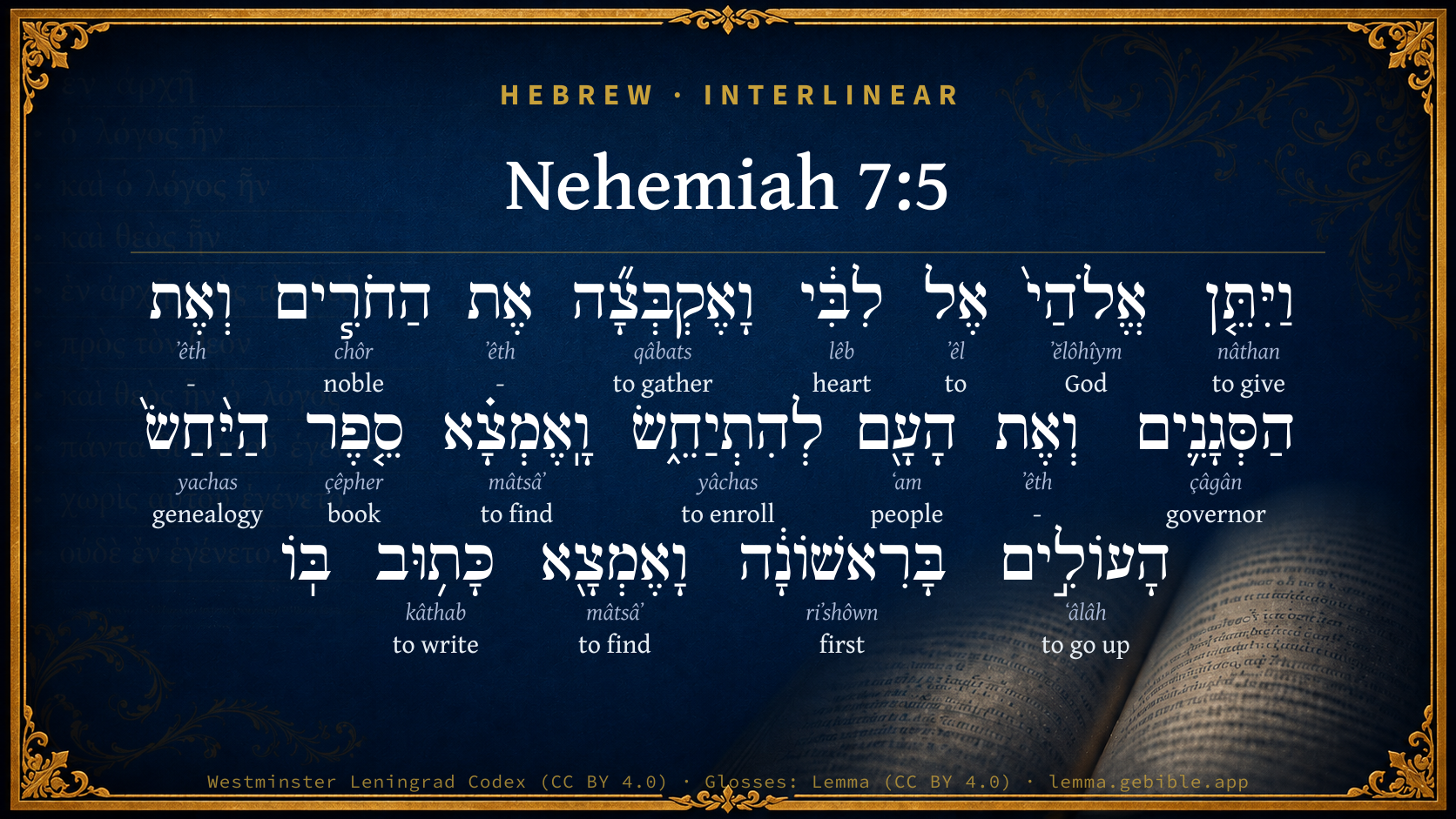
Hebrew (Westminster Leningrad Codex) Nehemiah 7:5 appears in the Hebrew Old Testament. The text above is from the Westminster Leningrad Codex. Each word links to its Strong’s number, a concise gloss, and parsing drawn from the Open Scriptures Hebrew Bible morphology. Click any word for its full Brown-Driver-Briggs (BDB) entry.
Download image
Cite this verse

Nehemiah 7:5 (World English Bible). Public Domain. Lemma interlinear Bible study tool, https://lemma.gebible.app/v/nehemiah/7/5.

Show BibTeX & RIS
BibTeX
RIS
English Translation
My God put into my heart to gather together the nobles, and the rulers, and the people, that they might be reckoned by genealogy. I found the book of the genealogy of those who came up at the first, and I found written therein:
World English Bible · Public Domain
Highlights
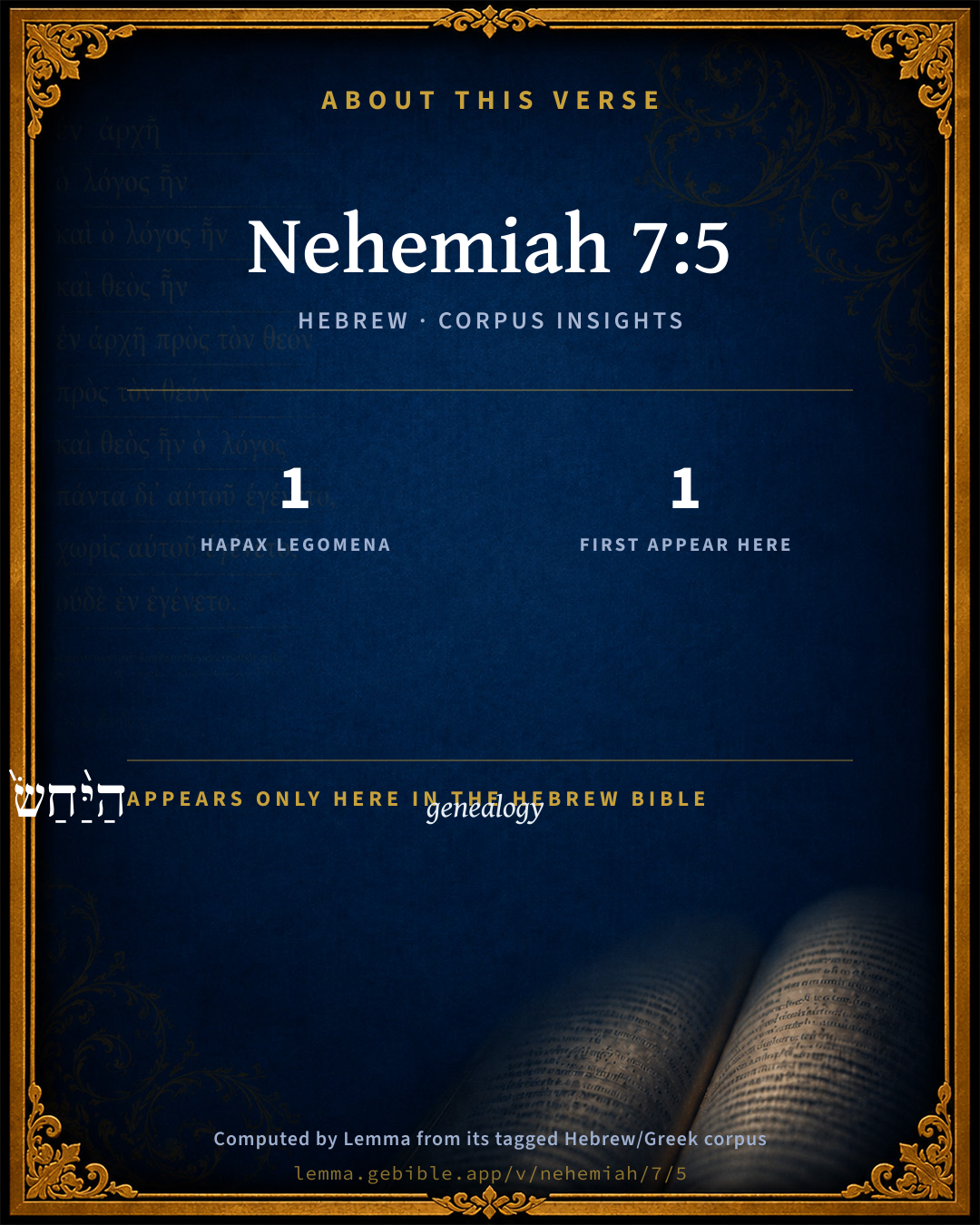
  • 1 hapax legomenon — only here in the Hebrew Bible
  • 1 first appearance in the Hebrew Bible
Full analysis ↓
Download a study sheet

One document with this verse’s original text, its word-by-word gloss line, the meaning frame, cross-references with their text, attributed commentary, and full source and license credits — printable, and it pastes into notes with its structure intact.

This verse Autodidact and up

Study sheet (.html) Plain text (.txt)

A passage Seminary Student

Up to 50 verses in one chapter. A passage sheet keeps up to 6 commentary sources and 12 cross-references per verse, in the order this page ranks them, and says so on the sheet whenever that leaves anything out. Ask for a single verse and you get the Autodidact verse sheet above.

Everything on this page stays free to read, with no account — the sheet is a download of what is already on screen, not access to it.

Want to remove ads? Support Godless Engineer
Compare translations 3

The same verse in 3 English versions, stacked beneath the original-language interlinear above. Click any original word for its lexicon entry.

Each is an independent rendering of the whole verse — the interlinear is not word-aligned to these translations.

Highlighted words mark where these versions differ — a whole-verse word diff, not a word-by-word alignment.

  • World English Bible Public Domain
    My God put into my heart to gather together the nobles, and the rulers, and the people, that they might be reckoned by genealogy. I found the book of the genealogy of those who came up at the first, and I found written therein:
  • King James Version Public Domain
    And my God put into mine heart to gather together the nobles, and the rulers, and the people, that they might be reckoned by genealogy. And I found a register of the genealogy of them which came up at the first, and found written therein,
  • unfoldingWord Literal Text CC BY-SA 4.0
    And my God gave to my heart, and I gathered together the nobles and the prefects and the people to be enrolled by genealogy. And I found the book of the genealogy for the ones who came up at the first. And I found written in it:

unfoldingWord Literal Text — © unfoldingWord, licensed CC BY-SA 4.0. Word-aligned USFM3 via Door43 (git.door43.org/unfoldingWord/en_ult).

Versions to compare (up to 4)

3 of 4 selected

Show all 18 translations

Every available English version of this verse, each an independent rendering of the whole verse.

  • World English Bible Public Domain
    My God put into my heart to gather together the nobles, and the rulers, and the people, that they might be reckoned by genealogy. I found the book of the genealogy of those who came up at the first, and I found written therein:
  • Berean Standard Bible Public Domain
    Then my God put it into my heart to assemble the nobles, the officials, and the people to be enrolled by genealogy. I found the genealogical register of those who had first returned, and I found the following written in it:
  • Majority Standard Bible Public Domain
    Then my God put it into my heart to assemble the nobles, the officials, and the people to be enrolled by genealogy. I found the genealogical register of those who had first returned, and I found the following written in it:
  • King James Version Public Domain
    And my God put into mine heart to gather together the nobles, and the rulers, and the people, that they might be reckoned by genealogy. And I found a register of the genealogy of them which came up at the first, and found written therein,
  • American Standard Version (1901) Public Domain
    And my God put into my heart to gather together the nobles, and the rulers, and the people, that they might be reckoned by genealogy. And I found the book of the genealogy of them that came up at the first, and I found written therein:
  • Revised Version (1885) Public Domain
    And my God put into my heart to gather together the nobles, and the rulers, and the people, that they might be reckoned by genealogy. And I found the book of the genealogy of them which came up at the first, and I found written therein:
  • Geneva Bible (1599) Public Domain
    And my God put into mine heart, and I gathered the princes, and the rulers, and the people, to count their genealogies: and I found a booke of the genealogie of them, which came vp at the first, and found written therein,
  • Douay-Rheims (1899) Public Domain
    But God had put in my heart, and I assembled the princes and magistrates, and common people, to number them: and I found a book of the number of them who came up at first, and therein it was found written:
  • Young's Literal Translation Public Domain
    and my God putteth it unto my heart, and I gather the freeman, and the prefects, and the people, for the genealogy, and I find a book of the genealogy of those coming up at the beginning, and I find written in it: --
  • Literal Standard Version CC BY-SA 4.0
    and my God puts it to my heart, and I gather the nobles, and the prefects, and the people, for the genealogy, and I find a scroll of the genealogy of those coming up at the beginning, and I find written in it:
  • Unlocked Literal Bible CC BY-SA 4.0
    My God put into my heart to gather together the nobles, the officials, and the people to enroll them by their families. I found the book of the genealogy of those who returned at the first and found the following written in it.
  • unfoldingWord Literal Text CC BY-SA 4.0
    And my God gave to my heart, and I gathered together the nobles and the prefects and the people to be enrolled by genealogy. And I found the book of the genealogy for the ones who came up at the first. And I found written in it:
  • Darby Bible Public Domain
    And my God put into my heart to gather together the nobles, and the rulers, and the people, for registration by genealogy. And I found a genealogical register of those that had come up at the first, and I found written in it:
  • World Messianic Bible Public Domain
    My God put into my heart to gather together the nobles, and the rulers, and the people, that they might be listed by genealogy. I found the book of the genealogy of those who came up at the first, and I found this written in it:
  • Webster's Bible Public Domain
    And my God put into my heart to assemble the nobles, and the rulers, and the people, that they might be reckoned by genealogy. And I found a register of the genealogy of them who came up at the first, and found written in it,
  • Free Bible Version CC BY-SA 4.0
    My God encouraged me to have everyone—the nobles, the officials, and the people—all come to be registered according to their family genealogy. I found the genealogical register of those who had returned first. This what I discovered written there.
  • Bible in Basic English Public Domain
    And my God put it into my heart to get together the rulers and the chiefs and the people so that they might be listed by families. And I came across a record of the names of those who came up at the first, and in it I saw these words:
  • JPS Tanakh (1917) Public Domain
    And my God put into my heart to gather together the nobles, and the rulers, and the people, that they might be reckoned by genealogy. And I found the book of the genealogy of them that came up at the first, and I found written therein:

Literal Standard Version (2020), Covenant Press — licensed CC BY-SA 4.0. Text via the HelloAO Bible API (eBible.org). Unlocked Literal Bible (unfoldingWord) — licensed CC BY-SA 4.0. Text via the HelloAO Bible API (eBible.org). unfoldingWord Literal Text — © unfoldingWord, licensed CC BY-SA 4.0. Word-aligned USFM3 via Door43 (git.door43.org/unfoldingWord/en_ult). Free Bible Version, Dr. Jonathan Gallagher — licensed CC BY-SA 4.0. Text via the HelloAO Bible API (eBible.org).

Word by word

More ways to search: Search by grammar → Find every occurrence → Compare this word →

Practice this passage: Drill this verse → Learn its vocabulary →

הַיַּ֨חַשׂ֙
yachas
H3188
“the · genealogy”
Particle, Definite Article + Noun, Common, Masculine, Singular, Absolute
Part of Speech
Particle + Noun
Type
Common
Gender
Masculine
Number
Singular
State
Absolute
Full BDB Definition

Origin: from H3187

TWOT: 862a

genealogy
  1. וַיִּתֵּ֤ן nâthan H5414 “and · to give” Conjunction + Verb, Qal, Sequential Imperfect, 3rd Person, Masculine, Singular
  2. אֱלֹהַי֙ ʼĕlôhîym H430 “God(s) · my” Noun, Common, Masculine, Plural, Construct + Suffix, Personal, 1st Person, Common, Singular
  3. אֶל ʼêl H413 “to” Preposition
  4. לִבִּ֔י lêb H3820 “heart · my” Noun, Common, Masculine, Singular, Construct + Suffix, Personal, 1st Person, Common, Singular
  5. וָאֶקְבְּצָ֞ה qâbats H6908 “and · to gather” Conjunction + Verb, Qal, Sequential Imperfect, 1st Person, Common, Singular + Suffix, h
  6. אֶת ʼêth H853 “-” Particle, Direct Object
  7. הַחֹרִ֧ים chôr H2715 “the · nobles” Particle, Definite Article + Noun, Common, Masculine, Plural, Absolute
  8. וְאֶת ʼêth H853 “and · -” Conjunction + Particle, Direct Object
  9. הַסְּגָנִ֛ים çâgân H5461 “the · governors” Particle, Definite Article + Noun, Common, Masculine, Plural, Absolute
  10. וְאֶת ʼêth H853 “and · -” Conjunction + Particle, Direct Object
  11. הָעָ֖ם ʻam H5971 “the · people” Particle, Definite Article + Noun, Common, Masculine, Singular, Absolute
  12. לְהִתְיַחֵ֑שׂ yâchas H3187 “to enroll” Preposition + Verb, Hithpael, Infinitive Construct
  13. וָֽאֶמְצָ֗א mâtsâʼ H4672 “and · to find” Conjunction + Verb, Qal, Sequential Imperfect, 1st Person, Common, Singular
  14. סֵ֤פֶר çêpher H5612 “book of” Noun, Common, Masculine, Singular, Construct
  15. הָעוֹלִ֣ים ʻâlâh H5927 “the · going up” Particle, Definite Article + Verb, Qal, Participle Active, Masculine, Plural, Absolute
  16. בָּרִאשׁוֹנָ֔ה riʼshôwn H7223 “in/at the · first” Preposition, Determined + Adjective, Adjective, Feminine, Singular, Absolute
  17. וָאֶמְצָ֖א mâtsâʼ H4672 “and · to find” Conjunction + Verb, Qal, Sequential Imperfect, 1st Person, Common, Singular
  18. כָּת֥וּב kâthab H3789 “written” Verb, Qal, Participle Passive, Masculine, Singular, Absolute

About this verse

These counts appear in no published source. They are computed here, from the morphology-tagged text and Lemma’s own curated glosses. What Lemma adds →

20
words
16
distinct lemmas
Historical
section

Notable vocabulary

1 hapax legomenon — a word that appears only here in the entire Hebrew Bible:

  • הַיַּ֨חַשׂ֙ genealogy H3188

First appearance in Scripture

This word makes its first canonical appearance in the Hebrew Bible here:

  • הַיַּ֨חַשׂ֙ genealogy H3188

Shared distinctive vocabulary

הַחֹרִ֧ים noble H2715 occurs in 13 verses of the Hebrew Bible. Also found in:

Grammatical profile

  • 7 verbs
  • 7 nouns
  • 1 adjective
  • 2 prepositions
  • 3 particles

Verb forms

  • וַיִּתֵּ֤ן Qal · Sequential Imperfect
  • וָאֶקְבְּצָ֞ה Qal · Sequential Imperfect
  • לְהִתְיַחֵ֑שׂ Hithpael · Infinitive Construct
  • וָֽאֶמְצָ֗א Qal · Sequential Imperfect
  • הָעוֹלִ֣ים Qal · Participle Active
  • וָאֶמְצָ֖א Qal · Sequential Imperfect
  • כָּת֥וּב Qal · Participle Passive

Repetition

A word recurs within this verse — often emphatic in Hebrew:

  • וָֽאֶמְצָ֗א to find H4672 ×2

Cross-references

12

Topical passages linked to Nehemiah 7:5 in the Treasury of Scripture Knowledge — connected by theme and wording, ordered by reader-vote popularity; previews shown in the World English Bible.

  • 2 Corinthians 3:5 not that we are sufficient of ourselves, to account anything as from ourselves; but our sufficiency is from God;
  • 1 Chronicles 9:1–9 So all Israel were reckoned by genealogies; and, behold, they are written in the book of the kings of Israel: and Judah was carried away captive to Babylon for their disobedience.
  • Ezra 2:62 These sought their register [among] those who were reckoned by genealogy, but they were not found: therefore were they deemed polluted and put from the priesthood.
  • Ezra 7:27 Blessed be Yahweh, the God of our fathers, who has put such a thing as this in the king's heart, to beautify the house of Yahweh which is in Jerusalem;
  • Nehemiah 5:19 Remember to me, my God, for good, all that I have done for this people.
  • Nehemiah 6:14 Remember, my God, Tobiah and Sanballat according to these their works, and also the prophetess Noadiah, and the rest of the prophets, that would have put me in fear.
  • Nehemiah 7:64 These sought their register [among] those who were reckoned by genealogy, but it was not found: therefore were they deemed polluted and put from the priesthood.
  • 1 Corinthians 15:10 But by the grace of God I am what I am. His grace which was bestowed on me was not futile, but I worked more than all of them; yet not I, but the grace of God which was with me.
  • 2 Corinthians 8:16 But thanks be to God, who puts the same earnest care for you into the heart of Titus.
  • Colossians 1:29 for which I also labor, striving according to his working, which works in me mightily.
  • James 1:16 Don't be deceived, my beloved brothers.
  • Philippians 2:12–13 So then, my beloved, even as you have always obeyed, not only in my presence, but now much more in my absence, work out your own salvation with fear and trembling.

Cross-references courtesy of OpenBible.info (CC BY 4.0).

Hebrew and Greek witnesses Masoretic Hebrew ↔ Greek Septuagint

The same verse in the two great witnesses to the Old Testament, shown verse-for-verse.

These are two independent witnesses, not word-aligned to each other, and the Septuagint is shown in lemma (dictionary) form.

Hebrew Nehemiah 7:5 Masoretic · Westminster Leningrad Codex

וַיִּתֵּ֤ן אֱלֹהַי֙ אֶל לִבִּ֔י וָאֶקְבְּצָ֞ה אֶת הַחֹרִ֧ים וְאֶת הַסְּגָנִ֛ים וְאֶת הָעָ֖ם לְהִתְיַחֵ֑שׂ וָֽאֶמְצָ֗א סֵ֤פֶר הַיַּ֨חַשׂ֙ הָעוֹלִ֣ים בָּרִאשׁוֹנָ֔ה וָאֶמְצָ֖א כָּת֥וּב בּֽוֹ

My God put into my heart to gather together the nobles, and the rulers, and the people, that they might be reckoned by genealogy. I found the book of the genealogy of those who came up at the first, and I found written therein:

World English Bible · Public Domain

Greek LXX Structure differs

The Septuagint has no separate book of Nehemiah. Its Greek text is the second half of Esdras B (2 Esdras), chapters 11–23; Ezra is the first half (1–10).

A verse-for-verse comparison isn’t shown here because the chapters and verses don’t line up. Switch to the LXX edition with the MT / LXX toggle above to read the Greek directly.

On this verse, The Cambridge Bible for Schools and Colleges discusses the Septuagint’s reading. Read the note in Commentary ↓

Hebrew: Westminster Leningrad Codex (CC BY 4.0). Greek: Septuagint (public domain); English from a public-domain English Septuagint. How the Septuagint differs from the Hebrew →

Commentary

Notes on Nehemiah 7:5 from classic Christian and Jewish commentators (each source and its license shown beneath its notes). The classic Christian expositions comment on the surrounding passage and are grouped to its opening verse, so a note may address several verses; the Jewish commentaries on the Tanakh (Rashi and others) are per-verse, so they appear only where the commentator wrote on this verse.

Lemma curates 59 commentaries, every one of them public domain or Creative Commons licensed, each selected and text-cleaned for this edition rather than reprinted as found. About our sources →

Matthew Henry's Commentary

We have here another good project of Nehemiah's; for wise and zealous men will be always contriving something or other for the glory of God and the edification of his church. He knew very well that the safety of a city, under God, depends more upon the number and valour of the inhabitants than upon the height or strength of its walls; and therefore, observing that the people were few that dwelt in it, he thought fit to take an account of the people, that he might find what families had formerly had their settlement in Jerusalem, but were now removed into the country, that he might bring them back, and what families could in any other way be influenced by their religion, or by their business, to come and rebuild the houses in Jerusalem and dwell in them. So little reason have we to wish that we may be placed alone in the earth, or in Jerusalem itself, that much of our safety and comfort depends upon our neighbours and friends; the more the stronger, the more the merrier. It is the wisdom of the governors of a nation to keep the balance even between the city and country, that the metropolis be not so extravagantly large as to drain and impoverish the country, nor yet so weak as not to be able to protect it. Now observe,

I. Whence this good design of Nehemiah's came. He owns, My God put it into my heart, Neh 7:5. Note, Whatever good motion is in our minds, either prudent or pious, we must acknowledge it to come from God. It was he that put it into our hearts; for every good gift and every good work are from above. He gives knowledge; he gives grace; all is of him, and therefore all must be to him. What is done by human prudence must be ascribed to the direction of divine Providence; he that teaches the husbandman his discretion (Isa 28:26) teaches the statesman his.

II. What method he took in prosecution of it.

1. He called the rulers together, and the people, that he might have an account of the present state of their families - their number and strength, and where they were settled. It is probable that when he summoned them to come together he ordered them to bring such an account along with them out of their several districts. And I doubt they were not so many but that it might be soon done.

2. He reviewed the old register of the genealogy of those who came up at the first, and compared the present accounts with that; and here we have the repetition of that out of Ezra 2. The title is the same here (Neh 7:6, Neh 7:7) as there (Ezr 2:1): These are the children of the province, etc. Two things are here repeated and recorded a second time from thence - the names and numbers of their several families, and their oblations to the service of the temple. The repetition of these accounts may intimate to us the delight which the great God is pleased to take in the persons, families, and services of his spiritual Israel, and the particular notice he takes of them. He knows those that are his, knows them all, knows them by name, has his eye on the register of those children of the captivity, and does all according to the ancient counsel of his will concerning them.

(1.) Here is an account of the heads of the several families that first came up, v. 6-69. As to this, [1.] Though it seem of little use to us now, yet then it was of great use, to compare what they had been with what they now were. We may suppose they were much increased by this time; but it would do well for them to remember their small beginnings, that they might acknowledge God in multiplying their families and building them up. By this means likewise their genealogies would be preserved, and the distinction of their families kept up, till the Messiah should come, and then an end be put to all their genealogies, which were preserved for his sake, but afterwards were endless. But, [2.] There are many differences in the numbers between this catalogue and that in Ezra. Most of them indeed are exactly the same, and some others within a very few under or over (one or two perhaps); and therefore I cannot think, as some do, that that was the number of these families at their first coming and this as they were now, which was at least forty years after (some make it much more); for we cannot suppose so many families to be not at all, or but little, altered in their numbers in all that time; therefore what differences there are we may suppose to arise either from the mistakes of transcribers, which easily happen in numbers, or from the diversity of the copies from which they were taken. Or perhaps one was the account of them when they set out from Babylon with Zerubbabel, the other when they came to Jerusalem. The sum totals are all just the same there and here, except of the singing-men and singing-women, which there are 200, here 245. These were not of such importance as that they should keep any strict account of them.

(2.) Here is an account of the offerings which were given towards the work of God, Neh 7:70, etc. This differs much from that in Ezr 2:68, Ezr 2:69, and it may be questioned whether it refers to the same contribution; here the tirshatha, or chief governor, who there was not mentioned, begins the offering; and the single sum mentioned there exceeds all those here put together; yet it is probable that it was the same, but that followed one copy of the lists, this another; for the last verse is the same here that it was Ezr 2:70, adding Ezr 3:1. Blessed be God that our faith and hope are not built upon the niceties of names and numbers, genealogy and chronology, but on the great things of the law and gospel. Whatever is given to the work of God, he is not unrighteous to forget it; nor shall even a cup of cold water, wherewith he is honoured, go without its reward.

Matthew Henry's Commentary on the Whole Bible (1708–1710) — public domain (CC PDM 1.0). Text via the HelloAO Bible API.

Jamieson, Fausset & Brown

Robert Jamieson, A. R. Fausset & David Brown

GENEALOGY OF THOSE WHO CAME AT THE FIRST OUT OF BABYLON. (Neh. 7:5-38)

my God put into mine heart to gather together the nobles, &c.--The arrangement about to be described, though dictated by mere common prudence, is, in accordance with the pious feelings of Nehemiah, ascribed not to his own prudence or reflection, but to the grace of God prompting and directing him. He resolved to prepare a register of the returned exiles, containing an exact record of the family and ancestral abode of every individual. While thus directing his attention, he discovered a register of the first detachment who had come under the care of Zerubbabel. It is transcribed in the following verses, and differs in some few particulars from that given in Ezra 2:1-61. But the discrepancy is sufficiently accounted for from the different circumstances in which the two registers were taken; that of Ezra having been made up at Babylon, while that of Nehemiah was drawn out in Judea, after the walls of Jerusalem had been rebuilt. The lapse of so many years might well be expected to make a difference appear in the catalogue, through death or other causes; in particular, one person being, according to Jewish custom, called by different names. Thus Hariph (Neh 7:24) is the same as Jorah (Ezr 2:18), Sia (Neh 7:47) the same as Siaha (Ezr 2:44), &c. Besides other purposes to which this genealogy of the nobles, rulers, and people was subservient, one leading object contemplated by it was to ascertain with accuracy the parties to whom the duty legally belonged of ministering at the altar and conducting the various services of the temple. For guiding to exact information in this important point of enquiry, the possession of the old register of Zerubbabel was invaluable.

Jamieson, Fausset & Brown — Commentary Critical and Explanatory on the Whole Bible (1871) — public domain (CC PDM 1.0). Text via the HelloAO Bible API.

Trapp's Complete Commentary

John Trapp

Neh 7:5 And my God put into mine heart to gather together the nobles, and the rulers, and the people, that they might be reckoned by genealogy. And I found a register of the genealogy of them which came up at the first, and found written therein,

Ver. 5. And my God put into my heart] Seeing how thinly the city was inhabited, and casting in his mind what evil might come of it, he bethinks himself (by a motion from heaven) how to set things to rights; that the city might be better peopled, and so preserved. This to do, God put into his heart by his Holy Spirit (the sweet motions whereof are the sound of his goings, the footsteps of his anointed, Psa 89:51). We are not sufficient of ourselves (saith that great apostle) to think anything as of ourselves: but our sufficiency is of God, 2Co 3:5. Nemo vir magnus sine aliquo afflatu Divino unquam fuit, saith Cicero; no man ever grew to be greatly good without a Divine instinct.

To gather together the nobles, and the rulers, &c.] That out of them a tenth man might be taken to furnish out the city, Neh 11:1, after that they had been first prepared by the hearing of the law, Neh 8:2.

That they might be reckoned by their genealogy] And so, Jerusalem be inhabited again, in her own place, even in Jerusalem, Zec 12:6.

John Trapp, A Commentary or Exposition upon All the Books of the Old and New Testament (1647–1656) — public domain. Text from a community e-Sword module.

Joseph Benson's Commentary

Neh 7:5. And my God put into my heart, &c. — Whatever good motion is put into our minds, we must acknowledge it to come from God; and even what is done by human prudence is to be ascribed to the direction of divine providence. To gather together the nobles and the rulers of the people — Not only for the particular end here mentioned, but for divers other weighty purposes and matters, of which the following chapters treat. That they might be reckoned by genealogy — In order that it might appear to what family each person belonged, and where their ancient habitations lay, which, for a great number of them, were in the city, the peopling of which was now his design. I found a register of them which came up at the first — To wit, with Zerubbabel, as it follows, Neh 7:7. But this following catalogue differs in some particulars from that in Ezra, chap. 2., of which see the notes there. The author of the Universal History observes, that though the genealogies had been once rectified, soo after the return, there were still many families of priests, Levites, and people, who could not make out their claim to their tribes. It is therefore likely that some of them were afterward enabled to do it, and were then inserted in this new register, together with those who came up with Nehemiah. Several of the old families, which came up on the first edict, might be, by this time, extinct, and these are the probable causes of the difference we find in the genealogies of the books of Ezra and Nehemiah.

Joseph Benson's Commentary on the Old and New Testaments (1811–1818) — public domain. Text from a community e-Sword module.

Adam Clarke's Commentary

Verse 5. God put into mine heart] With this good man every good thing was of GOD. If he purposed any good, it was because God put it into his heart; if he did any good, it was because the good hand of his God was upon him; if he expected any good, it was because he earnestly prayed God to remember him for good. Thus, in all his ways he acknowledged God, and God directed all his steps.

Adam Clarke's Commentary on the Bible (1810–1826) — public domain. Text from a community e-Sword/MySword module.

Ellicott's Commentary for English Readers

(5-73) The genealogical reckoning of the people, as the first step towards increasing the population of the metropolis, is determined on, not without express Divine suggestion; the allusion to this inspiration from God, is, as in Neh_2:12, very emphatic. The original register of Zerubbabelis found and copied. The express language of both Ezra and Nehemiah makes it plain that this is no other than the list of those who came up with Zerubbabel and Joshua after the decree of Cyrus, in B.C. 538. Nehemiah’s own census follows, in Nehemiah 11. The exposition, especially as compared with Ezra 2, has been given on that chapter.

A Bible Commentary for English Readers, edited by Charles John Ellicott (1878–1897) — public domain. Text from a community e-Sword module.

The Cambridge Bible for Schools and Colleges

gen. ed. J. J. S. Perowne

5. my God put into mine heart] R.V. my heart. For this expression see note on Neh_2:12.

nobles … rulers (R.V. marg. deputies) … people] cf. Neh_2:16; Neh_4:14; Neh_4:19.

that they might be reckoned by genealogy] LXX. εἰς συνοδίας, Vulg. ‘ut recenserem eos.’ Nehemiah’s census seems to be referred to in Neh_11:1-3, from which passage we gather that the census was a preliminary to measures for replenishing the population of Jerusalem.

The Cambridge Bible for Schools and Colleges (gen. ed. J. J. S. Perowne; Cambridge University Press, 1878–1918) — public domain. Text from a community e-Sword module.

John Gill's Exposition

And my God put into mine heart,.... Every good motion in him, and whatever he thought of that was conducive to the good and welfare of Jerusalem, Nehemiah always ascribed it to God; see Co2 3:5

to gather together the nobles, and the rulers, and the people, that they might be reckoned by genealogy; that their number might be known, and of what families they were, and in what cities they formerly dwelt; and this was not only of use for the present purpose of Nehemiah, but was of service hereafter to show the pedigree of families, and that it might be clearly known from whence the Messiah sprung:

and I found a register of the genealogy of them which came up at the first; from Babylon to Jerusalem, along with Zerubbabel, as appears from Neh 7:7, and this was of great use to him, whereby he would know not only their names and number, but to what city they belonged, and who to the city of Jerusalem, that they might be called upon to come, and rebuild their houses, and take up their residence there:

and found written therein; the names of the persons and families after mentioned.

John Gill's Exposition of the Whole Bible (1746–1763) — public domain (CC PDM 1.0). Text via the HelloAO Bible API.

Albert Barnes' Notes on the Bible

It is argued by some that the entire catalogue which follows Neh. 7:7-73 is not the register of them “which came up ‘at the first’,” but of the Jewish people in Nehemiah’s time. Neh 7:7 and Ezr 2:2 are, however, very positive in their support of the usual view; and some of the arguments against it are thought to be met by considering the Nehemiah of Neh 7:7 and Ezr 2:2 a person different from Nehemiah the governor; and “Tirshatha” an official title likely to have belonged to others besides Nehemiah (see the Ezr 2:63 note.)

Albert Barnes' Notes on the Bible (1834–1885) — public domain. Text from a community e-Sword/MySword module.

Haydock's Catholic Bible Commentary

Heart, inspired me to provide inhabitants for the city, as was afterwards done by lot, chap. xi. (Tirinus) --- Written. Hence it seems evident that Nehemias here only transcribes this ancient record, of those who came under Zorobabel, and consequently this chapter sought to agree with 1 Esdras ii., as well as with 3 Esdras v. 9., (Haydock) which is now strangely corrupted; so that it can throw no light upon the matter. (Calmet) --- Some think that various catalogues were taken, at Babylon, at the first coming to Jerusalem, (Menochius) and at the dedication of the temple; (Tirinus) and that Nehemias refer to a different one from that of Esdras. (Sa) (Lucas) (Tirinus) --- Others suppose that changes were introduced, as the families were increased or diminished, in the time of Nehemias; (Tirinus) who, therefore, judged it necessary to write a fresh catalogue, but only adjusted the old one to the present circumstances, including probably the names of those who had returned with Esdras, or with himself. (Calmet) --- This seems contrary to the text, a book of, &c., and it would perhaps be as well to allow that the variations arise from transcribers, as all allow that many of the names and numbers are corrupted. (Haydock) --- The similarity of Hebrew letters for different numbers might easily occasion this; as we cannot suppose but Esdras would be able to give the total of sixty particular sums. (Watson, let. 5.)

George Leo Haydock (1774–1849), Haydock's Catholic Family Bible and Commentary, 1859 edition — public domain. Excludes Psalms (Douay-Rheims chapter numbering differs from Protestant) and Deuterocanonical books (Catholic canon only).

Matthew Poole's English Annotations

God put into mine heart: this action, though merely prudential, he doth not ascribe to himself, or his own wit, but to the gift and grace of God directing and inclining him to it.

To gather together the nobles, and the rulers, and the people not only for the particular end here mentioned, but for divers other weighty purposes and matters, of which the following chapters treat.

That they might be reckoned by genealogy; that so it might appear to what families each person belonged, and where their ancient habitations lay, which for a great number of them were in the city, the replenishing of which was now his design.

Them which came up at the first, to wit, with Zerubbabel, as it follows, Neh 7:7. But this following catalogue differs in some particulars from that Ezr 2, of which see the notes there.

Matthew Poole's English Annotations on the Holy Bible (1683–1685) — public domain. Text from a community e-Sword/MySword module.

Whedon's Commentary on the Bible

Daniel D. Whedon

5. God put into mine heart — Inspired me with the thought and purpose about to be told.

To gather together the nobles… rulers… people — The object of this gathering was to ascertain the number of the people, and see how many or what proportion of them might be brought to dwell in Jerusalem, and thus increase the population of the city. The result of this plan is told in Neh_11:1-2.

I found a register — Which is presented in the sequel of this chapter, and is substantially identical with that of Ezra 2, where see notes.

Daniel D. Whedon (gen. ed.), Commentary on the Old and New Testaments (1874–1909) — public domain. Text from a community e-Sword module.

The Pulpit Commentary

And my God put into mine heart to gather together the nobles, etc. As Nehemiah contemplated the vast empty spaces within the city walls, and considered with himself how they might best be peopled, the thought came to him and he hailed it as a Divine inspiration that by taking a census of the people he might pave the way for some transfer of the inhabitants of the country districts into the capital, which would at any rate strengthen the latter, and lessen the desolate appearance of its streets and squares, which had so pained him. The census would show what proportion the country and town populations bore to each other, and would point out which were the places in the country districts that could best afford to lose a portion of their inhabitants. A census, therefore was resolved upon, and, according to ordinary Jewish usage, (Num_1:17-47 1Ch_21:5, 6 Ezr_2:3-62) it was genealogical. The tribes of Judah, Benjamin, and Levi were numbered separately; (Neh_11:4-19) and in the tribe of Judah the children of Pharez were reckoned apart from those of Zerah. (1Ch_9:4, 1Ch_9:6) No doubt the genealogical principle was acted upon throughout, but further evidence upon the point is wanting. It would seem to have been in the course of his preparations for this census, perhaps in searching for precedents, that Nehemiah found the "register of the genealogy of them which came up at the first," which is the subject of the next section.

Vers. 5-69. An honourable register.

Account of those who had returned to the Holy Land under Zerubbabel, Jeshua, and other leaders; found by Nehemiah when seeking guidance in making a general census of the people. In reading this record, the following observations suggest themselves:

I THE COMPARATIVE FEWNESS AND GENERAL POVERTY OF THE RETURNING PEOPLE. The majority of their brethren preferred their position among the heathen to the honour and peril of aiding to reestablish their nation in their own land. The temptation to this course was greatest in the case of men of substance, and most of them appear to have yielded to it. We are reminded that of professing Christians a large number, perhaps the majority, do not really accept the invitation pressed continually upon them to undertake the journey to heaven, and that still the rich find it hard to enter the kingdom of heaven.

II Although few and poor, THE RETURNING PEOPLE INCLUDED ALL THE ELEMENTS NEEDFUL FOR THE ESTABLISHMENT OF A REGULARLY ORGANISED JEWISH STATE. They were not a mere rabble. There was the civil governor, Zerubbabel; the high priest, Jeshua; a considerable number of ordinary priests; there were Levites and other temple servants, even singers; besides the body of the people.

III THEIR FAITH, ZEAL, AND COURAGE ARE TO BE NOTED AND ADMIRED. All left some sort of settled home to which they were accustomed; some, businesses more or less lucrative; a few, the positions which wealth or talent affords. They encountered certain, though untried, privations, struggles, and dangers, the end of which to each one was very uncertain. But they were men, whose spirit God had raised, to go up to build the house of the Lord which is in Jerusalem". (Ezr_1:5) They believed the prophets, and anticipated a glorious future for their nation. They loved their God, their nation, and their country, though to the last most of them were strangers. The priests particularly distinguished themselves, as is shown by the number of them who returned, as compared with that of the people. They surpassed the Levites, who, both under Zerubbabel and Ezra, showed backwardness. Yet this class had formerly been more zealous than the priests. (2Ch_29:34) The leaders are especially worthy of commendation. Their sacrifice must have been greater, and the cares and responsibilities they undertook were much heavier. Numbers followed at subsequent periods, after the first difficulties had been overcome and a settlement effected; but they could not attain to the honour of those who led the way.

IV The failure of some who accompanied the expedition to prove themselves by genealogy Israelites, of others to prove themselves priests, suggests THAT GOD"S TRUE ISRAEL AND PRIESTHOOD REQUIRE NO GENEALOGY. They belong to a higher order of things, not regulated "after the law of a carnal commandment, but after the power of an endless life". (Heb_7:16) God"s spiritual Israel become such by faith; each one belonging to it is "born not of blood, but of God". (Joh_1:13) And while it is a blessed thing to have a pious ancestry, those who have it not are admitted as freely and fully into all the privileges of citizenship, on their acceptance of Christ, as those who have it. One of these privileges is that of being "priests unto God." Nor is special ministry in the Church inherited; it is the privilege of those who are fitted for it, and called to it by the Holy Ghost, who distributes his gifts "to every man severally as he will". (1Co_12:11)

V THE LACK IN THE NEWLY-ESTABLISHED COMMUNITY OF SOME PRIVILEGES ENJOYED BY THEIR FOREFATHERS is seen in the absence of "a priest with Urim and Thummim." The time was eagerly expected when this and other like advantages would be restored, but in vain. For a while the gift of prophecy lingered, and then passed away. The losses were deplored, but proved to be gains. The guidance withdrawn belonged to the period of childhood. God s people were more and more to be prepared for the time of moral manhood, when they would realise the guidance and help of God in the exercise of their own spirits in connection with the written word remaining as a permanent legacy from the past. One more outburst of the miraculous, the grandest and most fruitful of all, and then the Spirit of God would abide with the Church as never before, its permanent Teacher and Guide through the at length completed word; but the miraculous would cease. We long at times for the return of "signs from heaven," but "it is expedient" for us that we should be without them.

VI The variations in the several copies of this document suggest that happily THERE ARE, AND CAN BE, NO MISTAKES IN GOD"S REGISTER OF HIS SPIRITUAL ISRAEL. Finally, the perusal of this and similar lists may well lead us to exclaim with good Matthew Henry, "Blessed be God that our faith and hope are not built upon the niceties of names and numbers, genealogy and chronology, but on the great things of the law and gospel."

The Pulpit Commentary (1880–1919), ed. H.D.M. Spence-Jones & Joseph S. Exell — public domain. Text from a community e-Sword module.

John Wesley's Explanatory Notes

God put it into mine heart - Whatever good motion is in our minds, we must acknowledge it to come from God. What is done by human prudence is to be ascribed to the direction of Divine Providence.

John Wesley, Explanatory Notes Upon the Whole Bible (1754–1765) — public domain. Text via the GEBible commentary corpus.

Keil & Delitzsch

C. F. Keil & F. Delitzsch

And God put into my heart, i.e., God inspired me with the resolution; comp. Neh 2:12. What resolution, is declared by the sentences following, which detail its execution. The resolution to gather together the nobles and rulers of the people for the purpose of making a list of their kinsmen, and thus to obtain a basis for the operations contemplated for increasing the inhabitants of Jerusalem. והסּגנים החרים are combined, as in Neh 2:16. On התיחשׂ, comp. Ch1 5:17.

While this resolve was under consideration, Nehemiah found the register, i.e., the genealogical registry, of those who came up at first (from Babylon). בּראשׁונה, at the beginning, i.e., with Zerubbabel and Joshua under Cyrus (Ezra 2), and not subsequently with Ezra (Ezra 7). "And I found written therein." These words introduce the list now given. This list, vv. 6-73a, is identical with that in Ezra 2, and has been already discussed in our remarks on that chapter.

Keil & Delitzsch — Biblical Commentary on the Old Testament (1861–1891) — public domain (CC PDM 1.0). Text via the HelloAO Bible API. (Old Testament only.)

Kretzmann's Popular Commentary

Paul E. Kretzmann

A List of Returned Exiles

v. 5. And my God put into mine heart to gather together the nobles and the rulers and the people that they might be reckoned by genealogy, his idea being to increase the number of the city’s inhabitants by appropriate measures. And I found a register of the genealogy of them which came up at the first, a list of the time of Zerubbabel, some ninety years before, and found written therein,

v. 6. These are the children of the province that went up out of the captivity, of those that had been carried away, whom Nebuchadnezzar, the king of Babylon, had carried away, and came again to Jerusalem and to Judah, every one unto his city, Cf Ezra 2,

v. 7. who came with Zerubbabel, Joshua, Nehemiah, Azariah (or Seraiah), Raamiah, Nahamani, Mordecai, Bilshan, Mispereth, Bigvai, Nehum, Baanah. It should be noted at once that the difference between the figures given in this list and those in the list of Ezra is probably due to the fact that Zerubbabel had the list of the caravan as it was assembled for the journey, while Nehemiah used a copy which showed the members of the caravan as it actually arrived in Jerusalem, or those registered in Jerusalem upon their arrival are here mentioned, some of the people going directly to the homesteads of their father. without waiting for a second registration. The number, I say, of the men of the people of Israel was this:

v. 8. the children of Parosh, two thousand an hundred seventy and two.

v. 9. The children of Shephatish, three hundred seventy and two.

v. 10. The children of Arah, six hundred fifty and two.

v. 11. The children of Pahath-moab, of the children of Jeshua and Joab, two thousand and eight hundred and eighteen.

v. 12. The children of Elam, a thousand two hundred fifty and four.

v. 13. The children of Zattu, eight hundred forty and five.

v. 14. The ohildren of Zaccai, seven hundred and threescore.

v. 15. The children of Binnui (or Bani), six hundred forty and eight.

v. 16. The children of Rebai, six hundred twenty and eight.

v. 17. The children of Azgad, two thousand three hundred twenty and two, this being a sample of a case where a large company from a father-house joined the caravan after the list of its members had been prepared.

v. 18. The children of Adonikam, six hundred threescore and seven.

v. 19. The children of Bigvai, two thousand threescore and seven.

v. 20. The children of Adin, six hundred fifty and five.

v. 21. The children of Ater of Hesskiah, ninety and eight.

v. 22. The children of Hashum, three hundred twenty and eight.

v. 23. The children of Bezai, three hundred twenty and four.

v. 24. The children of Hariph (or Jorah), an hundred and twelve.

v. 25. The children of Gibeon (or Gibbar), ninety and five.

v. 26. The men of Bethlehem and Netophah, an hundred fourscore and eight.

v. 27. The men of Anathoth, an hundred twenty and eight.

v. 28. The men of Beth-azmaveth, forty and two.

v. 29. The men of Kirjath-jearim, Chephirah, and Beeroth, seven hundred forty and three.

v. 30. The men of Ramah and Gaba, lix hundred twenty and one.

v. 31. The men of Michmas, an hundred and twenty and two.

v. 32. The men of Bethel and Ai, an hundred twenty and three.

v. 33. The men of the other Nebo, the Nobe in Judah, to distinguish it from that in the territory of Reuben, fifty and two.

v. 34. The children of the other Elam, distinguished from those of v. 12, a thousand two hundred fifty and four.

v. 35. The children of Harim, three hundred and twenty.

v. 36. The children of Jericho, three hundred forty and five.

v. 37. The children of Lod, Hadid, a The Nethinim: the children of Ziha, the children of Hasupha, the children of Tabbaotknd Ono, seven hundred twenty and one. For the location of the cities mentioned in this list compare the notes on Ezra 2.

v. 38. The children of Senaab, three thousand nine hundred and thirty.

v. 39. The priests: the children of Jedaiah, of the house of Jeshua, nine hundred seventy and three.

v. 40. The children of Immer, a thousand fifty and two.

v. 41. The children of Pashur, a thousand two hundred forty and seven.

v. 42. The children of Harim, a thousand and seventeen. It seems that only four courses of priests returned from Babylon, at least at the time of the first journey under Zerubbabel. The four courses were afterward once more divided into twenty-four, with the names of the original courses which David appointed.

v. 43. The Levites: the children of Joshua, of Hadmiel, and of the children of Hodevah (or Hodaviah), seventy and four.

v. 44. The singers: the children of Asaph, the only ones returned from exile at that time, an hundred forty and eight.

v. 45. The porters: the children of Shallum, the children of Ater, the children of Talmon, the children of Akkub, the children of Hatita, the children of Shobai, an hundred thirty and eight.

v. 46. The Nethinim: the children of Ziha, the children of Hasupha, the children of Tabbaoth,

v. 47. the children of Keros, the children of Sia (or Siaha), the children of Padon,

v. 48. the children of Lebana, the children of Hagaba, the children of Shalmai (or Shamlai),

v. 49. the children of Hanan, the children of Giddel, the children of Gahar,

v. 50. the children of Reaiah, the children at Rezin, the children of Nekoda,

v. 51. the children of Gazzam, the children of Uzza, the children of Phaseah,

v. 52. the children of Besai, the children of Meunim, the children of Nephishesim (or Nephusim),

v. 53. the children of Bakbuk, the children of Hakupha, the children of Harhur,

v. 54. the children of Bazlith, the children of Mehida, the children of Harsha,

v. 55. the children of Barkos, the children of Sisera, the children of Tamah,

v. 56. the children of Neziah, the children of Hatipha. All these belonged to the Nethinim, who were in charge of the minor tasks in the Temple.

v. 57. The children of Solomon’s servants, below the Nethinim in rank: the children of Sotai, the children of Sophereth, the children of Perida,

v. 58. the children of Jaala, the children of Darkon, the children of Giddel,

v. 59. the children at Shephatiah, the children of Hattil, the children of Pochereth of Zebaim, the children of Amon (or Ami).

v. 60. All the Nethinim andthe children of Solomon’s servants were three hundred ninety and two.

v. 61. And these were they which went up also from Telmelah, Tel-haresha, Cherub, Addon (or Addan), and Immer; but they could not show their father’s house, could not produce evidence of their descent, nor their seed, whether they were of Israel.

v. 62. The children of Delaiah, the children of Tobiah, the children of Nekoda, six hundred forty and two.

v. 63. And of the priests: the children of Habaiah, the children of Koz, the children of Barzillai, which took one of the daughters of Barzillai the Gileadite to wife and was called after their name, an act which now cost his descendants their rights as members of the Jewish congregation.

v. 64. These sought their register among those that were reckoned by genealogy, but it was not found; therefore were they, as polluted, their priestly descent not being clearly shown by documents, put from the priesthood.

v. 65. And the Tirshatha, the governor, at that time Zerubbabel, said unto them, that they should not eat of the most holy things, the special privilege of the priests, till there stood up a priest with Urim and Thummim, those connected with the high priest’s breastplate, Exo 28:30, by means of which the high priest inquired of God, Num 27:21; 1Sa 28:6.

v. 66. The whole congregation together was forty and two thousand three hundred and threescore,

v. 67. beside their man-servants and their maidservants, of whom there were seven thousand three hundred thirty and seven; and they had two hundred forty and five singing men and singing women, probably a guild of professional entertainers.

v. 68. Their horses, seven hundred thirty and six; their mules, two hundred forty and five;

v. 69. their camels, four hundred thirty and five; six thousand seven hundred and twenty asses. Here the list of the people and their possessions ends.

Paul E. Kretzmann, Popular Commentary of the Bible (1921–1924) — public domain. Text from a community e-Sword module.

unfoldingWord translationNotes

Door43 World Missions Community

put into my heart

Here Nehemiah's "heart" refers to his thoughts and will. See how you translated this in Nehemiah 2:12. AT: "inspired me" or "led me" (See: Metonymy)

to enroll them

"to list and register them"

the book of the genealogy

This was a book that no longer exists.

found the following written in it

This can be expressed in active form. AT: "found that someone had written the following in it" (See: Active or Passive)

translationWords

God

heart

family

written

unfoldingWord translationNotes — © Distant Shores Media and the Door43 World Missions Community, licensed CC BY-SA 4.0. Source: git.door43.org/Door43/en_tn.

Rashi

Rabbi Shlomo Yitzchaki (Rashi)

to trace their lineage Heb. לְהִתְיַחֵישׂ, to search for their lineage.

those who went up at first of those Jews who went up with Ezra at first.

and I found written in it All these words were written in that letter.

Rashi on the Tanakh — English translations: “The Judaica Press complete Tanach with Rashi, translated by A. J. Rosenberg” (CC BY 4.0); “Pentateuch with Rashi's commentary by M. Rosenbaum and A.M. Silbermann, 1929-1934” (public domain); “The Metsudah Tanach series, Lakewood, N.J” (CC BY 4.0); and “The Book of Joshua, Metsudah Publications, 1997” (CC BY 4.0). Text via Sefaria.

Lesson kit

Teaching starters — assembled from the data on this page, not authored interpretation. Every prompt links to the verse data it draws on. Edit before teaching.

Nehemiah, in the Historical, opens this verse with 20 words (16 distinct Hebrew lemmas). Its most distinctive word is yachas (“genealogy”). A historical commentator’s framing appears above. Read the whole chapter for the surrounding context.

Discussion questions

  1. How does “genealogy” (yachas) shape what this verse is saying?
  2. 1 word here appears nowhere else in the Hebrew Bible. Why might the author reach for such rare wording?
  3. This is the first place “genealogy” appears in Scripture (first appears here). What does its debut here establish?
  4. How does 1 Kings 21:8, which shares the word «noble», read alongside this verse?
  5. What does the repetition of “to find” (2× in this one verse) do in this verse?
  6. The translations on this page render this verse differently — a whole-verse word diff, not a word-by-word alignment. What might account for the different wordings?
  7. «וַיִּתֵּ֤ן» is a Qal Sequential Imperfect verb. How does that grammatical form shape the action described?
  8. Compare how Matthew Henry's Commentary and Jamieson, Fausset & Brown read this verse. Where do they agree or differ?

Things to notice

  • 1 word in this verse appears nowhere else in the Hebrew Bible.
  • 1 word makes its first canonical appearance in Scripture here.
  • These translations choose different wording for 17 words in this verse.
  • “to find” occurs 2× in this single verse.
  • 16 distinct Hebrew lemmas span 20 words in this verse.

Reading settings

Reading text

Shown beneath each verse's original-language words.

Old Testament
Old Testament edition

Read the OT as the Masoretic Hebrew (MT) or the Greek Septuagint (LXX).

English shown for the Greek Septuagint (in the Hebrew ↔ Greek comparison).

Comparing translations? Open the Compare panel on any verse page to stack up to four side by side.