
1 Samuel 10:25

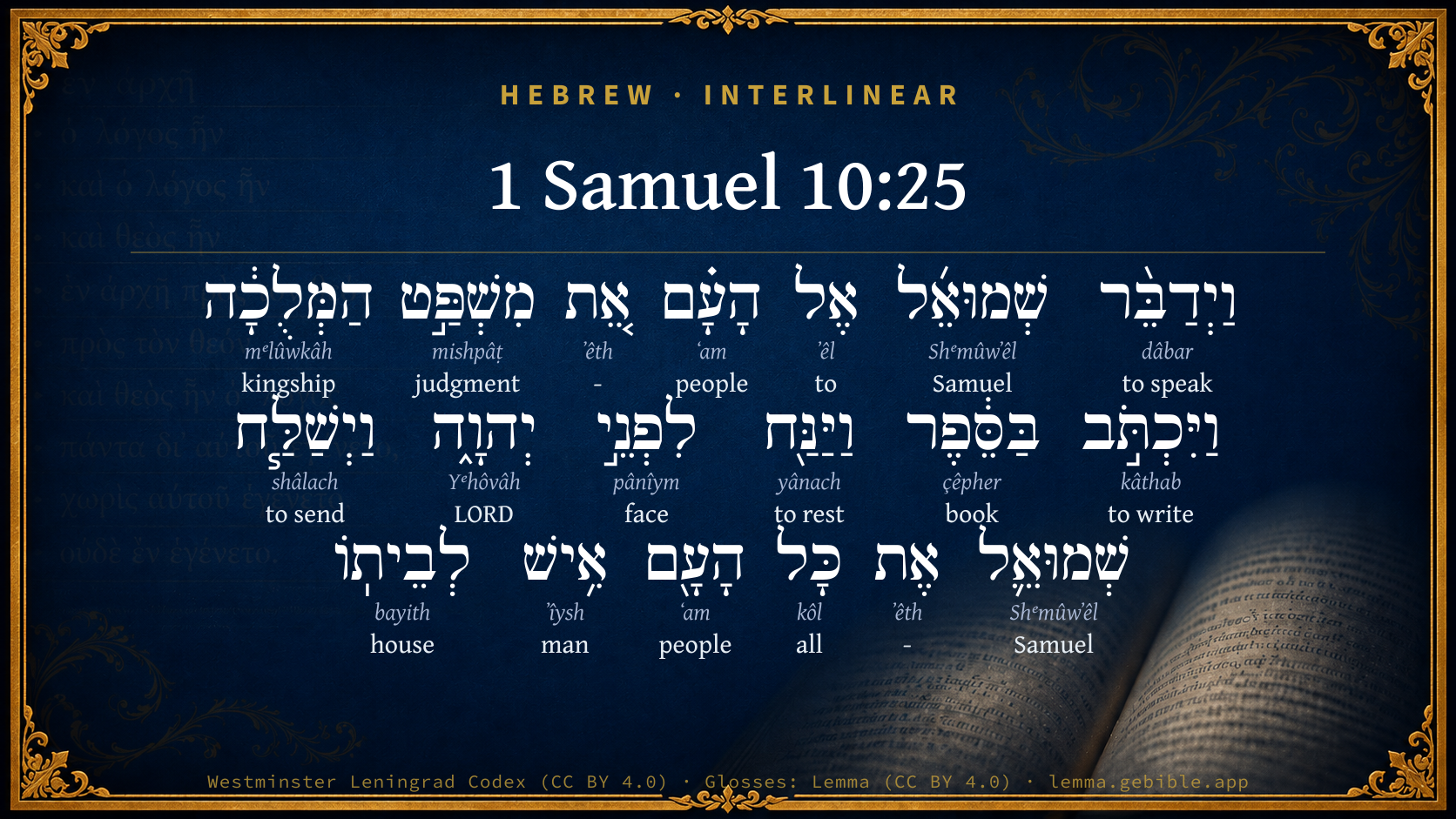
Hebrew (Westminster Leningrad Codex) 1 Samuel 10:25 appears in the Hebrew Old Testament. The text above is from the Westminster Leningrad Codex. Each word links to its Strong’s number, a concise gloss, and parsing drawn from the Open Scriptures Hebrew Bible morphology. Click any word for its full Brown-Driver-Briggs (BDB) entry.
Download image
Cite this verse

1 Samuel 10:25 (World English Bible). Public Domain. Lemma interlinear Bible study tool, https://lemma.gebible.app/v/1-samuel/10/25.

Show BibTeX & RIS
BibTeX
RIS
English Translation
Then Samuel told the people the manner of the kingdom, and wrote it in a book, and laid it up before Yahweh. Samuel sent all the people away, every man to his house.
World English Bible · Public Domain
Download a study sheet

One document with this verse’s original text, its word-by-word gloss line, the meaning frame, cross-references with their text, attributed commentary, and full source and license credits — printable, and it pastes into notes with its structure intact.

This verse Autodidact and up

Study sheet (.html) Plain text (.txt)

A passage Seminary Student

Up to 50 verses in one chapter. A passage sheet keeps up to 6 commentary sources and 12 cross-references per verse, in the order this page ranks them, and says so on the sheet whenever that leaves anything out. Ask for a single verse and you get the Autodidact verse sheet above.

Everything on this page stays free to read, with no account — the sheet is a download of what is already on screen, not access to it.

Want to remove ads? Support Godless Engineer
Compare translations 3

The same verse in 3 English versions, stacked beneath the original-language interlinear above. Click any original word for its lexicon entry.

Each is an independent rendering of the whole verse — the interlinear is not word-aligned to these translations.

Highlighted words mark where these versions differ — a whole-verse word diff, not a word-by-word alignment.

  • World English Bible Public Domain
    Then Samuel told the people the manner of the kingdom, and wrote it in a book, and laid it up before Yahweh. Samuel sent all the people away, every man to his house.
  • King James Version Public Domain
    Then Samuel told the people the manner of the kingdom, and wrote it in a book, and laid it up before the LORD. And Samuel sent all the people away, every man to his house.
  • unfoldingWord Literal Text CC BY-SA 4.0
    And Samuel spoke to the people the custom of the kingship, and he wrote in a book, and he made rest to the face of Yahweh. And Samuel sent away all of the people, a man to his house.

unfoldingWord Literal Text — © unfoldingWord, licensed CC BY-SA 4.0. Word-aligned USFM3 via Door43 (git.door43.org/unfoldingWord/en_ult).

Versions to compare (up to 4)

3 of 4 selected

Show all 18 translations

Every available English version of this verse, each an independent rendering of the whole verse.

  • World English Bible Public Domain
    Then Samuel told the people the manner of the kingdom, and wrote it in a book, and laid it up before Yahweh. Samuel sent all the people away, every man to his house.
  • Berean Standard Bible Public Domain
    Then Samuel explained to the people the rights of kingship. He wrote them on a scroll and laid it up before the LORD. And Samuel sent all the people away, each to his own home.
  • Majority Standard Bible Public Domain
    Then Samuel explained to the people the rights of kingship. He wrote them on a scroll and laid it up before the LORD. And Samuel sent all the people away, each to his own home.
  • King James Version Public Domain
    Then Samuel told the people the manner of the kingdom, and wrote it in a book, and laid it up before the LORD. And Samuel sent all the people away, every man to his house.
  • American Standard Version (1901) Public Domain
    Then Samuel told the people the manner of the kingdom, and wrote it in a book, and laid it up before Jehovah. And Samuel sent all the people away, every man to his house.
  • Revised Version (1885) Public Domain
    Then Samuel told the people the manner of the kingdom, and wrote it in a book, and laid it up before the LORD. And Samuel sent all the people away, every man to his house.
  • Geneva Bible (1599) Public Domain
    Then Samuel tolde the people the duetie of the kingdome, and wrote it in a booke, and laied it vp before the Lord, and Samuel sent all the people away euery man to his house.
  • Douay-Rheims (1899) Public Domain
    And Samuel told the people the law of the kingdom, and wrote it in a book, and laid it up before the Lord: and Samuel sent away all the people, every one to his own house.
  • Young's Literal Translation Public Domain
    And Samuel speaketh unto the people the right of the kingdom, and writeth in a book, and placeth before Jehovah; and Samuel sendeth all the people away, each to his house.
  • Literal Standard Version CC BY-SA 4.0
    And Samuel speaks to the people the right of the kingdom, and writes in a scroll, and places [it] before YHWH; and Samuel sends all the people away, each to his house.
  • Unlocked Literal Bible CC BY-SA 4.0
    Then Samuel told the people the customs and rules of kingship, wrote them down in a book, and placed it before Yahweh. Samuel then sent all the people away, each man to his own house.
  • unfoldingWord Literal Text CC BY-SA 4.0
    And Samuel spoke to the people the custom of the kingship, and he wrote in a book, and he made rest to the face of Yahweh. And Samuel sent away all of the people, a man to his house.
  • Darby Bible Public Domain
    And Samuel told the people the right of the kingdom, and wrote it in the book, and laid it before Jehovah. And Samuel sent all the people away, every man to his house.
  • World Messianic Bible Public Domain
    Then Samuel told the people the regulations of the kingdom, and wrote it in a book and laid it up before the LORD. Samuel sent all the people away, every man to his house.
  • Webster's Bible Public Domain
    Then Samuel told the people the manner of the kingdom, and wrote it in a book, and laid it up before the LORD. And Samuel sent all the people away, every man to his house.
  • Free Bible Version CC BY-SA 4.0
    Then Samuel explained to the people all that a king would do. He wrote it down on a scroll and placed it before the Lord. Then Samuel sent everyone home.
  • Bible in Basic English Public Domain
    Then Samuel gave the people the laws of the kingdom, writing them in a book which he put in a safe place before the Lord. And Samuel sent all the people away, every man to his house.
  • JPS Tanakh (1917) Public Domain
    Then Samuel told the people the manner of the kingdom, and wrote it in a book, and laid it up before the LORD. And Samuel sent all the people away, every man to his house.

Literal Standard Version (2020), Covenant Press — licensed CC BY-SA 4.0. Text via the HelloAO Bible API (eBible.org). Unlocked Literal Bible (unfoldingWord) — licensed CC BY-SA 4.0. Text via the HelloAO Bible API (eBible.org). unfoldingWord Literal Text — © unfoldingWord, licensed CC BY-SA 4.0. Word-aligned USFM3 via Door43 (git.door43.org/unfoldingWord/en_ult). Free Bible Version, Dr. Jonathan Gallagher — licensed CC BY-SA 4.0. Text via the HelloAO Bible API (eBible.org).

Word by word

More ways to search: Search by grammar → Find every occurrence → Compare this word →

Practice this passage: Drill this verse → Learn its vocabulary →

הַמְּלֻכָ֔ה
mᵉlûwkâh
H4410
“the · kingship”
Particle, Definite Article + Noun, Common, Feminine, Singular, Absolute
Part of Speech
Particle + Noun
Type
Common
Gender
Feminine
Number
Singular
State
Absolute
Full BDB Definition

Origin: pass. participle of H4427

TWOT: 1199d

kingship, royalty, kingly office
  1. וַיְדַבֵּ֨ר dâbar H1696 “and · to speak” Conjunction + Verb, Piel, Sequential Imperfect, 3rd Person, Masculine, Singular
  2. שְׁמוּאֵ֜ל Shᵉmûwʼêl H8050 “Samuel” Noun, Proper
  3. אֶל ʼêl H413 “to” Preposition
  4. הָעָ֗ם ʻam H5971 “the · people” Particle, Definite Article + Noun, Common, Masculine, Singular, Absolute
  5. אֵ֚ת ʼêth H853 “-” Particle, Direct Object
  6. מִשְׁפַּ֣ט mishpâṭ H4941 “judgment of” Noun, Common, Masculine, Singular, Construct
  7. וַיִּכְתֹּ֣ב kâthab H3789 “and · to write” Conjunction + Verb, Qal, Sequential Imperfect, 3rd Person, Masculine, Singular
  8. בַּסֵּ֔פֶר çêpher H5612 “in/at the · book” Preposition, Determined + Noun, Common, Masculine, Singular, Absolute
  9. וַיַּנַּ֖ח yânach H3240 “and · to rest” Conjunction + Verb, Hiphil, Sequential Imperfect, 3rd Person, Masculine, Singular
  10. לִפְנֵ֣י pânîym H6440 “to/for · face(s) of” Preposition + Noun, Common, Both, Plural, Construct
  11. יְהוָ֑ה Yᵉhôvâh H3068 “LORD” Noun, Proper
  12. וַיְשַׁלַּ֧ח shâlach H7971 “and · to send” Conjunction + Verb, Piel, Sequential Imperfect, 3rd Person, Masculine, Singular
  13. שְׁמוּאֵ֛ל Shᵉmûwʼêl H8050 “Samuel” Noun, Proper
  14. אֶת ʼêth H853 “-” Particle, Direct Object
  15. כָּל kôl H3605 “all of” Noun, Common, Masculine, Singular, Construct
  16. הָעָ֖ם ʻam H5971 “the · people” Particle, Definite Article + Noun, Common, Masculine, Singular, Absolute
  17. אִ֥ישׁ ʼîysh H376 “man” Noun, Common, Masculine, Singular, Absolute
  18. לְבֵיתֽוֹ bayith H1004 “to/for · house · his” Preposition + Noun, Common, Masculine, Singular, Construct + Suffix, Personal, 3rd Person, Masculine, Singular

About this verse

These counts appear in no published source. They are computed here, from the morphology-tagged text and Lemma’s own curated glosses. What Lemma adds →

19
words
16
distinct lemmas
Historical
section

Notable vocabulary

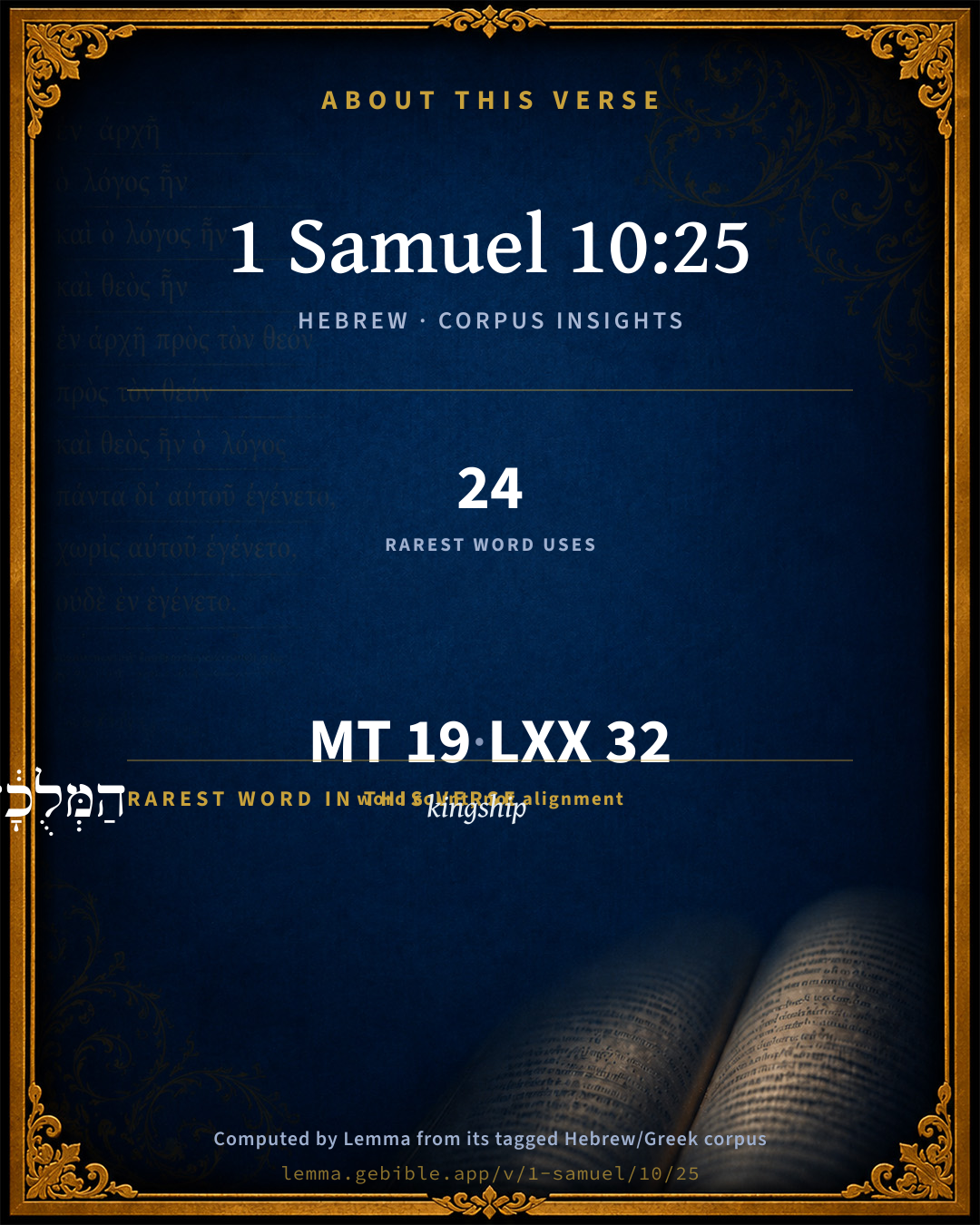
The rarest word here is הַמְּלֻכָ֔ה kingship H4410 — appearing just 24 times in the whole Hebrew Bible.

Shared distinctive vocabulary

הַמְּלֻכָ֔ה kingship H4410 occurs in 23 verses of the Hebrew Bible. Also found in:

Grammatical profile

  • 4 verbs
  • 12 nouns
  • 1 preposition
  • 2 particles

Verb forms

  • וַיְדַבֵּ֨ר Piel · Sequential Imperfect
  • וַיִּכְתֹּ֣ב Qal · Sequential Imperfect
  • וַיַּנַּ֖ח Hiphil · Sequential Imperfect
  • וַיְשַׁלַּ֧ח Piel · Sequential Imperfect

Repetition

Words recur within this verse — often emphatic in Hebrew:

  • שְׁמוּאֵ֜ל Samuel H8050 ×2
  • הָעָ֗ם people H5971 ×2

Hebrew & Septuagint length

In English translation the verse runs 33 words from the Hebrew and 35 from the Septuagint (LXX English) — closely comparable.

A rough comparison of the two English renderings, which tokenize alike — not a word-level alignment.

Word counts can differ between the Hebrew and the Greek without any difference in meaning — e.g. the Hebrew direct-object marker אֵת has no separate Greek word, and Greek often adds the article ὁ.

In the original languages it is 19 Hebrew tokens and 32 Greek tokens — but the two are counted differently (Hebrew bundles its prefixes and suffixes into one token; the Greek is in lemma form), so that isn’t a like-for-like length.

Cross-references

8

Topical passages linked to 1 Samuel 10:25 in the Treasury of Scripture Knowledge — connected by theme and wording, ordered by reader-vote popularity; previews shown in the World English Bible.

  • 1 Samuel 8:11–18 He said, This will be the manner of the king who shall reign over you: he will take your sons, and appoint them to him, for his chariots, and to be his horsemen; and they shall run before his chariots;
  • Deuteronomy 17:14–20 When you are come to the land which Yahweh your God gives you, and shall possess it, and shall dwell therein, and shall say, I will set a king over me, like all the nations that are round about me;
  • Ezekiel 45:9–10 Thus says the Lord Yahweh: Let it suffice you, princes of Israel: remove violence and spoil, and execute justice and righteousness; dispossessing my people, says the Lord Yahweh.
  • Ezekiel 46:16–18 Thus says the Lord Yahweh: If the prince give a gift to any of his sons, it is his inheritance, it shall belong to his sons; it is their possession by inheritance.
  • Romans 13:1–7 Let every soul be in subjection to the higher authorities, for there is no authority except from God, and those who exist are ordained by God.
  • 1 Timothy 2:2 for kings and all who are in high places; that we may lead a tranquil and quiet life in all godliness and reverence.
  • Titus 3:1 Remind them to be in subjection to rulers and to authorities, to be obedient, to be ready for every good work,
  • 1 Peter 2:13–14 Therefore subject yourselves to every ordinance of man for the Lord's sake: whether to the king, as supreme;

Cross-references courtesy of OpenBible.info (CC BY 4.0).

Hebrew and Greek witnesses Masoretic Hebrew ↔ Greek Septuagint

The same verse in the two great witnesses to the Old Testament, shown verse-for-verse.

These are two independent witnesses, not word-aligned to each other, and the Septuagint is shown in lemma (dictionary) form.

Hebrew 1 Samuel 10:25 Masoretic · Westminster Leningrad Codex

וַיְדַבֵּ֨ר שְׁמוּאֵ֜ל אֶל הָעָ֗ם אֵ֚ת מִשְׁפַּ֣ט הַמְּלֻכָ֔ה וַיִּכְתֹּ֣ב בַּסֵּ֔פֶר וַיַּנַּ֖ח לִפְנֵ֣י יְהוָ֑ה וַיְשַׁלַּ֧ח שְׁמוּאֵ֛ל אֶת כָּל הָעָ֖ם אִ֥ישׁ לְבֵיתֽוֹ

Then Samuel told the people the manner of the kingdom, and wrote it in a book, and laid it up before Yahweh. Samuel sent all the people away, every man to his house.

World English Bible · Public Domain

Greek LXX 1 Samuel 10:25 Septuagint · lemma form

καί εἶπον σαμουηλ πρός ὁ λαός ὁ δικαίωμα ὁ βασιλεύς καί γράφω ἐν βιβλίον καί τίθημι ἐνώπιον κύριος καί ἐκ ἀποστέλλω σαμουηλ πᾶς ὁ λαός καί ἀποἔρχομαι ἕκαστος εἰς ὁ τόπος αὐτός

And Samuel told the people the manner of the king, and wrote it in a book, and set it before the Lord: and Samuel sent away all the people, and each went to his place.

LXX2012 (modern English Septuagint) · Public Domain

Hebrew: Westminster Leningrad Codex (CC BY 4.0). Greek: Septuagint (public domain); English from LXX2012 (modern English Septuagint) (Public Domain). How the Septuagint differs from the Hebrew →

Targum (Aramaic paraphrase)

1

The Targum is the ancient Jewish Aramaic paraphrase of the Hebrew Scriptures — an interpretive translation, not the Hebrew text itself. Onkelos (literal) and Pseudo-Jonathan (expansive) render the Torah, and Jonathan the Prophets. Coverage is partial: where no permissively-licensed English translation exists for a verse, only the Aramaic is shown. This is verse-level text, not a word-by-word alignment to the Hebrew.

  1. Targum Jonathan Prophets (Joshua–Malachi)
    וּמַלֵיל שְׁמוּאֵל עִם עַמָא יַת נִימוּסָא דְמַלְכָּא וּכְתַב בְּסִפְרָא וְאַצְנַע קֳדָם יְיָ וּשְׁלַח שְׁמוּאֵל יַת כָּל עַמָא גְבַר לְבֵיתֵיהּ:

    (no public-domain English translation for this verse)

    Targum Jonathan — Aramaic: “Mikraot Gedolot” (public domain). English: “Sefaria Community Translation” (CC0 1.0 (public-domain dedication)); “London "Chaldee Paraphrase," 1871” (public domain). Text via Sefaria.

Commentary

Notes on 1 Samuel 10:25 from classic Christian and Jewish commentators (each source and its license shown beneath its notes). The classic Christian expositions comment on the surrounding passage and are grouped to its opening verse, so a note may address several verses; the Jewish commentaries on the Tanakh (Rashi and others) are per-verse, so they appear only where the commentator wrote on this verse.

Lemma curates 59 commentaries, every one of them public domain or Creative Commons licensed, each selected and text-cleaned for this edition rather than reprinted as found. About our sources →

Trapp's Complete Commentary

John Trapp

1Sa 10:25 Then Samuel told the people the manner of the kingdom, and wrote [it] in a book, and laid [it] up before the LORD. And Samuel sent all the people away, every man to his house.

Ver. 25. Then Samuel told the people the manner of the kingdom.] Not what it usually is, - degenerating into tyranny, as if it were not enough to be above men, but to be above mankind, {1Sa 8:9-10} - but what it ought to be, according to Deu 17:14-16 Eze 45:9-10; Eze 46:6.

And wrote it in a book.] {a} That it might be as their Magna Charta, made to keep the beam right betwixt sovereignty and subjection.

{a} Hic liber periit cum multis aliis. - Vat.

John Trapp, A Commentary or Exposition upon All the Books of the Old and New Testament (1647–1656) — public domain. Text from a community e-Sword module.

The Biblical Illustrator

Joseph S. Exell

1Sa_10:25

And wrote it in a book.

Value or a written constitution

A written revelation is an incomparable blessing. Is not the cry of subjects everywhere for a constitution, something written, the fights and duties of sovereign and subject in black and white? The Bible is to us like a written constitution; we can take it home, we can consult it when we please, quote from it, appeal to it God graciously binds Himself by it. Of all the modern heresies, none is more contrary to human experience than the rejection of a written word, and the proposed substitution of human conscience and the moral sentiments as our guide. (N. Adams.)

The Biblical Illustrator, edited by Joseph S. Exell (c. 1880s–1900s) — public domain. Text from a community e-Sword module.

Joseph Benson's Commentary

1Sa 10:25. Samuel said, See ye him whom the Lord hath chosen? — Though the people were resolutely bent on having a king, yet they were sensible only God could make one. And therefore they came in the beginning of this business, to ask one of his prophet. But Samuel could not constitute one without divine direction and appointment, as appears by the first verse of this chapter, where he says to Saul, The Lord hath anointed thee; and the lot whereby he was publicly chosen was cast before the Lord, 1Sa 10:19; 1Sa 10:23. Accordingly he here tells them, The Lord hath chosen him. Thus afterward the Lord commanded David to be anointed, 1Sa 19:1; 1Sa 19:3; and of all his sons, Solomon was particularly appointed by God to succeed him, 1Ch 29:5. There is none like him among all the people — As to his aspect and the height of his bodily stature, which was in itself desirable in a king, and some kind of indication of great endowments of mind. God save the king — Hebrew, Let the king live; that is, long and prosperously. The same form was used in after ages when they made kings, 1Ki 1:34; 1Ki 1:39; 2Ki 11:12; 2Ch 23:11. Hereby they accepted him for their king, and, in effect, promised subjection to him. None will be losers in the end by their humility and modesty. Honour, like the shadows, follows them that flee from it, but flees from them that pursue it.

1Sa 10:25. The manner of the kingdom — The laws and rules by which the kingly government was to be managed; agreeably to those mentioned Deu 17:16, &c. Before the Lord — Before the ark, where it was kept safe from depravation.

Joseph Benson's Commentary on the Old and New Testaments (1811–1818) — public domain. Text from a community e-Sword module.

Tyndale Open Study Notes

Tyndale Open Resources

10:25 rights and duties of a king: See Deut 17:14-20. • He wrote them: Cp. Exod 24:4; Josh 24:26. • Samuel placed the document before the Lord—presumably in the Tabernacle. This position showed that God would honor those who lived by the covenant and punish those who violated it.

Tyndale Open Study Notes — © Tyndale Open Resources, licensed CC BY-SA 4.0. Text via the HelloAO Bible API.

Geneva Bible (1599)

Geneva Bible translators

As it is written in Deut. 17:15, etc.

Geneva Bible (1599) marginal notes — public domain. Text via Bolls.life.

Adam Clarke's Commentary

Verse 25. The manner of the kingdom] It is the same word as in 1Sa 8:9; and doubtless the same thing is implied as is there related. But possibly there was some kind of compact or covenant between them and Saul; and this was the thing that was written in a book, and laid up before the Lord, probably near the ark.

Adam Clarke's Commentary on the Bible (1810–1826) — public domain. Text from a community e-Sword/MySword module.

Ellicott's Commentary for English Readers

(25) Wrote it in a book.—The “Law of the Kingdom,” which Samuel rehearsed before the people, and which he wrote in a roll, and laid solemnly up and preserved among the State archives, related to the divinely established right and duties of the God-appointed king, and also clearly set forth the limitations of his power. The vice-gerent on earth of the invisible King could be no arbitrary despot, unless he transgressed plainly and openly the “manner of the kingdom” written in a book, and laid up before the Lord by Samuel.

This sacred document, we may assume, contained, too, the exact details of the singular story of the choice of the first king of Israel. It was well, no doubt, thought Samuel, that coming ages should know exactly how it came to pass that he, the seer, anointed the Benjamite of Gibeah as king over the Lord’s inheritance. We may, therefore, fairly conclude that from the record laid up among the sacred archives in the sanctuary, the compiler or redactor of this “Book of Samuel” derived his intimate knowledge of every little fact connected with the Divine choice of Saul.

The legal portion of this writing respecting the kingdom was, of course, strictly based upon what Moses had already written on this subject in Deuteronomy (see 1Sa_17:14-20).

We find here, in this writing of Samuel, the first trace of literary composition among the Israelites since the days of Moses. The great revival in letters which began shortly after the days of Saul was due, most probably, to the influence of Samuel and those great schools of the prophets which he had established in the land.

And laid it up before the Lord.—We are not told where this was done, but the words seem to imply that the document, or roll, was placed by the side of the Ark, then in the “city of woods,” Kiriath-yearim. Josephus says this writing was preserved in the Tabernacle of the Holy of Holies, where the Book of the Law had been laid up (Deu_31:26).

And Samuel sent all the people away.—It is noteworthy that even after the formal popular ratification of Saul’s election as king, it is Samuel who dismisses the assembly. Indeed, throughout the remainder of the great seer’s life, whenever he appears on the scene, he is evidently the principal person, occupying a position above king or priest. On the other hand, after this period Samuel made but comparatively few public appearances; of his own free will he seems to have retired into privacy, and only in emergencies to have left his retirement.

A Bible Commentary for English Readers, edited by Charles John Ellicott (1878–1897) — public domain. Text from a community e-Sword module.

The Cambridge Bible for Schools and Colleges

gen. ed. J. J. S. Perowne

25. the manner of the kingdom] A charter establishing and defining the position of the king in relation to Jehovah, and to the people. It must be distinguished from the “manner of the king” in 1Sa_8:11 ff., which describes the arbitrary exactions of an oriental despot; but it can scarcely be said to be “the first example of a limited constitutional monarchy.” In substance at any rate, it probably resembled the law of the king in Deu_17:14-20.

wrote it in a book, and laid it up before the Lord] Lit. in the book. Possibly this important charter was added to “the book of the law” kept by the side of the ark “before the Lord” (Deu_31:26). This book contained not only the record of the Mosaic legislation (Exo_24:7; Deu_28:61), but historical narratives (Exo_17:14), and other records of importance, such as the solemn renewal of the covenant at Shechem under Joshua (Jos_24:26). See Smith’s Dict. of the Bible, Art. Canon, Vol. 1. p. 251.

The Cambridge Bible for Schools and Colleges (gen. ed. J. J. S. Perowne; Cambridge University Press, 1878–1918) — public domain. Text from a community e-Sword module.

John Gill's Exposition

And Saul also went home to Gibeah,.... His native place, where was his father's house, to which he retired; where were no royal palace, or princely court, nor any of the ensigns of kingly majesty; and whither it does not appear that he was followed by the nobility or princes of the tribes, only accompanied by a few men, as next observed:

and there went with him a band of men; an army, or part of one they seem to be military men, at least men of strength, valour, and courage; gallant men, who, in honour to their king elect, freely offered themselves to be his body guard, however, until he was come to his house at Gibeah; the Targum is only, "some of the people"

whose heart God had touched; and inclined to show honour and respect to their king; the Targum describes them,"men that feared to sin, and in whose hearts the fear of God was put.''

John Gill's Exposition of the Whole Bible (1746–1763) — public domain (CC PDM 1.0). Text via the HelloAO Bible API.

Albert Barnes' Notes on the Bible

The manner of the kingdom - i. e., the just prerogative of the kingdom, the law, or bill of rights, by which the king’s power was limited as well as secured. It is not improbable that what Samuel wrote was simply a transcript of Deu 17:14-20, which he “laid up before the Lord,” i. e., placed by the side of the ark of the covenant with the copy of the Law (see Deu 31:26). It would be ready for reference if either king or people violated the “law of the kingdom.”

Albert Barnes' Notes on the Bible (1834–1885) — public domain. Text from a community e-Sword/MySword module.

Haydock's Catholic Bible Commentary

Before the Lord. It seems that the ark was therefore present. This record of Samuel is lost, so that we cannot determine what laws he prescribed on this occasion. (Calmet) --- Josephus ([Antiquities?] vi. 5.) says that he wrote and read in the hearing of all, and in the presence of the king, what evils would ensue under the regal government; and deposited the writing in the tabernacle, that the truth of the prediction might be ascertained. He probably alludes to the denunciation of tyranny, which had been made [in] chap. viii., and which he says Samuel repeated on this occasion. But the prophet would also take a copy of the law of the kingdom, prescribed by Moses, (Deuteronomy xvii.) and deliver it to Saul, that he might make it the rule of his conduct, and not imitate the wicked customs of tyrants. (Haydock) --- The whole process of this memorable event he would also write down, (Menochius) as we read it at present in this chapter, placing it in the proper order, as a continuation of the sacred history which Moses and Josue had commenced; and like them, depositing the sacred volume beside the ark, or in the tabernacle. See Josue xxiv. 26. (Haydock)

George Leo Haydock (1774–1849), Haydock's Catholic Family Bible and Commentary, 1859 edition — public domain. Excludes Psalms (Douay-Rheims chapter numbering differs from Protestant) and Deuterocanonical books (Catholic canon only).

Matthew Poole's English Annotations

The manner of the kingdom; not the manner of the king, of which he had spoken before, 1Sa 8:11, &c., but of the kingdom: to wit, the laws and rules by which the kingly government was to be managed, agreeable to those mentioned Deu 17:16, &c, which peradventure Samuel did expound and apply to their particular case.

Before the Lord; before the ark, or in the sanctuary, where it was kept safe from depravation.

Matthew Poole's English Annotations on the Holy Bible (1683–1685) — public domain. Text from a community e-Sword/MySword module.

Whedon's Commentary on the Bible

Daniel D. Whedon

25. Manner of the kingdom — This phrase is not identical with the manner of the king, described 1Sa_8:11-18, for that was a description of what oriental despots claimed as their right, while this was probably an expansion of the Mosaic law concerning a monarchy, as recorded Deu_17:14-20. Hence it appears that the kingdom of Israel was a constitutional, not an absolute monarchy. The king himself was to be governed and guided by law, and ever to understand that government itself was a divine ordinance, not a human invention.

Wrote it in a book — According to the commandment, Deu_17:18 : “He shall write him a copy of this law in a book,” etc.

Laid it up before the Lord — Committed it to the charge of the priests, as Moses did the law. Deu_31:9; Deu_31:26. The ark and the tabernacle were at this time separate, and it is uncertain in which of them this book of Samuel was placed. Perhaps this disorganized state of the priesthood was a cause of the loss of many ancient books.

Daniel D. Whedon (gen. ed.), Commentary on the Old and New Testaments (1874–1909) — public domain. Text from a community e-Sword module.

The Pulpit Commentary

THE EVENTS WHICH FOLLOWED IMMEDIATELY UPON SAUL"S ELECTION (vers. 25-27).

The manner. The difficult word already discussed in 1Sa_2:13 1Sa_8:11. Here, however, it is not used for rights so exercised as to become wrongs, but in a good sense, for what we should call a constitution. The heathen kings were despots, subject to no higher law, and Samuel, in 1Sa_8:11-18, speaks with merited abhorrence of their violation of the natural rights of their subjects; but under the theocracy the king"s power was limited by laws which protected, in the enjoyment of their privileges, the people, the priests, and the prophets. The latter class especially, as being the mouthpiece of Jehovah, formed a powerful check upon the development of despotic tendencies. In sketching Saul"s kingly rights Samuel would be guided by Deu_17:14-20, and would give the king his true position as the representative of Jehovah both in all matters of internal administration and of war. And laid it up before Jehovah. Probably by the side of the ark. We are not to suppose that Samuel wrote this at Mizpah. He would fully explain to Saul and the people there what a theocratic king ought to be, and would afterwards draw up a formal document both as a memorial of what had been done, and for the use of future sovereigns, and place it within the sanctuary. It is noteworthy that this is the first notice of writing since the days of the illustrious scribe Eleazar.

The Pulpit Commentary (1880–1919), ed. H.D.M. Spence-Jones & Joseph S. Exell — public domain. Text from a community e-Sword module.

John Wesley's Explanatory Notes

Manner of the kingdom - The laws and rules by which the kingly government was to be managed; agreeable to those mentioned Deut. xvii, 16, &c. Before the Lord - Before the ark, where it was kept safe from depravation.

John Wesley, Explanatory Notes Upon the Whole Bible (1754–1765) — public domain. Text via the GEBible commentary corpus.

unfoldingWord translationNotes

Door43 World Missions Community

the customs and rules of kingship

The abstract noun "kingship" can be translated with a noun clause. AT: "the customs and rules that a king would be required to follow" (See: Abstract Nouns)

translationWords

rule

send

unfoldingWord translationNotes — © Distant Shores Media and the Door43 World Missions Community, licensed CC BY-SA 4.0. Source: git.door43.org/Door43/en_tn.

Lesson kit

Teaching starters — assembled from the data on this page, not authored interpretation. Every prompt links to the verse data it draws on. Edit before teaching.

1 Samuel, in the Historical, opens this verse with 19 words (16 distinct Hebrew lemmas). Its most distinctive word is mᵉlûwkâh (“kingship”). A historical commentator’s framing appears above. Read the whole chapter for the surrounding context.

Discussion questions

  1. What does “kingship” (mᵉlûwkâh) contribute to the verse as a whole?
  2. 1 Samuel 10:16 shares the word «kingship» with this verse. How do the two illuminate each other?
  3. “Samuel” occurs 2× in this one verse. What is the effect of the repetition?
  4. These translations render this verse differently. What is at stake in choosing one wording over another?
  5. The verb «וַיְדַבֵּ֨ר» is Piel Sequential Imperfect. How does its form color the action?
  6. Reading how Trapp's Complete Commentary and The Biblical Illustrator read this verse, where do the two commentators agree and where do they part?

Things to notice

Reading settings

Reading text

Shown beneath each verse's original-language words.

Old Testament
Old Testament edition

Read the OT as the Masoretic Hebrew (MT) or the Greek Septuagint (LXX).

English shown for the Greek Septuagint (in the Hebrew ↔ Greek comparison).

Comparing translations? Open the Compare panel on any verse page to stack up to four side by side.