
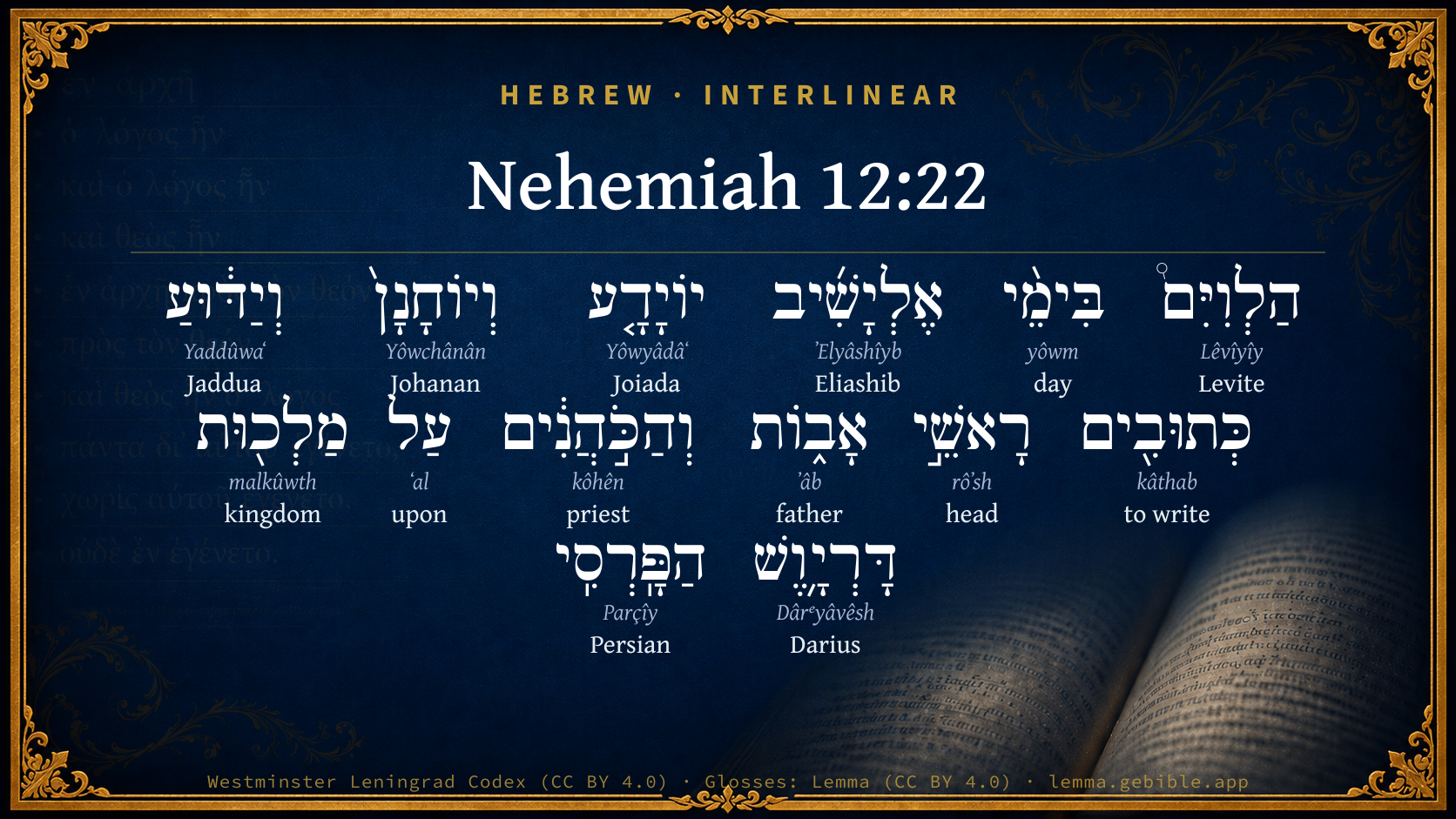
Nehemiah 12:22

Hebrew (Westminster Leningrad Codex) Nehemiah 12:22 appears in the Hebrew Old Testament. The text above is from the Westminster Leningrad Codex. Each word links to its Strong’s number, a concise gloss, and parsing drawn from the Open Scriptures Hebrew Bible morphology. Click any word for its full Brown-Driver-Briggs (BDB) entry.
Download image
Cite this verse

Nehemiah 12:22 (World English Bible). Public Domain. Lemma interlinear Bible study tool, https://lemma.gebible.app/v/nehemiah/12/22.

Show BibTeX & RIS
BibTeX
RIS
English Translation
As for the Levites, in the days of Eliashib, Joiada, and Johanan, and Jaddua, there were recorded the heads of fathers' [houses]; also the priests, in the reign of Darius the Persian.
World English Bible · Public Domain
Highlights
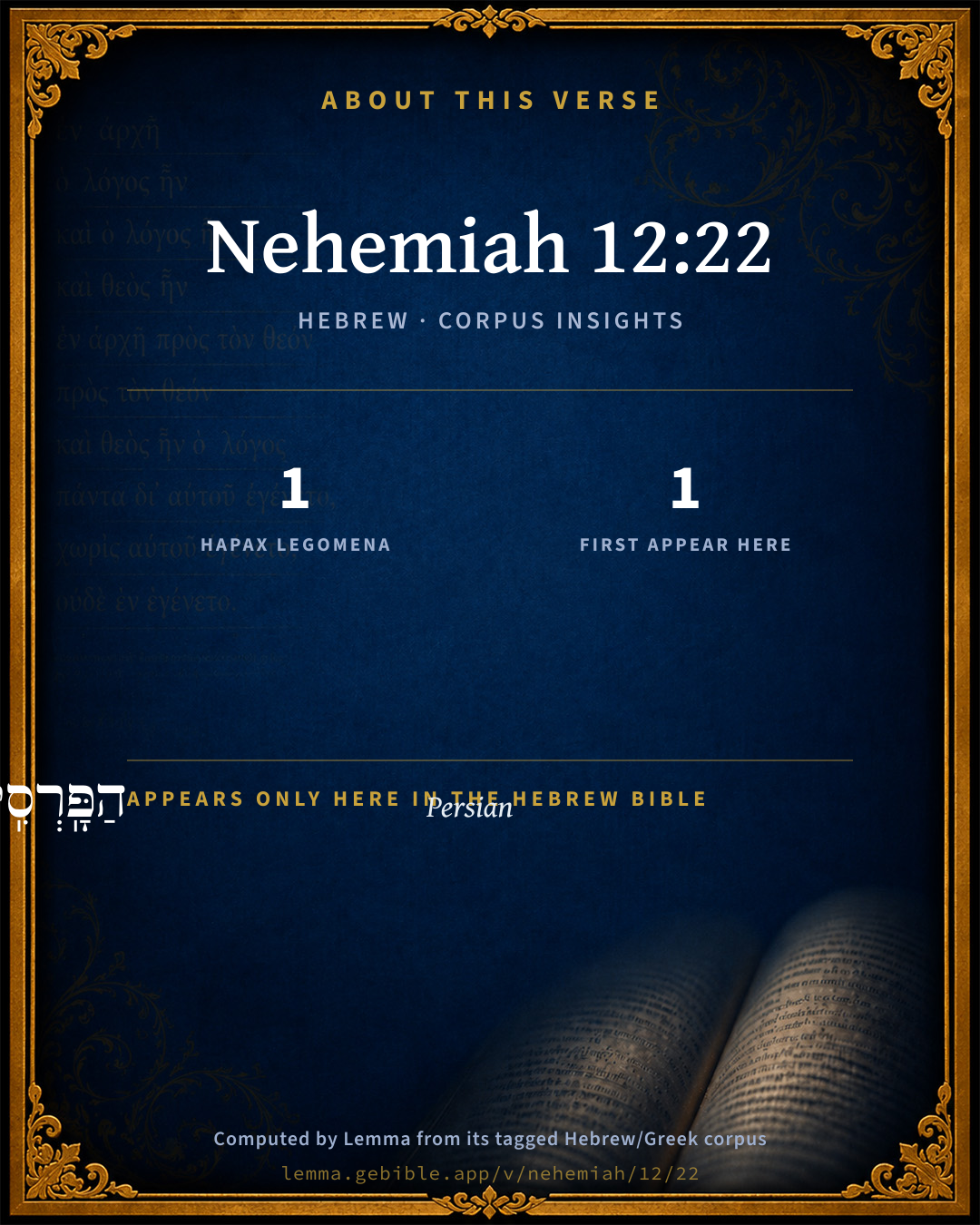
  • 1 hapax legomenon — only here in the Hebrew Bible
  • 1 first appearance in the Hebrew Bible
Full analysis ↓
Download a study sheet

One document with this verse’s original text, its word-by-word gloss line, the meaning frame, cross-references with their text, attributed commentary, and full source and license credits — printable, and it pastes into notes with its structure intact.

This verse Autodidact and up

Study sheet (.html) Plain text (.txt)

A passage Seminary Student

Up to 50 verses in one chapter. A passage sheet keeps up to 6 commentary sources and 12 cross-references per verse, in the order this page ranks them, and says so on the sheet whenever that leaves anything out. Ask for a single verse and you get the Autodidact verse sheet above.

Everything on this page stays free to read, with no account — the sheet is a download of what is already on screen, not access to it.

Want to remove ads? Support Godless Engineer
Compare translations 3

The same verse in 3 English versions, stacked beneath the original-language interlinear above. Click any original word for its lexicon entry.

Each is an independent rendering of the whole verse — the interlinear is not word-aligned to these translations.

Highlighted words mark where these versions differ — a whole-verse word diff, not a word-by-word alignment.

  • World English Bible Public Domain
    As for the Levites, in the days of Eliashib, Joiada, and Johanan, and Jaddua, there were recorded the heads of fathers' [houses]; also the priests, in the reign of Darius the Persian.
  • King James Version Public Domain
    The Levites in the days of Eliashib, Joiada, and Johanan, and Jaddua, were recorded chief of the fathers: also the priests, to the reign of Darius the Persian.
  • unfoldingWord Literal Text CC BY-SA 4.0
    In the days of Eliashib, the Levites Joiada, and Johanan, and Jaddua, were written as heads of fathers: also the priests, during the reign of Darius the Persian.

unfoldingWord Literal Text — © unfoldingWord, licensed CC BY-SA 4.0. Word-aligned USFM3 via Door43 (git.door43.org/unfoldingWord/en_ult).

Versions to compare (up to 4)

3 of 4 selected

Show all 18 translations

Every available English version of this verse, each an independent rendering of the whole verse.

  • World English Bible Public Domain
    As for the Levites, in the days of Eliashib, Joiada, and Johanan, and Jaddua, there were recorded the heads of fathers' [houses]; also the priests, in the reign of Darius the Persian.
  • Berean Standard Bible Public Domain
    In the days of Eliashib, Joiada, Johanan, and Jaddua, during the reign of Darius the Persian, the heads of the families of the Levites and priests were recorded.
  • Majority Standard Bible Public Domain
    In the days of Eliashib, Joiada, Johanan, and Jaddua, during the reign of Darius the Persian, the heads of the families of the Levites and priests were recorded.
  • King James Version Public Domain
    The Levites in the days of Eliashib, Joiada, and Johanan, and Jaddua, were recorded chief of the fathers: also the priests, to the reign of Darius the Persian.
  • American Standard Version (1901) Public Domain
    As for the Levites, in the days of Eliashib, Joiada, and Johanan, and Jaddua, there were recorded the heads of fathers' `houses'; also the priests, in the reign of Darius the Persian.
  • Revised Version (1885) Public Domain
    The Levites in the days of Eliashib, Joiada, and Johanan, and Jaddua, were recorded heads of fathers’ houses: also the priests, in the reign of Darius the Persian.
  • Geneva Bible (1599) Public Domain
    In the dayes of Eliashib, Ioiada, and Iohanan and Iaddua were the chiefe fathers of the Leuites written, and the Priests in the reigne of Darius the Persian.
  • Douay-Rheims (1899) Public Domain
    The Levites the chiefs of the families in the days of Eliasib, and Joiada, and Johanan, and Jeddoa, were recorded, and the priests in the reign of Darius the Persian.
  • Young's Literal Translation Public Domain
    The Levites, in the days of Eliashib, Joiada, and Johanan, and Jaddua, are written, heads of fathers, and of the priests, in the kingdom of Darius the Persian.
  • Literal Standard Version CC BY-SA 4.0
    The Levites, in the days of Eliashib, Joiada, and Johanan, and Jaddua, are written, heads of fathers, and of the priests, in the kingdom of Darius the Persian.
  • Unlocked Literal Bible CC BY-SA 4.0
    In the days of Eliashib, the Levites Eliashib, Joiada, Johanan, and Jaddua were recorded as the heads of families, and the priests were recorded during the reign of Darius the Persian.
  • unfoldingWord Literal Text CC BY-SA 4.0
    In the days of Eliashib, the Levites Joiada, and Johanan, and Jaddua, were written as heads of fathers: also the priests, during the reign of Darius the Persian.
  • Darby Bible Public Domain
    of the Levites, the chief fathers were recorded in the days of Eliashib, Joiada, and Johanan, and Jaddua, and the priests, until the reign of Darius the Persian.
  • World Messianic Bible Public Domain
    As for the Levites, in the days of Eliashib, Joiada, Yochanan, and Jaddua, there were recorded the heads of fathers’ households; also the priests, in the reign of Darius the Persian.
  • Webster's Bible Public Domain
    The Levites in the days of Eliashib, Joiada, and Johanan, and Jaddua, were recorded chief of the fathers: also the priests, to the reign of Darius the Persian.
  • Free Bible Version CC BY-SA 4.0
    The family leaders of the Levites in the time of Eliashib, Joiada, Johanan, and Jaddua, in addition to those of the priests, were recorded during the reign of Darius the Persian.
  • Bible in Basic English Public Domain
    The Levites in the days of Eliashib, Joiada, and Johanan, and Jaddua, were listed as heads of families; and the priests, when Darius the Persian was king.
  • JPS Tanakh (1917) Public Domain
    The Levites in the days of Eliashib, Joiada, and Johanan, and Jaddua, were recorded heads of fathers' houses; also the priests, in the reign of Darius the Persian.

Literal Standard Version (2020), Covenant Press — licensed CC BY-SA 4.0. Text via the HelloAO Bible API (eBible.org). Unlocked Literal Bible (unfoldingWord) — licensed CC BY-SA 4.0. Text via the HelloAO Bible API (eBible.org). unfoldingWord Literal Text — © unfoldingWord, licensed CC BY-SA 4.0. Word-aligned USFM3 via Door43 (git.door43.org/unfoldingWord/en_ult). Free Bible Version, Dr. Jonathan Gallagher — licensed CC BY-SA 4.0. Text via the HelloAO Bible API (eBible.org).

Word by word

More ways to search: Search by grammar → Find every occurrence → Compare this word →

Practice this passage: Drill this verse → Learn its vocabulary →

הַפָּֽרְסִֽי
Parçîy
H6542
“the · Persian”
Particle, Definite Article + Noun, Gentilic, Masculine, Singular, Absolute
Part of Speech
Particle + Noun
Type
Gentilic
Gender
Masculine
Number
Singular
State
Absolute
Full BDB Definition

Origin: patrial from H6539

TWOT: None

Persian = see Persia " pure" or " splendid" - an inhabitant of Persia
  1. הַלְוִיִּם֩ Lêvîyîy H3881 “the · Levites” Particle, Definite Article + Noun, Gentilic, Masculine, Plural, Absolute
  2. בִּימֵ֨י yôwm H3117 “in/at · days of” Preposition + Noun, Common, Masculine, Plural, Construct
  3. אֶלְיָשִׁ֜יב ʼElyâshîyb H475 “Eliashib” Noun, Proper
  4. יוֹיָדָ֤ע Yôwyâdâʻ H3111 “Joiada” Noun, Proper
  5. וְיוֹחָנָן֙ Yôwchânân H3110 “and · Johanan” Conjunction + Noun, Proper
  6. וְיַדּ֔וּעַ Yaddûwaʻ H3037 “and · Jaddua” Conjunction + Noun, Proper
  7. כְּתוּבִ֖ים kâthab H3789 “written” Verb, Qal, Participle Passive, Masculine, Plural, Absolute
  8. רָאשֵׁ֣י rôʼsh H7218 “heads of” Noun, Common, Masculine, Plural, Construct
  9. אָב֑וֹת ʼâb H1 “fathers” Noun, Common, Masculine, Plural, Absolute
  10. וְהַכֹּ֣הֲנִ֔ים kôhên H3548 “and · the · priests” Conjunction + Particle, Definite Article + Noun, Common, Masculine, Plural, Absolute
  11. עַל ʻal H5921 “upon” Preposition
  12. מַלְכ֖וּת malkûwth H4438 “kingdom of” Noun, Common, Feminine, Singular, Construct
  13. דָּרְיָ֥וֶשׁ Dârᵉyâvêsh H1867 “Darius” Noun, Proper

About this verse

These counts appear in no published source. They are computed here, from the morphology-tagged text and Lemma’s own curated glosses. What Lemma adds →

14
words
14
distinct lemmas
Historical
section

Notable vocabulary

1 hapax legomenon — a word that appears only here in the entire Hebrew Bible:

  • הַפָּֽרְסִֽי Persian H6542

First appearance in Scripture

This word makes its first canonical appearance in the Hebrew Bible here:

  • הַפָּֽרְסִֽי Persian H6542

Shared distinctive vocabulary

וְיַדּ֔וּעַ Jaddua H3037 occurs in 3 verses of the Hebrew Bible. Also found in:

Grammatical profile

  • 1 verb
  • 12 nouns
  • 1 preposition

Verb forms

  • כְּתוּבִ֖ים Qal · Participle Passive

Cross-references

1

Topical passages linked to Nehemiah 12:22 in the Treasury of Scripture Knowledge — connected by theme and wording, ordered by reader-vote popularity; previews shown in the World English Bible.

  • Nehemiah 12:10–13 Jeshua became the father of Joiakim, and Joiakim became the father of Eliashib, and Eliashib became the father of Joiada,

Cross-references courtesy of OpenBible.info (CC BY 4.0).

Hebrew and Greek witnesses Masoretic Hebrew ↔ Greek Septuagint

The same verse in the two great witnesses to the Old Testament, shown verse-for-verse.

These are two independent witnesses, not word-aligned to each other, and the Septuagint is shown in lemma (dictionary) form.

Hebrew Nehemiah 12:22 Masoretic · Westminster Leningrad Codex

הַלְוִיִּם֩ בִּימֵ֨י אֶלְיָשִׁ֜יב יוֹיָדָ֤ע וְיוֹחָנָן֙ וְיַדּ֔וּעַ כְּתוּבִ֖ים רָאשֵׁ֣י אָב֑וֹת וְהַכֹּ֣הֲנִ֔ים עַל מַלְכ֖וּת דָּרְיָ֥וֶשׁ הַפָּֽרְסִֽי

As for the Levites, in the days of Eliashib, Joiada, and Johanan, and Jaddua, there were recorded the heads of fathers' [houses]; also the priests, in the reign of Darius the Persian.

World English Bible · Public Domain

Greek LXX Structure differs

The Septuagint has no separate book of Nehemiah. Its Greek text is the second half of Esdras B (2 Esdras), chapters 11–23; Ezra is the first half (1–10).

A verse-for-verse comparison isn’t shown here because the chapters and verses don’t line up. Switch to the LXX edition with the MT / LXX toggle above to read the Greek directly.

On this verse, The Cambridge Bible for Schools and Colleges discusses the Septuagint’s reading. Read the note in Commentary ↓

Hebrew: Westminster Leningrad Codex (CC BY 4.0). Greek: Septuagint (public domain); English from a public-domain English Septuagint. How the Septuagint differs from the Hebrew →

Commentary

Notes on Nehemiah 12:22 from classic Christian and Jewish commentators (each source and its license shown beneath its notes). The classic Christian expositions comment on the surrounding passage and are grouped to its opening verse, so a note may address several verses; the Jewish commentaries on the Tanakh (Rashi and others) are per-verse, so they appear only where the commentator wrote on this verse.

Lemma curates 59 commentaries, every one of them public domain or Creative Commons licensed, each selected and text-cleaned for this edition rather than reprinted as found. About our sources →

Trapp's Complete Commentary

John Trapp

Neh 12:22 The Levites in the days of Eliashib, Joiada, and Johanan, and Jaddua, [were] recorded chief of the fathers: also the priests, to the reign of Darius the Persian.

Ver. 22. To the reign of Darius the Persian] viz. Darius Codomannus, the last Persian king.

John Trapp, A Commentary or Exposition upon All the Books of the Old and New Testament (1647–1656) — public domain. Text from a community e-Sword module.

Joseph Benson's Commentary

Neh 12:22. Also the priests, to the reign of Darius the Persians — “This verse,” observes Dr. Dodd, after Le Clerc, “wherein mention is made of Darius Codomanus, and the high-priest Jaddua, affords us proof that Nehemiah did not put the finishing hand to this book. For Nehemiah, to be able to speak of Darius, must have lived, according to Huet, at least one hundred and thirty-one years, and at that age have written or enlarged his book, which is not probable. We may therefore conclude, that the book of Nehemiah could not have been published, such as it is, till the reign of Darius Codomanus at least; and since one chapter of the book of Nehemiah has been put into that of Ezra, we may very probably suppose that it did not appear in its present form till about the same time. So that these two books have been collected from the memoirs of three different authors, to which have been added several things for the illustration of the history.” Le Clerc, and Houbigant’s note on the place.

Joseph Benson's Commentary on the Old and New Testaments (1811–1818) — public domain. Text from a community e-Sword module.

Whedon's Commentary on the Bible

Daniel D. Whedon

22. The Levites… to the reign of Darius the Persian — The grammatical connexion of the parts of this verse it is difficult to determine. The whole verse seems to be the heading or superscription of a list of names, and, indeed, the whole passage (Neh_12:22-26) has a fragmentary aspect, like disconnected parts of some more extensive document. It is evident from this verse that a register of the chief fathers of the priests and Levites was kept until the reign of Darius. But who was this Darius the Persian? According to Josephus, (Ant., Neh_11:8; Neh_11:4-5,) Jaddua was the name of the high-priest who was contemporary with Alexander the Great, the conqueror of Darius Codomannus. This Darius was the last king of Persia, and must have reigned so long after the time of Nehemiah, that if the Jaddua of this verse was his contemporary, this passage must have been written later than the age of the supposed author of this book.

There are three methods of obviating these difficulties: 1.) This verse may have been inserted by a later hand. Into a passage so aphoristic as this, such an interpolation might have easily crept. This supposition is favoured by the insertion of “and” before the name of Johanan, as if that name had originally ended the list; and also by the mention, in the next verse, of Chronicles that were continued to “the days of Johanan.” 2.) The Jaddua of this verse may have been a different person from the one mentioned by Josephus as contemporary with Alexander. 3.) Most interpreters identify this Darius the Persian with Darius Nothus, who, after a few months of anarchy in the royal family, succeeded his father, Artaxerxes Longimanus, and reigned nineteen years. Nehemiah might easily have been living in his day, and the Jaddua of Josephus might have been then a young man. For, according to Neh_13:28, Joiada had in Nehemiah’s time a son who was married, and, therefore, the oldest son. Johanan might have begotten Jaddua some years before this. Accordingly in bringing down these registers to his own time, Nehemiah recorded the name of Jaddua as then living and prospectively high priest, though not yet in office.

If these representatives of four successive generations in the high priest’s family were all living at one time, we may see a reason for thus recording their names even though one or more of them had not yet entered upon his office. One of the sons of the high priest had married Sanballat’s daughter, and erected a false worship on Mount Gerizim; and such a pollution in the priesthood may have shaken the faith of many a pious Jew. But it would restore confidence to note the remarkable providence of God in preserving at such a time four generations of high priests to look each other in the face at once.

Daniel D. Whedon (gen. ed.), Commentary on the Old and New Testaments (1874–1909) — public domain. Text from a community e-Sword module.

The Pulpit Commentary

PARENTHETIC STATEMENT OF THE TIME DOWN TO WHICH EXACT LISTS OF THE LEADING PRIESTS AND LEVITES WERE KEPT. (Neh_12:22, Neh_12:23) These verses appear to constitute a late insertion. They interrupt the list of high church officers in the time of Joiakim, which is commenced in ver. 12 and not concluded till ver. 26. By their mention of Jaddua as high priest, and of "Darius the Persian" as contemporary king, they betray a writer who lived at least as late as B.C. 336, or nearly a century after the time of Nehemiah"s religious reforms. The facts put on record by this writer are not of very much importance. They seem to be simply these:

1. That the practice of accurately recording the heads of the priestly and Levitical courses, which Nehemiah has noted as belonging to the days of Joiakim, was continued under his successors, Eliashib, Joiada, Johanan, and Jaddua, down (at any rate) to the accession of Darius Codomannus; and,

2. That in the case of the Levites the lists were inserted into the book of the chronicles not our "Book," but that larger one, of which ours is in the main an abbreviation down to the time of Johanan, the son (or, rather, grandson) of Eliashib. It has been supposed that the writer originally accompanied these statements with lists that have been lost, but this does not appear to be probable.

In the days of Eliashib, Joiada, and Johanan, and Jaddua. See comment on vers. 10, 11. In the reign of Darius. Rather, "to the reign." The "Darius" intended is beyond all doubt Codomannus, the adversary of Alexander the Great, who was contemporary with Jaddua. The lists went on under the four high priests down to the time when Darius Codomannus was king of Persia. It is not said that they then ceased. The Persian. Some suppose an antithesis here between this Darius and "Darius the Mede" of Daniel. (Dan_5:31 Dan_11:1) But this is unlikely, since there was nothing to recall that unimportant personage to the thoughts of the writer. Others, with better reason, suggest a tacit allusion to the transfer of empire from Persia to Macedon, and think the date of the passage must be subsequent to B.C. 331, when the kingdom passed away from Persia.

The Pulpit Commentary (1880–1919), ed. H.D.M. Spence-Jones & Joseph S. Exell — public domain. Text from a community e-Sword module.

Keil & Delitzsch

C. F. Keil & F. Delitzsch

"With respect to the Levites in the days of Eliashib, Joiada, Johanan, and Jaddua were recorded the heads of the houses, and also (those) of the priests during the reign of Darius the Persian." To judge from the הלויּם with which it commences, this verse seems to be the title of the list of Levites following, while the rest of its contents rather seems adapted for the subscription of the preceding list of priests (Neh 12:12-21). מלכוּת על, under the reign. The use of על with reference to time is to be explained by the circumstance that the time, and here therefore the reign of Darius, is regarded as the ground and soil of that which is done in it, as e.g., ἐπὶ νυκτί, upon night = at night-time. Darius is Darius Nothus, the second Persian monarch of that name; where also the meaning of this verse has been already discussed. In Neh 12:23, the original document in which the list of Levites was originally included, is alluded to as the book of the daily occurrences or events of the time, i.e., the public chronicle, a continuation of the former annals of the kingdom. ימי ועד, and also to the days of Johanan, the son of Eliashib. So far did the official records of the chronicle extend. That Nehemiah may have been still living in the days of Johanan, i.e., in the time of his high-priesthood, has been already shown, p. 95. The statements in Neh 12:22 and Neh 12:23 are aphoristic, and of the nature of supplementary and occasional remarks.

Keil & Delitzsch — Biblical Commentary on the Old Testament (1861–1891) — public domain (CC PDM 1.0). Text via the HelloAO Bible API. (Old Testament only.)

Adam Clarke's Commentary

Verse 22. Jaddua] This was probably the high priest who went in his pontifical robes, accompanied by his brethren, to meet Alexander the Great, when he was advancing towards Jerusalem, with the purpose to destroy it, after having conquered Tyre and Gaza. Alexander was so struck with the appearance of the priest, that he forbore all hostilities against Jerusalem, prostrated himself before Jaddua, worshipped the Lord at the temple, and granted many privileges to the Jews. See Josephus, ANT. lib. xi., c. 3, and Prideaux's Connections, lib. 7, p. 695.

To the reign of Darius the Persian.] Calmet maintains that this must have been Darius Codomanus, who was defeated by Alexander the Great: but Archbishop Usher understands it of Darius Nothus, in whose reign he thinks Jaddua was born, who was high priest under Darius Codomanus.

Adam Clarke's Commentary on the Bible (1810–1826) — public domain. Text from a community e-Sword/MySword module.

Ellicott's Commentary for English Readers

(22, 23) The Levites.—Here is an evident interpolation. The writer says that the records of the heads of courses was continued down to Jaddua and Darius Codomannus.

A Bible Commentary for English Readers, edited by Charles John Ellicott (1878–1897) — public domain. Text from a community e-Sword module.

The Cambridge Bible for Schools and Colleges

gen. ed. J. J. S. Perowne

22. were recorded chief of the fathers] R.V. were recorded heads of fathers’ houses. The language is obscure on account of the abruptness with which the statement is introduced. The meaning seems to be that during the four high-priesthoods mentioned, a full register of the heads of fathers’ houses among the Levites was kept.

to the reign of Darius the Persian] R.V. in (marg. Or, to) the reign. The preposition (literally ‘upon’) concerning which the doubt is expressed in the alternative rendering of the R.V. is rendered in the LXX. ἐν βασιλείᾳ and the Vulg. ‘in regno.’ It may be considered very questionable whether the rendering ‘to’ is admissible; ‘in’ is certainly preferable.

Darius the Persian] That this Darius is Darius III. Codomannus (336–331) is the most obvious explanation. And if the Jaddua mentioned in this verse be, as there is really no reason to doubt, the high-priest of Alexander’s time, the mention of Darius III. Codomannus, the contemporary Persian king, presents no difficulty. On the title ‘the Persian,’ see the Introduction.

The alternative preferred by some commentators, viz. that Darius Nothus (424–404 b.c.), the successor of Artaxerxes, is intended, is improbable after the mention of Jaddua’s enrolment, unless it be maintained that this Jaddua is not the high-priest of Alexander’s time. But it must also be evident that the reference to Jaddua is to his tenure of the high-priesthood. The attempt to reconcile the mention of Jaddua with the allusion to Darius Nothus, by the suggestion that Darius Nothus was king when Jaddua was born, only arises from the presupposition that none but Nehemiah could have written this chapter.

The Cambridge Bible for Schools and Colleges (gen. ed. J. J. S. Perowne; Cambridge University Press, 1878–1918) — public domain. Text from a community e-Sword module.

John Gill's Exposition

The sons of Levi, the chief of the fathers, were written in the book of the chronicles,.... Some think this refers to Ch1 9:14, &c.

until the days of Johanan the son of Eliashib; from whence Dr. Lightfoot (p) concludes, that the Chronicles were written by Ezra in the times of this Johanan.

(p) Works, vol. 1. p. 146.

John Gill's Exposition of the Whole Bible (1746–1763) — public domain (CC PDM 1.0). Text via the HelloAO Bible API.

Albert Barnes' Notes on the Bible

These verses interrupt the account of the church officers in the time of Joiakim, resumed in Neh 12:24. They appear to be an addition to the original text, made about the time of Alexander the Great, when the Books of Chronicles, Ezra, and Nehemiah would seem to have first taken their existing shape. The same writer who introduced these verses, probably also added Neh 12:11 to the original text.

Darius the Persian - Probably Darius Codomannus (336-331 B.C.), the antagonist of Alexander the Great. See the introduction of the Book of Nehemiah.

This passage shows that the practice of keeping a record of public events in state archives was continued after the return from the captivity, at least to the time of Johanan, the son, i. e., “the grandson,” of Eliasbib.

Albert Barnes' Notes on the Bible (1834–1885) — public domain. Text from a community e-Sword/MySword module.

Haydock's Catholic Bible Commentary

Persian. Surnamed Codomannus, (Haydock) Condomanus, (Grotius; Calmet) or Natus, under whom Jaddus was born, though he was pontiff under the former. (Usher, the year of the world 3553.)

George Leo Haydock (1774–1849), Haydock's Catholic Family Bible and Commentary, 1859 edition — public domain. Excludes Psalms (Douay-Rheims chapter numbering differs from Protestant) and Deuterocanonical books (Catholic canon only).

Matthew Poole's English Annotations

Either Darius Codomanus, and then what was said concerning Jaddua, Neh 12:11, must be in part repeated and applied here: or Darius Nothus; and so this Jaddua might be father to him who was in the days of Darius Codomanus, and of Alexander the Great.

Matthew Poole's English Annotations on the Holy Bible (1683–1685) — public domain. Text from a community e-Sword/MySword module.

John Wesley's Explanatory Notes

Darius - Darius Noehus; and so this Jaddua might be father to him who was in the days of Darius Codomanus, and of Alexander the Great.

John Wesley, Explanatory Notes Upon the Whole Bible (1754–1765) — public domain. Text via the GEBible commentary corpus.

unfoldingWord translationNotes

Door43 World Missions Community

Eliashib ... Joiada, Johanan ... Jaddua

names of men (See: How to Translate Names)

during the reign of Darius

Another possible meaning is "until the reign of Darius"

recorded in the book of the annals

This may refer to the Book of Chronicles. The scribes wrote the words in the verses above in a book that recorded the events of each day.

up to the days of Johanan son of Eliashib

The records in the temple recorded only up until Johanan.

translationWords

Levi

family

priest

reign

Darius

Persia

descend

son

unfoldingWord translationNotes — © Distant Shores Media and the Door43 World Missions Community, licensed CC BY-SA 4.0. Source: git.door43.org/Door43/en_tn.

Rashi

Rabbi Shlomo Yitzchaki (Rashi)

The Levites in the days of Eliashib These Levites were the heads of the fathers’ houses in the watches of the Levites in the days of Eliashib the High Priest, and the priests enumerated immediately above were the heads of the fathers’ houses in their watches, also in the days of Eliashib.

in the reign of This matter came about in the days of Darius.

Rashi on the Tanakh — English translations: “The Judaica Press complete Tanach with Rashi, translated by A. J. Rosenberg” (CC BY 4.0); “Pentateuch with Rashi's commentary by M. Rosenbaum and A.M. Silbermann, 1929-1934” (public domain); “The Metsudah Tanach series, Lakewood, N.J” (CC BY 4.0); and “The Book of Joshua, Metsudah Publications, 1997” (CC BY 4.0). Text via Sefaria.

Lesson kit

Teaching starters — assembled from the data on this page, not authored interpretation. Every prompt links to the verse data it draws on. Edit before teaching.

Nehemiah, in the Historical, opens this verse with 14 words (14 distinct Hebrew lemmas). Its most distinctive word is Parçîy (“Persian”). A historical commentator’s framing appears above. Read the whole chapter for the surrounding context.

Discussion questions

  1. The word Parçîy carries the sense “Persian.” How does it shape the verse?
  2. This verse holds 1 word here found nowhere else in the Hebrew Bible. What might the rare word draw attention to?
  3. The word “Persian” first appears here in Scripture. What is being introduced at this debut?
  4. Nehemiah 10:21 shares the word «Jaddua» with this verse. How do the two illuminate each other?
  5. The translations on this page render this verse differently — a whole-verse word diff, not a word-by-word alignment. What might account for the different wordings?
  6. The verb «כְּתוּבִ֖ים» is Qal Participle Passive. How does its form color the action?
  7. Reading how Trapp's Complete Commentary and Joseph Benson's Commentary read this verse, where do the two commentators agree and where do they part?

Things to notice

  • 1 word in this verse appears nowhere else in the Hebrew Bible.
  • 1 word makes its first canonical appearance in Scripture here.
  • These translations choose different wording for 7 words in this verse.
  • 14 distinct Hebrew lemmas span 14 words in this verse.

Reading settings

Reading text

Shown beneath each verse's original-language words.

Old Testament
Old Testament edition

Read the OT as the Masoretic Hebrew (MT) or the Greek Septuagint (LXX).

English shown for the Greek Septuagint (in the Hebrew ↔ Greek comparison).

Comparing translations? Open the Compare panel on any verse page to stack up to four side by side.