Nehemiah 12:23

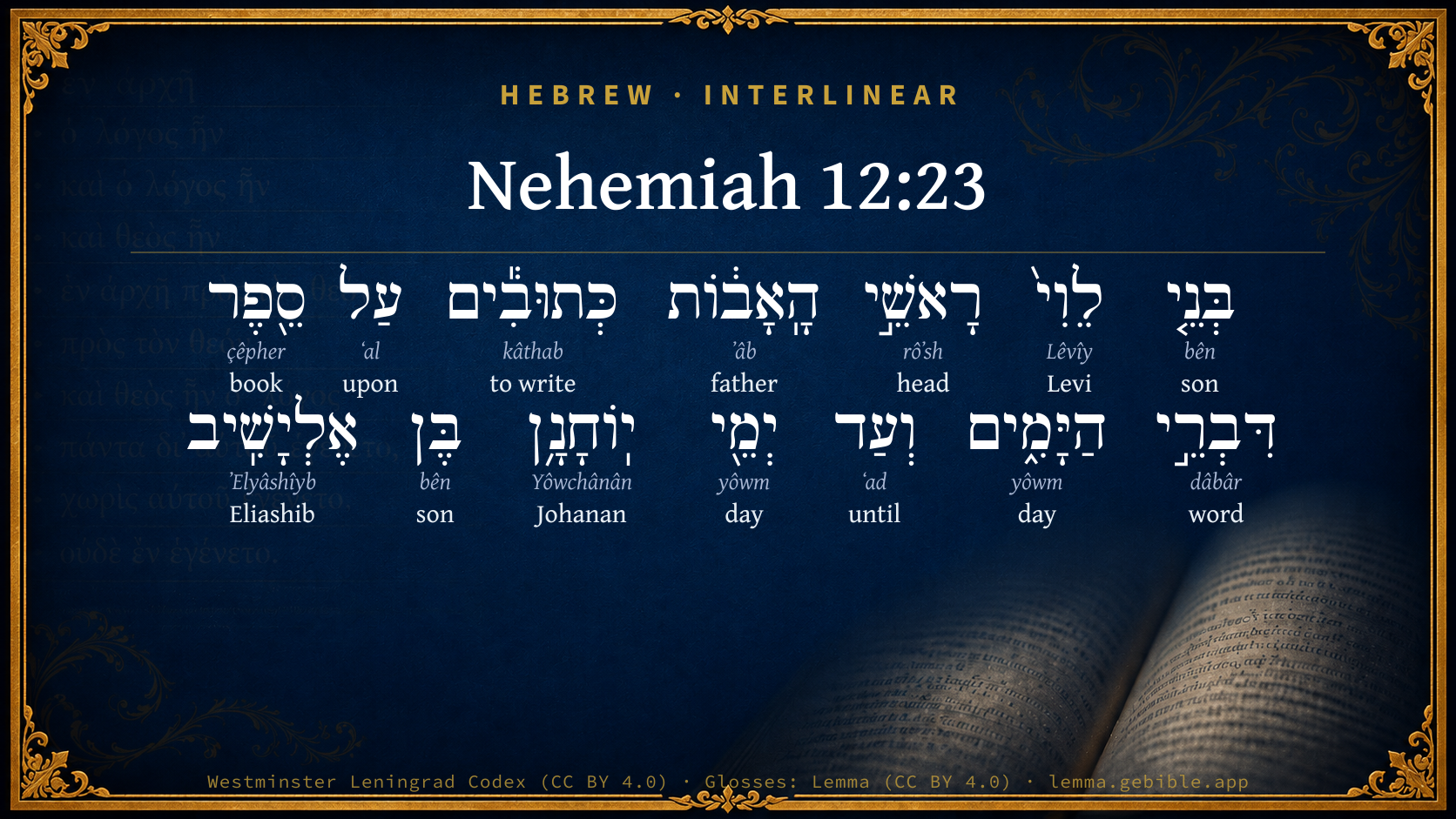
Hebrew (Westminster Leningrad Codex) Nehemiah 12:23 appears in the Hebrew Old Testament. The text above is from the Westminster Leningrad Codex. Each word links to its Strong’s number, a concise gloss, and parsing drawn from the Open Scriptures Hebrew Bible morphology. Click any word for its full Brown-Driver-Briggs (BDB) entry.
Download image
Cite this verse

Nehemiah 12:23 (World English Bible). Public Domain. Lemma interlinear Bible study tool, https://lemma.gebible.app/v/nehemiah/12/23.

Show BibTeX & RIS
BibTeX
RIS
English Translation
The sons of Levi, heads of fathers' [houses], were written in the book of the chronicles, even until the days of Johanan the son of Eliashib.
World English Bible · Public Domain
Download a study sheet

One document with this verse’s original text, its word-by-word gloss line, the meaning frame, cross-references with their text, attributed commentary, and full source and license credits — printable, and it pastes into notes with its structure intact.

This verse Autodidact and up

Study sheet (.html) Plain text (.txt)

A passage Seminary Student

Up to 50 verses in one chapter. A passage sheet keeps up to 6 commentary sources and 12 cross-references per verse, in the order this page ranks them, and says so on the sheet whenever that leaves anything out. Ask for a single verse and you get the Autodidact verse sheet above.

Everything on this page stays free to read, with no account — the sheet is a download of what is already on screen, not access to it.

Want to remove ads? Support Godless Engineer
Compare translations 3

The same verse in 3 English versions, stacked beneath the original-language interlinear above. Click any original word for its lexicon entry.

Each is an independent rendering of the whole verse — the interlinear is not word-aligned to these translations.

Highlighted words mark where these versions differ — a whole-verse word diff, not a word-by-word alignment.

  • World English Bible Public Domain
    The sons of Levi, heads of fathers' [houses], were written in the book of the chronicles, even until the days of Johanan the son of Eliashib.
  • King James Version Public Domain
    The sons of Levi, the chief of the fathers, were written in the book of the chronicles, even until the days of Johanan the son of Eliashib.
  • unfoldingWord Literal Text CC BY-SA 4.0
    The sons of Levi, the heads of fathers, were written in the book of the events of days even until the days of Johanan, the son of Eliashib.

unfoldingWord Literal Text — © unfoldingWord, licensed CC BY-SA 4.0. Word-aligned USFM3 via Door43 (git.door43.org/unfoldingWord/en_ult).

Versions to compare (up to 4)

3 of 4 selected

Show all 18 translations

Every available English version of this verse, each an independent rendering of the whole verse.

  • World English Bible Public Domain
    The sons of Levi, heads of fathers' [houses], were written in the book of the chronicles, even until the days of Johanan the son of Eliashib.
  • Berean Standard Bible Public Domain
    As for the descendants of Levi, the family heads up to the days of Johanan son of Eliashib were recorded in the Book of the Chronicles.
  • Majority Standard Bible Public Domain
    As for the descendants of Levi, the family heads up to the days of Johanan son of Eliashib were recorded in the Book of the Chronicles.
  • King James Version Public Domain
    The sons of Levi, the chief of the fathers, were written in the book of the chronicles, even until the days of Johanan the son of Eliashib.
  • American Standard Version (1901) Public Domain
    The sons of Levi, heads of fathers' `houses', were written in the book of the chronicles, even until the days of Johanan the son of Eliashib.
  • Revised Version (1885) Public Domain
    The sons of Levi, heads of fathers’ houses, were written in the book of the chronicles, even until the days of Johanan the son of Eliashib.
  • Geneva Bible (1599) Public Domain
    The sonnes of Leui, the chiefe fathers were written in the booke of the Chronicles euen vnto the dayes of Iohanan the sonne of Eliashib.
  • Douay-Rheims (1899) Public Domain
    The sons of Levi, heads of the families were written in the book of Chronicles, even unto the days of Jonathan the son of Eliasib.
  • Young's Literal Translation Public Domain
    Sons of Levi, heads of the fathers, are written on the book of the Chronicles even till the days of Johanan son of Eliashib;
  • Literal Standard Version CC BY-SA 4.0
    Sons of Levi, heads of the fathers, are written on the scroll of the Chronicles even until the days of Johanan son of Eliashib;
  • Unlocked Literal Bible CC BY-SA 4.0
    The descendants of Levi, their leaders of families were recorded in the book of the annals up to the days of Johanan son of Eliashib.
  • unfoldingWord Literal Text CC BY-SA 4.0
    The sons of Levi, the heads of fathers, were written in the book of the events of days even until the days of Johanan, the son of Eliashib.
  • Darby Bible Public Domain
    The children of Levi, the chief fathers, were recorded in the book of the chronicles, even until the days of Johanan the son of Eliashib.
  • World Messianic Bible Public Domain
    The sons of Levi, heads of fathers’ households, were written in the book of the chronicles, even until the days of Yochanan the son of Eliashib.
  • Webster's Bible Public Domain
    The sons of Levi, the chief of the fathers, were written in the book of the chronicles, even till the days of Johanan the son of Eliashib.
  • Free Bible Version CC BY-SA 4.0
    As for the genealogy of the sons of Levi, the family leaders up to the time of Johanan, son of Eliashib, were listed in the Book of the Records.
  • Bible in Basic English Public Domain
    The sons of Levi, heads of families, were recorded in the book of the histories, even till the days of Johanan, the son of Eliashib.
  • JPS Tanakh (1917) Public Domain
    The sons of Levi, heads of fathers' houses, were written in the book of the chronicles, even until the days of Johanan the son of Eliashib.

Literal Standard Version (2020), Covenant Press — licensed CC BY-SA 4.0. Text via the HelloAO Bible API (eBible.org). Unlocked Literal Bible (unfoldingWord) — licensed CC BY-SA 4.0. Text via the HelloAO Bible API (eBible.org). unfoldingWord Literal Text — © unfoldingWord, licensed CC BY-SA 4.0. Word-aligned USFM3 via Door43 (git.door43.org/unfoldingWord/en_ult). Free Bible Version, Dr. Jonathan Gallagher — licensed CC BY-SA 4.0. Text via the HelloAO Bible API (eBible.org).

Word by word

More ways to search: Search by grammar → Find every occurrence → Compare this word →

Practice this passage: Drill this verse → Learn its vocabulary →

אֶלְיָשִֽׁיב
ʼElyâshîyb
H475
“Eliashib”
Noun, Proper
Part of Speech
Noun
Type
Proper
Full BDB Definition

Origin: from H410 and H7725

TWOT: None

Eliashib = "God restores" - a priest in David's reign - a descendant of David - a high priest in Nehemiah's time - a temple singer with foreign wife - one of the line of Zattu - one of the line of Bani
  1. בְּנֵ֤י bên H1121 “sons of” Noun, Common, Masculine, Plural, Construct
  2. לֵוִי֙ Lêvîy H3878 “Levi” Noun, Proper
  3. רָאשֵׁ֣י rôʼsh H7218 “heads of” Noun, Common, Masculine, Plural, Construct
  4. הָֽאָב֔וֹת ʼâb H1 “the · fathers” Particle, Definite Article + Noun, Common, Masculine, Plural, Absolute
  5. כְּתוּבִ֕ים kâthab H3789 “written” Verb, Qal, Participle Passive, Masculine, Plural, Absolute
  6. עַל ʻal H5921 “upon” Preposition
  7. סֵ֖פֶר çêpher H5612 “book of” Noun, Common, Masculine, Singular, Construct
  8. דִּבְרֵ֣י dâbâr H1697 “words of” Noun, Common, Masculine, Plural, Construct
  9. הַיָּמִ֑ים yôwm H3117 “the · days” Particle, Definite Article + Noun, Common, Masculine, Plural, Absolute
  10. וְעַד ʻad H5704 “and · until” Conjunction + Preposition
  11. יְמֵ֖י yôwm H3117 “days of” Noun, Common, Masculine, Plural, Construct
  12. יֽוֹחָנָ֥ן Yôwchânân H3110 “Johanan” Noun, Proper
  13. בֶּן bên H1121 “son of” Noun, Common, Masculine, Singular, Construct

About this verse

These counts appear in no published source. They are computed here, from the morphology-tagged text and Lemma’s own curated glosses. What Lemma adds →

14
words
12
distinct lemmas
Historical
section

Notable vocabulary

The rarest word here is אֶלְיָשִֽׁיב Eliashib H475 — appearing just 17 times in the whole Hebrew Bible.

Shared distinctive vocabulary

אֶלְיָשִֽׁיב Eliashib H475 occurs in 15 verses of the Hebrew Bible. Also found in:

Grammatical profile

  • 1 verb
  • 11 nouns
  • 2 prepositions

Verb forms

  • כְּתוּבִ֕ים Qal · Participle Passive

Repetition

Words recur within this verse — often emphatic in Hebrew:

  • בְּנֵ֤י son H1121 ×2
  • הַיָּמִ֑ים day H3117 ×2

Cross-references

1

Topical passages linked to Nehemiah 12:23 in the Treasury of Scripture Knowledge — connected by theme and wording, ordered by reader-vote popularity; previews shown in the World English Bible.

  • 1 Chronicles 9:14–44 Of the Levites: Shemaiah the son of Hasshub, the son of Azrikam, the son of Hashabiah, of the sons of Merari;

Cross-references courtesy of OpenBible.info (CC BY 4.0).

Hebrew and Greek witnesses Masoretic Hebrew ↔ Greek Septuagint

The same verse in the two great witnesses to the Old Testament, shown verse-for-verse.

These are two independent witnesses, not word-aligned to each other, and the Septuagint is shown in lemma (dictionary) form.

Hebrew Nehemiah 12:23 Masoretic · Westminster Leningrad Codex

בְּנֵ֤י לֵוִי֙ רָאשֵׁ֣י הָֽאָב֔וֹת כְּתוּבִ֕ים עַל סֵ֖פֶר דִּבְרֵ֣י הַיָּמִ֑ים וְעַד יְמֵ֖י יֽוֹחָנָ֥ן בֶּן אֶלְיָשִֽׁיב

The sons of Levi, heads of fathers' [houses], were written in the book of the chronicles, even until the days of Johanan the son of Eliashib.

World English Bible · Public Domain

Greek LXX Structure differs

The Septuagint has no separate book of Nehemiah. Its Greek text is the second half of Esdras B (2 Esdras), chapters 11–23; Ezra is the first half (1–10).

A verse-for-verse comparison isn’t shown here because the chapters and verses don’t line up. Switch to the LXX edition with the MT / LXX toggle above to read the Greek directly.

Hebrew: Westminster Leningrad Codex (CC BY 4.0). Greek: Septuagint (public domain); English from a public-domain English Septuagint. How the Septuagint differs from the Hebrew →

Commentary

Notes on Nehemiah 12:23 from classic Christian and Jewish commentators (each source and its license shown beneath its notes). The classic Christian expositions comment on the surrounding passage and are grouped to its opening verse, so a note may address several verses; the Jewish commentaries on the Tanakh (Rashi and others) are per-verse, so they appear only where the commentator wrote on this verse.

Lemma curates 59 commentaries, every one of them public domain or Creative Commons licensed, each selected and text-cleaned for this edition rather than reprinted as found. About our sources →

Trapp's Complete Commentary

John Trapp

Neh 12:23 The sons of Levi, the chief of the fathers, [were] written in the book of the chronicles, even until the days of Johanan the son of Eliashib.

Ver. 23. In the book of the chronicles] sc. 1Ch 9:10, &c.

Johanan the son of Eliashib] That is, Jonathan, the grandchild of Eliashib, and the son of Joiada.

John Trapp, A Commentary or Exposition upon All the Books of the Old and New Testament (1647–1656) — public domain. Text from a community e-Sword module.

Joseph Benson's Commentary

Neh 12:23-25. Written in the book of the Chronicles — That is, in the public annals or registers, in which the genealogies of the several families were recorded by the Jews with great exactness, as all persons agree. Ward over against ward — Or, by turns, one coming in when another went out, to attend in their courses, which are called wards. At the thresholds of the gates — To wit, of the temple, where the holy things were laid up, their watching-place being close by the thresholds of the gates.

Joseph Benson's Commentary on the Old and New Testaments (1811–1818) — public domain. Text from a community e-Sword module.

Jamieson, Fausset & Brown

Robert Jamieson, A. R. Fausset & David Brown

The sons of Levi . . . were written in the book of the chronicles--that is, the public registers in which the genealogies were kept with great regularity and exactness.

Jamieson, Fausset & Brown — Commentary Critical and Explanatory on the Whole Bible (1871) — public domain (CC PDM 1.0). Text via the HelloAO Bible API.

Adam Clarke's Commentary

Verse 23. The book of the chronicles] This is not the book of Chronicles which we have now, no such list being found in it; but some other book or register, which is lost.

Adam Clarke's Commentary on the Bible (1810–1826) — public domain. Text from a community e-Sword/MySword module.

The Cambridge Bible for Schools and Colleges

gen. ed. J. J. S. Perowne

23. The sons of Levi] Here we have the heading or title of another enrolment. The expression ‘the sons of Levi’ is to be noted, and compared with the mention of ‘the Levites’ in Neh_12:8; Neh_12:22. The whole house of Levi is probably intended, priests and Levites together.

in the book of the chronicles] Clearly not the same as our ‘Chronicles,’ although the title is the same; ‘the words of the days’ was the regular Hebrew term for annals of any kind. The book here referred to seems to have been an official document, and to have been brought down to the days of Johanan the son of Eliashib, hence presumably down to the close of the fifth century b.c.

even until the days … Eliashib] Some connect with the following verse.

The Cambridge Bible for Schools and Colleges (gen. ed. J. J. S. Perowne; Cambridge University Press, 1878–1918) — public domain. Text from a community e-Sword module.

John Gill's Exposition

And the chief of the Levites,.... Here the thread of the history of Nehemiah, interrupted by the insertion of the two preceding verses, is carried from the priests to the Levites in the times of the third high priest:

Hashabiah, Sherebiah, and Jeshua the son of Kadmiel; these were singers, since it follows:

with their brethren over against them, to praise and to give thanks, according to the commandment of David the man of God, ward over against ward; which office of theirs they performed by turns in courses, as David under a divine direction ordered, see Ch1 23:5.

John Gill's Exposition of the Whole Bible (1746–1763) — public domain (CC PDM 1.0). Text via the HelloAO Bible API.

Haydock's Catholic Bible Commentary

Chronicles. Not those which are now extant: but some records which regarded the families of the priests. See 1 Esdras ii. 61. --- The son, or grandson of Eliasib. The author refers to others records, ver. 26. (Calmet)

George Leo Haydock (1774–1849), Haydock's Catholic Family Bible and Commentary, 1859 edition — public domain. Excludes Psalms (Douay-Rheims chapter numbering differs from Protestant) and Deuterocanonical books (Catholic canon only).

Matthew Poole's English Annotations

In the book of the chronicles, i.e. in the public annals or registers, in which the genealogies of the several families were set down by the Jews with great exactness, as all persons agree.

Matthew Poole's English Annotations on the Holy Bible (1683–1685) — public domain. Text from a community e-Sword/MySword module.

Whedon's Commentary on the Bible

Daniel D. Whedon

23. The sons of Levi — This expression comprehends both priests and Levites, and is therefore more general than the term the Levites, which is used in distinction from the priests.

The book of the Chronicles — Not our present book of “Chronicles,” but the public annals of the Jewish nation, from which all these registers were probably derived.

Until the days of Johanan — The preceding verse mentions registers kept until the reign of Darius the Persian, a date apparently later than the time of Johanan; and this favours the opinion of some that the mention of Darius and Jaddua is a later interpolation. But if this Persian king were Darius Nothus, then his reign and the days of Johanan were contemporaneous, and Nehemiah himself may have written these words.

Daniel D. Whedon (gen. ed.), Commentary on the Old and New Testaments (1874–1909) — public domain. Text from a community e-Sword module.

The Pulpit Commentary

Even until the days of Johanan. Why the practice of inserting the names in the book of the chronicles ceased at this date it is impossible to say, unless it was that the chronicles themselves ceased to be compiled. There certainly appears to be a long gap in the authentic Jewish annals between the close of the Old Testament canon and the composition of the First Book of the Maccabees. Johanan, the son of Eliashib. The "grandson" really, as appears by vers. 10, 11.

The Pulpit Commentary (1880–1919), ed. H.D.M. Spence-Jones & Joseph S. Exell — public domain. Text from a community e-Sword module.

Rashi

Rabbi Shlomo Yitzchaki (Rashi)

even until the days of Johanan All those who were the heads of the fathers’ houses of the Levites until the days of Johanan the High Priest were enumerated in the chronicles.

Rashi on the Tanakh — English translations: “The Judaica Press complete Tanach with Rashi, translated by A. J. Rosenberg” (CC BY 4.0); “Pentateuch with Rashi's commentary by M. Rosenbaum and A.M. Silbermann, 1929-1934” (public domain); “The Metsudah Tanach series, Lakewood, N.J” (CC BY 4.0); and “The Book of Joshua, Metsudah Publications, 1997” (CC BY 4.0). Text via Sefaria.

Lesson kit

Teaching starters — assembled from the data on this page, not authored interpretation. Every prompt links to the verse data it draws on. Edit before teaching.

Nehemiah, in the Historical, opens this verse with 14 words (12 distinct Hebrew lemmas). Its most distinctive word is ʼElyâshîyb (“Eliashib”). A historical commentator’s framing appears above. Read the whole chapter for the surrounding context.

Discussion questions

  1. The word ʼElyâshîyb carries the sense “Eliashib.” How does it shape the verse?
  2. How does 1 Chronicles 3:24, which shares the word «Eliashib», read alongside this verse?
  3. What does the repetition of “son” (2× in this one verse) do in this verse?
  4. The translations on this page render this verse differently — a whole-verse word diff, not a word-by-word alignment. What might account for the different wordings?
  5. «כְּתוּבִ֕ים» is a Qal Participle Passive verb. How does that grammatical form shape the action described?
  6. Compare how Trapp's Complete Commentary and Joseph Benson's Commentary read this verse. Where do they agree or differ?

Things to notice

Reading settings

Reading text

Shown beneath each verse's original-language words.

Old Testament
Old Testament edition

Read the OT as the Masoretic Hebrew (MT) or the Greek Septuagint (LXX).

English shown for the Greek Septuagint (in the Hebrew ↔ Greek comparison).

Comparing translations? Open the Compare panel on any verse page to stack up to four side by side.