
Jeremiah 36:4

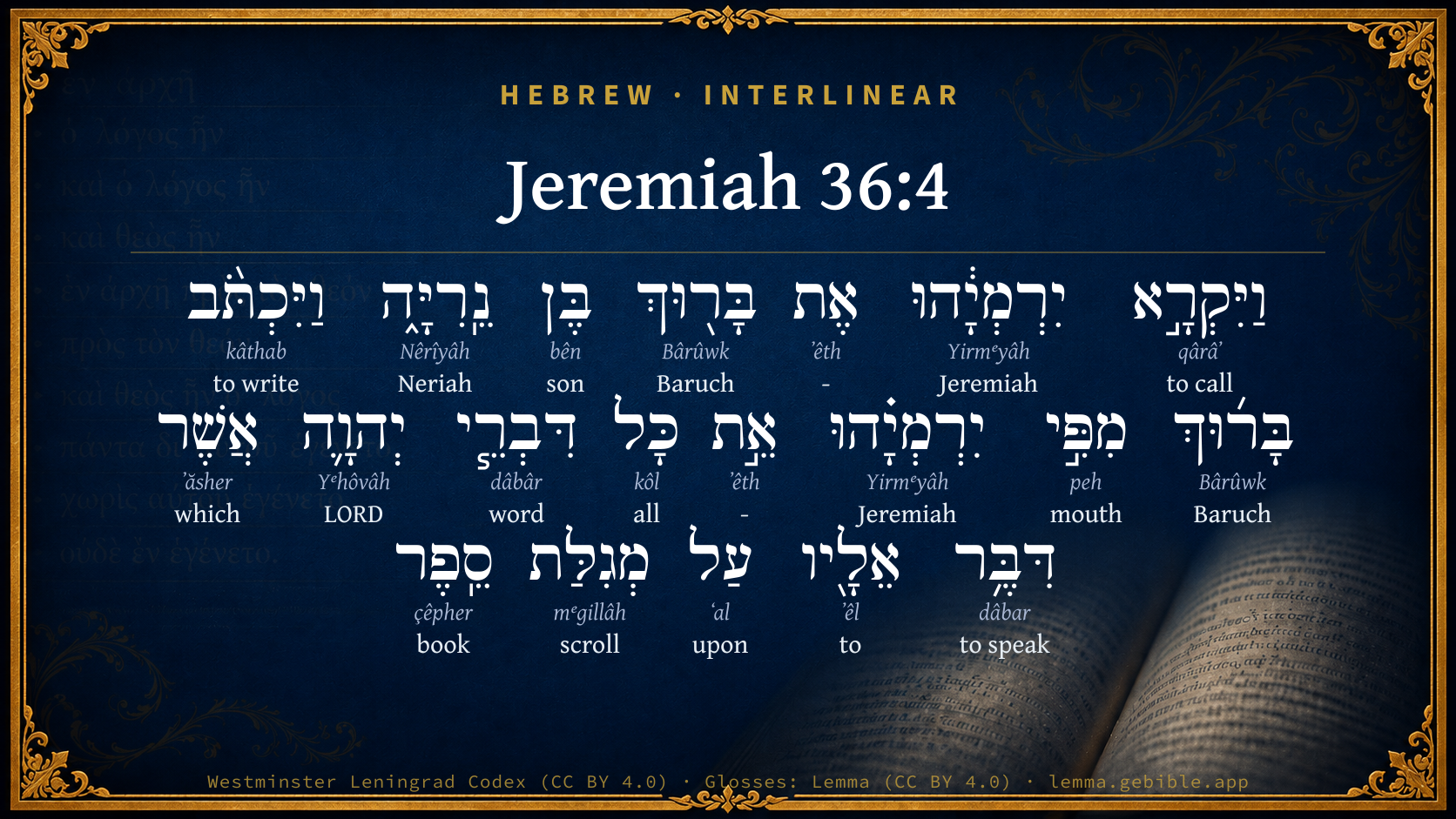
Hebrew (Westminster Leningrad Codex) Jeremiah 36:4 appears in the Hebrew Old Testament. The text above is from the Westminster Leningrad Codex. Each word links to its Strong’s number, a concise gloss, and parsing drawn from the Open Scriptures Hebrew Bible morphology. Click any word for its full Brown-Driver-Briggs (BDB) entry.
Download image
Cite this verse

Jeremiah 36:4 (World English Bible). Public Domain. Lemma interlinear Bible study tool, https://lemma.gebible.app/v/jeremiah/36/4.

Show BibTeX & RIS
BibTeX
RIS
English Translation
Then Jeremiah called Baruch the son of Neriah; and Baruch wrote from the mouth of Jeremiah all the words of Yahweh, which he had spoken to him, on a scroll of a book.
World English Bible · Public Domain
Download a study sheet

One document with this verse’s original text, its word-by-word gloss line, the meaning frame, cross-references with their text, attributed commentary, and full source and license credits — printable, and it pastes into notes with its structure intact.

This verse Autodidact and up

Study sheet (.html) Plain text (.txt)

A passage Seminary Student

Up to 50 verses in one chapter. A passage sheet keeps up to 6 commentary sources and 12 cross-references per verse, in the order this page ranks them, and says so on the sheet whenever that leaves anything out. Ask for a single verse and you get the Autodidact verse sheet above.

Everything on this page stays free to read, with no account — the sheet is a download of what is already on screen, not access to it.

Want to remove ads? Support Godless Engineer
Compare translations 3

The same verse in 3 English versions, stacked beneath the original-language interlinear above. Click any original word for its lexicon entry.

Each is an independent rendering of the whole verse — the interlinear is not word-aligned to these translations.

Highlighted words mark where these versions differ — a whole-verse word diff, not a word-by-word alignment.

  • World English Bible Public Domain
    Then Jeremiah called Baruch the son of Neriah; and Baruch wrote from the mouth of Jeremiah all the words of Yahweh, which he had spoken to him, on a scroll of a book.
  • King James Version Public Domain
    Then Jeremiah called Baruch the son of Neriah: and Baruch wrote from the mouth of Jeremiah all the words of the LORD, which he had spoken unto him, upon a roll of a book.
  • unfoldingWord Literal Text CC BY-SA 4.0
    Then Jeremiah called Baruch son of Neriah, and Baruch wrote in a scroll, at Jeremiah’s dictation, all the words of Yahweh spoken to him.

unfoldingWord Literal Text — © unfoldingWord, licensed CC BY-SA 4.0. Word-aligned USFM3 via Door43 (git.door43.org/unfoldingWord/en_ult).

Versions to compare (up to 4)

3 of 4 selected

Show all 18 translations

Every available English version of this verse, each an independent rendering of the whole verse.

  • World English Bible Public Domain
    Then Jeremiah called Baruch the son of Neriah; and Baruch wrote from the mouth of Jeremiah all the words of Yahweh, which he had spoken to him, on a scroll of a book.
  • Berean Standard Bible Public Domain
    So Jeremiah called Baruch son of Neriah, and at the dictation of Jeremiah, Baruch wrote on a scroll all the words that the LORD had spoken to Jeremiah.
  • Majority Standard Bible Public Domain
    So Jeremiah called Baruch son of Neriah, and at the dictation of Jeremiah, Baruch wrote on a scroll all the words that the LORD had spoken to Jeremiah.
  • King James Version Public Domain
    Then Jeremiah called Baruch the son of Neriah: and Baruch wrote from the mouth of Jeremiah all the words of the LORD, which he had spoken unto him, upon a roll of a book.
  • American Standard Version (1901) Public Domain
    Then Jeremiah called Baruch the son of Neriah; and Baruch wrote from the mouth of Jeremiah all the words of Jehovah, which he had spoken unto him, upon a roll of a book.
  • Revised Version (1885) Public Domain
    Then Jeremiah called Baruch the son of Neriah; and Baruch wrote from the mouth of Jeremiah all the words of the LORD, which he had spoken unto him, upon a roll of a book.
  • Geneva Bible (1599) Public Domain
    Then Ieremiah called Baruch the sonne of Neriah, and Baruch wrote at the mouth of Ieremiah all the wordes of the Lord, which hee had spoken vnto him, vpon a roule or booke.
  • Douay-Rheims (1899) Public Domain
    So Jeremias called Baruch the son of Nerias: and Baruch wrote from the mouth of Jeremias all the words of the Lord, which he spoke to him, upon the roll of a book.
  • Young's Literal Translation Public Domain
    And Jeremiah calleth Baruch son of Neriah, and Baruch writeth from the mouth of Jeremiah all the words of Jehovah, that He hath spoken unto him, on a roll of a book.
  • Literal Standard Version CC BY-SA 4.0
    And Jeremiah calls Baruch son of Neriah, and Baruch writes from the mouth of Jeremiah all the words of YHWH, that He has spoken to him, on a roll of a scroll.
  • Unlocked Literal Bible CC BY-SA 4.0
    Then Jeremiah called Baruch son of Neriah, and Baruch wrote in a scroll, at Jeremiah's dictation, all the words of Yahweh spoken to him.
  • unfoldingWord Literal Text CC BY-SA 4.0
    Then Jeremiah called Baruch son of Neriah, and Baruch wrote in a scroll, at Jeremiah’s dictation, all the words of Yahweh spoken to him.
  • Darby Bible Public Domain
    And Jeremiah called Baruch the son of Nerijah; and Baruch wrote from the mouth of Jeremiah all the words of Jehovah, which he had spoken unto him, upon a roll of a book.
  • World Messianic Bible Public Domain
    Then Jeremiah called Baruch the son of Neriah; and Baruch wrote from the mouth of Jeremiah all the LORD’s words, which he had spoken to him, on a scroll of a book.
  • Webster's Bible Public Domain
    Then Jeremiah called Baruch the son of Neriah: and Baruch wrote from the mouth of Jeremiah all the words of the LORD, which he had spoken to him, upon a roll of a book.
  • Free Bible Version CC BY-SA 4.0
    So Jeremiah called Baruch son of Neriah to come, and while Jeremiah dictated, Baruch wrote down on a scroll everything that the Lord had told Jeremiah.
  • Bible in Basic English Public Domain
    Then Jeremiah sent for Baruch, the son of Neriah; and Baruch took down from the mouth of Jeremiah all the words of the Lord which he had said to him, writing them in a book.
  • JPS Tanakh (1917) Public Domain
    Then Jeremiah called Baruch the son of Neriah; and Baruch wrote from the mouth of Jeremiah all the words of the LORD, which He had spoken unto him, upon a roll of a book.

Literal Standard Version (2020), Covenant Press — licensed CC BY-SA 4.0. Text via the HelloAO Bible API (eBible.org). Unlocked Literal Bible (unfoldingWord) — licensed CC BY-SA 4.0. Text via the HelloAO Bible API (eBible.org). unfoldingWord Literal Text — © unfoldingWord, licensed CC BY-SA 4.0. Word-aligned USFM3 via Door43 (git.door43.org/unfoldingWord/en_ult). Free Bible Version, Dr. Jonathan Gallagher — licensed CC BY-SA 4.0. Text via the HelloAO Bible API (eBible.org).

Word by word

More ways to search: Search by grammar → Find every occurrence → Compare this word →

Practice this passage: Drill this verse → Learn its vocabulary →

נֵֽרִיָּ֑ה
Nêrîyâh
H5374
“Neriah”
Noun, Proper
Part of Speech
Noun
Type
Proper
Full BDB Definition

Origin: from H5216 and H3050

TWOT: None

Neriah = "lamp of Jehovah" - son of Maaseiah and father of Baruch and Seraiah
  1. וַיִּקְרָ֣א qârâʼ H7121 “and · to call” Conjunction + Verb, Qal, Sequential Imperfect, 3rd Person, Masculine, Singular
  2. יִרְמְיָ֔הוּ Yirmᵉyâh H3414 “Jeremiah” Noun, Proper
  3. אֶת ʼêth H853 “-” Particle, Direct Object
  4. בָּר֖וּךְ Bârûwk H1263 “Baruch” Noun, Proper
  5. בֶּן bên H1121 “son of” Noun, Common, Masculine, Singular, Construct
  6. וַיִּכְתֹּ֨ב kâthab H3789 “and · to write” Conjunction + Verb, Qal, Sequential Imperfect, 3rd Person, Masculine, Singular
  7. בָּר֜וּךְ Bârûwk H1263 “Baruch” Noun, Proper
  8. מִפִּ֣י peh H6310 “from · mouth of” Preposition + Noun, Common, Masculine, Singular, Construct
  9. יִרְמְיָ֗הוּ Yirmᵉyâh H3414 “Jeremiah” Noun, Proper
  10. אֵ֣ת ʼêth H853 “-” Particle, Direct Object
  11. כָּל kôl H3605 “all of” Noun, Common, Masculine, Singular, Construct
  12. דִּבְרֵ֧י dâbâr H1697 “words of” Noun, Common, Masculine, Plural, Construct
  13. יְהוָ֛ה Yᵉhôvâh H3068 “LORD” Noun, Proper
  14. אֲשֶׁר ʼăsher H834 “which” Particle, Relative
  15. דִּבֶּ֥ר dâbar H1696 “to speak” Verb, Piel, Perfect, 3rd Person, Masculine, Singular
  16. אֵלָ֖יו ʼêl H413 “to · him” Preposition + Suffix, Personal, 3rd Person, Masculine, Singular
  17. עַל ʻal H5921 “upon” Preposition
  18. מְגִלַּת mᵉgillâh H4039 “scroll of” Noun, Common, Feminine, Singular, Construct
  19. סֵֽפֶר çêpher H5612 “book” Noun, Common, Masculine, Singular, Absolute

About this verse

These counts appear in no published source. They are computed here, from the morphology-tagged text and Lemma’s own curated glosses. What Lemma adds →

20
words
17
distinct lemmas
Prophets
section

Notable vocabulary

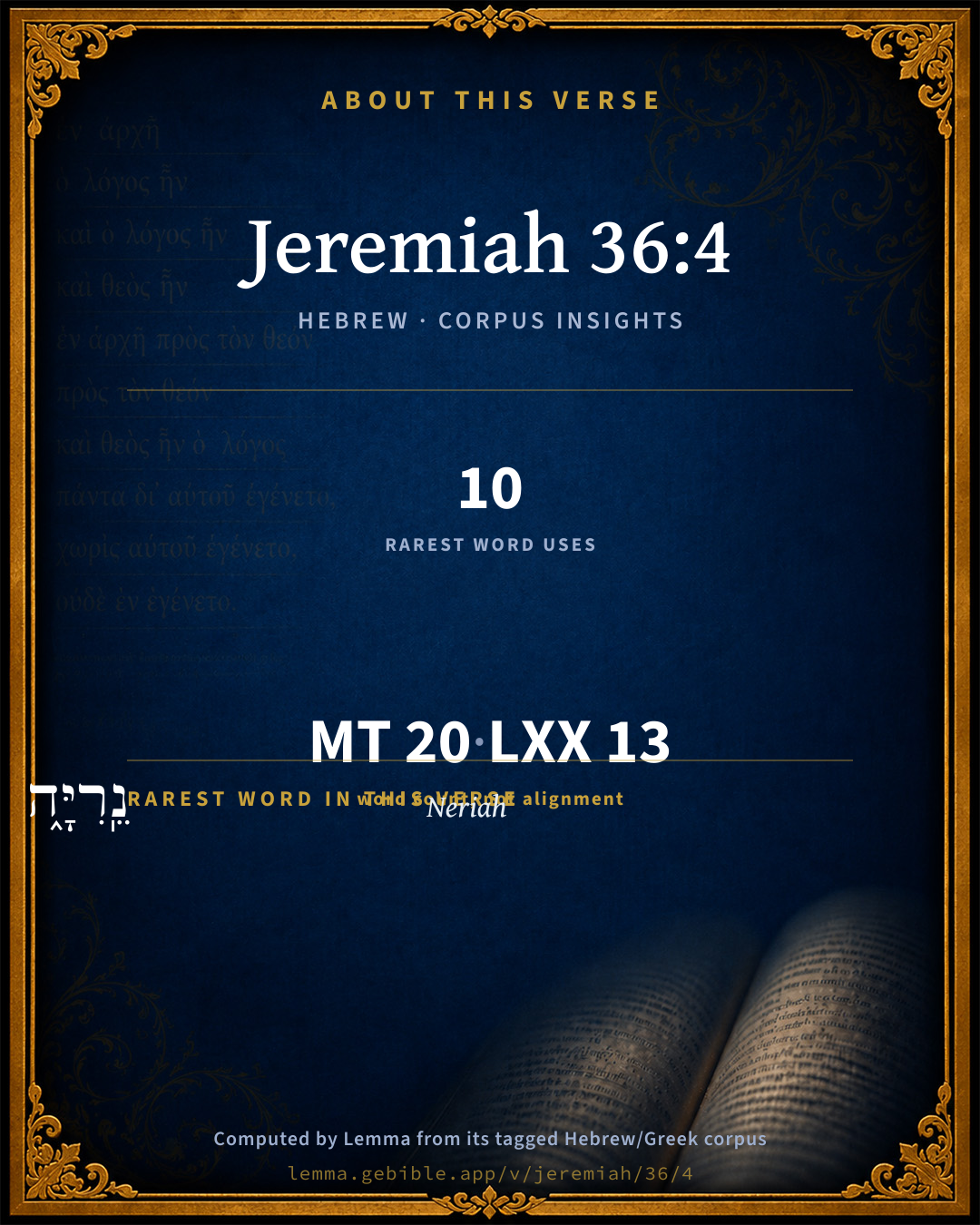
The rarest word here is נֵֽרִיָּ֑ה Neriah H5374 — appearing just 10 times in the whole Hebrew Bible.

Shared distinctive vocabulary

נֵֽרִיָּ֑ה Neriah H5374 occurs in 10 verses of the Hebrew Bible. Also found in:

Grammatical profile

  • 3 verbs
  • 12 nouns
  • 2 prepositions
  • 3 particles

Verb forms

  • וַיִּקְרָ֣א Qal · Sequential Imperfect
  • וַיִּכְתֹּ֨ב Qal · Sequential Imperfect
  • דִּבֶּ֥ר Piel · Perfect

Repetition

Words recur within this verse — often emphatic in Hebrew:

  • יִרְמְיָ֔הוּ Jeremiah H3414 ×2
  • בָּר֖וּךְ Baruch H1263 ×2

Hebrew & Septuagint length

In the original languages it is 20 Hebrew tokens and 13 Greek tokens — but the two are counted differently (Hebrew bundles its prefixes and suffixes into one token; the Greek is in lemma form), so that isn’t a like-for-like length.

Cross-references

13

Topical passages linked to Jeremiah 36:4 in the Treasury of Scripture Knowledge — connected by theme and wording, ordered by reader-vote popularity; previews shown in the World English Bible.

  • Jeremiah 32:12 and I delivered the deed of the purchase to Baruch the son of Neriah, the son of Mahseiah, in the presence of Hanamel my uncle's son, and in the presence of the witnesses who subscribed the deed of the purchase, before all the Jews who sat in the court of the guard.
  • Jeremiah 36:32 Then took Jeremiah another scroll, and gave it to Baruch the scribe, the son of Neriah, who wrote therein from the mouth of Jeremiah all the words of the book which Jehoiakim king of Judah had burned in the fire; and there were added besides to them many like words.
  • Ezekiel 2:9 When I looked, behold, a hand was put forth to me; and, behold, a scroll of a book was therein;
  • Jeremiah 43:3 but Baruch the son of Neriah sets you on against us, to deliver us into the hand of the Chaldeans, that they may put us to death, and carry us away captive to Babylon.
  • Isaiah 8:1 Yahweh said to me, "Take a large tablet, and write on it with a man's pen, 'For Maher Shalal Hash Baz;'
  • Jeremiah 36:17–18 They asked Baruch, saying, Tell us now, How did you write all these words at his mouth?
  • Jeremiah 36:21 So the king sent Jehudi to get the scroll; and he took it out of the chamber of Elishama the scribe. Jehudi read it in the ears of the king, and in the ears of all the princes who stood beside the king.
  • Jeremiah 36:23 It happened, when Jehudi had read three or four leaves, that [the king] cut it with the penknife, and cast it into the fire that was in the brazier, until all the scroll was consumed in the fire that was in the brazier.
  • Jeremiah 36:26 The king commanded Jerahmeel the king's son, and Seraiah the son of Azriel, and Shelemiah the son of Abdeel, to take Baruch the scribe and Jeremiah the prophet; but Yahweh hid them.
  • Jeremiah 36:28 Take again another scroll, and write in it all the former words that were in the first scroll, which Jehoiakim the king of Judah has burned.
  • Jeremiah 45:1–2 The word that Jeremiah the prophet spoke to Baruch the son of Neriah, when he wrote these word in a book at the mouth of Jeremiah, in the fourth year of Jehoiakim the son of Josiah, king of Judah, saying,
  • Zechariah 5:1 Then again I lifted up my eyes, and saw, and, behold, a flying scroll.
  • Romans 16:22 I, Tertius, who write the letter, greet you in the Lord.

Cross-references courtesy of OpenBible.info (CC BY 4.0).

Hebrew and Greek witnesses Masoretic Hebrew ↔ Greek Septuagint

The same verse in the two great witnesses to the Old Testament, shown verse-for-verse.

These are two independent witnesses, not word-aligned to each other, and the Septuagint is shown in lemma (dictionary) form.

Hebrew Jeremiah 36:4 Masoretic · Westminster Leningrad Codex

וַיִּקְרָ֣א יִרְמְיָ֔הוּ אֶת בָּר֖וּךְ בֶּן נֵֽרִיָּ֑ה וַיִּכְתֹּ֨ב בָּר֜וּךְ מִפִּ֣י יִרְמְיָ֗הוּ אֵ֣ת כָּל דִּבְרֵ֧י יְהוָ֛ה אֲשֶׁר דִּבֶּ֥ר אֵלָ֖יו עַל מְגִלַּת סֵֽפֶר

Then Jeremiah called Baruch the son of Neriah; and Baruch wrote from the mouth of Jeremiah all the words of Yahweh, which he had spoken to him, on a scroll of a book.

World English Bible · Public Domain

Greek LXX Structure differs

In the Septuagint, Jeremiah is about an eighth shorter than the Hebrew and arranges its material differently — the Oracles Against the Nations (Hebrew chapters 46–51) appear in the middle of the Greek book, after 25:13. Because the chapter and verse boundaries do not line up, a verse-for-verse comparison with the Hebrew is not shown.

A verse-for-verse comparison isn’t shown here because the chapters and verses don’t line up. Switch to the LXX edition with the MT / LXX toggle above to read the Greek directly.

Hebrew: Westminster Leningrad Codex (CC BY 4.0). Greek: Septuagint (public domain); English from a public-domain English Septuagint. How the Septuagint differs from the Hebrew →

Targum (Aramaic paraphrase)

1

The Targum is the ancient Jewish Aramaic paraphrase of the Hebrew Scriptures — an interpretive translation, not the Hebrew text itself. Onkelos (literal) and Pseudo-Jonathan (expansive) render the Torah, and Jonathan the Prophets. Coverage is partial: where no permissively-licensed English translation exists for a verse, only the Aramaic is shown. This is verse-level text, not a word-by-word alignment to the Hebrew.

  1. Targum Jonathan Prophets (Joshua–Malachi)
    וּקְרָא יִרְמְיָה יַת בָּרוּךְ בַּר נֵרִיָה וּכְתַב בָּרוּךְ מִפּוּם דְיִרְמְיָה יַת כָּל פִּתְגָמַיָא דַייָ דְמַלֵיל עִמֵיהּ עַל מְגִלַת סַפְרָא:

    (no public-domain English translation for this verse)

    Targum Jonathan — Aramaic: “Mikraot Gedolot” (public domain). English: “Sefaria Community Translation” (CC0 1.0 (public-domain dedication)); “London "Chaldee Paraphrase," 1871” (public domain). Text via Sefaria.

Commentary

Notes on Jeremiah 36:4 from classic Christian and Jewish commentators (each source and its license shown beneath its notes). The classic Christian expositions comment on the surrounding passage and are grouped to its opening verse, so a note may address several verses; the Jewish commentaries on the Tanakh (Rashi and others) are per-verse, so they appear only where the commentator wrote on this verse.

Lemma curates 59 commentaries, every one of them public domain or Creative Commons licensed, each selected and text-cleaned for this edition rather than reprinted as found. About our sources →

Trapp's Complete Commentary

John Trapp

Jer 36:4 Then Jeremiah called Baruch the son of Neriah: and Baruch wrote from the mouth of Jeremiah all the words of the LORD, which he had spoken unto him, upon a roll of a book.

Ver. 4. Then Jeremiah calIed Baruch, … and {a} Baruch wrote from the mouth.] Dictantis ab ore pependit. Jeremiah, it seemeth, had either not written his prophecies, or not so legibly, or in loose papers only; now he hath them fair written out into a book, making the same use of Baruch as afterward Paul did of Tertius, {Rom 16:22} who himself wrote no very good hand, as some have gathered from Gal 6:11; {See Trapp on "Gal 6:11"}

{a} Baruch iste notarius et diaconus Ieremiae, simulque propheta fuit. - Oecolamp.

John Trapp, A Commentary or Exposition upon All the Books of the Old and New Testament (1647–1656) — public domain. Text from a community e-Sword module.

The Biblical Illustrator

Joseph S. Exell

Jer_36:4-7

I am shut up.

Jeremiah in prison

1. Jeremiahs age was one of great political troubles.

2. It was also an age of signal religious privileges.

3. It was an age of great moral corruption.

I. His imprisonment suggests the sad moral character of his age. The prisons of an age are often criteria by which to determine its character. When prisons are filled with men of signal excellence of character, force of conscience, and self-denying philanthropy, you have sad moral proofs of the deep moral corruption of the age that could tolerate such enormity.

II. His imprisonment suggests Gods method of raising humanity. Heavens plan embraces the agency of good men. The agency is twofold, primary and secondary. There are spiritual seers and spiritual mechanics.

1. Jeremiah may be regarded as a type of the primary human agents whom God employs. They are frequently in the lowest secular condition; yet in that condition God communes with them, and gives them a message for the world.

2. Baruch may be regarded as a type of the secondary agents. In this age the Baruchs are numerous. Men abound who will take down the thoughts of great thinkers; but the Jeremiahs are rare. Thought power, rather than tongue power, is wanted now.

III. His imprisonment suggests the inability of the external to crush a holy soul.

1. He is free in his communion with heaven. From the dungeon he cried, and God heard him (Lam_3:56-57).

2. He was free in his sympathies with the race. He could not go out in body to the house of the Lord, but he went out in soul. Walls of granite, massive iron bars, chains of adamant, cannot confine the soul; nor can the densest darkness throw on it a single shadow. (Homilist.)

Gods servant imprisoned

When Henry Burton, two centuries ago, was persecuted for the name of Christ and put in prison, I found, he said, the comforts of my God in the Fleet Prison exceedingly, it being the first time of my being a prisoner. Go thou, and read in the roll.

The prophet and the roll:--

I. The solicitude of Jeremiah--(verses 4, 5).

II. The command of Jeremiah (verse 6).

III. The hope of Jeremiah (verse 7).

If Divine mercy could not woo them back to righteousness, he hoped that Divine justice might drive them. Alas! he was disappointed. The national heart, with a few rare exceptions, hardened into granite. And then they were overwhelmed with calamities. (E. Davies, D. D.)

The utility of Holy Scripture

See here the utility of the Holy Scriptures and the excellent use that may be made of reading them. A man maybe thereby doubtless converted, where preaching is wanting, as divers were in Queen Marys days, when the Word of God was precious; as Augustine was, by reading Rom_13:1-14.; Fulgentius, by the prophet Jonah; Franciscus Junius, by Joh_1:1-51., &c. (John Trapp.)

The Biblical Illustrator, edited by Joseph S. Exell (c. 1880s–1900s) — public domain. Text from a community e-Sword module.

Joseph Benson's Commentary

Jer 36:4. Then Jeremiah called Baruch — Baruch was the most faithful disciple of this prophet: he served him as long as he lived in the capacity of his secretary, and never left him till his death. And Baruch wrote from the mouth of Jeremiah all the words, &c. — We need not ask how Jeremiah could remember all the prophecies that he had prophesied, for twenty-two years before, considering who it was that commanded him to put them in writing. God undoubtedly brought them to his remembrance, otherwise it would have been impossible for him to have recollected them all. The Spirit of God dictated to Jeremiah, and he to Baruch.

Joseph Benson's Commentary on the Old and New Testaments (1811–1818) — public domain. Text from a community e-Sword module.

Tyndale Open Study Notes

Tyndale Open Resources

36:4 Evidently, Jeremiah was not skilled in writing, so he enlisted the services of a scribe named Baruch. As they sat in their private quarters, Jeremiah repeated message after message from memory. It is not known whether Baruch had a role in composition or arrangement, or whether he simply recorded exactly what Jeremiah dictated.

Tyndale Open Study Notes — © Tyndale Open Resources, licensed CC BY-SA 4.0. Text via the HelloAO Bible API.

Geneva Bible (1599)

Geneva Bible translators

As he did indite.

Geneva Bible (1599) marginal notes — public domain. Text via Bolls.life.

Jamieson, Fausset & Brown

Robert Jamieson, A. R. Fausset & David Brown

all . . . words of . . . Lord--God specially suggesting what might otherwise have escaped his memory, and directing the choice of words, as well as the substance (Joh 14:26; Joh 16:13).

Jamieson, Fausset & Brown — Commentary Critical and Explanatory on the Whole Bible (1871) — public domain (CC PDM 1.0). Text via the HelloAO Bible API.

Adam Clarke's Commentary

Verse 4. Then Jeremiah called Baruch] This man, so useful to the prophet, and so faithfully attached to him, was by office a scribe; which signifies, not only a writer, but also a man in office; a chancellor, secretary, c., a learned man one acquainted with laws and customs.

Adam Clarke's Commentary on the Bible (1810–1826) — public domain. Text from a community e-Sword/MySword module.

John Calvin's Commentaries

Here the Prophet declares that he dictated to Baruch, a servant of God, whatever he had previously taught. But there is no doubt but that God suggested to the Prophet at the time what might have been erazed from his memory; for all the things which we have some time ago said, do not always occur to us. Therefore the greater part of so many words must have escaped the Prophet, had not God dictated them again to him. Jeremiah then stood, as it were, between God and Baruch; for God, by his Spirit, presided over and guided the mind and tongue of the Prophet. Now the Prophet, the Spirit being his guide and teacher, recited what God had commanded; and Baruch wrote down, and then proclaimed the whole summary of what the Prophet had taught.

He therefore says, that he called to him Baruch the son of Neria, who wrote from his mouth, and he wrote all the words of Jehovah Jeremiah repeats again that nothing came from himself. We hence see that he did not dictate, according to his own will, what came to his mind, but that God suggested whatever he wished to be written by Baruch. It is added, that he commanded Baruch to recite in the Temple what he had written, because he himself was detained. Some think that he was shut up in prison; and he used the same word before, when he told us that he was cast into prison by Zedekiah. But as sacred history does not say that he suffered any such thing under Jehoiakim, I am inclined to think that he was prevented by God; I do not, however, ascribe it to a divine oracle; for it might have happened either through God’s command, or through some human impediments. If we believe the Prophet to have been in prison, and that he might have gone out, he yet abstained; for the more liberty was given him, the more bound he felt himself to continue in prison, lest he should violate public authority. But the other supposition is more probable, that he was detained by God’s hand. However this may have been, he says that he could not go forth; and he mentioned this, lest it should appear that he was only careful as to himself, and that through fear of danger, he devolved this duty on Baruch. He then shews that he did not shun his office, because it exposed him to hatred, but that he was not at liberty to go forth.

John Calvin's Commentaries (1540-1563) — public domain. Text from the Calvin Translation Society English edition (1840s-50s) via the Christian Classics Ethereal Library (ccel.org). Calvin's coverage is partial (roughly two-thirds of the Bible); uncommented books and verses are honest gaps, never fabricated. The 19th-century editor's footnotes and remarks are omitted so the notes are faithfully Calvin's own voice.

Ellicott's Commentary for English Readers

(4) Then Jeremiah called Baruch the son of Neriah.—See Note on Jer_32:12. The prophet was, as the next verse shows, in some way hindered, though apparently not by imprisonment, as he and Baruch could hide themselves (Jer_36:19): Baruch therefore had to act not only as the prophet’s amanuensis, but as the preacher of his sermon. It will be noted that an interval of some months elapsed between the dictation and the public utterance.

A Bible Commentary for English Readers, edited by Charles John Ellicott (1878–1897) — public domain. Text from a community e-Sword module.

The Cambridge Bible for Schools and Colleges

gen. ed. J. J. S. Perowne

4. Then Jeremiah called Baruch] mentioned already (Jer_32:12 f.) as the prophet’s attendant. He was grandson of Maaseiah, “governor of the city” (2Ch_34:8) and brother of Seraiah (Jer_51:59).

The Cambridge Bible for Schools and Colleges (gen. ed. J. J. S. Perowne; Cambridge University Press, 1878–1918) — public domain. Text from a community e-Sword module.

John Gill's Exposition

Then Jeremiah called Baruch the son of Neriah,.... One of his disciples, and whom he had before made use of in the purchase of a field of his uncle's son, and to whom he gave the evidence of the purchase, Jer 32:12; he was probably a better penman than the prophet, or a quicker writer; however, he thought proper, for quicker dispatch, to make use of him as his amanuensis:

and Baruch wrote from the mouth of Jeremiah all the words of the Lord,

which he had spoken unto him, upon a roll of a book; it seems that Jeremiah had not committed any of his prophecies to writing; and yet it cannot be thought that by the mere strength of memory he could repeat every discourse and prophecy he had delivered in the space of two and twenty years; wherefore it must be concluded, that that same Spirit, which first dictated the prophecies to him, brought them fresh to his memory; so that he could readily repeat them to Baruch, who took them down in writing on a roll of parchment.

John Gill's Exposition of the Whole Bible (1746–1763) — public domain (CC PDM 1.0). Text via the HelloAO Bible API.

Haydock's Catholic Bible Commentary

Book. This was afterwards burnt. What he wrote a second time has not come down to us, in the same order. Jeremias made us of his memory, which was directed by the Holy Spirit. (Calmet)

George Leo Haydock (1774–1849), Haydock's Catholic Family Bible and Commentary, 1859 edition — public domain. Excludes Psalms (Douay-Rheims chapter numbering differs from Protestant) and Deuterocanonical books (Catholic canon only).

Matthew Poole's English Annotations

We shall find this Baruch, being one of Jeremiah’s disciples, more than once thus employed as Jeremiah’s secretary or amanuensis. None shall need ask how Jeremiah could remember all the prophecies he had prophesied for twenty-two years before past, that considereth who it was that commanded him to do this. God undoubtedly revived the prophet’s memory, or he could not have called all to mind.

Matthew Poole's English Annotations on the Holy Bible (1683–1685) — public domain. Text from a community e-Sword/MySword module.

Whedon's Commentary on the Bible

Daniel D. Whedon

4. Wrote from the mouth of Jeremiah — That is, at his dictation. The writing was done under his supervision; but, as stated above, there is no conclusive reason why the scribe might not avail himself in making his record of any earlier ones if they existed. This matter of writing would seem to have been the most honourable of employments. Hence in this case the scribe is Baruch, a member of a noble family.

Daniel D. Whedon (gen. ed.), Commentary on the Old and New Testaments (1874–1909) — public domain. Text from a community e-Sword module.

The Pulpit Commentary

Baruch. Already mentioned as Jeremiah"s attendant, in Jer_32:12. He appears to have been of high rank (see on ver. 15), as Josephus, indeed, expressly states ("Ant.," 10:9, 1). Maaseiah, his grandfather, was governor of the city, (2Ch_34:8) and Seraiah his brother (Jer_51:59) held some equally honourable, though not so easily definable, position in the court.

The Pulpit Commentary (1880–1919), ed. H.D.M. Spence-Jones & Joseph S. Exell — public domain. Text from a community e-Sword module.

Keil & Delitzsch

C. F. Keil & F. Delitzsch

Jeremiah carries out the divine command by making Baruch write down on a book-roll all the words of the Lord, out of his mouth ('מפּי , i.e., at the dictation of Jeremiah); and since he himself is prevented from getting to the house of the Lord, he bids him read the words he had written down in the ears of the people in the temple on the fast-day, at the same time expressing the hope, Jer 36:7 : "Perhaps their supplication will fall down before the Lord, and they will return each one from his wicked way; for great is the wrath and the anger which the Lord hath expressed concerning this people." Baruch, who is mentioned so early as Jer 32:12. as the attendant of the prophet, was, according to the passage now before us, his amanuensis, and executed his commissions. אני עצוּר, according to Jer 33:1 and Jer 39:15, might mean, "I am in prison;" but this does not accord with the request of the princes, Jer 36:19, that Jeremiah should hide himself. Moreover, עצוּר does not mean "seized, captus," but "stopped, restrained, hindered;" see on Neh 6:10. The cause of hindrance is not mentioned, as being away from the purpose of the narrative. "To read in the roll in the ears of the people," i.e., to read to the people out of the book. בּיום צום does not mean "on any fast-day whatever," but, "on the fast-day." The article is omitted because there was no need for defining the fast-day more exactly. The special fast-day mentioned in Jer 36:9 is intended. 'תּפּל תּחנּתם וגו, "their supplication will fall down before the Lord," i.e., reach unto God, as if it were laid before His feet. נפל is transferred from the posture of the suppliant - his falling down before God - to his supplication. Hence, in Hiphil, to make the supplication fall down before the Lord is equivalent to laying the request at His feet; Jer 38:26; Jer 42:9; Dan 9:18, Dan 9:20. If the supplication actually comes before God, it is also heard and finds success. This success is pointed out in 'וישׁבוּ וגו, "that they may repent." If man, in a repentant spirit, supplicates God for grace, God grants him power for conversion. But the return of the people from their wicked way is indispensable, because the wrath which God has expressed concerning it is great, i.e., because God has threatened a heavy judgment of wrath.

Keil & Delitzsch — Biblical Commentary on the Old Testament (1861–1891) — public domain (CC PDM 1.0). Text via the HelloAO Bible API. (Old Testament only.)

unfoldingWord translationNotes

Door43 World Missions Community

Jeremiah called ... at Jeremiah's dictation ... to him ... Jeremiah gave ... He said

It is not clear why Jeremiah is referring to himself by name here. You may translate using first person, as the UDB does. AT: "I called ... at my dictation ... to me ... I gave ... I said" (See: First, Second, or Third Person)

Baruch wrote in a scroll, at Jeremiah's dictation, all the words of Yahweh spoken to him

"while Jeremiah was speaking, Baruch wrote in a scroll all of Yahweh's words that Yahweh had spoken to Jeremiah"

read from the scroll

"read out loud from the scroll" or "proclaim from the scroll"

must read

"must read out loud" or "must proclaim"

in the hearing of the people in his house

"so that the people in Yahweh's house can hear them." See how similar words are translated in Jeremiah 2:2.

in the hearing of all of Judah who have come from their cities

"so all the people of Judah who have come from their cities can hear them." See how similar words are translated in Jeremiah 2:2.

translationWords

Jeremiah

call

Baruch

scroll

word of God

command

prison

house of God

day

fast

preach

unfoldingWord translationNotes — © Distant Shores Media and the Door43 World Missions Community, licensed CC BY-SA 4.0. Source: git.door43.org/Door43/en_tn.

Lesson kit

Teaching starters — assembled from the data on this page, not authored interpretation. Every prompt links to the verse data it draws on. Edit before teaching.

Jeremiah, in the Prophets, opens this verse with 20 words (17 distinct Hebrew lemmas). Its most distinctive word is Nêrîyâh (“Neriah”). A historical commentator’s framing appears above. Read the whole chapter for the surrounding context.

Discussion questions

  1. What does “Neriah” (Nêrîyâh) contribute to the verse as a whole?
  2. Jeremiah 32:12 shares the word «Neriah» with this verse. How do the two illuminate each other?
  3. “Jeremiah” occurs 2× in this one verse. What is the effect of the repetition?
  4. These translations render this verse differently. What is at stake in choosing one wording over another?
  5. The verb «וַיִּקְרָ֣א» is Qal Sequential Imperfect. How does its form color the action?
  6. Reading how Trapp's Complete Commentary and The Biblical Illustrator read this verse, where do the two commentators agree and where do they part?

Things to notice

Reading settings

Reading text

Shown beneath each verse's original-language words.

Old Testament
Old Testament edition

Read the OT as the Masoretic Hebrew (MT) or the Greek Septuagint (LXX).

English shown for the Greek Septuagint (in the Hebrew ↔ Greek comparison).

Comparing translations? Open the Compare panel on any verse page to stack up to four side by side.