
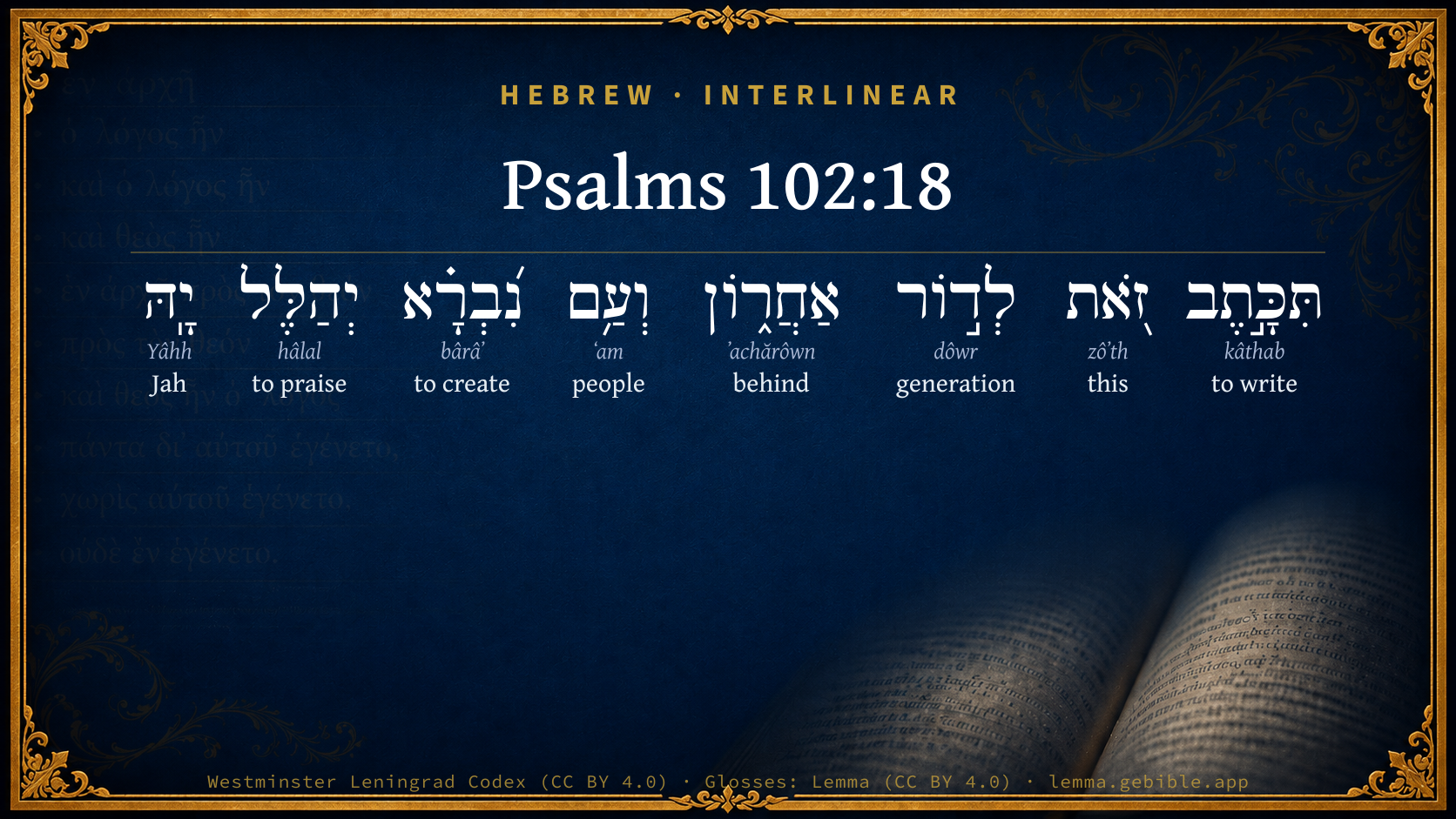
Psalms 102:18

Hebrew (Westminster Leningrad Codex) Psalms 102:18 appears in the Hebrew Old Testament. The text above is from the Westminster Leningrad Codex. Each word links to its Strong’s number, a concise gloss, and parsing drawn from the Open Scriptures Hebrew Bible morphology. Click any word for its full Brown-Driver-Briggs (BDB) entry.
Download image
Cite this verse

Psalms 102:18 (World English Bible). Public Domain. Lemma interlinear Bible study tool, https://lemma.gebible.app/v/psalms/102/18.

Show BibTeX & RIS
BibTeX
RIS
English Translation
This will be written for the generation to come. A people which will be created will praise Yah.
World English Bible · Public Domain
Download a study sheet

One document with this verse’s original text, its word-by-word gloss line, the meaning frame, cross-references with their text, attributed commentary, and full source and license credits — printable, and it pastes into notes with its structure intact.

This verse Autodidact and up

Study sheet (.html) Plain text (.txt)

A passage Seminary Student

Up to 50 verses in one chapter. A passage sheet keeps up to 6 commentary sources and 12 cross-references per verse, in the order this page ranks them, and says so on the sheet whenever that leaves anything out. Ask for a single verse and you get the Autodidact verse sheet above.

Everything on this page stays free to read, with no account — the sheet is a download of what is already on screen, not access to it.

Want to remove ads? Support Godless Engineer
Compare translations 3

The same verse in 3 English versions, stacked beneath the original-language interlinear above. Click any original word for its lexicon entry.

Each is an independent rendering of the whole verse — the interlinear is not word-aligned to these translations.

Highlighted words mark where these versions differ — a whole-verse word diff, not a word-by-word alignment.

  • World English Bible Public Domain
    This will be written for the generation to come. A people which will be created will praise Yah.
  • King James Version Public Domain
    This shall be written for the generation to come: and the people which shall be created shall praise the LORD.
  • unfoldingWord Literal Text CC BY-SA 4.0
    This will be written for a future generation, and a people being created will praise Yah;

unfoldingWord Literal Text — © unfoldingWord, licensed CC BY-SA 4.0. Word-aligned USFM3 via Door43 (git.door43.org/unfoldingWord/en_ult).

Versions to compare (up to 4)

3 of 4 selected

Show all 18 translations

Every available English version of this verse, each an independent rendering of the whole verse.

  • World English Bible Public Domain
    This will be written for the generation to come. A people which will be created will praise Yah.
  • Berean Standard Bible Public Domain
    Let this be written for the generation to come, so that a people not yet created may praise the LORD.
  • Majority Standard Bible Public Domain
    Let this be written for the generation to come, so that a people not yet created may praise the LORD.
  • King James Version Public Domain
    This shall be written for the generation to come: and the people which shall be created shall praise the LORD.
  • American Standard Version (1901) Public Domain
    This shall be written for the generation to come; And a people which shall be created shall praise Jehovah.
  • Revised Version (1885) Public Domain
    This shall be written for the generation to come: and a people which shall be created shall praise the LORD.
  • Geneva Bible (1599) Public Domain
    This shall be written for the generation to come: and the people, which shalbe created, shall prayse the Lord.
  • Douay-Rheims (1899) Public Domain
    He hath had regard to the prayer of the humble: and he hath not despised their petition.
  • Young's Literal Translation Public Domain
    This is written for a later generation, And the people created do praise Jah.
  • Literal Standard Version CC BY-SA 4.0
    This is written for a later generation, || And the people created praise YAH.
  • Unlocked Literal Bible CC BY-SA 4.0
    This will be written for future generations, and a people not yet born will praise Yahweh.
  • unfoldingWord Literal Text CC BY-SA 4.0
    This will be written for a future generation, and a people being created will praise Yah;
  • Darby Bible Public Domain
    This shall be written for the generation to come; and a people that shall be created shall praise Jah:
  • World Messianic Bible Public Domain
    This will be written for the generation to come. A people which will be created will praise the LORD,
  • Webster's Bible Public Domain
    \\102:17\\He will regard the prayer of the destitute, and not despise their prayer.
  • Free Bible Version CC BY-SA 4.0
    Let this be recorded for generations to come, so that people yet to be born may praise the Lord:
  • Bible in Basic English Public Domain
    This will be put in writing for the coming generation, and the people of the future will give praise to the Lord.
  • JPS Tanakh (1917) Public Domain
    (102-19) This shall be written for the generation to come; and a people which shall be created shall praise the LORD.

Literal Standard Version (2020), Covenant Press — licensed CC BY-SA 4.0. Text via the HelloAO Bible API (eBible.org). Unlocked Literal Bible (unfoldingWord) — licensed CC BY-SA 4.0. Text via the HelloAO Bible API (eBible.org). unfoldingWord Literal Text — © unfoldingWord, licensed CC BY-SA 4.0. Word-aligned USFM3 via Door43 (git.door43.org/unfoldingWord/en_ult). Free Bible Version, Dr. Jonathan Gallagher — licensed CC BY-SA 4.0. Text via the HelloAO Bible API (eBible.org).

Word by word

More ways to search: Search by grammar → Find every occurrence → Compare this word →

Practice this passage: Drill this verse → Learn its vocabulary →

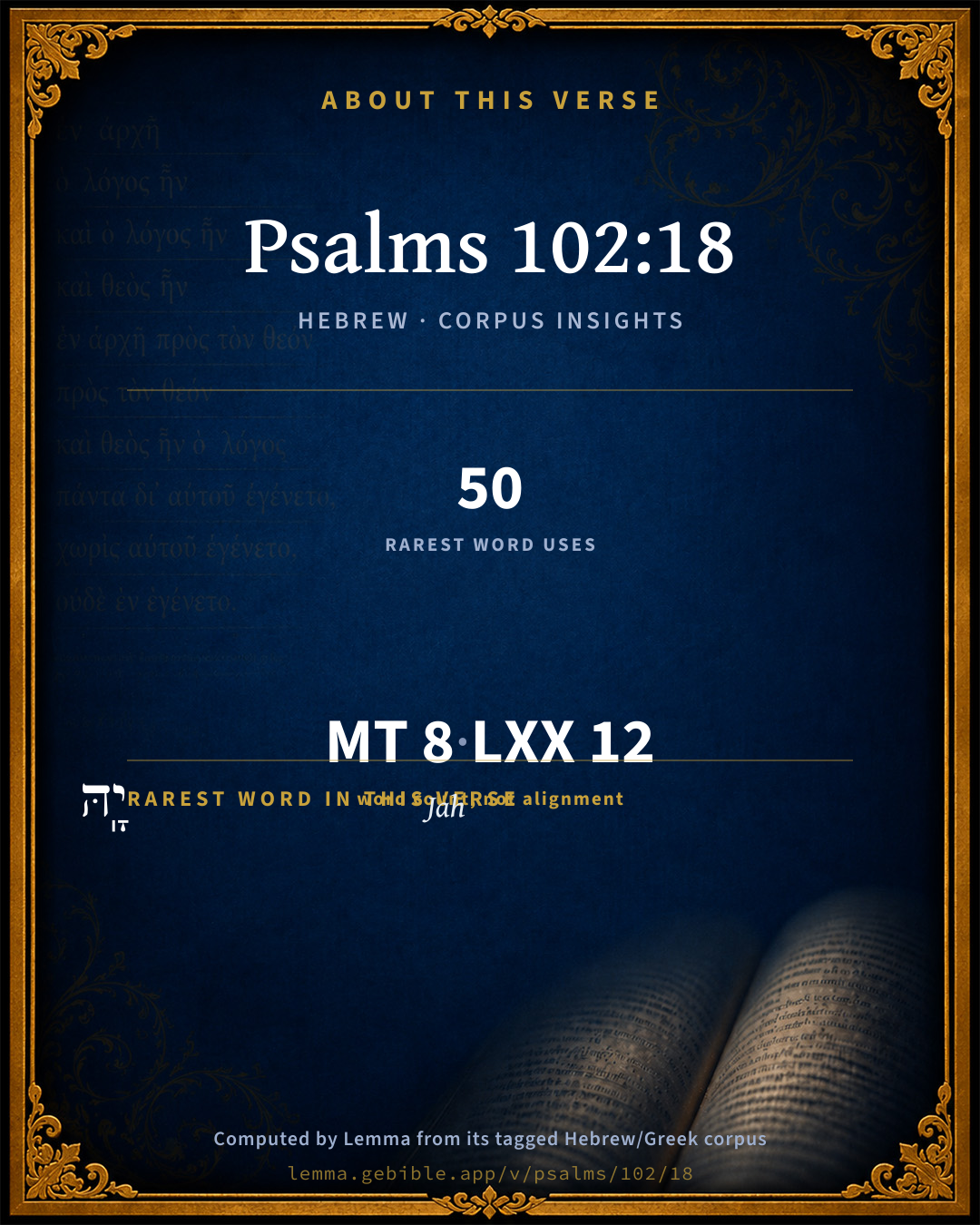
About this verse

These counts appear in no published source. They are computed here, from the morphology-tagged text and Lemma’s own curated glosses. What Lemma adds →

8
words
8
distinct lemmas
Wisdom
section

Shared distinctive vocabulary

יָֽהּ Jah H3050 occurs in 46 verses of the Hebrew Bible. Also found in:

Grammatical profile

  • 3 verbs
  • 3 nouns
  • 1 adjective
  • 1 pronoun

Verb forms

  • תִּכָּ֣תֶב Niphal · Imperfect
  • נִ֝בְרָ֗א Niphal · Participle Active
  • יְהַלֶּל Piel · Imperfect

Hebrew & Septuagint length

In English translation the verse runs 18 words from the Hebrew and 18 from the Septuagint (LXX English) — the same length.

A rough comparison of the two English renderings, which tokenize alike — not a word-level alignment.

Word counts can differ between the Hebrew and the Greek without any difference in meaning — e.g. the Hebrew direct-object marker אֵת has no separate Greek word, and Greek often adds the article ὁ.

In the original languages it is 8 Hebrew tokens and 12 Greek tokens — but the two are counted differently (Hebrew bundles its prefixes and suffixes into one token; the Greek is in lemma form), so that isn’t a like-for-like length.

Cross-references

20

Topical passages linked to Psalms 102:18 in the Treasury of Scripture Knowledge — connected by theme and wording, ordered by reader-vote popularity; previews shown in the World English Bible.

  • Psalms 22:30–31 Posterity shall serve him. Future generations shall be told about the Lord.
  • Romans 15:4 For whatever things were written before were written for our learning, that through patience and through encouragement of the Scriptures we might have hope.
  • Isaiah 43:21 the people which I formed for myself, that they might set forth my praise.
  • Psalms 78:4–6 We will not hide them from their children, Telling to the generation to come the praises of Yahweh, His strength, and his wondrous works that he has done.
  • 1 Peter 2:9–10 But you are a chosen race, a royal priesthood, a holy nation, a people for God's own possession, that you may show forth the excellencies of him who called you out of darkness into his marvelous light:
  • Ephesians 2:10 For we are his workmanship, created in Christ Jesus for good works, which God prepared before that we would walk in them.
  • 2 Peter 1:15 Yes, I will make every effort that you may always be able to remember these things even after my departure.
  • Deuteronomy 31:19–30 Now therefore write you this song for you, and teach you it the children of Israel: put it in their mouths, that this song may be a witness for me against the children of Israel.
  • 1 Corinthians 10:11 Now all these things happened to them by way of example, and they were written for our admonition, on whom the ends of the ages have come.
  • 2 Corinthians 5:17–18 Therefore if anyone is in Christ, he is a new creation. The old things have passed away. Behold, all things have become new.
  • Job 19:23–24 "Oh that my words were now written! Oh that they were inscribed in a book!
  • Psalms 45:16–17 Your sons will take the place of your fathers. You shall make them princes in all the earth.
  • Psalms 48:13 Mark well her bulwarks. Consider her palaces, That you may tell it to the next generation.
  • Psalms 71:18 Yes, even when I am old and gray-haired, God, don't forsake me, Until I have declared your strength to the next generation, Your might to everyone who is to come.
  • Isaiah 43:7 everyone who is called by my name, and whom I have created for my glory, whom I have formed, yes, whom I have made.
  • Isaiah 65:17–19 For, behold, I create new heavens and a new earth; and the former things shall not be remembered, nor come into mind.
  • Daniel 9:2 in the first year of his reign I, Daniel, understood by the books the number of the years about which the word of Yahweh came to Jeremiah the prophet, for the accomplishing of the desolations of Jerusalem, even seventy years.
  • John 20:31 but these are written, that you may believe that Jesus is the Christ, the Son of God, and that believing you may have life in his name.
  • 2 Timothy 3:16–17 Every writing inspired by God is profitable for teaching, for reproof, for correction, and for instruction which is in righteousness,
  • Exodus 17:14 Yahweh said to Moses, "Write this for a memorial in a book, and rehearse it in the ears of Joshua: that I will utterly blot out the memory of Amalek from under the sky."

Cross-references courtesy of OpenBible.info (CC BY 4.0).

Hebrew and Greek witnesses Masoretic Hebrew ↔ Greek Septuagint

The same verse in the two great witnesses to the Old Testament, shown verse-for-verse.

You’re reading Greek Psalm 101 (Hebrew Psalm 102). The Septuagint counts the superscription, so verse numbers can differ from the Hebrew — chapter-level alignment, not verse-by-verse. Numbering follows Rahlfs.

These are two independent witnesses, not word-aligned to each other, and the Septuagint is shown in lemma (dictionary) form.

Hebrew Psalms 102:18 Masoretic · Westminster Leningrad Codex

תִּכָּ֣תֶב זֹ֭את לְד֣וֹר אַחֲר֑וֹן וְעַ֥ם נִ֝בְרָ֗א יְהַלֶּל יָֽהּ

This will be written for the generation to come. A people which will be created will praise Yah.

World English Bible · Public Domain

Greek LXX Greek Psalm 101:18 Septuagint · lemma form

ἐπιβλέπω ἐπί ὁ προσευχή ὁ ταπεινός καί οὐ ἐκοὐδενόω ὁ δέησις αὐτός

Let this be written for another generation; and the people that shall be created shall praise the Lord.

LXX2012 (modern English Septuagint) · Public Domain

On this verse, The Pulpit Commentary discusses the Septuagint’s reading. Read the note in Commentary ↓

Hebrew: Westminster Leningrad Codex (CC BY 4.0). Greek: Septuagint (public domain); English from LXX2012 (modern English Septuagint) (Public Domain). How the Septuagint differs from the Hebrew →

Commentary

Notes on Psalms 102:18 from classic Christian and Jewish commentators (each source and its license shown beneath its notes). The classic Christian expositions comment on the surrounding passage and are grouped to its opening verse, so a note may address several verses; the Jewish commentaries on the Tanakh (Rashi and others) are per-verse, so they appear only where the commentator wrote on this verse.

Lemma curates 59 commentaries, every one of them public domain or Creative Commons licensed, each selected and text-cleaned for this edition rather than reprinted as found. About our sources →

Trapp's Complete Commentary

John Trapp

Psa 102:18 This shall be written for the generation to come: and the people which shall be created shall praise the LORD.

Ver. 18. This shall be written for the generation to come] This, that the poor shrub hath sped so well in prayer, together with all other the particulars of this psalm, and indeed the whole Scripture, Rom 15:4. So little truth is there in that assertion of the Jesuits, that the epistles of the apostles were intended only for the use of those Churches or persons to whom they were first written.

And the people which shall be created] "Created in Christ Jesus unto good works," Eph 2:10, his regenerated people; for God planteth the heavens, and layeth the foundations of the earth, that he may "say to Zion, Thou art my people," Isa 51:16.

John Trapp, A Commentary or Exposition upon All the Books of the Old and New Testament (1647–1656) — public domain. Text from a community e-Sword module.

The Biblical Illustrator

Joseph S. Exell

Psa_102:18

This shall he written for the generation to come.

Our responsibility towards the young

The antecedent to the word this are the truths contained in Psa_102:1-13 :--

1. That the Lord will have mercy upon Zion.

2. That the heathen shall fear the name of the Lord.

3. That He will build up Zion.

4. That He will regard the prayer of the destitute.

These were the promises that were to be written for the generations to come. Why written? That they might be preserved and handed down. Tradition is uncertain, imperfect, often fails wholly, cannot command credence. The New Testament declares that these things were written for our instruction.

I. What has been written?

1. Observe the nature of this knowledge of God which was written. It concerns Gods faithfulness and ability in the performance of all He has promised. He who makes a promise comes under obligation. In this God differs from man. He was under no obligation to come under obligation. Having promised, He has come under obligation, and Christians everywhere bear testimony to His faithfulness and His ability to perform fully all He has freely promised.

2. What God has promised. The great thing is the reconciliation of Himself to man; the salvation worked out through atonement; the establishment of a Church--a family that bears the name of Jesus. Salvation can be wrought only through this atonement. It is loose thinking that makes men imagine that education, culture, political economy, philosophy can lift up the world. The fear of the Lord lifts up man.

II. Our duty.

1. Let us be faithful to our own children. We want more men and women to tell to the generation coming of Gods promises and faithfulness.

2. We want to take care of the children grown up into youth. The most critical period in the life of man is when he is breaking away from home. How many of the children at this age become vagrants among the Churches, wandering here and there, receiving but little benefit and giving none. The class most largely reached are the children of believing parents.

3. Then we have a great work to do among the children near us, those who are to be our fellow-citizens. A great work is there to be done. God knows there is enough of ignorance and criminality around us. These evils must be restrained by knowledge, by virtue. Ignorance and crime must be restrained, or social ruin is inevitable.

4. We must do all possible for the children of the entire country. If we would have the nation Christian, we must work and bear the burdens. We have the opportunity. (John Hall, D.D.)

The Biblical Illustrator, edited by Joseph S. Exell (c. 1880s–1900s) — public domain. Text from a community e-Sword module.

J. A. Alexander on Psalms

Joseph Addison Alexander

19. (Psa 102:18) This shall be written for an after generation, and a people (yet to be) created shell praise Jah. This fulfilment of God's promise and illustration of his attributes is left on record for the learning or instruction of posterity. Compare 1Co 10:11. An after generation, as in Psa 48:13. Equivalent in meaning, but abridged in form, is the expression in the passage upon which these are founded, Psa 22:30. See also Psa 71:18. Created may have the force of a gerundive, as the passive particle often has in Hebrew; or it may mean (then) created (but not now). See above, on Psa 22:31. As the verb create is applied only to divine acts, its use here seems to indicate that what is meant is not merely a future generation, a race yet to come into existence, but a people in the strict sense, an organised body to be formed hereafter by sovereign authority and almighty power. Shall praise Jah, recognise Jehovah as possessing and as being all that is denoted by his name.

Joseph Addison Alexander, The Psalms Translated and Explained (1850) — public domain. Text from a community e-Sword module.

Tyndale Open Study Notes

Tyndale Open Resources

102:18-22 The Lord will have mercy; Jews and Gentiles alike will worship him.

102:18 Let this be recorded: The written record stands as a memorial to the Lord’s goodness.

Tyndale Open Study Notes — © Tyndale Open Resources, licensed CC BY-SA 4.0. Text via the HelloAO Bible API.

Geneva Bible (1599)

Geneva Bible translators

The deliverance of the Church is a most excellent benefit, and therefore he compareth it to a new creation: for in their banishment the body of the Church seemed to have been dead, which by deliverance was as it were created anew.

Geneva Bible (1599) marginal notes — public domain. Text via Bolls.life.

Adam Clarke's Commentary

Verse 18. The people which shall be created] "The Gentiles, who shall be brought to the knowledge of salvation by Christ," as the Syriac states in its inscription to this Psalm: how often the conversion of the soul to God is represented as a new creation, no reader of the New Testament need be told. See Eph 2:10; Eph 4:24; 2Co 5:17; Ga 6:15. Even the publication of the Gospel, and its influence among men, is represented under the notion of "creating a new heaven and a new earth," Isa 65:17-18.

Adam Clarke's Commentary on the Bible (1810–1826) — public domain. Text from a community e-Sword/MySword module.

John Calvin's Commentaries

18. This shall be registered for the generation that is to come The Psalmist magnifies still more the fruit of the deliverance of his people, for the purpose of encouraging himself and others in the hope of obtaining the object of their prayers. He intimates, that this will be a memorable work of God, the praise of which shall be handed down to succeeding ages. Many things are worthy of praise, which are soon forgotten; but the prophet distinguishes between the salvation of the Church, for which he makes supplication, and common benefits. By the word register, he means that the history of this would be worthy of having a place in the public records, that the remembrance of it might be transmitted to future generations. There is in the words a beautiful contrast between the new creation of the people and the present destruction; of which interpreters improperly omit to take any notice. When the people were expelled from their country, the Church was in a manner extinguished. Her very name might seem to be dead, when the Jews were mingled among the heathen nations, and no longer constituted a distinct and united body. Their return was accordingly as it were a second birth. Accordingly, the prophet with propriety expects a new creation. Although the Church had perished, he was persuaded that God, by his wonderful power, would make her rise again from death to renovated life. This is a remarkable passage, showing that the Church is not always so preserved, as to continue to outward appearance to survive, but that when she seems to be dead, she is suddenly created anew, whenever it so pleases God. Let no desolation, therefore, which befalls the Church, deprive us of the hope, that as God once created the world out of nothing, so it is his proper work to bring forth the Church from the darkness of death.

John Calvin's Commentaries (1540-1563) — public domain. Text from the Calvin Translation Society English edition (1840s-50s) via the Christian Classics Ethereal Library (ccel.org). Calvin's coverage is partial (roughly two-thirds of the Bible); uncommented books and verses are honest gaps, never fabricated. The 19th-century editor's footnotes and remarks are omitted so the notes are faithfully Calvin's own voice.

Ellicott's Commentary for English Readers

(18) Written.—This is interesting as being the only place in the Psalms where the memory of great events is said to be preserved in writing. Oral tradition is mentioned in Psa_22:30; Psa_44:1; Psa_78:2.

Shall be created.—See Psa_22:31, “a people that shall be born”—the coming generation (as the parallelism shows) for whom the world will be regenerated.

A Bible Commentary for English Readers, edited by Charles John Ellicott (1878–1897) — public domain. Text from a community e-Sword module.

The Cambridge Bible for Schools and Colleges

gen. ed. J. J. S. Perowne

18. The good news of Jehovah’s mercy shall be recorded as the theme for the grateful praises of future generations. Cp. Jer_30:2. The restoration of Israel will be nothing less than a new creation. Cp. Isa_43:7; Isa_43:21; Psa_22:31.

shall praise the Lord] Heb. Jah. Here first in the Psalter we have the combination of words which forms the characteristic call to worship in the post-exilic Psalms, Hallelujah, ‘Praise ye Jah.’

The Cambridge Bible for Schools and Colleges (gen. ed. J. J. S. Perowne; Cambridge University Press, 1878–1918) — public domain. Text from a community e-Sword module.

John Gill's Exposition

For he hath looked down from the height of his sanctuary,.... From heaven, as it is explained in the next clause, which is the Lord's sanctuary, or holy place, where he dwells, even in the height of it; it is both high and holy, as he himself is; yet he condescends to look down from thence on sinful mortals:

from heaven did the Lord behold the earth; the inhabitants of it, good and bad: it designs the general notice he takes of men and things in a providential way; he beholds the world, that lies in wickedness, and all the wickedness committed in it; and will one day call to an account, and punish for it; he beholds good men, not only with an eye of providence, to take care of them, protect and defend, but with an eye of love, grace, and mercy; he has a special and distinct knowledge of them, and it may here particularly regard the notice he takes of his people, under antichristian tyranny; he sees all the barbarity and cruelty exercised upon them, and will requite it, ere long, to their adversaries, and free them from it, as follows.

John Gill's Exposition of the Whole Bible (1746–1763) — public domain (CC PDM 1.0). Text via the HelloAO Bible API.

Albert Barnes' Notes on the Bible

This shall be written for the generation to come - It shall be recorded for the instruction and encouragement of future ages. The fact that God has heard the prayer of his people in a time of trial shall be so recorded and remembered that it may be referred to in similar circumstances in all time to come, for he is an unchanging God. What he has done now, he will always be willing to do hereafter.

And the people which shall be created - Future generations. Each successive generation is in fact a new “creation;” each individual is also; for the essential idea in creation is that of bringing something into existence where there was nothing before. There is a “beginning” of existence in every human being. Man is not in any proper sense a “development” from former being, nor is his life merely a “continuance” of something which existed before.

Shall praise the Lord - Shall praise the Lord for what he has now done; shall learn, from the great principles now illustrated in regard to his administration, to praise him.

Albert Barnes' Notes on the Bible (1834–1885) — public domain. Text from a community e-Sword/MySword module.

Matthew Poole's English Annotations

This shall be written; this wonderful deliverance shall not be lost nor forgotten, but carefully recorded by thy people. For the generation to come; for the instruction and encouragement of all succeeding generations. The singular number put for the plural, as is ordinary.

The people which shall be created; which may be understood, either,

1. Of the Jews which should be restored, who were in a manner dead and buried in the grave, and mere dry bones, Isa 26:19; Eze 37; and therefore their restoration might well be called a creation; or, as it is elsewhere, a resurrection. Or,

2. Of the Gentiles who should be converted, whose conversion is frequently, and might very justly, be called a second creation. See Isa 43:1,7,15; 65:18; Eph 2:10,15.

Matthew Poole's English Annotations on the Holy Bible (1683–1685) — public domain. Text from a community e-Sword/MySword module.

The Treasury of David

Charles H. Spurgeon

Ver. 18. This shall be written for the generation to come. A note shall be made of it, for there will be destitute ones in future generations, "the poor shall never cease out of the land, "and it will make glad their eyes to read the story of the Lord's mercy to the needy in former times. Registers of divine kindness ought to be made and preserved; we write dcwn in history the calamities of nations, wars, famines, pestilences, and earthquakes are recorded; how much rather then should we set up memorials of the Lord's lovingkindness! Those who have in their own souls endured spiritual destitution, and have been delivered out of it, cannot forget it; they are bound to tell others of it, and especially to instruct their children in the goodness of the Lord.

And the people which shall be created shall praise the LORD. The Psalmist here intends to say that the rebuilding of Jerusalem would be a fact in history for which the Lord would be praised from age to age. Revivals of religion not only cause great joy to those who are immediately concerned in them, but they give encouragement and delight to the people of God long after, and are indeed perpetual incentives to adoration throughout the church of God. This verse teaches us that we ought to have an eye to posterity, and especially should we endeavour to perpetuate the memory of God's love to his church and to his poor people, so that young people as they grow up may know that the Lord God of their fathers is good and full of compassion. Sad as the Psalmist was when he wrote the dreary portions of this complaint, he was not so absorbed in his own sorrow, or so distracted by the national calamity, as to forget the claims of coming generations; this, indeed, is a clear proof that he was not without hope for his people, for he who is making arrangements for the good of a future generation has not yet despaired of his nation. The praise of God should be the great object of all that we do, and to secure him a revenue of glory both from the present and the future is the noblest aim of intelligent beings.

Ver. 18. Shall praise the LORD. The people whom God in mercy brings from a low and mean condition, are the people from whom God promises to receive praise and glory. Indeed, such is the selfishness of our corrupt nature, that if we are anything, or do anything, we are prone to forget God, and sacrifice to our own nets, and burn incense to our own yarn; inasmuch, that whenever God finds a people who shall either trust in him, or praise him, it must be "an afflicted and poor people, "(Zep 3:11-13; Ps 22:22-25), or a people brought from such an estate: free grace is even most valued by such a people. And if you look all the Scripture over, you will find that all the praises and songs of deliverance that have been made to God have proceeded from a people that have thus judged of themselves, as those that were brought to nothing; but God in mercy had brought them back again from the gates of death, and usually until they had such apprehensions of themselves they never gave unto God the glory due unto his name. Stephen Marshall.

Ver. 18. Expositors observe upon this text, that this redeemed Church takes no thought concerning themselves, about their own ease, pleasure, wealth, gain, or anything else which might accrue unto themselves by this deliverance, to make their own life easy or sweet; but their thoughts and studies are wholly laid out, how the present and succeeding generations should give all glory to God for it...

There are three special reasons why this should be the great work of the Lord's saved and rescued people, and why indeed they can do no other than study thus to exalt him. I. One is, because they well know that the Lord hath reserved nothing to himself but only his glory; the benefits he gives to them; all the sweetness and honey that can be found in them he gives them leave to suck out; but his glory and his praise is his own, and that which he hath wholly reserved; of that he is jealous, lest it should either be denied, eclipsed, diminished, or any the least violation offered to it in any kind. All God's people know this of him, and therefore they cannot but endeavour to preserve it for him.

II. Secondly, besides, they know, as God is jealous in that point, so it is all the work that he hath appointed them to do; he hath therefore separated them to himself out of all nations of the world, to be his peculiar ones for this very end, that they might give him all the glory and praise of his mercy. "I have( said God) created him, formed, and made him for my glory." Isa 43:7. This is the law of his new creation, which is as powerful in them as the law of nature, or the first creation, is in the rest of his works. And therefore with a holy and spiritual naturalness (if I may so call it) the hearts of all the saints are carried to give God the glory, as really as the stones are carried to the centre, or the fire to fly upwards: this is fixed in their hearts, the work of grace hath moulded them to it, that they can do no other but endeavour to exalt God, it being the very end why their spiritual life and all their other privileges are conferred upon them.

III. Yea, thirdly, they know their own interests are much concerned in God's glory, they never are losers by it: if in any work of God he want his praise, they will want their comfort; but if God be a gainer, they shall certainly be no losers. Whatever is poured upon the head of Christwhat ointment soever of praise or glory, it will in a due proportion fall down to the skirts of his garments; nor is there any other way to have any sweetness, comfort, praise, or glory to be derived unto themselves, but by giving all unto him to whom alone it belongeth, and then although he will never give away his glorythe glory of being the fountain, the first, supreme, original giver of all good; yet they shall have the glory of instruments, and of fellow workers with him, which is a glory and praise sufficient. Stephen Marshall.

Ver. 18 (first clause). Calvin translates thus, This shall be registered for the generations to come; and observes, "The Psalmist intimates, that this will be a memorable work of God, the praise of which shall be handed down to succeeding ages. Many things are worthy of praise, which are soon forgotten; but the prophet distinguishes between the salvation of the Church, for which he makes supplication, and common benefits. By the word register he means that the history of this would be worthy of having a place in the public records, that the remembrance of it might be transmitted to future generations."

Ver. 18. This shall be written. Nothing is more tenacious than man's, memory when he suffers an injury; nothing more lax if a benefit is conferred. For this reason God desires lest his gifts should fall out of mind, to have them committed to writing. Le Blanc.

Ver. 18.

1. A memorial.

2. A magnificat. W. Durban.

Verses 18-21.

1. Misery in extremis.

2. Divinity observant.

3. Deity actively assisting.

4. Glory consequently published.

Psalms 102:19*

Charles H. Spurgeon's The Treasury of David (1869–1885) — public domain. Psalms only. Text from a community e-Sword/MySword module.

Whedon's Commentary on the Bible

Daniel D. Whedon

18. This shall be written— “The only place in the psalms where the memory of great events is said to be preserved in writing.”—Perowne. Elsewhere left to oral transmission. Psa_44:1; Psa_48:13; Psa_78:2.

The people which shall be created—That is, the Jewish nation, which should be resuscitated by the restoration. Calvin: “Their return was as a second birth—a new creation.” Same as “a people that shall be born,” Psa_22:31

Daniel D. Whedon (gen. ed.), Commentary on the Old and New Testaments (1874–1909) — public domain. Text from a community e-Sword module.

The Pulpit Commentary

This shall be written for the generation to come; or, let it be written; grafhtw auth , LXX The mercy of God in restoring his people to their own land and city must be recorded in writing, as his past mercies have been, (Exo_17:14 Deu_31:19) for the edification of future generations. The record was made by Ezra and Nehemiah. And the people which shall be created shall praise the Lord. Restored Israel is spoken of as a new creation. (comp. Psa_22:31 Isa_43:7, Isa_43:21) It was, indeed, a sort of resurrection from the dead. (see Eze_37:1-10) (For the "praise" immediately rendered, see Ezr_3:10, 11 6:16-22 Neh_12:27-43)

The Pulpit Commentary (1880–1919), ed. H.D.M. Spence-Jones & Joseph S. Exell — public domain. Text from a community e-Sword module.

John Wesley's Explanatory Notes

This - This wonderful deliverance shall be carefully recorded by thy people.

John Wesley, Explanatory Notes Upon the Whole Bible (1754–1765) — public domain. Text via the GEBible commentary corpus.

Keil & Delitzsch

C. F. Keil & F. Delitzsch

The poet goes on advancing motives to Jahve for the fulfilment of his desire, by holding up to Him what will take place when He shall have restored Zion. The evangel of God's redemptive deed will be written down for succeeding generations, and a new, created people, i.e., a people coming into existence, the church of the future, shall praise God the Redeemer for it. דּור אחרון as in Psa 48:14; Psa 78:4. עם נברא like עם נולד Ps 22:32, perhaps with reference to deutero-Isaianic passages like Isa 43:17. On Psa 102:20, cf. Isa 63:15; in Psa 102:21 (cf. Isa 42:7; Isa 61:1) the deutero-Isaianic colouring is very evident. And Psa 102:21 rests still more verbally upon Psa 79:11. The people of the Exile are as it were in prison and chains (אסיר), and are advancing towards their destruction (בּני תמוּתה), if God does not interpose. Those who have returned home are the subject to לספּר. בּ in Psa 102:23 introduces that which takes place simultaneously: with the release of Israel from servitude is united the conversion of the world. נקבּץ occurs in the same connection as in Isa 60:4. After having thus revelled in the glory of the time of redemption the poet comes back to himself and gives form to his prayer on his own behalf.

Keil & Delitzsch — Biblical Commentary on the Old Testament (1861–1891) — public domain (CC PDM 1.0). Text via the HelloAO Bible API. (Old Testament only.)

Rashi

Rabbi Shlomo Yitzchaki (Rashi)

He has turned to the prayer of those who cried out Heb. הערער, who cries out, as (Isa. 15:5): “a cry of destruction they will raise (יעוערו).” Another explanation: ערער means devastated and destroyed, as (below 137:7) “who say, ‘Raze it, raze it.’ “

Rashi on the Tanakh — English translations: “The Judaica Press complete Tanach with Rashi, translated by A. J. Rosenberg” (CC BY 4.0); “Pentateuch with Rashi's commentary by M. Rosenbaum and A.M. Silbermann, 1929-1934” (public domain); “The Metsudah Tanach series, Lakewood, N.J” (CC BY 4.0); and “The Book of Joshua, Metsudah Publications, 1997” (CC BY 4.0). Text via Sefaria.

Lesson kit

Teaching starters — assembled from the data on this page, not authored interpretation. Every prompt links to the verse data it draws on. Edit before teaching.

Psalms, in the Wisdom, opens this verse with 8 words (8 distinct Hebrew lemmas). Its most distinctive word is Yâhh (“Jah”). A historical commentator’s framing appears above. Read the whole chapter for the surrounding context.

Discussion questions

  1. What does “Jah” (Yâhh) contribute to the verse as a whole?
  2. Exodus 15:2 shares the word «Jah» with this verse. How do the two illuminate each other?
  3. These translations render this verse differently. What is at stake in choosing one wording over another?
  4. The verb «תִּכָּ֣תֶב» is Niphal Imperfect. How does its form color the action?
  5. Reading how Trapp's Complete Commentary and The Biblical Illustrator read this verse, where do the two commentators agree and where do they part?

Things to notice

Reading settings

Reading text

Shown beneath each verse's original-language words.

Old Testament
Old Testament edition

Read the OT as the Masoretic Hebrew (MT) or the Greek Septuagint (LXX).

English shown for the Greek Septuagint (in the Hebrew ↔ Greek comparison).

Comparing translations? Open the Compare panel on any verse page to stack up to four side by side.