
2 Kings 14:28

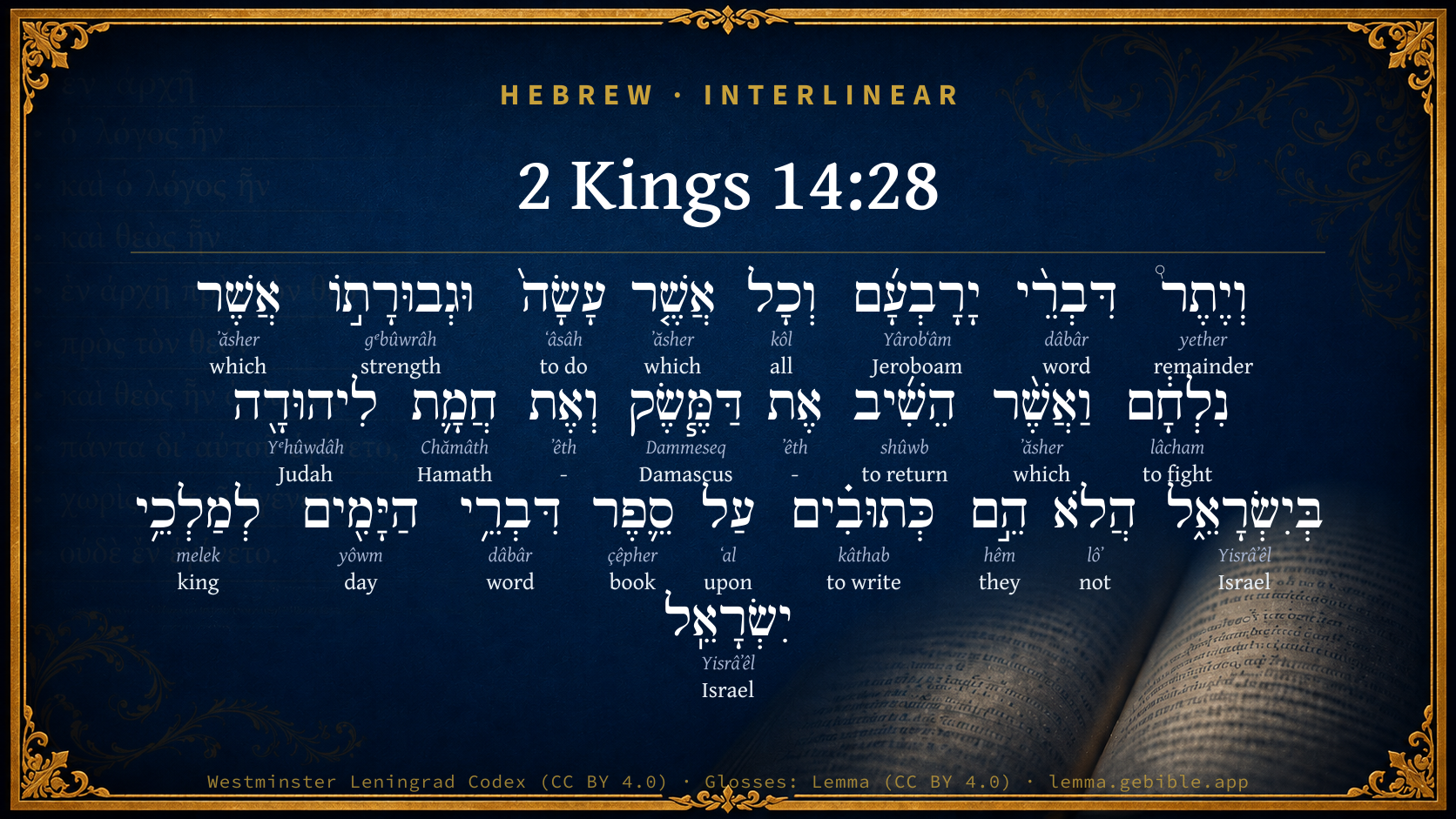
Hebrew (Westminster Leningrad Codex) 2 Kings 14:28 appears in the Hebrew Old Testament. The text above is from the Westminster Leningrad Codex. Each word links to its Strong’s number, a concise gloss, and parsing drawn from the Open Scriptures Hebrew Bible morphology. Click any word for its full Brown-Driver-Briggs (BDB) entry.
Download image
Cite this verse

2 Kings 14:28 (World English Bible). Public Domain. Lemma interlinear Bible study tool, https://lemma.gebible.app/v/2-kings/14/28.

Show BibTeX & RIS
BibTeX
RIS
English Translation
Now the rest of the acts of Jeroboam, and all that he did, and his might, how he warred, and how he recovered Damascus, and Hamath, [which had belonged] to Judah, for Israel, aren't they written in the book of the chronicles of the kings of Israel?
World English Bible · Public Domain
Download a study sheet

One document with this verse’s original text, its word-by-word gloss line, the meaning frame, cross-references with their text, attributed commentary, and full source and license credits — printable, and it pastes into notes with its structure intact.

This verse Autodidact and up

Study sheet (.html) Plain text (.txt)

A passage Seminary Student

Up to 50 verses in one chapter. A passage sheet keeps up to 6 commentary sources and 12 cross-references per verse, in the order this page ranks them, and says so on the sheet whenever that leaves anything out. Ask for a single verse and you get the Autodidact verse sheet above.

Everything on this page stays free to read, with no account — the sheet is a download of what is already on screen, not access to it.

Want to remove ads? Support Godless Engineer
Compare translations 3

The same verse in 3 English versions, stacked beneath the original-language interlinear above. Click any original word for its lexicon entry.

Each is an independent rendering of the whole verse — the interlinear is not word-aligned to these translations.

Highlighted words mark where these versions differ — a whole-verse word diff, not a word-by-word alignment.

  • World English Bible Public Domain
    Now the rest of the acts of Jeroboam, and all that he did, and his might, how he warred, and how he recovered Damascus, and Hamath, [which had belonged] to Judah, for Israel, aren't they written in the book of the chronicles of the kings of Israel?
  • King James Version Public Domain
    Now the rest of the acts of Jeroboam, and all that he did, and his might, how he warred, and how he recovered Damascus, and Hamath, which belonged to Judah, for Israel, are they not written in the book of the chronicles of the kings of Israel?
  • unfoldingWord Literal Text CC BY-SA 4.0
    Now the rest of the matters of Jeroboam and all that he did and his might, how he fought and how he brought Damascus and Hamath of Judah back into Israel, are they not written in the book of the matters of the days of the kings of Israel?

unfoldingWord Literal Text — © unfoldingWord, licensed CC BY-SA 4.0. Word-aligned USFM3 via Door43 (git.door43.org/unfoldingWord/en_ult).

Versions to compare (up to 4)

3 of 4 selected

Show all 18 translations

Every available English version of this verse, each an independent rendering of the whole verse.

  • World English Bible Public Domain
    Now the rest of the acts of Jeroboam, and all that he did, and his might, how he warred, and how he recovered Damascus, and Hamath, [which had belonged] to Judah, for Israel, aren't they written in the book of the chronicles of the kings of Israel?
  • Berean Standard Bible Public Domain
    As for the rest of the acts of Jeroboam, along with all his accomplishments and might, and how he waged war and recovered both Damascus and Hamath for Israel from Judah, are they not written in the Book of the Chronicles of the Kings of Israel?
  • Majority Standard Bible Public Domain
    As for the rest of the acts of Jeroboam, along with all his accomplishments and might, and how he waged war and recovered both Damascus and Hamath for Israel from Judah, are they not written in the Book of the Chronicles of the Kings of Israel?
  • King James Version Public Domain
    Now the rest of the acts of Jeroboam, and all that he did, and his might, how he warred, and how he recovered Damascus, and Hamath, which belonged to Judah, for Israel, are they not written in the book of the chronicles of the kings of Israel?
  • American Standard Version (1901) Public Domain
    Now the rest of the acts of Jeroboam, and all that he did, and his might, how he warred, and how he recovered Damascus, and Hamath, `which had belonged' to Judah, for Israel, are they not written in the book of the chronicles of the kings of Israel?
  • Revised Version (1885) Public Domain
    Now the rest of the acts of Jeroboam, and all that he did, and his might, how he warred, and how he recovered Damascus, and Hamath, which had belonged to Judah, for Israel, are they hot written in the book of the chronicles of the kings of Israel?
  • Geneva Bible (1599) Public Domain
    Concerning the rest of the actes of Ieroboam, and all that he did, and his valiant deedes, and how he fought, and how he restored Damascus, and Hamath to Iudah in Israel, are they not written in the booke of the Chronicles of the Kings of Israel?
  • Douay-Rheims (1899) Public Domain
    But the rest of the acts of Jeroboam, and all that he did, and his velour, where- with he fought, and how he restored Damascus, and Emath to Juda in Israel, are they not written in the book of the words of the days of the kings of Israel?
  • Young's Literal Translation Public Domain
    And the rest of the matters of Jeroboam, and all that he did, and his might with which he fought, and with which he brought back Damascus, and Hamath of Judah, into Israel, are they not written on the book of the Chronicles of the kings of Israel?
  • Literal Standard Version CC BY-SA 4.0
    And the rest of the matters of Jeroboam, and all that he did, and his might with which he fought, and with which he brought back Damascus, and Hamath of Judah, into Israel, are they not written on the scroll of the Chronicles of the Kings of Israel?
  • Unlocked Literal Bible CC BY-SA 4.0
    As for the other matters concerning Jeroboam, all that he did, his power, how he waged war and recovered Damascus and Hamath, which had belonged to Judah, for Israel, are they not written in the book of the events of the kings of Israel?
  • unfoldingWord Literal Text CC BY-SA 4.0
    Now the rest of the matters of Jeroboam and all that he did and his might, how he fought and how he brought Damascus and Hamath of Judah back into Israel, are they not written in the book of the matters of the days of the kings of Israel?
  • Darby Bible Public Domain
    And the rest of the acts of Jeroboam, and all that he did, and his might, how he warred, and how he recovered for Israel that [which had belonged] to Judah in Damascus and in Hamath, are they not written in the book of the chronicles of the kings of Israel?
  • World Messianic Bible Public Domain
    Now the rest of the acts of Jeroboam, and all that he did, and his might, how he fought, and how he recovered Damascus, and Hamath, which had belonged to Judah, for Israel, aren’t they written in the book of the chronicles of the kings of Israel?
  • Webster's Bible Public Domain
    Now the rest of the acts of Jeroboam, and all that he did, and his might, how he warred, and how he recovered Damascus, and Hamath, which belonged to Judah, for Israel, are they not written in the book of the chronicles of the kings of Israel?
  • Free Bible Version CC BY-SA 4.0
    The rest of what happened in Jeroboam's reign, all he did, his great achievements and the battles he fought, and how he recovered for Israel both Damascus and Hamath, are recorded in the Book of Chronicles of the Kings of Israel.
  • Bible in Basic English Public Domain
    Now the rest of the acts of Jeroboam, and all he did, and his power, and how he went to war with Damascus, causing the wrath of the Lord to be turned away from Israel, are they not recorded in the book of the history of the kings of Israel?
  • JPS Tanakh (1917) Public Domain
    Now the rest of the acts of Jeroboam, and all that he did, and his might, how he warred, and how he recovered Damascus, and Hamath, for Judah in Israel, are they not written in the book of the chronicles of the kings of Israel?

Literal Standard Version (2020), Covenant Press — licensed CC BY-SA 4.0. Text via the HelloAO Bible API (eBible.org). Unlocked Literal Bible (unfoldingWord) — licensed CC BY-SA 4.0. Text via the HelloAO Bible API (eBible.org). unfoldingWord Literal Text — © unfoldingWord, licensed CC BY-SA 4.0. Word-aligned USFM3 via Door43 (git.door43.org/unfoldingWord/en_ult). Free Bible Version, Dr. Jonathan Gallagher — licensed CC BY-SA 4.0. Text via the HelloAO Bible API (eBible.org).

Word by word

More ways to search: Search by grammar → Find every occurrence → Compare this word →

Practice this passage: Drill this verse → Learn its vocabulary →

חֲמָ֛ת
Chămâth
H2574
“Hamath”
Noun, Proper
Part of Speech
Noun
Type
Proper
Full BDB Definition

Origin: from the same as H2346

TWOT: None

Hamath = "fortress" - the principle city of upper Syria in the valley of the Orontes (noun proper locative) - father of the house of Rechab (noun proper masculine)
  1. וְיֶתֶר֩ yether H3499 “and · remainder of” Conjunction + Noun, Common, Masculine, Singular, Construct
  2. דִּבְרֵ֨י dâbâr H1697 “words of” Noun, Common, Masculine, Plural, Construct
  3. יָרָבְעָ֜ם Yârobʻâm H3379 “Jeroboam” Noun, Proper
  4. וְכָל kôl H3605 “and · all of” Conjunction + Noun, Common, Masculine, Singular, Construct
  5. אֲשֶׁ֤ר ʼăsher H834 “which” Particle, Relative
  6. עָשָׂה֙ ʻâsâh H6213 “to do” Verb, Qal, Perfect, 3rd Person, Masculine, Singular
  7. וּגְבוּרָת֣וֹ gᵉbûwrâh H1369 “and · strength · his” Conjunction + Noun, Common, Feminine, Singular, Construct + Suffix, Personal, 3rd Person, Masculine, Singular
  8. אֲשֶׁר ʼăsher H834 “which” Particle, Relative
  9. נִלְחָ֔ם lâcham H3898 “to fight” Verb, Niphal, Perfect, 3rd Person, Masculine, Singular
  10. וַאֲשֶׁ֨ר ʼăsher H834 “and · which” Conjunction + Particle, Relative
  11. הֵשִׁ֜יב shûwb H7725 “to return” Verb, Hiphil, Perfect, 3rd Person, Masculine, Singular
  12. אֶת ʼêth H853 “-” Particle, Direct Object
  13. דַּמֶּ֧שֶׂק Dammeseq H1834 “Damascus” Noun, Proper
  14. וְאֶת ʼêth H853 “and · -” Conjunction + Particle, Direct Object
  15. לִיהוּדָ֖ה Yᵉhûwdâh H3063 “to/for · Judah” Preposition + Noun, Proper
  16. בְּיִשְׂרָאֵ֑ל Yisrâʼêl H3478 “in/at · Israel” Preposition + Noun, Proper
  17. הֲלֹא lôʼ H3808 “not” Particle, Interrogative + Particle, Negative
  18. הֵ֣ם hêm H1992 “they” Pronoun, Personal, 3rd Person, Masculine, Plural
  19. כְּתוּבִ֗ים kâthab H3789 “written” Verb, Qal, Participle Passive, Masculine, Plural, Absolute
  20. עַל ʻal H5921 “upon” Preposition
  21. סֵ֛פֶר çêpher H5612 “book of” Noun, Common, Masculine, Singular, Construct
  22. דִּבְרֵ֥י dâbâr H1697 “words of” Noun, Common, Masculine, Plural, Construct
  23. הַיָּמִ֖ים yôwm H3117 “the · days” Particle, Definite Article + Noun, Common, Masculine, Plural, Absolute
  24. לְמַלְכֵ֥י melek H4428 “to/for · kings of” Preposition + Noun, Common, Masculine, Plural, Construct
  25. יִשְׂרָאֵֽל Yisrâʼêl H3478 “Israel” Noun, Proper

About this verse

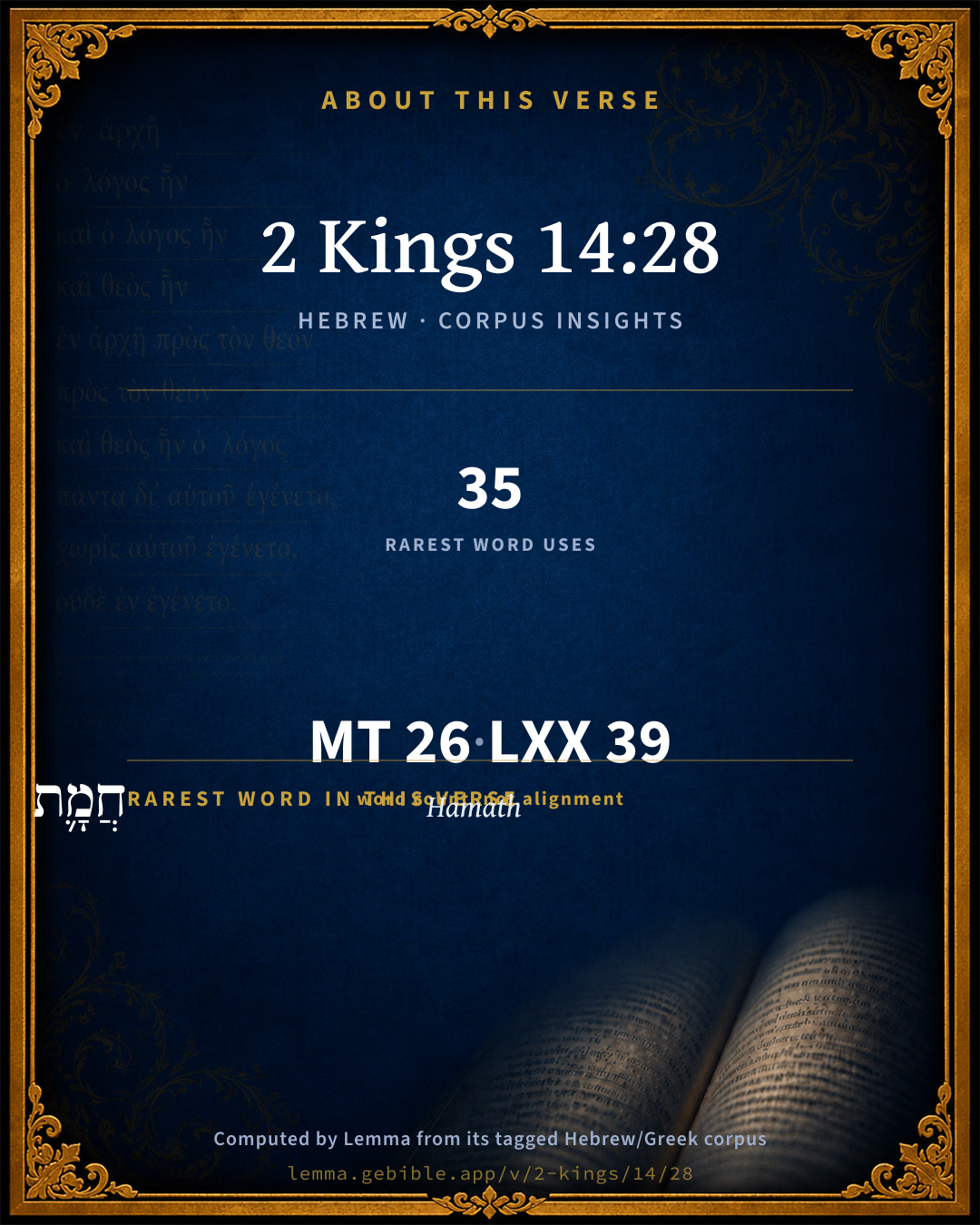
These counts appear in no published source. They are computed here, from the morphology-tagged text and Lemma’s own curated glosses. What Lemma adds →

26
words
21
distinct lemmas
Historical
section

Shared distinctive vocabulary

חֲמָ֛ת Hamath H2574 occurs in 33 verses of the Hebrew Bible. Also found in:

Grammatical profile

  • 4 verbs
  • 14 nouns
  • 1 pronoun
  • 1 preposition
  • 6 particles

Verb forms

  • עָשָׂה֙ Qal · Perfect
  • נִלְחָ֔ם Niphal · Perfect
  • הֵשִׁ֜יב Hiphil · Perfect
  • כְּתוּבִ֗ים Qal · Participle Passive

Repetition

Words recur within this verse — often emphatic in Hebrew:

  • דִּבְרֵ֨י word H1697 ×2
  • בְּיִשְׂרָאֵ֑ל Israel H3478 ×2
  • אֲשֶׁ֤ר which H834 ×3

Hebrew & Septuagint length

In English translation the verse runs 47 words from the Hebrew and 49 from the Septuagint (LXX English) — closely comparable.

A rough comparison of the two English renderings, which tokenize alike — not a word-level alignment.

Word counts can differ between the Hebrew and the Greek without any difference in meaning — e.g. the Hebrew direct-object marker אֵת has no separate Greek word, and Greek often adds the article ὁ.

In the original languages it is 26 Hebrew tokens and 39 Greek tokens — but the two are counted differently (Hebrew bundles its prefixes and suffixes into one token; the Greek is in lemma form), so that isn’t a like-for-like length.

Cross-references

4

Topical passages linked to 2 Kings 14:28 in the Treasury of Scripture Knowledge — connected by theme and wording, ordered by reader-vote popularity; previews shown in the World English Bible.

  • 1 Kings 11:24 He gathered men to him, and became captain over a troop, when David killed them [of Zobah]: and they went to Damascus, and lived therein, and reigned in Damascus.
  • 2 Samuel 8:6 Then David put garrisons in Syria of Damascus; and the Syrians became servants to David, and brought tribute. Yahweh gave victory to David wherever he went.
  • 1 Chronicles 18:5–6 When the Syrians of Damascus came to help Hadarezer king of Zobah, David struck of the Syrians twenty-two thousand men.
  • 2 Chronicles 8:3–4 Solomon went to Hamath-zobah, and prevailed against it.

Cross-references courtesy of OpenBible.info (CC BY 4.0).

Hebrew and Greek witnesses Masoretic Hebrew ↔ Greek Septuagint

The same verse in the two great witnesses to the Old Testament, shown verse-for-verse.

These are two independent witnesses, not word-aligned to each other, and the Septuagint is shown in lemma (dictionary) form.

Hebrew 2 Kings 14:28 Masoretic · Westminster Leningrad Codex

וְיֶתֶר֩ דִּבְרֵ֨י יָרָבְעָ֜ם וְכָל אֲשֶׁ֤ר עָשָׂה֙ וּגְבוּרָת֣וֹ אֲשֶׁר נִלְחָ֔ם וַאֲשֶׁ֨ר הֵשִׁ֜יב אֶת דַּמֶּ֧שֶׂק וְאֶת חֲמָ֛ת לִיהוּדָ֖ה בְּיִשְׂרָאֵ֑ל הֲלֹא הֵ֣ם כְּתוּבִ֗ים עַל סֵ֛פֶר דִּבְרֵ֥י הַיָּמִ֖ים לְמַלְכֵ֥י יִשְׂרָאֵֽל

Now the rest of the acts of Jeroboam, and all that he did, and his might, how he warred, and how he recovered Damascus, and Hamath, [which had belonged] to Judah, for Israel, aren't they written in the book of the chronicles of the kings of Israel?

World English Bible · Public Domain

Greek LXX 2 Kings 14:28 Septuagint · lemma form

καί ὁ λοιπός ὁ λόγος ιεροβοαμ καί πᾶς ὅσος ποιέω καί ὁ δυναστεία αὐτός ὅσος πολεμέω καί ὅσος ἐπιστρέφω ὁ δαμασκός καί ὁ αιμαθ ὁ ιουδα ἐν ἰσραήλ οὐ οὗτος γράφω ἐπί βιβλίον λόγος ὁ ἡμέρα ὁ βασιλεύς ἰσραήλ

And the rest of the acts of Jeroboam and all that he did, and his mighty deeds, which he achieved in war, and how he recovered Damascus and Aemath to Juda in Israel, are not these things written in the book of the chronicles of the kings of Israel?

LXX2012 (modern English Septuagint) · Public Domain

On this verse, Ellicott's Commentary for English Readers discusses the Septuagint’s reading. Read the note in Commentary ↓

Hebrew: Westminster Leningrad Codex (CC BY 4.0). Greek: Septuagint (public domain); English from LXX2012 (modern English Septuagint) (Public Domain). How the Septuagint differs from the Hebrew →

Targum (Aramaic paraphrase)

1

The Targum is the ancient Jewish Aramaic paraphrase of the Hebrew Scriptures — an interpretive translation, not the Hebrew text itself. Onkelos (literal) and Pseudo-Jonathan (expansive) render the Torah, and Jonathan the Prophets. Coverage is partial: where no permissively-licensed English translation exists for a verse, only the Aramaic is shown. This is verse-level text, not a word-by-word alignment to the Hebrew.

  1. Targum Jonathan Prophets (Joshua–Malachi)
    וּשְׁאַר פִּתְגְמֵי יָרָבְעָם וְכָל דַעֲבַד וּגְבוּרְתֵיהּ דְאַגִיחַ וּדְאָתִיב יַת דַמֶשֶׂק וְיַת חֲמָת לִדְבֵית יְהוּדָה בְּיִשְׂרָאֵל הֲלָא אִינוּן כְּתִיבִין עַל סְפַר פִּתְגָמֵי יוֹמַיָא לְמַלְכֵי יִשְׂרָאֵל:

    (no public-domain English translation for this verse)

    Targum Jonathan — Aramaic: “Mikraot Gedolot” (public domain). English: “Sefaria Community Translation” (CC0 1.0 (public-domain dedication)); “London "Chaldee Paraphrase," 1871” (public domain). Text via Sefaria.

Commentary

Notes on 2 Kings 14:28 from classic Christian and Jewish commentators (each source and its license shown beneath its notes). The classic Christian expositions comment on the surrounding passage and are grouped to its opening verse, so a note may address several verses; the Jewish commentaries on the Tanakh (Rashi and others) are per-verse, so they appear only where the commentator wrote on this verse.

Lemma curates 59 commentaries, every one of them public domain or Creative Commons licensed, each selected and text-cleaned for this edition rather than reprinted as found. About our sources →

Trapp's Complete Commentary

John Trapp

2Ki 14:28 Now the rest of the acts of Jeroboam, and all that he did, and his might, how he warred, and how he recovered Damascus, and Hamath, [which belonged] to Judah, for Israel, are they not written in the book of the chronicles of the kings of Israel?

Ver. 28. And Hamath.] Which lay near to Damascus, and fared the worse for its neighbourhood. {Zec 9:2}

John Trapp, A Commentary or Exposition upon All the Books of the Old and New Testament (1647–1656) — public domain. Text from a community e-Sword module.

The Biblical Illustrator

Joseph S. Exell

2Ki_14:28

Now the rest of the acts of Jeroboam.

--

Life-Re-lived

There is a moment when a mans life is re-lived on earth. It is in that hour in which the coffin lid is shut down, just before the funeral, when earth has seen the last of him for ever. Then the whole life is, as it were, lived over again in the conversation which turns upon the memory of the departed. The history of threescore years and ten is soon recapitulated; not, of course, the innumerable incidents and acts which they contained, but the central governing principle of the whole. (F. W. Robertson.)

Record of sin

It is said that the Bank of France has an invisible studio in a gallery behind the cashiers, so that at a signal from one of them a suspected customer can instantly have his picture taken without his own knowledge. So our sins and evil deeds may be registered against us, and we ourselves altogether unconscious of the fact.

The Biblical Illustrator, edited by Joseph S. Exell (c. 1880s–1900s) — public domain. Text from a community e-Sword module.

Joseph Benson's Commentary

2Ki 14:28. And how he recovered Damascus and Hamath — These were cities of Syria, but were taken from the Syrians by David and Solomon, and probably by them incorporated with, and added to, the possessions of their own tribe, to which, from that time, they belonged: but afterward they were retaken by the Syrians, and were now recovered by this Jeroboam.

Joseph Benson's Commentary on the Old and New Testaments (1811–1818) — public domain. Text from a community e-Sword module.

Geneva Bible (1599)

Geneva Bible translators

Which was also called Antioch of Syria, or Riblah.

Geneva Bible (1599) marginal notes — public domain. Text via Bolls.life.

Adam Clarke's Commentary

Verse 28. How he warred, and - recovered Damascus] We learn from 1Ch 18:3-11, that David had conquered all Syria, and put garrisons in Damascus and other places, and laid all the Syrians under tribute; but this yoke they had not only shaken off, but they had conquered a considerable portion of the Israelitish territory, and added it to Syria. These latter Jeroboam now recovered; and thus the places which anciently belonged to Judah by David's conquests, and were repossessed by Syria, he now conquered, and added to Israel.

Adam Clarke's Commentary on the Bible (1810–1826) — public domain. Text from a community e-Sword/MySword module.

Ellicott's Commentary for English Readers

(28) How he recovered Damascus, and Hamath.—Jeroboam II. was probably contemporary with Rammân-nirâri, king of Assyria (B.C. 812-783). This king has recorded his exaction of tribute from Tyre and Sidon, “the land of Omri” (i.e., Israel), Edom, and Philistia; and a siege of Damascus, followed by the submission of Mari’, its king, and the spoiling of his palace. The prostration of his enemy thus accounts for the permanent success of Jeroboam, who was himself a vassal of Assyria.

He recovered.—This verb was rendered “lie restored” in 2Ki_14:25, and that is the meaning here.

Damascus and Hamath.—Not the entire states so named, which were powerful independent communities, but portions of their territory, which had belonged to Israel in the days of Solomon. (See Note on 2Ch_8:3-4.)

Which belonged to Judah.—This is really an epithet restrictive of the phrase, “Damascus and Hamath,” the sense being, “Judœan Damascus and Hamath.” (Comp, the Note on 2Ki_15:1.)

For Israel.—Heb., in Israel. The sense is obscure; but the particle “in” appears to refer to the re-incorporation of the Damascene and Hamathite districts with Israel. Ewald would cancel “which belonged to Judah,” and read “to Israel” (so the Syriac and Arabic. But the LXX., Vulg., and Targum support the existing text.) Others explain: He restored Damascus and Hamath to Judah (i.e., to the theocratic people) through Israel (i.e., the northern kingdom, to which the recovered districts were actually annexed). No explanation, however, is really satisfactory. It may be that by an oversight the Judæan editor wrote” to Judah, “instead of” to Israel and that some scribe added a marginal note “in Israel,” which afterwards crept into the text. It is curious to find certain districts of Hamath leagued with Azariah, king of Judah, against Tiglath Pileser. (See Note on 2Ki_15:1.)

A Bible Commentary for English Readers, edited by Charles John Ellicott (1878–1897) — public domain. Text from a community e-Sword module.

The Cambridge Bible for Schools and Colleges

gen. ed. J. J. S. Perowne

28. how he recovered Damascus] We are told (2Sa_8:6) that garrisons were placed in Damascus by David, and that the Syrians became servants to David. Having been once in the possession of the Israelites, the reconquest by Jeroboam II. may be spoken of as a recovery. A sort of occupation of Damascus was also granted by Ben-hadad to Ahab (1Ki_20:34), when the Israelite king was permitted to make streets for himself in the Syrian city.

and Hamath, which belonged [R.V. had belonged] to Judah] We find (2Sa_8:9-11) that Toi the king of Hamath was one of David’s tributaries, and from 1Ki_4:21-24 it is clear that in Solomon’s days Hamath was part of his possessions. In 2Ch_8:4 we learn that Solomon built ‘store cities’ in Hamath. The revolt of the ten tribes gave Hamath a chance of freedom again, of which the people probably availed themselves, and remained independent till the conquest by Jeroboam here spoken of. This event brought the city into the hand of Israel.

The Cambridge Bible for Schools and Colleges (gen. ed. J. J. S. Perowne; Cambridge University Press, 1878–1918) — public domain. Text from a community e-Sword module.

Albert Barnes' Notes on the Bible

He recovered Damascus - Jeroboam probably gained certain advantages over Benhadad, which induced the latter to make his submission and consent to such terms as those extorted by Ahab 1Ki 20:34.

Hamath was probably among the actual conquests of Jeroboam. It was brought so low in his reign, as to have become almost a by-word for calamity (compare Amo 6:2).

Which belonged to Judah, for Israel - i. e. these cities were recovered to Judah, i. e. to the people of God generally, through or by means of being added to Israel, i. e. to the northern kingdom.

A few further facts in the history of Jeroboam II are recorded by the prophet Amos (compare Amo 7:10, etc.).

Albert Barnes' Notes on the Bible (1834–1885) — public domain. Text from a community e-Sword/MySword module.

Haydock's Catholic Bible Commentary

To Juda, or "of Juda;" Judæ; (Haydock) as those strong cities had been conquered by David. The Syriac and Arabic omit this word entirely, and suppose, with many others, that Jeroboam kept possession of these cities. (Calmet) (Tirinus) --- In Israel, or "to Israel," over which he reigned. (Haydock)

George Leo Haydock (1774–1849), Haydock's Catholic Family Bible and Commentary, 1859 edition — public domain. Excludes Psalms (Douay-Rheims chapter numbering differs from Protestant) and Deuterocanonical books (Catholic canon only).

Matthew Poole's English Annotations

Damascus and Hamath were cities of Syria, but were taken from the Syrians by David and Solomon, 2Sa 8:6; 2Ch 8:3, and probably by them incorporated with and added to the possessions of their own tribe, to which from that time they belonged; but afterwards they were retaken by the Syrians, and were now recovered by this Jeroboam.

Matthew Poole's English Annotations on the Holy Bible (1683–1685) — public domain. Text from a community e-Sword/MySword module.

Whedon's Commentary on the Bible

Daniel D. Whedon

28. He recovered Damascus — David smote the Syrians of Damascus and made them tributary; (2Sa_8:6;) but in Solomon’s day Rezon established himself in Damascus and acted the part of an adversary to Israel, (1Ki_11:23,) after which time Damascus was not recovered for Israel until the time of this Jeroboam. He brought the kingdom of Damascus, which had so long distressed both Judah and Israel, into subjection, and made it tributary to himself. Afterwards we find Syria and Israel in league against Judah. 2Ki_15:37; 2Ki_16:5.

Hamath, which belonged to Judah — That is, it belonged to the united kingdom under David and Solomon when the seat of empire was in Judah and Jerusalem. David’s conquests, according to 1Ch_18:3, extended to Hamath, and Solomon completed the conquest of this district and built store cities there. 2Ch_8:3-4. But soon afterwards it seems to have recovered its independence. Hamath was one of the oldest cities of Palestine, and is often mentioned in connexion with its northern border. See on Jos_13:5.

Daniel D. Whedon (gen. ed.), Commentary on the Old and New Testaments (1874–1909) — public domain. Text from a community e-Sword module.

The Pulpit Commentary

Now the rest of the acts of Jeroboam, and all that he did, and his might, how he warred, and how he recovered Damascus and Hamath. It has been suggested that these words mean no more than that Jeroboam took territory from Damascus and Hamath from Damascus the trans-Jordanic territory which Hazael had conquered from Jehu; (2Ki_10:33) from Hamath some small portion of the Coele-Syrian valley, about the head-streams of the Orontes and Litany (so Keil and Bahr). But there does not seem to be any sufficient reason for giving the words used this narrow signification. Damascus was conquered and annexed by David, (2Sa_8:6) and held for a time even by Solomon, (1Ki_11:24) of whose kingdom Hamath also seems to have formed part (1Ki_4:21-24 2Ch_8:4 2Ch_9:26) The word "recovered" is, therefore, a suitable one. The prophecy of Amos, no doubt, represents Damascus as independent; (Amo_1:3, Amo_1:4) but this may have been written before Jeroboam conquered it. Hamath"s subjection seems to be implied in Amo_6:2, Amo_6:14. We may, therefore, well understand, with Ewald ("History of Israel," vol. 4. p. 124) and Dr. Pusey ("Minor Prophets," pp, 157, 209), that Jeroboam. "subdued Damascus and even Hamath," and added them to his kingdom. How long the subjection continued is a different question. Probably, in the troubles that followed the death of Zachariah, (2Ki_15:10-14) the yoke was thrown off. In the Assyrian Inscriptions, Damascus appears under its own king about B.C. 786 (G. Smith, "Eponym Canon," p. 115), and it was certainly independent in B.C. 743. At the latter date Hamath also appears as the capital of an independent kingdom (ibid., pp. 118, 120) under its own monarch. Which belonged to Judah. Keil and Bahr render, "Hamath of Judah," regarding hdWhyli as a genitive. Ewald proposes to read hbwOxl tmj "Hamath of Zobah", (comp. 2Ch_8:3) or else to cut out hdwjyl altogether. The passage is one of great difficulty. For Israel. It is questionable whether this meaning can be obtained from the present text, which is laercyib. Bahr thinks that it can; but Ewald regards the change into laercyil as one "of necessity." Might we not avoid all these alterations by translating simply he recovered Damascus and Hamath to Judah through Israel"? Attaching them to Israel was a sort of recovering of them to Judah, to which (i.e. the Judah of David and Solomon) they had once belonged. Are they not written in the book of the chronicles of the kings of Israel?

The Pulpit Commentary (1880–1919), ed. H.D.M. Spence-Jones & Joseph S. Exell — public domain. Text from a community e-Sword module.

Keil & Delitzsch

C. F. Keil & F. Delitzsch

Of the rest of the history of Jeroboam we have nothing more than an intimation that he brought back Damascus and Hamath of Judah to Israel, i.e., subjugated it again to the kingdom of Israel. ליהוּדה is a periphrastic form for the genitive, as proper names do not admit of any form of the construct state, and in this case the simple genitive would not have answered so well to the fact. For the meaning is: "whatever in the two kingdoms of Damascus and Hamath had formerly belonged to Judah in the times of David and Solomon." By Damascus and Hamath we are not to understand the cities, but the kingdoms; for not only did the city of Hamath never belong to the kingdom of Israel, but it was situated outside the boundaries laid down by Moses for Israel (see at Num 34:8). It cannot, therefore, have been re-conquered (השׁיב) by Jeroboam. It was different with the city of Damascus, which David had conquered and even Solomon had not permanently lost (see at Kg1 11:24). Consequently in the case of Damascus the capital is included in the kingdom.

Kg2 14:29

As Jeroboam reigned forty-one years, his death occurred in the twenty-seventh year of Uzziah. If, then, his son did not begin to reign till the thirty-eight year of Uzziah, as is stated in Kg2 15:8, he cannot have come to the throne immediately after his father's death (see at Kg2 15:8).

Keil & Delitzsch — Biblical Commentary on the Old Testament (1861–1891) — public domain (CC PDM 1.0). Text via the HelloAO Bible API. (Old Testament only.)

unfoldingWord translationNotes

Door43 World Missions Community

are they not written in the book of the events of the kings of Israel?

This question is used to remind the reader that the acts of Jehoahaz are recorded in another book. See how this phrase is translated in 2 Kings 1:18. AT: "they are written in the book of the events of the kings of Israel." (See: Rhetorical Question)

Jeroboam slept with his ancestors, with the kings of Israel

This is a polite way to say that he died and was buried. AT: "Jeroboam died, and was buried where the other kings of Israel were buried" (See: Euphemism)

translationWords

Damascus

Hamath

Zechariah (OT)

unfoldingWord translationNotes — © Distant Shores Media and the Door43 World Missions Community, licensed CC BY-SA 4.0. Source: git.door43.org/Door43/en_tn.

Lesson kit

Teaching starters — assembled from the data on this page, not authored interpretation. Every prompt links to the verse data it draws on. Edit before teaching.

2 Kings, in the Historical, opens this verse with 26 words (21 distinct Hebrew lemmas). Its most distinctive word is Chămâth (“Hamath”). A historical commentator’s framing appears above. Read the whole chapter for the surrounding context.

Discussion questions

  1. The word Chămâth carries the sense “Hamath.” How does it shape the verse?
  2. How does Numbers 13:21, which shares the word «Hamath», read alongside this verse?
  3. What does the repetition of “word” (2× in this one verse) do in this verse?
  4. These translations render this verse differently. What is at stake in choosing one wording over another?
  5. «עָשָׂה֙» is a Qal Perfect verb. How does that grammatical form shape the action described?
  6. Compare how Trapp's Complete Commentary and The Biblical Illustrator read this verse. Where do they agree or differ?

Things to notice

Reading settings

Reading text

Shown beneath each verse's original-language words.

Old Testament
Old Testament edition

Read the OT as the Masoretic Hebrew (MT) or the Greek Septuagint (LXX).

English shown for the Greek Septuagint (in the Hebrew ↔ Greek comparison).

Comparing translations? Open the Compare panel on any verse page to stack up to four side by side.