
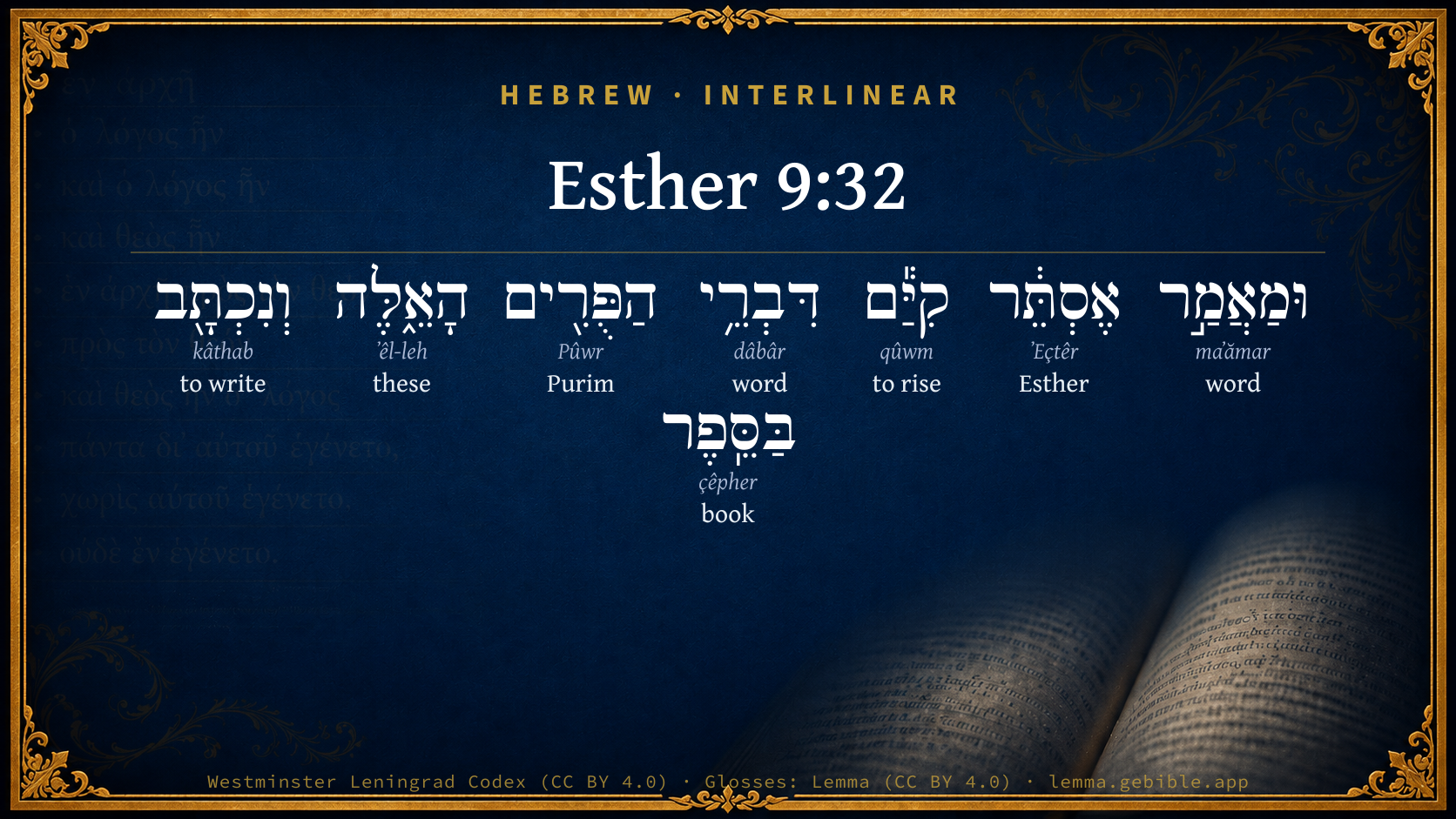
Esther 9:32

Hebrew (Westminster Leningrad Codex) Esther 9:32 appears in the Hebrew Old Testament. The text above is from the Westminster Leningrad Codex. Each word links to its Strong’s number, a concise gloss, and parsing drawn from the Open Scriptures Hebrew Bible morphology. Click any word for its full Brown-Driver-Briggs (BDB) entry.
Download image
Cite this verse

Esther 9:32 (World English Bible). Public Domain. Lemma interlinear Bible study tool, https://lemma.gebible.app/v/esther/9/32.

Show BibTeX & RIS
BibTeX
RIS
English Translation
The commandment of Esther confirmed these matters of Purim; and it was written in the book.
World English Bible · Public Domain
Download a study sheet

One document with this verse’s original text, its word-by-word gloss line, the meaning frame, cross-references with their text, attributed commentary, and full source and license credits — printable, and it pastes into notes with its structure intact.

This verse Autodidact and up

Study sheet (.html) Plain text (.txt)

A passage Seminary Student

Up to 50 verses in one chapter. A passage sheet keeps up to 6 commentary sources and 12 cross-references per verse, in the order this page ranks them, and says so on the sheet whenever that leaves anything out. Ask for a single verse and you get the Autodidact verse sheet above.

Everything on this page stays free to read, with no account — the sheet is a download of what is already on screen, not access to it.

Want to remove ads? Support Godless Engineer
Compare translations 3

The same verse in 3 English versions, stacked beneath the original-language interlinear above. Click any original word for its lexicon entry.

Each is an independent rendering of the whole verse — the interlinear is not word-aligned to these translations.

Highlighted words mark where these versions differ — a whole-verse word diff, not a word-by-word alignment.

  • World English Bible Public Domain
    The commandment of Esther confirmed these matters of Purim; and it was written in the book.
  • King James Version Public Domain
    And the decree of Esther confirmed these matters of Purim; and it was written in the book.
  • unfoldingWord Literal Text CC BY-SA 4.0
    And the decree of Esther set up these matters of Purim, and it was written in the book.

unfoldingWord Literal Text — © unfoldingWord, licensed CC BY-SA 4.0. Word-aligned USFM3 via Door43 (git.door43.org/unfoldingWord/en_ult).

Versions to compare (up to 4)

3 of 4 selected

Show all 18 translations

Every available English version of this verse, each an independent rendering of the whole verse.

  • World English Bible Public Domain
    The commandment of Esther confirmed these matters of Purim; and it was written in the book.
  • Berean Standard Bible Public Domain
    So Esther’s decree confirmed these regulations about Purim, which were written into the record.
  • Majority Standard Bible Public Domain
    So Esther’s decree confirmed these regulations about Purim, which were written into the record.
  • King James Version Public Domain
    And the decree of Esther confirmed these matters of Purim; and it was written in the book.
  • American Standard Version (1901) Public Domain
    And the commandment of Esther confirmed these matters of Purim; and it was written in the book.
  • Revised Version (1885) Public Domain
    And the commandment of Esther confirmed these matters of Purim; and it was written in the book.
  • Geneva Bible (1599) Public Domain
    And the decree of Ester confirmed these words of Purim, and was written in the booke.
  • Douay-Rheims (1899) Public Domain
    And all things which are contained in the history of this book, which is called Esther.
  • Young's Literal Translation Public Domain
    And a saying of Esther hath established these matters of Purim, and it is written in the Book.
  • Literal Standard Version CC BY-SA 4.0
    And a saying of Esther has established these matters of Purim, and it is written in the Scroll.
  • Unlocked Literal Bible CC BY-SA 4.0
    The command of Esther confirmed these regulations regarding Purim, and it was written in the book.
  • unfoldingWord Literal Text CC BY-SA 4.0
    And the decree of Esther set up these matters of Purim, and it was written in the book.
  • Darby Bible Public Domain
    And the decree of Esther confirmed these matters of Purim; and it was written in the book.
  • World Messianic Bible Public Domain
    The commandment of Esther confirmed these matters of Purim; and it was written in the book.
  • Webster's Bible Public Domain
    And the decree of Esther confirmed these matters of Purim; and it was written in the book.
  • Free Bible Version CC BY-SA 4.0
    In this way Esther's decree confirmed these practices regarding Purim, which were entered in the official record.
  • Bible in Basic English Public Domain
    The order given by Esther gave the force of law to the rules about the Purim; and it was recorded in the book.
  • JPS Tanakh (1917) Public Domain
    And the commandment of Esther confirmed these matters of Purim; and it was written in the book.

Literal Standard Version (2020), Covenant Press — licensed CC BY-SA 4.0. Text via the HelloAO Bible API (eBible.org). Unlocked Literal Bible (unfoldingWord) — licensed CC BY-SA 4.0. Text via the HelloAO Bible API (eBible.org). unfoldingWord Literal Text — © unfoldingWord, licensed CC BY-SA 4.0. Word-aligned USFM3 via Door43 (git.door43.org/unfoldingWord/en_ult). Free Bible Version, Dr. Jonathan Gallagher — licensed CC BY-SA 4.0. Text via the HelloAO Bible API (eBible.org).

Word by word

More ways to search: Search by grammar → Find every occurrence → Compare this word →

Practice this passage: Drill this verse → Learn its vocabulary →

About this verse

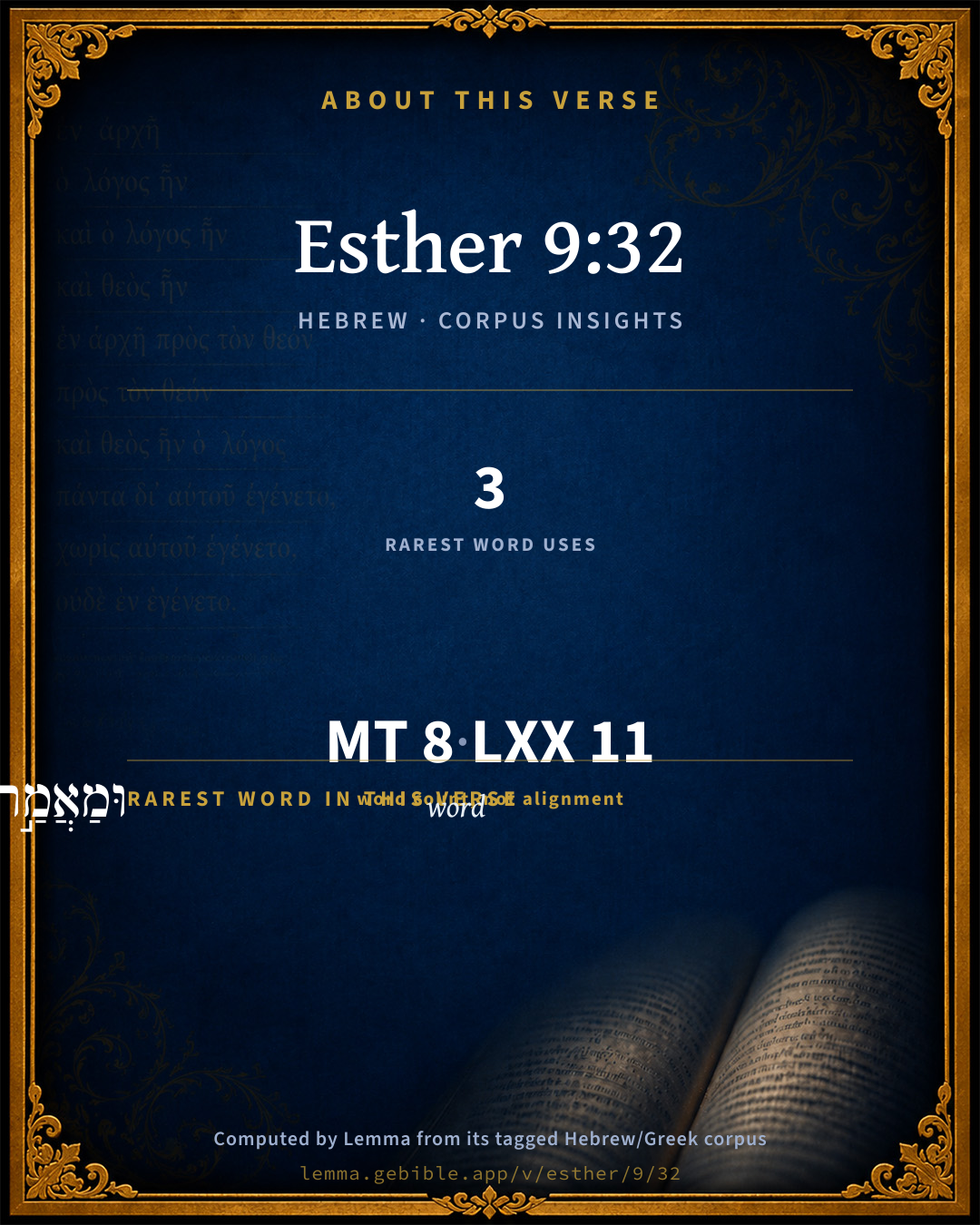
These counts appear in no published source. They are computed here, from the morphology-tagged text and Lemma’s own curated glosses. What Lemma adds →

8
words
8
distinct lemmas
Historical
section

Notable vocabulary

The rarest word here is וּמַאֲמַ֣ר word H3982 — appearing just 3 times in the whole Hebrew Bible.

Shared distinctive vocabulary

וּמַאֲמַ֣ר word H3982 occurs in 3 verses of the Hebrew Bible. Also found in:

Grammatical profile

  • 2 verbs
  • 5 nouns
  • 1 pronoun

Verb forms

  • קִיַּ֕ם Piel · Perfect
  • וְנִכְתָּ֖ב Niphal · Participle Passive

Hebrew & Septuagint length

In English translation the verse runs 16 words from the Hebrew and 16 from the Septuagint (LXX English) — the same length.

A rough comparison of the two English renderings, which tokenize alike — not a word-level alignment.

Word counts can differ between the Hebrew and the Greek without any difference in meaning — e.g. the Hebrew direct-object marker אֵת has no separate Greek word, and Greek often adds the article ὁ.

In the original languages it is 8 Hebrew tokens and 11 Greek tokens — but the two are counted differently (Hebrew bundles its prefixes and suffixes into one token; the Greek is in lemma form), so that isn’t a like-for-like length.

Cross-references

1

Topical passages linked to Esther 9:32 in the Treasury of Scripture Knowledge — connected by theme and wording, ordered by reader-vote popularity; previews shown in the World English Bible.

  • Esther 9:26 Therefore they called these days Purim, after the name of Pur. Therefore because of all the words of this letter, and of that which they had seen concerning this matter, and that which had come to them,

Cross-references courtesy of OpenBible.info (CC BY 4.0).

Hebrew and Greek witnesses Masoretic Hebrew ↔ Greek Septuagint

The same verse in the two great witnesses to the Old Testament, shown verse-for-verse.

These are two independent witnesses, not word-aligned to each other, and the Septuagint is shown in lemma (dictionary) form.

Hebrew Esther 9:32 Masoretic · Westminster Leningrad Codex

וּמַאֲמַ֣ר אֶסְתֵּ֔ר קִיַּ֕ם דִּבְרֵ֥י הַפֻּרִ֖ים הָאֵ֑לֶּה וְנִכְתָּ֖ב בַּסֵּֽפֶר

The commandment of Esther confirmed these matters of Purim; and it was written in the book.

World English Bible · Public Domain

Greek LXX Esther 9:32 Septuagint · lemma form

καί εσθηρ λόγος ἵστημι εἰς ὁ αἰών καί γράφω εἰς μνημόσυνον

And Esther established it by a command for ever, and it was written for a memorial.

LXX2012 (modern English Septuagint) · Public Domain

On this verse, Adam Clarke's Commentary discusses the Septuagint’s reading. Read the note in Commentary ↓

Hebrew: Westminster Leningrad Codex (CC BY 4.0). Greek: Septuagint (public domain); English from LXX2012 (modern English Septuagint) (Public Domain). How the Septuagint differs from the Hebrew →

Commentary

Notes on Esther 9:32 from classic Christian and Jewish commentators (each source and its license shown beneath its notes). The classic Christian expositions comment on the surrounding passage and are grouped to its opening verse, so a note may address several verses; the Jewish commentaries on the Tanakh (Rashi and others) are per-verse, so they appear only where the commentator wrote on this verse.

Lemma curates 59 commentaries, every one of them public domain or Creative Commons licensed, each selected and text-cleaned for this edition rather than reprinted as found. About our sources →

Trapp's Complete Commentary

John Trapp

Est 9:32 And the decree of Esther confirmed these matters of Purim; and it was written in the book.

Ver. 32. And the decree of Esther confirmed, &c.] Dux femina facti. Money was coined in the year 1588, in honour of Queen Elizabeth, with that posy inscribed. The like may be here said of Queen Esther, yea, we may add that in the Gospel, spoken concerning another: Wherever this history shall be read in all the world, this that she hath done shall be spoken of to her eternal commendation.

And it was written in the book] Tremellius rendereth it thus, When, therefore, the edict of Esther had confirmed these things, it was written in this book. Lyra and others thus, She requested the wise men of that age, that they would reckon this history for Holy Writ. If it be meant of any other public record, which the Jews then had, it is lost; as are likewise some other pieces which never were any part of the Holy Scriptures; for God, by his providence, ever took care and course that no one hair of that sacred head should fall to the ground. That unsound conceit of Pellican here is by no means to be admitted, viz. That this latter part of the chapter, from Est 9:25 to the end, came from the pen of some other man, not guided by the Spirit of God, and that because here is no mention made of praising God at this feast or stirring up one another to trust in him. For we know that all Scripture is of Divine inspiration, and it is to be presumed that those things were done at such solemnities, though it be not recorded in each particular.

John Trapp, A Commentary or Exposition upon All the Books of the Old and New Testament (1647–1656) — public domain. Text from a community e-Sword module.

Joseph Benson's Commentary

Est 9:32. And the decree of Esther — Who had received authority and commission from the king to impose this upon all the Jews; confirmed these things — She commanded the forementioned decree, which confirmed or established the observance of the days of Purim, to be recorded and made a public act; and it was written in the book — Either in the records of the kingdom, or in those which the Jews kept of the most memorable passages of their own history. This feast of Purim, the reader will observe, is celebrated among the Jews to this very day, and that with several peculiar ceremonies, most of which, however, says Dr. Dodd, are “reducible to these three things, reading, resting, and fasting. Before the reading, which is performed in the synagogue, and begins in the evening as soon as the stars appear, they make use of three forms of prayer. In the first of these they praise God for counting them worthy to attend this divine service; in the second they thank him for the miraculous preservation of their ancestors; and in the third they bless his holy name for having continued their lives for the celebration of another festival in commemoration of it. Then they read over the whole history of Haman, from the beginning to the end; not out of any printed book, for that is not lawful, but out of a Hebrew manuscript, written on parchment. There are five places in the text wherein the reader raises his voice with all his might: when he comes to the place that mentions the names of the ten sons of Haman, he repeats them very quick, to show that they were all destroyed in a moment; and every time that the name of Haman is pronounced, the children, with great fury, strike against the benches of the synagogue with mallets brought for that purpose. After the reading is finished, they return home, and have a supper, not of flesh, but of spoon-meat. Next morning they arise early, and return to the synagogue, where, after they have read that passage in Exodus which mentions the war of Amalek, they begin again to read the book of Esther, with the same ceremonies as before, and so conclude the services of the day, with curses against Haman and his wife, with blessings upon Mordecai and Esther and with praises to God for having preserved his people. Their resting on this day is observed so religiously that they will not so much as set or sow any thing in their gardens, being fully persuaded that it would not come up if they did; and therefore they either play at chess, or such like games, or spend their time in music or dancing, till it be proper to begin their feasting, wherein they indulge themselves to such an immoderate degree, that their feast of Purim has, with great justice, been called the Bacchanals of the Jews. They allow themselves to drink wine to excess; nay, even to such a pitch as not to be able to distinguish between the blessing of Mordecai and the curse of Haman, as they themselves speak. Among the other sports and diversions of the day, they used formerly to erect a gibbet, and burn upon it a man of straw, whom they called Haman; but it being surmised that they might have a design herein to insult the Christians, Theodosius the Second forbade them to use this ceremony, under the penalty of forfeiting all their privileges. See Calmet’s Dictionary, under the word Purim. The most laudable particular in the feast of Purim, is the abundant charities, in money and food, which the rich bestow upon the poor, in order to put them in a capacity to celebrate the festival.”

Joseph Benson's Commentary on the Old and New Testaments (1811–1818) — public domain. Text from a community e-Sword module.

The Pulpit Commentary

The decree of Esther. Rather, "a commandment of Esther." Some fresh act seems to be intended something beyond the joint letter of Esther and Mordecai; though why it was needed, or what additional authority it could give, is not apparent. And it was written in the book. i.e. "this commandment of Esther was inserted in the book of the chronicles," where the writer probably found it. No other book being mentioned in Esther but this, "the book" can have no other meaning. (see Est_2:23 Est_6:1 Est_10:2)

Written in the book.

Tradition is the simplest mode of transmitting what is memorable from generation to generation. Ordinances, festivals, celebrations, are a kind of acted tradition, and have always been in use among nations and religious communities. But there are certain respects in which literature is preferable to either oral tradition or commemorative festival, and certainly these receive force and point and power from what is written in their explanation. The origin of the feast of Purim was committed to the form and keeping of literature. Whether the reference is to the Book of Esther, or to the chronicles of the Persian kingdom, or to some other document, is matter of dispute. In any case, the story was "written in a book in a scroll of manuscript, from which copies were made for use and information of those interested in the events recorded. This literary document

I SECURED AN ACCURATE RECORD. Tradition is proverbially untrustworthy. The only thoroughly trustworthy evidence for the historian is that furnished by contemporary documents.

II DIFFUSED GOOD TIDINGS. Copies were multiplied, and wherever people of Hebrew race were found, there this delightful story pursued them.

III PERPETUATED LASTING MEMORY, AND INSURED UNIVERSAL CELEBRATION. As a matter of fact, the record has assisted towards these ends. The roll of Esther is unfolded, and the story read, even to this day, in the Jewish synagogues throughout the world.

IV AWAKENED UNFAILING GRATITUDE. The book does not contain the name of God, but God himself is apparent on every page, and its reading cannot fail to stimulate thanksgiving and praise. How grateful should we be that the great facts of the gospel have been committed to writing, and that we possess in the Scriptures the means of verifying our most sacred beliefs!

Valuable lessons from unpromising materials.

book." The Book of Esther is secular in its tone, has no mention of the name of God, and no recognition in the Gospels or Epistles; still it is of great value.

I It gives A VALUABLE PICTURE OF LIFE at a certain period of the world"s history. The luxury of an Oriental court, the tyranny of rulers, the emptiness of regal pomp, the danger from conspiracies, the plottings of politicians, and misery of oppressed peoples, are well depicted in this book. Hints are given of the means provided for dissipating ennui by reading, (Est_6:1) of the correct recording of public events, (Est_9:32) and of the facilities provided for rapid communication. (Est_8:10-14)

II It gives A CLEAR INDICATION OF THE WORKING OF GOD IN THE INTERESTS OF MEN.

1. In a nation outside the pale of the covenant people.

2. In preserving at a most critical period the nation selected by himself tobe the means of keeping up a knowledge of the unity of the Godhead and the hope of a Messiah. Hence, if God"s name is not mentioned, his working is seen. As the name of the Queen of England is not written in full on all the ships, forts, guns, carriages, etc., but only a V R. or the broad arrow, so the name of God may not be mentioned in the whole Book of Esther, yet his cipher is in every chapter, verse, and word. The shady parts of the Bible are to be studied as well as the bright; its valleys are to be explored as well as its heights to be scaled. H.

The Pulpit Commentary (1880–1919), ed. H.D.M. Spence-Jones & Joseph S. Exell — public domain. Text from a community e-Sword module.

Adam Clarke's Commentary

Verse 32. The decree of Esther confirmed these matters] It was received by the Jews universally with all respect, and they bound themselves to abide by it.

The Vulgate gives a strange turn to this verse: Et omnia quae libri hujus, qui vocatur Esther, historia continentur; "And all things which are contained in the history of this book, which is called Esther."

The Targum says, And by the word of Esther all these things relative to Purim were confirmed; and the roll was transcribed in this book. The Syriac is the same as the Hebrew, and the Septuagint in this place not very different.

Adam Clarke's Commentary on the Bible (1810–1826) — public domain. Text from a community e-Sword/MySword module.

Ellicott's Commentary for English Readers

(32) In the book.—It is doubtful what “the book” here means. The Vulgate explains it of the Book of Esther itself, and so many modern scholars. Still “the book” hardly seems a natural Hebrew way of referring to a work on the part of its author as he writes it, and no similar case is adducible. Others think it must have been a book written at the time on the subject of the festival, which is, perhaps, possible. Canon Rawlinson identifies it with “the Book of the Chronicles of the Kings of Media and Persia.” Because such is the use of the word book elsewhere in Esther.

A Bible Commentary for English Readers, edited by Charles John Ellicott (1878–1897) — public domain. Text from a community e-Sword module.

The Cambridge Bible for Schools and Colleges

gen. ed. J. J. S. Perowne

32. in the book] not meaning the Book of Esther, but most likely the book from which the compiler drew this part of his materials.

The Cambridge Bible for Schools and Colleges (gen. ed. J. J. S. Perowne; Cambridge University Press, 1878–1918) — public domain. Text from a community e-Sword module.

Albert Barnes' Notes on the Bible

As “the book” elsewhere in Esther always means a particular book - “the book of the chronicles of the kings of Media and Persia” - Est 2:23; Est 6:1; Est 10:2 it seems best to give it the same sense here.

Albert Barnes' Notes on the Bible (1834–1885) — public domain. Text from a community e-Sword/MySword module.

Matthew Poole's English Annotations

Esther had received authority and commission from the king to impose this upon all the Jews.

In the book; either in the public registers of that kingdom; or rather, in the records which the Jews kept of their most memorable passages.

Matthew Poole's English Annotations on the Holy Bible (1683–1685) — public domain. Text from a community e-Sword/MySword module.

Whedon's Commentary on the Bible

Daniel D. Whedon

32. The decree of Esther — This is to be understood as the same with the letter of authority respecting Purim which is mentioned in Est_9:29, and was issued by both Esther and Mordecai.

It was written in the book — The decree of Esther was recorded, and doubtless with it, also an account of the institution of the feast of Purim. The book referred to here is somewhat uncertain. Some have thought the Book of Esther is intended; but the author of that book would hardly have designated his own work in this way. Bertheau and Keil think it was a book or treatise on the feast of Purim, which our author used in preparing his work, but which has not come down to us. This, however, is purely conjectural. It seems most natural, since we have in several other passages of this history a mention of the book of the chronicles of Media and Persia, (Est_2:23; Est_6:1; Est_10:2,) to understand the book of this verse as that same book of State annals. The documents issued by Esther and Mordecai, establishing the feast of Purim, and perhaps, also, describing its origin and mode of observance, may well have been registered among the national chronicles.

The following account of the manner in which the feast of Purim is observed by the Jews of the present day is substantially from Smith’s Dictionary of the Bible: —

The observance commences with the feast of Esther, (see note above on Est_9:31,) on the thirteenth of Adar. If the thirteenth falls upon a sabbath the fast is placed upon the Thursday preceding. As soon as the evening preceding the fourteenth of the month arrives candles are lighted in token of rejoicing, and the people assemble at the synagogue. The Book of Esther, written on a roll called the Megillah, is produced, and, after a short prayer, the reader proceeds to read it in a histrionic manner, aiming to suit his tones and gestures to the sense. When he pronounces the name of Haman the congregation exclaim, “May his name be blotted out,” or, “Let the name of the ungodly perish,” and at the same time the children present make a great noise with their hands, or with pieces of wood and stone. The names of Haman’s ten sons are read with one breath, to signify that they were all hung at once. Comp. note on Est_9:7-9. When the roll is read through the whole congregation exclaim, “Cursed be Haman; blessed be Mordecai; cursed be Zeresh, the wife of Haman; blessed be Esther; cursed be all idolaters; blessed be all Israelites, and blessed be Harbonah, who hanged Haman.” When this evening service is over all go home and partake of a simple repast. On the morning of the fourteenth all resort to the synagogue again; prayer is offered, and the passage of the law (Exo_17:8-16) relating the destruction of the Amalekites is read, for the Jews regard Haman as a descendant of Agag the Amalekite. See note on Est_3:1. The roll of Esther is again read, as on the preceding evening. When the synagogue service is ended, all give themselves over to feasting and joy. Presents are sent to and fro among friends and relations, and liberal gifts are bestowed upon the poor. Games, dramatical entertainments, dancing, and music are resorted to, and every effort is made to promote general merriment and joy. Such festivities and joy are continued through the fifteenth also, but any Jews who desire may carry on their usual business during the days of this festival.

Josephus attests the observance of Purim in his day: “Even now all the Jews in the world celebrate these days with feasting, (εορταζουσι,) sending portions to one another.… They celebrate the forementioned days, calling them Phrouraim, (Φρουραιους.”) — Ant., 11:13. A number of Jewish proverbs also attest the high esteem in which this feast was held: “The temple may fail, but Purim never.” “The Prophets may fail, but not the Megillah.” It was even said that no books would survive in the Messiah’s kingdom but the Law and the Megillah.

Daniel D. Whedon (gen. ed.), Commentary on the Old and New Testaments (1874–1909) — public domain. Text from a community e-Sword module.

John Wesley's Explanatory Notes

Either - Who had received authority from the king. The book - In the records which the Jews kept of their most memorable passages.

John Wesley, Explanatory Notes Upon the Whole Bible (1754–1765) — public domain. Text via the GEBible commentary corpus.

Rashi

Rabbi Shlomo Yitzchaki (Rashi)

Now Esther’s order confirmed, etc. Esther requested of the sages of the generation to commemorate her and to write this book with the rest of the Holy Writings, and that is the meaning of “and it was inscribed in the book.”

Rashi on the Tanakh — English translations: “The Judaica Press complete Tanach with Rashi, translated by A. J. Rosenberg” (CC BY 4.0); “Pentateuch with Rashi's commentary by M. Rosenbaum and A.M. Silbermann, 1929-1934” (public domain); “The Metsudah Tanach series, Lakewood, N.J” (CC BY 4.0); and “The Book of Joshua, Metsudah Publications, 1997” (CC BY 4.0). Text via Sefaria.

Lesson kit

Teaching starters — assembled from the data on this page, not authored interpretation. Every prompt links to the verse data it draws on. Edit before teaching.

Esther, in the Historical, opens this verse with 8 words (8 distinct Hebrew lemmas). Its most distinctive word is maʼămar (“word”). A historical commentator’s framing appears above. Read the whole chapter for the surrounding context.

Discussion questions

  1. What does “word” (maʼămar) contribute to the verse as a whole?
  2. How does Esther 1:15, which shares the word «word», read alongside this verse?
  3. These translations render this verse differently. What is at stake in choosing one wording over another?
  4. «קִיַּ֕ם» is a Piel Perfect verb. How does that grammatical form shape the action described?
  5. Compare how Trapp's Complete Commentary and Joseph Benson's Commentary read this verse. Where do they agree or differ?

Things to notice

Reading settings

Reading text

Shown beneath each verse's original-language words.

Old Testament
Old Testament edition

Read the OT as the Masoretic Hebrew (MT) or the Greek Septuagint (LXX).

English shown for the Greek Septuagint (in the Hebrew ↔ Greek comparison).

Comparing translations? Open the Compare panel on any verse page to stack up to four side by side.