
Esther 9:20

Hebrew (Westminster Leningrad Codex) Esther 9:20 appears in the Hebrew Old Testament. The text above is from the Westminster Leningrad Codex. Each word links to its Strong’s number, a concise gloss, and parsing drawn from the Open Scriptures Hebrew Bible morphology. Click any word for its full Brown-Driver-Briggs (BDB) entry.
Download image
Cite this verse

Esther 9:20 (World English Bible). Public Domain. Lemma interlinear Bible study tool, https://lemma.gebible.app/v/esther/9/20.

Show BibTeX & RIS
BibTeX
RIS
English Translation
Mordecai wrote these things, and sent letters to all the Jews who were in all the provinces of the king Ahasuerus, both near and far,
World English Bible · Public Domain
Download a study sheet

One document with this verse’s original text, its word-by-word gloss line, the meaning frame, cross-references with their text, attributed commentary, and full source and license credits — printable, and it pastes into notes with its structure intact.

This verse Autodidact and up

Study sheet (.html) Plain text (.txt)

A passage Seminary Student

Up to 50 verses in one chapter. A passage sheet keeps up to 6 commentary sources and 12 cross-references per verse, in the order this page ranks them, and says so on the sheet whenever that leaves anything out. Ask for a single verse and you get the Autodidact verse sheet above.

Everything on this page stays free to read, with no account — the sheet is a download of what is already on screen, not access to it.

Want to remove ads? Support Godless Engineer
Compare translations 3

The same verse in 3 English versions, stacked beneath the original-language interlinear above. Click any original word for its lexicon entry.

Each is an independent rendering of the whole verse — the interlinear is not word-aligned to these translations.

Highlighted words mark where these versions differ — a whole-verse word diff, not a word-by-word alignment.

  • World English Bible Public Domain
    Mordecai wrote these things, and sent letters to all the Jews who were in all the provinces of the king Ahasuerus, both near and far,
  • King James Version Public Domain
    And Mordecai wrote these things, and sent letters unto all the Jews that were in all the provinces of the king Ahasuerus, both nigh and far,
  • unfoldingWord Literal Text CC BY-SA 4.0
    And Mordecai wrote these things. And he sent letters to all the Jews who were in all the provinces of the king Ahasuerus, the near ones and the far ones,

unfoldingWord Literal Text — © unfoldingWord, licensed CC BY-SA 4.0. Word-aligned USFM3 via Door43 (git.door43.org/unfoldingWord/en_ult).

Versions to compare (up to 4)

3 of 4 selected

Show all 18 translations

Every available English version of this verse, each an independent rendering of the whole verse.

  • World English Bible Public Domain
    Mordecai wrote these things, and sent letters to all the Jews who were in all the provinces of the king Ahasuerus, both near and far,
  • Berean Standard Bible Public Domain
    Mordecai recorded these events and sent letters to all the Jews in all the provinces of King Xerxes, both near and far,
  • Majority Standard Bible Public Domain
    Mordecai recorded these events and sent letters to all the Jews in all the provinces of King Xerxes, both near and far,
  • King James Version Public Domain
    And Mordecai wrote these things, and sent letters unto all the Jews that were in all the provinces of the king Ahasuerus, both nigh and far,
  • American Standard Version (1901) Public Domain
    And Mordecai wrote these things, and sent letters unto all the Jews that were in all the provinces of the king Ahasuerus, both nigh and far,
  • Revised Version (1885) Public Domain
    And Mordecai wrote these things, and sent letters unto all the Jews that were in all the provinces of the king Ahasuerus, both nigh and far,
  • Geneva Bible (1599) Public Domain
    And Mordecai wrote these words, and sent letters vnto all the Iewes that were through all the prouinces of the King Ahashuerosh, both neere and farre,
  • Douay-Rheims (1899) Public Domain
    And Mardochai wrote all these things, and sent them comprised in letters to the Jews that abode in all the king's provinces, both those that lay near and those afar off,
  • Young's Literal Translation Public Domain
    And Mordecai writeth these things, and sendeth letters unto all the Jews who `are' in all provinces of the king Ahasuerus, who are near and who are far off,
  • Literal Standard Version CC BY-SA 4.0
    And Mordecai writes these things, and sends letters to all the Jews who [are] in all provinces of King Ahasuerus, who are near and who are far off,
  • Unlocked Literal Bible CC BY-SA 4.0
    Mordecai recorded these things and sent letters to all the Jews who were in all the provinces of King Ahasuerus, both near and far,
  • unfoldingWord Literal Text CC BY-SA 4.0
    And Mordecai wrote these things. And he sent letters to all the Jews who were in all the provinces of the king Ahasuerus, the near ones and the far ones,
  • Darby Bible Public Domain
    And Mordecai wrote these things, and sent letters to all the Jews near and far that were in all the provinces of king Ahasuerus,
  • World Messianic Bible Public Domain
    Mordecai wrote these things, and sent letters to all the Jews who were in all the provinces of the King Ahasuerus, both near and far,
  • Webster's Bible Public Domain
    And Mordecai wrote these things, and sent letters to all the Jews that were in all the provinces of the king Ahasuerus, both nigh and far,
  • Free Bible Version CC BY-SA 4.0
    Mordecai recorded these events and sent letters to all the Jews throughout the provinces ruled by King Xerxes, near and far,
  • Bible in Basic English Public Domain
    And Mordecai sent letters to all the Jews in every division of the kingdom of Ahasuerus, near and far,
  • JPS Tanakh (1917) Public Domain
    And Mordecai wrote these things, and sent letters unto all the Jews that were in all the provinces of the king Ahasuerus, both nigh and far,

Literal Standard Version (2020), Covenant Press — licensed CC BY-SA 4.0. Text via the HelloAO Bible API (eBible.org). Unlocked Literal Bible (unfoldingWord) — licensed CC BY-SA 4.0. Text via the HelloAO Bible API (eBible.org). unfoldingWord Literal Text — © unfoldingWord, licensed CC BY-SA 4.0. Word-aligned USFM3 via Door43 (git.door43.org/unfoldingWord/en_ult). Free Bible Version, Dr. Jonathan Gallagher — licensed CC BY-SA 4.0. Text via the HelloAO Bible API (eBible.org).

Word by word

More ways to search: Search by grammar → Find every occurrence → Compare this word →

Practice this passage: Drill this verse → Learn its vocabulary →

אֲחַשְׁוֵר֔וֹשׁ
ʼĂchashvêrôwsh
H325
“Ahasuerus”
Noun, Proper
Part of Speech
Noun
Type
Proper
Full BDB Definition

Origin: of Persian origin

TWOT: None

Ahasuerus = "I will be silent and poor" - title of the king of Persia, probably Xerxes
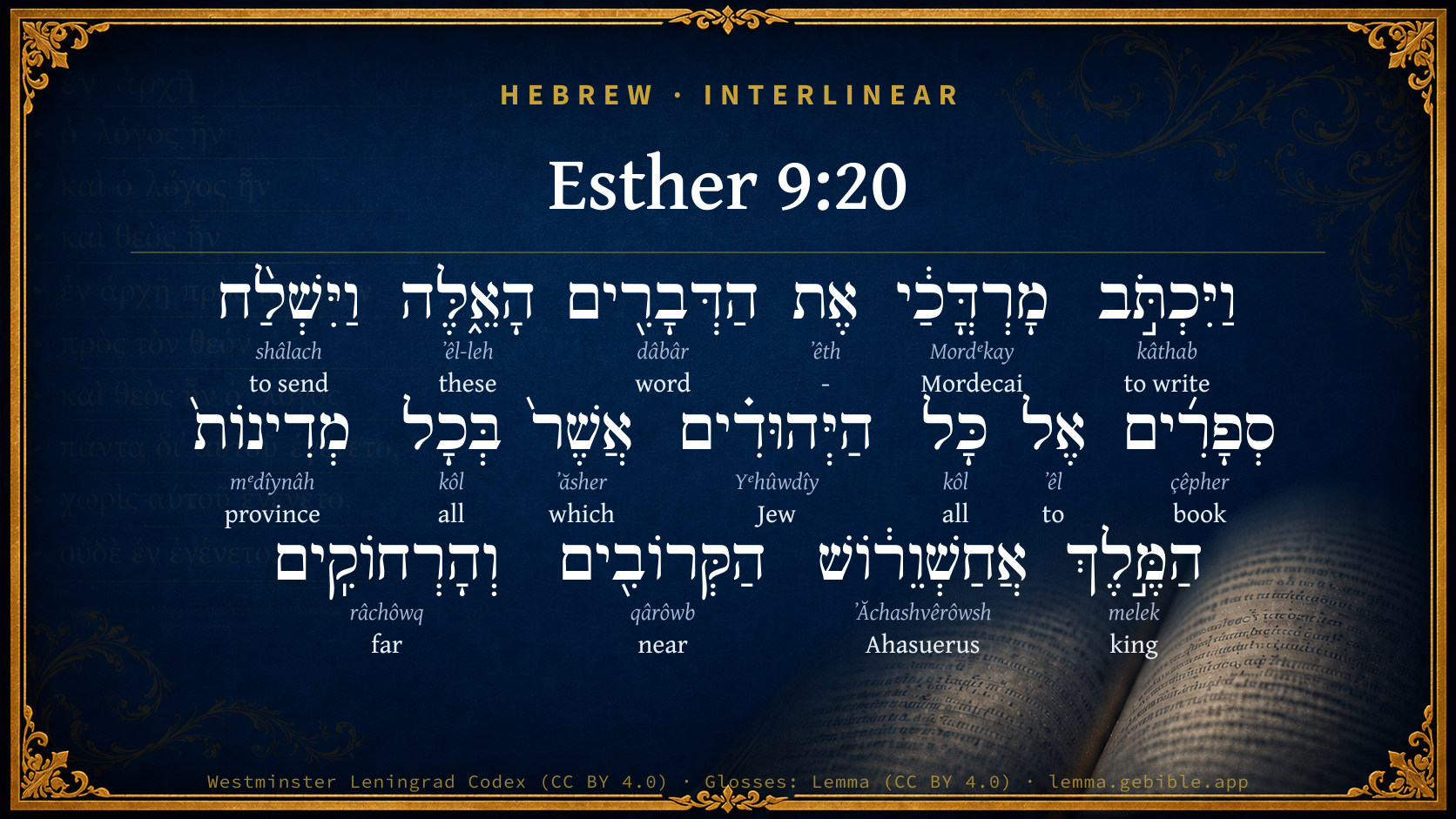
  1. וַיִּכְתֹּ֣ב kâthab H3789 “and · to write” Conjunction + Verb, Qal, Sequential Imperfect, 3rd Person, Masculine, Singular
  2. מָרְדֳּכַ֔י Mordᵉkay H4782 “Mordecai” Noun, Proper
  3. אֶת ʼêth H853 “-” Particle, Direct Object
  4. הַדְּבָרִ֖ים dâbâr H1697 “the · words” Particle, Definite Article + Noun, Common, Masculine, Plural, Absolute
  5. הָאֵ֑לֶּה ʼêl-leh H428 “the · these” Particle, Definite Article + Pronoun, Demonstrative, Common, Plural
  6. וַיִּשְׁלַ֨ח shâlach H7971 “and · to send” Conjunction + Verb, Qal, Sequential Imperfect, 3rd Person, Masculine, Singular
  7. סְפָרִ֜ים çêpher H5612 “books” Noun, Common, Masculine, Plural, Absolute
  8. אֶל ʼêl H413 “to” Preposition
  9. כָּל kôl H3605 “all of” Noun, Common, Masculine, Singular, Construct
  10. הַיְּהוּדִ֗ים Yᵉhûwdîy H3064 “the · Jews” Particle, Definite Article + Noun, Gentilic, Masculine, Plural, Absolute
  11. אֲשֶׁר֙ ʼăsher H834 “which” Particle, Relative
  12. בְּכָל kôl H3605 “in/at · all of” Preposition + Noun, Common, Masculine, Singular, Construct
  13. מְדִינוֹת֙ mᵉdîynâh H4082 “provinces of” Noun, Common, Feminine, Plural, Construct
  14. הַמֶּ֣לֶךְ melek H4428 “the · king” Particle, Definite Article + Noun, Common, Masculine, Singular, Absolute
  15. הַקְּרוֹבִ֖ים qârôwb H7138 “the · near” Particle, Definite Article + Adjective, Adjective, Masculine, Plural, Absolute
  16. וְהָרְחוֹקִֽים râchôwq H7350 “and · the · far” Conjunction + Particle, Definite Article + Adjective, Adjective, Masculine, Plural, Absolute

About this verse

These counts appear in no published source. They are computed here, from the morphology-tagged text and Lemma’s own curated glosses. What Lemma adds →

17
words
16
distinct lemmas
Historical
section

Shared distinctive vocabulary

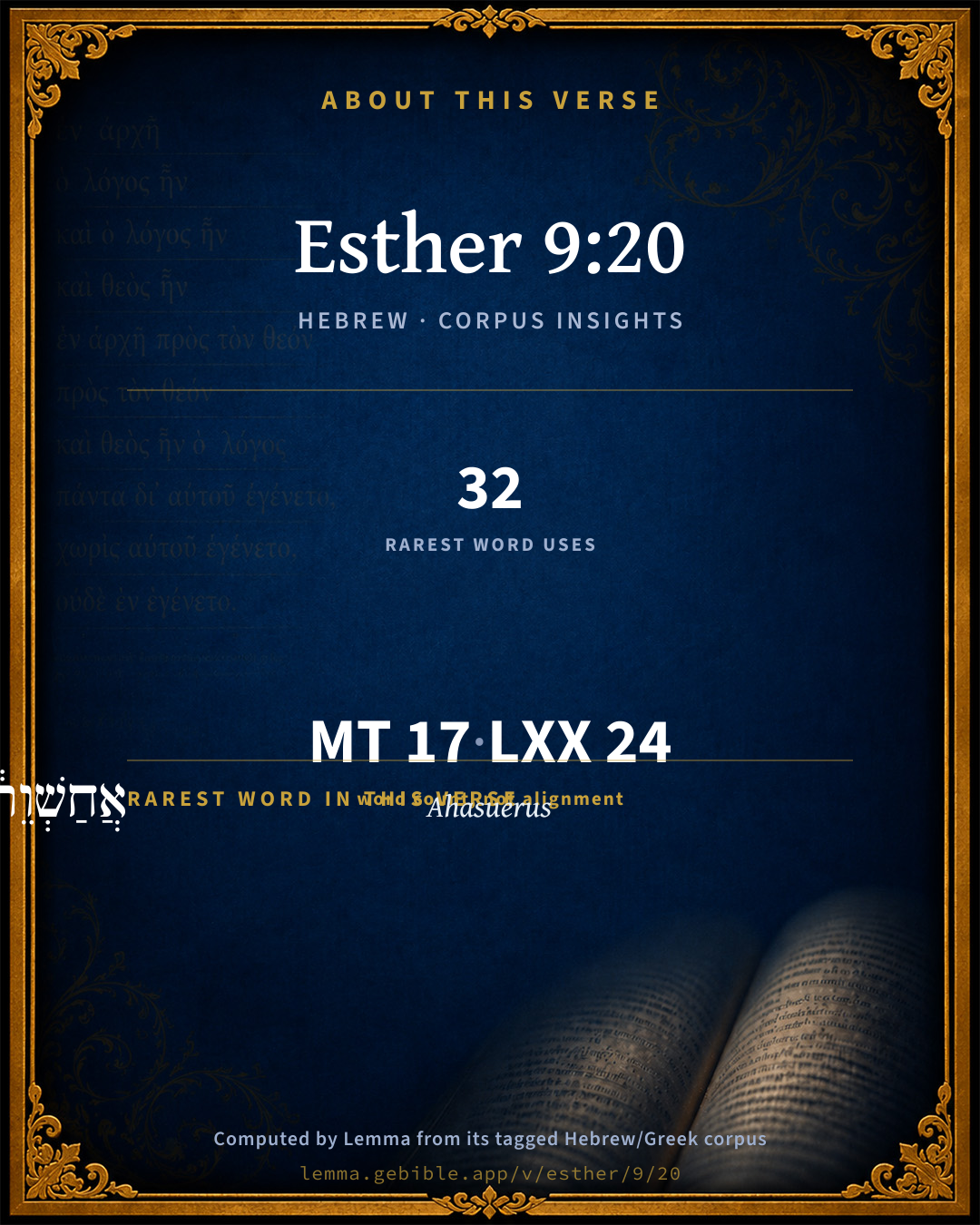
אֲחַשְׁוֵר֔וֹשׁ Ahasuerus H325 occurs in 30 verses of the Hebrew Bible. Also found in:

Grammatical profile

  • 2 verbs
  • 9 nouns
  • 2 adjectives
  • 1 pronoun
  • 1 preposition
  • 2 particles

Verb forms

  • וַיִּכְתֹּ֣ב Qal · Sequential Imperfect
  • וַיִּשְׁלַ֨ח Qal · Sequential Imperfect

Repetition

A word recurs within this verse — often emphatic in Hebrew:

Hebrew & Septuagint length

In English translation the verse runs 25 words from the Hebrew and 34 from the Septuagint (LXX English) — closely comparable.

A rough comparison of the two English renderings, which tokenize alike — not a word-level alignment.

Word counts can differ between the Hebrew and the Greek without any difference in meaning — e.g. the Hebrew direct-object marker אֵת has no separate Greek word, and Greek often adds the article ὁ.

In the original languages it is 17 Hebrew tokens and 24 Greek tokens — but the two are counted differently (Hebrew bundles its prefixes and suffixes into one token; the Greek is in lemma form), so that isn’t a like-for-like length.

Cross-references

10

Topical passages linked to Esther 9:20 in the Treasury of Scripture Knowledge — connected by theme and wording, ordered by reader-vote popularity; previews shown in the World English Bible.

  • Exodus 17:14 Yahweh said to Moses, "Write this for a memorial in a book, and rehearse it in the ears of Joshua: that I will utterly blot out the memory of Amalek from under the sky."
  • Deuteronomy 31:19–22 Now therefore write you this song for you, and teach you it the children of Israel: put it in their mouths, that this song may be a witness for me against the children of Israel.
  • Esther 1:1 Now it happened in the days of Ahasuerus (this is Ahasuerus who reigned from India even to Ethiopia, over one hundred twenty-seven provinces),
  • Esther 1:22 for he sent letters into all the king's provinces, into every province according to the writing of it, and to every people after their language, that every man should bear rule in his own house, and should speak according to the language of his people.
  • Esther 3:12 Then were the king's scribes called in the first month, on the thirteenth day of it; and there was written according to all that Haman commanded to the king's satraps, and to the governors who were over every province, and to the princes of every people, to every province according to the writing of it, and to every people after their language; in the name of king Ahasuerus was it written, and it was sealed with the king's ring.
  • Esther 8:9 Then were the king's scribes called at that time, in the third month Sivan, on the three and twentieth [day] of it; and it was written according to all that Mordecai commanded to the Jews, and to the satraps, and the governors and princes of the provinces which are from India to Ethiopia, one hundred twenty-seven provinces, to every province according to the writing of it, and to every people after their language, and to the Jews according to their writing, and according to their language.
  • Psalms 124:1–3 If it had not been Yahweh who was on our side, Let Israel now say,
  • Psalms 145:4–12 One generation will commend your works to another, And will declare your mighty acts.
  • 2 Corinthians 1:10–11 who delivered us out of so great a death, and does deliver; on whom we have set our hope that he will also still deliver us;
  • 1 Chronicles 16:12 Remember his marvelous works that he has done, His wonders, and the judgments of his mouth,

Cross-references courtesy of OpenBible.info (CC BY 4.0).

Hebrew and Greek witnesses Masoretic Hebrew ↔ Greek Septuagint

The same verse in the two great witnesses to the Old Testament, shown verse-for-verse.

These are two independent witnesses, not word-aligned to each other, and the Septuagint is shown in lemma (dictionary) form.

Hebrew Esther 9:20 Masoretic · Westminster Leningrad Codex

וַיִּכְתֹּ֣ב מָרְדֳּכַ֔י אֶת הַדְּבָרִ֖ים הָאֵ֑לֶּה וַיִּשְׁלַ֨ח סְפָרִ֜ים אֶל כָּל הַיְּהוּדִ֗ים אֲשֶׁר֙ בְּכָל מְדִינוֹת֙ הַמֶּ֣לֶךְ אֲחַשְׁוֵר֔וֹשׁ הַקְּרוֹבִ֖ים וְהָרְחוֹקִֽים

Mordecai wrote these things, and sent letters to all the Jews who were in all the provinces of the king Ahasuerus, both near and far,

World English Bible · Public Domain

Greek LXX Esther 9:20 Septuagint · lemma form

γράφω δέ μαρδοχαῖος ὁ λόγος οὗτος εἰς βιβλίον καί ἐκ ἀποστέλλω ὁ ἰουδαῖος ὅσος εἰμί ἐν ὁ ἀρταξέρξης βασιλεία ὁ ἐγγύς καί ὁ μακράν

And Mardochaeus wrote these things in a book, and sent them to the Jews, as many as were in the kingdom of Artaxerxes, both them that were near and them that were afar off,

LXX2012 (modern English Septuagint) · Public Domain

Hebrew: Westminster Leningrad Codex (CC BY 4.0). Greek: Septuagint (public domain); English from LXX2012 (modern English Septuagint) (Public Domain). How the Septuagint differs from the Hebrew →

Commentary

Notes on Esther 9:20 from classic Christian and Jewish commentators (each source and its license shown beneath its notes). The classic Christian expositions comment on the surrounding passage and are grouped to its opening verse, so a note may address several verses; the Jewish commentaries on the Tanakh (Rashi and others) are per-verse, so they appear only where the commentator wrote on this verse.

Lemma curates 59 commentaries, every one of them public domain or Creative Commons licensed, each selected and text-cleaned for this edition rather than reprinted as found. About our sources →

Matthew Henry's Commentary

We may well imagine how much affected Mordecai and Esther were with the triumphs of the Jews over their enemies, and how they saw the issue of that decisive day with a satisfaction proportionable to the care and concern with which they expected it. How were their hearts enlarged with joy in God and his salvation, and what new songs of praise were put into their mouths! But here we are told what course they took to spread the knowledge of it among their people, and to perpetuate the remembrance of it to posterity, for the honour of God and the encouragement of his people to trust in him at all times.

I. The history was written, and copies of it were dispersed among all the Jews in all the provinces of the empire, both nigh and far, Est 9:20. They all knew something of the story, being nearly concerned in it - were by the first edict made sensible of their danger and by the second of their deliverance; but how this amazing turn was given they could not tell. Mordecai therefore wrote all these things. And if this book be the same that he wrote, as many think it is, I cannot but observe what a difference there is between Mordecai's style and Nehemiah's. Nehemiah, at every turn, takes notice of divine Providence and the good hand of his God upon him, which is very proper to stir up devout affections in the minds of his readers; but Mordecai never so much as mentions the name of God in the whole story. Nehemiah wrote his book at Jerusalem, where religion was in fashion and an air of it appeared in men's common conversation; Mordecai wrote his at Shushan the palace, where policy reigned more then piety, and he wrote according to the genius of the place. Even those that have the root of the matter in them are apt to lose the savour of religion, and let their leaf wither, when they converse wholly with those that have little religion. Commend me to Nehemiah's way of writing; that I would imitate, and yet learn from Mordecai's that men may be truly devout though they do not abound in the shows and expressions of devotion, and therefore that we must not judge nor despise our brethren. But, because there is so little of the language of Canaan in this book, many think it was not written by Mordecai, but was an extract out of the journals of the kings of Persia, giving an account of the matter of fact, which the Jews themselves knew how to comment upon.

II. A festival was instituted, to be observed yearly from generation to generation by the Jews, in remembrance of this wonderful work which God wrought for them, that the children who should be born might know it, and declare it to their children, that they might set their hope in God, Psa 78:6, Psa 78:7. It would be for the honour of God as the protector of his people, and the honour of Israel as the care of Heaven, a confirmation of the fidelity of God's covenant, an invitation to strangers to come into the bonds of it, and an encouragement to God's own people cheerfully to depend upon his wisdom, power, and goodness, in the greatest straits. Posterity would reap the benefit of this deliverance, and therefore ought to celebrate the memorial of it. Now concerning this festival we are here told,

1. When it was observed - every year on the fourteenth and fifteenth days of the twelfth month, just a month before the passover, Est 9:21. Thus the first month and the last month of the year kept in remembrance the months that were past, even the days when God preserved them. They kept two days together as thanksgiving days, and did not think them too much to spend in praising God. Let us not be niggardly in our returns of praise to him who bestows his favours so liberally upon us. Observe, They did not keep the day when they fought, but the days when they rested, and on the fifteenth those in Shushan, and both those days they kept. The sabbath was appointed not on the day that God finished his work, but on the day that he rested from it. The modern Jews observe the thirteenth day, the day appointed for their destruction, as a fasting-day, grounding the practice on Est 9:31, the matters of their fastings and cry. But that refers to what was in the day of their distress (Est 4:3, Est 4:16), which was not to be continued when God had turned their fasts into joy and gladness, Zac 8:19.

2. How it was called - The feast of Purim (Est 9:26), from Pur, a Persian word which signified a lot, because Haman had by lot determined this to be the time of the Jews' destruction, but the Lord, at whose disposal the lot is, had determined it to be the time of their triumph. The name of this festival would remind them of the sovereign dominion of the God of Israel, who served his own purposes by the foolish superstitions of the heathen, and outwitted the monthly prognosticators in their own craft (Isa 47:13), frustrating the tokens of the liars and making the diviners mad, Isa 44:25, Isa 44:26.

3. By whom it was instituted and enacted. It was not a divine institution, and therefore it is not called a holy day, but a human appointment, by which it was made a good day, Est 9:19, Est 9:22. (1.) The Jews ordained it, and took it upon themselves (Est 9:27), voluntarily undertook to do as they had begun. Est 9:23. They bound themselves to this by common consent. (2.) Mordecai and Esther confirmed their resolve, that it might be the more binding on posterity, and might come well recommended by those great names. They wrote, [1.] With all authority (Est 9:29), as well they might, Esther being queen and Mordecai prime-minister of state. It is well when those who are in authority use their authority to authorize that which is good. [2.] With words of peace and truth. Though they wrote with authority, they wrote with tenderness, not imperious, not imposing, but in such language as the council at Jerusalem use in their decree (Act 15:29): "If you do so and so, you shall do well. Fare you well." Such was the style of these letters, or such the salutation or valediction of them: Peace and truth be with you.

4. By whom it was to be observed - by all the Jews, and by their seed, and by all such as joined themselves to them, Est 9:27. The observance of this feast was to be both universal and perpetual; the proselytes must observe it, in token of their sincere affection to the Jewish nation and their having united interests with them. A concurrence in joys and praises is one branch of the communion of saints.

5. Why it was to be observed - that the memorial of the great things God had done for his church might never perish from their seed, Est 9:28. God does not work wonders for a day, but to be had in everlasting remembrance. What he does shall be for ever, and therefore should for ever be had in mind, Ecc 3:14. In this affair they would remember, (1.) Haman's bad practices against the church, to his perpetual reproach (Est 9:24): Because he had devised against the Jews to destroy them. Let this be kept in mind, that God's people may never be secure, while they have such malicious enemies, on whom they ought to have a jealous eye. Their enemies aim at no less then their destruction; on God therefore let them depend for salvation. (2.) Esther's good services to the church, to her immortal honour. When Esther, in peril of her life, came before the king, he repealed the edict, Est 9:25. This also must be remembered, that wherever this feast should be kept, and this history read in explication of it, this which she did might be told for a memorial of her. Good deeds done for the Israel of God ought to be remembered, for the encouragement of others to do the like. God will not forget them, and therefore we must not. (3.) Their own prayers, and the answers given to them (Est 9:31): The matters of their fastings and their cry. The more cries we have offered up in our trouble, and the more prayers for deliverance, the more we are obliged to be thankful to God for deliverance. Call upon me in the time of trouble, and then offer to God thanksgiving.

6. How it was to be observed. And of this let us see,

(1.) What was here enjoined, which was very good, that they should make it, [1.] A day of cheerfulness, a day of feasting and joy (Est 9:22), and a feast was made for laughter, Ecc 10:19. When God gives us cause to rejoice why should we not express our joy? [2.] A day of generosity, sending portions one to another, in token of their pleasantness and mutual respect, and their being knit by this and other public common dangers and deliverances so much the closer to each other in love. Friends have their goods in common. [3.] A day of charity, sending gifts to the poor. It is not to our kinsmen and rich neighbours only that we are to send tokens, but to the poor and the maimed, Luk 14:12, Luk 14:13. Those that have received mercy must, in token of their gratitude, show mercy; and there never wants occasion, for the poor we have always with us. Thanksgiving and almsgiving should go together, that, when we are rejoicing and blessing God, the heart of the poor may rejoice with us and their loins may bless us.

(2.) What was added to this, which was much better. They always, at the feast, read the whole story over in the synagogue each day, and put up three prayers to God, in the first of which they praise God for counting them worthy to attend this divine service; in the second they thank him for the miraculous preservation of their ancestors; in the third they praise him that they have lived to observe another festival in memory of it. So bishop Patrick.

(3.) What it has since degenerated to, which is much worse. Their own writers acknowledge that this feast is commonly celebrated among them with gluttony, and drunkenness, and excess of riot. Their Talmud says expressly that, in the feast of Purim, a man should drink till he knows not the difference between Cursed be Haman, and Blessed be Mordecai. See what the corrupt and wicked nature of man often brings that to which was at first well intended: here is a religious feast turned into a carnival, a perfect revel, as wakes are among us. Nothing more purifies the heart and adorns religion than holy joy; nothing more pollutes the heart and reproaches religion than carnal mirth and sensual pleasure. Corruptio optimi est pessima - What is best becomes when corrupted the worst.

Matthew Henry's Commentary on the Whole Bible (1708–1710) — public domain (CC PDM 1.0). Text via the HelloAO Bible API.

Jamieson, Fausset & Brown

Robert Jamieson, A. R. Fausset & David Brown

THE TWO DAYS OF PURIM MADE FESTIVAL. (Est 9:20-32)

Mordecai wrote these things--Commentators are not agreed what is particularly meant by "these things"; whether the letters following, or an account of these marvellous events to be preserved in the families of the Jewish people, and transmitted from one generation to another.

Jamieson, Fausset & Brown — Commentary Critical and Explanatory on the Whole Bible (1871) — public domain (CC PDM 1.0). Text via the HelloAO Bible API.

Trapp's Complete Commentary

John Trapp

Est 9:20 And Mordecai wrote these things, and sent letters unto all the Jews that [were] in all the provinces of the king Ahasuerus, [both] nigh and far,

Ver. 20. And Mordecai wrote these things] He wrote with authority, as a magistrate (say some), that the Jews should keep these days with greatest solemnity. He wrote the relation of these things mentioned before, say others, as the ground of this annual festivity. Or else it may be meant more generally that Mordecai was the penman of the Holy Ghost, in writing this whole Book of Esther, as was before hinted.

And sent letters unto all the Jews … both nigh and far] Propinquis et longinquis, near and far, that they might all agree together about the time and manner of praising God; and so sing the great Hallelujah. See 2Co 1:11 2Ch 20:26-28 Psa 124:1-2; Psa 126:1 Psa 136:1-26, penned for a recorded public form, to praise God among the multitude, Psa 109:30, and in the great congregation, Psa 22:22; Psa 22:25. David would go into the presses of people, and there praise the Lord, Psa 116:18-19. This was to walk worthy of the Lord, Col 1:10. This was to make a proportionable return, for we are God’s soil, and our thanks his crop.

John Trapp, A Commentary or Exposition upon All the Books of the Old and New Testament (1647–1656) — public domain. Text from a community e-Sword module.

Joseph Benson's Commentary

Est 9:20. Mordecai wrote these things, &c. — That is, the history of these things, which was the ground of the feast here spoken of. Mordecai knew very well these things ought to be had in remembrance, and to be told to their children and posterity through all ages, according to the many commands of God to that purpose, and the constant practice of the holy men of God in such cases. And sent letters unto all the Jews that were in all the provinces — Signifying what a mighty deliverance God had vouchsafed them, and appointing, in commemoration thereof, an annual festival to be observed.

Joseph Benson's Commentary on the Old and New Testaments (1811–1818) — public domain. Text from a community e-Sword module.

Whedon's Commentary on the Bible

Daniel D. Whedon

THE FEAST OF PURIM, Est_9:20-32.

So signal a deliverance, so marvellous a display of divine providence in behalf of the Jews as that delineated in this book, should be commemorated by an annual festival. This the sagacious Mordecai was not slow to see, and without delay he proceeded, in conjunction with Esther, to establish a new festival in Israel. To this measure, says the Talmud, eighty-five Jewish elders were opposed, but the queen and the prime minister of Persia had too much power and influence with the people to be successfully opposed in establishing a festival of so much interest. The order and forms of its ancient observance are not recorded. On the modern custom, see note at the end of this chapter.

20. Mordecai wrote these things — Namely, the things or occurrences that transpired throughout the Persian empire on the thirteenth, fourteenth, and fifteenth of Adar. He wrote a report of the matter, as of something worthy to be chronicled for everlasting remembrance, and with this record he also sent letters unto all the Jews throughout the empire of Ahasuerus, proposing to them what is stated in the next two verses. Mordecai’s official position in the Persian court enabled him to establish this festival as no other Jew could have done. He could issue orders with royal authority, and use the posts and agents of the empire to facilitate his plans. The statement here made, that Mordecai chronicled these events, and wrote letters to all the Jews, will not warrant the conclusion that he was the author of this Book of Esther, but is sufficient to show that such a conclusion is not therefore improbable.

Daniel D. Whedon (gen. ed.), Commentary on the Old and New Testaments (1874–1909) — public domain. Text from a community e-Sword module.

Keil & Delitzsch

C. F. Keil & F. Delitzsch

The feast of Purim instituted by letters from Mordochai and Esther. Est 9:20. Mordochai wrote these things, and sent letters to all the Jews, etc. האלּה הדּברים does not mean the contents of the present book but the events of the last days, especially the fact that the Jews, after overcoming their enemies, rested in Susa on the 15th, in the other provinces on the 14th Adar, and kept these days as days of rejoicing. This is obvious from the object of these letters, Est 9:21 : וגו עליהם לקיּם, to appoint among them "that they should keep the 14th day of the month Adar and the 15th day of the same yearly, as the days on which the Jews rested from their enemies, and as the month which was turned unto them from sorrow to joy, and from mourning into a glad day, that they should keep them as days of feasting and joy, and of mutual sending of portions one to another, and gifts to the poor." יום עשׂה, to keep, to celebrate a day. The עשׂים להיות, Est 9:21, is after long parentheses taken up again in אותם לעשׂות. קיּם, to establish a matter, to authorize it, comp. Rut 4:7. Both the 14th and 15th Adar were made festivals because the Jews on them had rest from their enemies, and celebrated this rest by feasting, some on the former, some on the latter day.

Keil & Delitzsch — Biblical Commentary on the Old Testament (1861–1891) — public domain (CC PDM 1.0). Text via the HelloAO Bible API. (Old Testament only.)

Geneva Bible (1599)

Geneva Bible translators

The Jews gather hereof that Mordecai wrote this story: but it seemeth that he wrote but only these letters and decrees that follow.

Geneva Bible (1599) marginal notes — public domain. Text via Bolls.life.

Adam Clarke's Commentary

Verse 20. Mordecai wrote these things] It has been supposed that thus far that part of the book of Esther, which was written by Mordecai extends: what follows to the end, was probably added either by Ezra, or the men of the Great Synagogue; though what is said here may refer only to the letters sent by Mordecai to the Jews of the provinces. From this to the end of the chapter is nothing else than a recapitulation of the chief heads of the preceding history, and an account of the appointment of an annual feast, called the feast of Purim, in commemoration of their providential deliverance from the malice of Haman.

Adam Clarke's Commentary on the Bible (1810–1826) — public domain. Text from a community e-Sword/MySword module.

The Cambridge Bible for Schools and Colleges

gen. ed. J. J. S. Perowne

20–28. Mordecai’s injunctions for the keeping of Purim

20. And Mordecai wrote these things] Mordecai’s position as a Jew, who had attained to the office of grand vizier, seems to have been regarded as giving him, under the circumstances, a right to impose upon the Jews within the king of Persia’s dominions a new annual celebration. It is best to take ‘these things’ to mean so much of the story as appeared needful by way of explanation of the circumstances of the deliverance, as calling for a commemorative festival. We may notice that in this letter, unlike the second (Est_9:29-32), there is no reference to any but the joyous side of the commemoration.

The Cambridge Bible for Schools and Colleges (gen. ed. J. J. S. Perowne; Cambridge University Press, 1878–1918) — public domain. Text from a community e-Sword module.

John Gill's Exposition

As the days wherein the Jews rested from their enemies,.... Having slain all those that rose up against them, and assaulted them:

and the month which was turned unto them from sorrow to joy, and from mourning unto a good day; for in this month Adar, on the thirteenth day of it, they expected to have been all destroyed, which had occasioned great sorrow and mourning in them; but beyond their expectation, in the same month, and on the selfsame day of the month, they had deliverance and freedom from their enemies; which was matter of joy, and made this day a good day to them:

that they should make them days of feasting and joy; keep both the fourteenth and fifteenth days of the month as festivals, eating and drinking, and making all tokens of joy and gladness, though not in the Bacchanalian way in which they now observe them; for they say (n), a man is bound at the feast of Purim to exhilarate or inebriate himself until he does not know the difference between `cursed be Haman' and `blessed be Mordecai:'

and of sending portions one to another; and these now consist of eatables and drinkables; and according to the Jewish canons (o), a man must send two gifts to his friend, at least; and they that multiply them are most commendable; and those are sent by men to men, and by women to women, and not on the contrary:

and gifts to the poor; alms money, as the Targum, to purchase food and drink with, nor may they use it to any other purpose; though some say they may do what they will with it (p); and a man must not give less than two gifts to the poor; these are called the monies of Purim (q).

(n) T. Bab. Megillah, fol. 7. 2. Lebush, par. 1. c. 695. sect. 2. Schulchan Aruch, par. 1. c. 695. sect. 2. (o) Lebush & Schulchan, ib. sect. 4. (p) Ib. c. 694. sect. 1. 2. (q) Ib. sect. 2. 3.

John Gill's Exposition of the Whole Bible (1746–1763) — public domain (CC PDM 1.0). Text via the HelloAO Bible API.

Matthew Poole's English Annotations

Mordecai wrote these things; either,

1. The letters here following. But that is distinctly mentioned in the next words. Or,

2. The history of these things, which was the ground of the feast; which Mordecai knew very well ought to be had in remembrance, and to be told to their children and posterity, through all ages, according to the many commands of God to that purpose, and the constant practice of the holy men of God in such cases.

Matthew Poole's English Annotations on the Holy Bible (1683–1685) — public domain. Text from a community e-Sword/MySword module.

The Pulpit Commentary

Mordecai wrote these things. Mordecai seems, in the first instance, to have written to the provincial Jews, suggesting to them the future observance of two days of Purim instead of one, and explaining the grounds of his proposition, but without venturing to issue any order. When he found his proposition well received (vers. 23, 27) he sent out a second letter, with all authority" (ver. 29), enjoining the observance.

Vers. 20-22.

The feast of Purim.

Other Jewish festivals, as the passover and tabernacles, were instituted by express Divine authority. The feast of Purim was instituted by the authority of Mordecai and Esther. Yet its observance was undoubtedly sanctioned by the God whose merciful interposition it commemorated. The festival has been observed by the Jews from that day to this; the observance consisting of a preliminary fast; of a sacred assembly in the synagogue, when the Megillah (or roll) of the Book of Esther, is unfolded and solemnly read aloud; and of a repast at home, followed by merry-making, and the sending of presents. The feast of Purim was, and is

I A REMINDER OF AN ERA OF CAPTIVITY. The Jews are put in memory of the fact that a large portion of their nation was once in exile in Persia, and that, although their captivity must be regarded as a sign of their sin and of God"s displeasure, yet they had not been as a nation forsaken, but had been spared and recalled to the land of promise.

II A MEMORIAL BOTH OF THE ENEMIES AND OF THE FRIENDS OF THE NATION. When, in the reading, Haman"s name is mentioned, the synagogue is filled with the noise of stamping and rattling, and with shouts of "Cursed be Haman! may his name perish!" At the same time the memory of the great benefactors of Israel, Esther and Mordecai, is cherished with gratitude and warmth.

III A COMMEMORATION OF A DIVINE DELIVERANCE. The name "Purim" means "lots," because Haman cast lots for a lucky day for the execution of his malignant project. "The lot is cast into the lap, but the disposal thereof is of the Lord." No wonder that the joy of salvation was too great to find expression in one celebration. It was felt that one generation might well speak God"s praises to another, and declare his mighty works. Purim may serve as an emblem of the deliverance which the God of all grace has wrought on behalf not of Israel only, but of all mankind. He is, in Christ Jesus, a God "mighty to save."

The Pulpit Commentary (1880–1919), ed. H.D.M. Spence-Jones & Joseph S. Exell — public domain. Text from a community e-Sword module.

Kretzmann's Popular Commentary

Paul E. Kretzmann

The Purim Festival Instituted

v. 20. And Mordecai wrote these things, a full account of all these happenings, and sent letters unto all the Jews that were in all the provinces of the King Ahasuerus, both nigh and far, wherever there were colonies and congregations of his countrymen,

v. 21. to stablish this among them, that they should keep the fourteenth day of the month Adar and the fifteenth day of the same, yearly, making the celebration of the festival an event occupying two days,

v. 22. as the days wherein the Jews rested from their enemies, when their deliverance from their oppressors brought them lasting peace, and the month which was turned unto them from sorrow to Joy and from mourning into a good day, that they should make them days of feasting and Joy, and of sending portions one to another and gifts to the poor, as manifestations of their great thankfulness.

v. 23. And the Jews undertook to do as they had begun, the first celebration having already taken place in an outburst of spontaneous joy, and as Mordecai had written unto them,

v. 24. because Haman, the son of Hammedatha, the Agagite, the enemy of all the Jews, had devised against the Jews to destroy them, and had cast Pur, that is, the lot, this being done through the astrologers and magicians, Est 3:7, to consume them, crush them out of existence, and to destroy them;

v. 25. but when Esther came before the king, he commanded by letters that his, Haman’s, wicked device which he devised against the Jews should return upon his own head, that he be caught in his own net,and that he and his sons should be hanged on the gallows, these two commands, as they were directed to the queen, being given in direct speech.

v. 26. Wherefore they called these days Purim after the name of Pur, the word for the lot which Haman had used in trying to carry out his murderous scheme. Therefore, for all the words of this letter, which was sent out by Mordecai, and of that which they had seen concerning this matter, their own experience agreeing with the account as given by Mordecai, and which had come unto them, which they found out from other reliable sources,

v. 27. the Jews ordained and took upon them and upon their seed, all their descendants, and upon all such as joined themselves unto them, so as it should not fail, not be passed by and forgotten, that they would keep these two days according to their writing and according to their appointed time every year, the time of celebration being determined by the order of Mordecai;

v. 28. and that these days should be remembered and kept throughout every generation, every family, every province, and every city; and that these days of Purim should not fail, should never cease, from among the Jews, nor the memorial of them perish, come to an end, from their seed.

v. 29. Then Esther, the queen, the daughter of Abihail, and Mordecai, the Jew, wrote with all authority, with all emphasis, to confirm this second letter of Purim, the name of Mordecai giving the document full weight and legal power. The contents of this letter are not given, its existence being known to all Jews.

v. 30. And he sent the letters unto all the Jews, to the hundred twenty and seven provinces of the kingdom of Ahasuerus, with words of peace and truth, since they were aimed at the welfare of Israel and ware based upon facts,

v. 31. to confirm these days of Purim in their times appointed, according as Mordecai, the Jew, and Esther, the queen, had enjoined them, and as they had decreed for themselves and for their seed, themselves perfectly willing to agree to the establishment of the new festival, the matters of the fastings and their cry, in remembrance of the lamentations which the Jews indulged in before they were delivered by the decree of Mordecai.

v. 32. And the decree of Esther confirmed these matters of Purim; and it was written in the book, that which related the events connected with the establishment of the festival. The Feast of Esther, or that of Purim, is celebrated by the Jews to this day. "On both days of the feast the modern Jews read over the Megillah, or Book of Esther, in their synagogues. The copy read must not be printed, but written on vellum in the form of a roll; and the names of the ten sons of Haman are written on it in a peculiar manner, being ranged, they say, like so many bodies on a gibbet. The reader must pronounce all these names in one breath. Whenever Haman’s name is pronounced, they make a terrible noise in the synagogue. Some drum with their feet on the floor, and the boys have mallets with which they knock and make a noise. They prepare themselves for their carnival by a previous fast, which should continue three days, in imitation of Esther’s; but they have mostly reduced it to one day. " It is perfectly right and proper that Christians celebrate also such festivals on which they remember some great teacher of the Church and the great things which the Lord did through such a chosen instrument of His grace, as in the case of Martin Luther.

Paul E. Kretzmann, Popular Commentary of the Bible (1921–1924) — public domain. Text from a community e-Sword module.

unfoldingWord translationNotes

Door43 World Missions Community

to keep the fourteenth and the fifteenth day of Adar every year

To keep a day is an idiom that means to celebrate it. AT: "to celebrate the fourteenth and fifteenth days of Adar every year" (See: Idiom)

their sorrow turned to joy

Turning represents changing. The abstract nouns sorrow and joy can be expressed with "sad" and "joyful." AT: "they changed from being very sad to being joyful" (See: Metaphor)

translationWords

Mordecai

Ahasuerus

unfoldingWord translationNotes — © Distant Shores Media and the Door43 World Missions Community, licensed CC BY-SA 4.0. Source: git.door43.org/Door43/en_tn.

Rashi

Rabbi Shlomo Yitzchaki (Rashi)

And Mordecai inscribed this scroll, as it is. [i.e., in its present state.]

Rashi on the Tanakh — English translations: “The Judaica Press complete Tanach with Rashi, translated by A. J. Rosenberg” (CC BY 4.0); “Pentateuch with Rashi's commentary by M. Rosenbaum and A.M. Silbermann, 1929-1934” (public domain); “The Metsudah Tanach series, Lakewood, N.J” (CC BY 4.0); and “The Book of Joshua, Metsudah Publications, 1997” (CC BY 4.0). Text via Sefaria.

Lesson kit

Teaching starters — assembled from the data on this page, not authored interpretation. Every prompt links to the verse data it draws on. Edit before teaching.

Esther, in the Historical, opens this verse with 17 words (16 distinct Hebrew lemmas). Its most distinctive word is ʼĂchashvêrôwsh (“Ahasuerus”). A historical commentator’s framing appears above. Read the whole chapter for the surrounding context.

Discussion questions

  1. How does “Ahasuerus” (ʼĂchashvêrôwsh) shape what this verse is saying?
  2. Ezra 4:6 shares the word «Ahasuerus» with this verse. How do the two illuminate each other?
  3. “all” occurs 2× in this one verse. What is the effect of the repetition?
  4. These translations render this verse differently; the difference is in the English rendering, not the original. What questions does that raise?
  5. The verb «וַיִּכְתֹּ֣ב» is Qal Sequential Imperfect. How does its form color the action?
  6. Reading how Matthew Henry's Commentary and Jamieson, Fausset & Brown read this verse, where do the two commentators agree and where do they part?

Things to notice

Reading settings

Reading text

Shown beneath each verse's original-language words.

Old Testament
Old Testament edition

Read the OT as the Masoretic Hebrew (MT) or the Greek Septuagint (LXX).

English shown for the Greek Septuagint (in the Hebrew ↔ Greek comparison).

Comparing translations? Open the Compare panel on any verse page to stack up to four side by side.