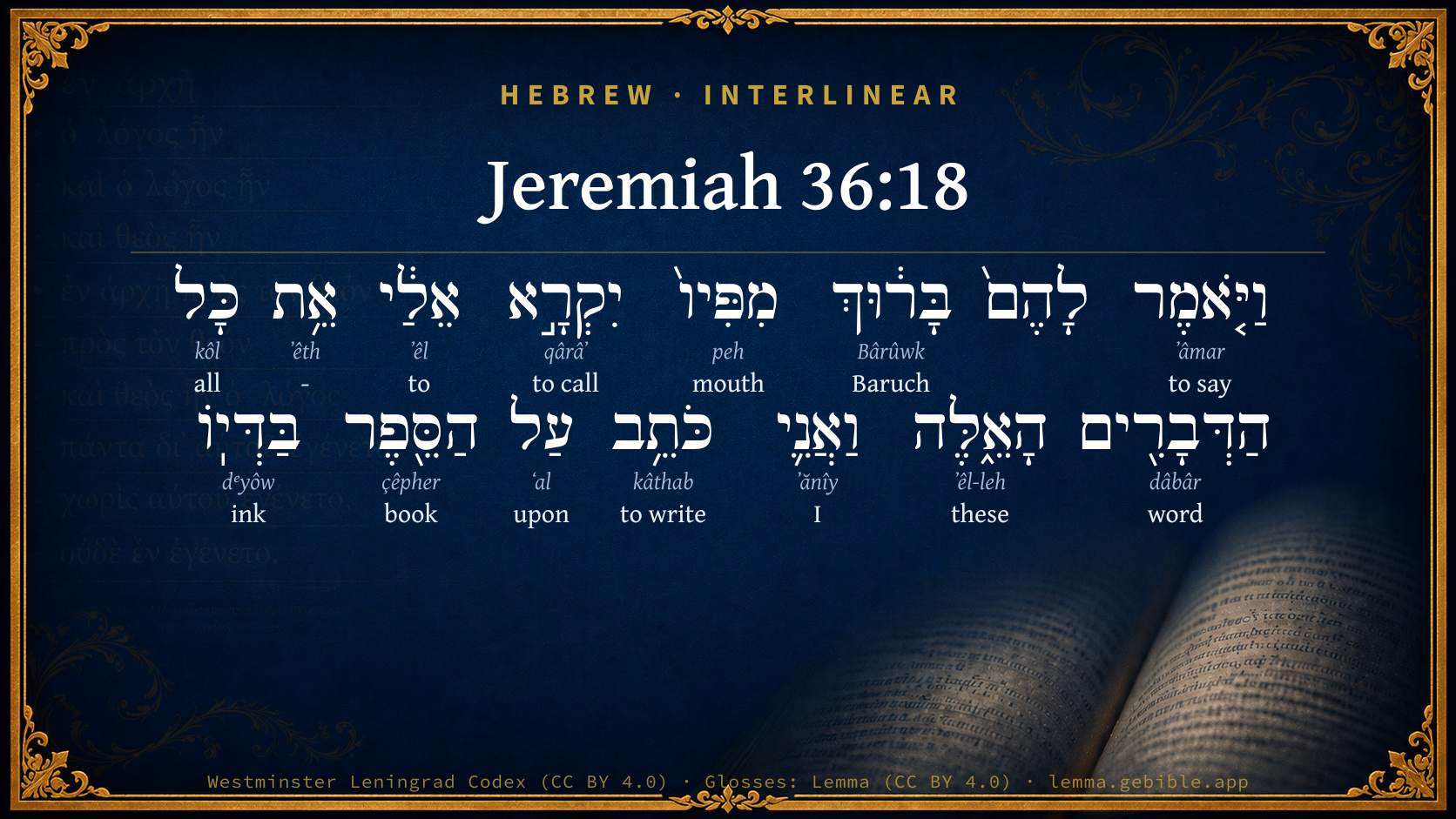
Jeremiah 36:18

Hebrew (Westminster Leningrad Codex) Jeremiah 36:18 appears in the Hebrew Old Testament. The text above is from the Westminster Leningrad Codex. Each word links to its Strong’s number, a concise gloss, and parsing drawn from the Open Scriptures Hebrew Bible morphology. Click any word for its full Brown-Driver-Briggs (BDB) entry.
Download image
Cite this verse

Jeremiah 36:18 (World English Bible). Public Domain. Lemma interlinear Bible study tool, https://lemma.gebible.app/v/jeremiah/36/18.

Show BibTeX & RIS
BibTeX
RIS
English Translation
Then Baruch answered them, He pronounced all these words to me with his mouth, and I wrote them with ink in the book.
World English Bible · Public Domain
Highlights
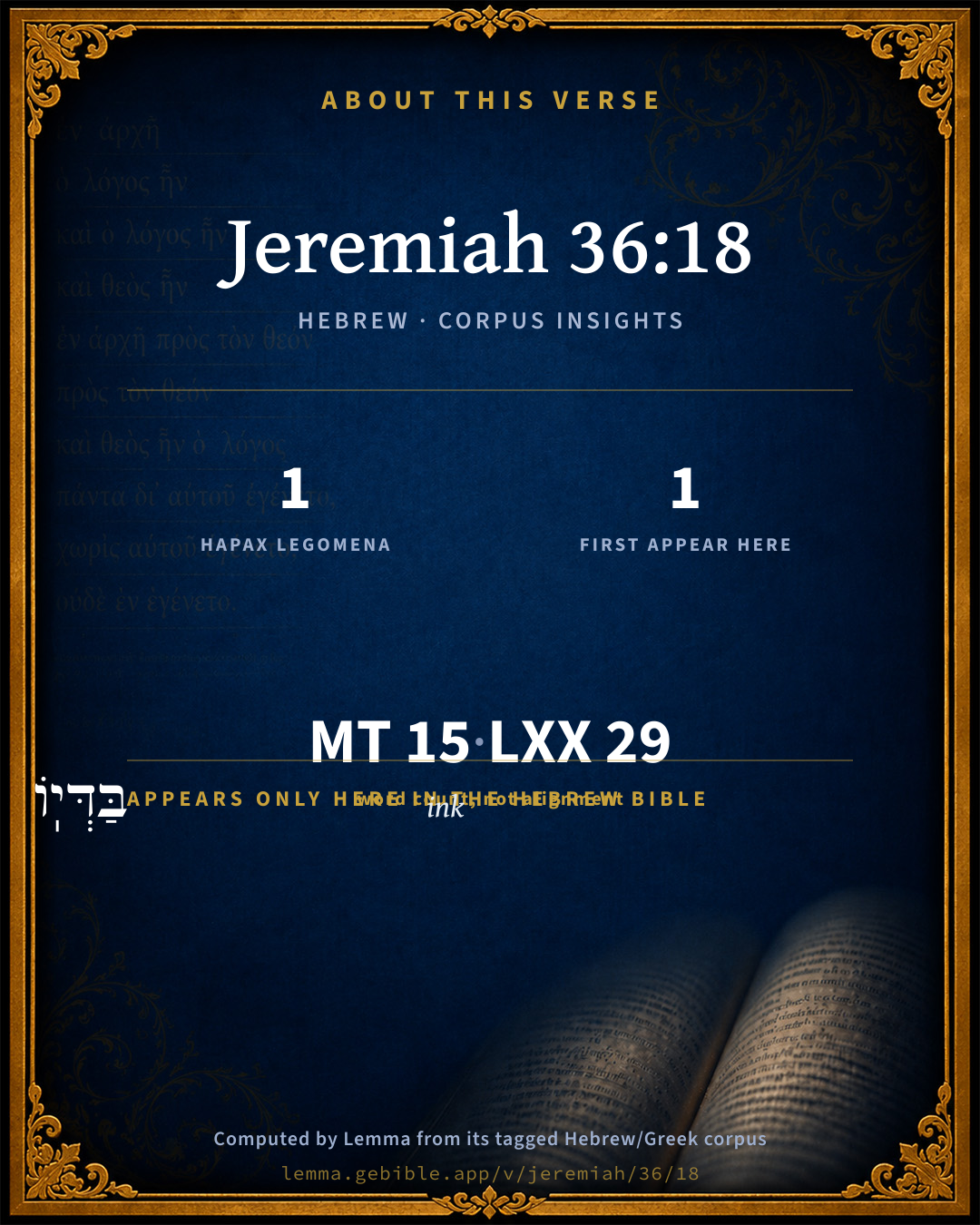
  • 1 hapax legomenon — only here in the Hebrew Bible
  • 1 first appearance in the Hebrew Bible
Full analysis ↓
Download a study sheet

One document with this verse’s original text, its word-by-word gloss line, the meaning frame, cross-references with their text, attributed commentary, and full source and license credits — printable, and it pastes into notes with its structure intact.

This verse Autodidact and up

Study sheet (.html) Plain text (.txt)

A passage Seminary Student

Up to 50 verses in one chapter. A passage sheet keeps up to 6 commentary sources and 12 cross-references per verse, in the order this page ranks them, and says so on the sheet whenever that leaves anything out. Ask for a single verse and you get the Autodidact verse sheet above.

Everything on this page stays free to read, with no account — the sheet is a download of what is already on screen, not access to it.

Want to remove ads? Support Godless Engineer
Compare translations 3

The same verse in 3 English versions, stacked beneath the original-language interlinear above. Click any original word for its lexicon entry.

Each is an independent rendering of the whole verse — the interlinear is not word-aligned to these translations.

Highlighted words mark where these versions differ — a whole-verse word diff, not a word-by-word alignment.

  • World English Bible Public Domain
    Then Baruch answered them, He pronounced all these words to me with his mouth, and I wrote them with ink in the book.
  • King James Version Public Domain
    Then Baruch answered them, He pronounced all these words unto me with his mouth, and I wrote them with ink in the book.
  • unfoldingWord Literal Text CC BY-SA 4.0
    Baruch said to them, “He dictated all these words to me, and I wrote them in ink on this scroll.”

unfoldingWord Literal Text — © unfoldingWord, licensed CC BY-SA 4.0. Word-aligned USFM3 via Door43 (git.door43.org/unfoldingWord/en_ult).

Versions to compare (up to 4)

3 of 4 selected

Show all 18 translations

Every available English version of this verse, each an independent rendering of the whole verse.

  • World English Bible Public Domain
    Then Baruch answered them, He pronounced all these words to me with his mouth, and I wrote them with ink in the book.
  • Berean Standard Bible Public Domain
    “It was at his dictation,” Baruch replied. “He recited all these words to me and I wrote them in ink on the scroll.”
  • Majority Standard Bible Public Domain
    “It was at his dictation,” Baruch replied. “He recited all these words to me and I wrote them in ink on the scroll.”
  • King James Version Public Domain
    Then Baruch answered them, He pronounced all these words unto me with his mouth, and I wrote them with ink in the book.
  • American Standard Version (1901) Public Domain
    Then Baruch answered them, He pronounced all these words unto me with his mouth, and I wrote them with ink in the book.
  • Revised Version (1885) Public Domain
    Then Baruch answered them, He pronounced all these words unto me with his mouth, and I wrote them with ink in the book.
  • Geneva Bible (1599) Public Domain
    Then Baruch answered them, He pronounced all these wordes vnto me with his mouth, and I wrote them with ynke in the booke.
  • Douay-Rheims (1899) Public Domain
    And Baruch said to them: With his mouth he pronounced all these words as if he were reading to me: and I wrote in a volume with ink.
  • Young's Literal Translation Public Domain
    And Baruch saith to them, `From his mouth, he pronounceth unto me all these words, and I am writing on the book with ink.'
  • Literal Standard Version CC BY-SA 4.0
    And Baruch says to them, “He pronounces from his mouth all these words to me, and I am writing on the scroll with ink.”
  • Unlocked Literal Bible CC BY-SA 4.0
    Baruch said to them, “He dictated all these words to me, and I wrote them in ink on this scroll.”
  • unfoldingWord Literal Text CC BY-SA 4.0
    Baruch said to them, “He dictated all these words to me, and I wrote them in ink on this scroll.”
  • Darby Bible Public Domain
    And Baruch said unto them, He pronounced all these words unto me with his mouth, and I wrote [them] with ink in the book.
  • World Messianic Bible Public Domain
    Then Baruch answered them, “He dictated all these words to me with his mouth, and I wrote them with ink in the book.”
  • Webster's Bible Public Domain
    Then Baruch answered them, He pronounced all these words to me with his mouth, and I wrote them with ink in the book.
  • Free Bible Version CC BY-SA 4.0
    “Yes, he dictated it,” Baruch replied. “I wrote down in ink on the scroll everything he told me.”
  • Bible in Basic English Public Domain
    Then Baruch, answering, said, He said all these things to me by word of mouth, and I put them down with ink in the book.
  • JPS Tanakh (1917) Public Domain
    Then Baruch answered them: 'He pronounced all these words unto me with his mouth, and I wrote them with ink in the book.'

Literal Standard Version (2020), Covenant Press — licensed CC BY-SA 4.0. Text via the HelloAO Bible API (eBible.org). Unlocked Literal Bible (unfoldingWord) — licensed CC BY-SA 4.0. Text via the HelloAO Bible API (eBible.org). unfoldingWord Literal Text — © unfoldingWord, licensed CC BY-SA 4.0. Word-aligned USFM3 via Door43 (git.door43.org/unfoldingWord/en_ult). Free Bible Version, Dr. Jonathan Gallagher — licensed CC BY-SA 4.0. Text via the HelloAO Bible API (eBible.org).

Word by word

More ways to search: Search by grammar → Find every occurrence → Compare this word →

Practice this passage: Drill this verse → Learn its vocabulary →

בַּדְּיֽוֹ
dᵉyôw
H1773
“in/at the · ink”
Preposition, Determined + Noun, Common, Feminine, Singular, Absolute
Part of Speech
Preposition + Noun
Type
Common
Gender
Feminine
Number
Singular
State
Absolute
Full BDB Definition

Origin: of uncertain derivation

TWOT: 411e

ink
  1. וַיֹּ֤אמֶר ʼâmar H559 “and · to say” Conjunction + Verb, Qal, Sequential Imperfect, 3rd Person, Masculine, Singular
  2. בָּר֔וּךְ Bârûwk H1263 “Baruch” Noun, Proper
  3. מִפִּיו֙ peh H6310 “from · mouth · his” Preposition + Noun, Common, Masculine, Singular, Construct + Suffix, Personal, 3rd Person, Masculine, Singular
  4. יִקְרָ֣א qârâʼ H7121 “to call” Verb, Qal, Imperfect, 3rd Person, Masculine, Singular
  5. אֵלַ֔י ʼêl H413 “to · me” Preposition + Suffix, Personal, 1st Person, Common, Singular
  6. אֵ֥ת ʼêth H853 “-” Particle, Direct Object
  7. כָּל kôl H3605 “all of” Noun, Common, Masculine, Singular, Construct
  8. הַדְּבָרִ֖ים dâbâr H1697 “the · words” Particle, Definite Article + Noun, Common, Masculine, Plural, Absolute
  9. הָאֵ֑לֶּה ʼêl-leh H428 “the · these” Particle, Definite Article + Pronoun, Demonstrative, Common, Plural
  10. וַאֲנִ֛י ʼănîy H589 “and · I” Conjunction + Pronoun, Personal, 1st Person, Common, Singular
  11. כֹּתֵ֥ב kâthab H3789 “writing” Verb, Qal, Participle Active, Masculine, Singular, Absolute
  12. עַל ʻal H5921 “upon” Preposition
  13. הַסֵּ֖פֶר çêpher H5612 “the · book” Particle, Definite Article + Noun, Common, Masculine, Singular, Absolute

About this verse

These counts appear in no published source. They are computed here, from the morphology-tagged text and Lemma’s own curated glosses. What Lemma adds →

15
words
14
distinct lemmas
Prophets
section

Notable vocabulary

1 hapax legomenon — a word that appears only here in the entire Hebrew Bible:

  • בַּדְּיֽוֹ ink H1773

First appearance in Scripture

This word makes its first canonical appearance in the Hebrew Bible here:

  • בַּדְּיֽוֹ ink H1773

Shared distinctive vocabulary

בָּר֔וּךְ Baruch H1263 occurs in 24 verses of the Hebrew Bible. Also found in:

Grammatical profile

  • 3 verbs
  • 6 nouns
  • 2 pronouns
  • 3 prepositions
  • 1 particle

Verb forms

  • וַיֹּ֤אמֶר Qal · Sequential Imperfect
  • יִקְרָ֣א Qal · Imperfect
  • כֹּתֵ֥ב Qal · Participle Active

Hebrew & Septuagint length

In the original languages it is 15 Hebrew tokens and 29 Greek tokens — but the two are counted differently (Hebrew bundles its prefixes and suffixes into one token; the Greek is in lemma form), so that isn’t a like-for-like length.

Cross-references

4

Topical passages linked to Jeremiah 36:18 in the Treasury of Scripture Knowledge — connected by theme and wording, ordered by reader-vote popularity; previews shown in the World English Bible.

  • Jeremiah 36:4 Then Jeremiah called Baruch the son of Neriah; and Baruch wrote from the mouth of Jeremiah all the words of Yahweh, which he had spoken to him, on a scroll of a book.
  • Jeremiah 36:2 Take a scroll of a book, and write therein all the words that I have spoken to you against Israel, and against Judah, and against all the nations, from the day I spoke to you, from the days of Josiah, even to this day.
  • Proverbs 26:4–5 Don't answer a fool according to his folly, Lest you also be like him.
  • Jeremiah 43:2–3 then spoke Azariah the son of Hoshaiah, and Johanan the son of Kareah, and all the proud men, saying to Jeremiah, You speak falsely: Yahweh our God has not sent you to say, You shall not go into Egypt to sojourn there;

Cross-references courtesy of OpenBible.info (CC BY 4.0).

Hebrew and Greek witnesses Masoretic Hebrew ↔ Greek Septuagint

The same verse in the two great witnesses to the Old Testament, shown verse-for-verse.

These are two independent witnesses, not word-aligned to each other, and the Septuagint is shown in lemma (dictionary) form.

Hebrew Jeremiah 36:18 Masoretic · Westminster Leningrad Codex

וַיֹּ֤אמֶר לָהֶם֙ בָּר֔וּךְ מִפִּיו֙ יִקְרָ֣א אֵלַ֔י אֵ֥ת כָּל הַדְּבָרִ֖ים הָאֵ֑לֶּה וַאֲנִ֛י כֹּתֵ֥ב עַל הַסֵּ֖פֶר בַּדְּיֽוֹ

Then Baruch answered them, He pronounced all these words to me with his mouth, and I wrote them with ink in the book.

World English Bible · Public Domain

Greek LXX Structure differs

In the Septuagint, Jeremiah is about an eighth shorter than the Hebrew and arranges its material differently — the Oracles Against the Nations (Hebrew chapters 46–51) appear in the middle of the Greek book, after 25:13. Because the chapter and verse boundaries do not line up, a verse-for-verse comparison with the Hebrew is not shown.

A verse-for-verse comparison isn’t shown here because the chapters and verses don’t line up. Switch to the LXX edition with the MT / LXX toggle above to read the Greek directly.

Hebrew: Westminster Leningrad Codex (CC BY 4.0). Greek: Septuagint (public domain); English from a public-domain English Septuagint. How the Septuagint differs from the Hebrew →

Targum (Aramaic paraphrase)

1

The Targum is the ancient Jewish Aramaic paraphrase of the Hebrew Scriptures — an interpretive translation, not the Hebrew text itself. Onkelos (literal) and Pseudo-Jonathan (expansive) render the Torah, and Jonathan the Prophets. Coverage is partial: where no permissively-licensed English translation exists for a verse, only the Aramaic is shown. This is verse-level text, not a word-by-word alignment to the Hebrew.

  1. Targum Jonathan Prophets (Joshua–Malachi)
    וַאֲמַר לְהוֹן בָּרוּךְ מִפּוּמֵיהּ קָרֵי לִי יַת כָּל פִּתְגָמַיָא הָאִלֵין וַאֲנָא כָּתֵיב עַל סִפְרָא בִּדְיוּתָא:

    (no public-domain English translation for this verse)

    Targum Jonathan — Aramaic: “Mikraot Gedolot” (public domain). English: “Sefaria Community Translation” (CC0 1.0 (public-domain dedication)); “London "Chaldee Paraphrase," 1871” (public domain). Text via Sefaria.

Commentary

Notes on Jeremiah 36:18 from classic Christian and Jewish commentators (each source and its license shown beneath its notes). The classic Christian expositions comment on the surrounding passage and are grouped to its opening verse, so a note may address several verses; the Jewish commentaries on the Tanakh (Rashi and others) are per-verse, so they appear only where the commentator wrote on this verse.

Lemma curates 59 commentaries, every one of them public domain or Creative Commons licensed, each selected and text-cleaned for this edition rather than reprinted as found. About our sources →

Trapp's Complete Commentary

John Trapp

Jer 36:18 Then Baruch answered them, He pronounced all these words unto me with his mouth, and I wrote [them] with ink in the book.

Ver. 18. And Baruch answered them.] Answerably {a} to the question they asked him. {Jer 36:17} Dignum patella operculum.

And I wrote them with ink in the book.] The use, then, of writing with pen and ink is ancient among the Hebrews.

{a} Hos fere simili responso eludere videtur sanctus Dei homo. - Zeged.

John Trapp, A Commentary or Exposition upon All the Books of the Old and New Testament (1647–1656) — public domain. Text from a community e-Sword module.

Jamieson, Fausset & Brown

Robert Jamieson, A. R. Fausset & David Brown

his mouth--Baruch replies it was by the oral dictation of the prophet; Jer 36:2 accords with this view, rather than with the notion that Jeremiah repeated his prophecies from manuscripts.

ink--his specification of the "ink" implies: I added nothing save the hand, pen, and ink.

Jamieson, Fausset & Brown — Commentary Critical and Explanatory on the Whole Bible (1871) — public domain (CC PDM 1.0). Text via the HelloAO Bible API.

John Calvin's Commentaries

He simply answered, that Jeremiah had pronounced these words to him. They might hence have concluded, that Jeremiah had no roll laid before him, and that he had been not long meditating on what he communicated to his scribe Baruch. And though he seems to have said no more than what might satisfy the princes, yet the purport of the whole is, that Jeremiah did not produce the roll from a recess or his desk, but promptly gave utterance to what God’s Spirit suggested to him. Their astonishment, then, must have increased, when the king’s counsellors knew that these commands did not proceed from a mortal man, but that, on the contrary, God spoke them by the mouth of Jeremiah, and by the hand of Baruch. It follows, —

John Calvin's Commentaries (1540-1563) — public domain. Text from the Calvin Translation Society English edition (1840s-50s) via the Christian Classics Ethereal Library (ccel.org). Calvin's coverage is partial (roughly two-thirds of the Bible); uncommented books and verses are honest gaps, never fabricated. The 19th-century editor's footnotes and remarks are omitted so the notes are faithfully Calvin's own voice.

John Gill's Exposition

Then Baruch answered them,.... At once, without any hesitation, plainly and fully:

he pronounced all these words unto me with his mouth; that is, the Prophet Jeremiah delivered by word of mouth, not the substance only of this roll, but the express words of it, and everyone of them, and that clearly and distinctly, without any hesitation, or premeditation; by which it is plain it was by the Spirit of the Lord he did it; neither matter nor words were Baruch's, but were exactly as they were delivered:

and I wrote them with ink in the book; as they saw with their eyes, and which was the manner of writing with the Jews so early; Baruch had no further concern in this matter than to provide pen, ink, and parchment, and to make use of them as he did, just as the prophet dictated and directed him.

John Gill's Exposition of the Whole Bible (1746–1763) — public domain (CC PDM 1.0). Text via the HelloAO Bible API.

Albert Barnes' Notes on the Bible

He pronounced - He used to say aloud, he dictated. Baruch’s office was merely mechanical. He contributed nothing but hand, pen, and ink.

Albert Barnes' Notes on the Bible (1834–1885) — public domain. Text from a community e-Sword/MySword module.

Haydock's Catholic Bible Commentary

Reading. No study was requisite. (Haydock) --- Ink. It formerly resembled that used by printers, (Calmet) being composed of soot and gum. (Vitruvius vii. 10.)

George Leo Haydock (1774–1849), Haydock's Catholic Family Bible and Commentary, 1859 edition — public domain. Excludes Psalms (Douay-Rheims chapter numbering differs from Protestant) and Deuterocanonical books (Catholic canon only).

Matthew Poole's English Annotations

This could not but add to the princes’ fear and amazement. They must needs conceive that the thing was done from God, for without a special influence of God it had been a thing impossible that Jeremiah should have called to mind all that he had spoken at several times in so many years; and proceeding from the God of truth, they must needs fear that they would have their certain and just accomplishment in their season.

Matthew Poole's English Annotations on the Holy Bible (1683–1685) — public domain. Text from a community e-Sword/MySword module.

The Pulpit Commentary

He pronounced, etc.; rather, He kept dictating... while I wrote with ink, etc. The addition of the last clause suggests (and was, perhaps, intended to do so) that Baruch"s function was simply mechanical.

The Pulpit Commentary (1880–1919), ed. H.D.M. Spence-Jones & Joseph S. Exell — public domain. Text from a community e-Sword module.

John Wesley's Explanatory Notes

He pronounced - This could not but add to the princes fear, they must needs conceive that without a special influence of God, it had been impossible, that Jeremiah should have called to mind all that he had spoken at several times in so many years.

John Wesley, Explanatory Notes Upon the Whole Bible (1754–1765) — public domain. Text via the GEBible commentary corpus.

Lesson kit

Teaching starters — assembled from the data on this page, not authored interpretation. Every prompt links to the verse data it draws on. Edit before teaching.

Jeremiah, in the Prophets, opens this verse with 15 words (14 distinct Hebrew lemmas). Its most distinctive word is dᵉyôw (“ink”). A historical commentator’s framing appears above. Read the whole chapter for the surrounding context.

Discussion questions

  1. The word dᵉyôw carries the sense “ink.” How does it shape the verse?
  2. 1 word here appears nowhere else in the Hebrew Bible. Why might the author reach for such rare wording?
  3. This is the first place “ink” appears in Scripture (first appears here). What does its debut here establish?
  4. How does Nehemiah 3:20, which shares the word «Baruch», read alongside this verse?
  5. The translations on this page render this verse differently — a whole-verse word diff, not a word-by-word alignment. What might account for the different wordings?
  6. «וַיֹּ֤אמֶר» is a Qal Sequential Imperfect verb. How does that grammatical form shape the action described?
  7. Compare how Trapp's Complete Commentary and Jamieson, Fausset & Brown read this verse. Where do they agree or differ?

Things to notice

Reading settings

Reading text

Shown beneath each verse's original-language words.

Old Testament
Old Testament edition

Read the OT as the Masoretic Hebrew (MT) or the Greek Septuagint (LXX).

English shown for the Greek Septuagint (in the Hebrew ↔ Greek comparison).

Comparing translations? Open the Compare panel on any verse page to stack up to four side by side.