Jeremiah 51:60

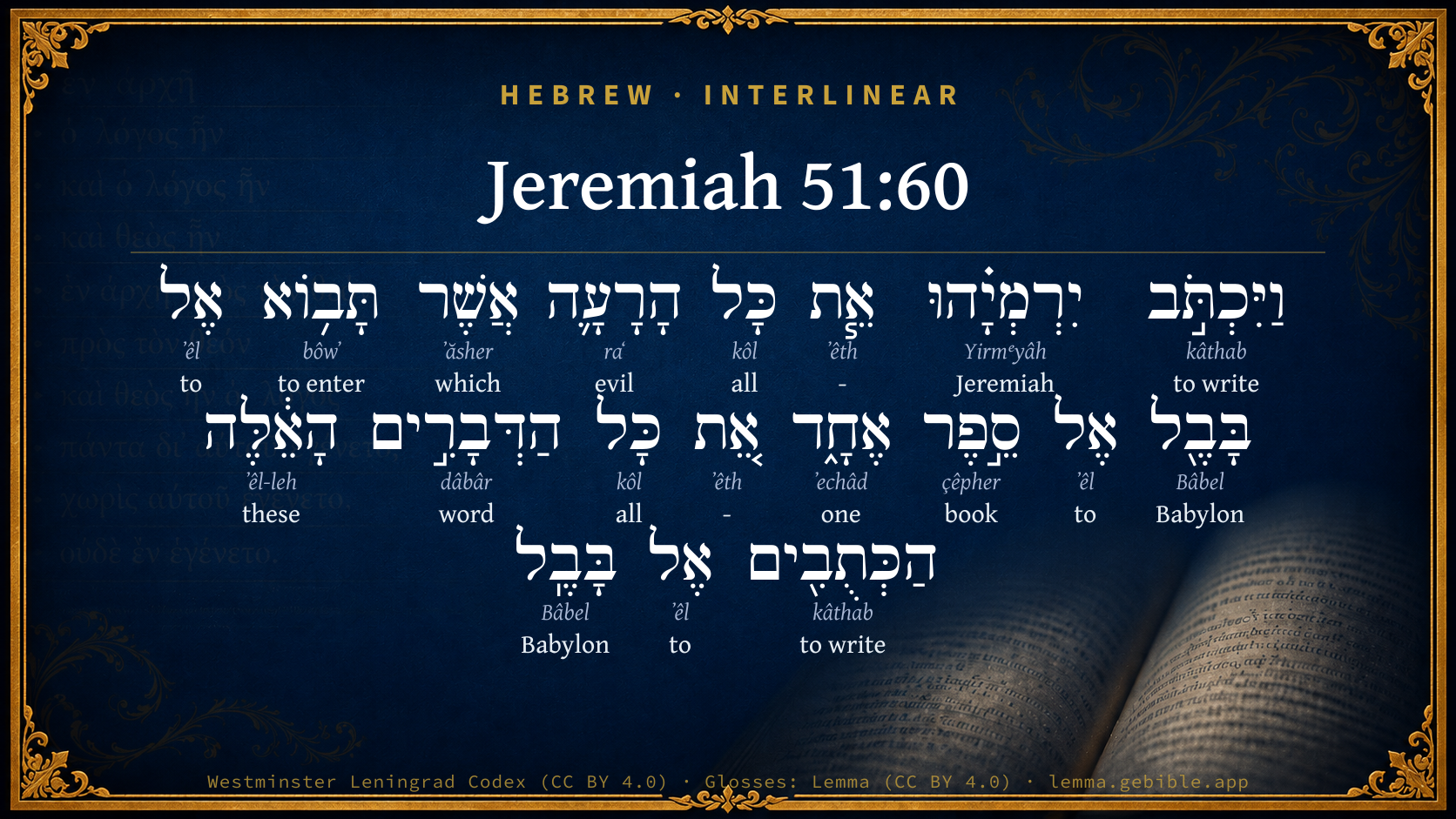
Hebrew (Westminster Leningrad Codex) Jeremiah 51:60 appears in the Hebrew Old Testament. The text above is from the Westminster Leningrad Codex. Each word links to its Strong’s number, a concise gloss, and parsing drawn from the Open Scriptures Hebrew Bible morphology. Click any word for its full Brown-Driver-Briggs (BDB) entry.
Download image
Cite this verse

Jeremiah 51:60 (World English Bible). Public Domain. Lemma interlinear Bible study tool, https://lemma.gebible.app/v/jeremiah/51/60.

Show BibTeX & RIS
BibTeX
RIS
English Translation
Jeremiah wrote in a book all the evil that should come on Babylon, even all these words that are written concerning Babylon.
World English Bible · Public Domain
Download a study sheet

One document with this verse’s original text, its word-by-word gloss line, the meaning frame, cross-references with their text, attributed commentary, and full source and license credits — printable, and it pastes into notes with its structure intact.

This verse Autodidact and up

Study sheet (.html) Plain text (.txt)

A passage Seminary Student

Up to 50 verses in one chapter. A passage sheet keeps up to 6 commentary sources and 12 cross-references per verse, in the order this page ranks them, and says so on the sheet whenever that leaves anything out. Ask for a single verse and you get the Autodidact verse sheet above.

Everything on this page stays free to read, with no account — the sheet is a download of what is already on screen, not access to it.

Want to remove ads? Support Godless Engineer
Compare translations 3

The same verse in 3 English versions, stacked beneath the original-language interlinear above. Click any original word for its lexicon entry.

Each is an independent rendering of the whole verse — the interlinear is not word-aligned to these translations.

Highlighted words mark where these versions differ — a whole-verse word diff, not a word-by-word alignment.

  • World English Bible Public Domain
    Jeremiah wrote in a book all the evil that should come on Babylon, even all these words that are written concerning Babylon.
  • King James Version Public Domain
    So Jeremiah wrote in a book all the evil that should come upon Babylon, even all these words that are written against Babylon.
  • unfoldingWord Literal Text CC BY-SA 4.0
    For Jeremiah had written in a scroll about all the disaster that was going to come on Babylon—all these words that were written about Babylon.

unfoldingWord Literal Text — © unfoldingWord, licensed CC BY-SA 4.0. Word-aligned USFM3 via Door43 (git.door43.org/unfoldingWord/en_ult).

Versions to compare (up to 4)

3 of 4 selected

Show all 18 translations

Every available English version of this verse, each an independent rendering of the whole verse.

  • World English Bible Public Domain
    Jeremiah wrote in a book all the evil that should come on Babylon, even all these words that are written concerning Babylon.
  • Berean Standard Bible Public Domain
    Jeremiah had written on a single scroll about all the disaster that would come upon Babylon—all these words that had been written concerning Babylon.
  • Majority Standard Bible Public Domain
    Jeremiah had written on a single scroll about all the disaster that would come upon Babylon—all these words that had been written concerning Babylon.
  • King James Version Public Domain
    So Jeremiah wrote in a book all the evil that should come upon Babylon, even all these words that are written against Babylon.
  • American Standard Version (1901) Public Domain
    And Jeremiah wrote in a book all the evil that should come upon Babylon, even all these words that are written concerning Babylon.
  • Revised Version (1885) Public Domain
    And Jeremiah wrote in a book all the evil that should come upon Babylon, even all these words that are written concerning Babylon.
  • Geneva Bible (1599) Public Domain
    So Ieremiah wrote in a booke all the euill that should come vpon Babel: euen al these things, that are written against Babel.
  • Douay-Rheims (1899) Public Domain
    And Jeremias wrote in one book all the evil that was to come upon Babylon: all these words that are written against Babylon.
  • Young's Literal Translation Public Domain
    and Jeremiah writeth all the evil that cometh unto Babylon on one book -- all these words that are written concerning Babylon.
  • Literal Standard Version CC BY-SA 4.0
    and Jeremiah writes all the calamity that comes to Babylon on one scroll—all these words that are written concerning Babylon.
  • Unlocked Literal Bible CC BY-SA 4.0
    For Jeremiah had written in a scroll about all the disaster that was going to come on Babylon—all these words that were written about Babylon.
  • unfoldingWord Literal Text CC BY-SA 4.0
    For Jeremiah had written in a scroll about all the disaster that was going to come on Babylon—all these words that were written about Babylon.
  • Darby Bible Public Domain
    And Jeremiah wrote in a book all the evil that should come upon Babylon, all these words that are written against Babylon.
  • World Messianic Bible Public Domain
    Jeremiah wrote in a book all the evil that should come on Babylon, even all these words that are written concerning Babylon.
  • Webster's Bible Public Domain
    So Jeremiah wrote in a book all the evil that should come upon Babylon, even all these words that are written against Babylon.
  • Free Bible Version CC BY-SA 4.0
    Jeremiah had written on a scroll a description of all the disasters that would come to Babylon—all these words written here about Babylon.
  • Bible in Basic English Public Domain
    And Jeremiah put in a book all the evil which was to come on Babylon.
  • JPS Tanakh (1917) Public Domain
    And Jeremiah wrote in one book all the evil that should come upon Babylon, even all these words that are written concerning Babylon.

Literal Standard Version (2020), Covenant Press — licensed CC BY-SA 4.0. Text via the HelloAO Bible API (eBible.org). Unlocked Literal Bible (unfoldingWord) — licensed CC BY-SA 4.0. Text via the HelloAO Bible API (eBible.org). unfoldingWord Literal Text — © unfoldingWord, licensed CC BY-SA 4.0. Word-aligned USFM3 via Door43 (git.door43.org/unfoldingWord/en_ult). Free Bible Version, Dr. Jonathan Gallagher — licensed CC BY-SA 4.0. Text via the HelloAO Bible API (eBible.org).

Word by word

More ways to search: Search by grammar → Find every occurrence → Compare this word →

Practice this passage: Drill this verse → Learn its vocabulary →

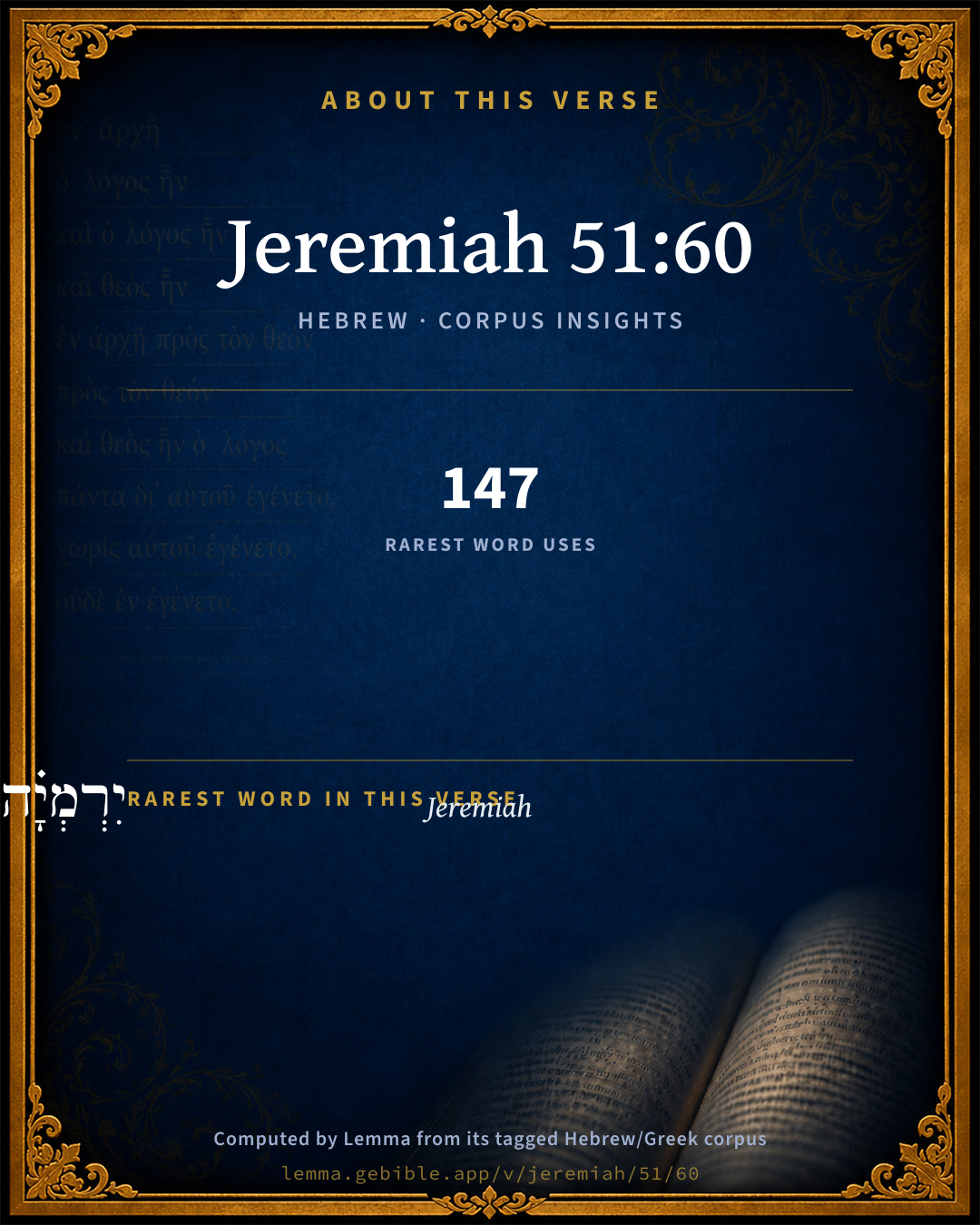
יִרְמְיָ֗הוּ
Yirmᵉyâh
H3414
“Jeremiah”
Noun, Proper
Part of Speech
Noun
Type
Proper
Full BDB Definition

Origin: from H7311 and H3050

TWOT: None

Jeremiah = "whom Jehovah has appointed" - the major prophet, son of Hilkiah of the priestly family in Anathoth; author of the prophetic book bearing his name - a man of Libnah and father of Hamutal the wife of king Josiah - a Gadite who joined David at Ziklag - a Manassehite, one of the mighty men of valour of the Transjordanic half tribe of Manasseh - a Gadite and warrior of David - a warrior of David - a priest who joined Nehemiah in the covenant ceremony - a priest also in the time of Nehemiah; maybe same as 7 - father of Jaazaniah the Rechabites
  1. וַיִּכְתֹּ֣ב kâthab H3789 “and · to write” Conjunction + Verb, Qal, Sequential Imperfect, 3rd Person, Masculine, Singular
  2. אֵ֧ת ʼêth H853 “-” Particle, Direct Object
  3. כָּל kôl H3605 “all of” Noun, Common, Masculine, Singular, Construct
  4. הָרָעָ֛ה raʻ H7451 “the · evil” Particle, Definite Article + Noun, Common, Feminine, Singular, Absolute
  5. אֲשֶׁר ʼăsher H834 “which” Particle, Relative
  6. תָּב֥וֹא bôwʼ H935 “to enter” Verb, Qal, Imperfect, 3rd Person, Feminine, Singular
  7. אֶל ʼêl H413 “to” Preposition
  8. בָּבֶ֖ל Bâbel H894 “Babylon” Noun, Proper
  9. אֶל ʼêl H413 “to” Preposition
  10. סֵ֣פֶר çêpher H5612 “book” Noun, Common, Masculine, Singular, Absolute
  11. אֶחָ֑ד ʼechâd H259 “one” Adjective, Cardinal number, Masculine, Singular, Absolute
  12. אֵ֚ת ʼêth H853 “-” Particle, Direct Object
  13. כָּל kôl H3605 “all of” Noun, Common, Masculine, Singular, Construct
  14. הַדְּבָרִ֣ים dâbâr H1697 “the · words” Particle, Definite Article + Noun, Common, Masculine, Plural, Absolute
  15. הָאֵ֔לֶּה ʼêl-leh H428 “the · these” Particle, Definite Article + Pronoun, Demonstrative, Common, Plural
  16. הַכְּתֻבִ֖ים kâthab H3789 “the · written” Particle, Definite Article + Verb, Qal, Participle Passive, Masculine, Plural, Absolute
  17. אֶל ʼêl H413 “to” Preposition
  18. בָּבֶֽל Bâbel H894 “Babylon” Noun, Proper

About this verse

These counts appear in no published source. They are computed here, from the morphology-tagged text and Lemma’s own curated glosses. What Lemma adds →

19
words
13
distinct lemmas
Prophets
section

Grammatical profile

  • 3 verbs
  • 8 nouns
  • 1 adjective
  • 1 pronoun
  • 3 prepositions
  • 3 particles

Verb forms

  • וַיִּכְתֹּ֣ב Qal · Sequential Imperfect
  • תָּב֥וֹא Qal · Imperfect
  • הַכְּתֻבִ֖ים Qal · Participle Passive

Repetition

Words recur within this verse — often emphatic in Hebrew:

  • וַיִּכְתֹּ֣ב to write H3789 ×2
  • כָּל all H3605 ×2
  • בָּבֶ֖ל Babylon H894 ×2
  • אֶל to H413 ×3

Cross-references

9

Topical passages linked to Jeremiah 51:60 in the Treasury of Scripture Knowledge — connected by theme and wording, ordered by reader-vote popularity; previews shown in the World English Bible.

  • Isaiah 30:8 Now go, write it before them on a tablet, and inscribe it in a book, that it may be for the time to come forever and ever.
  • Jeremiah 30:2–3 Thus speaks Yahweh, the God of Israel, saying, Write you all the words that I have spoken to you in a book.
  • Jeremiah 36:32 Then took Jeremiah another scroll, and gave it to Baruch the scribe, the son of Neriah, who wrote therein from the mouth of Jeremiah all the words of the book which Jehoiakim king of Judah had burned in the fire; and there were added besides to them many like words.
  • Habakkuk 2:2–3 Yahweh answered me, "Write the vision, and make it plain on tablets, that he may run who reads it.
  • Isaiah 8:1–4 Yahweh said to me, "Take a large tablet, and write on it with a man's pen, 'For Maher Shalal Hash Baz;'
  • Jeremiah 36:2–4 Take a scroll of a book, and write therein all the words that I have spoken to you against Israel, and against Judah, and against all the nations, from the day I spoke to you, from the days of Josiah, even to this day.
  • Daniel 12:4 But you, Daniel, shut up the words, and seal the book, even to the time of the end: many shall run back and forth, and knowledge shall be increased."
  • Revelation 1:11 saying, "What you see, write in a book and send to the seven assemblies: to Ephesus, Smyrna, Pergamum, Thyatira, Sardis, Philadelphia, and to Laodicea."
  • Revelation 1:19 Write therefore the things which you have seen, and the things which are, and the things which will happen hereafter;

Cross-references courtesy of OpenBible.info (CC BY 4.0).

Hebrew and Greek witnesses Masoretic Hebrew ↔ Greek Septuagint

The same verse in the two great witnesses to the Old Testament, shown verse-for-verse.

These are two independent witnesses, not word-aligned to each other, and the Septuagint is shown in lemma (dictionary) form.

Hebrew Jeremiah 51:60 Masoretic · Westminster Leningrad Codex

וַיִּכְתֹּ֣ב יִרְמְיָ֗הוּ אֵ֧ת כָּל הָרָעָ֛ה אֲשֶׁר תָּב֥וֹא אֶל בָּבֶ֖ל אֶל סֵ֣פֶר אֶחָ֑ד אֵ֚ת כָּל הַדְּבָרִ֣ים הָאֵ֔לֶּה הַכְּתֻבִ֖ים אֶל בָּבֶֽל

Jeremiah wrote in a book all the evil that should come on Babylon, even all these words that are written concerning Babylon.

World English Bible · Public Domain

Greek LXX Structure differs

In the Septuagint, Jeremiah is about an eighth shorter than the Hebrew and arranges its material differently — the Oracles Against the Nations (Hebrew chapters 46–51) appear in the middle of the Greek book, after 25:13. Because the chapter and verse boundaries do not line up, a verse-for-verse comparison with the Hebrew is not shown.

A verse-for-verse comparison isn’t shown here because the chapters and verses don’t line up. Switch to the LXX edition with the MT / LXX toggle above to read the Greek directly.

Hebrew: Westminster Leningrad Codex (CC BY 4.0). Greek: Septuagint (public domain); English from a public-domain English Septuagint. How the Septuagint differs from the Hebrew →

Targum (Aramaic paraphrase)

1

The Targum is the ancient Jewish Aramaic paraphrase of the Hebrew Scriptures — an interpretive translation, not the Hebrew text itself. Onkelos (literal) and Pseudo-Jonathan (expansive) render the Torah, and Jonathan the Prophets. Coverage is partial: where no permissively-licensed English translation exists for a verse, only the Aramaic is shown. This is verse-level text, not a word-by-word alignment to the Hebrew.

  1. Targum Jonathan Prophets (Joshua–Malachi)
    וּכְתַב יִרְמְיָה יַת כָּל בִּישְׁתָא דַעֲתִידָא לְמֵיתֵי עַל בָּבֶל עַל סִפְרָא חַד יַת כָּל פִּתְגָמַיָא הָאִלֵין דִכְתִיבִין עַל בָּבֶל:

    (no public-domain English translation for this verse)

    Targum Jonathan — Aramaic: “Mikraot Gedolot” (public domain). English: “Sefaria Community Translation” (CC0 1.0 (public-domain dedication)); “London "Chaldee Paraphrase," 1871” (public domain). Text via Sefaria.

Commentary

Notes on Jeremiah 51:60 from classic Christian and Jewish commentators (each source and its license shown beneath its notes). The classic Christian expositions comment on the surrounding passage and are grouped to its opening verse, so a note may address several verses; the Jewish commentaries on the Tanakh (Rashi and others) are per-verse, so they appear only where the commentator wrote on this verse.

Lemma curates 59 commentaries, every one of them public domain or Creative Commons licensed, each selected and text-cleaned for this edition rather than reprinted as found. About our sources →

Trapp's Complete Commentary

John Trapp

Jer 51:60 So Jeremiah wrote in a book all the evil that should come upon Babylon, [even] all these words that are written against Babylon.

Ver. 60. So Jeremiah wrote in a book all the evil.] For Babylon’s commination, if at least the book were read publicly, as some hold it was, and the Jewish captives’ consolation.

John Trapp, A Commentary or Exposition upon All the Books of the Old and New Testament (1647–1656) — public domain. Text from a community e-Sword module.

Joseph Benson's Commentary

Jer 51:60-62. So Jeremiah wrote in a book — Namely, in the two foregoing chapters; all the evil that should come upon Babylon — This was done that it might be known even in Babylon itself that Jeremiah had foretold the destruction of that city, six years before the Babylonians destroyed Jerusalem. And Jeremiah said, When thou shalt see and read all these words — This is probably to be understood, not of a mere private reading of them by himself, but of his reading them to the Jews in Babylon, (namely, those that had been carried thither in Jehoiakim’s captivity,) to comfort them under their exile, and, perhaps, in the hearing of some of the Babylonians themselves. Then shalt thou say — Looking up to God, and making a solemn protestation of the divine authority, and unquestionable certainty, of that which thou hast read; O Lord, thou hast spoken against this place — And I believe what thou hast spoken. Thou hast passed sentence upon Babylon, and it shall be executed. This is like the angel’s protestation, Rev 19:9, concerning the destruction of the New Testament Babylon, These are the true sayings of God: and Rev 21:6, These words are true and faithful. To cut it off, that none shall remain in it, &c. — Though Seraiah and the captive Jews see Babylon flourishing, yet, having read this prophecy, they must foresee Babylon falling, and by virtue of this foresight, must learn neither to envy its pomp nor fear its power. Thus, reader, when we observe what this world is, how glittering are its shows, and how flattering its proposals, let us read in the book of the Lord, that its fashion passeth away, and that it shall shortly be cut off, and made desolate for ever, and we shall learn to look upon it with a holy contempt, and to die to all its false glories and illusive joys.

Joseph Benson's Commentary on the Old and New Testaments (1811–1818) — public domain. Text from a community e-Sword module.

Adam Clarke's Commentary

Verse 60. Wrote in a book] Whether this book contained any more than is recorded in this place we do not know; probably it contained no more than what is found in Jer 51:62-64. A book, ספר sepher, signifies, in Hebrew, any writing, great or small.

Adam Clarke's Commentary on the Bible (1810–1826) — public domain. Text from a community e-Sword/MySword module.

John Calvin's Commentaries

Here we see, on one hand, what courage the Prophet had, who dared to command the king’s messenger; for though Seraiah was a meek man, so as to render himself submissive, yet Jeremiah exposed himself to danger; for he might have been timid, though he was neither proud nor arrogant; and thus, as men are wont to do when terrified, he might have referred to the king what he had heard from the Prophet. Then Jeremiah did what we here read, not without danger; and hence appears his firmness. We then see that he was endued with the spirit of invincible courage, so as to discharge his office freely and intrepidly.

On the other hand, we have to observe not only the meekness of Seraiah, but also his piety, together with his modesty; for except he had in him a strong principle of religion, he might have adduced plausible reasons for refusing. As, then, he was so submissive, and dreaded no danger, it is evident that the real fear of God was vigorous in his soul.

And these things ought to be carefully noticed; for who of our cornfly princes can be found at this day who will close his eyes to all dangers, and resolutely disregard all adverse events, when God and his servants are to be obeyed? And then we see how pusillanimous are those who profess to be God’s ambassadors, and claim to themselves the name of Pastors. As, then, teachers dare not faithfully to perform their office, so on the other hand courtly princes are so devoted to themselves and to their own prudence, that they are unwilling to undertake duties which are unpopular. On this account, then, this passage, with all its circumstances, ought to be carefully noticed.

John Calvin's Commentaries (1540-1563) — public domain. Text from the Calvin Translation Society English edition (1840s-50s) via the Christian Classics Ethereal Library (ccel.org). Calvin's coverage is partial (roughly two-thirds of the Bible); uncommented books and verses are honest gaps, never fabricated. The 19th-century editor's footnotes and remarks are omitted so the notes are faithfully Calvin's own voice.

Ellicott's Commentary for English Readers

(60) So Jeremiah wrote in a book.—The “book” is, as elsewhere, a parchment roll. Stress is laid on the fact that the long prophecy was all written on one roll, so that it might be a fitter symbol of the city that was its subject.

A Bible Commentary for English Readers, edited by Charles John Ellicott (1878–1897) — public domain. Text from a community e-Sword module.

The Cambridge Bible for Schools and Colleges

gen. ed. J. J. S. Perowne

60. a book] See introd. note. The latter part of the v. which seems to identify this book, or rather roll, scroll, with the preceding prophecy, Jer_50:2 to Jer_51:58, is doubtless only a note.

The Cambridge Bible for Schools and Colleges (gen. ed. J. J. S. Perowne; Cambridge University Press, 1878–1918) — public domain. Text from a community e-Sword module.

John Gill's Exposition

Then shall thou say, O Lord,.... Acknowledging this prophecy to be of God; believing the accomplishment of it; and praying over it, and for it, like a good man, as doubtless he was:

thou hast spoken against this place; the city of Babylon, where Seraiah is now supposed to be:

to cut it off, that none shall remain in it, neither man nor beast, but that it shall be desolate for ever; this is the substance of the whole prophecy, that the destruction of Babylon should be an utter and a perpetual one; and which is expressed in the same words that are here used, Jer 50:3.

John Gill's Exposition of the Whole Bible (1746–1763) — public domain (CC PDM 1.0). Text via the HelloAO Bible API.

Whedon's Commentary on the Bible

Daniel D. Whedon

60. In a book — Literally, in one book, a parenthetic remark which paves the way for the direction given in Jer_51:63.

Daniel D. Whedon (gen. ed.), Commentary on the Old and New Testaments (1874–1909) — public domain. Text from a community e-Sword module.

The Pulpit Commentary

Evil written in a book.

I THE FACT THAT EVIL IS WRITTEN AS WELL AS SPOKEN. The evils that Jehovah denounced against Babylon were such as could be written in a book, because the denunciations were not those of selfish and hasty passion, but expressed the calm wrath of a righteous God. The judgment on Babylon arose from the necessity of the position. A righteous God could not have acted otherwise. What a difference between his words in anger and our words! If all our angry, hasty, petulant words were perforce written in a book, what a record of shame there would be! Such a consequence of their utterance might make us a little more cautious, but still the words would come at times. If we are to understand what it is to be really angry and sin not, we must look at the deliberate records of Jehovah"s wrath in the Scriptures. We are glad that our angry words should be forgotten; God, so to speak, takes trouble that his words should be remembered.

II THE NECESSITY THAT THESE WORDS SHOULD BE WRITTEN. It is not enough that the words might be written there had to be a reason for the writing. This is found in the necessity for doing all that could be done by way of warning and preparation. What was written could be shown first to one and then another. There was a necessity that even people of Babylon themselves should have ample opportunity to profit by the words spoken against their city. A necessity too in history. The fall of Babylon is a remarkable event in history, altogether outside of Scripture records, but the real secret of its fall is only to be known when we read such solemn and sustained predictions as are found in these two chapters.

III GOD"S DENUNCIATIONS ARE NOT HIS ONLY WRITTEN WORDS. God has to write down his threatenings, but we are bound to remember that they are only a part and how small a part they are! of the total that he has caused to be written. How different he is in this respect from men! Their threatenings and angry words would sometimes fill a goodly volume, but their words of kindness and long suffering, on, now few are they! God"s delight is to cause words of grace and premises of reward to be written. Y.

The Pulpit Commentary (1880–1919), ed. H.D.M. Spence-Jones & Joseph S. Exell — public domain. Text from a community e-Sword module.

Lesson kit

Teaching starters — assembled from the data on this page, not authored interpretation. Every prompt links to the verse data it draws on. Edit before teaching.

Jeremiah, in the Prophets, opens this verse with 19 words (13 distinct Hebrew lemmas). Its most distinctive word is Yirmᵉyâh (“Jeremiah”). A historical commentator’s framing appears above. Read the whole chapter for the surrounding context.

Discussion questions

  1. What does “Jeremiah” (Yirmᵉyâh) contribute to the verse as a whole?
  2. How does Isaiah 30:8, which shares this passage’s theme, read alongside this verse?
  3. What does the repetition of “to write” (2× in this one verse) do in this verse?
  4. The translations on this page render this verse differently — a whole-verse word diff, not a word-by-word alignment. What might account for the different wordings?
  5. «וַיִּכְתֹּ֣ב» is a Qal Sequential Imperfect verb. How does that grammatical form shape the action described?
  6. Compare how Trapp's Complete Commentary and Joseph Benson's Commentary read this verse. Where do they agree or differ?

Things to notice

Reading settings

Reading text

Shown beneath each verse's original-language words.

Old Testament
Old Testament edition

Read the OT as the Masoretic Hebrew (MT) or the Greek Septuagint (LXX).

English shown for the Greek Septuagint (in the Hebrew ↔ Greek comparison).

Comparing translations? Open the Compare panel on any verse page to stack up to four side by side.