Numbers 33:2

Hebrew (Westminster Leningrad Codex) Numbers 33:2 appears in the Hebrew Old Testament. The text above is from the Westminster Leningrad Codex. Each word links to its Strong’s number, a concise gloss, and parsing drawn from the Open Scriptures Hebrew Bible morphology. Click any word for its full Brown-Driver-Briggs (BDB) entry.
Download image
Cite this verse

Numbers 33:2 (World English Bible). Public Domain. Lemma interlinear Bible study tool, https://lemma.gebible.app/v/numbers/33/2.

Show BibTeX & RIS
BibTeX
RIS
English Translation
Moses wrote their goings out according to their journeys by the commandment of Yahweh: and these are their journeys according to their goings out.
World English Bible · Public Domain
Download a study sheet

One document with this verse’s original text, its word-by-word gloss line, the meaning frame, cross-references with their text, attributed commentary, and full source and license credits — printable, and it pastes into notes with its structure intact.

This verse Autodidact and up

Study sheet (.html) Plain text (.txt)

A passage Seminary Student

Up to 50 verses in one chapter. A passage sheet keeps up to 6 commentary sources and 12 cross-references per verse, in the order this page ranks them, and says so on the sheet whenever that leaves anything out. Ask for a single verse and you get the Autodidact verse sheet above.

Everything on this page stays free to read, with no account — the sheet is a download of what is already on screen, not access to it.

Want to remove ads? Support Godless Engineer
Compare translations 3

The same verse in 3 English versions, stacked beneath the original-language interlinear above. Click any original word for its lexicon entry.

Each is an independent rendering of the whole verse — the interlinear is not word-aligned to these translations.

Highlighted words mark where these versions differ — a whole-verse word diff, not a word-by-word alignment.

  • World English Bible Public Domain
    Moses wrote their goings out according to their journeys by the commandment of Yahweh: and these are their journeys according to their goings out.
  • King James Version Public Domain
    And Moses wrote their goings out according to their journeys by the commandment of the LORD: and these are their journeys according to their goings out.
  • unfoldingWord Literal Text CC BY-SA 4.0
    And Moses wrote down their departure points according to their tribes in accordance with the mouth of Yahweh, and these are their journeys according to their departure points.

unfoldingWord Literal Text — © unfoldingWord, licensed CC BY-SA 4.0. Word-aligned USFM3 via Door43 (git.door43.org/unfoldingWord/en_ult).

Versions to compare (up to 4)

3 of 4 selected

Show all 18 translations

Every available English version of this verse, each an independent rendering of the whole verse.

  • World English Bible Public Domain
    Moses wrote their goings out according to their journeys by the commandment of Yahweh: and these are their journeys according to their goings out.
  • Berean Standard Bible Public Domain
    At the LORD’s command, Moses recorded the stages of their journey. These are the stages listed by their starting points:
  • Majority Standard Bible Public Domain
    At the LORD’s command, Moses recorded the stages of their journey. These are the stages listed by their starting points:
  • King James Version Public Domain
    And Moses wrote their goings out according to their journeys by the commandment of the LORD: and these are their journeys according to their goings out.
  • American Standard Version (1901) Public Domain
    And Moses wrote their goings out according to their journeys by the commandment of Jehovah: and these are their journeys according to their goings out.
  • Revised Version (1885) Public Domain
    And Moses wrote their goings out according to their journeys by the commandment of the LORD: and these are their journeys according to their goings out.
  • Geneva Bible (1599) Public Domain
    And Moses wrote their going out by their iourneies according to ye commandement of the Lord: so these are ye iourneies of their going out.
  • Douay-Rheims (1899) Public Domain
    Which Moses wrote down according to the places of their encamping, which they changed by the commandment of the Lord.
  • Young's Literal Translation Public Domain
    and Moses writeth their outgoings, by their journeys, by the command of Jehovah; and these `are' their journeys, by their outgoings:
  • Literal Standard Version CC BY-SA 4.0
    and Moses writes their outgoings, by their journeys, by the command of YHWH; and these [are] their journeys, by their outgoings:
  • Unlocked Literal Bible CC BY-SA 4.0
    Moses wrote down the places from where they left to where they went, as commanded by Yahweh. These were their movements, departure after departure.
  • unfoldingWord Literal Text CC BY-SA 4.0
    And Moses wrote down their departure points according to their tribes in accordance with the mouth of Yahweh, and these are their journeys according to their departure points.
  • Darby Bible Public Domain
    And Moses wrote their goings out according to their journeys by the commandment of Jehovah; and these are their journeys according to their goings out.
  • World Messianic Bible Public Domain
    Moses wrote the starting points of their journeys by the commandment of the LORD. These are their journeys according to their starting points.
  • Webster's Bible Public Domain
    And Moses wrote their goings out according to their journeys by the commandment of the LORD: and these are their journeys according to their goings out.
  • Free Bible Version CC BY-SA 4.0
    Moses recorded the different parts of their journey as instructed by the Lord. These are the journeys they made listed in order from where they started:
  • Bible in Basic English Public Domain
    And the stages of their journey on their way out were put down in writing by Moses at the order of the Lord: these are the stages of their journey and the way they went.
  • JPS Tanakh (1917) Public Domain
    And Moses wrote their goings forth, stage by stage, by the commandment of the LORD; and these are their stages at their goings forth.

Literal Standard Version (2020), Covenant Press — licensed CC BY-SA 4.0. Text via the HelloAO Bible API (eBible.org). Unlocked Literal Bible (unfoldingWord) — licensed CC BY-SA 4.0. Text via the HelloAO Bible API (eBible.org). unfoldingWord Literal Text — © unfoldingWord, licensed CC BY-SA 4.0. Word-aligned USFM3 via Door43 (git.door43.org/unfoldingWord/en_ult). Free Bible Version, Dr. Jonathan Gallagher — licensed CC BY-SA 4.0. Text via the HelloAO Bible API (eBible.org).

Word by word

More ways to search: Search by grammar → Find every occurrence → Compare this word →

Practice this passage: Drill this verse → Learn its vocabulary →

לְמַסְעֵיהֶ֖ם
maççaʻ
H4550
“to/for · journeys · their”
Preposition + Noun, Common, Masculine, Plural, Construct + Suffix, Personal, 3rd Person, Masculine, Plural
Part of Speech
Preposition + Noun
Type
Common
Gender
Masculine
Number
Plural
State
Construct
Full BDB Definition

Origin: from H5265

TWOT: 1380a

a pulling up (of stakes), breaking camp, setting out, journey - pulling up, breaking camp - setting out - station, stage, journey
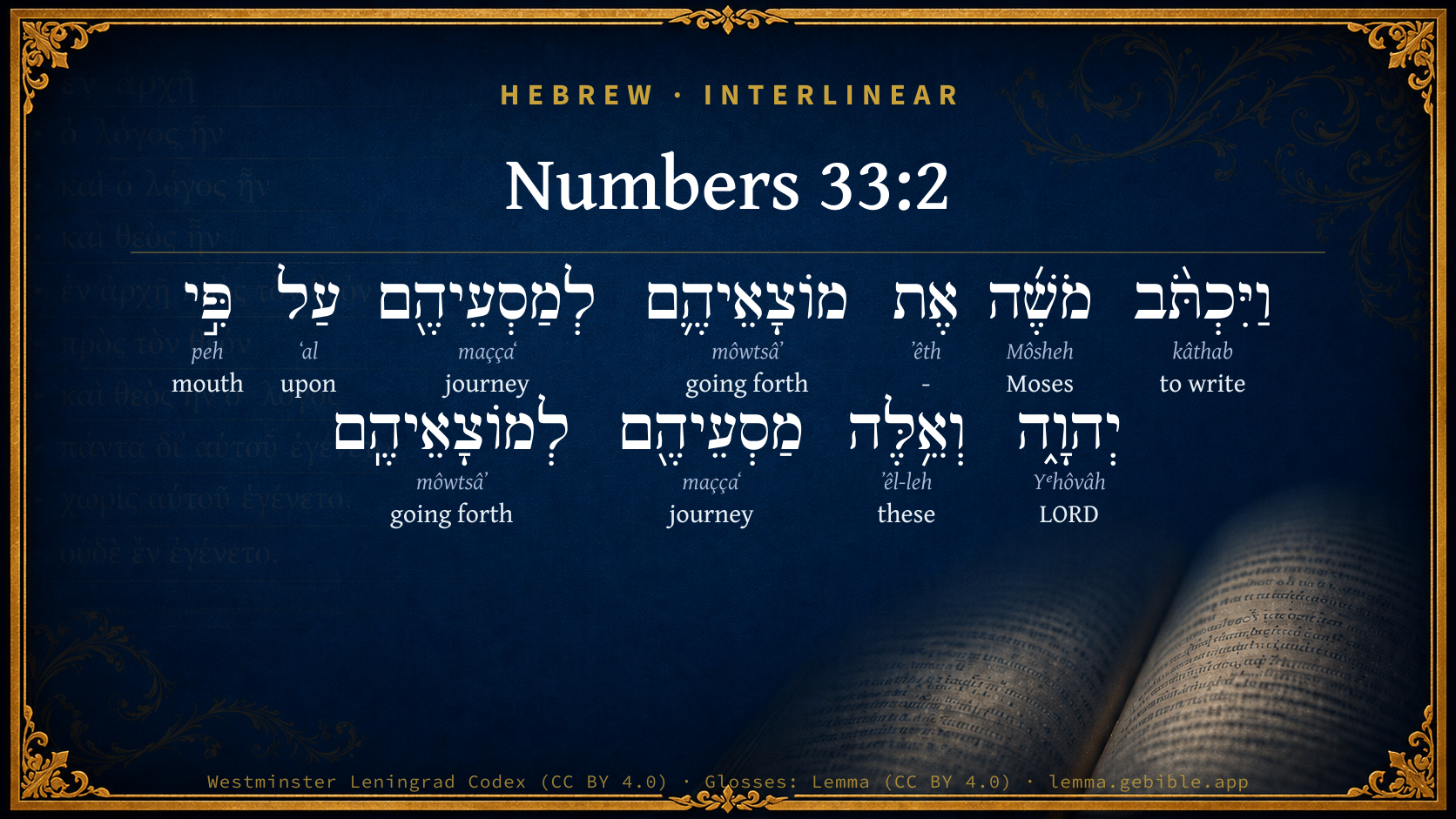
  1. וַיִּכְתֹּ֨ב kâthab H3789 “and · to write” Conjunction + Verb, Qal, Sequential Imperfect, 3rd Person, Masculine, Singular
  2. מֹשֶׁ֜ה Môsheh H4872 “Moses” Noun, Proper
  3. אֶת ʼêth H853 “-” Particle, Direct Object
  4. מוֹצָאֵיהֶ֛ם môwtsâʼ H4161 “goings forth · their” Noun, Common, Masculine, Plural, Construct + Suffix, Personal, 3rd Person, Masculine, Plural
  5. עַל ʻal H5921 “upon” Preposition
  6. פִּ֣י peh H6310 “mouth of” Noun, Common, Masculine, Singular, Construct
  7. יְהוָ֑ה Yᵉhôvâh H3068 “LORD” Noun, Proper
  8. וְאֵ֥לֶּה ʼêl-leh H428 “and · these” Conjunction + Pronoun, Demonstrative, Common, Plural
  9. מַסְעֵיהֶ֖ם maççaʻ H4550 “journeys · their” Noun, Common, Masculine, Plural, Construct + Suffix, Personal, 3rd Person, Masculine, Plural
  10. לְמוֹצָאֵיהֶֽם môwtsâʼ H4161 “to/for · goings forth · their” Preposition + Noun, Common, Masculine, Plural, Construct + Suffix, Personal, 3rd Person, Masculine, Plural

About this verse

These counts appear in no published source. They are computed here, from the morphology-tagged text and Lemma’s own curated glosses. What Lemma adds →

11
words
9
distinct lemmas
Pentateuch
section

Notable vocabulary

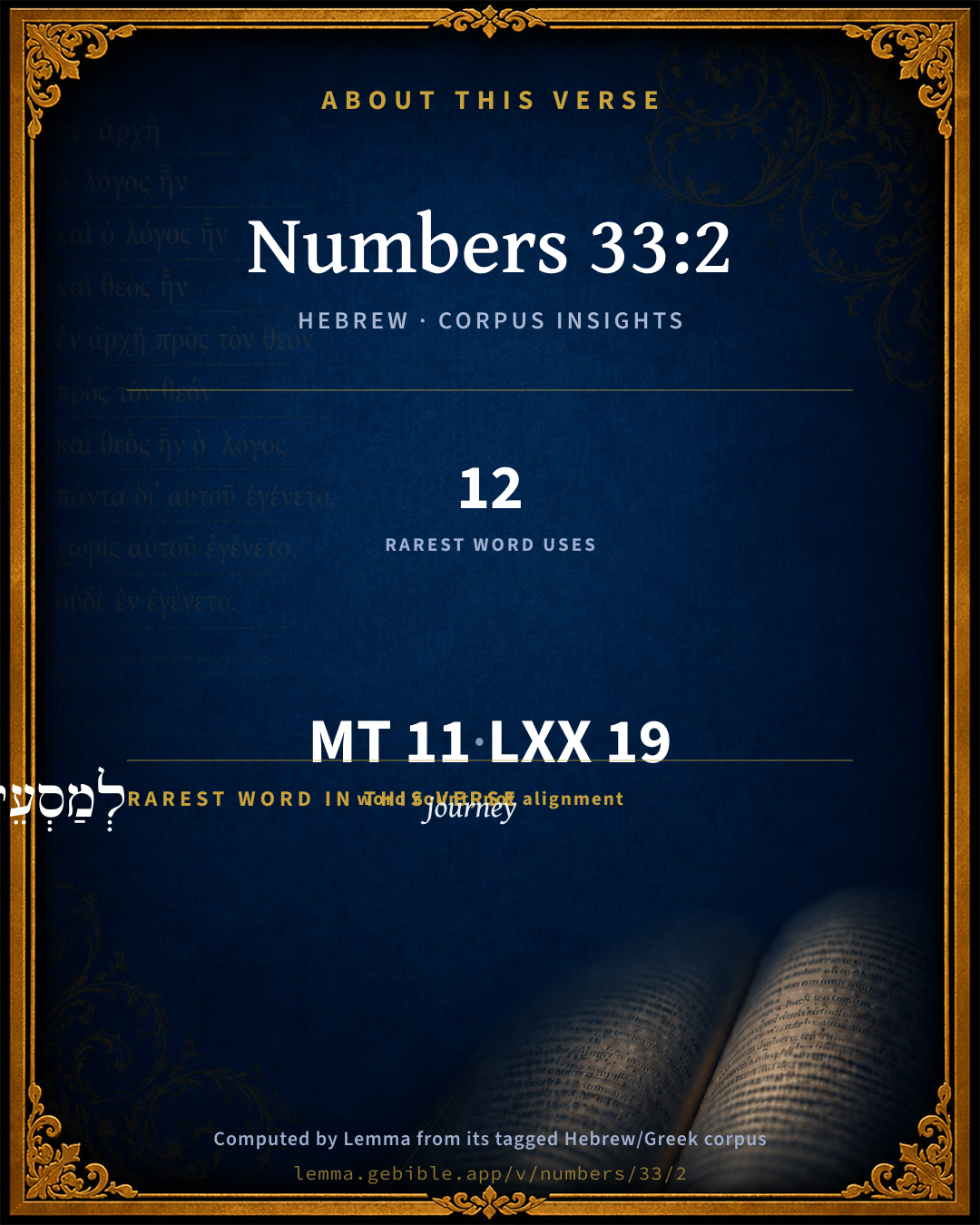
The rarest word here is לְמַסְעֵיהֶ֖ם journey H4550 — appearing just 12 times in the whole Hebrew Bible.

Shared distinctive vocabulary

לְמַסְעֵיהֶ֖ם journey H4550 occurs in 11 verses of the Hebrew Bible. Also found in:

Grammatical profile

  • 1 verb
  • 7 nouns
  • 1 pronoun
  • 1 preposition
  • 1 particle

Verb forms

  • וַיִּכְתֹּ֨ב Qal · Sequential Imperfect

Repetition

Words recur within this verse — often emphatic in Hebrew:

  • מוֹצָאֵיהֶ֛ם going forth H4161 ×2
  • לְמַסְעֵיהֶ֖ם journey H4550 ×2

Hebrew & Septuagint length

In English translation the verse runs 24 words from the Hebrew and 22 from the Septuagint (LXX English) — closely comparable.

A rough comparison of the two English renderings, which tokenize alike — not a word-level alignment.

Word counts can differ between the Hebrew and the Greek without any difference in meaning — e.g. the Hebrew direct-object marker אֵת has no separate Greek word, and Greek often adds the article ὁ.

In the original languages it is 11 Hebrew tokens and 19 Greek tokens — but the two are counted differently (Hebrew bundles its prefixes and suffixes into one token; the Greek is in lemma form), so that isn’t a like-for-like length.

Cross-references

5

Topical passages linked to Numbers 33:2 in the Treasury of Scripture Knowledge — connected by theme and wording, ordered by reader-vote popularity; previews shown in the World English Bible.

  • Numbers 9:17–23 Whenever the cloud was taken up from over the Tent, then after that the children of Israel traveled; and in the place where the cloud remained, there the children of Israel encamped.
  • Numbers 10:6 When you blow an alarm the second time, the camps that lie on the south side shall take their journey: they shall blow an alarm for their journeys.
  • Numbers 10:13 They first took their journey according to the commandment of Yahweh by Moses.
  • Deuteronomy 1:2 It is eleven days' [journey] from Horeb by the way of Mount Seir to Kadesh-barnea.
  • Deuteronomy 10:11 Yahweh said to me, Arise, take your journey before the people; and they shall go in and possess the land, which I swore to their fathers to give to them.

Cross-references courtesy of OpenBible.info (CC BY 4.0).

Hebrew and Greek witnesses Masoretic Hebrew ↔ Greek Septuagint

The same verse in the two great witnesses to the Old Testament, shown verse-for-verse.

These are two independent witnesses, not word-aligned to each other, and the Septuagint is shown in lemma (dictionary) form.

Hebrew Numbers 33:2 Masoretic · Westminster Leningrad Codex

וַיִּכְתֹּ֨ב מֹשֶׁ֜ה אֶת מוֹצָאֵיהֶ֛ם לְמַסְעֵיהֶ֖ם עַל פִּ֣י יְהוָ֑ה וְאֵ֥לֶּה מַסְעֵיהֶ֖ם לְמוֹצָאֵיהֶֽם

Moses wrote their goings out according to their journeys by the commandment of Yahweh: and these are their journeys according to their goings out.

World English Bible · Public Domain

Greek LXX Numbers 33:2 Septuagint · lemma form

καί γράφω μωυσῆς ὁ ἄπαρσις αὐτός καί ὁ σταθμός αὐτός διά ῥῆμα κύριος καί οὗτος σταθμός ὁ πορεία αὐτός

And Moses wrote their removals and their stages, by the word of the Lord: and these are the stages of their journeying.

LXX2012 (modern English Septuagint) · Public Domain

On this verse, The Pulpit Commentary discusses the Septuagint’s reading. Read the note in Commentary ↓

Hebrew: Westminster Leningrad Codex (CC BY 4.0). Greek: Septuagint (public domain); English from LXX2012 (modern English Septuagint) (Public Domain). How the Septuagint differs from the Hebrew →

Targum (Aramaic paraphrase)

2

The Targum is the ancient Jewish Aramaic paraphrase of the Hebrew Scriptures — an interpretive translation, not the Hebrew text itself. Onkelos (literal) and Pseudo-Jonathan (expansive) render the Torah, and Jonathan the Prophets. Coverage is partial: where no permissively-licensed English translation exists for a verse, only the Aramaic is shown. This is verse-level text, not a word-by-word alignment to the Hebrew.

  1. Targum Onkelos Torah (Genesis–Deuteronomy)
    וּכְתַב משֶׁה יָת מַפְּקָנֵיהוֹן לְמַטְלָנֵיהוֹן עַל מֵימְרָא דַיְיָ וְאִלֵין מַטְלָנֵיהוֹן לְמַפְּקָנֵיהוֹן

    (no public-domain English translation for this verse)

    Targum Onkelos — Aramaic: “Onkelos Genesis” (public domain); “Onkelos Exodus” (public domain); “Onkelos Leviticus” (public domain); “Onkelos Numbers” (public domain); “Onkelos Deuteronomy” (public domain). English: “Sefaria Community Translation” (CC0 1.0 (public-domain dedication)); “J.W. Etheridge. The Targums of Onkelos and Jonathan Ben Uzziel on the Pentateuch. London: Longmans, Green, 1862” (public domain). Text via Sefaria.

  2. Targum Pseudo-Jonathan Torah (Genesis–Deuteronomy)
    וּכְתַב משֶׁה יַת מַפְקָנֵיהוֹן לְמַטְלָנֵיהוֹן עַל מֵימַר דַיְיָ וְאִלְיֵין מַטְלָנֵיהוֹן לְמַפְקָנֵיהוֹן

    And Mosheh recorded their outgoings by their journeys by the Word of the Lord; and these are their journeys by their goings forth.

    Targum Pseudo-Jonathan — Aramaic: “Targum Jonathan on Genesis” (public domain); “Targum Jonathan on Exodus” (public domain); “Targum Jonathan on Leviticus” (public domain); “Targum Jonathan on Numbers” (public domain); “Targum Jonathan on Deuteronomy” (public domain). English: “The Targum of Jonathan ben Uzziel, trans. J. W. Etheridge, London, 1862” (public domain). Text via Sefaria.

Commentary

Notes on Numbers 33:2 from classic Christian and Jewish commentators (each source and its license shown beneath its notes). The classic Christian expositions comment on the surrounding passage and are grouped to its opening verse, so a note may address several verses; the Jewish commentaries on the Tanakh (Rashi and others) are per-verse, so they appear only where the commentator wrote on this verse.

Lemma curates 59 commentaries, every one of them public domain or Creative Commons licensed, each selected and text-cleaned for this edition rather than reprinted as found. About our sources →

Trapp's Complete Commentary

John Trapp

Num 33:2 And Moses wrote their goings out according to their journeys by the commandment of the LORD: and these [are] their journeys according to their goings out.

Ver. 2. And Moses wrote.] Moses was primus in historia, as Martial saith of Salust.

John Trapp, A Commentary or Exposition upon All the Books of the Old and New Testament (1647–1656) — public domain. Text from a community e-Sword module.

Jamieson, Fausset & Brown

Robert Jamieson, A. R. Fausset & David Brown

Moses wrote their goings out according to their journeys by the commandment of the Lord--The wisdom of this divine order is seen in the importance of the end to which it was subservient--namely, partly to establish the truth of the history, partly to preserve a memorial of God's marvellous interpositions on behalf of Israel, and partly to confirm their faith in the prospect of the difficult enterprise on which they were entering, the invasion of Canaan.

Jamieson, Fausset & Brown — Commentary Critical and Explanatory on the Whole Bible (1871) — public domain (CC PDM 1.0). Text via the HelloAO Bible API.

Adam Clarke's Commentary

Verse 2. And Moses wrote their goings out according to their journeys] We may consider the whole book of Numbers as a diary, and indeed the first book of travels ever published. Dr. Shaw, Dr. Pococke, and several others, have endeavoured to mark out the route of the Israelites, through this great, dreary, and trackless desert, and have ascertained many of the stages here described. Indeed there are sufficient evidences of this important journey still remaining, for the descriptions of many are so particular that the places are readily ascertained by them; but this is not the case with all. Israel was the Church of God in the wilderness, and its unsettled, wandering state under Moses may point out the unsettled state of religion under the law. Their being brought, after the death of Moses, into the promised rest by Joshua, may point out the establishment, fixedness, and certainty of that salvation provided by Jesus Christ, of whom Joshua, in name and conduct, was a remarkable type. Mr. Ainsworth imagines that the forty-two stations here enumerated, through which the Israelites were brought to the verge of the promised land, and afterwards taken over Jordan into the rest which God had promised, point out the forty-two generations from Abraham unto Christ, through whom the Saviour of the world came, by whose blood we have an entrance into the holiest, and enjoy the inheritance among the saints in light. And Mr. Bromley, in his Way to the Sabbath of Rest, considers each name and place as descriptive of the spiritual state through which a soul passes in its way to the kingdom of God. But in cases of this kind fancy has much more to do than judgment.

Adam Clarke's Commentary on the Bible (1810–1826) — public domain. Text from a community e-Sword/MySword module.

Ellicott's Commentary for English Readers

(2) By the commandment of the Lord.—It does not clearly appear whether these words should be understood of the record of the journeys of the Israelites as being made by Moses in obedience to a Divine command, or whether they should be understood of the journeys themselves as being taken in obedience to the Divine command.

A Bible Commentary for English Readers, edited by Charles John Ellicott (1878–1897) — public domain. Text from a community e-Sword module.

John Gill's Exposition

And Moses wrote their goings out according to their journeys, by the commandment of the Lord,.... Which may be understood, either that their journeys were by the commandment of the Lord; so Aben Ezra takes the connection to be, and which is undoubtedly true, and which is expressed plainly elsewhere; for so it was, that when the cloud abode on the tabernacle they rested, and had their stations, and continued as long as the cloud tarried on it, and when that was taken up, then they marched; and thus at the commandment of the Lord they rested, and at the commandment of the Lord they journeyed, see Num 9:17 or that Moses wrote the account of their journeys, and several stations, at the commandment of the Lord, that it might be on record, and be read in future ages, and appear to be a fact, that they were led about in a wilderness, in places which were unknown to others, and had no names but what they gave them:

and these are their journeys according to their goings out; from place to place; some of the ancients, as Jerom (z) particularly, and some modern writers, have allegorized these journeys of the children of Israel, and have fancied that there is something in the signification of the names of the places they came to, and abode in, suitable to the cases and circumstances of the people of God in their passage through this world; but though the travels of the children of Israel in the wilderness may in general be an emblem of the case and condition of the people of God in this world, and there are many things in them, and which they met with, and befell them, that may be accommodated to them; yet the particulars will never hold good of individual saints, since they are not all led exactly in the same path of difficulties and troubles, but each have something peculiar to themselves; and it will be difficult to apply these things to the church of God in general, in the several stages and periods of time, and which I do not know that any have attempted; and yet, if there is anything pointed out by the travels, one would think it should be that.

(z) "De 42 mansionibus", Fabiolae, "inter opera ejus", T. 3. fol. 13.

John Gill's Exposition of the Whole Bible (1746–1763) — public domain (CC PDM 1.0). Text via the HelloAO Bible API.

Haydock's Catholic Bible Commentary

Which. Hebrew, "and Moses wrote down their departure and their marches, by the commandment of the Lord; and these are their journeys, according to their going out." These are the places of any note in that wide and dreary desert, near which the Israelites passed. All the encampments are not intended to be specified. The people marched on slowly, and sought for pasturage, with all diligence. The names of these more remarkable places, have been so differently pronounced, that many of them have been greatly confounded; (Calmet) and interpreters vary so much in their situation, that nothing can be decided with certainty. (Haydock)

George Leo Haydock (1774–1849), Haydock's Catholic Family Bible and Commentary, 1859 edition — public domain. Excludes Psalms (Douay-Rheims chapter numbering differs from Protestant) and Deuterocanonical books (Catholic canon only).

Matthew Poole's English Annotations

Moses would have this done, partly to evince the truth of the history, partly to preserve the remembrance of God’s glorious and miraculous works both of judgment and mercy towards his people, and thereby to confirm their faith in their present difficult undertaking.

Matthew Poole's English Annotations on the Holy Bible (1683–1685) — public domain. Text from a community e-Sword/MySword module.

Whedon's Commentary on the Bible

Daniel D. Whedon

2. Moses wrote their goings — This is a proof of the Mosaic authorship of this book. See Introduction, (2.)

By the commandment of the Lord — While all Scripture is given by inspiration in some degree, this important record is written by commandment, implying the highest degree of inspiration.

Daniel D. Whedon (gen. ed.), Commentary on the Old and New Testaments (1874–1909) — public domain. Text from a community e-Sword module.

The Pulpit Commentary

And Moses wrote their goings out (axWm Septuagint, aparseiv ) according to their journeys by the commandment of the Lord. The latter clause (hwOhy ypiAl) may be taken as equivalent to an adjective qualifying the noun "goings out," signifying only that their marches were made under the orders of God himself. It is more natural to read it with the verb "wrote;" and in that case we have a direct assertion that Moses wrote this list of marches himself by command of God, doubtless as a memorial not only of historical interest, but of deep religious significance, as showing how Israel had been led by him who is faithful and true faithful in keeping his promise, true in fulfilling his word for good or for evil. The direct statement that Moses wrote this list himself is strongly corroborated by internal evidence, and has been accepted as substantially true by the most destructive critics. No conceivable inducement could have existed to invent a list of marches which only partially corresponds with the historical account, and can only with difficulty be reconciled with it a list which contains many names nowhere else occurring, and having no associations for the later Israelites. Whether the statement thus introduced tells in favour of the Mosaic authorship (as usually accepted) of the rest of the Book is a very different matter, on which see the Introduction.

The Pulpit Commentary (1880–1919), ed. H.D.M. Spence-Jones & Joseph S. Exell — public domain. Text from a community e-Sword module.

John Wesley's Explanatory Notes

And Moses wrote their goings out - When they set out, God ordered him to keep a journal of all the remarkable occurrences in the way, that it might be a satisfaction to himself and an instruction to others. It may be of use to Christians, to preserve an account of the providences of God concerning them, the constant series of mercies they have experienced, and especially those turns which have made some days of their lives more remarkable.

John Wesley, Explanatory Notes Upon the Whole Bible (1754–1765) — public domain. Text via the GEBible commentary corpus.

Lesson kit

Teaching starters — assembled from the data on this page, not authored interpretation. Every prompt links to the verse data it draws on. Edit before teaching.

Numbers, in the Pentateuch, opens this verse with 11 words (9 distinct Hebrew lemmas). Its most distinctive word is maççaʻ (“journey”). A historical commentator’s framing appears above. Read the whole chapter for the surrounding context.

Discussion questions

  1. The word maççaʻ carries the sense “journey.” How does it shape the verse?
  2. Genesis 13:3 shares the word «journey» with this verse. How do the two illuminate each other?
  3. “going forth” occurs 2× in this one verse. What is the effect of the repetition?
  4. These translations render this verse differently. What is at stake in choosing one wording over another?
  5. The verb «וַיִּכְתֹּ֨ב» is Qal Sequential Imperfect. How does its form color the action?
  6. Reading how Trapp's Complete Commentary and Jamieson, Fausset & Brown read this verse, where do the two commentators agree and where do they part?

Things to notice

Reading settings

Reading text

Shown beneath each verse's original-language words.

Old Testament
Old Testament edition

Read the OT as the Masoretic Hebrew (MT) or the Greek Septuagint (LXX).

English shown for the Greek Septuagint (in the Hebrew ↔ Greek comparison).

Comparing translations? Open the Compare panel on any verse page to stack up to four side by side.