
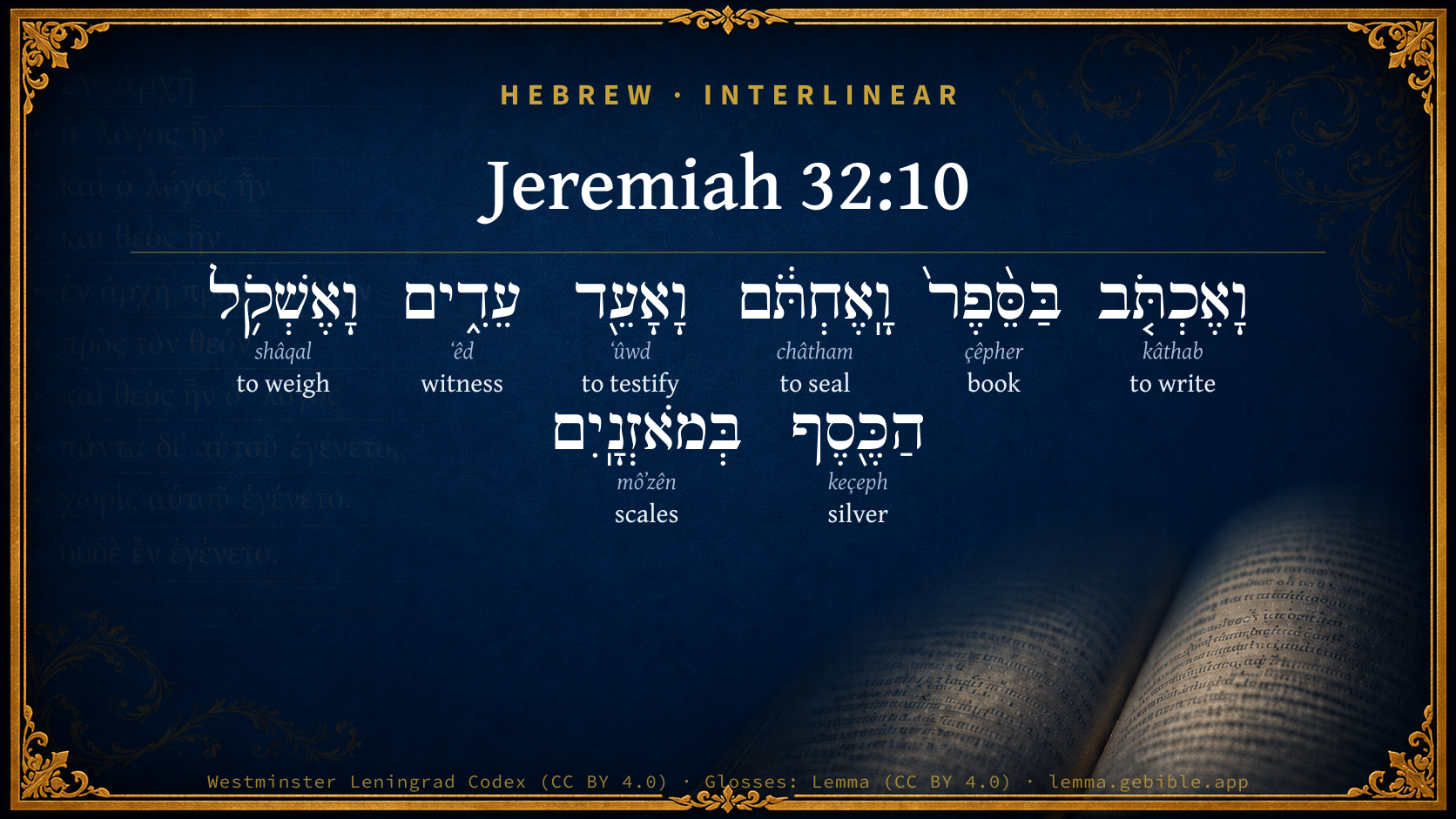
Jeremiah 32:10

Hebrew (Westminster Leningrad Codex) Jeremiah 32:10 appears in the Hebrew Old Testament. The text above is from the Westminster Leningrad Codex. Each word links to its Strong’s number, a concise gloss, and parsing drawn from the Open Scriptures Hebrew Bible morphology. Click any word for its full Brown-Driver-Briggs (BDB) entry.
Download image
Cite this verse

Jeremiah 32:10 (World English Bible). Public Domain. Lemma interlinear Bible study tool, https://lemma.gebible.app/v/jeremiah/32/10.

Show BibTeX & RIS
BibTeX
RIS
English Translation
I subscribed the deed, and sealed it, and called witnesses, and weighed him the money in the balances.
World English Bible · Public Domain
Download a study sheet

One document with this verse’s original text, its word-by-word gloss line, the meaning frame, cross-references with their text, attributed commentary, and full source and license credits — printable, and it pastes into notes with its structure intact.

This verse Autodidact and up

Study sheet (.html) Plain text (.txt)

A passage Seminary Student

Up to 50 verses in one chapter. A passage sheet keeps up to 6 commentary sources and 12 cross-references per verse, in the order this page ranks them, and says so on the sheet whenever that leaves anything out. Ask for a single verse and you get the Autodidact verse sheet above.

Everything on this page stays free to read, with no account — the sheet is a download of what is already on screen, not access to it.

Want to remove ads? Support Godless Engineer
Compare translations 3

The same verse in 3 English versions, stacked beneath the original-language interlinear above. Click any original word for its lexicon entry.

Each is an independent rendering of the whole verse — the interlinear is not word-aligned to these translations.

Highlighted words mark where these versions differ — a whole-verse word diff, not a word-by-word alignment.

  • World English Bible Public Domain
    I subscribed the deed, and sealed it, and called witnesses, and weighed him the money in the balances.
  • King James Version Public Domain
    And I subscribed the evidence, and sealed it, and took witnesses, and weighed him the money in the balances.
  • unfoldingWord Literal Text CC BY-SA 4.0
    Then I wrote in a scroll and sealed it, and had witnesses witness it. Then I weighed the silver in the scales.

unfoldingWord Literal Text — © unfoldingWord, licensed CC BY-SA 4.0. Word-aligned USFM3 via Door43 (git.door43.org/unfoldingWord/en_ult).

Versions to compare (up to 4)

3 of 4 selected

Show all 18 translations

Every available English version of this verse, each an independent rendering of the whole verse.

  • World English Bible Public Domain
    I subscribed the deed, and sealed it, and called witnesses, and weighed him the money in the balances.
  • Berean Standard Bible Public Domain
    I signed and sealed the deed, called in witnesses, and weighed out the silver on the scales.
  • Majority Standard Bible Public Domain
    I signed and sealed the deed, called in witnesses, and weighed out the silver on the scales.
  • King James Version Public Domain
    And I subscribed the evidence, and sealed it, and took witnesses, and weighed him the money in the balances.
  • American Standard Version (1901) Public Domain
    And I subscribed the deed, and sealed it, and called witnesses, and weighed him the money in the balances.
  • Revised Version (1885) Public Domain
    And I subscribed the deed, and sealed it, and called witnesses, and weighed him the money in the balances.
  • Geneva Bible (1599) Public Domain
    And I writ it in the booke and signed it, and tooke witnesses, and weighed him the siluer in the balances.
  • Douay-Rheims (1899) Public Domain
    And I wrote it in a book and sealed it, and took witnesses: and I weighed him the money in the balances.
  • Young's Literal Translation Public Domain
    And I write in a book, and seal, and cause witnesses to testify, and weigh the silver in balances;
  • Literal Standard Version CC BY-SA 4.0
    And I write in a scroll, and seal, and cause witnesses to testify, and weigh the silver in balances;
  • Unlocked Literal Bible CC BY-SA 4.0
    Then I wrote in a scroll and sealed it, and had witnesses witness it. Then I weighed the silver in the scales.
  • unfoldingWord Literal Text CC BY-SA 4.0
    Then I wrote in a scroll and sealed it, and had witnesses witness it. Then I weighed the silver in the scales.
  • Darby Bible Public Domain
    And I subscribed the writing, and sealed it, and took witnesses, and weighed the money in the balances.
  • World Messianic Bible Public Domain
    I signed the deed, sealed it, called witnesses, and weighed the money in the balances to him.
  • Webster's Bible Public Domain
    And I subscribed the contract, and sealed it, and took witnesses, and weighed him the money in the balances.
  • Free Bible Version CC BY-SA 4.0
    I signed the deed and sealed it, had it witnessed, and weighed out the silver using the scales.
  • Bible in Basic English Public Domain
    And I put it in writing, stamping it with my stamp, and I took witnesses and put the money into the scales.
  • JPS Tanakh (1917) Public Domain
    And I subscribed the deed, and sealed it, and called witnesses, and weighed him the money in the balances.

Literal Standard Version (2020), Covenant Press — licensed CC BY-SA 4.0. Text via the HelloAO Bible API (eBible.org). Unlocked Literal Bible (unfoldingWord) — licensed CC BY-SA 4.0. Text via the HelloAO Bible API (eBible.org). unfoldingWord Literal Text — © unfoldingWord, licensed CC BY-SA 4.0. Word-aligned USFM3 via Door43 (git.door43.org/unfoldingWord/en_ult). Free Bible Version, Dr. Jonathan Gallagher — licensed CC BY-SA 4.0. Text via the HelloAO Bible API (eBible.org).

Word by word

More ways to search: Search by grammar → Find every occurrence → Compare this word →

Practice this passage: Drill this verse → Learn its vocabulary →

בְּמֹאזְנָֽיִם
môʼzên
H3976
“in/at · scales”
Preposition + Noun, Common, Masculine, Dual, Absolute
Part of Speech
Preposition + Noun
Type
Common
Gender
Masculine
Number
Dual
State
Absolute
Full BDB Definition

Origin: from H239

TWOT: 58a

scales, balances
  1. וָאֶכְתֹּ֤ב kâthab H3789 “and · to write” Conjunction + Verb, Qal, Sequential Imperfect, 1st Person, Common, Singular
  2. בַּסֵּ֨פֶר֙ çêpher H5612 “in/at the · book” Preposition, Determined + Noun, Common, Masculine, Singular, Absolute
  3. וָֽאֶחְתֹּ֔ם châtham H2856 “and · to seal” Conjunction + Verb, Qal, Sequential Imperfect, 1st Person, Common, Singular
  4. וָאָעֵ֖ד ʻûwd H5749 “and · to testify” Conjunction + Verb, Hiphil, Sequential Imperfect, 1st Person, Common, Singular
  5. עֵדִ֑ים ʻêd H5707 “witnesses” Noun, Common, Masculine, Plural, Absolute
  6. וָאֶשְׁקֹ֥ל shâqal H8254 “and · to weigh” Conjunction + Verb, Qal, Sequential Imperfect, 1st Person, Common, Singular
  7. הַכֶּ֖סֶף keçeph H3701 “the · silver” Particle, Definite Article + Noun, Common, Masculine, Singular, Absolute

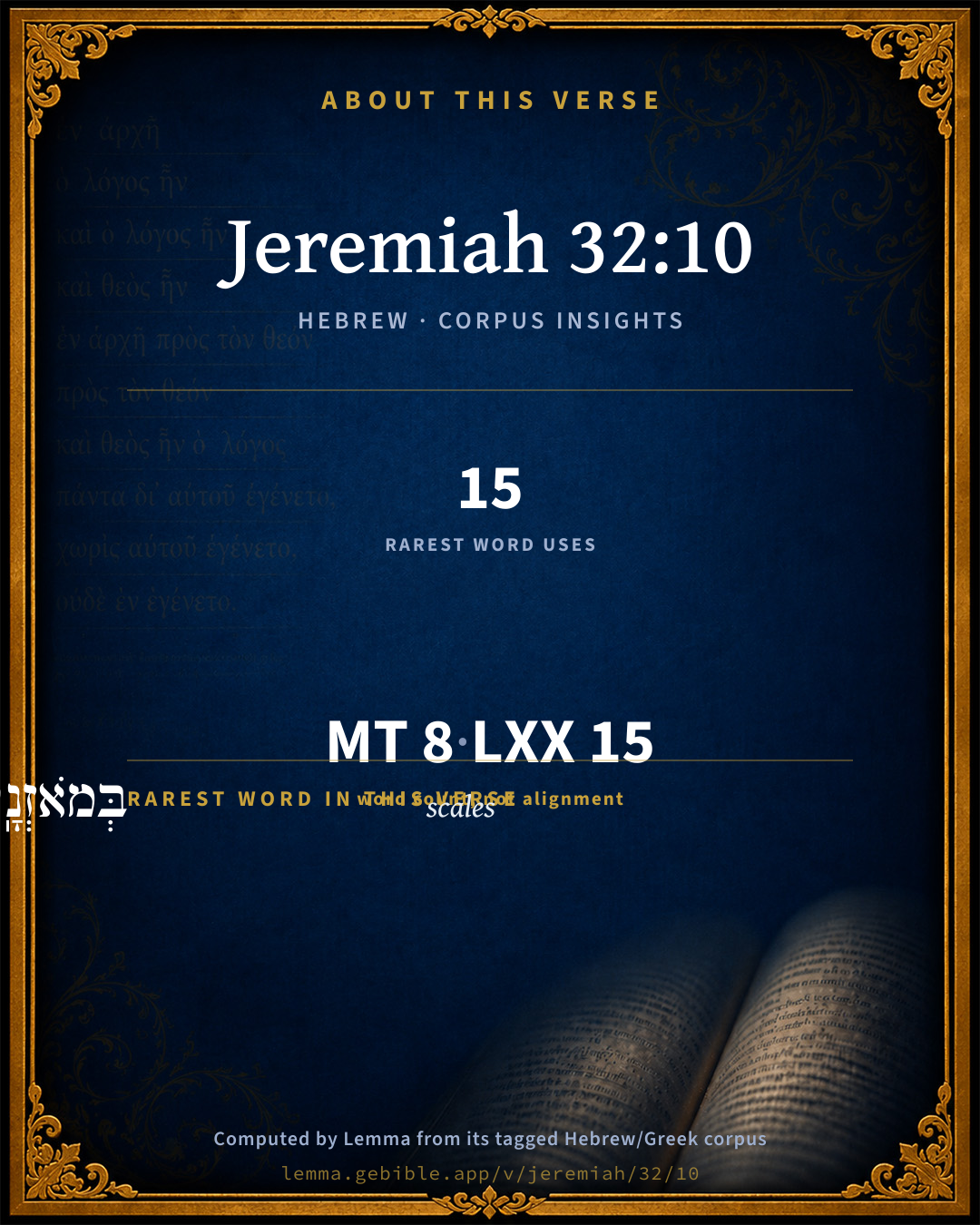
About this verse

These counts appear in no published source. They are computed here, from the morphology-tagged text and Lemma’s own curated glosses. What Lemma adds →

8
words
8
distinct lemmas
Prophets
section

Notable vocabulary

The rarest word here is בְּמֹאזְנָֽיִם scales H3976 — appearing just 15 times in the whole Hebrew Bible.

Shared distinctive vocabulary

בְּמֹאזְנָֽיִם scales H3976 occurs in 15 verses of the Hebrew Bible. Also found in:

Grammatical profile

  • 4 verbs
  • 4 nouns

Verb forms

  • וָאֶכְתֹּ֤ב Qal · Sequential Imperfect
  • וָֽאֶחְתֹּ֔ם Qal · Sequential Imperfect
  • וָאָעֵ֖ד Hiphil · Sequential Imperfect
  • וָאֶשְׁקֹ֥ל Qal · Sequential Imperfect

Hebrew & Septuagint length

In the original languages it is 8 Hebrew tokens and 15 Greek tokens — but the two are counted differently (Hebrew bundles its prefixes and suffixes into one token; the Greek is in lemma form), so that isn’t a like-for-like length.

Cross-references

19

Topical passages linked to Jeremiah 32:10 in the Treasury of Scripture Knowledge — connected by theme and wording, ordered by reader-vote popularity; previews shown in the World English Bible.

  • Jeremiah 32:44 Men shall buy fields for money, and subscribe the deeds, and seal them, and call witnesses, in the land of Benjamin, and in the places about Jerusalem, and in the cities of Judah, and in the cities of the hill-country, and in the cities of the lowland, and in the cities of the South: for I will cause their captivity to return, says Yahweh.
  • Jeremiah 32:12 and I delivered the deed of the purchase to Baruch the son of Neriah, the son of Mahseiah, in the presence of Hanamel my uncle's son, and in the presence of the witnesses who subscribed the deed of the purchase, before all the Jews who sat in the court of the guard.
  • Deuteronomy 32:34 Isn't this laid up in store with me, Sealed up among my treasures?
  • Job 14:17 My disobedience is sealed up in a bag. You fasten up my iniquity.
  • Isaiah 44:5 One shall say, I am Yahweh's; and another shall call [himself] by the name of Jacob; and another shall subscribe with his hand to Yahweh, and surname [himself] by the name of Israel.
  • Jeremiah 32:25 You have said to me, Lord Yahweh, Buy you the field for money, and call witnesses; whereas the city is given into the hand of the Chaldeans.
  • Joshua 18:9 The men went and passed through the land, and described it by cities into seven portions in a book; and they came to Joshua to the camp at Shiloh.
  • Ruth 4:9–11 Boaz said to the elders, and to all the people, You are witnesses this day, that I have bought all that was Elimelech's, and all that was Chilion's and Mahlon's, of the hand of Naomi.
  • Song of Solomon 8:6 Set me as a seal on your heart, As a seal on your arm; For love is strong as death. Jealousy is as cruel as Sheol; Its flashes are flashes of fire, A very flame of Yahweh.
  • Isaiah 8:1–2 Yahweh said to me, "Take a large tablet, and write on it with a man's pen, 'For Maher Shalal Hash Baz;'
  • Isaiah 30:8 Now go, write it before them on a tablet, and inscribe it in a book, that it may be for the time to come forever and ever.
  • Daniel 8:26 The vision of the evenings and mornings which has been told is true: but seal up the vision; for it belongs to many days [to come].
  • John 3:33 He who has received his witness has set his seal to this, that God is true.
  • John 6:27 Don't work for the food which perishes, but for the food which remains to eternal life, which the Son of Man will give to you. For God the Father has sealed him."
  • 2 Corinthians 1:22 who also sealed us, and gave us the down payment of the Spirit in our hearts.
  • Ephesians 1:13 in whom you also, having heard the word of the truth, the Gospel of your salvation,--in whom, having also believed, you were sealed with the Holy Spirit of promise,
  • Ephesians 4:30 Don't grieve the Holy Spirit of God, in whom you were sealed for the day of redemption.
  • Revelation 7:2 I saw another angel ascend from the sunrise, having the seal of the living God. He cried with a loud voice to the four angels to whom it was given to harm the earth and the sea,
  • Revelation 9:4 They were told that they should not hurt the grass of the earth, neither any green thing, neither any tree, but only those people who don't have God's seal on their foreheads.

Cross-references courtesy of OpenBible.info (CC BY 4.0).

Hebrew and Greek witnesses Masoretic Hebrew ↔ Greek Septuagint

The same verse in the two great witnesses to the Old Testament, shown verse-for-verse.

These are two independent witnesses, not word-aligned to each other, and the Septuagint is shown in lemma (dictionary) form.

Hebrew Jeremiah 32:10 Masoretic · Westminster Leningrad Codex

וָאֶכְתֹּ֤ב בַּסֵּ֨פֶר֙ וָֽאֶחְתֹּ֔ם וָאָעֵ֖ד עֵדִ֑ים וָאֶשְׁקֹ֥ל הַכֶּ֖סֶף בְּמֹאזְנָֽיִם

I subscribed the deed, and sealed it, and called witnesses, and weighed him the money in the balances.

World English Bible · Public Domain

Greek LXX Structure differs

In the Septuagint, Jeremiah is about an eighth shorter than the Hebrew and arranges its material differently — the Oracles Against the Nations (Hebrew chapters 46–51) appear in the middle of the Greek book, after 25:13. Because the chapter and verse boundaries do not line up, a verse-for-verse comparison with the Hebrew is not shown.

A verse-for-verse comparison isn’t shown here because the chapters and verses don’t line up. Switch to the LXX edition with the MT / LXX toggle above to read the Greek directly.

Hebrew: Westminster Leningrad Codex (CC BY 4.0). Greek: Septuagint (public domain); English from a public-domain English Septuagint. How the Septuagint differs from the Hebrew →

Targum (Aramaic paraphrase)

1

The Targum is the ancient Jewish Aramaic paraphrase of the Hebrew Scriptures — an interpretive translation, not the Hebrew text itself. Onkelos (literal) and Pseudo-Jonathan (expansive) render the Torah, and Jonathan the Prophets. Coverage is partial: where no permissively-licensed English translation exists for a verse, only the Aramaic is shown. This is verse-level text, not a word-by-word alignment to the Hebrew.

  1. Targum Jonathan Prophets (Joshua–Malachi)
    וּכְתָבֵית בְּשִׁטְרָא וַחֲתָמֵית וְאַסְהֵידֵית סַהֲדֵין וּתְקָלֵית כַּסְפָּא בְּמוֹזְנַיָא:

    (no public-domain English translation for this verse)

    Targum Jonathan — Aramaic: “Mikraot Gedolot” (public domain). English: “Sefaria Community Translation” (CC0 1.0 (public-domain dedication)); “London "Chaldee Paraphrase," 1871” (public domain). Text via Sefaria.

Commentary

Notes on Jeremiah 32:10 from classic Christian and Jewish commentators (each source and its license shown beneath its notes). The classic Christian expositions comment on the surrounding passage and are grouped to its opening verse, so a note may address several verses; the Jewish commentaries on the Tanakh (Rashi and others) are per-verse, so they appear only where the commentator wrote on this verse.

Lemma curates 59 commentaries, every one of them public domain or Creative Commons licensed, each selected and text-cleaned for this edition rather than reprinted as found. About our sources →

Trapp's Complete Commentary

John Trapp

Jer 32:10 And I subscribed the evidence, and sealed [it], and took witnesses, and weighed [him] the money in the balances.

Ver. 10. And I subscribed the evidence.] Heb., I wrote in the book, and sealed it. Men love to be upon sure grounds in things temporal; oh that they were as wise for their souls!

John Trapp, A Commentary or Exposition upon All the Books of the Old and New Testament (1647–1656) — public domain. Text from a community e-Sword module.

Joseph Benson's Commentary

Jer 32:10-14. I subscribed the evidence, and sealed it — I wrote down an account of the transaction in a book. The method it appears then in use among the Jews when any purchase was made was, that the purchaser, as well as those who sold, testified his consent by some writing signed before witnesses. I took the evidence, both that which was sealed and that which was open — The open, or unsealed writing, was either a copy of the sealed one, or else a certificate of the witnesses, in whose presence the deed of purchase was signed and sealed. I gave the evidence of the purchase unto Baruch — “Baruch was a scribe by profession, and it may be concluded that the attendance of such a one, skilled in the forms of law, was necessary on those occasions, both to draw up the writings and to officiate in the character of a notary public. And to his custody, as being a public officer, the custody of the title-deeds was intrusted.” I charged Baruch, to put them in an earthen vessel — To preserve them from fire and moisture. It was common with the ancients to put their writings into earthen vessels. Origen found at Jericho a version of the Scriptures hid in an earthen pot. That they may continue many days — When hid under ground for greater security, to be produced when the land should be re-inhabited.

Joseph Benson's Commentary on the Old and New Testaments (1811–1818) — public domain. Text from a community e-Sword module.

Tyndale Open Study Notes

Tyndale Open Resources

32:10 Jeremiah carefully followed the proper legal procedures for buying property. The deed of purchase was a sheet of papyrus that listed the terms of the purchase in Hebrew. Jeremiah signed and sealed the deed and paid the purchase price in the presence of witnesses (Gen 23:3-18; 2 Sam 24:20-24).

Tyndale Open Study Notes — © Tyndale Open Resources, licensed CC BY-SA 4.0. Text via the HelloAO Bible API.

Jamieson, Fausset & Brown

Robert Jamieson, A. R. Fausset & David Brown

subscribed--I wrote in the deed, "book of purchase" (Jer 32:12).

weighed--coined money was not in early use; hence money was "weighed" (Gen 23:16).

Jamieson, Fausset & Brown — Commentary Critical and Explanatory on the Whole Bible (1871) — public domain (CC PDM 1.0). Text via the HelloAO Bible API.

Adam Clarke's Commentary

Verse 10. I subscribed the evidence] We have here all the circumstances of this legal act:

1. An offer is made of the reversion of the ground, till the jubilee, to him who would then of right come into possession.

2. The price is agreed on, and the silver weighed in the balances.

3. A contract or deed of sale is drawn up, to which both parties agreeing,

4. Witnesses are brought forward to see it signed and sealed; for the contract was both subscribed and sealed.

5. A duplicate of the deed was drawn, which was not to be sealed, but to lie open for the inspection of those concerned, in some public place where it might be safe, and always to be seen.

6. The original, which was sealed up, was put in an earthen pitcher, in order to be preserved from accidents.

7. This was delivered by the purchaser into the hands of a third party, to be preserved for the use of the purchaser, and witnesses were called to attest this delivery.

8. They subscribed the book of the purchase, perhaps a town book, or register, where such purchases were entered. Baruch was a scribe by profession; and the deeds were delivered into his hands, before witnesses, to be preserved as above.

Perhaps the law, in this case, required that the instrument should be thus lodged. But, in the present case, both the deeds, the original and the duplicate, were put into the earthen pitcher, because the city was about to be burnt; and if lodged as usual, they would be destroyed in the general conflagration. See Jer 32:14.

Adam Clarke's Commentary on the Bible (1810–1826) — public domain. Text from a community e-Sword/MySword module.

John Calvin's Commentaries

It may now be asked, how could Hanameel, who was of the Levitical order, sell a field, for we know that fields did not belong to the Levites, and that they had tithes for their inheritance. (Numbers 18:21) But this is to be taken for a suburban field, for they had the suburbs, and each had a meadow: they neither ploughed nor reaped, nor was it indeed lawful for them, according to the law, to labor in agriculture, but they fed cattle and sheep: and this is proved by the smallness of the sum given; for what was the field sold for? for seven shekels and ten pieces of silver. We hence see that it was not a large field, but only a meadow like a garden; for the price would have been larger, had it been some acres of land. Then the difficulty here is easily removed, for Hanameel sold to Jeremiah a small meadow, as every Levite had in the suburbs a meadow to feed his sheep or his cattle; at the same time none of them had large herds, but each had a cow or two. This, then, is what we are to understand by the field.

John Calvin's Commentaries (1540-1563) — public domain. Text from the Calvin Translation Society English edition (1840s-50s) via the Christian Classics Ethereal Library (ccel.org). Calvin's coverage is partial (roughly two-thirds of the Bible); uncommented books and verses are honest gaps, never fabricated. The 19th-century editor's footnotes and remarks are omitted so the notes are faithfully Calvin's own voice.

Ellicott's Commentary for English Readers

(10) And I subscribed the evidence . . .—Literally, as in the margin, I wrote in the book—the last word being used for any kind of document, as for an indictment in Job_31:35, and here for a deed of conveyance. The minuteness with which the transaction is recorded is every way remarkable, partly as showing that the prophet was careful that no legal formality should be lacking to give validity to the purchase; partly, as the next verse shows, because there was a secret, unattested, unsealed (and in that sense “open”) document, which the witnesses did not subscribe, and with the contents of which they were probably not acquainted. The sealed document was one closed up as a safeguard against fraudulent alterations (comp. Isa_29:11). In the weighing of the money we see an indication of the old practice—probably consequent on the practice of “clipping” coined money—of dealing even with the current coin as if it were bullion, just as bankers weigh a parcel of sovereigns now before giving credit for the amount. (Comp. Gen_23:16; Zec_11:12.)

A Bible Commentary for English Readers, edited by Charles John Ellicott (1878–1897) — public domain. Text from a community e-Sword module.

The Cambridge Bible for Schools and Colleges

gen. ed. J. J. S. Perowne

10. And I subscribed the deed] The following will explain the particulars of Jeremiah’s action as given here and in the next vv. “Contracts stamped upon clay tablets have been found in Babylonia, enclosed in an envelope of clay, on the outside of which an exact duplicate of the contract was impressed (see an illustration in Maspero, The Dawn of Civilization, p. 732): if in course of time any disagreement arose, and it was suspected that the outside text had been tampered with, the envelope was broken in the presence of witnesses to see if the inside text agreed with it or not. Earthen jars containing such duplicate contracts have been excavated at Nippur (Peters, Nippur; II. 198).” Dr. ad loc. See further in Johns, Babylonian and Assyrian Laws, Contracts, and Letters, pp. 10 f.

sealed it] not in our sense of adding a seal to a signature (“under one’s hand and seal”), but sealed up, closed securely.

The Cambridge Bible for Schools and Colleges (gen. ed. J. J. S. Perowne; Cambridge University Press, 1878–1918) — public domain. Text from a community e-Sword module.

John Gill's Exposition

So I took the evidence of the purchase,.... The deed of purchase, the book or bill of sale, the instrument of the bargain, as before mentioned:

both that which is sealed, according to the law and custom; which was both sealed by the buyer and seller, and was sealed up, and not to be looked into by everyone, only when there might be a necessity; this was the original copy:

and that which was open; the counter part or copy of the former, which though signed and sealed as the other, yet not sealed up, but was open and exposed to view; either for the relations to see what was done, as some; or for the judges, as others, to ratify and make authentic: or, as is most probable, this copy was laid up in some public register, to have recourse unto upon any occasion; however it was, it was according to the laws and customs of those times, which Jeremiah carefully attended to: or, as others, it lay open for the witnesses to sign; so there are three distinct things; first the written contract; then that as signed and sealed by buyer and seller, according to law; and then as signed, but not sealed, by the witnesses.

John Gill's Exposition of the Whole Bible (1746–1763) — public domain (CC PDM 1.0). Text via the HelloAO Bible API.

Albert Barnes' Notes on the Bible

Translate: And I wrote the particulars of the purchase in the deed ... And I took the purchase-deed, both that which was sealed containing the oiler and the conditions, and that which was open etc. There were two indentures, of which one was called the purchase-deed, and was signed by the purchaser and the witnesses. It was then sealed, not in our sense of appending a seal in place of signatures, but to close it up. The open deed was probably an exact copy, and was that intended for common use. In case its authenticity was called in question, the sealed copy would have to be produced before the judge, the seal opened, and if its contents agreed with those of the open deed, the decision would be in the buyer’s favor.

By the offer is probably meant the specification. The conditions, literally, the statutes, would be the stipulations and terms of the sale, e. g. as to its restoration at the year of jubile, its price etc. The placing of the deeds in jar was of course intended to preserve them from damp during the long years of the exile.

Albert Barnes' Notes on the Bible (1834–1885) — public domain. Text from a community e-Sword/MySword module.

Matthew Poole's English Annotations

I went through with the purchase, setting my hand to and sealing the deed, and taking witnesses to it, as is usual.

Matthew Poole's English Annotations on the Holy Bible (1683–1685) — public domain. Text from a community e-Sword/MySword module.

Whedon's Commentary on the Bible

Daniel D. Whedon

10. I subscribed the evidence, etc. — The marginal reading is better, “I wrote in the book,” that is, the particulars of the transaction. Here we have, with unusual fulness, the description of an important business transaction. Written documents, witnesses, the weighing of money, and the sealing up of one of the copies of the bill of purchase for public use and permanent preservation. All this points unmistakably to a well-organized state of society. These deeds of purchase were to be put in an earthen vessel to preserve them from decay and destruction during the long years of exile. Sealed, in this passage, means “fastened together by a seal,” and not “attested by a seal,” as is the common sense in modern business documents.

Daniel D. Whedon (gen. ed.), Commentary on the Old and New Testaments (1874–1909) — public domain. Text from a community e-Sword module.

The Pulpit Commentary

Vers. 10-14. The Authorized Version is here so far wrong, on technical terms, that it seems best to retranslate the whole passage: "And I wrote (the circumstances) in the deed, and sealed it, and took witnesses, and weighed the money in the balance. And I took the purchase deed, that which was sealed (containing the offer and the conditions), and that which was open; and I gave the purchase deed unto Baruch the son of Neriah, the son of Maaseiah (rather, Makhseiah), in the sight of Hanameel my uncle, and in the sight of the witnesses who subscribed the purchase deed, in the sight of all the Jews who were sitting in the court of the guard. And I charged Baruch before them, saying, Thus saith Jehovah Sabaoth, the God of Israel, Take these deeds, this sealed purchase deed, and this open deed; and put them into an earthen vessel, that they may continue many days." The deed was made in two copies, so that if the open one were lost, or suspected of having been tampered with, an appeal might always be made to the sealed copy. The latter was to be placed in an earthen vessel, to preserve it from injury by damp. It ought to be added that the words in ver. 11, rendered "containing the offer and the conditions," are difficult. "Containing" is not expressed in the Hebrew, and "offer" is not the ordinary meaning, though etymologically justifiable.

The Pulpit Commentary (1880–1919), ed. H.D.M. Spence-Jones & Joseph S. Exell — public domain. Text from a community e-Sword module.

Keil & Delitzsch

C. F. Keil & F. Delitzsch

The purchase was concluded in full legal form. "I wrote it (the necessary terms) in the letter (the usual letter of purchase), and sealed it, and took witnesses, and weighed out the money on the balance" (it was then and still is the custom in the East to weigh money). חתם means here, not to append a seal instead of subscribing the name, or for attestation (cf. Kg1 21:8; Neh 10:1; 2), but to seal up, make sure by sealing (Isa 29:11, etc.). For, from Jer 32:11, Jer 32:12, we perceive that two copies of the bill of purchase were prepared, one sealed up, and the other open; so that, in case the open one were lost, or were accidentally or designedly injured or defaced, a perfect original might still exist in the sealed-up copy. Then "Jeremiah took the bill of purchase, the sealed one," - the specification and the conditions - "and the open one." The words המּצוה והחקּים are in apposition with 'את־ספר וגו. The Vulgate renders stipulationes et rata; Jerome, stipulatione rata, which he explains by stipulationibus et sponsionibus corroborata. מצוה, usually "a command, order," is probably employed here in the general sense of "specification," namely, the object and the price of purchase; חקּים, "statutes," the conditions and stipulations of sale. The apposition has the meaning, "containing the agreement and the conditions." Both copies of this bill, the prophet-before the eyes of Hanamel, his cousin (דּדי, either in the general sense of a near relation, since the relationship has been stated exactly enough already, or בּן־ has been inadvertently omitted), and before the eyes of, i.e., in the presence of "the witnesses, who wrote in the letter of purchase," i.e., had subscribed it as witnesses in attestation of the matter, and in the eyes of all the Jews who were sitting in the court of the prison, and in whose presence the transaction had been concluded - delivered up to his attendant Baruch, son of Nerijah, the son of Mahsejah, with the words, Jer 32:14 : "Thus saith Jahveh of hosts, the God of Israel: Take these letters, this sealed-up letter of purchase and this open letter, and put them into an earthen vessel, that they may remain a long time there. Jer 32:15. For thus saith Jahveh of hosts, the God of Israel: Houses, and fields, and vineyards shall still be bought in this land." - The second utterance of the Lord (Jer 32:15) declares the reason why the letters were to be preserved in an earthen vessel, in order to protect them from damp, decay, and destruction, namely, because one could make use of them afterwards, when sale of property would still be taking place. There is also implied the intimation, that the present desolation of the land and the transportation of its inhabitants will only last during their time; and then the population of Judah will return, and enter again on the possession of their land. The purchase of the field on the part of Jeremiah had this meaning; and for the sake of this meaning it was announced to him by God, and completed before witnesses, in the presence of the Jews who happened to be in the court of the prison.

Keil & Delitzsch — Biblical Commentary on the Old Testament (1861–1891) — public domain (CC PDM 1.0). Text via the HelloAO Bible API. (Old Testament only.)

unfoldingWord translationNotes

Door43 World Missions Community

General Information:

Jeremiah continues speaking.

in a scroll and sealed it, and had witnesses witness it

This refers to the deed that a person would sign to purchase land. Other people would be witnesses to confirm that Jeremiah had purchased this land.

had witnesses witness it

"had people watch me purchase the land so they could tell others that I had purchased the land"

that was sealed

This can be translated in active form. AT: "that I sealed" (See: Active or Passive)

unsealed deed

"opened copy" or "the deed that did not have a seal on it"

Baruch ... Neriah ... Mahseiah

These are names of men. (See: How to Translate Names)

the courtyard of the guard

The open area attached to the king's palace that was surrounded by buildings and in which they kept prisoners. See how you translated this in Jeremiah 32:2.

translationWords

scroll

seal

testimony

command

statute

Baruch

Judea

unfoldingWord translationNotes — © Distant Shores Media and the Door43 World Missions Community, licensed CC BY-SA 4.0. Source: git.door43.org/Door43/en_tn.

Lesson kit

Teaching starters — assembled from the data on this page, not authored interpretation. Every prompt links to the verse data it draws on. Edit before teaching.

Jeremiah, in the Prophets, opens this verse with 8 words (8 distinct Hebrew lemmas). Its most distinctive word is môʼzên (“scales”). A historical commentator’s framing appears above. Read the whole chapter for the surrounding context.

Discussion questions

  1. What does “scales” (môʼzên) contribute to the verse as a whole?
  2. How does Leviticus 19:36, which shares the word «scales», read alongside this verse?
  3. The translations on this page render this verse differently — a whole-verse word diff, not a word-by-word alignment. What might account for the different wordings?
  4. «וָאֶכְתֹּ֤ב» is a Qal Sequential Imperfect verb. How does that grammatical form shape the action described?
  5. Compare how Trapp's Complete Commentary and Joseph Benson's Commentary read this verse. Where do they agree or differ?

Things to notice

Reading settings

Reading text

Shown beneath each verse's original-language words.

Old Testament
Old Testament edition

Read the OT as the Masoretic Hebrew (MT) or the Greek Septuagint (LXX).

English shown for the Greek Septuagint (in the Hebrew ↔ Greek comparison).

Comparing translations? Open the Compare panel on any verse page to stack up to four side by side.