
Numbers 5:23

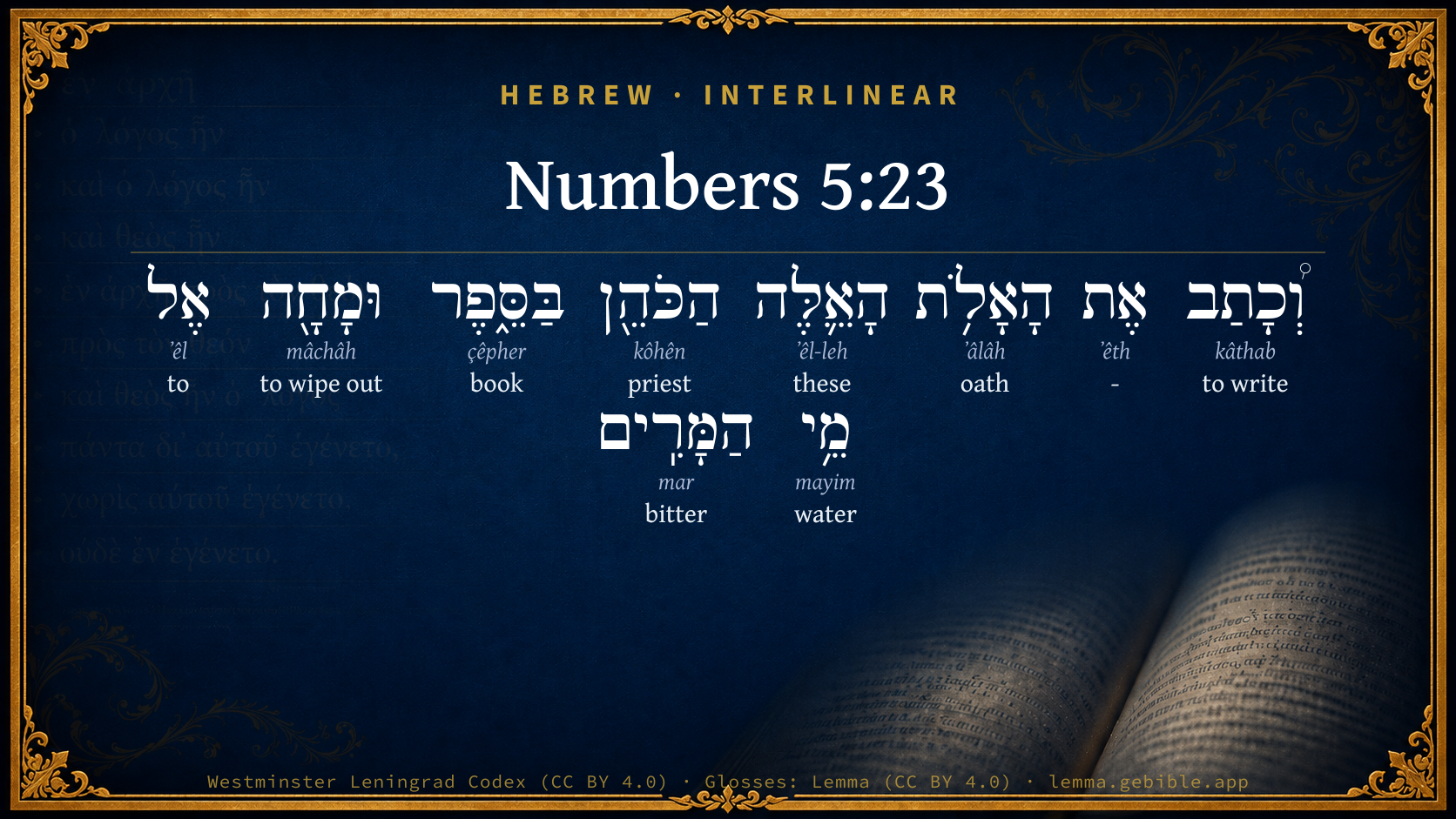
Hebrew (Westminster Leningrad Codex) Numbers 5:23 appears in the Hebrew Old Testament. The text above is from the Westminster Leningrad Codex. Each word links to its Strong’s number, a concise gloss, and parsing drawn from the Open Scriptures Hebrew Bible morphology. Click any word for its full Brown-Driver-Briggs (BDB) entry.
Download image
Cite this verse

Numbers 5:23 (World English Bible). Public Domain. Lemma interlinear Bible study tool, https://lemma.gebible.app/v/numbers/5/23.

Show BibTeX & RIS
BibTeX
RIS
English Translation
"The priest shall write these curses in a book, and he shall blot them out into the water of bitterness.
World English Bible · Public Domain
Download a study sheet

One document with this verse’s original text, its word-by-word gloss line, the meaning frame, cross-references with their text, attributed commentary, and full source and license credits — printable, and it pastes into notes with its structure intact.

This verse Autodidact and up

Study sheet (.html) Plain text (.txt)

A passage Seminary Student

Up to 50 verses in one chapter. A passage sheet keeps up to 6 commentary sources and 12 cross-references per verse, in the order this page ranks them, and says so on the sheet whenever that leaves anything out. Ask for a single verse and you get the Autodidact verse sheet above.

Everything on this page stays free to read, with no account — the sheet is a download of what is already on screen, not access to it.

Want to remove ads? Support Godless Engineer
Compare translations 3

The same verse in 3 English versions, stacked beneath the original-language interlinear above. Click any original word for its lexicon entry.

Each is an independent rendering of the whole verse — the interlinear is not word-aligned to these translations.

Highlighted words mark where these versions differ — a whole-verse word diff, not a word-by-word alignment.

  • World English Bible Public Domain
    "The priest shall write these curses in a book, and he shall blot them out into the water of bitterness.
  • King James Version Public Domain
    And the priest shall write these curses in a book, and he shall blot them out with the bitter water:
  • unfoldingWord Literal Text CC BY-SA 4.0
    And the priest shall write these curses in the book, and he shall wipe out into the water of bitterness.

unfoldingWord Literal Text — © unfoldingWord, licensed CC BY-SA 4.0. Word-aligned USFM3 via Door43 (git.door43.org/unfoldingWord/en_ult).

Versions to compare (up to 4)

3 of 4 selected

Show all 18 translations

Every available English version of this verse, each an independent rendering of the whole verse.

  • World English Bible Public Domain
    "The priest shall write these curses in a book, and he shall blot them out into the water of bitterness.
  • Berean Standard Bible Public Domain
    And the priest shall write these curses on a scroll and wash them off into the bitter water.
  • Majority Standard Bible Public Domain
    And the priest shall write these curses on a scroll and wash them off into the bitter water.
  • King James Version Public Domain
    And the priest shall write these curses in a book, and he shall blot them out with the bitter water:
  • American Standard Version (1901) Public Domain
    And the priest shall write these curses in a book, and he shall blot them out into the water of bitterness:
  • Revised Version (1885) Public Domain
    And the priest shall write these curses in a book, and he shall blot them out into the water of bitterness:
  • Geneva Bible (1599) Public Domain
    After, the Priest shall write these curses in a booke, and shall blot them out with the bitter water,
  • Douay-Rheims (1899) Public Domain
    And the priest shall write these curses in a book, and shall wash them out with the most bitter waters, upon which he hath heaped the curses,
  • Young's Literal Translation Public Domain
    `And the priest hath written these execrations in a book, and hath blotted `them' out with the bitter waters,
  • Literal Standard Version CC BY-SA 4.0
    And the priest has written these execrations in a scroll, and has blotted [them] out with the bitter waters,
  • Unlocked Literal Bible CC BY-SA 4.0
    The priest must write these curses on a scroll, and then he must wash away the written curses into the bitter water.
  • unfoldingWord Literal Text CC BY-SA 4.0
    And the priest shall write these curses in the book, and he shall wipe out into the water of bitterness.
  • Darby Bible Public Domain
    And the priest shall write these curses in a book, and shall blot them out with the bitter water,
  • World Messianic Bible Public Domain
    “‘The priest shall write these curses in a book, and he shall wipe them into the water of bitterness.
  • Webster's Bible Public Domain
    And the priest shall write these curses in a book, and he shall blot them out with the bitter water:
  • Free Bible Version CC BY-SA 4.0
    The priest is to write these curses on a scroll and then wash them off into the bitter water.
  • Bible in Basic English Public Domain
    And the priest will put these curses in a book, washing out the writing with the bitter water;
  • JPS Tanakh (1917) Public Domain
    And the priest shall write these curses in a scroll, and he shall blot them out into the water of bitterness.

Literal Standard Version (2020), Covenant Press — licensed CC BY-SA 4.0. Text via the HelloAO Bible API (eBible.org). Unlocked Literal Bible (unfoldingWord) — licensed CC BY-SA 4.0. Text via the HelloAO Bible API (eBible.org). unfoldingWord Literal Text — © unfoldingWord, licensed CC BY-SA 4.0. Word-aligned USFM3 via Door43 (git.door43.org/unfoldingWord/en_ult). Free Bible Version, Dr. Jonathan Gallagher — licensed CC BY-SA 4.0. Text via the HelloAO Bible API (eBible.org).

Word by word

More ways to search: Search by grammar → Find every occurrence → Compare this word →

Practice this passage: Drill this verse → Learn its vocabulary →

הָאָלֹ֥ת
ʼâlâh
H423
“the · oaths”
Particle, Definite Article + Noun, Common, Feminine, Plural, Absolute
Part of Speech
Particle + Noun
Type
Common
Gender
Feminine
Number
Plural
State
Absolute
Full BDB Definition

Origin: from H422

TWOT: 91a

oath - oath of covenant - curse - from God - from men - execration
  1. וְ֠כָתַב kâthab H3789 “and · to write” Conjunction + Verb, Qal, Sequential Perfect, 3rd Person, Masculine, Singular
  2. אֶת ʼêth H853 “-” Particle, Direct Object
  3. הָאֵ֛לֶּה ʼêl-leh H428 “the · these” Particle, Definite Article + Pronoun, Demonstrative, Common, Plural
  4. הַכֹּהֵ֖ן kôhên H3548 “the · priest” Particle, Definite Article + Noun, Common, Masculine, Singular, Absolute
  5. בַּסֵּ֑פֶר çêpher H5612 “in/at the · book” Preposition, Determined + Noun, Common, Masculine, Singular, Absolute
  6. וּמָחָ֖ה mâchâh H4229 “and · to wipe out” Conjunction + Verb, Qal, Sequential Perfect, 3rd Person, Masculine, Singular
  7. אֶל ʼêl H413 “to” Preposition
  8. מֵ֥י mayim H4325 “water(s) of” Noun, Common, Masculine, Plural, Construct
  9. הַמָּרִֽים mar H4751 “the · bitter” Particle, Definite Article + Adjective, Adjective, Masculine, Plural, Absolute

About this verse

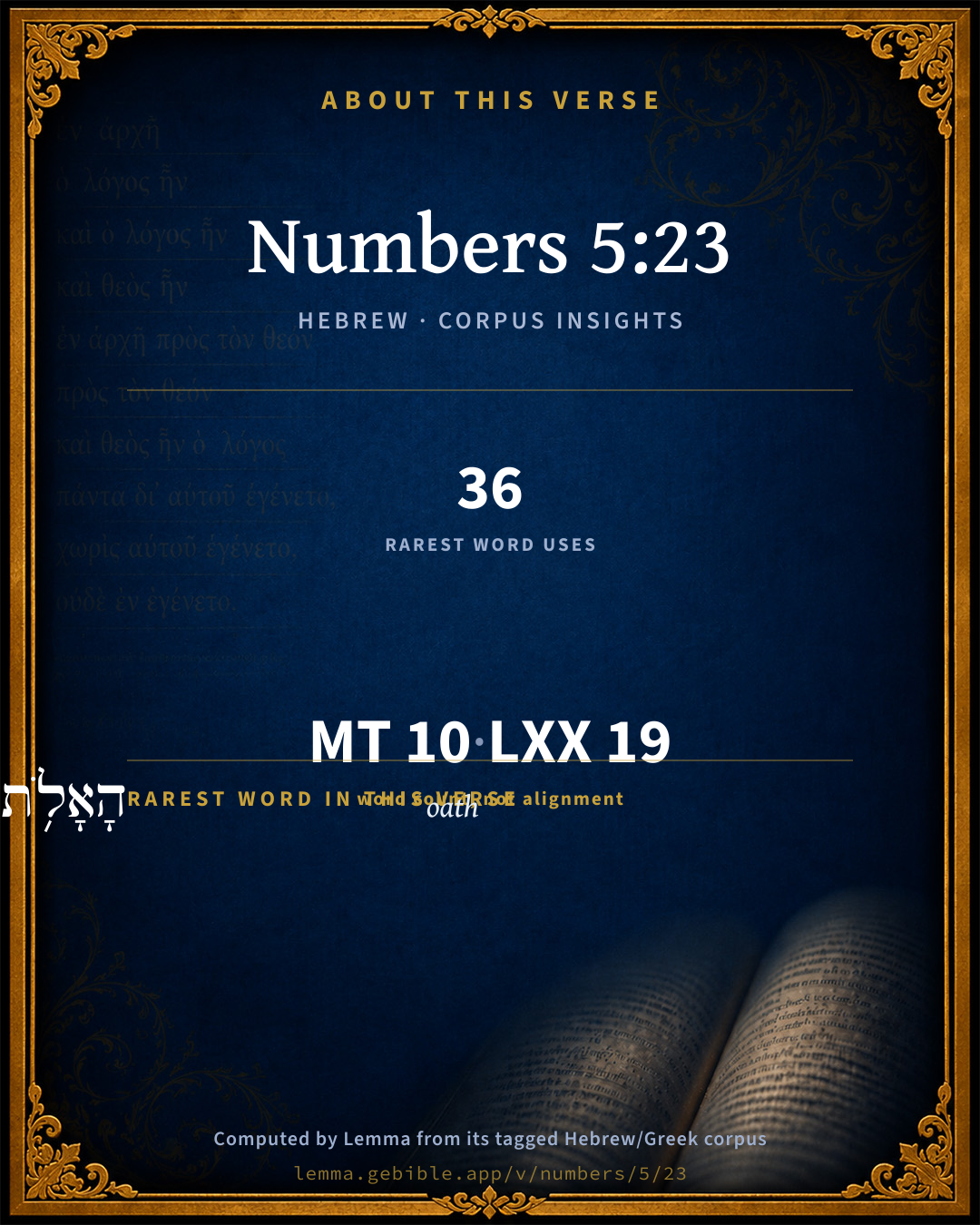
These counts appear in no published source. They are computed here, from the morphology-tagged text and Lemma’s own curated glosses. What Lemma adds →

10
words
10
distinct lemmas
Pentateuch
section

Shared distinctive vocabulary

הָאָלֹ֥ת oath H423 occurs in 32 verses of the Hebrew Bible. Also found in:

Grammatical profile

  • 2 verbs
  • 4 nouns
  • 1 adjective
  • 1 pronoun
  • 1 preposition
  • 1 particle

Verb forms

  • וְ֠כָתַב Qal · Sequential Perfect
  • וּמָחָ֖ה Qal · Sequential Perfect

Hebrew & Septuagint length

In English translation the verse runs 20 words from the Hebrew and 25 from the Septuagint (LXX English) — closely comparable.

A rough comparison of the two English renderings, which tokenize alike — not a word-level alignment.

Word counts can differ between the Hebrew and the Greek without any difference in meaning — e.g. the Hebrew direct-object marker אֵת has no separate Greek word, and Greek often adds the article ὁ.

In the original languages it is 10 Hebrew tokens and 19 Greek tokens — but the two are counted differently (Hebrew bundles its prefixes and suffixes into one token; the Greek is in lemma form), so that isn’t a like-for-like length.

Cross-references

12

Topical passages linked to Numbers 5:23 in the Treasury of Scripture Knowledge — connected by theme and wording, ordered by reader-vote popularity; previews shown in the World English Bible.

  • Exodus 17:14 Yahweh said to Moses, "Write this for a memorial in a book, and rehearse it in the ears of Joshua: that I will utterly blot out the memory of Amalek from under the sky."
  • Deuteronomy 31:19 Now therefore write you this song for you, and teach you it the children of Israel: put it in their mouths, that this song may be a witness for me against the children of Israel.
  • 2 Chronicles 34:24 Thus says Yahweh, Behold, I will bring evil on this place, and on the inhabitants of it, even all the curses that are written in the book which they have read before the king of Judah.
  • Job 31:35 Oh that I had one to hear me! (Behold, here is my signature, let the Almighty answer me); Let the accuser write my indictment!
  • Psalms 51:1 Have mercy on me, God, according to your loving kindness. According to the multitude of your tender mercies, blot out my transgressions.
  • Psalms 51:9 Hide your face from my sins, And blot out all of my iniquities.
  • Isaiah 43:25 I, even I, am he who blots out your transgressions for my own sake; and I will not remember your sins.
  • Isaiah 44:22 I have blotted out, as a thick cloud, your transgressions, and, as a cloud, your sins: return to me; for I have redeemed you.
  • Jeremiah 51:60–64 Jeremiah wrote in a book all the evil that should come on Babylon, even all these words that are written concerning Babylon.
  • Acts 3:19 "Repent therefore, and turn again, that your sins may be blotted out, so that there may come times of refreshing from the presence of the Lord,
  • 1 Corinthians 16:21–22 This greeting is by me, Paul, with my own hand.
  • Revelation 20:12 I saw the dead, the great and the small, standing before the throne, and they opened books. Another book was opened, which is the book of life. The dead were judged out of the things which were written in the books, according to their works.

Cross-references courtesy of OpenBible.info (CC BY 4.0).

Hebrew and Greek witnesses Masoretic Hebrew ↔ Greek Septuagint

The same verse in the two great witnesses to the Old Testament, shown verse-for-verse.

These are two independent witnesses, not word-aligned to each other, and the Septuagint is shown in lemma (dictionary) form.

Hebrew Numbers 5:23 Masoretic · Westminster Leningrad Codex

וְ֠כָתַב אֶת הָאָלֹ֥ת הָאֵ֛לֶּה הַכֹּהֵ֖ן בַּסֵּ֑פֶר וּמָחָ֖ה אֶל מֵ֥י הַמָּרִֽים

"The priest shall write these curses in a book, and he shall blot them out into the water of bitterness.

World English Bible · Public Domain

Greek LXX Numbers 5:23 Septuagint · lemma form

καί γράφω ὁ ἱερεύς ὁ ἀρά οὗτος εἰς βιβλίον καί ἐκἀλείφω εἰς ὁ ὕδωρ ὁ ἐλεγμός ὁ ἐπι καταἀράομαι

And the priest shall write these curses in a book, and shall blot them out with the water of the conviction that brings the curse.

LXX2012 (modern English Septuagint) · Public Domain

On this verse, The Pulpit Commentary discusses the Septuagint’s reading. Read the note in Commentary ↓

Hebrew: Westminster Leningrad Codex (CC BY 4.0). Greek: Septuagint (public domain); English from LXX2012 (modern English Septuagint) (Public Domain). How the Septuagint differs from the Hebrew →

Targum (Aramaic paraphrase)

2

The Targum is the ancient Jewish Aramaic paraphrase of the Hebrew Scriptures — an interpretive translation, not the Hebrew text itself. Onkelos (literal) and Pseudo-Jonathan (expansive) render the Torah, and Jonathan the Prophets. Coverage is partial: where no permissively-licensed English translation exists for a verse, only the Aramaic is shown. This is verse-level text, not a word-by-word alignment to the Hebrew.

  1. Targum Onkelos Torah (Genesis–Deuteronomy)
    וְיִכְתּוֹב יָת לְוָטַיָא הָאִלֵין כַּהֲנָא בְּסִפְרָא וְיִמְחוֹק לְמַיָא מְרִירַיָא

    (no public-domain English translation for this verse)

    Targum Onkelos — Aramaic: “Onkelos Genesis” (public domain); “Onkelos Exodus” (public domain); “Onkelos Leviticus” (public domain); “Onkelos Numbers” (public domain); “Onkelos Deuteronomy” (public domain). English: “Sefaria Community Translation” (CC0 1.0 (public-domain dedication)); “J.W. Etheridge. The Targums of Onkelos and Jonathan Ben Uzziel on the Pentateuch. London: Longmans, Green, 1862” (public domain). Text via Sefaria.

  2. Targum Pseudo-Jonathan Torah (Genesis–Deuteronomy)
    (וְתִכְתּוֹב) [צ"ל וְיִכְתּוֹב] יַת לְוָטַיָא הָאִלֵין כַּהֲנָא עַל מְגִילְתָּא וְיִמְחוֹק לְמַיָא בְּדוּקַיָא

    And the priest shall write these maledictions upon a parchment, and wash it out with the water of trial,

    Targum Pseudo-Jonathan — Aramaic: “Targum Jonathan on Genesis” (public domain); “Targum Jonathan on Exodus” (public domain); “Targum Jonathan on Leviticus” (public domain); “Targum Jonathan on Numbers” (public domain); “Targum Jonathan on Deuteronomy” (public domain). English: “The Targum of Jonathan ben Uzziel, trans. J. W. Etheridge, London, 1862” (public domain). Text via Sefaria.

Commentary

Notes on Numbers 5:23 from classic Christian and Jewish commentators (each source and its license shown beneath its notes). The classic Christian expositions comment on the surrounding passage and are grouped to its opening verse, so a note may address several verses; the Jewish commentaries on the Tanakh (Rashi and others) are per-verse, so they appear only where the commentator wrote on this verse.

Lemma curates 59 commentaries, every one of them public domain or Creative Commons licensed, each selected and text-cleaned for this edition rather than reprinted as found. About our sources →

Trapp's Complete Commentary

John Trapp

Num 5:23 And the priest shall write these curses in a book, and he shall blot [them] out with the bitter water:

Ver. 23. Shall write these curses in a book.] To show, that the word written should cause the water thus to work, according to the cleanness or uncleanness of the party. See 2Co 2:16. {See Trapp on "2Co 2:16"}

John Trapp, A Commentary or Exposition upon All the Books of the Old and New Testament (1647–1656) — public domain. Text from a community e-Sword module.

Tyndale Open Study Notes

Tyndale Open Resources

5:23-24 The symbolism of drinking disturbing words is repeated in Ezek 2:8–3:3 and Rev 10:8-11.

Tyndale Open Study Notes — © Tyndale Open Resources, licensed CC BY-SA 4.0. Text via the HelloAO Bible API.

Geneva Bible (1599)

Geneva Bible translators

Shall wash the curses, which are written, into the water in the vessel.

Geneva Bible (1599) marginal notes — public domain. Text via Bolls.life.

Jamieson, Fausset & Brown

Robert Jamieson, A. R. Fausset & David Brown

write these curses in a book--The imprecations, along with her name, were inscribed in some kind of record--on parchment, or more probably on a wooden tablet.

blot them out with the bitter water--If she were innocent, they could be easily erased, and were perfectly harmless; but if guilty, she would experience the fatal effects of the water she had drunk.

Jamieson, Fausset & Brown — Commentary Critical and Explanatory on the Whole Bible (1871) — public domain (CC PDM 1.0). Text via the HelloAO Bible API.

Adam Clarke's Commentary

Verse 23. The priest shall write these curses - and he shall blot them out] It appears that the curses which were written down with a kind of ink prepared for the purpose, as some of the rabbins think, without any calx of iron or other material that could make a permanent dye, were washed off the parchment into the water which the woman was obliged to drink, so that she drank the very words of the execration. The ink used in the East is almost all of this kind - a wet sponge will completely efface the finest of their writings. The rabbins say that the trial by the waters of jealousy was omitted after the Babylonish captivity, because adulteries were so frequent amongst them, that they were afraid of having the name of the Lord profaned by being so frequently appealed to! This is a most humiliating confession. "Though," says pious Bishop Wilson, "this judgment is not executed now on adulteresses, yet they have reason from this to conclude that a more terrible vengeance will await them hereafter without a bitter repentance; these being only a shadow of heavenly things, i. e., of what the Gospel requires of its professors, viz., a strict purity, or a severe repentance." The pious bishop would not preclude the necessity of pardon through the blood of the cross, for without this the severest repentance would be of no avail.

Adam Clarke's Commentary on the Bible (1810–1826) — public domain. Text from a community e-Sword/MySword module.

The Cambridge Bible for Schools and Colleges

gen. ed. J. J. S. Perowne

23. a book] The Heb. term sçpher denotes anything which can receive writing, e.g. a strip of parchment. Here it is something from which the written words of the curse can be washed or wiped out into the water. The curse is considered to be in this manner literally conveyed to the potion. The eating of written charms is a frequent practice in Thibet and India for the cure of disease. In Egypt ‘the most approved mode of charming away sickness or disease is to write certain passages of the Korân on the inner surface of an earthenware cup or bowl; then to pour in some water, and stir it until the writing is quite washed off: when the water, with the sacred words thus infused in it, is to be drunk by the patient’ (Waddell, The Buddhism of Tibet, quoted by Gray, p. 54).

The Cambridge Bible for Schools and Colleges (gen. ed. J. J. S. Perowne; Cambridge University Press, 1878–1918) — public domain. Text from a community e-Sword module.

John Gill's Exposition

And the priest shall write these curses in a book,.... The above curses imprecated on herself by an oath; the words and the letters of them were written at length, in a scroll of parchment; and, as some say also, her name, but not her double amen to them (y):

and he shall blot them out with the bitter water: wash them out with it, and into it, or scrape them off of the parchment into it.

(y) Misnah, ut supra, (Sotah, c. 2) sect. 3.

John Gill's Exposition of the Whole Bible (1746–1763) — public domain (CC PDM 1.0). Text via the HelloAO Bible API.

Haydock's Catholic Bible Commentary

Book. Hebrew sepher, may also denote a board covered with wax, which was used as one of the most ancient modes of writing. (Calmet) --- Josephus says, the priest wrote the name of God on parchment, and washed it out in the bitter waters.

George Leo Haydock (1774–1849), Haydock's Catholic Family Bible and Commentary, 1859 edition — public domain. Excludes Psalms (Douay-Rheims chapter numbering differs from Protestant) and Deuterocanonical books (Catholic canon only).

Matthew Poole's English Annotations

These curses, wherewith she cursed herself, to which peradventure her name was added.

In a book, i.e. in a scroll of parchment, which the Hebrews commonly call a book, as Deu 24:1; 2Sa 11:11; Isa 39:1.

Blot them out with the bitter water, or, rase or scourge them out, and cast then into the bitter water. Whereby it was signified, that if she was innocent, the curses should be blotted out and come to nothing, and if she were guilty, she should find in her the effects of this water which she drunk, after the words of this curse; had been scraped and put in.

Matthew Poole's English Annotations on the Holy Bible (1683–1685) — public domain. Text from a community e-Sword/MySword module.

Whedon's Commentary on the Bible

Daniel D. Whedon

23. Write these curses in a book — Hebrew, the book, as if there were a particular scroll on which curses were written.

Blot them… with… bitter water — Hebrew, Wipe them into the bitter water. This was a symbolic act for conveying the curse to the water. The Arab of to day thinks this is the best way to take a prescription. The charm-worshippers in Africa habitually seek the utmost efficacy of a written charm in the same manner. See the note on Num_5:11.

Daniel D. Whedon (gen. ed.), Commentary on the Old and New Testaments (1874–1909) — public domain. Text from a community e-Sword module.

The Pulpit Commentary

In a book. On a roll. Blot them out with the bitter water. Rather, "wash them off into the bitter water," in order to transfer the venom of the curses to the water. Exaleiqei ... eiv to udwr , Septuagint. The writing on the scroll was to be washed off in the vessel of water. Of course the only actual consequence was that the ink was mixed with the water, but in the imagination of the people, and to the frightened conscience of a guilty woman, the curses were also held in solution in the water of trial. The direction was founded on a world-wide superstition, still prevalent in Africa, and indeed amongst most semi-barbarous peoples. In the "Romance of Setnan," translated by Brugsch. Bey, the scene of which is laid in the time of Rameses the Great, a magical formula written on a papyrus leaf is dissolved in water, and drunk with the effect of imparting all its secrets to him that drinks it. So in the present day, by a similar superstition, do sick Mahomedans swallow texts of the Koran; and so in the middle ages the canonized Archbishop Edmund Rich (1240) on his death-bed washed a crucifix in water and drank it, saying, "Ye shall drink water from the wells of salvation."

The Pulpit Commentary (1880–1919), ed. H.D.M. Spence-Jones & Joseph S. Exell — public domain. Text from a community e-Sword module.

John Wesley's Explanatory Notes

In a book - That is, in a scroll of parchment, which the Hebrews commonly call a book. Blot them out - Or scrape them out and cast them into the bitter water. Whereby it was signified, that if she was innocent, the curses should be blotted out and come to nothing; and, if she were guilty, she should find in her the effects of this water which she drank, after the words of this curse had been scraped and put in.

John Wesley, Explanatory Notes Upon the Whole Bible (1754–1765) — public domain. Text via the GEBible commentary corpus.

unfoldingWord translationNotes

Door43 World Missions Community

he must wash away the written curses

This means that he is to wash the ink off of the scroll.

the written curses

This can be stated in active form. AT: "the curses he has written" (See: Active or Passive)

translationWords

scroll

unfoldingWord translationNotes — © Distant Shores Media and the Door43 World Missions Community, licensed CC BY-SA 4.0. Source: git.door43.org/Door43/en_tn.

Lesson kit

Teaching starters — assembled from the data on this page, not authored interpretation. Every prompt links to the verse data it draws on. Edit before teaching.

Numbers, in the Pentateuch, opens this verse with 10 words (10 distinct Hebrew lemmas). Its most distinctive word is ʼâlâh (“oath”). A historical commentator’s framing appears above. Read the whole chapter for the surrounding context.

Discussion questions

  1. What does “oath” (ʼâlâh) contribute to the verse as a whole?
  2. Genesis 24:41 shares the word «oath» with this verse. How do the two illuminate each other?
  3. These translations render this verse differently; the difference is in the English rendering, not the original. What questions does that raise?
  4. The verb «וְ֠כָתַב» is Qal Sequential Perfect. How does its form color the action?
  5. Reading how Trapp's Complete Commentary and Tyndale Open Study Notes read this verse, where do the two commentators agree and where do they part?

Things to notice

Reading settings

Reading text

Shown beneath each verse's original-language words.

Old Testament
Old Testament edition

Read the OT as the Masoretic Hebrew (MT) or the Greek Septuagint (LXX).

English shown for the Greek Septuagint (in the Hebrew ↔ Greek comparison).

Comparing translations? Open the Compare panel on any verse page to stack up to four side by side.