
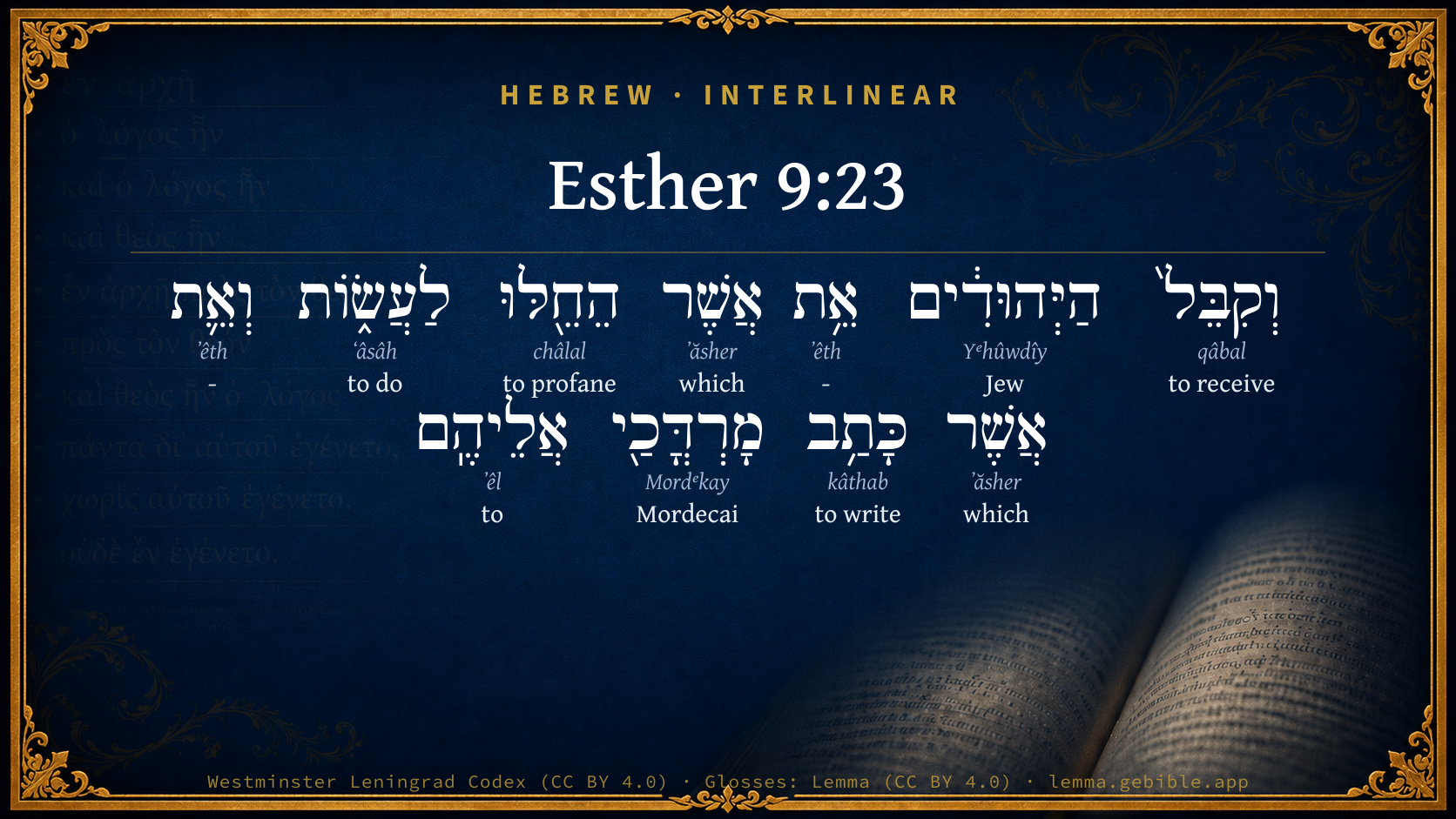
Esther 9:23

Hebrew (Westminster Leningrad Codex) Esther 9:23 appears in the Hebrew Old Testament. The text above is from the Westminster Leningrad Codex. Each word links to its Strong’s number, a concise gloss, and parsing drawn from the Open Scriptures Hebrew Bible morphology. Click any word for its full Brown-Driver-Briggs (BDB) entry.
Download image
Cite this verse

Esther 9:23 (World English Bible). Public Domain. Lemma interlinear Bible study tool, https://lemma.gebible.app/v/esther/9/23.

Show BibTeX & RIS
BibTeX
RIS
English Translation
The Jews undertook to do as they had begun, and as Mordecai had written to them;
World English Bible · Public Domain
Download a study sheet

One document with this verse’s original text, its word-by-word gloss line, the meaning frame, cross-references with their text, attributed commentary, and full source and license credits — printable, and it pastes into notes with its structure intact.

This verse Autodidact and up

Study sheet (.html) Plain text (.txt)

A passage Seminary Student

Up to 50 verses in one chapter. A passage sheet keeps up to 6 commentary sources and 12 cross-references per verse, in the order this page ranks them, and says so on the sheet whenever that leaves anything out. Ask for a single verse and you get the Autodidact verse sheet above.

Everything on this page stays free to read, with no account — the sheet is a download of what is already on screen, not access to it.

Want to remove ads? Support Godless Engineer
Compare translations 3

The same verse in 3 English versions, stacked beneath the original-language interlinear above. Click any original word for its lexicon entry.

Each is an independent rendering of the whole verse — the interlinear is not word-aligned to these translations.

Highlighted words mark where these versions differ — a whole-verse word diff, not a word-by-word alignment.

  • World English Bible Public Domain
    The Jews undertook to do as they had begun, and as Mordecai had written to them;
  • King James Version Public Domain
    And the Jews undertook to do as they had begun, and as Mordecai had written unto them;
  • unfoldingWord Literal Text CC BY-SA 4.0
    And the Jews accepted what they had begun to do and what Mordecai had written to them.

unfoldingWord Literal Text — © unfoldingWord, licensed CC BY-SA 4.0. Word-aligned USFM3 via Door43 (git.door43.org/unfoldingWord/en_ult).

Versions to compare (up to 4)

3 of 4 selected

Show all 18 translations

Every available English version of this verse, each an independent rendering of the whole verse.

  • World English Bible Public Domain
    The Jews undertook to do as they had begun, and as Mordecai had written to them;
  • Berean Standard Bible Public Domain
    So the Jews agreed to continue the custom they had started, as Mordecai had written to them.
  • Majority Standard Bible Public Domain
    So the Jews agreed to continue the custom they had started, as Mordecai had written to them.
  • King James Version Public Domain
    And the Jews undertook to do as they had begun, and as Mordecai had written unto them;
  • American Standard Version (1901) Public Domain
    And the Jews undertook to do as they had begun, and as Mordecai had written unto them;
  • Revised Version (1885) Public Domain
    And the Jews undertook to do as they had begun, and as Mordecai had written unto them;
  • Geneva Bible (1599) Public Domain
    And the Iewes promised to do as they had begun, and as Mordecai had written vnto them,
  • Douay-Rheims (1899) Public Domain
    And the Jews undertook to observe with solemnity all they had begun to do at that time, which Mardochai by letters had commanded to be done.
  • Young's Literal Translation Public Domain
    And the Jews have received that which they had begun to do, and that which Mordecai hath written unto them,
  • Literal Standard Version CC BY-SA 4.0
    And the Jews have received that which they had begun to do, and that which Mordecai has written to them,
  • Unlocked Literal Bible CC BY-SA 4.0
    So the Jews continued the celebration they had begun, doing what Mordecai had written to them.
  • unfoldingWord Literal Text CC BY-SA 4.0
    And the Jews accepted what they had begun to do and what Mordecai had written to them.
  • Darby Bible Public Domain
    And the Jews undertook to do as they had begun, and as Mordecai had written to them.
  • World Messianic Bible Public Domain
    The Jews accepted the custom that they had begun, as Mordecai had written to them,
  • Webster's Bible Public Domain
    And the Jews undertook to do as they had begun, and as Mordecai had written to them;
  • Free Bible Version CC BY-SA 4.0
    The Jews agreed to continue what they had already started doing, following what Mordecai had written to them.
  • Bible in Basic English Public Domain
    And the Jews gave their word to go on as they had been doing and as Mordecai had given them orders in writing;
  • JPS Tanakh (1917) Public Domain
    And the Jews took upon them to do as they had begun, and as Mordecai had written unto them;

Literal Standard Version (2020), Covenant Press — licensed CC BY-SA 4.0. Text via the HelloAO Bible API (eBible.org). Unlocked Literal Bible (unfoldingWord) — licensed CC BY-SA 4.0. Text via the HelloAO Bible API (eBible.org). unfoldingWord Literal Text — © unfoldingWord, licensed CC BY-SA 4.0. Word-aligned USFM3 via Door43 (git.door43.org/unfoldingWord/en_ult). Free Bible Version, Dr. Jonathan Gallagher — licensed CC BY-SA 4.0. Text via the HelloAO Bible API (eBible.org).

Word by word

More ways to search: Search by grammar → Find every occurrence → Compare this word →

Practice this passage: Drill this verse → Learn its vocabulary →

וְקִבֵּל֙
qâbal
H6901
“and · to receive”
Conjunction + Verb, Piel, Perfect, 3rd Person, Masculine, Singular
Part of Speech
Conjunction + Verb
Stem
Piel
Form
Perfect
Person
3rd Person
Gender
Masculine
Number
Singular
Full BDB Definition

Origin: a primitive root

TWOT: 1980

to take, receive, be before - (Piel) - to take, choose, receive - to accept - to accept, assume - (Hiphil) - to show oppositeness - to correspond, receive one to the other
  1. הַיְּהוּדִ֔ים Yᵉhûwdîy H3064 “the · Jews” Particle, Definite Article + Noun, Gentilic, Masculine, Plural, Absolute
  2. אֵ֥ת ʼêth H853 “-” Particle, Direct Object
  3. אֲשֶׁר ʼăsher H834 “which” Particle, Relative
  4. הֵחֵ֖לּוּ châlal H2490 “to profane” Verb, Hiphil, Perfect, 3rd Person, Common, Plural
  5. לַעֲשׂ֑וֹת ʻâsâh H6213 “to do” Preposition + Verb, Qal, Infinitive Construct
  6. וְאֵ֛ת ʼêth H853 “and · -” Conjunction + Particle, Direct Object
  7. אֲשֶׁר ʼăsher H834 “which” Particle, Relative
  8. כָּתַ֥ב kâthab H3789 “to write” Verb, Qal, Perfect, 3rd Person, Masculine, Singular
  9. מָרְדֳּכַ֖י Mordᵉkay H4782 “Mordecai” Noun, Proper
  10. אֲלֵיהֶֽם ʼêl H413 “to · them” Preposition + Suffix, Personal, 3rd Person, Masculine, Plural

About this verse

These counts appear in no published source. They are computed here, from the morphology-tagged text and Lemma’s own curated glosses. What Lemma adds →

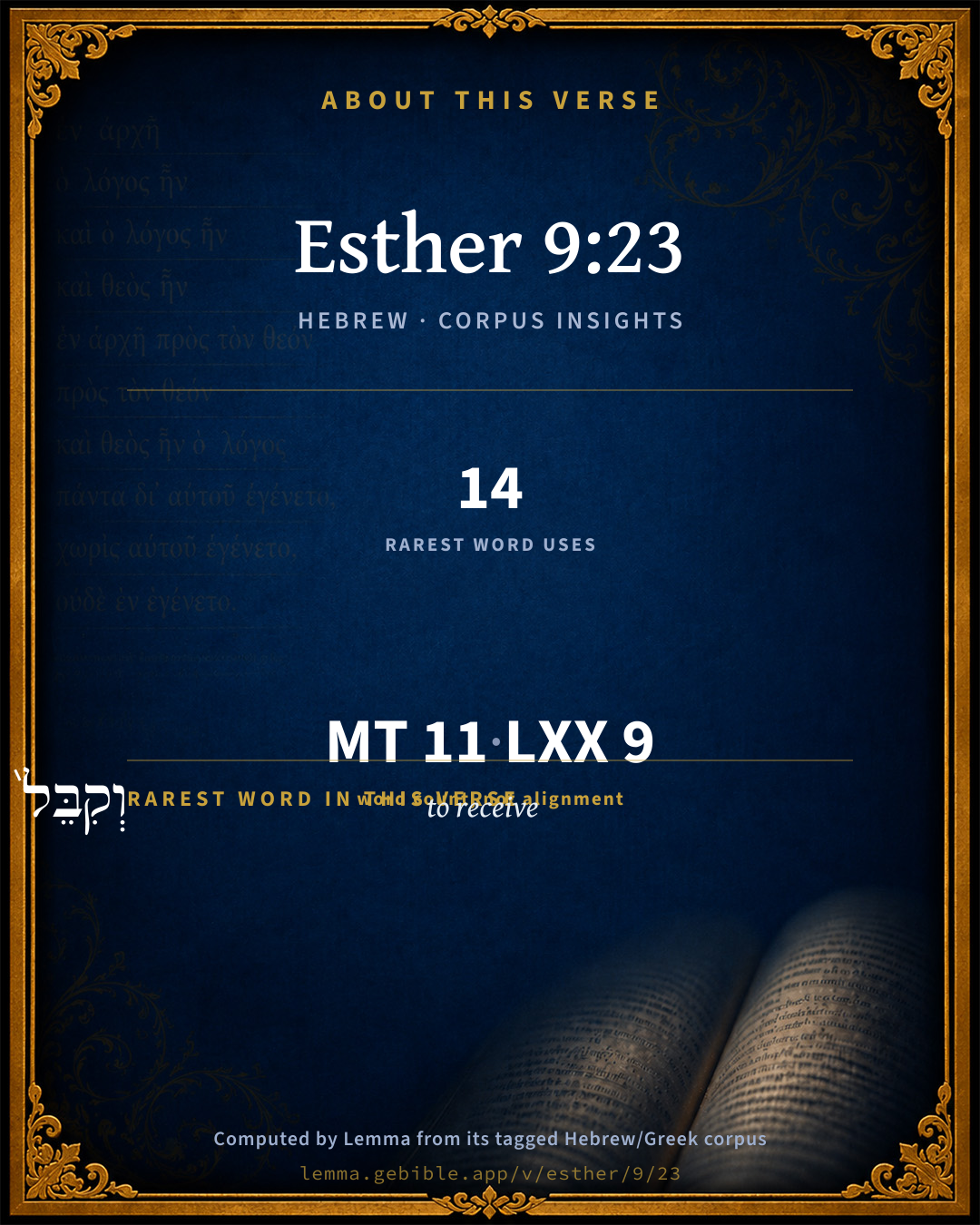
11
words
9
distinct lemmas
Historical
section

Notable vocabulary

The rarest word here is וְקִבֵּל֙ to receive H6901 — appearing just 14 times in the whole Hebrew Bible.

Shared distinctive vocabulary

וְקִבֵּל֙ to receive H6901 occurs in 12 verses of the Hebrew Bible. Also found in:

Grammatical profile

  • 4 verbs
  • 2 nouns
  • 1 preposition
  • 4 particles

Verb forms

  • וְקִבֵּל֙ Piel · Perfect
  • הֵחֵ֖לּוּ Hiphil · Perfect
  • לַעֲשׂ֑וֹת Qal · Infinitive Construct
  • כָּתַ֥ב Qal · Perfect

Repetition

A word recurs within this verse — often emphatic in Hebrew:

  • אֲשֶׁר which H834 ×2

Hebrew & Septuagint length

In English translation the verse runs 16 words from the Hebrew and 12 from the Septuagint (LXX English) — closely comparable.

A rough comparison of the two English renderings, which tokenize alike — not a word-level alignment.

Word counts can differ between the Hebrew and the Greek without any difference in meaning — e.g. the Hebrew direct-object marker אֵת has no separate Greek word, and Greek often adds the article ὁ.

In the original languages it is 11 Hebrew tokens and 9 Greek tokens — but the two are counted differently (Hebrew bundles its prefixes and suffixes into one token; the Greek is in lemma form), so that isn’t a like-for-like length.

Hebrew and Greek witnesses Masoretic Hebrew ↔ Greek Septuagint

The same verse in the two great witnesses to the Old Testament, shown verse-for-verse.

These are two independent witnesses, not word-aligned to each other, and the Septuagint is shown in lemma (dictionary) form.

Hebrew Esther 9:23 Masoretic · Westminster Leningrad Codex

וְקִבֵּל֙ הַיְּהוּדִ֔ים אֵ֥ת אֲשֶׁר הֵחֵ֖לּוּ לַעֲשׂ֑וֹת וְאֵ֛ת אֲשֶׁר כָּתַ֥ב מָרְדֳּכַ֖י אֲלֵיהֶֽם

The Jews undertook to do as they had begun, and as Mordecai had written to them;

World English Bible · Public Domain

Greek LXX Esther 9:23 Septuagint · lemma form

καί προςδέχομαι ὁ ἰουδαῖος καθώς γράφω αὐτός ὁ μαρδοχαῖος

And the Jews consented to this accordingly as Mardochaeus wrote to them,

LXX2012 (modern English Septuagint) · Public Domain

Hebrew: Westminster Leningrad Codex (CC BY 4.0). Greek: Septuagint (public domain); English from LXX2012 (modern English Septuagint) (Public Domain). How the Septuagint differs from the Hebrew →

Commentary

Notes on Esther 9:23 from classic Christian and Jewish commentators (each source and its license shown beneath its notes). The classic Christian expositions comment on the surrounding passage and are grouped to its opening verse, so a note may address several verses; the Jewish commentaries on the Tanakh (Rashi and others) are per-verse, so they appear only where the commentator wrote on this verse.

Lemma curates 59 commentaries, every one of them public domain or Creative Commons licensed, each selected and text-cleaned for this edition rather than reprinted as found. About our sources →

Trapp's Complete Commentary

John Trapp

Est 9:23 And the Jews undertook to do as they had begun, and as Mordecai had written unto them;

Ver. 28. And the Jews undertook to do as they had begun] Which yet they could not do unless God gave them a heart to do it. Holy David understood this, and therefore when he found that heat and height of good affections in his people, he prayed, "O Lord God of Abraham, Isaac, and of Israel, our fathers, keep this for ever in the imagination of the thoughts of the heart of thy people, and prepare their heart unto thee," 1Ch 29:18. And when he had at another time undertook for himself, that if God would deliver him from blood guiltiness his tongue should sing aloud of God’s righteousness, he subjoins (by way of correction, as if he were sensible that he had promised more than was in his power to perform), "O Lord, open thou my lips, and my mouth shall show forth thy praise," Psa 51:14-15. The Hebrew, or rather Chaldee, word here rendered undertook is of the singular number, to show that every particular Jew undertook for himself and for his posterity to all perpetuity. And indeed they keep this feast annually to this day, and exceedingly please themselves in the reading of this history, counting and calling all such princes and states as cross them Hamans, and wishing that they may be able one day to be avenged of them, as their fathers were of these Persians.

John Trapp, A Commentary or Exposition upon All the Books of the Old and New Testament (1647–1656) — public domain. Text from a community e-Sword module.

Joseph Benson's Commentary

Est 9:23. The Jews undertook to do as they had begun — That is, to keep these days as festivals everywhere. Having by this means an opportunity of gathering themselves together, on any occasion, the chief of them assembled, and freely and unanimously consented to Mordecai’s desire in this matter, and bound it upon themselves and posterity.

Joseph Benson's Commentary on the Old and New Testaments (1811–1818) — public domain. Text from a community e-Sword module.

Tyndale Open Study Notes

Tyndale Open Resources

9:23-26 These verses summarize the events leading to the Festival of Purim.

Tyndale Open Study Notes — © Tyndale Open Resources, licensed CC BY-SA 4.0. Text via the HelloAO Bible API.

Adam Clarke's Commentary

Verse 23. The Jews undertook to do as they had begun] They had already kept the fifteenth day, and some of them in the country the fourteenth also, as a day of rejoicing: Mordecai wrote to them to bind themselves and their successors, and all their proselytes, to celebrate this as an annual feast throughout all their generations; and this they undertook to do. And it has been observed among them, in all places of their dispersion, from that day to the present time, without any interruption.

Adam Clarke's Commentary on the Bible (1810–1826) — public domain. Text from a community e-Sword/MySword module.

The Cambridge Bible for Schools and Colleges

gen. ed. J. J. S. Perowne

23. undertook] assumed the obligation.

to do as they had begun] to continue to keep the celebration on the fourteenth day of Adar.

and as Mordecai had written unto them] i.e. to keep the celebration on the following day as well.

The Cambridge Bible for Schools and Colleges (gen. ed. J. J. S. Perowne; Cambridge University Press, 1878–1918) — public domain. Text from a community e-Sword module.

John Gill's Exposition

But when Esther came before the king,.... To request of him her life, and the life of her people:

he commanded by letters, that his wicked device, which he devised against the Jews, should return upon his own head; that whereas his wicked scheme was to destroy all the Jews, the king, by his second letter, gave orders that the Jews should have liberty to defend themselves, and destroy their enemies which rose up against them; and the friends and party of Haman were entirely cut off:

and that he and his sons should be hanged on the gallows; which he had prepared for Mordecai; not that they were ordered to be hanged together, nor were they; Haman was hanged before on the twenty third day of the month, but his sons not till the fourteenth day of the twelfth month; Est 7:10.

John Gill's Exposition of the Whole Bible (1746–1763) — public domain (CC PDM 1.0). Text via the HelloAO Bible API.

Matthew Poole's English Annotations

Having by this means opportunity to gather themselves together upon any occasion, the chief of them assembled together, and freely and unanimously consented to Mordecai’s desire in this matter, and bound it upon themselves and posterity.

Matthew Poole's English Annotations on the Holy Bible (1683–1685) — public domain. Text from a community e-Sword/MySword module.

Whedon's Commentary on the Bible

Daniel D. Whedon

23. Undertook to do as they had begun — They heartily accepted and adopted Mordecai’s proposal, and resolved to perpetuate what they had in fact already begun, namely, resting, feasting, and rejoicing on the fourteenth and fifteenth of Adar. Compare Est_9:17-18. Thus it seems Mordecai’s letters (Est_9:20) contained a proposal for the Jews of the empire either to adopt or reject. They at once adopted the proposal, and “ordained” (Est_9:27) the observance of these two days; whereupon Esther and Mordecai issued a “second letter,” (Est_9:29,) which was more of the nature of an authoritative proclamation, confirming and establishing the feast of Purim.

Daniel D. Whedon (gen. ed.), Commentary on the Old and New Testaments (1874–1909) — public domain. Text from a community e-Sword module.

The Pulpit Commentary

The Jews undertook to do as they had begun. i.e. "to observe the 14th day." And as Mordecai had written to them. i.e. "and to observe also the 15th."

The Pulpit Commentary (1880–1919), ed. H.D.M. Spence-Jones & Joseph S. Exell — public domain. Text from a community e-Sword module.

Keil & Delitzsch

C. F. Keil & F. Delitzsch

And the Jews undertook to do as they had begun, and as Mordochai had written to them. They had begun, as Est 9:22 tells us, by keeping both days, and Mordochai wrote to them that they should make this an annual custom. This they agreed to do in consequence of Mordochai's letters. The reason of their so doing is given in Est 9:24 and Est 9:25, and the name of this festival is explained, Est 9:26, by a brief recapitulation of the events which gave rise to it. Then follows, Est 9:26 and Est 9:27, another wordy statement of the fact, that it was by reason of this letter, and on account of what they had seen, i.e., experienced, that the annual celebration of this feast was instituted for a perpetual memorial to all Jews at all times (Est 9:28 and Est 9:29).

Keil & Delitzsch — Biblical Commentary on the Old Testament (1861–1891) — public domain (CC PDM 1.0). Text via the HelloAO Bible API. (Old Testament only.)

unfoldingWord translationNotes

Door43 World Missions Community

General Information:

This passage summarizes much of the story of Esther in order to explain the reason for the festival of Purim.

Haman son of Hammedatha the Agagite

This is the name and description of Haman, one of the king's officials. See how you translated this in Esther 3:1. (See: How to Translate Names)

he threw Pur (that is, he threw lots)

"Pur" was the Persian word for "lot." The phrase "he threw lots" explains what "he threw Pur" means.

he threw Pur (that is, he threw lots)

Why he threw Pur, or lots, can be stated clearly. AT: "he threw Pur (that is, he threw lots) to find out what would be the best day to attack the Jews" (See: Assumed Knowledge and Implicit Information)

But when the matter came before the king

The Hebrew text can also be interpreted to mean, "But when Esther came before the king." Some modern versions choose this interpretation.

the wicked plan Haman developed against the Jews should come back on his own head

"Come back on his own head" means that it should be done to Haman. AT: "the wicked plan Haman developed against the Jews should be done to him" (See: Idiom)

translationWords

epistle

evil

unfoldingWord translationNotes — © Distant Shores Media and the Door43 World Missions Community, licensed CC BY-SA 4.0. Source: git.door43.org/Door43/en_tn.

Lesson kit

Teaching starters — assembled from the data on this page, not authored interpretation. Every prompt links to the verse data it draws on. Edit before teaching.

Esther, in the Historical, opens this verse with 11 words (9 distinct Hebrew lemmas). Its most distinctive word is qâbal (“to receive”). A historical commentator’s framing appears above. Read the whole chapter for the surrounding context.

Discussion questions

  1. What does “to receive” (qâbal) contribute to the verse as a whole?
  2. How does Exodus 26:5, which shares the word «to receive», read alongside this verse?
  3. What does the repetition of “which” (2× in this one verse) do in this verse?
  4. These translations render this verse differently. What is at stake in choosing one wording over another?
  5. «וְקִבֵּל֙» is a Piel Perfect verb. How does that grammatical form shape the action described?
  6. Compare how Trapp's Complete Commentary and Joseph Benson's Commentary read this verse. Where do they agree or differ?

Things to notice

Reading settings

Reading text

Shown beneath each verse's original-language words.

Old Testament
Old Testament edition

Read the OT as the Masoretic Hebrew (MT) or the Greek Septuagint (LXX).

English shown for the Greek Septuagint (in the Hebrew ↔ Greek comparison).

Comparing translations? Open the Compare panel on any verse page to stack up to four side by side.