
Numbers 17:2

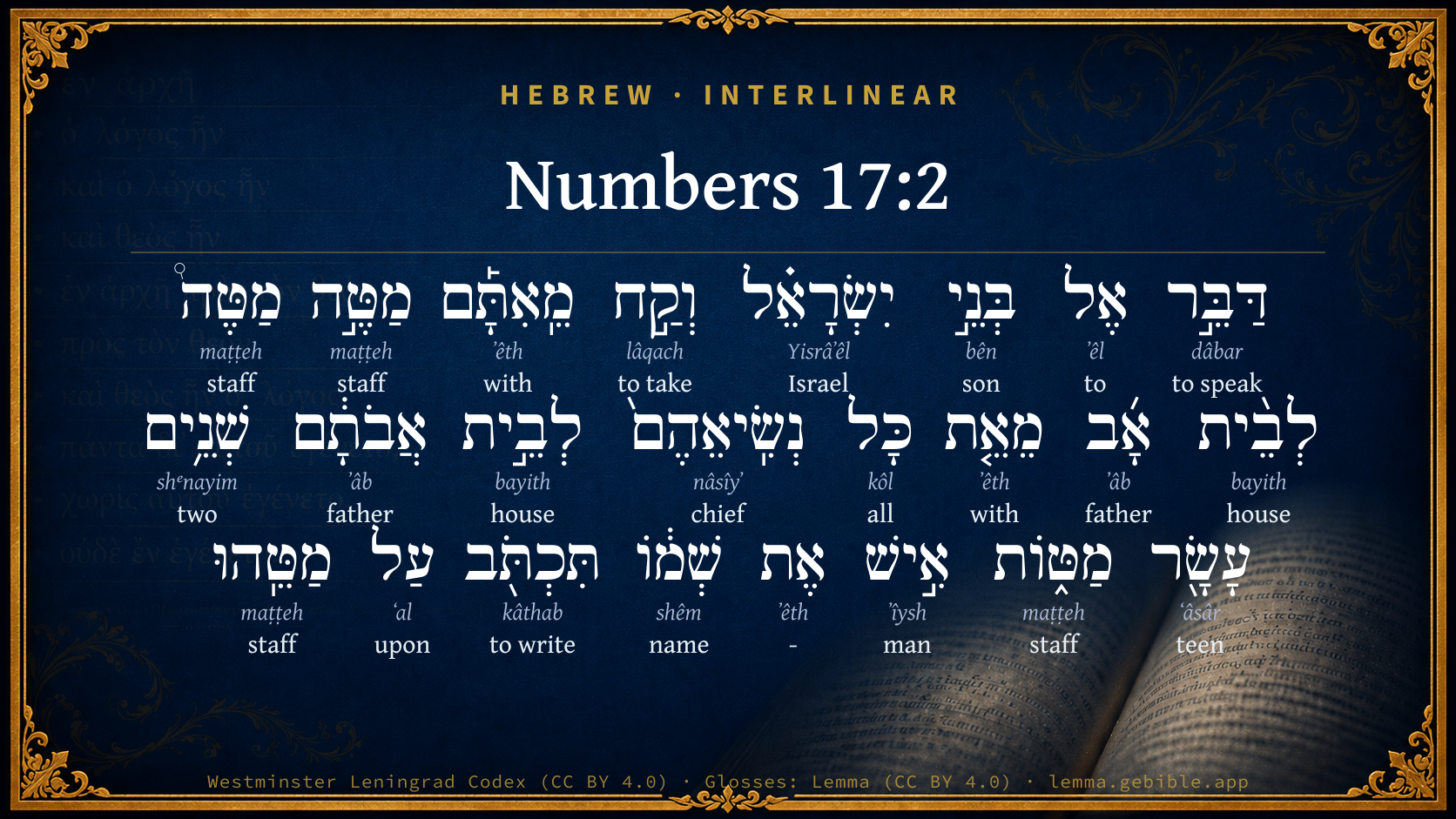
Hebrew (Westminster Leningrad Codex) Numbers 17:2 appears in the Hebrew Old Testament. The text above is from the Westminster Leningrad Codex. Each word links to its Strong’s number, a concise gloss, and parsing drawn from the Open Scriptures Hebrew Bible morphology. Click any word for its full Brown-Driver-Briggs (BDB) entry.
Download image
Cite this verse

Numbers 17:2 (World English Bible). Public Domain. Lemma interlinear Bible study tool, https://lemma.gebible.app/v/numbers/17/2.

Show BibTeX & RIS
BibTeX
RIS
English Translation
Speak to the children of Israel, and take of them rods, one for each fathers' house, of all their princes according to their fathers' houses, twelve rods: write you every man's name on his rod.
World English Bible · Public Domain
Download a study sheet

One document with this verse’s original text, its word-by-word gloss line, the meaning frame, cross-references with their text, attributed commentary, and full source and license credits — printable, and it pastes into notes with its structure intact.

This verse Autodidact and up

Study sheet (.html) Plain text (.txt)

A passage Seminary Student

Up to 50 verses in one chapter. A passage sheet keeps up to 6 commentary sources and 12 cross-references per verse, in the order this page ranks them, and says so on the sheet whenever that leaves anything out. Ask for a single verse and you get the Autodidact verse sheet above.

Everything on this page stays free to read, with no account — the sheet is a download of what is already on screen, not access to it.

Want to remove ads? Support Godless Engineer
Compare translations 3

The same verse in 3 English versions, stacked beneath the original-language interlinear above. Click any original word for its lexicon entry.

Each is an independent rendering of the whole verse — the interlinear is not word-aligned to these translations.

Highlighted words mark where these versions differ — a whole-verse word diff, not a word-by-word alignment.

  • World English Bible Public Domain
    Speak to the children of Israel, and take of them rods, one for each fathers' house, of all their princes according to their fathers' houses, twelve rods: write you every man's name on his rod.
  • King James Version Public Domain
    Speak unto the children of Israel, and take of every one of them a rod according to the house of their fathers, of all their princes according to the house of their fathers twelve rods: write thou every man's name upon his rod.
  • unfoldingWord Literal Text CC BY-SA 4.0
    “Speak to the sons of Israel, and take from with them a staff, a staff for a house of a father, from with all their leaders for the house of their fathers, 12 staffs. A man, his name you shall write on his staff.

unfoldingWord Literal Text — © unfoldingWord, licensed CC BY-SA 4.0. Word-aligned USFM3 via Door43 (git.door43.org/unfoldingWord/en_ult).

Versions to compare (up to 4)

3 of 4 selected

Show all 18 translations

Every available English version of this verse, each an independent rendering of the whole verse.

  • World English Bible Public Domain
    Speak to the children of Israel, and take of them rods, one for each fathers' house, of all their princes according to their fathers' houses, twelve rods: write you every man's name on his rod.
  • Berean Standard Bible Public Domain
    “Speak to the Israelites and take from them twelve staffs, one from the leader of each tribe. Write each man’s name on his staff,
  • Majority Standard Bible Public Domain
    “Speak to the Israelites and take from them twelve staffs, one from the leader of each tribe. Write each man’s name on his staff,
  • King James Version Public Domain
    Speak unto the children of Israel, and take of every one of them a rod according to the house of their fathers, of all their princes according to the house of their fathers twelve rods: write thou every man's name upon his rod.
  • American Standard Version (1901) Public Domain
    Speak unto the children of Israel, and take of them rods, one for each fathers' house, of all their princes according to their fathers' houses, twelve rods: write thou every man's name upon his rod.
  • Revised Version (1885) Public Domain
    Speak unto the children of Israel, and take of them rods, one for each fathers’ house, of all their princes according to their fathers’ houses, twelve rods: write thou every man’s name upon his rod.
  • Geneva Bible (1599) Public Domain
    Speake vnto the children of Israel, and take of euery one of them a rod, after the house of their fathers, of all their princes according to the familie of their fathers, euen twelue rods: and thou shalt write euery mans name vpon his rod.
  • Douay-Rheims (1899) Public Domain
    Speak to the children of Israel, and take of every one of them a rod by their kindreds, of all the princes of the tribes, twelve rods, and write the name of every man upon his rod.
  • Young's Literal Translation Public Domain
    `Speak unto the sons of Israel, and take from them each a rod, for a father's house, from all their princes, for the house of their fathers, twelve rods; the name of each thou dost write on his rod,
  • Literal Standard Version CC BY-SA 4.0
    “Speak to the sons of Israel, and take a rod from each of them, for a father’s house, from all their princes, for the house of their fathers—twelve rods; you write the name of each on his rod,
  • Unlocked Literal Bible CC BY-SA 4.0
    “Speak to the people of Israel and get staffs from them, one for each ancestral tribe, twelve staffs. Write each man's name on his staff.
  • unfoldingWord Literal Text CC BY-SA 4.0
    “Speak to the sons of Israel, and take from with them a staff, a staff for a house of a father, from with all their leaders for the house of their fathers, 12 staffs. A man, his name you shall write on his staff.
  • Darby Bible Public Domain
    Speak unto the children of Israel, and take of them a staff, a staff for each father's house, of all their princes according to the houses of their fathers, twelve staves: thou shalt write each one's name upon his staff.
  • World Messianic Bible Public Domain
    “Speak to the children of Israel, and take rods from them, one for each fathers’ house, of all their princes according to their fathers’ houses, twelve rods. Write each man’s name on his rod.
  • Webster's Bible Public Domain
    Speak to the children of Israel, and take of every one of them a rod according to the house of their fathers, of all their princes according to the house of their fathers, twelve rods: write thou every man's name upon his rod.
  • Free Bible Version CC BY-SA 4.0
    “Tell the Israelites to bring twelve walking sticks, one from the leader of each tribe. Write the name of each man on the walking stick,
  • Bible in Basic English Public Domain
    Say to the children of Israel that they are to give you rods, one for every family, for every chief, the head of his father's house, making twelve rods; let every man's name be placed on his rod.
  • JPS Tanakh (1917) Public Domain
    (17-17) 'Speak unto the children of Israel, and take of them rods, one for each fathers' house, of all their princes according to their fathers' houses, twelve rods; thou shalt write every man's name upon his rod.

Literal Standard Version (2020), Covenant Press — licensed CC BY-SA 4.0. Text via the HelloAO Bible API (eBible.org). Unlocked Literal Bible (unfoldingWord) — licensed CC BY-SA 4.0. Text via the HelloAO Bible API (eBible.org). unfoldingWord Literal Text — © unfoldingWord, licensed CC BY-SA 4.0. Word-aligned USFM3 via Door43 (git.door43.org/unfoldingWord/en_ult). Free Bible Version, Dr. Jonathan Gallagher — licensed CC BY-SA 4.0. Text via the HelloAO Bible API (eBible.org).

Word by word

More ways to search: Search by grammar → Find every occurrence → Compare this word →

Practice this passage: Drill this verse → Learn its vocabulary →

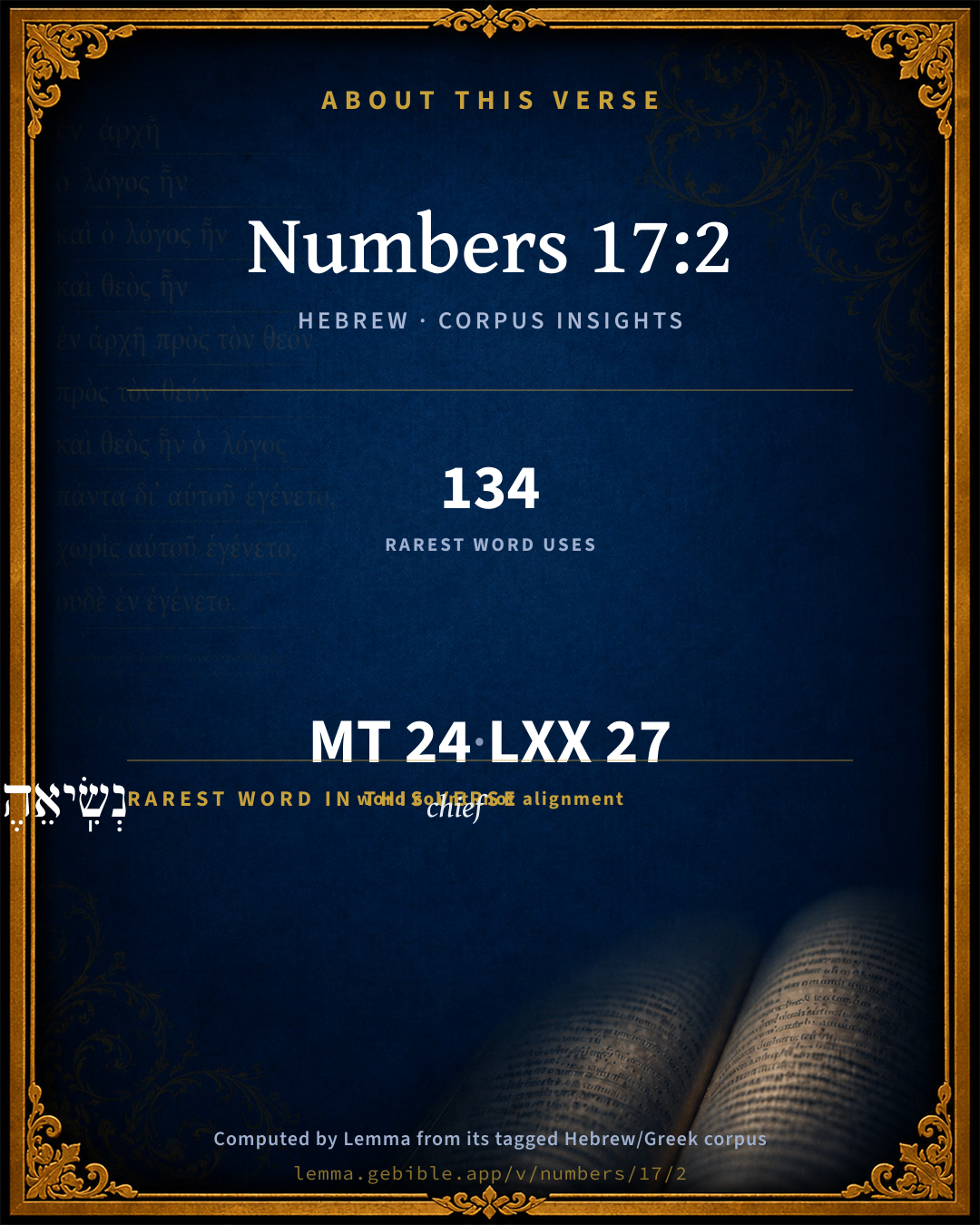
נְשִֽׂיאֵהֶם֙
nâsîyʼ
H5387
“chiefs · their”
Noun, Common, Masculine, Plural, Construct + Suffix, Personal, 3rd Person, Masculine, Plural
Part of Speech
Noun
Type
Common
Gender
Masculine
Number
Plural
State
Construct
Full BDB Definition

Origin: from H5375

TWOT: 1421b , 1421c

one lifted up, chief, prince, captain, leader - rising mist, vapour
  1. דַּבֵּ֣ר dâbar H1696 “speak” Verb, Piel, Imperative, 2nd Person, Masculine, Singular
  2. אֶל ʼêl H413 “to” Preposition
  3. בְּנֵ֣י bên H1121 “sons of” Noun, Common, Masculine, Plural, Construct
  4. יִשְׂרָאֵ֗ל Yisrâʼêl H3478 “Israel” Noun, Proper
  5. וְקַ֣ח lâqach H3947 “and · take” Conjunction + Verb, Qal, Imperative, 2nd Person, Masculine, Singular
  6. מֵֽאִתָּ֡ם ʼêth H854 “from · with · them” Preposition + Preposition + Suffix, Personal, 3rd Person, Masculine, Plural
  7. מַטֶּ֣ה maṭṭeh H4294 “staff” Noun, Common, Masculine, Singular, Absolute
  8. מַטֶּה֩ maṭṭeh H4294 “staff” Noun, Common, Masculine, Singular, Absolute
  9. לְבֵ֨ית bayith H1004 “to/for · house of” Preposition + Noun, Common, Masculine, Singular, Construct
  10. אָ֜ב ʼâb H1 “father” Noun, Common, Masculine, Singular, Absolute
  11. מֵאֵ֤ת ʼêth H854 “from · with” Preposition + Preposition
  12. כָּל kôl H3605 “all of” Noun, Common, Masculine, Singular, Construct
  13. לְבֵ֣ית bayith H1004 “to/for · house of” Preposition + Noun, Common, Masculine, Singular, Construct
  14. אֲבֹתָ֔ם ʼâb H1 “fathers · their” Noun, Common, Masculine, Plural, Construct + Suffix, Personal, 3rd Person, Masculine, Plural
  15. שְׁנֵ֥ים shᵉnayim H8147 “two” Adjective, Cardinal number, Masculine, Dual, Absolute
  16. עָשָׂ֖ר ʻâsâr H6240 “teen” Adjective, Cardinal number, Masculine, Singular, Absolute
  17. מַטּ֑וֹת maṭṭeh H4294 “staffs” Noun, Common, Masculine, Plural, Absolute
  18. אִ֣ישׁ ʼîysh H376 “man” Noun, Common, Masculine, Singular, Absolute
  19. אֶת ʼêth H853 “-” Particle, Direct Object
  20. שְׁמ֔וֹ shêm H8034 “name · his” Noun, Common, Masculine, Singular, Construct + Suffix, Personal, 3rd Person, Masculine, Singular
  21. תִּכְתֹּ֖ב kâthab H3789 “to write” Verb, Qal, Imperfect, 2nd Person, Masculine, Singular
  22. עַל ʻal H5921 “upon” Preposition
  23. מַטֵּֽהוּ maṭṭeh H4294 “staff · his” Noun, Common, Masculine, Singular, Construct + Suffix, Personal, 3rd Person, Masculine, Singular

About this verse

These counts appear in no published source. They are computed here, from the morphology-tagged text and Lemma’s own curated glosses. What Lemma adds →

24
words
18
distinct lemmas
Pentateuch
section

Grammatical profile

  • 3 verbs
  • 14 nouns
  • 2 adjectives
  • 4 prepositions
  • 1 particle

Verb forms

  • דַּבֵּ֣ר Piel · Imperative
  • וְקַ֣ח Qal · Imperative
  • תִּכְתֹּ֖ב Qal · Imperfect

Repetition

Words recur within this verse — often emphatic in Hebrew:

  • מַטֶּ֣ה staff H4294 ×4
  • לְבֵ֨ית house H1004 ×2
  • אָ֜ב father H1 ×2
  • מֵֽאִתָּ֡ם with H854 ×2

Hebrew & Septuagint length

In English translation the verse runs 35 words from the Hebrew and 42 from the Septuagint (LXX English) — closely comparable.

A rough comparison of the two English renderings, which tokenize alike — not a word-level alignment.

Word counts can differ between the Hebrew and the Greek without any difference in meaning — e.g. the Hebrew direct-object marker אֵת has no separate Greek word, and Greek often adds the article ὁ.

In the original languages it is 24 Hebrew tokens and 27 Greek tokens — but the two are counted differently (Hebrew bundles its prefixes and suffixes into one token; the Greek is in lemma form), so that isn’t a like-for-like length.

Cross-references

13

Topical passages linked to Numbers 17:2 in the Treasury of Scripture Knowledge — connected by theme and wording, ordered by reader-vote popularity; previews shown in the World English Bible.

  • Genesis 49:10 The scepter will not depart from Judah, Nor the ruler's staff from between his feet, Until he comes to whom it belongs. To him will the obedience of the peoples be.
  • Exodus 4:2 Yahweh said to him, "What is that in your hand?" He said, "A rod."
  • Exodus 4:17 You shall take this rod in your hand, with which you shall do the signs."
  • Numbers 1:5–16 These are the names of the men who shall stand with you: Of Reuben: Elizur the son of Shedeur.
  • Numbers 2:3–30 Those who encamp on the east side toward the sunrise shall be of the standard of the camp of Judah, according to their divisions: and the prince of the children of Judah shall be Nahshon the son of Amminadab.
  • Numbers 10:14–27 In the first [place] the standard of the camp of the children of Judah set forward according to their hosts: and over his host was Nahshon the son of Amminadab.
  • Psalms 110:2 Yahweh will send forth the rod of your strength out of Zion. Rule in the midst of your enemies.
  • Psalms 125:3 For the scepter of wickedness won't remain over the allotment of the righteous; So that the righteous won't use their hands to do evil.
  • Ezekiel 19:14 Fire is gone out of the rods of its branches, it has devoured its fruit, so that there is in it no strong rod to be a scepter to rule. This is a lamentation, and shall be for a lamentation.
  • Ezekiel 21:10 it is sharpened that it may make a slaughter; it is furbished that it may be as lightning: shall we then make mirth? the rod of my son, it condemns every tree.
  • Ezekiel 21:13 For there is a trial; and what if even the rod that condemns shall be no more? says the Lord Yahweh.
  • Ezekiel 37:16–20 You, son of man, take one stick, and write on it, For Judah, and for the children of Israel his companions: then take another stick, and write on it, For Joseph, the stick of Ephraim, and [for] all the house of Israel his companions:
  • Micah 7:14 Shepherd your people with your staff, The flock of your heritage, Who dwell by themselves in a forest, In the midst of fertile pasture land, let them feed; In Bashan and Gilead, as in the days of old.

Cross-references courtesy of OpenBible.info (CC BY 4.0).

Hebrew and Greek witnesses Masoretic Hebrew ↔ Greek Septuagint

The same verse in the two great witnesses to the Old Testament, shown verse-for-verse.

These are two independent witnesses, not word-aligned to each other, and the Septuagint is shown in lemma (dictionary) form.

Hebrew Numbers 17:2 Masoretic · Westminster Leningrad Codex

דַּבֵּ֣ר אֶל בְּנֵ֣י יִשְׂרָאֵ֗ל וְקַ֣ח מֵֽאִתָּ֡ם מַטֶּ֣ה מַטֶּה֩ לְבֵ֨ית אָ֜ב מֵאֵ֤ת כָּל נְשִֽׂיאֵהֶם֙ לְבֵ֣ית אֲבֹתָ֔ם שְׁנֵ֥ים עָשָׂ֖ר מַטּ֑וֹת אִ֣ישׁ אֶת שְׁמ֔וֹ תִּכְתֹּ֖ב עַל מַטֵּֽהוּ

Speak to the children of Israel, and take of them rods, one for each fathers' house, of all their princes according to their fathers' houses, twelve rods: write you every man's name on his rod.

World English Bible · Public Domain

Greek LXX Numbers 17:2 Septuagint · lemma form

καί πρός ελεαζαρ ὁ υἱός ἀαρών ὁ ἱερεύς ἀνααἱρέω ὁ πυρεῖον ὁ χαλκοῦς ἐκ μέσος ὁ κατακαίω καί ὁ πῦρ ὁ ἀλλότριος οὗτος σπείρω ἐκεῖ ὅτι ἁγιάζω

Speak to the children of Israel, and take rods of them, according to the houses of their families, a rod from all their princes, according to the houses of their families, twelve rods, and write the name of each on his rod.

LXX2012 (modern English Septuagint) · Public Domain

On this verse, The Pulpit Commentary discusses the Septuagint’s reading. Read the note in Commentary ↓

Hebrew: Westminster Leningrad Codex (CC BY 4.0). Greek: Septuagint (public domain); English from LXX2012 (modern English Septuagint) (Public Domain). How the Septuagint differs from the Hebrew →

Targum (Aramaic paraphrase)

2

The Targum is the ancient Jewish Aramaic paraphrase of the Hebrew Scriptures — an interpretive translation, not the Hebrew text itself. Onkelos (literal) and Pseudo-Jonathan (expansive) render the Torah, and Jonathan the Prophets. Coverage is partial: where no permissively-licensed English translation exists for a verse, only the Aramaic is shown. This is verse-level text, not a word-by-word alignment to the Hebrew.

  1. Targum Onkelos Torah (Genesis–Deuteronomy)
    אֱמַר לְאֶלְעָזָר בַּר אַהֲרֹן כַּהֲנָא וְיַפְרֵשׁ יָת מַחְתְּיָתָא מִבֵּין יְקִידַיָא וְיָת אֶשָׁתָא יַרְחִיק לְהָלָא אֲרֵי אִתְקַדָשׁוּ

    (no public-domain English translation for this verse)

    Targum Onkelos — Aramaic: “Onkelos Genesis” (public domain); “Onkelos Exodus” (public domain); “Onkelos Leviticus” (public domain); “Onkelos Numbers” (public domain); “Onkelos Deuteronomy” (public domain). English: “Sefaria Community Translation” (CC0 1.0 (public-domain dedication)); “J.W. Etheridge. The Targums of Onkelos and Jonathan Ben Uzziel on the Pentateuch. London: Longmans, Green, 1862” (public domain). Text via Sefaria.

  2. Targum Pseudo-Jonathan Torah (Genesis–Deuteronomy)
    אֲמַר לְאֶלְעָזָר בַּר אַהֲרן כַּהֲנָא וְיַפְרֵשׁ יַת מַחְתְּיָא מִן בֵּינֵי יַקִידַיָא וְיַת אֵישָׁתָא בַּדְרֵי לְהָאֵל אֲרוּם אִתְקֵדְשָׁא

    Bid Elazar bar Aharon the priest to take away the censers from among the burnings, and scatter the fire hither and thither; for the censers of these guilty men who have been punished by the destruction of their lives are consecrated;

    Targum Pseudo-Jonathan — Aramaic: “Targum Jonathan on Genesis” (public domain); “Targum Jonathan on Exodus” (public domain); “Targum Jonathan on Leviticus” (public domain); “Targum Jonathan on Numbers” (public domain); “Targum Jonathan on Deuteronomy” (public domain). English: “The Targum of Jonathan ben Uzziel, trans. J. W. Etheridge, London, 1862” (public domain). Text via Sefaria.

Commentary

Notes on Numbers 17:2 from classic Christian and Jewish commentators (each source and its license shown beneath its notes). The classic Christian expositions comment on the surrounding passage and are grouped to its opening verse, so a note may address several verses; the Jewish commentaries on the Tanakh (Rashi and others) are per-verse, so they appear only where the commentator wrote on this verse.

Lemma curates 59 commentaries, every one of them public domain or Creative Commons licensed, each selected and text-cleaned for this edition rather than reprinted as found. About our sources →

Trapp's Complete Commentary

John Trapp

Num 17:2 Speak unto the children of Israel, and take of every one of them a rod according to the house of [their] fathers, of all their princes according to the house of their fathers twelve rods: write thou every man’s name upon his rod.

Ver. 2. Take of every one of them a rod.] Or, Staff; the ensign of their honour, {Num 21:18} and of their civil authority; {Psa 110:2 Jer 48:16-17} a suificient witness against them, that the priesthood belonged not to them. Uzziah smarted for invading it. George, prince of Anhalt, was a singular example, qui primus et unus ex omni Principum Germanorum numero, subditos suos ipse et viva voce et scriptis editis de via salutis erudiret, who was the first, and the only German prince, that both by preaching and writing taught his subjects. {a}

{a} Melch. Adam.

John Trapp, A Commentary or Exposition upon All the Books of the Old and New Testament (1647–1656) — public domain. Text from a community e-Sword module.

Joseph Benson's Commentary

Num 17:2. Take of every one — Not of every person, but of every tribe. A rod — A twig, or branch, from one and the same almond-tree, as some infer from Num 17:8. Or, according to others, the ordinary rods which the princes of the tribes carried in their hands, as tokens of their dignity and authority, Num 21:18. And indeed the miracle would appear the greater, if neither Aaron’s rod, nor any of the rest, was of the almond-tree. But the miracle was sufficiently great either way to demonstrate the extraordinary interposition of Providence. Every man’s name — Every prince’s: for they being the firstborn, and the chief of their tribes, might, above all others, pretend to the priesthood, if it was communicable to any of their tribes; and besides, the prince represented all his tribe: so that this was a full decision of the question. And this place seems to confirm the opinion, that not only Korah and the Levites, but also those of other tribes, contended with Moses and Aaron about the priesthood, as that which belonged to all the congregation, they being all holy.

Joseph Benson's Commentary on the Old and New Testaments (1811–1818) — public domain. Text from a community e-Sword module.

Adam Clarke's Commentary

Verse 2. And take of every one of them a rod] מטה matteh, the staff or sceptre, which the prince or chief of each tribe bore, and which was the sign of office or royalty among almost all the people of the earth.

Adam Clarke's Commentary on the Bible (1810–1826) — public domain. Text from a community e-Sword/MySword module.

Ellicott's Commentary for English Readers

XVII.

(2) And take of every one of them . . . —Better, And take of them a rod for each father’s house.

Twelve rods.—Some suppose that Aaron’s rod was not included amongst the twelve. Others suppose that one rod only was taken for the tribes of Ephraim and Manasseh. The latter supposition is more accordant with the terms here employed than the former, and is supported by Deu_27:12-13, where Joseph stands for the two tribes of Ephraim and Manasseh, and Levi is included amongst the twelve tribes.

Write thou every man’s name upon his rod.—This was in accordance with an Egyptian custom. (See Wilkinson’s Ancient Egyptians, III. 388.) The prophet Ezekiel received a similar injunction (Eze_37:16).

A Bible Commentary for English Readers, edited by Charles John Ellicott (1878–1897) — public domain. Text from a community e-Sword module.

The Cambridge Bible for Schools and Colleges

gen. ed. J. J. S. Perowne

2. rods] staves. They were the official staves of the princes, symbols of their tribal authority, not fresh rods cut from trees, which might conceivably have blossomed in the ordinary course of nature.

The Cambridge Bible for Schools and Colleges (gen. ed. J. J. S. Perowne; Cambridge University Press, 1878–1918) — public domain. Text from a community e-Sword module.

John Gill's Exposition

Speak unto the children of Israel,.... The principal men among them of the several tribes:

and take of everyone of them; not of every individual of the people of Israel, but of their princes, as afterwards explained:

a rod, according to the house of their fathers; or "father", of whom their house or tribe was called, as Reuben, Simeon, &c. this rod was either a common walking staff, as some think, or rather the ensign of their princely office and dignity, peculiar to each tribe; though some think it was now freshly cut off from an almond tree, and that all the rods were of one and the same tree; but supposing they were all of the almond kind, as Josephus (d) thinks, yet being dry rods, and of long use, served to make the miracle appear the greater:

of all their princes, according to the house of their fathers, twelve rods; this explains who they were to be taken of, the princes of the several tribes, whose names are given, Num 1:5; and the number of them twelve, according to the number of the twelve tribes:

write thou every man's name upon his rod; the name of each prince, or head of a tribe, either by cutting it into the rod, or fastening a writing to it, after the manner of those times; as, for instance, the name of Elizur for the tribe of Reuben; by which it was to be made and was made to appear, that to none of these tribes belonged the priesthood, but to the tribe of Levi, and to none of that tribe but the family of Aaron; whereby it should seem that some of all the tribes made pretensions to it, as being all holy, and especially the chief firstborn of every tribe, as such their princes were.

(d) Antiqu. l. 4. c. 4. sect. 2.

John Gill's Exposition of the Whole Bible (1746–1763) — public domain (CC PDM 1.0). Text via the HelloAO Bible API.

Albert Barnes' Notes on the Bible

Compare Eze 37:16 ff.

Albert Barnes' Notes on the Bible (1834–1885) — public domain. Text from a community e-Sword/MySword module.

Haydock's Catholic Bible Commentary

Speak. The cause of the different families of the Levites now being fully decided, that one of the other tribes might pretend to the honour of the priesthood, God orders Moses to propose another miracle to them, of a less terrible nature than the preceding one. --- Man, or prince of the tribe. (Haydock) --- The name of Aaron was written upon his staff, which was taken from an almond tree; those of the princes of the other tribes appeared upon their respective rods, and represented their different families, ver. 3. (Calmet)

George Leo Haydock (1774–1849), Haydock's Catholic Family Bible and Commentary, 1859 edition — public domain. Excludes Psalms (Douay-Rheims chapter numbering differs from Protestant) and Deuterocanonical books (Catholic canon only).

Matthew Poole's English Annotations

Speak unto the children of Israel, that I may fully and finally satisfy all their scruples, and take away all pretence and cause of murmuring.

Of every one of them; not of every person, but of every tribe, as it follows.

A rod; either an ordinary walking staff; or rather, that staff or rod which the princes carried in their hand as tokens of their dignity and authority, as may be gathered from Num 21:18, compared with Psa 110:2; Jer 48:16,17.

According to the house of their fathers, i.e. according to each family proceeding from the patriarch or father of that tribe.

Every man’s name, i.e. every prince’s; for they being the first-born, and the chief of their tribes, might above all others pretend to the priesthood, if it was communicable to any of their tribes, and besides each prince represented and acted for all his tribe; so that this was a full decision of the whole question. And this plate seems to confirm what was before observed, that not only Korah and the Levites, but also those of other tribes, contested with Moses and Aaron about the priesthood, as that which belonged to all the congregation, they being all holy, as they said, Num 16:3.

Matthew Poole's English Annotations on the Holy Bible (1683–1685) — public domain. Text from a community e-Sword/MySword module.

Whedon's Commentary on the Bible

Daniel D. Whedon

2. A rod — Each chief prince of the twelve tribes bore a staff or sceptre as the sign of office. Such rods were often hereditary, and of great antiquity. That such dry staves should blossom and bear fruit again is so improbable that the Greeks were accustomed to swear by their sceptres. Thus Achilles:

“But hearken, I will swear a solemn oath,

By this sceptre, which shall never bud,

Nor boughs bring forth, as once.”

Write… every man’s name — To identify beyond dispute the rod of Aaron after the trial. The illiteracy of Moses and his generation as alleged by some modern writers is here abundantly confuted. Since there were twelve rods, including Levi’s, it is evident that the tribes of Manasseh and Ephraim are here counted as one tribe — that of Joseph.

Daniel D. Whedon (gen. ed.), Commentary on the Old and New Testaments (1874–1909) — public domain. Text from a community e-Sword module.

The Pulpit Commentary

Take of every one of them a rod. Literally, "take of them a rod, a rod," i.e., a rod apiece, in the way immediately particularized hFm (Septuagint, rabdon ,) is used for the staff of Judah (Gen_38:18) and for the rod of Moses. (Exo_4:2) It is also used in the sense of "tribe". (Num_1:4, Num_1:16) Each tribe was but a branch, or rod, out of the stock of Israel, and, therefore, was most naturally represented by the rod cut from the tree. "The words used for scepter in Gen_49:10, and in Psa_45:7, and for rod in Isa_11:1, and elsewhere are different, but the same imagery underlies the use of all of them. Of all their princes... twelve rods. These princes must be those named in chapter 2 and 7. Since among these are to be found the tribe princes of Ephraim and Manasseh, standing upon a perfect equality with the rest, it is evident that the twelve rods were exclusive of that of Aaron. The joining together of Ephraim and Manasseh in Deu_27:12 was a very different thing, because it could not raise any question as between the two.

The Pulpit Commentary (1880–1919), ed. H.D.M. Spence-Jones & Joseph S. Exell — public domain. Text from a community e-Sword module.

John Wesley's Explanatory Notes

Of every one - Not of every person, but of every tribe. A rod - That staff, or rod, which the princes carried in their hands as tokens of their dignity and authority. Every man's name - Every prince's: for they being the first-born, and the chief of their tribes might above all others pretend to the priesthood, if it was communicable to any of their tribes, and besides each prince represented all his tribe: so that this was a full decision of the question. And this place seems to confirm, that not only Korah and the Levites, but also those of other tribes contested with Moses and Aaron about the priesthood, as that which belonged to all the congregation they being all holy.

John Wesley, Explanatory Notes Upon the Whole Bible (1754–1765) — public domain. Text via the GEBible commentary corpus.

Rashi

Rabbi Shlomo Yitzchaki (Rashi)

ואת האש AND THE FIRE — that is in the censers (not, as might be assumed, that of the burning materials — the שרפה just mentioned).

זרה הלאה SCATTER YONDER on the ground from off the censers.

כי קדשו FOR THEY — the censers — ARE HALLOWED, and are therefore forbidden for any profane use, since they have made them into “vessels of service” (כלי שרת) (by using them for offering incense).

Rashi on the Tanakh — English translations: “The Judaica Press complete Tanach with Rashi, translated by A. J. Rosenberg” (CC BY 4.0); “Pentateuch with Rashi's commentary by M. Rosenbaum and A.M. Silbermann, 1929-1934” (public domain); “The Metsudah Tanach series, Lakewood, N.J” (CC BY 4.0); and “The Book of Joshua, Metsudah Publications, 1997” (CC BY 4.0). Text via Sefaria.

Ramban (Nachmanides)

Rabbi Moshe ben Nachman (Ramban / Nachmanides)

SPEAK UNTO ELEAZAR THE SON OF AARON THE PRIEST, THAT HE TAKE UP THE CENSERS OUT OF THE BURNING, AND SCATTER THOU THE FIRE YONDER; FOR THEY ARE BECOME HOLY. “The censers [have become holy]. And it is prohibited to have any benefit from them, since they had already made them ‘vessels of service.’” This is Rashi’s language. But I do not know the reason for this prohibition, since it was “strange incense” [which was not part of the daily commandment] that they offered, and if a non-priest makes a vessel of service in order to bring an offering in it outside [the prescribed place in the Tabernacle or Sanctuary], that vessel does not become sanctified! However, it is possible to say that since they did so at the command of Moses, the vessels did become holy, because they dedicated them to G-d, thinking that He would answer them through the [Heavenly] fire and that these censers would remain forever in the Tent of Meeting as [sacred] vessels of service. The correct interpretation, [however,], appears to me to be that Scripture is saying, Because they were offered before the Eternal, therefore they are hallowed, and they shall be for a sign unto the children of Israel, meaning: “I [the Eternal], have sanctified them [so that they may not be used], from the moment that they were offered before Me, in order that they shall be a sign unto the children of Israel.”

Ramban (Nachmanides) on the Tanakh — English translation: “Commentary on the Torah by Ramban (Nachmanides). Translated and annotated by Charles B. Chavel. New York, Shilo Pub. House, 1971-1976” (CC BY 4.0). Text via Sefaria.

Lesson kit

Teaching starters — assembled from the data on this page, not authored interpretation. Every prompt links to the verse data it draws on. Edit before teaching.

Numbers, in the Pentateuch, opens this verse with 24 words (18 distinct Hebrew lemmas). Its most distinctive word is nâsîyʼ (“chief”). A historical commentator’s framing appears above. Read the whole chapter for the surrounding context.

Discussion questions

  1. How does “chief” (nâsîyʼ) shape what this verse is saying?
  2. Genesis 49:10 shares this passage’s theme. How do the two illuminate each other?
  3. “staff” occurs 4× in this one verse. What is the effect of the repetition?
  4. These translations render this verse differently. What is at stake in choosing one wording over another?
  5. The verb «דַּבֵּ֣ר» is Piel Imperative. How does its form color the action?
  6. Reading how Trapp's Complete Commentary and Joseph Benson's Commentary read this verse, where do the two commentators agree and where do they part?

Things to notice

Reading settings

Reading text

Shown beneath each verse's original-language words.

Old Testament
Old Testament edition

Read the OT as the Masoretic Hebrew (MT) or the Greek Septuagint (LXX).

English shown for the Greek Septuagint (in the Hebrew ↔ Greek comparison).

Comparing translations? Open the Compare panel on any verse page to stack up to four side by side.