
2 Kings 14:15

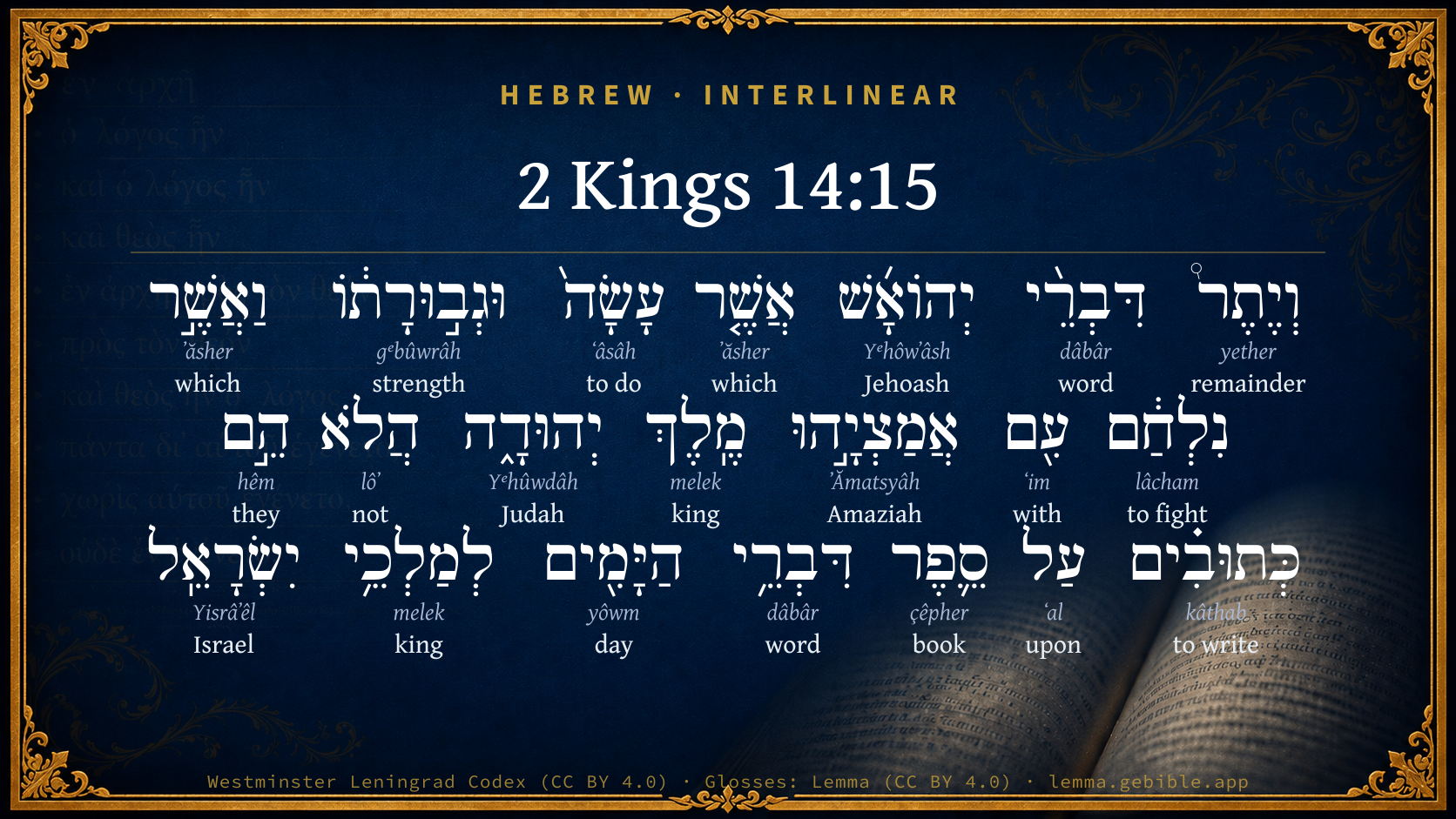
Hebrew (Westminster Leningrad Codex) 2 Kings 14:15 appears in the Hebrew Old Testament. The text above is from the Westminster Leningrad Codex. Each word links to its Strong’s number, a concise gloss, and parsing drawn from the Open Scriptures Hebrew Bible morphology. Click any word for its full Brown-Driver-Briggs (BDB) entry.
Download image
Cite this verse

2 Kings 14:15 (World English Bible). Public Domain. Lemma interlinear Bible study tool, https://lemma.gebible.app/v/2-kings/14/15.

Show BibTeX & RIS
BibTeX
RIS
English Translation
Now the rest of the acts of Jehoash which he did, and his might, and how he fought with Amaziah king of Judah, aren't they written in the book of the chronicles of the kings of Israel?
World English Bible · Public Domain
Download a study sheet

One document with this verse’s original text, its word-by-word gloss line, the meaning frame, cross-references with their text, attributed commentary, and full source and license credits — printable, and it pastes into notes with its structure intact.

This verse Autodidact and up

Study sheet (.html) Plain text (.txt)

A passage Seminary Student

Up to 50 verses in one chapter. A passage sheet keeps up to 6 commentary sources and 12 cross-references per verse, in the order this page ranks them, and says so on the sheet whenever that leaves anything out. Ask for a single verse and you get the Autodidact verse sheet above.

Everything on this page stays free to read, with no account — the sheet is a download of what is already on screen, not access to it.

Want to remove ads? Support Godless Engineer
Compare translations 3

The same verse in 3 English versions, stacked beneath the original-language interlinear above. Click any original word for its lexicon entry.

Each is an independent rendering of the whole verse — the interlinear is not word-aligned to these translations.

Highlighted words mark where these versions differ — a whole-verse word diff, not a word-by-word alignment.

  • World English Bible Public Domain
    Now the rest of the acts of Jehoash which he did, and his might, and how he fought with Amaziah king of Judah, aren't they written in the book of the chronicles of the kings of Israel?
  • King James Version Public Domain
    Now the rest of the acts of Jehoash which he did, and his might, and how he fought with Amaziah king of Judah, are they not written in the book of the chronicles of the kings of Israel?
  • unfoldingWord Literal Text CC BY-SA 4.0
    Now the rest of the matters of Jehoash, what he did, and his might, and how he fought with Amaziah, the king of Judah, are they not written in the book of the matters of the days of the kings of Israel?

unfoldingWord Literal Text — © unfoldingWord, licensed CC BY-SA 4.0. Word-aligned USFM3 via Door43 (git.door43.org/unfoldingWord/en_ult).

Versions to compare (up to 4)

3 of 4 selected

Show all 18 translations

Every available English version of this verse, each an independent rendering of the whole verse.

  • World English Bible Public Domain
    Now the rest of the acts of Jehoash which he did, and his might, and how he fought with Amaziah king of Judah, aren't they written in the book of the chronicles of the kings of Israel?
  • Berean Standard Bible Public Domain
    As for the rest of the acts of Jehoash, along with his accomplishments, his might, and how he waged war against Amaziah king of Judah, are they not written in the Book of the Chronicles of the Kings of Israel?
  • Majority Standard Bible Public Domain
    As for the rest of the acts of Jehoash, along with his accomplishments, his might, and how he waged war against Amaziah king of Judah, are they not written in the Book of the Chronicles of the Kings of Israel?
  • King James Version Public Domain
    Now the rest of the acts of Jehoash which he did, and his might, and how he fought with Amaziah king of Judah, are they not written in the book of the chronicles of the kings of Israel?
  • American Standard Version (1901) Public Domain
    Now the rest of the acts of Jehoash which he did, and his might, and how he fought with Amaziah king of Judah, are they not written in the book of the chronicles of the kings of Israel?
  • Revised Version (1885) Public Domain
    Now the rest of the acts of Jehoash which he did, and his might, and how he fought with Amaziah king of Judah, are they not written in the book of the chronicles of the kings of Israel?
  • Geneva Bible (1599) Public Domain
    Concerning the rest of the acts of Iehoash which he did and his valiant deedes, and how he fought with Amaziah King of Iudah, are they not written in the booke of the Chronicles of the Kings of Israel?
  • Douay-Rheims (1899) Public Domain
    But the rest of the acts of Joas, which he did, and his valour, wherewith he fought against Amasias king of Juda, are they not written in the book of the words of the days of the kings of Israel?
  • Young's Literal Translation Public Domain
    And the rest of the matters of Jehoash that he did, and his might, and how he fought with Amaziah king of Judah, are they not written on the book of the Chronicles of the kings of Israel?
  • Literal Standard Version CC BY-SA 4.0
    And the rest of the matters of Jehoash that he did, and his might, and how he fought with Amaziah king of Judah, are they not written on the scroll of the Chronicles of the Kings of Israel?
  • Unlocked Literal Bible CC BY-SA 4.0
    As for the other matters concerning Jehoash, all that he did, his power, and how he fought with Amaziah king of Judah, are they not written in the book of the events of the kings of Israel?
  • unfoldingWord Literal Text CC BY-SA 4.0
    Now the rest of the matters of Jehoash, what he did, and his might, and how he fought with Amaziah, the king of Judah, are they not written in the book of the matters of the days of the kings of Israel?
  • Darby Bible Public Domain
    And the rest of the acts of Jehoash, what he did, and his might, and how he fought with Amaziah king of Judah, are they not written in the book of the chronicles of the kings of Israel?
  • World Messianic Bible Public Domain
    Now the rest of the acts of Jehoash which he did, and his might, and how he fought with Amaziah king of Judah, aren’t they written in the book of the chronicles of the kings of Israel?
  • Webster's Bible Public Domain
    Now the rest of the acts of Jehoash which he did, and his might, and how he fought with Amaziah king of Judah, are they not written in the book of the chronicles of the kings of Israel?
  • Free Bible Version CC BY-SA 4.0
    The rest of what happened in Jehoash's reign, all he did, and his great achievements and his war with Amaziah, king of Judah, are recorded in the Book of Chronicles of the Kings of Israel.
  • Bible in Basic English Public Domain
    Now the rest of the acts of Jehoash, and his power, and how he went to war with Amaziah, king of Judah, are they not recorded in the book of the history of the kings of Israel?
  • JPS Tanakh (1917) Public Domain
    Now the rest of the acts of Jehoash which he did, and his might, and how he fought with Amaziah king of Judah, are they not written in the book of the chronicles of the kings of Israel?

Literal Standard Version (2020), Covenant Press — licensed CC BY-SA 4.0. Text via the HelloAO Bible API (eBible.org). Unlocked Literal Bible (unfoldingWord) — licensed CC BY-SA 4.0. Text via the HelloAO Bible API (eBible.org). unfoldingWord Literal Text — © unfoldingWord, licensed CC BY-SA 4.0. Word-aligned USFM3 via Door43 (git.door43.org/unfoldingWord/en_ult). Free Bible Version, Dr. Jonathan Gallagher — licensed CC BY-SA 4.0. Text via the HelloAO Bible API (eBible.org).

Word by word

More ways to search: Search by grammar → Find every occurrence → Compare this word →

Practice this passage: Drill this verse → Learn its vocabulary →

יְהוֹאָ֜שׁ
Yᵉhôwʼâsh
H3060
“Jehoash”
Noun, Proper
Part of Speech
Noun
Type
Proper
Full BDB Definition

Origin: from H3068 and (perhaps) H784

TWOT: None

Jehoash = "given by the Lord" - son of king Ahaziah and the 8th king of Judah - son of king Jehoahaz and the 12th king of the northern kingdom of Israel
  1. וְיֶתֶר֩ yether H3499 “and · remainder of” Conjunction + Noun, Common, Masculine, Singular, Construct
  2. דִּבְרֵ֨י dâbâr H1697 “words of” Noun, Common, Masculine, Plural, Construct
  3. אֲשֶׁ֤ר ʼăsher H834 “which” Particle, Relative
  4. עָשָׂה֙ ʻâsâh H6213 “to do” Verb, Qal, Perfect, 3rd Person, Masculine, Singular
  5. וּגְב֣וּרָת֔וֹ gᵉbûwrâh H1369 “and · strength · his” Conjunction + Noun, Common, Feminine, Singular, Construct + Suffix, Personal, 3rd Person, Masculine, Singular
  6. וַאֲשֶׁ֣ר ʼăsher H834 “and · which” Conjunction + Particle, Relative
  7. נִלְחַ֔ם lâcham H3898 “to fight” Verb, Niphal, Perfect, 3rd Person, Masculine, Singular
  8. עִ֖ם ʻim H5973 “with” Preposition
  9. אֲמַצְיָ֣הוּ ʼĂmatsyâh H558 “Amaziah” Noun, Proper
  10. מֶֽלֶךְ melek H4428 “king of” Noun, Common, Masculine, Singular, Construct
  11. יְהוּדָ֑ה Yᵉhûwdâh H3063 “Judah” Noun, Proper
  12. הֲלֹא lôʼ H3808 “not” Particle, Interrogative + Particle, Negative
  13. הֵ֣ם hêm H1992 “they” Pronoun, Personal, 3rd Person, Masculine, Plural
  14. כְּתוּבִ֗ים kâthab H3789 “written” Verb, Qal, Participle Passive, Masculine, Plural, Absolute
  15. עַל ʻal H5921 “upon” Preposition
  16. סֵ֛פֶר çêpher H5612 “book of” Noun, Common, Masculine, Singular, Construct
  17. דִּבְרֵ֥י dâbâr H1697 “words of” Noun, Common, Masculine, Plural, Construct
  18. הַיָּמִ֖ים yôwm H3117 “the · days” Particle, Definite Article + Noun, Common, Masculine, Plural, Absolute
  19. לְמַלְכֵ֥י melek H4428 “to/for · kings of” Preposition + Noun, Common, Masculine, Plural, Construct
  20. יִשְׂרָאֵֽל Yisrâʼêl H3478 “Israel” Noun, Proper

About this verse

These counts appear in no published source. They are computed here, from the morphology-tagged text and Lemma’s own curated glosses. What Lemma adds →

21
words
18
distinct lemmas
Historical
section

Notable vocabulary

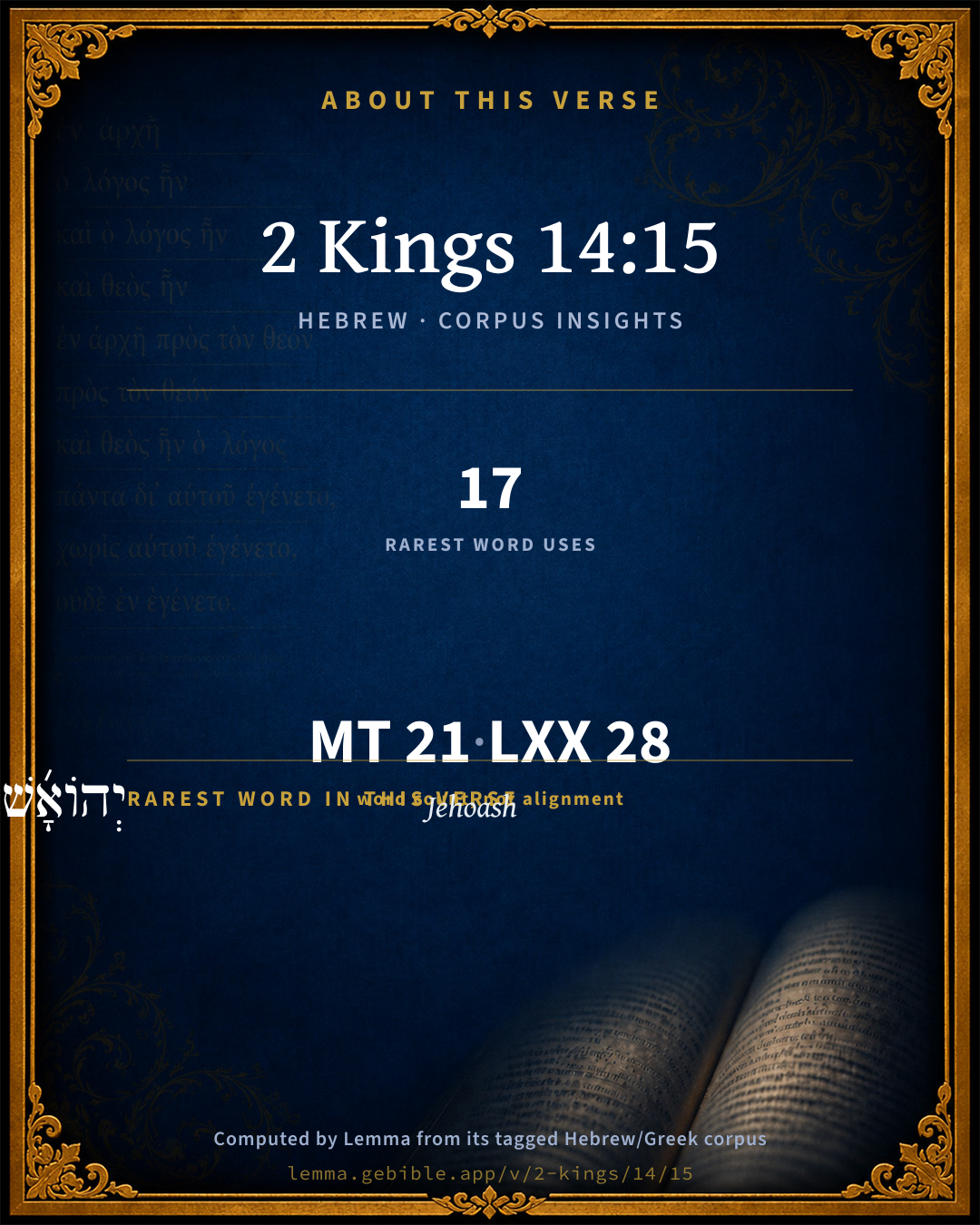
The rarest word here is יְהוֹאָ֜שׁ Jehoash H3060 — appearing just 17 times in the whole Hebrew Bible.

Shared distinctive vocabulary

יְהוֹאָ֜שׁ Jehoash H3060 occurs in 16 verses of the Hebrew Bible. Also found in:

Grammatical profile

  • 3 verbs
  • 12 nouns
  • 1 pronoun
  • 2 prepositions
  • 3 particles

Verb forms

  • עָשָׂה֙ Qal · Perfect
  • נִלְחַ֔ם Niphal · Perfect
  • כְּתוּבִ֗ים Qal · Participle Passive

Repetition

Words recur within this verse — often emphatic in Hebrew:

  • דִּבְרֵ֨י word H1697 ×2
  • מֶֽלֶךְ king H4428 ×2
  • אֲשֶׁ֤ר which H834 ×2

Hebrew & Septuagint length

In English translation the verse runs 37 words from the Hebrew and 40 from the Septuagint (LXX English) — closely comparable.

A rough comparison of the two English renderings, which tokenize alike — not a word-level alignment.

Word counts can differ between the Hebrew and the Greek without any difference in meaning — e.g. the Hebrew direct-object marker אֵת has no separate Greek word, and Greek often adds the article ὁ.

In the original languages it is 21 Hebrew tokens and 28 Greek tokens — but the two are counted differently (Hebrew bundles its prefixes and suffixes into one token; the Greek is in lemma form), so that isn’t a like-for-like length.

Cross-references

3

Topical passages linked to 2 Kings 14:15 in the Treasury of Scripture Knowledge — connected by theme and wording, ordered by reader-vote popularity; previews shown in the World English Bible.

  • 1 Kings 14:19–20 The rest of the acts of Jeroboam, how he warred, and how he reigned, behold, they are written in the book of the chronicles of the kings of Israel.
  • 2 Kings 10:34–35 Now the rest of the acts of Jehu, and all that he did, and all his might, aren't they written in the book of the chronicles of the kings of Israel?
  • 2 Kings 13:12–13 Now the rest of the acts of Joash, and all that he did, and his might with which he fought against Amaziah king of Judah, aren't they written in the book of the chronicles of the kings of Israel?

Cross-references courtesy of OpenBible.info (CC BY 4.0).

Hebrew and Greek witnesses Masoretic Hebrew ↔ Greek Septuagint

The same verse in the two great witnesses to the Old Testament, shown verse-for-verse.

These are two independent witnesses, not word-aligned to each other, and the Septuagint is shown in lemma (dictionary) form.

Hebrew 2 Kings 14:15 Masoretic · Westminster Leningrad Codex

וְיֶתֶר֩ דִּבְרֵ֨י יְהוֹאָ֜שׁ אֲשֶׁ֤ר עָשָׂה֙ וּגְב֣וּרָת֔וֹ וַאֲשֶׁ֣ר נִלְחַ֔ם עִ֖ם אֲמַצְיָ֣הוּ מֶֽלֶךְ יְהוּדָ֑ה הֲלֹא הֵ֣ם כְּתוּבִ֗ים עַל סֵ֛פֶר דִּבְרֵ֥י הַיָּמִ֖ים לְמַלְכֵ֥י יִשְׂרָאֵֽל

Now the rest of the acts of Jehoash which he did, and his might, and how he fought with Amaziah king of Judah, aren't they written in the book of the chronicles of the kings of Israel?

World English Bible · Public Domain

Greek LXX 2 Kings 14:15 Septuagint · lemma form

καί ὁ λοιπός ὁ λόγος ιωας ὅσος ποιέω ἐν δυναστεία αὐτός ὅς πολεμέω μετά αμεσσιας βασιλεύς ιουδα οὐ οὗτος γράφω ἐπί βιβλίον λόγος ὁ ἡμέρα ὁ βασιλεύς ἰσραήλ

And the rest of the acts of Joas, even all that he did in his might, how he warred with Amessias king of Juda, are not these things written in the book of the chronicles of the kings of Israel?

LXX2012 (modern English Septuagint) · Public Domain

Hebrew: Westminster Leningrad Codex (CC BY 4.0). Greek: Septuagint (public domain); English from LXX2012 (modern English Septuagint) (Public Domain). How the Septuagint differs from the Hebrew →

Targum (Aramaic paraphrase)

1

The Targum is the ancient Jewish Aramaic paraphrase of the Hebrew Scriptures — an interpretive translation, not the Hebrew text itself. Onkelos (literal) and Pseudo-Jonathan (expansive) render the Torah, and Jonathan the Prophets. Coverage is partial: where no permissively-licensed English translation exists for a verse, only the Aramaic is shown. This is verse-level text, not a word-by-word alignment to the Hebrew.

  1. Targum Jonathan Prophets (Joshua–Malachi)
    וּשְׁאַר פִּתְגָמֵי יְהוֹאָשׁ דִי עֲבַד וּגְבוּרְתֵּיהּ וּדְאַגִיחַ עִם אֲמַצְיָה מֶלֶךְ שִׁבְטָא דְבֵית יְהוּדָה הֲלָא אִינוּן כְּתִיבִין עַל סְפַר פִּתְגָמֵי יוֹמַיָא לְמַלְכֵי יִשְׂרָאֵל:

    (no public-domain English translation for this verse)

    Targum Jonathan — Aramaic: “Mikraot Gedolot” (public domain). English: “Sefaria Community Translation” (CC0 1.0 (public-domain dedication)); “London "Chaldee Paraphrase," 1871” (public domain). Text via Sefaria.

Commentary

Notes on 2 Kings 14:15 from classic Christian and Jewish commentators (each source and its license shown beneath its notes). The classic Christian expositions comment on the surrounding passage and are grouped to its opening verse, so a note may address several verses; the Jewish commentaries on the Tanakh (Rashi and others) are per-verse, so they appear only where the commentator wrote on this verse.

Lemma curates 59 commentaries, every one of them public domain or Creative Commons licensed, each selected and text-cleaned for this edition rather than reprinted as found. About our sources →

Matthew Henry's Commentary

Here are three kings brought to their graves in these few verses: - 1. Joash king of Israel, Kg2 14:15, Kg2 14:16. We attended his funeral once before, Kg2 13:12, Kg2 13:13. But, because the historian had occasion to give a further account of his life and actions, he again mentions his death and burial. 2. Amaziah king of Judah. Fifteen years he survived his conqueror the king of Israel, Kg2 14:17. A man may live a great while after he has been shamed, may be thoroughly mortified (as Amaziah no doubt was) and yet not dead. His acts are said to be found written in his annals (Kg2 14:18), but not his might; for his cruelty when he was a conqueror over the Edomites, and his insolence when he challenged the king of Israel, showed him void of true courage. He was slain by his own subjects, who hated him for his maladministration (Kg2 14:19) and made Jerusalem too hot for him, the ignominious breach made in their walls being occasioned by his folly and presumption. He fled to Lachish. How long he continued concealed or sheltered there we are not told, but, at last, he was there murdered, Kg2 14:19. No further did the rage of the rebels extend, for they brought him in a chariot to Jerusalem, and buried him there among his ancestors. 3. Azariah succeeded Amaziah, but not till twelve years after his father's death, for Amaziah died in the fifteenth year of Jeroboam (as appears by comparing Kg2 14:23 with Kg2 14:2), but Azariah did not begin his reign till the twenty-seventh of Jeroboam (ch. 15:1), for he was but four years old at the death of his father, so that, for twelve years, till he came to be sixteen, the government was in the hands of protectors. He reigned very long (ch. 15:2) and yet the account of his reign is here industriously huddled up, and broken off abruptly (v. 22): He built Elath (which had belonged to the Edomites, but, it is probable, was recovered by his father, v. 7), after that the king slept with his fathers, as if that had been all he did that was worth mentioning, or rather it is meant of king Amaziah: he built it soon after Amaziah died.

Matthew Henry's Commentary on the Whole Bible (1708–1710) — public domain (CC PDM 1.0). Text via the HelloAO Bible API.

Ellicott's Commentary for English Readers

(15, 16) Now the rest . . .—Comp. 2Ki_13:12-13, where the reign of Jehoash is already summed up, though not altogether in the same phraseology. The compiler probably found 2Ki_14:15-16, in their present position in the document from which he derived the entire section, 2Ki_14:8-17; a document which was not the same as that upon which 2 Kings 13 depends, as appears from the differences of language in the two passages.

The two verses are almost necessary here as a suitable introduction of the statement of 2Ki_14:17, that Amaziah survived Jehoash by fifteen years.

A Bible Commentary for English Readers, edited by Charles John Ellicott (1878–1897) — public domain. Text from a community e-Sword module.

Trapp's Complete Commentary

John Trapp

2Ki 14:15 Now the rest of the acts of Jehoash which he did, and his might, and how he fought with Amaziah king of Judah, [are] they not written in the book of the chronicles of the kings of Israel?

Ver. 15. And his might.] Showed against the Syrians chiefly.

John Trapp, A Commentary or Exposition upon All the Books of the Old and New Testament (1647–1656) — public domain. Text from a community e-Sword module.

Adam Clarke's Commentary

Verse 15. How he fought with Amaziah] The only fighting between them was the battle already mentioned; and this is minutely related in 2Ch 25:21-24.

Adam Clarke's Commentary on the Bible (1810–1826) — public domain. Text from a community e-Sword/MySword module.

The Cambridge Bible for Schools and Colleges

gen. ed. J. J. S. Perowne

15. the rest of the acts of Jehoash] The repetition of this sentence, which had been given in nearly the same terms in 2Ki_13:12, shews us that the compiler probably used two documents, and copied from one in the former chapter, and from the other here. The words of this chapter are more in accord with the usual formula. In 2Ki_13:13 the expression ‘and Jeroboam sat upon his throne’ is not so common as ‘Jeroboam his son reigned in his stead’.

The Cambridge Bible for Schools and Colleges (gen. ed. J. J. S. Perowne; Cambridge University Press, 1878–1918) — public domain. Text from a community e-Sword module.

John Gill's Exposition

And Amaziah the son of Joash king of Judah lived after the death of Jehoash son of Jehoahaz king of Israel fifteen years. Which, with the fourteen he reigned contemporary with him, made the twenty nine years he reigned, Kg2 14:2. The Vulgate Latin version is, "twenty five years".

. The Vulgate Latin version is, "twenty five years".

2 Kings 14:18

kg2 14:18

kg2 14:18

kg2 14:18And the rest of the acts of Amaziah, are they not written in the book of the chronicles of the kings of Judah? Not in the canonical book of Chronicles; though there are some things of him recorded there, which are not here; but in the annals of each reign, written by the king's historian appointed for that purpose.

John Gill's Exposition of the Whole Bible (1746–1763) — public domain (CC PDM 1.0). Text via the HelloAO Bible API.

Albert Barnes' Notes on the Bible

These two verses (repeated from 2Ki 13:12-13) are out of place here, where they interrupt the history of Amaziah’s reign.

Albert Barnes' Notes on the Bible (1834–1885) — public domain. Text from a community e-Sword/MySword module.

Haydock's Catholic Bible Commentary

Valour. Hence it appears that Juda made a stout resistance, though Josephus would insinuate the contrary.

George Leo Haydock (1774–1849), Haydock's Catholic Family Bible and Commentary, 1859 edition — public domain. Excludes Psalms (Douay-Rheims chapter numbering differs from Protestant) and Deuterocanonical books (Catholic canon only).

The Pulpit Commentary

Vers. 15, 16. Now the rest of the acts of Jehoash which he did, and his might, and how he fought with Amaziah King of Judah, are they not written in the book of the chronicles of the kings of Israel? And Jehoash slept with his fathers, and was buried in Samaria with the kings of Israel; and Jeroboam his son reigned in his stead. These verses are repeated with very slight alterations from 2Ki_13:11, 2Ki_13:12. Curiously, on both occasions they are out of place. It is scarcely worth while to consider how they came into the text at this point, since no explanation could be more than a conjecture. In point of fact, they are redundant.

Vers. 15-22. Changes in two thrones.

The next events recorded are the accession of Jeroboam II, after the death of Joash, in Israel; and the conspiracy against Amaziah fifteen years later and the accession of Azariah, in Judah.

I THE ACCESSION OF JEROBOAM. More is not told us, than we have already heard, of the "might" of Joash. Jeroboam, who succeeded him, proved the able son of an able father. But the stock of Jehu was godless as ever. The new king also, as we are to see, "did evil in the sight of the Lord," and kept up the "sin " of his namesake, Jeroboam I, in the worship of the calves. Great natural ability is often associated with godlessness of heart.

II THE ACOESSION OF AZARIAH.

1. Azariah made king. The notice of the conspiracy against Amaziah precedes in the narrative the notice of Azariah"s accession; but there is some reason from the chronology to think that the son was made king along with his father shortly after Amazlah"s disastrous defeat.

(1) It is stated in 2Ki_15:8 that the son of Jeroboam II, Zachariah, began to reign in the thirty-eighth year of Azariah, and as there is no sign in the narrative of the interregnum of eleven years which chronologers usually introduce, it would follow that Azariah really began to reign about eleven years before his father"s death.

(2) This is in itself not unlikely when we remember the odium which must have fallen on Amaziah after his defeat and captivity, and the capture of Jerusalem. The proof he had given of incapacity for government would make it desirable, to secure the popularity of the throne, that his son should be associated with him in the kingdom.

(3) There are indications in the narrative which point in this direction, e.g. the age of Amaziah, only sixteen years; the statement that Amaziah "lived" fifteen years after the death of Joash, where we might have expected the word "reigned;" lastly, the statement that Amaziah "built Elath, and restored it to Judah, after that the king slept with his fathers.

2. Amaziah"s ignominious end. In any case, it seems certain that Amaziah"s popularity never revived after the unhappy encounter with Joash. Fifteen years rolled on, and at length, from causes to us unknown, a plot was formed against him in Jerusalem. He fled to Lachish, but was pursued and killed. The slain king was brought back on horses, and buried in Jerusalem in the royal sepulcher. Thus the sun of another descendant of David, who had forsaken the God of his fathers, went down in blood and shame. J.O.

The Pulpit Commentary (1880–1919), ed. H.D.M. Spence-Jones & Joseph S. Exell — public domain. Text from a community e-Sword module.

unfoldingWord translationNotes

Door43 World Missions Community

are they not written in the book of the events of the kings of Israel?

This question is used to remind the reader that the acts of Jehoahaz are recorded in another book. See how this phrase is translated in 2 Kings 1:18. AT: "they are written in the book of the events of the kings of Israel." (See: Rhetorical Question)

Then Jehoash slept with his ancestors

This is a polite way to say that he died. AT: "Then Jehoash died" (See: Euphemism)

became king in his place

"became king after him"

translationWords

power

Amaziah

written

asleep

bury

Samaria

Jeroboam

unfoldingWord translationNotes — © Distant Shores Media and the Door43 World Missions Community, licensed CC BY-SA 4.0. Source: git.door43.org/Door43/en_tn.

Lesson kit

Teaching starters — assembled from the data on this page, not authored interpretation. Every prompt links to the verse data it draws on. Edit before teaching.

2 Kings, in the Historical, opens this verse with 21 words (18 distinct Hebrew lemmas). Its most distinctive word is Yᵉhôwʼâsh (“Jehoash”). A historical commentator’s framing appears above. Read the whole chapter for the surrounding context.

Discussion questions

  1. The word Yᵉhôwʼâsh carries the sense “Jehoash.” How does it shape the verse?
  2. How does 2 Kings 11:21, which shares the word «Jehoash», read alongside this verse?
  3. What does the repetition of “word” (2× in this one verse) do in this verse?
  4. These translations render this verse differently; the difference is in the English rendering, not the original. What questions does that raise?
  5. «עָשָׂה֙» is a Qal Perfect verb. How does that grammatical form shape the action described?
  6. Compare how Matthew Henry's Commentary and Ellicott's Commentary for English Readers read this verse. Where do they agree or differ?

Things to notice

Reading settings

Reading text

Shown beneath each verse's original-language words.

Old Testament
Old Testament edition

Read the OT as the Masoretic Hebrew (MT) or the Greek Septuagint (LXX).

English shown for the Greek Septuagint (in the Hebrew ↔ Greek comparison).

Comparing translations? Open the Compare panel on any verse page to stack up to four side by side.